Cover not their blood
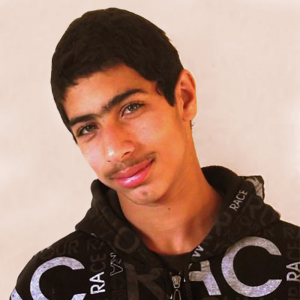
Yusuf Fahri Mussa Ahleil, 1995-2011
Yesh Din | November 24, 2013
Yusuf Fahri Mussa Ahleil, aged 16, was shot and killed on January 28th, 2011, probably by a settler. The prosecution took 14 months to appoint an attorney to the case, and eventually closed it due to lack of evidence.
Many of the posts in this blog deal with the incompetence of Israeli police investigations, and it’s possible that the death of Yusuf Fahri Mussa Ahleil, a 16-year old boy from Beit ‘Ummar, will be added to this list; but for the time being, it is a story of criminal negligence on behalf of the prosecution.
On January 28th, 2011, something happened in the village of Beit Ummar in the Hebron region. The testimonies describe an assault by Israeli civilians from two different directions simultaneously. Both incidents involved shooting; the second one ended in death. Witnesses describe a large group of Israeli civilians raiding the village, among whom three fired at the Palestinians using weapons, likely M-16 assault rifles. According to one of the witnesses, the Israelis were conducting some sort of ceremony, blew a shofar, and then opened fire. The witnesses agree that no military troops were present and that they arrived only after the shooting.
When it was all over, Yusuf Ahleil, who was on his way to help his father with his work in the field, lay dead on the ground. The testimony of the father, Fahri, is worth quoting: “I work in agriculture, and that is my main profession. During their vacations the children help me. Before I went to work [on the morning of the incident] I asked my son Yusuf to come with me to work later during the day. At some point I heard the sound of gunshots; I did not know what it was about and kept on working. And then, I don’t remember the time, some people from the village came with a vehicle and asked to take me home. I did not understand why – I refused but they insisted, took me with them and brought me back home. When we arrived, I saw that most of the village was gathered next to my house. I asked what happened? I was told, your son was shot. I said, how can that be? We agreed that he should join me at work. This is how I learned that my son, while on his way to work with me, had been wounded by the settlers.” Yusuf was shot in the head, and died.
The family filed a complaint with the police that same day. From that point onwards, our monitoring tells the story. On February 16th, 2011, the police informed us that the case was under investigation. On March 14th, 2011, it told us it received testimonies and photographs, and asked that we provide any further information we may come across. On May 2nd, 2011, the police informed us that the case had been transferred to the Jerusalem District Prosecution Office.
On June 5th, 2011, we called the Jerusalem District Attorney Office to ask which prosecuting attorney is handling the case. None had yet been appointed. We asked the same office again on August 24th, 2011, i.e. almost seven months after the incident, but the prosecution did not consider the violent death – this fact is not disputed – of a 16-year old boy as something requiring the immediate attention of an attorney. We repeated our query in September 25th, 2011. We might as well be speaking to the walls.
October 24th came and went, and the death of Yusuf still did not hinder the sleep of the prosecutors. We had reached December 15th, 2011, and the boy who had dropped dead from a bullet in his head still failed to arouse the interest of the prosecutors. On January 15th, 2012, almost a year since he had been killed, Yusuf’s prosecution file was still gathering dust. We kept on pestering, and on March 20th, 2012 – that is almost 14 months since the killing – we were informed that on this happy day a prosecutor had been assigned to the case. A week later, we tried to verify with her what steps she she had taken with the case so far. We were not dignified with an answer.
We repeated the question, to no avail, two months later. We are stubborn people, studied in the ways of banging our heads against the system’s wall, so we asked once again on July 30th, 2012 whether the prosecutors made any decision – four months since a prosecutor had been assigned to the case, and more than 18 months since the killing itself, but who’s counting. We did not receive a response.
On January 3rd, 2013, nearly two years after the killing and nine months after a prosecutor was assigned to the case, she still had no answer for us. Six months breezed by, and on August 4th, 2013, the prosecutor informed us that on July 30th, 2013, she had made the decision to close the case. The police had identified four suspects; the prosecutor closed the case against three of them for lack of evidence and against the fourth, for lack of criminal culpability.
That was the beginning of August. Since then we’ve been trying to get a hold of the investigative file so we can appeal the decision to close it. Until recently, the prosecution had failed in the rather simple job of providing us with it. There were contradictory claims as to what happened to it. The prosecution said it was sent back to the Hebron Police, which in turn said they never got it back. We are happy to report, however, that recently the file was found, photocopied, and will be reviewed by us soon.
Let’s conduct a mental experiment. Let’s say the victim is still 16 years old, still residing in the Occupied Palestinian Territories, but is not burdened with a foreign, Palestinian, name like Yussuf Alhleil; let’s say his name is something familiar, say Yossi Hebroni. Our hypothetical Yossi Hebroni was shot near a Palestinian village. Can anyone imagine that the prosecution would amble slowly to the case after 14 months? Or that it would need 16 more months to make up its mind?
The prosecution is entrusted, since Israel controls the Occupied Palestinian Territories, with protecting its residents from violence. When they are the victims of theft, it ought to bring the thief to justice. When they are killed, its duty is to bring justice for the dead.
The case of Yusuf Fahri Mussa Alhleil shows us how seriously the prosecution takes this duty. It removes another thin layer of the already crumbling patina of the claim that there is something you may refer to with a straight face as “rule of law” in the West Bank. Where the rule of law is absent, what we see is the law of nature, where the strong rule over the weak. The point of our social contract with the government is to overcome nature’s law, under which, to quote Hobbes, life is “nasty, brutish and short.” In the most gentle words possible, in Yusuf’s case – and, unfortunately, in far too many others – the prosecution has betrayed the social contract.
The result that there is the father who waits in vain for his son to return to him in the field, and killers who know that nothing will happen to them if they kill once more.
Related articles
- Israeli admits shooting at Palestinian children on TV game show (alethonews.wordpress.com)
- Nablus woman injured in hit and run vehicular assault by Jewish settler (alethonews.wordpress.com)
- Jewish Terrorism (alethonews.wordpress.com)
- Outrage as Palestinian child faces possible life prison sentence for throwing stones (gazasolidarity.blogspot.com)
- Israel to displace Palestinian community south of Hebron (altahrir.wordpress.com)
Thousands block NATO convoy route to protest US drone strikes in Pakistan
RT | November 23, 2013
Thousands of demonstrators protesting US drone strikes in Pakistan blocked a main road Saturday in the Peshawar province used to transport NATO supplies to and from Afghanistan.
The protests was led by the Pakistan Tehrik-e-Insaf (PTI) party, which is led by Imran Khan, a former international cricketer now turned politician.
They were supported by their allies in the Khyber Pakhtunkhwa provincial government and they were also joined by the Jamaat -i-Islami (JI) and the Awami Jamhoori Ittehad (AJIP) political parties.
“We will put pressure on America, and our protest will continue if drone attacks are not stopped,” Khan told reporters.
“We are here to give a clear message that now Pakistanis cannot remain silent over drone attacks,” said Shah Mehmood Qureshi, a senior member of the PTI, addressing the protesters.
Imran Khan has been a fierce critic of US drone attacks, arguing that they violate Pakistan’s sovereignty. Khan said that the Pakistani government is doing nothing to stop drone attacks except for issuing statements of condemnation and that the protest would continue indefinitely.
Khan stressed that NATO supplies would not be allowed to pass through Khyber Pakhtunkhwa, formerly called North-West Frontier Province, and added that the province’s PTI-led government had the mandate to block NATO trucks from passing through its territory.
Earlier Imran Khan had warned that NATO supply routes will be blocked if continuing US drone strikes in Pakistan threaten the country’s peace talks with the Taliban.
An attack on November 1 killed the former leader of the Pakistan Taliban, a day before the Pakistani government said it was going to invite him to peace talks. Officials said they were enraged by the attacks, although the Pakistani government is known to have supported some of the drone attacks in the past.
Party workers from the PTI and the JI travelled to Peshawar from across Pakistan and an estimated 10,000 people participated in Saturday’s protests. The protesters shouted anti US slogans such as “Stop drone attacks” and “Down with America”.
“I am participating in today’s sit-in to convey a message to America that we hate them since they are killing our people in drone attacks. America must stop drone attacks for peace in our country,” Hussain Shah, a 21 year old university student, told Dawn, Pakistan’s oldest and most widely read English-language newspaper.
American drones are performing regular extrajudicial killings of Islamist leaders, accompanied by the collateral damage of many civilian casualties.
Strict security measures were in place Saturday, with 500 police personnel on duty. Trucks were directed to use an alternative route, although Tahir Khan, a government official, said there was normally little NATO traffic Saturday as most of the trucks arrive by Friday night to clear the border crossing.
However, protesters said that they would begin to stop trucks carrying NATO supplies through Khyber Pakhtunkhwa from Sunday night, which could spark conflict with the federal government in Pakistan.
The US embassy in Islamabad declined to comment.
Online surveillance threatens democracy: web creator

Inventor of the World Wide Web Tim Berners-Lee
Press TV – November 23, 2013
Internet surveillance by British and US spying agencies has posed a threat to online freedom and the future of democracy, British inventor of the World Wide Web Tim Berners-Lee has warned.
Berners-Lee said some governments are jeopardized by how the Internet and social media help exposing wrongdoings across the planet, adding that the “growing tide of surveillance and censorship now threatens the future of democracy”.
He also said that whistleblowers who have leaked secret surveillance by US National Security Agency (NSA) and Britain’s eavesdropping agency the Government Communications Headquarters (GCHQ) deserve praise and need to be protected.
Berners-Lee’s comments come after classified documents, leaked by US whistleblower and former NSA contractor Edward Snowden in June, showed the NSA and its British counterpart the GCHQ had been eavesdropping on millions of American and European phone records and the Internet data.
“Countries owe a lot to whistleblowers – there’s a series of whistleblowers who have been involved. Snowden is the latest. Because there was no way we could have had that conversation without them,” he said at the launch of a new index showing web freedoms around the world.
“At the end of the end day when systems for checks and balances break down we have to rely on the whistleblowers – I think we must protect them and respect them,” he added.
In his interview with The Guardian earlier this month, Berners-Lee described the spying activities by the US and UK spying agencies as “dysfunctional and unaccountable.”
The inventor of the World Wide Web slammed the US and British governments for weakening online security and said their spying activities have contradicted all efforts to stop cybercrime and cyber warfare.
Western allies seek permanent inclusion of Israel in the Western European and Others Group (WEOG)
By Ramona Wadi | MEMO | November 21, 2013
Following Israel’s resumption of ties with the United Nations Human Rights Council, six Western countries; the United Kingdom, France, Germany, Australia, Canada and the United States are pressuring the United Nations to allow Israel to permanently join the Western European and Others Group (WEOG). The text of the letter, which has been made available online, states: “we, the undersigned, would like by this letter to recall Israel’s long standing request to join the WEOG regional group in Geneva. We are strongly supportive of Israel’s membership at the earliest opportunity.” The letter also exhorts a sense of urgency, requesting inclusion of the matter in the next meeting to be held in Geneva.
Exclusive treatment in Israel’s regard, ostensibly in return for its continuous human rights violations, remains a priority for the colonising power’s allies. Israel’s return to the Human Rights Council was characterised by negotiated leniency, including a concession preventing countries from criticising Israel’s human rights violations – a stipulation valid for the next two years during which any comments relating to Israel’s infringements on human rights will be deemed ‘empty of content’.
Discourse regarding political and regional isolation applied to Israel has been propagated, depicting an ongoing contrivance to enhance Israel’s victimised stance. In 2007 Canada deemed Item 7 as specific targeting of a particular country in a “politicised, selective, partial and subjective” manner which breaches the United Nations’ objectivity. In 2010 the US echoed similar sentiment, declaring the stipulation as a “disproportionate focus on Israel … the Council has too often been exploited to unfairly single out Israel, while ignoring significant human rights situations elsewhere”. This stance has been described as “working constructively on aspects that need change”. The hypocrisy within human rights discourse is easy to decipher – it is inadmissible to challenge Israel’s human rights violations. Instead, the international community should devise the means through which Israel is allowed to oppress with impunity – a trend which it has been perfecting for decades.
There is no justification for the removal of Item 7 – the only requirements are flawed reasoning, international complicity and oblivion. Claims that Israel fails to achieve support for its actions are erroneous and should be examined within the exclusive impunity bequeathed to Zionist ideology prior to the establishment of the illegal state. The depiction of Israel as a politically disadvantaged country has been utilised to the point of exhaustion, yet the deceitful reasoning is still upheld as inviolable, thus diverting attention from the problems faced daily by Palestinians whose rights have yet to be acknowledged, let alone implemented. According to conventional rhetoric, equality should only be applied when the issues at stake do not restrain Israel’s ability to perfect its oppression. Any objectivity and justified impartiality is vehemently rejected, lest Israel should declare a fictitious and detrimental isolation. Far from remaining isolated within the international community due to a degree of extra scrutiny, the coloniser has been embraced by world powers on account of its compatibility in maintaining the exploitation of land, people and countless human rights charters.
Related article
- | Exposing impunity: Israel’s ‘exceptionalism’ and the UN! (truthaholics.wordpress.com)
‘Illegal’ Spanish protests to face huge €600,000 euro fines
RT | November 20, 2013
Unauthorized demonstrations near the Spanish Parliament could see participants being fined €600,000 ($810,000) under a new Citizen Security bill being introduced by Spain’s ruling rightist Popular Party, local media reported.
Under the legislation, which will likely soon be approved in parliament, “social uproar” leading to harassment or insults of officials is to be made a criminal offense. Masked disorderly conduct could also incur charges. The legislation will likely be drafted by the Cabinet next Friday.
Unsanctioned protests outside political offices will be outlawed, alongside disorderly conduct by people hindering any means of identification, while people offering sexual services in the vicinity of children’s play areas will also be made illegal, according to Spanish newspaper 20minutos.es.
Other offenses deemed serious are to include publishing images or personal data of policemen, interrupting public events, possession of illegal drugs, vandalism of public property and drinking alcohol in the street.
The fines will vary between €1,000 and €30,000 ($1350 – $40,000) for more minor offences. However, just insulting a policeman could see a citizen landed with a €30,000 fine.
“We’re not looking to punish [people] more, just to reduce the discretionary margin for illicit conduct and not stumble into judicial limbo for ‘new’ acts like the escraches,” Spain’s Huffington Post quoted the Interior Ministry as saying.
“Escraches,” a kind of demonstration popular in Spain and Latin America, where protesters lobby outside the homes or offices of officials, have escalated this year, most notably those staged by the Movement of Mortgage Victims. The group lobbied outside politicians’ homes to protest the repossession of homes.
The law will first have to pass through the commission of undersecretaries, then analyzed in the Council of Ministers, followed by a State Council opinion and the General Council of the Judiciary, before being sent back to be discussed as organic law in the courts.
Texas drivers pulled over at random, told to turn over blood, saliva samples
RT | November 20, 2013
Dozens of Texas drivers have been stopped at a police road block, where they were then directed into a parking lot and forced into surrendering blood, saliva and breath samples in a study that has upset civil liberties advocates.
The National Highway Traffic Safety Administration admitted it was attempting to conduct a government study meant to determine the number of drunk or drug-impaired drivers on the road at any given time.
“It just doesn’t seem right that you can be forced off the road when you’re not doing anything wrong,” Kim Cope, who said she was forced to the side of the road while making her way to lunch, told NBCDFW.com. “I gestured to the guy in front that I just wanted to go straight, but he wouldn’t let me and forced me into the parking spot.”
The tests were made even more mysterious when reporters, alerted to the situation by concerned drivers, were unable to find any officers in the Fort Worth Police Department who had been involved. The NHTSA only admitted its involvement after local media sought answers.
The department, which says its mission is to “save lives, prevent injuries, and reduce vehicle-related crashes,” maintains that participation in the research was completely voluntary. But Ms. Cope said she felt trapped during what seemed to be an investigation.
“I finally did the breathalyzer test just because I thought it would be the easiest way to leave,” she said. “It just doesn’t seem right that they should be able to do any of it. If it’s voluntary, it’s voluntary, and none of it felt voluntary.”
When pressed, the FWPD said it was “reviewing the actions of all police personnel involved to ensure that FWPD policies and procedures were followed.” The NBC affiliate was able to determine that the Pacific Institute for Research and Evaluation, a government contractor, was hired to conduct the check.
An NHTSA spokesperson admitted similar programs were being conducted in 30 other cities throughout the US.
But civil liberties attorney Frank Colosi does not accept the rationale.
“You can’t just be pulled over randomly or for no reason,” he said. “They’re essentially lying to you when they say it’s completely voluntary, because they’re testing you at that moment.”
He added that drivers who refused may have been targeted by police for inadvertently giving the impression they were operating a vehicle under the influence. He also told NBC that fine print on the form told drivers their breath was being tested by “passive alcohol sensor readings before the consent process has been completed.”
This oddity comes just months after Texas state troopers were caught on video conducting vaginal and cavity searches on female drivers at the side of the road. The videos quickly went viral, and attorneys for the women filed federal lawsuits against the troopers.
“It’s ridiculous,” Peter Schulte, a former Texas police officer and prosecutor, told the New York Daily News earlier this year. “I was a law enforcement officer for 16 years and I never saw anything like it.”
UN envoy ‘shocked’ by UK’s ‘unacceptable’ persecution of The Guardian over Snowden leaks
RT | November 16, 2013
A senior United Nations official responsible for freedom of expression has warned that the UK government’s response to revelations of mass surveillance by Edward Snowden is damaging Britain’s reputation for press freedom and investigative journalism.
The UN special rapporteur, Frank La Rue, has said he is alarmed at the reaction from some British politicians following the Guardian’s revelations about the extent of the secret surveillance programs run by the UK’s eavesdropping center GCHQ and its US counterpart the NSA (National Security Agency), it was reported in the Guardian.
“I have been absolutely shocked about the way the Guardian has been treated, from the idea of prosecution to the fact that some members of parliament even called it treason. I think that is unacceptable in a democratic society,” said La Rue.
Speaking to the Guardian La Rue said that national security cannot be used as an argument against newspapers for publishing information that is in the public interest even if doing so is embarrassing for those who are in office.
The Guardian as well as other major world media organizations including the New York Times, the Washington Post and Der Spiegel began disclosing details about the US and UK’s mass surveillance programs in June, after receiving leaked documents from former NSA contractor, Edward Snowden.
The publications have sparked a huge global debate on whether such surveillance powers are justified, but in Britain there have been calls for the Guardian to be prosecuted and the editor, Alan Rusbridger, has been called to give evidence to the home affairs select committee.
The Prime Minister David Cameron has even warned that unless the newspaper begins to demonstrate some social responsibility, then he would take “tougher measures” including the issuing of D notices, which ban a newspaper or broadcaster from touching certain material.
While on Friday the New York Times wrote an editorial entitled “British press freedom under threat”. It said, “Britain has a long tradition of a free inquisitive press. That freedom, so essential to democratic accountability, is being challenged by the Conservative-Liberal coalition government of Prime Minster David Cameron.”
The op-ed added that Britain, unlike the US has no constitutional guarantee of press freedom.
“Parliamentary committees and the police are now exploiting that lack of protection to harass, intimidate and possibly prosecute the Guardian newspaper,” the leader read.
Frank La Rue’s intervention comes just days after a delegation of some of the world’s leading editors and publishers announced they were coming to Britain on a “press freedom mission”.
The trip is being organized by the Paris based, World Association of Newspapers and News Publishers (WAN-IFRA), and will arrive on UK soil in January. WAN-IFRA says it will include key newspaper figures from up to five continents and that this is the first mission of this kind to the UK ever.
The delegation is expected to meet government leaders and the opposition, as well as press industry figures and civil society and freedom of speech organizations. Their discussions are expected to focus on the political pressure brought to bear on the Guardian.
“We are concerned that these actions not only seriously damage the United Kingdom’s historic international reputation as a staunch defender of press freedom, but provide encouragement to non-democratic regimes to justify their own repressive actions,” Vincent Peyregne, the Chief of the WAN-IFRA, told the Guardian.
newspaper posed a threat to the UK national security.
Also in October, British Prime Minister David Cameron called on The Guardian and other newspapers to show “social responsibility” in the reporting of the leaked NSA files to avoid high court injunctions or the use of D-notices to prevent the publication of information that could damage national security.
La Rue’s remarks come as an international delegation is set to visit Britain over growing concerns about press freedom in the country and a government crackdown on media reporting leaks and scandals.
Organized by the World Association of Newspaper and News Publishers (WAN-IFRA), the delegation, which includes publishers and editors from five continents, will arrive in January.
The team will reportedly meet with government, opposition figures and media representatives.
Related article
Featured Video

Why the U.S. Should Pull Back From the First Island Chain
or go to
Aletho News Archives – Video-Images
From the Archives
Only 19.7% of Americans agree with US State Dept on Israeli settlements
… Most American adults of voting age don’t appear willing to reject the applicability of international law to Israel’s ongoing colonization of occupied territories in East Jerusalem, the West Bank and Golan Heights. … Full article
Blog Roll
 Aletho News
- British Government Employees Were Fact-Checking the News at the BBC. Nobody Told You.
- Albania on fire: who’s behind the riots?
- Egypt’s Civil Democratic Movement rejects involvement in regional war
- Egypt collaborates with Israel to build ‘Green Rafah’ project over erased Palestinian city
- Rising fuel prices and shortages have helped drive ongoing protests and rioting in France
- Tokyo protests demand Takaichi’s resignation over support for ‘Israel’
- Jennifer Kavanagh: Why the U.S. Should Pull Back From the First Island Chain
- Yemen denounces international community’s silence on Saudi aggression, siege
- UAE and Saudi Arabia move toward renewed coordination against Sanaa
- How Iran’s two-week retaliatory strikes exposed cracks in US military architecture in Persian Gulf
- If Americans Knew
- More on how Bari Weiss is using CBS on behalf of Israel
- What the UK Is Doing to Pro-Palestine Novelist Sally Rooney Is an Act of Orwellian Villainy
- ‘We will build palaces for Jews in Gaza’: Right-wing activists establish new outpost near border
- ‘You see us burning, you stay silent’: Family’s agony over mother and sons burned to death in Gaza tent
- Israel keeps Palestinian journalist Bushra al-Tawil in isolation for 46 days
- US-Israel integration plan puts US military tech in Israel’s hands
- Israeli Strike Burns Gaza Mother Alive in Front of Toddler, ‘Without Generating Any Headlines’
- ‘The Israel Experience with Mike Huckabee’: The Ambassador’s Family Sells Trips to Israel
- As Gazans carry out mass burial, food insecurity is getting worse – Daily Update
- Israeli rabbi permits occupiers to steal Palestinian olive harvest in West Bank
- No Tricks Zone
- Predictions Made By Renowned Climate Proifessor Over Past Decades Have Been Proven To Be Poor
- New Study Suggests Large Regions Of The Pacific Ocean Have Been Cooling For The Last 80 Years
- Germany’s Green Energy Debacle: High Energy Costs Force Kahla Porzellan to Close After 182 Years!
- New Study: 50 Years Of The Most Aggressive ‘Net Zero’ Policies Can Only Affect The Global Climate By 0.03°C
- US September “Heat” Was No Record…Many Records Set Decades Ago
- Latest European Green Energy Debacle; Portugal’s Largest Flagship Solar Park Insolvent!
- Green Energy Debacle: German Expert Professor Fritz Vahrenholt Warns Of Severe Economic And Social Consequences
- Two More Paleo Reconstructions Affirm Meters-Higher Sea Levels Across Ireland, Brazil 7000-6000 Years Ago
- New Study: Earth And Venus Surface Warmth Largely Explained By Convection And Lapse Rate, Not CO2 Or Radiation
- 2025 Nature Paper Claiming Worsening Global Drought Gets RETRACTED …Heavily Flawed

