US academic organization endorses boycott of Israel

Al-Akhbar | December 5, 2013
The American Studies Association, a 60-year old US academic organization with 5,000 members, passed a resolution on Wednesday committing to the boycott movement against Israel.
Citing its commitment to “the pursuit of social justice” and to “the struggle against all forms of racism,” the ASA revealed in a statement published on its website that it had voted to support the academic Boycott, Divestment and Sanctions (BDS) movement against Israel.
“The American Studies Association endorses and will honor the call of Palestinian civil society for a boycott of Israeli academic institutions,” the statement read.
“The ASA supports the protected rights of students and scholars everywhere to engage in research and public speaking about Israel-Palestine and in support of the boycott, divestment, and sanctions movement.”
ASA noted the “significant role” played by the United States “in enabling the Israeli occupation of Palestine and the expansion of illegal settlements and the [apartheid] Wall in violation of international law, as well as in supporting the systematic discrimination against Palestinians, which has had documented devastating impact on the overall well-being, the exercise of political and human rights, the freedom of movement, and the educational opportunities of Palestinians.”
The BDS movement has gained traction over the past years, as a growing number of scholars and academic entities have committed to the cause.
More than 950 scholars working in American institutions have endorsed the US Campaign for the Academic and Cultural Boycott of Israel.
The Association for Asian American Studies became the first US academic organization to officially support the boycott movement in April.
In May, renowned physicist Stephen Hawking withdrew from an Israeli conference, citing his decision to respect the Israel boycott.
UK food poverty a ‘public health emergency’, say leading experts
RT| December 4, 2013
A group of high-profile academics has written an open letter warning that food poverty has become an “emergency” in the UK. Use of food banks has tripled in the past year alone, but the government says this does not mean more people are starving.
“This has all the signs of a public health emergency that could go unrecognised until it is too late to take preventive action,” said the letter, co-signed by six leading public health experts, and addressed to the prestigious British Medical Journal (BMJ).
The authors, led by David Taylor-Robinson from the Medical Research Council, speculate that “the rising cost of living and increasingly austere welfare reforms” from the Conservative-Liberal government are at fault.
“The effects of these policies on nutritional status in the most vulnerable populations urgently need to be monitored… Access to an adequate food supply is the most basic of human needs and rights.”
Official statistics show that the number of those admitted to hospitals with malnutrition has risen from 3,161 in 2008/09 to 5,499 in 2012/13.
Even those who are not on the verge of starvation are suffering. The signatories cite a recent report by the Institute for Fiscal Studies that claimed that families are spending 8.5 percent less on food than before the recession, and there has been a “reduction in quality” of produce consumed during a “substitution towards processed sweet and savoury food and away from fruit and vegetables” particularly by poorer and single-parent families.
Leading food bank charity The Trussell Trust, which operates 400 outlets, says that three times more people have asked it for help than just a year ago. Nearly 350,000 people have received at least three days’ worth of meals from it in the 12 months leading to October.
British Red Cross has also started its first food aid collection drive since World War II.
The government has not only refused to take blame for increased food poverty, but has questioned that there has been an increase at all.
“The benefits system supports millions of people who are on low incomes or unemployed and there is no robust evidence that welfare reforms are linked to increased use of food banks,” said an official statement in response to the open letter.
“In fact, our welfare reforms will improve the lives of some of the poorest families in our communities with the universal credit making three million households better off – the majority of these from the bottom two fifths of the income scale.”
Government officials have said that the rise of food banks – which are made up from private donations – has actually been the result of greater generosity from private citizens, and charities opening new access points. Another issue is that of entitlement to receiving meals from the food banks. In order to be given a free meal, a needy individual has to be issued a voucher by a local official, policeman, or church minister. In recent months, employment office workers have begun to offer more food vouchers, whereas before, they might have handed out cash benefits.
But no definitive, non-ideological estimations of the scale of the food poverty problem are likely at least until the publication of an official Department for Environment Food and Rural Affairs (Defra) report on the issue commissioned last February, which has been completed but not released to the public.
The authors of the BMJ letter and The Trussel Trust have both hit out at the government for failing to publish the report – supposedly finished in July – implying that it is hiding the devastating effect of its welfare reforms, which include stricter criteria for receiving state aid and greater penalties for those who fail to comply with them.
In response Defra has said that it is simply conducting the “necessary review and quality assurance process” before publication.
Gitmo detainees expose CIA’s ‘extraordinary rendition’ at secret prison in Poland
RT | December 3, 2013
In the first ever public hearing, Europe’s human rights court examined Poland’s role in CIA ‘black site’ prisons and torture of suspects.
Lawyers of two terror suspects currently held at the US detention facility in Guantanamo Bay, accused Poland of abuse during Tuesday’s hearing at the European Court of Human Rights in Strasbourg, France.
The hearing examined claims that Warsaw allowed the CIA to operate a jail for suspected terrorists, who were tortured, in Stare Kiejkuty, a remote village in north-east Poland.
Both suspects said at the hearing that they were brought to Poland in December 2002 with the knowledge of the Polish authorities.
Poland declined to reveal to the court any information saying that it could compromise a separate investigation by Polish prosecutors, and because the court could not guarantee the information would be kept confidential.
“The government does not wish to confirm or deny the facts cited by the applicants,” said Artur Nowak-Far, Under-Secretary of State in the Polish foreign ministry.
The Polish investigation has gone on for five years without an outcome. Polish authorities have never disclosed the investigation’s terms or scope, while human rights groups have accused Warsaw of deliberately postponing the investigation.
The UN Committee Against Torture has criticized the “lengthy delays” and said that it was “also concerned about the secrecy surrounding the investigation and failure to ensure accountability in these cases.”
The lawyers of the two detainees said that the evidence of torture presented to the judges at the hearing will make it harder for the Polish government to close its eyes to the case.
“A really strong and compelling case has been put here, so in that sense the hearing was very encouraging,” said lawyer Helen Duffy, on behalf of Interrights, a human rights group, Reuters reported.
The ECHR is to take several months before issuing a ruling, while no further hearings have been scheduled.
The CIA’s post 9/11 extraordinary rendition and secret detention programs are believed to have involved up to 54 foreign governments which aided the US in its operations in a variety of ways. This included hosting CIA black sites on their territories, detaining, interrogating and torturing suspects, allowing the use of domestic airspace and airports for secret flights transporting detainees, and providing intelligence which aided efforts to the detain and rendition individuals.
American lawmakers have never said where the ‘black site’ prisons were based, but intelligence officials, aviation reports and human rights groups said they included Afghanistan and Thailand as well as Poland, Lithuania and Romania.
Investigators believe a military base in north-eastern Poland was the location of one of the CIA secret prisons between December 2002 and September 2003.
Former US President George W. Bush first acknowledged the secret prisons in 2006 after numerous media reports on the issue. He ordered their closure and announced that many of the detainees would be transferred to Guantanamo Bay, Cuba.
The two detainees – Abd al-Rahim Hussayn Muhammad al-Nashiri, a Saudi Arabian national of Yemeni descent and a Palestinian, Zayn al-Abidin Muhammad Husayn, also known as Abu Zubaydah – claim that they were waterboarded at the Polish facility during the interrogations. Currently, the two detainees are held under ultra-secure conditions in a section of Guantanamo known as Camp 7 according to a declassified report released in 2009.
Montreal deploying fleet of facial recognition drones for 24/7 patrols
RT | December 4, 2013
The City of Montreal has purchased 24 drones to help law enforcement tackle crime as authorities look to cut back the police force over the next 15 years. The UAVs, equipped with facial recognition technology, will be armed to ‘neutralize suspects’.
“It’s very exciting,” the chief of police for the borough where the drones will be deployed, Montreal North, told the Montreal Journal.
“The drones with facial recognition will patrol the streets 24 hours a day. Officers will interrogate individuals suspected of criminal acts or searched directly through speakers and microphones installed in the drones, but soon they can be provided with equipment capable of neutralizing on-site suspects pending the intervention of the law enforcement officers. It will mainly make our work less dangerous, especially in an area where there is a lot of social tension,” he said.
When asked to clarify what intermediate weapons would be used to neutralize suspects, a Royal Canadian Mounted Police (RCMP) spokesman told the Journal the “UAVs [unmanned aerial vehicles] will carry persuasive technologies, but non-lethal types, such as electric shock, blinding or paralyzing gases.”
He added that despite the seemingly limitless possibilities, only non-lethal weapons are “intended for the moment.”
The drones are set to be deployed in early 2014.
Despite the $400-million- plus price tag, the drones are intended to facilitate cutbacks to the city’s police force in line with nationwide efforts to curb RCMP expenditures, which have doubled over the last 15 years.
Employing new technology to create leaner, more effective law enforcements agencies, however, remains highly contentious.
A late 2012 poll conducted by Jennifer Stoddart, the privacy commissioner of Canada, found the public remains ambivalent about the use of UAVs in policing.
While 80 percent of those surveyed were comfortable with police use of drones for search-and-rescue missions, only 40 percent of respondents felt comfortable with their use in monitoring public events or protests.
“Considering the capacity of UAVs for surreptitious operation, the potential for the technology to be used for general surveillance purposes, and their increasing prevalence — including for civilian purposes — our office will be closely following their expanded use,” the report read.
“We will also continue to engage federal government institutions to ensure that any planned operation of UAVs is done in accordance with privacy requirements.”
The RCMP national drone is thus far in its infancy, with Mounties promising they will not be used to conduct general surveillance against the public.
A study released last month – Unmanned Eyes in the Sky – found that despite drones’ potential benefits for police, law enforcement had not “sought feedback from the public on how UAVs should or should not be adopted as a tool to serve the public interest,” the Canadian Press reported.
The study concluded that in light of the “potential for intrusive and massive surveillance,” Canadians needed reassurances that they would not be spied on once the drone program goes into full swing.
Related articles
- Facial recognition, once a battlefield tool, lands in San Diego County (backcountryvoices.wordpress.com)
- Montreal buys 24 drones with facial recognition that will interrogate suspected criminals (blacklistednews.com)
UN to probe security agencies’ snooping
RT | December 3, 2013
The United Nations is set to carry out an investigation into the spying activities of the US and UK, a senior judge has said. The probe will examine the espionage programs and assess whether they conform to UN regulations.
UN special rapporteur Ben Emmerson QC told British newspaper The Guardian that the UN will conduct an inquiry into the NSA and the GCHQ’s spying antics. Following Edward Snowden’s revelations, which blew the whistle on both agencies’ intelligence gathering programs, Emmerson said the issue was at “the very apex of public interest and concerns.”
The report will broach a number of contentious issues, said Emmerson, including whether Snowden should be granted the legal protection afforded to a whistleblower, whether the data he handed over to the media did significant harm to national security, whether intelligence agencies need to scale down their surveillance programs and whether the UK government was misled about the extent of intelligence gathering.
“When it comes to assessing the balance that must be struck between maintaining secrecy and exposing information in the public interest, there are often borderline cases,” Emmerson told The Guardian.
Emmerson also mentioned the raid this summer on The Guardian’s London offices in search of hard drives containing data from Snowden. Addressing the allegations made by the chiefs of British spy agencies MI5, GCHQ and MI6, that publishing Snowden’s material was “a gift to terrorists,” Emmerson said it was the media’s job to hold governments to account for their actions.
“The astonishing suggestion that this sort of responsible journalism can somehow be equated with aiding and abetting terrorism needs to be scotched decisively,” said Emmerson, who will present the conclusions of his inquiry to the UN General Assembly next autumn.
Guardian editor-in-chief Alan Rusbridger is set to appear before a Commons home affairs committee in a hearing about the newspaper publishing of Snowden’s security leaks. British Prime Minister David Cameron issued a statement in September, warning of a possible crackdown if media continued to publish information on covert intelligence gathering programs.
He said the government had not yet been “heavy-handed” in its dealings with the press, but it would be difficult not to act if the press does not “demonstrate some social responsibility.” Cameron added that the UK was a more dangerous place after the Guardian published Snowden’s material.
Snowden’s revelations of the international spying activities of the UK and US have embarrassed the White House and Downing Street. Recent leaks show that the NSA and GCHQ not only monitored millions of civilian communications using programs such as PRISM and Tempora, but also eavesdropped on high-profile businessmen and politicians. Moreover, it was revealed that the NSA also spied on the UN’s headquarters in New York.
Both nations have sought to justify their intelligence gathering programs as being in the interests of national security.
Related article
Israeli military occupier fires tear gas canister at B’Tselem videographer
Before shooting
Moment of shooting
On November 27th B’Tselem volunteer videographer Abu Ahmad documented clashes between Palestinian youth and soldiers in Beit Ummar. An officer fired a canister that hit him in the chest, while he filmed. Abu Ahmad was bruised and required medical treatment. The firing of tear gas canisters directly at individuals is a routine practice by security forces and has already claimed the lives of two people and injured dozens. The military continues to deny the existence of the practice and avoids addressing it systematically.
Related articles
- B’Tselem Investigation finds illegal use of force by Israeli troops in killing of young man (imemc.org)
- Israeli forces fire tear gas at 2 schools in Beit Ummar (maannews.net)
- Masked settlers assault and injure B’Tselem camera volunteer harvesting olives near Adei Ad settlement outpost, 26 October 2013 (aanewswire.wordpress.com)
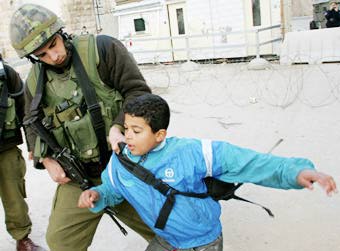
13 Palestinians Killed, 374 Kidnapped, In November
By Saed Bannoura | IMEMC | December 1, 2013
The Ahrar Center for Detainees Studies and Human Rights issued its monthly report Sunday revealing that Israel soldiers shot and killed 13 Palestinians in the West Bank and Gaza in November, while more than 374 Palestinians, including eight women, have been kidnapped.
Ahrar said that, similar to previous months, the southern West Bank district of Hebron witnessed the largest number of Israeli violations, while the army also kidnapped 95 Palestinians.
The Center stated that eight Palestinian women, including two teenagers, were among the kidnapped in Hebron. All kidnapped women, except the two young women, were released later on.
In occupied Jerusalem, soldiers kidnapped 85 Palestinians, including a journalist identified as Mohammad Abu Khdeir, who works for the Al-Quds daily; he was taken prisoner at the Ben Gurion Airport after concluding a visit to Egypt.
In Jenin, the army kidnapped 47 Palestinians, while 45 Palestinians were kidnapped in Nablus, 34 in Bethlehem, 30 in Ramallah, 18 in Qalqilia, 10 in Tulkarem, and one Palestinian has been kidnapped in Jericho.
Israeli soldiers also kidnapped nine Palestinians in the Gaza Strip, including three who allegedly tried to cross the border fence.
The Israeli Navy continued its attacks and assaults against the Palestinian fishermen in the Gaza Strip, and kidnapped four fishermen in Palestinian waters after the soldiers opened fire on them and their boats.
Soldiers also kidnapped a Palestinian patient from the Gaza Strip after he headed to the Erez terminal on his way for medical treatment at a hospital in Jerusalem. Israel granted him a permit to head to Jerusalem, but the soldiers still kidnapped him.
Ahrar added that soldiers also kidnapped a Palestinian from Gaza after he allegedly approached the border fence and “hurled a grenade” at an Israeli military vehicle.
In Jerusalem, soldiers kidnapped two Palestinian women, both teachers, and a young woman was kidnapped at an Israeli military roadblock near the northern West Bank city of Tulkarem. She is a college student from Nablus.
As for Palestinians killed by Israeli military fire in November, Ahrar said that Israeli soldiers shot and killed 13 Palestinians, including four from the Gaza Strip.
The four killed in Gaza have been identified as Rabee’ Baraka, 23, Khaled Mohammad Abu Bakra, 35, Mohammad Rashid Dawoud, 26, and Mohammad Issam Al-Qassam, 23; all were killed after the army bombarded Gaza on November 1st.
In the West Bank, detainee Hasan Toraby, 22, from the northern West Bank city of Nablus, died of cancer at the Al-‘Affoula Hospital after Israel failed to provide him with the needed medical treatment, and only moved him to hospital after having a very serious deterioration in his health condition.
On the night of November 7, resident Bashir Habaneen, 28, a university teacher from the northern West Bank city of Jenin, was shot and killed by soldiers at the Za’tara roadblock, south of the northern West Bank city of Nablus.
On the same night, Anas Al-Atrash, 22, from Hebron, was killed at the Container roadblock, near Bethlehem.
On November 26, soldiers assassinated three Palestinian from the southern West bank city of Hebron. The three have been identified as Mohammad Nairoukh, Mahmoud Najjar, and Mousa Fansha.
On November 28, Mahmoud Awwad, 24, from the central West Bank city of Ramallah, died of serious injuries he suffered in March. He was shot in the head and remained in a coma until his death.
On the same day, a Palestinian child identified as Nour Mohammad Affana, 14, died at an Israeli military roadblock as the soldiers closed the roadblock and prevented an ambulance, transporting her to a hospital in Bethlehem, from crossing.
On November 30, Israeli officers shot and killed Antar Al-Aqdra’, 24, from Qablan town, as he was working in the Petah Tikva area, north of historic Palestine. Twelve workers were taken prisoner.
Furthermore, Ahrar said that Israeli soldiers have escalated their attacks and assaults against Palestinian political prisoners, forced several detainees into solitary confinement, and denied family visits to dozens of detainees.
Palestinian researcher, former detainee and the head of the Ahrar Center, Fuad Al-khoffash, said that Israel’s violations, including deadly attacks and arrests, are ongoing, while extremist Israeli settlers carried out dozens of attacks, as part of organized assaults against the Palestinians, their lands and property, in the occupied West Bank, and occupied Jerusalem.
Spain sets new stiff fines for illegal protests
Press TV – November 29, 2013
The Spanish government has approved a new draft law which imposes harsh penalties on Spaniards taking part in unauthorized anti-government demonstrations, a move criticized by the opposition as trying to silence protests.
The draft law, presented by Interior Minister Jorge Fernandez Diaz on Friday, sets fines of up to 30,000 euros ($40,800) for offenses like torching the national flag, affronting the state or causing serious troubles outside parliament.
Fines of up to 1,000 euros will be imposed on people insulting or intimidating police officers.
Four “very serious” offenses, including interfering in electoral processes and illegal protests at strategic facilities such as airports or nuclear power plants, could be fined up to 600,000 euros (about $1,000,000).
The opposition says the bill is meant to prevent demonstrations against the government as the country struggles with a debt crisis and high unemployment.
“When more than 20 percent of people are unemployed, I don’t think this legislation is what we require,” said Alejandro Tourino, from law firm Ecija.
The government, however, has defended the bill, saying it will create discipline and safeguard public freedoms.
It will help “regulate and protect public freedoms,” said Deputy Prime Minister Soraya Saenz de Santamaria.
Madrid’s harsh spending cuts and rising unemployment have sparked massive anti-government protests across the country in recent years. Protesters argue that the government-imposed measures have failed to curb rising poverty or help extricate the country from its worst recession in years.
The draft law must be approved by parliament, where it may change to some extent. However, it will probably be ratified as the governing party has an absolute majority in the parliament.
Spain has seen numerous protests in recent years. On November 20, students gathered in front of the Education Ministry in Madrid to show their anger at the government’s austerity cuts, rising fees and other changes to the education system.
The Spanish government has been sharply criticized over the austerity measures that are hitting the middle and working classes the hardest.
Battered by the global financial downturn, the Spanish economy collapsed into recession in the second half of 2008, taking with it millions of jobs.
Related articles
Pakistan blows cover of suspected CIA chief after drone strike
RT | November 27, 2013
One of Pakistan’s major political parties has published the name of what it believes to be the CIA’s chief operative in Islamabad after a US drone strike killed five people last week. The group demanded on Wednesday that the spy chief face murder charges.
The Pakistan Tehreek-e-Insaaf (PTI), led by the country’s cricket star Imran Khan, dropped the name of the Central Intelligence Agency (CIA) operative to police in a letter in which the party demanded that the agent face up to the “gross offence” of the drone strike.
The letter was released to the media. However, the name could not be independently verified.
“I would like to nominate the US clandestine agency CIA (Central Intelligence Agency) Station Chief in Islamabad … and CIA Director John O. Brennan for committing the gross offences of committing murder and waging war against Pakistan,” PTI information secretary Shireen Mazarisaid wrote in the letter.
“CIA station chief is not a diplomatic post, therefore he does not enjoy any diplomatic immunity and is within the bounds of domestic laws of Pakistan,” the letter added. The complaint was lodged with Tal police station in Hangu district, northwestern Pakistan.
Intelligence agencies in foreign countries make a habit of keeping the identities of their agents and operatives private. If the PTI has successfully named the right person then he may be forced to leave the country.
This would not be the first time that an American operative has been outed in the country. In 2010 a former station chief was forced to leave Pakistan after his name was also revealed during a drone strike which led to the deaths of civilians.
The drone strike on 21 November was extremely provocative as it was one of the first outside the Federally Administered Tribal Areas, in the northwestern Khyber Pakhtunkwa province, and killed five militants – among them a senior commander of the Haqqani Network.
A separate strike at the beginning of November, which killed Pakistani Taliban chief Hakimullah Mehsud, prompted Khan to react with similar fury over how continued strikes could scuttle peace talks.
“The Taliban held only one condition for the peace talks and that was that drone attacks must end,” he said at a press conference. “But just before the talks began we saw this sabotage.”
CIA spokesman Dean Boyd would not confirm the Islamabad station chief’s name to the AP and declined to comment on the matter immediately.
Echoing Dirty Past, NSA Sought to Reveal Porn Habits to Discredit Targets
By Brett Max Kaufman | ACLU | November 27, 2013
In the five months since the world first learned of Edward Snowden, story after story based on documents disclosed by the young whistleblower have filled out a picture of the National Security Agency (NSA) as an organization with a limitless — and almost indiscriminate — hunger for information. Today, Glenn Greenwald, Ryan Gallagher, and Ryan Grim add a startling new dimension to that portrait by revealing that the agency has contemplated ways to use its troves of data to discredit and undermine individuals who the agency believes are “radicalizing others through incendiary speeches” but who lack any ties to actual criminality. The government is apparently seeking out “personal vulnerabilities” of these individuals, including their online sexual activity, hoping to expose them as hypocrites to their followers. While all of the targets are outside the United States, at least one of them is a U.S. person — meaning, either a citizen or a permanent resident.
As Greenwald notes, it’s a story that’s eerily reminiscent of past abuses of government surveillance authority. Greenwald’s new report does not provide evidence of the NSA marshaling its vast databases to influence individuals or events within the United States. But you need not be a conspiracy theorist or a novelist with a knack for bending history to imagine how granting the NSA the power to “collect it all” might have seriously chilling and destructive repercussions here at home.
In fact, the NSA appears to be taking this effort right out of the shameful playbook of our not-so-distant history. Most infamously, as part of the COINTELPRO program, J. Edgar Hoover’s Federal Bureau of Investigation (FBI) obsessively monitored the activities of Martin Luther King, Jr., picking and choosing from the results to produce a report chock full of insinuations about King’s role in an evolving Communist conspiracy against the United States. Never mind that King unwaveringly espoused non-violence. It was King’s rising public stature and broadly influential political ideas that led the government to see him as a threat.
The FBI viewed no space as off limits. The agency consistently bugged King’s hotel rooms to monitor his planning of the 1963 March on Washington and to keep tabs on his strategic partnerships with other civil-rights leaders. But it also sought to compile a dossier of embarrassing information about King’s private sex life that the government could (and did) employ to discredit King and obstruct his political efforts.
King was not alone on the government’s long list of targets; he shared marquee billing with boxer Muhammed Ali, humorist Art Buchwald, author Norman Mailer, and even Senator Howard Baker. But the greater scandal was that — as the Church Committee revealed in 1976 — these big names appeared alongside more than one million other Americans, including half a million so-called “subversives.”
That is why, as disturbing as it is to read about the FBI’s sordid history of targeting domestic political “enemies,” the potential of the NSA to revive those tactics today (as exposed by Greenwald’s article) is alarming on a profoundly different scale. In the age of mass call-tracking and XKeyScore, hotel-room bugs seem almost quaint.
Indeed, Greenwald’s new story is a warning shot to those of us who have thus far ignored the Snowden revelations on the basis of having “nothing to hide.” As Greenwald makes clear, the subjects of the NSA’s newly exposed effort to target individuals with influence on social media have tangential (if any) ties to real terrorists or violent extremists. And as the ACLU has explained, the entire premise of the NSA’s focus on so-called “radicalizers” — the theory that a person’s adoption of what the government views as “radical” ideas is a step to terrorism — has been debunked. Intelligence programs based on that discredited theory are not just wrong, they’re ineffective. But they do very real damage to belief communities and political activists singled out for surveillance based on their views.
The efforts reported by Greenwald cut to the heart of the zone of expression and association that must remain free from intrusive, dragnet surveillance, both abroad and at home. In his very first public words, Snowden himself addressed the alarming consequences of the NSA’s hunger for obtaining and storing an incomprehensibly vast record of our lives:
Even if you’re not doing anything wrong, you’re being watched and recorded…[T]hey can use the system to go back in time and scrutinize every decision you’ve ever made, every friend you’ve ever discussed something with, and attack you on that basis, to sort of derive suspicion from an innocent life and paint anyone in the context of a wrong-doer.
In the months since the first Snowden revelations, few have managed to evoke the existential threat presented by unhinged NSA surveillance with such plain, direct force. In an instant, Greenwald’s new story has brought this surveillance nightmare— “collect it all” meets COINTELPRO — jarringly close to the here and now.
Featured Video

Why the U.S. Should Pull Back From the First Island Chain
or go to
Aletho News Archives – Video-Images
From the Archives
Only 19.7% of Americans agree with US State Dept on Israeli settlements
… Most American adults of voting age don’t appear willing to reject the applicability of international law to Israel’s ongoing colonization of occupied territories in East Jerusalem, the West Bank and Golan Heights. … Full article
Blog Roll
 Aletho News
- British Government Employees Were Fact-Checking the News at the BBC. Nobody Told You.
- Albania on fire: who’s behind the riots?
- Egypt’s Civil Democratic Movement rejects involvement in regional war
- Egypt collaborates with Israel to build ‘Green Rafah’ project over erased Palestinian city
- Rising fuel prices and shortages have helped drive ongoing protests and rioting in France
- Tokyo protests demand Takaichi’s resignation over support for ‘Israel’
- Jennifer Kavanagh: Why the U.S. Should Pull Back From the First Island Chain
- Yemen denounces international community’s silence on Saudi aggression, siege
- UAE and Saudi Arabia move toward renewed coordination against Sanaa
- How Iran’s two-week retaliatory strikes exposed cracks in US military architecture in Persian Gulf
- If Americans Knew
- More on how Bari Weiss is using CBS on behalf of Israel
- What the UK Is Doing to Pro-Palestine Novelist Sally Rooney Is an Act of Orwellian Villainy
- ‘We will build palaces for Jews in Gaza’: Right-wing activists establish new outpost near border
- ‘You see us burning, you stay silent’: Family’s agony over mother and sons burned to death in Gaza tent
- Israel keeps Palestinian journalist Bushra al-Tawil in isolation for 46 days
- US-Israel integration plan puts US military tech in Israel’s hands
- Israeli Strike Burns Gaza Mother Alive in Front of Toddler, ‘Without Generating Any Headlines’
- ‘The Israel Experience with Mike Huckabee’: The Ambassador’s Family Sells Trips to Israel
- As Gazans carry out mass burial, food insecurity is getting worse – Daily Update
- Israeli rabbi permits occupiers to steal Palestinian olive harvest in West Bank
- No Tricks Zone
- Predictions Made By Renowned Climate Proifessor Over Past Decades Have Been Proven To Be Poor
- New Study Suggests Large Regions Of The Pacific Ocean Have Been Cooling For The Last 80 Years
- Germany’s Green Energy Debacle: High Energy Costs Force Kahla Porzellan to Close After 182 Years!
- New Study: 50 Years Of The Most Aggressive ‘Net Zero’ Policies Can Only Affect The Global Climate By 0.03°C
- US September “Heat” Was No Record…Many Records Set Decades Ago
- Latest European Green Energy Debacle; Portugal’s Largest Flagship Solar Park Insolvent!
- Green Energy Debacle: German Expert Professor Fritz Vahrenholt Warns Of Severe Economic And Social Consequences
- Two More Paleo Reconstructions Affirm Meters-Higher Sea Levels Across Ireland, Brazil 7000-6000 Years Ago
- New Study: Earth And Venus Surface Warmth Largely Explained By Convection And Lapse Rate, Not CO2 Or Radiation
- 2025 Nature Paper Claiming Worsening Global Drought Gets RETRACTED …Heavily Flawed

