Yemeni parliament bans US terror drone strikes
Press TV – December 15, 2013
Yemeni MPs have strongly condemned US assassination drone strikes inside the Arab country and the parliament passed a law banning the drone attacks.
“Lawmakers have voted to ban drone strikes in Yemen,” the official Saba news agency reported after the parliament held a session on Sunday.
The legislators stressed “the importance of protecting all citizens from any aggression” and “the importance of preserving the sovereignty of Yemeni air space,” Saba said.
On Thursday, a US drone fired several missiles into a convoy of vehicles traveling to a wedding party in central Yemen, killing at least 17 people.
The strike triggered protests across Yemen. Relatives of the people killed in the attack blocked roads to protest against the deadly incident, calling on the government to adopt measures to halt the drone strikes. They also demanded an official apology as well as compensation.
“If the government fails to stop American planes from… bombing the people of Yemen, then it has no rule over us,” Yemeni tribal chief Ahmad al-Salmani said on Saturday.
Washington has stepped up its assassination drone operations in Yemen over the past few years.
According to the Washington-based think tank the New America Foundation, US drone attacks in the Arab country almost tripled last year, surging from 18 to 53.
US officials claim that the attacks target militants, but local sources say civilians have been the main victims of the non-UN-sanctioned airstrikes — which have also been launched against locations in Afghanistan, Pakistan, and Somalia.
The US has come under fire for increasing its drone attacks in Yemen, where the people have held many demonstrations to condemn the violation of their national sovereignty.
Number recently displaced by flooding in Gaza tops 10,000
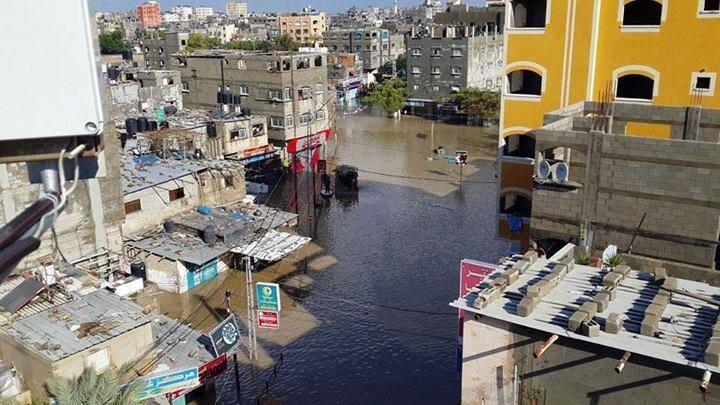
Ma’an | December 15, 2013
BETHLEHEM – Approximately 10,000 people have been forced to flee their homes due to widespread flooding in the Gaza Strip, according to a report released Saturday evening by the United Nations Office for the Coordination of Humanitarian Affairs.
The numbers of displaced dwarf earlier estimates, as they take into account both the thousands who have sought refuge in Gaza shelters as well as those who have sought refuge elsewhere.
Previous estimates released by the Gaza government had measured only those who had sought refuge in official shelters, who at their peak reached above 5,000 but were estimated at around 2,234 on Sunday.
In a comprehensive report on winter storm Alexa’s effects on the Palestinian Territories, OCHA reported that as of Saturday at 9 p.m., 10,000 Gazans had been evacuated from their homes and had gone to either shelters or relatives’ houses.
The areas most devastated by the storm are “North Gaza and Gaza City where over 1,500 houses suffered damage due to water entering houses, damaging furniture and electricity networks.”
An infant died and 100 were injured in storm-related incidents throughout Gaza, the report said. Gaza government officials said on Sunday that two individuals had died, but did not mention any case involving an infant.
Schools throughout Palestine have been closed since Thursday, and according to OCHA 17 schools in Gaza have been converted into shelters, while five other schools have been rendered unusable due to flooding.
The report also discussed the effects of the storm, in conjunction with the Israeli occupation, on herding communities in the West Bank.
“Several herding communities had their structures demolished (by the Israeli authorities) one day before the storm hit, prompting the UN Humanitarian Coordinator to call again for a halt to demolitions due to their humanitarian impact,” the report said.
Additionally, “approximately 30 families living in ten Bedouin communities in the northern Jordan Valley require emergency assistance.”
Meanwhile, the report said farmers across Palestine have been hit with livestock and crop losses, further weighing on levels of food insecurity throughout the territories.
“In the West Bank, preliminary reports of damages to the livestock sector are emerging from Hebron, Bethlehem and Salfit. Bedouin and herding communities seem to be the most affected. Herders are expected to face increasing livestock fatalities and morbidity in the coming weeks.”
In Gaza, over 10 percent of the coastal enclave’s greenhouses and field crops were destroyed or damaged by winter storm Alexa, in addition to 50 animal pens, the report said.
“120,000 chicks and 200 heads of livestock died as a result of the weather.”
The Gaza Strip is currently under a state of emergency due to severe weather conditions caused by a historic storm front moving south across the Levant.
UNRWA spokesperson Chris Gunness said on Saturday that large regions of the Gaza Strip were a “disaster area” and called on the international community to lift the Israeli blockade in order to allow recovery efforts to proceed.
“Any normal community would struggle to recover from this disaster. But a community that has been subjected to one of the longest blockades in human history, whose public health system has been destroyed and where the risk of disease was already rife, must be freed from these man made constraints to deal with the impact of a natural calamity such as this,” he said in a statement sent to Ma’an.
Fuel shortages have caused daily life in the Gaza Strip to grind slowly to a halt since early November, cutting off access to basic necessities for Gaza residents.
Until Sunday, the Gaza Strip had been without a functioning power plant since the beginning of November, when the plant ran out of diesel fuel as a result of the tightening of a seven-year-long blockade imposed on the territory by Israel with Egyptian support.
The power station began operating Sunday after receiving a delivery of diesel that was purchased from Israel by the Palestinian Authority using funds donated by Qatar.
The plant was only reopened in 2012 after it was targeted by an Israeli airstrike in the 2006 assault on the Strip. The power plant generates around 30 percent of the Gaza Strip’s electricity supply, while the rest comes from Israel and Egypt.
Until July of this year, the tunnels to Egypt provided a vital lifeline for the territory amidst the otherwise crippling Israeli blockade. The blockade has been in place since 2006, and it has limited imports and exports and led to a major economic decline and wide-reaching humanitarian crisis.
In 2011 and 2012, however, the situation improved, as the tunnels to Egypt witnessed a brisk trade following the Egyptian Revolution.
Gaza Strip energy officials have blamed Egypt for destroying numerous tunnels linking the Gaza Strip and Egypt in recent months. They also blamed the Fatah-led Palestinian Authority for charging taxes on fuel too high for Hamas authorities to afford.
Related article
‘Stop lying’: Uruguay president chides UN official over marijuana law
RT | December 14, 2013
Uruguay’s president has accused the head of the UN’s International Narcotics Control Board (INCB) of lying and double standards, after the official claimed the country did not consult the anti-drug body before legalizing marijuana.
Earlier this week, Uruguay became the first country in the world to legalize both the sale and production of marijuana.
INCB chief Raymond Yans has slammed the “surprising” move, accusing the South American state of legalizing the drug without first discussing it with the UN organization.
Uruguay’s president, Jose Mujica, rejected the criticism on Friday, saying that he’s ready to discuss the law with anyone.
“Tell that old man to stop lying,” Mujica said in an interview with Uruguay’s Canal 4.
“Let him come to Uruguay and meet me whenever he wishes… Anybody can meet and talk to me, and whoever says he couldn’t meet with me tells lies, blatant lies.”
“Because he sits in a comfortable international platform, he believes he can say whatever nonsense,” he added.
Yans has accused Uruguay of “pirate attitudes” for knowingly violating the 1961 Single Convention on Narcotic Drugs, which the South American country is part of.
But Mujica reminded that Yans did not say a word about the US states of Colorado and Washington, which also legalized marijuana.
“Does he have different rules: one for Uruguay and other for the world’s strong countries?” he asked.
First lady Lucia Topolansky, a member of the Uruguayan Senate, has fully backed her husband on the issue.
“Who is this fellow who likes to call names to countries?” she said of Yans. “I think he’s crossed the line, but anyhow I believe that he has had problems with other countries, Sweden, Denmark, Holland and they will be meeting him sometime in March.”
“But to be honest, marijuana is not the heart of life or earthly issues,” Topolansky added.
The law, which allows for a government-controlled marijuana market, was passed by the Uruguayan Senate on Monday.
According to the legislation, those wishing to smoke cannabis recreationally need to register with the authorities and limit their consumption to 40 grams per month.
President Mujica and his supporters argue that regulating marijuana consumption and production will remove profits from criminals and allow less money to be spent on soldiers and police, who are ultimately unable to prevent Uruguayan citizens from using the drug.
Tuqu’ – a village under siege
Letters from an Occupied People | December 12, 2013
A loud buzz of chainsaws greets our arrival following a call from Tuqu’ – a Palestinian village of about 12,000 people, south of Bethlehem in the West Bank. We find Israeli soldiers overseeing the destruction of row after row of mature olive trees.
The Palestinian farmers remonstrate with the army. They have land ownership documents dating back generations from the Jordanian, British and Ottoman administrations, but their arguments are ignored by the soldiers holding them back at the gunpoint. I notice a woman pleading with soldiers who order her away, but she will not let up.
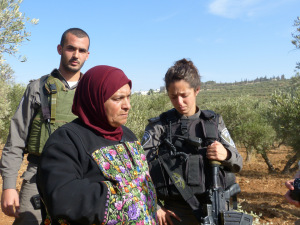
November 25, 2013 Israeli Border Guard weeping as Palestinian trees destroyed_A.Morgan
An Israeli Border Guard, a young woman who speaks Arabic, is called to deal with her. I watch as the young soldier stands listening and silently drops her head, turning her face to wipe away tears.
Finally, the buzzing stops, but it is a temporary reprieve. The Israelis have declared this ‘state land’ and the farmers are given four days to cut down hundreds more trees themselves, or the world’s fourth largest army will return to defend Israel from the olive trees.
‘How can we do this?’ asks one farmer ‘It will be like killing our mothers!’
Israeli military harassment of children in Area C
About three quarters of Tuqu’s land is in Area C*, under full Israeli military control, although this was supposed to transfer to the Palestinian Authority within 5 years of the Oslo Agreement. Tuqu’ has already lost hundreds of hectares to the illegal Israeli settlements of Teqoa, Noqedim and Ma’ale Amos that surround it to the north, south and east.
Our team comes regularly to Tuqu’. It is one of four Bethlehem villages where we accompany children to school as part of a UNICEF ‘Access to Education’ programme. Every day, children of six to 18 must run the gauntlet of armed Israeli soldiers and we have been present when the army has tear-gassed the schools. The soldiers obstruct the school entrances with jeeps, and patrol the footpaths with guns, forcing the frightened children to walk across rough fields or along the busy road.
‘It is emotional harassment’ says the mayor.
Recently we met a 16 year old boy who showed us the X- ray of a bullet still lodged in his back since a recent military incursion into Tuqu’. The mayor also tells us that over 20 children have been arrested in the last three months.
Two weeks before the trees were cut down, Tuqu’s mayor had called us because Israeli settlers, accompanied by soldiers, had begun putting up Israeli flags and tents on Tuqu’ land each afternoon.
One of the Israeli settlers I spoke to – a woman with an American accent – justified what she was doing, saying,
‘It is no different than what the Americans did to the Native Americans’.
Following this we saw the army erecting a series of concrete pillars along the roadside, with two red signs warning Israelis that this was a dangerous Palestinian village.
Soon after that, settlers erected a large marquee and put up provocative posters with a picture of a car being fire-bombed. The Palestinian landowner protested, but the military commander told him the settlers would take the land for two days for a party. There was nothing the farmer could do to stop this, but the village held a peaceful protest, whilst a large Israeli military force guarded the settlers.
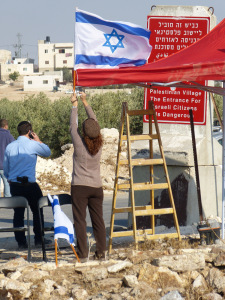
November 20, 2013 Nadia Matar, Women in Green at Tuqu’_A.Morgan
The people of Tuqu’ know that this is how it starts; a few tents, some flags, then some caravans – an illegal settlement outpost is born. With Israeli state protection and financial inducements it will soon grow to thousands of settlers. More land theft, house demolitions, movement restrictions and violence against local Palestinians will follow.
Two days after the party, the settlers are back. They include a vigilante group called Women in Green** led by a Belgian-born woman called Nadia Matar. We ask what she thinks about the 16 year old Tuqu’ boy who was shot it the back whilst going to visit his grandfather.
‘ He was probably throwing stones.’ She replies ‘Kids who throw stones should be shot in the head ’.
During a visit to Tuqu’ a week after the tree cutting, we see scores of settlers coming towards the village, many bringing young children. A large number of Israeli soldiers position themselves across the road and fields, aiming their rifles and teargas cannons at Palestinian children coming out with their unarmed parents for another peaceful protest.
The settlers hold a ceremony and light candles. It is Hanukkah, and they tell us they are renaming this area with a new Hebrew name.
Under international law it is illegal for Israel, as an occupying force, to transfer its own population into the occupied Palestinian territories. Despite this, Israel’s massive settlement programme has continued unabated for decades, with thousands more homes being planned during the current Peace talks. With many settlements to the east of Bethlehem and other Palestinian centres, the Israeli strategy seems clear: to expand the eastern settlements westward to join up with Jerusalem, bisecting the West Bank and corralling the Palestinian population into a series of isolated cantons. EAPPI is keeping international agencies informed about these developments in Tuqu’ and a legal challenge is underway, supported by UNOCHA and the Norwegian Refugee Council.
* The Oslo Accords led to the West Bank being divided into Areas A (under Palestinian control), Area B (Palestinian civil government and Israeli military security) and Area C (Completely under Israeli military law). Areas B and C were supposed to be transferred to Area A – full Palestinian control, within 5 years. Instead, 20 years on, Israel has consolidated it’s control over Area C, illegally building hundreds of thousands of settler homes. Area C represents over 60% of the West Bank. It is the only contiguous area and therefore control over Area C is essential for communications. It also includes most of the West Bank’s fertile land and water. Israel prohibits Palestinian construction in Area C. Israeli control over, and settlement building in Area C is a major obstacle to a peaceful solution to the conflict.
** Women in Green is a right wing group that opposes the creation of a Palestinian state and supports Israeli settlement of the West Bank, which it proposes Israel should annex. WiG also opposed Israeli withdrawal from southern Lebanon. Nadia Matar, the Belgian-born leader of WiG claims that the ‘Arabs’ in the ‘Holy Land’ are descended from relatively recent immigrants, and should be ‘transferred’ to neighbouring Arab countries.
Related articles
European Court of Justice officer argues against EU Data Retention Directive
DW | December 12, 2013
An EU law requiring companies to log telecommunications data for law enforcement breaches rights, an advocate-general of Europe’s top court has said. Germany in particular had challenged the Data Retention Directive.
Thursday’s opinion at the European Court of Justice in Luxembourg responds to challenges against the directive in Ireland and Austria. Adopted the by the EU in 2006 following attacks on the London tube and trains in Madrid , the Data Retention Directive specifies that firms must save telephone and Internet data – user, recipient and length of calls – for a period of up to two years.
“The directive constitutes a serious interference with the fundamental right of citizens to privacy,” Advocate-General Pedro Cruz Villalon said. “The use of those data may make it possible to create a both faithful and exhaustive map of a large portion of a person’s conduct strictly forming part of his private life, or even a complete and accurate picture of his private identity,” he added.
Cruz Villalon argued that the directive increased the risk that corporations and individuals could use the data for unlawful and possibly fraudulent or malicious purposes – even more so as private communication companies controlled the information rather than public authorities. Cruz Villalon also called the directive invalid because it failed to sufficiently specify the circumstances for data access, storage and use – leaving this for member states to define. In addition, Cruz Villalon called one year a disproportionately long time to hold so much information – let alone two.
Relevance, ‘even urgency’
The advocate-general did recognize the “relevance and even urgency” of data retention measures. Should the court decide to follow his opinion, Cruz Villalon suggested that it grant a grace period to change the directive, rather than taking immediate measures against it.
At any given time, the European Court of Justice has nine advocates general, who provide legal but nonbinding opinion ahead of deliberations and decisions by judges.
Germany does not currently comply with the Data Retention Directive, owing in large part to a Constitutional Court ban on the legislation in 2010. The forthcoming grand coalition government hopes to limit data storage in Europe to three months.
You destroy the soldier himself
By Melanie Ward · December 11, 2013
“You destroy the soldier himself”
That was the response of Munir, a Palestinian who is faced with Israeli soldiers at the checkpoint opposite his shop in Hebron every day, when I asked him how he thought being in Hebron must affect the soldiers.
I have had so many encounters with Israeli soldiers during my time in Hebron – it is impossible not to, due to the intensity of the military occupation.
I have passed the time of day and talked with some of them about what we are each doing here. Some have told me of their boredom, that they would much rather be on the beach. One helped keep a stray dog away from Palestinian school children who were frightened and I thanked him. Another told the police to leave me alone when they were harassing me about where in the street I was standing during the school run, and I thanked him too.
They have also spat at me, shouted at me, threatened to arrest me and called me stupid in Hebrew and a “sharmoota” (“whore” in Arabic). I have refused to follow their orders to move or stop taking photos. I have watched heavily armed soldiers throw stun grenades, and tasted the tear gas they shoot at Palestinian children on their way to school in response to small stones being thrown at their checkpoint. I have seen them harass and detain Palestinians trying to go about their lives, push kids for “facing the wrong direction” as Israeli settlers walk past, and arrest children. I have watched them laughing and joking many times in situations that are far from funny – most recently in the aftermath of an extremely serious attack by Israeli settlers against a Palestinian family.

An Israeli soldier fires tear gas at Palestinian children on their way to school after small stones were thrown at a fence near checkpoint 29 in Hebron
I have come to know some of the Givati Brigade of the Israeli army, currently serving in Hebron, by sight and a few by name. You can often tell how many schoolbags will be searched or Palestinians detained for ID checks by who is on duty. Almost without fail, the local Palestinians say that their treatment on a given day depends on the mood of the soldiers. I have often wondered what must be going through their minds and wished that I could talk to them properly about what they think. Amidst the tension and violence of Hebron, this is normally impossible.
One Friday night settlers blockaded a Palestinian family’s gateway and stopped them from leaving their home at Tel Rumeida in Hebron. I asked the nine watching Israeli soldiers to please help. They wouldn’t. One of them, whose name is Kawalski*, said “everything is fine.” 34 Israeli settlers were stopping a Palestinian family from walking down the street and thus from entering or leaving their home. Many of the settler children were shouting abuse, hitting our cameras and spitting at us.

An Israeli settler child hits my camera during the incident when settlers blockaded Palestinians in their home, and went on to attack us. Soldiers stand stand by in the background
They went on to throw two buckets of water at us, followed by a bucket of bleach. It was an awful scene and I cannot see how he could have thought it was fine.
Most of the soldiers in Hebron are young, ranging from 19-22 years old, and are conscripted into military service for three years. This is compulsory with a few exceptions, so most of them have not made a positive choice to be in the army. Yet in Israeli society there is real kudos attached to being a combat soldier like those in Hebron – just take a look at the Israel Defense Forces Facebook page. Only a tiny minority ever refuse to serve and spend time in prison as a result. Kawalski, the soldier on that Friday night, must be no more than 22 years old. After the incident, I wondered a lot about his “everything is fine” comment and thought maybe it was actually his internal reasoning – him trying to persuade himself it was all OK and he was in control (he most definitely was not).

An Israeli soldier gives first aid to our journalist colleague after refusing to intervene in a situation which culminated in the settlers throwing bleach in her eyes
Later, when he called an ambulance for my colleague after the attack on us that he had failed to prevent, he must have been forced to acknowledge that everything had not been fine.

Israeli soldiers tell a young Palestinian boy he is not allowed to ride his bike in H2 in Hebron. Israelis can drive on this street but Palestinian are not allowed to
Thousands of settlers and their supporters came to Hebron recently for Shabbat Chayei Sarah, which commemorates Sarah of biblical times, who is buried in Hebron. It was a difficult weekend, with heightened tensions and violence. Movement restrictions were even tighter than usual – the Ibrahimi Mosque and nearby Palestinian shops were forcibly closed. Most of Shuhada Street, which Palestinians are never allowed to walk down, was closed to my colleagues and I as well – “Jews only” as the enforcing soldier told me. Extra soldiers drafted into H2 checked the ID of Palestinian men every 50 metres.

Me intervening to stop Israeli soldiers harassing young Palestinians who were sitting on a wall chatting as Israeli settlers walked past on Shabbat Chayei Sarah
I was patrolling with a colleague and we went to an area with a few Palestinian homes and many settlers nearby. I felt nervous because large groups of settlers, some armed and some drunk, are not normally a great thing to encounter. A Palestinian family was harvesting olives on a hill where many settlers were hanging around. We checked if the family was OK and sat down under a tree, hoping to deter the settlers from coming to bother them, throw things at them etc (there was a fence between us and the Palestinians so we couldn’t help with the olives). A couple of Israeli soldiers were standing nearby.
After a bit, a group of male settlers tried to make their way towards us and I stood up, worried about what would happen next. But rather than standing back and letting them come over, the soldier stepped in the way and asked the settlers to leave. They did. I had never seen such a thing before and, when the settlers had moved away, I thanked the soldier. “Don’t worry” he said. Shortly after, a second group of settlers tried to come and the soldier and his colleague again turned them away. After this the soldiers came to ask if we were OK. I was slightly stunned that they were looking out for us and for the Palestinians. I thanked them both and said that we would move on soon. They told us there was no need for us to leave and not to worry, they would make sure everything was OK with the Palestinians. This was the opposite of what I am used to in Hebron, where the soldiers will often do whatever they can to get rid of us, and simply stand by as settlers harass and attack Palestinians. The first soldier told me that his name was Yossi* and he was not normally based in Hebron.
Later, when there were no settlers watching, I bumped into Yossi again. I asked him if he understood what I was doing there. “You want peace” he said, and told me that he wanted peace too. He told me that after my colleague and I had gone, the settlers had pushed him and thrown stones at him. He was astonished by this and couldn’t understand it. I asked what he knew about Hebron – not much. His orders that day had been to keep the Jewish and the Palestinians apart. I told him what it is like in Hebron – the settler violence, the soldiers refusing to help, the clashes, and showed him pictures. It was all news to him. “It’s good that you are telling me this, I will tell my commander”, he said. I really appreciated this but told him I didn’t think it would help – his commander was 24 years old and decisions about what happens in Hebron are made high up in military and political circles. None of those in charge will be unaware of what actually goes on in Hebron.
Yossi told me that he loved being in the army. He told me that he loved his gun. “Why do you love your gun?!” I asked him, “It’s for killing people.” “No!” he said, “I love target practice, I don’t want to kill anyone.” “But why do you think they give you a gun?!” I asked. I learned that Yossi was 19 years old. He seemed like a good, decent young man and I believed him when he said he wanted peace and didn’t want to kill anyone. But, as I have previously written about other discussions I’ve had with Israelis, I was surprised by his lack of understanding about the facts of the conflict he is part of. I asked him to keep being nice to the Palestinians and he told me to take care in Hebron.
My encounter with Yossi really made me think. That I was so surprised at his fair conduct says a lot about the norm for soldiers in Hebron.

An Israeli soldier detains Palestinian boys aged 8 and 10 years. Photo by Maria Schaffluetzel
I wonder how it comes to be that so many of the young soldiers behave in the morally unacceptable ways I have so often observed or seen evidence of: arresting children and beating them up; demolishing Palestinian houses with bulldozers and then preventing tents and emergency aid from being delivered; even deliberately shooting innocent people, as veterans’ organisation Breaking the Silence has documented. Sometimes they will be following their orders in doing these things, and sometimes not. Mohaned, a 13 year old from the town of Beit Ummar, told me how soldiers raided his house at 3am, blindfolded and arrested him wearing only his underwear. He was held for 10 days, in which he was slapped, hit with the butt of a rifle, beaten and then released.

An 11 year old Palestinian boy arrested by Israeli soldiers in Hebron
Surely it is important to ask how young men, most of whom start off as normal, decent guys like Yossi, end up doing these things?
On a day off I visited the Golan Heights and got talking to some soldiers about their jobs. One of them said that they themselves had been discussing these issues, “Some of us were talking – we are children and they give us guns.” I met another soldier in Haifa, Israel. He was 23 years old and had previously served in the Golani Brigade in Hebron. He recalled an army education week when there had been a discussion about putting the heads of dead Palestinians on poles. He had been in the minority 20:1 to say that such things were wrong. Another former Golani soldier simply refused to speak about what he had done when he served in the army.

A Palestinian looks out of his window to find armed Israeli soldiers using the roof of his home in Al Arrub refugee camp near Hebron
My friend Sam is Jewish, an Israeli of British origin who I got to know in our student days. After my blog about my some of my experiences in Israel, he emailed me saying, “I think another big reason why it’s hard to convince Israelis about what’s going on in the territories is that almost every Israeli knows somebody who serves in the territories… it’s hard for us to believe that they are monsters.”
His use of the word “monster” really stuck with me. I don’t believe the soldiers are monsters – perhaps with a few exceptions, as with all people. But sometimes they end up doing monstrous things on a regular basis. They are born into a system which takes apparently normal teenagers and seemingly trains them to behave in these ways.
One soldier who served in Hebron told Breaking the Silence, “In Hebron, I was disturbed and frightened most of all by the unregulated and uncontrolled power, and the things it made people do.” Another said, “Another thing that has stayed with me from Hebron? I think of myself as a little injured maybe, I don’t know. Not physically injured. More emotionally injured.”
Rather than monsters, I think it makes the young soldiers part of the tragedy of the conflict. I am pretty sure that it will damage them too, that they will suffer in the long run. Aside from the terrible harm that the military occupation does to the Palestinians, I am sure that Israel also hurts itself and its own young people in what it does. What kind of society, what kind of country, will Israel end up as?
Avraham Shalom is in a position to know. He led the Shin Bet, the Israeli intelligence service, between 1980-86 and in the film The Gatekeepers he says,
“We have become cruel. To ourselves as well, but mainly to the occupied population.” The Israeli army has become “a brutal occupation force.”
*Not his real name
Related articles
West defending dictatorships from democracy in Persian Gulf
By Finian Cunningham | Press TV | December 9, 2013
In a breathtaking display of absurdity, US secretary of defense Chuck Hagel and Britain’s Foreign Minister William Hague were among senior Western delegates to address the annual conference on “regional security” held in Bahrain at the weekend.
These officials pontificated about regional threats, conflict, international law, human rights and so on; meanwhile out on the streets of Bahrain, not far from the venue, peaceful protesters calling for democratic freedom were being bludgeoned by regime police thugs.
How absurd can it get? Like a comedy double act, Hagel and Hague were enthusing about high-minded democratic principles to their unelected, dictatorial hosts, the Al Khalifa rulers, surrounded by representatives of the other Persian Gulf Arab dictatorships, prime among them the absolute, tyrannical monarchy of the House of Saud.
And yet outside, ordinary Bahraini civilians yearning to see these same principles put into practice were getting their heads cracked open by uniformed thugs acting under the orders of the very same despots applauding Hagel and Hague. Talk about inside-out, upside-down doublethink.
When Bahrain’s mainly Shia majority rekindled their decades-old protests against the unelected Khalifa crime family in February 2011, it was the Saudi-led [Persian] Gulf Cooperation Council that marched into the tiny island to crush the pro-democracy movement.
The GCC military force is perversely, but aptly, named “a defense operation”. For its purpose is not the defense against some alleged, non-existent threat from without, but the imminent threat from within.
That threat is the spread of democracy in the region, which would sweep away the unelected super-wealthy families that rule over Saudi Arabia, Kuwait, Qatar, the United Arab Emirates, Oman and Bahrain – the six member states of the [Persian]GCC.
The Saudi-led invasion of Bahrain in March 2011 to wipe out “the contagion” of democracy in the oil-rich region was given the green light by Washington and London, with whom the Saudi rulers consulted days before sending in the troops and tanks.
Saudi forces still remain in Bahrain – albeit covertly, wearing Bahraini uniforms – where they continue to brutally attack pro-democracy demonstrators every week, as they have done for the past nearly three years.
And it’s not just protesters on the streets that are killed and injured. Saudi-backed Bahraini forces attack whole villages and family homes with night raids and poisonous gas, many of the occupants, including infants and elderly, having died from suffocating fumes.
Thousands of Bahraini families have been ripped apart, as fathers, mothers, sons and daughters are hauled off to jails and torture centers. The prisoners are denied any legal rights, convicted on the basis of tortured confessions, and many of them imprisoned for life.
Prisoners who have incurred disabilities and diseases from their trauma are also denied basic medical attention, putting their lives at risk. Such detainees include the photographer Hussain Hubail, suffering cardiac problems, elderly political opposition leader Hassan Mushaima, who is battling cancer, and human rights defenders Abdulhadi al-Singace and Naji Fateel, both of whom have become paralyzed from their physical beatings.
The same vicious assault on pro-democracy civilians goes on in Saudi Arabia where some 30,000 prisoners of conscience are rotting away behind dungeon bars, as well as in the other Persian Gulf states, although to a lesser extent.
The US and British governments are fully apprised of the systematic violations and torture carried out by their Persian Gulf dictator allies. Let’s be under no illusion. It’s not just that Washington and London are merely aware of the abominations and turn a blind eye; these Western governments are colluding in the ongoing barbarity.
Addressing the Manama Dialogue conference in Bahrain at the weekend, US Defense Secretary Chuck Hagel said: “I am under no illusions, like all of you, about the daily threats facing this region, or the current anxieties that I know exist here in the [Persian] Gulf.”
Indeed, Hagel is “under no illusions”. The threat to security that he alludes to is not the fairytale, fictional threat attributed to Iran.
The very real danger is that of democracy taking hold in the Persian Gulf. Whereby the people of the region might be able to avail of the vast oil wealth for genuine social development instead of the billions of dollars being funneled into the hands of crony royal families who in turn squander these billions on American and British weaponry.
The abundantly evidenced risk to security in the region is from the US and British-backed Arab tyrannies fuelling terrorism in Syria, Lebanon, Iraq, Yemen and elsewhere, as well as brutally repressing their own people.
When Hagel and Hague and their despotic clients talk about “defense” what they are referring to is the defense of dictatorships against democracy in the Persian Gulf and the protection of multi-billion-dollar weapons contracts to American and British companies (who in turn buy political prostitutes like Hagel and Hague to do their bidding).
There is zero evidence of any other kind of threat, certainly not from Iran, except in the figment of twisted, propagandized imaginations. By contrast, the evidence for American and British-backed despotic terrorism (including that of nuclear-armed Israel) is glaringly real in the form of thousands of lives killed, maimed, displaced and rotting away in ghettoes and jails.
But cracks in this absurd façade are appearing and widening. The Omanis have given notice that they are no longer willing to participate in this ludicrous charade, saying at the weekend that they will not be part of any Persian Gulf military club, probably knowing that its pretext is patently untenable.
Also, Western and international public awareness is becoming increasingly indignant and intolerant of the parody. Why are billions of dollars being spent on planet-destroying weapons and manufacturing terrorism when so many urgent social needs are being trampled on at home and abroad?
Ordinary people around the world know that the threat to peace, security, democracy and prosperity is not Iran or any other alleged bogeyman.
They know the real and imminent danger stems from elite Western-dominated capitalism and its satellite terrorist-sponsoring regimes in Israel, Saudi Arabia and the other Persian Gulf dictatorships.
The truth is both arresting and liberating. Western ruling cliques and their despotic “allies” – under the control of corporate fascism – are now seen more acutely than ever as the enemies of democracy and peace.
The absurd pretence otherwise is well and truly over.
The Unwelcome Return of Navi Pillay

By Daniel McAdams | Ron Paul Institute | December 3, 2013
You could very well say that Navi Pillay was more than anyone else the person responsible for NATO’s disastrous invasion of Libya. As UN Human Rights Commissioner she chaired that fateful meeting in February, 2011 where Libyan NGO leader Soliman Bouchuiguir was allowed to repeat incredible tales about the “massacres” taking place in Libya – tales he openly admitted after the NATO invasion he had just made up. “There is no evidence,” he exclaimed when asked after the invasion to back up his claims, which were the basis of the chain of events that led to NATO bombing.
The first link in that chain was the UN Human Rights Commission hearing chaired by Pillay, where Bouchuiguir’s lies led to the suspension of Libya from that body and the referral of the Libya issue to the UN Security Council. At the hearing, Pillay took her cue from the falsifier Bouchuiguir, exclaiming that, “The Libyan leader must stop the violence now.” Eventually the Security Council passed Resolution 1973, cracking the interventionist door to Libya, which NATO very soon kicked open.
Commissioner Pillay wasted no time setting her “humanitarian interventionist” sights on another crisis just waiting for a military solution. As early as August, 2011 she began urging the International Criminal Court to take up the case against the Syrian government, which was fighting against a foreign-sponsored insurgency seeking its overthrow. Never mind the illegality of her position urging the overthrow of a sovereign state, Pillay has argued relentlessly from the beginning in favor of a Libya-style NATO invasion of Syria.
Now Pillay is back in the news, releasing an incredibly dubious “report” concluding that the Syria government is guilty of war crimes in its fight against a foreign-sponsored insurgency. Pillay’s methodology would be laughed out of any courtroom except perhaps those of Stalin’s show trials. Her “investigators” had no access to Syria, conducted no on-the-ground investigations, but instead conducted their interviews in neighboring countries or via Skype. As with her previously discredited Libya claims, there is no independent verification of her findings, no way of even knowing who she talked to in the collection of this “evidence.” In fact, she would not even reveal the names of the accused, a list of perpetrators which she claims was secretly handed to her. No, she prefers to keep her information secret in hopes that the International Criminal Court would finally take up her case against the Syrian government.
Pillay’s fanaticism and the religious fervor of her devotion to the doctrine of “humanitarian interventionism” harkens back to an earlier era where the murder of millions was justified in pursuit of the historical inevitability of utopia on earth. It is a dangerous and deadly philosophy, which justifies all manner of death and destruction. The oft-cited C.S. Lewis quote comes most often to mind when thoughts wander to the Navi Pillays of the world:
Of all tyrannies, a tyranny sincerely exercised for the good of its victims may be the most oppressive. It would be better to live under robber barons than under omnipotent moral busybodies. The robber baron’s cruelty may sometimes sleep, his cupidity may at some point be satiated; but those who torment us for our own good will torment us without end for they do so with the approval of their own conscience.
Pakistani man sues US over false arrest
Press TV – December 6, 2013
A Pakistani immigrant has filed a lawsuit against the US government in a federal court in Miami, saying he was kept for over ten months in solitary confinement after being falsely arrested on ‘terrorism’ charges.
Forty-year-old Irfan Khan, who immigrated to the United States from Pakistan in 1994, filed the complaint on December 3 at US District Court of Miami, Reuters reported on Thursday.
According to the lawsuit, Khan was arrested in California in 2011 on charges that included providing material support for the Pakistani Taliban.
The 40-year-old was then taken to a prison in Florida as he was also accused of supporting a plot for the abduction and murder of individuals overseas.
The lawsuit says that all charges against Khan were dropped in June 2012. However, until then he had been held for around 320 days in solitary confinement.
“I was shocked at the time. I’m still shocked. I don’t know why it happened, how it happened, and that’s why we are doing this. To get some answers,” Khan told Reuters on Thursday.
“The conduct the government subjected Irfan to, as a result of his religion, national origin, and its overzealousness in its war on terror was and still is, by all standards, horrendous,” the complaint says.
The lawsuit also accuses Washington of false arrest, incarceration and malicious prosecution.
The US government accused Khan of giving money to a commander of the Pakistani Taliban known as Akbar Hussain in 2008. However, Khan says he sent money to his wife, who was visiting Pakistan, through her uncle who is also named Akbar Hussain, a retired college professor.
The complaint also says that an impartial translator would have rejected the government’s interpretation of Khan’s telephone conversations with his father in Urdu and Pashto, which were cited by prosecutors.
The lawsuit says he criticized the Pakistani government during the two conversations but did not advocate violence, as was claimed by government prosecutors.
Khan said he lost his job and his car after his arrest. His wife and two children had to move over safety concerns.
US Spy Satellite Logo Not At All Subtle: Octopus Enveloping The Earth
By Mike Masnick | Techdirt | December 6, 2013
Over the past few months, I’ve certainly wondered quite a bit about just how bad the NSA seems to be at recognizing how the public feels concerning what it’s doing. This week’s revelations about tracking mobile phone locations was incredible because folks at the NSA must have known that information about this program was in Snowden’s collection, and yet when they were asked about collecting location info a few months ago, they made statements that would clearly look bad, when put next to the truth:
“We don’t get any cell site or location information as to where any of these phones were located.” — Keith Alexander
These phones. Under this program. But under this other program we collect pretty much everything. Beyond that, the various “code names” the NSA uses are somewhat revealing as well. Lots of people commented on the insanity of calling the giant database FASCIA. But, at the very least, you could argue that the NSA never expected those code names to be made public. And with the misleading statements, they were still holding out hope that maybe, just maybe, a meteor would magically flatten Glenn Greenwald, Barton Gellman and Laura Poitras before the info got out.
But… how about when the US intelligence community actually does something publicly. Like live tweeting the launch of a new spy satellite. Apparently, they slap the most unsubtle logo on it that you can imagine.

Yes, it’s an octopus, with tentacles reaching all over the globe. And the tagline is “Nothing is Beyond Our Reach.”
Sure. They’re spies. This is what they do. But, somehow, you’d think that maybe, just maybe, someone with a tiny bit of sense back there at the office of the director of national intelligence would think that, “gee, a lot of people around the globe are pretty fucking angry at us for all the spying we’re doing right now. maybe we shouldn’t be spitting in their faces, mocking their concerns, and reminding them that we’re blatantly evil people who really don’t give two shits about their privacy.”
Of course, that would take some actual recognition of what anyone thinks of them, and that doesn’t seem to be part of the way that the US intelligence community operates.
DeBlasio, Bratton and the Ongoing Criminalization of Youth in New York City
By ZHANDARKA KURTI | CounterPunch | December 6, 2013
Today, standing in front of news-cameras and press, newly elect mayor of New York City, Bill de Blasio responds to the grievances of stop and frisk critics and progressive non-profits groups by appointing ‘America’s Top Cop,’ William Bratton as chief commissioner of the New York City Police Department. This is a slap in the face for many liberals across the city as their dreams of a progressive mayor are quickly dashed. Yet, for the few community activists that have not sold their hopes to city electoral politics, the appointment of Bratton signals the state response to dissent and a reaffirmation of the role of police in the neoliberal era with new points of interest, namely the criminalization of youth across New York City.
Now 66 years old, Bratton, admonished by many as “America’s Top Cop” comes back to the city that in the 1990s gave him the free pass to practice his zero-tolerance policing strategies, albeit, back then under a republican mayor. Some may question de Blasio’s decision. Given the tensions that have mounted recently against stop and frisk, why appoint someone that is so closely tied to this particular form of ‘quick-fix’ policing that continues to alienate communities of color?
Broken-windows policing was the brainchild of social science. James Q. Wilson and William Kelling in a 1982 article in The Atlantic proposed that eradicating graffiti, loitering, and other outward signs of community decay would effectively make communities safer and simultaneously address future crimes. The theory was taken up and applied by William Bratton, in his tenures as police chief in New York City in the 1990s and Los Angeles in 2000s. Since then the relationship between broken windows policing and crime rates has been debunked. Bernard Harcourt for example, in his book The Illusion of Order, challenges the correlation often drawn by criminologists between crime and disorder. It is also important to note that broken windows theory, also known as zero tolerance policing became the main form of policing strategy as neoliberal agenda was being consolidated. The consequences of zero tolerance policing have been documented far and wide from heightened surveillance to harassment, police brutality, over-arrests and overall dehumanization of poor communities and communities of color. Zero-tolerance policing has effectively allowed the NYPD to practice search and stops that are similar to the counterinsurgency military techniques of ‘cordon and search’ used in Afghanistan.
So given the way in which Bratton was instrumental in implementing zero tolerance policing, out of which ‘stop and frisk’ is an aspect of, why assign him again to the task of overseeing the NYPD?
Before we get angry at DeBlasio for failing to fulfill the role that many liberals across the city have boxed him into, let us recall the mainstream response to stop and frisk policing by the “progressive” elements of NYC.
On February 4th, 2012 at a rally in the South Bronx for the beating of Jatiek Reed and the murder of Rahmarley Graham, city council members and progressive officials took the opportunity to get on the microphone and to speak against stop and frisk and to criticize the NYPD for the egregious assault of one young man and the murder of another. While politicians gave speeches on end, no one from the community was invited to speak about their experiences with the NYPD. Furthermore, the rhetoric remained one that was critical of ‘stop and frisk’ but supportive of the role that police play in combating crime. Take Back the Bronx along with other activists drew attention away from the banter of the politicians to the heart of the matter by chanting: “Fuck the NYPD.” The real problem community members shouted was not only ‘stop and frisk’: the real enemy was the NYPD. The angry politicians tried to quiet the voices, but it was too late. The community members attending the march already left the politicians behind, chanting and taking over the streets of the South Bronx. This is a unique response to stop and frisk and to policing in general that is missing from progressive mainstream accounts.
Instead, the progressive activists and their non-profits have hijacked the discourse and have focused their energies on reforming the NYPD. Examples of this abound from so-called progressive East Flatbush councilmember Jumaane Williams to coalitions like Communities United for Police Reform (which includes many progressive non-profit groups throughout NYC). Together, they have been fundamental in channeling a radical critique of the NYPD to one that has boiled down to essentially legislative reform.
So, I wonder if these same groups will be surprised today as Bratton “the father of community policing” is called up to the task of overseeing the NYPD?
It may seem confusing to try to pinpoint why Bratton is hired at a moment when ‘stop and frisk’ has come under such scrutiny. Yet when we look at developments in Chicago and Oakland the picture is clearer.
Recently, in Oakland community groups came together to challenge City Council’s decision to hire Bratton as a consultant for its police department. In Chicago, Rahm Emmanuel[1] has openly embraced broken windows policing as a way to deal with violence. While politicians and their middle-class supporters cite violence as one of the main reasons for the need for heightened police presence, they do not look deeper to see the ways in which neoliberalism has affected Chicago, Oakland and New York City. Neoliberal re-structuring has displaced thousands. In neighborhoods that continue to ‘hold out’ and whose location is prime target for developers the only people that stand in the way are the youth. So, what we see in places like Chicago, Oakland and increasingly New York City is a focus on criminalization of youth, particularly street families or as the police likes to call them: gangs.
In Oakland, Bratton’s hire as a consultant for the police department was proposed at a time when community groups were heavily fighting gang injunctions, youth curfews etc. Similarly, in New York City, his appointment as Chief Commissioner of NYPD comes at time of increased scrutiny of police practices. The state is making a particular choice when it hires Bratton as chief commissioner of the NYPD. It is responding to its critics and is clamping down on them. Bratton is coming into New York City at time when the NYPD is turning its attention to youth gangs like never before. In the next year, we will see the state focus more of its forces more heavily on criminalization of youth. What will be our response?
Zhandarka Kurti lives in the Bronx. She can be reached at zh.kurti@gmail.com
Related articles
- Here’s What to Expect from NYPD Commissioner Bill Bratton (blogs.villagevoice.com)
- UK detains 3,000 people in unrest
- Liberals should stop and frisk Bill de Blasio
- The Shady Ties Between de Blasio and the Clintons
- Without Any Legal Basis, The NYPD Has Been Classifying Its Own Documents For More Than A Decade
Featured Video

Why the U.S. Should Pull Back From the First Island Chain
or go to
Aletho News Archives – Video-Images
From the Archives
Only 19.7% of Americans agree with US State Dept on Israeli settlements
… Most American adults of voting age don’t appear willing to reject the applicability of international law to Israel’s ongoing colonization of occupied territories in East Jerusalem, the West Bank and Golan Heights. … Full article
Blog Roll
 Aletho News
- British Government Employees Were Fact-Checking the News at the BBC. Nobody Told You.
- Albania on fire: who’s behind the riots?
- Egypt’s Civil Democratic Movement rejects involvement in regional war
- Egypt collaborates with Israel to build ‘Green Rafah’ project over erased Palestinian city
- Rising fuel prices and shortages have helped drive ongoing protests and rioting in France
- Tokyo protests demand Takaichi’s resignation over support for ‘Israel’
- Jennifer Kavanagh: Why the U.S. Should Pull Back From the First Island Chain
- Yemen denounces international community’s silence on Saudi aggression, siege
- UAE and Saudi Arabia move toward renewed coordination against Sanaa
- How Iran’s two-week retaliatory strikes exposed cracks in US military architecture in Persian Gulf
- If Americans Knew
- More on how Bari Weiss is using CBS on behalf of Israel
- What the UK Is Doing to Pro-Palestine Novelist Sally Rooney Is an Act of Orwellian Villainy
- ‘We will build palaces for Jews in Gaza’: Right-wing activists establish new outpost near border
- ‘You see us burning, you stay silent’: Family’s agony over mother and sons burned to death in Gaza tent
- Israel keeps Palestinian journalist Bushra al-Tawil in isolation for 46 days
- US-Israel integration plan puts US military tech in Israel’s hands
- Israeli Strike Burns Gaza Mother Alive in Front of Toddler, ‘Without Generating Any Headlines’
- ‘The Israel Experience with Mike Huckabee’: The Ambassador’s Family Sells Trips to Israel
- As Gazans carry out mass burial, food insecurity is getting worse – Daily Update
- Israeli rabbi permits occupiers to steal Palestinian olive harvest in West Bank
- No Tricks Zone
- Predictions Made By Renowned Climate Proifessor Over Past Decades Have Been Proven To Be Poor
- New Study Suggests Large Regions Of The Pacific Ocean Have Been Cooling For The Last 80 Years
- Germany’s Green Energy Debacle: High Energy Costs Force Kahla Porzellan to Close After 182 Years!
- New Study: 50 Years Of The Most Aggressive ‘Net Zero’ Policies Can Only Affect The Global Climate By 0.03°C
- US September “Heat” Was No Record…Many Records Set Decades Ago
- Latest European Green Energy Debacle; Portugal’s Largest Flagship Solar Park Insolvent!
- Green Energy Debacle: German Expert Professor Fritz Vahrenholt Warns Of Severe Economic And Social Consequences
- Two More Paleo Reconstructions Affirm Meters-Higher Sea Levels Across Ireland, Brazil 7000-6000 Years Ago
- New Study: Earth And Venus Surface Warmth Largely Explained By Convection And Lapse Rate, Not CO2 Or Radiation
- 2025 Nature Paper Claiming Worsening Global Drought Gets RETRACTED …Heavily Flawed

