 During many years of contacts with Iran, the IAEA has never found grounds to refuse negotiations on Iranian nuclear program, Russian Foreign Ministry Spokeswoman Maria Zakharova said.
“Throughout all these years, there has not been a single instance where the IAEA stated that there is a reason to confirm a claim or accusation against Iran,” Zakharova noted.
While the issue was “handled politically” and there were public and behind-the-scenes intrigues, not a single report, speech or fact-based document from the agency contained any accusations against Iran, she added.
The IAEA never stated Iran had a nuclear bomb, only noting the fact of uranium enrichment, Russian Foreign Minister Sergey Lavrov said on March 5. The Iranians started boosting the enrichment process only after the US withdrew from the agreements on Iran’s nuclear program, he added.
March 7, 2026
Posted by aletho |
Timeless or most popular | IAEA, Iran |
Comments Off on IAEA Never Had Reasons to Forgo Talks With Iran — Russian MFA Spox
Head of the Atomic Energy Organization of Iran (AEOI) says that political and psychological pressure over inspection of damaged nuclear facilities will have no effect, calling for clear procedures to be established for such occasions.
Speaking to reporters on the sidelines of a cabinet meeting on Wednesday, Mohammad Eslami said there is currently no codified instruction for inspecting nuclear facilities that have been damaged by military attacks.
“Until this issue is clarified, political and psychological pressure and irrelevant follow-ups aimed at re-inspecting bombed facilities and completing the enemy’s operations are unacceptable and will not be responded to,” he said.
Back in June, during the US-Israeli aggression against Iran, the US bombed three Iranian nuclear facilities in Fordow, Natanz, and Isfahan, in a clear violation of international law and the Nuclear Non-Proliferation Treaty (NPT).
Eslami noted that Article 68 of the Safeguards Agreement refers only to natural accidents and damage, not military attacks or war.
“If the IAEA considers military attacks on safeguarded nuclear facilities acceptable, it must explicitly approve and declare that,” he said. “But if such attacks are illegal, they must be condemned, and the post-war procedures must be clearly defined.”
He added that until such conditions are formally defined by the agency, Iran will not accept demands for renewed inspections of damaged sites.
On Iran’s cooperation with the International Atomic Energy Agency (IAEA), Eslami said no country in history has cooperated with the agency to the extent Iran has.
“The most extensive and intensive inspections ever conducted have been imposed on Iran’s nuclear industry, and there is not a single report indicating non-compliance or diversion from safeguards,” he said.
He characterized current pressure as politically motivated and aimed at harming and weakening the Iranian people, stressing that Iran’s nuclear activities remain entirely peaceful.
Referring to the UN Security Council meeting held on Tuesday, Eslami said the discussions no longer merely warranted regret but instead exposed the reality of long-standing US pressure on Iran’s nuclear industry.
He noted that Washington has openly stated in its national security strategy that it does not pursue its interests through international organizations and, instead, relies on “the law of the jungle and the use of force.”
Eslami described the report, statements, and references made during the Security Council session as “completely unprofessional and non-legal.”
He emphasized that UN Security Council Resolution 2231 has expired, and even if it were to be cited, its procedural requirements were not followed.
Claims that Iran’s alleged non-compliance with the JCPOA justifies the reinstatement of previous UN sanctions, he said, are “entirely rejected and unacceptable.”
He added that China and Russia, both permanent members of the Security Council with veto power, have explicitly rejected these claims, stating that the push by the three European countries and the United States—backed by Israeli lobbying—has no legal standing and is not enforceable.
Elsewhere in his remarks, Eslami announced the launch of a nationwide multimedia festival titled “Nuclear Technology for Life,” organized jointly with Iran’s national broadcaster.
He said the initiative aims to counter misinformation and distorted narratives about Iran’s nuclear program by presenting multi-layered accounts through public and media participation.
December 24, 2025
Posted by aletho |
War Crimes, Wars for Israel | China, IAEA, Iran, Israel, Russia, Sanctions against Iran, United States, Zionism |
Leave a comment
Tehran’s attempt at diplomatic detente was met with an escalation by the US and the E3
Just hours before his visit to France to discuss Iran’s nuclear file, Iranian Foreign Minister Abbas Araghchi warned:
“International relations face unprecedented crises due to militant unilateralism. Repeated violations of international law – including ongoing conflicts in West Asia – reflect the backing of the United States and the tolerance of certain European states.”
This underscores Tehran’s defiant stance as it moves in its nuclear diplomacy. Just three months after Israeli-US airstrikes targeted Iranian nuclear sites, Tehran signed a significant security agreement with the International Atomic Energy Agency (IAEA). It did not last long.
The so-called Cairo Agreement, signed in September and brokered by Egypt, was meant to defuse tensions. Yet that same month, the western-backed IAEA was warned against “any hostile action against Iran – including the reinstatement of cancelled UN Security Council resolutions” in which case the deal would become “null and void.”
Of note, Iran–IAEA relations had been deteriorating since June during the 12-day US-Israeli war on Iran. The IAEA and its director general, Rafael Grossi, refused to condemn the attacks on Iranian civilians and nuclear facilities, and the targeted assassinations of nuclear scientists and senior military officers.
The IAEA’s refusal to condemn the US-Israeli violations made Iranians furious. They accused Grossi of paving the ground for the strikes and being Israel’s footman. The Islamic Republic formally lodged a protest with the UN Secretary General and the Security Council against Grossi, arguing he breached the IAEA’s neutrality.
Resistance to western coercion
The Iranian parliament – or Majlis – raised the bar by ratifying legislation that suspended cooperation between Tehran and the international nuclear watchdog. The law was passed immediately after the war ended on 25 June.
It declared Grossi and his inspectors “persona non grata” and forbade them from travelling to Iran or visiting Iranian nuclear facilities. The law stipulated that the suspension will continue so long as the security and safety of Iranian nuclear installations and scientists have not been guaranteed.
Nevertheless, the Egyptian-mediated Cairo Agreement appeared to thaw the standoff, if temporarily. It was signed in the presence of Iranian Foreign Minister Araghchi and Grossi, and ambiguously framed as a deal on “implementing the Safeguards Agreement.”
Few details were made public then; while the IAEA called it a deal on “practical modalities and implementation of the Safeguards Agreement”, the Iranian side insisted it was “a new regime of cooperation.”
State news agency, IRNA, elaborated, “the agency will not engage in monitoring activities provided Iran has not carried out environmental and nuclear safety measures at its bombed facilities.” IRNA referred to the Supreme National Security Council as the sole body that “could greenlight the IAEA monitoring missions inside Iran, case by case.”
Iran’s diplomatic maneuvering, including the deal with the IAEA, was obviously part of the broader strategy to prevent the UK, France, and Germany from activating the snapback mechanism, in the 2015 nuclear deal between Iran and the five permanent members of the Security Council plus Germany.
The European Troika (E3), who were clearly dissatisfied with the Cairo Agreement, reiterated “Tehran needs to allow inspections of sensitive sites and address its stockpile of highly enriched uranium.”
Snapback triggers collapse
A threat to terminate the Cairo Agreement actually came three days after it was clinched, when Iran’s Foreign Ministry warned that “launching the snapback mechanism would put the ongoing cooperation between Iran and the IAEA at risk.” Nevertheless, the UK, France, and Germany moved ahead with the snapback activation.
Araghchi’s first reaction noted that “in regards to the E3’s move, the Cairo agreement has lost its functionality.” Iranians had also vowed to halt cooperation with the IAEA. However, they did not fulfill that threat and collaborated in silence.
The IAEA inspectors visited some Iranian nuclear sites in early November. However, they were not given access to the US-bombed Fordow, Natanz, and Isfahan facilities.
Even this tactical compliance failed to shield Tehran from a new IAEA censure. On 20 November, the agency’s Board of Governors passed a US-E3-backed resolution ignoring Iran’s cooperation and demanding immediate access to all affected sites and data.
It was the straw that broke the camel’s back. Iran condemned the move as “illegal, unjustifiable, irresponsible, and a stain on the image of its sponsors.”
Araghchi on his X account posted, “like the diplomacy which was assaulted by Israel and the US in June, the Cairo Agreement has been killed by the US and the E3.”
For the second time, Iran’s top diplomat announced the termination of the Cairo Agreement, “given that the E3 and the US seek escalation, they know full well that the official termination of the Cairo Agreement is the direct outcome of their provocations.”
Iran’s representative to the IAEA, Reza Nadjafi, told reporters that “If the US claims success in destroying Iran’s Natanz and Fordow facilities, then what is left for inspections?” and further warned, “any decision (by the IAEA) has its own consequences.”
Back to confrontation
By applying pressure through the IAEA, the E3 and the US seek to coerce Iran into opening the doors of its bombed nuclear sites to the IAEA inspectors, to hand over the 400 kilograms of uranium enriched to 60 percent, which the US believes is still intact, and “to eliminate Iran’s ability to convert that fuel into a nuclear weapon.”
The collapse of the Cairo Agreement marks a return to the kind of standoff that defined US–Iran relations from 2005 to 2013, when Iran’s nuclear file was sent to the UN Security Council, and sanctions were imposed under Chapter VII.
Some skeptics believe US President Donald Trump’s administration would not only take Iran to the Security Council but would also cite the chapter in question, which sanctions the use of military force against any country deemed a threat to global peace.
While Iran signed the 2015 Joint Comprehensive Plan of Action (JCPOA) in hopes of avoiding that scenario, the US’s unilateral withdrawal under Donald Trump’s first term in 2018 and the E3’s failure to meet their obligations rendered the agreement toothless.
June’s US-Israeli bombing campaign against Iranian nuclear infrastructure confirmed for Tehran that western powers have no intention of engaging in diplomacy in good faith.
Toward a new strategy
According to IRNA, which echoes the official line of the Iranian government, “Iran feels that the goodwill gestures it has shown towards the IAEA and the United States, have drawn further hostility. Therefore, maybe now it is the time to change course and revise its strategy and the rule of engagement with international bodies, including the IAEA.”
Some observers believe Iran’s first step to map out a new strategy is pursuing the policy of “nuclear ambiguity, remaining silent regarding the whereabouts of the stockpile of the highly-enriched uranium and quietly halting the implementation of the [Nuclear] Non-Proliferation Treaty, without officially admitting it.”
In the latest development, the chairman of the Parliament’s National Security Committee has vowed that “Iran will sturdily pursue its nuclear achievements.” Ibrahim Azizi has cautioned the US and Europe that “Iran has changed its behavior post June attacks and they’d better not try Iran’s patience.”
That posture is hardening. In September, over 70 Iranian lawmakers urged the Supreme National Security Council to reconsider Iran’s defense doctrine – including its long-standing religious prohibition on nuclear weapons.
They argue that the regional and international order has changed irreversibly since Israel and the US jointly bombed the Iranian nuclear facilities. While citing Iran’s Supreme Leader Ali Khamenei’s 2010 fatwa banning nuclear weapons, they assert that in Shia jurisprudence, such rulings may evolve when conditions change – especially when the survival of the Islamic Republic is at stake.
Iran is also working to immunize itself against any escalation at the UN Security Council. Here, it banks on the veto power of Russia and China to neutralize any western effort to reimpose sanctions.
The collapse of the Cairo Agreement marks a turning point in Tehran’s nuclear diplomacy. It is a conclusion drawn from years of unmet commitments and military escalation that western multilateralism has exhausted its credibility.
November 25, 2025
Posted by aletho |
Wars for Israel | France, Germany, IAEA, Iran, Israel, Sanctions against Iran, UK, United States, Zionism |
Leave a comment
Iran notified the International Atomic Energy Agency (IAEA) on 20 November that it is terminating the cooperation agreement signed in Cairo in retaliation for the UN nuclear watchdog adopting a new resolution demanding expanded access and information on Iran’s nuclear facilities.
Iran’s envoy to the agency, Reza Najafi, said the resolution “will not add anything to the current situation” and described it as “counterproductive” shortly after the Board of Governors approved the text.
He warned that it would have “a negative impact on the cooperation that has already started between Iran and the agency.”
According to diplomats who attended the closed session, the 35-member board passed the resolution with 19 votes in favor, three against, and 12 abstentions.
The text requires Iran to report “without delay” on the status of its enriched uranium stock and on its nuclear sites that were bombed by Israel and the US during the 12-day war on Iran in June.
It also urges Iran to “comply fully and without delay” with its obligations under UN Security Council (UNSC) resolutions and to provide all information and access requested by the agency.
Western members of the board stated that “Iran must resolve its safeguards issues without delay” and called for “practical cooperation through access, answers, restoration of monitoring.”
Iran maintains that its nuclear program is peaceful and had earlier cautioned that the resolution would “adversely affect” ongoing cooperation. Najafi noted that Iran had already granted access to “all undamaged facilities,” while inspectors have not been to sites such as Fordow and Natanz since they were hit in the June war.
The agency says verification of Iran’s uranium stock is “long overdue,” and that it cannot inspect the bombed facilities until Tehran submits updated reports.
Iranian Foreign Minister Abbas Araghchi said the IAEA resolution was “unlawful and politically motivated,” initiated by the US and the European troika, and pushed through despite the 15 members voting against or abstaining.
He said the move ignored Iran’s goodwill, undermined the agency’s credibility and independence, and would disrupt cooperation.
The Foreign Minister had previously said that the Cairo agreement with the IAEA was defunct after Europe triggered snapback sanctions, but added that a negotiated solution remains possible if the opposing side acts in good faith.
Araghchi confirmed that he informed IAEA chief Rafael Grossi in a formal letter that the agreement is now considered terminated.
When Israeli attacks began in June, the IAEA estimated Iran held 440.9 kilograms of uranium enriched up to 60 percent.
Iran and several allied states argued that issuing another resolution would jeopardize efforts to advance dialogue.
Tehran has declared that the September inspection agreement with the IAEA is void, and Najafi said the new resolution “will have its own consequences,” adding that Iran would announce them later.
November 20, 2025
Posted by aletho |
Wars for Israel | France, Germany, IAEA, Iran, Sanctions against Iran, UK, United States, Zionism |
Leave a comment
Efforts and consultations with Iran are ongoing in a bid to restore inspection activities in the country, Rafael Grossi, the Director General of the International Atomic Energy Agency (IAEA), announced on Wednesday.
Addressing the IAEA Board of Governors, Grossi said, “I believe there has been some progress. We have returned to Iran, and over a dozen inspections have taken place so far.”
“However, there is still more work to be done in line with the relevant provisions of the Comprehensive Safeguards Agreements,” he added.
He noted that, in coordination with the Iranian foreign minister in Cairo, “significant technical understandings have been reached with Iran to facilitate inspections following the events of June,” emphasizing that “this is the path we need to continue on.”
“I remain convinced that there is no solution other than a diplomatic one to this issue, which requires engagement, understanding, and full compliance by Iran with its obligations,” Grossi added.
He continued, “If this does not happen, we will continue to face one challenge after another and will not reach the position we all aspire to. Nevertheless, our work must continue, and my stance has always been to act decisively and maintain ongoing communication with Iran to return inspection activities in a country with a critical nuclear program to their normal course, in accordance with the Nuclear Non-Proliferation Treaty and the Comprehensive Safeguards Agreement—nothing more, nothing less.”
It is worth noting that Iran suspended cooperation with the IAEA in June, citing the need to ensure the security of its nuclear facilities following US and Israeli actions against them. Iran’s Atomic Energy Organization criticized the IAEA, saying that attacks on its nuclear sites resulted from the agency’s failure to maintain professionalism and political neutrality.
Clash between Iran and the IAEA
Following the June airstrikes carried out by the Israeli occupation and the United States on numerous Iranian nuclear and military sites, Iran swiftly suspended full cooperation with the IAEA. In response, the Iranian parliament passed legislation barring further access to its nuclear facilities by IAEA inspectors unless specifically approved by the Supreme National Security Council. Tehran accused the agency of failing to condemn the attacks and criticized it for lacking neutrality, arguing that this undermined the security of its nuclear infrastructure.
In the months that followed, particularly throughout July and August, the IAEA was unable to conduct its routine inspections in Iran. Iranian officials insisted that any resumption of IAEA activities required a renegotiation of the terms of engagement, emphasizing that previous frameworks had failed to protect Iran’s sovereign rights. This signaled a shift toward a more guarded stance, as Iran sought stronger guarantees before reopening its facilities to international scrutiny.
By September, however, progress was made when IAEA Director General Rafael Grossi and Iranian officials met in Cairo. The parties reached a preliminary technical understanding aimed at restoring monitoring mechanisms. As part of the deal, Iran agreed to provide detailed status reports on its affected nuclear sites and to resume IAEA inspections gradually. While this understanding marked a step forward, no firm timeline for full cooperation was established, leaving the situation tentative.
Despite the progress, the relationship between Iran and the IAEA remains fragile. Iran continues to demand that the agency uphold a politically neutral approach. At the same time, the IAEA insists that its role under the Nuclear Non-Proliferation Treaty and the Comprehensive Safeguards Agreement must be respected.
IAEA role called into question
However, the IAEA’s role in the latest attack on the country was called into question as Iran’s Atomic Energy Organization chief, Mohammad Eslami, accused “Israel” of striking key nuclear facilities in Tehran, based on technical details provided to the International Atomic Energy Agency (IAEA).
The attack, according to Eslami, targeted a fuel production unit at the city’s research reactor, as well as a reactor used to manufacture vital radiopharmaceuticals.
Speaking at the Foreign Ministry’s conference “International Law Under Assault: Aggression and Defense,” Eslami emphasized that Iran has long maintained strict safety protocols to protect its nuclear experts, infrastructure, and the surrounding environment, ensuring no leaks or contamination.
Eslami stressed that the accuracy of the strikes suggests that classified technical details, information Iran had provided to the International Atomic Energy Agency (IAEA), were exploited, noting that the only laboratory Iran built in full coordination with the agency was singled out in the attack.
November 19, 2025
Posted by aletho |
Aletho News | IAEA, Iran |
Leave a comment
IAEA Director General Rafael Grossi has released a new report on Iran’s nuclear program ahead of the Board of Governors meeting in Vienna, focusing on uranium stockpile estimates while avoiding comment on recent illegal attacks against Iranian nuclear facilities.
Press TV has obtained the unpublished report, dated November 12, which will be presented at the quarterly Board of Governors meeting beginning next week in Vienna.
It will be the first such session since the formal phase-out of the JCPOA, meaning Iran’s nuclear file will now be addressed solely under the NPT Safeguards Agreement rather than the defunct 2015 accord.
The report covers the period since the director general’s last assessment in early September and revisits the fallout from the June aggression on Iranian nuclear facilities by Israel and the United States.
The aggression led Tehran to halt all cooperation with the agency, citing “politically motivated” resolutions and the IAEA’s refusal to condemn terrorist attacks on its nuclear infrastructure and personnel.
Grossi has maintained his earlier stance; on September 8 he declined to denounce the assassinations of Iranian nuclear scientists during the June attacks, stating, “I believe this is not something that, as director general of the IAEA, falls within my purview.”
The new report similarly avoids comment on the June 13 Israeli aggression or the subsequent US bombing of Iranian nuclear sites—actions Tehran maintains violated the UN Charter, international law, and the NPT.
The director general instead focuses on verification issues that have arisen since Iran lawfully suspended cooperation in late June due to internal legislation and security concerns.
The report includes the agency’s estimate of Iran’s enriched-uranium stockpile as of June 13, shortly before cooperation was suspended. The IAEA assesses the total to be 9874.9 kg, of which 9040.5 kg is in the form of UF6.
This includes “2391.1 kg of uranium enriched up to 2% U-235; 6024.4 kg of uranium enriched up to 5% U-235; 184.1 kg of uranium enriched up to 20% U-235; and 440.9 kg of uranium enriched up to 60% U-235.”
The report notes that the figure represents an estimate based on “information previously provided by Iran, previous Agency verification activities and estimates based on the past operating records of the relevant declared facilities.”
Iran says its nuclear materials remain under rubble from recent attacks. “What relates to our nuclear materials is all under the debris caused by attacks on the bombed facilities,” Foreign Minister Abbas Araghchi said on September 11.
“Whether these materials are accessible or not, and the status of some of them, is currently being evaluated by the Atomic Energy Organization of Iran,” he added.
Araghchi said that once this evaluation is complete, the report will be submitted to Iran’s Supreme National Security Council, which will decide on any subsequent actions considering Iran’s security concerns.
Despite the disruptions caused by the June attacks, the new IAEA report stresses that safeguard obligations remain unchanged.
It states: “The Director General has made clear to Iran that it is indispensable and urgent to implement safeguards activities in Iran in accordance with the NPT Safeguards Agreement, which remains in force, and that its implementation cannot be suspended under any circumstances.”
At the same time, the agency acknowledges that “the military attacks on Iran’s nuclear facilities have created a situation which requires Iran and the Agency to cooperate constructively to implement safeguards.”
The Cairo agreement, reached on September 9 between Iran’s foreign minister and Grossi, is referenced as the basis for re-establishing some degree of procedural clarity.
According to the report, “the Cairo agreement provides a common understanding of the procedures for Agency inspections, notifications and safeguards implementation in Iran under the prevailing circumstances. While taking into consideration Iran’s concerns, these procedures remain in line with the relevant provisions of the NPT Safeguards Agreement.”
The report notes that Iran “has begun to facilitate” accounting reports and Design Information Questionnaire (DIQ) updates for facilities unaffected by the US-Israeli attacks. It also urges reports on affected sites.
Grossi claimed his readiness “to work with Iran without delay in order to achieve non-mutually exclusive objectives: full compliance with the NPT Safeguards Agreement and with the recently adopted Iranian domestic legislation.”
On June 25—the day after Iran’s retaliatory operations halted the 12-day aggression — the country’s parliament unanimously passed legislation suspending all cooperation.
The move was rooted in concerns that IAEA resolutions, particularly the June 12 resolution by the Board of Governors, paved the way for the Israeli aggression.
Talks with the IAEA resumed in September, but Iran warned that the decision by Britain, France, and Germany to trigger the UN “snapback” mechanism after the Cairo agreement would create “new conditions” rendering that framework void.
The agency has issued no criticism of the E3 decision, even as it continues to insist that Iran uphold its safeguards obligations under all circumstances.
November 14, 2025
Posted by aletho |
Aletho News | IAEA, Iran, Sanctions against Iran, United States, Zionism |
Leave a comment
Iran, China, and Russia have written a joint letter to the UN nuclear watchdog chief, affirming the termination of Security Council Resolution 2231 and the agency’s reporting concerning the Islamic Republic’s nuclear energy program.
In a post on his X account on Friday, Iran’s Deputy Foreign Minister for Legal and International Affairs, Kazem Gharibabadi, said ambassadors and permanent representatives of China, Iran and Russia sent a letter to Director General of the International Atomic Energy Agency (IAEA) Rafael Mariano Grossi.
It came after the three countries’ joint letter to the Secretary General of the United Nations and President of the Security Council declaring the termination of Resolution 2231 on October 18, he added.
In the letter to the IAEA chief, he noted, the three countries reaffirmed the “illegal” move by the European trio — Britain, France and Germany — to invoke the so-called snapback mechanism and the expiration of all provisions of Resolution 2231 on October 18, 2025.
“But there is another key point which relates to the end of the mandate of the IAEA Director General’s reporting on verification and monitoring under the Resolution 2231 and the implementation of the JCPOA,” Gharibabadi emphasized, referring to the 2015 nuclear deal, formally known as the Joint Comprehensive Plan of Action.
According to the Iranian diplomat, the letter asserted that in the IAEA, “the implementation of the JCPOA, as well as verification and monitoring in the Islamic Republic of Iran in light of UNSCR 2231, were enacted by the resolution of the Board of Governors of 15 December 2015(GOV/2015/72).”
He said, “Operative paragraph 14 of this Resolution unequivocally stipulates that the Board ‘decides to remain seized of the matter until ten years after the JCPOA Adoption Day or until the date on which the Director General reports that the Agency has reached the broader conclusion for Iran, whichever is earlier’.”
“Consequently, as of 18 October 2025, the related agenda item has been automatically removed from the agenda of the Board of Governors, and no further action is required in this regard,” Gharibabadi pointed out.
Iran has rejected the legality of E3’s triggering the snapback of UN sanctions, calling the mechanism “null and void” and a “fabricated” term.
On October 18, Tehran declared an end to all UN restrictions on its nuclear program following the expiration of Security Council resolution 2231.
Iran has faced sustained economic pressure in recent years, particularly after the United States unilaterally withdrew from the JCPOA in 2018 and re-imposed sweeping sanctions under the so-called “maximum pressure” policy.
Despite these pressures, Iran has sought to adapt through increased domestic production, non-dollar trade mechanisms, and expanding economic ties with partners in Asia and neighboring states.
October 25, 2025
Posted by aletho |
Wars for Israel | China, IAEA, Iran, Russia, Sanctions against Iran |
Leave a comment
The United States and its allies veto a draft resolution aimed at delaying “snapback” of the UN Security Council’s sanctions against Iran that were lifted in 2015 in line with a nuclear deal between the Islamic Republic and world countries.
On Friday, the US, the UK, France, Denmark, Greece, Panama, Sierra Leone, Slovenia, and Somalia vetoed the draft measure seeking to delay imposition of the coercive economic measures for six months.
China, Russia, Algeria, and Pakistan voted in favor of the measure that had been submitted by Beijing and Moscow. South Korea and Guyana abstained.
According to the UN, “The so-called ‘snapback’ mechanism [now] remains in force, which will see sanctions rei-imposed on Tehran this weekend, following the termination of the Joint Comprehensive Plan of Action (JCPOA).”
JCPOA refers to the official name of the nuclear deal that upon conclusion was endorsed by the Security Council in the form of its Resolution 2231.
The agreement lifted the sanctions, which had been imposed on Iran by the Security Council and the US, the UK, France, and Germany over unfounded allegations concerning Tehran’s peaceful nuclear energy program.
The bans had been enforced against the nation, despite the International Atomic Energy Agency (IAEA)’s having historically failed to find any proof of “diversion” of the nuclear program.
The US left the JCPOA in an illegal and unilateral move in 2018 and then re-imposed those of its sanctions that the deal had removed.
In 2020, Washington went further by trying unilaterally to trigger the “snapback.”
After the American withdrawal, the UK, France, and Germany too resorted to non-commitment vis-à-vis the Islamic Republic by stopping their trade with Tehran.
The Friday vote came after the trio launched their own bid to activate the “snapback” on August 28.
The allies have been rehashing their accusations concerning Iran’s nuclear energy activities in order to try to justify their bid to reenact the sanctions, ignoring absence of any proof provided by the IAEA that has subjected the Islamic Republic to the agency’s most intrusive inspections in history.
They have also constantly refused to accept their numerous instances of non-commitment to the JCPOA.
Iran, however, began observing an entire year of “strategic patience” following the US’s withdrawal – the first serious violation of the nuclear agreement – before retaliating incrementally in line with its legal right that has been enshrined in the deal itself.
In the meantime, the Islamic Republic has both voiced its preparedness to partake in dialog besides actually engaging in negotiation aimed at resolving the situation brought about by the Western allies’ intransigence.
Tehran refused to categorically rule out talks with the European troika even after illegal and unprovoked attacks by the Israeli regime and the United States against key Iranian nuclear facilities in June, which made it impossible for the IAEA to continue its inspections as before.
The Islamic Republic’s latest goodwill gesture came on September 9, when it signed a framework agreement with the IAEA aimed at resuming cooperation with the agency, which had been suspended following the attacks.
The Friday vote came, although, Iranian officials, including President Masoud Pezeshkian, Foreign Minister Abbas Araghchi, and security chief Ali Larijani, had strongly warned the US and its allies against triggering the “snapback.”
Araghchi had cautioned that such vote would lead to termination of the agreement with the IAEA, while Pezeshkian had noted that talks would be “meaningless” if the mechanism were to be enacted.
Meeting with anti-war activists in New York on Thursday, the president had called the prospect of re-imposition of the sanctions unwelcome, but added that the coercive measures did not signal “the end of the road.”
“Iran will never submit to them,” he had said, referring to the bans, and added that the Islamic Republic “will find the means of exiting any [unwelcome] situation.”
China voices ‘deep regret,’ discourages renewed aggression
Reacting to the vote, China’s Deputy UN Ambassador Geng Shuang similarly expressed “deep regret” for the failure to adopt the draft resolution, identifying dialogue and negotiation as two of “the only viable options” out of the situation caused by the Western measures.
He urged the US “to demonstrate political will” and “commit unequivocally to refraining from further military strikes against Iran.”
Geng further called on the European trio to engage in good faith in diplomatic efforts and abandon their approach of pushing for sanctions and coercive pressure against Iran.
Russia slams US, allies for lack of ‘courage, wisdom’
The remarks were echoed by Geng’s Russian counterpart Dmitry Polyanskiy, who said, “We regret the fact that a number of Security Council colleagues were unable to summon the courage or the wisdom to support our draft.”
“We had hoped that European colleagues and the US would think twice, and they would opt for the path of diplomacy and dialogue instead of their clumsy blackmail,” he said.
Such approach, the diplomat added, “merely results in escalation of the situation in the region.”
Speaking before the vote, Polyanskiy had also told the chamber that Iran had done all it could to accommodate Europeans, but that Western powers had refused to compromise.
September 27, 2025
Posted by aletho |
Deception, Wars for Israel | China, France, Germany, IAEA, Russia, Sanctions against Iran, UK |
Leave a comment
On September 19th, the UN Security Council voted to reimpose savage economic restrictions on Iran over its nuclear program. European leaders have in recent months repeatedly accused Tehran of refusing to abide by the 2015 Joint Comprehensive Plan of Action’s terms. A core, repeated claim is the Islamic Republic has collated a uranium stock over 40 times the level permitted under that deal. No supporting evidence for the charge has been provided, and the source of this information isn’t clear.
It may nonetheless be highly significant London has taken the lead in calling for the restoration of sanctions, independently imposed punitive measures on Iranian individuals and commercial entities, and employed relentlessly bellicose rhetoric about the Islamic Republic’s purported breaches of its JCPOA commitments. In August, then-Foreign Secretary David Lammy declared Tehran had “consistently failed to provide credible assurances on the nature of its nuclear programme.” In the wake of the UNSC vote, British ambassador Barbara Woodward proclaimed, “we urge [Iran] to act now.”
As this journalist has previously exposed, the JCPOA resulted from a long-running MI6 black propaganda campaign to falsely frame the Islamic Republic as possessing nuclear weapon ambitions, if not nukes outright. Under the Agreement’s terms, Tehran received sanctions relief in return for granting the International Atomic Energy Agency virtually unhindered access to its secret nuclear complexes. Despite the IAEA consistently certifying Iran’s compliance, the Trump administration shredded the Agreement in May 2018, and launched a “maximum pressure” campaign to cripple the country.
Information gathered by the IAEA under the Agreement appears to have assisted Israel’s criminal 12 Day War in June, raising the obvious question of whether the Agreement was always intended as an espionage operation, in preparation for future conflict with Tehran. This interpretation is amply reinforced by leaked documents, indicating the IAEA provided Zionist entity intelligence with names of Iranian nuclear scientists who were subsequently assassinated. Meanwhile, the papers show Agency chief Rafael Grossi enjoys an intimate, covert relationship with officials in Tel Aviv.
These disclosures understandably motivated Iranian lawmakers and President Masoud Pezeshkian to halt any and all cooperation with the Agency. The sanctions eased by the JCPOA being the product of an MI6 black propaganda effort, to falsely convince the West and its overseas proxies and puppets Tehran posed a global nuclear weapon threat, provides the Republic with even more urgent justification for ignoring the Agreement’s terms. Iran’s grounds for rejecting any accommodation with the same countries now seeking to sanction her are inarguable.
‘Supportive Relations’
At the centre of MI6’s black propaganda war on Iran was longtime British intelligence officer Nicholas Langman, a veteran dark arts specialist who has been repeatedly publicly exposed perpetrating the dirtiest imaginable deeds for London’s foreign spying agency the world over. He was for example intimately implicated in Britain’s contribution to the CIA’s global post-9/11 torture program. However, rather than being penalised or defenestrated for his actions and unmasking, he appears to have been richly rewarded, and consistently failed upwards.
A leaked CV shows 2006 – 2008, Langman led MI6’s Iran Department. Here, he oversaw a team seeking to “develop understanding” of Iran’s “nuclear program”. Then, 2010 – 2012, he led an “inter-agency” effort to infiltrate the IAEA, while “[building] highly effective and mutually supportive relations across government and with senior US, European, Middle and Far Eastern colleagues for strategy which enabled major diplomatic success [sic] of Iranian nuclear and sanctions agreement.”
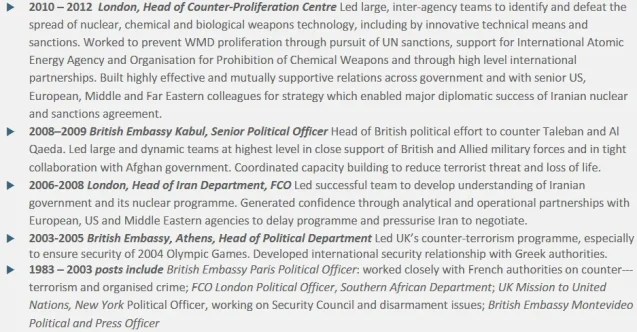
Nicholas Langman’s leaked CV
It was during the latter period that public and governmental attitudes across the West – and in vassal states – towards the Islamic Republic became highly belligerent, and negative. One by one, governments and international bodies – including the EU and UN – imposed ravaging sanctions against Tehran, devastating its economy, influence, and standing. MI6 journeyman Langman triumphed in his mission to foment concerted global hostility against Iran, based on the bogus spectre of the country posing a nuclear threat.
The question of whether British ‘intelligence’ on Iran’s nuclear program was the product of torture is an open and obvious one. Langman moved straight to leading MI6’s Iran Department from running the agency’s station in Athens, Greece. There, in late 2005, he was exposed by local media as having overseen an operation to abduct and ferociously mistreat 28 Pakistani guestworkers, wrongfully suspected of having had contact with individuals accused of perpetrating the 7/7 bombings in London in July that year.
That Langman wasn’t reprimanded over the incident strongly suggests he enjoyed a high level of protection, and London approved of his vicious intelligence-gathering methods – known to invariably produce false testimony from detainees. MI6 was not only an enthusiastic collaborator in the CIA’s global extraordinary rendition program, but led its own operations. Markedly, in at least one case, the British sought to sideline the CIA and ensure exclusive access to “intelligence” from a detainee in which Langley also had an interest.
The Obama administration was during its first year in office formally committed to non-interference in the Islamic Republic’s affairs, to the extent State Department apparatchik Jared Cohen was almost fired for publicly demanding Twitter halt planned maintenance during June 2009 protests in Iran, to ensure demonstrators could continue posting. It’s therefore unknown whether Washington was in on MI6’s Iran nuke con. If not, it wouldn’t be the first time British intelligence has misled the international community, with catastrophic results.
‘Possible Manipulation’
In July 2004, the Senate Intelligence Committee issued a scathing report on “the US intelligence community’s prewar intelligence assessments on Iraq.” It reserved particular disdain for how the CIA et al had “[relied] too heavily on foreign government services and third party reporting, thereby increasing the potential for manipulation of U.S. policy by foreign interests [emphasis added].” This was a reference to MI6’s central role in gathering – or concocting – intelligence on Baghdad’s purported WMD capabilities:
“Due to the lack of unilateral sources on Iraq’s links to terrorist groups like al-Qaida [redacted], the [US] Intelligence Community (IC) relied too heavily on foreign government service reporting and sources to whom it did not have direct access to determine the relationship between Iraq and [redacted] terrorist groups… The IC left itself open to possible manipulation by foreign governments and other parties interested in influencing US policy.”
As far back as the late 1990s, Britain’s foreign spying agency took the lead on sourcing dud ‘intelligence’ to manufacture consent for the against Baghdad. Under the auspices of a psychological warfare effort dubbed Operation Mass Appeal, MI6 black propaganda specialists circulated false information to foreign editors and reporters on its payroll “to help shape public opinion about Iraq and the threat posed by WMD,” which was then recycled by Western leaders and news outlets to reinforce its credibility.
In September 2002, then-MI6 chief Richard Dearlove personally approached British Prime Minister Tony Blair, claiming his agency had cultivated a source inside Iraq with “phenomenal access”, who could provide the “key to unlock” Iraq’s purported WMD program. Their assorted claims subsequently formed the basis of a dossier, which made a number of wild charges about Baghdad’s chemical and biological weapon capabilities. A prominently reported allegation was that Iraq could deploy WMD against Western countries within just 45 minutes. Its source was an Iraqi taxi driver.
This claim was repeated in a radio address by George W. Bush that month. In January the next year, as the invasion of Iraq rapidly loomed, the President declared in his State of the Union address, “the British government has learned that Saddam Hussein recently sought significant quantities of uranium from Africa.” That December, then-CIA chief George Tenet admitted this assertion was completely fallacious, and “these 16 words should never have been included in the text written for the President.”
The Zionist entity justified its unprovoked assault against Iran in June in large part on an intelligence dossier, which concluded the Islamic Republic had reached the “point of no return” in acquiring nukes. Its findings relied heavily on a May IAEA report that provided zero fresh information, but concluded Tehran supposedly maintained “undeclared nuclear material” until the early 2000s. While intended to trigger regime change, Tel Aviv’s broadside ended promptly in embarrassing failure, despite extensive foreign support, including US airstrikes.
Undeterred by the fiasco, Benjamin Netanyahu remains determined to crush the “Iranian axis”, while Trump has declared he would bomb Tehran “without a question” in response to indications the Islamic Republic has enriched uranium beyond agreed levels. We could be on the precipice of another war. As with the Iraq invasion, the perilous trail that brought us to this grave point could lead back to London. Yet again, MI6 may have taken the lead in concocting ‘intelligence’, justifying further US-Israeli aggression against the Islamic Republic.
September 24, 2025
Posted by aletho |
Deception, Timeless or most popular, Wars for Israel | IAEA, Iran, Israel, MI6, Sanctions against Iran, UK, United States, Zionism |
Leave a comment
Three months after the Israeli occupation state’s aerial assault on Iran, the Iranian government reached a new deal with the International Atomic Energy Agency (IAEA). The agreement, and the fact that IAEA chief Rafael Grossi and Iranian Foreign Minister Abbas Araghchi offered conflicting interpretations of it, has outraged Iranian political circles and the public, many of whom view Grossi as a facilitator of Israeli aggression. Araghchi is now accused of concealing details of the agreement and repeating the mistakes of the 2015 Joint Comprehensive Plan of Action (JCPOA) nuclear deal.
Iran signs surprise deal with IAEA after Israeli strikes
During a brief visit to Egypt on 12 September, Araghchi shook hands with Grossi as they announced a deal on the resumption of UN inspections of Iran’s nuclear program. The agreement was significant as Tehran had halted its cooperation with the IAEA in the wake of the Israeli aggression in June, and a parliamentary vote had suspended international inspections. The vote had been ratified after the cessation of the 12-day war between Iran and the occupation state in late June, amid accusations that the IAEA was sharing intelligence on their nuclear facilities and scientists with Israel and the US. Iranian officials claimed two IAEA inspectors smuggled classified documents on the Fordow nuclear site to Vienna. Iran revoked their licenses, but the agency took no punitive action. Fordow was later bombed by US B-52 bombers. Grossi’s 12 June report to the IAEA Board of Governors, which accused Iran of failing to meet its safeguards obligations, is widely seen as having paved the way for the 12-day Israel–Iran war that started one day after on 13 June. The agency’s refusal to condemn Tel Aviv’s attacks deepened Iranian distrust.
E3 pushes for sanctions as Iran tries to avoid snapback
As Iran withdrew from indirect nuclear talks with the US and halted cooperation with the IAEA, Germany, France, and Britain (the E3) announced their intention to reinstate UN sanctions. Those sanctions had been suspended under the 2015 JCPOA. The E3 said it would trigger the snapback mechanism before its expiry in mid-October, claiming that Iran had failed to uphold its commitments.
Seeking to avoid further sanctions, Iran agreed to engage the E3 in talks in late August. In exchange for Iranian cooperation with the IAEA, clarification on 440 kilograms of highly enriched uranium stockpiled before the Israeli attack, and a return to US negotiations, the Europeans offered to extend the snapback deadline by six months. Iran rejected the offer. The E3 then launched the snapback process but gave Iran a 30-day deadline to comply with the UN atomic watchdog’s demands. A week later, IAEA inspectors were scheduled to visit Iran to supervise fuel replacement at the Bushehr nuclear power plant. Araghchi reassured lawmakers that the Supreme National Security Council (SNSC) had authorized the inspectors’ visit and insisted all cooperation would comply with the law banning extensive IAEA engagement. A source close to the Iranian Foreign Ministry tells The Cradle that inspectors had also planned to visit other facilities, including the Tehran Research Reactor, but those plans were quietly scrapped under parliamentary pressure. Then, without warning, the Araghchi–Grossi agreement in Cairo was revealed, shocking Iranian society. The deal guarantees renewed Iranian cooperation with the IAEA.
Parliament sidelined, backlash intensifies
One day before Araghchi’s Cairo trip on 9 September, parliamentarian Hussein-Ali Haji-Deligani warned that a new IAEA deal was imminent – one that violated Iranian law and did not protect national rights. He warned Araghchi against signing or risking impeachment. Once news of the agreement broke, reports surfaced that the Iranian legislature, the Majlis, would close for three weeks for lawmakers to visit their constituencies. Critics alleged this was a calculated move to shield the Cairo agreement from scrutiny.
While the Foreign Ministry and the SNSC remained silent, Grossi publicly elaborated:
“The technical document would include access to all facilities and installations in Iran and contemplates the required reporting on all the attacked facilities including the nuclear material present at those and that will open the way for respective inspections and access.”
That statement drew sharp rebuke. Tehran MP Amir-Hussein Sabeti said, “This passive and weak settlement to renew cooperation with the IAEA contradicts national interests, paves the way for new [Israeli] strikes, and clearly violates the law.”
In a televised debate, Araghchi attempted to allay the criticism, claiming the deal was approved by the SNSC. He dismissed Grossi’s remarks as “his own interpretation of the text”, adding, “from now on, the IAEA should request access to each nuclear site and the SNSC will review the requests case by case.”
The Iranian top diplomat stressed that “as long as Iran has not implemented environmental and safety measures at the attacked facilities, the IAEA will not be granted permission to visit them.” He insisted the agreement had nothing to do with the E3’s ultimatum; nevertheless, he contradicted himself by stating, “This settlement will be declared null and void if the Snapback mechanism goes into effect.”
Araghchi faces mounting calls for impeachment
Araghchi’s inconsistent justifications failed to quell the backlash. His repeated references to the SNSC did little to calm MPs. And in Iranian politics, it is an unprecedented event. Tehran’s Hamid Rasaei posted on X, “Ambiguities remain despite Araghchi’s explanations. Therefore, the Foreign Ministry must publish the text of the agreement.” He added sarcastically, “We usually kept deals secret for fear of the enemies. But since the other party is Grossi – the Israeli spy – there’s no reason to hide this deal from the public.” His colleague, Kamran Ghazanfari, went further to threaten Araghchi, “either deny Grossi’s remarks and share the signed document with lawmakers, or get prepared for your impeachment. We are not treating our national interests flippantly.”
Keyhan newspaper openly called the Cairo deal “invalid” because it does not meet the requirements of the Iranian law. Rajanews compared the Cairo document with Lausanne’s nuclear deal, adding, “Back in 2015, the government of Hassan Rouhani and then FM [Mohammad Javad] Zarif refused to publish the relevant fact sheet. Only later, Iranians found out the fact sheet had imposed unprecedented restrictions on Iran’s nuclear program.”
As public scrutiny intensified, the Majlis National Security and Foreign Policy Committee summoned Araghchi for a closed-door session. He described the three-hour meeting as “very good and constructive” but revealed no details. According to reports, “Araghchi provided the committee with the text of the memorandum” and “it was decided that cooperation with the IAEA remain only in the framework of the law and its implementation depends on non-happening of the Snapback.” That reassurance did little to assuage critics. Rasaei summed up the mood with a blunt X post, “The three-hour session finished. It’s the JCPOA all over again.”
On 14 September, the SNSC issued a statement indicating that its Nuclear Committee had ratified the Cairo agreement, adding “the committee is backed by the SNSC whose decisions are confirmed by Iran’s leader [Ali Khamenei].” Yet, the statement also stressed that should any hostile action be taken against the Islamic Republic and its nuclear facilities, including the reinstatement of the terminated resolutions of the UN Security Council, the implementation of the arrangements would be suspended. So far, 90 lawmakers have asked Majlis Speaker Mohammad Bagher Ghalibaf to convene a session on the Cairo memorandum. Ghalibaf has yet to comply.
In a country still reeling from the JCPOA’s consequences, lawmakers are increasingly determined to block another unilateral, opaque agreement made without parliamentary oversight.
September 16, 2025
Posted by aletho |
Deception | France, Germany, IAEA, Iran, Israel, Sanctions against Iran, UK, Zionism |
Leave a comment
Iran, Russia, Belarus, China, Venezuela, and Nicaragua have submitted a draft resolution to the International Atomic Energy Agency (IAEA) calling for a ban on any attacks or threats against safeguarded nuclear sites.
The initiative of the six countries, titled Prohibition of all forms of attack and threats of attack against nuclear sites and facilities under IAEA safeguards, is meant to defend the integrity of the NPT, Iran’s Foreign Ministry spokesman Esmaeil Baqaei stated on X, in a reference to the Treaty on the Non-Proliferation of Nuclear Weapons.
The draft:
Stresses that all states have the right to peaceful nuclear energy and are entitled to guarantees against military threats;
*Reaffirms that no country should target another’s safeguarded nuclear facilities.
Baqaei urged the international community to act decisively, warning against the “normalization of lawlessness.”
September 16, 2025
Posted by aletho |
Nuclear Power, War Crimes | China, IAEA, Iran, Russia |
Leave a comment
Iran and the International Atomic Energy Agency (IAEA) officially agreed to resume cooperation on 9 September, following a suspension over Israel’s US-backed war against the country and its strikes on Iranian nuclear facilities.
The meeting between IAEA chief Rafael Grossi and Iran’s Foreign Minister Abbas Araghchi was hosted by Egypt.
“In Cairo today, I agreed with Iran’s Foreign Minister on practical modalities to resume inspection activities in Iran. This is an important step in the right direction,” Grossi said on X.
During a press conference between Grossi, Araghchi, and his Egyptian counterpart, the Iranian foreign minister said, “the development marks an important step in demonstrating the Islamic Republic’s goodwill and its commitment to resolving all issues related to its peaceful nuclear program through diplomacy and dialogue.”
“Iran has remained steadfast in defending its inalienable rights under the Nuclear Non-Proliferation Treaty (NPT) to peaceful nuclear energy, even while facing illegal and criminal attacks by the Israeli regime and the US, and has shown readiness to engage in meaningful dialogue for the implementation of its obligations,” he added.
US and Israeli strikes on the Islamic Republic have “fundamentally altered the conditions under which Iran had cooperated with the IAEA.”
As a result, a “new mechanism” has been reached after intensive talks between Iran and the IAEA recently, Araghchi said.
Unnamed diplomats cited by Reuters said “the devil was in the details, and neither Grossi nor Araghchi provided any.”
In early July, Tehran formally suspended cooperation with the IAEA. Talks between the two sides resumed the following month.
Iran stressed that it could not “completely end” its cooperation with the agency, but said “new conditions” would need to be reached.
The Iranian government had previously accused the agency of passing along sensitive information obtained from inspections over to Israel. It also said the agency paved the way for Israel’s war with its anti-Iran report in May and its resolution accusing Tehran of not fulfilling nuclear obligations, which was passed just one day before Tel Aviv attacked.
It also accused it of failing to properly condemn the attack on nuclear sites.
Officials even signaled potential legal action against Grossi himself, who was barred from entering the country in late June.
Sputnik – 10.09.2025
Iran has not yet given permission to IAEA inspectors to visit its nuclear facilities, despite an agreement to resume cooperation, Iranian Foreign Minister Abbas Araghchi said on Wednesday.
“I should note that under this agreement, we are currently not giving access to IAEA inspectors,” Araghchi said on Telelgram.
September 10, 2025
Posted by aletho |
Aletho News | IAEA, Iran, Sanctions against Iran |
Leave a comment


 Aletho News