IMF announces new $17.5bn bailout package for Ukraine
RT | February 12, 2015
The International Monetary Fund announced a new $17.5 billion lifeline for Ukraine, which would bring the total bailout package to $40 billion. The new sum would be a four-year program.
Lagarde will propose the $17.5 billion expansion program to the IMF by the end of the month.
“The program is not yet approved by the governing council. I hope to offer it for approval by the end of February,” she said Thursday.
“This new four-year arrangement would support immediate economic stabilization in Ukraine as well as a set of bold policy reforms aimed at restoring robust growth over the medium term and improving living standards for the Ukrainian people,” Lagarde said in a statement.
In return Ukraine will have to present a “program of deep economic reforms,” which includes the whole economy and a plan to transform Naftogaz, Ukraine’s state oil and gas company.
“It’s a large program, it’s a longer-term program than the previous one, which was a traditional SBA [Stand-By Arrangement] for two years,” the IMF chief said.
“It’s ambitious, it’s not without risk, but we believe it is a realistic set of macroeconomic framework, ambitious reforms, but reforms the authorities feel confident they can deliver,” Lagarde said.
IMF head Christine Lagarde didn’t answer the question as to whether the four-year international bailout program for Ukraine included credits from Russia.
“The sum includes funds from the IMF and the EU, and also bilateral and multilateral loans.”
Earlier this month, the US promised Ukraine as much as $2 billion in loan guarantees, while the EU said it would disburse €1.8 billion ($2.1 billion).
Boon to Ukraine’s economy
Ukraine’s Prime Minister Arseny Yatsenyuk stressed that the new bailout program would open sources for Ukraine to get help from other international organizations and partners, making the total sum thus $25 billion.
He confirmed the commitment to reforms that will stabilize Ukraine’s economy and finance. The country’s game plan includes fighting corruption, settling the energy sector, as well as cutting and optimizing state expenditure and increasing investment to 3 percent of the GDP, Yatsenyuk explained.
“Stabilization of the banking system and the exchange rate are also the goals of the program,” Yatsenyuk said.
“Recovery in confidence in Ukraine through the adoption of the 4–year program will be a major factor in the stabilization of the exchange rate, and an objective and strong banking system of Ukraine that will give the opportunity for Ukraine’s economy to develop,” he added.
Yatsenyuk said the government is also going to provide extensive assistance to low-income households. By the end of the year he expects it to include income indexation linked to the level of price rises. He also said the IMF program will provide $500 million for low-income families to help pay for increased energy bills.
READ MORE: IMF gives green light for $17 bn Ukraine aid package
The Corporate Takeover of Ukrainian Agriculture
By Frédéric Mousseau | IPS | January 27, 2015
OAKLAND, CA – At the same time as the United States, Canada and the European Union announced a set of new sanctions against Russia in mid-December last year, Ukraine received 350 million dollars in U.S. military aid, coming on top of a one billion dollar aid package approved by the U.S. Congress in March 2014.
Western governments’ further involvement in the Ukraine conflict signals their confidence in the cabinet appointed by the new government earlier in December 2014. This new government is unique given that three of its most important ministries were granted to foreign-born individuals who received Ukrainian citizenship just hours before their appointment.
The Ministry of Finance went to Natalie Jaresko, a U.S.-born and educated businesswoman who has been working in Ukraine since the mid-1990s, overseeing a private equity fund established by the U.S. government to invest in the country. Jaresko is also the CEO of Horizon Capital, an investment firm that administers various Western investments in the country.
As unusual as it may seem, this appointment is consistent with what looks more like a takeover of the Ukrainian economy by Western interests. In two reports – The Corporate Takeover of Ukrainian Agriculture and Walking on the West Side: The World Bank and the IMF in the Ukraine Conflict – the Oakland Institute has documented this takeover, particularly in the agricultural sector.
A major factor in the crisis that led to deadly protests and eventually to president Viktor Yanukovych’s removal from office in February 2014 was his rejection of a European Union (EU) Association agreement aimed at expanding trade and integrating Ukraine with the EU – an agreement that was tied to a 17 billion dollar loan from the International Monetary Fund (IMF).
After the president’s departure and the installation of a pro-Western government, the IMF initiated a reform programme that was a condition of its loan with the goal of increasing private investment in the country.
The package of measures includes reforming the public provision of water and energy, and, more important, attempts to address what the World Bank identified as the “structural roots” of the current economic crisis in Ukraine, notably the high cost of doing business in the country.
The Ukrainian agricultural sector has been a prime target for foreign private investment and is logically seen by the IMF and World Bank as a priority sector for reform. Both institutions praise the new government’s readiness to follow their advice.
For example, the foreign-driven agricultural reform roadmap provided to Ukraine includes facilitating the acquisition of agricultural land, cutting food and plant regulations and controls, and reducing corporate taxes and custom duties.
The stakes around Ukraine’s vast agricultural sector – the world’s third largest exporter of corn and fifth largest exporter of wheat – could not be higher. Ukraine is known for its ample fields of rich black soil, and the country boasts more than 32 million hectares of fertile, arable land – the equivalent of one-third of the entire arable land in the European Union.
The manoeuvring for control over the country’s agricultural system is a pivotal factor in the struggle that has been taking place over the last year in the greatest East-West confrontation since the Cold War.
The presence of foreign corporations in Ukrainian agriculture is growing quickly, with more than 1.6 million hectares signed over to foreign companies for agricultural purposes in recent years. While Monsanto, Cargill, and DuPont have been in Ukraine for quite some time, their investments in the country have grown significantly over the past few years.
Cargill is involved in the sale of pesticides, seeds and fertilisers and has recently expanded its agricultural investments to include grain storage, animal nutrition and a stake in UkrLandFarming, the largest agribusiness in the country.
Similarly, Monsanto has been in Ukraine for years but has doubled the size of its team over the last three years. In March 2014, just weeks after Yanukovych was deposed, the company invested 140 million dollars in building a new seed plant in Ukraine.
DuPont has also expanded its investments and announced in June 2013 that it too would be investing in a new seed plant in the country.
Western corporations have not just taken control of certain profitable agribusinesses and agricultural activities, they have now initiated a vertical integration of the agricultural sector and extended their grip on infrastructure and shipping.
For instance, Cargill now owns at least four grain elevators and two sunflower seed processing plants used for the production of sunflower oil. In December 2013, the company bought a “25% +1 share” in a grain terminal at the Black Sea port of Novorossiysk with a capacity of 3.5 million tons of grain per year.
All aspects of Ukraine’s agricultural supply chain – from the production of seeds and other agricultural inputs to the actual shipment of commodities out of the country – are thus increasingly controlled by Western firms.
European institutions and the U.S. government have actively promoted this expansion. It started with the push for a change of government at a time when president Yanukovych was seen as pro-Russian interests. This was further pushed, starting in February 2014, through the promotion of a “pro-business” reform agenda, as described by the U.S. Secretary of Commerce Penny Pritzker when she met with Prime Minister Arsenly Yatsenyuk in October 2014.
The European Union and the United States are working hand in hand in the takeover of Ukrainian agriculture. Although Ukraine does not allow the production of genetically modified (GM) crops, the Association Agreement between Ukraine and the European Union, which ignited the conflict that ousted Yanukovych, includes a clause (Article 404) that commits both parties to cooperate to “extend the use of biotechnologies” within the country.
This clause is surprising given that most European consumers reject GM crops. However, it creates an opening to bring GM products into Europe, an opportunity sought after by large agro-seed companies such as Monsanto.
Opening up Ukraine to the cultivation of GM crops would go against the will of European citizens, and it is unclear how the change would benefit Ukrainians.
It is similarly unclear how Ukrainians will benefit from this wave of foreign investment in their agriculture, and what impact these investments will have on the seven million local farmers.
Once they eventually look away from the conflict in the Eastern “pro-Russian” part of the country, Ukrainians may wonder what remains of their country’s ability to control its food supply and manage the economy to their own benefit.
As for U.S. and European citizens, will they eventually awaken from the headlines and grand rhetoric about Russian aggression and human rights abuses and question their governments’ involvement in the Ukraine conflict?
Frédéric Mousseau is the Policy Director at the Oakland Institute.
IMF Policies Blamed for Rapid Ebola Spread in West Africa
teleSUR | December 23, 2014
Strict public spending cuts imposed by the International Monetary Fund (IMF) on Guinea, Liberia and Sierra Leone may have contributed to the rapid spread of Ebola in these countries, according to Cambridge University researchers.
“A major reason why the Ebola outbreak spread so rapidly was the weakness of healthcare systems in the region,” said Cambridge sociologist Alexander Kentikelenis, lead author of the study that appeared in the latest issue of medical journal The Lancet.
“Policies advocated by the IMF have contributed to underfunded, insufficiently staffed and poorly prepared health systems in the countries with Ebola outbreaks,” added Kentikelenis.
The first cases of the deadly virus were discovered in Guinea earlier this year, but quickly spread to neighboring Liberia and Sierra Leone. The three countries have been the worst affected by the epidemic, both in terms of lives lost and the damages to their already fragile economies.
According to the researchers, all three countries have been receiving aid from the IMF since the 1990s. However, the lending came with what the IMF calls “conditionalities” that required all three governments “to adopt policies that favor short-term economic objectives over investment in health and education,” reads the report.
Kentikelenis told the BBC that IMF imposed government spending cuts and caps on wages meant countries could not hire health staff and pay them adequately. He also added that the IMF emphasizes and supports decentralized health care systems, which made it harder to mobilize a coordinated response to the virus outbreak.
The IMF denied all accusations in a press release, and called them “factual inaccuracies.”
As of Dec. 21, at least 7,580 people have died from Ebola in six countries: Liberia, Guinea, Sierra Leone, Nigeria, the United States and Mali, making it the worse outbreak of the virus since it was first identified in 1976 in what is now the Democratic Republic of the Congo.
BRICS create new Development Bank as well as a $100 billion foreign currency reserves pool
By Helmo Preuss | The BRICS Post | July 15, 2014
Fortaleza, Brazil – After some tough rounds of negotiations, BRICS nations (Brazil, Russia, India, China and South Africa) have created not only a new $100 billion Development Bank, but also a $100 billion foreign currency reserves pool.
The announcement was made after a plenary meet of the five BRICS heads of state in Fortaleza on Tuesday.
Shanghai finally won the bid to host the Bank while India will get the presidency of the Bank for the first six years. The Bank will have a rotating chair. The Bank will also have a regional office in Johannesburg, South Africa. All the five countries will have equal shareholding in the BRICS Bank.
The five Finance Ministers will constitute the Bank’s board which will be chaired by Brazil.
The Bank will initially be involved in infrastructure projects in the BRICS nations.
The authorized, dedicated and paid in capital will amount to $100 billion, $50 billion and $10 billion respectively.
The idea of the BRICS Bank was proposed by India during the 2012 Summit in New Delhi.
BRICS have long alleged that the IMF and World Bank impose belt-tightening policies in exchange for loans while giving them little say in deciding terms. Total trade between the countries is $6.14 trillion, or nearly 17 percent of the world’s total. The last decade saw the BRICS combined GDP grow more than 300 per cent, while that of the developed word grew 60 per cent.
Apart from the new development Bank, the group of five leading emerging economies also created a Contingency Reserve Arrangement on Tuesday.
BRICS central banks will keep their reserves in gold and foreign currencies.
China will fund $41 billion, Brazil, India and Russia $18 billion each and South Africa with $5 billion. The funds will be provided according to a multiple. China’s multiple is 0.5, which means that if needed, the country will get half of $41 billion. The multiple is 2 for South Africa and 1 for the rest.
BRICS Finance ministers or central banks’ governors will form a governing body to manage the CRA while it will be presided over by the BRICS President.
The BRICS CRA will not be open to outsiders.
Meanwhile, at the Summit in Fortaleza, Russian President Vladimir Putin said BRICS must form an energy alliance.
“We propose the establishment of the Energy Association of BRICS. Under this ‘umbrella’, a Fuel Reserve Bank and BRICS Energy Policy Institute could be set up,” Putin said on Tuesday.
Ukrainians Get IMF’s Bitter Medicine

By Robert Parry | Consortium News | April 2, 2014
It’s a safe bet that most of the Ukrainians who flooded Maidan Square in Kiev in February did not do so because they wanted the International Monetary Fund to make their lives even more miserable by slashing subsidies for heat, gutting pensions and devaluing the currency to make everyday goods more expensive.
But thanks to the U.S.-backed coup that ousted elected President Viktor Yanukovych and replaced him with a regime including far-right parties, super-rich ”oligarchs” and technocrats with little sympathy for the suffering of average people, that’s exactly what happened. Although lacking legitimacy that would come from national elections, the coup regime pushed through the demands of the Washington-based IMF.
The process began just 10 days after the violent Feb. 22 coup that forced Yanukovych to flee for his life. IMF officials landed in Kiev on March 4 to hammer out a deal that acting Prime Minister Arseniy Yatsenyuk, himself a chilly bank technocrat, has acknowledged is “very unpopular, very difficult, very tough.”
What is also striking about the IMF plan is that it puts virtually all the pain on average Ukrainians. There is nothing in the economic “reform” package that extracts some of the ill-gotten gains from Ukraine’s ten or so “oligarchs,” the multimillionaires and even billionaires who largely plundered Ukraine’s wealth after the collapse of the Soviet Union in 1991.
There is no plan for demanding that these “oligarchs” kick in some percentage of their net worth to help their own country. Instead, hard-pressed citizens of the United States and Europe are expected to carry the financial load.
The U.S. Congress voted by large bipartisan majorities to have the American taxpayers provide $1 billion in aid to Ukraine’s coup regime. Further, the IMF predicts that its $18 billion in loan guarantees could generate up to $27 billion from the international community over the next two years.
Though the IMF plan includes some promises about fighting corruption, there is no requirement that the West’s billions of dollars will go toward government programs that might actually strengthen Ukraine and help the average Ukrainian by putting the jobless to work. Nothing about upgrading the infrastructure or providing improved educational opportunities, better health care and other programs that might reduce some of Ukraine’s social pressures and make it a more viable nation.
For instance, investing in roads and rail could make Ukraine a more attractive investment opportunity for agricultural corporations eying the country’s rich soil which historically has made it the breadbasket for much of Central and Eastern Europe.
Cookie-Cutter Approach
Instead, the IMF has applied its usual cookie-cutter approach toward a troubled nation: reduce public spending, slash social programs, eliminate energy subsidies, devalue the currency, raise taxes, impose triggers for more austerity if inflation rises, etc.
Some economists project that the cumulative impact of the IMF “reforms” could result in a 3 percent contraction of Ukraine’s already depressed economy, which fell into a severe recession after the Wall Street crash of 2008 and has been inching along at almost zero growth the past two years. But Yatsenyuk warned parliament that the drop in the GDP could be more like 10 percent if corrective actions were not taken.
But those actions will inflict more hardship on the Ukrainian people — their “99 percent” — while giving Ukraine’s “1 percent” pretty much a pass. Yet, beyond fairness, there’s also the question of the legitimacy of the coup regime taking on new debt obligations without the consent of the Ukrainian people.
After the violent ouster of elected President Yanukovych on Feb. 22 — after he rejected the IMF’s terms – the post-coup parliament cobbled together a new government which involved handing out four ministries to far-right parties whose armed neo-Nazi militias had spearheaded the coup.
Yatsenyuk was the personal choice of U.S. Assistant Secretary of State for European Affairs Victoria Nuland to lead the new regime. Weeks before the coup, Nuland was caught discussing with U.S. Ambassador to Ukraine Geoffrey Pyatt who should serve in a new government. Nuland said in a phone call to Pyatt that was intercepted and posted online that “Yats is the guy” — and he was installed as prime minister once Yanukovych was gone. [See Consortiumnews.com’s “What Neocons Want from Ukraine Crisis.”]
Ukraine’s parliament has set a presidential election for May 25, and protesters in the Maidan also sought quick parliamentary elections. But Western diplomats have been urging a delay in the parliamentary balloting as well as postponement of the most onerous IMF provisions until after the May 25 vote. That way the election will have come and gone before the beleaguered Ukrainians truly understand how painful the IMF austerity will be.
As the New York Times reported, “Senior Western officials said on [March 26] that the loans from the United States and from the I.M.F. would be structured to get the government through its first few months without undue political upheaval, putting off some of the more difficult changes until after the May election. The West has also chosen not to press for early parliamentary elections, one senior official said, because ‘the priority now is stabilization in Kiev and de-escalation with Moscow.’”
Given such bleak economic prospects — and evidence of Western manipulation of the political process – is it any wonder that more than 90 percent of the voters in Crimea opted to leave Ukraine and rejoin Russia?
Investigative reporter Robert Parry broke many of the Iran-Contra stories for The Associated Press and Newsweek in the 1980s. You can buy his new book, America’s Stolen Narrative, either in print here or as an e-book (from Amazon and barnesandnoble.com).

Ukraine parliament passes austerity bill required by IMF
RT | March 28, 2014
The Ukrainian parliament has adopted an anti-crisis bill proposed by the IMF to secure an international financial aid package. Ordinary Ukrainians will have to tighten their belts to help the coup-installed government keep the collapsing economy afloat.
It took two readings of the bill for 246 MPs out of 321 registered to approve the austerity measures outlined in the legislation dubbed “On prevention of financial catastrophe and creation of prerequisites for economic growth.”
Ahead of the vote, Ukrainian self-imposed Prime Minister Arseny Yatsenyuk told the Parliament that it had “no other choice but to accept the IMF offer,” as country fiscal gap in 2014 is projected to reach $26 billion. Ukraine’s Finance Ministry says it needs $35 billion over the next two years to avoid default.
“The country is on the edge of economic and financial bankruptcy,” Yatsenyuk said. “This package of laws is very unpopular, very difficult, very tough. Reforms that should have been done in the past 20 years.”
It is ordinary Ukrainians who will suffer the most under the new austerity measures as the floating national currency is likely to push up inflation, while spike in domestic gas prices will impact every household. Under the IMF conditions Kiev has to cut the budget deficit, increase retail energy tariffs, and shift to a flexible exchange rate.
The state-owned energy company Naftogaz already said that it will increase household gas prices by 50 percent starting May 1, while utility companies will see a 40 percent rise as of July. According to estimates, this year Ukraine’s economy will contract by 3 percent while inflation will rise to 14 percent. The government is not planning to raise minimum wages in response to inflation.
The law adopted on Thursday, in particular, introduces a permanent application of the basic rate of corporate income tax at 18 percent and VAT at 20 percent, according to RBC-Ukraine. The government will also cancel the VAT refund for grain exporters.
The bill also introduces a 15 percent tax rate on pension payments if they exceed 10 thousand hryvnas (about $900). This tax, however, won’t really hurt an ordinary Ukrainian pensioner since an average pension in Ukraine is $160 – which may be further cut by 50% for those still working.
A progressive personal income taxation scale has also been installed to charge individuals 15, 17, 20 and 25 percent depending on their earnings. Those persons who make over 1 million hryvnas will be charged 25 percent income tax.
Car enthusiasts will also suffer as taxes on new cars and motorcycles with engine capacity exceeding 0.5 liters will also be doubled. Those who shop online and use overseas retailers will now see lowering of the limit on tax-free imports from 300 to 150 euros.
Excise taxes on alcohol and tobacco will also go up. In 2014 spirits price will see a 39 percent increase, while tobacco products will see a rise of 31.5 percent. Beer lovers will suffer the most with a 42.5 percent rise.
The legislation also reduces the total number of personnel in law enforcement agencies. Almost 80,000 people will be dismissed in the Ministry of Internal Affairs, Security Service, the Office of the State Guard, and the prosecutor’s office.
The International Monetary Fund has agreed to throw Ukraine’s sinking economy a lifeline provided the country adopts severe austerity measures. According to a preliminary agreement announced by the IMF, it would provide Kiev between $14 and $18 billion in loans over the next two years. Pending final approval by the IMF’s board, Ukraine could get their hands on the first installment as early as April.
“The mission has reached a staff-level agreement with the authorities of Ukraine on an economic reform program that can be supported by a two-year Stand-By Arrangement (SBA) with the IMF,” the Fund said in a press release.
A successful deal with the IMF is expected to unleash further $10 billion in loans from other international partners, including the EU and the US. The World Bank is also considering the possibility of providing Ukraine with $1 to $3 billion. Canada, Japan and Poland are also contemplating financial aid.
“The financial support from the broader international community that the program will unlock amounts to US$27 billion over the next two years. Of this, assistance from the IMF will range between US$14-18 billion, with the precise amount to be determined once reforms are in place,” the IMF said.
In Washington, both the Senate and House of Representatives passed a bill on Thursday to provide a $1 billion loan guarantee aid to Ukraine. In addition the Senate bill includes $50 million for democracy building and $100 million for enhanced security cooperation.
“This significant support will help stabilise the economy and meet the needs of Ukrainian people over the long term because it provides the prospect for true growth,” US President Barack Obama said in Rome.
Despite the promised injection of cash into Ukraine, Nikolay Gueorguiev, IMF Mission Chief for Ukraine said that “Nonetheless, the economic outlook remains difficult, with the economy falling back into recession,” he said cited by Kyivpost. “With no current market access, large foreign debt repayments loom in 2014-2015.”
World Bank and IMF Forecasts Follow Predictable Pattern for Haiti, Venezuela
By Arthur Phillips and Stephan Lefebvre | CEPR Americas Blog | January 28, 2013
The World Bank has joined the “doom and gloom” chorus on Venezuela’s economy. And in Haiti, the Washington-based institution again appears overly optimistic.
On Tuesday, January 15, the World Bank released its latest global economic forecast, which projects 2013 global GDP growth at 3.4%, up 0.4% from its preliminary estimate for 2012 and down a half a percentage point from its previous forecast in June. The Bank emphasized that the low rates were largely a result of sluggish growth in the U.S. and Europe. As for Latin America and the Caribbean, the regional predicted growth for 2013 is listed at 3.6%, up more than half a point from the estimated figure for 2012.
As with many media commentators over the past few years, the World Bank predicts that Venezuela’s economic recovery from the global recession cannot hold up. The Bank forecasts 1.8% growth in 2013, a sharp drop from an estimated 5.2% last year. Since the Venezuelan economy is not slowing, there is no obvious reason to predict a collapse in economic growth.
Furthermore, we can see that the projection numbers follow a trend. Both the World Bank and the IMF have been consistently underestimating growth projections in Venezuela.


Meanwhile, in Haiti the Bank predicts a sharp jump in GDP growth, from 2.2 to 6.0 percent, while the IMF has forecast growth at 6.5%. When we compare these numbers to those of previous years, we can see the opposite trend of that in Venezuela. All the projections for 2012 overestimated growth by well over 5 percentage points.


It is unclear why both the IMF and the World Bank have projected such high growth for Haiti considering the many severe challenges facing the country in the wake of the 2010 earthquake. As we have noted on an ongoing basis over the past three years, major international donor funding has been slow to materialize, progress on housing, water, sanitation and other infrastructure has been minimal, and there have been few examples of improvements that would suggest an upsurge in growth is on its way. There has been even more bad news in the wake of Hurricane Sandy at the end of October, which devastated crops and left 2.1 million people “food insecure.” The World Bank and IMF’s projections of 6 percent or higher GDP growth in 2013 seem unfounded.
The IMF’s pessimistic growth projections for Venezuela fit a pattern going back several years. GDP growth forecasts for Argentina were off by 5.0, 5.2, and 4.3 percentage points for the years 2004-2006, and for Venezuela they were off bya gigantic 10.6, 6.8 and 5.8 percentage points in the same years. These patterns suggest a politicization of the IMF’s projections for certain countries, since the Fund was consistently overly optimistic on Argentina’s growth in the years that the Argentine government was still following the IMF’s policy recommendations.
Related articles
UK changes position on IMF loan for Morsi’s Egypt
British officials refrain from giving full backing to Egypt’s $4.8 billion loan request, having previously supported such funding under military rule
By Amer Sultan | Ahram Online | August 25, 2012
London – The United Kingdom has refrained from backing Egypt’s request of a $4.8 billion loan from the International Monetary Fund (IMF).
“We prefer to wait and see the results of the negotiations between Egypt and the IMF,” a UK Foreign Office spokesperson told Ahram Online.
During her recent visit to Cairo, the IMF’s managing director, Christine Lagarde, received a formal request from Egypt for a $4.8 billion loan.
“The UK thinks that this is a good opportunity for dialogue between the two parties,” the spokesperson added.
Asked whether the UK would back the Egyptian request if the IMF board decides in its favour, the spokesperson replied: “We do not have anything to say for the time being.”
The UK’s caution seems to mark a significant change in its attitude towards Egypt’s calls for international assistance to overcome its economic difficulties.
The UK provides 5 per cent of the IMF budget, making it the fourth biggest contributor, with equivalent voting power. It follows the US (18 per cent), Germany (6 per cent) and Japan (6 per cent).
Early this year, the UK government was enthusiastic about an IMF offer of a $3.2 billion loan at a 1.5 per cent interest during Egypt’s period of direct military rule.
A high level UK diplomat then told Ahram Online that the offer was “an amazingly good deal” with “virtually no conditionality.”
UK support at the time followed a meeting of British representatives with the Supreme Council for Armed Force (SCAF), which until July 2012 had veto power on all political decisions.
The diplomat explained that his government felt the deal the IMF put to Egypt was very favourable.
Speaking this week, the Foreign Office spokesperson insisted there was no change in the UK positions on the IMF loan after President Morsi took the reins of power from SCAF.
During her visit to Egypt last Wednesday, Lagarde met Morsi and his prime minister Hesham Kandil, and praised the Egyptian vision for reform.
“We are impressed by the strategy that President Morsi and Prime Minister Kandil have proposed during our meetings today,” she said at a joint press conference with Kandil.
An IMF technical team is due to arrive in Cairo in early September to begin work on arrangements for the mooted loan.
“We prefer foreign borrowing at this stage given the low interest rate of the IMF loan compared to much higher rates when borrowing domestically,” said Kandil, on the matter.
He added that borrowing domestically would crowd out the private sector and the IMF loan would help ease liquidity problems.
The IMF said in a statement it had maintained close dialogue on economic policy with Egyptian authorities since the start of the transition period in February 2011. It said it has also provided considerable technical assistance upon request from the government.
Related articles
- Egypt requests $4.8bn IMF loan (alethonews.wordpress.com)
- IMF hopes to sink claws into Egypt (morningstaronline.co.uk)
- Egypt to get IMF technical team in September, says Managing Director Christine Lagarde (bikyamasr.com)
Egypt requests $4.8bn IMF loan
Al Akhbar | August 22, 2012
Egypt has formally requested a $4.8 billion loan from the International Monetary Fund, a spokesman for its president said on Wednesday during a visit to Cairo by IMF chief Christine Lagarde to discuss support for the country’s ailing economy.
Egypt’s finance minister said last week Cairo would discuss the possibility of the bigger-than-expected loan from the fund. Egypt’s previous government had requested a $3.2 billion package but the deal was not finalized.
Lagarde’s presence was requested by Egypt and could signal a fresh determination on both sides to iron out a loan after President Mohammed Mursi, who took office on June 30, appointed his first government last month.
“We have officially requested a $4.8 billion loan from the IMF and talks are currently going on inside about the request,” spokesman Yasser Ali told Reuters as Lagarde held discussions with Mursi. He said any details would be announced later.
An IMF official also confirmed the request had been made.
During 18 months of political turmoil since the overthrow of autocratic leader Hosni Mubarak, successive Egyptian governments negotiated with the IMF to secure emergency funding.
The Muslim Brotherhood was originally skeptical of the IMF loan, which it feared would undermine Egypt’s sovereignty by keeping it indebted to the IMF.
The IMF has a track record of failed policies in a number of developing countries, including Argentina and a number of African countries.
Sections of Egypt’s political and economic elite fear IMF involvement in resuscitating Egypt’s economy might in fact worsen the situation even further, as previously seen throughout Africa.
But Egypt’s fiscal and balance of payment problems have worsened, prompting the Muslim Brotherhood to surrender its opposition to the deal.
An exodus of foreign investors in the wake of the turmoil left local banks shouldering much of the short-term and other lending to the state. The government has also borrowed directly from the central bank.
Foreign reserves have fallen to well under half levels seen before last year’s popular uprising against Mubarak and investors’ reluctance to return is born partly of fears that a sharp currency devaluation could wipe out any returns.
(Al-Akhbar, Reuters)
Related articles
- IMF chief in Egypt for loan talks (oddonion.com)
- Egypt seeks up to $4.8bln IMF loan (rt.com)
- Qatar loans Egypt $2 billion for struggling economy (bikyamasr.com)
Featured Video
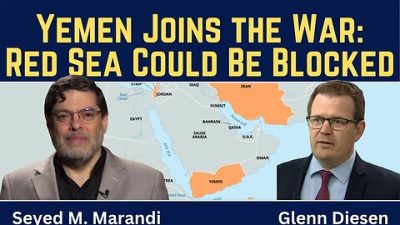
Yemen joins the war – Red Sea could be blocked next – Saudi regime at risk
or go to
Aletho News Archives – Video-Images
From the Archives
A superpower and “the world’s sickest warrior state”
By Paul J. Balles | March 8, 2010
Living through five or six major wars has hardened me to what I thought were the extremes of inhuman cruelty and brutality.
Two things made those extremes almost bearable: the brutality always revealed – at least according to the media coverage – the viciousness of the enemy. It was therefore quite understandable when our “brave men and women” pulverized the enemy.
Films of Japanese torturing captive Americans somehow justified holding Japanese Americans in internment camps during World War II; and only a small percentage of Americans found the bombing of Hiroshima and Nagasaki unreasonably vengeful at best, at worst, depraved.
The media giants in America portrayed the North Koreans as barbaric beasts with their captives, quite unlike their southern counterpoints – our allies during the Korean War. No one ever felt the need to explain how the South Koreans were a civilized breed while the North Koreans were absolute savages, at least according to the official line.
In Vietnam, our warriors justifiably (or so the media made us believe) dropped napalm on the North Vietnamese who had the gall to hide in villages and tunnels to ravage our invaders. At least it was accepted practice until some rogue photojournalist filmed a young girl screaming down a Vietnamese road in flames. … continue
Blog Roll
 Aletho News
- Russian tanker approaches Cuba despite US oil blockade
- Marandi: Yemen joins the war – Red Sea could be blocked next – Saudi regime at risk
- Pro-Palestinian French member of European Parliament denied entry to Canada
- Pakistan to Host US-Iran Talks
- How Indonesia’s tilt toward the US left it stranded in the Strait of Hormuz
- US has no choice but to retreat from Iranian borders: Top commander
- Iran Retaliation Strikes Chemical Plant Near Dimona
- AWACS’ Destruction is a Major Loss for US Military – Ex-DoW Analyst
- Israel’s Iran Strategy Uses US Military & Gulf States as Its Pawns
- Iran: Trump wanted regime change, now just begging for Hormuz to open
- If Americans Knew
- Israeli police block Catholic cardinal from entering Church of the Holy Sepulchre on Palm Sunday
- Israel is assassinating journalists again, more than any other nation, anywhere, ever – Not a ceasefire Day 170
- Over 300 US service members wounded, majority have brain injuries – Not a ceasefire Day 169
- Researchers at Human Rights Watch Resign Over Blocked Report on Palestinian Refugee Return
- Jewish Groups Are Backing a War Americans Don’t Want
- Eric Fingerhut Thinks He’s the President of the Jews
- Top Jewish Philanthropists, Rabbis Urge Israeli President to Take Action Against ‘Jewish Extremists’
- Don’t Be Fooled. Zionist Leaders Have Always Wanted to Control Southern Lebanon
- Israel’s widespread use of torture is a core element of its genocide against the Palestinian people
- In Israel’s War on Iran, Many Middle East US Bases Rendered “All But Uninhabitable”
- No Tricks Zone
- German Science Blog Accuses PIK Climate Institute Of Hallucinating Climate Tipping Points
- Devastating Assessment Of Comirnaty Vaccine By Former Senior Pfizer Europe Toxicologist
- New Study: CO2 Is ‘Effectively Negligible’ As An Explanatory Climate Change Factor Since 2000
- Former Pfizer Toxicologist Dr. Helmut Sterz Tells Bundestag Hearing Pfizer Vaccine Should Have Never Been Approved
- Energy Expert: Germany’s Nuclear Phaseout Was A “500 Billion Euro Mistake”
- New Research: South Australia’s Mid-Holocene Sea Surface Temperatures Were 4°C Warmer Than Today
- Storing Green Energy To Last Germany 10 Days Would Require A 60-Million Tonne Battery
- New Studies: UK Sea Levels Were 4 Meters Higher Than Today During The Mid-Holocene
- Destructive Green New Deal: German Energy And Metal Group Warns Of Drastic Crisis
- New Study Documents A 20-Year Pause In Arctic Sea Ice Decline – Driven By Internal Variability
 Aletho News