Russia Will Keep Up The Pace Of Oil Exports To India Despite Increased Chinese Demand
By Andrew Korybko | March 1, 2023
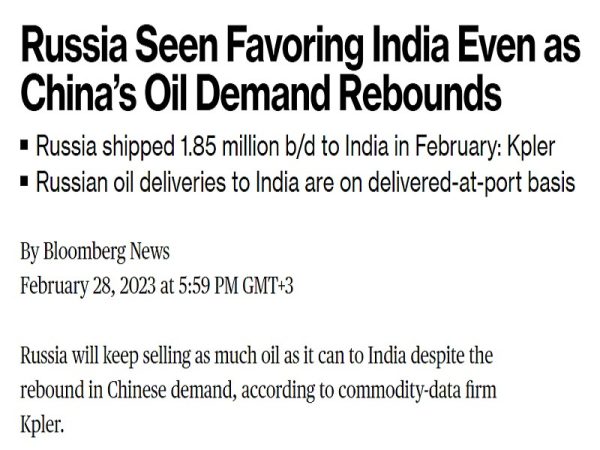
Bloomberg’s points in support of this observation are purely economic and overlook the strategic dimension of Russia’s discounted oil exports to India, which will be explained in the present piece.
Bloomberg published a piece on Tuesday about how “Russia Seen Favoring India Even as China’s Oil Demand Rebounds”, which cites lead crude analyst Viktor Katona from commodity-data firm Kpler. According to him, “While China could ‘buy literally the entire Russian oil exports’ as it abandons Covid-zero policies, Russia will want to keep the Indian market because it is more lucrative and gives its crude sellers greater control.”
Katona is also quoted as adding that “Chinese refiners may want to buy more Russian crude this year, but they also have the capacity to do their own shipping. That would deprive Moscow of income from the ‘parallel gray fleet’ of tankers it has established to deliver crude to India.” While these are all valid points in support of his prediction, they’re purely economic and overlook the strategic dimension of Russia’s discounted oil exports to India, which will now be explained.
First, India’s unprecedentd scaling of Russian oil imports over the past year since the start of the latter’s special operation preemptively averted Moscow’s potentially disproportionate dependence on China and continues to do so into the present.
Second, the Kremlin will never forget the aforementioned strategic favor that India did for Russia at its most sensitive moment in decades, hence why it’s inclined to keep up the pace of its discounted exports to that country as a way of thanking it for this.
Third, the Kremlin is cognizant of the fact that there must be tangible benefits for India in continuing to defy Western pressure upon it to dump Russia, so keeping up the pace of oil exports to it incentivizes India to continue its pragmatic policy of principled neutrality towards the Ukrainian Conflict.
Fourth, their newfound energy relations also served Russia’s grand strategic goal of accelerating India’s rise as a globally significant Great Power.
That last-mentioned outcome advances the global systemic transition’s ongoing evolution towards tripolarity ahead of its final form of more complex multipolarity (“multiplexity”), which serves both of their interests. And finally, the larger dynamics connected to the aforesaid development is that it helps break the Sino-American bi-multipolar superpower duopoly that previously characterized International Relations, thus greatly enhancing Russia and India’s strategic autonomy in the New Cold War.
Altogether, these strategic motivations ensure that Russia won’t increase oil exports to China at the expense of the level at which it’s presently supplying India. Observers should always keep them in mind since they prove that the Russian-Indian Strategic Partnership is premised on their shared goal of accelerating the global systemic transition and not on deriving opportunistic economic benefits like Bloomberg implied is supposedly the case when it comes to their current energy ties.
Blinken hopes to derail India’s relationship with Russia following Scholz’s failure
By Ahmed Adel | March 1, 2023
With Russia’s military operation in Ukraine evidently destroying NATO’s ambitions, Washington is becoming increasingly frustrated that Moscow has not been isolated. Russia did not economically collapse, as was predicted in the West, partly because of the robust and longstanding relationship it has with India. It is unsurprising that in only a matter of days, Germany and the US have pressured India to capitulate their sovereignty and serve Western interests instead of their own.
German Chancellor Olaf Scholz sought assurances from India on February 25 that it would not only refuse to block, but also support efforts to isolate Russia. Following his talks with Indian Prime Minister Narendra Modi, the chancellor refused to reveal what exactly they discussed in relation to Ukraine.
Although the contents of the discussion were cited as being confidential in nature, it is likely that Scholz did not want to humiliatingly admit that India refused to step back from its tried and tested relationship with Russia. Scholz did reveal though that he and Modi had discussed the war in Ukraine “very extensively and very intensely.”
It is noted that this trip was Scholz’s first official visit to India but his fourth meeting with Modi since taking office in 2021. Although they also discussed ways to boost economic cooperation, including through a free trade agreement between the European Union and India, it cannot be overlooked that US Secretary of State Antony Blinken arrived in New Delhi only days after Scholz.
Days before arriving in the Indian capital, Blinken said that countries like India, which have not joined the West in denouncing Russia’s military operation, were on a supposed trajectory away from alignment with Moscow. He stressed that the process would not occur “in one fell swoop.”
“There are countries that have long-standing, decades-long relationships with Russia, with the Soviet Union before, that are challenging to break off in one fell swoop. It’s not flipping a light switch, it’s moving an aircraft carrier,” Blinken said in an interview with The Atlantic on February 24.
However, for all of Blinken’s claims that India is moving away from Moscow, there is no actual suggestion that this is occurring. The US and India cooperate through the QUAD format, a naval bloc aimed against China, but this has not meant India’s submission to Washington, as the Americans evidently anticipated.
Although India has faced sustained and continued pressure from the West to distance itself from Moscow, New Delhi has thus far resisted, citing its longstanding ties with Russia and its economic and oil interests. It cannot be overlooked that Russia has been India’s largest weapons supplier since the Cold War-era, particularly since the US traditionally favoured Pakistan.
However, Washington in recent years has looked to turn New Delhi away from its main military supplier (but without wanting to adjust its policy to Pakistan).
“India for decades had Russia at the core of providing military equipment to it and its defences, but what we’ve seen over the last few years is a trajectory away from relying on Russia and moving into partnership with us and other countries,” Blinken said, without mentioning the fact that India is moving towards home-grown production, something that Russia is playing a key role in.
None-the-less, it is expected that Blinken, in the same way as Scholz, will try and convince India to change course regarding its ties with Russia.
As Bloomberg reported, citing Kpler’s lead crude analyst, Viktor Katona, “India purchased almost no Russian oil a year ago, but has become a crucial market after the US and European Union imposed sanctions on Moscow. The Asian country imported around 1.85 million barrels a day from Russia in February, close to its potential maximum of about 2 million barrels a day.”
The cold hard facts are that Moscow and New Delhi have a longstanding relationship that India will not break just for the sake of serving Western interests. Beyond the time-tested security ties, Russia offers energy hungry India the best deal for oil, something that will not be sacrificed because of a far-off war in Eastern Europe.
According to QUARTZ, India has in less than a year saved an estimated $3.6 billion by increasing Russian oil imports. This is a significant amount for a country that depends on imports to meet 85% of its petroleum needs.
It is recalled that in November 2022, Indian Foreign Minister S Jaishankar said “Russia has been a steady and time-tested partner. Any objective evaluation of our relationship over many decades would confirm that it has actually served both our countries very, very well.”
With this statement, he effectively confirmed a continuance of the current policy despite sustained pressure – a pressure that Scholz and Blinken are the latest to apply. They are however also the latest that were unable to convince New Delhi to change its policy regarding Russia.
Ahmed Adel is a Cairo-based geopolitics and political economy researcher.
Why Western Sanctions Against Russia Failed
By Simes Dimitri – Sputnik – February 24, 2023
Sanctions were meant to deliver a swift and devastating blow to the Russian economy, one that would take years to recover from. Much to the dismay of Western politicians, however, not only did Russia survive the sanctions storm, but it has the potential to emerge even stronger than before.
During a speech in Poland last year, US President Joe Biden boasted that sanctions had reduced the Russian ruble to “rubble” and confidently predicted that the Russian economy was on “track to be cut in half.” French Finance Minister Bruno Le Maire went even further, declaring that the West would bring about Russia’s economic “collapse.”
“We are waging total economic and financial war on Russia,” he told a French broadcaster last March. “The economic and financial balance of power is totally in favor of the European Union, which is in the process of discovering its own economic power.”
Despite these loud promises, the Russian economy contracted by a mere 2.5 % last year – a decline considerably smaller than those experienced during the 1998 financial crisis (5.3%) and the 2008 Great Recession (7.9%). In a report published last month, the International Monetary Fund forecast that Russian economic growth would outpace that of Germany and the United Kingdom in 2023.
Nor did sanctions succeed in turning Russia into a global pariah. A recent report by the University of St.Gallen in Switzerland found that only 8.5% of European and G7 companies had divested from Russia between February and November 2022. At the same time, Russia’s trade turnover with non-Western economic powers such as China, India, Turkey, and Indonesia soared.
Earlier this month, EU foreign policy chief Josep Borrell was forced to admit that the West’s sanctions strategy was not going according to plan. “It is true that the Russian economy has not collapsed and that the GDP is not what has been forecast, and it is true that last year it got extraordinarily high revenues that came from oil and gas,” he said during a speech at the European Parliament plenary session.
How was Russia able to overcome an unprecedented sanctions blitzkrieg? To answer that question, Sputnik News spoke with economists and Russian businesspeople in industries ranging from agriculture to information technologies. They told us that Western sanctions were headed for failure from the very beginning because they were built on a distorted view of the Russian economy.
Our interlocutors emphasized that although sanctions undoubtedly created economic challenges for Russia in the short and medium term, they also presented a powerful opportunity to revive domestic industry and scientific potential, as well as establish new partnerships with Asian, Middle Eastern, Latin American, and African economies.
Failed Strategy
In the weeks and months following the start of Russia’s special military operation in Ukraine, the US and the EU rolled out some of the most expansive sanctions packages in recent memory. Western governments pressured the SWIFT global payment system into expelling several of Russia’s largest banks, barred Russian ships and airplanes from entering their ports and airspace, and imposed export controls aimed at restricting Russia’s access to various advanced technologies and key production components.
Although this sanctions barrage initially caused the Russian ruble to dip in value and inflation to spike, the shock-effect proved to be short lived. Within weeks, the ruble recovered all of its pre-conflict value and then some. Likewise, inflation reached a peak rate of 17.8% in April 2022 and then began to steadily decline, hitting 11.8% in January 2023 (a rate less than many countries in central and eastern Europe). Contrary to the expectations of many Western economists, Russia’s unemployment rate not only did not increase, but actually hit a post-Soviet record low of 3.7% in December 2022.
Despite the new financial and logistical restrictions against Russian exporters, foreign trade contacts also remained strong. Russia’s current account surplus – which measures the difference between a country’s trade outflows and inflows – reached a record high of $227.4 billion last year, an 86% increase from 2021.
Why did such unprecedented sanctions deliver such unimpressive results? Jacques Sapir, an economist at the Paris-based School for Advanced Studies in the Social Sciences, told Sputnik that the main reason was because they were based on false premises about the size and resilience of the Russian economy. A large part of the problem, he explained, was that American and European policymakers were looking at the wrong statistics.
The main metric used in the West to measure the Russian economy is nominal gross domestic product (GDP), which is calculated by simply converting its value in rubles into US dollars. Sapir argued that nominal GDP underestimated the strength of the Russian economy because it failed to account for purchasing power parity (PPP), which adjusts for differences in costs across countries. He noted that whereas Russia’s nominal GDP was comparable to Spain’s, its GDP based on PPP was roughly the same level as Germany’s.
Another key factor was the fact that the Russian economy was far less based on services than its Western counterparts. Sapir explained that although services could serve as an important source of economic growth during peacetime, they inevitably took a backseat to the manufacturing and commodities sectors during times of geopolitical turmoil. He noted that Russia still maintained a sizable industrial base and was a leading global supplier of natural gas, oil, rare earth metals, and agricultural products.
“Russia has a very specific place in the world markets and, therefore, attempting to isolate such a country would inevitably lead to an international economic catastrophe,” he said. “Unsurprisingly, a lot of countries would never agree to join efforts aimed at isolating Russia because they need trade with Russia.”
Sapir also said that the West underestimated Russia’s ability to find alternative suppliers for various types of machinery and key components used in production. He noted that although Russian imports fell substantially during the second quarter of 2022, they rebounded during the third and fourth quarters. “Russia is now importing more or less the same quantity of products that it was importing by the end of 2021,” he said.
This relatively quick recovery was due to Russia reorienting its trade flows from Europe to Asia, especially China, Sapir explained. Another important factor was that Russian companies had become fairly adept at circumventing Western sanctions with the help of counterparts in third-party countries. As a result, many European and American goods were still finding their way into the Russian market.
Rebirth of Industry
Sanctions have the potential to become a blessing in disguise for Russia, according to Konstantin Babkin, president of the Rostelmash, one of Russia’s largest agricultural equipment manufacturers.
Decades of economic integration with the West had caused Russia to sacrifice some of the industrial potential it inherited from the Soviet Union, Babkin argued. Instead of manufacturing airplanes and trucks from start to finish as it once did, Russia began to import such complex machinery from the West.
The Western sanctions imposed last year have created an urgent need for Russia to rebuild its industrial base. During a speech before the Federal Assembly on Tuesday, President Vladimir Putin declared that Russia needed to reorient its economy from selling raw materials to the West to developing its own advanced technologies and equipment.
Babkin told Sputnik that Russia possessed all the necessary conditions to support an industrial revival — immense natural resource wealth, vast swathes of available land, a market of 150 million people, and strong scientific institutions capable of training the next generation of innovators.
The main thing needed to translate Russia’s economic potential into reality is strong government support for domestic manufacturers, he said. Some of the policy measures Babkin recommended include lower interest rates and taxes, as well as new tariffs.
“Many countries have already reached the physical or spatial limits of their development – there are no more markets left to conquer, no more fields left to sow, no more opportunities for expansion. That’s why much of the modern world is experiencing such a crisis” he said. “Russia is one of the few countries, perhaps even the only country, that has plenty of room to develop further. We can grow many times over if we rely on our resources, ourselves, and our civilization.”

Sources: Public data, vedomosti.ru, forbes.ru, cbr.ru
Some Russian companies are already moving to fill newly-created niches in the domestic market. Last November, the Russian manufacturing sector experienced its largest expansion in over five years, according to a business survey by the S&P Global financial analytics firm. A surge in domestic demand was the primary driving force behind the increased output and employment.
Babkin noted that after the West imposed sanctions against Russia in 2014 over the reunification of Crimea, the share of Russian-made agricultural equipment on the domestic market jumped from 25% to 65%. He argued that the current round of sanctions could provide a similar impetus to resurrect Russian aircraft and automobile production.
“Today, the priority task in civil aviation is to launch the serial production of fully Russian-made passenger aircraft, without any foreign components, as quickly as possible” the United Air Corporation, a Russian aerospace company that is part of the Rostec state corporation, told Sputnik. The company explained that the decision of Western airliner giants Boeing and Airbus to exit the Russian market last year was forcing domestic manufacturers to not only step up aircraft production, but also start making their own engines and other key components.
For its part, the United Air Corporation plans on manufacturing 500 aircraft by 2030 to help replace Russia’s existing fleet of foreign planes, which will be gradually retired. One of its most promising projects is the MC-21, a next-generation passenger aircraft that is already in production. The main advantage of the MC-21 is its cutting-edge composite wing, which provides the plane with superior aerodynamics.
Technological Sovereignty
One of the central objectives of Western sanctions is to suffocate Russian technological innovation. When Biden unveiled the first Ukraine-related sanctions package last year, he promised that the US and its allies would impair Russia’s “ability to compete in a high-tech 21st century economy.” The technological aspect of sanctions has only become more important since then. Although Western politicians now admit that sanctions have failed to collapse the Russian economy, they still express hope that technological restrictions will stunt Russia’s progress in the long run.
That is an assumption challenged by many Russian scientists and entrepreneurs. Evgeny Nikolaev is a project manager at Health Test, a Russian company that is working to develop a machine-learning program that will help doctors to diagnose Alzheimer’s Disease in patients during the earliest stages of its development. The technology, which has no foreign analogues, is currently undergoing clinical tests at a Moscow hospital, after which it will be distributed to other medical institutions in the Russian capital.
Nikolaev said that Western sanctions have not had any meaningful impact on the project’s development, noting that all the “necessary reagents and consumables could be replaced with domestic ones or obtained through parallel importation.” At the same time, he emphasized that Russian scientists did not need foreign sponsorships in order to make breakthroughs. He noted that government institutions such as the Moscow Department of Health and the Moscow Innovation Cluster were offering the project significant support in terms of product development and practical application.
A similar argument was advanced by Valentin Makarov, president of the Russian Software Developers Association (RUSSOFT). He told Sputnik that Russia had two advantages it could rely on to keep innovating despite Western sanctions. The first was Russia’s strong scientific education, which has a legacy of excellence dating back to the Czarist-period. Additionally, Makarov argued that Russia was well positioned to build new technological partnerships with non-Western economies such as China and India.
Ironically enough, sanctions had provided Russian software and cybersecurity systems with an opportunity to show their resilience in the face of unprecedented external pressure.
“Following the start of the special military operation, we saw a manifold increase in cyber attacks against Russian systems, a ban on the use of foreign software, and the termination of support licenses for this software,“ he said. “Despite everything that happened, Russian systems continued to work as before. It turned out that giant American corporations, which dominate the global information technologies, cannot destroy the operation of these Russian systems. This showed everybody that Russia has the capacity for technological sovereignty.”
According to Makarov, the world was on the brink of a new technological order – one centered on artificial intelligence and cyber-physical systems. Instead of remaining a junior partner in the Western-led technological ecosystem, Russia needed to seize the initiative and develop its own ambitious, revolutionary projects in coordination with its allies.
One promising idea, Makarov said, was for Russia to spearhead the creation of a new Eurasian digital financial payment system. Such an initiative would not only facilitate greater regional trade, but also shield its members from Western sanctions and other forms of economic pressure.
“We cannot become leaders in the new technological order by continuing to sell oil and gas to the world market and then using those profits to buy technological systems developed by other countries,” he said. “If we do not focus on developing our own systems, in cooperation with partners from friendly countries of course, then that means we will again be dependent on someone else. Russia has a huge number of specialists capable of creating new technologies that will change the world, so we must take advantage of that.”
The West severely miscalculated the geopolitical ramifications of the war in Ukraine
The EU, and not Russia, has weakened since the start of the special military operation
By Ahmed Adel | February 24, 2023
Although many remember February 24 as the first anniversary of the war in Ukraine, Russia’s special military operation is actually the next phase of a wider conflict that began in 2014. This is a key point often overlooked because the narrative built in the West is that Russia’s intervention was an unprovoked invasion with the sole purpose of territorial expansionism. The international community, which the West incorrectly refers to itself as, has rejected this narrative. To the disappointment of Western leaders, most of the world has instead deepened their ties with Russia.
However, the “unprovoked invasion” narrative has been exposed in the West also as a fallacy. It is recalled that former German Chancellor Angela Merkel admitted in December 2022 that “the 2014 Minsk agreement was an attempt to give time to Ukraine.”
“It also used this time to become stronger as can be seen today. The Ukraine of 2014-2015 is not the modern Ukraine,” she said, adding that “it was clear to everyone” that the conflict had been put on hold, “yet this was what gave Ukraine invaluable time.”
Merkel’s statement confirmed that the Minsk Accords, a series of agreements which sought to end the Donbass war, was only intended to give the Ukrainian state more time to militarily strengthen. It also proves that the Western party of the Minsk Accords never intended to use this mechanism to find peace and address the concerns of local residents.
Therefore, the Russian intervention was not necessarily a surprise, and perhaps the West were even expecting it.
However, what was an absolute surprise for the West was the geopolitical and economic ramifications – all to the detriment of the West and to the advancement of Moscow.
It cannot be denied that sanctions had an impact on the Russian economy, but the European Union has demonstrated that it is nothing more than a political dwarf that has no autonomy from Washington. Sanctions have a limited effect on Russia given that it is a completely self-sustainable country, unlike Syria and Iran (which are also heavily sanctioned but without the capacity for self-sustainability).
Rather, the sanctions have actually accelerated the de-Dollorisation of the global economy and deepened the economic crisis in Europe.
Evidently, there was naivety in the West, as there was a false belief that Russia would capitulate to sanctions pressure. Instead, Europe is experiencing an economic crisis that has crushed the Middle Class through a cost-of-living crisis. Meanwhile, Russia has greater prospects for recovery compared to Germany and the UK.
According to a January forecast by the International Monetary Fund, Russia’s economy will grow faster than Germany’s while Britain’s will contract. This is a far cry from the eminent collapse of the Russian economy that was predicted when hundreds of international companies, such as McDonald’s and Boeing, withdrew from Russia and Russians were blocked from using Western financial institutions.
It is recalled that in March 2022, US Treasury Secretary Janet Yellen boasted that “the Russian economy will be devastated.” Eleven months after Yellen’s statement, the IMF predicts that the Russian economy will start growing again in 2023, expanding by 0.3% and then 2.1% in 2024. Although 0.3% growth is paltry, it is still surprisingly higher than Germany’s 0.1%, a phenomenal situation considering that it is Berlin imposing the sanctions, not Russia on Germany.
The UK is in an even worse situation. Its economy is expected to contract by 0.6%.
India and China are helping Russia alleviate the stress of decoupling from Western financial institutions and trade exchanges. Many experts believe that the 21st century is the “Asian Century” and expect the world’s major financial centres to shift from the West to the East. In this light, Russia’s exclusion from the West has left it with no choice but to strongly project to the East, something that India, China and other countries have enthusiastically taken advantage of.
The 20th century was dominated by the bipolar system and a short-lived unipolar system. Although the 21st century is multipolar in nature, the overwhelmingly dominant economic and military powers are expected to be the US and China, with a host of other Great Powers, such as Russia and India, fully capable of defending their own interests.
What the West does not realise is that in such a global system, it is Russia that hugely influences whether the US or China will triumph. Russia has effectively been given no choice but to pivot towards China. Future generations in the West will learn that this was a strategic blunder – and all for the illiberal sake of defending a neo-Nazi regime in Kiev.
The war in Ukraine was expected to be another advancement of “liberalism” and Western internationalism. However, what has transpired instead is the weakening of Western hegemony. The US expected most countries to fall in line and impose sanctions against Russia, however, this did not trend in Asia, the Islamic World, Africa, or Latin America.
Although the West is persistently and arrogantly defending the Kiev regime against the reality that Russia will triumph in the war, it continues to ruin its own reputation in the eyes of the actual international community by lambasting countries, such as India, for not following their orders. This will have long-term negative ramifications for the West as its influence is weakening and mistrust is deepening.
Ahmed Adel is a Cairo-based geopolitics and political economy researcher.
An Enlightened Man Among Lawyers
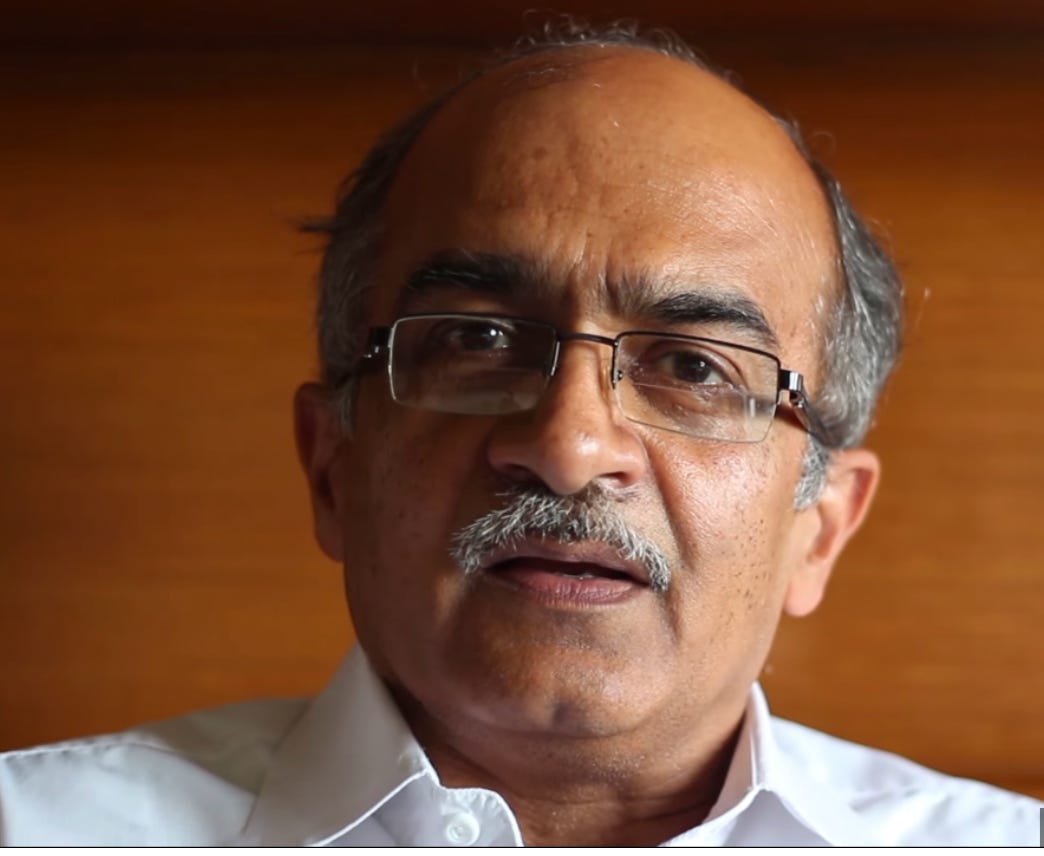
The Indian public interest advocate, Prashant Bhushan, lights the path forward.
By John Leake | Courageous Discourse | February 22, 2023
An old friend who loves India once told me it is the only country in which he’d met what he called an “enlightened man.” His understanding of “enlightenment” was influenced by the German philologist, Max Mueller’s translation of the Sanskrit word, Bodhi (German: Erwachen or Erleuchtung) which translates into English as “awaken” or “enlightenment.” While most of us—with our myriad desires, attachments, and fears—blunder through life, he who possesses Bodhi sees through all of the illusions and deceptions.
My friend was convinced that an enlightened man is instantly recognizable as such, because his enlightenment gives him extraordinary calm, cheerfulness, and courage. At the time I heard this, years ago, I figured my friend was just one of many westerners who have romanticized India. But then, at a conference in Delhi on February 7, I met the great Indian lawyer and public interest advocate, Prashant Bhushan.
As he was one of many people I met at the conference, I didn’t initially realize that he is a world-renowned jurist who recently persuaded the Indian Supreme Court to strike down India’s vaccine mandates as unconstitutional. The only detail I caught in our introduction was that he was a medical freedom advocate. I sat next to him on stage with Drs. McCullough and Malhotra. Before the audience was seated and the formal introductions began, I asked him about the origin of the Indian Constitution.
He had the most friendly and elegant way of speaking with great erudition and not a hint of pedantry. And though a relatively small and slightly built man, he seemed to exude an inner strength. After we spoke for a while, Dr. McCullough leaned over to me and said, “It’s not every day you get to meet a guy who argues a case before the Supreme Court and wins.”
“What?” I asked, not entirely believing my ears.
“Yeah!” McCullough said. “Prashant took on the vaccine syndicate in India and won.”
“Wow!” I exclaimed. “What a man!”
During lunch I Googled him and read his Wikipedia entry, which tells of his extraordinary career as public interest advocate for human rights, environmental protection, constitutional protection, and government accountability, performing most of his work pro bono. In a world of selfish greed and corruption, Mr. Bhushan is one of those rare, enlightened souls who really can lead mankind out of the dark.
The Hindu Times published a report on his argument before the Indian Supreme Court. It seems to me that his reasoning and his victory serve as a beacon of hope for everyone who cares about classical liberal principles and constitutional protections.
Tony Blair launches new push for biometric digital ID for all citizens
By Ken Macon | Reclaim The Net | February 22, 2023
Former UK Prime Minister Tony Blair is again promoting a controversial plan to give every British citizen a digital ID. This would entail the utilization of new biometric technology to store a person’s passport, driving license, tax records, qualifications, and their right to work status.
Sir Tony had previously attempted to introduce ID cards during his time as Prime Minister.
Tony Blair and former Conservative lawmaker William Hague have stated that a major transformation of the government with regards to technology is necessary in order to keep up with the ever-changing world.
However, there was backlash from their demands with Sir Jake Berry calling it a “creepy state plan to track you from the cradle to the grave.”
Blair and Hague revealed their plot in an article for The Times, in which they said “politics must change radically because the world is changing radically.
“We are living through a 21st-century technology revolution as huge in its implications as the 19th-century industrial revolution.”
The duo alleged that current politicians were “in danger of conducting a 20th-century fight at the margins of tax and spending policy when the issue is how we harness this new revolution to reimagine the state and public services.”
The duo demand digital IDs for every citizen – they also called for “a national health infrastructure that uses data to improve care and keep costs down, and sovereign AI systems backed by supercomputing capabilities.”
In an interview with BBC Radio 4 Blair highlighted how countries “as small as Estonia and as large as India’ are moving towards digital IDs.
“If you look at the biometric technology that allows you to do digital ID today, it can overcome many of these problems,’ Blair said.
Big Brother Watch condemned Blair for pushing for a digital identity system.
Big Brother Watch director Silkie Carlo said: “Sir Tony and Lord Hague are absolutely right about the need for the UK to take leadership in technological innovation, but this means protecting people’s rights and privacy, not reviving failed proposals for an intrusive mass digital identity system and a database state.”
Carlo added: “A sprawling digital identity system of the type described by Sir Tony and Lord Hague is utterly retrograde and would be one of the biggest assaults on privacy ever seen in the UK. The public has consistently opposed mandatory ID systems and there is absolutely nothing to suggest the public would want or support such a digital ID system now.”
Blair recently called for global organizations such as the World Trade Organization (WTO) and World Economic Forum (WEF) to push national governments to introduce “digital infrastructure” that monitors who has been vaccinated and who hasn’t.
Russia makes claim over West’s ‘hybrid war’
RT | February 15, 2023
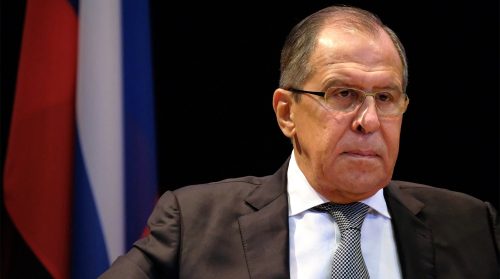
The West is attempting to use the Ukraine conflict to portray Russia as a “rogue state” in the eyes of the world, Foreign Minister Sergey Lavrov said on Wednesday. He stressed that the strategy has not been successful.
“The US and its satellite states are waging an all-encompassing hybrid war that they have long been preparing for, and are using Ukrainian radical nationalists as a battering ram against us,” Lavrov said in a speech in the lower house of the Russian parliament, the State Duma.
“They are not even trying to hide the goal of this war: it is not only to defeat our country on the battlefield and destroy our economy, but also to surround us with a ‘sanitary cordon’ and turn us into a type of a rogue state.”
The statement came the same day that European Commission President Ursula von der Leyen unveiled proposals for a new sanctions package against Russia, including additional export bans and measures to prevent the bypassing of restrictions.
Lavrov said that the West’s efforts to isolate Russia have failed because Moscow continues to develop relations with partners in other areas of the globe. He added that nations that have refused to back the “unprecedented” sanctions make up the majority of the world’s population.
The countries of the Asia-Pacific, the Middle East, Africa, and South America “don’t want to live in accordance with the West-centric order,” the Russian minister stated. “So it makes perfect sense why three-quarters of the world’s countries have not joined the anti-Russian sanctions and have a reasonable view regarding the situation in Ukraine.”
China and India are among the major economies that have refused to impose restrictions on Moscow. Denis Alipov, Russia’s ambassador to New Delhi, said on Tuesday that sanctions “had an opposite effect” and facilitated more trade and closer cooperation between Russia and India.
Beijing, meanwhile, has accused the US of fueling the Ukraine conflict and trying to weaponize the world economy for its own benefit.
Will Japan and India become permanent members of the UN Security Council?
By Petr Konovalov – New Eastern Outlook – 14.01.2023
On December 12, 2022 in London, during a meeting of the British Foreign, Commonwealth and Development Office, its head, James Cleverly, said that he was in favor of expanding the number of permanent members of the UN Security Council (UNSC) by including Japan, India, Brazil and Germany.
The British diplomat believes that the current world order allows a much larger number of people to live much better than before, but today it needs some changes. According to Cleverly, the UK is interested in reflecting the needs of as many countries as possible in the UN. He also noted that the inclusion of Japan, Brazil, India and Germany would allow London to expand interaction with these countries and thus accelerate the growth of global prosperity.
The British Secretary of State for Foreign, Commonwealth and Development Affairs said that the established system of international relations, which was approved as a result of the victory of the Allies after the Second World War, is allegedly outdated due to the fact that since 1950 the volume of world trade has increased by about 40 times, which has led to a radical change in the balance of power in the world. Furthermore, he emphasized that demographic changes had also made their own adjustments to the modern world order.
The rhetoric of the British leadership is quite logical. The UK no longer represents the military and economic power that it used to be during the second half of the previous century. London is aware that it needs allies to support it internationally. The countries listed by James Cleverly, which, in his opinion, should become permanent members of the UN Security Council, maintain close relations with the US and the UK and are highly likely to pursue a common policy with London and Washington on many issues.
In accordance with the norms of international law, the UN Charter can be revised only with the unanimous consent of all the permanent members of the UN Security Council. France, which is a permanent member of the UN Security Council and is loyal to the policy pursued by Washington and London, will support the proposal of the UK, however, Russia and China, who are also permanent members of the UN Security Council, may not approve its expansion, as this may upset their geopolitical plans.
Russia welcomes the inclusion of India and Brazil in the list of permanent members of the UN Security Council. The Russian Federation has fairly warm relations with these states, and it is unlikely that Moscow will have any international disputes with them in the foreseeable future. Back in 2010, Russian President Vladimir Putin, who was serving as Prime Minister of the Russian Federation that year, during a meeting with Indian diplomats, said that India should be included in the list of permanent members of the UN Security Council. Subsequently, the Russian president has always adhered to this rhetoric. As for Russian-Brazilian relations, they have always been at a high level, and Lula da Silva, elected for the third time as President of Brazil in October 2022, is known for his pro-Russian views. During the previous presidency of Lula da Silva, the international organization BRICS was created (in 2006), which includes Brazil, Russia, India, China and South Africa. Consequently, the Russian Federation is likely to approve the inclusion of Brazil in the list of permanent members of the UN Security Council.
However, the Kremlin has a negative stance when it comes to the inclusion of Germany and Japan in the list of permanent members of the UN Security Council, since these states are pursuing an unfriendly policy towards Russia, and Tokyo completely casts doubt on the territorial integrity of the Russian Federation, claiming control over the Kuril Islands.
It should be noted that the inclusion of Germany, Brazil, Japan and India in the list of permanent members of the UN Security Council is not beneficial for China either, since these states maintain good relations with the United States and will adhere to a pro-American position in numerous international disputes.
Germany and Brazil are in close economic relations with London and Washington and therefore, with a high degree of probability, they will act in the interests of the US and the UK if they become permanent members of the UN Security Council. Of course, China will prevent such a development of events.
In China, the memory of Japan’s war crimes against the Chinese population during the Second World War is still fresh. Beijing also disapproves of Tokyo’s pro-American policy and is wary of the impressive number of US military installations in Japan.
Relations between Beijing and New Delhi are also at a fairly low level. India and China are competing for influence in places like Bangladesh and Sri Lanka. The Chinese authorities do not want the strengthening of Indian international influence and will do everything in their power to prevent India from being included in the list of permanent members of the UN Security Council.
It is important to emphasize that skirmishes have periodically occurred between Indian and Chinese border guards over the past 45 years. As recently as December 9, 2022, another conflict broke out between the military of China and India along the Indian line of actual control in the Tawang district in the west of the Indian state of Arunachal Pradesh in an area of the disputed territory. As a result of the collision, the military personnel of the two countries were slightly injured.
Despite the rationality of the idea of expanding the list of permanent members of the UN Security Council, Russia and China are unlikely to take such a step. Russia will not vote for granting this privilege to Germany and Japan, which today openly support the Ukrainian army participating in hostilities against the Russian Armed Forces. In turn, China is not interested in increasing the clout in the international arena of Tokyo and New Delhi, which are on cool terms with Beijing. Also, China will not give an opportunity to Germany and Brazil to become permanent members of the UN Security Council since both countries sympathize with the policies of the states of the Western bloc. As noted above, without the unanimous consent of all the permanent members of the UN Security Council, changes in the norms of international law are impossible.
The West is pursuing its own interests and engaging in geopolitical confrontation with China through the Quadrilateral Security Dialogue (QUAD), which includes Australia, the US, Japan and India. Within the framework of this organization, annual military exercises of the participating countries are held.
On May 24, 2022, a QUAD summit was held in Tokyo, the main agenda of which, according to Australian Prime Minister Anthony Albanese, was to discuss how to counter the growth of China’s influence in East and Southeast Asia.
As it stands now, there will be no expansion in the number of countries that are permanent members of the UN Security Council any time soon, since this comes into conflict with the plans of several current permanent members of the UN Security Council. However, the absence of Japan and India in the UN Security Council is offset by their participation in the QUAD, as well as their close cooperation with the United States in the field of defense.
Modi ignores West’s sanctions on Russia
BY M. K. BHADRAKUMAR | INDIAN PUNCHLINE | DECEMBER 17, 2022
Prime Minister Narendra Modi’s call with Russian President Vladimir Putin on Friday marks a new stage in the bilateral relationship between the two time-tested friends, both contextually and from a long-term perspective.
The media may find it alluring to link Modi’s call to Ukraine developments despite the Indian and Russian readouts (here and here) making it clear that Russian-Indian bilateral relations dominated the conversation.
Nonetheless, it is very significant that Modi was not deterred by the fact that although this is not an era for wars, the Ukraine conflict in all probability will only escalate, and there is a greater likelihood than ever before that Russia may be compelled to seek a total military victory, as the US is leaving it with no option by doggedly blocking all avenues for a realistic settlement and is furtively climbing the escalation ladder.
Without doubt, the Biden Administration’s reported decision to deploy Patriot missile in Ukraine is a major escalation. Moscow has warned of “consequences.” Again, Moscow has confirmed that the US planned, masterminded and equipped Ukraine with the military capability to attack deep inside Russian territory — hundreds of kilometres, in fact — including against the base at Engels where Russia’s nuclear-capable strategic bombers are stationed. The two superpowers never before targeted each other’s nuclear assets.
So, there is no question that Modi’s initiative at this point in time to discuss “the high level of bilateral cooperation that has been developing on the basis of the Russian-Indian privileged strategic partnership,” including in key areas of energy, trade and investments, defence & security cooperation, conveys a huge message in itself.
It quietly underscores a medium and long term perspective on the Russian-Indian relationship that goes far beyond the vicissitudes of the Ukraine conflict. Put differently, India will not allow its long-standing ties with Russia to be held hostage to Western sanctions.
For India, the reorientation of Russian economic diplomacy toward the Asian region presents huge business opportunities. Who would have thought nine months ago that Russia was going to be the largest supplier of oil to India, leapfrogging Iraq, Saudi Arabia and the US? According to Reuters, India purchased about 40% of all export volumes of Russian Urals grade oil transported by sea in November, when European countries accounted for 25%, Turkey 15% and China 5%.
The figures speak for themselves: in November, while Russia supplied 909,000.4 barrels of crude oil to India per day, the corresponding figures were for Iraq (861,000.4), Saudi Arabia (570,000.9), and the US (405,000.5) Suffice it to say that when Modi upfront listed energy as his talking point with Putin, it reconfirms that India is giving a wide berth to the G7’s hare-brained scheme to impose a price cap on Russian oil exports.
But all good things have a flip side. As the volume of India-Russia trade shoots up — with Russia emerging as India’s seventh largest trading partner, rising from 25th place — the imbalance in the bilateral trade is also widening, as Moscow prioritises India (and China) as preferred trading partners.
EAM Jaishankar’s recent Moscow visit focused on a list of 500 items that Russia would be keen to source from India. Importantly, this is also about a supply chain for the Russian industry / economy. Jaishankar reportedly gave an interim reply of India’s readiness to start supplying spare parts necessary for airplanes, cars and trains.
Some Russian experts have talked about India as a potentially significant “trans-shipment” state for Russia’s “parallel imports” — that is, Russia can buy not only Indian goods from India but also products from third countries.
Meanwhile, turning away from the European market, Russia also seeks business opportunities for its export basket that includes mineral products, precious metals and products made from them, aluminium and other non-ferrous metals, electric machines, vehicles, pharmaceutical, chemical, rubber products, etc.
Clearly, there are systemic issues to be addressed such as transportation logistics; payment mechanism, collateral sanctions. However, for the near term, all eyes are on the Russian oil exports to India in the time of the G7 price cap.
The Russian government daily Rossyiskaya Gazeta reported on Tuesday, “It is expected that Russia, in response to the price ceiling, will adopt an official ban on selling oil under contracts where the “ceiling” will be mentioned or the marginal price for our oil will be indicated.” That is, Moscow will insist on an embargo on supplies basically restricted to the G7 and Australia.
China and India are not affected, as they haven’t joined the price cap. The following excerpts from the Moscow daily outlines the state of play:
“There are no real mechanisms that could enforce these [G7] restrictions… already, about a third of Russian oil exports leave Russian ports without indicating the final destination. That is, a so-called “grey trade zone” is growing before our eyes, which allows traders to purchase Russian raw materials without the risk of falling under secondary sanctions… discount [ie., fair prices] allows the Asia-Pacific countries, primarily China and India, to increase purchases of Russian raw materials.”
The fascinating part is that not only is the so-called “grey zone” expanding steadily but alongside, other suppliers have begun to adjust to the prices of Russian oil in the Asia-Pacific region — that is, to the real equilibrium prices or discounted prices. Curiously, even Western countries are in a position to receive relatively inexpensive Russian oil through third parties.
The bottom line is that the Biden administration’s goal was not to limit the volume of Russian oil exports but focused on the revenues of the Russian budget from oil production and the world oil market. Rissyiskaya Gazeta concludes: “In fact, so far what is happening does not contradict either our aspirations or the desires of the United States.” [See my article Race for Russian oil begins, The Tribune, Nov. 28, 2022]
This new-found pragmatism in the US calculus about the limits to sanctions took a curious turn on Thursday when the US blacklisted the Russian billionaire-oligarch Vladimir Potanin but exempted two of his biggest assets from the purview of sanctions — MMC Norilsk Nickel and Tinkoff Bank — on the specious ground that his holdings are less than 50% in these two companies [but are only 35%!]
Why so? Because, MMC’s share in the world market of high-grade nickel is 17%, palladium 38%, platinum 10%, rhodium 7%, copper and cobalt 2% each; and, sanctioning the Russian company could sharply aggravate the world market for non-ferrous metals and can hurt US manufacturers.
Clearly, the law of diminishing returns is at work in the continued weaponisation of sanctions against Russia. Indian business and industry should pay close attention to Modi’s far-sighted initiative on Friday.
India denies Western fake news that Modi cancelled meeting with Putin over nuclear warning
By Ahmed Adel | December 12, 2022
According to “people with knowledge of the matter”, Bloomberg reported that Indian Prime Minister Narendra Modi will not be holding an annual in-person summit with Vladimir Putin after the Russian president allegedly threatened to use nuclear weapons in the war in Ukraine. The same article was shared on Twitter by Professor Derek J. Grossman, national security and Indo-Pacific analyst at RAND Corporation, who disingenuously wrote: “India isn’t pleased with Russia.”
But what is the actual truth?
“The relationship between India and Russia remains strong but trumpeting the friendship at this point may not be beneficial for Modi, said a senior official with knowledge of the matter, who asked not to be named due to the sensitivity of the issue,” Bloomberg claimed on December 9, before adding that Russia’s nuclear warning was a tipping point for India.
However, an Indian government source clarified on the same day to Reuters that the annual in-person meeting between Modi and Putin took place on the sidelines of an international event in September.
In addition, New Delhi-based WION reported that “sources pointed out that plans to hold the annual summit could not materialise in November and December because of the elections in the [Indian] states of Gujarat and Himachal Pradesh.”
“Sources also deny western media reports that the Russian President’s nuclear threat had any role to play in India-Russia Summit not happening…” the report added.
For his part, former Indian Ambassador to Moscow Kanwal Sibal tweeted a response to Grossman, saying: “Article tailored to suit a narrative. India was treating Modi’s bilateral meeting with Putin at the SCO meeting at Samarkand as the annual summit between the two leaders in view of elections in Gujarat in December preventing Modi from visiting Moscow.”
This is not the first case of fake news attributed to India’s position on Russia concocted by Western media. In fact, the majority of 2022 has been defined by Western governments and media making fake claims on India’s relations with Russia, something borne mostly out of the frustration that the world’s second most populous country has deepened its relations with the Eurasian country instead, particularly in the energy sector.
Russia has even offered India help in overcoming the oil price cap being imposed by western countries.
“In order not to depend on the ban on insurance services and tanker chartering in the European Union and Britain, the Deputy Prime Minister of Russia Alexander Novak has offered India cooperation on leasing and building large-capacity ships,” the Russian embassy in New Delhi said in a statement on December 9. “In the first eight months of 2022, Russian oil exports to India grew to 16.35 million tonnes; in the summer, Russia ranked second in terms of oil shipments to India.”
Although India calls for peace negotiations over Ukraine, it still has to stand firm in the face of endless Western pressure to end its purchase of Russian oil. New Delhi has not capitulated to Western pressure and continues to stress that it will keep buying oil from wherever it gets the best deal, something that Russia, and not the West, is offering.
“We do not ask our companies to buy Russian oil. We ask our companies to buy oil, what is the best option that they can get. Now it depends on what the market throws up… Again, please do understand, it’s not just that we buy oil from one country. We buy oil from multiple sources, but it is a sensible policy to go where we get the best deal in the interests of the Indian people and that is exactly what we are trying to do,” Jaishankar told parliament on December 7.
It is the very fact that India pursues policies that it perceives to be best for its citizens that frustrates the West and leads them to fake news campaigns in a vain attempt to disrupt Russian-Indian relations. However, this fake news campaign does not change the reality on the ground, such as the fact that three top Indian ministers and officials have visited Russia since the war in Ukraine began —Heath Minister Mansukh Mandaviya, National Security Advisor Ajit Doval and Foreign Affairs Minister Jaishankar, or that bilateral ties have deepened in the energy sector.
Meanwhile, The Independent reported that Russia in December is on course to become India’s top oil supplier, a move “that will likely undermine the impact of a price cap imposed by G7 countries and their Western allies.”
“Russian crude oil loadings bound for India climbed to the highest level in November as refiners purchased more than 1 million barrels per day (bpd), according to data provided to The Independent by commodities tracking firm Kpler,” the British outlet reported.
Indian-Russian ties continue to deepen despite the West’s immense frustration.
Ahmed Adel is a Cairo-based geopolitics and political economy researcher.
Iran, India recalibrating ties amid geopolitical shifts
‘Not a choice, but necessity’
By Zafar Mehdi | The Cradle | December 1, 2022
“Not a choice, but a necessity.” That’s how Iran’s Deputy Foreign Minister Ali Bagheri Kani stressed the importance of closer strategic and economic ties between Tehran and New Delhi during his visit to India in November.
Kani had a message for Prime Minister Narendra Modi from Tehran – strategic synergy is a win-win proposition for the two sides amid the shifting geopolitical and geo-economic landscape in the wake of the Ukraine war and the new world order.
Before the Trump administration reinstated sanctions on Iran in 2018, Iranian oil comprised nearly 11 percent of India’s total oil basket. However, New Delhi buckled under US pressure and stopped importing oil from Tehran in a move that hampered their cooperation in other strategic areas.
Three years down the line, amid rapidly changing geopolitical power dynamics and the end of “the era of the unipolar world,” as announced by Russian President Vladimir Putin in June, India has become keen on recalibrating its ties with Iran, a traditional ally, in the midst of an energy crisis gripping the world.
It is worth noting that Russia became the biggest oil supplier to India in October, supplying 935,556 barrels of crude oil per day, according to energy cargo tracker Vortexa, making up for 22 percent of the energy-dependent country’s total crude imports, ahead of Iraq’s 20.5 percent and Saudi Arabia’s 16 percent.
Iran as an alternative energy supplier
Faced with a burgeoning demand for oil and gas amid the global energy crisis and recent oil cuts by the OPEC+, India now looks poised to resume oil imports from Iran, defying US sanctions, The Cradle learned from sources in Tehran and New Delhi.
Interestingly, India’s petroleum minister Hardeep Puri hinted at it during his visit to Washington in October, saying New Delhi will buy oil from wherever it has to. Russia, as we know, is already shipping oil to India, despite strong US pressures.
Talks are currently underway between India and Venezuela, especially with the US easing oil-related sanctions against Caracas. This, by extension, has opened a window of opportunity for India and Iran to revive their energy trade. The good news is that both sides look interested.
Iran has already expressed its readiness to resume energy trade with India. Last month, newly-appointed Iranian ambassador to New Delhi, Iraj Elahi, announced that Iran is willing to provide low-cost crude oil to India to ensure the country’s energy security, something top Indian officials have in recent months cited as the government’s priority.
A win-win proposition
In 2018-2019, India purchased $12.11 billion worth of crude oil from Iran, which plummeted to zero in May 2019 after the significant reduction exemption (SRE) period ended.
Likewise, trade between the two countries dropped from $17.3 billion in 2018-2019 to $4.77 billion in 2019-2020. Although it has ultimately failed to achieve its objectives, Washington’s “maximum pressure” campaign had a negative impact on India-Iran relations.
However, ties have since markedly improved, as evidenced by Bagheri Kani telling the Indian press that the Islamic Republic is ready to meet the country’s growing energy needs, while India can in turn contribute to Iran’s food security as a major food producer.
This, he asserted, would help in boosting the process of multilateralism in the international system, which essentially means the death of US unilateralism more than three decades after the end of the Cold War and the collapse of the former Soviet Union that paved the way for the era of the unipolar world.
Suhasini Haidar, diplomatic affairs editor at The Hindu and a leading Indian analyst, termed Bagheri Kani’s visit to India as “significant,” saying it “shows a commitment to India-Iran ties by both governments despite geopolitical divides in the world on issues like the Ukraine war.”
Penalized by US sanctions
Haidar described Iranian crude as “sweeter, lighter, cheaper, and easier to transport to India than other options,” calling the Indian government’s decision to cut Iranian imports “irrational.”
“It was irrational of the Modi government to have canceled India’s imports of Iranian oil under threat from the Trump administration, and it would make sense if they decided to restore the oil trade between the two countries,” she told The Cradle.
Haidar said it remains to be seen if the Modi government will be willing to resume oil imports from Iran, “despite several signals that both sides are exploring their options,” especially after the latest sanctions on an Indian company transporting Iranian oil.
Mumbai-based Tibalaji Petrochem Private Limited was sanctioned in late September for shipping Iranian petrochemical products to China. It was the first time an Indian company was sanctioned by the US for dealing with Iran.
In his meeting with his Indian counterpart Vinay Mohan Kwatra, Bagheri Kani pointed to the “necessity” of regional cooperation between the two countries, which he said would “take away the opportunity from foreigners to exploit the lack of cooperation.”
The sentiments were mutual as India’s foreign ministry spokesman, in a statement following Bagger Kani’s meeting with Kwatra, said the two officials “discussed bilateral relations, including the development of Chabahar Port” and “regional and international issues of mutual interest.”
Time to shore up ties
According to observers, the time is now ripe for the two sides to shore up bilateral ties and multilateral cooperation, with Tehran set to become a full member of the Shanghai Cooperation Organization (SCO) as well as the BRICS group, given its close ties with Russia and China.
Notwithstanding existing challenges, Iran and India share mutual interests in trade and connectivity. Iran’s full SCO membership could prompt the two sides to focus more on connectivity projects like the Chabahar Port, which links with the International North-South Transport Corridor (INSTC), the multi-mode network of ships, rail and roads for moving freight between India and Iran, among other countries.
“India and Iran have important trade needs, including in wheat, pulses and commodities, as well as oil reserves. And the connectivity engagement is very important for India through Chabahar and through the INSTC,” Haidar explained.
Importantly, in recent years, Chabahar Port in Iran’s southeastern Sistan-Baluchestan province has emerged as a key area of cooperation between Tehran and New Delhi, which will provide India access to Afghanistan and Central Asia through Iran, ending its reliance on arch-rival Pakistan.
Rezaul Hasan Laskar, the foreign affairs editor at Hindustan Times, says the strategic port has “become more important following its growing use” but that “it needs to be connected to Iran’s railway network.”
While the first section of the Zahedan-Chabahar railway line is nearing completion, official sources in Tehran said the agreement between the two sides to construct the 628-kilometer (390 miles) railway line had faced “serious impediments” due to New Delhi’s reluctance to start work fearing US sanctions.
“Despite India’s close ties with the US and Israel, its decision to build strategic ties with Iran, and Iran’s according special projects to India like Chabahar Port despite its ties with China are a constant reminder of this special relationship,” Haidar told The Cradle.
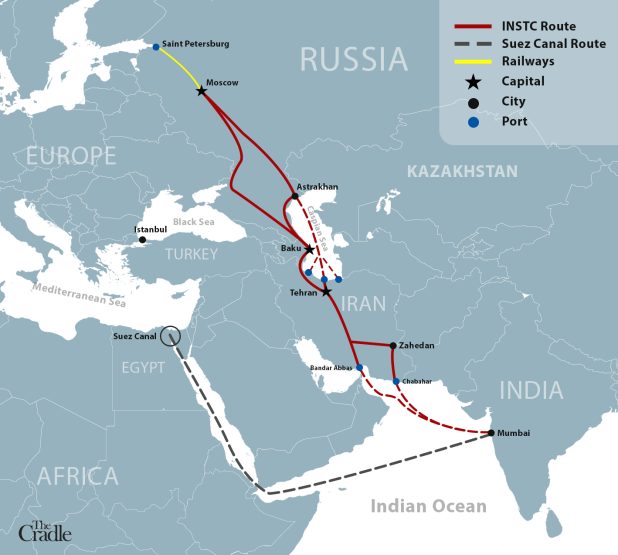
Map of the International North-South Transport Corridor (INSTC)
Joint cooperation with Beijing and Moscow
Sources in Tehran and New Delhi said the use of rupee-rial trade was also “seriously considered” during Bagheri Kani’s New Delhi visit, with both sides agreeing that a banking mechanism that is not tied to the west is key to strengthening the process of multilateralism, and paving the way for the resumption of trade.
Laskar of Hindustan Times confirmed that the senior Iranian diplomat “reiterated Iran’s offer to resume oil supplies and raised the issue of trade in national currencies.”
The changing geopolitical landscape in the wake of growing anti-western mechanisms, including SCO and BRICS, led by China and Russia, is also likely to propel increased cooperation between Tehran and New Delhi.
Laskar, however, believes that the SCO has not been a particularly crucial grouping for India in recent years, “largely because of the tensions with China,” adding that India’s biggest concern about the expansion of BRICS is that “it shouldn’t become a China-centric grouping,” underlying Sino-India tensions.
Meanwhile, Russia remains a common ally of India and Iran, which is evident in Moscow and New Delhi looking to ramp up trade via Tehran along the INSTC – the strategic route that has assumed tremendous significance since the start of the Ukraine war.
The decision to boost INSTC trade, according to reports in Indian media, was high on the agenda during Bagheri Kani’s India visit, as Russia now looks set to invest in the Chabahar Port. According to sources, the war in Ukraine also figured prominently in Bagheri Kani’s talks with Indian officials. Both sides agreed on maintaining a “neutral stance” on the war and increased engagement with Moscow.
“Russia is the new game-changer in the region, especially after the realignment of power centers, and that is good news for India-Iran ties,” an Iranian diplomat stationed in South Asia told The Cradle.
Featured Video
Your Enslavement Begins in Gaza: The ‘Board of Peace’
or go to
Aletho News Archives – Video-Images
From the Archives
The US: The Century of Lost Wars
By James Petras | Global Research | September 12, 2018
Introduction
Despite having the biggest military budget in the world, five times larger than the next six countries, the largest number of military bases – over 180 – in the world and the most expensive military industrial complex, the US has failed to win a single war in the 21st century.
In this paper we will enumerate the wars and proceed to analyze why, despite the powerful material basis for wars, it has led to failures. … continue
Blog Roll
 Aletho News
- The US build-up around Iran constitutes strategic war option, not ‘deterrence’
- Iran to US: Sanctions and war failed; try diplomacy and respect
- China supplies Iran with radar, surveillance tech to track US stealth aircraft: Report
- Zelensky rejects territorial concessions to Russia
- German leader of EU’s largest faction sounds the alarm of possibility of right-wing forces coming to power in France, Poland
- Putin: Developing Russia’s nuclear forces ‘absolute priority’
- Hungary Blocks 20th Package of Anti-Russia Sanctions, $106B Loan to Ukraine – Szijjarto
- NATO Must Return to 1997 Borders for Peace in Ukraine – Finnish Politician
- Your Enslavement Begins in Gaza: The ‘Board of Peace’
- Israeli FOIA Data Reveals Massive Heart Injury Spike in Children Immediately After mRNA Shot Rollout
- If Americans Knew
- Average of five Palestinians killed by Israel every day in Gaza since ceasefire – Not a ceasefire Day 136
- Palestinian church leaders admonish Christian Zionist Mike Huckabee – Not a ceasefire Day 135
- Ominous messaging from Trump’s “Board of Peace” – Not a ceasefire Day 134
- ‘Christians Out’: Jerusalem Church Tagged With Hate Graffiti, Police Investigating
- Israeli Settlers Kill American Teen
- ‘We returned from hell’: Palestinian journalists recount torture in Israeli prisons
- No mercy for Gaza in Ramadan – Not a ceasefire Day 133
- The Israeli Government Installed and Maintained Security System at Epstein Apartment
- Tucker Carlson interrogated in Israel, has passport seized after interviewing US ambassador
- 6,000 Amputees in Gaza Face Impossible Recovery amid Israeli War Ultimatum
- No Tricks Zone
- New Research Reaffirms Clouds, Aerosols, And Surface Solar Radiation Are ‘Driving The Climate System’
- Germany: Electric Car Catches Fire At Charging Station, Sets Off Local “Inferno”, Widespread Damage
- New Study: Canada’s New Brunswick Was 1°C Warmer Than Today During The Medieval Warm Period
- Coal Power Back In Trend As Globe Tries To Keep Pace With Growing Demand For Power
- New Study: A 4°C Warmer Beaufort Sea Had ‘No Sea Ice’ 11,700 – 8200 Years Ago
- Unfudging The Data: Dutch Meteorological Institute Reinstates Early 20th Centruy Heat Waves It Had Erased Earlier
- German Gas Crisis…Chancellor Merz Allegedly Bans Gas Debate Ahead of Elections!
- Pollen Reconstructions Show The Last Glacial’s Warming Events Were Global, 10x Greater Than Modern
- Germany’s Natural Gas Storage Level Dwindles To Just 28%… Increasingly Critical
- New Study Rebuts The Assumption That Anthropogenic CO2 Molecules Have ‘Special’ Properties
 Aletho News