Five Reasons Why India Could Mediate A Russian-Ukrainian Ceasefire
BY ANDREW KORYBKO | JULY 11, 2023
There’s a growing consensus that the failure of Kiev’s NATO–backed counteroffensive and Moscow’s edge over NATO in their “race of logistics”/”war of attrition” will result in the resumption of Russian-Ukrainian talks in some form by the end of the year as was explained here. This will at the very least be aimed at reaching a ceasefire, but Zelensky is prohibited by the Rada from conducting talks with Russia, ergo the need for a mediator. Here are five reasons why India could play this role:
———-
1. The US Wants To “De-Sinify” The Peace Process
China has the diplomatic power to implement its plan for freezing the NATO-Russian proxy war, but only if the US allows Kiev to participate in talks under its aegis, which is unlikely to be approved. There’s no way that Washington would let its systemic rival go down in history as the country that helped end the most geostrategically significant conflict since World War II, with it instead preferring to “de-Sinify” the peace process by having someone else play this role in order to deprive Beijing of that diplomatic victory.
2. Russia Might Not Trust Turkiye To Mediate Again
Turkish President Erdogan’s violation of the Azovstal deal that he reached last year with his Russian counterpart might have irreparably damaged trust between them to the point where President Putin no longer feels comfortable with Turkiye mediating between it and Kiev ever again. In that case and considering the seeming inevitability of talks resuming in some form by year’s end, then it therefore follows that Russia, Ukraine, and the US would have to agree on someone else to mediate in its place.
3. India Is Much More Appealing Than South Africa
Apart from South Africa, India is the only major country that’s consistently abstained from all anti–Russian UNGA Resolutions, thus proving its neutrality towards the NATO-Russian proxy war in Ukraine. Unlike Pretoria, however, Delhi isn’t a party to the ICC and its ties with Moscow are no longer criticized by Washington. These two factors combine to make India much more appealing than South Africa as Turkiye’s possible replacement for mediating between Russia and US-controlled Ukraine.
4. Russia & The US Have Excellent Relations With India
The decades-long Russian-Indian Strategic Partnership has impressively weathered unprecedented Western pressure upon it over the last sixteen and a half months while the Indian-US Strategic Partnership was recently strengthened without doing so at the expense of Moscow’s interests. Each of those two Great Powers have natural interests in further elevating India’s rapidly rising role in global affairs, hence why they could prospectively agree on having it mediate Russian-Ukrainian ceasefire talks.
5. The Optics Of Indian Mediation Are Acceptable To All
Russia and the US are competing for hearts and minds across the Global South so each would gain from the optics of them requesting the “Voice of the Global South” to mediate. Both would also receive supplementary benefits by doing so too: Russia wouldn’t have to worry about whatever compromises it might make being spun for divide-and-rule purposes as “Chinese-dictated”, while the US can present India’s prestigious diplomatic role as proof that the “Asian Century” doesn’t mean a “Chinese Century”.
———-
State Department spokesman Matt Miller confirmed on Monday that “we welcome a role that India or any other country could play” in stopping this conflict, which signaled that it could replace Turkiye if Russia no longer regards the latter as a trusted mediator. Should Delhi be interested, then it should begin talks with both about this right away because time is of the essence as other players vie for the chance to go down in history for helping end the most geostrategically significant conflict since World War II.
DC Scholars: Ukraine Conflict Shows World Has Grown Weary of US Hegemony
By Ekaterina Blinova – Sputnik – 24.06.2023
Despite having the largest military budget in the world and being the largest operator of military bases abroad, the US is far from being a global hegemon, argues a DC-based think tank Quincy Institute for Responsible Statecraft.
Over the past decades Washington has demonstrated a capacity for mass destruction – in Korea, Vietnam, Afghanistan, Iraq, Libya and elsewhere – but “it has won no more than Pyrrhic victories” which led to the erosion of trust in Pax Americana both at home and abroad, according to Responsible Statecraft scholars.
The US military spending reached $876.9 billion in 2022, while the nation also operates a whopping 750 foreign military bases. Still, Washington is incapable of persuading the Global South to join anti-Russia sanctions over the latter’s special military operation in Ukraine, the think tank remarks. “If hegemony means the capacity to get other countries to comply with one’s demands, the United States is far from being a global hegemon,” the report notes.
Judging from the so-called Pentagon leak, even some US allies and partners demonstrated hesitance and unwillingness to provide the Kiev regime with shells, jets and armored vehicles. Meanwhile, most nations of the Global South shrugged off the US calls for slapping sanctions on Moscow as contradicting their national interests.
US political observers emphasize that six nations in the Global South – namely, India, Brazil, Turkey, Indonesia, Saudi Arabia, and South Africa – are set to decide the future of geopolitics and insist that the Biden administration needs to win their hearts and minds. At the same time, European commentators argue that developing nations have the right to remain neutral and non-aligned.
For instance, in June 2022, India’s External Affairs Minister Dr S Jaishankar shredded the West’s claim that New Delhi was “sitting on the fence.” According to the minister, India is entitled to its opinion when it comes to the Russo-Ukrainian conflict.
Likewise, the Association of Southeast Asian Nations (ASEAN) has chosen to collaborate with both the US and China, instead of taking sides. Moreover, ASEAN nations are active participants of Beijing’s Belt and Road Initiative (BRI) regardless of Washington’s attempts to maintain its dominance in the region and curb China’s influence in the Asia Pacific.
Per DC scholars, the emerging trend was articulated by Brookings Institution fellow Fiona Hill, former Deputy Assistant to the President of the United States, in May 2023:
“The war in Ukraine is perhaps the event that makes the passing of Pax Americana apparent to everyone. … [Other countries] want to decide, not be told what’s in their interest. In short, in 2023, we hear a resounding no to US domination and see a marked appetite for a world without a hegemon,” she said at a conference in Tallinn, Estonia
According to Hill, the Global South’s resistance to the US and the EU’s demands to slap sanctions on Moscow is nothing short of “an open rebellion.” She noted that “this is a mutiny against what they see as the collective West dominating the international discourse and foisting its problems on everyone else, while brushing aside their priorities on climate change compensation, economic development, and debt relief.”
Western observers also acknowledge that the world’s center of gravity is steadily shifting east, adding that the Biden administration has so far sought to avert this trend by trying to establish “a lasting technological lead over China” and beefing up the US military in Western Pacific.
However, “most developing countries, including emerging powers in the Global South, are no longer willing to make zero-sum choices” between Washington and its geopolitical rivals, DC scholars underscore, urging American policymakers to accept the reality that the US is no longer “the indispensable nation.”
Iran, Regional States to Form Naval Coalition Soon: Navy Commander
Al-Manar – June 3, 2023
Iranian Navy Commander Rear Admiral Shahram Irani announced that Iran’s navy and the countries of the region including Saudi Arabia, UAE, Qatar, Bahrain and Iraq will form a new naval coalition soon.
Irani in a televised program on Friday night announced the formation of new regional and extra-regional coalitions, saying that today, the countries of the region have realized that the security of the region can be established through synergy and cooperation of the regional states.
Referring to the holding of annual exercises of the naval coalition of Iran, Russia and China, he said that the regional coalition is also forming.
Almost all the countries of the North Indian Ocean region have come to the understanding that they should stand by the Islamic Republic of Iran and jointly establish security with significant synergy, he said, adding that Oman, Saudi Arabia, UAE, Qatar, Bahrain, Iraq, Pakistan and India are among these countries.
Earlier, a Qatari website reported that Iran, Saudi Arabia, the United Arab Emirates, and Oman are to form a joint naval force under China’s auspices towards enhancing maritime security in the Persian Gulf.
Al-Jadid carried the report on Friday, saying China had already begun mediating negotiations among Tehran, Riyadh, and Abu Dhabi aimed at reinforcing maritime navigation’s safety in the strategic body of water.
Since the 1979 victory of Iran’s Islamic Revolution, the Islamic Republic has invariably opposed foreign meddling and presence in the region, asserting that the regional issues have to be addressed by the regional players themselves.
Historical anomaly of unipolarity has indisputably ended
By Andrew Korybko | Global Times | May 11, 2023
There’s a heated debate in the US nowadays about the future of global affairs. Some believe that what’s been described as their country’s unipolar moment is ending and giving way to multipolarity, while others believe that the US remains the world’s most comprehensively powerful country by far. Understanding the current state of international relations can provide policymakers with a clear and accurate picture of the world they are dealing with. This knowledge can help them make informed decisions and take appropriate actions. Americans first began worrying that their country’s predominant role was fading around the start of the Obama administration, which coincided with the 2008 financial crisis. For various reasons, some related to partisan opinions and others to compelling observations about the evolving world order, these concerns continued through the Trump administration and into the incumbent Biden one, but they were recently exacerbated by the start of conventional hostilities between Russia and Ukraine last year.
Several factors since then contributed to raising worldwide awareness of multipolarity, which simply refers to the system of international relations where there isn’t a hegemon like the US was after 1991 or aren’t two superpowers like there were from 1945 up until that year prior to the Soviet Union’s dissolution. Perhaps the most visible one concerns the documented fact that only a little more than three dozen countries joined the US in imposing sanctions against Russia and/or arming Ukraine.
The rest of the world remains neutral in practice despite most countries voting against Russia at the UN General Assembly, which in hindsight didn’t signal the change in policy toward Moscow that the US expected at the time. Some states might have been pressured to vote that way while others wanted to peacefully signal their disagreement with Russia for its military operations in Ukraine. Either way, the lack of any subsequently punitive consequences like those that the US demanded spoke volumes.
This observation is all the more impressive when remembering that many of these same neutral states are comparatively medium- and smaller-sized ones with economies that aren’t anywhere near as large as the US’. The importance in pointing this out is to show how surprising it is that the US couldn’t successfully pressure them into sanctioning Russia and/or arming Ukraine, which speaks to the very real limits of its influence nowadays.
China is already the top trade partner of practically every Global South country, which imbues them with the confidence to refuse the US’ political demands since their leaders believe that they could weather whatever sanctions it could threaten against them as punishment for their defiance. Meanwhile, India’s example of successfully resisting American pressure to sanction Russia and arm Ukraine despite its close ties with the US reassured other states that their own ties with it probably won’t suffer as a result either.
America has a track record of abusing developing countries in myriad ways, including through information warfare, political meddling, and strings-attached loans.
Many of these countries have become deeply resentful of the US after seeing how terribly it treated their beloved homeland, the sentiment of which their leaders sought to channel in strengthening their states’ strategic autonomy upon being given the chance to do so. The start of last year’s conventional Russia-Ukraine hostilities served as the perfect opportunity to do so in a way that would attract the rest of the world’s attention, inspired as they were by independent giants like China and India.
Besides, the center of global economic gravity is shifting away from the Atlantic and toward the Asia-Pacific over the past few decades. This is directly due to the rise of those two aforementioned giants, but especially China, whose Belt and Road Initiative (BRI) investments helped the rest of the Global South rise as well in its wake. With economic strength comes political influence, and the BRICS countries of which China, India, and Russia are a part want to reform the world.
They rightly concluded that the US-led unipolar system only serves that hegemon’s interests. Such a system is dictatorial due to the US aggressively enforcing its so-called “rules” onto everyone else, unequal in the sense that the West’s economic rise is entirely due to exploiting the Global South, and unjust because international law is wantonly violated by the US. Accordingly, the BRICS are leveraging their economic strength to accelerate reforms aimed at making international relations more democratic, equal, and just.
All Global South states will benefit once the BRICS succeeds with this noble goal, though expectations should responsibly be tempered since it’ll still likely take a lot of time for them to institutionalize their envisaged changes. Nevertheless, the wide awareness of those countries’ selfless mission to humanity was another reason why all of the Global South defied the US at once since they wanted to signal their support for the emerging multipolar world order that’s rapidly replacing the unipolar one.
And finally, everyone apart from the most media-indoctrinated people in the West knows that the world was multipolar for ages, thus meaning that the prior unipolar period that began after 1991 with the Soviet Union’s dissolution is literally a historical anomaly. Never before was the whole world under the control of a single country, but this happened as a result of unique circumstances, not due to the US being “exceptional” like its leaders ridiculously claim.
With this in mind, the entire Global South has an interest in returning international relations to their normal multipolar model that was in place for centuries prior to three decades ago, which is but a very brief moment in terms of the historical spectrum. Their leaders saw that the opportunity to speed up the so-called “return of history” appeared last year with the start of conventional Russia-Ukraine hostilities, which unprecedentedly accelerated the global systemic transition back to multipolarity.
Returning back to the debate that was referenced in the introduction, those Americans who still believe that unipolarity exists therefore aren’t accounting for any of the factors shared in this analysis. Upon doing so, the honest ones among them will realize that this historical anomaly has indisputably ended and been replaced by multipolarity, thus restoring balance to international relations. The global systemic transition still continues, however, since the latest manifestation of multipolarity hasn’t yet fully formed.
The author is a Moscow-based American political analyst. This is the third piece of the “Quest for multipolarity” series. opinion@globaltimes.com.cn
Twitter Received 16,000 Information Requests From Over 85 Governments at Start of 2022
Sputnik – 25.04.2023
WASHINGTON – Twitter said on Tuesday that it received more than 16,000 government information requests for user data from over 85 countries in the first half of 2022 alone.
“Twitter received over 16,000 government information requests for user data from over 85 countries during the reporting period. Disclosure rates vary by requester country,” the social network said in a press release.
The United States, France, Japan, Germany and India were the top five requesting countries for the period, the release said.
Twitter also received about 53,000 legal requests from governments around the world to remove content, with the majority of requests coming from Japan, South Korea, Turkey, and India, the release added.
In the first half of 2022, Twitter required users to remove 6,586,109 pieces of content that violated the company’s rules – an increase of 29% from the second half of 2021, according to the release.
China’s Latest Renaming Of Indian-Controlled Disputed Territory Is A Major Development
By Andrew Korybko | April 5, 2023
The decades-long Sino-Indo border dispute owes its origins to the legacy of British colonialism in the Subcontinent but persists to this day due to the complicated dynamics of this issue, which still remains bilateral despite the US’ efforts to meddling in it for divide-and-rule purposes. The latest major development on this front concerns China’s renaming of Indian-controlled disputed territory on Sunday in what Beijing regards as South Tibet but Delhi administers as Arunachal Pradesh.
This occurred one day prior to Chinese Foreign Ministry spokeswoman Mao Ning’s perfunctory policy reaffirmation pertaining to her country’s desire to trilaterally cooperate with Russia and India via the RIC platform, which was prompted by a related question regarding Moscow’s new foreign policy concept. The signal being sent is that Beijing won’t back down from its claims to that region, but nevertheless believes that this shouldn’t be an impediment to improving ties with Delhi.
Indian External Affairs Minister Dr. Subrahmanyam Jaishankar, however, reminded everyone of his South Asian Great Power’s official policy late last month regarding the impossibility of normalizing relations with China so long as their border dispute remains unresolved. The reason why China’s third renaming of disputed territory in the past six years is such a major development is because it reduces the chances of a deal whereby it and India turn the Line of Actual Control (LAC) into their official border.
The impending trifurcation of International Relations into the US-led West’s Golden Billion, the Sino-Russo Entente, and the informally Indian–led Global South (within which there are multiple rising powers) could therefore lead to more uncertainty between the last two’s Sino-Indo members. Moscow’s interests are in replicating the Chinese-mediated Iranian-Saudi rapprochement between its fellow BRICS and SCO partners, yet this well-intended scenario is impossible without mutual compromises.
The concept of “face” is immensely important in Asian cultures like China’s, hence why it’s unlikely that Beijing will seriously consider rescinding its enduring claims to Indian-controlled disputed territory after just renaming several areas therein. This insight extends credence to predictions that ties between those two will remain tense for the indefinite future, though this likely state of affairs shouldn’t be misinterpreted as implying that the US will succeed in its plot to divide-and-rule them.
Rather, it simply shows that leading countries with multipolar grand strategies like China and India don’t always see eye-to-eye on every issue, which contradicts the Alt-Media Community’s common misportrayal of all non-Western states as supposedly being united against the US. The reality is that very serious differences persist in Sino-Indo ties, which limits the extent to which they’ll cooperate, potentially even including when it comes to financial multipolarity where they have shared interests.
Looking forward, absent any concessions – whether unilateral or mutual – by either or both of these two claimants, there’s no credible reason to predict that their relations will considerably improve even if they do indeed end up cooperating to a limited extent on certain issues of shared interest. Russia’s goal is therefore to ensure that their “security dilemma” and related perceptions of each other remain manageable otherwise the outbreak of a large-scale conflict between them could doom multipolarity.
President Xi’s Trip To Moscow Solidifies The Sino-Russo Entente
By Andrew Korybko | March 20, 2023
The impending trifurcation of International Relations will result in the formation of three de facto New Cold War blocs: The US-led West’s Golden Billion, the Sino-Russo Entente, and the informally Indian–led Global South. Intrepid readers can review the preceding hyperlinked analysis to learn more about the grand strategic dynamics behind this latest phase of the global systemic transition, while the present one will elaborate on those connected to the Russian-Chinese Strategic Partnership in particular.
These two Eurasian Great Powers had already closely aligned their foreign and economic policies far before Russia was forced to commence its special operation in Ukraine last year after NATO clandestinely crossed its red lines there and refused to diplomatically resolve their security dilemma. This was due to their shared multipolar vision, which in turn resulted in Moscow synchronizing its Greater Eurasian Partnership (GEP) with Beijing’s Belt & Road Initiative (BRI).
The purpose behind doing so was to supercharge multipolar processes across the supercontinent with a view towards making International Relations more democratic, equal, just, and predictable a lot sooner than even the most optimistic observers could have expected. None of this was driven by anti-Western animosity either since both of them envisaged the EU and US playing pragmatic roles in this emerging world order, which is proven by their proactive engagement of each over the years.
Russia expected that it could diplomatically resolve its security dilemma with the US over NATO’s expansion simultaneously with encouraging it and the EU to get Kiev to implement the Minsk Accords, thus ending the then-Ukrainian Civil War and optimizing trans-Eurasian trade. Meanwhile, many EU countries joined BRI and China even clinched an investment pact with the bloc, all while seeking to diplomatically resolve its own security dilemma with the US and work out a new trade deal with it.
Had the US formulated its grand strategy with mutually beneficial economically driven outcomes in mind instead of remaining under the influence of Brzezinski’s zero-sum divide-and-rule teachings, then everything could have been much different. That declining unipolar hegemon could have responsibly carved out a comfortable niche in the new era of globalization that Russia and China were jointly seeking to pioneer, thus ensuring that the global systemic transition smoothly moved towards multipolarity.
Regrettably, liberal–globalist members of the US’ military, intelligence, and diplomatic bureaucracies (“deep state”) continued to believe that Brzezinski’s geostrategic schemes could successfully reverse the aforesaid transition and thus indefinitely retain their country’s dominant position in International Relations. This explains why they subsequently sought to “contain” Russia and China at the same time by worsening regional disputes instead of reciprocating those two’s efforts to peacefully resolve them.
The decision was eventually made to prioritize Russia’s “containment” over China’s with the expectation that the first would either strategically capitulate to NATO’s blackmail campaign or quickly collapse due to sanctions if it resorted to military force for defending its red lines in Ukraine, thus making China’s successful “containment” a fait accompli in that scenario and therefore preserving the US’ hegemony. Where everything went wrong was that the West never prepared for a protracted conflict in Ukraine.
Russia proved much more resilient in all respects than the Golden Billion expected, ergo why they’re panicking that the over $100 billion that they’ve already given to their proxies in Kiev isn’t anywhere near enough for defeating that Eurasian Great Power. The New York Times admitted last month that the sanctions failed just like their “isolation” campaign did, while the NATO chief recently declared a “race of logistics” and the Washington Post finally told the truth about just how poorly Kiev’s forces are faring.
Amidst the past year of international proxy hostilities that the West itself provoked, the globalized system upon which China’s grand strategy depended was unprecedentedly destabilized by their unilateral sanctions regime that’s responsible for the food and fuel crises across the Global South. This influenced President Xi to seriously consider a “New Détente” with the US, which he initiated during last November’s G20 Summit in Bali after he met with Biden and a bunch of other Western leaders.
To be absolutely clear, this well-intended effort wasn’t meant to reverse any of the multipolar progress that China was responsible for over the past decade but purely to pursue a series of mutual compromises aimed at establishing a “new normal” in their ties so as to restore stability to globalization. In other words, it was about buying time for the world’s top two economies to recalibrate their grand strategies, ideally in the direction of working more closely together for everyone’s sake.
Their talks unexpectedly ended in early February, however, after the black swan event that’s known as the balloon incident. This saw anti-Chinese hardliners in the US suddenly ascend to policymaking prominence, thus dooming the “New Détente”, which resulted in China recalibrating its approach to the NATO-Russian proxy war to the point where President Xi, Foreign Minister Qin, and Ambassador to the EU Fu all concluded that it’s part of the US’ anti-Chinese “containment” strategy.
Under these newfound circumstances, the US consolidated its successfully reasserted hegemony over the EU by getting Germany to go along with Washington’s very strongly implied threats that the Golden Billion will sanction China if it decides to arm Russia should Moscow require such aid as a last resort. In response, China felt compelled to consolidate its strategic partnership with Russia to the point of turning it into an entente, hence the purpose of President Xi’s trip to work out the finer details of this.
Just like these two Great Powers earlier synchronized Russia’s GEP and China’s BRI, so too are they now poised to synchronize the first’s Global Revolutionary Manifesto with the second’s global initiatives on development, security, and civilization. This prediction is predicated on the articles that Presidents Putin and Xi published in one another’s national media on the eve of the latter’s trip to Moscow, which confirms that they intend to cooperate more closely than ever before.
Observers can therefore expect the Sino-Russo Entente to solidify into one of the world’s three premier poles of influence as a result of the Chinese leader’s visit, thus making it a milestone in the New Cold War over the direction of the global systemic transition. The worldwide struggle between this pole and the Golden Billion will intensify, especially in the Global South, which will reinforce India’s importance in helping fellow developing states balance between both and thus bring about true tripolarity.
Russia to maintain high oil output – JPMorgan
RT | March 5, 2023
Russian oil drillers can maintain high production despite numerous rounds of Western sanctions, JPMorgan projected this week, according to Reuters.
The Wall Street bank pointed to growing demand for crude oil from China and India which is expected to increase collectively by 1 million barrels per day (mbd) this year.
“We believe Russia will be able to maintain its oil production at pre-war levels of 10.8 mbd but will have difficulties getting back to peak pre-Covid volumes of 11.3 mbd,” JPMorgan reportedly stated.
The US bank suggested that Moscow could struggle to reroute part of its oil product exports away from the EU, following the bloc’s embargo on imports of Russian fuels. Seaborne oil product shipments from Russia are set to decline by around 300,000 barrels per day to “lows last seen in May 2022,” it projected.
Meanwhile, business daily Kommersant reported this week, citing industry sources, that Russian oil output in February reached pre-sanctions levels for the first time, and may exceed the February 2022 figure.
According to Kpler, Russian crude oil and petroleum product exports also held strong last month, with energy producers managing to ship 7.32 million barrels per day of crude oil and oil products.
While the EU and G7 nations have introduced price caps and restrictions on Russian fuel imports, China, India, Türkiye, and some other countries have boosted purchases from Moscow. Last month, Russia unveiled plans to curb oil production in March by 500,000 barrels a day, or about 5%, in retaliation to Western sanctions.
Turkish FM speaks out on sanctioning Russia over Ukraine
RT | March 1, 2023
Türkiye will not be joining unilateral sanctions imposed on Russia by the West over the conflict in Ukraine, Turkish Foreign Minister Mevlut Cavusoglu said on Wednesday.
Cavusoglu was asked how long Ankara would be able to resist pressure from the US and its allies to put restrictions on Moscow ahead of talks with his Russian counterpart Sergey Lavrov on the sidelines of the G20 Foreign Ministers Meeting in India’s capital New Delhi.
“We don’t need to resist anyone, we make our own decisions as a sovereign state. We don’t join any unilateral sanctions. We support only those [restrictions that are] introduced with the backing of the UN,” the foreign minister replied, as cited by the media.
“It’s not just about Russia, but we also don’t support sanctions against Iran or any other country,” Cavusoglu pointed out, adding that “no one can put pressure” on Türkiye.
India, which chairs the G20 this year, is hosting the summit of foreign ministers on Wednesday and Thursday.
An Indian foreign ministry official told Reuters on Wednesday that New Delhi didn’t want the conflict in Ukraine to dominate the discussions at the event, but acknowledged that it would likely be among the top issues on the agenda. The host nation’s “intention [is] to continue playing the voice of the Global South [Latin America, Africa, Asia and Oceania] and raising issues pertinent to the region,” the official said.
High-ranking Indian diplomat Vinay Kwatra told reporters that “questions relating to food, energy and fertilizer security, [and] the impact that the conflict has on these economic challenges that we face” will be among those to receive “due focus” in New Delhi.
However, EU foreign policy chief Josep Borrell, who is a stalwart supporter of Kiev, insisted that India should use the G20 gathering to “make Russia understand that this war has to finish.” According to Borrell, the “success” of the whole meeting “will be measured in respect to what we will be able to do on that.”
An EU source said separately the EU delegation in New Delhi won’t support the final statement as a result of the summit if it doesn’t include condemnation of Russia’s conduct in Ukraine, Reuters reported.
Korybko: There’s No Reason For India To Decouple Itself From Russia
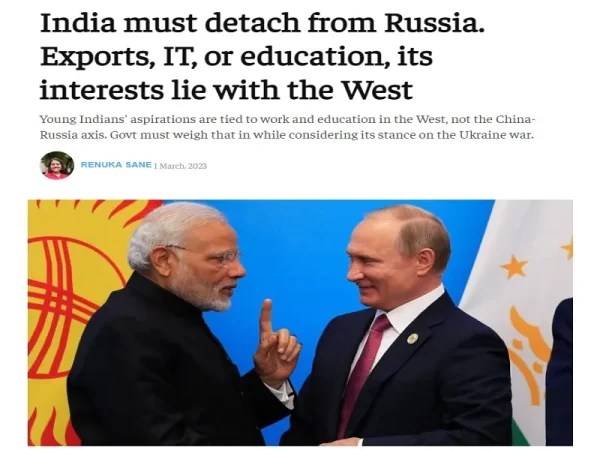
By Andrew Korybko | March 1, 2023
As an economic expert, Renuka Sane’s heart might presumably be in the right place, but her suggestion to decouple from Russia is counterproductive from the perspective of India’s grand strategic interests. By following her well-intended advice, India would be abandoning its masterful balancing act between key players in the New Cold War that’s responsible for its rapid rise as a globally significant Great Power over the past year. It would also be voluntarily submitting itself to vassal status vis-à-vis the US-led West’s Golden Billion.
The Print, a popular Indian online media outlet, published an op-ed by Renuka Sane on Wednesday urging her country to decouple from Russia in order to please its Western partners. Titled “India must detach from Russia. Exports, IT, or education, its interests lie with the West”, the research director at Trustbridge, which works on improving the rule of law for better economic outcomes for India, shared plenty of details about Indian-Western economic, financial, and tech ties in order to make her case.
There’s no disputing the fact that these abovementioned relationships are incredibly important for India and far outweigh related ties with Russia. The problem, however, is the innuendo that pervades her text whereby she appears to regularly hint that her country’s Western partners might employ “state coercion” against it in response to Delhi’s defiance of their demand to distance itself from Moscow. The first such example of this is present in the second paragraph of her piece.
Sane writes that “State coercion limits engagement between individuals in two countries. Governments make such decisions based on a balance of economic interests and foreign policy. One arena where this plays out is visa diplomacy. Denial of visas is a lever of international relations and often used as a tool to influence actions by another State.” She then adds near the end of that paragraph that “Trade agreements may sometimes be driven primarily by geopolitical and strategic reasons.”
Sane continues this trend into the third paragraph where she opines that “The energy, support, and prioritisation for all these [Indian-US tech initiatives] on the part of the two governments are shaped by their security environment.” This part can be interpreted as her hinting that the US’ displeasure with the Russian dimension of India’s foreign policy could have consequences for bilateral cooperation, especially in the tech sphere.
Reinforcing this point, the fourth paragraph includes the following insight: “Information Technology is now India’s biggest industry, and the future of the Indian economy is tied to success in this sector. For further doubling of services exports, support and cooperation from Western governments is important.” Sane then adds at the end of the sixth paragraph that “India’s approach to the Ukraine war will shape the extent to which Western governments choose to support India’s services exports growth targets.”
The last two paragraphs more directly convey the implied purpose behind her latest op-ed. This is evidenced by her warning that “If global firms want to exit China on the grounds that it is an authoritarian country hostile to the West, then it is in India’s interest to look ‘un-China’ in the eyes of the world. Our equation and policies vis-a-vis Russia may shape the attitude of these global corporate players.”
Sane then ends her piece on the following ominous note: “India’s economic interests lie with the West, and the latter is extremely worried about Russia’s invasion of Ukraine.” Putting everything together and keeping in mind the excerpts that were shared, there’s little doubt that she’s concerned that the West – particularly the US – might punish India for its independent foreign policy towards Russia through economic, financial, and/or tech means, ergo her innuendo that it should ditch Moscow.
As an economic expert, her heart might presumably be in the right place, but her suggestion is counterproductive from the perspective of India’s grand strategic interests. By following her well-intended advice, India would be abandoning its masterful balancing act between key players in the New Cold War that’s responsible for its rapid rise as a globally significant Great Power over the past year. It would also be voluntarily submitting itself to vassal status vis-à-vis the US-led West’s Golden Billion.
India’s hard-earned strategic autonomy would be surrendered in exchange for literally nothing at all since it’s highly unlikely that her implied scenario of that de facto New Cold War bloc punishing her country through the related means that she warned about will ever come to pass. This South Asian Great Power is simply much too important to the Golden Billion for the latter to unilaterally decouple itself from the former for five reasons that will now be summarized.
First, India’s labor and market potentials are too large for the West to ignore, which directly segues into the second point of them envisaging that country functioning as a reliable re-shoring location for gradually reducing their presently disproportionate dependence on Chinese-based supply chains. Third, their support for India’s continued economic growth enhances its comprehensive capabilities to manage China’s rise, which aligns with their de facto New Cold War bloc’s geostrategic interests.
Fourth, no other country has anywhere near the previously mentioned characteristics that India has, meaning that there’s no viable alternative for the West with respect to those related opportunities in the event that they decide to decouple themselves from it as punishment for its foreign policy. And finally, the worst-case scenario that they want to avoid at all costs is pushing India into considering the “Chindia” scenario of combining its potential with China and jointly challenging the West.
That last-mentioned scenario is only foreseeable in the event that the West’s liberal–globalist elite succeed in punishing India for its foreign policy through economic and other means of the sort that Color Revolution mastermind George Soros implied last month are credibly in the cards. His de facto declaration of Hybrid War against India during the Munich Security Conference was alarming, but his more pragmatic and non-ideological peers might still rein him in and prevent this from materializing.
If they can’t, then they risk pushing India into seriously considering synergizing its economic, financial, and tech potential with China, which would deal a deathblow to Western dominance. In any case, this is a choice for the West itself to make and India shouldn’t voluntarily subjugate itself to the Golden Billion’s foreign policy demands out of desperation to avert the scenario of it being punished by them like Sane appears to be strongly suggesting throughout her piece.
Rather, India should maintain its multi-alignment between all key players, but never shy away from signaling to everyone that it always has backup plans in the event that any of them unilaterally decides to worsen their relations for purely zero-sum political reasons. There’s no indication that the West as a whole is seriously considering punishing India for its ties with Russia, Soros’ de facto declaration of Hybrid War against it notwithstanding, but they should still know what would happen if they do.
Russia Will Keep Up The Pace Of Oil Exports To India Despite Increased Chinese Demand
By Andrew Korybko | March 1, 2023
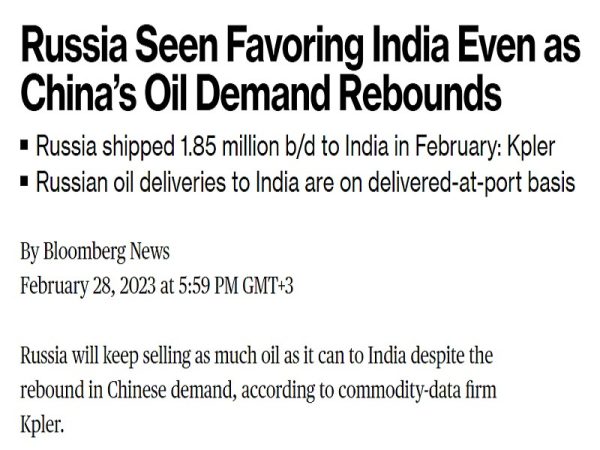
Bloomberg’s points in support of this observation are purely economic and overlook the strategic dimension of Russia’s discounted oil exports to India, which will be explained in the present piece.
Bloomberg published a piece on Tuesday about how “Russia Seen Favoring India Even as China’s Oil Demand Rebounds”, which cites lead crude analyst Viktor Katona from commodity-data firm Kpler. According to him, “While China could ‘buy literally the entire Russian oil exports’ as it abandons Covid-zero policies, Russia will want to keep the Indian market because it is more lucrative and gives its crude sellers greater control.”
Katona is also quoted as adding that “Chinese refiners may want to buy more Russian crude this year, but they also have the capacity to do their own shipping. That would deprive Moscow of income from the ‘parallel gray fleet’ of tankers it has established to deliver crude to India.” While these are all valid points in support of his prediction, they’re purely economic and overlook the strategic dimension of Russia’s discounted oil exports to India, which will now be explained.
First, India’s unprecedentd scaling of Russian oil imports over the past year since the start of the latter’s special operation preemptively averted Moscow’s potentially disproportionate dependence on China and continues to do so into the present.
Second, the Kremlin will never forget the aforementioned strategic favor that India did for Russia at its most sensitive moment in decades, hence why it’s inclined to keep up the pace of its discounted exports to that country as a way of thanking it for this.
Third, the Kremlin is cognizant of the fact that there must be tangible benefits for India in continuing to defy Western pressure upon it to dump Russia, so keeping up the pace of oil exports to it incentivizes India to continue its pragmatic policy of principled neutrality towards the Ukrainian Conflict.
Fourth, their newfound energy relations also served Russia’s grand strategic goal of accelerating India’s rise as a globally significant Great Power.
That last-mentioned outcome advances the global systemic transition’s ongoing evolution towards tripolarity ahead of its final form of more complex multipolarity (“multiplexity”), which serves both of their interests. And finally, the larger dynamics connected to the aforesaid development is that it helps break the Sino-American bi-multipolar superpower duopoly that previously characterized International Relations, thus greatly enhancing Russia and India’s strategic autonomy in the New Cold War.
Altogether, these strategic motivations ensure that Russia won’t increase oil exports to China at the expense of the level at which it’s presently supplying India. Observers should always keep them in mind since they prove that the Russian-Indian Strategic Partnership is premised on their shared goal of accelerating the global systemic transition and not on deriving opportunistic economic benefits like Bloomberg implied is supposedly the case when it comes to their current energy ties.
Blinken hopes to derail India’s relationship with Russia following Scholz’s failure
By Ahmed Adel | March 1, 2023
With Russia’s military operation in Ukraine evidently destroying NATO’s ambitions, Washington is becoming increasingly frustrated that Moscow has not been isolated. Russia did not economically collapse, as was predicted in the West, partly because of the robust and longstanding relationship it has with India. It is unsurprising that in only a matter of days, Germany and the US have pressured India to capitulate their sovereignty and serve Western interests instead of their own.
German Chancellor Olaf Scholz sought assurances from India on February 25 that it would not only refuse to block, but also support efforts to isolate Russia. Following his talks with Indian Prime Minister Narendra Modi, the chancellor refused to reveal what exactly they discussed in relation to Ukraine.
Although the contents of the discussion were cited as being confidential in nature, it is likely that Scholz did not want to humiliatingly admit that India refused to step back from its tried and tested relationship with Russia. Scholz did reveal though that he and Modi had discussed the war in Ukraine “very extensively and very intensely.”
It is noted that this trip was Scholz’s first official visit to India but his fourth meeting with Modi since taking office in 2021. Although they also discussed ways to boost economic cooperation, including through a free trade agreement between the European Union and India, it cannot be overlooked that US Secretary of State Antony Blinken arrived in New Delhi only days after Scholz.
Days before arriving in the Indian capital, Blinken said that countries like India, which have not joined the West in denouncing Russia’s military operation, were on a supposed trajectory away from alignment with Moscow. He stressed that the process would not occur “in one fell swoop.”
“There are countries that have long-standing, decades-long relationships with Russia, with the Soviet Union before, that are challenging to break off in one fell swoop. It’s not flipping a light switch, it’s moving an aircraft carrier,” Blinken said in an interview with The Atlantic on February 24.
However, for all of Blinken’s claims that India is moving away from Moscow, there is no actual suggestion that this is occurring. The US and India cooperate through the QUAD format, a naval bloc aimed against China, but this has not meant India’s submission to Washington, as the Americans evidently anticipated.
Although India has faced sustained and continued pressure from the West to distance itself from Moscow, New Delhi has thus far resisted, citing its longstanding ties with Russia and its economic and oil interests. It cannot be overlooked that Russia has been India’s largest weapons supplier since the Cold War-era, particularly since the US traditionally favoured Pakistan.
However, Washington in recent years has looked to turn New Delhi away from its main military supplier (but without wanting to adjust its policy to Pakistan).
“India for decades had Russia at the core of providing military equipment to it and its defences, but what we’ve seen over the last few years is a trajectory away from relying on Russia and moving into partnership with us and other countries,” Blinken said, without mentioning the fact that India is moving towards home-grown production, something that Russia is playing a key role in.
None-the-less, it is expected that Blinken, in the same way as Scholz, will try and convince India to change course regarding its ties with Russia.
As Bloomberg reported, citing Kpler’s lead crude analyst, Viktor Katona, “India purchased almost no Russian oil a year ago, but has become a crucial market after the US and European Union imposed sanctions on Moscow. The Asian country imported around 1.85 million barrels a day from Russia in February, close to its potential maximum of about 2 million barrels a day.”
The cold hard facts are that Moscow and New Delhi have a longstanding relationship that India will not break just for the sake of serving Western interests. Beyond the time-tested security ties, Russia offers energy hungry India the best deal for oil, something that will not be sacrificed because of a far-off war in Eastern Europe.
According to QUARTZ, India has in less than a year saved an estimated $3.6 billion by increasing Russian oil imports. This is a significant amount for a country that depends on imports to meet 85% of its petroleum needs.
It is recalled that in November 2022, Indian Foreign Minister S Jaishankar said “Russia has been a steady and time-tested partner. Any objective evaluation of our relationship over many decades would confirm that it has actually served both our countries very, very well.”
With this statement, he effectively confirmed a continuance of the current policy despite sustained pressure – a pressure that Scholz and Blinken are the latest to apply. They are however also the latest that were unable to convince New Delhi to change its policy regarding Russia.
Ahmed Adel is a Cairo-based geopolitics and political economy researcher.
Featured Video

Iran FM Araghchi: “Hormuz Will No Longer Be the Same”
or go to
Aletho News Archives – Video-Images
From the Archives
Sam Husseini: The entire US establishment helped lie their way into the Iraq war
By Slava Zilber | American Herald Tribune | October 14, 2019
Sam Husseini is a senior analyst with the Institute for Public Accuracy, independent journalist and contributor to The Nation and FAIR.
Slava Zilber: Sam, three years ago, you appeared on Talk Nation Radio with David Swanson and spoke about the case of the GCHQ whistleblower Katharine Gun. You pointed out that the people involved in the spying on the UN and the people authorizing the Iraq War were not held accountable:
“Virtually everybody who went along with the war, whether it is Kerry or Clinton, of course, the Bush administration themselves has falsified their own records in terms of why, what they did, when they did, why they did it, to the extent that they’ve been scrutinised at all.”
You also address it in a recent article. And recently, Joe Biden has been lying about his position on the Iraq War. How can such an important issue escape meaningful scrutiny? … continue
Blog Roll
 Aletho News
- Barghouti: ‘Netanyahu has fallen,’ era of Smotrich, Ben-Gvir over
- China slams US policy on Iran as Russia rejects legality of nuclear meeting at UN
- The Mecca Pact Courts Iran: Containment Comes Full Circle
- Oman FM: Persian Gulf states, Iran, Iraq should form security pact excluding US
- Trump peddles fresh falsehoods, claims Iran ‘started the war’ as US aggression drags on
- Ukraine quagmire? Yes, but it’s for NATO, not Russia
- US intelligence hypes Chinese, Russian space threats while accelerating its own military buildup in orbit
- Iran FM Araghchi: “Hormuz Will No Longer Be the Same”
- EU facing trillion-euro debt hole while seeking more cash for Kiev
- How US, Europe, Persian Gulf states exhausted missile stockpiles, splurged billions to defend Israel
- If Americans Knew
- An error has occurred; the feed is probably down. Try again later.
- No Tricks Zone
- Sudden Stratospheric Warming, Powerful El Niño Combination May Lead To Extreme Europe Cold, Energy Crisis!
- Two New Studies Find Thwaites Glacier Melt Cannot Be Driven By Human Activity Or A Warming Ocean
- E-Cars Reduce CO2 Emissions By Only 41% Compared To Internal Combustion Engine Vehicles
- Predictions Made By Renowned Climate Professor Over Past Decades Have Been Proven To Be Poor
- New Study Suggests Large Regions Of The Pacific Ocean Have Been Cooling For The Last 80 Years
- Germany’s Green Energy Debacle: High Energy Costs Force Kahla Porzellan to Close After 182 Years!
- New Study: 50 Years Of The Most Aggressive ‘Net Zero’ Policies Can Only Affect The Global Climate By 0.03°C
- US September “Heat” Was No Record…Many Records Set Decades Ago
- Latest European Green Energy Debacle; Portugal’s Largest Flagship Solar Park Insolvent!
- Green Energy Debacle: German Expert Professor Fritz Vahrenholt Warns Of Severe Economic And Social Consequences

