Israeli officials slam director over ‘propaganda’ claim
RT | November 29, 2022
Israeli officials tore into their countryman, filmmaker Nadav Lapid, after he condemned popular Indian film The Kashmir Files as “propaganda” and “vulgar” before an audience at the International Film Festival of India in Goa. Lapid had been invited to lead the jury of the festival, which is funded by the government and counts many politicians and other VIPs among its attendees.
“We were all disturbed and shocked by the 15th film, The Kashmir Files, that felt to us like a propaganda, vulgar movie inappropriate for an artistic competitive section of such a prestigious film festival,” Lapid said during the closing ceremony. The film dramatizes the flight of Hindus from Kashmir in the 1990s amid an armed Muslim uprising, and has galvanized Islamophobic sentiment in the country.
“You should be ashamed,” Ambassador Naor Gilon chided Lapid via tweet on Tuesday, accusing the filmmaker of abusing “the trust, respect, and warm hospitality [the International Film Festival of India] have bestowed upon” him.
“It’s insensitive and presumptuous to speak about historic events before deeply studying them and which are an open wound in India because many of those involved are still around and still paying a price,” Gilon continued, suggesting that by publicly casting aspersions on The Kashmir Files’ version of history, Lapid was encouraging Indians to question the Holocaust.
Former ambassador to India Danny Carmon agreed, calling for Lapid to “apologize for the personal comments on historical facts without sensitivity and without knowing what he is talking about.” Consul General of Israel to Midwest India Kobbi Shoshani was quick to reassure local media that Lapid’s words were “not the opinion or the attitude of the government of Israel,” declaring “we completely don’t accept such speeches.”
While Lapid clarified he meant his comment as an artistic rather than personal criticism – “I feel totally comfortable to share openly these feelings here with you on stage since the spirit of the festival can truly accept also a critical discussion, which is essential for art and for life,” he said – that did little to blunt the attacks that came his way, from Indians as well as Israelis.
Lapid was denounced as “a Hindu-hating bigot who whitewashes ethnic cleansing” and as “not less than a Nazi enabler” by Abhinav Prakash, head of the Bharatiya Janata Yuva Morcha youth movement, while Aditya Raj Kaul, executive editor of the TV9 network, questioned whether the filmmaker would “call Holocaust a propaganda [sic]” or say the same about Holocaust films Schindler’s List and The Pianist.
Washington Attempts To Bully India Into Cutting Ties With Russia
By Conor Gallagher | naked capitalism | November 13, 2022
For months the US has repeatedly tried to coerce India into cutting ties with Russia, thereby abandoning its national interests. New Delhi, however, continues to spurn American attempts to subject its economy to Washington’s dictates.
The latest fuss concerns the G7 price cap on Russian oil and EU and UK bans on shipping and related services for Russian crude. India continues to have no interest in joining the US-led initiative as it gets a steep discount on oil from Russia and wants to maintain the relationship with a long-time strategic partner. Indian Foreign Affairs Minister Subrahmanyam Jaishankar was just in Moscow on Nov. 8 to discuss continued sales of oil. From the South China Morning Post :
India’s foreign minister hailed New Delhi’s “strong and steady” relationship with Moscow on Tuesday, during his first visit there since Russia invaded Ukraine in February.
Subrahmanyam Jaishankar also declared India’s intention to continue to buy Russian oil, again disregarding the US appeal to allies and partners to isolate Russia from the global markets.
The G-7 plans are likely to send oil prices higher (despite US Treasury Secretary Janet Yellen claiming the opposite) and reduce tanker availability, both of which will threaten India’s energy security and hurt its economy as India is the third-largest consumer and importer of oil worldwide.
Russia has said it will not sell to any countries that participate in the price cap scheme, and Jaishankar has repeatedly stated that India cannot afford to buy oil at high prices – at least not without undermining its economic growth, which is forecast to be 6.1 percent in 2023, the fastest-growing major economy in the world. According to Energy Intelligence :
Russia emerged as India’s top crude supplier in October, shipping over 900,000 barrels per day or roughly a fifth of India’s demand. The two countries’ biggest concern is ensuring that Russian oil continues to flow after the Dec. 5 EU and UK bans and related G7 price cap.
But despite Jaishankar’s bullish stance in Moscow, India’s state refiners have not placed orders for crude lifting beyond Dec. 5 due to uncertainties about whether shipping and insurance will be available, Energy Intelligence understands. And a recent attempt by an Indian buyer to use the price cap in negotiations with a Russian seller prompted the latter to abandon the deal, market sources said.
The ongoing lack of clarity on the G-7 could be by design. Russian oil exports have already begun to dip, and Bruce Paulsen, a sanctions expert and partner at law firm Seward & Kissel, told American Shipper, “ If guidance on [price cap] compliance doesn’t come soon, some industry players may sit on the sidelines until they can determine that shipments under the price cap are safe.”
The US, in a neat sleight of hand, quit pressuring India to adhere to the price cap, and Yellen now says Washington is “happy” for New Delhi to continue buying as much Russian oil as it wants, including at prices above a G7-imposed price cap. But there are just a few caveats: India wouldn’t be able to use western insurance, finance, or maritime services to transport the oil.
“Russia is going to find it very difficult to continue shipping as much oil as they have done when the EU stops buying Russian oil,” Yellen told Reuters on Friday. “They’re going to be heavily in search of buyers, and many buyers are reliant on Western services.”
More from Energy Intelligence on why this amounts to a de facto price cap:
Indian refiners have the capacity to soak up another 600,000 b/d of Russian crude, provided it outcompetes the staple Mideast grades that are the lifeline of the country’s 5 million b/d refining base. But the availability of shipping and insurance — and payment channels — is key. From Dec. 5, tankers and shipping insurance linked to EU and G7 countries — which dominate oil shipping globally — will be barred from trading Russian crude unless those volumes are sold under the price cap, as yet undetermined.
About 90% of India’s liquids trade is shipped by foreign tankers, presenting challenges, independent energy analyst Narendra Taneja said. Insurance does not appear as problematic, and analysts say that Russian and Chinese firms can handle it.
This could leave Russia reliant on a shadow fleet of older tankers with opaque ownership that do not transact in dollars. According to Freight Waves :
Brokerage Braemar reported that 33 tankers previously handling Iranian or Venezuelan exports have carried Russian exports since April, mostly to China and secondarily to India.
Braemar defined the dark fleet as tankers that have carried Iranian or Venezuelan crude at least once in the past year. It put the current total at 240 tankers, mostly smaller and midsized, with 74% 19 years or older. Eighty of those vessels are very large crude carriers (VLCCs, tankers that carry 2 million barrels) that won’t fit in Russian ports but could be used for ship-to-ship transfers for Russian cargoes.
If the entire dark fleet switched to Russian service and were as efficient as the “mainstream fleet,” it would be more than enough to keep Russian exports flowing, but “vessels engaged in illicit trading are highly inefficient,” Braemar emphasized.
At the same time Washington is pressuring New Delhi to comply with the price cap, it is importing from India more vacuum gasoil, which is mostly used at refineries to produce other products such as gasoline and diesel. From Reuters :
Russia used to be a key VGO supplier to U.S. refiners before the Ukraine war broke out.
“Given that the U.S. is not buying Russian oil, they are looking for any and all alternatives,” said Roslan Khasawneh, senior fuel oil analyst at Vortexa…
U.S. and EU sanctions do not apply to refined products produced from Russian crude exported from a third country as they are not of Russian origin. In India, refiners boosted imports of discounted Russian oil to 793,000 barrels per day between April and October, up from just 38,000 bpd in the same period a year ago, trade data showed.
India joins a list of countries – including Saudi Arabia, Serbia, and Turkey – that are causing heads to explode in Washington for refusing to be bullied into submission.
This all must be coming as a shock in Washington as its Indo-Pacific strategy in recent years has always included a “like-minded” India helping to counter China and do the US’ bidding in southeast Asia. The possibility that India might pursue its own national interests didn’t seem to factor into the strategy.
The tension over the Russian price cap is just the latest in a series of disagreements between New Delhi and Washington. US sanctions on Iran’s oil exports deprive India of cheap Iranian oil, and force it to buy more expensive US energy exports. India is now the largest oil export destination for the US.
Similar to the way Washington is arming Greece and Cyprus in an effort to bully Turkey into breaking off its friendly ties with Russia, the US is doing the same in Pakistan to pressure India. The US has begun to accommodate Pakistan again after the ouster of former Pakistani prime minister Imran Khan, who blames his loss of power in a no-confidence vote on the US.
In September, the U.S. State Department enraged India when it approved a $450 million deal to upgrade Pakistan’s F-16 fleet. Shortly after, the US ambassador to Pakistan created more tension during a visit to the Pakistani-held part of Kashmir, which he called by its Pakistani name instead of the United Nations-approved name “Pakistan-administered Kashmir.”
On Nov. 8 US State Department spokesman Ned Price lectured India on what are in its best interests:
We’ve also been clear that now is not the time for business as usual with Russia, and it’s incumbent on countries around the world to do what they can to lessen those economic ties with Russia. That’s something that’s in the collective interest, but it’s also in the bilateral interest of countries around the world to end and certainly over the course of time to wean their dependence on Russian energy. There have been a number of countries that have learned the hard way of the fact that Russia is not a reliable source of energy. Russia is not a reliable supplier of security assistance. Russia is far from reliable in any realm. So it is not only in the interest of Ukraine, it is not only in the interest of the region, of the collective interests that India decrease its dependence on Russia over time, but it’s also in India’s own bilateral interest, given what we’ve seen from Russia.
We’ll have to wait and see if the Indian people get the message because as of now the opposite is true. India’s Observer Research Foundation released poll results on Nov. 2 that showed that 43 percent of Indians regarded Russia as their country’s most reliable partner, which was far ahead of the US at 27 percent.
Washington would be hard pressed to explain how New Delhi scaling back its economic ties with Russia would be a good thing for India.
Fuelled by a surge in import of oil and fertilizers, India’s bilateral trade with Russia has soared to an all-time high of $18.2 billion over the April-August period of this financial year, according to the latest data available with the Department of Commerce. That makes Russia India’s seventh biggest trading partner — up from its 25th position last year. The US, China, UAE, Saudi Arabia, Iraq, and Indonesia remain ahead of Russia.
India, Iran, and Russia have also spent the past twenty years developing the International North-South Transport Corridor to increase trade between the countries, and it took on increased importance with the western sanctions on Moscow. From The LoadStar :
RZD Logistics, a subsidiary of Russian railway monopoly RZD, has begun regular container train services from Moscow to Iran to serve growing trade with India by transloading.
This is aimed at maximizing use of the alternative International North South Transport Corridor (INSTC), a Central Asia cross-border multimodal freight network helping the two strategic partners work around supply chain challenges created by western sanctions on Russia.
The inland-ocean leg involves an estimated transit time of 35 days, compared with about 40 with previous traditional shipping, according to industry sources.

©Peter Hermes Furian
In much the same way that US heavy-handedness is backfiring elsewhere, the pressure applied on India seems to only be encouraging New Delhi to find a way around the dollar. The Loadstar adds that the Reserve Bank of India is also implementing new regulatory guidelines to help exporters settle shipments in rupees, instead of US dollars that had run into sanctions-related bottlenecks:
The Federation of Indian Export Organizations has also been pressing government leaders to extend the alternative currency method beyond Russian markets.
“While the Russia-Ukraine war is a setback to our exports in the short run, we are looking to increase our exports to Russia once the rupee payment mechanism gets operationalised,” FIEO noted.
While India has been benefitting from the discounted Russian crude, it also wants to maintain good ties with Moscow to avoid pushing Russia closer to China and potentially Pakistan, India’s biggest rivals in Asia.
Pakistan is also now asking the Russian Trade Ministry to introduce a currency swap arrangement to strengthen economic ties between the two countries.
New Delhi may sue Berlin over undelivered LNG – Bloomberg
RT | November 12, 2022
A diplomatic dispute is brewing between India and Germany after Berlin took over a former Gazprom subsidiary and halted LNG shipments to New Delhi.
The Russian gas giant’s former local subsidiary Gazprom Germania, renamed SEFE (Securing Energy for Europe), cut LNG supplies to India’s Gail back in May, citing sanctions Moscow imposed after the company was taken over by the German state. Under the sanctions, Gazprom stopped supplying SEFE with gas.
Gail had a 20-year contract with Gazprom Germania’s Singaporean unit, GM&T Singapore, for the supply of 2.5 million tons of LNG per year. According to Bloomberg, citing the association of LNG importers GIIGNL, the contract remained valid after Berlin took over Gazprom Germania, meaning SEFE was still required to meet its obligations to Gail.
In September, SEFE’s Singaporean unit said it could no longer fulfill its long-term contract with Gail and offered to pay compensation of 20% of the contract price for the failed LNG deliveries. Gail CFO Rakesh Kumar Jain last week said that SEFE had canceled a total of 17 LNG shipments since May.
According to Bloomberg’s sources, India is now demanding that SEFE find alternative gas suppliers in order to meet its obligations to Gail, as the Indian company has been forced to spend much larger sums to buy gas on the spot market. It also had to cut supplies to customers and lower production at its petrochemicals plant due to the LNG deficit. The company has also turned down the compensation offer for undelivered LNG as it prefers to retain the right to the cancelled cargoes, Reuters reported on Friday.
Bloomberg’s sources said that both Indian and German diplomats have been engaged to solve the dispute. A diplomatic solution is preferable for the parties, according to the sources, although they noted that Gail was also consulting lawyers about arbitration over the contract with SEFE, which means the dispute could turn into a lawsuit. Gail is also reportedly negotiating with Gazprom to buy LNG directly from the Russian company.
Kashmiris mark 1947 murder of 200,000 Muslims by Hindu extremists
Press TV – November 6, 2022
Kashmiris on both sides of the Line of Control (LOC) are marking the 75th anniversary of the day when hundreds of thousands of Muslims were killed in the Jammu region.
More than 200,000 Muslims were systematically killed by Hindu extremists when they were migrating to Pakistan.
The All Parties Hurriyat Conference (APHC) leaders on Sunday paid tributes to the memory of those killed.
Detained senior APHC leader Shabbir Ahmad Shah, in a message from New Delhi’s Tihar Jail, said the massacre of Muslims was the most horrible incident of Kashmir’s history that continues to haunt the regional people.
Other APHC leaders, in a joint statement, said the Kashmiris “will always remember the great sacrifice of the Jammu martyrs”.
“The Kashmiris have been rendering sacrifices for a great cause for the last several decades and the day is not far when they will achieve their cherished goal,” the statement said.
They also urged the international community to press India to stop its “brutalities” in Kashmir and settle the dispute in accordance with the aspirations of its people and the relevant UN resolutions.
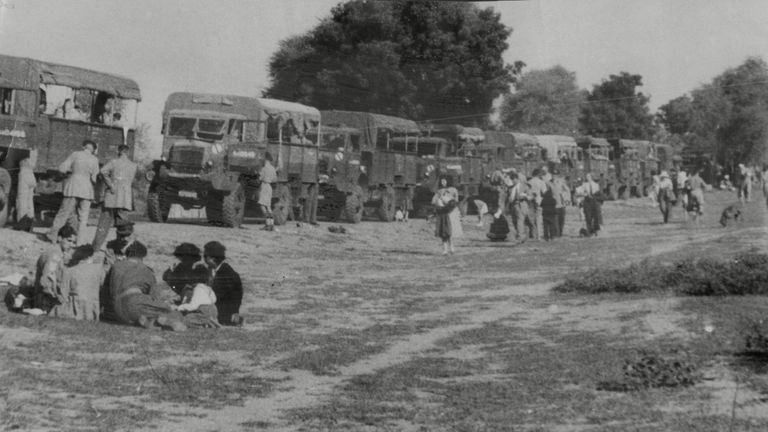
Between October and November in 1947, the majority of Muslims living in Jammu, Kathua, Reasi and Udhampur were uprooted from their homes during the days the genocide took place.
The crimes that were committed during that week included abduction and rape of Muslim women, mass slaughtering of Muslims including children and stealing of personal belongings.
In one of the many incidents that took place during that week, it was announced by the beat of the drum for all Muslims to assemble at the parade ground in Jammu.
They were later loaded on motor lorry convoys to be sent to Suchetgarh in India, but instead they were driven to Kathua road of the Jammu region and told to get off, after which they were killed by the Hindu forces that escorted them.
US scales back plan for Russian oil price cap – Report
Samizdat | October 27, 2022
President Joe Biden’s administration has reportedly been forced back to the drawing board on its plan to cap international prices for Russian oil, having failed to secure enough commitments to control how much Moscow is paid for the bulk of its crude exports.
The US and the European Union will likely have to settle for a “loosely policed” pricing cap, enforced by fewer buyers and at a higher price than envisioned, Bloomberg News reported on Wednesday, citing unidentified people familiar with the plans. The original goal was to drastically reduce Russia’s oil revenue – the latest effort to punish Moscow for its military offensive in Ukraine – by imposing a strict price lid to which a broad “buyer’s cartel” of nations would adhere.
Instead, only G7 nations and Australia have committed to honoring the price cap, Bloomberg said, attributing failure of the original plan to investor skepticism, volatile financial markets and efforts to tame inflation around the world. The cap level also might need to go higher than a previously targeted range of $40-$60 per barrel.
Biden’s administration has denied that its plan would fall short of throttling Russian oil revenue. “The White House and the administration are staying the course on implementing an effective, strong price cap on Russian oil in coordination with the G7 and other partners,” White House National Security Council spokeswoman Adrienne Watson told Bloomberg in a statement.
Russian officials have said the country won’t sell oil or other commodities under price caps or unprofitable market conditions. Nor will Moscow supply energy to nations that adopt trade policies contradicting the terms of their existing oil and natural gas contracts, Russian Deputy Prime Minister Aleksandr Novak said earlier this month. A cap on crude wouldn’t be viable because prices are driven by the global supply-demand balance, he added.
The G7 price cap is scheduled to go into force on December 5, along with an EU ban on imports of seaborne Russian crude. Reuters reported last week that after December 5, Russia would still be able to ship the vast majority of its oil exports at market prices because it would have ample access to tankers and other services. The outlet cited a US Treasury official as saying that between 80% and 90% of Russian oil would continue to flow to buyers outside the cap mechanism.
Russia would have access not only to its own oil tankers, but also to Chinese and Indian ships, Reuters added. Traders and insurance companies from Russia, Asia and the Middle East would provide the necessary transactional services. Brent crude, a leading international oil benchmark, is currently selling for around $95 per barrel.
Ex-Aussie PM Calls Quad ‘Piece of Strategic Nonsense’
Samizdat – 12.10.2022
The Quad was officially launched in 2007 but suspended in 2008 after Australia pulled out of the US-led grouping over concerns expressed by China. The grouping was revived in 2017, a year after the US announced its ‘Indo-Pacific Strategy’. Beijing has labelled the Quad ‘Asian NATO’, accusing Washington of inciting tensions in the region.
Former Australian Prime Minister Paul Keating has slammed the US-led Quad grouping as “illegitimate” and a “strategic piece of nonsense,” as he advised Canberra to not be a part of the US-led efforts to “ring-fence” China.
The Quad, which comprises Australia, India, Japan and the US, says that its official goal is to maintain a “free and open Indo-Pacific region”.
“We shouldn’t be stringing together the US, Japan, India and Australia to try to contain China,” Keating, a senior party colleague of Prime Minister Anthony Albanese, said on Wednesday.
Keating argued that that Beijing’s “ambitions are in the west, not the east,” as he underlined the inroads made by the Belt and Road Initiative (BRI) in regions outside Asia. “Everywhere between Wuhan and Istanbul, in the next 30 years, will have a huge Chinese influence.”
Keating pointed out that the BRI has already financed infrastructure projects in the Baltic states as well as in former Soviet countries.
The multi-trillion-dollar BRI initiative was launched by Chinese President Xi Jinping in 2013 and strives to connect east Asia with Europe and beyond through connectivity and infrastructure projects. As of March 2022, a total of 147 countries across Asia, Africa, Europe, South America as well as North America have been members of the Beijing-backed global initiative.
Keating also reckoned that the era of US “supremacy” as the pre-eminent global power has already passed.
“This idea that the US is an exceptional power… they have God’s ear and proselytizing democracy was fine in the 20th century. The 20th century was owned by the US. The 21st century belongs to someone else,” stated Keating.
He also expressed doubts whether the US would come to the help of Taiwan if Beijing went ahead with the re-unification of the island with the mainland through military means.
Beijing has doubled down on its commitment to “reunify” Taiwan with the mainland following the visit of US House Speaker Nancy Pelosi to Taipei in August. Chinese President Xi Jinping has said that reunifying Taiwan is part of China’s goal to achieve “national rejuvenation”.
“China would see every amphibious vessel coming towards the United States, whether it is San Diego or Honolulu. They would see them and sink them,” the former Australian PM claimed, suggesting that the chances of an American “victory” in such a scenario would be “nil”.
Keating advised the Australian government not to get involved in the “geopolitical conflict” around Taiwan.
“We should be no more interested in the political system of Taiwan than Vietnam and Kazakhstan,” argued Keating.
US is recalibrating the power dynamic in East Mediterranean. Can South Asia be far behind?

File Photo
BY M. K. BHADRAKUMAR | INDIAN PUNCHLINE | OCTOBER 2, 2022
A mild flutter ensued after External Affairs Minister S Jaishankar’s recent meeting with his Turkiye counterpart Mevlut Cavusoglu on the sidelines of the UN General Assembly session in New York on September 21 when it came to be known that Cyprus figured in their discussion. Jaishankar highlighted it in a tweet.
The Indian media instinctively related this to Turkish President Recep Erdogan making a one-line reference to the Kashmir issue earlier that day in his address to the UN GA. But Jaishankar being a scholar-diplomat, would know that Cyprus issue is in the news cycle and the new cold war conditions breathe fresh life into it, as tensions mount in the Turkish-Greek rivalry, which often draws comparison with the India-Pakistan animosity, stemming from another historical “Partition” — under the Treaty of Lausanne (1923) that ended the Ottoman Empire.
The beauty about peace treaties is that they have no ‘expiration date’ but the Treaty of Lausanne was signed for a period of a hundred years between Turkiye on one side and Britain, France, Italy, Greece, and their allies on the other. The approaching date heightens the existential predicament at the heart of Turkiye’s foreign policy.
The stunning reality is that by 24th July 2023, Turkey’s modern borders become “obsolete”. The secret articles of the 1923 Treaty, signed by Turkish and British diplomats, provide for a chain of strange happenings — British troops will reoccupy the forts overlooking the Bosphorus; the Greek Orthodox Patriarch will resurrect a Byzantine mini state within Istanbul’s city walls; and Turkey will finally be able to tap the forbidden vast energy resources of the East Mediterranean (and, perhaps, regain Western Thrace, a province of Greece.)
Of course, none of that can happen and they remain conspiracy theories. Nonetheless, the “end-of-Lausanne” syndrome remains a foundational myth and weaves neatly into the historical revisionism that Ataturk should have got a much better deal from the Western powers.
All this goes to underline the magnitude of the current massively underestimated drama, of which Cyprus is at the epicentre. Suffice to say, Turkey’s geometrically growing rift with Greece and Cyprus over the offshore hydrocarbon reserves and naval borders must be properly understood in terms of the big picture.
Turkiye’s ruling elite believe that Turkey was forced to sign the Treaty of Sevres in 1920 and the “Treaty of Lausanne” in 1923 and thereby concede vast tracts of land under its domain. Erdogan rejects any understanding of history that takes 1919 as the start of the 1,000-year history of his great nation and civilisation. “Whoever leaves out our last 200 years, even 600 years together with its victories and defeats, and jumps directly from old Turkish history to the Republic, is an enemy of our nation and state,” he once stated.
The international community has begun to pay attention as Turkiye celebrates its centenary next year, which also happens to be an election year for Erdogan. In a typical first shot, the US State Department announced on September 16 — just five days before Jaishankar met Cavusoglu — that Washington is lifting defence trade restrictions on the Greek Cypriot administration for the 2023 fiscal year.
Spokesman Ned Price said, “Secretary of State Antony J. Blinken determined and certified to Congress that the Republic of Cyprus has met the necessary conditions under relevant legislation to allow the approval of exports, re-exports, and transfers of defence articles.”
The US move comes against the backdrop of a spate of recent arms deals by Cyprus and Greece, including a deal to purchase attack helicopters from France and efforts to procure missile and long-range radar systems. Turkiye called on the US “to reconsider this decision and to pursue a balanced policy towards the two sides on the Island.” It has since announced a beefing up of its military presence in Northern Cyprus.
To be sure, the unilateral US move also means indirect support for the maritime claims by Greece and the Greek Cypriot administration, which Turkiye, with the longest continental coastline in the Eastern Mediterranean, rejects as excessive and violates its sovereign rights and that of Turkish Cypriots.
Whether these developments figured in Jaishankar’s discussion with Cavusoglu is unclear, but curiously, India too is currently grappling with a similar US decision to offer a $450 million military package to Pakistan to upgrade its nuclear-capable F-16 aircraft.
Indeed, the US-Turkey-Cyprus triangle has some striking similarities with the US-India-Pakistan triangle. In both cases, the Biden administration is dealing with friendly pro-US governments in Nicosia and Islamabad but is discernibly unhappy with the nationalist credo of the leaderships in Ankara and New Delhi.
Washington is annoyed that the governments in Ankara and New Delhi preserve their strategic autonomy. Most important, the US’ attempt to isolate Russia weakening due to the refusal by Turkiye and India to impose sanctions against Moscow.
The US is worried that India and Turkiye, two influential regional powers, pursue foreign policies promoting multipolarity in the international system, which undermines US’ global hegemony. Above all, it is an eyesore for Washington that Erdogan and Prime Minister Modi enjoy warm trustful personal interaction with Russian President Vladimir Putin.
The photo beamed from Samarkand during the recent SCO summit showing Erdogan arm in arm with Putin must have infuriated President Biden. Modi too displayed a rare moment of surging emotions when he told Putin at Samarkand on September 16,
“The relationship between India and Russia has deepened manifold. We also value this relationship because we have been such friends who have been with each other every moment for the last several decades and the whole world also knows how Russia’s relationship with India has been and how India’s relationship with Russia has been and therefore the world also knows that it is an unbreakable friendship. Personally speaking, in a way, the journey for both of us started at the same time. I first met you in 2001, when you were working as the head of the government and I had started working as head of the state government. Today, it has been 22 years, our friendship is constantly growing, we are constantly working together for the betterment of this region, for the well-being of the people. Today, at the SCO Summit, I am very grateful to you for all the feelings that you have expressed for India.”
Amazingly, the western media censored this stirring passage in its reports on the Modi-Putin meeting!
Notably, following the meeting between Modi and Erdogan in Samarkand on Sept. 16, a commentary by the state-owned TRT titled Turkiye-India ties have a bright future ahead signalled the Erdogan government’s interest to move forward in relations with India.
India’s ties with Turkiye deserve to be prioritised, as that country is inching toward BRICS and the SCO and is destined to be a serious player in the emerging multipolar world order. Symptomatic of the shift in tectonic plates is the recent report that Russia might launch direct flights between Moscow and the Turkish Republic of Northern Cyprus, a state supported and recognised only by Ankara. (Incidentally, one “pre-condition” set by the Biden administration to resume military aid to Cyprus was that Nicosia should roll back its relations with Moscow!)
Without doubt, the US and the EU are recalibrating the power dynamics in the Eastern Mediterranean by building up the Cyprus-Greece axis and sending a warning to Turkiye to know its place. In geopolitical terms, this is another way of welcoming Cyprus into NATO. Thus, it becomes part of the new cold war.
Can South Asia’s future be any different? Turkiye has so many advantages over India, having been a longstanding cold-war era ally of the US. It hosts Incirlik Air Base, one of the US’ major strategically located military bases. Kurecik Radar Station partners with the US Air Force and Navy in a mission related to missile interception and defence. Turkey is a NATO power which is irreplaceable in the alliance’s southern tier. Turkey controls the Bosphorus Straits under the Montreux Convention (1936).
Yet, the US is unwilling to have a relationship of mutual interest and mutual respect with Turkiye. Pentagon is openly aligned with the Kurdish separatists. The Obama administration made a failed coup attempt to overthrow Erdogan.
Russia Backs India’s Bid to Become Permanent Member of United Nations Security Council
Samizdat – 25.09.2022
Russia has come out in support of India’s bid to become one of the permanent members of the United Nations Security Council (UNSC) – the all-powerful global body which is responsible for taking key decisions about maintaining peace and security in the world.
At present, it comprises the United States, France, Russia, China, and Great Britain.
During his speech at the UNGA, Russian foreign minister Sergey Lavrov called for wider representation of Asian, African, and Latin American countries in the Security Council, making particular mention of New Delhi and Brazil.
“We see an opportunity to make the Security Council more democratic by having representation from African, Asian and Latin American countries. India and Brazil, in particular, are major international players and should be included as permanent members of the council,” Lavrov said in his address to the 77th United Nations General Assembly.
Earlier, in a joint statement, India and 31 other nations urged the UN to expand both the permanent and non-permanent membership of the UNSC.
Besides, New Delhi said that reforms in the UN were necessary to make it more effective and representative.
At another meeting in which foreign ministers from India, Japan, Germany, and Brazil took part, reforms of the Security Council were discussed at length.
The four nations together are known as the G4 and after the meeting they released a joint statement, saying that “today’s conflicts around the globe and the interconnected global challenges have brought to the fore the urgency to carry out reforms in the Security Council as well as expand the membership of other decision-making groups so that they are more representative of the interests of the developing nations.”
At present, India is a non-permanent member of the UNSC.
New Delhi’s two-year term on the Council ends on 31 December this year.
India’s gaffe at Samarkand
BY M. K. BHADRAKUMAR | INDIAN PUNCHLINE | SEPTEMBER 20, 2022
Prime Minister Narendra Modi’s meeting with Russian President Vladimir Putin at Samarkand on September 16 after the SCO Summit turned into a media scandal. The Western media zeroed in on six words culled out of context in the PM’s opening remarks — “today’s era is not of war”— to triumphantly proclaim that India is finally distancing itself from Russia on Ukraine issue, as the US and European leaders have been incessantly demanding.
Of course, this motivated interpretation lacks empirical evidence and is, therefore, malicious. Besides, Modi also spoke with a rare interplay of emotions by underscoring the quintessence of the Indian-Russian relationship, and his two decade-long association with Putin.
The steamy part cooked up by the US media shows the desperation on the part of the “Collective West” to isolate Russia at a time when even western leaders have candidly admitted that the bulk of the non-western world does not identify with the western narrative on Ukraine and refuses to roll back their relationship with Russia.
Many countries are, in fact, stepping up their cooperation with Russia —Turkey, Saudi Arabia, Egypt, Iran, for example. Curiously, even western companies are loathe to leave the highly attractive Russian market where business returns are high. A report in the Atlantic Council magazine on September 18 highlights that although something like 1,000 multinational corporations had announced that they would be leaving Russia in the wake of the western sanctions, “the unfortunate reality is that… three-quarters of the most profitable foreign multinationals remain in Russia.” Thus, statistically, while 106 western companies exited the Russian market, over 1,149 internationals still remain and simply keep silent about it.
The giant Sakhalin-2 oil-and-natural-gas project in the Russian Far East is a celebrated case where two big energy Japanese investors Mitsui and Mitsublishi, with government support, simply refused to quit, as the Russian project supplies 9 percent of Japan’s energy needs. The G7 has no option but to exempt Japan from the purview of sanctions when it comes to Sakhalin-2!
Again, the West continues to import fertiliser from Russia and to that end, lifts the restrictions on shipping, insurance, etc. But the restrictions continue against Russia’s exports of food grain and fertiliser to the non-Western world. Russia has now offered to distribute the fertiliser held up in European ports free of charge to the poorest countries in Africa if only the restrictions for exports are waived, but Europe would rather use it for their own needs.
It has recently been exposed that the brouhaha about a “global food crisis” (which India too mouthed) was basically a cheap hoax perpetrated by the Biden Administration to get Russia to allow the sale of wheat held up in Ukrainian silos to the European market by American companies, who have apparently bought up Ukraine’s farm lands and control that country’s grain trade! Only a fraction of the grain shipments from Ukraine went to poor countries threatened by famine. Suffice to say, the US and the European Union pressure on India’s purchase of Russian oil was nothing but bullying.
That said, India should know that in a situation where Russia faces an existential threat to its security, it will not be deterred in firmly, decisively responding, no matter what anybody says. Will India be deterred if any foreign country gets agitated over state repression in Kashmir? Violence and bloodshed are abhorrent features of the contemporary world situation and is a painful reality all over the world.
That is why, PM Modi’s awkward reference to war and peace in his initial remarks to Putin at Samarkand was way out of place in what turned out to be a “wonderful” meeting otherwise. There was simply no need to have characterised, at PM’s level, the Ukraine conflict as a “war”. It betrayed ignorance, since the whole world knows that what is going on is a proxy war between the US and Russia that had been simmering through the past quarter century ever since NATO began its eastward enlargement with an agenda to encircle Russia. Moscow seriously erred by tolerating the US interference in Ukraine so long until NATO finally appeared on its doorstep. It is doubtful if India would have shown such strategic patience.
Against such a complex backdrop, the litmus test of India’s “neutrality” will, perhaps, lie in EAM Jaishankar at least speaking up on the NATO’s eastward expansion, the US stoking the fire of conflict by pumping tens of billions of dollars worth weaponry into Ukraine, and the Biden Administration’s diabolical role in undermining nascent peace moves between Moscow and Kiev.
If Turkey’s Recep Erdogan and Hungary’s Viktor Orban can speak up, although NATO leaders, why can’t India’s EAM? But, never mind, there is no question of Jaishankar even remotely embarrassing Biden.
From the Kremlin readout, Putin actually acknowledged right at the outset of the conversation with Modi that Russia and India are not on the same page on Ukraine. To be sure, Putin must be knowing that India’s behaviour is guided by its narrowly defined self-interests and conditioned by an itch to do cherrypicking. But Moscow has never been and will never be a demanding partner. Mutual interest and mutual respect are the hall marks of Russian diplomacy toward India. Despite own reservations over what India was doing by splitting Pakistan into two halves, when the crunch time came in 1971, Moscow not only stood by India but even despatched its warships and submarines to guard Indian waters from a potential US military intervention against India. It is, therefore, all the more reason for us to be discreet.
Ironically, India must be one of the few countries that benefits out of the Ukraine conflict. Aside oil, coal and what not at low prices, paradoxically, even the rupee has taken baby steps to commence its indeterminate journey to become a “world currency.” No patriotic Indian will criticise the Modi government for such sophistry. However, confusion arises when morality is injected into all this with a contrived attitude of indignation, when there is really no need for it.
The meeting in Samarkand took place in the context of the SCO’s annual summit. The summit was not about Ukraine but about the profound issues that have surfaced in its wake that will shape the contours of the world order. This SCO summit was special, as it took place amid large-scale geopolitical changes, triggering a rapid and irrevocable transformation of the entire complex of international ties, relations, policies, economy, when a new model based on the real multi-polarity and dialogue is being built.
Everyone understands that the SCO, which represents half the world’s population, will help forge the new world order. Unlike the case with NATO, where all decisions are made in Washington and imposed on America’s “allies”, there is no Pied Piper in the SCO tent. Modi could easily have played a meaningful role at the summit instead of meandering his way aimlessly through the pandemic, supply chains, et al, at a juncture when such profound issues were being discussed by his peer group in Samarkand.
The word “multipolarity,” which was on everyone’s mind in Samarkand, didn’t even figure in Modi’s speech at Samarkand. Whoever drafted the speech must have done it with an eye on Washington. Therefore, don’t blame the US media. They happened to notice all these aberrations and decided to cull out those six sharply-etched words to put India on the mat, mocking it for doublespeak and rank opportunism, and all that hand-wringing by the apologists of our government cannot wash away that stain.
India unlikely to be coerced by G7 to enforce price cap on Russian oil
Ursula von der Leyen says anti-Russia sanctions “are here to stay” despite European crisis
By Ahmed Adel | September 16, 2022
G7 countries are hoping to secure India’s support to enforce a price cap on Russian oil. Decisionmakers in New Delhi are unlikely to be coerced though as Moscow is willing to provide petroleum at even lower rates than before.
“In principle, the ask in return is that India should not support the G7 proposal. A decision on this issue will be taken later following talks with all the partners,” the The Business Standard quoted a foreign ministry official as saying.
Comprising of Canada, France, Germany, Italy, Japan, the UK, and the US, the G7 excludes India despite the South Asian country now having the fifth largest economy, larger than the UK, France, Italy and Canada. The Western bloc, with the exception being Japan, are looking to choke Russia’s crude oil revenue streams, but countries like India are prioritising their economy and citizen wellbeing instead of serving Washington’s agenda.
India depends on imports to meet 85% of its petroleum needs, and with Russia offering good deals to friendly countries, it became the second-largest crude oil supplier to the country after Iraq. Although Russia’s share in India’s imports rose to only 1% in February, before the war in Ukraine began, it skyrocketed to 18% by June.
Russian oil was $16 cheaper in May than the average barrel of crude oil ($110) imported to India. It is for this reason that India took advantage of many countries ending their trade with Russia. Russia has so far reduced $30 on every barrel of oil it sells to India, forcing Iraq to cut its rate to $9 lower than a Russian barrel of oil. At the same time, according to Business Standard, Russian crude oil in August cost $6 less than India’s average imported barrel.
The G7 is hoping to enforce price caps on Russian crude oil and refined petroleum products. While the one on crude oil comes into effect on December 5, the other will be enacted on February 5, 2023. This is when the European Union bans Russian oil products. Although India has said it will consider all aspects before making a decision, it is unlikely that New Delhi will decide on the same self-destructive policies as the European Union.
European Commission President Ursula von der Leyen, who spoke at the European Parliament in Strasbourg on September 14 and delivered her State of the Union address, said: “It is the Kremlin that has put Russia’s economy on the path to oblivion. This is the price for Putin’s trail of death and destruction. And I want to make it very clear, the sanctions are here to stay. This is the time for us to show resolve, not appeasement.”
However, it is the economies of European Union member states that are suffering much worse than Russia now. In fact, their economies will only continue to decline as winter approaches. Russian President Vladimir Putin warned on September 7 that he will stop oil and gas supply to countries that introduce price caps.
Putin told the Eastern Economic Forum that such a move “would be an absolutely stupid decision”.
“We will not supply anything at all if it is contrary to our interests, in this case economic (interests),” he said. “No gas, no oil, no coal, no fuel oil, nothing.”
Putin said that Russia would supply nothing outside of existing contracts.
The Munich-based Ifo think-tank warned that the recent surge in electricity and gas prices was “wreaking havoc” on the German economy and that the main cause was the expected “decline in private consumer spending” triggered by energy suppliers “markedly adjusting their electricity and gas prices in the light of high procurement costs, especially at the beginning of 2023.”
For their part, the Kiel Institute for the World Economy slashed its forecast for the German GDP next year by 4% points to minus 0.7%, warning: “With the high import prices for energy, an economic avalanche is rolling towards Germany.” Meanwhile, German deputy finance minister Florian Toncar warned of an “increasing risk of stagflation” in the country, telling the VVW insurance sector publication: “We are experiencing supply-chain problems, production bottlenecks and price increases the likes of which we haven’t seen in decades.”
Germany, as the industrial and economic centre of the European Union, will be experiencing a crisis that it has not seen since the end of World War II. The rest of the European Union will also end up in the same position, if not worse than Germany. As for India, it is this exact situation it wants to avoid, hence why it has increased its imports of Russian energy at good prices. For this reason, it is unlikely that New Delhi will be coerced by the G7 to implement a price cap on Russian oil.
Ahmed Adel is a Cairo-based geopolitics and political economy researcher.
Iran given roadmap for joining Russia and China in major bloc
Samizdat | September 15, 2022
Iran has signed a memorandum paving the way to transition from its current observer status to full membership of the Shanghai Cooperation Organization (SCO).
The Middle-Eastern nation, which the US has long sought to undermine with diplomatic isolation and economic sanctions, made a formal step on Thursday to become the ninth member of the organization. Among the SCO’s heavyweights are Russia and China, two major powers that are on Washington’s list of geopolitical opponents.
The SCO was created in 2001 as an intragovernmental forum aimed at fostering trust and developing economic and humanitarian ties in Asia.
It currently has eight permanent members: China, India, Kazakhstan, Kyrgyzstan, Russia, Pakistan, Tajikistan, and Uzbekistan. The last is currently hosting the annual summit of the leaders of the member states in the city of Samarkand.
Iran has been an SCO observer since 2005. Its delegation to the summit is headed by President Ebrahim Raisi, who met with senior Uzbek officials on Wednesday.
The memorandum, which spells the commitments that Tehran will undertake to become an SCO member, was signed by Iranian Foreign Minister Hossein Amir-Abdollahian and SCO Secretary-General Zhang Ming, the host country’s foreign ministry reported.
Yury Ushakov, a foreign affairs advisor to Russian President Vladimir Putin, said earlier this week that Iran could qualify for being upgraded to full membership before next year’s SCO summit in India.
Uzbek President Shavkat Mirziyoyev touted this year’s event as a turning point for the organization. He cited the rapidly growing interest of nations in closer involvement with the SCO and said that it served as an example of how a “deep crisis of trust at the global level” can be overcome by parties willing to do so. He also stressed the scale of the group, which accounts for roughly half of the world’s population and a quarter of global GDP.
Belarus, also an SCO observer, is set to start the formal process for full membership this year. Egypt and Qatar formally joined the organization as dialogue partners on Wednesday. Saudi Arabia is scheduled to do the same, while Bahrain, Kuwait, the UAE, Myanmar, and the Maldives are expected to begin their respective paths to receiving the same status.
The Big picture of disengagement in Ladakh
BY M. K. BHADRAKUMAR | INDIAN PUNCHLINE | SEPTEMBER 10, 2022
The Ministry of External Affairs has done the right thing by explaining its taciturn press release on Thursday in a single sentence regarding the disengagement of troops in the area of Gogra-Hotsprings along the LAC in the Western Sector of India-China border areas.
The Official Spokesman Arindam Bagchi shared on Friday more details. Broadly, a consensus reached at the 16th round of India China Corps Commander Level Meeting on 17 July has since been fleshed out by the two sides, and the actual disengagement commenced on Thursday which will be completed on coming Monday. The following key elements draw attention:
- Both sides will “cease forward deployments in this area in a phased, coordinated and verified manner, resulting in the return of the troops of both sides to their respective areas.”
- All temporary structures and other allied infrastructure created in the area by both sides “will be dismantled and mutually verified.”
- “The landforms in the area will be restored to pre-stand-off period by both sides.”
- “The agreement ensures that the LAC in this area will be strictly observed and respected by both sides, and that there will be no unilateral change in status quo.”
- Going forward, the sides will “take the talks forward and resolve the remaining issues along LAC and restore peace and tranquility in India-China border areas.”
The last two elements — prohibiting “unilateral change in status quo” and the commitment to resolve the remaining issues — are inter-related.
Simply put, there will be no attempts by either side to indulge in any “Mission Creep” to seize unilateral advantage of territory. This is hugely important, given the two vastly divergent narratives on what precipitated the standoff two years ago. How the “status quo” is to be understood is not yet in the public domain but presumably, it is to mutual satisfaction.
A judicious mix of firmness and realism made this agreement possible. Some Indian commentators have rushed to belittle its importance by linking it to a possible meeting between Prime Minister Narendra Modi and Chinese President Xi Jinping next week at Samarkand.
That said, if there is going to be a meeting at Samarkand, this disengagement provides a setting for constructive discussion. Both governments have high stakes in maintaining peace and tranquility along the LAC in the present hugely transformative period in the world order. For China, issues of war and peace in the Taiwan Straits are a top priority.
As for India, a crucial period of adjustment to new geopolitical conditions lies ahead which presents daunting challenges to its strategic autonomy and independent foreign policies, stemming from the West’s attempts to polarise the world community against Russia and China.
Both India and China sense the high importance of pursuing their respective trajectories of economic growth and development optimally in a difficult and unfavourable climate internationally. Speaking of India, our analysts prefer — either due to ignorance or with deliberation — to sidestep the co-relation between a peaceful and tranquil border and the country’s overall economic situation.
The Ukraine conflict is adding to global inflation by raising the cost of energy and other raw commodities while an increasingly hawkish US Fed is tightening its policies, and significantly reducing its balance sheet. There could be looming currency and foreign exchange worries. Time may have come to build up a clearing system among BRICS countries. India’s current foreign exchange reserves are at their lowest since October 2020. Persistent foreign outflows from India’s equity and debt markets have also weighed on the rupee.
There is continuing Western interference in India-China relations and the fact that the government has sequestered the bilateral track with China is not going to be to the liking of the West. Fundamentally, the contradiction is that without India, there is no “Indo-Pacific Strategy” against China.
In a recent interview with an Indian newspaper, the former Prime Minister of Australia and an acclaimed hawk on China, Kevin Rudd, posed the question that troubles the Western mind most: “What does India do ultimately, if China does unilaterally resolve the border, as Gorbachev did, with the Russian Federation within the Soviet Union in 1989?”
Rudd repeated, “what would India then do in terms of China’s rise if the border was resolved, and India and China and Russia folded into one enormous market of mutual opportunity?” In such a scenario, Rudd could see only a binary choice for India: it should either “bandwagon” with China or “balance” China.
Rudd must be a terribly disappointed man to see that there could be a Third Way. China is not really expecting anyone to “bandwagon” with it. Its DNA is similar to India’s — pursuit of national interests while retaining strategic autonomy (even with regard to its partner Russia.)
China takes satisfaction that India treasures its strategic autonomy. Its expectation is only that India should not align with the US to pursue hostile policies. That is perfectly understandable, too.
A consensus with China that neither party will try to gain territorial advantage is the maximum that can be expected today and the irreducible minimum required until such time as the Indian opinion can accept a fair and just settlement of the boundary question in a spirit of compromise.
Notably, Chinese commentators have appreciated EAM Jaishankar’s forceful remarks through March-April enunciating India’s oil purchases from Russia giving primacy to national interests. Conceivably, such assertion of India’s strategic autonomy created a favourable ambience in the ongoing talks at various levels with China, leading to the disengagement in Gogra-Hotsprings.
China and India have many common interests in the emergent world order. Only two days ago, PM’s remarks at the Eastern Economic Forum plenary at Vladivostok signalled India’s interest to work with Russia in the Arctic (where China is also a participant) as also in the Northern Sea Route (where China too is a stakeholder).
By the way, the Russia-China Joint Statement on the International Relations Entering a New Era and the Global Sustainable Development (February 4, 2022)speaks about the two countries “consistently intensifying practical cooperation for the sustainable development of the Arctic” as well as the “development and use of Arctic routes.”
There is no empirical evidence to show that China has blocked India’s pathway in the Arctic or the Russian Far East, Southeast Asia, Central Asia or West Asia. The disengagement in Ladakh gives hope that the bilateral relations can be restored, especially in the economic sphere. There is no question that India should be vigilant about its defence and national security. But to be paranoid about it or getting entrapped in xenophobic attitudes will be wasteful and ultimately debilitating.
Featured Video
Your Enslavement Begins in Gaza: The ‘Board of Peace’
or go to
Aletho News Archives – Video-Images
From the Archives
The US: The Century of Lost Wars
By James Petras | Global Research | September 12, 2018
Introduction
Despite having the biggest military budget in the world, five times larger than the next six countries, the largest number of military bases – over 180 – in the world and the most expensive military industrial complex, the US has failed to win a single war in the 21st century.
In this paper we will enumerate the wars and proceed to analyze why, despite the powerful material basis for wars, it has led to failures. … continue
Blog Roll
 Aletho News
- The US build-up around Iran constitutes strategic war option, not ‘deterrence’
- Iran to US: Sanctions and war failed; try diplomacy and respect
- China supplies Iran with radar, surveillance tech to track US stealth aircraft: Report
- Zelensky rejects territorial concessions to Russia
- German leader of EU’s largest faction sounds the alarm of possibility of right-wing forces coming to power in France, Poland
- Putin: Developing Russia’s nuclear forces ‘absolute priority’
- Hungary Blocks 20th Package of Anti-Russia Sanctions, $106B Loan to Ukraine – Szijjarto
- NATO Must Return to 1997 Borders for Peace in Ukraine – Finnish Politician
- Your Enslavement Begins in Gaza: The ‘Board of Peace’
- Israeli FOIA Data Reveals Massive Heart Injury Spike in Children Immediately After mRNA Shot Rollout
- If Americans Knew
- Average of five Palestinians killed by Israel every day in Gaza since ceasefire – Not a ceasefire Day 136
- Palestinian church leaders admonish Christian Zionist Mike Huckabee – Not a ceasefire Day 135
- Ominous messaging from Trump’s “Board of Peace” – Not a ceasefire Day 134
- ‘Christians Out’: Jerusalem Church Tagged With Hate Graffiti, Police Investigating
- Israeli Settlers Kill American Teen
- ‘We returned from hell’: Palestinian journalists recount torture in Israeli prisons
- No mercy for Gaza in Ramadan – Not a ceasefire Day 133
- The Israeli Government Installed and Maintained Security System at Epstein Apartment
- Tucker Carlson interrogated in Israel, has passport seized after interviewing US ambassador
- 6,000 Amputees in Gaza Face Impossible Recovery amid Israeli War Ultimatum
- No Tricks Zone
- New Research Reaffirms Clouds, Aerosols, And Surface Solar Radiation Are ‘Driving The Climate System’
- Germany: Electric Car Catches Fire At Charging Station, Sets Off Local “Inferno”, Widespread Damage
- New Study: Canada’s New Brunswick Was 1°C Warmer Than Today During The Medieval Warm Period
- Coal Power Back In Trend As Globe Tries To Keep Pace With Growing Demand For Power
- New Study: A 4°C Warmer Beaufort Sea Had ‘No Sea Ice’ 11,700 – 8200 Years Ago
- Unfudging The Data: Dutch Meteorological Institute Reinstates Early 20th Centruy Heat Waves It Had Erased Earlier
- German Gas Crisis…Chancellor Merz Allegedly Bans Gas Debate Ahead of Elections!
- Pollen Reconstructions Show The Last Glacial’s Warming Events Were Global, 10x Greater Than Modern
- Germany’s Natural Gas Storage Level Dwindles To Just 28%… Increasingly Critical
- New Study Rebuts The Assumption That Anthropogenic CO2 Molecules Have ‘Special’ Properties
 Aletho News