Russia comments on UN Security Council expansion prospects
Samizdat | July 4, 2022
Moscow supports expanding the UN Security Council (UNSC), but not by admitting Germany and Japan, the Russian ambassador to China, Andrey Denisov, said on Monday.
Speaking during the plenary session of the UN World Peace Forum in Beijing, Denisov, whose key statements have been published on the embassy’s social media accounts, claimed that the Security Council has become a place where “the Western colleagues carry out propaganda, presenting their views as the ultimate truth.”
Therefore, he argued, there is a pressing need to reform the UN.
“Our country is in favor of expanding the composition of the UN Security Council on the basis of a broad consensus. To do this, it is necessary to increase the share of African, Asian and Latin American states,” Denisov said, explaining that this would make the council “more democratic.”
He added that Russia is open to the idea of membership for India and Brazil, but not Germany and Japan, “since this will not change the internal balance in any way.”
His remarks followed multiple calls from Ukrainian President Volodymyr Zelensky to strip Russia of its membership, amid Moscow’s military operation in his country. The US, however, has repeatedly made it clear that Russia will remain a permanent member of the UNSC, as there is no way to exclude the country.
There have been discussions about increasing the number of permanent Security Council members since the approval of the UN Charter in 1945. Brazil, Germany, India, and Japan have made the strongest demands.
The UNSC, whose primary responsibility is “the maintenance of international peace and security,” is the only UN body authorized to issue binding resolutions on member states.
Its five permanent members – China, France, Russia, the UK, and US – can block any resolution. The bloc of Western democratic and generally aligned permanent members – France, the UK, and US – is often called the ‘P3’.
India, BRICS in cold war conditions
BY M. K. BHADRAKUMAR | INDIAN PUNCHLINE | JULY 2, 2022
The phone conversation on Friday between Prime Minister Modi and Russian President Putin conveyed a big signal, coming on the morrow of the release of the new Strategic Concept by NATO which called Russia the alliance’s “most significant and direct threat.” The readouts from Moscow and New Delhi both highlighted the two leaderships’ determination to carry forward the momentum of economic cooperation despite the western sanctions against Russia. (here and here)
Ironically, the West’s “sanctions from hell” have given a big stimulus to India-Russia bilateral trade, giving it a dynamism that one never suspected would be recaptured in the post-Soviet era.
Friday’s call was agreed upon in the sidelines of the BRICS summit (June 23-24). Curiously, it has come at a time when the Western powers have stepped up their efforts to create discord among the BRICS member countries, and brainwash India, in particular, to join their bandwagon in the new Cold War conditions. India is of course cherrypicking.
But that is understandable at a time when the economy is in “stagflation.” India’s relationship with Russia was the leitmotif of Modi’s visit to Japan in April and three visits to Europe in May as well as his two meetings with US President Biden during this period. In the West’s calculus, China and India are giving what analysts would call “strategic depth” to Russia, which nullifies its frantic efforts to “erase” Russia. Interestingly, the western attempts to create paranoia in the Indian mind about the close ties between Russia and China are no longer having the desired effect of Delhi becoming wary of Russia’s intentions. India sees, on the contrary, great opportunities to tap into Russia’s tilt to Asia-Pacific region for economic partnerships.
Without doubt, India is “balancing” between Washington and Moscow and BRICS summit was a great occasion to monitor that trapeze act. An unabashedly pro-western internet paper from Delhi had predicted that Modi would act as a vigilante for US President Biden, blocking any BRICS statement critical of the US. Whether that was true or not, Modi made a rather anodyne speech at the BRICS summit.
On the other hand, Putin had stated in his speech at the summit that “Considering the complexity of the challenges and threats the international community is facing, and the fact that they transcend borders, we need to come up with collective solutions. BRICS can make a meaningful contribution to these efforts.”
Putin added, “We are confident that today, as never before, the world needs the BRICS countries’ leadership in defining a unifying and positive course for forming a truly multipolar system of interstate relations… we can count on support from many states in Asia, Africa and Latin America, which are seeking to pursue an independent policy.”
In his speech, Chinese President Xi Jinping made an even more direct appeal to the BRICS partners: “Our world today is overshadowed by the dark clouds of Cold War mentality and power politics and beset by constantly emerging traditional and non-traditional security threats. Some countries attempt to expand military alliances to seek absolute security, stoke bloc-based confrontation by coercing other countries into picking sides and pursue unilateral dominance at the expense of others’ rights and interests. If such dangerous trends are allowed to continue, the world will witness even more turbulence and insecurity.
“It is important that BRICS countries support each other on issues concerning core interests, practice true multilateralism, safeguard justice, fairness and solidarity and reject hegemony, bullying and division.”
Frankly, no matter the impressive-looking XIV BRICS Summit Beijing Declaration, the fact remains that the grouping is performing far below its actual potential and one principal reason for this is India’s zero-sum mindset regarding China, which makes it difficult for it to work with China collectively in any regional forum.
However, any apprehension in the Indian mind that China would “dominate” BRICS is unwarranted. Russia undoubtedly occupies a special place in the structure of the BRICS. In fact, BRICS was Moscow’s brainchild and Russia was responsible for launching the format. The first ministerial meeting (in the BRIC format) took place at the suggestion of Putin in September 2006, on the sidelines of the UN General Assembly session in New York. Thus, the idea of creating BRICS matured in Russia.
Second, BRICS is a “de-ideologised” format. It shows no animus against America although it challenges western hegemony of the international political and economic order. The very fact that the Manmohan Singh government welcomed Putin’s BRIC initiative at a most sensitive juncture when India’s negotiations for a nuclear deal with the US (with eye on Washington’s embargo on technology transfer) speaks for itself.
Moscow conceived the BRICS concept for the strengthening of the formation of a multipolar system of international relations and the growth of economic cooperation — and it has indeed contributed to the birth of a new economic system, based on the equal access of countries to financing and sales markets, a combination of state planning and market economy.
India has a problem to appreciate that the BRICS paradigm does not lie in expanding the capabilities or ambitions of the group’s member countries, but in fostering a qualitative change in the economic development model of the Global South. India’s dog-in-the-manger attitude — sulking and politicising the forum with extraneous issues (primarily to embarrass China) — doesn’t make sense.
Unlike India, China takes BRICS seriously. The Chinese initiative to create a BRICS Vaccine Centre has been under development and the implementation of this project amid the current conditions can be a significant achievement that will bolster the entire format of the association. Ideally, India should cooperate with the project instead of teaming up with its QUAD partners which has turned out to be a wild goose chase.
Again, industrial innovation is slated to be a priority for China’s BRICS Presidency in 2022. Expectations are high that during its presidency, China will come up with a number of breakthrough initiatives. Clearly, now that the construction of the BRICS’ New Development Bank headquarters in Shanghai has finished, new proposals are expected from China on the development of its operations, including possibly an expansion of the number of shareholders of the bank.
Of course, China will promote its own projects, including Belt and Road initiative. But then, China is also putting into the projects the most financial resources. It is high time for India to have a serious reassessment of values within the BRICS framework, and the changing internal balance of power in the grouping in the new Cold War conditions.
BRICS is at the crossroads and this realisation has propelled the concept of a “BRICS+” format to the centerstage of discussions. China’s BRICS chairmanship 2022 witnessed the launch of the extended BRICS+ meeting at the level of Ministers of Foreign Affairs. Participants included Egypt, Nigeria, Senegal, Argentina, Indonesia, Kazakhstan, Saudi Arabia, UAE and Thailand.
During the ministerial, China also announced plans to open up the possibility of developing countries joining the core BRICS grouping. Argentina and Iran have been mentioned as candidates for BRICS expansion. Be that as it may, “BRICS+” is certain to be on the agenda of global governance in times to come.
Nepal’s rebuff of SPP is major failure in US attempts to expand influence in South Asia
By Paul Antonopoulos | June 28, 2022
The Nepalese government has refused to cooperate with the United States in security matters via the State Partnership Program (SPP). Kathmandu made the decision to not promote the SPP ahead of a visit to Washington by Prime Minister Sher Bahadur Deuba in mid-July, where he will be accompanied by senior military officials, including Nepal’s army chief of staff, General Prabhu Ram Sharma. Nepal effectively does not want to ruin the delicate balance it has between China and India, the two giants that the country is sandwiched between, by adding the US into the geopolitical equation.
The Kathmandu Post noted that Deuba’s administration has come under intense pressure due to disagreements with Washington over Nepal’s participation in the SPP. At the same time, not only the Nepal Communist Party, the country’s main opposition party, but also the Nepali Congress Party, led by the prime minister himself, has voiced opposition to this type of cooperation with the US.
It is recalled that commander of the US Army in the Pacific, General Charles Flynn, made a four-day visit to Nepal in early June. The arrival of an American general put the opposition on high alert, fearing the development of military ties between Nepal and the US.
At the time, Giriraj Mani Pokhrel, a former education minister and member of the country’s parliament representing the Nepal Community Party, asked the government to inform parliament of the objectives and agenda of its military contacts with the US. Shortly afterwards, Interior Minister Bal Krishna Khand said that the government had no intention of signing an SPP agreement during the prime minister’s upcoming visit to Washington.
Officially, the partnership program regulates the exchange with the US National Guard and their responses to natural disasters, such as earthquakes, floods and wildfires. Critics in Nepal, however, believe that the US could interfere in internal affairs under the guise of the SPP, arguing that participating in the program is tantamount to Nepal signing off on the US’ Indo-Pacific Strategy.
By the ruling government and the opposition being in unison on this matter, Washington has failed in its attempt to expand its strategic presence in South Asia. Kathmandu’s decision was largely due to foreign policy factors, with the Nepalese government not wanting to damage relations with China or India.
It must be noted that both Beijing and New Delhi yield significant influence on Nepalese politics and economics. However, only China was open in welcoming Nepal’s decision and its non-aligned foreign policy. Chinese Foreign Ministry spokesman Wang Wenbin “commended” Kathmandu’s decision on June 23 and assured that China will always support Nepal in defending its sovereignty, independence and territorial integrity.
From the Chinese perspective, Nepal avoided a trap that the US could have set in the hope of dragging the landlocked country into a confrontation with one of its two neighbours. Effectively, the Nepalese government prevented any attempts at being pushed into confrontation with China by blocking the possibility of Nepalese territory being used.
And although it may appear that New Delhi would have welcomed closer cooperation between Nepal and the US considering China’s claims over parts of Indian territory and their participation in QUAD, the Indian Army’s exclusive and unique relationship with their Nepali counterpart would have been weakened by the SPP.
According to sources quoted by Indian media, New Delhi was not in favor of Nepal’s participation in the SPP, believing that it would unsettle the traditional relationship between the Indian and Nepali militaries.
The US Embassy in Nepal denies that the SPP has ulterior motives, writing on its website that: “The State Partnership Program is not and has not ever been a security or military alliance. The United States is not seeking a military alliance with Nepal.”
However, the SPP is administered by the National Guard Bureau, which means it is guided by Washington’s foreign policy goals. As the National Guard admits on its own website: “Through SPP, the National Guard conducts military-to-military engagements in support of defense security goals but also leverages whole-of-society relationships and capabilities to facilitate broader interagency and corollary engagements spanning military, government, economic and social spheres.”
This essentially makes the SPP another American trojan horse to penetrate the political, economic and social orders of countries to advance foreign policy goals under the guise of humanitarian engagement. With Nepal’s two main political parties unified in opposing participation in the SPP, and with both Beijing and New Delhi supporting Kathmandu’s decision, it represents a major failure in the US’ attempts to extend its influence in South Asia and the borders of Tibet.
Paul Antonopoulos is an independent geopolitical analyst.
BRICS Leaders Vow to Enhance & Expand New Development Bank
Samizdat – 23.06.2022
The leaders of Brazil, Russia, India, China, and South Africa held their 14th annual summit on Thursday virtually. This year, the summit was chaired by China.
BRICS members vowed to widen the Shanghai-based New Development Bank (NDB) on Thursday, following the successful admission of Bangladesh, Egypt, the United Arab Emirates (UAE) and Uruguay in September 2021.
“We look forward to further membership expansion in a gradual and balanced manner in terms of geographic representation and comprising of both developed and developing countries, to enhance the NDB’s international influence as well as the representation and voice of Emerging Market and Developing Countries (EMDCs) in global governance,” the 75-point joint declaration released after the summit read.
BRICS has supported the NDB’s goals of attaining the highest possible credit rating and institutional development. The BRICS member nations have also stressed that they have a similar approach to the global economic governance, and their mutual cooperation can make a valuable contribution to the post-Covid economic recovery.
Geopolitical Concerns
Leaders also discussed the ongoing crisis in Eastern Europe, recalling their national positions at different global forums, including the United Nations’ Security Council and General Assembly.
“We support talks between Russia and Ukraine. We have also discussed our concerns over the humanitarian situation in and around Ukraine,” the joint declaration said.
Amid border tensions between India and China, the leaders committed to “respect the sovereignty and territorial integrity of all States,” stressing the peaceful resolution of differences and disputes through dialogue and consultation.
The BRICS countries – which represent 24 percent of the global GDP and 16 percent of worldwide trade – further reiterated the need to resolve the Iranian nuclear issue through peaceful and diplomatic means as per international law. They stressed the importance of preserving the Joint Comprehensive Plan of Action, a deal reached between Iran and the five permanent members of the UN Security Council in 2015. The stand-off between Iran and western nations continues following the US’ withdrawal from the JCPOA in May 2018.
India’s weapon diversification not a “humiliating blow for Putin”
By Paul Antonopoulos | June 22, 2022
India for decades has had a close cooperation with Moscow, which extends into the defence industry. With India attempting to rise to Great Power status in the context of the current multipolar system, it has also engaged in an ambitious effort to achieve a thriving indigenous military industrial complex through joint productions, which includes Russia. However, according to Western media, India’s diversification of its defence systems is a “humiliating blow” for Russian President Vladimir Putin.
Britain’s Express newspaper, with the title “India turns on Russia and strikes major deal with West in humiliating blow for Putin”, wrote on June 20 that India is beginning talks with the US, Israel and European countries for a new arms deal.
The article explains that “India is not a major importer of Russian oil and gas” but omits, according to Bloomberg, that the South Asian country has bought more than 40 million barrels of Russian oil between late-February and early-May, which comes to about 20% more than flows for all of 2021.
India imports 80% of its oil but usually only buys about 2% to 3% from Russia. With oil prices increasing following the Russian military operation in Ukraine, New Delhi has increased its intake from Moscow, taking advantage of the major discounts. In this way, India is rapidly becoming a major market for Russian energy, so-much-so that the country has overtaken Saudi Arabia to become India’s second biggest supplier of oil – only behind Iraq.
The article’s author writes: “Russia’s ability to influence European decisions due to its energy dependence has sparked concerns about relying too heavily on a single supplier.” However, there is no evidence or indication from New Delhi that Europe’s energy dependence on Russia has motivated India’s weapon diversification.
In fact, Javin Aryan in his March 2021 paper titled “The evolving landscape of India’s arms trade”, stated that: “defense transfers from the US to India declined by 46% as well. India’s goal, thus, seems to have been to cut its dependence on other countries for defence systems across the board rather than to pivot from one supplier to the other. This underlines New Delhi’s resolve to promote indigenous defence manufacturing and export.”
He then stresses that “India should find ways of becoming self-reliant that would not adversely affect relations with its partner countries”, naming Russia, France and Israel, as they are countries which New Delhi find “operationally, diplomatically, and politically unviable to sever” from.
In this way, India’s weapons diversification and indigenous programs is not a “humiliating blow to Putin” as the Express leads readers to believe, but rather a years-long stated goal that has been worked on, and even with assistance from Russia. More importantly, it is certainly not a reaction to the war in Ukraine and Europe’s energy dependence on Russia.
Rather, it is a lazy attempt to coverup the fact that the West has been humiliated time and again in their incessant demand that India ends its decades long cooperation with Moscow to impose sanctions and end energy imports.
“Furthermore, Putin’s invasion of Ukraine has deepened relations between Russia and China, a neighboring country that India is continually in a border conflict with,” the Express article added.
Although the strategic relationship between Moscow and Beijing has certainly strengthened over the course of the war in Ukraine, the statement alludes that this has affected Russia-India ties. Moscow, New Delhi and Beijing, unlike most of the West, operate on principles of bilateral relations not being beholden by third parties. In this way, despite tensions that may exist between India and China, it will not spill over into their relations with Russia.
As the Express was alluding to Putin’s “humiliation” from India, Indian banks met with Russian banks, that are not under Western sanctions, on June 15 to facilitate bilateral payments. According to the Economic Times, these Indian banks will likely open accounts at their Russian counterparts and vice versa without violating the economic sanctions on Russia over the Ukraine war.
If these banks from both sides start engaging bilaterally, banking transactions can take place in any currency, including the dollar, euro, rupee or the rouble. A proposal of paying Russians in rupees was also discussed.
The British tabloid alludes that there is a crisis, or at least a looming crisis, in Russian-Indian relations. However, despite these allusions, deceiving Western readers does not change the facts on the ground that Moscow-New Delhi ties and cooperation is only expanding and not contracting just because India is pursuing its years-long stated goal of diversification and indigenisation of its defence systems.
Paul Antonopoulos is an independent geopolitical analyst.
Iran and Russia Revive the North-South Transport Corridor
By Vladimir Platov – New Eastern Outlook – 20.06.2022
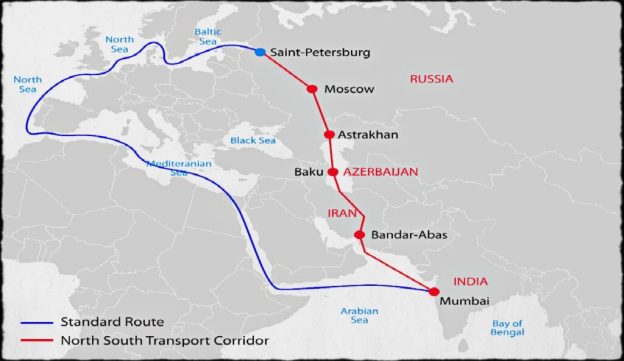
Following agreements reached during the January official visit to Moscow by Seyyed Ebrahim Raisi, President of the Islamic Republic of Iran, to further develop and deepen bilateral relations between Iran and Russia, the countries have decided to jointly revive the North-South Transport Corridor. This decision has become particularly relevant against the background of the unlawful sanctions policy pursued by the United States and its Western allies against Russia and Iran, and Tehran’s and Moscow’s desire to establish trade routes that are not linked to the West.
In order to implement this decision, Iranian authorities are seeking to revive the recently stalled International North-South Transport Corridor (INSTC) project, which traverses Russian and Iranian territory and the two countries’ waters to connect with Asian export markets. As the Islamic Republic News Agency (IRNA) reported on June 11, in order to implement the International North-South Transport Corridor, the Islamic Republic of Iran Shipping Lines (IRISL) has initiated the transit of cargo from Russia to India or to South Asia through the project, using just one consignment note for the entire transit route.
According to Dariusz Jamali, director of the joint Iranian-Russian terminal in Astrakhan, such transits have taken place occasionally in recent times. However, this route has clear advantages: lower transport costs (such as port and customs charges in particular),shorter waiting periods for containers, faster delivery of goods, elimination of dangers in transferring empty or full containers, issuance of legal documents and compensation for possible losses, and faster banking transactions.
The first pilot Russian-Iranian transit proposed by IRISL consists of two 41-ton containers of wood laminated plastic. The consignor is in St. Petersburg and the transit port is Astrakhan. The cargo will then be transported by the Caspian Sea to the northern Iranian port of Anzali (Bandar-e Anzali) and then by road through Iranian territory from the port of Anzali to the southern port of Bandar Abbas on the Persian Gulf and further by sea to the Indian port of Nhava Sheva. IRISL is the operator. The estimated delivery time is 25 days.
It is assumed that the main Russian exports through Astrakhan could be cereals (wheat), timber and scrap metal.
This transport corridor could go to Afghanistan via Iran’s Sistan and Baluchestan Province. The plan for further joint use of the North-South Transport Corridor even includes the construction of a railway line that could bring goods arriving at Iranian Caspian Sea ports to the south-eastern port of Chabahar. In addition, the construction of a railway line from Chabahar to the Hajigak iron ore mine in Afghanistan, where India has made large investments, is also under consideration.
The International North-South Transport Corridor emphasizes the Russian port of Astrakhan and the Iranian Chabahar as bases for further transport to Eurasia. The development of the latter, as well as the construction of a large petrochemical complex and an export terminal near the port of Jask, are projects being implemented by the Iranian government as part of the Mokran coastal development strategy.
Nevsky Shipyard, which produces multipurpose dry-cargo ships of RSD49 (deadweight of 7150 tons, container capacity of 289 TEU) and 005RSD03 (container capacity of 225 TEU) projects, is also engaged in the work of the North-South transit corridor in building ships for the Caspian Sea.
As part of its increased participation in the North-South Transport Corridor, Iran is considering expanding international road transport cooperation with the countries participating in the Transport Corridor Europe-Caucasus-Asia (TRACECA) program, the Tehran Times reported, citing the Iranian Ministry of Roads and Urban Development. This issue was brought up in particular during a meeting between Aset Assavbayev, Secretary General of the Permanent Secretariat of the TRACECA International Transport Program, and Dariush Amani, Head of Iran Road Maintenance and Transportation Organization (RMTO). The negotiations focused on developing international road transport cooperation with TRACECA member countries and increasing the volume of transit traffic along the corridor. As you may know, the TRACECA International Transport Program, in which the European Union and 12 countries of Eastern Europe, Southern Caucasus and Central Asia now participate, was set up in Brussels in May 1993. The aim of the program is to strengthen economic ties, trade and transport links.
Russian Foreign Minister Sergey Lavrov plans to visit Iran in the near future to discuss, among other things, further steps of cooperation between Russia and Iran. The year 2022 has already seen two important visits in Russian-Iranian interaction. First, Iranian President Ebrahim Raisi’s visit to Moscow in January 2022, which was a clear diplomatic breakthrough for the new head of the Iranian government. And second, Russian Deputy Prime Minister Alexander Novak’s visit to Iran in May, which took place against the backdrop of unprecedentedly harsh sanctions imposed by the West in the wake of the Ukrainian events. The biggest change in regional policy is undoubtedly the prospect of a full-fledged free trade area (FTA) agreement with the EEU. It is expected to be signed by the autumn of this year to replace the interim FTA that came into force on October 27, 2019, and which has already had a positive impact on bilateral trade between Russia and Iran.
In the rapprochement between the two countries, Moscow takes into account the compromise position taken by Iran after the start of Russia’s special operation in Ukraine: while not proclaiming its support for Russia’s actions per se, Tehran has not joined the wave of international condemnation of Moscow, instead placing the main blame for what is happening on the US and NATO. Russia also takes into account that Iran’s potential as an economic partner far exceeds the current level of relations.
Why India must decouple from I2U2
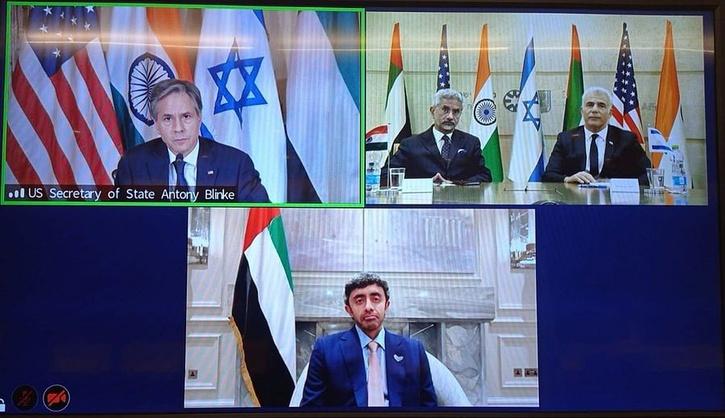
Foreign Ministers of India, Israel, UAE, US (clockwise) held a videoconference in October 2021 to launch a ‘Quad’ for West Asia
BY M. K. BHADRAKUMAR | INDIAN PUNCHLINE | JUNE 17, 2022
Indian diplomacy is descending from the sublime to the absurd. Such wild swings signal rank opportunism. These are extraordinary times when to be smart is equated as being opportunistic.
Hardly a week passed since PM Modi received the Iranian Foreign Minister Amir-Abdollahian in Delhi and expressed high hopes for India-Iran relationship. Now it transpires that India also forms part of the Gang of Four led by US President Joe Biden to “contain” Iran, from a new platform called I2U2 — the ‘I’ being India and Israel, and ‘U’ being US and UAE.
The I2U2 summit in mid-July between Biden, Israeli Prime Minister Bennett, Modi, and Emirati President Mohammed bin Zayed is destined to be a signpost in the geopolitics of West Asia. This new Quad first appeared on 18th October 2021 as an offspring of External Affairs Minister Jaishankar’s 5-day trip to Israel when from Tel Aviv he pulled a rabbit out of the hat, leaving the Indian public wonder what new grandstanding their impulsive minister was indulging in.
Between October and July this year, the I2U2 is getting an upgrade from foreign minister to prime minister/president level. On Tuesday, while announcing Biden’s first West Asian tour as president in mid-July, Washington has made some effort to rationalise Biden’s intentions in undertaking the planned visits to Israel and Saudi Arabia. A senior White House official said Biden intends:
- To demonstrate “the return of American leadership to bring countries together”;
- To create “new frameworks that aim to harness unique American capabilities to enable partners to work more closely together, which is essential to a more secure, prosperous, and stable Middle East region over the long term”;
- To build on the “resounding vote isolating Iran last week at the IAEA Board of Governors in Vienna where 30 countries condemned Iran’s lack of compliance with safeguard obligations” (where India, by the way, had abstained from supporting the US move);
- “To make sure we’re doing all we can to strengthen Israel’s security, prosperity, and integration into the larger region, both now and over the longer term”;
- To “focus on Israel’s increasing integration into the region” through new formats other than Abraham Accords, such as the “entirely new grouping of partners… what we call I2U2”!
So, that’s it. India will lend a hand to assist the US to refill the fizz that has gone out of the Abraham Accords. The hope that more countries would join Abraham Accords is withering away. Israel needs to be shown around to prospective suitors in its neighbourhood. I2U2 is, in essence, a dating agency. When it concerns Israel, the role of pandar comes naturally to the US presidents. But why should India squander away its soft power?
The US prestige and influence in West Asia has suffered a severe jolt during the Biden presidency. Not too long ago, Biden had called Saudi Arabia a “pariah” and pledged to make a horrible example of it on account of its human rights record. But now the shoe is on the other foot. Biden is craving for attention from Saudi Arabia. He had taken a second vow not to have any dealings with the powerful Saudi Crown Prince Mohammed bin Salman. But he is now beseeching the proud Prince for an audience. His recent phone calls weren’t answered.
The White House official explained Biden’s U-turn this way: “we have important interests interwoven with Saudi Arabia, and engagement is essential to protecting and advancing those interests on behalf of the American people.” In reality, Biden is swallowing pride and reviving the old matrix of US-Saudi relationship riveted on the petrodollar.
With poll rating falling abysmally low, Biden is desperate to tackle the rising inflation in the US economy, and the soaring price of oil is fuelling public disaffection. Saudi Arabia can help Biden salvage his standing.
However, it is the turn of the Saudis now to tell Americans there’s no free lunch. They want a written treaty to the effect that the US won’t ditch them when the crunch time comes or if the Kingdom or the ruling family feels insecure. Put differently, they want the Americans to act as their Praetorian guards as before.
In return, of course, Saudis will generate massive business for the US military-industrial complex, recycle their petrodollar to strengthen the Western banking system and create lucrative business for American companies — in short, help the beleaguered Western economies to pursue their post-pandemic recovery that is getting derailed by the war in Ukraine.
Indeed, the Saudis also have a rich history of lavishly greasing the palm of the American elite in the administration, the Pentagon and the Congress. In a nutshell, Biden as a seasoned operator in the Beltway knows which side of the bread is buttered.
But to rationalise his U-turn, an alibi is needed. So, Biden has decided to hoist “Iranian threat” as the leitmotif of the revamped US-Saudi security alliance. All signs are that Biden has acceded to the Saudi demand to scuttle the JCPOA and pile new sanctions against Iran, although the negotiations in Vienna are in home stretch and an agreement is within sight.
Biden’s West Asian agenda is completely US-centric, aimed at securing US business interests and shoring up its regional influence. Israel, of course, is a “holy cow”. Very soon Biden will begin fund-raising for his re-election bid in 2024, and Jewish donors are a generous lot.
However, the million dollar question remains: What has India got to do with Biden’s agenda? There are real risks, for the subplot here is that Biden hopes to nix India’s plans to revive its atrophied relationship with Iran. The recent visit of the Iranian foreign minister to India would have set alarm bells ringing in Washington and Tel Aviv.
Biden has a game plan for leaders like Modi who have a tendency to disregard the US diktat occasionally. Biden’s national security advisor Jake Sullivan spoke candidly just the other day:
“We’re playing the long game here. We are investing in a relationship (with India) that we are not going to judge by one issue even if that issue is quite consequential, but rather that we are going to judge over the fullness of time, as we try to work to convergence on the major strategic questions facing our two countries.
“On one of those questions — how to deal with the challenge posed by China — there’s much more convergence today, and that is important to US foreign policy. On the question of Russia, obviously, we have different historical perspectives, different muscle memories, but we feel confident that the dialogue we have going with India right now will bear fruit over time.”
Sullivan was discussing India’s time-tested relationship with Russia — how Washington hopes to erode and dissolve it all in good time.
Plainly put, Americans estimate that Indians have no “staying power,” or “big picture.” They probably estimate that the Indian government would grab the I2U2 platform to burnish its international image. But if there is any sanity left in the Indian foreign policy establishment, a subaltern role to serve US and Israeli interests cannot enhance India’s prestige in West Asia where, as it is, Modi government is perceived as an Islamophobic regime backed by religious fanatics.
In the life of individuals and nations alike, there are moments when one has to learn to say “no.” This self-serving, cynical overture from 78-year old Biden is one such moment. That’s why, despite zero chance of India turning down Biden’s invite, not to urge Modi to say “Nyet” to I2U2 will be a serious lapse.
South Block is underestimating the gravity of its folly. India never ever got entangled in the intra-regional issues in West Asia. It never acted as the surrogate of extra-regional powers, either. Most important, it never sought the “containment” of any regional state. That’s how it held its head high in the choppy waters of the Persian Gulf.
Nuclear-armed states spent $82.4bn on nukes in 2021, US topped list: Report
Press TV – June 15, 2022
The world’s nine nuclear-armed countries – led by the US – spent $82.4 billion upgrading their atomic arsenal in 2021, eight percent more than the previous year, an anti-nuke campaign group has unveiled.
The largest spender by far was the United States, which accounted for more than half the total expenditures on nuclear weapons – followed respectively by China, Russia, Britain, France, India, the Israeli regime, Pakistan and North Korea – the International Campaign to Abolish Nuclear Weapons (ICAN) stated in its annual report, titled “Squandered: 2021 Global Nuclear Weapons Spending.”
“Nuclear-armed states spent an obscene amount of money on illegal weapons of mass destruction in 2021, while the majority of the world’s countries support a global nuclear weapons ban,” the group said in the report, noting that the massive spending nevertheless failed to prevent a war in Europe.
“This spending failed to deter a war in Europe and squandered valuable resources that could be better used to address current security challenges, or cope with the outcome of a still raging global pandemic,” ICAN said. “This corrupt cycle of wasteful spending must be put to an end.”
The group said atomic arms producers had further spent millions of dollars on political lobbying efforts, saying that every $1 spent on lobbying had led to an average of $256 in new contracts involving nuclear weaponry.
“The exchange of money and influence, from countries to companies to lobbyists and think tanks, sustains and maintains a global arsenal of catastrophically destructive weapons,” it said.
The US spent $44.2 billion on atomic weaponry in 2021, followed by China’s $11.7 billion, Russia’s $8.6 billion, the UK’s $6.8 billion, and France’s $5.9 billion, according to the report. India led the more recent nuclear arms developers in expenditures on the mass-destructive weaponry, spending $2.3 billion, followed by the Israeli regime’s $1.2 billion, Pakistan’s $1.1 billion and North Korea’s $642 million.
The report came a week after US-led NATO alliance declared that it did not offer a guarantee to Russia that it would not deploy nuclear weapons on the territories of its two prospective new members, Finland and Sweden.
ICAN’s report further confirmed a statement released by the prominent Stockholm International Peace Research (SIPRI) a day earlier in which it had warned that all the nine nuclear-armed states were increasing or upgrading their arsenals, and that the risk of deployment of such weapons appeared higher now than at any time since the height of the Cold War.
While there is no official confirmation on the amount North Korea spends on nuclear weapons or its arsenal, SIPRI estimates that it possesses as many as 20 warheads.
The Israeli regime, along with India, Pakistan, and South Sudan have never joined the Treaty on the Non-Proliferation of Nuclear Weapons (NPT), an international treaty purportedly established to prevent the spread of nuclear weapons.
As of August 2016, 191 states have become parties to the NPT, though North Korea, which acceded in 1985, announced its withdrawal from the treaty in 2003, following detonation of nuclear devices in violation of core obligations.
Critics of the treaty insist, however, that the NPT cannot stop the proliferation of nuclear arms or the motivation to acquire them, arguing that the biggest possessors and developers of atomic weapons are leading members of the global accord. Officials of the treaty have been selective in enforcing nuclear disarmament, imposing sanctions on observant member nations, such as Iran, while ignoring certain atomic arms possessor and developers such as India, Pakistan, and the Israeli regime, which is widely believe to possess at least 300 nuclear warheads.
WHO Estimates of India’s Covid Deaths Are Highly Suspect
By Ramesh Thakur | The Daily Sceptic | May 8, 2022
On May 5th, the World Health Organisation (WHO) issued a new report estimating global excess deaths at 14.9m for two years of the pandemic 2020-21 as the true COVID-19 mortality toll, nearly triple the official toll of 5.44m. “Excess mortality” is the difference between the number of deaths that would be expected in any time period based on data from earlier years and the number of deaths that have occurred. For countries with robust data surveillance, reporting and recording systems, this poses no real difficulty. Unfortunately, these conditions are not met in many countries. Therefore their excess mortality can only be estimated and the accuracy is a function of the reliability of the methodology and modelling used in the exercise. Given the overwhelming evidence about the flaws and deficiencies of Covid-related modelling over the last two years, and the damage caused by governments trusting modelling projections over real-world data, this should immediately throw up a forest of red flags about the WHO report.
A second reason to be sceptical is the less than stellar role of the WHO in its well-known Covid-related deference to China, the abandonment of its own summary of the state of the art science on managing pandemics from October 2019, its willingness to manipulate definitions of ‘herd immunity’ in relation to vaccines and natural immunity in order to fit with the experimental pharmaceutical and non-pharmaceutical interventions (NPIs) that came to dominate Covid policy around the world, and its self-interest in expanding its budget, authority and role in steering global health policies and management by means of a new international treaty.
A third ground for scepticism is they ascribe the total death count to the direct effects of Covid “due to the disease” and indirect effects “due to the pandemic’s impact on health systems and society”. The first part is questionable because it fails to distinguish between deaths with and from Covid. The second is disingenuous because the indirect toll of the NPIs (lockdowns, masks, induced fear, lost schooling, lost jobs, cancelled screenings and operations, aborted immunisation programs, disruptions to global food production and distribution, etc.) and vaccine-related adverse events will prove to be significantly higher than the indirect effects of the disease per se. Any study that fails to disaggregate deaths caused by the disease and by policy interventions to mitigate it lacks credibility.
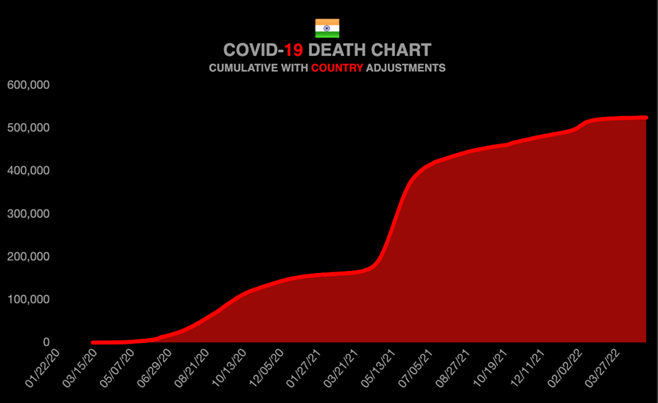
Figure 1: India’s COVID-19 Deaths, Jan. 1st 2020-Mar. 27th 2022. Source: World Life Expectancy, May 8th 2022
Like many others including Will Jones on this site, I was especially struck by the new figures for India. The report pushes India up to the very top of the Covid mortality toll with 4.74m deaths, nearly 10 times more than the count of 481,486 (as of December 31st 2021), almost one-third of the world total. Sorry, but that is simply not credible.
India’s geographic diversity, population size and economic conditions make data collection especially challenging. In public lectures in Australia and Canada, to drive home the point about the scale, I usually comment that the entire Australian population is a rounding error in 1.3bn-strong India. It suffers from persistent and widespread mass poverty – India is a country of a few mega-billionaires amidst the world’s biggest pool of poor, illiterate and sick people bar none. It might be nuclear-armed, but state capacity when it comes to administration and public and social services is easily the worst of all major economies. The public sector scores high on petty corruption but low on efficiency. The public health service is risible and high quality healthcare is neither accessible nor affordable for ordinary Indians. The best doctors work in the public sector, in medium to large clinics and hospitals in metropolitan centres and as individual practitioners in most towns and villages. Consequently, health statistics are not all that reliable. But this is a general pathology, not one unique to COVID-19.
From everything I know about India, the WHO estimate does not align with overall death data, historical trends and Covid death compensation claims on the Indian Government from states. Indian experts believe that official statistics capture over 90% of all deaths. But this also means that about 10% of deaths would have been missed in previous years, yet the WHO’s ‘excess deaths’ count uses the official numbers as the baseline against which to estimate the impact of Covid. In a related vein, why would under-reporting be limited to Covid-related deaths and not, say, to suicides with its heavy social stigma and traffic accidents where the operators of overloaded buses and vans would try to drastically reduce actual numbers in order to hide the illegal loads (Figure 2)? The WHO estimates are flawed also in relying on 2019 deaths instead of using a five year average 2015-19 to wrinkle out anomalies in any given year.
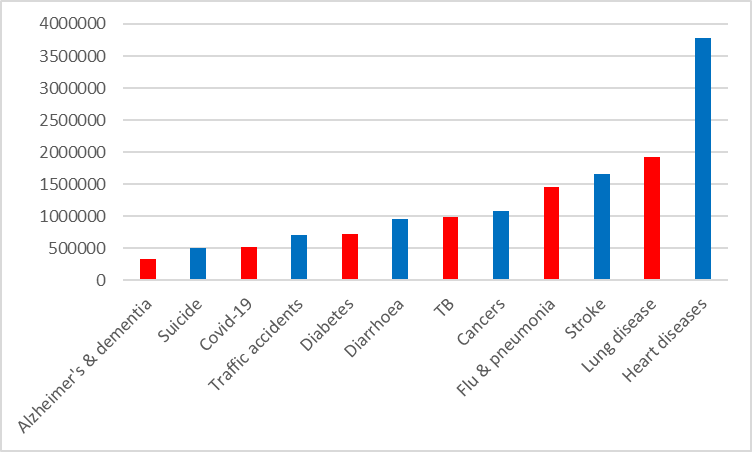
Figure 2: India’s Top Dozen Killer Diseases (March 1st 2020-May 7th 2022). Top six cancers in order: oral, lung, breast, cervical, stomach, colon. Source: Chart constructed by author drawing on data from World Life Expectancy, May 8th 2022
Estimates of India’s total annual death rate range from 738 per 100,000 people by the World Bank to 1,030 per 100,000 people by World Life Expectancy. The total annual death toll therefore would be somewhere in the 10-13 million range: a very wide range. The WHO estimate of the death rate for 2021 is within the higher range from World Life Expectancy. Simply put, the WHO estimate of all-cause deaths is within any realistic estimate of the margin of error in India’s unique circumstances of scale and state capacity.
The caveats to official data notwithstanding, the WHO estimate would mean almost one-quarter additional deaths than normal. In fact it’s worse. Looking at the detailed tables, the 4.74m excess deaths is calculated from a combined excess death rate for 2020–21 of 171 per 100,00 people. This is disaggregated into 60 and 280 per 100,000 people for 2020 and 2021, respectively. That would imply a 38% jump in all cause deaths in 2021. Despite all the horror scenes we saw on TV of corpses lying in the streets and washed ashore on riverbanks, that’s just not possible. Perhaps the clue to the error lies in the title of the actual document: “Global excess deaths associated with COVID-19 (modelled estimates)” (emphasis added).
Some Daily Sceptic readers had fun with this aspect of the WHO announcement. My favourite exchange was this:
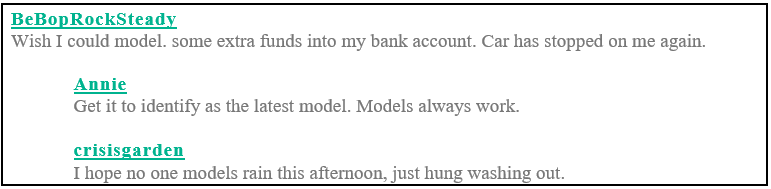
India’s own estimates of excess deaths for 2020 compared to 2019 is 480,000, of which Covid-related deaths were just under 150,000. So over 300,000 excess deaths were due to non-Covid causes, which in itself is far more believable because of the impact of the lockdown measures on exacerbating most of the conditions underlying India’s leading causes of deaths. By contrast, in 2021 the Covid-related death toll was much higher at 332,492.
Much as I have been critical in the past of official dismissals of international reports on India including weakening democratic practices, in this instance the Government is right to reject the WHO methodology of mathematical modelling based on data on 17 Indian states collected from websites and media reports: “This reflects a statistically unsound and scientifically questionable methodology of data collection for making excess mortality projections in the case of India.” As well as defective data collection methodology, the report is marred also by three critically flawed assumptions: that uncounted excess deaths occurred only in 2020-21 and not before; they occurred only for COVID-19 and not other diseases; and Covid-related deaths were due solely to the disease and not caused by policy interventions to control and eradicate it.
Ramesh Thakur is Emeritus Professor at the Australian National University’s Crawford School of Public Policy and a former UN Assistant Secretary-General.
‘Don’t patronize us’ over Ukraine, India tells Netherlands
Samizdat | May 6, 2022
India’s Permanent Representative to the United Nations, TS Tirumurti, has accused the Netherlands of “patronizing” his country after the Dutch ambassador to the UK publicly scolded New Delhi for abstaining on UN General Assembly resolutions on the war in Ukraine.
“Kindly don’t patronise us, Ambassador. We know what to do,” Tirumurti wrote in a tweet to Dutch envoy Karel van Oosterom on Thursday.
Tirumurti’s tweet came in response to van Oosterom’s (now-deleted) warning that India “should not have abstained” from votes pertaining to Russia and the war in Ukraine and that it should “respect the UN Charter.”
Despite repeated calls and pressure to join the West in isolating Russia over the Ukraine war, New Delhi has been reluctant to cut ties with Moscow.
India has abstained on multiple votes and resolutions at the UN General Assembly this year, including a vote moved by the US in April to suspend Russia from the UN Human Rights Council over accusations of the killing of civilians.
India also abstained from a vote brought by Ukraine and its backers in March, condemning Russia over the humanitarian situation in the country, saying then that the focus should be on the cessation of hostilities.
In a statement delivered Wednesday at the UN Security Council meeting on Ukraine, Tirumurti reiterated India’s position that “pursuing the path of dialogue and diplomacy” is the “only way out” of the crisis.
“India remains on the side of peace and therefore believes that there will be no winning side in this conflict and, while those impacted by this conflict will continue to suffer, diplomacy will be a lasting casualty,” he said.
The South Asian nation has a strong trading relationship with Russia, receiving arms from Moscow in previous agreements between the two sides. It even deemed the current situation an opportunity to broaden cooperation. The country boosted oil purchases from Russia recently, despite pressure from Washington.
India, Germany cogitate on Ukraine
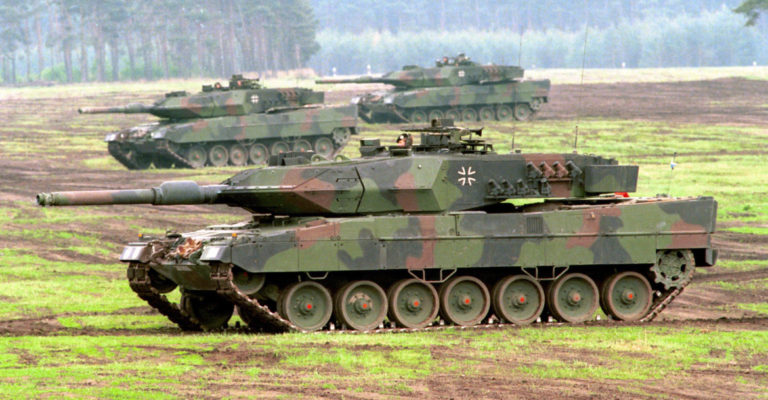
Germany to send fifty Leopard 1 tanks to Ukraine to fight Russia
BY M. K. BHADRAKUMAR | INDIAN PUNCHLINE | MAY 3, 2022
Prime Minister Narendra Modi’s short visit to Germany pegged on the Indian-German Intergovernmental Commission meeting in Berlin on Monday inevitably came to focus on the Ukraine crisis. The western media would have loved to grill Modi on India’s reluctance to criticise Russia’s special military operation in Ukraine. But German hosts thoughtfully skipped the customary Q&A after the joint appearance of Modi and Chancellor Olaf Scholz before the press.
India’s prudence is self-evident as much as Germany’s zealousness to flaunt its condemnation of Russia. Modi and Scholz are sailing in different boats. Modi draws flak for being a “strongman” who views the Ukraine crisis through the prism of India’s interests, while also taking a principled stance, whereas, Scholz carries the burden of vacuous moralising.
Scholz must prove constantly that he is indeed a loyal ally of President Biden and is by no means a “pacifist.” (To get a hang of Scholz’s predicament, read Spiegel’s maddening interview with him, here — alternatively annoying, infuriating, taunting, affronting and goading.)
Modi can afford to be nonchalant because he is clearheaded about where Indian interests lie — its strategic autonomy in a highly unpredictable international environment. But Scholz is nervous as a mouse because German interests are caught up betwixt the crosscurrents of European politics and the NATO’s epochal struggle to bring Russia down on its knees.
Modi is well ensconced in power while Scholz heads a precarious coalition of disparate partners. Modi could witness Scholz and his foreign minister Annalena Baerbock speaking in two different voices on Russia. Baerbock insisted that Russian forces should vacate Ukrainian soil before Western sanctions can be lifted, but Scholz toned down saying that the lifting of Western sanctions is linked to Russia and Ukraine reaching an agreement.
Germany is a divided house when it comes to Russia ties. On the contrary, aside the clutch of noisy American lobbyists operating in India, the Indian public at large recognises the centrality of India’s friendly relations with Russia.
India gets the space to manoeuvre, as Russia is excessively indulgent towards Delhi’ stance, which is, quintessentially, neither to support nor to oppose Moscow’s intervention — something like Professor Godbole in the EM Forster novel A Passage to India, a Brahman Hindu who is very spiritual and reluctant to become involved in human affairs.
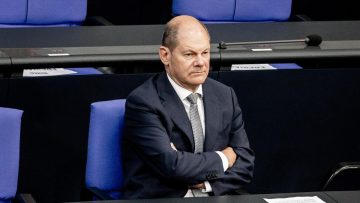 Scholz who is new to international diplomacy could have learnt a thing or two from UK prime minister Boris Johnson’s recent visit to India. Johnson put Ukraine on the back burner and focused on the agenda of “Global Britain” to create his country’s post-Brexit pathway in India’s vast market.
That said, Scholz has done remarkably well in getting the US off his back over sanctions against gas supplies from Russia. Germany’s dependence on Russian supplies of oil and gas (and coal) has been heavy and the Americans accept it as a reality. The point is, Germany and Russia have had a dense relationship and the Ukraine crisis comes in handy for Washington to try to redefine the parameters within which German-Russian relations will work in future.
In India’s case, if Washington dared to bully the Modi government, it was largely because in the post-Cold War era, under successive Congress governments, India’s relations with Russia got atrophied to such an extent that Americans convinced themselves that it was a conscious Indian policy direction dictated by the compulsions of the “Washington Consensus,” which has been a beacon light for India’s past leaderships. Unsurprisingly, the Biden Administration misjudged that Modi too must be fair game.
But the core difference between the German and Indian predicament is that while German industry is a stakeholder in the relationship with Russia, India’s corporate houses, for reasons best known to them, sidestep the Russian turf in deference to the US wish. Thus, Washington has powerful Indian lobbyists and, therefore, the Modi government’s audacity to pursue an independent policy toward Russia becomes commendable.
The chances are that Germany may pick up the threads of its relationship with Russia once the Ukraine conflict ends. In the chronicle of the “German Question” in European history, Russia had the role of a balancer, mostly. But there is a deep economic and political crisis waiting to erupt in Germany and how it pans out is crucial.
The rising inflation and the dramatic fall in living standards is souring the German mood, as the debris from Ukraine falls on it. So far, an estimated 5 million Ukrainian refugees have entered Europe. This figure is expected to double in a near future.
Meanwhile, the looming food crisis will also put tens of millions of people in Africa or the Middle East on the verge of starvation fuelling in turn large scale migration to Europe. Such migration will inevitably bring the dregs of Ukrainian society into Germany, which means that organised crime, human trafficking, illegal drug distribution and transnational crime, etc. will increase. Make no mistake that the Ukrainian mafia will introduce a new vicious culture of crime as it begins to dominate the European streets.
All in all, a fine balance has been struck during Modi’s visit. The joint statement conceded the host country’s prerogative to reiterate its “strong condemnation of the unlawful and unprovoked aggression against Ukraine by Russian Forces.” But it formed a “stand alone” statement of a solitary sentence, which helps signal India’s distancing from it. Germany joined India’s call for an “immediate cessation of hostilities,” although Berlin just announced a major transfer of offensive weaponry to Ukraine as part of the US-led “coalition of the willing” and implicitly acquiesces with the Biden administration’s aggressive agenda of “weakening Russia” militarily.
Significantly, the sombre mood in Germany got reflected in the joint statement. The Indo-German economic relations are far below potential and will remain so. CNN carried a grim report in the weekend that not only is German economy heading into a recession but it may suffer “structural damage” that will make recovery a drawn-out process.
Clearly, behind the German rhetoric today, the fact remains that Berlin’s intelligence apparatus played a dubious role in Ukraine by navigating the ascendancy of the neo-Nazi forces to usurp power in Kiev in the coup in February 2014. This controversial past is now further complicated by Berlin fuelling the conflict by despatching tanks into Ukraine, which was after all the invasion route of Nazi Germany.
When it comes to Ukraine, Germany doesn’t make good company for India. We have a transparent record and with great honesty and integrity, Modi could forewarn , with Scholz listening, that “there will be no winning party in this war, everyone will suffer.”
India looks to scoop up offloaded Western assets in Russia
Samizdat | April 28, 2022
India has asked state-run energy companies to evaluate the possibility of acquiring oil major BP’s stake in sanctions-hit Russian firm Rosneft, sources told Reuters on Thursday. BP had earlier announced it was abandoning its 19.75% stake in the Russian company.
Sources familiar with the matter said that the Indian oil ministry last week conveyed its intent to ONGC Videsh (OVL), Indian Oil, Bharat Petro Resources, Hindustan Petroleum’s subsidiary Prize Petroleum, Oil India and GAIL (India).
The ministry also asked OVL, the overseas investment arm of Oil and Natural Gas, to consider buying a 30% stake held by US supermajor ExxonMobil in the Sakhalin 1 project in Russia’s Far East. OVL already holds a 20% stake in the project.
One of the sources said Indian companies hope to get stakes in Russian assets at discounted rates, given the risk involved.
“Our effort has been to see how we can stabilize economic transactions, economic engagements with Russia in the current context … There are of course constraints, there are sanctions by some countries, and we will have to kind of work through that,” India’s foreign ministry spokesperson Arindam Bagchi said, according to media reports.
Featured Video
Your Enslavement Begins in Gaza: The ‘Board of Peace’
or go to
Aletho News Archives – Video-Images
From the Archives
The US: The Century of Lost Wars
By James Petras | Global Research | September 12, 2018
Introduction
Despite having the biggest military budget in the world, five times larger than the next six countries, the largest number of military bases – over 180 – in the world and the most expensive military industrial complex, the US has failed to win a single war in the 21st century.
In this paper we will enumerate the wars and proceed to analyze why, despite the powerful material basis for wars, it has led to failures. … continue
Blog Roll
 Aletho News
- Why Israel Is Escalating Its War Crimes Against Lebanon
- Iran in the face of the armed diplomacy of imperialism
- The US build-up around Iran constitutes strategic war option, not ‘deterrence’
- Iran to US: Sanctions and war failed; try diplomacy and respect
- China supplies Iran with radar, surveillance tech to track US stealth aircraft: Report
- Zelensky rejects territorial concessions to Russia
- German leader of EU’s largest faction sounds the alarm of possibility of right-wing forces coming to power in France, Poland
- Putin: Developing Russia’s nuclear forces ‘absolute priority’
- Hungary Blocks 20th Package of Anti-Russia Sanctions, $106B Loan to Ukraine – Szijjarto
- NATO Must Return to 1997 Borders for Peace in Ukraine – Finnish Politician
- If Americans Knew
- Maria Farmer: Epstein Victim Reveals Explosive Information Covered Up by Media
- Average of five Palestinians killed by Israel every day in Gaza since ceasefire – Not a ceasefire Day 136
- Palestinian church leaders admonish Christian Zionist Mike Huckabee – Not a ceasefire Day 135
- Ominous messaging from Trump’s “Board of Peace” – Not a ceasefire Day 134
- ‘Christians Out’: Jerusalem Church Tagged With Hate Graffiti, Police Investigating
- Israeli Settlers Kill American Teen
- ‘We returned from hell’: Palestinian journalists recount torture in Israeli prisons
- No mercy for Gaza in Ramadan – Not a ceasefire Day 133
- The Israeli Government Installed and Maintained Security System at Epstein Apartment
- Tucker Carlson interrogated in Israel, has passport seized after interviewing US ambassador
- No Tricks Zone
- New Research Reaffirms Clouds, Aerosols, And Surface Solar Radiation Are ‘Driving The Climate System’
- Germany: Electric Car Catches Fire At Charging Station, Sets Off Local “Inferno”, Widespread Damage
- New Study: Canada’s New Brunswick Was 1°C Warmer Than Today During The Medieval Warm Period
- Coal Power Back In Trend As Globe Tries To Keep Pace With Growing Demand For Power
- New Study: A 4°C Warmer Beaufort Sea Had ‘No Sea Ice’ 11,700 – 8200 Years Ago
- Unfudging The Data: Dutch Meteorological Institute Reinstates Early 20th Centruy Heat Waves It Had Erased Earlier
- German Gas Crisis…Chancellor Merz Allegedly Bans Gas Debate Ahead of Elections!
- Pollen Reconstructions Show The Last Glacial’s Warming Events Were Global, 10x Greater Than Modern
- Germany’s Natural Gas Storage Level Dwindles To Just 28%… Increasingly Critical
- New Study Rebuts The Assumption That Anthropogenic CO2 Molecules Have ‘Special’ Properties
 Aletho News