Tehran: In a strategically significant move to counter China’s presence in the region, India has announced that it will upgrade Iran’s crucial Chabahar port that gives a transit route to land-locked Afghanistan.
India’s decision was conveyed by Foreign Minister Salman Khurshid in Tehran today during his meeting with his counterpart.
An expert team from India will visit Iran to assess investment needed for the upgrade of the port on the Iran-Pakistan border facing the Arabian Sea. Sources say an investment to the tune of $100 million is required for the upgrade.
The move comes despite strong pressure from America, which doesn’t want any investment in developing infrastructure in Iran to put pressure on the Western Asian country over its covert [sic] nuclear programme. But India has been worried and keen to open an alternative route to Afghanistan ever since China took over Pakistan’s Gwadar port in the region, which is just 76 km from the Chabahar port.
Chahbahar port, which is surrounded by a free trade zone, is crucial particularly since Pakistan does not allow transit facility from India to Afghanistan.
India will also discuss ways to increase trade with Iran as it is concerned over the “grave” imbalance. The two-way trade is around US $15 billion, out of which Indian exports account only for around US $2.5 billion.
Oil is the biggest item of Indian import from Iran but India feels there is a lot of scope for increasing Indian exports to the Persian country particularly in pharmaceuticals and food.
However, efforts to enhance trade have been facing hurdles because of sanctions imposed by the UN and European Union, which make payment difficult.
There are also problems like re-insurance of oil refineries and transportation of consignment from Iran because of the sanctions.
May 4, 2013
Posted by aletho |
Economics | Afghanistan, Chah Bahar, China, India, Iran, Pakistan |
Leave a comment
TEHRAN – Iran and India will hold a joint economic meeting in Tehran in the upcoming days, during which the two sides will sign six memorandums of understanding, the Iranian ambassador to India stated.
Iranian foreign minister Ali-Akbar Salehi and his Indian counterpart Salman Khurshid will chair the meeting, ILNA quoted Ambassador Gholamreza Ansari as saying on Monday.
The issue of exporting Iranian gas via the Iran-Pakistan gas pipeline to India will be also discussed, Ansari said.
India and Iran must work together to further promote trade and economic links, increased people- to-people contacts between them and within the region, Indian President Pranab Mukherjee has said.
The two countries plan to reach $25 billion in annual bilateral trade in the next four years.
April 30, 2013
Posted by aletho |
Economics | Ali Akbar Salehi, India, Iran, Salman Khurshid |
Leave a comment
Karuturi Global Limited, a publicly registered holding company headquartered in Bangalore, India, may be under fire from the Kenya Revenue Authority (KRA) for tax evasion, but the complaints against it go further than that. The agribusiness firm, whose farm operations also straddle Ethiopia and India, has been dodging bullets about labour law violations, human rights abuses and environmental issues. Even the World Bank Group is no longer considering the company’s request for risk insurance for its investments in Ethiopia. This background note summarises the various problems that Karuturi has come to be known for among social justice movements around the world.
Tax evasion
Every year around US$ 1000 billion disappears without a trace from developing countries, ending up in tax havens or rich countries. The main part of this is driven by multinational companies seeking to evade tax where they operate.
The sum that leaves developing countries each year as unreported financial outflows, referred to as illicit capital flight, amounts to ten times the annual global aid flows, and twice the debt service developing countries pay each year. During 2000-2008 Africa was the region with the largest real growth of illicit capital flight, amounting to 21.9 % per year.
This money, if properly registered and taxed in the country of origin, could of course contribute to fulfilling human rights like the right to education and health care, and make a major difference in the fight to combat poverty. Due to just two forms of illicit capital flight used by corporations (‘mispricing’ and ‘false invoicing’), developing countries are losing three times the amount that is missing to achieve the UN millennium development goals (like universal education, stopping the spread of HIV, and halving extreme poverty) in tax revenues every year.
(For all facts on tax evasion above and more info on mispricing please see “Bringing the billions back: how Africa and Europe can end illicit capital flight” by Fröberg and Waris, 2011)
In 2012, the Kenya Revenue Authority developed a team of transfer pricing experts to audit accounts of companies in order to assess whether there was transfer mispricing and tax evasion taking place. Some transnational companies that export from Kenya are notoriously adept at it. However, the government has had difficulty tracing these firms’ operations due to lack of capacity and to date all audits and assessments, apart from one against Unilever, have been settled outside of public view.
On the 4th of April 2013 Karuturi filed a notice of appeal against the decision of the tax tribunal for taxes due to the Kenyan government and the Kenyan people. According to ICRA, an Indian credit rating research agency, in an October 2012 analysis commissioned by Karuturi as well as Karuturi’s 2012 annual report, Karuturi has been facing a number of potential threats to its financial viability, namely:
- An INR 57.8 crore (= KES 975 million / USD 10.7 million / EUR 8 million) dispute from the Kenya Revenue Authority over transfer pricing
- An INR 83.5 crore (= KES 1.4 billion / USD 15 million / EUR 11.5 million) claim on unpaid income taxes from the Indian authorities
- A risk of default on a USD 54.7 million (= KES 4.8 billion / EUR 40.3 million) foreign currency convertible bond due for redemption on 19 Oct 2012 which was since restructured
The overall tax claims come to USD 26 million, which is about one-quarter of the multinational’s global turnover in fiscal year 2012 (USD 106 million) while the amount for Kenya amounts to almost 1 per cent of Kenya’s total annual tax collection.
Money of this magnitude could be used as additional income for development or to replace some current taxes that target the poor like value added tax or even to delay the enactment of additional taxes like the one on maize flour due to be activated in Kenya in 2015.
Land grabs
Since 1996, Karuturi’s core business has been floriculture, producing 580 million roses per year from 289 hectares of land the company leases in Kenya (154 hectares), Ethiopia (125 hectares) and India (10 hectares). In 2012, the group commanded no less than 9% of the cut rose market in Europe. Since the 2007/2008 global food crisis, Karuturi began expanding from floriculture into food production. Its plan is to set up farming operations on over one million hectares, mainly in eastern and southern Africa, to produce primarily maize, rice, sugarcane and palm oil for international markets.
The hub of this expansion is Ethiopia. In 2009, Karuturi acquired 10,700 ha of land in Bako for maize, rice and vegetable production. In 2010, it got an additional 300,000 hectares for expansion in Gambela. The company aims to farm a total of 750,000 ha in Ethiopia. This land is leased from the government at bargain prices, but local communities consider it their own.
As a result, many conflicts have emerged around compensation, displacement and the relocation of villagers and herders who suddenly found themselves fenced off of their lands by the Indian company.
In 2011, Karuturi announced it was expanding further by pursuing a US$500 million investment for 370,000 ha in Tanzania, including an initial 1,000 ha in the country’s fertile Rufiji Basin. That same year, the company announced that it was in discussions with government officials in the Republic of Congo for a farm project in a special economic zone in Oyo-Ollombo, 400 km north of Brazzaville. In addition, it has been planning fruit and vegetable farms in Sudan, Mozambique and Ghana, and, says CEO Ramakrishna Karuturi, “in Senegal, we have made an exploratory probe and in Sierra Leone we have made initial contacts.” All of these countries are rife with land grabs right now.
Labour issues & disputes
According to a 2012 report published by the London Business School, 5% of Karuturi’s workforce in Ethiopia is composed of foreigners. Karuturi has been bringing in staff and consultants from abroad, including India, to run management, irrigation & drainage operations, and logistics because they said they could not find the experience locally. Same for manual labourers. Karuturi hires Ethiopians as unskilled labour but for skilled labour it says it faces problems. At the end of 2011, Karuturi got into a dispute with the Ethiopian government because they brought in several hundred Indian farmers to work on their farms in Gambela, which the Ethiopian authorities said contravened Ethiopian law and for which they would not give the permits. Karuturi reportedly also expects to rely on Indian farmers to handle its work on oil palm.
According to media and labour organisation organisation reports, workers on Karuturi farms in both Kenya and Ethiopia have been complaining about, and initiating labour actions against, various conditions, especially related to wages and safety.
In November 2012, Karuturi reportedly began laying off about 900 of its 3,500 seasonal workers in Naivasha, Kenya, due to financial problems. The number was later reduced to 600. In December 2012, 1,000 Karuturi workers went on strike to demand action from management on unpaid salaries and poor working conditions.
Earlier, in June 2010, Workers Rights Watch, a Kenyan association, carried out focus group discussions with Karuturi flower farm workers in Naivasha and registered a mixed scorecard of positive and negative opinions about the company.
Regarding Karuturi’s Ethiopian farms, various media and research reports have exposed complaints of poor wages. For example, a solid report commissioned by the International Land Coalition shows that Karuturi pays Ethiopian farm labourers at its Bako farm ETB 10 per day (US$ 0.50) which compares with about ETB 20 per day (US$ 1.00) for labourers on commercial sesame farms in the country. Night guards for the company are said to be paid ETB 300 per month (US$ 15) if they own a gun and ETB 200 (US$ 10) per month if they do not.
Human rights violations
According to a powerful 2012 report by Human Rights Watch, the Ethiopian government is forcibly relocating thousands of indigenous people in western Gambela to new villages lacking adequate food, farmland, healthcare, and educational facilities to make way for large scale agricultural projects of foreign investors, including Karuturi. The report said, based on interviews with community representatives, that crops of local Anuak communities were cleared without consent for the Karuturi operations and that residents of Ilea, a village of over 1,000 people within Karuturi’s lease area, were told by the Ethiopian government that they would be moved in 2012 as part of its “villagisation programme”. In response, CEO Sai Ramakrishna Karuturi denied any connection between his company’s activities and the government’s villagisation programme. In conversation with the Wall Street Journal’s unit in India, he described the Human Rights Watch report as “hogwash” and “a completely jaundiced western vision”, and even denied that the villagisation programme exists.
Loss of livelihoods
Karuturi’s 10,700 ha Bechera Agricultural Development Project in the Bako Plains of Ethiopia has deprived several local communities of their communal grazing areas and access to water for their livestock, thus severely affecting their livelihoods. This comes from a study commissioned by the International Land Coalition, based on detailed discussions with local communities, local authorities and Karuturi employees. The study documents how the lands were provided to Karuturi without the consent of the local communities and without compensation. It reveals that Karuturi is refusing to implement even the most minimal measures recommended by local authorities to address some of the impacts from its operations. For example building a livestock corridor through its fields so that locals could access water sources for their animals, or allowing them to graze their animals on crop residues.
Environmental & health concerns
Karuturi operates one of the largest flower farms in the Lake Naivasha Basin in Kenya, the country’s second largest freshwater lake. The flower farms are blamed for causing a drop in the lake’s water level, for polluting the lake with pesticides and chemical fertiliser runoff and for affecting the lake’s biodiversity. Workers at Karuturi’s flower farms in Naivasha who spoke with Muungano wa Wanavijiji, a local partner organisations of Forum Syd, in February 2013 said that the dilapidated condition of the Karuturi operations and poor protective clothing puts them at risk to exposure from chemicals. They say the company does not seem to care about their concerns.
For its farm in Gambela, Ethiopia, Karuturi has developed an irrigation system with 50km of canals, 50km of drainage, and 40km of dykes, to pump a reported 22,000 litres of water per second from the Baro River, a crucial source of water for people dependent on the White Nile. Karuturi’s smaller 10,700 ha farm in Bako also generates significant issues related to access to water and water quality for the local communities. Although environmental impact assessments are usually required for irrigation projects in Ethiopia, Karuturi reportedly did not undertake any such assessment prior to constructing its farming complex in Bako.
Investor confidence
Karuturi and its shareholders have been waiting since at least May 2011 for the World Bank’s Multilateral Investment Guarantee Agency (MIGA) to approve the company’s long pending bid for political risk insurance for its Ethiopian operations. According to Sai Karuturi, as of 2012 the application had still not been approved due to Karuturi’s plans to produce palm oil — a sensitive issue for which the Bank would require the Ethiopian government to put in place environmental protocols. Karuturi explained that he was therefore advised by MIGA to omit palm oil from the application for now and so he did. If MIGA protection fails to materialise, the company told investors that its fallback option would be to seek support from India’s Export Credit Guarantee Agency. On 29 January 2013, MIGA informed GRAIN, flatly, that Karuturi’s application “is no longer under consideration”.
In March 2013, Bloomberg reported that Karuturi was seeking “hundreds of millions” of fresh investment dollars from an unnamed sovereign wealth fund after yet another unnamed development bank refused it a loan.
In April 2013, the Indian paper Business Today reported that Karuturi was thinking of taking the company private.
April 23, 2013
Posted by aletho |
Corruption, Deception, Economics, Timeless or most popular | Africa, Ethiopia, India, Karuturi, Kenya, Kenya Revenue Authority |
Leave a comment
India’s Petroleum and Natural Gas Minister M. Veerappa Moily has emphasized that his country will not halt imports of Iranian crude oil, rejecting recent Western news reports to the contrary.
While noting that unilateral anti-Iran sanctions by the US and the European Union have caused some difficulties for India in terms of insuring Iranian oil shipments, Moily told reporters in New Delhi that his country intends to establish a special fund for insuring oil imports originating from the Islamic Republic, IRNA reported on Tuesday.
The remarks by the Indian official came in response to the Western media reports on New Delhi’s decision to halt its Iranian oil purchases, which he strongly denied.
Meanwhile a deputy petroleum minister in India further reiterated that details of an insurance fund for Iranian oil shipments will be outlined in the near future, noting that the country’s national insurance companies, Oil India Development Board as well as major players in the nation’s oil industry will contribute funds to the insurance fund.
According to the report, Western media outlets, particularly Reuters have cited unnamed and unofficial sources in recent weeks who pointed to the possibility that India will soon halt its crude imports from Iran.
Indian officials, however, have insisted on continued oil imports from Iran while reiterating that they will not submit to the Western pressures on the issue, the report further adds.
India is among Asia’s major importers of energy, relying on the Islamic Republic to satisfy a portion of its energy requirements.
March 26, 2013
Posted by aletho |
Economics | European Union, India, Iran, Press TV, Sanctions against Iran, United States, Veerappa Moily |
Leave a comment
Ancestral land that for generations has served as home and livelihood for hundreds of thousands of indigenous people in Ethiopia is being leased out, on 99-year renewable contracts at nominal sums to foreign corporations. The land giveaway or agrarian reforms as the government would prefer to present them began in 2008 when the Ethiopian government, under the brutal suppressive Premiership of Meles Zenawi invited foreign countries/corporation to take up highly attractive deals and turn large areas of land over to industrial farming for the export of crops. India, China and Saudi Arabia were all courted and along with wealthy Ethiopians have eagerly grabbed large pieces of land at basement prices; rates vary from $1.10 to $6.05 per hectare (HA), comparable land in India would set you back $600 per ha.
A total of 3,619,509 ha, the Oakland Institute (OI), a US based think tank, estimate has been leased out. Land made available by the forced re-location of hundreds of thousands of indigenous people under the government’s universally condemned Villagization progamme, which aims to forcibly re-locate over 1.5 million people from their homes.
Indian corporations have taken the lion’s share, acquiring around 600,000 ha concentrated in Gambella and Afar, split between 10 investing companies. The term ‘investing’ implies benefits for Ethiopia, which is misleading; ‘profiteering’, or ‘exploiting’ sits closer to the truth of these land deals, as the OI make clear, “taking over land and natural resources from rural Ethiopians, is resulting in a massive destruction of livelihoods and making millions of locals [farmers and pastoralist communities] dependent on food handouts”. With small scale farmers being evicted from their land, prices of staples such as Teff, used by millions throughout Ethiopia to make Injera (bread), has rocketed in price, according to Ethiotribune 22/5/2012, increasing fourfold since 2008.
Corporate expansionism: small change big profits
In line with its ambitions of diversity and world food dominance – Karuturi Global, the world’s largest grower of roses, leads the Indian charge, leasing 311,700 ha in Gambella. Not satisfied with this, GRAIN (an international NGO, working to support small farmers) report Mr.Karuturi “wants to set up farming operations [throughout Eastern and Southern Africa] on more than 1 million [ha]” – too much never enough in corporate expansionism.
Almost a quarter of Gambella’s 25 million ha has been earmarked by the federal government for agricultural ‘development’. Karuturi, whose profits “rose 55.13% to Rs 1.21 crore [10 million] in the quarter ended June 2012”, took their chunk without even seeing it, paying only $1.10 per ha. For the Indian giant it is, John Vidal in ‘Land Grab Ethiopia (LGE)’ says, “the sale of the century”. ‘Green Gold’ is how Mr. Karuturi in GRAIN (‘Who’s Behind the Land Deals’), describes his 300,000 ha of Ethiopian soil, “for which he pays $46 per ha per year including water and labour and expects at least $660 [per ha] in profit per year”. (Ibid)
In addition to paddy, Indian farmers are being sub-contracted to grow maize, cereals, palm oil and sugarcane amongst others. All of which are destined for export, either to India or Europe, where companies farming in Ethiopia (and other Sub-Saharan African nations), benefit from lower import duties applied to developing countries, notwithstanding the fact that the land is leased to, and the crops produced and sold by, multi million-rupee rich companies.
Another major Indian company leasing land in Gambella is the decidedly green sounding BHO Bioproducts. Following the corporate rhetoric, BHO Chief Operating Officer Sunny Maker told Bloomberg in 2010 that, they have “plans to invest more than $120 million in rice and cotton production”, which, by 2017, should “generate about $135 million a year from sales divided equally between domestic [Indian] and international markets.” He added that the “incredibly rich fertile land”, will all be “cleared within the next three years”. Cleared yes, violently, indiscriminately and totally; villages, people, forests, woodland, all destroyed, burnt, relocated, displaced, desecrated. The governments promise to such prized investors is that the land is handed over stripped of everything and everyone. Dissent is not allowed and dealt with brutally should it occur, as Anuradha Mittal, Executive Director of OI makes clear. “The repression of social resistance to land investments is even stipulated in land lease contracts, [it is the] state’s obligation to ‘deliver and hand over the vacant possession of leased land free of impediments’ and to provide free security ‘against any riot, disturbance or any turbulent time.”
The ‘rich fertile land’, lovingly cultivated at the hands of the men and women who have farmed it for generations, is unlikely to be nurtured so carefully by Indian (or indeed Chinese or Saudi Arabian) corporations with their thirsty ‘GM seeds’ (Ibid). For as Oxfam in their detailed report ‘Land and Power’ diplomatically point out, “investors short time scales may tempt them into unsustainable cultivation, undermining agricultural production.”
The devolution of development
Land is a prime cut asset in the commercialization of everything, everywhere, and the “rich fertile land” in Ethiopia is cheap, even by Sub-Saharan African standards. Along with long-term leases, the government offers a neat bundle of carrots, including tax incentives and unrestricted export clauses, incentives that the OI state “deny African countries economic benefits” from land deals that the Ethiopian regime wraps up neatly in its complete disregard for the human rights of the indigenous people. Government indifference encouraging corporate irresponsibility – and they need little encouragement. Businesses hardly seem to be grabbing the land, so much as accepting it as a gift, parceled up and ready to be torn open.
In exchange for such attractive deals, the Ethiopian government has been extended, the OI reports “a $640 million line of credit… over five years to boost sugar production in the country’s Lower Omo region”. Not a philanthropic gesture, more a sales trap by India’s EXIM (export and import) Bank, who stipulate, “Ethiopia must import 75% of the value of the credit line in the form of Indian goods and services.”
The government-owned sugar plantations in the Lower Omo are themselves attracting a great deal of concern and criticism from human rights groups, who highlight the environmental and human damage being perpetrated. Government acts of violence and abuse, in the various land deal regions, are justified under the overused and misleading title of ‘development’; a term appropriated by the international monetary machine – the World Bank and International Monetary Fund (IMF) primarily – misunderstood and distorted by government development agencies, acting in line with foreign affairs policies by promoting national self interest and perverted by the corrupt ideologically-blinkered governments of developing nations. An undeveloped ideological trinity whose actions have drained the 21st century sacred cow and its stable mate ‘growth’ – dry of any true and relevant meaning. Far from supporting human and or social development the “unfair terms and near give-away prices [of land deals]… are hindering development…. Foreign corporations and the World Bank are pressuring African leaders to give them exemptions from taxes, import and export duties, and local labor laws – not to mention water and mineral rights that could be worth billions”, the OI confirm.
More concerned with sitting at the top table and cultivating the right international allies than with doing their constitutional duty and serving the needs of the people, the Ethiopian government is in danger of giving away, and for peanuts, it’s ‘rich and fertile’ land to overseas companies who have no interest in Ethiopia, it’s environment, its culture and even less in its people.
Increasing hunger
Hunger and poverty stalk the land of both Ethiopia and India. 12 – 15 million people survive on food aid in Ethiopia, which ranks at the bottom of the World Hunger Index at 76. India, with the highest rate of malnourished children in the world, where 25% (around 270 million) of the world’s hungry live, despite the fact that, according to the World Food Programme (WFP), “the country grows enough food for its people”, comes in 65th of the hungriest nations, below Niger and the Sudan – neither of which, to my knowledge, boast 61 billionaires and 200,000 dollar millionaires unlike India. And whereas “most countries have made consistent progress in reducing hunger, India has seen hunger rise over the last decade compared with the late 1990s.”(Ibid) This so-called economic miracle nation refuses to feed it’s own people.
Food insecurity, the WFP makes clear is caused not by lack of produce, but by an unwillingness to share the Earths bounty equitably. The states in India with the greatest numbers suffering from hunger and malnutrition, as per WFP records, “include Madhya Pradesh, Chhattisgarh, Bihar, Jharkhand, Orissa, Rajasthan and Uttar Pradesh”; these are the states where the poorest (Adivasi – indigenous and Dalit) people in the country and quite possibly in the World happen to live. The poor are dying of hunger not because India cannot feeed everyone, as the United Nations report on regional cooperation makes crystal clear, “the root cause of hunger across the sub-region and the world today is not a lack of food. It is the economic and social distribution of that food which leaves populations undernourished and hungry.”
Men women and children living in dire poverty starve to death, in India, Ethiopia and throughout the world. They starve and die for want of the food that is rotting in warehouses, food served up to rats or destroyed by the Indian government, because it is cheaper to burn it than to distribute it to those in need. As Graziano da Silva, Director-General of the Food and Agriculture Organisation of the United Nations (26/01/13) said, “globally, a third of all food produced is wasted, and… if one could avoid this waste it would be possible to feed all the hungry people [in the world] and have food to spare.” Food to spare!Such is the inhumane ethos that underpins market fundamentalism, that allows men women and children, young and old to starve – simply because the do not have the financial means to feed themselves. Shame on governments Indian and the rest, that allow such inhumane injustice to prevail, as a wise teacher said, “throughout the world there are men, women and little children who have not even the essentials to stay alive; they crowd the cities of many of the poorest countries in the world… My brothers, how can you watch these people die before your eyes and call yourselves men”.
The commercialization of the countryside in India and Ethiopia, which is displacing large numbers of small-scale farmers and concentrating crop production in the hands of multi-nationals, is intensifying existing levels of hunger. Substantive agricultural reform and real development would see the army of skilled small scale producers, with generations of local knowledge and love of the land, supported with the needed capital and technology, given access to markets that corporations bring. Such an agrarian revolution, ethically founded, environmentally healthy and socially sustained, would build long-term food security and feed the hungry.
Soft targets easy profits
India as the WFP makes clear, has no domestic need for food produced by the overseas industrial farms that are causing such far-reaching damage, to the hundreds of thousands of displaced people of Ethiopia as well as the natural environment. The movement in Ethiopia mirrors what is taking place to a much greater degree in India. The government has shifted all support away from Indian farmers and is supporting the transfer of land from the rural poor to large companies – wealthy government benefactors, causing the displacement of millions (60 million to date, according to Arundhati Roy) of indigenous people.
Corporations are targeting countries with “poor governance”, Oxfam 7/02/2013 makes clear, that “allow investors to secure land quickly and cheaply…. [They] “Seem to be cherry picking countries with weak rules and regulations”. Needy nations like hungry people make easy targets for multi-national men, whose pockets governments are desperate to nestle inside. The driving force behind such destructive land developments, undertaken by corporations obsessed by an insatiable desire for growth and world leading economic development, is, as Oxfam suggests, profit and profit alone.
Graham Peebles is director of the Create Trust. He can be reached at: graham@thecreatetrust.org
March 8, 2013
Posted by aletho |
Corruption, Economics, Ethnic Cleansing, Racism, Zionism, Malthusian Ideology, Phony Scarcity, Timeless or most popular | Ethiopia, Gambella, IMF, India, International Monetary Fund, Karuturi, Saudi Arabia, World Bank |
Leave a comment
Leaving the scandal of horsemeat contamination of processed meat products behind, the British prime minister David Cameron flew to India for a three-day visit (February 18-20), boasting the largest-ever trade delegation he had led to a foreign country. The aim of young Cameron was to clinch multi-million pound deals with the world’s second most populous nation, and a vibrant and rising economy. The reasons behind his mission to India were domestic as well as foreign.
Cameron leads a wobbly government in coalition with the Liberal Democratic Party, which has all but abandoned many of its policies on civil liberties, minority rights, the nature of Britain’s relationship with the European Union and the welfare state. In essence, the Liberal Democrats, whose leader Nick Clegg has the title of deputy prime minister with no portfolio, have become the enablers keeping in power a Conservative Party that is itself fatally divided over how far right to move on some of the most fundamental issues.
Britain’s Conservative prime minister, his finance minister George Osborne, and a group of ministers to the right, are enforcing draconian cuts that, many experts complain, are making economic recovery more difficult. The Liberal Democrats have become supporters of war. A former Liberal Democrat leader, now a party grandee, Lord Paddy Ashdown, recently defended President Obama’s drone wars that, according to several authoritative studies including one by Stanford and New York Universities, have killed thousands of innocent people. In an astonishing defense of Obama’s “kill list,” Lord Ashdown asserted that the president’s policy had more accountability than ever before. A U.S. president secretly ordering to kill specific individuals, and others who happen to be in the targeted area, without Congressional or judicial scrutiny, is somehow “more accountable than ever”? One does not know what to say––except that power has clearly elevated Lord Ashdown and deputy prime minister Nick Clegg to a different planet.
Against this backdrop, Prime Minister Cameron went to India to seduce politicians in government and big business with a basket of offers. He reminded his hosts of India’s colonial links with Britain, and sought to press the Indian government to buy Eurofighters, in which Britain has a stake, instead of French multi-role combat planes already being negotiated. Cameron had been promising his party MPs that he would be pushing the deal aggressively, failing to realize that the Indians do not like being told by the British, especially by a Conservative prime minister. In such an event, the Indian response would likely be to buy from any one except India’s former colonial rulers.
Cameron leads a party which continues to live in the Churchillian past. He simply misread India’s historical development, and was badly advised as he embarked on his visit. Cameron failed to accept the reality that India, a country twenty times larger in population than the United Kingdom, was not a client state that could be pressured. The Indians would be courteous in welcoming him, but were quite capable of turning the tables, and would rebuff unwanted offers. The signs were there some while ago when India told Britain that it did not want a few hundred million pounds worth of British aid, describing it as “peanuts.” The British government’s increasingly hostile anti-immigrant rhetoric and policies to placate the political right at home were alienating many Indian residents and new students coming to Britain. The consequences of this went largely unnoticed in Cameron’s circle.
There is an unmistakable propensity in today’s Britain to blame “immigrants” and “asylum-seekers” for all the ills––from filth to chaos and crime in the streets, as well as unemployment among white Britons. Alienation and frustration of those less fortunate are alarming, but their causes are easier to explain. However, the eagerness of the political class to join in the chorus of xenophobic hysteria, and to craft legislation to placate the Right are much harder to understand because of the risks this entails. News reaches distant places with lightning speed in a globalized world. Indian students, increasingly better informed and direct, told the BBC, as Cameron sought to woo them, that they thought the British attitudes were a “little racist.” They would rather seek other destinations for education, or stay in their own country.
As he visited the historic Golden Temple of Amritsar and the nearby site of the 1919 Jallianwala massacre of hundreds of men, women and children, committed on the orders of General Reginald Dyer, Prime Minister Cameron described the episode as a “deeply shameful event.” But he stopped short of issuing an outright apology. That was not enough for historians and ordinary citizens alike in India. Among other questions raised was whether the British government would please return the Koh-i-noor to India. The world’s most precious diamond had been taken to Britain following the imperial power’s annexation of the Punjab into the Empire in 1849. For ten years prior to that, the British administrators had failed to execute the last will of the Punjab ruler Ranjit Singh, who had the diamond until his death. Cameron could not have agreed, so he said that he did not believe in “returnism.”
By the time the British prime minister met his Indian counterpart Manmohan Singh in Delhi, the deal to sell AgustaWestland helicopters to India seemed to have been scuppered. It was suggested to Cameron that Britain cooperate with the Indian authorities in providing more information about allegations that the Anglo-Italian helicopter manufacturer based in the United Kingdom had attempted to bribe influential figures to secure the deal with India. The British prime minister promised to do so, and returned home, leaving a “wish list” behind.
February 25, 2013
Posted by aletho |
Corruption, Economics, Timeless or most popular | Britain, Cameron, David Cameron, India, Liberal Democrat |
Leave a comment
The idea that British rule in India was a force for good is not uncommon in Britain and even in certain sections of westernised Indian elite. Read right-of-centre British newspapers and you will regularly find articles and columns that glorify Britain’s colonial past, giving the impression that Britain was spreading the light of Western Civilisation to the dark corners of the world. Many British history books still do their best to highlight the benefits that British rule brought to the numerous colonies, rather than the hardships.
Recently in an interview with the BBC, Niall Ferguson, a British historian who has recently produced a six-part documentary series for Channel 4, and also works in a research department at Oxford University, said that British rule greatly benefited the ruled nations and people.
To be sure, many white Britons, perhaps even the majority, think that the colonial era is not something to be proud of. But at the same time it must be acknowledged that the idea of British rule as benevolent is not just a fringe idea. In this light it is worth examining some facts about the British Raj that are seldom discussed in the media.
History is never black and white. There are benefits that come out of otherwise bad situations. In the case of India, British rule certainly did have some benefits, such as development of previously absent infrastructure. Of course, colonial historians such as Niall Ferguson will be fast to point this out:
By the 1880s the British had invested £270 million in India, not much less than one-fifth of their entire investment overseas.
But at what cost were these investments made? The pro-colonial authors miss out or even cover-up some basic points about the British Raj, which should be the foundation of any debate about the ‘merits’ of colonialism.
The economic devastation of India under British rule is discernible from the fact that India’s share of world trade fell from 17% percent in 1800 (almost equal to America’s share of world trade in 2000) to less than 2%. It is a very telling fact that during British rule of India, British per capita gross domestic product increased in real terms by 347 per cent, Indian by a mere 14 per cent. But even more important are the famine statistics of British-controlled India.
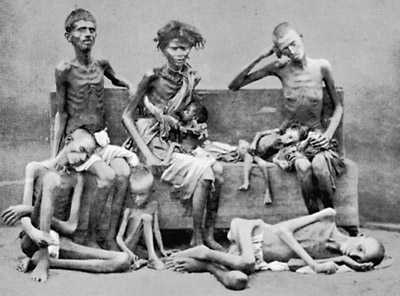
According to British records, one million Indians died of famine between 1800 and 1825, 4 million between 1825 and 1850, 5 million between 1850 and 1875 and 15 million between 1875 and 1900. Thus 25 million Indians died in 100 years! Since Independence, although poverty still exists, there have been no such mass famines, a record of which India should be proud. Funnily enough, there is no mention of this by pro-colonial authors. It is certainly a strange omission on their part and something they should be ashamed of. Perhaps not surprising as it would make British investment in India seem trivial and pointless by comparison. Any rational person would rather avoid millions of deaths than have a few railway tracks built and some land irrigated.
How did these famines occur? The main reason was not bad weather or natural causes but rather the breaking up of India’s indigenous crop patterns. The British replaced food crops such as rice and wheat and instead forced Indian farmers to produce jute, cotton, tea and oil seeds, which they needed as raw materials for their home industries. The implication of this in times of shortages was catastrophic, as the famine figures show.
Niall Ferguson also credits the British with labouring to improve India’s public health:
It was the British who introduced quinine as an anti-malarial prophylactic, carried out public programmes of vaccination against smallpox – often in the face of local resistance – and laboured to improve the urban water supplies that were so often the bearers of cholera and other diseases.
Once again, there is some truth in this, but also some omission, and some downright distortion. On the subject of smallpox vaccination, it is well documented that before the British arrived, Indians had a system of immunisation against smallpox, in which cowpox was used inoculate against smallpox. The British doctor J Z Holwell wrote a book in 1767 describing the system, accepting that it was safe and effective. European medicine did not have any treatment against the disease at that time.
Inoculation against smallpox became a part of Western medicine by 1840. No sooner did that happen that the British in India banned the older method of vaccination, denouncing it as barbaric, without making certain that sufficient number of inoculators in the new technique existed. Smallpox in India became a greater scourge than before. This is not the only example in which the British undermined and even banned indigenous systems of knowledge, particularly medicine, creating dire consequences.
In writing this article I am not trying to stir up bitterness. As I have mentioned, many if not most white Britons see colonialism as a dark part of their history, and refrain from glorifying it or acting triumphant over it. I am simply trying to combat the smug, celebratory version of Imperial history that is in vogue in some circles. This distorted version of history should be discarded into the dustbin of history.
This article is dedicated to the millions men, women and children, of India as well as other nations, who perished in unnecessary and avoidable famines during the colonial era.
February 24, 2013
Posted by aletho |
Deception, Mainstream Media, Warmongering, Timeless or most popular | Britain, British, British Raj, David Cameron, India, Niall Ferguson, Oxford University |
8 Comments
 India and Pakistan have agreed on a ceasefire to halt cross-border fighting over Kashmir, following recent deadly clashes in the disputed region.
A ceasefire took hold Thursday in disputed Kashmir after Pakistani Foreign Minister Hina Rabbani Khar appealed for talks with her Indian counterpart to help defuse tensions.
“No fresh incidents of firing or violation of the ceasefire agreement have been reported from the Line of Control,” said Rajesh Kalia, the spokesman for the Indian army’s Northern Command.
Three Pakistani soldiers and two Indian troops have been killed along the de facto border known as the Line of Control since January 6. India says one of its two soldiers was beheaded.
The ceasefire agreement was reached during a phone call on Wednesday between India’s General Vinod Bhatia and Pakistan’s General Ashfaq Nadeem.
“An understanding has been arrived at between the two director-generals of military operations to de-escalate the situation along the Line of Control,” said Indian army spokesman Jagdeep Dahiya.
The Pakistani military confirmed the telephone conversation, saying in a statement that “both sides agreed on the need to reduce tension on the LOC.”
The Pakistani foreign minister said in New York on Wednesday, “We will be open to a discussion, a dialogue, at the level of the foreign ministers to be able to resolve” the issue of the Line of Control (LOC) “incidents and to re-commit ourselves to the respect for the ceasefire.”
Kashmir lies at the heart of more than 60 years of hostility between India and Pakistan. Both countries claim the region in full but each only has control over a section of the territory.
Over the past two decades, the conflict in Kashmir has left over 47,000 people dead by the official count, although other sources say the death toll could be as high as 90,000.
January 17, 2013
Posted by aletho |
Aletho News | India, Kashmir, Line of Control, Pakistan |
Leave a comment
By Dr. Paul Larudee | January 8, 2013
Amazing stuff, India ink. A few drops spread vigorously with a roller for several minutes on an iron plate are enough for eight sets of fingerprints and two sets of hand prints on four ancient double-sided and folded Indian police fingerprint forms. By contrast, the mug shot was taken with a digital camera. After that, I was issued an official deportation order, for which I signed to acknowledge receipt. My passport remained in police custody until I got to the security check at the airport, when it was returned to me.
My crime? I had spoken to an audience of 22,000 youth at a Student Islamic Organization conference in Kerala State without having a visa that authorized public speaking or conference participation. India is perhaps the only “democracy” where free speech for foreigners depends upon the visa they are carrying. In fact, it is probably the only such country that has no visit visa category at all, and which has one of the most convoluted, bureaucratic and invasive visa application procedures this side of North Korea.
Not that the visa restrictions are always enforced. However, the myriad regulations and procedures (“for public protection”) permit the security apparatus to control individuals and events at their discretion without having to cite the true reasons for their enforcement. Every effective police state knows the drill.
In my case, I used a tourist visa, because the conference visa is a truly onerous procedure unless it is a state-sponsored event. In fact, that is the only type of conference participation permitted, because even private groups must seek state sponsorship in order to bring speakers from outside. In today’s India, however, state sponsorship is hardly a routine bureaucratic procedure.
It shouldn’t have been this way. India was supposed to have been the model for tolerant multi-ethnic, multi-linguistic, multi-confessional societies. And when India was a leader of the Non-Aligned Movement, carefully balancing its relationships among great and small powers and supporting those who might otherwise be a mere pawn in world affairs, this promise seemed plausible.
Regrettably, India has now become a home-grown Raj, choosing sides and fomenting discord between competing interests as a means of governing and controlling, in the best traditions of its colonial past. Thus, for example, conservative Salafist clerics are welcome when they attend conferences on tourist visas, while human rights speakers like David Barsamian, John Esposito, Yvonne Ridley, Wilhelm Langthaler and myself are unwelcome, and are denied visas or expelled, and/or their hosts are prosecuted.
The Salafist treatment is part of a Machiavellian formula hatched by India with its newest partner, Israel. Salafists deserve free speech as much as anyone, but the reason India accords more of it to them is on the advice of Israel. Israel promotes Islamophobia as part of its strategy of demonizing Palestinians and Arabs, a majority of whom are Muslims, and the Salafist brand of Islam fits Israel’s agenda of portraying Islam as an extremist ideology. This stokes the flames of the more extreme nationalist Hindu groups in India and plays on the fears of many other non-Muslim groups, as well. Since Pakistan is an external Muslim enemy, such demonization helps to unify non-Muslim India and permit popular tolerance of greater government control as well as encroachment of security forces on civil rights and privacy.
In fact, India has its own version of the U.S. Patriot Act, curbing the rights of its people. It is called the Unlawful Activities Prevention Act (UAPA), and while the title is more honest than “Patriot”, it is also a bit scary. It implies that people can be snatched from the edge of a sidewalk on the pretext that they were intent on jaywalking. No need for the infraction to happen first.[i] UAPA is an illustration of the degree to which human rights have been marginalized in the land of M.K. Gandhi and Abdulghaffar Khan.
Not that India doesn’t have real security concerns. Communal strife is as old as India itself and has sometimes risen to the level of genocide, which drove the 1947 Pakistan secession. However, it is one thing to use law enforcement to prevent fighting and quite another to use it to drive a wedge between communities with a view towards playing them off against each other.
A case in point is the role that Israel is playing. The self-proclaimed Jewish state is selling itself to India as a worthwhile ally on the basis that it is a) an experienced and effective leader in the fight against Islamist extremism and terrorism, b) a supplier of high-tech weapons and intelligence, and c) a means of access to U.S. support and cooperation. In effect, Israel is saying that both states have common friends and enemies and that Israel is in a position to provide what India needs.
India appears to be buying, and is currently the largest customer for Israeli military arms systems and services. Never mind that the expensive Iron Dome systems are effective less than 50% of the time against rockets from Gaza that use 16th century technology. Like most governments, India has been seduced by the promise of omniscient surveillance systems and the prospect of winning battles rather than preventing them.
This is obviously a devil’s bargain. True to the nature of such contracts, however, are the surprises that await the unwary. It is instructive to remember that Israeli agents once planted bombs in Baghdad synagogues to encourage Iraq’s Jews to emigrate to Israel. (It worked, and encouraged Iraqi thugs toward violence, as well.)
Since then, Israel has stolen nuclear weapon technology and weapons grade fissionable material from the U.S., conducted the most massive spying operation in U.S. history against its “ally”, and staged numerous assassinations and “black ops” actions outside its borders, including friendly countries. Questions currently surround the killing of Israeli tourists in Bulgaria and the putative assassination attempt on Israeli diplomats in India. Israel blamed both of these on Iran on the basis of flimsy evidence, possibly fabricated in collaboration with its allies, the violent Mujahedin-e-Khalq Iranian exile group.
India would do well to be more circumspect toward friends like this. Vilifying Iran is high on Israel’s current agenda, and Israel reportedly provided “evidence” and pushed the Indian government to prosecute the case. The result was the arrest of journalist Syed Mohammed Ahmed Kazmi, who anchors a news program on West Asia providing alternative views of events in the region. His open advocacy of better relations with Iran and his Iranian contacts were enough make him an Israeli target and an Indian suspect. After seven months of incarceration, however, the Indian government had to release him for lack of evidence.
Kazmi and I shared the podium at the SIO conference in Kerala and I was able to chat with him privately just prior to the event. He is a courageous man, willing to accept the risk of speaking in public so soon after his release, but appears to hold no bitterness. Peaceful dissent of this kind needs to be encouraged in India, which is well advised to heed John F. Kennedy’s warning that, “Those who make peaceful revolution impossible will make violent revolution inevitable.”
Sadly, Israel sees violent revolution in foreign countries to be in its national interest, under the “divide and conquer” principle. However, one would think that India’s principle would be the opposite if it wants to remain a successful unified nation with a highly diverse population seeking assurance that all their voices are heard in a national consensus. Furthermore, there is no need for India to acquire the same enemies as Israel. It may be in Israel’s perceived interests, but is it in India’s?
My few days in Kerala were an inspiring glimpse of what is possible. I saw thousands of young Indian Muslims whose religious and social mission is to benefit all mankind, to alleviate the social ills of Muslims and non-Muslims alike, to promote interfaith cooperation and to create an umbrella that is inclusive of everyone.
Although this was a Muslim event, many who attended were not Muslim and were invited directly by their Muslim neighbors. I was invited to be the keynote speaker even though I am not Muslim and spoke more generally about human rights and about Palestinian issues, which are not specifically Muslim or Indian. Roughly 40% of the attendees were young women, in a society not always known for its success in promoting women’s rights.
These young people were politically aware, committed, well organized and motivated. Society is supposed to create models for young people, but in this case it was the young that created a model for their society.
Dr. Paul Larudee is a human rights advocate and one of the co-founders of the movement to break the siege of Gaza by sea. He was deported from India on 31st December, 2012.
[i] For a fictional treatment illustrating the absurdity of this proposition, see the film Minority Report (2002).
Source
January 8, 2013
Posted by aletho |
Civil Liberties, Full Spectrum Dominance, Islamophobia, Timeless or most popular, Wars for Israel | India, Israel, Kerala, Non-Aligned Movement, Paul Larudee, Unlawful Activities Act |
1 Comment
NEW DELHI – Prominent Indian writer and human rights activist, Arundhati Roy has said that the Indian army and police are using rape as a weapon against the people of Kashmir and parts of India like Manipur.
Arundhati Roy in a media interview in New Delhi while commenting on the issue of the recent Delhi rape incident said that when rape was used as a means of domination by the Upper Caste of the Hindus or by the army and police in India, it always went unpunished.
She said that rape was legitimately used, as the Indian laws protected the culprits when they did it. Arundhati Roy questioned why Indians did not demand the death penalty for the perpetrators of such crimes in occupied Kashmir.
APHC (G) Chairman Syed Ali Geelani in a statement in New Delhi while denouncing the incident criticized the Indian people’s silence over numerous such occurrences in Kashmir. He referred to the tragedies of Kunan-Poshpora, Chanapora and Shopian and said that the culprits in these cases were identified but, even though, were not punished.
And in Srinagar, Jamaat-e-Islami and APHC leader, Zafar Akbar Butt in separate statements raised concerns over double standards adopted by Indian civil society towards the people especially rape victims in the territory.
A majority of Kashmiri youth using Facebook and other social network websites expressed surprise that the entirety of India was demanding the execution of Delhi rapists, but the troops involved in the gory incident of Kunan Poshpora in the occupied territory were protected by the system.
December 27, 2012
Posted by aletho |
Illegal Occupation, Subjugation - Torture, Timeless or most popular | Arundhati Roy, Human rights, India, Indian Army, Jammu and Kashmir, Kashmir |
1 Comment
Indian and Latin American cooperation
THIS year, India has shown a notable interest in increasing its economic relations with Latin American countries. Given the serious crisis in the Eurozone and the deceleration of the U.S. economy, nations south of the Rio Bravo are demonstrating greater macroeconomic stability and represent a major growing market.
For example, Brazil, the principal regional buyer of Indian products and the second-largest supplier to the country, increased imports from the Asian giant by 66.2% on the first seven months of 2012. Mexico, the second largest buyer and fourth Latin American exporter to India, raised its exports to the country by 72.1% in the first half of the year.
Other Latin American nations, essentially exporters of raw materials, also have a secure market in India at a time of financial instability. Indian business executives predict that, by 2014, bi-regional trade will be double that of 2011.
However, the Indian Ministry of Foreign Affairs believes that economic links with Latin America could be more developed, and thus exceed the current trade volume of $25 billion, an insufficient figure and equal to 10% of Chinese economic exchange with the region.
The Indian economy is historically based on manufactured goods and agriculture, being one of the principal world producers of sugar cane, cotton and jute. But in recent decades the country has diversified and developed into sectors such as space and aeronautics research, informatics, telecommunications, electronics, medicine, oil and natural gas.
In fact, India’s dynamic industrial development has caught the attention of companies worldwide, leading to the establishment of subsidiaries in the country, which possess a large qualified workforce.
As a member of the group of emerging economies, BRICS, together with Brazil, Russia, China and South Africa, India contributes half of global economic growth. In 2011, its Gross Domestic Product grew by over 8%.
In June 2012, a ministerial representation from the Community of Latin American and Caribbean Community (CELAC) had a meeting in New Delhi with Indian government officials, during which both sides expressed a mutual interest in extending political relations and economic ones in particular. It was the first time that CELAC, comprising 33 countries in the region, had negotiated abroad as a bloc.
~
See also:
Iran, Brazil Trade Balance Hits $2.4bln
Sri Lanka proposes barter trade with Iran
Pakistan, Iran to open a new market near border
Belarus to Get $600 Mln in Loans from China
Chinese MP: Beijing Welcomes Expansion of All-out Ties with Tehran
Diplomat: Iran-Iraq Trade Ties to Surpass $12bln
December 20, 2012
Posted by aletho |
Economics | BRICS, Community of Latin American and Caribbean States, India, Latin America, Sri Lanka |
Leave a comment
India has joined Japan in offering government-backed insurance for ships carrying Iranian crude in order to bypass European sanctions, the Washington Post reported.
The first Indian ship to carry oil from Iran with Indian insurance is scheduled to load up in Iran on Wednesday, a shipping company executive said. This is a breakthrough for the Indian government, which has scrambled to maintain vital Iranian oil imports after European sanctions blocked third-party insurance in July.
The MT Omvati Prem — a tanker contracted to carry 85,000 metric tons of crude oil from Iran for Indian state refiner Mangalore Refinery and Petrochemicals Ltd. — is scheduled to arrive in India by Aug. 25, said Kowshik Kuchroo, president of shipping for Mercator Ltd., an Indian shipping company.
“This being a government of India cargo, it has a different sense of importance. We’re not doing it just for business,” Kuchroo said Monday. “India is in definite need of the crude. At a short notice, we can’t just snap the supply.”
Mercator is insuring the ship with $50 million in hull and machinery insurance, which covers physical damage to the ship, from state-owned New India Assurance Co. It’s insuring the vessel with another $50 million in protection and indemnity insurance, which covers a broad range of liabilities, including environmental pollution and cargo damage, from government-backed United India Insurance.
August 15, 2012
Posted by aletho |
Economics, Wars for Israel | India, Iran, Mangalore Refinery and Petrochemicals Limited |
Leave a comment
 India and Pakistan have agreed on a ceasefire to halt cross-border fighting over Kashmir, following recent deadly clashes in the disputed region.


 Aletho News
 Aletho News