Hindu extremists beat Muslim man in northern India

In this picture, a Muslim man is being thrashed by Hindu extremists from the Bajrang Dal organization in Muzaffarnagar, northern India, June 19, 2015
Press TV – June 29, 2015
Footage has been released online purportedly showing members of an extremist Hindu organization thrash a Muslim man in India’s northern and most populous state of Uttar Pradesh.
Videos posted on social media networks show radicals from the Bajrang Dal organization, whose ideology is based on fundamentalist Hindutva, verbally abusing the victim as a fanatic mercilessly beats the man, identified as Riyaz, with a belt in the city of Muzaffarnagar, situated approximately 130 kilometers (80 miles) north of the capital, New Delhi, and in front of a large number of onlookers.
The ill-fated Muslim man is being tormented on the accusations that he was attempting to slaughter a cow in Shamli district of the city. Riyaz, however, has dismissed the claims and said he was just present at the site, where the cow was allegedly being slaughtered.
The video further shows Indian police forces arresting the victim, while taking no actions against Bajrang Dal extremists.
Meanwhile, local civil groups have blamed Samajwadi Party and Bharatiya Janata Party – the two major Indian political parties – of rekindling sectarian strife in Muzaffarnagar.
In September 2013, clashes between Muslims and Hindus in the Shamli and Muzaffarnagar districts of Uttar Pradesh state killed more than 50 and left 50,000 displaced. Many among the Muslim community fled their homes seeking shelter at relief camps.
A total of 294 people were arrested over the violence, despite nearly 6,000 being named as suspects.
Displaced Indian Muslims said their makeshift homes were being demolished by the state government in order to avoid negative media attention, following a report that revealed 34 children had died in the relief camps.
China, India, Russia largest shareholders in China-led bank
The BRICS Post | June 29, 2015
Fifty countries on Monday signed the articles of agreement for the new China-led Asian Infrastructure Investment Bank, the first major global financial instrument independent from the Bretton Woods system.
Seven remaining countries out of the 57 that have applied to be founding members, Denmark, Kuwait, Malaysia, Philippines, Holland, South Africa and Thailand, are awaiting domestic approval.
“This will be a significant event. The constitution will lay a solid foundation for the establishment and operation of the AIIB,” said Chinese Finance Minister Lou Jiwei.
The AIIB will have an authorized capital of $100 billion, divided into shares that have a value of $100,000.
BRICS members China, India and Russia are the three largest shareholders, with a voting share of 26.06 per cent, 7.5 per cent and 5.92 per cent, respectively.
Following the signing of the bank’s charter, the agreement on the $100 billion AIIB will now have to be ratified by the parliaments of the founding members.
Asian countries will contribute up to 75 per cent of the total capital and be allocated a share of the quota based on their economic size.
Chinese Vice Finance Minister Shi Yaobin said China’s initial stake and voting share are “natural results” of current rules, and may be diluted as more members join.
Australia was first to sign the agreement in the Great Hall of the People in Beijing on Monday, state media reports said.
The Bank will base its headquarters in Beijing.
The Chinese Finance Ministry said the new lender will start operations by the end of 2015 under two preconditions: At least 10 prospective members ratify the agreement, and the initial subscribed capital is no less than 50 per cent of the authorized capital.
The AIIB will extend China’s financial reach and compete not only with the World Bank, but also with the Asian Development Bank, which is heavily dominated by Japan.
China and other emerging economies, including BRICS, have long protested against their limited voice at other multilateral development banks, including the World Bank, International Monetary Fund and Asian Development Bank (ADB).
China is grouped in the ‘Category II’ voting bloc at the World Bank while at the Asian Development Bank, China with a 5.5 per cent share is far outdone by America’s 15.7 per cent and Japan’s 15.6 per cent share.
The ADB has estimated that in the next decade Asian countries will need $8 trillion in infrastructure investments to maintain the current economic growth rate.
China scholar Asit Biswas at the Lee Kuan Yew School of Public Policy, Singapore, says Washington’s criticism of the China-led Bank is “childish”.
“Some critics argue that the AIIB will reduce the environmental, social and procurement standards in a race to the bottom. This is a childish criticism, especially because China has invited other governments to help with funding and governance,” he writes.
The US and Japan have not applied for the membership in the AIIB.
However, despite US pressures on its allies not to join the bank, Britain, France, Germany, Italy among others have signed on as founding members of the China-led Bank.
Meanwhile, New Zealand and Australia have already announced that they will invest $87.27 million and $718 million respectively as paid-in capital to the AIIB.
The new lender will finance infrastructure projects like the construction of roads, railways, and airports in the Asia-Pacific Region.
Iran, 49 states sign Asia bank charter
Press TV June 29, 2015
Iran on Monday joined 49 countries in signing up to the Asian Infrastructure Investment Bank (AIIB), bringing Asia’s largest financial lender a step closer to existence.
Finance and Economy Minister Ali Tayebnia put Iran’s signature to the bank’s articles of association at a ceremony in Beijing’s Great Hall of the People, which capped six months of intense negotiations.
In April, China accepted Iran as a founding member of the Asian Infrastructure Investment Bank being seen as a rival to the US-led World Bank, the International Monetary Fund (IMF) and the Asian Development Bank.
With the signing which amounted to the creation of AIIB’s legal framework, China’s Finance Minister Lou Jiwei said he was confident the bank could start functioning before the end of the year.
Seven more founding members would ink the articles after approval by their respective governments.
The bank will have a capital of $100 billion in the form of shares, each worth $100,000, distributed among the members. Beijing will be by far the largest shareholder at about 30%, followed by India at 8.4% and Russia at 6.5%.
China will also have 26% of the votes which are not enough to give it a veto on decision-making, while smaller members will have larger voice.
Singapore’s Senior Minister for Finance and Transport Josephine Teo said the bank will provide new opportunities for its members’ businesses and promote sustainable growth in Asia.
Seventy-five percent of AIIB’s shares are distributed within the Asian region while the rest is assigned among countries beyond it.
Germany, France and Brazil are among the non-Asian members of the bank despite US efforts to dissuade allies from joining it. Another US ally joining AIIB is Australia but Japan has stayed away from it.
Countries beyond the region can expand their share but the portion cannot be bigger than 30%. Public procurement of the AIIB will be open to all countries around the world.
But the president of the bank will have to be chosen from the Asian region for a maximum of two consecutive five-year terms.
The bank will be headquartered in Beijing and its lean structure will be overseen by an unpaid, non-resident board of directors which, architects say, would save it money and friction in decision-making.
Earlier this month, former Federal Reserve chairman Ben Bernanke rebuked US lawmakers for allowing China to found the new bank, which threatens to upend Washington’s domination over the world economic order.
He said lawmakers were to blame because they refused to agree 2010 reforms that would have given greater clout to China and other emerging powers in the International Monetary Fund.
The Ethics of Climate Change
Calls for massive reductions in global greenhouse gas emissions ignore the impacts on the poor
By Bob Lyman | Watts Up With That? | May 23, 2015

People who believe in the theory of catastrophic human-induced global warming claim that they want to “save the planet” and that this is the moral thing to do. They insist, however, that saving the planet requires stringent reductions in people’s use of fossil fuel energy to reduce greenhouse gas emissions. They never talk about what that means to the poor. I think that, before people decide on the ethics of the debate, they need to consider what the impact would be of sharply reducing energy consumption on the wellbeing of world’s population, and especially on the poor.
In 2014, the International Energy Agency (IEA) issued a Special Report entitled “Modern Energy for All”. In it, the IEA stated that modern energy services are:
…crucial to human wellbeing” and to a country’s economic development.
Access to modern energy is essential for the provision of clean water, sanitation and healthcare and for the provision of reliable and efficient lighting heating, cooking, mechanical power, transport and telecommunications services.”
Today billions of people lack access to the most basic energy services. Nearly 1.3 billion people are without access to electricity and 2.7 billion people rely on traditional use of biomass (wood, charcoal and animal dung) for cooking, which causes harmful indoor air pollution.
Pause to think about that for a few minutes. Hundreds of millions of people are without the modern energy services that were available to our ancestors who lived in the nineteenth century. They get up with the dawn and go to bed close to nightfall because they have no electrical lighting. They have to go a river or well (if they are lucky) for water to drink or wash in. They have no way to power an appliance, including a refrigerator, so all food has to be eaten quickly or it may go bad. They have to walk long distances everyday to search for firewood or dried animal dung. There is no light to extend the day to provide time for reading or entertainment. They have no telephones. They have no way to pump water for irrigating crops. They have no motorized transportation, so they cannot go very far. Almost all their time is spent simply doing the simple tasks that in Canada and other advanced countries are done by machines. Worse, every day they breathe in the fumes from the dirty cooking fires, developing lung disorders. In fact, according to the IEA, every year 4.3 million premature deaths can be attributed to household air pollution resulting from the use of traditional biomass fuels for cooking.
The international community has long been aware of the close correlation between income levels and access to modern energy; not surprisingly, countries with a large proportion of the population living on an income of $2 per day tend to have low electrification rates and few motorized vehicles. The problem is spread throughout the developing world, but it is particularly severe in sub-Saharan Africa and developing Asia, which together account for 95% of people in abject energy poverty.
The latent demand for electricity is immense. An estimated 400 million people in India still lack access to electricity. A recent study looked at the expansion of electricity that would be needed on an economy-wide basis in sub-Saharan Africa to comprehensively address energy access. To reach moderate access, where electricity generation capacity is around 200-400 megawatts (MW) per million people, the region would need a total of 374 MW of installed capacity. That’s about twelve times the level of capacity in the region today. All energy sources would be needed to help provide that much capacity.
This is where aspiration runs into reality. In desperately poor countries, they do not have the luxury to spend millions of dollars on energy. Renewable energy sources like wind and solar energy can sometimes be useful where there is no electricity transmission system to take centrally-generated power to rural areas, but it is expensive and often requires technology to install and operate. Further, wind and solar are “intermittent” sources, meaning that they only produce energy when the wind blows or the sun shines respectively. Electrical energy is expensive to store and this can only be done in small amounts.
For reliable electrical energy supply for any possibility of industrial development and for transportation, developing countries need large scale power generation based on low cost, generally available fuels. In India, and in many parts of Africa, this means coal.
Coal reserves are available in almost every country worldwide, with recoverable reserves in around 70 countries. In fact, coal is the backbone of modern electricity in most parts of the world. It now provides about 30% of the primary energy and 41% of global electricity generation. It is plentiful and relatively cheap. Over the decade from 2000 to 2010, China showed the world how massive expansion of coal-fired electricity generation could modernize its economy and bring electrification to almost all parts of the country. As a result, hundreds of millions of Chinese have lifted themselves out of energy and economic poverty and dramatically improved both their income and quality of life.
Yet, coal is the most carbon-intensive of fossil fuels. It is the fuel source most despised by those who want to drastically reduce emissions. The Obama Administration in the United States has, as part of its climate change agenda, pressured the World Bank to stop lending to coal-fired electricity projects and the World Bank has complied. The U.S. Administration has also withdrawn funding from the Export-Import Bank for such projects. Fortunately for the developing countries, a new Asian Infrastructure Investment Bank has been established with major funding from China, which will include funding of new coal projects.
Those pursuing the climate change political agenda are prepared to condemn the world’s poor living without modern energy to remain in their backward situation. For them, billions of blighted lives are preferable to increasing greenhouse gas emissions.
Even in the developed countries, the policies advanced for climate reasons fall heavily on the poor.
Electricity prices continue to surge in Europe where costs are often triple those in the U.S. EU governments have various schemes, taxes, subsidies, and mandates, such as Cap and Trade, feed-in tariffs, and surcharges that make Europeans pay more for power. Perhaps the best (worst?) example is Germany, where nearly 20% of families now live in “fuel poverty,” spending more than 10% of household income on energy. Germany’s energy transition (“Energiewende”) is expected to cost an astounding $735 billion, and many are demanding changes. Overall in Europe, 1.4 million more households are expected to be in fuel poverty by 2020.
In the name of climate change, governments are forcing utilities to sign long-term contracts paying as much as four times the going wholesale electricity rate for renewables. Power markets have become so distorted that wind farms in the UK and in Ontario, for instance, have been paid millions to NOT produce electricity.
Supporters of “green” energy policies keep saying that poverty will be reduced if only efficiency would improve, but that position doesn’t hold up. Energy efficiency in the EU has improved around 20% since 2005. In the UK, for instance, energy efficiency has increased nearly 30% since 2003, yet electricity prices have almost doubled and homes in fuel poverty have nearly quadrupled. Europe’s main fuel poverty problem isn’t a lack of efficiency, it’s soaring prices.
Apart from the higher prices, another meaningful measure of energy poverty in Germany is the number of supply stoppages (“power cuts”) ordered by utility companies. Basic suppliers are entitled to interrupt their electricity or gas deliveries in the event of arrears in payment of more than 100 euros after a warning notice followed by a repeated threat to terminate service. According to a survey of the German Network Agency (Bundesnetzagentur), in 2013 warnings of electricity supply termination were issued to 5.7 million private households in Germany. The supply of electricity was actually interrupted to roughly 320,000 households.
There are many different moral standards to which one might refer in defining what is the most “ethical” way for people to act when considering their use of energy and other goods to improve their lives. Those environmentalists who claim that “nature” is more important than humans and that any measure, regardless of how costly, should be taken to reduce the effects of humans on the planet will never be satisfied. In my view, human wellbeing, and especially the plight of the world’s poor, deserves a prominent place in judgments about what is ethical behavior. Sharply reducing fossil fuel use means reducing economic development, condemning poor societies to remain poor, and requiring the poor people of today to sacrifice for the sake of addressing an unproven problem in a distant future — this is truly immoral.
US frowns at India-Iran port deal
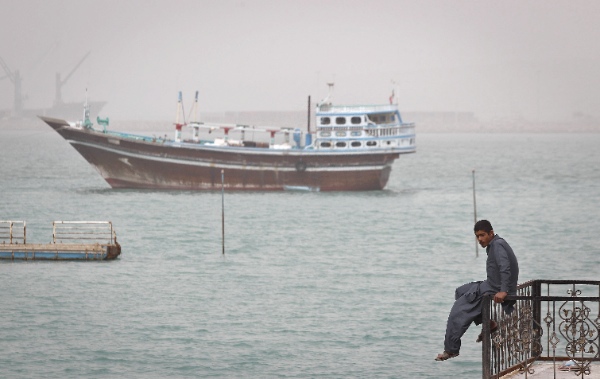
An Iranian man sits on the beach in the port city of Chabahar, southeastern Iran, on March 7, 2015 [Xinhua]
The BRICS Post | May 7, 2015
As New Delhi aims to take advantage of a thaw in Tehran’s relations with world powers, India and Iran have reached a deal on Wednesday to develop a strategic port in southeast Iran.
Abbas Ahmad Akhoundi, Iranian Minister for Transport and Urban Development and his Indian counterpart Nitin Gadkari signed an inter-Governmental Memorandum of Understanding (MoU) regarding India’s participation in the development of the Chabahar Port in Iran.
“With the signing of this MoU, Indian and Iranian commercial entities will now be in a position to commence negotiations towards finalisation of a commercial contract under which Indian firms will lease two existing berths at the port and operationalise them as container and multi-purpose cargo terminals,” the Indian Foreign Ministry said in a statement.
Richard Verma, US Ambassador in India, cautioned against “rushing in” with the deal saying there is no guarantee that a final deal will be secured with Tehran by a June 30 deadline.
India intends to lease two berths at Chabahar for 10 years. The port will be developed through a special purpose vehicle (SPV) which will invest $85.21 million to convert the berths into a container terminal and a multi-purpose cargo terminal.
The port of Chabahar in southeast Iran is central to India’s efforts to open up a route to landlocked Afghanistan where it has developed close security ties and economic interests.
“The availability of a functional container and multipurpose cargo terminal at Chabahar Port would provide Afghanistan’s garland road network system alternate access to a sea port, significantly enhancing Afghanistan’s overall connectivity to regional and global markets, and providing a fillip to the ongoing reconstruction and humanitarian efforts in the country,” said the Indian Foreign Ministry late on Wednesday evening.
Iranian President Hassan Rouhani, in his meeting with the Indian Minister in Tehran said, “Resumption of Iran-India cooperation in the southeastern Iranian port city of Chabahar would lead to a new chapter in relations of two countries.”
Meanwhile, India’s fellow BRICS member, South Africa is sending a delegation headed by its Foreign Minister for talks with Iranian leaders.
South Africa hopes to restore energy ties with Iran, its energy minister, Tina Joemat-Pettersson, said on Sunday.
The Hidden Tears of Punjab
By ANDRE VLTCHEK | CounterPunch | May 2, 2015
A lane, a narrow passage to Jallianwala Bagh Garden inside the old city of Amritsar, in the state of Punjab. It is a monument now, one of the testaments to madness and crimes committed by the British Empire during its colonial reign over Sub-Continent.
This is where, on April 13, 1919, thousands of people gathered, demanding release of two of their detained leaders, Dr. Satyapal and Dr. Saifuddin. It was right before the day of Baisakhi, the main Sikh festival, and the pilgrims came to the city, in multitudes, from all corners of Punjab.
The British Brigadier-General Reginald Dyer brought fifty Gurkha riflemen to a raised bank, and then ordered them to shoot at the crowd.
Bipan Chandra, an Indian historian, wrote in his iconic work, “India’s Struggle for Independence”:
“On the orders of Brigadier-General Reginald Dyer, the army fired on the crowd for ten minutes, directing their bullets largely towards the few open gates through which people were trying to run out. The figures released by the British government were 370 dead and 1200 wounded. Other sources place the number dead at well over 1000.”
While reading through the draft of this essay, my friend and comrade, renowned Canadian international lawyer Christopher Black, added:
“… At the investigation into the Amritsar massacre, General Dyer said his only regret was that he had not killed more people. He also used armoured cars to block the entrances and machine guns were also used on the crowd. After that the British made people in the streets crawl on the stomachs when they passed a British officer. Terrible, terrible things-and what the British did in Kenya in the 50’s is worse than what the Nazis did in Europe.”
Jallianwala Bagh is now a monument, a testament, a warning. There are bullet holes clearly marked in white, penetrating the walls of surrounding buildings. There is a well, where bodies of countless victims had fallen. Some people had chosen to jump, to escape the bullets.
There is a museum, containing historic documents: statements of defiance and spite from the officials of British Raj, as well as declarations of several maverick Indian figures, including Rabindranath Tagore, one of the greatest writers of India, who threw his knighthood back in the face of the British oppressors, after he learned about the massacre.
There are old black and white photos of Punjabi people tied to poles, their buttocks exposed, being flogged by shorts-wearing British soldiers, who were apparently enjoying their heinous acts.
There is also a statement of General Dyer himself. It is chilling, arrogant and unapologetic statement:
“I fired and continued to fire until the crowd dispersed, and I consider this is the least amount of firing which would produce the necessary moral and widespread effect it was my duty to produce if I was to justify my action. If more troops had been at hand the casualties would have been greater in proportion. It was no longer a question of merely dispersing the crowd, but one of producing a sufficient moral effect from a military point of view not only on those who were present, but more especially throughout the Punjab. There could be no question of undue severity.”
Not everyone in India is outraged by former crimes of the British Empire. Some want to forget and to “move on”, especially those closely linked to the establishment; to the new corporate and pro-Western India, where education is being privatized, mass media controlled by big business interests, and progressive ideologies buried under unsavory layers of greed.
At the grounds of Jallianwala Bagh, Anand P. Mishra, Professor at O. P. Jindal Global University, Haryana, spreads his arms:
“This happened almost 100 years ago and I don’t hold any grudges towards British, anymore.”
But when I approach Ms. Garima Sahata, a Punjabi student, she does not hide her feelings towards the British Empire and the West:
“I feel ager, thinking what they had done to our people. I think it is important for us to come here and to see the remnants of the massacre. I still feel angry towards the British people, even now… but in a different way… They are not killing us the same way, as they used to in the past, but they are killing us nevertheless.”
***
The British Empire was actually based on enforcing full submission and obedience on its local subjects, in all corners of the world; it was based on fear and terror, on disinformation, propaganda, supremacist concepts, and on shameless collaboration of the local “elites”. “Law and order” was maintained by using torture and extra-judiciary executions, “divide and rule” strategies, and by building countless prisons and concentration camps.
To kill 1,000 or more “niggers,” to borrow from the colorful, racist dictionary of Lloyd George, who was serving as British Prime Minister between 1916 and 1922, was never something that Western empires would feel ashamed of. For centuries, the British Kingdom was murdering merrily, all over Africa and the Middle East, as well as in the Punjab, Kerala, Gujarat, in fact all over the Sub-Continent. In London the acts of smashing unruly nations were considered as something “normal”, even praiseworthy. Commanders in charge of slaughtering thousands of people in the colonies were promoted, not demoted, and their statues have been decorating countless squares and government buildings.
The British Empire has been above the law. All rights to punish “locals” were reserved. But British citizens were almost never punished for their horrendous crimes committed in foreign lands.
When the Nazis grabbed power in Germany, they immediately began enjoying a dedicated following from the elites in the United Kingdom. It is because British colonialism and German Nazism were in essence not too different from each other.
Today’s Western Empire is clearly following its predecessor. Not much has changed. Technology improved, that is about all.
***
Standing at the monument of colonial carnage in Punjab, I recalled dozens of horrific crimes of the British Empire, committed all over the world:
I thought about those concentration camps in Africa, and about the stations where slaves who were first hunted down like animals were shackled and beaten, then put on boats and forced to undergo voyages to the “new world” – voyages that most of them never managed to survive. I thought about murder, torture, flogging, raping women and men, destruction of entire countries, tribes and families. It is all connected: colonialism, present-day riots in Baltimore, horrid ruins of Africa.
In Kenya, near Voi, I was shown a British prison for resistance cadres, which was surrounded by wilderness and dangerous animals. This is where the leaders of local rebellions were jailed, tortured and exterminated.
In Uganda, I was told stories about how British colonizers used to humiliate local people and break their pride: in the villages, they would hunt down the tallest and the strongest man; they would shackled him, beat him up, and then the British officer would rape him, sodomize him in public, so there would be no doubts left of who was in charge.
In the Middle East, people still remember those savage chemical bombings of the “locals”, the extermination of entire tribes. Winston Churchill made it clear, on several occasions: “I do not understand the squeamishness about the use of gas,” he told the House of Commons during an address in the autumn of 1937. “I am strongly in favour of using poisonous gas against uncivilised tribes.”
In Malaya, I was told, as the Japanese were approaching, British soldiers were chaining locals to the cannons, forcing them to fight and die.
The Brits triggered countless famines all over India, killing dozens of millions. To them, Indian people were not humans. When Churchill was begged to send food to Bengal that was ravished by famine in 1943, he replied that it was their own fault for “breeding like rabbits” and that the plague was “merrily” culling the population. At least 3 million died.
Wherever the British Empire, or any other European empire, grabbed control over the territory – in Africa, Caribbean, the Middle East, Asia, in Sub-Continent, Oceania – horror and brutality reigned.
***
V. Arun Kumar, MPhil in International Organization and researcher at Jawaharlal Nehru University, expressed his feelings regarding Partition, doubtlessly one more terrible result of the British “divide and rule” policy:
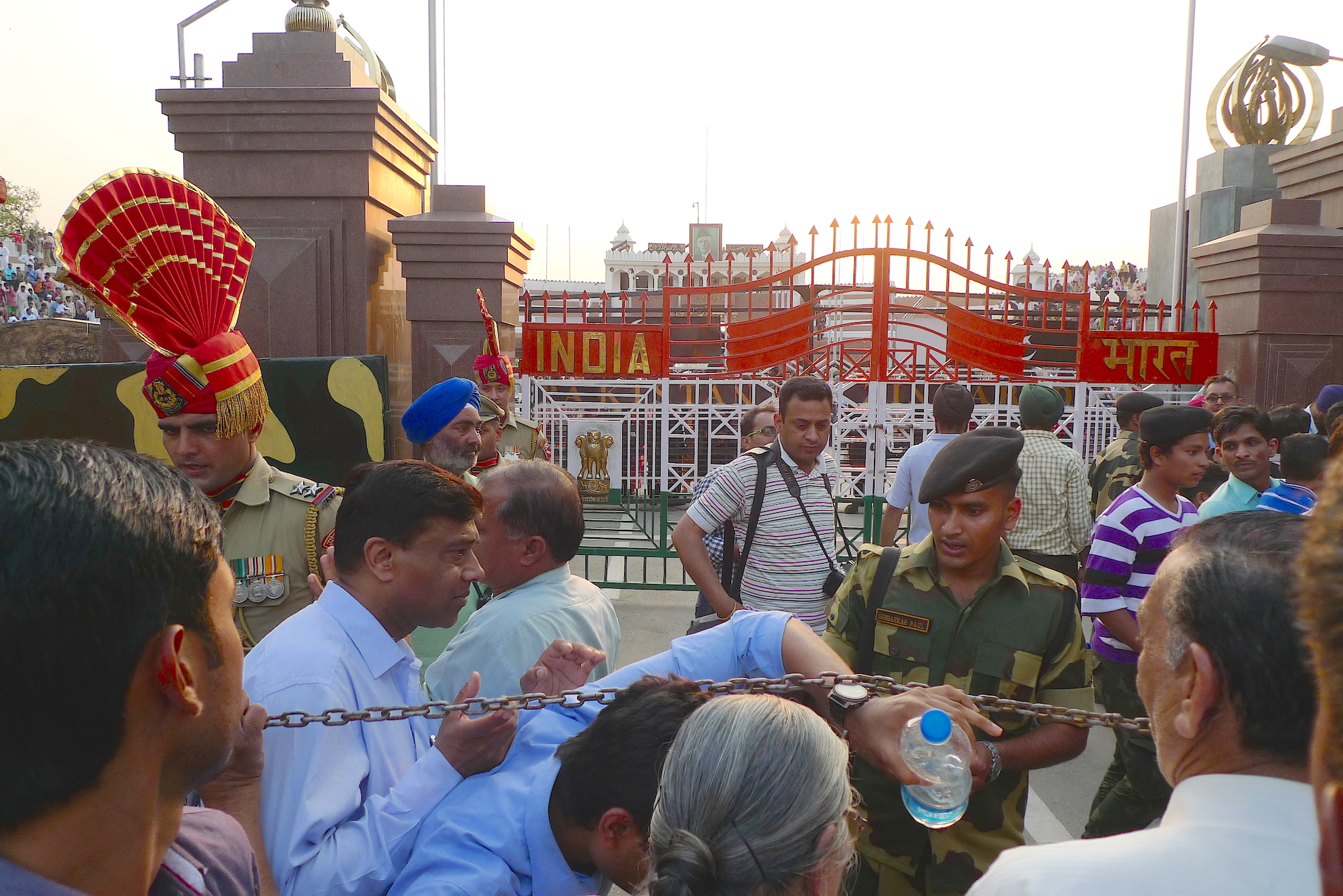
“India and Pakistan, two children born out of the same mother’s womb have today reached at a juncture where no mother would bear. From their birth and to more than sixty years down the history, India and Pakistan has gained the label of archenemies. These two countries have fought numerous wars over a narrow thread that divides them – which they call as border. State machinery on the both sides has constructed massive hatred-mongering propaganda programs, which ensure constant creation of fear psychosis in the minds of people against the other. Even when two countries are not in actual war, they are always in a state of war. A visit to Wagah border between India and Pakistan, one can see the mockery of peace, when soldiers on the both side perform a war like aggressive drill manoeuvre while opening the gates at the border. And the sea of people on both sides enthusiastically claps shouting abusive slogans on the other country- forgetting that they are abusing their own siblings.”
Beautifully said, and so true!
Only 30 kilometers from Amritsar, one of the most grotesque events on earth takes place: “Lowering of the Flag” on the Indian/Pakistani border. Here, what is often described as the perfectly choreographed expression of hate, takes place in front of thousands of visitors from both countries.
Wagah Border has even tribunes built to accommodate aggressive spectators. It goes everyday like this:
“Death to Pakistan!
Long Live India!”
“Death to India!
Long live Pakistan!”
“Hindustaaaaaaaaaaaaaaaaan Zindabad!!!!!!” They shout here, “Long Live India!!!!” and those endless spasms are immediately followed by barks glorifying India and insulting Pakistan. And vice versa.
Border guards, male and female, are then performing short marches, at a tremendously aggressive and fast pace, towards the border gate. The public, sick from the murderous heat and the fascist, nationalist idiocy, speeches and shouts, is roaring.
As I am made to sit on the pavement, right next to the border gate of Wagah, squeezed between two corpulent women wearing sweat-soaked saris, flies are buzzing all over my cameras. Here I feel hate being omnipresent: there is hate expressed by the Indian crowd towards Pakistan, hate of the border guards towards its own unruly crowd, even hate of the crowd towards me, a daring foreigner who came, most likely, to poke fun at this insane martial ceremony.
The issue is so explosive, that my friends from nearby Lahore conveniently “forgot” to supply me with their quote. Few people in New Delhi “forgot” as well.
***
Now, Punjab is split, because that old “divide and rule” scheme was applied here meticulously, as it was almost everywhere at the Sub-Continent.
The British never really left: they live in the minds of the Indian elites.
Punjab suffered terribly during the Partition, and later, too, from brutality of the Indian state. In fact, almost all of India is now suffering, unable to shake off those racist, religious and social prejudices.
Delhi behaves like a colonialist master in Kashmir (where it is committing one of the most brutal genocides on earth), the Northeast and in several other areas. Indian elites are almost as ruthless and barbaric as were the British colonizers; the faces changed, but the power system remained almost intact.
It goes without saying that the Indian elites, disciples and admirers of the British Raj, are treating their own people with similar spite and cruelty.
***
The seeds sown by the British Raj have been inherited by several successive states of the Sub-Continent. They are now growing, blooming into a tremendous toxic and murderous insanity. Instead of turning against the homicidal elites, the poor majority is yelling nationalist slogans.
Everything here is deeply connected: the colonial torture, the post-colonial genocides, the prostitution of the local elites, who are offering themselves to the Western rulers of the world, the over-militarization, the institutionalized spite for the poor and for the lower castes and classes.
Confusion is omnipresent. Words and terminology have lost their meanings. Dust, injustice, pain and insecurity are everywhere.
Anyone who claims that colonialism is dead is either a liar or a madman.
And if this – the direct result of colonialism – is “democracy”, then we should all, immediately, take a bus in the opposite direction!


Andre Vltchek is a philosopher, novelist, filmmaker and investigative journalist. He covered wars and conflicts in dozens of countries. His latest books are: “Exposing Lies Of The Empire” and “Fighting Against Western Imperialism”.
Facebook’s Internet.org, the Anti-Net Neutrality in Action
By Steve Straehley | AllGov | April 26, 2015
The idea sounds great—provide Internet access for the millions of people in developing areas that don’t have it. But in the process of putting that knowledge at the fingertips of that under-served community, Facebook founder Mark Zuckerberg’s Internet.org has drawn a bright line between the haves and have-nots.
Zuckerberg’s plan, developed with manufacturers such as Nokia, Ericsson, Qualcomm and Samsung, allows free access via mobile phones in developing areas only to certain parts of the Internet. Surprise—Facebook is one of the applications able to be reached by way of the Internet.org app. Wikipedia is also available as are weather and a few other sites. But if you want to go to a site not on the app, you must either pay a fee or you’re out of luck.
Latin American leaders, such as Colombian President Juan Manuel Santos, have applauded the Internet.org strategy, according to the Electronic Frontier Foundation (EFF). But others, including Carolina Botero, executive director of the Karisma Foundation in Bogotá, have reservations. Karisma supports the positive use of technology as it pertains to human rights. Botero said: “We have serious concerns that Internet.org is presented as a public policy strategy for universal access to the Internet. This initiative compromises everyone’s rights and blurs the government’s obligation to reduce the digital divide for its citizens for compromised access to certain applications. No matter how interesting they are, these services are associated with a commercial interest of a multinational which the state is directly supporting.”
Zuckerberg claims that because Internet.org doesn’t specifically block sites or charge sites more to run faster, the app conforms with net neutrality principles. But more businesses are starting to see it the other way and are opting out of the program, among them a group of Indian publishers.
“We support net neutrality because it creates a fair, level playing field for all companies—big and small—to produce the best service and offer it to consumers,” The Times Group, one of the publishers that withdrew from Internet.org, said in a statement. Other Indian companies to opt out of Internet.org are travel website Cleartrip and information site Newshunt. “What started off with providing a simple search service has us now concerned with influencing customer decision-making by forcing options on them, something that is against our core DNA,” Cleartrip said in a statement, according to The Wall Street Journal.
“The problem runs deeper than simply which sites to which poor users should have subsidized access,” wrote EFF’s David Boagado and Katitza Rodriguez. “It lies in the very concept that Facebook and its corporate partners, or governments, should be able to privilege one service or site above another. Despite the good intentions of Facebook and the handful of allied companies, Internet.org effectively leaves its users without a real Internet in the [Latin American] region.”
The result is “having access to only a sliver of what is supposed to be the worldwide web,” wrote Issie Lapowsky at Wired. “As we’ve said before, this creates ‘an Internet for poor people.’”
Zuckerberg’s response, basically, is that half a loaf is better than none. “Arguments about net neutrality shouldn’t be used to prevent the most disadvantaged people in society from gaining access or to deprive people of opportunity,” he wrote April 17 in a Facebook post. “Eliminating programs that bring more people online won’t increase social inclusion or close the digital divide. It will only deprive all of us of the ideas and contributions of the two thirds of the world who are not connected.”
To Learn More:
Does Internet.org Leave Latin Americans Without A Real Internet? (by David Bogado and Katitza Rodriguez, Electronic Frontier Foundation)
Mark Zuckerberg Can’t Have It Both Ways on Net Neutrality (by Issie Lapowsky, Wired )
Indian Companies Pull Out of Internet.org amid Battle over Net Neutrality (by Aditi Malhotra, Wall Street Journal )
Supreme Court Upholds Cyber Freedom in India (by Karan Singh, AllGov India )
Kashmiris protest Hindus only settlement plans
Press TV – April 10, 2015
Large crowds of demonstrators have held a massive protest rally in the Indian-administered Kashmir in response to a New Delhi plan to build new townships across the disputed region.
Kashmiri protesters rallied in Srinagar after Friday prayers to voice opposition to a government plan to build new townships for thousands of Hindus in the Muslim-majority region.
The angry protesters chanted pro-independence slogans as they marched toward the city center, Lalchowk, in Srinagar, the main city in Indian-controlled Kashmir.
Srinagar, which lies in the Kashmir Valley, is the summer capital and largest city of the northern Indian state of Jammu and Kashmir. Its winter capital is Jammu.
Indian police and paramilitary troops fired teargas and used stun grenades to disperse the crowd. The security forces also arrested nearly a dozen activists, including some prominent regional protest leaders.
The protesters pelted Indian security forces with stones and blocked roads in the region.
The massive rally comes as New Delhi has announced plans to build a number of townships to accommodate some 200,000 Hindus.
Kashmiri leaders have called the plan a conspiracy to create settlements on religious lines, saying the plan will create hatred between Hindus and Muslims.
Mohammed Yasin Malik, the chairman of the pro-independence Jammu-Kashmir Liberation Front (JKLF) compared the plan to that of Israeli settlements on occupied Palestinian land. Malik suggested that they would rather live side by side the Hindus in a merged society.
“We will not allow anybody to turn Kashmir into another Palestine. They (Pandits) are owners of this land as we are, and we welcome them to live in a composite society along with their Muslim brothers,” a media outlet quoted Malik as saying.
Indian authorities have deployed large contingents of police and paramilitary troops to most parts of Srinagar and several other major towns to prevent street demonstrations.
Kashmir lies at the heart of more than 67 years of hostility between India and Pakistan. Both neighbors claim the region in full but have partial control over it.
The neighbors agreed on a ceasefire in 2003, and launched a peace process the following year. Since then, there have been sporadic clashes, with both sides accusing the other of violating the ceasefire.
Thousands of people have been killed in Kashmir unrest over the past two decades.
China to build $2bn Iran-Pakistan pipeline – media
RT | April 9, 2015
China will reportedly finance the so-called ‘Peace Pipeline’ natural gas pipeline from Iran, home to the world’s second largest reserves, to energy-deprived Pakistan. The project was delayed due to US dissent.
The final deal is to be signed during the long-sought visit of Chinese President Xi Jinping to Islamabad in April, the Wall Street Journal reported on Thursday.
“We’re building it. The process has started,” Pakistani Petroleum Minister Shahid Khaqan Abbasi told the WSJ.
First proposed over 20 years ago, the 1045 mile (1682km) pipeline will transfer gas from Iran’s south to the Pakistani cities of Gwadar and Nawabshah. Karachi, the country’s biggest city of 27.3 million, will also be connected via local energy distribution systems already in place.
Iran has said the 560-mile portion that runs to the Pakistan border is already complete, which only leaves $2 billion needed to build the Pakistani stretch.
The project could cost up to $2 billion if a Liquefied Natural Gas port is constructed at Gwadar. Otherwise, the project to complete the Pakistani pipeline will cost between $1.5 billion to $1.8 billion, the WSJ said. Pakistan is in negotiations with China Petroleum Pipeline Bureau, a subsidiary of Chinese energy major China National Petroleum Corporation, to finance 85 percent of the project. Pakistan will pay the rest.
The original plan envisioned the pipeline continuing to India, but Delhi dropped out due to US pressure in 2009, Tehran claims. Pakistan, a country of 199 million people faces intermittent blackouts in major cities, and Iran is looking for a place to export its soon-to-not-be-banned gas.
Iran has 33.7 trillion cubic meters of gas reserves according to the June 2014 BP Statistical Review of World Energy. According to BP estimates, it has the world’s fourth-largest oil reserves at 157 billion barrels.
US-led sanctions against Iran over its nuclear program have stunted Iran’s oil and gas industry.
Iran’s oil exports have dropped from 2.5 million barrels a day in 2011 to about one million barrels in 2014, according to the US Energy Information Administration (EIA). In March, Iran produced 2.85 million barrels of oil per day, according to data from Bloomberg.
Free Trade, Corporate Plunder and the War on Working People
By COLIN TODHUNTER | CounterPunch | April 3, 2015
Prior to last year’s national elections in India, there were calls for a Thatcherite revolution to fast-track the country towards privatisation and neo-liberalism. Under successive Thatcher-led governments in the eighties, however, inequalities skyrocketed in Britain and economic growth was no better than in the seventies.
Traditional manufacturing was decimated and international finance became the bedrock of the ‘new’ economy. Jobs disappeared over the horizon to cheap labour economies, corporations bought up public utilities, the rich got richer and many of Britain’s towns and cities in its former industrial heartland became shadows of their former selves. Low paid, insecure, non-unionised labour is now the norm and unemployment and underemployment are rife. Destroying ordinary people’s livelihoods was done in the name of ‘the national interest’. Destroying industry was done in the name of ‘efficiency’.
In 2010, 28 percent of the UK workforce, some 10.6 million people, either did not have a job, or had stopped looking for one. And that figure was calculated before many public sector jobs were slashed under the lie of ‘austerity’.
Today, much of the mainstream political and media rhetoric revolves around the need to create jobs, facilitate ‘free’ trade, ensure growth and make ‘the nation’ competitive. The endless, tedious mantra says ordinary people have to be ‘flexible’, ‘tighten their belts, expect to do a ‘fair day’s work for a fair day’s pay’ and let the market decide. This creates jobs. This fuels ‘growth’. Unfortunately, it does neither. What we have is austerity. What we have is an on-going economic crisis, a huge national debt, rule by profligate bankers and corporate entities and mass surveillance to keep ordinary people in check.
So what might the future hold? Unfortunately, more of the same.
The Transatlantic Trade and Investment Partnership
The Transatlantic Trade and Investment Partnership being negotiated between the EU and US is intended to be the biggest trade deal in history. The EU and US together account for 40 percent of global economic output. The European Commission tries to sell the deal to the public by claiming that the agreement will increase GDP by one percent and will entail massive job creation.
However, these claims are not supported even by its own studies, which predict a growth rate of just 0.01 percent GDP over the next ten years and the potential loss of jobs in several sectors, including agriculture. Corporations are lobbying EU-US trade negotiators to use the deal to weaken food safety, labour, health and environmental standards and undermine digital rights. Negotiations are shrouded in secrecy and are being driven by corporate interests. And the outcome could entail the bypassing of any democratic processes in order to push through corporate-friendly policies. The proposed agreement represents little more than a corporate power grab.
It should come as little surprise that this is the case. Based on a recent report, the European Commission’s trade and investment policy reveals a bunch of unelected technocrats who care little about what ordinary people want and negotiate on behalf of big business. The Commission has eagerly pursued a corporate agenda and has pushed for policies in sync with the interests of big business. It is effectively a captive but willing servant of a corporate agenda. Big business has been able to translate its massive wealth into political influence to render the European Commission a “disgrace to the democratic traditions of Europe.”
This proposed trade agreement (and others like it being negotiated across the world) is based on a firm belief in ‘the market’ (a euphemism for subsidies for the rich, cronyism, rigged markets and cartels) and the intense dislike of state intervention and state provision of goods and services. The ‘free market’ doctrine that underpins this belief attempts to convince people that nations can prosper by having austerity imposed on them and by embracing neo-liberalism and ‘free’ trade. This is a smokescreen that the financial-corporate elites hide behind while continuing to enrich themselves and secure taxpayer handouts, whether in the form of bank bailouts or other huge amounts of corporate dole.
In much of the West, the actual reality of neo-liberalism and the market is stagnating or declining wages in real terms, high levels of personal debt and a permanent underclass, while the rich and their corporations to rake in record profits and salt away wealth in tax havens.
Corporate plunder in India
Thatcher was a handmaiden of the rich. Her role was to destroy ‘subversive’ or socialist tendencies within Britain and to shatter the post-1945 Keynesian consensus based on full employment, fairness and a robust welfare state. She tilted the balance of power in favour of elite interests by embarking on a pro-privatisation, anti-trade union/anti-welfare state policy agenda. Sections of the public regarded Thatcher as a strong leader who would get things done, where others before her had been too weak and dithered. In India, Narendra Modi has been portrayed in a similar light.
His government is attempting to move ahead with ‘reforms’ that others dragged their feet on. To date, India has experienced a brand of ‘neo-liberalism lite’. Yet what we have seen thus far has been state-backed violence and human rights abuses to ‘secure’ tribal areas for rich foreign and Indian corporations, increasing inequalities, more illicit money than ever pouring into Swiss bank accounts and massive corruption and cronyism.
Under Modi are we to witness an accelerated ‘restructuring’ of agriculture in favour of Western agribusiness? Will more farmers be forced from their land on behalf of commercial interests? Officialdom wants to depopulate rural areas by shifting over 600 million to cities. It begs the question: in an age of increasing automation, how will hundreds of millions of agriculture sector workers earn their livelihoods once they have left the land?
What type of already filthy and overburdened urban centres can play host to such a gigantic mass of humanity who were deemed ‘surplus to requirements’ in rural India and will possibly be (indeed, already are) deemed ‘surplus to requirements’ once in the cities?
Gandhi stated that the future of India lies in its villages. Rural society was regarded as India’s bedrock. But now that bedrock is being dug up. Global agritech companies have been granted license to influence key aspects of agriculture by controlling seeds and chemical inputs and by funding and thus distorting the biotech research agenda and aspects of overall development policy.
Part of that ‘development’ agenda is based on dismantling the Public Distribution System for food. Policy analyst Devinder Sharma notes that the government may eventually stop supporting farmers by doing away with the system of announcing the minimum support price for farmers and thereby reduce the subsidy outgo. He argues that farmers would be encouraged to grow cash crops for supermarkets and to ‘compete’ in a market based on trade policies that work in favour of big landowners and heavily subsidised Western agriculture.
By shifting towards a commercialised system that would also give the poor cash to buy food in the market place, rather than the almost half a million ‘ration shops’ that currently exist, the result will be what the WTO/ World Bank/IMF have been telling India to for a long time: to displace the farming population so that agribusiness can find a stronghold in India.
We need only look at what happened to the soy industry in India during the nineties, or last year’s report by GRAIN, to see how small farmers are forced from their land to benefit powerful global agritech. If it cannot be achieved by unfair trade policies and other duplicitous practices, it is achieved by repression and violence, as Helena Paul notes:
“Repression and displacement, often violent, of remaining rural populations, illness, falling local food production have all featured in this picture. Indigenous communities have been displaced and reduced to living on the capital’s rubbish dumps. This is a crime that we can rightly call genocide – the extinguishment of entire Peoples, their culture, their way of life and their environment.”
Although Helena Paul is referring to the situation in Paraguay, what she describes could well apply to India or elsewhere.
In addition, the secretive corporate-driven trade agreement being negotiated between the EU and India could fundamentally restructure Indian society in favour of Western corporate interests and adversely impact hundreds of millions and their livelihoods and traditional ways of living. And as with the proposed US-EU agreement, powerful transnational corporations would be able to by-pass national legislation that was implemented to safeguard the public’s rights. Governments could be sued by multinational companies for billions of dollars in private arbitration panels outside of national courts if laws, policies, court decisions or other actions are perceived to interfere with their investments.
A massive shift in global power and wealth from poor to rich
Current negotiations over ‘free’ trade agreements have little to do with free trade. They are more concerned with loosening regulatory barriers and bypassing any democratic processes to allow large corporations to destroy competition and siphon off wealth to the detriment of smaller, locally based firms and producers.
The planet’s super rich comprise a global elite. It is not a unified elite. But whether based in China, Russia or India, its members have to varying extents been incorporated into the Anglo-American system of trade and finance. For them, the ability to ‘do business’ is what matters, not national identity or the ability to empathise with someone toiling in a field who happened to be born on the same land mass. And in order ‘to do business’, government machinery has been corrupted and bent to serve their ends. In turn, organisations that were intended to be ‘by’ and ‘for’ ordinary working people have been successfully infiltrated and dealt with.
The increasing global takeover of agriculture by powerful agribusiness, the selling off of industrial developments built with public money and strategic assets and secretive corporate-driven trade agreements represent a massive corporate heist of wealth and power across the world. The world’s super rich regard ‘nations’ as population holding centres to be exploited whereby people are stripped of control of their livelihoods for personal gain. Whether it concerns rich oligarchs in the US or India’s billionaire business men, corporate profits and personal gain trump any notion of the ‘national interest’.
Still want a Thatcherite revolution?
Colin Todhunter is an extensively published independent writer and former social policy researcher based in the UK and India.
U.S. Dominates Weapons Export Market as Profits Grow with Sales to the Middle East
By Noel Brinkerhoff | AllGov | March 17, 2015
The global arms trade business continues to thrive, with the United States being the biggest beneficiary of an ever-growing market that’s being fueled by Middle East purchases.
IHS Inc., an international information and analytics firm based in Colorado, reported in its Global Defense Trade Report that worldwide arms sales increased last year for the sixth straight year. The total in military trade went from $56.8 billion in 2013 to $64.4 billion in 2014—a 13.4% increase.
The U.S. was responsible for one-third of all defense exports and “was the main beneficiary of growth,” IHS reported. American exports of weapons were particularly popular among buyers in the Middle East.
Saudi Arabia surpassed India to become the largest defense market for U.S. weapons makers, as the oil sheikdom increased its defense imports 54% from 2013 to 2014. This year is expected to be another strong year for Saudi imports, IHS says, rising another 52% to $9.8 billion.
“One out of every seven dollars spent on defense imports in 2015 will be spent by Saudi Arabia,” according to IHS.
Ben Moores, senior defense analyst at IHS Aerospace, Defense & Security, said: “The Middle East is the biggest regional market, and there are $110 billion in opportunities in coming decade.”
To Learn More:
Saudi Arabia Replaces India as Largest Defence Market for US, IHS Study Says (IHS Inc.)
Charted: The World’s Biggest Arms Importers (by Alan Tovey, The Telegraph )
The SIPRI Top 100 Arms-Producing and Military Services Companies, 2013 (by Aude Fleurant and Sam Perlo-freeman, SIPRI) (pdf)
Obama Steps Up Foreign Weapons Sales, Overwhelming Other Arms Makers (by Noel Brinkerhoff and David Wallechinsky, AllGov )
Featured Video
Iran spent $1 million to wipe out $30 billion in data center plans, and take down Amazon in the ME
or go to
Aletho News Archives – Video-Images
From the Archives
What Exactly Was Bin Laden’s Role in 911?
By Tim King | American Herald tribune | March 20, 2017
Osama bin Laden, it’s a name every American knows and loves to hate. After the horrific terrorist attacks on 11 September 2011, former US President George W Bush told his countrymen that this terrorist bin Laden orchestrated the 911 attacks in New York City, Washington DC and Shanksville, Pa. and people believed it. They envisioned his face with a target on it and blamed him for the deaths of thousands of Americans. Why shouldn’t they? No president would lie about something so serious, right?
The real truth may never be known, the Central Intelligence Agency will see to that. But here is what we do know… in the simplest terms: GW Bush told the nation almost immediately that bin Laden was responsible, but Osama bin Laden denied having any involvement in 9/11. Americans are widely familiar with the first part, but almost nobody knows the latter. … continue
Blog Roll
 Aletho News
- Houthis Keep Advancing as the Red Sea Crisis Deepens
- Iran spent $1 million to wipe out $30 billion in data center plans, and take down Amazon in the ME
- Zionist billionaire pressure to silence Macklemore sparks exodus from Ed Sheeran tour
- House Votes to End Iran War for Third Time
- North Korea Slams US Plan for ‘AUKUS 2.0’ with South Korea and Japan
- Prolonging US-Iran Conflict Not Meeting Interests of Int’l Community – China’s Wang Yi
- EU bans former Zelensky aide from parliament
- NATO-backed Kosovo separatist ‘responsible for war crimes’
- US destroying international space law
- SCO Calls for Binding Global Deal to Prevent Arms Race in Space
- If Americans Knew
- U.S. Makes, Israel Takes: The Real Story of U.S.-Israeli Military Cooperation
- Night raids rise in Palestine
- Tucker Carlson interviews Norman Finkelstein about Gaza
- Groups urge Americans to support Van Hollen legislation on Israel’s killing of Americans & Palestinians
- Trump administration plans to send 40,000 tons of bombs to Israel: report
- Sanctions Target Iran’s Government, But Kill Hospitalized 23-Year-Old Woman
- An alternative view on the book “Israel’s Lobby: America in the Grip of a Foreign Power”
- Ed Sheeran’s band Beoga, other opening acts quit tour after Macklemore was dropped over his pro-Palestinian comments
- The assassination attempt on President Trump in Butler and the various Israeli connections to it
- “We Want That the Whole Land Be Jewish”
- No Tricks Zone
- New Study: ‘Global Drought Shows No Detectable Recent Acceleration Under Climate Warming’
- Economic Masterminds: German Socialists Suggest Taxing Productivity Gains Stemming From Using AI
- The South China Sea Has Not Been Cooperating With The Climate Change Narrative
- Energy Crisis: Germany Enters Heating Season With Historically Low Gas Reserve Fill Levels
- New Study: The Antarctic Ice Sheet Gained Mass From 2020-2024 Due To Staggering Snow And Ice Accumulation
- Study: Ocean Heating Rates From Thousands Of Years Ago ‘Dwarf’ Modern Ocean Heating Rates
- Climate Extremists Target, Attack Large-Scale Power Grid Infrastructure In Germany!
- New Study: Antarctic Ice Melt Has Contributed Less Than 1 Centimeter To Sea Level Rise In The Last 30 Years
- Fear Of Debate: Alarmist German Climate Scientist Calls On Mainstream Media To Discredit Skeptic Voices
- End-Of-August Arctic Sea Ice Extent Hasn’t Fallen In 20 Years, Official Data Show!
 Aletho News