How Indonesia’s tilt toward the US left it stranded in the Strait of Hormuz
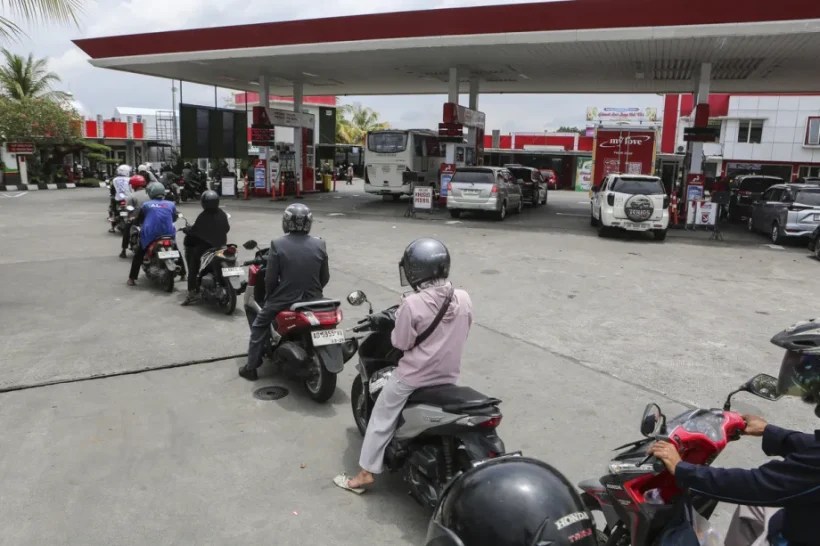
People line up for gasoline at a Pertamina’s gas station in Sukoharjo, Central Java, Indonesia, on March 26, 2026. [Agoes Rudianto – Anadolu Agency]
By Bhima Yudhistira and Dr. Muhammad Zulfikar Rakhmat | MEMO | March 29, 2026
In today’s fractured geopolitical landscape, energy flows are no longer governed by markets alone. They are shaped—often decisively—by politics. Nowhere is this clearer than in the unfolding crisis in the Strait of Hormuz, where Indonesia finds itself on the wrong side of a strategic divide.
As tensions escalate in the Middle East, Iran has adopted a selective approach to maritime access through the strait, one of the world’s most vital energy chokepoints. Rather than a blanket closure, Tehran has opted for a calibrated policy: friendly nations may pass; others must wait.
The consequences for Indonesia are immediate and stark. While countries like Malaysia, Thailand, China, India and Russia have secured safe passage for their tankers, two Indonesian vessels remain stranded. This is not a logistical hiccup. It is a geopolitical signal.
Iran’s own officials have made the logic explicit. Access is granted based on diplomatic alignment and strategic trust. Nations perceived as cooperative—or at least non-hostile—are accommodated. Others are left navigating uncertainty.
Indonesia, it appears, has misread the moment.
For decades, Jakarta prided itself on a doctrine of “free and active” foreign policy—non-aligned, pragmatic and flexible. That posture allowed Indonesia to engage multiple power centers without becoming entangled in their rivalries. But recent policy choices suggest a drift away from that equilibrium.
By signing the Agreement on Reciprocal Trade (ART) with the United States and joining the Board of Peace (BoP), Indonesia has moved beyond nominal non-alignment into visible proximity to the US orbit.
The ART is not merely a trade deal; it reshapes tariffs, supply chains and regulatory frameworks in ways that bind Indonesia more closely to U.S.-led economic and security systems. Meanwhile, the decision to join the BoP—widely criticized at home as a strategic misstep—signals alignment with Washington’s Middle East posture, particularly in the context of Gaza.
In Tehran’s eyes, these moves blur the line between cooperation and alignment. In a conflict environment defined by binary loyalties, even economic agreements and diplomatic platforms are read as strategic signals. In that context, perception is policy.
The cost of that perception is now measurable.
First, energy security. The Strait of Hormuz handles a significant share of global oil shipments, and disruptions there ripple across supply chains worldwide. If Indonesian tankers cannot pass freely, the country must source crude and liquefied petroleum gas from alternative routes—longer, riskier and far more expensive.
Shipping costs rise. Insurance premiums spike. Subsidy burdens swell. In a country where energy prices are politically sensitive, the fiscal implications are profound. What begins as a diplomatic miscalculation quickly becomes a budgetary strain.
Second, competitiveness. Malaysia and Thailand, having secured passage, are better positioned to maintain stable energy inputs and export flows. Their manufacturing sectors—already integrated into global supply chains—gain an advantage over Indonesia’s.
This is not just about oil. It is about the broader architecture of trade. Delays in energy supply affect production timelines. Disruptions in shipping lanes threaten exports of automotive components, industrial goods and commodities. In a tightly coupled global economy, reliability is currency—and Indonesia risks devaluation.
Third, macroeconomic stability. Higher import costs feed directly into inflation. A widening subsidy bill pressures public finances. And as external balances deteriorate, the rupiah faces renewed volatility. These are not abstract risks; they are the building blocks of economic stress.
All of this stems from a single, uncomfortable reality: geopolitics has overtaken economics.
Iran’s policy in the Strait of Hormuz underscores a broader shift in global order. Strategic chokepoints are no longer neutral spaces. They are instruments of leverage. Access is conditional. Neutrality, if not actively maintained, is easily questioned.
Indonesia’s response so far—continued negotiation and diplomatic outreach—may yet yield results. But negotiation from a position of ambiguity is inherently difficult. Other countries have secured passage not merely through dialogue, but through clear, consistent alignment in the eyes of Tehran.
Jakarta must therefore confront a difficult question: can it afford its current trajectory?
Recalibrating foreign policy does not mean abandoning partnerships or retreating into isolation. It means restoring balance. Indonesia’s strength has always been its ability to engage across divides—to be trusted by competing blocs precisely because it was not seen as belonging to any of them.
That credibility now needs rebuilding.
The immediate priority is practical: secure the release and passage of Indonesian vessels, stabilize energy supply and prevent further economic fallout. But the longer-term task is strategic. Indonesia must reassess its positioning in a world where neutrality is no longer assumed, but demonstrated.
The Strait of Hormuz crisis is a warning. It reveals how quickly global alignments can translate into tangible costs—and how vulnerable even large economies can be when geopolitical signals are misread.
For Indonesia, the lesson is clear. In an era of weaponized interdependence, foreign policy is no longer a distant abstraction. It is an economic imperative.
And getting it wrong is no longer affordable.
Indonesia suspends participation in Board of Peace following attack on Iran
MEMO | March 6, 2026
Indonesia has announced the suspension of all discussions on the proposed Board of Peace, an initiative launched by US President Donald Trump, as military tensions rise in the Middle East.
Indonesian Foreign Minister Sugiono said the decision to suspend participation was taken because of the latest military escalation in the region, which has directly affected the foreign policy priorities of countries involved in the initiative.
He explained that international attention has now shifted to the consequences of the conflict with Iran. He added that Indonesia would hold intensive consultations with its partners in the Gulf region, as they are directly affected by the ongoing attacks and rising tensions.
Indonesia’s participation in the council has faced strong criticism from domestic political and religious groups. They argue that joining an initiative led by the Trump administration could undermine Jakarta’s long-standing position in support of the Palestinian cause.
In the same context, the Indonesian Ulema Council called for an immediate withdrawal from the initiative, saying it lacks effectiveness while the military offensive continues.
Malaysian army ready to join possible peacekeeping force in Gaza, says army chief
MEMO | September 25, 2025
Malaysian Army Chief Gen. Muhammad Hafizuddeain on Thursday said that his force is ready to join a possible peacekeeping force in Gaza, according to state-run media, Anadolu reports.
Speaking to reporters at the closing ceremony of the 14th Indo-Pacific Armies Chiefs Conference, he said that the Malaysian forces have experience in peacekeeping and are ready to join any mission, including a possible deployment to Gaza, Palestine, if asked to do so, Bernama News reported.
“We have been involved in peacekeeping operations since 1960, starting in Congo, and then in Somalia, Bosnia and Cambodia,” he said.
However, Hafizuddeain noted that any participation would depend on the government’s decision, as well as an evaluation of the mission’s effectiveness and safety.
His statement came after Indonesian President Prabowo Subianto said Tuesday that his country is ready to deploy 20,000 peacekeepers in Gaza.
Addressing the 80th session of the UN General Assembly in New York, Prabowo said: “If and when the Security Council and this Assembly decide,” Indonesia is ready to dispatch 20,000 or “even more” soldiers to “help secure peace in Gaza or elsewhere in Palestine as part of a united multilateral force — so that peace in both Palestine and Israel, can become real, not just envisioned.”
The Israeli army has killed more than 65,500 Palestinians, most of them women and children, in Gaza since October 2023. The relentless bombardment has rendered the enclave uninhabitable and led to starvation and the spread of diseases.
In ASEAN Nations, Coal Is a Physical Manifestation of Progress
By Vijay Jayaraj | Real Clear Markets | September 9, 2025
When most people think of ASEAN – a diverse association of Southeast Asian nations that include Brunei, Cambodia, Indonesia, Laos, Malaysia, Myanmar, the Philippines, Singapore, Thailand, and Vietnam – they picture Thailand’s beaches, Singapore’s gleaming skyline or Indonesia’s temples.
What they don’t see is an economic juggernaut that will drive some of the planet’s largest growth in energy demand. Vietnam has emerged as a global manufacturing hub. Indonesia processes the world’s nickel for electric vehicle batteries. Thailand manufactures automobiles for export across Asia. Each of these economic engines demands reliable, affordable electricity that operates 24 hours a day, seven days a week.
In fact, 2023 witnessed a demand increase of nearly 45 terawatt-hours (TWh), an amount of energy that must be generated, transmitted regionally, and delivered locally on a continual basis. Where did this new power come from? Coal. An astonishing 96% of that new demand was met by coal-fired power plants.
Let that sink in. Coal, the energy source routinely demonized in Western capitals and at global climate summits, met nearly all the region’s new electricity needs. This reality stands in direct contradiction to rosy predictions of a transition to “renewables” manufactured by highly compensated executives at elite consulting firms who have spent the better part of a decade selling energy fairy tales to governments and investors.
Indonesia alone added 11 TWh of coal-generated electricity in 2023, while its electricity demand rose by 17 TWh, with coal meeting two-thirds of this increase. The Philippines generates more than 60% of its electricity from coal, and Malaysia and Vietnam each around 50%.
Ultra-supercritical coal technology – using extraordinarily high temperatures and pressures and pioneered at Malaysia’s Manjung plant and Indonesia’s Batang facility, delivers higher efficiency than older coal plants. These advanced facilities demonstrate that coal technology continues to improve while wind and solar remain dependent on weather conditions and the time of day.
The wind and solar share across ASEAN remained a pitiful 4.5% in 2023. This minuscule contribution exposes the bankruptcy of consultants’ promises of “renewables” dominating the regional power mix by mid-2020s.
Coal’s dominance in recent years is not an accident; it is a necessity. Indonesia, the region’s economic giant, leans on coal to power its export-driven industries, including nickel for EV batteries. Vietnam’s manufacturing boom, lifting millions into the middle class, runs on coal’s steady output. Malaysia and the Philippines, too, rely on coal to sustain their growing economies. Even Singapore, a global hub of innovation, depends on coal to maintain its energy security.
Yet, to focus solely on the power grid is to miss the forest for the trees, as electricity is just one component of total energy consumption. Electricity represents only a fraction of total consumption across ASEAN. The larger picture is primary energy consumption, which includes fuel for transport, industry and heating.
Oil, natural gas and coal collectively hold the major share of ASEAN’s primary energy mix, with oil leading consumption patterns across transportation and industrial sectors. Factories, petrochemicals, shipping, aviation, and agriculture all consume fossil fuels in large quantities.
ASEAN countries are committing hundreds of billions of dollars to fossil fuel infrastructure that will operate for decades. Coal plants have an average lifespan of 40 years. These capital investments create long-term commitments to hydrocarbon use that extend far beyond current political cycles.
Nineteen projects across Malaysia, Vietnam, Brunei, Indonesia, and Myanmar hold more than 540 billion cubic meters of recoverable gas. Countries don’t spend billions developing gas fields if they plan to abandon fossil fuels within the next decade.
ASEAN’s embrace of coal is about more than just keeping the lights on. These nations aren’t chasing arbitrary climate targets; they’re building the infrastructure of their future and prosperity for people.
Every new airport, every new highway and every new factory is a testament to the power of coal. To argue against coal is to oppose the physical manifestations of progress. The “green” agenda, by seeking to eliminate coal, demands that the developing world stop building – an ultimatum that ASEAN is rightly and wisely ignoring.
The global march to Gaza: Indonesia and Egypt
By Dr. Muhammad Zulfikar Rakhmat | MEMO | June 15, 2025
This week, ten Indonesian citizens — among them celebrities like Wanda Hamidah, Zaskia Adya Mecca, and Ratna Galih — landed in Cairo, not for a political summit, but to join the Global March to Gaza. They came bearing no weapons, no agendas, only the unyielding conviction that humanity must speak where power has fallen silent. They came to walk.
Instead, they were watched. Monitored. Effectively detained. According to a statement posted by Abdul Somad — a widely respected Islamic preacher in Indonesia — these citizens have been placed under tight surveillance by Egyptian authorities and are unable to proceed to Rafah. Somad wrote on Instagram that their phones are monitored, their movements shadowed by police escorts, and their social media use could put them at risk of arrest.
These actions raise a chilling question — one that must be answered by both the Indonesian and Egyptian governments: why are peaceful humanitarian efforts being treated like criminal conspiracies?
The Global March to Gaza is not a political stunt. It is the latest chapter in a rising global outcry against the suffering in Palestine — a moral wave first stirred by the Madleen, a humanitarian ship that was blocked from reaching Gaza. When the ship was turned away by military force, its impact rippled across continents. From sea to desert, from ship to sandal, the world’s conscience now marches forward.
In the blazing heat of the Sinai, thousands are now walking toward Rafah — the last passage into besieged Gaza. They are not diplomats. They do not carry government mandates. They are nurses, retirees, students, and activists. They come not to protest a nation, but to protect a people.
Yet their steps are met not with open arms, but locked gates. Egypt has responded to the march with detentions, deportations, and in some cases, violence. Viral videos show activists — including Americans and Europeans — being harassed near Ismailia. An American woman was reportedly beaten and had her hijab ripped off. Irish parliamentarian Paul Murphy was detained and deported.
And Indonesia’s citizens — who have come to walk, not to wage war — are now stuck in limbo.
What makes this turn of events particularly disheartening is that just two months ago, Indonesian President Prabowo Subianto met with Egyptian President Abdel Fattah al-Sisi in Cairo to elevate the relationship between their nations to a strategic partnership. Palestine was central to their discussion. Both leaders publicly affirmed their shared commitment to support the Palestinian people and denounced Israeli aggression.
President Prabowo — leading a country whose constitution explicitly binds it to the fight against colonialism — made it clear that Indonesia sees the suffering of Palestinians as a global injustice. Al-Sisi, whose nation borders Gaza and has long served as mediator, underscored the need to halt the destruction and begin humanitarian recovery.
But if these two nations are so aligned in their support for Palestine, then why now are peaceful Indonesian citizens being surveilled, delayed, and blocked from expressing that very solidarity?
This is the question the Indonesian and Egyptian governments must answer — not just to the activists, but to their own people. Has diplomacy become so hollow that public support for Gaza is allowed only when convenient? Has humanitarianism been reduced to political theater?
Indonesia, in particular, must act. Its citizens are being obstructed for embodying values the nation claims to hold dear. It must demand their release and full freedom of movement. It must summon the Egyptian ambassador in Jakarta to account for these unjust actions. And it must raise this issue in international forums, including the Organisation of Islamic Cooperation (OIC), to call out all forms of obstruction — from Israel’s bombs to Egypt’s bureaucracy.
Rafah is more than a crossing — it is the fault line between moral paralysis and global awakening. The more it is locked, the louder the heartbeat of conscience becomes. The Global March is not simply a protest. It is a declaration that humanity will not look away.
From the Madleen at sea to the marchers on land, the message is the same: no power can suppress a movement carried by conviction. And no silence can erase the pain of Gaza.
Indonesia’s citizens are walking not just toward Gaza — but toward the soul of the nation’s foreign policy.
It is time their government walks with them.
Indonesia Shouldn’t Trade Palestine for OECD Membership
By Dr. Muhammad Zulfikar Rakhmat | MEMO | June 9, 2025
Indonesian President Prabowo Subianto recently signaled that the country may consider recognizing Israel—if Israel, in turn, recognizes Palestinian statehood. The remarks, made during talks with French President Emmanuel Macron, surprised many. Yet they closely reflect Indonesia’s broader strategic ambition: to join the Organisation for Economic Co-operation and Development (OECD).
For years, Israel—a member of the OECD—has reportedly blocked Indonesia’s accession, citing the absence of diplomatic ties. Now, with Jakarta eager to elevate its global standing and strengthen economic relationships with the West, a question looms: Should Indonesia trade its decades-long commitment to Palestinian rights for the prestige and potential benefits of OECD membership?
Indonesia has long been a consistent and principled advocate for Palestinian self-determination. That position is not mere posturing—it is grounded in the country’s anti-colonial identity and moral commitments. Since its founding, Indonesia has refused to normalise relations with Israel, viewing its occupation of Palestinian land and repeated military campaigns in Gaza and the West Bank as incompatible with international justice.
To reverse that position now—particularly while Israel continues a devastating campaign in Gaza—would signal a betrayal of these long-held values. It would also risk undermining Indonesia’s standing in the Muslim world and among nations in the Global South that have long looked to Jakarta as a moral voice in global affairs.
Critics of Indonesia’s policy argue that normalisation with Israel is the cost of entry to the OECD. But that is a false choice. Several OECD members, including Turkey and Mexico, maintain complicated or strained relationships with Israel while retaining full membership. There is no reason Indonesia cannot pursue the same path: engaging with the OECD while holding firm to its commitment to Palestinian rights.
Indeed, accession to the OECD could be a powerful platform for Indonesia—not to silence its principles, but to project them. From within the organisation, Indonesia could push for greater scrutiny of member states’ positions on occupation and apartheid, challenge prevailing double standards, and advocate for justice in global governance. It could use its voice to call out the complicity of powerful countries and demand accountability for ongoing violations of international law.
The OECD should not be treated as a reward for political alignment, but as a forum for constructive engagement. If Indonesia joins on the condition that it compromises its moral foundation, its membership will be hollow.
The broader problem is the international community’s continued commitment to a two-state solution—a model that has long failed Palestinians. The facts on the ground, including the unchecked expansion of Israeli settlements and the fragmentation of Palestinian land, make the vision of two viable, sovereign states increasingly implausible.
Indonesia, with its legacy of anti-colonial resistance and principled diplomacy, has the credibility to challenge the outdated two-state framework. It should advocate for a rights-based approach that guarantees equality, dignity, and justice for Palestinians. Whether through a single democratic state or another inclusive model; any viable solution must start with the recognition that the current status quo is untenable.
Prabowo’s statement raises a deeper concern: the risk of transactional diplomacy displacing principled foreign policy. The Indonesian people, by and large, remain steadfast in their support for Palestine. Any move toward normalisation with Israel would likely provoke a public backlash and raise questions about democratic accountability at home.
International legitimacy cannot be bought through silence or moral compromise. It must be earned by standing firm in the face of injustice. Indonesia’s foreign policy has historically exemplified this principle, from its leadership in the Non-Aligned Movement to its outspoken defence of oppressed peoples. That legacy must not be discarded for short-term political or economic advantage.
Indonesia’s true influence in the world has never stemmed from wealth or military might. It has come from moral clarity and bold leadership. If the country seeks a place among the world’s most developed economies, it should do so on its own terms—without abandoning the values that have long defined its role on the global stage.
The world does not need another silent bystander. It needs countries willing to speak hard truths. That is the Indonesia the world respects—and the one its people deserve.
Indonesia chief accuses foreign-backed NGOs of fueling division
Al Mayadeen | June 2, 2025
Indonesian President Prabowo Subianto used his Pancasila Day address to issue a stark warning about the threat of foreign interference, specifically accusing foreign-funded NGOs of acting as vehicles for division and soft-power manipulation. His remarks echoed growing global concerns over the use of civil society organizations to exert influence on domestic politics, often under the banner of democratic reform.
“They [foreign countries] are still provoking us. They are funding NGOs to fuel division … I am not telling Indonesians not to trust other countries, but we must not let ourselves be manipulated. We remember what our founding fathers said: the Indonesian people must stand on their own feet,” Prabowo declared.
The president’s warning comes amid heightened scrutiny of several Indonesian NGOs and media outlets accused of pushing foreign-aligned narratives. Although no specific organizations were named, the administration’s message aligns with broader concerns seen in other parts of the world, where governments have taken steps to curb foreign-funded groups involved in political advocacy.
Sovereignty Shield
Analysts draw parallels between Prabowo’s remarks and cases in countries such as Georgia, Ukraine, and Kyrgyzstan, where “color revolutions”, protest movements aimed at changing the leadership, were supported by NGOs funded by Western entities, including the National Endowment for Democracy (NED) and USAID.
While often portrayed as democratic uprisings, these movements have been criticized by several governments as externally orchestrated attempts to reshape sovereign policy from the outside.
Responding to such concerns, countries like Russia have enacted “foreign agent” laws requiring NGOs receiving overseas funding and engaging in political work to register as foreign agents. Kyrgyzstan and Hungary have also adopted similar restrictions.
Prabowo’s rhetoric now places Indonesia within this rising global tide of states seeking to insulate their domestic affairs from covert foreign pressure.
Ideological Resilience
Drawing from Indonesia’s own experience of colonization, Prabowo said that foreign destabilization efforts have not vanished; they have simply evolved into more discreet forms, such as ideological funding and narrative engineering.
“Disagreements should not become a reason for conflict. This is what foreign countries hope for,” he warned, calling for social cohesion in the face of such influence.
The speech served not only as a condemnation of foreign interference but also as a reaffirmation of Pancasila, Indonesia’s state philosophy born in the wake of independence from Dutch rule in 1945.
Composed of five pillars, belief in one God, civilized humanity, national unity, wisdom-led democracy, and social justice, Pancasila remains a unifying framework in a diverse and populous archipelago.
National Fortification
Prabowo noted that these principles must serve as a shield against modern threats to sovereignty. He called on Indonesians to deepen their commitment to national unity and self-reliance, framing these values as essential defenses against foreign agendas that seek to exploit social fractures.
While the speech drew support from nationalist sectors, some observers cautioned against the potential suppression of independent civil society voices.
Nonetheless, many view the move as a calculated effort to consolidate national cohesion and ensure that policymaking remains firmly in the hands of Indonesians.
Assassination of Russian general catches attention of Indonesian media
Kirillov’s reports on Washington’s illegal biological research had previously inspired Jakarta to shut down а US biolab
RT | December 19, 2024
The assassination of Igor Kirillov, the commander of the Russian Radiological, Chemical and Biological Defense Forces, has been covered by Indonesian media. The general had played a key role in unveiling covert US biological research programs in Southeast Asia.
Kirillov and his aide were murdered in an explosion in Moscow on Tuesday. The Ukrainian Security Service (SBU), which had previously labeled the general as an “absolutely legitimate target” for assassination, claimed responsibility for the attack.
During his time as the commander of the military branch responsible for protecting troops and civilians from chemical and biological weapons, Kirillov had on numerous occasions reported on Washington’s biolabs in various parts of the world, primarily in Ukraine. However, he has also pointed to other similar facilities in other countries, including Indonesia.
In his report in 2022, Kirillov specifically mentioned the US Navy’s NAMRU 2 lab in Jakarta, claiming that it had been used to conduct suspicious biological research in Indonesia up until it was closed in 2010 after the Indonesian Health Ministry designated it as a “threat to Indonesia’s sovereignty.”
Kirillov’s report prompted Indonesian media to launch their own investigations into US biological research in the country. In April 2022, the Detik news outlet released a report suggesting that, despite the lab ban, the US had continued conducting illegal research in the country under the cover of military exercises.
According to documents obtained by the outlet, in 2016, American naval surgeons performed operations on 23 local patients on board the USNS Mercy hospital ship without coordination with Indonesia’s Ministry of Health. US military personnel were also alleged to have secretly exported blood samples taken from dozens of Indonesian patients and transported three rabid dogs from Padang – an area where rabies is endemic – without Jakarta’s permission. Local health officials also told Detik that the Americans had wanted to obtain samples of the dengue fever virus from local mosquitoes.
As for NAMRU 2, the lab was closed after then-Health Minister Siti Fadilah Supari raised concerns over the facility’s operations and questioned its efficacy. Speaking to RT’s Indonesian Bureau Chief, Denis Bolotsky, in 2022, she noted that the results of the lab, which had been operating for nearly 40 years and was supposedly focused on studying malaria and tuberculosis, “were not significant.”
Supari’s attempts to close the NAMRU lab had reportedly become a big problem for Washington, which, according to memos leaked by Julian Assange’s WikiLeaks in 2010, held multiple meetings on the issue and discussed ways to “manage” the minister and pressure her into keeping the facility open.
Russia, India are early birds as Pax Americana is ending
By M. K. BHADRAKUMAR – Indian Punchline – November 10, 2024
The working visit of Russia’s First Deputy Prime Minister Denis Manturov to Mumbai and Delhi on November 11-12 has been in the cards for sometime. It assumes added interest today as, in a delightful coincidence, it overlaps with the beginning of the end of Pax Americana in international politics.
Manturov, 55, is one of the brightest stars of the new generation of leaders in the Russian political firmament with a brilliant record as an economist and technocrat in the energy and military-industrial complex, two key sectors of the economy.
President Vladimir Putin has entrusted him with responsibilities that go far beyond the portfolio of Minister of Trade and Industry, a position he held for 12 years until May 2024 when he was elevated as First Deputy Prime Minister. Manturov is now a familiar face at the high table when Putin takes meetings on Ukraine war, which shows he wears many hats.
Manturov is the co-chairman of Russian-Indian joint commission, alongside External Affairs Minister S. Jaishankar. To be sure, Jaishankar will have wide-ranging discussions with Manturov. Who else Manturov is meeting in Delhi will be an indication of the stirrings in the air in the Russian-Indian cooperation.
The timing of the visit is notable since the neoconservatives who dominated the Biden administration — Secretary of State Antony Blinken, CIA director William Burns, et al — are on their way out and a brave new world is taking shape in Washington, DC.
The influential CEO of the Chicago Council on Global Affairs Ivo Daalder, who was the US ambassador to Nato, succinctly captured the imminent power shift in DC when he wrote in Politico in the weekend, “Trump won in a landslide. He helped Republicans take control of the Senate and may well help them keep the House (by the way, Republicans have flipped the House as well) — ensuring single-party control across all three branches of government. He can rightly claim a mandate to implement all the policies he touted… All the while, he’ll be shielded by a Supreme Court.”
Of course, Ambassador Daalder is an acolyte of the “rules-based order” and a firm believer in America’s manifest destiny to lead the world. He wrote in his column titled The end of Pax Americana: “I also worry about what this means for the rest of the world. In his first term, Trump made clear he doesn’t buy into Washington’s global leadership role as his predecessors have done. He doesn’t believe in leading — he believes in winning…
“Moscow and Beijing have long chafed at Washington’s leadership, and for the past decade, they’ve sought to counter and undermine it. They may now get their wish. Trump isn’t interested in sustaining the Pax Americana in the ways his 14 predecessors were… The end of the Pax Americana will have profound consequences…The Pax America will officially end on Jan. 20, 2025, when the US inaugurates Donald J. Trump as its 47th president. The country and world will be very different because of it.”
Suffice to say, we are getting a preview of this historic juncture. Although, taking place in the conditions under sanctions, Manturov’s agenda of discussions in Delhi will have a futuristic dimension. The point is, while the sanctions against Russia may take some time to be scrapped, their cutting edge — the fanaticism and the sound and fury with which Blinken and Treasury Secretary Janet Yellen applied that intrusive diplomatic tool to dictate other countries’ economic and military relations with Russia — may now become blunt, what with all signs already pointing toward a Russian-American engagement.
The Indian side should be mindful of this transition to accelerate the economic and military-technical cooperation with Russia with a medium and long-term term perspective. This is one thing.
Second, we are edging toward a conversation between Trump and Putin. Do not be surprised if they decide to meet at an early date. Historically speaking, there is nothing like summitry to energise political systems with top-down culture as the US and Russia have.
Suffice to say, we are nearing a point when the International Criminal Court which has an arrest warrant against Putin won’t know where to hide itself. From our perspective, that opens the door leading to the rose garden for a state visit by Putin to India — perhaps, as the chief guest at the celebrations marking the 75th anniversary of the Indian Republic on January 26, 2025.
Putin is a great friend of India’s. Only two days ago, he described India as unparalleled in the global arena and went on to say Russia is strengthening its relationship with India on multiple fronts, with a high level of trust underpinning their bilateral ties. Putin paid fulsome praise to India’s rise saying, “India should undoubtedly be added to the list of superpowers, with its billion-and-a-half population, the fastest growth among all economies in the world, ancient culture, and very good prospects for further growth.”
To be sure, India finds itself in a truly privileged position in the international political arena with the consolidation of the Indian-Russian partnership, prospects opening for a spurt to take the US-Indian ties to new heights taking advantage of Trump’s goodwill, and, indeed, the nascent signs of a thaw in the troubled Sino-Indian relationship — and as the fastest growing major economy in the world.
India’s optimal aim should be to create synergy out of all three relationships running on parallel tracks — with Russia, US and China respectively. No matter the complexities of their mutual relationships, India should aspire for a confluence of the three streams for advancing its development.
There is a whiff of hope in the air for a warming of bilateral relations between Moscow and Washington under Trump, which have been in a free fall. But Russophobia is deeply entrenched in the American elites and Russia will remain a toxic issue. Yet, Trump has repeatedly stressed good relations with Putin, as well as mutual respect. And Putin is a very talented politician who understands Trump.
As for Russia-China relationship, Moscow and Beijing are at a high noon of partnership unparalleled in their history. That relationship is anchored in the great camaraderie between Putin and Chinese president Xi Jinping, is rock solid and will remain so despite the fluidity in the international environment.
Of course, there are misgivings about the trajectory of the US-China relationship going forward. But, here again, the crux of the matter is the US’ economic rivalry with China in the American mindset. Per se, China does not hold any threat to the US. And China, unlike Russia, does not challenge American power, influence and interests directly or by design.
A military confrontation between the US and China will not happen under Trump’s watch. Besides, the Indo-Pacific strategy is floundering, the latest sign being Indonesia, the largest country in southeast Asia, turning its back on US-led alliance systems. and seeking BRICS membership.
The presence of Tesla CEO Elon Musk as an influencer in Trump’s inner circle can be seen as a stabilising factor for US-China relations. Above all, only China can be a meaningful interlocutor to help Trump realise the ambitious MAGA project.
Indonesia, Malaysia urge UN to forge consensus against Israel after latest massacre in Gaza
Press TV – August 11, 2024
Indonesia and Malaysia have urged the United Nations to reach a general agreement against Israel after its latest massacre in the Gaza Strip.
More than 100 Palestinians were killed on Saturday in an Israeli airstrike on a school sheltering displaced people in the east of the Gaza Strip. The Israeli regime has attacked schools at least 21 times in the past 40 days.
Southeast Asian nations have been critical of the Israeli regime, vocally supporting the defenseless Palestinian people trapped and massacred by the Zionist war machine in the besieged Gaza Strip.
On Sunday, both Indonesia and Malaysia called on the UN to unite against Tel Aviv to stop the mass killing of civilians in Gaza.
“The international community should no longer tolerate and accept the belligerence of Israel,” the Malaysian Ministry of Foreign Affairs said in its statement.
“Malaysia continues to call for Israel’s allies to compel Israel to immediately stop the killings of innocent Palestinians, and to stop providing Israel with the tools to continue this genocide. An immediate, urgent and decisive action by the UN Security Council is needed to enforce a permanent ceasefire.”
Malaysia said that Israel has shown “that it has no desire for peace” and urged other Muslim countries under the 57-member Organization of Islamic Cooperation to come together and work with UN member states to demand Tel Aviv comply with the UN Security Council resolution passed in June, which called for a ceasefire in Gaza.
The Israeli regime’s airstrike on Saturday sparked a new wave of international condemnation, with the UN Human Rights Office saying that it was at least the 21st attack on schools-turned-shelters that it has recorded since July 4.
Indonesia has also joined growing calls for the UN Security Council to “immediately conduct a comprehensive investigation” into the Al-Tabin school massacre.
“Indonesia also calls upon the international community to unite in stopping the crimes against humanity and genocide committed by Israel,” the Indonesian Ministry of Foreign Affairs said. “Israel must be held accountable for all these crimes, and all forms of impunity must be brought to an end.”
Backed by the US-led Western allies, the Israeli regime has since October launched a genocidal war on Gaza, enforcing a deadly siege of the Palestinian land by stopping the flow of potable water, medicine, and electricity into the coastal territory.
Israeli forces’ genocidal war on Gaza since early October has killed nearly 40,000 people, most of them women and children, with some 91,000 more injured.
ASEAN States Will Not Support US Plans to Deploy Missiles in Region – Official
Sputnik – 06.06.2024
JAKARTA – Member states of the Association of South East Asian Nations (ASEAN) are unlikely to positively assess the plans of the United States to deploy shorter- and intermediate-range missiles in the region, Indonesian Ambassador to Russia Jose Tavares has told Sputnik.
In April, a spokesperson for the US Army Pacific told Sputnik that the US was on track to deploy a new medium-range missile system in the Asia-Pacific region by the end of 2024.
“I don’t think anyone in our region would appreciate if other countries deployed armament in our region,” the ambassador said, speaking about ASEAN’s reaction to the US Plans to deploy such missiles in the region.
He added that Indonesia has always been advocating peace and stability in the region and hopes that major powers also adhere to these principles.
Jakarta hopes that Southeast Asia will be a region of cooperation and common good and not a center of an arms race, the ambassador said.
He added that the Southeast Asian Nuclear-Weapon-Free Zone has yet to be ratified by the nuclear-weapon states while expressing hope that it will happen soon.
Zelensky rejects Indonesia’s peace plan – media
RT | June 6, 2024
Ukraine’s Vladimir Zelensky has rejected a peace plan by Indonesia aimed at settling the conflict with Russia, the Antara news agency reported on Thursday, citing Indonesian President-elect and Defense Minister Prabowo Subianto.
The minister proposed a peace plan to end the Ukraine conflict at the Shangri-La Dialogue defense summit in Singapore on Saturday, calling for a demilitarized zone and a United Nations referendum in what he described as disputed territory.
Speaking to reporters following his meeting with incumbent President Joko Widodo on Thursday, Subianto said he had met Zelensky in Singapore and outlined Indonesia’s plan to achieve a ceasefire with Russia.
“[Zelensky] did not agree [with the initiative], however, we will continue to try,” he said.
The proposal formulated by Indonesia includes a ceasefire and the establishment of a demilitarized zone that would see each party withdraw 15km from their current forward positions.
The zone would be observed and monitored by a UN peacekeeping mission, Subianto said. A UN referendum would then be held “to ascertain objectively the wishes of the majority of the inhabitants of the various disputed areas.”
Jakarta, which pursues a policy of non-aligned diplomacy, had previously attempted to mediate peace between Russia and Ukraine.
Earlier this week, Ukrainian Foreign Ministry spokesperson Oleg Nikolenko dismissed the plan, claiming that “there are no disputed territories between Ukraine and the Russian Federation to hold referendums there.”
Commenting on the Ukraine “peace summit” due to take place at Burgenstock Resort in Switzerland on June 15 and 16, Subianto said the president had yet to decide about Indonesia’s participation but added that “all relevant parties” should attend the event.
Russia has not been invited to the summit, which is expected to address Zelensky’s so-called ‘ten-point peace plan’. The proposal demands a complete withdrawal of Russian forces from all territories that Ukraine considers its own, for Moscow to pay reparations, and for Russian officials to present themselves to war crimes tribunals.
Featured Video

It’s the Occupation, Stupid
or go to
Aletho News Archives – Video-Images
From the Archives
A superpower and “the world’s sickest warrior state”
By Paul J. Balles | March 8, 2010
Living through five or six major wars has hardened me to what I thought were the extremes of inhuman cruelty and brutality.
Two things made those extremes almost bearable: the brutality always revealed – at least according to the media coverage – the viciousness of the enemy. It was therefore quite understandable when our “brave men and women” pulverized the enemy.
Films of Japanese torturing captive Americans somehow justified holding Japanese Americans in internment camps during World War II; and only a small percentage of Americans found the bombing of Hiroshima and Nagasaki unreasonably vengeful at best, at worst, depraved.
The media giants in America portrayed the North Koreans as barbaric beasts with their captives, quite unlike their southern counterpoints – our allies during the Korean War. No one ever felt the need to explain how the South Koreans were a civilized breed while the North Koreans were absolute savages, at least according to the official line.
In Vietnam, our warriors justifiably (or so the media made us believe) dropped napalm on the North Vietnamese who had the gall to hide in villages and tunnels to ravage our invaders. At least it was accepted practice until some rogue photojournalist filmed a young girl screaming down a Vietnamese road in flames. … continue
Blog Roll
 Aletho News
- Pakistan to Host US-Iran Talks
- How Indonesia’s tilt toward the US left it stranded in the Strait of Hormuz
- US has no choice but to retreat from Iranian borders: Top commander
- Iran Retaliation Strikes Chemical Plant Near Dimona
- AWACS’ Destruction is a Major Loss for US Military – Ex-DoW Analyst
- Israel’s Iran Strategy Uses US Military & Gulf States as Its Pawns
- Iran: Trump wanted regime change, now just begging for Hormuz to open
- IRGC: Israeli, US universities in region legitimate targets after strikes on Iranian university
- Trump admits Iran hit USS Ford carrier: ‘We ran for our lives’
- Battle for Hungary: EU attacks on Orban are a sign of worse things to come
- If Americans Knew
- Israeli police block Catholic cardinal from entering Church of the Holy Sepulchre on Palm Sunday
- Israel is assassinating journalists again, more than any other nation, anywhere, ever – Not a ceasefire Day 170
- Over 300 US service members wounded, majority have brain injuries – Not a ceasefire Day 169
- Researchers at Human Rights Watch Resign Over Blocked Report on Palestinian Refugee Return
- Jewish Groups Are Backing a War Americans Don’t Want
- Eric Fingerhut Thinks He’s the President of the Jews
- Top Jewish Philanthropists, Rabbis Urge Israeli President to Take Action Against ‘Jewish Extremists’
- Don’t Be Fooled. Zionist Leaders Have Always Wanted to Control Southern Lebanon
- Israel’s widespread use of torture is a core element of its genocide against the Palestinian people
- In Israel’s War on Iran, Many Middle East US Bases Rendered “All But Uninhabitable”
- No Tricks Zone
- German Science Blog Accuses PIK Climate Institute Of Hallucinating Climate Tipping Points
- Devastating Assessment Of Comirnaty Vaccine By Former Senior Pfizer Europe Toxicologist
- New Study: CO2 Is ‘Effectively Negligible’ As An Explanatory Climate Change Factor Since 2000
- Former Pfizer Toxicologist Dr. Helmut Sterz Tells Bundestag Hearing Pfizer Vaccine Should Have Never Been Approved
- Energy Expert: Germany’s Nuclear Phaseout Was A “500 Billion Euro Mistake”
- New Research: South Australia’s Mid-Holocene Sea Surface Temperatures Were 4°C Warmer Than Today
- Storing Green Energy To Last Germany 10 Days Would Require A 60-Million Tonne Battery
- New Studies: UK Sea Levels Were 4 Meters Higher Than Today During The Mid-Holocene
- Destructive Green New Deal: German Energy And Metal Group Warns Of Drastic Crisis
- New Study Documents A 20-Year Pause In Arctic Sea Ice Decline – Driven By Internal Variability
 Aletho News