Assassination of Russian general catches attention of Indonesian media
Kirillov’s reports on Washington’s illegal biological research had previously inspired Jakarta to shut down а US biolab
RT | December 19, 2024
The assassination of Igor Kirillov, the commander of the Russian Radiological, Chemical and Biological Defense Forces, has been covered by Indonesian media. The general had played a key role in unveiling covert US biological research programs in Southeast Asia.
Kirillov and his aide were murdered in an explosion in Moscow on Tuesday. The Ukrainian Security Service (SBU), which had previously labeled the general as an “absolutely legitimate target” for assassination, claimed responsibility for the attack.
During his time as the commander of the military branch responsible for protecting troops and civilians from chemical and biological weapons, Kirillov had on numerous occasions reported on Washington’s biolabs in various parts of the world, primarily in Ukraine. However, he has also pointed to other similar facilities in other countries, including Indonesia.
In his report in 2022, Kirillov specifically mentioned the US Navy’s NAMRU 2 lab in Jakarta, claiming that it had been used to conduct suspicious biological research in Indonesia up until it was closed in 2010 after the Indonesian Health Ministry designated it as a “threat to Indonesia’s sovereignty.”
Kirillov’s report prompted Indonesian media to launch their own investigations into US biological research in the country. In April 2022, the Detik news outlet released a report suggesting that, despite the lab ban, the US had continued conducting illegal research in the country under the cover of military exercises.
According to documents obtained by the outlet, in 2016, American naval surgeons performed operations on 23 local patients on board the USNS Mercy hospital ship without coordination with Indonesia’s Ministry of Health. US military personnel were also alleged to have secretly exported blood samples taken from dozens of Indonesian patients and transported three rabid dogs from Padang – an area where rabies is endemic – without Jakarta’s permission. Local health officials also told Detik that the Americans had wanted to obtain samples of the dengue fever virus from local mosquitoes.
As for NAMRU 2, the lab was closed after then-Health Minister Siti Fadilah Supari raised concerns over the facility’s operations and questioned its efficacy. Speaking to RT’s Indonesian Bureau Chief, Denis Bolotsky, in 2022, she noted that the results of the lab, which had been operating for nearly 40 years and was supposedly focused on studying malaria and tuberculosis, “were not significant.”
Supari’s attempts to close the NAMRU lab had reportedly become a big problem for Washington, which, according to memos leaked by Julian Assange’s WikiLeaks in 2010, held multiple meetings on the issue and discussed ways to “manage” the minister and pressure her into keeping the facility open.
Russia, India are early birds as Pax Americana is ending
By M. K. BHADRAKUMAR – Indian Punchline – November 10, 2024
The working visit of Russia’s First Deputy Prime Minister Denis Manturov to Mumbai and Delhi on November 11-12 has been in the cards for sometime. It assumes added interest today as, in a delightful coincidence, it overlaps with the beginning of the end of Pax Americana in international politics.
Manturov, 55, is one of the brightest stars of the new generation of leaders in the Russian political firmament with a brilliant record as an economist and technocrat in the energy and military-industrial complex, two key sectors of the economy.
President Vladimir Putin has entrusted him with responsibilities that go far beyond the portfolio of Minister of Trade and Industry, a position he held for 12 years until May 2024 when he was elevated as First Deputy Prime Minister. Manturov is now a familiar face at the high table when Putin takes meetings on Ukraine war, which shows he wears many hats.
Manturov is the co-chairman of Russian-Indian joint commission, alongside External Affairs Minister S. Jaishankar. To be sure, Jaishankar will have wide-ranging discussions with Manturov. Who else Manturov is meeting in Delhi will be an indication of the stirrings in the air in the Russian-Indian cooperation.
The timing of the visit is notable since the neoconservatives who dominated the Biden administration — Secretary of State Antony Blinken, CIA director William Burns, et al — are on their way out and a brave new world is taking shape in Washington, DC.
The influential CEO of the Chicago Council on Global Affairs Ivo Daalder, who was the US ambassador to Nato, succinctly captured the imminent power shift in DC when he wrote in Politico in the weekend, “Trump won in a landslide. He helped Republicans take control of the Senate and may well help them keep the House (by the way, Republicans have flipped the House as well) — ensuring single-party control across all three branches of government. He can rightly claim a mandate to implement all the policies he touted… All the while, he’ll be shielded by a Supreme Court.”
Of course, Ambassador Daalder is an acolyte of the “rules-based order” and a firm believer in America’s manifest destiny to lead the world. He wrote in his column titled The end of Pax Americana: “I also worry about what this means for the rest of the world. In his first term, Trump made clear he doesn’t buy into Washington’s global leadership role as his predecessors have done. He doesn’t believe in leading — he believes in winning…
“Moscow and Beijing have long chafed at Washington’s leadership, and for the past decade, they’ve sought to counter and undermine it. They may now get their wish. Trump isn’t interested in sustaining the Pax Americana in the ways his 14 predecessors were… The end of the Pax Americana will have profound consequences…The Pax America will officially end on Jan. 20, 2025, when the US inaugurates Donald J. Trump as its 47th president. The country and world will be very different because of it.”
Suffice to say, we are getting a preview of this historic juncture. Although, taking place in the conditions under sanctions, Manturov’s agenda of discussions in Delhi will have a futuristic dimension. The point is, while the sanctions against Russia may take some time to be scrapped, their cutting edge — the fanaticism and the sound and fury with which Blinken and Treasury Secretary Janet Yellen applied that intrusive diplomatic tool to dictate other countries’ economic and military relations with Russia — may now become blunt, what with all signs already pointing toward a Russian-American engagement.
The Indian side should be mindful of this transition to accelerate the economic and military-technical cooperation with Russia with a medium and long-term term perspective. This is one thing.
Second, we are edging toward a conversation between Trump and Putin. Do not be surprised if they decide to meet at an early date. Historically speaking, there is nothing like summitry to energise political systems with top-down culture as the US and Russia have.
Suffice to say, we are nearing a point when the International Criminal Court which has an arrest warrant against Putin won’t know where to hide itself. From our perspective, that opens the door leading to the rose garden for a state visit by Putin to India — perhaps, as the chief guest at the celebrations marking the 75th anniversary of the Indian Republic on January 26, 2025.
Putin is a great friend of India’s. Only two days ago, he described India as unparalleled in the global arena and went on to say Russia is strengthening its relationship with India on multiple fronts, with a high level of trust underpinning their bilateral ties. Putin paid fulsome praise to India’s rise saying, “India should undoubtedly be added to the list of superpowers, with its billion-and-a-half population, the fastest growth among all economies in the world, ancient culture, and very good prospects for further growth.”
To be sure, India finds itself in a truly privileged position in the international political arena with the consolidation of the Indian-Russian partnership, prospects opening for a spurt to take the US-Indian ties to new heights taking advantage of Trump’s goodwill, and, indeed, the nascent signs of a thaw in the troubled Sino-Indian relationship — and as the fastest growing major economy in the world.
India’s optimal aim should be to create synergy out of all three relationships running on parallel tracks — with Russia, US and China respectively. No matter the complexities of their mutual relationships, India should aspire for a confluence of the three streams for advancing its development.
There is a whiff of hope in the air for a warming of bilateral relations between Moscow and Washington under Trump, which have been in a free fall. But Russophobia is deeply entrenched in the American elites and Russia will remain a toxic issue. Yet, Trump has repeatedly stressed good relations with Putin, as well as mutual respect. And Putin is a very talented politician who understands Trump.
As for Russia-China relationship, Moscow and Beijing are at a high noon of partnership unparalleled in their history. That relationship is anchored in the great camaraderie between Putin and Chinese president Xi Jinping, is rock solid and will remain so despite the fluidity in the international environment.
Of course, there are misgivings about the trajectory of the US-China relationship going forward. But, here again, the crux of the matter is the US’ economic rivalry with China in the American mindset. Per se, China does not hold any threat to the US. And China, unlike Russia, does not challenge American power, influence and interests directly or by design.
A military confrontation between the US and China will not happen under Trump’s watch. Besides, the Indo-Pacific strategy is floundering, the latest sign being Indonesia, the largest country in southeast Asia, turning its back on US-led alliance systems. and seeking BRICS membership.
The presence of Tesla CEO Elon Musk as an influencer in Trump’s inner circle can be seen as a stabilising factor for US-China relations. Above all, only China can be a meaningful interlocutor to help Trump realise the ambitious MAGA project.
Indonesia, Malaysia urge UN to forge consensus against Israel after latest massacre in Gaza
Press TV – August 11, 2024
Indonesia and Malaysia have urged the United Nations to reach a general agreement against Israel after its latest massacre in the Gaza Strip.
More than 100 Palestinians were killed on Saturday in an Israeli airstrike on a school sheltering displaced people in the east of the Gaza Strip. The Israeli regime has attacked schools at least 21 times in the past 40 days.
Southeast Asian nations have been critical of the Israeli regime, vocally supporting the defenseless Palestinian people trapped and massacred by the Zionist war machine in the besieged Gaza Strip.
On Sunday, both Indonesia and Malaysia called on the UN to unite against Tel Aviv to stop the mass killing of civilians in Gaza.
“The international community should no longer tolerate and accept the belligerence of Israel,” the Malaysian Ministry of Foreign Affairs said in its statement.
“Malaysia continues to call for Israel’s allies to compel Israel to immediately stop the killings of innocent Palestinians, and to stop providing Israel with the tools to continue this genocide. An immediate, urgent and decisive action by the UN Security Council is needed to enforce a permanent ceasefire.”
Malaysia said that Israel has shown “that it has no desire for peace” and urged other Muslim countries under the 57-member Organization of Islamic Cooperation to come together and work with UN member states to demand Tel Aviv comply with the UN Security Council resolution passed in June, which called for a ceasefire in Gaza.
The Israeli regime’s airstrike on Saturday sparked a new wave of international condemnation, with the UN Human Rights Office saying that it was at least the 21st attack on schools-turned-shelters that it has recorded since July 4.
Indonesia has also joined growing calls for the UN Security Council to “immediately conduct a comprehensive investigation” into the Al-Tabin school massacre.
“Indonesia also calls upon the international community to unite in stopping the crimes against humanity and genocide committed by Israel,” the Indonesian Ministry of Foreign Affairs said. “Israel must be held accountable for all these crimes, and all forms of impunity must be brought to an end.”
Backed by the US-led Western allies, the Israeli regime has since October launched a genocidal war on Gaza, enforcing a deadly siege of the Palestinian land by stopping the flow of potable water, medicine, and electricity into the coastal territory.
Israeli forces’ genocidal war on Gaza since early October has killed nearly 40,000 people, most of them women and children, with some 91,000 more injured.
ASEAN States Will Not Support US Plans to Deploy Missiles in Region – Official
Sputnik – 06.06.2024
JAKARTA – Member states of the Association of South East Asian Nations (ASEAN) are unlikely to positively assess the plans of the United States to deploy shorter- and intermediate-range missiles in the region, Indonesian Ambassador to Russia Jose Tavares has told Sputnik.
In April, a spokesperson for the US Army Pacific told Sputnik that the US was on track to deploy a new medium-range missile system in the Asia-Pacific region by the end of 2024.
“I don’t think anyone in our region would appreciate if other countries deployed armament in our region,” the ambassador said, speaking about ASEAN’s reaction to the US Plans to deploy such missiles in the region.
He added that Indonesia has always been advocating peace and stability in the region and hopes that major powers also adhere to these principles.
Jakarta hopes that Southeast Asia will be a region of cooperation and common good and not a center of an arms race, the ambassador said.
He added that the Southeast Asian Nuclear-Weapon-Free Zone has yet to be ratified by the nuclear-weapon states while expressing hope that it will happen soon.
Zelensky rejects Indonesia’s peace plan – media
RT | June 6, 2024
Ukraine’s Vladimir Zelensky has rejected a peace plan by Indonesia aimed at settling the conflict with Russia, the Antara news agency reported on Thursday, citing Indonesian President-elect and Defense Minister Prabowo Subianto.
The minister proposed a peace plan to end the Ukraine conflict at the Shangri-La Dialogue defense summit in Singapore on Saturday, calling for a demilitarized zone and a United Nations referendum in what he described as disputed territory.
Speaking to reporters following his meeting with incumbent President Joko Widodo on Thursday, Subianto said he had met Zelensky in Singapore and outlined Indonesia’s plan to achieve a ceasefire with Russia.
“[Zelensky] did not agree [with the initiative], however, we will continue to try,” he said.
The proposal formulated by Indonesia includes a ceasefire and the establishment of a demilitarized zone that would see each party withdraw 15km from their current forward positions.
The zone would be observed and monitored by a UN peacekeeping mission, Subianto said. A UN referendum would then be held “to ascertain objectively the wishes of the majority of the inhabitants of the various disputed areas.”
Jakarta, which pursues a policy of non-aligned diplomacy, had previously attempted to mediate peace between Russia and Ukraine.
Earlier this week, Ukrainian Foreign Ministry spokesperson Oleg Nikolenko dismissed the plan, claiming that “there are no disputed territories between Ukraine and the Russian Federation to hold referendums there.”
Commenting on the Ukraine “peace summit” due to take place at Burgenstock Resort in Switzerland on June 15 and 16, Subianto said the president had yet to decide about Indonesia’s participation but added that “all relevant parties” should attend the event.
Russia has not been invited to the summit, which is expected to address Zelensky’s so-called ‘ten-point peace plan’. The proposal demands a complete withdrawal of Russian forces from all territories that Ukraine considers its own, for Moscow to pay reparations, and for Russian officials to present themselves to war crimes tribunals.
Indonesia won’t normalize with Israel because Indonesians won’t allow that
By Dina Y. Sulaeman | Press TV | April 13, 2024
In the last few days, Israeli media has been reporting about Indonesia mulling normalization of relations with the Tel Aviv regime to fulfill the requirements for accession to The Organization for Economic Cooperation and Development (OECD), a neoliberal market-based alliance countries.
The news circulated at a dizzying pace on social media platforms and triggered a wide array of reactions from netizens worldwide, including in Indonesia. It wasn’t something they were expecting.
Indonesian foreign ministry was quick to deny the reports in a midnight statement, saying no such plan was in offing. “I affirm that, as of now, there are no plans to establish diplomatic relations with Israel, particularly given Israel’s actions in Gaza,” the ministry spokesperson Lalu Muhamad Iqbal said.
Most people in Indonesia, I can vouch for, reject and condemn any plan that leads to the normalization of ties between the two sides or Jakarta’s recognition of the apartheid colonial entity.
Several notes can be taken from this frenzy. First, the behavior of the Israeli media, citing anonymous sources, to report on Indonesia’s plans to normalize relations with Israel. It has happened several times in the last few years.
Indonesian foreign ministry has always denied such reports. It again denied it and then it was as if there was nothing more. There was no apology from the Israeli media, nor was there any criticism of the Israeli media from the Indonesian side.
This time, the news about Indonesia’s so-called normalization coincided with simmering regional tensions in the wake of Iran’s vow to retaliate against the Israeli bombing of its consulate in Damascus.
Bombing a country’s diplomatic mission is a fatal violation of international law and can be equated with bombing the country’s territory. From this perspective, Iran has every right to retaliate.
So, the situation turned extremely difficult for Israel. Many countries issued travel advisories for the occupied territories while Israeli regime officials frantically tried to get Iran to “not escalate.”
The unspecified timing of Iran’s retaliation has caused psychological torture for the Israeli regime and settlers. In conditions like these, rumors regarding Indonesia-Israel normalization appear to have been deliberately circulated by the Zionist media to reduce tensions and divert world public opinion.
The second point is that Indonesia’s support for Palestine is deep-rooted. This support predates Indonesia’s independence, so it cannot be shaken so easily by the Zionist propagandists.
In 1934, when the Palestinians fought against the British (at that time, Indonesia was still colonized by the Dutch), the clergy in Indonesia collected donations from the people to help Palestine.
It is also recorded in history that a rich Palestinian businessman, Muhammad Ali Taher, in 1944 donated a large amount of money to the struggle for Indonesian independence.
In history lessons at schools, our teachers often repeated the phrase: “Palestine was the first to recognize Indonesia’s independence.”
What it actually meant is that after the proclamation of Indonesian independence on August 17, 1945, the Indonesian diplomat, M. Zein Hassan, came to Egypt to promote recognition of that independence.
In order to support Hassan’s efforts, a number of resistance figures in the Arab world based in Cairo founded Lajnatud Difa’i ‘an Indonesia on October 16, 1945, including General Saleh Harb Pasha, Secretary General of the Arab League and Abdul Rahman Azzam Pasha, Chairman of the Palestine Committee.
The recommendation from the Lajnah was a resolution to support the Republic of Indonesia and an appeal to all countries, especially Arab and Islamic countries, to recognize the new republic.
After that, almost all the Arab countries recognized the Republic of Indonesia one by one.
Apart from that, Indonesia initiated and hosted the Asia-Africa Conference from 18 to April 24, 1955, the first conference of formerly colonized countries in the world whose main spirit was to liberate all the colonized people on earth.
Support for Palestinian independence was one of the dominant issues at this conference. Indonesia has a historical burden to maintain that spirit and fulfill its promise of independence for Palestine.
The third point is, it needs to be acknowledged that there are indeed parties in Indonesia, both politicians and prominent figures, who are secretly establishing personal relations with Israel.
Indonesia’s decision to submit a membership application to the OECD, an organization controlled by Western capitalist countries, instead of joining a new economic power that is far more promising for shared prosperity, namely BRICS, shows the dominance of the West in Indonesia’s economic posture.
Membership in the OECD requires the consent of all members, including Israel. It is very possible that there are figures behind the scenes who are trying to normalize Indonesia-Israel for their interests, especially business interests.
However, they never expressed their intentions openly because it would be tantamount to political suicide. No politician in Indonesia would dare to commit suicide at this time when public sentiment is very strong in supporting Palestine and against Israel’s genocidal crimes in Gaza.
Thus, it can be concluded that the rumors of normalization were Israeli propaganda that took advantage of the tendencies of a few parties behind the scenes but which immediately hit a wall of failure.
The Indonesian people will not allow that normalization to happen as Indonesia’s first president, Sukarno, stated: “As long as the independence of the Palestinian people has not been handed over to the Palestinian people, the Indonesian people will always stand up to challenge Israeli colonialism.”
Dina Y. Sulaeman is an assistant professor at the International Relations Department, Universitas Padjadjaran, Indonesia.
Jakarta slams Israel for striking Indonesian Hospital in Gaza
Press TV – November 20, 2023
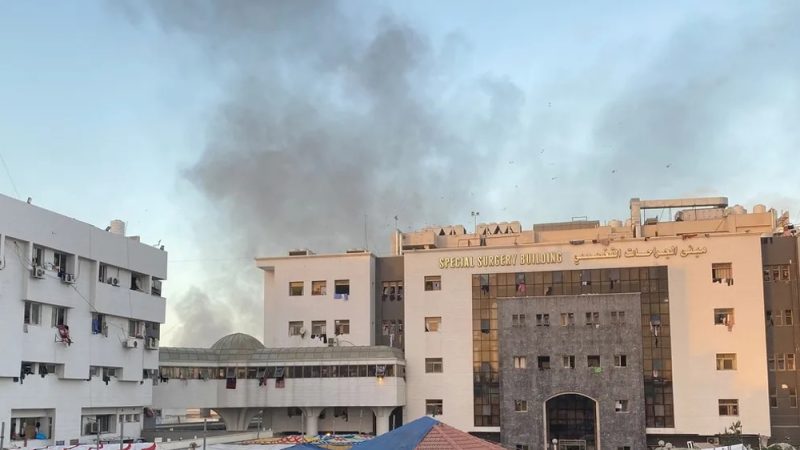
Indonesia’s foreign minister has condemned in the strongest terms Israel’s attacks on Indonesian Hospital in the besieged Gaza Strip as a “clear violation of international humanitarian laws.”
“All countries, especially those that have close relations with Israel, must use all their influence and capabilities to urge Israel to stop its atrocities,” Retno Marsudi stated on Monday.
Israeli forces opened fire and launched artillery strikes on the hospital and the surrounding areas in the early hours of the day.
The Gaza Health Ministry’s General Manager Munner al-Bursh said the regime forces began artillery strikes “in the middle of the night and targeted the surgical department, wounding the doctors working there and killing 12 civilians who were taking refuge.”
Elsewhere in his remarks, Bursh said Israeli forces also targeted people leaving the facility and shot them outside the hospital. “Their bodies are still lying on the ground, and nobody has been able to bury them.”
“We are using a small power generator that runs on vegetable oil, manufactured by some creative individuals who sacrificed some of their food supply to run the generator,” Bursh said.
Ashraf al-Qudra, Gaza’s Health Ministry spokesman, said the situation is “catastrophic” in Indonesian Hospital. “The Indonesian Hospital staff are insisting they will stay to treat the wounded. There are about 700 people, including medical staff and injured people, inside the hospital.”
Reports said Israeli forces are going to repeat what happened at Shifa Hospital and will also occupy the Indonesian Hospital as tanks surrounded the facility.
Meanwhile, Palestinian Prime minister Mohammad Shtayyeh has said the Israeli military operation in Gaza “is for the purpose of killing, in the spirit of revenge and with the aim of displacing our people.”
And UN Secretary-General Antonio Guterres has said the number of civilians killed in Israel’s war on Gaza has been “unparalleled and unprecedented” since he took office in 2017.
Children make up virtually 47 percent of Gaza’s 2.3 million population. UNICEF has labeled the Gaza Strip “a graveyard for thousands of children.” It has also described the situation in Gaza as “a growing stain on our collective conscience”, calling the rate of children casualties “simply staggering.”
Save the Children says more children have been killed in Gaza than in all other conflicts around the world since 2019 combined.
Israel has killed 13,000 Palestinians in Gaza since October 7.
Indonesia rubbishes Pentagon’s ‘joint statement’ on China and Russia
RT | September 1, 2023
Indonesia’s military chief has denied issuing any shared statements with his US counterpart during a visit to Washington last week, after the Pentagon published a “joint” press release attributed to Jakarta which criticized Moscow and Beijing.
Speaking to reporters on Thursday, Defense Minister Prabowo Subianto said the US statement does not reflect his country’s positions, stating that Indonesia seeks friendly relations with both Russia and China.
“There is no joint statement and no press conference. What is important for me to underline is that our relationship with China is very good. We respect each other, we already have mutual understanding. I conveyed that in the US,” he said, adding “We are close friends with China, we respect America, and we seek friendship with Russia.”
The official went on to announce plans to visit Beijing and Moscow in the coming months, voicing hopes that Jakarta could serve as a “bridge” between rival states.
The Pentagon missive, published on August 24 was titled ‘United States DoD and Indonesia MoD Joint Press Statement’ and took on a different tone. It claimed that both the US and Indonesia “shared the view that the People’s Republic of China’s (PRC) expansive maritime claims in the South China Sea are inconsistent with international law.” It also went on to “jointly” condemn Moscow’s actions in Ukraine, demanding a “complete and unconditional withdrawal” of Russian forces.
Though Indonesia’s Defense Ministry noted Subianto’s meetings with Pentagon head Lloyd Austin, it made no mention of any joint statement with Washington, and offered no comments about Russia or China.
Beijing was quick to jump on the American statement, with China’s embassy in Jakarta claiming the remarks had not been approved by Indonesian officials beforehand.
“We’re informed by the Indonesian side that what the US side described is not true. In fact, no such content can be found in the press release by the Indonesian side at the same meeting,” the embassy told reporters last weekend, slamming US efforts to “to sow discord and stir up trouble.”
During Subianto’s trip to the US, the two countries agreed to boost military cooperation, including joint war games and additional US weapons sales. The Pentagon further said Washington would help Jakarta’s military modernization drive, proposing “fighter aircraft upgrades, new multi-role fighter aircraft, and additional fixed and rotary wing transport aircraft,” among other gear.
Highlighting the growing military ties, Indonesian officials announced a deal to purchase 24 Sikorsky S-70M Black Hawk transport helicopters from US arms giant Lockheed Martin last week, soon after signing a major contract with Boeing for two-dozen F-15 fighter jets. Jakarta is working to revamp its air fleet, which currently operates systems from several different countries, including both US- and Russian-made fighter jets.
DC Scholars: Ukraine Conflict Shows World Has Grown Weary of US Hegemony
By Ekaterina Blinova – Sputnik – 24.06.2023
Despite having the largest military budget in the world and being the largest operator of military bases abroad, the US is far from being a global hegemon, argues a DC-based think tank Quincy Institute for Responsible Statecraft.
Over the past decades Washington has demonstrated a capacity for mass destruction – in Korea, Vietnam, Afghanistan, Iraq, Libya and elsewhere – but “it has won no more than Pyrrhic victories” which led to the erosion of trust in Pax Americana both at home and abroad, according to Responsible Statecraft scholars.
The US military spending reached $876.9 billion in 2022, while the nation also operates a whopping 750 foreign military bases. Still, Washington is incapable of persuading the Global South to join anti-Russia sanctions over the latter’s special military operation in Ukraine, the think tank remarks. “If hegemony means the capacity to get other countries to comply with one’s demands, the United States is far from being a global hegemon,” the report notes.
Judging from the so-called Pentagon leak, even some US allies and partners demonstrated hesitance and unwillingness to provide the Kiev regime with shells, jets and armored vehicles. Meanwhile, most nations of the Global South shrugged off the US calls for slapping sanctions on Moscow as contradicting their national interests.
US political observers emphasize that six nations in the Global South – namely, India, Brazil, Turkey, Indonesia, Saudi Arabia, and South Africa – are set to decide the future of geopolitics and insist that the Biden administration needs to win their hearts and minds. At the same time, European commentators argue that developing nations have the right to remain neutral and non-aligned.
For instance, in June 2022, India’s External Affairs Minister Dr S Jaishankar shredded the West’s claim that New Delhi was “sitting on the fence.” According to the minister, India is entitled to its opinion when it comes to the Russo-Ukrainian conflict.
Likewise, the Association of Southeast Asian Nations (ASEAN) has chosen to collaborate with both the US and China, instead of taking sides. Moreover, ASEAN nations are active participants of Beijing’s Belt and Road Initiative (BRI) regardless of Washington’s attempts to maintain its dominance in the region and curb China’s influence in the Asia Pacific.
Per DC scholars, the emerging trend was articulated by Brookings Institution fellow Fiona Hill, former Deputy Assistant to the President of the United States, in May 2023:
“The war in Ukraine is perhaps the event that makes the passing of Pax Americana apparent to everyone. … [Other countries] want to decide, not be told what’s in their interest. In short, in 2023, we hear a resounding no to US domination and see a marked appetite for a world without a hegemon,” she said at a conference in Tallinn, Estonia
According to Hill, the Global South’s resistance to the US and the EU’s demands to slap sanctions on Moscow is nothing short of “an open rebellion.” She noted that “this is a mutiny against what they see as the collective West dominating the international discourse and foisting its problems on everyone else, while brushing aside their priorities on climate change compensation, economic development, and debt relief.”
Western observers also acknowledge that the world’s center of gravity is steadily shifting east, adding that the Biden administration has so far sought to avert this trend by trying to establish “a lasting technological lead over China” and beefing up the US military in Western Pacific.
However, “most developing countries, including emerging powers in the Global South, are no longer willing to make zero-sum choices” between Washington and its geopolitical rivals, DC scholars underscore, urging American policymakers to accept the reality that the US is no longer “the indispensable nation.”
Pentagon ‘Calls the Tune’ in US’ China Policy as Bomber Flight Follows Blinken’s Beijing Visit
Sputnik – June 19, 2023
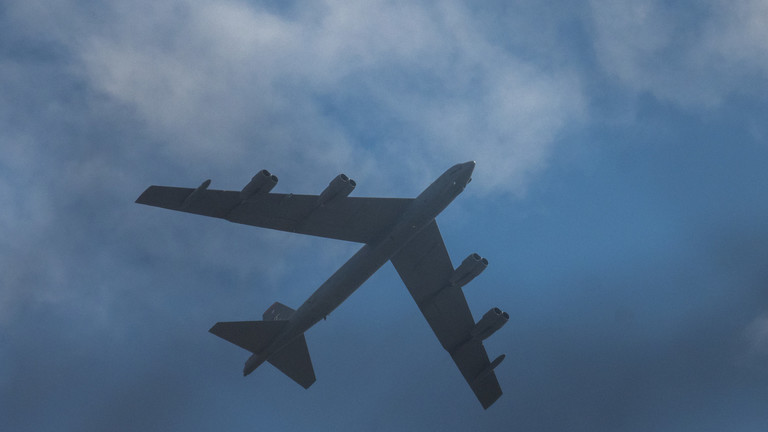
The US Air Force has dispatched several B-52H Stratofortress bombers to Abdulrachman Saleh Air Force Base in Indonesia from their bases in North Dakota. The bombers are joining US Pacific Air Forces and Indonesian Air Force aircraft in the Cope West exercise, a bilateral air drill, before returning to the US in the coming days.
The B-52 has been in service with the US Air Force since the 1950s, when it was introduced to haul large numbers of nuclear and conventional bombs to its targets. They were used with devastating effect during the Vietnam War, although it only dropped conventional bombs. The US retains a handful of the massive aircraft to use as “missile trucks” and to intimidate “hostile” nations.
The drills come just days after US Secretary of State Antony Blinken paid a visit to Beijing to meet with senior Chinese diplomatic leaders, including President Xi Jinping. The two sides reaffirmed their desire to avoid a new cold war and claimed they do not seek the other’s overthrow or to supplant their positions on the international stage.
Experts told Sputnik that this kind of contradictory messaging is all too common from the West, especially the United States, where war and intimidation have always been the primary tools of diplomacy.
James Bradley, China expert, historian and author of the “The China Mirage: The Hidden History of American Disaster in Asia,” told Sputnik on Thursday that whatever rhetoric the US says at the moment, its long-term strategic concern in East Asia has always been controlling and containing China.
“The US Navy was surveying islands near China as early as the 1850s,” he noted, adding that “1898 saw America grabbing the Philippines, Guam, and Hawaii to construct a sluice for the riches of China to flow to the US. Since 1945, the United States has been trying to contain China. The State Department can talk about dialogue, but the former War Department – currently called the Defense Department – calls the tune.”
In fact, Bradley noted that when journalist John Pilger asked him in 2016 if the US was already at war with China, “I answered yes.” That was even before the official US strategic shift toward “great power competition” that came in 2018.
“Economic war, cyber war, propaganda war. The business of China is business, and the business of America is war,” Bradley told Sputnik.
Jeff J. Brown, author of The China Trilogy, editor at China Rising Radio Sinoland and co-founder and curator of the Bioweapon Truth Commission, told Sputnik that such disjointedness between diplomatic rhetoric and military activity is typical of Western nations, where “in general, politics is individual and self-aggrandizing.”
“It is not unusual for the US Department of State, Department of Defense, the White House and Congresspersons to have conflicting and confusing messages, since each has their own agendas to push,”he said. “Not only are we seeing the Blinken-Indonesia white-hat black-hat routine, but at the same time, Joe Biden just called Chinese President Xi a ‘dictator!’”
“In the West in general, politics is individual and self-aggrandizing, so none of this is surprising that the left hand doesn’t care what the right hand is doing. In China, the government practices Marxist democratic centralism: argue and debate beforehand, but then publicly speak and act in one, unified voice,” Brown noted.
As to why Indonesia would agree to host US strategic bombers amid its attempts to stay neutral on the Washington-Beijing rivalry, Brown noted that the forces in power in Jakarta came to power in a US-sponsored pressure of pro-Chinese forces.
“We cannot forget that today’s Indonesia was born in the US genocide of millions of communists, socialists, leftists and liberals in 1965-66, to depose non-aligned President Sukarno for <…> General Suharto. Since then, the US military naturally pulls a lot of strings with the Indonesian army. We see the same situation in the Philippines, South Korea, Taiwan and Japan. Independent-minded presidents, prime ministers and legislatures are always confronted by the Western imperial toolbox: blackmail, bribery, extortion, false flags and fake news,” he explained.
“This is why we can see executives and legislatures cooperating with anti-imperial countries like China, Russia, Iran and Venezuela, while their militaries work with NATO.”
The author predicted that while the US would likely continue to pressure Jakarta to avoid buying advanced military hardware from China or Russia using “negative, reactionary diplomacy,” the inevitable decline of the West and rising of the developing world means its ability to do so is only going to diminish in the future.
“With the West’s continuing decline and the rise of BRICS and SCO [Shanghai Cooperation Organization], Indonesia may want to reorder those Su-35s,” Brown said, referring to a 2018 deal with Russia that the US blocked.
“It might work this go-around. In the meantime, the US will continue to use Western imperialism’s negative, reactionary diplomacy, by heavily playing the Taiwan separatist card, pushing NATO in Japan <…>, patching together hind-end groupings like the Quad and AUKUS, and sanctioning everything that moves,” he added.
“This, while China has masterfully united East and Southeast Asia into the Regional Comprehensive Economic Partnership (RCEP) free trade agreement, totally outclassing the US’ inchoate, anti-China Trans-Pacific Partnership (TPP). It’s so much easier to say ‘yes’ to mutually respectful, win-win cooperation.”
Iranian President: US Claims to Promote Democracy Are ‘Fake’
By Wyatt Reed – Sputnik – 24.05.2023
Claims by the US government that it pursues the promotion of democracy abroad are simply “fake,” Iranian President Ebrahim Raisi said Tuesday.
“The United States and [some] Western countries are not after democracy, but domination and plundering of other countries’ wealth,” Raisi said during an official visit to Indonesia, according to Iranian media.
“With the rise of emerging powers, the era of US domination has come to an end, said Iran’s chief executive,” media summarized.
Raisi pointed out that if Western powers are really after democracy and self-determination, they can start by guaranteeing Palestinians the right to choose their own destiny.
“Let the Yemeni and Afghan people decide for themselves,” he concluded, asking: “Why are you interfering in their affairs?”
The statements, delivered during a speech urging unity among Muslims at an Islamic center in Jakarta, came as Raisi seeks to bolster bilateral relations on his first official trip to Indonesia.
During a meeting with Indonesian House Speaker Puan Maharani, Raisi said the “expansion of ties between the Islamic Republic and Indonesia holds great promise for the progress of the two nations, the region, and the broader Muslim community,” state media reported.
“Despite the unjust threats and sanctions, the Islamic Republic of Iran has made significant progress and has achieved capabilities that have created good opportunities for the development of bilateral relations,” Raisi is quoted as saying.
On Tuesday, the two countries’ presidents and high-ranking officials met to sign off on 11 cooperation agreements.
The deals relate to “preferential trade, visa waivers, cultural exchanges, cooperation on supervising the production of pharmaceutical products, collaborations in scientific, technological, and innovative arenas, and bilateral cooperation in oil and gas sectors,” media indicated.
Featured Video

Why the U.S. Should Pull Back From the First Island Chain
or go to
Aletho News Archives – Video-Images
From the Archives
Only 19.7% of Americans agree with US State Dept on Israeli settlements
… Most American adults of voting age don’t appear willing to reject the applicability of international law to Israel’s ongoing colonization of occupied territories in East Jerusalem, the West Bank and Golan Heights. … Full article
Blog Roll
 Aletho News
- Albania on fire: who’s behind the riots?
- Egypt’s Civil Democratic Movement rejects involvement in regional war
- Egypt collaborates with Israel to build ‘Green Rafah’ project over erased Palestinian city
- Rising fuel prices and shortages have helped drive ongoing protests and rioting in France
- Tokyo protests demand Takaichi’s resignation over support for ‘Israel’
- Jennifer Kavanagh: Why the U.S. Should Pull Back From the First Island Chain
- Yemen denounces international community’s silence on Saudi aggression, siege
- UAE and Saudi Arabia move toward renewed coordination against Sanaa
- How Iran’s two-week retaliatory strikes exposed cracks in US military architecture in Persian Gulf
- The mother of all propaganda: Why the hype over US MOAB strike against Iran is nothing but theater
- If Americans Knew
- What the UK Is Doing to Pro-Palestine Novelist Sally Rooney Is an Act of Orwellian Villainy
- ‘We will build palaces for Jews in Gaza’: Right-wing activists establish new outpost near border
- ‘You see us burning, you stay silent’: Family’s agony over mother and sons burned to death in Gaza tent
- Israel keeps Palestinian journalist Bushra al-Tawil in isolation for 46 days
- US-Israel integration plan puts US military tech in Israel’s hands
- Israeli Strike Burns Gaza Mother Alive in Front of Toddler, ‘Without Generating Any Headlines’
- ‘The Israel Experience with Mike Huckabee’: The Ambassador’s Family Sells Trips to Israel
- As Gazans carry out mass burial, food insecurity is getting worse – Daily Update
- Israeli rabbi permits occupiers to steal Palestinian olive harvest in West Bank
- Netanyahu’s spin on latest settler attack is laughable – Daily Update
- No Tricks Zone
- Predictions Made By Renowned Climate Proifessor Over Past Decades Have Been Proven To Be Poor
- New Study Suggests Large Regions Of The Pacific Ocean Have Been Cooling For The Last 80 Years
- Germany’s Green Energy Debacle: High Energy Costs Force Kahla Porzellan to Close After 182 Years!
- New Study: 50 Years Of The Most Aggressive ‘Net Zero’ Policies Can Only Affect The Global Climate By 0.03°C
- US September “Heat” Was No Record…Many Records Set Decades Ago
- Latest European Green Energy Debacle; Portugal’s Largest Flagship Solar Park Insolvent!
- Green Energy Debacle: German Expert Professor Fritz Vahrenholt Warns Of Severe Economic And Social Consequences
- Two More Paleo Reconstructions Affirm Meters-Higher Sea Levels Across Ireland, Brazil 7000-6000 Years Ago
- New Study: Earth And Venus Surface Warmth Largely Explained By Convection And Lapse Rate, Not CO2 Or Radiation
- 2025 Nature Paper Claiming Worsening Global Drought Gets RETRACTED …Heavily Flawed

