Russia in Full Compliance With INF Treaty, US Side Knows Well About It – Moscow
Sputnik – 04.12.2018
Russian Foreign Ministry Spokeswoman Maria Zakharova responded to earlier statements by US Secretary of State Mike Pompeo and NATO chief Jens Stoltenberg regarding the INF treaty by stating that Moscow strictly adheres to the provisions of the arms accord.
“Russia is following the provisions of the treaty and the American side knows this well,” she said.
Earlier, NATO Secretary General Jens Stoltenberg stated at a press conference in Brussels on December 4 that Russia should not miss its “last chance” to preserve the key arms control agreement between Moscow and Washington. Speaking at the same conference, Pompeo said that the US would suspend its adherence to the INF Treaty in 60 days unless Russia returns to full compliance with the agreement.
The US secretary of state also announced that the US would suspend its obligations under the arms treaty for 60 days until Russia “returns to full and verifiable compliance”. He also said that the US would not produce, deploy, or test any missile that violates the treaty during this period.
Earlier, US President Donald Trump accused Russia of violating the INF treaty by building prohibited missiles and vowed to abandon it in the near future. Moscow denied Washington’s accusations, saying it abides by the accord’s provisions. Russia has called the US plans to withdraw from the INF dangerous, saying that it could draw “entire regions of the world into an arms race”.
Previously, Russia has also accused the US of violating the INF treaty by deploying launchers capable of firing prohibited missiles in Europe, which is also prohibited by the INF.
US Congress’ Demands on New START Treaty ‘Unacceptable’ – Russian Ambassador
Sputnik – 30.11.2018
The demands issued by the US Congress regarding the New Strategic Arms Reduction Treaty (New START) with Russia are not acceptable, Russian Ambassador to the United States Anatoly Antonov told Sputnik.
US Senator Tom Cotton and Congresswoman Liz Cheney introduced a bill on Wednesday that prevents extending the New START until the US president certifies to Congress that Russia has agreed to verifiably reduce its stockpile of tactical nuclear weapons and include its new weapons systems under the limits of the accord.
“It feels like US lawmakers mix all these issues to make it unacceptable for Russia, so that we reject them at once,” Antonov told Sputnik after the speech. “Additional obstacles and barriers are being created that prevent the extension of the New START. A tactical nuclear weapon has nothing to do with these questions.”
Following the cancellation of the G20 meeting between US President Donald Trump and Russian President Vladimir Putin on Thursday, Antonov emphasized it is important to have a conversation between the two leaders concerning developments of nuclear arms control and the 1987 Intermediate-Range Nuclear Forces (INF) Treaty.
“It is high time for President Putin and President Trump to discuss strategic stability and the future of nuclear arms control, primarily the INF Treaty and the New START,” Antonov said.
Russia still stands for continuing consultations with a view to preserve the INF Treaty as one of the cornerstones of international security, he added.
Antonov continued that reestablishing dialogue between the Russian and US defence ministries is also necessary to better bilateral ties and avoid possible conflict in the future.
Additionally, the Russian ambassador touched upon the development of a missile program by the United States and said it would impact the possibility of reaching new deals with Russia.
Antonov, who took his diplomatic post in August 2017, visited Princeton University on Thursday to give a speech as well as answer questions addressing current events on the political arena and US-Russian relations.
The New START Treaty entered into force in 2011 and covers a ten-year period with the possibility of a five-year extension. The treaty limits the number of deployed intercontinental ballistic missiles, submarine-launched ballistic missiles, nuclear-armed bombers and nuclear warheads. The talks on extending the START Treaty have been delayed over mutual concerns about compliance.
The Trump administration has announced plans to withdraw from the INF treaty. The treaty, signed by the United States and the Soviet Union in 1987, bans ballistic and cruise missiles with ranges of 300 miles to 3,400 miles.
The Nuclear Lies of NATO’s Jens Stoltenberg. Brand New “Precision Guidance” Nukes Deployed All Over Europe
By Manlio Dinucci | Global Research | November 30, 2018
 “Russian missiles are a danger” – the alarm was sounded by the Secretary General of NATO, Jens Stoltenberg, in an interview with Maurizio Caprara published in the Corriere della Sera*, three days before the “incident” in the Sea of Azov which added fuel to the already incandescent tension with Russia. “There are no new missiles in Europe. But there are Russian missiles, yes”, began Stoltenberg, ignoring two facts.
First: as from March 2020, the United States will begin to deploy in Italy, Germany, Belgium, and Holland (where B-61 nuclear bombs are already based), and probably also in other European countries, the first nuclear bomb with precision guidance in their arsenal, the B61-12. Its function is primarily anti-Russian. This new bomb is designed with penetrating capacity, enabling it to explode underground in order to destroy the central command bunkers with its first strike. How would the United States react if Russia deployed nuclear bombs in Mexico, right next to their territory? Since Italy and the other countries, violating the non-proliferation Treaty, are allowing the USA to use its bases, as well as its pilots and planes, for the deployment of nuclear weapons, Europe will be exposed to a greater risk as the first line of the growing confrontation with Russia.
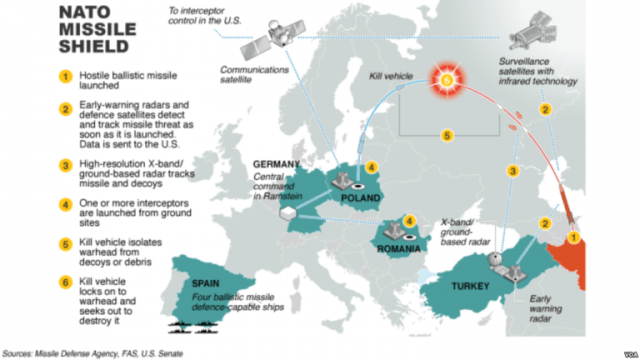
Second: a new US missile system was installed in Romania in 2016, and another similar system is currently being built in Poland. The same missile system is installed on four warships which, based by the US Navy in the Spanish port of Rota, sail the Black Sea and the Baltic Sea close to Russian territory. The land-based installations, like the ships, are equipped with Lockheed Martin Mk41 vertical launchers, which – as specified by the manufacturer himself – are able to launch “missiles for all missions: either SM-3’s as defence against ballistic missiles, or long-range Tomahawks to attack land-based objective”. The latter can also be loaded with a nuclear warhead. Since it is unable to check which missiles are actually loaded into the launchers parked at the frontier with Russia, Moscow supposes that there are also nuclear attack missiles, in violation of the Intermediate-Range Nuclear Forces Treaty, which forbids the installation of intermediate- and short-range missiles on land bases.
On the contrary, Stoltenberg accuses Russia of violating the INF Treaty, and sends out a warning:
“We can not allow the Treaties to be violated without punishment”.
In 2014, the Obama administration accused Russia, without providing the slightest proof, of having tested a Cruise missile (SSC-8) from a category forbidden by the Treaty, announcing that “the United States are considering the deployment of land-based missiles in Europe”, in other words, the abandon of the INF Treaty. This plan, supported by the European allies of NATO, was confirmed by the Trump administration: in the fiscal year of 2018, Congress authorised the financing of a programme of research and development for a Cruise missile to be launched from a mobile platform.
Nuclear missiles of the Euromissile type, deployed by the USA in Europe during the 1980’s and eliminated by the INF Treaty, are capable of hitting Russia, while similar nuclear missiles deployed in Russia can hit Europe but not the USA. Stoltenberg himself, referring to the SSC-8’s that Russia had deployed on its own territory, declared that they are capable of reaching most of Europe, but not the United States. This is how the United States defends Europe.
And in this grotesque affirmation by Stoltenberg, who attributes to Russia “the highly perilous idea of limited nuclear conflict”, he warns:
“All atomic weapons are dangerous, but those which can lower the threshold for use are especially so”.
This is exactly the warning sounded by US military and scientific experts about the B61-12’s which are on the verge of being deployed in Europe:
“Low-powered, more accurate nuclear weapons increase the temptation of using them, even to using them first instead of as a retaliation”.
Why is the Corriere della Sera not going to interview them?
Source: PandoraTV
This article was originally published in Italian on Il Manifesto.
Translated by Pete Kimberley
Manlio Dinucci is a Research Associate of the Centre for Research on Globalization.
Note
*The Corriere della Sera is a historical Italian daily newspaper, founded in Milan in 1876. Published by RCS MediaGroup, it is the most important Italian daily in terms of distribution and the number of readers.
US tried to get classified data on Russian missiles with claims of INF Treaty violation – deputy FM
RT | November 26, 2018
Accusations by Washington that Moscow had violated the INF Treaty were actually an attempt by the US to obtain classified data on missile projects that were developed by Russia, the country’s deputy foreign minister has said.
In view of those accusations, Moscow “received several question lists” from the US, according to Sergey Ryabkov.
“The subject of many questions by the Americans far exceeded Russia’s obligations as part of the treaty, and were rightly perceived by us as an attempt to ‘scan’ our newest missile developments,” he told a briefing in Moscow.
The Americans even pressed Russia to reveal the dates on which tests of a certain class of missile were carried out, “so that the US side could themselves pinpoint the questionable launches,” he added.
In other words, for a long time we were asked to ‘solve the puzzle’ from various scattered elements and then to name the missile, which the US believed didn’t conform with the INF Treaty.
The deputy foreign minister said that such an approach was about making Russia “confess to the violation, which it did not commit.” Moscow had no other choice but to “reject such an intrusive attempt.”
At the same, the Americans “haven’t presented any real piece of evidence confirming our violations of the INF Treaty,” Ryabkov pointed out.
Russia has no munitions that violate the INF Treaty, he confirmed. The 9М729 missile, which was the subject of concern from Washington, wasn’t developed or tested to reach the distances outlawed by the accord, he added.
Despite the US clearly being out of line, Moscow still “showed some transparency in the spirit of good will,” but this didn’t change the American stance in any way, the Russian diplomat said.
“They have decided everything for themselves a long time ago, the only thing they wanted from Russia is a confession of its guilt,” he added.
In late October, Donald Trump warned that Washington was considering unilateral withdrawal from the INF Treaty because “Russia has not adhered to the agreement,” either in form or in spirit. However, the announcement hasn’t yet been followed by any concrete steps. The US leader also promised that the country would keep boosting its nuclear arsenal until Russia and China “come to their senses.”
Ryabkov warned that, with the course of action chosen by the US administration, “we can’t exclude a collapse of the whole system of arms control, which took decades to build.”
However, the deputy FM affirmed that Russia’s nuclear doctrine remains unchanged and is purely defensive in nature. There are only two “hypothetical scenarios” in which nuclear arms could be used by Russia, he explained. “The first one is the use of nuclear weapons or other types of weapons of mass destruction against Russia. The second is an [act of] aggression against Russia with the use of conventional weapons on such a scale that the very existence of our state is threatened.”
The situation around the INF Treaty will be discussed by Russian President Vladimir Putin and Donald Trump when they meet on the sidelines of the upcoming G20 summit in Argentina, Ryabkov said.
Moscow Considers US Actions in S Syria ‘Occupation’ – Russian Foreign Ministry
Sputnik – 25.10.2018
Moscow has repeatedly criticized the US military campaign in Syria, which has not been authorized by either the UN or Damascus.
Speaking at a regular briefing on Thursday, Russian Foreign Ministry spokeswoman Maria Zakharova said that the United States has occupied the southern part of Syria.
“The situation in the northeast of Syria, where the US side is still trying to flirt with separatist-minded Kurdish groups, is concerning, as well as in the south of the country near At Tanf, where there is a de facto undisguised occupation by US forces of the territory of the sovereign Syrian state,” she said.
The Russian diplomat further stated that the militants who had found such a “safe haven, a shelter in the 55-kilometer exclusive zone,” established by the US, were extorting $2,000 dollars per person from civilians who wanted to leave the area.
Zakharova also stressed that Moscow was ready for a constructive dialogue with UN Special Envoy for Syria Staffan de Mistura’s successor.
“We reaffirm the focus on constructive cooperation with Staffan de Mistura’s successor. Let me remind you that he should be appointed by the UN secretary general… The candidacy of the new special envoy should be acceptable to the authorities of the Syrian Arab Republic.”
INF Treaty
Addressing Washington’s potential withdrawal from the 1987 Intermediate-Range Nuclear Forces Treaty (INF), Zakharova said that Russia was calling on all nations to signal the US to preserve the agreement.
“We urge all those who feel their own responsibility for the destinies of the world to send an unambiguous signal to Washington about the danger of the plans announced by them,” she said.
The diplomat stressed that Russia’s missile programs, including development of cruise missiles, were carried out in full compliance with the treaty, and while Moscow intends to continue work with the agreement, Washington is unwilling to act on equal basis.
“For several years, the American side has refused to provide any objective data supporting Washington’s conclusions that the Russian 9M729 ground-based cruise missile that passed flight tests has the operating range banned by the treaty. We have repeatedly confirmed that the missile programs implemented by Russia fully meet our obligations under the INF Treaty,” she underscored, adding that the development of the 9M729 cruise missile was “transparent to the maximum affordable degree.
“The American side was never able to present any evidence to either Russia or the international community to substantiate its claims. They remain unfounded and are provocative. And we reiterate that Russia strictly abides by the provisions of the treaty,” she added.
Russia will be forced to react if the US undermines the INF treaty, Zakharova said.
“Now we are forced to seriously warn Washington. If the American side undermines the treaty, Russia will have to react. We are ready to work on maintaining its [the INF] viability, but for this we need a partner who is responsible and interested in continuing the dialogue for the sake of world stability. A solution to the problem can only be found through a frank, equitable and, of course, constructive dialogue,” she said.
The spokeswoman also added that the appeal of US President Donald Trump about China’s participation in the new INF agreements should not be addressed to Russia.
“The question about the possibility of China’s participation in certain new, modified agreements in the field of intermediate- and shorter-range missiles, which the US President publicly argued in a hypothetical manner, should not be addressed to us.”
Her remarks came just days after Donald Trump told reporters he would scrap the 1987 INF treaty, citing Russia’s alleged violations of the agreement on the development of ground-based intermediate-range missiles. Moscow has repeatedly rejected the claims, and pointed to possible US violations of the treaty with its missile defense installations in Eastern Europe.
US Withdrawal from INF Treaty: Implications for Asia Pacific
By Arkady SAVITSKY | Strategic Culture Foundation | 23.10.2018
One of the motives behind the US withdrawal from the INF Treaty is its desire to acquire first-strike capability against Russia from Europe, while keeping intact its strategic nuclear arsenal. Another motivation is the need to keep China, America’s fiercest geopolitical challenger, in its crosshairs by forcing it to alter its foreign, defense, and trade policies in order to tip the balance in Washington’s favor. The capability to knock out key infrastructure sites with precision intermediate-range strikes deep inside China, not just in the coastal provinces, is one way to make Beijing more tractable on key issues and force a rollback of its global influence. In April, Adm. Harry Harris, the commander of US Pacific Command, told the Senate Armed Services Committee that the US should renegotiate the INF Treaty to better compete with China. The admiral knew what he was talking about.
China has developed the DF-26 “aircraft carrier-killer” ballistic missile that has now rendered the old US strategy ineffective. Zachary Keck of the National Interest believes the DF-26 intermediate-range ballistic missile could stop the US Navy in its tracks without firing a shot. That threat has to be countered and one way to do it is by knocking it out with land-based, highly accurate missiles. Such systems are cheaper than aircraft carriers and can do the job without exposing thousands of servicemen to the missile threat if used for a first strike. China has been testing a new nuclear-capable, air-launched ballistic missile constructed on the basis of the DF-21 that will help that country improve its warfighting capabilities. Beijing also boasts land-based mobile missile systems (LBMMS) with DF-10 cruise missiles that have a maximum range of 1,500 to 2,000 km. China has to defend itself, and fielding these systems is the only way that it can counteract America’s huge sea, space, and air advantages.
Actually, the process of encircling China with intermediate missiles is going to kick off with the deployment of the Aegis Ashore ballistic missile-defense (BMD) systems Japan has decided to buy. The batteries will be installed in the prefectures of Akita and Yamaguchi. Using the MK-41 launcher, the Aegis Ashore can fire intermediate-range Tomahawk missiles. The deal is a blatant violation of the INF Treaty that Washington accuses Moscow of not complying with.
After a long period of indecision, the US approved the sale of military equipment to Taiwan in September, drawing China’s ire. Last summer, the State Department requested that US Marines be sent to Taiwan under the pretext of safeguarding America’s de facto embassy there. National Security Adviser John Bolton is known for his support of the idea of stationing US troops on Taiwanese soil. Bolton wants to see the China policy revisited. He argues that Taiwan is closer to the Chinese mainland and the disputed islands in the South China Sea than either Okinawa or Guam — giving US forces “greater flexibility for rapid deployment throughout the region should the need arise.” If the ongoing escalation continues, the US could wind up deploying intermediate-range missiles on that friendly island.
Other targets include North Korea and the Russian Far East, especially the Vilyuchinsk naval base on the Kamchatka Peninsula that is home to a fleet of ballistic missile submarines.
Locating and destroying mobile land-based missiles, either from the air or from the ground, is an extremely challenging mission. Fast-flying ballistic delivery technology and stealthy cruise missiles are effective against a wide variety of targets, even if sophisticated air defenses are in place to protect them. The states in the region that are unfriendly to the United States would see their biggest military advantage erode away.
Intermediate-range weapons can accomplish the same missions as strategic weapons. With the high-precision technology the US possesses today, even conventional missiles could inflict damage comparable to that of nuclear strikes. Its ground-based assets boast large magazines and can have numerous reloads at the ready. In theory, the US could impose an arms-control agreement with China on its own terms, using theater weapons as its negotiating leverage. All the countries unfriendly to the US, such as China and North Korea, as well as Russia’s Far East area, will be within the range of fast-hitting, hard to counter, intermediate-range missile systems.
Moreover, with the arms race escalating in the Asia Pacific region, the US could involve itself in some lucrative deals selling conventional intermediate-range missile systems to the countries in that area, such as Japan. A conventional version of some of these weapons will be in high demand, bringing in substantial profits and spurring US economic growth.
So, the US is encouraging an arms race in the Asia Pacific region. It has adopted a policy of encirclement with its potential enemies in the crosshairs of its intermediate-range weapons. It will have the option of destroying key sites with conventional warheads. This policy will inevitably force Russia and China closer together. The militarization of the region will further accelerate. Those targeted by the US will be incentivized to develop weapons systems that can reach the continental US. No one will win and everyone will lose. There is still time to reverse the US decision to leave the INF Treaty.
Americans should be ‘scared’ about end of INF, Carter Page tells RT
RT | October 23, 2018
The ‘Russiagate’ hysteria that originated with the Democrat-funded Steele Dossier has damaged relations between Washington and Moscow to the point of ending the INF Treaty, former Trump adviser Carter Page has told RT.
Ending the Intermediate Nuclear Forces in Europe (INF) treaty is something Americans should be “scared about,” Page told RT America’s Scottie Nell Hughes in an exclusive interview on Monday. He said he’d worked on implementing that and other nuclear treaties when he was at the Pentagon in the early 1990s, and that there are “deep problems” between the US and Russia that “misunderstandings” over the Trump presidency are only making worse.
President Donald Trump announced on Monday he was preparing to pull the US out of the 1987 arms control treaty, citing the claim by the two previous administrations that Russia “has not adhered to the agreement.”
Page was drawn to the Trump campaign in 2016 because as a candidate, Trump had “said some very positive things, some very constructive ideas as to ways to improve” the relationship between Washington and Moscow.
“Unfortunately, there were various political actors that were within the government in Washington –and also on the fringes of Washington– which helped continue the downward cycle that we’ve seen for so many years.”
Page was specifically referring to what he calls the “dodgy dossier” – an opposition research file compiled by British spy Christopher Steele, alleging Trump’s ties to Russia. Steele wrote the dossier for Fusion GPS, and was paid for it by the Clinton campaign via the Democratic National Committee (DNC) and its law firm, Perkins Coie. Page is suing Perkins Coie and the DNC for defamation.
Congressional investigations have discovered that the dossier was used to obtain a Foreign Intelligence Surveillance Act (FISA) surveillance warrant to spy on Page, and through him on the Trump campaign, which the former US Navy intelligence officer and energy consultant briefly advised in 2016.
Democrats have actually accused Page of being a “foreign agent” recruited by Russia. He laughed off those charges, telling Hughes that he would speak to the CIA every time he went to Russia for a meeting or to give a speech.
Explaining the Trump administration’s hostility towards Russia that’s in stark contrast with his campaign rhetoric, Page said that “false stories placed by the Democrats” have created a “dark cloud hanging over the administration.”
The July summit in Helsinki between Trump and Russian President Vladimir Putin held a lot of potential to advance US-Russian relations, but the political and media fallout stopped any momentum in its tracks, Page argued.
Trump is “very much a straight shooter,” Page said, but there is a “a lot of political pressures” on him to be hostile to Russia. He remains hopeful that with Trump’s “strength and perseverance,” things might just work out.
“There’s a lot that needs to be fixed,” he said.
What Trump’s pullout from IMF treaty means
By M. K. BHADRAKUMAR | Indian Punchline | October 21, 2018
President Donald Trump’s confirmation that the US is terminating the Intermediate-Range Nuclear Forces treaty (INF) with Russia will be regarded as a defining moment in international security. The INF, which was signed by then US President Ronald Reagan and Soviet leader Mikhail Gorbachev in Washington in December 1987, has been a flagship of the disarmament process leading to the elimination of around 2,700 short and medium range ballistic missiles and preventing a US-Russia nuclear standoff in Europe.
A first-rate crisis is appearing in nuclear arms limitations and reduction processes. Now, let it be clarified this is not a temper tantrum by Trump but stems from the US policy to place accent on developing new nuclear weapons and aiming at securing a strategic dominance in the global arena. It was during the Obama administration, in 2014, that the US first alleged that Russia violated the INF treaty, but despite persistent requests from Moscow to provide substantiation of the allegation or at least to discuss the discord, Washington failed to respond.
The US has vaguely pointed the finger at the index of a Russian missile research project, but Moscow has refuted it pointing out that the US can easily see on its satellite images during field tests that these charges are totally unfounded and not substantiated by either the technical characteristics of the launcher that allegedly is at variance with the INF Treaty or in-flight telemetry data.
The plain truth is that it no longer suits the US to be constrained by the INF Treaty in the emerging New Cold War conditions where it has bracketed Russia and China as “revisionist powers” whom it must counter. In fact, contrary to the INF Treaty, Washington has already deployed launchers at the US antimissile base in Romania and Poland, whose specifications enable them to launch not only interceptor missiles but also strike missiles like Tomahawks.
One urgent compulsion for the US today is that the need arises for it in the downstream of the 2017 decision by Japanese government to buy two Aegis Ashore systems, as the deployment of the system in Japan will be a violation of the INF obligations – although the deployment will be in the Asia-Pacific.

Fundamentally, the US objective is nothing other than attaining nuclear superiority, which has been an elusive dream through the Cold War era. In the present context, Russian conventional forces are not a match for the US’ capability but nuclear deterrence gives Russia the status of a great power and enables it to maintain global strategic balance. Equally, China’s growing nuclear capabilities are an added factor in the American calculus. Simply put, the jettisoning of the INF will free the hands of the US to develop new weapons systems and to make large-scale deployments along the borders of Russia and China to contain them.
Russia has military-technical capabilities to respond to the challenge posed by US walking out of IMF Treaty. The hypersonic missile that it has developed is an example. Besides, Russia can also respond by deploying intermediate- and short-range missiles at its borders. To be sure, all this will directly affect European security and it may even create, hopefully, a convergence of interests between Russia and European countries to preserve the INF treaty. But the US may circumvent such a possibility by wearing down the European opposition by moving the discussion onto the multilateral NATO format.
Most importantly, the US pullout from INF treaty may bring the roof down on the New START treaty of 2010 and the Nuclear Non-Proliferation Treaty (NPT). In fact, the likelihood is high that the New START treaty may not be renewed by 2021, as is required, or that the NPT can survive. All in all, what is in the cards is the frightening scenario of a seamless, uncontrollable nuclear race – and the growing likelihood of a nuclear conflict.
Without doubt, the stakes are very high for India. The impact of the US decision on INF on the Asia-Pacific security would vitally affect Indian interests, especially in the context of the US-China rivalry where Japan (with which India has striven to forge a strong relationship) also happens to be a crucial participant. The US and Japanese pressure on India will increase to be ‘on the right side of history’ – that is, by becoming part of the US-led alliance system against China. Japan and Australia are figuring as the US’ main partners in the Indo-Pacific.
On the contrary, China will deepen its military cooperation with Russia and the two countries may be edging toward an alliance. (See my blog Military cooperation is the highlight and pillar of China-Russia strategic cooperation.) Ironically, the US will be achieving what it all along wanted, namely, injecting ‘bloc mentality’ among the countries of the Indo-Pacific, which would help consolidate its long-term presence in the region. All this means that unlike in the Cold War era, Asia is inexorably turning into the principal theatre of big-power rivalries.
US Tears up Landmark INF Treaty
By Andrei AKULOV | Strategic Culture Foundation | 21.10.2018
President Donald Trump has announced the decision to exit from the bedrock 1987 Intermediate-Range Nuclear Forces Treaty (INF Treaty), which bans all land-based missiles carrying both nuclear and conventional warheads with ranges of 500 to 5,500 kilometers, or 310 to 3,420 miles shorter- and intermediate-range missiles. It does not cover air-launched or sea-launched weapons. National Security Adviser (NSA) John R. Bolton is going to discuss the president’s decision with the Russian leadership during his upcoming visit to Moscow on Oct. 22-23.
It’s not a coincidence that the issue of alleged violations of the INF Treaty by Russia was put on the agenda of NATO defense ministers held on October 3-4 in Brussels. US Defense Secretary James Mattis said Moscow was in “blatant violation” – the view largely shared by NATO partners. The very fact that the US briefed the allies on the issue was a sign that the decision had already been made by the administration to be formally acknowledged now. The Nuclear Posture Review, released in February, called for the development of ground-launched medium-range missiles.
At the July summit, the NATO leaders agreed in the declaration that “the most plausible assessment would be that Russia is in violation of the Treaty.” But they did not say they approved the idea of deploying American missiles as a response. The missile in question is the 9M729 (NATO designation SSC-8) but the US has never said when and where it was tested to exceed the 500 kilometers limit allowed by the Treaty.
The alliance urged Russia to address these concerns. It should be noted that in its turn NATO has never addressed Russia’s concerns over US violations, such as the use of Mk41 launchers capable of firing intermediate range cruise missiles as well as armed drones and target missiles with a range exceeding the INF-imposed limitations. The list is long enough.
It is the second time the US tore up a major arms control treaty with Russia. The first one was the 1972 Anti-Ballistic Missile Treaty (the ABM Treaty) President George W. Bush Jr. pulled the US out from in 2002. Neither the USSR nor the Russian Federation ever scrapped an arms control agreement. The ensuing development of ballistic missile defense systems have become a snag on the way to hinder further arms control efforts.
Washington and Moscow have repeatedly accused each other of violations but the US decision to withdraw triggers questions. Why the proposal to negotiate a new treaty with stronger verification and compliance measures is not even on the agenda? Why new ideas on how to make the document better have not been offered for consideration by the Special Verification Commission (SVC)? Has Moscow refused to consider the possibility of adding on-site verification to the Treaty’s text? Is the idea of new strengthened inspection procedures not worth consideration and should be turned a blind eye on?
Perhaps, it’s because the US does not care about violations. It wants to get rid of the treaty for other reasons. One of them is to get the advantage by deploying such missiles near Russia’s borders to acquire a first nuclear strike capability with the strategic arsenal intact. For instance, the US Army is working on long-range artillery rockets that can exceed the 500 km range to station them in Europe. The weapon will serve as a means of delivering intermediate range strikes.
The other reason is not related to Russia or Europe. The US Nuclear Posture Review says “China likely already has the largest medium and intermediate-range missile force in Asia, and probably the world.” In his statement on withdrawal from the INF Treaty, President Trump said any agreement on intermediate range missiles must include China too. A military conflict between the US and China is likely. The US needs medium range missiles to strike its mainland. And it’s not China only. As Eric Sayers, a CSIS expert, put it “Deploying conventionally-armed ground-launched intermediate-range missiles may be key to reasserting US military superiority in East Asia.”
What will the withdrawal lead to? The INF Treaty is fundamental to European security. NATO will be divided over the issue with few nations ready to host the weapons, except Poland and the Baltic States happy to get the American military presence they have been longing for. This could lead to another rift among the allies at a time when that relationship is at a nadir because of trade wars and the rift over the Iran deal. Many Europeans still remember the 1983 protests to prevent the deployment of America’s missiles on national territories. They know well that an intermediate ground-based missile Russia will be free to deploy without the restrictions in place is not a threat to the continental USA while the countries of Old Continent will become a target. The INF Treaty will cease to be effective in six months after the US withdrawal, which is still to be made official. Europe should not sit idle watching the US leaving the Treaty. There is still some time left to press the US into thinking twice about the consequences.
The INF Treaty is not the only one teetering on the brink. The New Start Treaty, the remaining pillar of arms control, has a slim chance to survive. The Russian TASS news agency has just reported the US is unlikely to extend it and there are no talks on another agreement to take its place. Russia (the Soviet Union) and the US have always had an arms control treaty in effect since the Partial Nuclear Test Ban Treaty was concluded in 1963. Ever since the first Strategic Arms Limitation Talks (SALT I) Treaty was signed 1972, there have been negotiated constraints on nuclear arsenals. It may all change in 2021 when the New START expires, if not extended till 2026, to trigger an unfettered arms race. The entire system of arms control will unravel as a result of US withdrawal from the INF Treaty.
US Nuclear Missiles Deployed in Italy, … against Russia
By Manlio Dinucci | Global Research | October 18, 2018
The B61-12, the new US nuclear bomb which replaces the B-61 deployed in Italy and other European countries, will begin production in less than a year. The announcement was made officially by the National Nuclear Security Administration (NNSA). It reveals that the revision of the final project has now been completed with success, and the qualification stage will begin this month at the Pantex Plant in Texas. Production will be authorised to begin in September 2019.
In March 2020, the first unit of production will begin fabricating a series of 500 bombs. As from that time, in other words in about a year and a half, the United States will begin the anti-Russian deployment in Italy, Germany, Belgium, Holland and probably certain other European countries, of the first nuclear bomb in their arsenal with a precision guidance system. The B61-12 is designed with penetrating capacity, built to explode underground in order to destroy bunkers housing command centres.
Since Italy and the other countries, in violation of the Non-Proliferation Treaty, are offering the USA the bases, the pilots and the aircraft for the deployment of the B61-12, Europe will soon be exposed to a greater risk as the front line of the developing nuclear confrontation with Russia.
An even more dangerous situation appears at the same moment – the return of the Euromissiles, meaning the nuclear missiles which are similar to those deployed in Europe in the 1980’s by the USA, with the official aim of defending against Soviet missiles.
Source: PandoraTV [English subtitles]
This category of ground-based nuclear missiles of intermediate range (between 500 and 5,500 km) were eliminated with the INF Treaty of 1987. But in 2014, the Obama administration accused Russia of having experimented with a cruise missile (# 9M729) whose category was forbidden by the Treaty. Moscow denied that the missile violated the INF Treaty and, in turn, accused Washington of having installed in Poland and Romania launch ramps for interceptor missiles (elements of the “shield”), which could be used to launch cruise missiles bearing nuclear warheads.
The accusation aimed by Washington at Moscow, which is not supported by any evidence, enabled the USA to launch a plan aimed at once again deploying in Europe ground-based intermediate-range nuclear missiles. The Obama administration had already announced in 2015 that “faced with the violation of the INF Treaty by Russia, the United States are considering the deployment of ground-based missiles in Europe”. This plan was confirmed by the Trump administration – in fiscal year 2018, Congress authorised the financing of a “programme of research and development for a cruise missile which could be launched from a mobile road base”.
The plan is supported by the European allies of NATO. The recent North-Atlantic Council, at the level of Europe’s Defence Ministers, which was attended for Italy by Elisabetta Trenta (M5S), declared that the “INF Treaty is in danger because of the actions of Russia”, which it accused of deploying “a disturbing missile system which constitutes a serious risk for our security”. Hence the necessity that “NATO must maintain nuclear forces which are stable, trust-worthy and efficient” (which explains why the members of the Alliance rejected en bloc the United Nations Treaty for the prohibition of nuclear weapons).
So the grounds are being laid for a European deployment, on the borders of Russian territory, of ground-based intermediate-range US nuclear missiles. It’s as if Russia were deploying in Mexico nuclear missiles pointed at the United States.
This article was originally published in Italian on Il Manifesto.
Read more:
Featured Video
Theodore Postol: Iran’s Missiles & Drones Were Underestimated
or go to
Aletho News Archives – Video-Images
From the Archives
What is the Israeli Lobby in Australia Doing in Interfaith Dialogue?
By Ali Kazak | Dissident Voice | October 11, 2015
For years Israel and its lobby around the world have been trying to normalise their relations with Arabs and Muslims without solving the Palestine Question.
One of the methods they resorted to in the last few years is using human rights and community organizations such as interfaith dialogue and Multiculturalism to achieve this objective and to: isolate the Palestinians, marginalise the Palestine question, end Israel’s isolation, and prevent criticism of Israel, knowing that these organisations will be the first to stand against Israel’s violations, racial and religious discrimination.
The group responsible for this task in Australia is The Australia/Israel & Jewish Affairs Council (AIJAC); its Director of International & Community Affairs, Jeremy Jones is in charge of lobbying religious community organizations, specifically Muslims and Christians. Consequently he convened the Faith Communities for Reconciliation, founding participant in the Australian Partnership of Religious Organisations and the Australian National Dialogue of Christians, Muslims & Jews.
AIJAC is a private political propaganda group. It is recognised as the main Israeli lobby in Australia. It coordinates its activities and works intimately with the Israeli embassy in Canberra and different institutions in Israel. It is privately funded by some Jewish businessmen. It monitors closely Australian politicians, the media, ethnic and religious groups, (especially Arabs and Muslims), unions and academics on their stands towards Israel and the Palestine question. … continue
Blog Roll
 Aletho News
- The Most Important Bet You’ve Never Heard Of
- The killing of three Indonesian soldiers in Lebanon should remind Jakarta that Israel does not want peace
- Defeated and delusional: Netanyahu’s remarks reveal $80bn war failure, says analyst
- Iran’s friends are about to make life much more difficult for Israel and the US
- The war of liberation of the Arab and Islamic peoples expands across the Gulf
- Envoy warns UN on Trump’s threat to ‘obliterate’ Iran’s civilian infrastructure
- The Larak Corridor: Iran’s Rial Gate With No US, No Israel, and No Way Around
- ‘Economic terrorism’: Steel facilities hit again in US-Israeli strike
- ‘War Crime’: Iran condemns attacks on Arak, Ardakan nuclear sites
- Two-thirds of Americans want quick end to Iran war even if goals unmet
- If Americans Knew
- Gaza families reunite years after babies evacuated amid Israel’s war
- International Rescue Committee warns Gaza’s children face grave protection risks
- Iran’s Alleged 47-Year War on America: Debunking the 1,050 American Deaths Canard
- Israel wants US to bomb more of Iran’s civilian structures (113,000 is not enough) – Not a ceasefire Day 173
- Ann Coulter Rips Into Fox News for Iran War Coverage
- Joe Kent Urges Americans To Call White House and Congress To Object To Sending Troops Into Iran
- DNC Resolution to Reject AIPAC Funding Puts Democratic Leaders in the Hot Seat
- Swedish foundation to build 400 schools as over 650,000 Gaza children remain without education for 2 years
- Israeli army admits photshopping image of slain Lebanese journalist
- This is how Israel is systematically killing health workers under the cover of war in Lebanon
- No Tricks Zone
- New Study Finds Warming Saves Lives…Cold Temperatures 12 Times More Deadly Than Excess Heat
- German Science Blog Accuses PIK Climate Institute Of Hallucinating Climate Tipping Points
- Devastating Assessment Of Comirnaty Vaccine By Former Senior Pfizer Europe Toxicologist
- New Study: CO2 Is ‘Effectively Negligible’ As An Explanatory Climate Change Factor Since 2000
- Former Pfizer Toxicologist Dr. Helmut Sterz Tells Bundestag Hearing Pfizer Vaccine Should Have Never Been Approved
- Energy Expert: Germany’s Nuclear Phaseout Was A “500 Billion Euro Mistake”
- New Research: South Australia’s Mid-Holocene Sea Surface Temperatures Were 4°C Warmer Than Today
- Storing Green Energy To Last Germany 10 Days Would Require A 60-Million Tonne Battery
- New Studies: UK Sea Levels Were 4 Meters Higher Than Today During The Mid-Holocene
- Destructive Green New Deal: German Energy And Metal Group Warns Of Drastic Crisis
 Aletho News