Understanding The IPCC AR5 Climate Assessment
By Dr. Richard Lindzen | Watts Up With That? | October 8, 2013
Each IPCC report seems to be required to conclude that the case for an international agreement to curb carbon dioxide has grown stronger. That is to say the IPCC report (and especially the press release accompanying the summary) is a political document, and as George Orwell noted, political language “is designed to make lies sound truthful and murder respectable, and to give an appearance of solidity to pure wind.”
With respect to climate, we have had 17 years without warming; all models show greater tropical warming than has been observed since 1978; and arctic sea ice is suddenly showing surprising growth. And yet, as the discrepancies between models and observations increase, the IPCC insists that its confidence in the model predictions is greater than ever.
Referring to the 17 year ‘pause,’ the IPCC allows for two possibilities: that the sensitivity of the climate to increasing greenhouse gases is less than models project and that the heat added by increasing CO2 is ‘hiding’ in the deep ocean. Both possibilities contradict alarming claims.
With low sensitivity, economic analyses suggest that warming under 2C would likely be beneficial to the earth. Heat ‘hiding’ in the deep ocean would mean that current IPCC models fail to describe heat exchange between surface waters and the deep ocean. Such exchanges are essential features of natural climate variability, and all IPCC claims of attribution of warming to mans activities depend on the assumption that the models accurately portray this natural variability.
In attempting to convince the public to accept the need to for the environmental movement’s agenda, continual reference is made to consensus. This is dishonest not because of the absence of a consensus, but because the consensus concerning such things as the existence of irregular (and small compared to normal regional variability) net warming since about 1850, the existence of climate change (which has occurred over the earths entire existence), the fact that added greenhouse gases should have some impact (though small unless the climate system acts so as to greatly amplify this effect)over the past 60 years with little impact before then, and the fact that greenhouse gases have increased over the past 200 years or so, and that their greenhouse impact is already about 80% of what one expects from a doubling of CO2 are all perfectly consistent with there being no serious problem. Even the text of the IPCC Scientific Assessment agrees that catastrophic consequences are highly unlikely, and that connections of warming to extreme weather have not been found. The IPCC iconic statement that there is a high degree of certainty that most of the warming of the past 50 years is due to man’s emissions is, whether true or not, completely consistent with there being no problem. To say that most of a small change is due to man is hardly an argument for the likelihood of large changes.
Carbon restriction policies, to have any effect on climate, would require that the most extreme projections of dangerous climate actually be correct, and would require massive reductions in the use of energy to be universally adopted. There is little question that such reductions would have negative impacts on income, development, the environment, and food availability and cost – especially for the poor. This would clearly be immoral.
By contrast, the reasonable and moral policy would be to foster economic growth, poverty reduction and well being in order that societies be better able to deal with climate change regardless of its origin. Mitigation policies appear to have the opposite effect without significantly reducing the hypothetical risk of any changes in climate. While reducing vulnerability to climate change is a worthy goal, blind support for mitigation measures – regardless of the invalidity of the claims – constitutes what might be called bankrupt morality.
It is not sufficient for actions to artificially fulfill people’s need for transcendent aspirations in order for the actions to be considered moral. Needless to add, support of global warming alarm hardly constitutes intelligent respect for science.
~
Richard S. Lindzen, Massachusetts Institute of Technology, October 5th, 2013
Expensive Energy Kills Poor People
 More stunning pictures of Al Gore’s mansion at link
By Willis Eschenbach | Watts Up With That? | September 27, 2013
Lesotho (pronounced “Leh – soo – too”), is a mountain fortress of a country, totally surrounded by South Africa. The people there, the Basotho (pronounced “Bah – soo – too), are tough as nails, and you’d have to be. It’s high desert country, cold in the winter, not much water. The Basotho are fiercely independent.
Back in the early days, they fought off the Germans who tried to take their land. The Germans then drove them off of the fertile lowlands and into the arid mountains. So their King cut a deal with the English King for the country to be a British Protectorate … very clever, one of the few parts of Africa that was never a colony of anybody. These days, curiously, most of the time the country is populated by old folks, and women and kids—the only real employment for hundreds of miles around are the mines of South Africa … including the coal mines. So the men are all at work in South Africa, and the country runs on the money that the miners send home.
Of a wintry morning in Maseru, the capital, there’s a haze across the city from the thousands and thousands of coal fires. By and large, these fires are warming poor women’s shacks and shanties, and cooking what passes for their kids’ breakfasts. They burn coal because it’s what they have. There are no forests, so they can’t burn wood. There are no great herds of cattle, so they can’t burn dung.
And as a result, Maseru mornings have that curious acrid smell that only comes from coal, and the haze that comes from coal burnt in leaky stoves and open three-stone fires.
I bring up this image of dirt-poor people in a dirt-poor country to provide a clear context for the New York Times report of the latest lethal IPCC recommendation, which they describe as follows:
To stand the best chance of keeping the planetary warming below an internationally agreed target of 3.6 degrees Fahrenheit (2 degrees Celsius) above the level of preindustrial times, the panel found, no more than one trillion metric tons of carbon can be burned and the resulting gas released into the atmosphere.
Just over half that amount has already been emitted since the beginning of the Industrial Revolution, and at the rate energy consumption is growing, the trillionth ton will be released somewhere around 2040, according to calculations by Myles R. Allen, a scientist at the University of Oxford and one of the authors of the new report. More than three trillion tons of carbon are still left in the ground as fossil fuels. SOURCE
First, the “internationally agreed target” of 2°C? I don’t recall any international agreement on that, except perhaps among attendees at one of the IPCC’s annual moribund quackathons held in Rio or somewhere.
But lets look instead at the important issue, the numbers that they give for carbon. They say we’ve burnt a half-trillion tonnes, and that we should stop when we’ve burned another half trillion tonnes, and leave the other two-and-a-half trillion tons of fossil fuels in the ground. Leave it in the ground … the mind boggles. Never happen.
So in a scant few decades, the women of Maseru are supposed to just stop burning coal? And do what? Burn their furniture? They could pull up the floorboards and burn them … if they had floors …
Dont’cha love these guys? Don’t they understand that their policies KILL PEOPLE! I apologize for shouting, but they seem to be congenitally blind to the results of their actions, so perhaps their ears still work. Do they have a plan in hand for fueling Maseru, and a thousand other Maseru’s around the world? Wind won’t do it. Sun won’t do it. So in a couple decades … what?
Here’s what they avert their eyes from.
Artificially increasing energy prices for any reason harms, impoverishes, and kills the poor.
Yes, kills. People die from the cold. If the women of Maseru have to pay more for coal, they have less money to pay for food. So they will buy a bit less coal and a bit less food, and somewhere in there, in the hidden part that far too many people don’t want to think about, kids are dying. It’s already happening. The World Bank and the US are currently refusing to fund coal-fired power plants around the world … rich people refusing cheap energy to poor people, on my planet that is disgusting and criminal behavior.
Can’t say much more than that without excessively angrifying my blood, thinking about rich 1%ers like the IPCC conclave and Myles R. Allen trying to make all fossil fuels more expensive, and blithely ignoring the lethal consequences of their actions. So I’ll leave it there, but spread the word.
Expensive energy kills poor people.
The coming crisis of climate science?
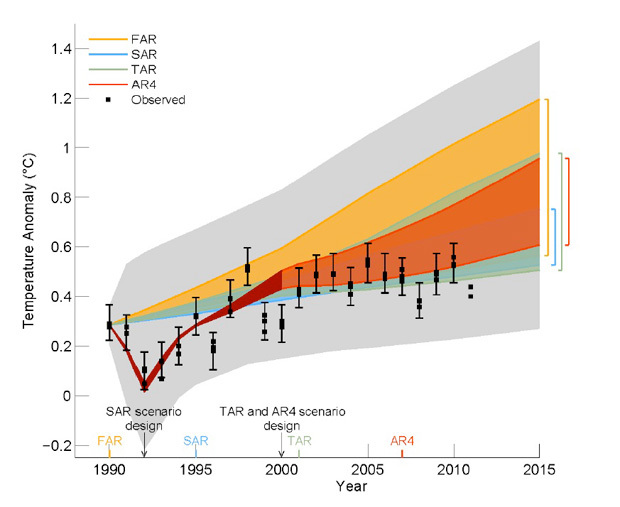
Figure 1.4 from Chapter 1 of a draft of the Fifth Assessment Report from the Intergovernmental Panel on Climate Change. Initials represent the First Assessment Report (FAR) in 1990, the Second (SAR) in 1995. Shaded banks show range of predictions from each of the four climate models used for all four reports since 1990. The last report, AR4, was issued in 2007. The black squares, shown with uncertainty bars, measure the observed average surface temperatures over the same interval. The range of model runs is indicated by the vertical bars. The light grey area above and below is not part of the model prediction ranges.
By Reiner Grundmann | September 19, 2013
With the fifth assessment report soon to be released by the IPCC the pre-publication buzz is well underway. A while ago unauthorised drafts circulated in the blogosphere and now the official leaks have found their way into news editing rooms. A central question picked up by most commentators is the ‘pause in global warming’, the ‘stagnation’, or the ‘hiatus’.
An anomaly presents itself for climate science in that model projections about future temperature increases do not concur with actual temperature observations. As expected, comments align with the agendas of the commentators, depending if one wants to defend the official modelling output or criticise it. These agendas are closely linked to policy options and the question if a lower observed temperature trend provides justification for political action on greenhouse gas emissions.
On this blog Hans von Storch expressed optimism as regards the ability of climate science to deal with this anomaly: ‘Eventually, we need to evaluate the different suggestions, but that will need time. No doubt that the scientific community will achieve this.’ Others are quick to pronounce climate science bunk. David Rose wrote in the Daily Mail ‘A leaked copy of the world’s most authoritative climate study reveals scientific forecasts of imminent doom were drastically wrong.’ Hayley Dixon in The Telegraph put it less blatant but still succinct in her opening sentence: ‘A leaked draft of a report by the UN Intergovernmental Panel on Climate Change is understood to concede that the computer predictions for global warming and the effects of carbon emissions have been proved to be inaccurate.’
Of course, both papers are on the political right and often skeptical about efforts to curb greenhouse gas emissions. It seems as if this topic is inconvenient for the left leaning papers who support action on climate mitigation. The Guardian so far is silent on the issue and prefers to write about new record lows of Arctic Ice coverage. When it looked last at this issue, Fiona Harvey bolstered the heat uptake by the oceans as explanation for the pause in global warming, thus doing away with a potential anomaly. At the same time she claims that climate scientists point out ‘that the trend is still upwards, and that the current temperature rises are well within the expected range.’ A quick glance at the graph above shows this is an illusion (the grey upper and lower bands are not part of the model prediction range).
Both the Mail and Telegraph quote Myles Allen (Oxford University) who tries to put the IPCC and its work into perspective. Says Allen: ‘we need to look very carefully about what the IPCC does in future… It is a complete fantasy to think that you can compile an infallible or approximately infallible report, that is just not how science works. It is not a bible, it is a scientific review, an assessment of the literature. Frankly both sides are seriously confused on how science works – the critics of the IPCC and the environmentalists who credit the IPCC as if it is the gospel.’
The Mail quotes Judy Curry (Georgia Institute of Technology) saying it makes ‘no sense that the IPCC was claiming that its confidence in its forecasts and conclusions has increased. For example, in the new report, the IPCC says it is ‘extremely likely’ – 95 per cent certain – that human influence caused more than half the temperature rises from 1951 to 2010, up from ‘very confident’ – 90 per cent certain – in 2007. Prof Curry said: ‘This is incomprehensible to me’ – adding that the IPCC projections are ‘overconfident’, especially given the report’s admitted areas of doubt.’
Both Allen and Curry call for a radical reform of the IPCC with Curry being more specific: ‘The consensus-seeking process used by the IPCC creates and amplifies biases in the science. It should be abandoned in favour of a more traditional review that presents arguments for and against – which would better support scientific progress, and be more useful for policy makers.’
Meanwhile in the Financial Post, Ross McKitrick wrote: ‘As the gap between models and reality has grown wider, so has the number of mainstream scientists gingerly raising the possibility that climate models may soon need a bit of a re-think. A recent study by some well-known German climate modellers put the probability that models can currently be reconciled with observations at less than 2%, and they said that if we see another five years without a large warming, the probability will drop to zero.’ (this seems to be a reference to the paper by Hans von Storch and Eduardo Zorita recently presented here on Klimazwiebel).
McKitrick goes on: ‘Judging by the drafts circulated this year, [the IPCC] is in full denial mode. Its own figure reveals a discrepancy between models and observations, yet its discussion says something entirely different. On page 9 of Chapter 1 it explains where the numbers come from, it talks about the various challenges faced by models, and then it sums up the graph as follows: “In summary, the globally-averaged surface temperatures are well within the uncertainty range of all previous IPCC projections, and generally are in the middle of the scenario ranges.” Later, in Chapter 9, it states with “very high confidence” that models can correctly simulate global surface temperature trends.’
McKitrick then makes a link between a ‘failed science’ and a ‘costly policy’: ‘since we are on the verge of seeing the emergence of data that could rock the foundations of mainstream climatology, this is obviously no time for entering into costly and permanent climate policy commitments based on failed model forecasts. The real message of the science is: Hold on a bit longer, information is coming soon that could radically change our understanding of this issue.’
This is where the crux of the matter lies. While it is indeed highly problematic to tie costly policies to flawed model forecasts the prospects of climatology are perhaps worth considering.
I chose as title for this blog post ‘The coming Crisis of Climate Science?’ The question mark is intentional and important. It could well be that in the coming year global surface temperatures pick up as expected. Existing models would be vindicated, end of story. The question is: how many more years should climatologists wait for this ‘renormalization’? It appears that mood is shifting towards alternative models and explanations. The timing of the fifth assessment report falls into this critical juncture where a lot of momentum has built up in favour of the current modelling practices which now prove so elusive. While the IPCC tries to make last minute rhetorical adjustments in order to accommodate anomalies, some of its participants, looking beyond, already indicate that this institution may have run its course. But even if the IPCC was reformed or dissolved, we still would have these questions in front of us:
How convincing is the climate science? How important should it be for climate policies? Do we need to implement climate policies, and if so, what should they be?
I can envisage an irony of history where climatology enters a period of crisis and looses its central place in public discourse about climate change, thus opening up discursive spaces for pragmatic options to deal with the problem.
Update: Global mean surface temperatures continued their sideways trajectory for the entire year of 2013 and October 2013 Arctic ice volume increased 50% from October 2012. – (Aletho News)
Related article
No significant warming for 17 years 4 months
By Christopher Monckton of Brenchley | Watt’s Up With That? | June 13, 2013
As Anthony and others have pointed out, even the New York Times has at last been constrained to admit what Dr. Pachauri of the IPCC was constrained to admit some months ago. There has been no global warming statistically distinguishable from zero for getting on for two decades.
The NYT says the absence of warming arises because skeptics cherry-pick 1998, the year of the Great el Niño, as their starting point. However, as Anthony explained yesterday, the stasis goes back farther than that. He says we shall soon be approaching Dr. Ben Santer’s 17-year test: if there is no warming for 17 years, the models are wrong.
Usefully, the latest version of the Hadley Centre/Climatic Research Unit monthly global mean surface temperature anomaly series provides not only the anomalies themselves but also the 2 σ uncertainties.
Superimposing the temperature curve and its least-squares linear-regression trend on the statistical insignificance region bounded by the means of the trends on these published uncertainties since January 1996 demonstrates that there has been no statistically-significant warming in 17 years 4 months:

On Dr. Santer’s 17-year test, then, the models may have failed. A rethink is needed.
The fact that an apparent warming rate equivalent to almost 0.9 Cº is statistically insignificant may seem surprising at first sight, but there are two reasons for it. First, the published uncertainties are substantial: approximately 0.15 Cº either side of the central estimate.
Secondly, one weakness of linear regression is that it is unduly influenced by outliers. Visibly, the Great el Niño of 1998 is one such outlier.
If 1998 were the only outlier, and particularly if it were the largest, going back to 1996 would be much the same as cherry-picking 1998 itself as the start date.
However, the magnitude of the 1998 positive outlier is countervailed by that of the 1996/7 la Niña. Also, there is a still more substantial positive outlier in the shape of the 2007 el Niño, against which the la Niña of 2008 countervails.
In passing, note that the cooling from January 2007 to January 2008 is the fastest January-to-January cooling in the HadCRUT4 record going back to 1850.
Bearing these considerations in mind, going back to January 1996 is a fair test for statistical significance. And, as the graph shows, there has been no warming that we can statistically distinguish from zero throughout that period, for even the rightmost endpoint of the regression trend-line falls (albeit barely) within the region of statistical insignificance.
Be that as it may, one should beware of focusing the debate solely on how many years and months have passed without significant global warming. Another strong el Niño could – at least temporarily – bring the long period without warming to an end. If so, the cry-babies [salaried agenda-men – Aletho News] will screech that catastrophic global warming has resumed, the models were right all along, etc., etc.
It is better to focus on the ever-widening discrepancy between predicted and observed warming rates. The IPCC’s forthcoming Fifth Assessment Report backcasts the interval of 34 models’ global warming projections to 2005, since when the world should have been warming at a rate equivalent to 2.33 Cº/century. Instead, it has been cooling at a rate equivalent to a statistically-insignificant 0.87 Cº/century:

The variance between prediction and observation over the 100 months from January 2005 to April 2013 is thus equivalent to 3.2 Cº/century.
The correlation coefficient is low, the period of record is short, and I have not yet obtained the monthly projected-anomaly data from the modelers to allow a proper p-value comparison.
Yet it is becoming difficult to suggest with a straight face that the models’ projections are healthily on track.
From now on, I propose to publish a monthly index of the variance between the IPCC’s predicted global warming and the thermometers’ measurements. That variance may well inexorably widen over time.
In any event, the index will limit the scope for false claims that the world continues to warm at an unprecedented and dangerous rate.
Related articles
- Benchmarking IPCC’s warming predictions (wattsupwiththat.com)
- Only 65 Scientists of 12,000 Make up Alleged 97% on Climate Change and Global Warming Consensus According to Breakdown of Cook et al study, say Friends of Science (prweb.com)
- The Met Drops Its Basis For Claim Of “Significant” Warming (papundits.wordpress.com)
- David Whitehouse: Before And After The Temperature Standstill (tallbloke.wordpress.com)
Glacier scientist: I knew data hadn’t been verified
By David Rose | Daily Mail | January 24, 2010
The scientist behind the bogus claim in a Nobel Prize-winning UN report that Himalayan glaciers will have melted by 2035 last night admitted it was included purely to put political pressure on world leaders.
Dr Murari Lal also said he was well aware the statement, in the 2007 report by the Intergovernmental Panel on Climate Change (IPCC), did not rest on peer-reviewed scientific research.
In an interview with The Mail on Sunday, Dr Lal, the co-ordinating lead author of the report’s chapter on Asia, said: ‘It related to several countries in this region and their water sources. We thought that if we can highlight it, it will impact policy-makers and politicians and encourage them to take some concrete action.
‘It had importance for the region, so we thought we should put it in.’
Dr Lal’s admission will only add to the mounting furore over the melting glaciers assertion, which the IPCC was last week forced to withdraw because it has no scientific foundation.
According to the IPCC’s statement of principles, its role is ‘to assess on a comprehensive, objective, open and transparent basis, scientific, technical and socio-economic information – IPCC reports should be neutral with respect to policy’.
The claim that Himalayan glaciers are set to disappear by 2035 rests on two 1999 magazine interviews with glaciologist Syed Hasnain, which were then recycled without any further investigation in a 2005 report by the environmental campaign group WWF.
It was this report that Dr Lal and his team cited as their source.
The WWF article also contained a basic error in its arithmetic. A claim that one glacier was retreating at the alarming rate of 134 metres a year should in fact have said 23 metres – the authors had divided the total loss measured over 121 years by 21, not 121.
Last Friday, the WWF website posted a humiliating statement recognising the claim as ‘unsound’, and saying it ‘regrets any confusion caused’.
Dr Lal said: ‘We knew the WWF report with the 2035 date was “grey literature” [material not published in a peer-reviewed journal]. But it was never picked up by any of the authors in our working group, nor by any of the more than 500 external reviewers, by the governments to which it was sent, or by the final IPCC review editors.’
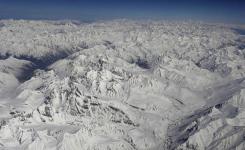 In fact, the 2035 melting date seems to have been plucked from thin air.
Professor Graham Cogley, a glacier expert at Trent University in Canada, who began to raise doubts in scientific circles last year, said the claim multiplies the rate at which glaciers have been seen to melt by a factor of about 25.
‘My educated guess is that there will be somewhat less ice in 2035 than there is now,’ he said.
‘But there is no way the glaciers will be close to disappearing. It doesn’t seem to me that exaggerating the problem’s seriousness is going to help solve it.’
One of the problems bedeviling Himalayan glacier research is a lack of reliable data. But an authoritative report published last November by the Indian government said: ‘Himalayan glaciers have not in any way exhibited, especially in recent years, an abnormal annual retreat.’
When this report was issued, Raj Pachauri, the IPCC chairman, denounced it as ‘voodoo science’.
- IPCC chairman Raj Pachauri
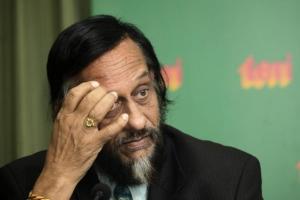
Having been forced to apologise over the 2035 claim, Dr Pachauri blamed Dr Lal, saying his team had failed to apply IPCC procedures.
It was an accusation rebutted angrily by Dr Lal. ‘We as authors followed them to the letter,’ he said. ‘Had we received information that undermined the claim, we would have included it.’
However, an analysis of those 500-plus formal review comments, to be published tomorrow by the Global Warming Policy Foundation (GWPF), the new body founded by former Chancellor Nigel Lawson, suggests that when reviewers did raise issues that called the claim into question, Dr Lal and his colleagues simply ignored them.
For example, Hayley Fowler of Newcastle University, suggested that their draft did not mention that Himalayan glaciers in the Karakoram range are growing rapidly, citing a paper published in the influential journal Nature.
In their response, the IPCC authors said, bizarrely, that they were ‘unable to get hold of the suggested references’, but would ‘consider’ this in their final version. They failed to do so.
The Japanese government commented that the draft did not clarify what it meant by stating that the likelihood of the glaciers disappearing by 2035 was ‘very high’. ‘What is the confidence level?’ it asked.
The authors’ response said ‘appropriate revisions and editing made’. But the final version was identical to their draft.
Last week, Professor Georg Kaser, a glacier expert from Austria, who was lead author of a different chapter in the IPCC report, said when he became aware of the 2035 claim a few months before the report was published, he wrote to Dr Lal, urging him to withdraw it as patently untrue.
Dr Lal claimed he never received this letter. ‘He didn’t contact me or any of the other authors of the chapter,’ he said.
The damage to the IPCC’s reputation, already tarnished by last year’s ‘Warmergate’ leaked email scandal, is likely to be considerable.
Benny Peiser, the GWPF’s director, said the affair suggested the IPCC review process was ‘skewed by a bias towards alarmist assessments’.
Environmentalist Alton Byers said the panel’s credibility had been damaged. ‘They’ve done sloppy work,’ he said. ‘We need better research on the ground, not unreliable predictions derived from computer models.’
Last night, Dr Pachauri defended the IPCC, saying it was wrong to generalise based on a single mistake. ‘Our procedure is robust,’ he added.
Related article
- Déjà Vu : Himalayan glaciers to melt (again) by 2035! (climatism.wordpress.com)
Featured Video
Prof. Ted Postol: US–Iran War? Israel’s Fatal Gamble
or go to
Aletho News Archives – Video-Images
From the Archives
Still No End in Sight of the Murder and Mayhem Wrought by the 9/11 Culprits
By Prof. Tony Hall | American Herald Tribune | July 17, 2016
The Kevin Barrett-Chomsky Dispute in Historical Perspective – Fourth part of the series titled “9/11 and the Zionist Question”
Back in 2006 all but a prescient few, such as Christopher Bollyn, perceived it as premature to try to identify and bring to justice the actual perpetrators of the 9/11 crimes. There was still some residue of confidence that responsible officials in government, law enforcement, media and the universities could and would respond in good faith to multiple revelations that great frauds had occurred in interpreting 9/11 for the public.
Accordingly, the main methodology of public intellectuals like Dr. Kevin Barrett or, for instance, Professors David Ray Griffin, Steven E. Jones, Peter Dale Scott, Graeme MacQueen, John McMurtry, Michael Keefer, Richard B. Lee, A.K. Dewdney, Nafeez Mossadeq Ahmed, and Michel Chossudovsky, was to marshal evidence demonstrating that the official narrative of 9/11 could not be true.
The marshaling of evidence was spurred on by observations coming from government insiders like Eckehardt Wertherbach, a former head of Germany’s intelligence service. In a meeting in Germany with Christopher Bollyn and Dr. Andreas von Bülow, Wertherbach pointed out that, “an attack of this magnitude and precision would have required years of planning. Such a sophisticated operation would require the fixed frame of a state intelligence organization, something not found in a loose group like the one led by the student Mohammed Atta in Hamburg.”
Andreas von Bülow was a German parliamentarian and Defense Ministry official. He confirmed this assessment in his book on the CIA and 9/11. In the text von Bülow remarked that the execution of the 9/11 plan “would have been unthinkable without backing from secret apparatuses of state and industry.” The author spoke of the “invented story of 19 Muslims working with Osama bin Laden in order the hide the truth” of the real perpetrators’ identity. … continue
Blog Roll
 Aletho News
- ‘Britain’s Index of Repression’ documents 964 incidents of anti-Palestinian crackdown
- Prof. Ted Postol: US–Iran War? Israel’s Fatal Gamble
- UK prosecutors drop aggravated burglary charges against 24 Palestine Action activists
- Unidentified drone downed over Lebanon airbase, US forces block authorities from crash site
- Peeling Back the US Information Operation in Iran
- Israel ‘dictating terms’ to US – Turkish professor
- US ramps up nuclear claims against China
- Erdogan wants nukes: What a Turkish bomb would mean for the Middle East
- Ukrainian disruption of Russian oil pipeline triggers emergency in EU state
- Kaja Kallas: an uncomfortable figure useful to the EU’s Russophobic purposes
- If Americans Knew
- Compliant aid: Who are the Israel-approved NGOs scaling up in Gaza?
- Why won’t Trump’s “Board of Peace” bring peace? – Not a ceasefire Day 131
- Help end the injustice against Shadi
- Israel’s Favorite American President
- Israel’s “Yellow Line” Is a Death Trap for Palestinians. We Drove Into It.
- Why Israel’s expanding occupation in Syria presents a critical legal test
- Gaza is not a natural disaster. It is the victim of genocide enabled by global inaction
- Netanyahu’s plan to “end” US aid to Israel is to give even more money under a different name
- Israel ceased firing on Gaza for just 15 days of the “ceasefire” – Not a ceasefire Day 130
- In Gaza, “rats run over our faces” – Not a ceasefire Day 129
- No Tricks Zone
- Coal Power Back In Trend As Globe Tries To Keep Pace With Growing Demand For Power
- New Study: A 4°C Warmer Beaufort Sea Had ‘No Sea Ice’ 11,700 – 8200 Years Ago
- Unfudging The Data: Dutch Meteorological Institute Reinstates Early 20th Centruy Heat Waves It Had Erased Earlier
- German Gas Crisis…Chancellor Merz Allegedly Bans Gas Debate Ahead of Elections!
- Pollen Reconstructions Show The Last Glacial’s Warming Events Were Global, 10x Greater Than Modern
- Germany’s Natural Gas Storage Level Dwindles To Just 28%… Increasingly Critical
- New Study Rebuts The Assumption That Anthropogenic CO2 Molecules Have ‘Special’ Properties
- Climate Scientist Who Predicted End Of “Heavy Frost And Snow” Now Refuses Media Inquiries
- Polar Bear Numbers Rising And Health Improving In Areas With The Most Rapid Sea Ice Decline
- One Reason Only For Germany’s Heating Gas Crisis: Its Hardcore-Dumbass Energy Policy
 Aletho News
