Hebron: Palestinian streets closed for Israeli settlers
6 August 2012 | International Solidarity Movement, West Bank
In Hebron on the evening of July 29, almost 100 Israeli settlers from the illegal settlements occupying the centre of the city crossed into the Palestinian-controlled area H1. The settlers illegally entered H1 supported by a heavy Israeli military presence.

Earlier that evening, 4 Israeli military vehicles were witnessed driving through H1 area. At the same time, some 60 Israeli settlers gathered at Checkpoint 56 which marks the border between H1and H2 (the Israeli-controlled areas of Hebron). Several of the settlers, besides being armed with assault rifles, were also carrying compact tables and large bags of food.
Shortly before 7 p.m., Checkpoint 56 was closed to all Palestinians. Soon after, the Israeli military escorted the settlers through the checkpoint into the Bab al-Zawiyeh neighbourhood of area H1.
After the group of settlers passed through, Checkpoint 56 was reopened to Palestinians but the streets of Bab al-Zawiyeh were closed to Palestinian pedestrians and cars who were told to use a parallel street. The 4 military vehicles seen earlier were now parked and soldiers forced Palestinian shops to close down. Thus the otherwise lively Bab al-Zawiyeh was almost deserted.
The Israeli brigade commander declared that the street was a Closed Military Zone (CMZ), and when asked for the CMZ paper permit he replied,“this is a Closed Military Zone because I say so.” The same commander pushed several International Solidarity Movement volunteers in the chest for their inquiries.
Several Palestinians attempted to enter to their homes in H2, as they regularly would, but were aggressively refused at the checkpoint and directed to a lengthy detour. The detour is made kilometres longer by the fact that Palestinians are denied access to Shuhada street.
At 7:30 p.m., just before eftar when most Palestinians would be breaking the day’s fast, a group of about 30 settlers gathered at Checkpoint 56. A short while later, this group was escorted down the closed-off street to join the other settlers now numbering almost 100.
Twenty minutes later, a group of 20 settlers returned back towards H2. As they passed the empty square of Bab al-Zawiyeh they clapped their hands and started chanting in Hebrew, celebrating the empty Palestinian streets. Several pointed, laughed, and made rude gestures at the few Palestinians remaining on the edges of the street.
At around 8:30 p.m., the settlers returned to H2 in smaller groups and escorted by soldiers. Again they pointed, laughed, and took photos of Palestinians they passed. At 9 p.m., the last soldiers packed up and left the area. Immediately, shops reopened and Palestinians returned to the streets. Slowly, Bab al-Zawiyeh began to look like itself again.
More than 50 soldiers and almost 100 illegal Israeli settlers were participating in what is a yearly event. Annually, dinner is had at a site in Bab al-Zawiyeh which they consider a sacred place in Judaism. In practice, this dinner serves as an aggressive reminder of who is in charge. That Israel with more than 4000 soldiers stationed in Hebron, can do as they please despite what the lawful agreements may dictate.
It is noteworthy that this occurred in a week that has been rampant with military night raids, harassment and abuse against Palestinian residents of Hebron who are celebrating the month of Ramadan.
Related articles
- 8 injured as settlers stone bus carrying worshipers (alethonews.wordpress.com)
- Hebron: Over 30 detained (alethonews.wordpress.com)
- Hebron: Israeli settlers occupy Palestinian home (alethonews.wordpress.com)
- French activist injured as Israeli troops attack Hebron (alethonews.wordpress.com)
- Ultimate goal of Israeli policies in Hebron: ethnic cleansing (alethonews.wordpress.com)
- Israeli kills 2 Palestinians near Hebron (alethonews.wordpress.com)
- Tuesday Raids Follow Monday Killing (alethonews.wordpress.com)
- Settlers set fire to ancient tree in Hebron (alethonews.wordpress.com)
One year after killings: Iraq Burin continues its struggle
31 July 2012 | International Solidarity Movement, West Bank
Three days before the start of Ramadan, the small mountainside town of Iraq Burin was attacked by Israeli settlers from the illegal colony of Bracha. The attackers descended from the settlement at 12:30 a.m. and were soon followed by the Israeli military, shooting tear-gas and sound grenades.
“Since Ramadan started, things have been relatively calm here,” says Yousef, a resident of Iraq Burin, “earlier we used to have trouble all the time.”
Ironically, the settler attacks are most common on Saturdays, the Jewish Sabbath, which traditionally is revered as a day of rest.
“But there have also been plenty of attacks on Wednesdays and Thursdays,” says Yousef.
The settlers target farmers closest to the settlement, making it impossible for them to work their land due to risk of being attacked or shot. The farmers’ lack of activity is then used against them as settlers claim the land to be abandoned and subsequently annex it. By these means, the illegal settlements across the West Bank continue to steal the lands of neighboring Palestinian villages.
Bracha is one of over 250 Israeli settlements and outposts erected in the Palestinian West Bank and violating Article 49 of the Fourth Geneva Convention. “Seizure of land for settlement building and future expansion has resulted in the shrinking of space available for Palestinians to sustain their livelihoods and develop adequate housing, basic infrastructure and services,” wrote the United Nations Office for the Coordination of Humanitarian Affairs (OCHA).
From Yousef’s rooftop one can see clearly where the irrigated fields of Bracha have stretched down into the valley since its construction in the early 1980′s.
Of the 2000 dunums that originally was Iraq Burin, 300 have been annexed by the settlement of Bracha and many hundreds have become inaccessible to Palestinians due to the risk of violent attacks. To protest this, the village has been holding demonstrations every Saturday for the past year. Similar to numerous protests across the West Bank, Iraq Burin’s regular demonstrations are met with brute force by the Israeli army.
“The failure to respect international law, along with the lack of adequate law enforcement vis-àvis settler violence and takeover of land has led to a state of impunity, which encourages further violence and undermines the physical security and livelihoods of Palestinians. Those protesting settlement expansion or access restrictions imposed for the benefit of settlements (including the Barrier) are regularly exposed to injury and arrest by Israeli forces,” noted OCHA.
For a short while, the demonstrations ceased after 2 young men, Muhammad and Usaid Qadus, were shot dead at close range by an Israeli soldier.
“But our peaceful struggle will continue among both the young and the old,” promises Yousef.
Related articles
- Hebron: Over 30 detained (alethonews.wordpress.com)
- Ultimate goal of Israeli policies in Hebron: ethnic cleansing (alethonews.wordpress.com)
- Report details Israeli violations and seizure of West Bank land (occupiedpalestine.wordpress.com)
- Palestinian voice from Susiya, a Palestinian village that existed before the establishment of the State of Israel (alethonews.wordpress.com)
- Number of Jewish settlers in West Bank doubled in 12 years (alethonews.wordpress.com)
- Sleepless nights in Burin (occupiedpalestine.wordpress.com)
- Daglas: Settlers have formed special teams to attack the Palestinians (occupiedpalestine.wordpress.com)
Nablus: night raids and arrests
30 July 2012 | International Solidarity Movement
Five Palestinian men were arrested by the Israeli Occupation Forces (IOF) in a night raid inside the old city of Nablus on Saturday, July 28. Tear gas and sound bombs were used against families and civilians protesting the arrests. 19 young men suffered asphyxiation and were taken to hospital. Israeli soldiers remained inside the city until 6 a.m. terrorizing residents.

A Palestinian woman walks through the destroyed home of the Kharuf family | Team Palestina & Free Gaza
Military incursions in Nablus, which is located in Area A and therefore under Palestinian military jurisdiction, are breaches of the Oslo Agreement, but nonetheless occur regularly. As always in occupied Palestine, human rights and agreements take the back seat to Israel’s political desires.
Among the families who were particularly afflicted by the night raid was the al-Kharuf family. At 2 a.m. their home was attacked by Israeli soldiers shooting tear gas at the 9 inhabitants, 5 of whom are children under 12 years old. The children were terrified by the attack and have now been sent to stay with relatives outside the city. An elderly woman had to go to the hospital after suffocating from the tear gas.
The IOF entered the house, where they seized Walid Kharuf. He was questioned on the whereabouts of his brother Omar and was severely beaten. When Walid claimed he did not know where his brother was, he was threatened by the commanding officer, “if you are lying and I find you brother here, I will destroy the house.”
The Kharuf home was turned upside down in the search for Omar, who was eventually found. After arresting the 23 year old young man, Israeli soldiers ordered everyone outside while they applied a bomb to one of the walls in the house. The blast that followed tore a hole in the house and devastated the room in which it was placed.

A Palestinian man looks into a wardrobe of the home of the Kharuf family after Israeli forces carried out a raid and bombed a wall of the home | Team Palestina & Free Gaza
All of Saturday the Kharuf family was busy clearing their home of rubble and broken furniture scattered throughout the house.
“So now we are homeless,” Walid solemnly noted, surveying the damage to his home.
Related articles
- Weekly Report On Israeli Human Rights Violations in the Occupied Palestinian Territory (altahrir.wordpress.com)
- Hebron: Over 30 detained (alethonews.wordpress.com)
- Deliberate Medical Neglect by Israel: Prisoner Ahmad Orabi Lahham suffering difficult heath condition (occupiedpalestine.wordpress.com)
- Palestinian stabbed, shot in settler attack near Nablus (alethonews.wordpress.com)
Ultimate goal of Israeli policies in Hebron: ethnic cleansing
28 July 2012 | International Solidarity Movement
Just below the illegal settlement of Kiryat Arba, situated on the the eastern outskirts of Al Khalil (Hebron) is the Palestinian area of ar-Ras.
A quick online search of the Israeli settlement of Kiryat Arba provides general knowledge on the founding history and how it has been subject to Palestinian resistance since 1981 but fails to inform the reader of the consequences for the indigenous Palestinians living nearby the relatively large (ca. 7000 inhabitants) settlement. Nor will one find written that such colonies are considered illegal by international law as confirmed by the International Court of Justice. Nor of the Ibrahimi Mosque massacre in 1994 which was committed against Palestinians by an Israeli settler from the same area.
Hebron residents regularly speak with the International Solidarity Movement about constant violent attacks by the settlers, land expropriation by Israeli policies, lack of freedom of movement and the requirement of special permits for car use, lack of running water, and demolitions.
Demolitions
In 2006, Palestinian landlord Fayiz Arajar began the construction of a large building intended to house a dozen shops and several families. The building is formidably situated, overlooking the olive grove of the ar-Ras area and the distant white houses of Al Khalil, flickering in the heat.
In 2007, as the project was nearly completed, Israeli settlers occupied the building. Subsequent to a high court decision to evict them, settlers from across the West Bank gathered in the house ready to defend their illegal takeover of the building. The eviction deadline was set to December 4, 2007 by the high court.
The week leading to the deadline was tense. Israeli settlers vandalized the Palestinian cemetery, burned Palestinian cars, and attacked Palestinian houses. The escalation in such attacks came due to the arrival of thousands of illegal settlers in support of the squatters. They succeeded in fighting the eviction force. Israeli authorities simply refrained from further attempts to remove them and, as seen before, allowed the story to twist from that of property theft to a question of security (of the settlers). In recent years, Israel has even decided to erect a military checkpoint for Palestinian pedestrians in the interest of ‘protecting’ the settlers.
Muhammed Al-Jabari ‘Abu Naim’ and his family live in a house about 100 metres from the occupied building. On May 28 of this year, they began to build an extra floor ontop of their house. The family of 15 members needed more space.
Settlers from a nearby recently occupied house repeatedly attacked the building project underway by Abu Naim. Subsequently, Abu Naim was banned by Israeli authorities from continuing construction.
With reference to the Oslo accords (Annex 1, article XII) Palestinians are not allowed to build within 50 metres of security roads. In Abu Naim’s case, a security road was announced with the construction of a new military checkpoint in the area. The legal value of Abu Naim’s construction permit was overruled although his house is far from the 50 meter no-construction zone. The land on which the house was built 14 years ago has belonged to the Al-Jabari family since before the Israeli occupation in 1967.
For now, the mid-construction upper floor is left as an empty shell without windows or doors. Israeli bulldozers are on stand by to demolish the entire house should Abu Naim continue construction.
Prevention and annexation of resources
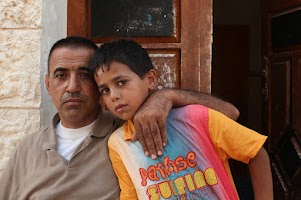 Across the olive grove and by Kiryat Arba’s barbed wire fence lives Kayid Dana and his brothers. Another stunning view embraces you from just outside their house, disrupted only by a looming Israeli watchtower. Most of the occupied West Bank is spotted with these grey towers. Watching from their windows, the ever present occupation, reminding Palestinians that privacy is a luxury that few, if any, enjoy.
The Dana family has been living on the same land for over 50 years. In 1958, the Israeli authorities repetitively offered them money to leave the house and make room for the growing illegal settlement. The family refused and nonetheless Israeli forces bulldozed half of their garden.
As of June 24, the Dana family has been without water. Israeli authorities prevented water trucks from entering the area to refill their water tanks. As a result, Kavid and his family are relegated to pump water from an unsanitary well outside their home. This is where they encounter the next problem: water is only available for a couple of hours each day. This is not enough to supply their 4 camels (100 liters/day) and the most basic household needs.
North of the Dana family home, through the olive groves, lives the Abdul Hay family (Abu Hossni). Their windows are fenced to prevent Israeli settlers from shattering the glass with the stones they throw. On December 4, the family was subject to a vicious attack that left 3 with dumdum (expanding bullet) wounds. Dumdum bullets are a type of live ammunition that enter the body, expand, and cause permanent injuries or death. Although dumdum bullets have been known to be used by Israeli settlers, they are illegal according to international law.
Jamal Abu Saifan, who lives in the area, captured the incident on his camera and explains how a lightly injured Israeli settler was choppered away 15 minutes after his injury, whereas the 3 Palestinians wounded by gunfire, one critically, waited 3 hours for an ambulance.
The ambulance attempting to reach them was stopped and denied entry to the area by Israeli forces.
Unfortunately, settler attacks are far from rare and have been occurring since Kiryat Arba was established in 1968. The purpose of these violent attacks, and the army violence and policies that accompany them, are not only to injure people and destroy their lands. That is only a strategic measure to reach an ultimate goal: the ethnic cleansing of Palestine.
The next step by Kiryat Arba is the construction of a new road which will divide the vital Palestinian olive groves down the middle. The road will be inaccessible to Palestinians, not only preventing Palestinians from tending to their trees on the other side, but annexing further land, expropriating an economic necessity, and making life more difficult for the indigenous Palestinians.
Despite the collection of circumstances to make life difficult, all the families in the area have made the choice to remain on their land despite the uncertainty and pressures of their everyday life under Israeli occupation.
Related articles
- Hebron: Over 30 detained (alethonews.wordpress.com)
- French activist injured as Israeli troops attack Hebron (alethonews.wordpress.com)
- Renegade Jewish Settlers (alethonews.wordpress.com)
- Weekly Report On Israeli Human Rights Violations in the Occupied Palestinian Territory (altahrir.wordpress.com)
- Palestinian stabbed, shot in settler attack near Nablus (alethonews.wordpress.com)
- Hebron: Israeli settlers occupy Palestinian home (alethonews.wordpress.com)
Palestinian stabbed, shot in settler attack near Nablus
Ma’an – 07/07/2012
 NABLUS – A Palestinian man was shot by Israeli forces in the northern West Bank on Saturday, after which a group of Israeli settlers stabbed him repeatedly, a Palestinian official said.
Jawdat Bani Jabir, 43, was shot in the face and the foot by soldiers in Yanun village, south of Nablus, governorate official Ghassan Daghlas told Ma’an.
A group of Israeli settlers who had descended into the village proceeded to stab him in several places, Daghlas added. Jabir’s condition could not be immediately confirmed.
An Israeli army spokesman said he was looking into the incident.
Daghlas said the settlers had entered Yanun village, and fatally stabbed five cattle. He pointed out that the village depends on agriculture and livestock.
Villagers came out to defend their homes, the official added.
Yanun is surrounded by Israeli settler outposts, illegal under both international and Israeli law.
Yanoun: Settlers and soldiers attack village, injuring 5
8th July 2012 | International Solidarity Movement, West Bank
On Saturday 7 July, 2012, the village of Yanoun, located 12km southeast of Nablus, was attacked by illegal settlers from the illegal Itamar settlement. Five Palestinians were injured in the attack and large sections of agricultural land were set ablaze.
The attack began at roughly 2pm. The illegal settlers descended on the village and began setting fire to sections of land and firing on sheep while they were grazing. In the course of the attack on Yanoun, 5 residents of Aqraba, (the neighbouring village) were injured to varying degrees. Two men, Ibrahim Hamid Ibrahim, and Adwan Rajih bini Naber were beaten by settlers, and another, Joudat Hamid Ibrahim was stabbed in the shoulder after being beaten as well. When the Israeli Occupation Forces (IOF) arrived, they joined in the attacks, injuring two more. Hakimun Ahmed Yusuf Bini Jaber, 42, was shot in the arm with live ammunition by an IOF soldier and Ashraf Adel Hamid Ibrahim, 29, was shot in the back with a tear gas canister when the soldiers attempted to scatter villagers who were aiding the injured.
The villagers who were aiding the injured attempted to carry the injured men to ambulances, but IOF soldiers blocked the roads and refused to let them through. The IOF and illegal settlers also stopped residents from putting out the fires. The first ambulance to leave was reportedly stopped at Huwwara checkpoint en route to a hospital in Nablus. Two of the injured men were taken from the ambulance and held in Israeli custody for an undetermined period of time. The second and third ambulance were not allowed to depart with those wounded for two hours.
After the attacks had stopped, IOF soldiers still held Adwan Rajih Bini Jaber captive, refusing to allow the ambulance carrying him to depart. Illegal settlers stood by heavily armed, protecting the fires that they had set to Palestinian land.

Nearing 6pm, illegal settlers and IOF soldiers once again advanced on the Palestinians, as internationals gathered to show solidarity, ending in the firing of tear gas canisters and live ammunition into the air.
Yanoun and its residents have been subject to terrorism by illegal settlers from Itamar for many years. On October 19, 2002, there was a temporary mass exodus due to the harassment, drawing parallels with the refugees created in 1948. The villagers returned little by little in the weeks following, with the help of peace activists from Ta’ayush & other groups but the village still suffers from violent attacks regardless.
Related articles
- Renegade Jewish Settlers (alethonews.wordpress.com)
- Jewish settlers attack village, block Nablus road (alethonews.wordpress.com)
- Israeli kills 2 Palestinians near Hebron (alethonews.wordpress.com)
- Settlers Uproot 41 Olive Trees Near Nablus (occupiedpalestine.wordpress.com)
- Official: Settlers erect homes, level land by Nablus outposts (occupiedpalestine.wordpress.com)
- Israeli settler shoots Palestinian in West Bank (theuglytruth.wordpress.com)
- Official: Settlers torch agricultural field near Hebron (altahrir.wordpress.com)
- Jewish teens ‘tied up and beat’ man shot by settlers (alethonews.wordpress.com)
Aqaba: Family of 12 receives home demolition order
28 June 2012 | International Solidarity Movement, West Bank
On Sunday, June 24 in Aqaba, Muhammed and Nassa Al-Jabba received a demolition order by Israeli authorities demanding that they evacuate the premises of their home within the next 3 days. The Al-Jabba family have not evacuated the home as it is the sole residence for their family of 10 children. The Israeli military may arrive at any time to demolish the building in the Area C (Israeli civil and security control) village.
Upon arriving in the village of Aqaba, International Solidarity Movement (ISM) volunteers spoke with the mayor, Haj Sami, an older man left wheelchair bound after suffering 3 gunshots from Israeli soldiers while working on his farm in 1971. He was only 16 years old at the time and fortunate to survive.
Haj Sami introduced ISM volunteers to Nassa Al-Jabbar, the mother of 10 who has been faced with a demolition order, giving her only 3 days to abandon the premises before the Israeli army is able to arrive with bulldozers and raze her home.
Nassa and her husband Muhammed have spent 10 years building their home. When asked why it took them so long, Nassa replied that because a permit to build on their own land is impossible to attain from Israel, the house was built in 7 different stages in order to avoid the soldiers attention.
Nassa says that if Israeli forces demolish her home, she, her husband, and her 10 young sons and daughters will have no other place to go. They do not have the funds to build another home.
Muhammed states that regardless of the outcome, he will not leave his home. If demolished, their house will join the over 24,000 Palestinian homes that have been demolished since 1967.
Nassa and Muhammed’s home is not the only building that faces demolition. Four other shelters and a concrete factory have received orders as well.
The village of Aqaba has suffered extensively from the Israeli occupation. Of a population of 1000, 700 residents are internal refugees. The villagers live in constant threat of home demolition.
On September 15, 2011, two animal shelters and a home were demolished. There was no advance warning, not even a demolition order. The roads that provide easy access into the village were also destroyed by Israeli forces. On a weekly basis, Israeli forces hold military training near the village, subjecting Aqaba to the sound of gun shots. On Tuesday morning however, the Israeli military began also training with tanks. The explosions are resulting in stress and trauma for the villagers.
If allowed to happen, Nassa and Muhammed’s home will join the list of thousands of demolitions inflicted on Palestinians by the Israeli military occupation.
Related articles
- Five houses, and another five, and a bulldozer, and a prison cell (adam-keller2.blogspot.com)
- Israel Plans Demolition of Entire Palestinian Village (alethonews.wordpress.com)
- Israeli military training in Al ‘Aqaba village, West Bank | #PHOTOS & #VIDEOS (occupiedpalestine.wordpress.com)
- Al Aqaba (altahrir.wordpress.com)
- Israel’s military training in Al-Aqaba northern Jordan Valley (occupiedpalestine.wordpress.com)
Jordan Valley: Palestinian family’s water confiscated, internationals arrested
25 June 2012 | International Solidarity Movement, West Bank
On Thursday, June 21, Israeli forces confiscated a water tank from a Bedouin Palestinian family in the Jordan Valley, leaving them with no access to water. Three Swedish women were arrested for standing in solidarity with Palestinian women and children who peacefully protested by standing in between the Israeli military and the water tank at risk of theft.

Israeli soldiers deal violently with a Palestinian woman peacefully protesting the theft of her water tank
The Jordan valley is a fertile area ideal for agricultural production. When Israel took control of the West Bank, it immediately took hold of water resources and began to target Palestinian communities and empty them from the Jordan Valley. The villages left are isolated from each other not only by distance but by Israeli checkpoints, closed military zones, and other restrictions on movement. The Israeli military performs military training in proximity to many communities, putting them at constant risk.
The illegal occupation of water resources has made water access an urgent problem. The United Nations declares water a basic human right. The World Health Organization has declared that each individual needs access to 100 litres of water per day, but Palestinians use on average between 50 to 70 litres per day. Many Palestinians in the Jordan Valley however, receive as little as 10-20 litres per day. This is a figure lower than the absolute minimum daily consumption required to avoid ‘mass health epidemics.’ Families in the Jordan Valley are forced to buy water at incredibly inflated prices. Some households spend 40-50% of their income to buy water from Israeli companies.
“When we came to the Bedouin camp, children were crying and there were a lot of soldiers trying to drag them away from the tractor that they tried to block. There were no men, only women and children, and around 60 soldiers and policemen. The Bedouin men were scared to show any resistance because of the risk of administrative detention,” says Rosa Andersson, one of the women who was later arrested.
The Swedish women were released after 30 hours of arrest and they are now prohibited from being in the West Bank. No one, Palestinian or International, showed any violence. The Palestinian family dependent on the confiscated water tank now has no access to water as the driest season of the year has just begun.
Related articles
- 18 year old shepherd shot by Israeli soldiers in Jordan Valley (alethonews.wordpress.com)
- Palestinian farmland exploited for Israeli military exercises (alethonews.wordpress.com)
- The Forcible Transfer of the Palestinian People from the Jordan Valley (alethonews.wordpress.com)
- Israeli Forces Destroy Tents, Shacks in Jordan Valley (occupiedpalestine.wordpress.com)
- Susiya: Another Casualty of Israeli Occupation? (alethonews.wordpress.com)
- Bedouin Community Demolished, Thirty People Displaced (altahrir.wordpress.com)
- Israelis Stop Palestinians from Getting Drinking Water (altahrir.wordpress.com)
- IOA serves demolition notices in occupied Jerusalem, Jordan Valley (occupiedpalestine.wordpress.com)
Hebron: Israeli settlers occupy Palestinian home
May 30, 2012 | International Solidarity Movement, West Bank
On Wednesday, May 23, a group of Israeli settlers forcefully occupied the home of a Palestinian family near the illegal Tel Rumeida colony in the Palestinian city of Hebron. In an incident that lasted 3 hours, settlers forced their way into the house and began physically and verbally abusing the family. The family was evacuated by Israeli soldiers. The settlers then blocked the entrance, preventing the family from entering the premises.
At 6p.m., Muhammed Toma Aburmeli was working in his shop in Tel Rumeida when he received a call from his distressed wife requesting that he come home immediately. As he returned home he saw his wife and young children standing near checkpoint Gilbert, with his home surrounded by Israeli soldiers. Looking closer at the entrance of his home, Muhammed saw a large group of young Israeli settlers standing outside his doorstep and preventing the family from entering.
At approximately 5:30 p.m., Muhammed’s wife, Merfat Muhammed Aburmeli, and 4 children, the eldest only 8 years old, were inside their new home located on the same road as the illegal Tel Rumeida settlement. The family was preparing to move furniture into the house. As the preparations were underway a group of 15 to 20 settlers no older than the age of 16 stormed into the house.
The settlers immediately confronted the frightened family, insulting them and demanding that they leave the home. The young settlers repeatedly claimed that the land is theirs and that the Palestinian family has no right to live here. As well as the verbal barrage, the settlers began to violently push Muhammed’s wife and her children.
The harassment lasted 10 minutes before Israeli soldiers intervened. Checkpoint Gilbert is only 3 metres from the house so this can be considered a slow response on behalf of the soldiers.
Israeli military arrived and the settlers continued to abuse the family. The first thing the soldiers did was evacuate the Aburmeli family, rather than force the settlers to leave. The family was then ordered by the military not to return to their house until the settlers were gone.
The Israeli soldiers requested that the settlers leave. The young Israeli settlers ignored the request and ran through the house causing damage. Ten minutes passed before soldiers resorted to physical means to force them out of the home. The settlers showed resistance, shoving soldiers as they dragged them out.
After evacuating the premises, soldiers locked the house’s door. The young settlers then blocked the entrance to the home from the outside. The Israeli military made no effort to disperse the group and instead soldiers surrounded the house.
When Muhammed arrived at the scene he asked the soldiers what was happening. The soldiers shrugged off his question and instead demanded that he show identification. After handing back his ID card, he too was told to go stand with his family and wait for the soldiers to diffuse the situation.
Soldiers made no efforts to remove the settlers, and Muhammed and his family were left standing outside and waiting for almost 3 hours before the settlers began to leave by themselves at 8:30 p.m.
Muhammed, Merfat, and their young children returned to their home. They say that what is upsetting is not only the behaviour of the illegal Israeli settlers, but the incompetent reaction of the Israeli army. This harassment, however, is not a new ordeal for the Aburmeli family. Only one day before, settlers damaged a window of their home by hitting it with sticks. In their last home, located nearby, settlers similarly blocked the entrance on more than one occasion.
Families living near the illegal Tel Rumeida settlement, which occupied a section of houses and roads in downtown Hebron, have long been the subject of abuse and discrimination coming from both the settlers and Israeli policies. Currently, only 2 Palestinian families remain living in what is now the Israeli settlement.
These 2 families are not permitted visitors, even family members, because all other Palestinians are prevented by Israeli soldiers from entering. These families in particular face abuse by the Israeli settlers on a regular basis. It can be difficult for the families even just to walk without being pelted by stones or being subject to insults.
Muhammed fears that incidents such as these will continue to occur, but says that no matter what happens he will never leave his home because he, as well as other Palestinians, has a right to live in freedom, peace, and dignity in his own land, and illegal settlers can not force them to leave. He finishes by saying, “if they wish to do worse, then let them, because we will not leave. As the olive tree will continue to live here, we Palestinians will continue to live here.”
Related articles
- Two Palestinians arrested as Israeli settlers forcefully enter their property (alethonews.wordpress.com)
- Bethlehem: 18 year old Palestinian stabbed (alethonews.wordpress.com)
- Israeli settler shoots Palestinian in West Bank (theuglytruth.wordpress.com)
- Israeli settlers injure three Palestinians, uproot dozens of olive trees in two separate incidents (alethonews.wordpress.com)
- Israeli Soldiers Invade Homes In Hebron, Jewish Settlers Attack Young Man (alethonews.wordpress.com)
- Jewish settlers shoot Palestinians as Israeli soldiers stand idle (altahrir.wordpress.com)
- (Again) Israeli settler shoots Palestinian in West Bank (occupiedpalestine.wordpress.com)
- Israeli settlers storm into Palestinian home, occupy residence (alethonews.wordpress.com)
Two Palestinians arrested as Israeli settlers forcefully enter their property
28 May 2012 | International Solidarity Movement, West Bank
On Friday, May 25, illegal Israeli settlers drove into the village Lubban ash-Sharqiya where they attempted to forcefully enter a family’s home. When Israeli soldiers and policemen arrived at the scene they joined the settlers, supporting’ them whilst they tried to enter the house.
Men of the Palestinian family, together with International Solidarity Movement (ISM) volunteers and other internationals, stood at the gate of the house to prevent the settlers from entering. The father of the household, Khaled Daraghmeh, and his son were then beaten and arrested.
Lubban ash-Sharqiya is a village located some 30 kilometres south of Nablus, adjacent to Route-60, the primary north-south road that runs through the occupied West Bank. The village is surrounded from all directions by 3 illegal settlements: Eli, Shilo, and Ma’le Levona. The illegality of these Israeli colonies has been confirmed by the International Court of Justice and the United Nations Security Council.
On the outskirts of Lubban ash-Sharqiya, near the colony Ma’le Levona, Khaled Daraghmeh lives with his family. Khaled, like many other Palestinian villagers, works as a farmer and is dependent on what the harvest provides him. Living next to Israeli settlements is not an easy fate for Palestinians and Khaled has suffered a lot.
“It began to get really bad about five years ago. That was when the Israeli Occupying Forces (IOF) demolished my first house.” says Khaled.
After his first house was demolished, Khaled moved to his father’s old house just across the road. The peace he sought there did not last long. Only a couple months later, settlers attacked and burned down the entire building. Khaled was then forced to move to a third house, an ancient Ottoman building that also belongs to his father. Here the family lived in one part of the house, using the remaining space as a poultry farm.
The settlers have made it clear, however, that they are determined to get rid of Palestinians in the area. Last Saturday, some 50 settlers forcefully entered the house, removed all the furniture, and burned it. They also poisoned the drinking water of the poultry farm, leading to the death of most of the animals inside.
Now Khaled is frightened of life in his own home. He welded the door to the living area and moved into a small, dark room, where he used to keep animals.
“In the past, I was able to repair or rebuild what the settlers destroyed, but now I have used up all my savings,” says Khaled.
The harassment continues til today. As Khaled worked his land, a settler car stopped at the road and began making phone calls. He feared a new attack and called the ISM, seeking their immediate presence. Upon their arrival, the settlers had already left and everything appeared calm. Later, while the group of Palestinians and internationals sat together having lunch, approximately 20 settlers of all ages arrived and started walking towards the Ottoman house.
Palestinians from the area, accompanied by the ISM, approached the settlers and asked them what they were doing here. They replied that the land was ‘community property’ and that they had the right to be there. Khaled, who owns the land and has all the needed documents to prove it, replied by saying that this is his land, and that he wanted them to leave.
While the discussion continued, an Israeli military jeep with 6 soldiers arrived and began to split up the crowd. A policeman told the settlers that they could not enter the house as it belongs to Khaled and his family. The settlers grew upset with the policeman and screamed that he was a coward and afraid of the internationals and their cameras.
A discussion in Hebrew took place between them and meanwhile another police car arrived and 2 other policemen joined the crowd. After a couple of minutes of heated dialogue, the 3 policemen, the 6 soldiers, and the illegal settlers walked towards the house while the settlers screamed, “you see, you see, now we can enter!”

Jamal Daraghmeh is peppersprayed and loses his shoe in the violent arrest | Katarina Reigo
The Palestinians together with the internationals formed a line at the gate of the house to prevent the approaching group from illegally entering the house. Khaled was wrestled to the ground and beaten by soldiers and police men, even after being handcuffed. When Jamal, Khaled’s 21 year old son, saw his father beaten and attacked, he ran over to try to help. When he reached, the soldiers and policemen attacked Jamal in the same way they did his father.
Khaled’s 17 year old son, Jalad, then tried to help them and was instead attacked by the settlers and pushed away by the soldiers.
As the policemen walked away with the handcuffed men, they struck Jamal in the head a couple of times. The youngest son, Mu’min, 14, was filming the attacks on his brother and father when the policemen tried to kick him in the head. The boot missed him only by a few centimetres. Then policeman pulled the camera out of the teenager’s hands and stole it.
Only moments later, Jamal was pepper sprayed in the face before they forced him into the police vehicle. Khaled was then pushed into the jeep with bleeding hands from the brutal handcuffing.
“This has become normal to us. My father has been arrested 4 times recently and my brothers is beaten up all the time. Mu’min can not even walk to school without the settlers attacking him,” says Jalad.
To survive as a Palestinian living adjacent to these illegal settlements, can, with the assistance of the Israeli Occupation Forces, feel like a losing game. Only last year, 250 to 270 of Khaled’s olive trees were uprooted by settlers. Last week, an entire field of cucumbers was destroyed along with the irrigation system of the family’s land.
These attacks have pushed the Daraghmeh family into the desperate situation they are now in. After being forced to start over again and again, they have no money left. They can not repair the things that are destroyed, leading to a bad harvest, and less income.
Simultaneously, the Israeli state has offered Khaled 5 million shekels (1 million Euros) for his land. But as many other Palestinians, he is rejecting the money, and the resulting ethnic cleansing, and will continue to live and work on his land even if it means sleeping in a small, dark room with no electricity or running water.
Related articles
- Bethlehem: 18 year old Palestinian stabbed (alethonews.wordpress.com)
- Israeli settlers injure three Palestinians, uproot dozens of olive trees in two separate incidents (alethonews.wordpress.com)
- Hebron teen ‘shot by Israeli settler’ (alethonews.wordpress.com)
- Impunity Under the Law: Settler attack in Jabari neighborhood (alethonews.wordpress.com)
Bethlehem: 18 year old Palestinian stabbed
27 May 2012 | International Solidarity Movement, West Bank
18 year old Saleh al-Zoghayer, who was recently stabbed by Israeli soldiers in Bethlehem, has been at the centre of the media recently. Several contradicting and false reports surfaced along with a shocking photograph of Saleh following the stabbing.
On Sunday, May 20, Saleh took a day off. Leaving his construction job in the town of Tobas, he travelled to Bethlehem to visit doctors there due to an illness. Upon arriving in Bethlehem, it is uncertain as to why, he was instructed by Israeli soldiers to exit the vehicle in which he was a passenger. Saleh found himself in the midst of a bike tour held by illegal Israeli settlers. The tour in question was held for Jerusalem day and was heavily guarded by Israeli Occupation Forces (IOF).
According to Israeli media sources such as Ynet and Hareetz, Saleh attempted to stab an IOF soldier and instead harmed himself. At first, both Palestinian and Israeli news sources suggested that Saleh had died from his injuries but this was not the case.
Saleh’s father, Nidal Mohamad al-Zoghayer, was interviewed by International Solidarity Movement (ISM) volunteers on May 23 and an entirely different story emerged. Nidal says his son is not the “Palestinian terrorist” that Itamar Fleishman of Ynet baselessly suggests. Saleh was on the receiving end of criminal violence, said Nidal, and not from IOF soldiers but from the illegal settlers.
Having been denied permission from Israeli authorities to go visit his son, Nidal relays to ISM what his lawyer said after seeing Saleh with his own eyes.
According to Nidal’s lawyer, Saleh is recovering and in stable condition. He suffered multiple stab wounds, with two perpendicular wounds across his abdomen and one near to his heart. Barely able to sit up in his hospital bed, his legs are tied together at the ankles with cuffs. Three IOF soldiers are positioned at his door at all times.
Nidal tells us the IOF are detaining his son and upon his recovery, Saleh will be charged with ‘assaulting a soldier.’ He finds the IOF’s version of events highly unlikely. If Saleh had indeed attacked a soldier in an area with a large military presence, says Nidal, he would have immediately been shot.
Saleh is not a political activist, said Nidal. “My son has no political affiliation, and has never been detained before this incident. He works 6 days a week, Saturday to Thursday, only to come to Hebron on Friday evening to spend time with his family and friends.”
Illegal settlers are known for their violent behaviour against Palestinian men and women of all ages. Just one day prior to Saleh’s stabbing, settlers attacked the town of Asira Al-Qibliya, shooting live ammunition and injuring several including one man who was shot in the head. Israeli soldiers were present but did not interfere with the settlers’ attack as has become routine in the occupied West Bank.
 Nidal showed photographs of wounds to Saleh’s neck that indicate a struggle as well as further photographs of his son covered in blood, with IOF soldiers standing on his hands.
Nidal says that if the IOF is able to stand by as illegal settlers fire live ammunition at unarmed villagers, then it should not be controversial for him to suggest they stood by and allowed an attack on his son. “There are many cameras in that area and soldiers are on hand 24 hours a day. I want to see the Closed Circuit Television (CCTV) footage of what really happened to my son.”
This would be the only hope for Saleh to prove his innocence as the Israeli military courts are notoriously unjust: 99.74% of cases heard by the military courts against Palestinians in the West Bank end in a conviction. In Israeli military courts, the word of a soldier is enough evidence to convict even a minor.
Saleh was in the midst of saving money for his wedding and the purchase of a home. He is one of 8 children, the eldest of which is currently held in an Israeli prison. Originally having been detained by the Palestinian Authority for his political views, Saleh’s eldest brother was re-incarcerated by the IOF upon his release, without a chance to see his family in between.
Saleh’s uncle, Ahmed al-Zoghayer, also sat down with the ISM. He reenforced Nidal’s belief that if his nephew had attempted to attack a soldier he would have been shot.
Ahmed clarified one of the reasons for Saleh’s presumed death. The ambulance carrying Saleh was late to arrive at the scene. When it arrived, his heart had stopped and he was believed to be dead. Defibrillators were used and his heart began beating again. Saleh was then successfully operated on.
An 18 year old has been accused of attacking an IOF soldier. His family contests this and their demand for CCTV footage has not yet been responded to. ISM supports the call for its obtainment.
Related articles
- Yitzhar settlers attack school children in Urif (alethonews.wordpress.com)
- Teen stabbed by soldiers in ‘stable condition’ (altahrir.wordpress.com)
- OCHA: 160 Palestinians wounded in IOF attacks in one week (windowintopalestine.blogspot.com)
- DFLP leader calls for settler watch groups (occupiedpalestine.wordpress.com)
Palestinian farmland exploited for Israeli military exercises
May 22, 2012 | International Solidarity Movement, West Bank
Monday May 21 is the third day in a row of Israeli military exercises in and around the small Palestinian village of Khirbet Atwayel outside Nablus. These exercises prevent the farmers from working on their lands and force the villagers to sleep under the sound of heavy shelling with the constant presence of soldiers.
Khirbet Atweyel is a village located on the slopes West of the Jordan valley. The 18 families that reside there are almost exclusively farmers and have been victims to the actions of the Israeli Occupation Forces (IOF) for a long time.
Every month, Israeli soldiers arrive, erect tents, and stay for a few days while they receive various kinds of military training. These include the shooting of live rounds, rocket missiles, and other heavy artillery. During these days, the farmers are denied entry to their own lands and can only stand aside and watch while soldiers drive their jeeps and other vehicles over the fields.
Volunteers with the International Solidarity Movement (ISM), together with members of the municipality of the nearby town of Aqraba, approached the village on Monday, May 21.
“As usual, the soldiers stop their activities when they see internationals in the village. Only ten minutes ago they were shooting rockets on the hills a couple of hundred meters from the town’s houses,” Basem, the mayor of Khirbet Atwayel says.
Later, whilst two ISM activists attempted to approach the field in order to better photograph the military tents, Israeli soldiers opened fire nearby. The activists were forced to turn around and flee the way they came. A rocket was fired on an adjacent hill, creating an ear piercing bang.
“These rockets are the kind of weapons they usually shoot at night. If you come here between 10-11 p.m. you will find they shoot dozens, making it impossible to sleep,” Basem says.
The military training, however, is only one of many aspects of oppression that the people of Khirbet Atwayel suffer on a daily basis. Like many other villages in the Jordan valley, Khirbet Atwayel is in Area C. It is under full Israeli civil and military control. One result is that the villagers are not allowed to have wells or water cisterns. Instead, they are forced to buy water from Aqraba and transport it in tanks to their houses. This makes the basic necessity of water enormously expensive. Irrigation of crops has become impossible and farmers are left to hope that the winter will bring enough rain.
When asked for his thoughts about the future of his village, Basem replied, “the occupiers are obviously trying to get rid of us, but we were born in this village and this land has been within our families for generations. We will never leave and give up what is rightfully ours.”
Related articles
- Palestinian teen shot during Israeli military training (alethonews.wordpress.com)
- 18 year old shepherd shot by Israeli soldiers in Jordan Valley (alethonews.wordpress.com)
- Israeli Forces Abduct Palestinians From Across the West Bank, Take Them to Unknown Destinations (occupiedpalestine.wordpress.com)
- Israeli military armored vehicle rams Palestinian bus injuring at least 19 passengers (alethonews.wordpress.com)
Israeli Army Appoints Col. Eisner to New Position

PNN | May 5, 2012
On Friday, May 4th, Israel’s channel 2 revealed that the Israeli occupation army appointed Lt. Col. Eisner, who attacked a Danish ISM activist in the face with his rifle at the end of the confrontation on April 14, as a deputy commander of the Tactical Training Center in Tze’elim.
In his new position, Eisner will be responsible for training battalions of infantry and armor in battlefield simulations.
A Hebrew-language newspaper reported that through a private conversation taped by a third party which was broadcast on Channel 10, Israeli officers and students from the military school supported Eisner.
Chief of Staff Benny Grantz, who issued a decision to remove Eisner from his post as deputy commander of the Jordan Valley Brigade following the incident in April, also supported Eisner and contradicted the decision he had taken earlier.
“The IDF is a large military force and there are many events in many places and people can make mistakes. We work hard at it, but this incident is not representative of the IDF, or of Lt. Col. Eisner,” said Grantz
Though the Israeli army has denounced the attack on the pro-Palestinians activists and Eisner’s removal was on “moral grounds”, Israeli officers described the incident as just “professional and command failures.”
Related articles
- Israeli soldiers assault cycling group in Jordan Valley (alethonews.wordpress.com)
Featured Video
The First Pyrrhic Victory of the Vietnam War
or go to
Aletho News Archives – Video-Images
Frlom the Archives
The 52 Major Jewish American Organizations and Israel Celebrate Passover with the Slaughter of 25 Muslim, Christian and Secular Palestinians
By James Petras • Unz Review • April 8, 2018
Introduction
As of April 7, nearly three thousand unarmed Christian, Muslim and secular Palestinians have been wounded, over three dozen are in critical condition and at least twenty-five unarmed protestors, including children have been assassinated by hundreds of Israeli snipers and heavily armed troops shooting tank shells into crowds of civilians protesting their decades of incarceration by the racist Israeli state.
The Israeli government praised the ‘restraint and morality’ of the IDF, as did the fifty-two Major Jewish American Organizations (MJAO) who largely control the US Congress. These grotesque massacres began during the Christian Holy Week on Good Friday and Easter, coinciding with the Jewish Passover. The self-righteous officials of the MJAO and their relatives and friends broke matzos at joyful Seders as the blood of Palestinians soaked into ground at the fence containing the largest open-air prison camp in history, Gaza.
While tribal loyalties bonded the Israeli and Jewish American leaders, the politicians of the Western oligarchic electoral regimes refrained from criticizing the shocking display of brute force and even defended Israel’s cold blood mass killings of Palestinian civilians in their Gaza prison.
This paper will discuss and analyze the reasons for Israel’s willing Western accomplices and the centrality of its fifth column in the United States. … continue
Blog Roll
 Aletho News
- No time for losers: Why the war meant to save Israel may destroy it
- Top US Counterterrorism Official Resigns in Protest of Operation Against Iran
- Just Get Out! Now!
- Unpacking glaring contradictions in US-Zionist justifications for war against Iran
- Iranian model of warfare bleeds US dry while Persian Gulf states watch and learn: Analyst
- IRGC orders ‘defeated’ US to evacuate industrial facilities in region
- Hegseth’s call for ‘no mercy’ to Iranians deemed war crime
- Iran War Exposes Limits of US Military Power – Journalist
- Even The Neo-Cons Admit The Iran War Is Failing
- Inside the Caucasus Drone Corridor Fueling Tensions With Iran
- If Americans Knew
- Top US counterterror advisor resigns in protest of “war manufactured by Israel” – Not a ceasefire Day 158
- ‘I Liked the House’: When Israeli Soldiers Turn Palestinian Homes into Barracks
- ‘They Were All I Had’: Lebanese Father Buries Parents, 4 Daughters Killed by Israeli Bombing
- Israel and its supporters are causing attacks on Jewish institutions. Case in point: Michigan synagogue tragedy.
- These are the casualties and cost of the war in Iran 2 weeks into the conflict
- Chicago Teachers Union accuses AIPAC of swaying elections with ‘dark money’
- Predictions of another 9/11, amid Israel-US killing spree – Not a ceasefire Day 157
- As US-Israel war on Iran rages, Gaza faces massive dust storm – Not a ceasefire Day 156
- No let-up in attacks on Gaza as Israel takes on Iran, Lebanon – Not a ceasefire Day 155
- ‘Of Course’: IDF Drops Case Against Soldiers Accused of Raping Palestinian Prisoner
- No Tricks Zone
- Storing Green Energy To Last Germany 10 Days Would Require A 60-Million Tonne Battery
- New Studies: UK Sea Levels Were 4 Meters Higher Than Today During The Mid-Holocene
- Destructive Green New Deal: German Energy And Metal Group Warns Of Drastic Crisis
- New Study Documents A 20-Year Pause In Arctic Sea Ice Decline – Driven By Internal Variability
- Wake-up Call: Survey Shows Majority Of Germans Now Favor Postponing Climate Targets!
- Televised! Leading German Political Candidate Tells Schoolchildren CO2 Makes Sun Hotter!
- New Study: A Century Warming Of 1.1°C Is ‘Commonplace’ And ‘Not Unusual’ During This Interglacial
- New Study: ‘Internal Noise’ And Volcanic Forcing Can Trigger 10-15°C Warming Within Decades
- Glaciers Worldwide Are Suddendly Surging, Experts Blame Warming!
- Surprising Discovery: Sahara Is Greening…Billions Of Trees Where Once Thought To Be Barren
 Aletho News