The SCO Steps in Where UN Has Failed
Sputnik – September 1, 2025
The SCO has condemned Israel and the US for their attack on Iran in June. In a joint statement, they said that such aggressive actions against civilian targets, including nuclear energy infrastructure, which resulted in civilian deaths, constitute a gross violation of the principles and norms of international law and infringe on Iran’s sovereignty.
The SCO’s condemnation of Israeli and US strikes on Iran marks a turning point, Seyed Mohammad Marandi, Tehran University professor and political analyst, told Sputnik. “This is what we should have seen from the United Nations. Instead, the SCO and BRICS are emerging as the real alternative.”
Key takeaways:
- The West’s wars, sanctions, and support for apartheid regimes are pushing nations together and marginalizing the very institutions it built after WWII
- Iran’s membership in the SCO shows its people are not isolated—they have the backing of countries representing the global majority
- Asia’s rise is unstoppable: new trade corridors, Belt & Road, and collective security are shielding nations from Western disruption
- SCO is shifting into a real force: security, economic integration, and independence from Western financial institutions
Marandi: “Thanks to the West’s own foolish behavior, the SCO is becoming a central pillar of peace, security, and prosperity across Asia—and beyond.”
The reek of desperation hangs over Albanese’s Iran conspiracy theories
By Samuel Geddes | Al Mayadeen | August 31, 2025
The Australian Prime Minister and his government are resorting to increasingly laughable measures to deflect public anger at their continued support for “Israel”.
A day after “Israel” had committed yet another massacre against journalists in Gaza, luring them with a strike on a hospital before eliminating them in a “double-tap” maneuver, the Labor government of Australia announced a major imminent foreign policy measure.
For a brief, fleeting moment, it appeared as though Anthony Albanese had listened to the demands of hundreds of thousands of protesters marching almost constantly throughout the country and was going to impose sanctions on the Israeli entity or even expel its ambassador over the Gaza slaughter.
Instead, the PM and his foreign minister, Penny Wong, engaged in a kind of public humiliation ritual, in which they asserted that Iran had “attacked” Australia by sponsoring the firebombing of a Melbourne synagogue and a Jewish delicatessen in Sydney through a convoluted web of criminal intermediaries.
Based on this “intelligence” provided by the national spy agency ASIO, the PM then announced the expulsion of the Iranian ambassador and his staff and the proscription of the Islamic Revolution Guard Corps, an institutional part of Iran’s political system, as a “terrorist organization”.
When questioned live on national television on the specifics of what he was claiming, Albanese cut the figure of a lying schoolboy caught in the act, refusing to disclose any level of detail beyond the assertions themselves.
Scarcely a day has gone by, and already members of the Israeli government are crowing that they were involved in pushing Australia to take this action. Whether the Mossad was a source of the “intelligence” provided to the Australian Prime Minister is unclear, but to this and almost every other query for the specifics of the claims underpinning this major foreign policy shift, Albanese has steadfastly refused to comment.
The public reaction to the government’s assertions, at least online, has been less than charitable. Elementary questions of why, amid the full spectrum of military, economic, and political pressure on the country, Iran’s leaders would choose to pay local vandals in Australia to firebomb a Melbourne synagogue and a Sydney deli, are curiously uninteresting to much of the country’s media, which is all too willing to accept the government’s assertions at face value.
What benefit would Tehran possibly achieve by doing this, in Australia, of all places? The only other country possibly more removed from the Islamic Republic’s circle of concern, at least physically, might be New Zealand.
Of course, many will, and already have, concluded that this charade has less to do with any actual facts than it does the government’s ham-fisted attempts to deflect growing public outrage at its obstinate refusal to impose sanctions on “Israel” or even censure it for its genocidal behavior.
For nearly two years, since Oct. 7, 2023, the foreign minister, Penny Wong, has made it a near-daily ritual that each successive Israeli atrocity, rather than being condemned, is deemed merely a source of “concern” to the government.
Albanese himself, when the question of sanctions against “Israel” is raised, clearly seems to resent even having to address the issue, at one point rhetorically questioning what sanctions Australia should impose, seeming blissfully ignorant of his obligations under the Genocide Convention.
The government’s total disengagement stands in marked contrast to the Australian public, which has kept up one of the most consistent routines of public protest in support of Gaza, anywhere in the world. Just weeks ago, despite attempts to ban it, a protest spanning the Sydney Harbour Bridge drew global media attention. Just the following week, hundreds of thousands of demonstrators took to the streets around the country.
As of this week, tens of thousands of university students are voting in a nationwide referendum on whether to condemn the government for its inaction and to demand diplomatic expulsions and sanctions against Israel.
In May, the Australian Labor government was returned to power in a landslide election victory. The Liberal party, the official right-wing opposition, is widely considered unable to win back government even in the next election three years away, facing potentially as much as a decade in the wilderness.
Given its lack of any political rival, the government’s obstinate ignoring of public opposition to genocide hardly seems motivated by electoral calculations. In the face of an unstable Trump administration bringing the US alliance into question, it is more content to fall back on politicized narratives of “national security” written by the intelligence community rather than reacting dynamically to a changed world.
Whatever the real reasons for this government’s industrial-scale obfuscation, it speaks to a profound moral rot at the heart of its politics, rather than it needs to invent excuses to expel an ambassador, but cannot bring itself to expel that of an entity committing the defining slaughter of the century in real-time.
West Asia is lurching toward war
By M. K. BHADRAKUMAR | Indian Punchline | August 30, 2025
There is extremely alarming news about the situation around Iran. In consultations with the Trump administration — rather, in deference to the command from Washington — the E3 countries (Britain, France and Germany) who are the remaining western signatories of the 2015 Iran nuclear deal known as JCPOA, have initiated the process of triggering the so-called snapback mechanism with the aim to reimpose all UN sanctions against Iran on the plea that it has breached the terms of the ten-year old agreement.
A joint statement issued in the three European capitals on Thursday notified the UN Security Council that Tehran is “in significant non-performance of its commitments under the JCPOA” to give a 30-day notice “before the possible reestablishment of previously terminated United Nations Security Council resolutions.”
The E3 statement is patently an act of sophistry since it was the US which unilaterally abandoned the JCOPA in 2018 and the three European powers themselves have been remiss in ignoring their own commitments to lift the sanctions against Iran through the past 15-year period, which only had ultimately prompted Tehran to resume the uranium enrichment activity — although the Iranian side was ready to reinstate the JCOPA as recently as in December 2022.
A strange part of the E3 move is that they short-circuited the prescribed procedure in regard of the snapback mechanism with the intent to reduce the two other permanent member countries of the Security Council to be mere bystanders with no role whatsoever in the matter. Unsurprisingly, Russia and China have taken exception to this and in a lengthy statement on Friday, the Russian Foreign Ministry has demanded (with China’s backing) an extension of the time line by another six months by the Security Council as an interim measure so as to avoid a standoff with dangerous and tragic consequences.
Tehran has welcomed the Russia-China proposal as a “practical step.” Iran, of course, has explicitly warned that any such attempt by the E3 to reimpose the UN sanctions against it may compel it to reconsider its membership of the Nuclear Non-Proliferation Treaty.
It remains to be seen whether the E3 — or more precisely, the US-Israeli nexus which is the driving force behind the precipitate move — will be amenable to a compromise. All indications are that Israel with the full support of the Trump administration is spoiling for a fight with Iran and make a second attempt to force regime change in Tehran and the restoration of the erstwhile Pahlavi dynasty to replace the Islamic system that got established after the 1979 Islamic Revolution. Simply put, it is a make-or-break attempt by the US and Israel to bring about a geopolitical realignment in the West Asian region.
The US and Israel have drawn lessons out of the miserable failure of their first attempt in June to overthrow the Islamic system in Iran, and Israel suffered huge losses as Iran retaliated. This time around, the US and Israel seem to be preparing for a fight to the finish, although the outcome remains to be seen. Indeed, a protracted war may ensue. The US is rearming Israel with advanced weaponry. At some point, early enough in the war, a direct American intervention in some form can also be expected.
Unlike in June when the Trump administration in an elaborate ploy of deception lulled Tehran into a state of complacency when the Israeli attack began, this time around, Iran is on guard and has been strengthening its defenses. Make no mistake, Iran will fight back no matter what is takes. Iran is also getting help from Russia for beefing up its air defence system and there are reports that Russian advisors are helping Iran’s armed forces to augment their capability to resist the US-Israeli aggression.
Many western experts, including Alastair Crooke, have predicted that an Israeli attack on Iran can be expected sooner rather than later. The Israeli-American expectation could be that Russia’s military operations in Ukraine will have reached a climactic point by autumn which would almost certainly preclude any scope for Moscow to get involved in a West Asian conflict, and that, in turn, will give them a free hand to take the regime change agenda to its finish.
Besides, in a policy reversal, Iran has taken up the standing Russian offer to provide an integrated air defence system. Such a system will possibly be in position by the middle of next year or so and it is expected to be a force multiplier for Iran. Israel will most certainly try to attack Iran before the integrated system which is connected to Russian satellites becomes fully operational. It remains to be seen whether the Trump administration will be able to withstand Israeli pressure, given the Mossad’s alleged involvement in the Epstein scandal.
A West Asian war of titanic scale will be unprecedented. Apart from large scale loss of lives and destruction, the regional turmoil that ensues will also affect the surrounding regions — India in particular. The point is, an estimated 6 million Indians live in the Gulf region. Their safety and welfare will be in serious jeopardy if the Gulf states get sucked in to the war at some point.
The probability is high that Iran’s retaliation this time around may involve the blockade of the Strait of Hormuz through which tankers carry approximately 17 million barrels of oil each day, or 20 to 30 percent of the world’s total consumption. If that happens, oil price will sky rocket and India’s energy security, which is heavily dependent on oil imports, will be affected. India’s main sources of oil supplies are Russia (18-20%), Saudi Arabia (16-18%), UAE (8-10%) and the US (6-7%).
Clearly, if the oil supplies from the Gulf region get disrupted, India’s dependence on oil flows from Russia will only increase further. In fact, there will be a scramble for Russian oil and, paradoxically, Trump’s best-laid plans to hollow out “Putin’s war chest” will remain a pipe dream.
Significantly, according to Israel’s Kanal 13, Russia has evacuated its diplomatic personnel and their families in its embassy in Tel Aviv in anticipation of a “dramatic” change in the security situation and growing signs of an outbreak of hostilities between Israel and Iran.
Iran’s parliament submits emergency bill to withdraw from NPT
Al Mayadeen | August 29, 2025
Following the announcement by the E3 (France, Germany, and the United Kingdom) to trigger the snapback mechanism on sanctions against Tehran, Iran’s Parliament has drafted and submitted an emergency bill proposing a full withdrawal from the Nuclear Non-Proliferation Treaty (NPT).
Hossein-Ali Haji-Deligani, Deputy Chairman of the Article 90 Committee of Iran’s Parliament, confirmed that the bill will be uploaded to the parliamentary system on the following day and subsequently reviewed in an open session.
“As we had previously stated, these countries were already implementing the consequences of the snapback mechanism, including sanctions against us. There is nothing new in this.” Haji-Deligani told Iran’s Tasnim.
He further stated that the steps taken were “the most minimal response by Parliament to the recent action of the European countries, and further regret-inducing measures are also on the agenda.”
Deputy chairman calls for decisive action
The proposed legislation comes amid growing frustration in Tehran over the West’s repeated failure to honor agreements and ease pressure on Iran. Haji-Deligani noted that Iran’s Parliament is determined to pursue a firm and deterrent course of action.
According to the lawmaker, the activation of the snapback mechanism effectively reinstates previous sanctions but introduces no new developments. Nonetheless, he emphasized that Iran’s response would be strategic and assertive.
Criticizing continued dialogue with Western countries, Haji-Deligani asserted, “Given what these three countries have done, negotiations with them are now meaningless. Dialogue will only embolden them.”
“We witnessed that during negotiations with the arrogant US, a brutal war was launched against our country by Israel, and the US bombed our peaceful nuclear sites,” he added. “Our people clearly know that talks with these countries have brought nothing but more pressure. Therefore, all dialogue must be suspended until these countries abandon their double standards.”
The emergency bill signals a potential turning point in Iran-E3 talks and highlights a significant policy shift in Tehran’s approach to its nuclear file. The move could impact the broader framework governing the Iran nuclear program and regional diplomacy.
Iran vows response
Iran’s Foreign Ministry confirmed on Thursday that France, Britain, and Germany have formally notified Tehran of their decision to trigger the “snapback” mechanism to reimpose United Nations sanctions under the 2015 nuclear deal.
Foreign Minister Abbas Araghchi condemned the measure as “illegal and unjustified,” warning that Tehran would respond “appropriately to protect and guarantee its national rights and interests.”
In a phone call with his French, British, and German counterparts, Araghchi urged them to “appropriately correct this wrong decision in the coming days.” He stopped short of detailing possible retaliatory steps but hinted that the E3 risk being excluded from any future negotiations on Iran’s nuclear program.
The E3 action came just days after Iranian and European diplomats held a second round of talks in Geneva, billed as a last chance to salvage engagement before the October deadline for invoking the snapback clause.
The discussions collapsed without “tangible commitments,” according to European officials, who claim that Tehran’s ongoing breaches of enrichment limits left them with no choice but to act. It is noteworthy that the E3 had failed to uphold their commitments in accordance with the JCPOA after the US unilaterally left the agreement in 2018.
How US-Israeli Regime Change in Iran Failed
By Kit Klarenberg | Global Delinquents |August 28, 2025
On July 29th, the Tel Aviv-based Institute for National Security Studies, a think tank that is enormously influential on Zionist entity ‘defence’ and security policy, published a document advocating for regime change in Iran, setting out potential methods by which Israel could achieve that malign end. In a bitter irony, much of the report’s contents not only attest to the implausibility of achieving such a goal, but lay bare how Benjamin Netanyahu’s calamitous ‘12 Day War’ has made this objective all the more unfeasible.
A flagrant deceit lies at the document’s core. Namely, “Israel did not set the overthrow of the regime in Iran as a goal in the war.” In reality, on June 15th Netanyahu menacingly declared the entity’s unprovoked attack on the Islamic Republic “could certainly” produce regime change. He claimed the government was “very weak”, and “80% of the people would throw these theological thugs out.” Such bold pronouncements were quickly silenced by an unprecedented and devastating missile barrage from Tehran, which Tel Aviv couldn’t repel.
Instead, INSS claims “some” military moves undertaken by the Zionist entity during the 12 Day War “were intended to undermine the foundations” of the Islamic Republic, and ignite mass public protests. However, the Institute admits “not only is there no evidence Israel’s actions advanced this goal, but at least some of them had the opposite effect.” The “clearest example” of this failure, per INSS, was Tel Aviv’s blitzkrieg of Evin prison on June 23rd – a “symbolic blow…intended to encourage public mobilization.”
As it was, scores of civilians, including prisoners and their family members, medical professionals, administrative staff, and lawyers were killed, which “aroused harsh criticism of Israel” even among “critics and opponents” of the Iranian government “inside and outside” the country, the Institute records. Western media and major rights groups condemned the action, with Amnesty International branding it a “serious violation of international humanitarian law” that “must be investigated as a war crime.”
Likewise, attacks on the headquarters of Iran’s internal security forces and IRGC branch Basij “had no noticeable effect and did not lead to eruption of public protests.” INSS suggests Israel’s reckless, indiscriminate targeting of civilian infrastructure during the conflict also neutralised any prospect of citizens taking to streets even if they were at all inclined to do so, due to concerns they may be caught in crossfire. Moreover, Tel Aviv’s belligerence elicited an intense “anti-Israel wave” among the public.
The Institute observes how Iranians “exhibited a notable degree” of “rallying around the flag” during the 12 Day War – “a willingness to defend their homeland at a critical moment against an external enemy.” IINS laments how any and all traces of public dissent in the Islamic Republic “have almost completely disappeared”, in the conflict’s wake. Today, there is no “organized, structured opposition” within or without the country capable of mobilising protesters, let alone displacing the Islamic Republic’s popular government.
Instead, Tel Aviv’s wanton bellicosity has only increased fears among Iranians that foreign powers are seeking to incite and exploit “anarchy and civil war…to impose an alternative political order” on Tehran. It also represented “the most traumatic event for the Iranian public” since the Iran-Iraq war during the 1980s. Millions of citizens, particularly younger generations external actors typically look to as regime change footsoldiers, “have now been exposed to the horrors” of “imposed” conflict – and are resultantly more united than ever against external threats.
‘Inadvertent Effects’
Meanwhile, the Islamic Republic demonstrated a “high level of internal cohesion”, and “ability to recover relatively quickly” from the Zionist entity’s initial onslaught. INSS bemoans how “there is no indication…of a significant and immediate threat to the stability” of Tehran. On top of the government enjoying “considerable support” among Iran’s “security and law enforcement apparatuses,” Mossad-controlled internal networks that initially wreaked havoc upon the 12 Day War’s eruption have been systematically hunted down, and liquidated. It will be difficult if not impossible to reconstruct them.
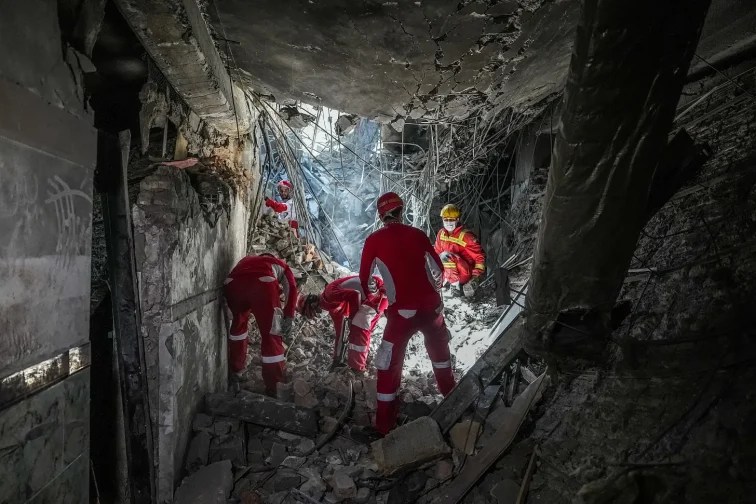
Iranian rescue workers sift through rubble inside Evin prison following Israel’s attack
Despite all this, the Institute inexplicably declares regime change in Tehran remains “a possible solution” and “worthy goal” – not just for the Zionist entity, but “the region, and the West.” The report sets out four “different strategies for overthrowing” Iran’s government, each more fantastical than the last. INSS advocates “beheading the ruling leadership” – assassinating “senior regime officials, including the Supreme Leader, his inner hive, and the heads of the political and military leadership,” arguing it might “create a reality that could develop into political change.”
The Institute alternatively suggests “a covert campaign to promote regime change, led by military, security, and political elements in Iran,” to foment a violent palace coup. Another option is “encouraging, organizing, and supporting opposition organizations in exile and training them for a quick return to Iran and taking over the centers of governmental power.” Finally, “providing aid and support to ethno-linguistic minorities while encouraging separatist tendencies and internal divisions within Iran” is mooted.
However, INSS contrarily concedes every proposed route “could lead to the opposite results of strengthening the government’s cohesion in Tehran and ‘rallying the public around the flag’,” and should thus be avoided. For example, the few Iranian diaspora who applauded the Zionist entity aggression’s against their home country, if not supported all-out insurrection in Tehran – most prominently monarchists – repulsed domestic audiences. “Large segments of the Iranian public” thus perceive them as “having betrayed Iran in its time of need”:
“Although aligning with pro-Western and pro-Israel diaspora groups that push for revolutionary change may seem natural, such associations may, in fact, undermine the credibility of internal opposition and ultimately obstruct the desired outcome.”
Similarly, the Institute warns assassinating Ali Khamenei – “raised as a possibility during the war” – “would not necessarily result in regime change,” and probably backfire spectacularly. The Islamic Republic “would likely have little difficulty selecting a successor, who could prove to be more extreme or more capable,” and the Supreme Leader’s murder “may also have inadvertent effects, such as elevating him into a martyr.” This would strengthen the government, solidify public opinion against Tel Aviv, and “complicate efforts to destabilize the regime through popular protest.”
Moreover, as a state that prides itself on religious and ethnic diversity and inclusion, “encouraging separatist tendencies” in Iran is likewise judged an ill-omened approach. INSS observes “heightened public sensitivity to any perceived foreign attempts to promote ethnic fragmentation” locally. Efforts to do so by Israel or its Anglo-American puppetmasters would inevitably “be viewed as trying to fracture the country” and rebound, “uniting large segments of the Iranian public against Israel.”
‘Capacity Problems’
No doubt disappointingly from Tel Aviv’s perspective, INSS concludes toppling the Islamic Republic “depends mainly on factors beyond Israel’s control, and on a catalyst whose prediction is elusive and may never materialize.” Despite purportedly “impressive operational successes” in the 12 Day War, the conflict amply demonstrated Zionist entity military action cannot “promote political change processes in Iran.” More generally, “historical experience shows regime change through foreign intervention brings highly questionable results at best” in West Asia:
“The US has failed to achieve the desired results in the vast majority of cases in which it has promoted moves for regime change, and Israel itself has problematic experience in intervening in another country for regime change – both in the First Lebanon War and in the considerable effort to topple Hamas in the Gaza Strip.”
Elsewhere, it’s suggested Iran “could be dragged into a strategic arms race with Israel, further depleting its already strained economic resources and deepening civilian suffering.” However, INSS acknowledges an almost inevitable upshot would be Tehran seeking nuclear weapons capability, given such an arsenal “would serve as an existential insurance policy.” In any event, “Israel, too, faces limits on its military and economic capabilities” – which is quite an understatement. Yet again though, the Institute ultimately endorses “Israel’s decision to actively act toward regime change in Tehran.”
Evidently, from the perspective of Tel Aviv and its Western sponsors, the regime change coast isn’t clear in Tehran. It is therefore imperative Iranian authorities and the public alike remain ever-vigilant of foreign-borne threats, seen and unseen. Yet, the INSS report abundantly underlines how in the 12 Day War’s wake, the Zionist entity has no good options left available, only scope for triggering far worse consequences for itself. And the Institute considerably downplays the extent to which the conflict was a counterproductive catastrophe for Israel.
It’s been reported senior entity officials had been preparing for June 13th since March, seeking to strike before Iran “rebuilt its air defenses by the latter half of the year.” The underlying plan to militarily cripple Tehran and trigger a popular revolution was in turn purportedly “carefully laid months and years in advance,” having been specifically wargamed in conjunction with the Biden administration. Israel gave Tehran its best shot, failed in its each and every objective, and was left battered.
Tel Aviv’s grand scheme to crush the Islamic Republic employed an extraordinary amount of finite munitions, at astronomical cost. A former financial adviser to the ZOF’s chief of staff has estimated the abortive campaign’s first 48 hours alone cost $1.45 billion, with almost $1 billion spent on defensive measures alone. Government economists place the daily cost of military operations at $725 million. Haaretz calculates civilian and domestic financial damage could run to many billions. This, while the entity’s economy is already barely-functioning.
Furthermore, the entity was reportedly running hazardously low on missile interceptors within five days, despite the US being cognisant of “capacity problems” for months prior, and spending intervening months “augmenting Israel’s defenses with systems on the ground, at sea and in the air.” A July report from Zionist lobby group JINSA warned, “after burning through a large portion of their available interceptors,” Washington and Israel “both face an urgent need to replenish stockpiles and sharply increase production rates.”
Grave questions abound over the pair’s ability to do either. JINSA notes US THAAD interceptors provided 60% of the entity’s air defence, expending roughly 14% of Washington’s total THAAD stockpile in the process – which “at current production rates” will take three to eight years to replenish. Iran’s “large-scale missile campaign” moreover “revealed vulnerabilities in Israeli and US air defense systems, providing lessons that Iran or other US adversaries could exploit in the future.”
In sum, the Zionist entity is a beast encircled, reduced to lashing out through desperation, not strength. Its ability to flail against not merely Iran, but the wider Axis of Resistance, without further endangering its already precarious position is extremely limited, if not non-existent. Wholly dependent on foreign support at a time polls indicate it’s the most hated ‘country’ on Earth, Tel Aviv still presumes the capability to make the next move against its adversaries. INSS’ report strongly suggests this could be its very last.
Iran’s foreign minister: Entry of IAEA inspectors does not signal full cooperation

Abbas Araghchi, Iran’s foreign minister
Press TV – August 27, 2025
Iran’s foreign minister has confirmed the arrival of inspectors from the International Atomic Energy Agency (IAEA) following a months-long hiatus.
Abbas Araghchi, however, said their presence does not mean the resumption of full cooperation with the UN nuclear watchdog.
Speaking to reporters in Tehran on Wednesday, the foreign minister said the entry was authorized by Iran’s Supreme National Security Council (SNSC) and limited to overseeing the fuel replacement process at the Bushehr Nuclear Power Plant.
He said under a recent parliamentary law, all cooperation with the IAEA must be approved by the SNSC.
“No text has yet received final approval,” he added, referring to ongoing discussions about a new cooperation modality following the acts of aggression by the Israeli regime and the United States in June.
Iran has barred any new inspections since the attacks, citing safety concerns at damaged nuclear sites and criticizing the IAEA’s failure to condemn the strikes.
Earlier, Behrouz Kamalvandi, spokesman for the Atomic Energy Organization of Iran (AEOI), said the inspectors’ presence was tied to routine operations at the Bushehr facility and the need to maintain electricity supply to the national grid.
On August 26, IAEA Director General Rafael Grossi announced that inspectors were “back in Iran.”
In an interview with Fox News, Grossi said, “When it comes to Iran, as you know, there are many facilities. Some were attacked, some were not.”
“So we are discussing what kind of … practical modalities can be implemented to facilitate the restart of our work there.”
The developments come amid renewed diplomatic tensions, as Iran held talks in Geneva with Britain, France, and Germany over their threat to trigger the so-called snapback mechanism, a provision of the 2015 nuclear deal that would restore UN sanctions lifted under the accord.
European signatories to the Joint Comprehensive Plan of Action (JCPOA) have said they will wait until August 31 to decide whether to activate the mechanism.
Iran has reduced its cooperation with the IAEA in recent years in response to the withdrawal of the United States from the 2015 nuclear deal and the failure of Europeans to make up for the withdrawal.
China decouples from US energy as key exports crash to zero
Inside China Business | August 25, 2025
Resources and links:
Iran FM says Australia’s envoy expulsion ‘appeasement’ of Israel
Press TV – August 26, 2025
Iran’s Foreign Minister has condemned Australia’s decision to expel Tehran’s ambassador over allegations of attacks on Jewish sites, describing it as an act of appeasement toward a “regime led by war criminals.”
In a post on X on Tuesday, Abbas Araghchi rejected Canberra’s allegation, citing Iran’s longstanding protection of its Jewish community.
“Iran is home to among the world’s oldest Jewish communities, including dozens of synagogues. Accusing Iran of attacking such sites in Australia while we do our utmost to protect them in our own country makes zero sense,” he said.
Araghchi said “Iran is paying the price for the Australian people’s support for Palestine”, referring to rising pro‑Palestine protests across Australia in the wake of the war in Gaza.
Earlier on Tuesday, Australian Prime Minister Anthony Albanese accused Iran of orchestrating two attacks on Jewish sites in October and December, allegations made without presenting evidence.
Media reports suggested the move could be aimed at countering Israeli criticism of Albanese’s government.
Tensions between Israel and Australia have already been running high after Canberra announced earlier this month it would join France and other nations in formalizing recognition of a Palestinian state at the UN General Assembly in September.
Israeli Prime Minister Benjamin Netanyahu reacted to that decision, accusing Albanese of “betraying Israel” and “abandoning Australia’s Jews” and labeling him a “weak politician.”
Araghchi said he was “not in the habit of joining causes with wanted War Criminals, but Netanyahu is right about one thing: Australia’s PM is indeed a ‘weak politician’.”
Issuing a warning to Australia, he added, “Canberra should know better than to attempt to appease a regime led by War Criminals. Doing so will only embolden Netanyahu and his ilk.”
Tehran has vowed reciprocal action in response to Australia’s move.
Europe lacks strategy to break snapback ‘deadlock’: Russia envoy
Press TV – August 23, 2025
A senior Russian diplomat says the European troika—Britain, France, and Germany—lack a clear strategy to break the “deadlock” they are poised to create if they follow through on their threat to invoke the “snapback” mechanism against Iran.
Russia’s permanent envoy to international organizations in Vienna, Mikhail Ulyanov, made the remarks in a post on his X account on Saturday.
He proposed to put aside legal and procedural issues which definitely do not give the E3 the right to trigger the snapback mechanism and to address the issue from a purely political viewpoint.
The Russian diplomat asked whether the trio has an exit strategy and a vision of how to find a way out of the deadlock they are going to create.
“The answers to these questions seem to be negative,” Ulyanov emphasized.
Snapback would bring into force six previous Iran-related Security Council resolutions adopted between 2006 and 2010. It would reinstate the expired UN arms embargo that barred countries from supplying, selling, or transferring most military equipment to Iran and prohibited Tehran from exporting any weapons.
It would also impose export controls, travel bans, asset freezes, and other restrictions on individuals, entities, and banks.
In a Friday phone conversation with the EU high representative for foreign and security policy and his British, French, and German counterparts, whose countries are the European signatories to the 2015 nuclear agreement, Iranian Foreign Minister Abbas Araghchi warned that triggering the snapback would have consequences.
The top Iranian negotiator once again emphasized that the European countries lack the legal and moral authority to resort to the mechanism.
China’s mission to the United Nations on Wednesday declared the country’s firm opposition to threats by European parties to the 2015 nuclear deal to activate the snapback mechanism within the framework of UN Security Council Resolution 2231.
The mission at the UN headquarters in New York distributed an explanatory note to the Security Council, stating that the difficult situation in implementing the JCPOA and Resolution 2231 is not the result of Iran’s actions but the disruption of the JCPOA’s implementation by the United States and the three European countries.
China and Russia’s backing plays a critical role in Iran’s diplomatic efforts to counter the snapback threat. Both countries are permanent members of the UN Security Council and have veto power over resolutions, including those related to Iran’s nuclear program.
Sabotage in the Skies: Was Pakistani General Zia-ul-Haq Murdered by Mossad?
The death of Pakistan’s military ruler remains one of the great unsolved puzzles of the 20th century
José Niño Unfiltered | August 17, 2025
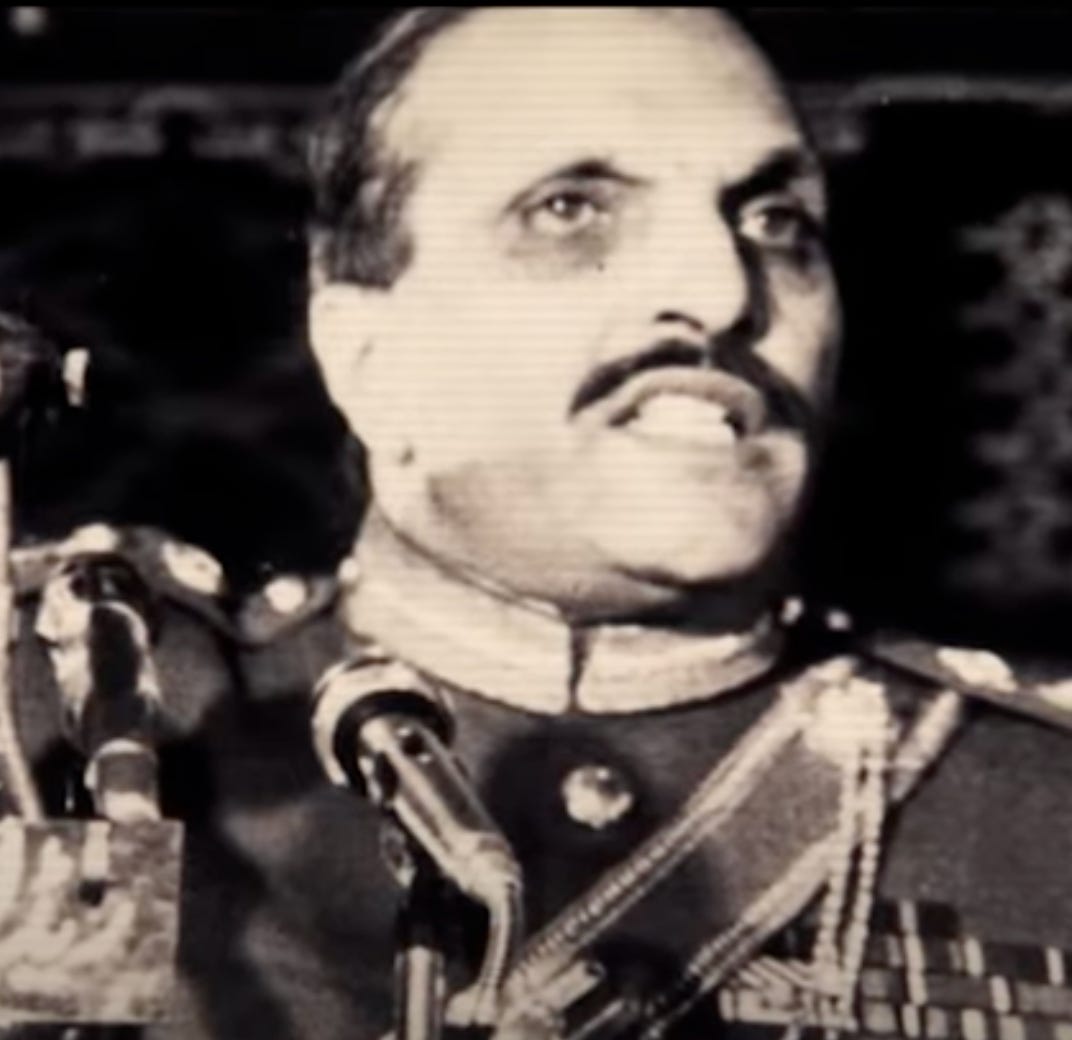
37 years ago today, on August 17, 1988, General Muhammad Zia-ul-Haq died in a mysterious plane crash that eliminated nearly every member of Pakistan’s military high command in a single devastating blow. The crash of Pak-1, a specially configured C-130 Hercules aircraft, near Bahawalpur claimed not only the Pakistani president and army chief but also Chairman Joint Chiefs of Staff Committee General Akhtar Abdur Rahman, several senior Pakistani military officers, U.S. Ambassador Arnold Lewis Raphel, and Brigadier General Herbert M. Wassom, head of the U.S. military aid mission to Pakistan.
Zia’s Strategic Legacy: Architect of Pakistan’s Nuclear Ambitions
Before examining the mysterious circumstances of his death, Zia’s foreign policy accomplishments merit recognition. During his rule (1978—1988), Zia transformed Pakistan from a middling regional actor into a regional power with the ability to change the strategic landscape. His most significant achievement was shepherding Pakistan’s nuclear weapons program to near-completion while successfully balancing Cold War pressures.
After India conducted its first nuclear test—codenamed Smiling Buddha—on May 18, 1974, Pakistan moved swiftly toward its own weapons program. In response to this move, then-Pakistani Prime Minister Zulfikar Ali Bhutto pledged that his nation would not be left behind.
“We will eat grass or leaves, even go hungry, but we will get one of our own,” he declared. Pointing to the existing arsenals of other faith-based powers, he remarked: “There is a Christian bomb, a Jewish bomb and now a Hindu bomb. Why not an Islamic bomb?”
When Zia took power in 1978, he continued the Pakistani ruling class plan to turn the South Asian nation into a nuclear power. In 1987, Zia told the Carnegie Endowment that Pakistan sought sufficient nuclear capability “to create an impression of deterrence.” His bold proclamation that Pakistan was “a screwdriver’s turn away from the bomb” sent shockwaves across intelligence communities worldwide.
The nuclear program’s success vindicated Zia’s vision. Pakistan conducted its first successful nuclear tests on May 28, 1998, becoming the world’s seventh nuclear power.
Pakistan’s Unpredictable Foreign Policy Under Zia
Zia’s foreign policy demonstrated remarkable strategic acumen. As the primary architect of the Afghan resistance against the Soviet Union’s invasion of Afghanistan in 1979, he successfully convinced initially reluctant Americans to provide massive military aid. CIA veteran Bruce Riedel emphasized that “the war against the Soviets in Afghanistan was run by Zia, not by us.” Zia rejected President Carter’s initial $400 million aid offer as “peanuts” and ultimately secured $3.2 billion in military and economic aid from the Reagan administration.
Simultaneously, Zia pursued deeper ties with China and maintained complex relationships with Iran despite sectarian pressures. During the Iran-Iraq War, Pakistan officially maintained neutrality while covertly supporting Iran. Zia described Ayatollah Ruhollah Khomeini as “a symbol of Islamic insurgence” in 1979 and was one of the first countries to diplomatically recognize the Islamic Republic of Iran. Pakistan reportedly conducted clandestine arms deals that saw Chinese and U.S. weapons sent to Iran, including Silkworm and Stinger missiles originally intended for Afghan mujahideen, which played a decisive role for Iran in the “Tanker War” against Iraq.
The Fatal Flight: August 17, 1988
The events of that fateful day began routinely. Zia had traveled to Bahawalpur to witness a demonstration of the U.S. Army’s M1 Abrams tank at the Thamewali Test Range. After the successful demonstration, organized by Major-General Mahmud Ali Durrani, Zia and his delegation departed by army helicopter before transferring to the specially configured C-130 for the return flight to Islamabad.
At 3:40 PM Pakistan Time, Pak-1 took off from Bahawalpur Airport with thirty people aboard, including 17 passengers and 13 crew members. The aircraft had been equipped with an air-conditioned VIP capsule where Zia and his American guests were seated, walled off from both the flight crew and passenger sections. For two minutes and thirty seconds, the plane rose into clear skies. Takeoff was smooth and without problems.
At 3:51 PM, Bahawalpur control tower lost contact. Witnesses cited in Pakistan’s official investigation reported that the C-130 began pitching “in an up-and-down motion” while flying low before going into a “near-vertical dive” and exploding on impact. The plane crashed with such force that it was blown to pieces, with wreckage scattered over a wide area. All 30 people aboard died instantly.
Brigadier Naseem Khan, flying a French-made Puma helicopter in the vicinity, was among the first to arrive at the crash site. “I walked all around it,” he later recalled. “The plane had crashed at an almost perpendicular angle. I first spotted the cap worn by Gen Wassom, and then Gen Akhtar Rahman’s peaked cap. Then my eye fell upon a dismembered leg, wearing a black sock and black shoe. I suspected it belonged to Gen Zia.”
The Cover-Up Begins
Pakistan’s board of inquiry concluded that the most likely cause of the crash was a criminal act of sabotage within the aircraft. Investigators suggested that toxic gases rendered passengers and crew unconscious, preventing any distress call from being made. Curiously, despite prior C-130 models being fitted with flight recorders, none was found after the crash.
The American response proved equally suspicious. According to former New York Times South Asia Bureau Chief and Council on Foreign Relations member Barbara Crossette’s investigation, Ambassador Robert Oakley and General George B. Crist of CENTCOM rejected an attempt to have the FBI investigate a crash that killed the U.S. ambassador and an American general. Instead, they arranged for the Pentagon and State Department to hold an inter-departmental inquiry. Both officials later apologized to Congress for this decision.
Within two months of the crash, the American government was alone in promoting the theory that mechanical malfunction brought down the plane. On the other hand, most Pakistanis assumed assassination from the start.
Ambassador John Gunther Dean’s Shocking Revelations
The most explosive allegations about Zia’s death came from an unexpected source. John Gunther Dean, who in 1988 served as U.S. Ambassador to India, was a distinguished diplomat with four decades of service who had held more ambassadorships than most envoys. Dean was uniquely positioned to observe the aftermath of Zia’s death, and what he suspected would end his diplomatic career.
Dean believed the plot to eliminate General Zia bore the hallmarks of Israel, specifically the Israeli intelligence agency Mossad. His suspicions weren’t outlandish. Dean had personal experience with Israeli operations. Eight years earlier, while serving as Ambassador to Lebanon, Israelis had sought his support for their local projects, assuming that a fellow Jew would be willing to cooperate with them. When Dean rejected those overtures and declared his primary loyalty was to America, an attempt was made to assassinate him.
On August 28, 1980, Dean, his wife, daughter, and son-in-law narrowly escaped serious injury in a motorcade attack in suburban Beirut. The munitions were eventually traced back to Israel. Dean later discovered the Lebanese group claiming responsibility was an Israeli-created front organization used to carry out Mossad terrorist attacks.
Barbara Crossette’s Investigation
In 2005, after 17 years of silence, Dean finally revealed his suspicions to Barbara Crossette, in what would become a landmark investigation. Crossette’s 5,000-word article “Who Killed Zia?” appeared in the prestigious World Policy Journal, published by The New School in New York City under academic Stephen Schlesinger.
Dean’s theory centered on Israel’s alarm over Pakistan’s nuclear program. A few years before his death, Zia took bold steps to develop a nuclear weapons program. Although his primary motive was balancing India’s nuclear arsenal, Zia promised to share such weapons with other Muslim countries, including those in the Middle East. This possibility created major concerns in the Israeli national security community.
According to journalist Eric Margolis, Israel repeatedly tried to enlist India in launching a joint assault against Pakistan’s nuclear facilities. After careful consideration, India declined. This left Israel in a quandary. Zia was a proud military dictator with very close U.S. ties that strengthened his diplomatic leverage. Pakistan was 2,000 miles from Israel and possessed a strong military, making any long-distance bombing raid similar to the 1981 strike against Iraq’s Osirak reactor virtually impossible. That left assassination as the remaining option.
The Diplomatic Retaliation
Dean chose proper diplomatic channels rather than media disclosure. He immediately departed for Washington to share his views with State Department superiors and other top Administration officials. Upon reaching Washington, Dean was quickly declared mentally incompetent, prevented from returning to his India posting, and soon forced to resign. His four-decade career in government service came to a screeching halt.
Dean was sent to Switzerland to “rest” for six weeks before being allowed to return to New Delhi to pack his belongings and resign. He lost his medical clearance and security clearance because of his views about the crash. The accusation of “mental imbalance” effectively ended any investigation into his allegations.
One might expect such explosive charges from such a solid source would provoke considerable press attention, but the story was instead totally ignored and boycotted by the entire North American media. Stephen Schlesinger, who had spent a decade at the helm of World Policy Journal, saw his name vanish from the masthead shortly after publication, and his employment at The New School came to an end.
Ron Unz observed, with some shock, that the article is no longer available on the World Policy Journal website, though the text remains accessible via Archive.org. Even Dean’s detailed New York Times obituary portrayed his distinguished career in flattering terms while devoting not a single sentence to the bizarre circumstances under which it ended.
Zia’s Legacy Lives On
The patterns established during Zia’s era continue influencing Pakistan’s foreign policy today, often creating tension with traditional allies. Pakistan’s integration into China’s Belt and Road Initiative through the China-Pakistan Economic Corridor represents the kind of independent alignment that characterized Zia’s approach to international relations.
However, recent attacks on Chinese nationals working in Pakistan have troubling parallels to the covert plans to potentially target Pakistan’s nuclear program in the 1980s. What was envisioned as a secure trade and energy corridor linking Xinjiang to Gwadar has instead become a flashpoint for insurgency. Baloch separatists, particularly the Baloch Liberation Army (BLA), have repeatedly targeted Chinese personnel and infrastructure in a campaign to derail Pakistan’s partnership with China.
These efforts have ranged from the killing of nine Chinese engineers at the Dasu Hydropower Project in 2021, to Operation Dara-e-Bolan in January 2024, and the March 2025 hijacking of the Jaffar Express that left 59 dead. Each new CPEC agreement, including six signed in 2023, has provoked fresh waves of violence, underscoring the project’s vulnerability. Far from isolated incidents, this sustained series of attacks highlights how militant groups and their great power patrons see undermining CPEC as central to weakening the Chinese-Pakistani alliance.
Speculation about Western intelligence support for Balochi separatists has gained currency in recent years. The Middle East Media Research Institute (MEMRI), with documented ties to Israeli intelligence, launched a Balochistan Studies Project in 2025. This initiative highlighted Balochistan’s strategic importance for monitoring Iran’s and Pakistan’s nuclear program, suggesting Israel’s continued interest in leveraging regional ethnic tensions for broader geopolitical objectives.
The Imran Khan Parallel
The 2022 removal of Prime Minister Imran Khan bears striking similarities to the pressures Zia faced for maintaining independent foreign policy positions. Khan’s insistence on neutrality regarding the Russia-Ukraine conflict angered Washington, just as Zia’s support for Iran during the Iran-Iraq War created friction with Reagan administration officials.
The leaked diplomatic cable published by The Intercept revealed that U.S. State Department official Donald Lu explicitly linked Khan’s removal to his Russia policy. “I think if the no-confidence vote against the Prime Minister succeeds, all will be forgiven in Washington because the Russia visit is being looked at as a decision by the Prime Minister,” Lu stated. “Otherwise, I think it will be tough going ahead.”
Khan was removed through a no-confidence vote on April 10, 2022, exactly one month after the threatening meeting with U.S. officials. The parallel with Zia’s fate thirty-four years earlier is unmistakable: Pakistani leaders who pursue independent foreign policies will face tremendous pressure from Washington and could be unceremoniously removed from power.
Iran-Pakistan Relations: From Conflict to Cooperation
The January 2024 tit-for-tat missile exchanges between Iran and Pakistan initially appeared to represent a dangerous escalation. Iran struck Balochi separatist targets in Pakistani Balochistan on January 16, killing two children. Pakistan retaliated two days later, targeting Balochi militants in Iranian Sistan-Baluchestan province, killing nine people including four children.
However, the rapid diplomatic resolution echoed Zia’s approach to managing regional relationships. Within days, both countries agreed to de-escalate through diplomatic channels. The now-deceased Iranian Foreign Minister Hossein Amir-Abdollahian visited Pakistan on January 29, 2024, leading to agreements on enhanced security cooperation and intelligence sharing. This swift return to cooperation reflected the kind of pragmatic diplomacy Zia employed during the Iran-Iraq War.
This move also reflects the new challenge of challenging Judeo-American perfidy with respect to the activation of Balochi militants against the security interests of both Iran and Pakistan. Iran and Pakistan have been increasingly alarmed by the growing nexus between Baloch separatists and Israel, which both states see as a direct threat to their security. As Mansur Khan Mahsud of Pakistan’s FATA Research Centre told The Cradle, “During the recent 12-day standoff between Iran and Israel, Tehran noticed a tight-knit connection between Baloch separatists and Israel. Their sharing of intelligence with Tel Aviv led to significant human and infrastructure losses for Iran.”
Tehran has gone further with its accusations, directly implicating Tel Aviv and accusing Israel of recruiting and deploying mercenaries through the Balochistan Liberation United Front (BLUF). Abdullah Khan of the Pakistan Institute for Conflict and Security Studies warned: “Iran is enhancing its ties with Pakistan in the background of militants’ increased alignment with Israel. Their liaison with Tel Aviv would further crystallize when Iran shifts its policies and takes action against BLA and BLF sanctuaries within its territory. India has cultivated strong ties with both groups, enabling it to serve as a bridge to connect them with Israel.”
The Multipolar Reality
Today’s geopolitical environment increasingly resembles the complex balance Zia navigated during the 1980s. Pakistan’s alignment with China and Iran in various contexts, from CPEC to regional security cooperation against Israel’s Judeo-Accelerationist foreign policy, represents the kind of hedging strategy Zia pioneered.
The emergence of a multipolar world order, with China and Russia challenging American hegemony, provides Pakistan with alternatives to complete dependence on Washington. This mirrors the strategic space Zia created by balancing Cold War pressures while pursuing Pakistan’s independent interests.
The emergence of India as a strategic partner for both Israel and the United States creates new pressure points for Pakistan. This convergence of Israeli and American interests regarding Pakistan mirrors the strategic calculations that may have motivated action against Zia in 1988. Pakistan’s continued opposition to India, combined with its growing alignment with China and Iran, places it squarely in opposition to the emerging U.S.-India-Israel axis.
Just as Zia-ul-Haq’s demise brought one era to a close, the unresolved questions surrounding his death continue to haunt Pakistan’s foreign policy decision-making in a world where old alliances fade and new fault lines emerge.
Russia: European states ‘snapback’ activation push fundamentally illegal
Press TV – August 21, 2025
A senior Russian diplomat has roundly rejected the UK, France, and Germany’s push to invoke the so-called “snapback” mechanism inside the UN Security Council Resolution 2231 that has endorsed a 2015 nuclear deal between Iran and world countries, including the trio.
Mikhail Ulyanov, the Russian Federation’s permanent envoy to international organizations in Vienna, made the remarks in a post on X, former Twitter, on Wednesday.
He reminded that the countries, themselves, had been in clear violation of the resolution for long, and were, therefore, legally barred from activating the mechanism that returns the Security Council’s sanctions against the Islamic Republic.
“There is a serious obstacle on the way of implementing this threat,” he warned, while calling the European drive an effort at “blackmailing” the Islamic Republic.
The European states “are themselves in violation of Res.2231 and the JCPOA,” the official said.
He was referring to the nuclear agreement by the abbreviation of its official name, the Joint Comprehensive Plan of Action.
“The doctrine of good faith in international law precludes a party from claiming rights under an agreement while simultaneously failing to fulfill its own obligations thereunder,” he added.
“In other words, an attempt by E3 to trigger snapback, despite their own non-compliance would contradict the fundamental principles of international law.”
The countries have threatened to invoke the mechanism by the end of August in response to, what they have called, Iran’s contravention of the JCPOA.
Apart from Russia, China, another permanent Security Council member, has vociferously opposed the prospect.
Beijing has reminded that the European countries, themselves, were the parties that had initially started trying to throw the deal into trouble with their outright non-commitment to the accord.
The tripartite states returned their own economic sanctions against the Islamic Republic, accusing Tehran of trying to divert its peaceful nuclear energy program towards “military purposes.”
The International Atomic Energy Agency (IAEA) has, however, found no evidence that could verify the allegations, despite subjecting Iran to its most rigorous inspections in history.
Iranian officials and international observers have, meanwhile, repeatedly underscored the illegal nature of recourse to the “snapback.” They have also reminded the Islamic Republic’s resilience in the face of Western sanctions, noting that the country had already managed to successfully bypass Western sanctions of far more intensity than the ones that could be imposed following potential activation of the mechanism.
China says there’s no justification for JCPOA snapback activation
Press TV – August 20, 2025
China’s mission to the United Nations has declared the country’s firm opposition to threats by European parties to the 2015 nuclear deal to activate the “snapback” mechanism within the framework of UN Security Council Resolution 2231.
The mission at the UN headquarters in New York distributed an explanatory note to the Security Council, stating that the difficult situation in implementing the JCPOA and Resolution 2231 is not the result of Iran’s actions but the disruption of the JCPOA’s implementation by the United States and the three European countries.
The statement said this cannot be an excuse to restore the anti-Iran sanctions that had been lifted under the 2015 deal.
In the note, China warned that attempts to activate the snapback could have “unpredictable and catastrophic” consequences, destroying all the diplomatic achievements of recent years.
The document said any attempt by some countries to activate the “snapback” without following the legal process would be an abuse of the Security Council’s powers and duties and would be invalid.
The note underscored Iran’s right to peaceful use of nuclear energy as a member of the NPT, calling on all parties to adhere to dialogue, mutual respect, and finding solutions that address the legitimate concerns of the international community.
China concluded by stating that it will continue to play an active role in the negotiation process and called on the Security Council to, instead of creating obstacles, pave the way for a new and lasting agreement.
As the 2015 nuclear deal nears its official end, Iran is preparing for the removal of confidence-building curbs on its nuclear program.
However, the European signatories have threatened to invoke the “snapback” mechanism, which would restore all UN sanctions on Iran that were lifted under the deal.
Western media reports indicate that three European nations have agreed to activate the snapback by the end of August if a new nuclear deal is not reached.
This move would disrupt the successful conclusion of the current agreement.
The United States and Iran had been in talks to find a replacement for the 2015 deal, but these negotiations were halted following a surprise US-Israeli aggression against Iran.
In a show of support for Iran, Russia has also publicly opposed Europe’s activation of the snapback, distributing an explanatory note to declare its position.
Featured Video

Israelis SUDDENLY Mass Deported From Many Countries
or go to
Aletho News Archives – Video-Images
From the Archives
Elite Western universities are a corrupt, parasitic empire
Instead of high-quality education, these institutions are fostering a global neo-feudal system reminiscent of the British Raj
By Dr. Mathew Maavak | RT | May 30, 2025
In a move that has ignited a global uproar, US President Donald Trump banned international students from Harvard University, citing “national security” and ideological infiltration. The decision, which has been widely condemned by academics and foreign governments alike, apparently threatens to undermine America’s “intellectual leadership and soft power.” At stake is not just Harvard’s global appeal, but the very premise of open academic exchange that has long defined elite higher education in the US.
But exactly how ‘open’ is Harvard’s admissions process? Every year, highly qualified students – many with top-tier SAT or GMAT test scores – are rejected, often with little explanation. Critics argue that behind the prestigious Ivy League brand lies an opaque system shaped by legacy preferences, DEI imperatives, geopolitical interests, and outright bribes. George Soros, for instance, once pledged $1 billion to open up elite university admissions to drones who would read from his Open Society script.
China’s swift condemnation of Trump’s policy added a layer of geopolitical irony to the debate. Why would Beijing feign concern for “America’s international standing” amid a bitter trade war? The international standing of US universities has long been tarnished by a woke psychosis which spread like cancer to all branches of the government.
So, what was behind China’s latest gripe? ... continue
Blog Roll
Recent Comments
seversonebcfb985d9 on Villains of Judea: Philip Esfo… loongtip on Report warns that ‘Jewish terr… Craig Nelms on New study shows that toxic gas… loongtip on A Funny Thing Happened on the… loongtip on EU free trade pact on hold as… John Edward Kendrick on Regime Change In Iran Is The F… Bill Francis on Australia Passes New Hate Spee… seversonebcfb985d9 on Australia Passes New Hate Spee… Bill Francis on Britain’s AI Policing Plan Tur… loongtip on Miami Beach Resident Questione… loongtip on Israeli agricultural export co… loongtip on The War On Free Speech In Aust…


 Aletho News
- Mom Tells Trump: Dumping Sewage Sludge on Farmland Won’t Make America Healthy Again
- NIAID Funds Gain-of-Function Study Engineering Novel Influenza Viruses
- Villains of Judea: Philip Esformes and the Largest Healthcare Fraud in American History
- US sanctions Popular Conference for Palestinians Abroad over alleged Hamas links
- You reap what you sow: Ukraine’s blackout is Zelensky’s failure
- Ukraine Blackouts Caused by Zelensky’s Terrorist Attacks on Russia
- Orban Hits Out at EU Green Light for $1.5 Trillion Ukraine Aid
- World has had enough of confused clowns: Araghchi to Zelensky
- Jordan using Israeli software to monitor journalists, rights defenders: Report
- Israelis SUDDENLY Mass Deported From Many Countries
- If Americans Knew
- Oppose Israel’s Abuses While You Still Can
- UNRWA Heads Tell Ha’aretz: ‘We Don’t Radicalize Palestinians – Their Lived Existence Does’
- Plans Call for “New Rafah” Built in Israel’s Image — Without Palestinians
- Posing as priest, reporter is spat at many times, highlighting anti-Christian sentiment in Israel
- Leaked Documents: “Planned Community” in Rafah Would Force Palestinians Into Israeli Panopticon
- ‘Permits of Humiliation’: How Israel Strangles Christian Education in Jerusalem
- “The world sees death, destruction and injustice – and they see dollar signs” – Not a ceasefire Day 105
- War criminal Netanyahu kills 11 in Gaza, joins Board of Peace – Not a ceasefire Day 104
- Another baby dies of cold in Gaza, as Rafah crossing remains locked down – Not a ceasefire Day 103
- Brutal Beatings, Arson, and Impunity: A Palestinian Plant Nursery Becomes a Target for Settler Pogroms
- No Tricks Zone
- New Study: Sea Levels Rose 20 Times The Modern Rate During The Roman Warm Period
- As German Gas Storage Dips Dangerously Low…Shortage Hardly Avoidable
- New Study: Brazil’s Relative Sea Level Was 2+ Meters Higher And SSTs 3-4°C Warmer 6000 Years Ago
- Philosopher Schopenhauer: Climate Science Certainty Stems From Stupidity, Ignorance
- New Study: Species Extinction Rates Declining Since 1980 – ‘Climate Change Is Not An Important Threat’
- Denmark Places Climate Protection Above Animal Welfare, Poisoning And Culling Cows
- New Study: Greenland Was 3-7°C Warmer And Far Less Glaciated Than Today 6000-8000 Years Ago
- German Media Report That Current Frigid Weather Can Be Explained By Arctic Warming!
- Berlin Blackout Shows Germany’s $5 Trillion Green Scheme Is “Left-Green Ideological Pipe Dream”
- Modeling Error In Estimating How Clouds Affect Climate Is 8700% Larger Than Alleged CO2 Forcing
 Aletho News