Trump Revolution? Diplomacy Toward Yemen, Iran, Russia & China
Larry Johnson with Glenn Diesen
Glenn Diesen | March 26, 2025
Larry Johnson, a former CIA Intelligence Analyst, argues that Trump’s international diplomacy may be derailing. JD Vance recognised in private messages that bombing Yemen was a mistake and contradicted the America First platform, although the attacks nonetheless took place. Is America returning to its forever wars?
Explainer: What does Iran’s newly-unveiled largest subterranean ‘missile city’ reveal?
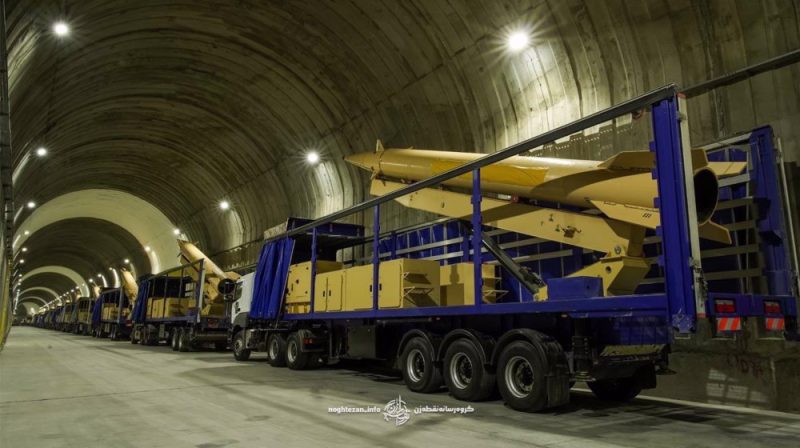
By Ivan Kesic | Press TV | March 26, 2025
The Islamic Revolution Guards Corps (IRGC) on Tuesday unveiled its largest underground missile city at an undisclosed location, sending a powerful message to enemies about Iran’s growing military prowess and complete readiness for any eventuality.
The subterranean facility was revealed in the presence of Chief of Staff of the Iranian Armed Forces, Major General Mohammad Bagheri, and IRGC Aerospace Commander, Brigadier General Amir Ali Hajizadeh.
Its unveiling comes amid escalating threats and blatant warmongering from the Donald Trump administration and the Israeli regime, prompting Iran to showcase its military preparedness to defend the homeland.
Just three days prior, the IRGC had unveiled new missile systems on three strategic islands in the Persian Gulf, capable of striking enemy bases, vessels, and assets across the region.
In recent years, the IRGC has released images of various underground bases, but this latest facility stands out as the largest yet, both in scale and firepower.
What ballistic missiles are stored in this underground base?
During the latest unveiling, it was revealed that a wide array of ballistic missiles—including Kheibar Shekan, Haj Qasem, Emad, Sajjil, and Ghadr-H, as well as Paveh cruise missiles—are stored in this missile city.
In a single frame, at least 78 Kheibar Shekan or Haj Qasem missiles were visible, with additional footage showing tunnels filled with dozens more, suggesting that the base houses at least hundreds, if not thousands, of missiles.
Some of these missiles, such as Kheibar Shekan, Ghadr, and Emad, were used in the True Promise I and II retaliatory operations against the Zionist entity last year that sent shockwaves across the world.
These operations demonstrated Iran’s capability to strike Israeli military and intelligence targets with high precision, penetrating much-hyped and advanced Israeli and American air defense systems.
During his visit to the facility, Major General Bagheri emphasized that “Iran’s iron fist is far stronger today than before,” stating that the current missile capacity is ten times greater than during past operations.
He further asserted that “the enemy will definitely fall behind in this balance of power,” signaling Iran’s continued advancement in missile development and underground military infrastructure.
What is the purpose of underground bases?
Iran’s underground missile bases are fortified military facilities constructed beneath the Earth’s surface to store, maintain, and launch ballistic missiles of short (SRBM), medium (MRBM), and intermediate range (IRBM).
Often referred to as “missile cities” by Iranian officials, these bases form a key component of Iran’s defense strategy, designed to shield its vast and burgeoning missile arsenal from detection and destruction during conflicts.
In addition to offering natural protection against aerial threats, these underground bases allow military operations to be carried out in complete secrecy, avoiding exposure to aerial reconnaissance.
The exact number of these facilities remains a closely guarded secret, but estimates suggest there are dozens of them, mostly located in the western mountainous regions.
Brigadier General Hajizadeh in a TV interview recently commented on the vast number of missile bases in the country, stating, “If we unveil a missile city every week for the next two years, it will still not be finished.”
The IRGC has frequently released footage from these underground bases, and analysis of tunnel shapes and weaponry confirms that they are distinct facilities.
In 2018, the IRGC announced the relocation of missile factories to underground bases, marking the first time images from a subterranean ballistic missile production plant were publicly released.
Beyond missile bases, Iran has also constructed underground air bases for jet fighters, underground naval bases for speedboats and missiles, and underground drone facilities.
How protected are these underground bases?
With modern satellite, reconnaissance, and intelligence technology, fully concealing the locations of such underground bases is impossible, particularly due to excavation debris and construction logistics.
However, this does not make them vulnerable, as they are typically carved into mountains, with depths reported to reach up to 500 meters, providing protection against airstrikes and nearly all bunker-busting munitions.
All critical facilities are located hundreds of meters inside the mountains and are practically indestructible, with multiple entrances and exits being their only potential weak points.
To mitigate this, each base has up to several dozen entrances. The destruction of one or even a few does not cause significant damage, as they are typically hundreds or thousands of meters apart, separated by multiple tunnel gates.
Iran has refined camouflage techniques and the creation of false entrances to ensure operational continuity, even under complete enemy air dominance.
Based on published images and videos, these bases feature arched tunnel designs, optimal for load distribution, arranged in either linear or grid formations.
Tunnels range from 6 to 12 meters in width, sometimes reinforced with concrete ceilings, and serve as corridors, missile storage areas, and parking spaces for transporter-erector launchers (TELs).
In some cases, high halls are visible, suggesting the utilization of natural caves to reduce excavation costs and complicate hostile intelligence assessments based on excavation debris.
How are ballistic missiles stored in these bases launched?
Ballistic missiles stored in these bases are launched in two ways: either by deploying the transporter-erector launcher into the open or using vertical silos.
Each base contains numerous silos—often several dozen—as they, along with entrances, are potential vulnerabilities.
Once a silo is used, the hot exhaust trail from rocket engines irreversibly reveals its position, making it a prime target for aerial bombs or cruise missiles.
To counter this, Iran has developed unique underground launch methods to enhance both effectiveness and stealth.
In 2020, Iran released footage of an underground missile system capable of launching multiple ballistic missiles from a single silo in rapid succession.
In other countries with underground missile bases—where such facilities are typically used for bulky intercontinental ballistic missiles (ICBMs) within nuclear deterrence strategies—each silo usually holds only one missile.
By contrast, Iran’s system functions more like a “semi-automatic” magazine-fed launcher, rather than a “single-shot” silo.
Footage shows five Emad missiles positioned for vertical launch on a single rail car, which then moves down a high tunnel toward the launch site.
The tunnel’s length and rail system suggest it can rapidly launch dozens of missiles before a potential counterstrike, with multiple silo openings likely enabling continuous barrages.
That same year, during the Payambar-e-A’azam (The Great Prophet) 14 drills, Iran demonstrated a unique camouflaged underground ballistic missile launch, bypassing conventional platforms and equipment.
Brigadier General Hajizadeh stated that Iran was the first country in the world to achieve such a launch capability, posing significant challenges to enemy intelligence agencies.
The released video shows two missiles launching from different locations on what appears to be an untouched surface, suggesting that the vertical launch tubes were constructed from below rather than being dug from above and later camouflaged.
This demonstration signaled that Iran’s underground missile bases, often covering dozens of square kilometers, may house countless concealed silos.
The High Price of War with Iran: $10 Gas and the Collapse of the US Economy
By Dennis J. Kucinich | March 25, 2025
Israel is currently in turmoil, marked by widespread protests demanding Netanyahu’s resignation. Critics accuse him of prolonging war for political gain, while his dismissal of top security officials and ongoing attacks on the judiciary have further intensified the unrest.
Meanwhile, Washington DC’s drumbeat for war never stops. It’s always at the expense of a decent and secure standard of living for people in this country and abroad.
The Trump Administration, after the series of heady airstrikes against Yemen, is at this moment being beseeched by Netanyahu and his associates to prepare for a seemingly consequence-free nuclear strike against Iran, completing the trifecta of Netanyahu’s long-standing dream.
I have consistently warned against the consequences of an attack on Iran, delivering 155 speeches to the House, 63 presentations alone in the 109th Congress, between 2005 and 2007, when the Bush Administration deliberated using nuclear “bunker-busters” as a means of bringing Iran to heel.
I understood the politics then and I understand them today. I warned hundreds of times that it was not in America’s interests to go to war against Netanyahu’s hit list: Iraq, Iran, Libya…
IRAQ
In 2002, the Bush Administration caused Americans grieving over 9/11 to believe Iraq had a direct role in the attacks which took over 3,000 lives. Except, Iraq had nothing to do with 9/11.
Bush claimed Iraq was pursuing nuclear weapons and other “Weapons of Mass Destruction” (WMDs) and was an imminent threat to the U.S. Iraq did not have WMD’s. Iraq was not a threat to the U.S. Iraq had no ability to attack America. Didn’t matter.
The war against Iraq began 22 years ago and lasted eight years. One million innocent Iraqi men, women and children perished because of lies. They were killed in relentless bombings and aggressive ground operations.
At least 4,443 U.S. servicemen and women were killed, and an estimated 32,000 wounded during “Operation Iraqi Freedom,” because of lies.
The lies cost U.S. taxpayers at least $3 trillion. Three trillion hard-earned tax dollars of the American people were spent to pay for the destruction of the people of Iraq while Americans struggled to pay bills for housing, health care, and education and the nation went further into debt.
Remember this diabolical playbook: Create a pretext. Lie to the American people about a threat. Hype the threat. Create irrational fear. Tell them military action is needed to eliminate the threat, and their fears. Bombs away.
On September 12, 2002, as a Member of Congress, I grilled then-former Israeli Prime Minister Benjamin Netanyahu during a congressional hearing entitled, “An Israeli Perspective on Conflict with Iraq” (video and transcript link below). Despite evidence to the contrary, he testified that Iraq and its leader, Saddam Hussein, were a direct threat to America due to an alleged pursuit of WMDs including a nuclear weapon. He urged the U.S. to take military action against Iraq.
I inquired of him who else he would have the United States attack.
“Iran and Libya,” he said.
I spoke to Mr. Netanyahu outside the hearing room and asked him that if he was so convinced those countries were a threat, why didn’t Israel commence the attacks?
“Oh no,” he responded. “We need you to do it.”
On October 10, 2002, the House of Representatives, by a vote of 296-133, authorized the use of military force against Iraq. I led the opposition. The war bill passed the Senate the next day, 77-23, and was signed into law by President Bush on October 16, 2002.
On March 20, 2003, the President describing Iraq as part of an “Axis of Evil,” commenced a “Shock and Awe” onslaught by American warships, aircraft and submarines, launching cruise missiles and “precision guided bombs” roundly murdering people in Baghdad. Iraq was destroyed. Saddam was deposed, captured and hung.
Libya
On March 19, 2011, despite lacking formal congressional authorization, President Barack Obama authorized an attack on Libya to depose Muammar Gaddafi. I led the opposition. Hillary Clinton’s State Department, the EU, NATO, the UK and France to name but a few, lobbied Congress hard to accelerate actions against Libya.
That country’s leaders were dumbfounded as to why, considering that they had done everything America had asked, such as open markets to foreign investment. I held up the bombing for some time by building a bi-partisan coalition of Members of Congress to vote no.
Alas, Obama and the Clinton State Department prevailed. Republican Speaker of the House John Boehner negotiated a redraft of the authorization bill and the Republicans fell in line.
The U.S., with NATO allies, joined forces, wreaking destruction and havoc upon Libya. Gaddafi was deposed, captured and killed, at an estimated cost of over a billion dollars. Obama admitted years later that this was the worst decision of his Presidency.
Iran
On July 25, 2024, Prime Minister Netanyahu, (while under a criminal investigation by the Israeli judiciary), addressed the U.S. Congress concerning Iran, which he characterized as not only a deadly enemy of Israel, but also of the United States.
“Iran’s axis of terror confronts America, Israel and our Arab friends,” Netanyahu declared.
The interests of Israel and America were and are inseparable, he proclaimed – to 58 standing ovations. One could take that heroic reception as rubberstamping an authorization for war. As Netanyahu had told me years ago, “…we need you [the U.S.] to do it.”
Today, the Houthis of Yemen continue their attacks on Israeli shipping interests in the Red Sea, in protest to the Netanyahu government’s genocidal attack on Gaza.
President Trump, ever sensitive to and allegiant to Israel, views the Houthis as proxies of Iran. The President directed America’s air forces to rain down fire and brimstone upon Yemen, a nation of teenagers. The median age in Yemen is 18.4 years. The country spends about 1/1000 of the U.S. military budget for its own defense.
Trump threatened the Iranian government: “Every shot fired by the Houthis will be looked upon from this point forward, as being a shot fired from the weapons and leadership of IRAN (his emphasis). And IRAN will be held responsible, and suffer the consequences, and those consequences will be dire.”
The Administration followed up with Executive Order (E.O.) 13902, which, according to the U.S. Treasury Department was part of a “campaign of maximum pressure” which “targets Iran’s petroleum and petrochemical sectors and marks the fourth round of sanctions targeting Iranian oil sales…”
The first Trump Administration withdrew from a Joint Plan of Action agreement (JCPOA) which provided Iran relief from sanctions in exchange for accepting limitations which would preclude nuclear weaponization.
President Trump ordered the assassination by drone strike of Iranian General Qasem Soleimani, considered the second most powerful person in Iran, at the Baghdad airport, underscoring his determination to strike at Iran.
Iran has consistently asserted its nuclear research is for peaceful purposes. There has been a long-standing formal prohibition in Islamic law, a fatwa, issued by Ayatollah Ali Khamenei, the Supreme Leader of Iran, against the development or use of nuclear weapons.
Recently, President Trump said he would love a deal to prevent Iran from having a nuclear weapon, “I would love to make a deal with them without bombing them.”
At the same time, U.S. B-52 bombers, capable of delivering nuclear bunker-busting bombs, were engaged in joint exercises with the Israeli Air Force, in preparation for a potential strike at Iran’s underground nuclear sites.
These joint maneuvers were reminiscent of the cooperation and interoperability exercises that took place between the UK and French forces in preparation for a real-world offensive against Libya in 2011.
Ayatollah Khamenei replied “…threats will get them (the Americans) nowhere,” and refused talks under such conditions as “deceptive.” Iranian Brigadier General Kiumars Heidari added, for emphasis, “Iran is ready to crush its enemies if it makes mistakes.”
The dialectic of conflict is escalating.
It was not in America’s interest then, nor is it now, to go to war with Iran, a nation of 90 million people, a technologically advanced society, with nearly a million-person army.
President Trump should not be misled. War with Iran would be the end of his presidency. Here is why:
Iran supplies 3% of the world’s oil. If the U.S. goes to war with Iran, crude oil prices per barrel (currently ranging from $68.86 (West Texas Intermediate) – $72.28 (Brent Crude), could rise to $200 per barrel.
The Strait of Hormuz, a major conduit for the transport of oil would be disrupted. Iran has the capability retaliate by targeting Gulf oil infrastructure, including Saudi Arabia. Market panic would ensue.
The price of a gallon of gas, currently averaging $3.13, would double, approach $7 a gallon, and in some cases, reach $10 a gallon, in states with higher fuel taxes. (This is based on historical data which calculates that every $1 increase in crude oil per barrel translates to about a 2 to 3 cent increase per gallon at the pump).
Attempts to manage supply disruptions and market distortions through the release of oil from the Strategic Petroleum Reserve would do little to offset panic buying and stockpiling by consumers. Nor would an increase in U.S. domestic drilling be sufficient to offset lost Middle East oil supplies, due to supply shortage, infrastructure constraints and limitations on refining capacity.
Major disruptions, including high inflation, recession risks, and market instability would hit the US economy. Consumer retail spending would sink while prices rose for food and other goods, as energy costs for manufacturing, agriculture and transportation spiraled out of control.
Slower economic growth would push the U.S. into a recession, with the Fed forced to try to maintain control over inflation by hiking interest rates well beyond the current 4.25% – 4.50 % range.
Auto sales would take a hit. Corporate profits in transportation, airlines, trucking would nosedive. The Dow Jones and S& P 500 would be in shock, with major selloffs. America would arrive at stagflation, high inflation rates and negative growth as it did during the 1973 Oil Embargo.
The multiple economic impacts of the 2008 subprime meltdown and subsequent financial crash which cost the US economy $16 to $20 trillion dollars would become the morbid benchmark for the descent of the American economy.
Now contemplate this concatenation: War with Iran, reciprocal high tariffs, massive cuts in the federal workforce and domestic federal spending and you have an economy in a tailspin, with high inflation, rising unemployment, falling consumer spending, leading to an economic contraction requiring a system of government intervention which is currently being dismantled. Then there is the permanent restructuring of the tax code to accelerate wealth upwards. These conditions create political combustibility.
In the end, Iran will never crush Donald Trump. The U.S. will crush itself trying to wipe out Iran.
The economic effects of war with Iran could spell the end, not only of the viability of the Trump Presidency, but of the Republican House and Senate, a political turnaround the likes of which has not been seen in American politics since the 1932 sweep led by Franklin Delano Roosevelt and the New Deal.
In 1928 Republican Herbert Hoover took 58.2% of the popular vote and defeated Democrat Al Smith 444-87 in the Electoral College. Amidst a complete rejection of Republican economic policies and the Depression, Roosevelt took 57.4% of the popular vote in 1932 and defeated Hoover in the Electoral College 472-59.
The 270-164 advantage which House Republicans held in 1928 evaporated in 1932 as Democrats crushed Republicans with a 313-117 majority.
There has not been another turnaround like this in American political history and it was driven by the economic forces which overwhelmed a Republican Administration, followed by a program of promised reform which the new Administration delivered.
While the Administration is at the fullness of its expression of unbridled power, it faces a fateful decision regarding Iran which will determine whether the mandate received by Trump in 2024 evaporates as quickly as did Hoover’s in 1932.
Israel itself is in turmoil, with mass protests calling for Netanyahu’s resignation, charges he is prolonging the war for his political benefit, his firing of top security officials and his attacks on the judiciary.
Netanyahu is on shaky ground, pummeled by his fellow countrymen and women who worry, far from ensuring the future of Israel, his deadly policies threaten it.
One could imagine Trump, considering his own and America’s interests, could call Netanyahu and say, “Bibi, we are friends ‘til the end. This is the end.”
Links: 2002 Congressional Hearing “Conflict in Iraq: An Israeli Perspective” video and transcript
Talk of US-Iran war is all a load of baloney
By M. K. BHADRAKUMAR | Indian Punchline | March 26, 2025
The air is thick with the prognosis that a military confrontation between the US and Iran is now just a matter of time. Going by the pattern of such scare mongering in the past decades, Israeli media management skills are self-evident. There is a sense of de javu. Of course, therein lies the danger of miscalculations by the protagonists but that is unlikely to happen.
There are no takers among the regional states for a military conflagration in the Gulf region. The old US-led anti-Iran front has unravelled following the shift in the Iranian and Saudi policies towards reconciliation and amity and the display of strategic autonomy by even those countries who still remain close allies of the US (in particular, Saudi Arabia, the UAE, Qatar.)
In a recent interview with the famous American podcaster Tucker Carlson, Qatar’s Prime Minister and Minister of Foreign Affairs Sheikh Mohammed bin Abdulrahman Al Thani drew an apocalyptic scenario that his country and the Persian Gulf Arab states will run out of water within three days if Iran’s nuclear facilities are targeted by the US or Israel! Does that occur to anyone?
The big question is, what are the intentions of the Trump administration. An underlying assumption here is that President Donald Trump is under obligation to the Jewish-Israeli lobby who funded his election campaign to be supportive of Netanyahu all the way through thick and thin. This assumption is untested yet and may never be, perhaps, given Trump’s complex personality as a deal maker.
According to a recent poll from YouGov, 52% of Americans think Trump will have a shot at a third term; former White House strategist Steve Bannon is convinced that Trump will run and win in 2028. Indeed, Trump himself has not ruled out a 2028 White House bid. This is an X factor, given the historical legacy that the Iran question ultimately proved to be the nemesis of Jimmy Carter’s presidency. Trump, a connoisseur of past American presidencies, cannot be unaware that he ought to tread with great circumspection.
In an interview with Tucker Carlson last week, Trump’s Middle East special envoy Steve Witkoff underscored that regional stabilisation in West Asia demands addressing Iran. In his words, “I would say the goal begins with how do we deal with Iran? That’s the biggie. So the first is nuclear… If they were to have a bomb that would create North Korea in the GCC, we cannot have that… we can never allow someone to have a nuclear weapon and have outsized influence. That doesn’t work. So if we can solve for that, which I’m hopeful that we can.
“The next thing we need to deal with Iran is they’re being a benefactor of these proxy armies because we’ve proven that … they’re not really an existential risk… But if we can get these terrorist organisations eliminated as risks. Not existential, but still risks. They’re destabilising risks. Then we’ll normalise everywhere. I think Lebanon could normalise with Israel, literally normalise, meaning a peace treaty with the two countries. That’s really possible.
“Syria, too, the indications are that Jelani is a different person than he once was. And people do change. You at 55 are completely different than how you were at 35, that’s for sure… So maybe Jelani in Syria is a different guy. They’ve driven Iran out.
“Imagine if Lebanon normalises, Syria normalises, and the Saudis sign a normalisation treaty with Israel because there’s a peace in Gaza. They must have that as a — without question — as a prerequisite. That’s a condition precedent to Saudi normalising. But now you’d begin to have a GCC that all work together. I mean, that would be, it would be epic.”
Does this ‘big picture’ envisage the destruction of Iran as a prerequisite? Not even remotely. And if anyone should know what he is talking about, it is Witkoff.
Later, towards the end of the interview, Carlson drew out Witkoff specifically with regard to Trump’s recent communication addressed to Iran’s Supreme Leader Ayatollah Ali Khamenei. Excerpts of Witkoff’s remarks are reproduced below:
“Look, he [Trump] sent a letter to the Iranians. Usually it would be the Iranians sending a letter to him…They’re open to attack today. Yeah, they’re a small country compared to ours… If we used overwhelming force, it would be very, very bad for them…
“So under those circumstances, it would be natural for the Iranians to reach out to the President to say, I want to diplomatically solve this. Instead, it’s him doing that. Now, I can tell you that he’s not reaching out because he’s weak, because he is not a weak man. He is a strong man… Maybe the strongest man I’ve ever met in my life…
“So with that all said, he wrote that letter. And why did he write that letter? It roughly said, ‘I’m a president of peace. That’s what I want. There’s no reason for us to do this militarily. We should talk. We should clear up the misconceptions. We should create a verification program so that nobody worries about weaponisation of your nuclear material. And I’d like to get us to that place because the alternative is not a very good alternative.’ That’s a rough encapsulation of what was said…
“The Iranians have reached back out, and I’m not at liberty to talk about specifics, but clearly, through back channels, through multiple countries and multiple conduits, they’ve reached back out.
“I think that it has a real possibility of being solved diplomatically, not because I’ve talked to anybody in Iran, but just because I think logically it makes sense that it ought to be solved diplomatically. It should be.
“I think the President has acknowledged that he’s open to an opportunity to clean it all up with Iran, where they come back to the world and be a great nation once again and not have to be sanctioned and being able to grow their economy. Their economy—I mean, these are very smart people. Their economy was once a wonderful economy. They’re being strangled and suffocated today. There’s no need for that to happen.
“They can join the League of Nations and we can have a better relationship and grow that relationship… That’s the alternative he’s presenting… he wants to deal with Iran with respect. He wants to build trust with them if it’s possible. And that’s his directive to his administration. And hopefully, that will be met positively by the Iranians.
“And I’m certainly hopeful for it. I think anything can be solved with dialogue by clearing up misconception and miscommunication and disconnects between people… And the president is a president who doesn’t want to go to war, and he’ll use military action to stop a war … In this particular case, hopefully it won’t be necessary. Hopefully, we can do it at the negotiating table…”
Again, do such remarks sound like war mongering? Curiously, in the interview, Witkoff openly welcomed an opportunity to serve as Trump’s special envoy to Iran to navigate the dialogue and peaceful resolution of issues.
To my mind, Iranians understand the meaning of Trump’s letter. They are now in an engaging mood as back channels are clocking hours. A commentary by Nour News, a mouthpiece of the Iranian security establishment, rather playfully titled as Analysis of Trump’s Letter to Iran from a Game Theory Perspective, speaks for the mood in Tehran. Read it here.
Make no mistake that Iran and the US are seasoned adversaries who have absolute mastery over the guardrails that contain tensions from escalating in their complicated relationship.
China submits five-point Iran nuclear deal proposal to UN conference
Al Mayadeen | March 24, 2025
China has formally presented a new proposal to revive stalled negotiations over Iran’s nuclear program, calling for diplomacy, mutual respect, and the preservation of the 2015 nuclear deal. The five-point initiative was first unveiled by Chinese Foreign Minister Wang Yi on March 14 during a trilateral meeting in Beijing with his Iranian and Russian counterparts. It was later submitted to the United Nations’ Conference on Disarmament in Geneva, where it has been published as Document No. 2448/CD.
According to Chinese diplomats, the document outlines principles intended to defuse mounting tensions surrounding Iran’s nuclear activities and offers a framework to restart talks. The Chinese delegation requested its official release as a UN document, underlining Beijing’s push for a greater role in global security discussions.
The first principle calls for a diplomatic solution and warns against military escalation or punitive economic actions. “Stay committed to peaceful settlement of disputes through political and diplomatic means, and oppose the use of force and illegal sanctions,” the proposal states. It urges all sides to create conditions for renewed negotiations and to avoid steps that could worsen the situation.
In its second point, the proposal emphasizes Iran’s rights under the Nuclear Non-Proliferation Treaty, while also encouraging Tehran to maintain its pledge not to pursue nuclear weapons. “Stay committed to balancing rights and responsibilities, and take a holistic approach to the goals of nuclear nonproliferation and peaceful uses of nuclear energy,” it reads. “Iran should continue honoring its commitment to not developing nuclear weapons, and all other parties should fully respect Iran’s right to peaceful uses of nuclear energy.”
The third point calls for renewed commitment to the Joint Comprehensive Plan of Action (JCPOA), the multilateral agreement signed in 2015 that placed limits on Iran’s nuclear program in exchange for sanctions relief. “Stay committed to the framework of the Joint Comprehensive Plan of Action (JCPOA) as the basis for new consensus. China hopes that all parties will work toward the same direction and resume dialogue and negotiation as early as possible. The United States should demonstrate political sincerity and return to talks at an early date.”
China’s fourth recommendation cautions against moving the matter to the United Nations Security Council, which could trigger the reimposition of international sanctions through the so-called “snapback” mechanism. “Stay committed to promoting cooperation through dialogue, and oppose pressing for intervention by the UN Security Council (UNSC). Under the current situation, hasty intervention by the UNSC will not help build confidence or bridge differences among the relevant parties. Initiating the snapback mechanism would undo years of diplomatic efforts, and must be handled with caution.”
The final principle calls for gradual, reciprocal steps to build consensus, stressing that no lasting resolution can be achieved through pressure or force. “Stay committed to a step-by-step and reciprocal approach, and seek consensus through consultation. History has proven that acting from a position of strength would not lead to the key to resolving difficult issues. Upholding the principle of mutual respect is the only viable path to finding the greatest common ground that accommodates the legitimate concerns of all parties and reaching a solution that meets the expectation of the international community.”
Beijing framed the proposal as part of its broader strategy to promote dialogue over confrontation. Chinese officials said the country will remain in close contact with all relevant parties and will “actively promote talks for peace, and play a constructive role in realizing early resumption of talks.”
Reiterating its longstanding position, China stressed that negotiations—not threats or sanctions—remain the only viable path forward. “Sanctions, pressure, and threats of force are not viable solutions,” Beijing stated.
Trump and Putin begin addressing cumulated geo-strategic debris… amidst Trump’s ultimatum to Iran
By Alastair Crooke | Strategic Culture Foundation | March 24, 2025
The phone call on 18 March between Presidents Trump and Putin has happened. It was a success, insofar as it allowed both sides to label the result as ‘positive’. And it did not lead to a breakdown (by virtue of the smallest of concessions from Putin – an energy infrastructure truce) – something easily it could have done (i.e. devolve into impasse – with Trump excoriating Putin, as he has done to Zelensky), given the fantastical and unrealistic expectations being woven in the West that this would be the ‘decider meeting’ for a final division of Ukraine.
It may have been a success too, insofar as it has laid the groundwork for the absent homework, now to be handled by two teams of experts on the detailed mechanics of the ceasefire. It was always a puzzle why this had not been earlier tackled by the U.S. team in Riyadh (lack of experience?). It was, after all, because the ceasefire was treated as a self-creating entity, by virtue of an American signature, that western expectations took flight in the belief that details did not matter; All that remained to do – in this (flawed) estimation – was to ‘divvy out the cake’.
Until the mechanics of a ceasefire – which must be comprehensive since ceasefires almost always break down – there was little to discuss on that topic on Tuesday. Predictably, then, discussion (reportedly) seemed to have turned to other issues: mainly economic ones and Iran, underlining again that the negotiation process between the U.S. and Russia does not boil down to just Ukraine.
So, how to move to ceasefire implementation? Simple. Begin to unravel the ‘cats cradle’ of impedimenta blocking normalised relations. Putin, plucking out just one strand to this problem, observed that:
“Sanctions [alone] are neither temporary nor targeted measures. They constitute [rather], a mechanism of systemic, strategic pressure against our nation. Our competitors perpetually seek to constrain Russia and diminish its economic and technological capacities … they churn out these packages incessantly”.
There is thus much cumulated geo-strategic debris to be addressed, and corrected, dating back many years, before a Big Picture normalisation can start in earnest.
What is apparent is that whilst Trump seems to be in a tearing hurry, Putin, by contrast, is not. And he will not be rushed. His own constituency will not countenance a hastily fudged accord with the U.S. that later implodes amidst recriminations of deceit – and of Moscow again having been fooled by the West. Russian blood is invested in this strategic normalisation process. It needs to work.
What is behind Trump’s evident hurry? Is it the need for breakneck speed on the domestic front to push ahead, before the cumulated forces of the opposition in the U.S. (plus their brethren in Europe) have the time to re-group and to torpedo normalisation with Russia?
Or does Trump fear that a long gap before ceasefire implementation will enable opposition forces to push for the recommencement of arms supplies and intelligence sharing – as the Russian military steamroller continues its advance? Is the fear, as Steve Bannon has warned, that by rearming Ukraine, Trump effectively will ‘own’ the war, and shoulder the blame for a massive western and NATO defeat?
Or, perhaps Trump anticipates that Kiev might unexpectedly cascade into a systemic collapse (as occurred to the Karzai government in Afghanistan). Trump is acutely aware of the political disaster that befell Biden from the images of Afghans clinging to the tyres of departing U.S. transport planes (à la Vietnam), as the U.S. evacuated the country.
Yet again, it might be something different. I learned from my time facilitating ceasefires in Palestine/Israel that it is not possible to make a ceasefire in one place (say Bethlehem), whilst Israeli forces were concurrently setting Nablus or Jenin ablaze. The emotional contagion and anger from one conflict cannot be contained to one locality; it would overflow to the other. It was tried. The one contaminated the implied sincere intentions behind the other.
Is the reason for the Trump haste mainly that he suspects his unconstrained support for Israel eventually will lead him to embrace major war in the Middle East? The world of today (thanks to the internet) is much smaller than before: Is it possible to be a ‘peacemaker’ and a ‘warmaker’ simultaneously – and have the first taken seriously?
Trump and those U.S. politicians ‘owned’ by the pro-Israeli lobby, know that Netanyahu et al. want the U.S. to help eliminate Israel’s regional rival – Iran. Trump cannot both retrench the U.S. as a western hemisphere ‘Sphere of Influence’, yet continue to throw the U.S.’ weight around as world Hegemon, causing the U.S. government to go broke. Can Trump successfully retrench the U.S. to Fortress America, or will foreign entanglements – i.e. an unstable Israel – lead to war and derail Trump’s administration, as all is intertwined?
What is Trump’s vision for the Middle East? Certainly, he has one – it is one that is rooted in his unstinting allegiance to the Israeli interest. The plan is either to destroy Iran financially, or to decapitate it and empower a Greater Israel. Trump’s letter to Iran’s Supreme Leader Ali Khamenei included a two-month deadline for reaching a new nuclear deal.
A day after his missive, Trump said the U.S. is “down to the final moments” with Iran:
“We can’t let them have a nuclear weapon. Something is going to happen very soon. I would rather have a peace deal than the other option, but the other option will solve the problem”.
U.S. journalist Ken Klippenstein has noted that on 28 February, two B-52 bombers flying from Qatar dropped bombs on an “undisclosed location” – Iraq. These nuclear-capable bombers were carrying a message whose recipient “was clear as day; The Islamic Republic of Iran”. Why B-52s and not F-35s which also can carry bombs? (Because ‘bunker-buster’ bombs are too heavy for F-35s? Israel has F-35s, but does not have B-52 heavy bombers).
Then on 9 March, Klippenstein writes, a second demonstration was made: A B-52s flew alongside Israeli fighter jets on long-range missions, practicing aerial refuelling operations. The Israeli press correctly reported the real purpose of the operation – “readying the Israeli military for a potential joint strike with the U.S. on Iran”.
Then, last Sunday, National Security Adviser Mike Waltz boasted that multiple Anglo-U.S. airstrikes “took out” top Houthi officials, making it very clear that this is all about Iran:
“This was an overwhelming response that actually targeted multiple Houthi leaders and took them out. And the difference here is, one, going after the Houthi leadership, and two, holding Iran responsible”.
Marco Rubio elaborated on CBS: “We’re doing the entire world a favour by getting rid of these guys”.
Trump then followed up with the same theme:
“Every shot fired by the Houthis will be looked upon, from this point forward, as being a shot fired from the weapons and leadership of IRAN, and IRAN will be held responsible, and suffer the consequences, and those consequences will be dire!”
In a further piece, Klippenstein writes:
“Trump’s menu of options for dealing with Tehran now includes one he didn’t have in his first term: full-scale war – with “nuclear weapons on the table” (the Trident II low-yield option) Pentagon and company contracting documents I’ve obtained describe “a unique joint staff planning” effort underway in Washington and in the Middle East to refine the next generation of “a major regional conflict” with Iran. The plans are the result of a reassessment of Iran’s military capabilities, as well as a fundamental shift in how America conducts war”.
What is new is that the “multilateral” component includes Israel working in unison with Arab Gulf partners for the first time, either indirectly or directly. The plan also includes many different contingencies and levels of war, according to the documents cited by Klippenstein, from “crisis action” (meaning response to events and attacks), to “deliberate” planning (which refers to set scenarios that flow from crises that escalate out of control). One document warns of the “distinct possibility” of the war “escalating outside of the United States Government’s intention” and impacting the rest of the region, demanding a multifaceted approach.
War preparations for Iran are so closely restricted, that even contracting companies involved in war planning are prohibited from even mentioning unclassified portions, notes Klippenstein:
“While a range of military options are often provided to presidents in an attempt on the part of the Pentagon to steer the President to the one favoured by the Pentagon, Trump already has shown his proclivity to select the most provocative option”.
“Equally, Trump’s green light for the Israeli air-strikes on Gaza, killing hundreds, [last] Monday, but ostensibly targetted on the Hamas leadership can be seen as consonant with the pattern of taking the belligerent option”.
Following his successful assassination of Iran’s top general Qassim Suleimani in 2020, Trump seems to have taken the lesson that aggressive action is relatively cost-free, Klippenstein notes.
As Waltz noted in his press interview:
“The difference is these [Yemen attacks] were not pinpricks, back and forth, what ultimately proved to be feckless attacks. This was an overwhelming response that actually targeted multiple Houthi leaders and took them out”.
Klippenstein cautions that, “2024 may be behind us but its lessons aren’t. Israel’s assassination of top Hezbollah officials in Lebanon was largely perceived by Washington to be a resounding success with few downsides. Trump likely took back the same message, leading to his strike on [the] Houthi leadership this week”.
If western observers are seeing all of what’s going on as some repeat of Biden’s tit-for-tat or limited attacks by Israel on Iran’s early warning and air defences, they may be misunderstanding what’s going on behind the scenes. What Trump might now do, which is right out of the Israeli playbook, would be to attack Iran’s command and control, including Iran’s leadership.
This – very certainly – would have a profound effect on Trump’s relations with Russia – and China. It would eviscerate any sense in Moscow and Beijing that Trump is agreement capable. What price then his ‘peacemaker’ ‘Big Picture’ reset were he, in the wake of wars in Lebanon, Syria and Yemen, to start a war with Iran? Does Trump see Iran through some disturbed optic – that in destroying Iran, he is bringing about peace through strength?
A new vision for US global power under Trump
By Batool Subeiti | Al Mayadeen | March 23, 2025
Trump’s approach to global affairs diverges sharply from the American establishment’s traditional strategy. Trump does not see America as a “police state.” He is sceptical of NATO, does not support war with Russia, and believes the US military presence in West Asia primarily serves to protect Arab allies. In his view, they should bear the financial burden of that protection.
The American establishment, represented by institutions like the Pentagon and the White House, follows a long-term strategic vision. It maintains hundreds of military bases worldwide and pursues a structured political strategy across various regions.
Trump, by contrast, envisions American leadership within a multipolar world order. He is less concerned with imposing the American system on other nations and more focused on fostering economic alliances that benefit the US. He also seeks to counter the rise of BRICS and prevent alternative economic blocs from challenging the dollar’s dominance. Rather than waging ideological battles, his strategy revolves around economic leverage.
A key example of establishment influence has been USAID, which has historically functioned as a covert tool for advancing American unipolarity. By using soft power tactics, it has helped destabilize nations through coups and colour revolutions. However, under Trump, funding for such initiatives has been slashed, allowing the US to save billions. His approach is more direct—rather than relying on NGOs to influence societies, he prefers sanctions as a means of coercion. This shift weakens American influence at the grassroots level, creating a vacuum that local movements and other powers can exploit.
Trump aims to strengthen the American economy through relative stability rather than confrontation. He opposes prolonged war with Russia, favouring investment over sanctions. Rather than spending $350 billion on Ukraine, he sees greater economic potential in working with Russia, which he does not view as a direct economic competitor. His broader goal is to retract costly foreign commitments and consolidate American economic dominance, using economic leverage—such as tariffs and sanctions—to maintain control. This was evident in his approach to Zelensky, where he set clear conditions for support.
This stance starkly contrasts with that of Europe, which remains deeply hostile toward Russia and relies on US backing to counter it. Trump’s push for increased tariffs on European imports will likely reduce demand for European goods in the US, stimulating domestic manufacturing and bolstering the dollar. His retreat from NATO further exposes contradictions within the alliance, creating strategic openings that others may exploit.
Trump operates like a political tsunami. In Gaza, he has positioned himself as the real power behind the war, stopping it on his terms. Even his controversial depopulation proposal was more of a bargaining tool than a concrete plan. He sees West Asia as secondary to regions like Mexico, Panama, or Greenland. When asked about Iran’s strength, he acknowledges Iran is very strong—suggesting he prefers to focus on nuclear containment rather than military confrontation, much to Netanyahu’s frustration.
Trump also has a tendency towards withdrawal when he sees American involvement as a financial drain. While “Israel” has expanded its influence in Syria, if its actions provoke widespread resistance, and it becomes clear that “Israel” is a source of ongoing conflict, Trump may reconsider US support.
In contrast to the deep state’s approach—where a weakening “Israel” prompts the search for regional substitutes—Trump’s stance is more transactional. If there is no significant opposition, he will stamp “Israel’s” territorial gains. But if the costs outweigh the benefits, he is willing to incrementally remove support from the occupation entity.
Scorch Marks in the Sand
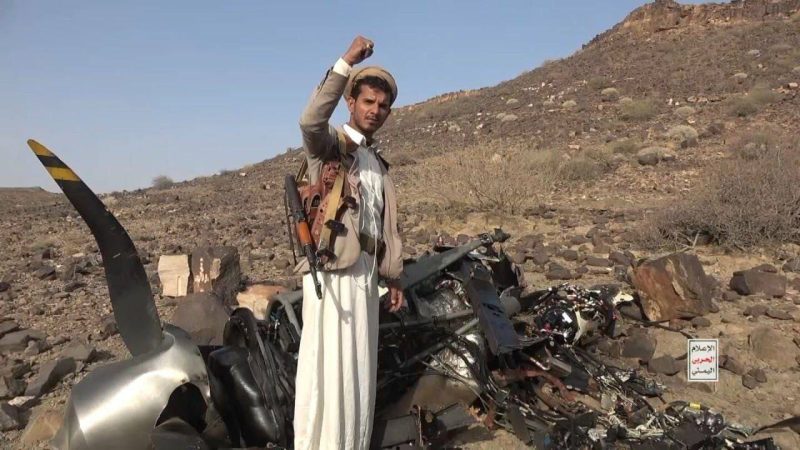
Yemeni Warrior Rejoicing over a Slain MQ-9 Reaper
By William Schryver – imetatronink – March 22, 2025
Javelin, Stinger, M-777 howitzer, HIMARS, Excalibur, Switchblade, all manner of electronic warfare gizmos and counter-battery radars, Bradley IFVs, Stryker, Leopard, Challenger, Abrams, Patriot, JDAMs, HARMS, Storm Shadow, ATACMS … I’m sure I’m forgetting some.
Oh, yeah … remember in early 2022 when the unveiling of the Bayraktar strike drones was hailed with great fanfare? They were predicted to be the bane of the Russian army. Instead, it was a major embarrassment for the Turks.
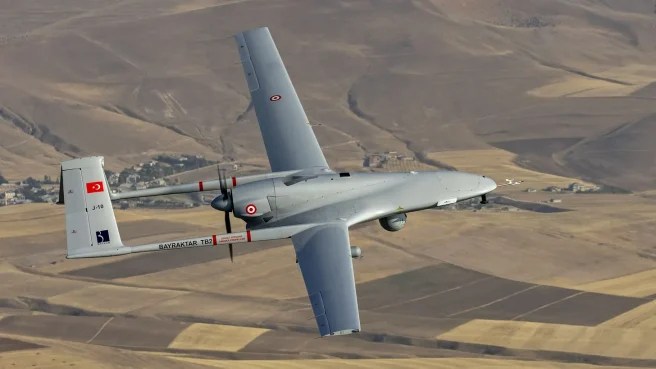
Turkish Bayraktar TB2 Surveillance and Attack Drone
That said, over the past year or so, those “savage barbarians” down in Yemen have shot-down a baker’s dozen of the once-vaunted US MQ-9 Reaper drones – supposedly vastly superior to the Bayraktar TB2.

US MQ-9 Reaper Surveillance and Attack Drone
In any case, all of these things represent top-shelf front-line US/NATO war stuff that has been objectively proven inferior in the crucible of protracted high-intensity warfare. Many are simply ill-suited for the current state-of-play in the military realm, as it has been revealed over the course of the war in Ukraine.
Before this war began, the almost-universal belief was that US/NATO weaponry and equipment were far and away superior to anything the Russians could put on the battlefield.
That unfounded faith in the unrivaled supremacy of western arms has now been shattered — although we already see the think-tank apologists fashioning their strained rationalizations.
Nevertheless, when one examines in aggregate the implements of war the US/NATO have provided to Ukraine, the overwhelming majority consists of the very stuff every military in NATO would field in a war against Russia, or anyone else, for that matter.
Here is a sobering truth: if the Armed Forces of Ukraine could make one wish, it would be to respawn as the army and abundant quantities of effective and durable Soviet equipment they had in February 2022. That was, all things considered, the strongest army they would ever have. And it was, in great measure, squandered on the altar of a misguided commitment to NATO field doctrines that repeatedly proved misconceived and ill-adaptive to the war that actually ensued, as well as the war as it has subsequently evolved.
So, in the case of the Ukraine War, we see attested two now-indisputable facts:
1) US/NATO weaponry and equipment is FAR LESS FEARSOME than was previously believed by the supposed “military experts” in the world. It has either failed abysmally or vastly underperformed in virtually every case.
2) US/NATO war doctrine has been demonstrated to be something quite a bit less than the greatest expression of the martial arts since Napoleon at the Battle of Austerlitz. The disastrous NATO/AFU “counteroffensive” in Zaporozhye in summer 2023 and the catastrophic blunder of the Kursk Kamikaze Incursion in summer 2024 have laid waste to the mythology of US/NATO military prowess.
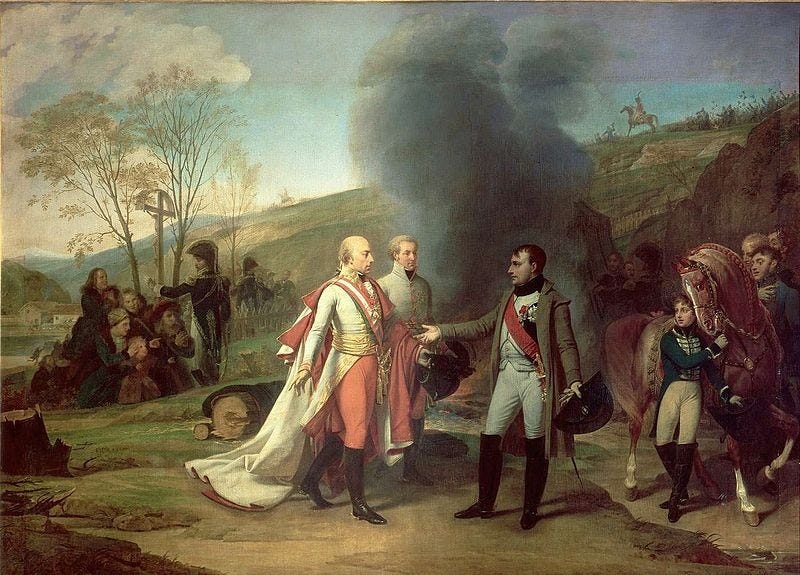
Napoleon at Austerlitz Accepting the Surrender of Francis II
Now, here in the early spring of 2025, we see the United States, with Donald Trump again at the helm, trying to soothe the sting and obfuscate the reality of the resounding defeat its strategic designs and battlefield arms have suffered against Russia.
And, after weighing all options and considerations in the balance, the Masters of Declining Empire have decided beating up on Iran is the right medicine for what ails them.
I mean, after all, the Russians never had to face them, and the Iranians certainly cannot pose a credible threat to our decades-old F-15s, F-16s, F/A-18s, F-22s, F-35s, B-52s, B-1s, B-2s, Tomahawks, etc., not to mention the almighty US Navy.
Everybody KNOWS this to be true. Right?
And even though the Iranians have already proven to be able to defeat all manner of US and Israeli air defenses with their upper-tiers of ballistic missiles … well, if we just have Pete Hegseth give them a proper pep-talk, those interceptors that failed during the reign of the imbecile Joe Biden will strike down every single Muslim Missile they see. American air defense interceptors will be made great again. Hail to the Chief!
As for the Iranian air defenses … well, everyone also knows the Israelis already destroyed them. Right? They told us all about it – how the heroic Israeli F-35s and F-15s stormed across the Tigris into the heart of Iran and blew to smithereens all those S-300s and missile factories. They even showed pictures of scorch marks in the sand to prove it.
Anyway, the point is that America needs to go to war again in an attempt to erase the stain of having lost to the Russians, just as going to war against the Russians was meant to erase the stain of having lost to the Afghanis, just as going to war against Iraq and Afghanistan was meant to erase the stain of having lost to the Vietnamese. And … well, you know the drill by now.
You should also know what they say about the best laid plans of mice and men. Nothing ever goes as planned. And I strongly suspect the next war of American redemption will not be a reversal of the prevailing trend.
Geography

The Middle East
By William Schryver – imetatronink – March 21, 2025
So the US is sending Carrier Strike Group One (CVN-70 USS Carl Vinson) to the Middle East, leaving CSG-5 (CVN-73 USS George Washington) to “hold the fort” in the western Pacific from the semi-safe environs of its quasi-permanent berth in Yokosuka, Japan.
All the Washington does is sail back and forth between San Diego and Yokosuka every so often to give the impression it’s doing something meaningful. Otherwise I’ve seen no indication for several years that it is anything more than a training and parade vessel.
In any case, the Vinson is headed to the Arabian Sea, and perhaps points beyond. (That remains to be seen.)
Meanwhile the deployment of CSG-8 (CVN-75 USS Trembling Puppy) has been extended, even as it remains bottled up in the northern reaches of the Red Sea, launching air strikes on Yemen from ~1000 km away, with USAF refueling tankers at the ready as needed.
The Yemeni have launched a few modest packages of antiquated drones and antiship cruise missiles in the general direction of the Trembling Puppy – all of which have been relatively easy pickings for the cruiser and destroyers and combat air patrol.
But, keep in mind, even though these old and slow Yemeni drones and missiles have little chance of scoring a hit from 1000 km away, the carrier strike group ships and planes still have to shoot at every one of them!
So every Yemeni strike package of a couple dozen missiles will deplete CSG-8’s munitions magazines by AT LEAST a corresponding number of air defense missiles, and quite possibly TWICE as many, according to standard practice of firing two interceptors at each threat.
CSG-8’s magazine depth has already been substantially depleted over the course of the past two weeks — and remember, the US Navy cannot replenish its vertical launch systems at sea.
And, of course, if military operations against Iran are the ultimate objective, then at some point the Trembling Puppy and its entourage are going to have to leave the cozy waters between Jeddah and the Gulf of Suez, and run the gauntlet of the Gate of Lamentation (Bab el-Mandeb).
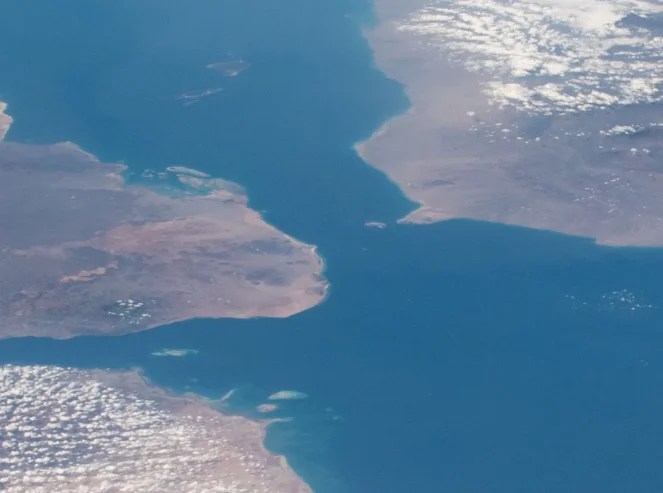
The Gate of Lamentation (Bab el-Mandeb)
That’s when things could get more interesting. Because it’s a pretty tight squeeze to pass through. A big deep-draft aircraft carrier can’t just run at full speed, zig-zagging back and forth. It has to stick to the navigable channel.

Navigable Shipping Channels in the Bab el-Mandeb
In the relatively open waters north of Jeddah, there is quite a bit of room for maneuver. But in the straits, you’re restricted to a narrow band — and most significantly, potential Yemeni missile launching sites are only ~200 km away. A more substantial strike package of 50 or so drones, antiship cruise missiles, antiship ballistic missiles, and fast boat and surface drone attacks will get there a whole lot faster, and with a much better chance of actually hitting something.
So, even though CSG-8’s odds of passing through unscathed still probably remain pretty good, there is unquestionably a considerably elevated risk compared to hiding out at the mouth of the Gulf of Suez.
But let’s suppose they sail right through the Bab el-Mandeb with minimal difficulties … then what? You join up with CSG-1 in the Arabian Sea and attempt long-distance strikes into southern Iran — strikes that would still require air-refueling to have any meaningful reach?
Because you sure as hell aren’t going to sail a couple carrier strike groups into the Persian Gulf. And anyone who believes otherwise is drowning in delusion. I mean, just look at the damn map! The Iranians have potent fire control over the passage from the Gulf of Oman, through the Strait of Hormuz, and throughout the entire Persian Gulf.
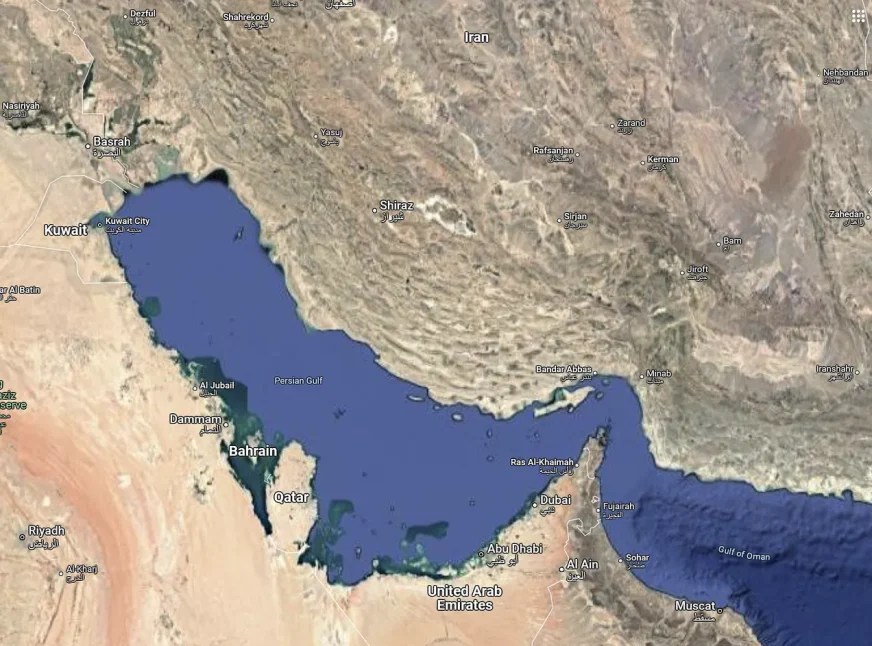
Strait of Hormuz / Persian Gulf
So I ask, in all seriousness, what exactly are two US Navy carrier strike groups going to do in the context of a no-holds-barred war against Iran?
To me, the entire concept screams of hubris running blindly into catastrophe.
If the US is foolish enough to start a big war against Iran, then 2025 is likely to demonstrate yet again that, combined with firepower, geography is the indomitable god of war.
Seyed Marandi: America Attacks Yemen – Has Trump Set Himself Up For Failure?
Glenn Diesen | March 19, 2025
Seyed Mohammad Marandi is a professor, analyst and advisor to Iran’s nuclear negotiation team
Follow me:
Substack: https://glenndiesen.substack.com/
X/Twitter: https://x.com/Glenn_DiesenPatreon:

Support the channel:
PayPal: https://www.paypal.com/paypalme/glenn…
Buy me a Coffee: buymeacoffee.com/gdieseng
Go Fund Me: https://gofund.me/09ea012f
Trump hypes up tensions with Iran
By M. K. BHADRAKUMAR | Indian Punchline | March 17, 2025
On Saturday, US President Donald Trump ordered the Pentagon “to launch a decisive and powerful military operation” against the Houthis of Yemen with “overwhelming lethal force” in the most significant military action of his second term, to date.
The US attacks began on Saturday and continued into Sunday on the Yemeni capital Sanaa and other areas reportedly killing 31 people and wounding 101 so far, most of them children and women.
Such wanton killing of defenceless women and children can only be seen as an act of cowardice. Trump has blood on his hands. Trump wrote on Truth Social addressing the Houthis, “Your time is up, and your attacks must stop, starting today. If they don’t, hell will rain down upon you like nothing you have ever seen before.”
Thereupon, Trump abruptly digressed to address Iran that it needed to immediately stop supporting the Houthis. Trump threatened, “America will hold you fully accountable and, we won’t be nice about it!”
Iran has reacted strongly. Foreign Minister Abbas Araghchi said Trump has no authority or business to dictate Iran’s foreign policy. Araghchi noted that Houthis are only reacting to “Israeli genocide and terrorism”. The commander of Iran’s Islamic Revolutionary Guard Corps General Hossein Salami warned that Iran would give “a destructive response” to any attack.
Trump’s belligerence came within two days of a visit by Anwar Gargash, the UAE’s Minister of State for Foreign Affairs, to Tehran on Thursday to hand over a letter from Trump addressed to Iran’s Supreme Leader Ayatollah Ali Khamenei proposing talks on Iran’s nuclear programme and Iran’s support to resistance groups. Tehran remains open to nuclear talks but has rejected any linkage with its regional policies.
Meanwhile, Tehran has begun circling the wagons as a new phase is beginning in Trump’s foreign policies, with tensions rising steadily over the nuclear issue. The October deadline is drawing closer by the day for invoking the snapback clause in the JCPOA (2015 Iran nuclear deal) to reinstate UN Security Council sanctions will expire, and Iran’s enrichment programme, on the other hand, has apparently reached a point where it already has a stockpile to make “several” nuclear bombs, per the International Atomic Energy Agency.
On March 14, China’s foreign minister Wang Yi hosted a joint meeting in Beijing with the Russian and Iranian deputy foreign ministers where he proposed five points “on the proper settlement of the Iranian nuclear issue”, which, for all purposes endorsed Tehran’s stance. It was a resounding diplomatic victory for Iran.
Interestingly, the Beijing meeting was timed to coincide with the conclusion of a 6-day naval exercise at Iran’s Chabahar Port with the theme of Creating Peace and Security Together between the navies of Iran, Russia and China. A readout by the Chinese Ministry of Defence stated that “The naval exercise enhanced the joint operational capabilities of the three navies to respond to various emergencies and maintain maritime security, deepened military trust and practical cooperation among the navies of the participating countries, and laid a solid foundation for future cooperation.”
All these developments taken into account, Trump faces multiple challenges at the diplomatic level over the Iranian nuclear issue with Tehran, Moscow and Beijing coordinating their approaches in the crucial six-month period ahead and Tehran giving confusing signals over Trump’s letter to Khamenei. Trump cannot be pleased with the developing situation on the diplomatic track and some pressure tactic becomes necessary against Iran. Simply put, Trump’s egocentric mind took the easy route of punching the Houthis so hard to send an indirect message to Tehran (and Moscow and Beijing) that he is not to be trifled with.
Indeed, Moscow has lately waded into the Iran nuclear issue and is positioning itself for a mediatory role potentially. Foreign Minister Sergey Lavrov recently came out against attaching extraneous issues (eg., verifiable arrangements by Tehran to ensure the cessation of its support for resistance groups in Iraq, Lebanon, and Syria) to the nuclear negotiations. Lavrov said frankly, “Such a thing is unlikely to yield results.”
Lavrov has also emphasised Moscow’s support for Tehran’s basic stance that any resumption of US-Iran negotiations ought to be stemming from the 2015 nuclear deal known as the JCPOA which carries the approval of the UN Security Council (which of course Trump tore up in 2018.)
Don’t be surprised if Moscow is wading into the US-Iran nuclear standoff with great deliberation when it is tackling on a parallel track Trump’s intrusive calls for cessation of Russian special military operations in Ukraine even while there is much unfinished business which remains to be completed and Ukraine showing no genuine interest in negotiations with Russia — and has actually enacted a law expressly prohibiting such negotiations.
Specifically, Trump would know he is in no position to get Zelensky to agree to a surrender of weapons by the Ukrainian troops in Kursk — although, Putin has offered that “If they lay down their weapons and surrender, they will be guaranteed life and decent treatment.”
The crunch time is coming as the Russian deadline for peaceful surrender is about to expire by 6 am Moscow time today. Dmitry Medvedev, Deputy Chairman of Russia’s Security Council wrote on Telegram channel that “should they refuse to lay down arms, they will all be systematically and mercilessly eliminated.” Trump’s nerves must be on edge as embedded within the Ukrainian occupying forces there could be Western mercenaries as well.
In the circumstances, one feels sorry for the Houthis whom Trump is using as a punchbag to vent his frustrations and suppressed fury against Tehran. Top officials in the Trump administration have openly acknowledged that Tehran is being notified that “enough is enough” — an expression used by Trump’s National Security advisor Mike Waltz to interpret the nuanced message of the air and missile strike against the Houthis.
Certainly, Yemen which has gone through so much suffering does not deserve such bestial attacks. As for Houthis, they are yet to attack any ships despite threatening to do so over Israel’s blockade on all food, fuel and other supplies into the Gaza Strip. The Houthis have accused the Trump administration of overstating the threat of maritime embargo, which is limited only to Israeli navigation until humanitarian aid is delivered to the people of Gaza according to the ceasefire agreement between Hamas and Israel.
Evidently, the Houthis are neither looking for a showdown with Trump nor are they to be regarded as Iranian proxies. Houthis halted the drone and missile attacks altogether when the Gaza ceasefire was declared in January. Even Trump’s best argument is that Houthis had attacked US ships during the Biden administration.
Nonetheless, US Central Command described Saturday’s strikes as the start of a large-scale operation that may continue indefinitely. Secretary of Defense Pete Hegseth wrote on X, “Houthi attacks on American ships & aircraft (and our troops!) will not be tolerated; and Iran, their benefactor, is on notice, Freedom of Navigation will be restored.” Behind such fictitious rhetoric, Hegseth probably understands that Trump expects him to keep the pot boiling in the Gulf region through the next several months as the Iran nuclear issue approaches a point of criticality.
The Russian Foreign Ministry, in a readout on Saturday, stated that US Secretary of State Marco Rubio called Lavrov and informed him about the US decision to attack the Houthis. It said Lavrov, in response, “emphasised the need for an immediate cessation of the use of force and the importance of all parties engaging in political dialogue to find a solution that prevents further bloodshed.” Well, the shoe is on the other foot now, isn’t it? On March 15, Trump forfeited the moral ground to be leading with peace through strength in his foreign policy.
Iran, Russia, China reject ‘unlawful’ US sanctions after tripartite meeting
The Cradle | March 14, 2025
China, Russia, and Iran released a joint statement on 14 March demanding an end to “unlawful” US sanctions against the Islamic Republic after meetings in Beijing between the three countries, which were aimed at jumpstarting stalled nuclear talks between Tehran and Washington.
The three countries “emphasized the necessity of terminating all unlawful unilateral sanctions” after talks hosted by Beijing on Friday morning, according to the joint statement read out by Chinese Vice Foreign Minister Ma Zhaxou.
“The three countries reiterated that political and diplomatic engagement and dialogue based on the principle of mutual respect remains the only viable and practical option in this regard,” read the joint statement.
Russia’s Deputy Foreign Minister Ryabkov Sergey Alexeevich and Iran’s Deputy Foreign Minister Kazem Gharibadi were also present.
The Chinese Foreign Ministry revealed on 12 March that Beijing would host the high-level talks regarding the nuclear issue with Russia and Iran this week, coinciding with growing tension between Washington and Tehran over the Iranian atomic energy program.
Russia also signaled earlier this month that it was willing to help facilitate negotiations between Iran and the US.
US President Donald Trump has been pushing for nuclear negotiations with the Islamic Republic while simultaneously issuing threats and imposing harsh economic sanctions against the country.
Iranian officials, including President Masoud Pezeshkian and Foreign Minister Abbas Araghchi, have announced their refusal to engage in negotiations under pressure, in line with the position taken by Iran’s Supreme Leader Ali Khamenei.
A letter written by Trump addressing the supreme leader, which has yet to be published, has reportedly been handed over to Araghchi by Anwar Gargash, the diplomatic advisor to UAE President Mohammed Bin Zayed (MbZ).
On 7 March, Trump said: “I’ve written them a letter, saying I hope you’re going to negotiate because if we have to go in militarily, it’s going to be a terrible thing for them. There are two ways in which Iran can be handled – militarily, or you make a deal.”
Khamenei said in response that “bully governments … insist on negotiations” which are “not aimed at solving problems; they aim at domination.”
The International Atomic Energy Agency (IAEA) reported last month that Iran significantly increased its stockpile of near-weapons-grade uranium by 92.5 kilograms (203.9 pounds) since its previous report in November.
A closed-door UN Security Council (UNSC) meeting attended by representatives of the US, UK, France, and other countries was held on Wednesday. After the meeting, the UK deputy ambassador to the UN, James Kariuki, accused Iran of “dramatically” enriching uranium towards weapons-grade level and said western countries will “take any diplomatic measures to prevent Iran acquiring a nuclear weapon,” including the reimposition of sanctions.
Tehran insists that its nuclear program is entirely peaceful, in line with a religious fatwa against weapons of mass destruction, as well as the fact that it is a signatory in the Nuclear Non-Proliferation Treaty (NPT).
Yet it faces constant threats of attack from Israel. Reports from last month cited US intelligence estimates as saying that Israel is strongly considering strikes on Iranian nuclear facilities, which could potentially come this year.
Featured Video

ARE PATIENTS BEING PROPERLY INFORMED ABOUT OZEMPIC?
or go to
Aletho News Archives – Video-Images
From the Archives
Trans ‘milk’ as good as the real thing – NHS
RT | February 18, 2024
The drug-induced nipple secretions of trans women are as good as mothers’ breast milk for babies, the University of Sussex Hospitals NHS Trust claimed in a letter to campaigners made public in a report by British think tank the Policy Exchange on Sunday.
The healthcare trust’s medical director, Rachel James, argued that the off-label prescription drug cocktail men transitioning to female take in order to produce milk was “similar to the natural hormones which encourage lactation to develop when the baby is newly born.”
“The evidence which is available demonstrates that the milk is comparable to that produced following the birth of a baby,” James wrote in the letter, sent to Children of Transitioners last August.
Biological men who wish to lactate must first take hormones to grow milk glands and then take high doses of either domperidone or metoclopramide to stimulate milk production. Neither drug is approved for this use, though they are occasionally prescribed off-label to biological women who have trouble lactating.
However, domperidone’s own manufacturer, Janssen, warns patients the drug “may cause unwanted side effects affecting the heart in a breastfed baby” and “should be used during breastfeeding only if your physician considers this clearly necessary.” … continue
Blog Roll
 Aletho News
- 2025 Nature Paper Claiming Worsening Global Drought Gets RETRACTED …Heavily Flawed
- Your Milk Is Not the Problem
- The Truth About the Trump Shootings with Ken Silva
- ARE PATIENTS BEING PROPERLY INFORMED ABOUT OZEMPIC?
- US lawmaker blocks $2.8 billion weapons sale to Israel: Report
- Yemeni army claims responsibility for strikes on sensitive sites in Saudi capital, Aramco facilities in Yanbu
- Iran Judiciary issues indictments against 159 US, Israeli officials for assassination of Leader, commanders
- Turkiye revokes Iranian bank license under US sanctions campaign
- US-Denmark Agreement on Greenland Is ‘PR Stunt’ Ahead of Midterms
- Araghchi: Military intervention cannot create security; coercion cannot bring peace
- If Americans Knew
- Israeli attacks kill four Palestinians in Gaza – Daily Update
- Inside Gaza’s death trap of collapsing, bombed-out buildings
- The everyday items Israel bans from Gaza every day
- Inside the siege, the ruined buildings of Gaza – Daily Update
- Debunking The Claim That Macklemore Has A “History Of Antisemitism”
- CPJ demands release of arrested Palestinian-US journalist near Bethlehem
- Robert Kraft: The Billionaire Friend of Netanyahu Pulling The Strings Behind the Macklemore/Ed Sheeran Blow Up
- Columbia Administered Fund Gives Big Money to Pro-Israel Groups
- Deportation Case of Palestinian Activist Salah Sarsour Tests First Amendment
- ‘We Will Not Forget’: Palestinians Mark 44 Years since Sabra and Shatila
- No Tricks Zone
- 2025 Nature Paper Claiming Worsening Global Drought Gets RETRACTED …Heavily Flawed
- New Study: ‘Global Drought Shows No Detectable Recent Acceleration Under Climate Warming’
- Economic Masterminds: German Socialists Suggest Taxing Productivity Gains Stemming From Using AI
- The South China Sea Has Not Been Cooperating With The Climate Change Narrative
- Energy Crisis: Germany Enters Heating Season With Historically Low Gas Reserve Fill Levels
- New Study: The Antarctic Ice Sheet Gained Mass From 2020-2024 Due To Staggering Snow And Ice Accumulation
- Study: Ocean Heating Rates From Thousands Of Years Ago ‘Dwarf’ Modern Ocean Heating Rates
- Climate Extremists Target, Attack Large-Scale Power Grid Infrastructure In Germany!
- New Study: Antarctic Ice Melt Has Contributed Less Than 1 Centimeter To Sea Level Rise In The Last 30 Years
- Fear Of Debate: Alarmist German Climate Scientist Calls On Mainstream Media To Discredit Skeptic Voices
 Aletho News