Iraqi FM warns PMU, Lebanese Hezbollah cannot be disarmed by force
The Cradle | August 18, 2025
Iraqi Foreign Minister Fuad Hussein stated on 18 August that efforts to pass a new law in the parliament to regulate the status of the Popular Mobilization Units (PMU) are coming at the wrong time, while at the same time emphasizing the government’s inability to disarm the resistance factions comprising the PMU by force.
“The timing of introducing the Popular Mobilization Forces law was wrong, and I was the only minister who expressed this within the cabinet before the draft law was sent to parliament, especially in light of the tense regional and international situation and the Iranian–American conflict,” Hussein said in an interview on Iraqi TV.
The new law would update an existing law regulating the PMU, transforming it into a fully independent security institution directly under the prime minister and bypassing the Defense and Interior Ministries.
The PMU was created in 2014 to recruit volunteers to fight against ISIS, which had just taken over Mosul, Iraq’s second-largest city, with covert support from the US and Peshmerga forces loyal to Iraqi Kurdish leader Masoud Barzani.
The PMU, which was comprised of multiple Shia armed factions, was incorporated into Iraq’s security forces with the passage of the first PMU law in 2016. The group was later expanded to include other ethnic groups, including Sunnis, Yezidis, Shabaks, and Christians.
The Coordination Framework coalition, a Shia political bloc supported by Iran, is pushing for the Iraqi parliament to include a vote on the new PMU law in its upcoming sessions.
In contrast, Foreign Minister Hussein argued that the PMU should be disarmed, but through dialogue rather than force.
“We need a rational dialogue with the factions to disarm, and this cannot be done by force, as this could lead to internal strife. Before the national dialogue, we need an inter-Shia dialogue between the Shia parties and leaders, but unfortunately, so far, there has been no dialogue in this regard,” Hussein added.
The US has also reportedly pushed for the PMU to be disarmed.
Hussein, who also serves as deputy prime minister, compared the issue of the PMU in Iraq to that of Hezbollah in Lebanon. The US is also pressuring the Lebanese government to disarm Hezbollah, which defended the country from Israel’s invasion last year.
“Hezbollah’s weapons in Lebanon cannot be disarmed except through dialogue, and the Iraqis cannot disarm the Popular Mobilization Forces by force. Centralization of decision-making is the problem in Syria, and decentralization may be the solution.”
The minister accused Iran of interfering in Iraqi affairs by promoting the law. “Most neighboring countries interfere in political, security, and military affairs, including Iran, which has significant influence,” he stated.
Hussein’s statements come amid interference from Washington, which seeks to block the law’s passage.
The US has warned Iraq against passing the new law, arguing it would entrench Iranian influence and empower armed groups “undermining Iraq’s sovereignty.”
US Chargé d’Affaires Steven Fagin and US Secretary of State Marco Rubio both raised these concerns in meetings and calls with Iraqi officials, pressuring parliament to halt the vote despite the bill already completing its second reading in July.
Iraq’s parliament has since avoided including the law on its agenda, facing opposition from Sunni and Kurdish blocs, while pro-Iran factions continue to push for its passage.
Shafaq News wrote on Monday that according to Iraqi MP Thaer Mokheef, “the real obstacle lies in US opposition, warning that Washington seeks to block the legislation and may attempt to reassert influence in Iraq.”
Among the groups represented in the PMU are Kataib Hezbollah, Asaib Ahl al-Haq, and the Al-Nujaba Movement – Iran-linked resistance factions involved in the attacks on US bases in Iraq and Syria, which began after the start of the Gaza war and ended months later with the help of Iraqi government pressure.
Last year, the US launched heavy strikes on Kataib Hezbollah sites in Iraq in response to the killing of three soldiers in a drone strike on a US military base on the Syria–Jordan border.
Israeli daily reveals Mossad-MKO collaboration during aggression against Iran
Press TV – August 17, 2025
An Israeli newspaper has revealed collaboration between the Mossad spy agency and the Mujahedin Khalq Organization (MKO) terrorist cult during the recent illegal aggression against Iran.
In a blog in Times of Israel, US-based freelance journalist Julian Rennell said the Mossad-MKO collaboration, which dates back to at least 2002, reached “new levels of sophistication” over the course of the 12-day Israeli-US assault against Iran.
The MKO’s “operational elements” had established “team houses in Tehran, where they built launchers and handheld mortars” and conducted “propaganda and information-gathering activities” in support of Israeli objectives, he said.
The notorious terror group provided targeting data for high-value assassinations in Iran and “precise coordinates” of critical infrastructure during the June’s aggression.
Rennell also quoted US officials as saying that the MKO has been “financed, trained and armed by Israel’s secret service” to assassinate Iranian nuclear scientists.
He further cited Tehran’s Criminal Court as documenting how MKO operatives coordinated with Israeli intelligence by gathering data on traffic flow near Kermanshah’s Farabi Hospital and passing it to the Tel Aviv regime for a deadly strike.
Meanwhile, he referred to remarks by an Iranian judge, who confirmed “active cooperation” between MKO terrorists and Israeli operatives, particularly in identifying and targeting Iranian nuclear scientists.
Rennell urged Israel to “formalize” its relationship with the MKO and move beyond covert cooperation to strategic partnership regardless of significant backlash, both among Iranians and internationally.
The MKO – the most despised group among ordinary Iranians – has a dismal history of perpetrating heinous attacks against Iranian civilians and officials, killing around 12,000 people since the victory of Iran’s 1979 Islamic Revolution.
MKO members spent many years in Iraq, where they were hosted and armed by the former Iraqi dictator Saddam Hussein. They sided with Saddam during the 1980-88 imposed war against Iran.
MKO terrorists, who are now based in Albania, enjoy freedom of activity in the US and Europe.
A top Iranian criminal court has held 36 hearings on crimes of MKO members. It will hold more trial sessions for the case.
Iran blasts ICJ vice-president’s ‘blatant bias’ toward ‘Israel’
Al Mayadeen | August 16, 2025
Deputy Foreign Minister for Legal and International Affairs Kazem Gharibabadi has sharply condemned what he described as a “shocking breach of judicial ethics,” accusing International Court of Justice (ICJ) Vice-President Julia Sebutinde of openly siding with “Israel”, an entity currently facing multiple cases before the Court.
He warned that such “blatant bias” undermines the ICJ’s integrity and violates the core principle of judicial impartiality.
Gharibabadi’s comments follow Justice Julia Sebutinde’s controversial remarks defending her dissenting opinion in the ongoing Israeli genocide against Palestinians in Gaza.
Sebutinde, the only judge to oppose provisional measures against “Israel”, has now further stoked anger with a public speech that critics say confirms long-standing suspicions of personal bias and ideological alignment with Zionist narratives.
“There are now about 30 countries against Israel… the Lord is counting on me to stand on the side of Israel. The whole world was against Israel, including my country,” she declared on August 10 at Watoto Church in Uganda.
Speaking during the launch of the Golden Legacy ministry for members aged 55 and above, Sebutinde added, “I will never forget the day the judgment came out. Even though the government was against me, I remember one ambassador saying, ‘Ignore her because her ruling is not a representation of Uganda.’ The media ran this to fuel more anger and sentiment. Such sentiments can only come from the pit of hell.”
Her speech, laced with religious justification and inflammatory rhetoric, has intensified scrutiny over her role at the court, especially given the gravity of the charges brought against “Israel” by South Africa.
Controversial dissent at ICJ
Justice Sebutinde stood alone among the 17-judge panel at the ICJ, voting against emergency measures directing “Israel” to prevent and punish incitement to genocide in Gaza. Her lone dissent drew widespread condemnation and triggered accusations of both political and religious bias, particularly due to her openly expressed Zionist leanings.
Ugandan officials moved quickly to distance themselves from her stance. Uganda’s Permanent Representative to the UN, Adonia Ayebare, clarified in January: “Justice Sebutinde’s ruling at the ICJ does not represent the Government of Uganda’s position on the situation in Palestine. Uganda’s support for the plight of the Palestinian people has been expressed through our voting pattern at the United Nations.”
Public reaction in the region has been overwhelmingly critical. A Kenyan social media user wrote: “Judge Julia Sebutinde is such an embarrassment to her country and a disgrace to humanity. She didn’t just vote against South Africa’s petition; she voted against reason and morality, justice and freedom, love and compassion. She voted against the very soul of humanity.”
South Africa’s genocide case
On December 29, 2024, South Africa filed a case against “Israel” at the ICJ, accusing it of committing genocidal acts during its military campaign in Gaza. The case prompted global attention, with legal experts and rights advocates calling it a historic test of international law.
Uganda’s Permanent Secretary at the Ministry of Foreign Affairs, Vincent Bagiire Wasswa, reinforced the government’s position, saying, “She made an independent decision that was being misconstrued to be a decision of Uganda. The comments were to make clear that her decision was independent.”
Adding another layer of controversy, Sebutinde revealed that at the time of her dissent, she was also seeking election as ICJ vice-president. She claims she was hesitant to continue due to public backlash but said she was “compelled by God” to go through with it.
She added that a fellow judge later told her she had been elected because of her “character and independence.”
“So whatever the devil had planned for me, God turned it around. This happened a day after the verdict,” she added
Critics argue that such remarks, invoking divine guidance in judicial matters and portraying dissenters as influenced by “the devil”, raise serious questions about her suitability for one of the highest judicial offices in the world.
Lin: China opposes invocation of UN Security Council ‘snapback’ sanctions against Iran

Chinese Foreign Ministry Spokesperson Lin Jian
Press TV – August 15, 2025
China reaffirms its commitment to the peaceful resolution of Iran’s nuclear issue and opposes the invocation of the UN Security Council’s “snapback” mechanism.
Chinese Foreign Ministry spokesperson Lin issued the statement on Friday in response to the European troika’s warning to reimpose sanctions if a diplomatic solution is not achieved by the end of August.
“China stays committed to peacefully resolving the Iranian nuclear issue through political and diplomatic means, opposes invoking Security Council ‘snapback’ sanctions,” Lin said.
He argued that reimposing sanctions on Iran would not foster trust or bridge differences among parties and would hinder diplomatic efforts to resume talks promptly.
Lin emphasized that any actions taken by the Security Council should facilitate the achievement of new agreements rather than undermine the negotiation process.
The Chinese diplomat reiterated that China is committed to maintaining an objective and fair stance, continuing to promote conversations aimed at peace, and playing a constructive role in bringing the Iranian nuclear issue back to diplomatic negotiations at the earliest opportunity.
He also highlighted Beijing’s intention to safeguard the international nuclear non-proliferation regime and to promote peace and stability in the region.
Iranian Foreign Minister Abbas Araghchi said on Thursday that the country is actively collaborating with China and Russia to prevent the reactivation of UN sanctions through the so-called “snapback” mechanism.
“We are working with China and Russia to stop it. If this does not work and they apply it, we have tools to respond. We will discuss them in due course,” he added.
The snapback mechanism, embedded in the 2015 nuclear deal, known as the Joint Comprehensive Plan of Action (JCPOA), allows the automatic reinstatement of UN Security Council sanctions that had been lifted under the agreement. The deal terminates in October.
Iran, however, disputes the legitimacy of the European powers’ efforts to trigger the provision.
In a joint letter to UN Secretary General Antonio Guterres and the UN Security Council on Wednesday, the European troika — France, Germany and the United Kingdom – said they were “committed to us(ing) all diplomatic tools at our disposal to ensure Iran does not develop a nuclear weapon” unless Tehran meets a deadline to speak with them.
“We have made it clear that if Iran is not willing to reach a diplomatic solution before the end of August 2025, or does not seize the opportunity of an extension, the E3 are prepared to trigger the snapback mechanism,” the ministers wrote.
In a detailed letter to the UN Security Council last month, Iran laid out its position, asserting that Britain, France, and Germany are no longer legitimate JCPOA participants with the authority to reinstate sanctions through snapback. This position is supported by China and Russia, who share Tehran’s view on the matter.
China and Russia’s backing plays a critical role in Iran’s diplomatic efforts to counter the snapback threat. Both countries are permanent members of the UN Security Council and have veto power over resolutions, including those related to Iran’s nuclear program.
Iran overcomes heavy US sanctions and war with Israel, takes over key energy export markets
Inside China Business | August 12, 2025
China is a top buyer of Iranian crude, taking 90% of its crude exports. But Iran has recently passed Saudi Arabia, the UAE, and Qatar as the top producer and exporter of NG products, bringing in billions more. Ambitious expansions of their petrochemical industry are also ongoing. Iranians report little difficulty in business operations among different currencies, despite the US Treasury Department’s blacklisting of key energy suppliers, and firm control over the SWIFT systems.
Closing scene, Beihai, Guangxi
Resources and links: Iran Defies US Sanctions With Surging Exports of Liquefied Petroleum Gas https://www.bloomberg.com/news/articl…
Bloomberg, Iranian Oil Production Booms Amid the Bombs https://www.bloomberg.com/opinion/art…
S&P Global, Iran’s petrochemicals defy sanctions as exports, output on the rise https://www.spglobal.com/commodity-in…
Iran announces 15 petrochemical projects to expand domestic production to nearly 80 MMtpy https://www.hydrocarbonprocessing.com…
How real is the U.S. rhetoric of a ‘Unified Syria’?
By Erkin Oncan | Strategic Culture Foundation | August 7, 2025
The recent statements by the U.S. Special Envoy for Syria, Thomas Barrack, may at first glance appear to reflect diplomatic commitment, but developments on the ground and the U.S.’s covert alliances reveal that this rhetoric is largely a propaganda maneuver.
Speaking to the Associated Press, Barrack emphasized that the “deaths and massacres” on both sides of the conflict in southern Syria are unacceptable, stating: “I believe the current Syrian government, which is a new government with very few resources to address the emerging issues, is doing the best it can.”
However, if we are to speak of “territorial integrity” in the context of a new Syria, it is clear that the U.S.’s de facto policy in Syria actually serves to strengthen structures that weaken the country’s territorial unity. On the ground, the U.S. has established a fragile balance between Syria’s new government and the Syrian Democratic Forces (SDF). While this balance may give the appearance of localized stability in the short term, it carries the potential to pave the way for Syria’s long-term fragmentation. These entities are ideologically, ethnically, and politically at odds, with starkly conflicting expectations for a new Syria.
Red Lines in the Damascus—SDF Talks
The Damascus administration’s plans to integrate the SDF into the New Syrian Army, dismantle its autonomous structure, and transfer control of northeastern resources (oil, borders, educational institutions) to the Syrian state are clear.
The SDF, meanwhile, although it continues its contacts with the new Syrian administration, maintains a series of “red lines”: preserving autonomous administration, integrating its forces into the army independently of the central command, receiving a share of resources, and maintaining control over the borders.
In this scenario, the U.S. — a power that has provided extensive military and political support to both sides over time — appears to be attempting to “gloss over” this deeply uncertain process with diplomatic statements and messages of goodwill.
Israel’s Proxy Strategy
Israel, which has effectively “entered” the Syrian arena through the Suwayda clashes, likely sees the criticisms voiced by its greatest ally’s special envoy as a mere formality. Israel’s main strategy here is to sever southern Syria from Damascus and create new zones of control via proxy forces under the pretext of border security.
In other words, while there is rhetorical emphasis on a “Unified Syria,” what is being built on the ground is an increasingly entrenched multi-structure reality. A possible agreement between the SDF and HTS (Hay’at Tahrir al-Sham), for example, is not just about two armed groups sitting at the negotiating table; it encapsulates the conflicting interests of regional and global actors.
The negotiations between the SDF and HTS do not only involve these two actors; the balance includes the intervention of the U.S., Israel, and Turkey. Turkey, operating on the assumption that these negotiations will proceed parallel to the PKK’s disarmament process, seeks to secure its “share” in the governance of the new Syria.
The SDF, which received the most comprehensive support from the U.S. during the Trump era, is aware that such direct military and political backing may not continue under the Democrats. Furthermore, Washington’s regional priorities have shifted. Therefore, the SDF is striving to secure a balanced but strong position against HTS, with the primary goal of ensuring its continued existence. It is among the claims reported in Israeli and regional media that the group has engaged in a series of meetings not only with the U.S. but also with Israel.
Israel, for its part, is determined to exploit the “power vacuum” emerging in the new Syria to the fullest extent. What began under the guise of border security has now merged with Israel’s structural expansionist policy. Should Israel decide to “accelerate” its operations in Syria, it is well aware that Damascus may not be able to mount a serious resistance.
Is the Damascus Government Falling Short?
The new government led by Shara has so far failed to demonstrate the capacity to bear the role of “new leadership.” It faces a governance crisis, ethnic massacres that have sparked international condemnation, ongoing clashes with Israel, and severe economic issues.
Thus, the Damascus government finds itself compelled to “find middle ground” with the SDF, the U.S., and even Israel in order to secure its hold on power.
Within this equation, the perception of Iran as the “primary threat” on a regional level offers significant clues about the future of current power struggles.
The “Iran Threat” Will Determine the Balance
Despite suffering a severe blow with the fall of the Assad regime, Iran remains one of the strongest actors in the region. The SDF’s potential to serve as an “independent balancing force” against Iran perfectly aligns with the interests of the Tel Aviv—Washington axis. Therefore, in negotiations between the SDF and Damascus, the scenario in which the SDF’s demands gain weight and the central government’s power is curtailed is highly probable.
Despite the U.S.’s diplomatic calls for “unity,” the SDF’s de facto autonomy, its capacity to continue negotiations with Damascus thanks to current power balances, and the U.S.—Israel strategy of positioning against Iran all stand in the way of any real unification of Syria. Under current circumstances, it is nearly impossible for the new Syrian government under Shara to evolve into a stable and functioning structure. Ongoing military, political, and economic crises, coupled with the overarching “main threat is Iran” strategy, necessitate the continuation of the existing fragmented structure.
In conclusion, Washington’s rhetoric of a “Unified Syria” is largely propagandistic when viewed in light of the multilayered web of interests and covert alliances on the ground. With the U.S. and Israel seeking to expand the anti-Iran front, the scenario in which the SDF continues to play a strong role outside the framework of the central government remains the most likely outcome.
John Fetterman, a hawkish US senator who represents Americans but speaks for Israel

By Musa Iqbal | Press TV | August 7, 2025
It is no secret that the political apparatus of the United States is teeming with Zionists.
While some politicians are sleek in their support for the Zionist Occupation (with politically convenient cries for ‘civility’ in Palestine and the rest of the region), others are completely devoted to a maximalist Zionist agenda – advocating for Zionist expansion, aggression, and total servitude to Israeli interests – no matter their maximalist goals.
Among the latter is US Senator John Fetterman, a hawkish politician who once campaigned as a “progressive,” but has now turned into the Israeli occupation’s most darling Democratic cheerleader and an unofficial mouthpiece and apologist of the genocidal child-murdering regime.
Fetterman’s unwavering support for Israel, which comes with belligerent calls for war against Iran, betrays the very principles he once claimed to champion.
During the election cycle that put him into power, progressive groups had rallied around Fetterman as a “working man” that most Americans could relate to. They could not have been more wrong.
Fetterman, often skulking the halls of the US Capitol in a hoodie and gym shorts, has become the poster child for the US political establishment’s subservience to the Zionist project and its reckless drive toward regional hegemony in Western Asia.
Fetterman has shown total support with each new act of Zionist terror, something his constituents are increasingly condemning.
His rhetoric, particularly his enthusiastic endorsement of Israel’s military actions and his calls for US involvement in illegal and unprovoked strikes on Iran, is not only a betrayal of his constituents but a dangerous escalation that threatens to give more support to an increasingly belligerent Israeli occupation entity as it faces an existential crisis.
He has draped himself in the Israeli flag on several occasions—literally and figuratively—while dismissing calls for a ceasefire and championing Israel’s so-called “right to defend itself” against a besieged, starving population.
Perhaps as a hat-tip to his pro-Israeli donors, his office walls are covered with posters of Israeli captives held by the Palestinian resistance movement Hamas, further serving as a shrine to a one-sided narrative that erases the decades-long suffering of Palestinians under occupation.
To compare, there are tens of thousands of Palestinian hostages in Zionist prisons, a sizeable amount of them being Palestinian youth.
Speaking of donors, Fetterman has unapologetically collected hundreds of thousands of dollars from the Zionist lobby. Based on the data organized by Track AIPAC, Fetterman has received over $370,000 in donations from Israeli-associated PACs and donors, with one of his top donors being JStreetPAC, which donated $175k in 2024 alone.
Donations of this caliber suggest extreme levels of loyalty to furthering Israeli settler-colonial interests in the power corridors of Washington – from domestic policy fighting against Boycott Divestment Sanctions (BDS) efforts to foreign policy warmongering on behalf of the American-Israeli axis of evil.
It also aligns with Fetterman’s refusal to acknowledge the Palestinian death toll—over 150,000 by some estimates, including thousands of children—while fixating on Israeli victims reveals a moral bankruptcy that aligns him with the most hawkish elements of the US political spectrum.
Fetterman ghoulishly refuses to acknowledge the catastrophic loss of life, insisting that “now is not the time to talk about a ceasefire.”
Clearly, Fetterman’s loyalty to the Zionist cause goes as far as deliberate endorsement of collective punishment of innocent Palestinians, including children and women, a policy that violates international law.
Of course, being in line with the Zionist occupation’s expansionist interests, Fetterman’s zeal for Israel does not stop at Gaza. He has cheered on for US military aggression against Iran, celebrating the bombings against Iran’s peaceful nuclear program and threatening that Israel can continue to assassinate its nuclear scientists with his and other US politicians’ approval.
In his March 2025 visit to the occupied territories, Fetterman told journalists in Jerusalem al-Quds that he supports “partnering with Israel to bomb Iran’s nuclear facilities,” urging the US to “blow it up.”
His rhetoric continued to escalate, including in June 2025, when he called for Israel to assassinate the Leader of the Islamic Revolution, Ayatollah Seyyed Ali Khamenei. Such statements are not the musings of a principled senator but the ravings of a warmonger eager to appease the Zionist war machine and its patrons in Washington.
Fetterman’s rhetoric must be seen in the context of the broader US-Israel agenda to neutralize Iran as a regional power, especially as the latter secures critical economic alliances such as a place in BRICS and the SCO (Shanghai Cooperation Organization).
For decades, the US and its Zionist ally have sought to undermine Iran’s sovereignty, from crippling, high-pressure sanctions to covert sabotage operations and outright military threats.
Fetterman’s calls for illegal and unjustified strikes on Iran’s nuclear facilities, which Iran maintains are for peaceful energy purposes, echo the same discredited playbook used to justify the invasion of Iraq and Afghanistan, the bombing of Libya, the destruction of Yugoslavia, etc.
The threat of a nuclear bomb armed Iran is a propaganda campaign orchestrated by Washington and Tel Aviv to justify aggression while ignoring Israel’s undeclared nuclear arsenal, a violation of international norms, and a total means to destabilize the region.
The hypocrisy of Fetterman’s position declares the official US policy for the area: Israel’s nuclear capabilities are strategic and protect American interests, but Iran’s pursuit of energy independence is an intolerable existential threat.
Fetterman, in his blind allegiance to Israel, seems unperturbed by the realities of what the execution of this US-led policy would look like, choosing to ignore the total rupture of the region, plunging the US into a war it would not understand or be prepared for – Iran is not Iraq, Libya, or Afghanistan.
It is a regional power with a sophisticated military and an alliance with resistance groups that would be eager to defend their ally against American aggression.
By endorsing Israel’s strikes on Iran and advocating for US aggression, Fetterman is perpetuating a cycle of violence that benefits only the US ruling class and its Zionist beneficiaries.
The US has spent trillions on wars in the West Asia region, leaving behind shattered societies that will take decades to redevelop.
Fetterman’s call to “take out” Iran’s leadership and nuclear program is a recipe for more of the same- a reckless gamble with lives and resources that the US can ill afford, and would further plant the seeds of disdain for US policy both at home and abroad.
The American people, weary of endless wars and economic hardship, deserve a senator who prioritizes their interests over those of a foreign power tied to genocidal crimes and occupation.
Fetterman’s betrayal of his “progressive” voter base that elected him into power is not just a personal failing but a symptom of a deeper, more sinister alignment in US politics, where loyalty to Israel and the war machine comes before anything else, if anything else at all.
It is incumbent on the global community to reject the likes of Fetterman and their imperialist agendas, as there are war mongers like Fetterman, or worse, spread throughout different Western governments.
While they are considering replacements, they can also add someone who knows how to dress themselves as a requirement. Indeed, the bar has never been lower.
Marked for Death by a Reckless America?
By Ron Unz • Unz Review • August 4, 2025
A few weeks ago I published an article noting that the State of Israel and the Zionist movement that gave rise to it have probably employed assassination as a tool of statecraft more heavily than any other political entity in recorded history. Indeed, their deadly activities had easily eclipsed those of the notorious Muslim sect that had terrorized the Middle East a thousand years ago and gave rise to that term.
The piece had been prompted by Israel’s sudden strike against Iran, capping its reputation as the greatest band of assassins known to history. Even as the Iranian government was intensely focused on the negotiations with America over its nuclear program, a sudden Israeli surprise attack successfully assassinated most of Iran’s highest military commanders, some of its political leaders, and nearly all of its most prominent nuclear scientists. I cannot recall any previous case in which a major country had ever had so large a fraction of its top military, political, and scientific leadership eliminated in that sort of illegal sneak attack.
Less than one year earlier, a series of missile exchanges between Israel and Iran had soon been followed by the death of hardline Iranian President Ebrahim Raisi and his foreign minister in a highly-suspicious and never explained helicopter crash. Given subsequent events, I think we can safely assume that he, too, had died at the hands of the Israelis.
- Zionist Israel as the Assassination Nation
Ron Unz • The Unz Review • June 23, 2025 • 11,800 Words
Earlier this year, the declassification of a large batch of JFK Assassination files had prompted me to recapitulate and summarize many of my articles of the last half-dozen years on that landmark twentieth century event. I gathered together some of the very considerable evidence that the Israeli Mossad played the central role in the assassination of President John F. Kennedy in 1963 as well as the death of his younger brother Robert a few years later, probably the highest-profile political assassinations of the last one hundred years or more.
- How Israel Killed the Kennedys
Ron Unz and Mike Whitney • The Unz Review • March 24, 2025 • 11,500 Words
The most weighty and authoritative work on the long history of Israeli assassinations is surely Ronen Bergman’s 2018 volume Rise and Kill First, running 750 pages and including a thousand-odd source references, with many of the latter citing official documents never previously made available to journalists. By some estimates, this book documented nearly 3,000 such foreign political killings, a remarkable total for a small country then less than three generations old.
Although the Bergman book was certainly very comprehensive, it was produced under strict Israeli censorship, so the text quite understandably omitted almost any coverage of some of the highest-profile Zionist attacks on Western targets. For example, there was no mention of the unsuccessful but well-documented attempts to kill President Harry Truman, nor the assassination efforts aimed at British Prime Minister Winston Churchill and the top members of his Cabinet.
Some of this latter coverage may be found in Thomas Suarez’s 2016 book State of Terror which I would recommend as a very useful supplementary work, though its focus is almost entirely limited to the activities of Zionist groups just prior to the establishment of Israel.
For a broader discussion of the history of Israeli assassinations and closely-related terrorist attacks, especially those targeting Westerners, one of the most useful compilations might be my own very long January 2020 article, providing extensive references to the underlying primary and secondary sources.
- American Pravda: Mossad Assassinations
Ron Unz • The Unz Review • January 27, 2020 • 27,300 Words
That 2020 article had actually been prompted by America’s own sudden assassination of Iranian Gen. Qassem Soleimani, a shocking development that drew a great deal of media coverage at the time.
I had opened my long discussion by noting that over the last several centuries Western governments had almost totally abandoned the use of political assassinations against the leadership of major rival nations, regarding such actions as immoral and illegal.
For example, historian David Irving revealed that when one of Adolf Hitler’s aides suggested to him that an attempt be made to assassinate the Soviet military leadership during the bitter combat on the Eastern Front of World War II, the German Fuhrer immediately forbade any such practices as obvious violations of the laws of civilized warfare.
For most of American history, a similar attitude had prevailed, but I explained that this began to change over the last couple of decades, mostly in the wake of the 9/11 Attacks.
The 1914 terrorist assassination of Archduke Franz Ferdinand, heir to the throne of Austria-Hungary, was certainly organized by fanatical elements of Serbian Intelligence, but the Serbian government fiercely denied its own complicity, and no major European power was ever directly implicated in the plot. The aftermath of the killing soon led to the outbreak of World War I, and although many millions died in the trenches over the next few years, it would have been completely unthinkable for one of the major belligerents to consider assassinating the leadership of another.
A century earlier, the Napoleonic Wars had raged across the entire continent of Europe for most of a generation, but I don’t recall reading of any governmental assassination plots during that era, let alone in the quite gentlemanly wars of the preceding 18th century when Frederick the Great and Maria Theresa disputed ownership of the wealthy province of Silesia by military means. I am hardly a specialist in modern European history, but after the 1648 Peace of Westphalia ended the Thirty Years War and regularized the rules of warfare, no assassination as high-profile as that of Gen. Soleimani comes to mind…
During our Revolutionary War, George Washington, Thomas Jefferson, and our other Founding Fathers fully recognized that if their effort failed, they would all be hanged as rebels by the British. However, I have never heard that they feared falling to an assassin’s blade, nor that King George III ever considered using such an underhanded means of attack. During the first century and more of our nation’s history, nearly all our presidents and other top political leaders traced their ancestry back to the British Isles, and political assassinations were exceptionally rare, with Abraham Lincoln’s death being one of the very few that comes to mind.
At the height of the Cold War, our CIA did involve itself in various secret assassination plots against Cuba’s Communist dictator Fidel Castro and other foreign leaders considered hostile to US interests. But when these facts later came out in the 1970s, they evoked such enormous outrage from the public and the media, that three consecutive American presidents—Gerald R. Ford, Jimmy Carter, and Ronald Reagan—all issued successive Executive Orders absolutely prohibiting assassinations by the CIA or any other agent of the US government.
Although some cynics might claim that these public declarations represented mere window-dressing, a March 2018 book review in the New York Times strongly suggests otherwise. Kenneth M. Pollack spent years as a CIA analyst and National Security Council staffer, then went on to publish a number of influential books on foreign policy and military strategy over the last two decades. He had originally joined the CIA in 1988, and opens his review by declaring:
One of the very first things I was taught when I joined the CIA was that we do not conduct assassinations. It was drilled into new recruits over and over again.
Yet Pollack notes with dismay that over the last quarter-century, these once solid prohibitions have been steadily eaten away, with the process rapidly accelerating after the 9/11 attacks of 2001. The laws on our books may not have changed, but
Today, it seems that all that is left of this policy is a euphemism.
We don’t call them assassinations anymore. Now, they are “targeted killings,” most often performed by drone strike, and they have become America’s go-to weapon in the war on terror.
The Bush Administration had conducted 47 of these assassinations-by-another-name, while his successor Barack Obama, a constitutional scholar and Nobel Peace Prize winner, had raised his own total to 542. Not without justification, Pollack wonders whether assassination has become “a very effective drug, but [one that] treats only the symptom and so offers no cure.”
Thus over the last couple of decades the American government has followed a disturbing trajectory in its use of assassination as a tool of foreign policy, first restricting its application only to the most extreme circumstances, next targeting small numbers of high-profile “terrorists” hiding in rough terrain, then escalating those same killings to the many hundreds. And now under President Trump, the fateful step has been taken of America claiming the right to assassinate any world leader not to our liking whom we unilaterally declare worthy of death.
Pollack had made his career as a Clinton Democrat, and is best known for his 2002 book The Threatening Storm that strongly endorsed President Bush’s proposed invasion of Iraq and was enormously influential in producing bipartisan support for that ill-fated policy. I have no doubt that he is a committed supporter of Israel, and he probably falls into a category that I would loosely describe as “Left Neocon.”
But while reviewing a history of Israel’s own long use of assassination as a mainstay of its national security policy, he seems deeply disturbed that America might now be following along that same terrible path.
Pollock’s discussion of these facts came in his lengthy 2018 New York Times review of the Bergman book entitled “Learning From Israel’s Political Assassination Program,” and he greatly decried what many have called the “Israelization” of the American government and its military doctrine. President Donald Trump’s sudden public assassination of so high-profile a foreign leader as Gen. Soleimani came less than two years later and demonstrated that Pollock’s concerns were fully warranted and indeed even understated.
As my January 2020 article explained, nothing like this had ever previously happened in peacetime American history, and only very rarely even during wars.
The January 2nd American assassination of Gen. Qassem Soleimani of Iran was an event of enormous moment.
Gen. Soleimani had been the highest-ranking military figure in his nation of 80 million, and with a storied career of 30 years, one of the most universally popular and highly regarded. Most analysts ranked him second in influence only to Ayatollah Ali Khamenei, Iran’s elderly Supreme Leader, and there were widespread reports that he was being urged to run for the presidency in the 2021 elections.
The circumstances of his peacetime death were also quite remarkable. His vehicle was incinerated by the missile of an American Reaper drone near Iraq’s Baghdad international airport just after he had arrived there on a regular commercial flight for peace negotiations originally suggested by the American government.
Our major media hardly ignored the gravity of this sudden, unexpected killing of so high-ranking a political and military figure, and gave it enormous attention. A day or so later, the front page of my morning New York Times was almost entirely filled with coverage of the event and its implications, along with several inside pages devoted to the same topic. Later that same week, America’s national newspaper of record allocated more than one-third of all the pages of its front section to the same shocking story.
But even such copious coverage by teams of veteran journalists failed to provide the incident with its proper context and implications. Last year, the Trump Administration had declared the Iranian Revolutionary Guard “a terrorist organization,” drawing widespread criticism and even ridicule from national security experts appalled at the notion of classifying a major branch of Iran’s armed forces as “terrorists.” Gen. Soleimani was a top commander in that body, and this apparently provided the legal fig-leaf for his assassination in broad daylight while on a diplomatic peace mission.
- American Pravda: Mossad Assassinations
From the Peace of Westphalia to the Law of the Jungle
Ron Unz • The Unz Review • January 27, 2020 • 27,300 Words
Although Pollock provided some explanations for this shocking transformation in American doctrine, he failed to note what was arguably the most obvious factor. Over the last generation or two, the American government and American political life have been almost entirely captured by what scholars John J. Mearsheimer and Stephen M. Walt called “The Israel Lobby” in their best-selling 2008 book of that title, and this political and ideological transformation has only further accelerated in the last couple of years, most recently reaching ridiculous, almost cartoonishly extreme levels.
For example, nearly every other country on earth regards Israeli Prime Minister Benjamin Netanyahu as one of the worst war criminals in modern history, now under indictment by the International Criminal Court for his ongoing genocidal massacre of Gaza’s helpless two million civilians, with an international warrant issued for his arrest. But the American political system is almost entirely under the control of pro-Israel partisans so he was invited in 2024 to give an unprecedented fourth public address to a joint session of Congress, receiving an endless series of standing ovations by the trained barking seals of our national legislative body.
Over the last couple of generations, successful American politicians have increasingly been selected for their unswerving loyalty to the State of Israel and their admiration for all things Israeli, often describing themselves as committed Zionists, followers of a foreign nationalist movement.
As a notable example of this strange pattern, a Republican Gentile such as Rep. Brian Mast had not only volunteered for service in the Israeli military, but then proudly wore his foreign uniform while serving as an elected member of Congress. Perhaps partly as a consequence of this demonstration of his overriding loyalty to a foreign nation, in January he was named chairman of our powerful House Foreign Relations Committee.
In another bizarre twist, foreign students attending American universities have never been punished for denouncing or condemning America or the behavior of the American government, but under the Trump Administration they have been rounded up and deported if they criticized the foreign government of Israel.
So if Israel and the Zionist movement have spent the last one hundred years heavily relying upon political assassinations as a primary geopolitical tool, it is hardly surprising if American political leaders have now increasingly adopted the practice of their Israeli mentors and exemplars and done the same.
This trend was further accelerated by the complete capture of the foreign policy establishment of both of our major political parties by the militantly pro-Israel Neocons. Indeed, as I have noted, the term “Neocon” has largely dropped from usage during the last decade or so because the views and beliefs of almost everyone in DC establishment circles would now fall into that category, a tendency that extends across our entire political ecosphere of elected officials, staffers, think-tanks, and media outlets.
I believe that this new American emphasis on political assassinations has extremely dangerous consequences for the world, consequences that perhaps most analysts have failed to properly appreciate. Israel’s tendency to assassinate the political leaders of those countries it views as rivals or threats has naturally focused upon its own region. But when American leaders have adopted that same mind-set, their targets have obviously been different ones.
Israel’s sudden and largely successful decapitation strike against Iran had heavily relied upon the innovative use of drones. But just a couple of weeks earlier, a somewhat different but equally bold use of drones had been used to hit all of Russia’s interior airbases housing its strategic bomber fleet, successfully destroying quite a number of those nuclear-capable aircraft, one of the important legs of the country’s nuclear deterrent triad. Just before that, there was an attempt to assassinate Russian President Vladimir Putin with a swarm of drones when he visited the Kursk area on a helicopter tour of that region.
Although the Ukrainian government took full credit for these latter two attacks against Russia, it seems extremely unlikely that they would have undertaken such action without the full support and approval of their American and NATO paymasters, and indeed the Russians claimed to have hard evidence of such involvement. As I noted in an article, the Ukrainian government explained that the planning for the project had begun roughly eighteen months earlier, and that had been exactly the time when New Jersey and parts of the East Coast had reported a mysterious wave of very heavy drone activity, which our government later admitted was testing for a highly classified military project. I think that the very close match of timing was hardly likely to have been coincidental.
The size of Russia’s nuclear arsenal surpasses our own and its large suite of unstoppable hypersonic delivery systems has given it a measure of strategic superiority over America and our NATO allies on both the nuclear and conventional escalation ladders. So the very strong likelihood that America was intimately involved in an attack on Russia’s nuclear triad and an attempt to assassinate Russia’s president seems exceptionally reckless and dangerous behavior. In a recent article, I suggested that Russia should take prompt and forceful action to deter any such future attacks, but this has not yet happened:
- A Forceful Russian Response to NATO Recklessness
How a Deft Strategic Blow Could Shatter the Western Alliance
Ron Unz • The Unz Review • June 30, 2025 • 5,300 Words
A couple of years earlier, I published an article focusing on indications of earlier American attempts to kill President Putin. This came after our bipartisan political and media elites had begun vilifying the Russian leader as “another Hitler,” with leading media figures and top U.S. Senators loudly calling for his assassination. I noted that the Russians seemed concerned that such assassination efforts might even employ novel, biological means:
We should also recognize the reality that during the last seventy years America has maintained the world’s largest and best-funded biological warfare program, with our government spending many tens of billions of dollars on biowarfare/biodefense across those decades. And as I’ve discussed in a long article, there is even considerable evidence that we actually used those illegal weapons during the very difficult first year of the Korean War…
Soon after their invasion, the Russians publicly claimed that the U.S. had established a series of biolabs in Ukraine, which were preparing biological warfare attacks against their country. Last year one of their top generals declared that the global Covid epidemic was probably the result of a deliberate American biowarfare attack against China and Iran, echoing the accusations previously made by those countries.
Russian security concerns over our advanced biowarfare capabilities and the extreme recklessness with which we might employ them may explain the rather strange behavior of President Putin when he met in Moscow for talks with French President Emmanuel Macron and German Chancellor Olaf Scholz shortly before the outbreak of the Ukraine war.
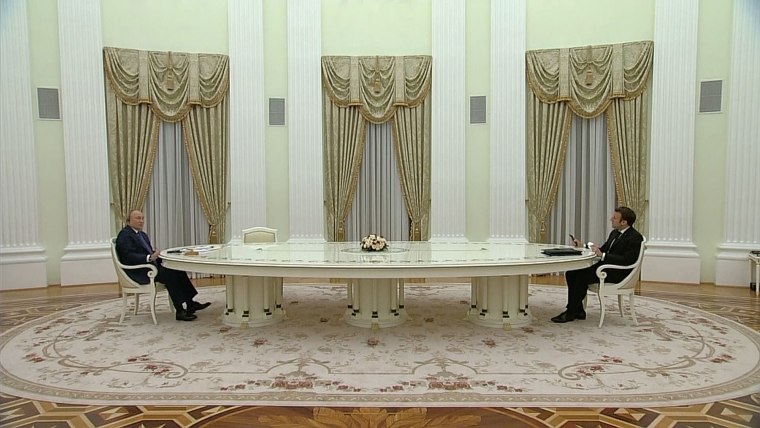
At the time many observers were puzzled why in each case the two national leaders were seated at opposite ends of a very long table, with Putin blandly suggesting that the placement was meant to symbolize the vast distance separating Russia and NATO’s Western leaders. Perhaps that innocuous explanation was correct. But I think it far more likely that the Russians were actually concerned that the Western leaders meeting him might be the immunized carriers of a dangerous biological agent intended to infect their president.
- Assassinating Vladimir Putin?
Ron Unz • The Unz Review • May 15, 2023 • 3,800 Words
On the face of it, American attempts to assassinate Russia’s president would make little logical sense and these would obviously be extremely reckless and dangerous. But much the same could be said of American-orchestrated efforts to destroy Russia’s strategic nuclear bomber fleet, yet there seems very strong evidence that both these actions occurred. So we should seek to understand the logical framework, however irrational and unrealistic, under which such American decisions would be made.
I think an important insight may have been recently provided by Alistair Crooke, a former senior MI6 officer and Middle East peace negotiator, with a great deal of expertise and excellent sources in that latter region.
In an interview a couple of weeks ago, he claimed that America had been directly involved in the wave of Israeli assassinations against Iran’s leaders, taking such action despite the fact that we were currently in the midst of crucial nuclear negotiations with that country. Launching a massive assassination attack against the entire leadership of a country with whom you are currently negotiating is obviously an extremely destabilizing action, one that will hardly inspire confidence among other prospective negotiating partners and will surely long be remembered.
But according to Crooke, the logic behind such American action was the widespread belief that the hold of the Islamic Republic upon the 90 million people of that country was quite fragile, and that the successful assassination of most of the Iranian leaders would cause the collapse of the regime, much like the government of Syria had collapsed earlier this year after attacks by armed Islamicist forces based in Idlib. The American government was greatly disappointed when that wave of assassinations failed to trigger such a political collapse and instead redoubled popular support for the ruling regime.
Crooke suggested that Iranian President Masoud Pezeshkian and Supreme Leader Ayatollah Ali Khamenei had been targeted for death as well, but unlike so many other senior Iranian officials they had been fortunate enough to survive. Indeed, not long afterward, President Trump repeatedly threatened to assassinate Ayatollah Khamenei unless he completely acceded to America’s demands regarding Iran’s nuclear program. Offhand, I can’t remember the last time a world leader has publicly threatened to assassinate one of his foreign counterparts in such fashion.
If Crooke’s analysis is correct, similarly mistaken reasoning might help to explain the likely American involvement in the attempt to assassinate Putin a few weeks earlier. Most of America’s political decisionmakers may have convinced themselves that the Russian regime was discredited, unpopular, and fragile, and that the sudden elimination of Russia’s president perhaps combined with a heavy blow to Russia’s nuclear retaliatory arsenal would cause its collapse.
Such an analysis might seem extremely implausible to most observers, but much of America’s leadership seems to exist in an unrealistic propaganda-bubble in which these notions have become widespread.
Consider, for example, estimates of Russian casualties in Ukraine. The Western-funded anti-Putin media outlet Mediazona has used its considerable resources to continually sweep the Russian Internet in order to compile a running total of verified Russian losses in the Ukraine war, and as of July 2025 had confirmed a total of over 120,000 Russian soldiers killed. This is likely somewhat of an underestimate given that at least some such deaths have escaped public notice, and such totals certainly represent heavy losses in a Russian population of around 140 million.
But our Neocon-dominated American government and its intelligence services have instead accepted without question totally outrageous figures apparently based upon the dishonest claims of Ukrainian propagandists. Back in February, Trump told reporters that Russia had already suffered 1.5 million casualties, an astonishing figure, and just a few days ago, he claimed that almost 20,000 additional Russians had been killed in the month of July alone.
As former CIA officer Larry Johnson noted, journalist Seymour Hersh reported that an intelligence official described for him a destroyed Russian military that had already suffered two million casualties:
“The total now is two million. Most importantly,” the official stressed, “was how this number was described. All the best trained regular Army troops, to be replaced by ignorant peasants. All the best mid-grade officers and NCOs dead. All modern armor and fighting vehicles. Junk. This is unsustainable.”
Two million Russian casualties would probably amount to more than 5% of that country’s entire population of military-age males, and such enormous losses could not possibly be kept concealed. Those figures are obviously delusional.
But if America’s political leaders and many of their military advisors accept such fantasies, they could easily convince themselves that a defeated Russia is now ripe for regime-change triggered by Putin’s assassination. They would obviously hope that the replacement might be a new government closely aligned with the West and subservient to its demands, much as had been the case during the 1990s.
Other Neocon analysts have proposed Russia’s dismemberment into several different much smaller states, none of which would be able to resist American pressure and domination, with various such proposed maps floating around.

Thus, America’s likely involvement in assassination efforts against the top leadership of both Iran and Russia was based upon our unrealistic assumptions regarding the weakness of the two regimes, and the belief that elimination of their top leaders would lead to a collapse. Moreover, in each case these attacks rather treacherously occurred in the midst of ongoing negotiations, over Iran’s nuclear program in one case and over Russian willingness to end the Ukraine war in the other. We should also remember that Trump’s earlier assassination of Gen. Soleimani occurred when that latter leader had been treacherously lured to Iraq for peace negotiations.
Unfortunately, countries that are totally delusional on some national security matters are much more likely to be equally delusional on others as well. I have recently discovered that important elements of the American foreign policy establishment have convinced themselves that the government of China is also fragile and weak, and possibly ripe for collapse if it were hit by one or more sharp shocks. A blogpost brought these strange and surprising notions to my attention a couple of weeks ago.
The blogger highlighted a major article in the New Yorker focusing on aspects of a likely future war between America and China, and suggesting that in some respects it might be analogous to the ongoing conflict between Israel and Gaza. Indeed, the subtitle even described Israel’s invasion of Gaza as “a dress rehearsal” for a future American war with China.
China has an enormous military, equipped with some of the world’s most highly-advanced weapons, and these include a full suite of the unstoppable hypersonic missiles that America has so far failed to successfully produce. So the belief that Israel’s ongoing slaughter of Gaza’s helpless, unarmed civilians holds any serious lessons for the course of a future American war with China seems rather strange reasoning indeed.
- What’s Legally Allowed in War
How U.S. military lawyers see Israel’s invasion of Gaza—and the public’s reaction to it—as a dress rehearsal for a potential conflict with a foreign power like China.
Colin Jones • The New Yorker • April 25, 2025 • 3,300 Words
The rather peculiar tone of that article may have been influenced by a very lengthy report published several months earlier by the Rand Corporation, whose title appeared to raise strong doubts about the military effectiveness of China’s armed forces.
- The Chinese Military’s Doubtful Combat Readiness
The People’s Liberation Army Remains Focused on Upholding Chinese Communist Party Rule, Not Preparing for War
Timothy R. Heath • The Rand Corporation • January 27, 2025 • 15,000 Words
However, after carefully reading that Rand study, I concluded that the title was somewhat misleading. The researcher correctly noted that China gave no indications of preparing to wage war against Taiwan, America, or any other country, and much unlike the U.S. had avoided involvement any military conflicts for the last half-century. But lack of interest in starting wars is quite different than lack of military effectiveness if attacked or sufficiently provoked, and conflating the two probably reflected the ideological climate found at most American think-tanks based upon the influence of their funders.
Finally, the lengthiest and most astonishing think-tank report of all was published just a couple of weeks ago by the Hudson Institute, one of our most unswervingly Neocon research organizations. This book-length study argued that China’s Communist government might be ripe for collapse and casually suggested that American military forces should be prepared for deployment inside China in order to seize crucial military and technological facilities and then reconstruct the government of that enormous country after the downfall of its current regime.
- China After Communism
Preparing for a Post-CCP China
Miles Yu et al. • The Hudson Institute • July 16, 2025 • 65,000 Words
The blogger quoted a couple of the paragraphs from the executive summary of this remarkable document:
While the People’s Republic of China (PRC) has weathered crises before, a sudden regime collapse in China is not entirely unthinkable. Policymakers need to consider what might happen and what steps they would have to take if the world’s longest-ruling Communist dictatorship and second-largest economy collapses due to its domestic and international troubles.
With chapters written by experts in military affairs, intelligence, economics, human rights, transitional justice, and constitutional governance, this report examines the initial steps that should be taken in the immediate aftermath of the CCP regime’s collapse and the long-term trajectory China might take after a stabilization period. Drawing on historical analysis, strategic foresight, and domain-specific expertise, this anthology describes these challenges as an exercise in possibilities. The different chapters explore how a single-party system collapses in key sectors of the country and how political institutions transform, as well as China’s unique political, economic, and social situation. Taken together, they assess the daunting tasks of stabilizing a long-repressed country after it has collapsed, in addition to the forces shaping China’s future. In so doing, the authors hope to offer policy recommendations for managing the risks and opportunities of a transition.
Having carefully read the entire report, I found it just as astonishing as was suggested by those paragraphs.
Over the last half-century, China has certainly been the world’s most successful major country, experiencing perhaps the highest sustained rate of economic growth in all of human history and now possessing a real economy far larger than that of the U.S.
Indeed, if we exclude the service sector, whose statistics are easily subject to manipulation, China’s real productive economy is now actually larger than the combined total for America, the EU, and Japan, while certainly growing much more rapidly. Meanwhile, America has experienced decades of stagnation, with heavy financialization replacing our once enormous real industrial strength. Moreover, in many technological sectors, China has now become the world leader, and it is near the very top in most of the others.
Earlier this year I published a lengthy comparative analysis of China and America, whose conclusions were hardly favorable to the latter:
- American Pravda: China vs. America
A Comprehensive Review of the Economic, Technological, and Military Factors
Ron Unz • The Unz Review • January 13, 2025 • 14,100 Words
The following month I summarized much of this same material in a lengthy interview with Mike Whitney:
- Confucius, DeepSeek, and Why China Would Win a War with the United States
Mike Whitney Interview with Ron Unz
Ron Unz and Mike Whitney • The Unz Review • February 2, 2025 • 9,900 Words
One of the main authors of that Hudson Institute report was lawyer and conservative columnist Gordon G. Chang, probably best known as the author of the 2001 book The Coming Collapse of China, and a quarter-century of absolutely contrary real-life trends seems to have hardly changed any of his views.
The Hudson Institute is a leading DC think-tank, quite influential in mainstream political circles, and a report with five co-authors that runs 128 pages must surely carry considerable weight in establishment circles. So when it suggests that the Chinese government is fragile and might soon collapse, those policy makers hostile to China are likely to take such views quite seriously.
Suppose that a leading Chinese think-tank with close ties to the PRC government published a weighty report predicting that America might soon collapse, then went on to argue that Chinese military forces would need to be deployed in our own country to seize our key military and technological assets and also establish a new government organized along Chinese lines. I doubt that most American political leaders or ordinary citizens would view such Chinese proposals with total equanimity, and indeed the blogger quoted a shocked Western pro-China business executive who succinctly summarized some of the striking elements in that Hudson Institute research study:
… which provides detailed operational plans for inducing Chinese regime collapse through systematic information operations, financial warfare, and covert influence campaigns, followed by detailed protocols for U.S. post-collapse management including military occupation, territorial reorganization, and the installation of a political and cultural system vassalized to the U.S.
Rand and Hudson are two of our leading mainstream think-tanks and the New Yorker is one of our most prestigious media outlets. Taken together those major articles and reports could easily convince the ignorant and suggestible ideologues in our government that the Chinese military was weak and the Chinese government fragile and ripe for collapse.
If delusional beliefs regarding the fragility of the Iranian and Russian governments had already led to American assassination attempts against their top leadership, similar reasoning might easily result in targeting those of China as well, especially President Xi Jinping, widely regarded as the strongest Chinese leader in decades. And given all of the recent American assassination projects, the Chinese government might certainly have itself reached such conclusions.
China and Russia are the two leading members of the BRICS movement, which held its 17th summit last month in Brazil. The media noted that neither Russian President Putin nor Chinese President Xi attended in person, with the latter missing his first BRICS summit since he came to power 13 years ago.
Xi’s surprising absence caused some discussion in the media. I initially paid little attention to this issue, but then some commenter suggested an obvious explanation: Both Xi and Putin were concerned about the possible risk of American assassination.
Brazil is located within the Western Hemisphere, a region under full American military domination. Given the extremely reckless and unpredictable behavior of the American government, with President Trump having publicly threatened to assassinate Iran’s top leader just a couple of weeks earlier, both China and Russia may have believed that some risks should best be avoided.
Suppose an errant missile struck down an incoming presidential plane, with no conclusive means of proving the source, or an aircraft were destroyed by some more sophisticated methods. Over the years, Xi and Putin had both met on numerous occasions with Iranian President Raisi, with whom they had developed an excellent working relationship, and surely his 2024 death in a mysterious helicopter crash while returning from a foreign trip would have concentrated their minds.
Any such “conspiratorial” explanation has naturally been entirely avoided by the media. For example, a lengthy article late last month in the Wall Street Journal described how Xi had drastically reduced his foreign travel over the last year or so, noting that a China-EU summit originally set for Brussels was moved to Beijing after the Chinese explained that Xi had no plans to visit Europe. Since the end of 2024, Xi’s only foreign travels have been to Russia and to several countries in South-East Asia. Unlike Europe or Latin America, none of these countries nor the travel routes to reach them would be likely venues for serious American attempts at assassination.
When major countries develop a well-deserved reputation for assassinating the leaders of other major countries, often even doing so in the midst of international negotiations, such behavior may obviously have serious consequences. Back in 2017, President Xi was quite willing to visit Mar-a-Lago for face-to-face negotiations with President Trump, but I very much doubt the Chinese leader will be taking any trips to our own country in the foreseeable future.
Related Reading:
Iran: West’s ‘ridiculous’ assassination claims cover for Israeli crimes
Press TV – August 1, 2025
Iran has dismissed “baseless and ridiculous” accusations from Western countries claiming that Tehran is collaborating with international criminal groups to carry out assassination plots abroad.
Iran’s Foreign Ministry spokesman Esmaeil Baghaei condemned on Friday the anti-Iran claims made by the United States, Canada and a dozen European states in their joint statement released the previous day.
He said the “blatant blame game” is an attempt to divert public attention from the most pressing issue of the day, which is the Israeli genocide in the occupied Palestine.
“The United States, France, and other signatories to the anti-Iran statement must themselves be held accountable for actions that violate international law, as they support and host terrorist and violent elements and groups,” he added.
Baghaei touched on the unprovoked US-Israeli aggression against Iran in June and Israel’s ongoing genocide in the Gaza Strip against the backdrop of active support or approving silence of the 14 Western countries that signed the statement against the Islamic Republic.
He further denounced the accusations as “blatant lies and an escape forward, designed as part of a malicious Iranophobia campaign aimed at exerting pressure on the great Iranian nation.”
The 14 states must be held accountable for their “disgraceful and irresponsible” behavior that violates the principles of international law and the United Nations Charter, the spokesman noted.
Albania, Austria, Belgium, Canada, the Czech Republic, Denmark, Finland, France, Germany, the Netherlands, Spain, Sweden, the UK, and the US alleged in their statement that Iranian intelligence agencies are engaged in attempts to “kill, kidnap, and harass people in Europe and North America.”
‘Compensation for war and security guarantees’: Iran sets conditions for US nuclear talks
The Cradle | July 31, 2025
Iranian Foreign Minister Abbas Araghchi said in an interview published on 31 July that Tehran is seeking financial compensation for Israel’s war, an explanation on why Iran was attacked during negotiations, and security guarantees for any resumption of nuclear talks with Washington.
Araghchi told the Financial Times that Iran will not accept going back to “business as usual” after Israel launched its unprovoked war on the country in mid-June.
“They should explain why they attacked us in the middle of … negotiations, and they have to ensure that they are not going to repeat that [during future talks]. And they have to compensate [Iran for] the damage that they have done,” Araghchi added.
He said he has exchanged messages with US envoy Steve Witkoff since the war ended, and that Witkoff has tried to convince him to return to negotiations.
“The road to negotiation is narrow but it’s not impossible. I need to convince my hierarchy that if we go for negotiation, the other side is coming with real determination for a win-win deal. We need real confidence-building measures from their side. My message [to Witkoff] is not that complicated. I said the recent aggression proved there is no military solution for Iran’s nuclear program, but a negotiated solution can be found,” the Iranian diplomat added.
Israel started its war on Iran on 13 June in the middle of nuclear talks between Tehran and Washington. Iran responded with successive barrages of ballistic missiles until the war came to an end on 24 June.
The US joined the war on 23 June with a bunker-buster attack on Iranian nuclear facilities, to which Tehran responded with a missile attack on its Al-Udeid base in Qatar.
Iranian nuclear facilities were heavily damaged, and western intelligence assessments have revealed that the Islamic Republic’s nuclear program has not been “obliterated” as Washington has claimed.
According to Araghchi, a new enrichment site that Tehran had revealed right before the war – in response to the International Atomic Energy Agency (IAEA) board vote against it – was also struck.
This is the first acknowledgment of an attack on this particular site.
“As far as I know, the preparations were made [for enrichment], but it was not active when it was attacked,” Araghchi said.
Araghchi’s comments come after recent threats by Israel to restart the war against Iran. Defense Minister Israel Katz said late last month that attempts by Tehran to move forward with its nuclear program will be met with force.
The Iranian foreign minister has said that a deal with Washington is not possible if the US returns to its previous “zero enrichment” demand, and that Iran will not back down from enrichment.
He has also reiterated Iranian warnings of a harsher retaliation to any renewed attack.
“If aggression is repeated, we will not hesitate to react in a more decisive manner and in a way that will be IMPOSSIBLE to cover up,” Araghchi said earlier this week, referring to Israeli censorship of coverage on sites targeted by Iran.
The AMIA case: The untold story
By Raphael Machado | Strategic Culture Foundation | July 27, 2025
On the morning of July 18, 1994, a bomb exploded at the headquarters of the Argentine Israelite Mutual Association (AMIA) in downtown Buenos Aires, leveling the building and killing 85 people, with over 300 injured.
The attack occurred two years after the bombing of the Israeli embassy in Argentina, which left 22 dead and 242 wounded. Both attacks took place during the presidency of Carlos Menem, a government that was pivotal for Argentina as it marked a transition to neoliberalism, featuring mass privatizations and a partial dollarization of the economy.
But on the geopolitical front, the Menem administration is more remembered for the apparent “secret war” that unfolded within the country, involving intelligence agencies and subversive groups from various nations.
The most widely accepted version of the AMIA case goes as follows: To retaliate against the cancellation of a nuclear technology transfer agreement between Argentina and Iran, the Iranian government (then under President Akbar Rafsanjani) orchestrated an act of revenge, with operatives from the Lebanese Hezbollah carrying it out.
This narrative, elevated to “official truth,” was supported by intelligence reports from the U.S. and Israel. It led to Argentina designating Hezbollah as a terrorist organization and the rupture of previously friendly relations between Argentina and Iran.
But what if this popular version is wrong?
Recently, a former aide to Judge Juan José Galeano—who oversaw the investigation and trial from 1994 to 2005—revealed details that cast doubt on the established narrative. According to Claudio Lifschitz, Galeano’s former assistant and a former Argentine security official, no concrete evidence linking the Iranian government to the attack was ever found. On the contrary, Lifschitz claims that the evidence increasingly pointed toward elements within Argentina’s intelligence service, SIDE.
Lifschitz first entered the public eye in this case when he released a video recording of a meeting between Galeano and Carlos Telleldín, in which the judge allegedly offered money to the supposed supplier of the van used in the attack—in exchange for confessing that he had sold it to Mohsen Rabbani, the cultural attaché at the Iranian Embassy in Buenos Aires. According to Lifschitz, one of the key pieces of evidence that could exonerate Iran is the fact that SIDE had illegally wiretapped—without a court order—the Iranian Embassy and the Iranian Cultural Center in Buenos Aires, amassing thousands of hours of recordings without a single indication that any Iranians frequenting these places had prior knowledge of the attack.
The real mastermind, Lifschitz alleges, was Jaime Stiuso, deputy chief of SIDE’s counterintelligence division (Section 85) and the officer in charge of intelligence investigations for the AMIA case. According to Lifschitz, Telleldín had actually sold the van used in the attack to a SIDE agent. Furthermore, Stiuso—who had close ties to Mossad and the CIA—was allegedly responsible for constructing the accusation made by prosecutor Alberto Nisman that then-President Cristina Kirchner had sought to cover up Iranian involvement in the case.
The former Argentine intelligence agent claims he heard directly from Stiuso that Mossad was the real force behind the attacks—though it remains difficult to verify whether this conversation actually took place.
The case remains relevant today because it is being leveraged by Javier Milei’s government to justify closer ties with Israel, to the point where the Argentine president has labeled Iran as an “enemy state of Argentina.”
Tehran’s new war plan: Build an anti-NATO
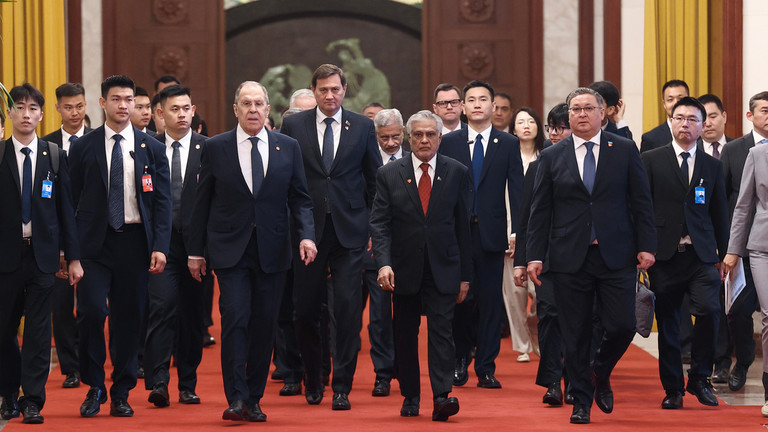
Russian FM Sergey Lavrov attends a meeting with foreign ministers of the Shanghai Cooperation Organization in Beijing, China. © Sputnik / Russian Foreign Ministry
By Farhad Ibragimov | RT | July 27, 2025
What if the next global security pact wasn’t forged in Brussels or Washington – but in Beijing, with Iran at the table?
This is no longer a theoretical question. At the mid-July meeting of the Shanghai Cooperation Organization (SCO) Council of Foreign Ministers in China, Iran made it clear: Tehran now views the SCO not just as a regional forum, but as a potential counterweight to NATO. In doing so, it signaled a profound strategic pivot – away from an outdated Western-dominated system and toward an emerging Eurasian order.
The summit highlighted the increasing resilience of multilateral Eurasian cooperation in the face of growing global turbulence. Russia was represented by Foreign Minister Sergey Lavrov, who also met with Chinese leader Xi Jinping – an encounter that underscored the strength of the Moscow-Beijing axis. On the sidelines, Lavrov held bilateral meetings with the foreign ministers of China, Pakistan, India, and notably, Iran. His talks with Iranian Foreign Minister Abbas Araghchi focused on diplomatic solutions to the nuclear issue and emphasized deepening strategic coordination.
The Iranian side used the platform with purpose. Araghchi expressed his appreciation for the SCO’s solidarity amid Israeli aggression and stressed that Iran views the organization not as symbolic, but as a practical mechanism for regional unity and global positioning.
A platform that works – despite the skeptics
India’s full participation also contradicted predictions in Western circles that geopolitical tensions would paralyze the SCO. Instead, New Delhi reaffirmed its commitment to the platform. The implication is clear: unlike NATO, where unity depends on compliance with a central authority, the SCO has proven flexible enough to accommodate diverse interests while building consensus.
For Russia, the SCO remains a cornerstone of its Eurasian strategy. Moscow serves as a balancing force – linking China with South and Central Asia, and now, with an assertive Iran. Russia’s approach is pragmatic, multi-vector, and geared toward creating a new geopolitical equilibrium.
Iran’s strategic breakout
The heart of the summit was Abbas Araghchi’s speech – an assertive and legally grounded critique of Israeli and American actions. He cited Article 2, Section 4 of the UN Charter, denounced attacks on Iran’s IAEA-monitored nuclear facilities, and invoked Resolution 487 of the UN Security Council. His message: Western aggression has no legal cover, and no amount of narrative control can change that.
But beyond condemnation, Araghchi delivered a concrete roadmap to strengthen the SCO as a vehicle for collective security and sovereignty:
-
A collective security body to respond to external aggression, sabotage, and terrorism
-
A permanent coordination mechanism for documenting and countering subversive acts
-
A Center for Sanctions Resistance, to shield member economies from unilateral Western measures
-
A Shanghai Security Forum for defense and intelligence coordination
-
Enhanced cultural and media cooperation to counter cognitive and information warfare
These are not rhetorical gestures – they are blueprints for institutional transformation. Iran is operationalizing a new security doctrine built on multipolarity, mutual defense, and resistance to hybrid threats.
SCO vs. NATO: Two models, two futures
While NATO is structured around a rigid hierarchy dominated by Washington, the SCO embodies a post-hegemonic vision: sovereignty, equality, and civilizational plurality. Its member states represent over 40% of the global population, possess vast industrial capacities, and share a collective desire to break the unipolar mold.
Tehran’s bet is clear: the SCO offers not just a geopolitical shelter, but a platform for advancing a new global logic – one rooted in strategic autonomy, not dependency.
The sophistication and clarity of Araghchi’s initiatives suggest that Tehran is preparing for the long game. Behind closed doors, the summit likely featured discussions – formal and informal – about deepening SCO institutionalism, perhaps even rethinking the organization’s mandate.
Araghchi made that vision explicit: “The SCO is gradually strengthening its position on the world stage… It must adopt a more active, independent, and structured role.” That’s diplomatic code for institutional realignment.
The West responds – predictably
The Western response was immediate. Within days of Iran’s proposals, the EU imposed new sanctions on eight individuals and one Iranian organization – citing vague claims of “serious human rights violations.” Israel, by contrast, faced no new penalties.
It is geopolitical signaling. Tehran’s push to turn the SCO into an action-oriented bloc is seen in Brussels and Washington as a direct threat to the current order. The more coherent and proactive the SCO becomes, the harsher the pressure will grow.
But that pressure proves Iran’s point. The rules-based order is no longer rules-based – it is power-based. For countries like Iran, the only path to sovereignty is through multilateral defiance and integration on their own terms.
The stakes ahead
Iran is not improvising. It is positioning itself as a co-architect of a post-Western security order. Its vision for the SCO goes beyond survival – it is about shaping an international system where no single bloc can dominate through sanctions, information warfare, or coercive diplomacy.
This strategy has implications far beyond Tehran. If the SCO embraces Iran’s proposals and begins to institutionalize them, we could be witnessing the early formation of the 21st-century’s first true alternative to NATO.
The West may dismiss this as fantasy – but in Eurasia, the future is already being drafted. And this time, it’s not happening in English.
Farhad Ibragimov – lecturer at the Faculty of Economics at RUDN University, visiting lecturer at the Institute of Social Sciences of the Russian Presidential Academy of National Economy and Public Administration
Featured Video

Israelis SUDDENLY Mass Deported From Many Countries
or go to
Aletho News Archives – Video-Images
From the Archives
Elite Western universities are a corrupt, parasitic empire
Instead of high-quality education, these institutions are fostering a global neo-feudal system reminiscent of the British Raj
By Dr. Mathew Maavak | RT | May 30, 2025
In a move that has ignited a global uproar, US President Donald Trump banned international students from Harvard University, citing “national security” and ideological infiltration. The decision, which has been widely condemned by academics and foreign governments alike, apparently threatens to undermine America’s “intellectual leadership and soft power.” At stake is not just Harvard’s global appeal, but the very premise of open academic exchange that has long defined elite higher education in the US.
But exactly how ‘open’ is Harvard’s admissions process? Every year, highly qualified students – many with top-tier SAT or GMAT test scores – are rejected, often with little explanation. Critics argue that behind the prestigious Ivy League brand lies an opaque system shaped by legacy preferences, DEI imperatives, geopolitical interests, and outright bribes. George Soros, for instance, once pledged $1 billion to open up elite university admissions to drones who would read from his Open Society script.
China’s swift condemnation of Trump’s policy added a layer of geopolitical irony to the debate. Why would Beijing feign concern for “America’s international standing” amid a bitter trade war? The international standing of US universities has long been tarnished by a woke psychosis which spread like cancer to all branches of the government.
So, what was behind China’s latest gripe? ... continue
Blog Roll
Recent Comments
seversonebcfb985d9 on Villains of Judea: Philip Esfo… loongtip on Report warns that ‘Jewish terr… Craig Nelms on New study shows that toxic gas… loongtip on A Funny Thing Happened on the… loongtip on EU free trade pact on hold as… John Edward Kendrick on Regime Change In Iran Is The F… Bill Francis on Australia Passes New Hate Spee… seversonebcfb985d9 on Australia Passes New Hate Spee… Bill Francis on Britain’s AI Policing Plan Tur… loongtip on Miami Beach Resident Questione… loongtip on Israeli agricultural export co… loongtip on The War On Free Speech In Aust…


 Aletho News
- American Academy of Pediatrics Hit With Federal RICO Lawsuit for Vaccine Safety Fraud
- Mom Tells Trump: Dumping Sewage Sludge on Farmland Won’t Make America Healthy Again
- NIAID Funds Gain-of-Function Study Engineering Novel Influenza Viruses
- Villains of Judea: Philip Esformes and the Largest Healthcare Fraud in American History
- US sanctions Popular Conference for Palestinians Abroad over alleged Hamas links
- You reap what you sow: Ukraine’s blackout is Zelensky’s failure
- Ukraine Blackouts Caused by Zelensky’s Terrorist Attacks on Russia
- Orban Hits Out at EU Green Light for $1.5 Trillion Ukraine Aid
- World has had enough of confused clowns: Araghchi to Zelensky
- Jordan using Israeli software to monitor journalists, rights defenders: Report
- If Americans Knew
- Oppose Israel’s Abuses While You Still Can
- UNRWA Heads Tell Ha’aretz: ‘We Don’t Radicalize Palestinians – Their Lived Existence Does’
- Plans Call for “New Rafah” Built in Israel’s Image — Without Palestinians
- Posing as priest, reporter is spat at many times, highlighting anti-Christian sentiment in Israel
- Leaked Documents: “Planned Community” in Rafah Would Force Palestinians Into Israeli Panopticon
- ‘Permits of Humiliation’: How Israel Strangles Christian Education in Jerusalem
- “The world sees death, destruction and injustice – and they see dollar signs” – Not a ceasefire Day 105
- War criminal Netanyahu kills 11 in Gaza, joins Board of Peace – Not a ceasefire Day 104
- Another baby dies of cold in Gaza, as Rafah crossing remains locked down – Not a ceasefire Day 103
- Brutal Beatings, Arson, and Impunity: A Palestinian Plant Nursery Becomes a Target for Settler Pogroms
- No Tricks Zone
- New Study: Sea Levels Rose 20 Times The Modern Rate During The Roman Warm Period
- As German Gas Storage Dips Dangerously Low…Shortage Hardly Avoidable
- New Study: Brazil’s Relative Sea Level Was 2+ Meters Higher And SSTs 3-4°C Warmer 6000 Years Ago
- Philosopher Schopenhauer: Climate Science Certainty Stems From Stupidity, Ignorance
- New Study: Species Extinction Rates Declining Since 1980 – ‘Climate Change Is Not An Important Threat’
- Denmark Places Climate Protection Above Animal Welfare, Poisoning And Culling Cows
- New Study: Greenland Was 3-7°C Warmer And Far Less Glaciated Than Today 6000-8000 Years Ago
- German Media Report That Current Frigid Weather Can Be Explained By Arctic Warming!
- Berlin Blackout Shows Germany’s $5 Trillion Green Scheme Is “Left-Green Ideological Pipe Dream”
- Modeling Error In Estimating How Clouds Affect Climate Is 8700% Larger Than Alleged CO2 Forcing
 Aletho News