Pakistan won’t remain silent if US, Israel target Ayatollah Khamenei: Senator
Press TV – June 30, 2025
A Pakistani senator has condemned a threat by the US and Israel to target Leader of the Islamic Revolution Ayatollah Seyyed Ali Khamenei, saying it will trigger a response from all Muslim nations, including Pakistan.
Allama Raja Nasir Abbas Jafari, a member of the Pakistani Senate, described Ayatollah Khamenei as a religious leader and a Marja (religious authority), who is also a political leader.
Religious authorities issued a fatwa (religious decree) that says anyone who threatens the Leader is an enemy of God, whose punishment is death in Islam, he noted.
Between June 13 and 24, Israel waged a blatant and unprovoked aggression against Iran, assassinating many high-ranking military commanders, nuclear scientists, and ordinary civilians.
On June 22, the United States also jumped on the bandwagon and bombed three Iranian nuclear sites in a grave violation of the United Nations Charter, international law, and the Nuclear Non-Proliferation Treaty (NPT).
During the 12-day war, US President Donald Trump claimed that Ayatollah Khamenei was “an easy target.”
Benjamin Netanyahu of Israel also ranted that the assassination of Ayatollah Khamenei would “end” the war.
The Pakistani senator said Trump and Netanyahu should know that if an attack is carried out, it will not just be an attack on Iran, and all Muslims in the world will respond to it.
“We will respond in Pakistan as well; if such an action is taken, no American will remain in Pakistan. We will not remain silent when they (Trump and Netanyahu) do not abide by any law,” he added.
On Sunday, senior Iranian clerics Grand Ayatollah Nasser Makarem Shirazi and Grand Ayatollah Hossein Nouri-Hamedani issued religious decrees against any attack or threat to Ayatollah Khamenei.
They said that any person or regime that threatens or attacks the leadership and religious authority to harm the Islamic Ummah and its sovereignty is subject to the ruling of confrontation.
Agent of Chaos: Lindsey Graham’s Power Depends on War
By Ekaterina Blinova – Sputnik – 30.06.2025
Hawkish Senator Lindsey Graham got President Donald Trump to strike Iran, according to the Wall Street Journal. What’s he gaining from the Middle East war?
Darling of Jewish Lobby
- The Republican Jewish Coalition was Graham’s top donor in his 2020 re-election, giving $111,000 (OpenSecrets).
- Over $1 million more came via RJC, according to RJC’s executive director Matt Brooks.
- Brooks: “There is nobody more important in the US Senate” for the US-Israel partnership.
- He raised $109 million in total.
RJC: Longtime Supporter of Graham
- RJC leaders Larry Mizel and Sam Fox backed Graham’s 2014 re-election.
- Fox gave $50,000 and Mizel $100,000 to his super PAC, West Main Street Values.
- RJC board member Sheldon Adelson co-hosted a fundraiser for Graham’s 2016 presidential bid.
AIPAC is Another Backer
- Graham major backer, billionaire Mizel, also sits on AIPAC’s board — the top pro-Israel lobby in the US.
- Haaretz calls Mizel a key booster of pro-Israel Republicans who opens doors in Israel’s power circles for GOP politicians.
More Wars – More Defense Contractors Backing
- Lockheed Martin gave Graham $102,000 in 2020, according to OpenSecrets
- Boeing added $80,700 in 2024.
- The Intercept notes most cash comes from defense-linked individual donors — like Humvee mogul Ron Perelman, who gave $500,000 to Graham’s 2016 run.
Graham’s 2026 Senate Bid at Stake
- Graham’s hawkish Iran stance apparently ties to his 2026 ambitions – he needs big donor cash.
- RJC backs him as “one of the strongest advocates for the US Jewish community.”
- Defense firms will pay too—if he keeps the bombs dropping.
Can international institutions be reformed?
By Raphael Machado | Strategic Culture Foundation | June 30, 2025
It appears that Israel and Iran have postponed World War III and, for now, seem to adhere to the ceasefire negotiated by Donald Trump (likely with the help of other countries). But even if the “12-Day War” has stopped and missiles are no longer flying back and forth, doubts remain about the fate of Iran’s nuclear program.
The U.S. government insists that Iran’s nuclear program no longer exists, while Iran maintains that its nuclear program is still operational. All signs indicate that the Iranians are correct and that the U.S. is once again constructing a purely simulated parallel reality for the sake of narrative power projection.
But the main issue is not this—it is, in fact, something few have mentioned, as recently noted by Sergey Lavrov: the role of Rafael Grossi and the International Atomic Energy Agency (IAEA).
The IAEA was founded in 1957 as an “autonomous” agency—though linked to the UN—with the goal of monitoring nations’ use of nuclear energy to promote peaceful applications and prevent the construction of nuclear weapons. In this capacity, IAEA teams visit nuclear power plants, research centers, and other facilities related to national nuclear programs to conduct safety checks and oversee enrichment levels.
However, it is important to note that despite its claims of “autonomy,” the IAEA was established at the insistence of the U.S., shortly after the abandonment of the post-WWII “utopian” idea of keeping nuclear weapons under the exclusive control of the UN. The institution has always been closer to the interests of the Western Bloc than to those of the Eastern Bloc or the Non-Aligned Movement.
That said, in the past, the IAEA did challenge U.S. claims about weapons of mass destruction in Iraq, under the leadership of Hans Blix and Mohamed ElBaradei.
But even during ElBaradei’s tenure, there were signs of a shift toward Western alignment. In writings from that period, ElBaradei advocated for a revival of the utopian, globalist vision of nuclear energy monopolized by a “multinational” agency—much like the various Western agencies controlled or influenced by the U.S. ElBaradei himself became a collaborator with the U.S. after his term ended, participating in the color revolution orchestrated in Egypt against Hosni Mubarak.
It was only during Yukiya Amano’s leadership that the IAEA’s collaboration with the U.S. became evident, thanks to WikiLeaks revelations. According to documents obtained by Julian Assange, in a meeting between Amano and U.S. diplomats, Amano explicitly stated that he was aligned with the U.S. regarding staffing decisions and the stance to be taken on Iran’s nuclear program. This, of course, meant that Amano filled the IAEA with U.S. collaborators. He was later accused by IAEA staff themselves of having a pro-Western bias.
This context helps explain the behavior of Rafael Grossi, Amano’s successor.
Fast-forward to June: Grossi prepared a report accusing Iran of failing to meet its obligations to the IAEA and scheduled a board meeting for the same day Trump’s 60-day ultimatum on negotiations with Iran expired. According to CNN, the U.S. contacted several board members to persuade them to vote in favor of Grossi’s resolution. The purpose was to lend an institutional veneer of legitimacy to Israel’s attacks against Iran.
Grossi’s report was entirely based on information provided by Mossad, which alleged the existence of previously unknown nuclear facilities containing traces of enriched uranium.
All evidence suggests that Grossi was aware of the imminent attack and collaborated in creating a pretext to justify Israel’s actions. This is further corroborated by the fact that Grossi has never once turned his attention to Israel’s nuclear program, which remains entirely opaque, free from any international inspections.
In light of these revelations, it is alarming that, as Grossi told the Financial Times earlier this year, he intends to run for UN Secretary-General. Given his track record, it is plausible that he will have U.S. backing, which would greatly aid his candidacy.
Cases like this are not isolated. We have seen how the International Criminal Court (ICC) moved to accuse Vladimir Putin and Russia of “kidnapping” Ukrainian children. The World Health Organization (WHO), meanwhile, attempted to override national sovereignty during the pandemic. The IMF is routinely used to deindustrialize Third World countries.
The list could go on.
The key issue, however, is this: Given the current state of international institutions, can they be reformed?
Or will we need to abandon them—as Iran did with the IAEA—and build new ones from scratch?
Iran asks UN Security Council to recognize Israel, US as ‘initiators’ of aggression

Iranian Foreign Minister Abbas Araghchi
Press TV – June 29, 2025
Iranian Foreign Minister Abbas Araghchi has called on the United Nations Security Council to recognize the Israeli regime and the United States as the “initiators” of the recent 12-day aggression against the Islamic Republic.
“We solemnly request that the Security Council recognize the Israeli regime and the United States as the initiators of the act of aggression and their subsequent responsibility, therefore including compensation and reparation,” Araghchi said in a letter to UN Secretary General Antonio Guterres on Sunday.
“The Security Council should also hold the aggressors accountable and prevent the recurrence of such heinous and serious crimes to enable it to maintain international peace and security,” he added.
He emphasized that political and military leaders, who order an act of aggression, “are also individually liable for the international crime of aggression under customary international law.”
The top Iranian diplomat described the act of aggression as a “brazen assault” on the very foundations of international law, warning that tolerating it and its legal consequences seriously undermines the credibility of the United Nations system.
It also “poses a real threat to the rule of law at the international level and engenders lawlessness in the future of international relations in our region as well as the international community at large,” Araghchi pointed out.
In the early hours of June 13, the Israeli regime launched an all-out aggression on Iranian soil by targeting various military and nuclear sites, claiming the lives of dozens of top military commanders and nuclear scientists as well as ordinary civilians.
On June 22, the United States joined the Israeli regime in the assault and bombed three Iranian nuclear sites in a grave violation of the United Nations Charter, international law, and the Nuclear Non-Proliferation Treaty (NPT).
A day later, Iran launched a wave of missiles at al-Udeid air base in Qatar—the largest American military base in West Asia—in retaliation for the aggression.
As the Iranian armed forces pounded Israel and its military and industrial infrastructure, using many new-generation missiles that precisely hit the designated targets, the embattled regime was forced to unilaterally declare a truce deal on June 24.
In a letter to the United Nations secretary general and president of the Security Council on June 13, Araghchi said the Israeli regime’s act of aggression against the country amounts to a “declaration of war.”
“These oppressive acts are not only constitute a severe violation of sovereignty and territorial integrity of Iran as an independent member of the United Nations, but as per international law and international humanitarian law, including the Geneva Conventions, are among acts of aggression and war crimes,” he said back then.
From the War of the Cities to True Promise 3: Iran’s ballistic program and the path to networked deterrence
By Abbas Al-Zein | The Cradle | June 28, 2025
Under a regional sky long dominated by US and Israeli air and intelligence superiority, Iran made a fateful decision decades ago. It would not attempt to match its adversaries tank-for-tank or plane-for-plane, but would instead build an asymmetric deterrent from scratch.
Rather than chase the mirage of classical military parity, Tehran developed an indigenous ballistic missile arsenal that is now the largest and most formidable in West Asia. This was no short-term, tactical gambit. Iran’s missile doctrine was forged in an existential struggle, refined over war and siege, and ultimately transformed into a cornerstone of national defense policy.
The War of the Cities: Birth under siege (1980–1988)
The first phase of Iran’s missile journey began in the crucible of the devastating Iran–Iraq War, specifically during the infamous “War of the Cities.” As the Baathist government in Baghdad launched Soviet-supplied Scud-B missiles deep into Iranian urban centers, it did so under the protective umbrella of western intelligence and funding from Arab states of the Persian Gulf. The intent was clear: to break Iranian civilian morale through systematic terror from the sky.
Caught without a missile deterrent of its own, besieged diplomatically, and encircled by western-aligned forces, Iran turned to whatever resources it could muster. It secured limited quantities of Scud-B missiles from Libya, Syria, and North Korea. These early acquisitions, modest as they were, formed the embryonic core of a deterrent force placed under the direct command of the Islamic Revolutionary Guard Corps (IRGC).
But these were more than mere missiles. They were weapons of national dignity in a war for survival for the nascent Islamic Republic. Iran’s leadership came to view missile capability not simply as a tactical asset, but as a psychological and political necessity.
Military historian Pierre Razoux notes in The Iran-Iraq War (2014) that it was during this phase that Iran’s leadership came to the unshakable conclusion: without a retaliatory missile force, no psychological or strategic deterrence was possible.
The Iranian response was neither ad hoc nor passive. Alongside importing missiles, Iranian engineers began dismantling, studying, and maintaining the systems. They built smuggling networks, circumvented embargoes, and reverse-engineered technology.
North Korea emerged as a critical partner, acting as a conduit for Soviet missile know-how. A 2010 RAND Corporation report titled Iran’s Ballistic Missile Capabilities: A Net Assessment noted that Iran had become capable not only of replicating but also of redesigning and expanding missile technology independently. Between 2000 and 2010, Iran pivoted from mass production to innovation, prioritizing accuracy, range, and operational readiness.
The foundations of Iran’s ballistic doctrine were thus laid: sovereignty through technological independence, and defense through deterrence.
From imitation to innovation (1989–2009)
With the Imposed War over, Iran’s military establishment—spearheaded by the IRGC—began restructuring its defense priorities. The goal was no longer just to have missiles but to produce them independently and on a large scale.
At the heart of this transformation was the late martyred Brigadier General Hassan Tehrani Moghaddam, a strategic thinker and technical mastermind hailed as the ‘father of Iran’s missile program.’ He understood that deterrence was not about launching missiles, but about mastering their lifecycle: production, concealment, deployment, and precision.
Under his leadership, Iran transitioned from a user to a manufacturer. The Shahab-1 and Shahab-2 were enhanced variants of the Scud-B and Scud-C. But the real breakthrough came in 2003 with the Shahab-3, boasting a range exceeding 1,300 kilometers—a capability that placed US bases in the Persian Gulf and occupied Palestine within striking distance. The Shahab lineage would later give way to the Ghadr class, with better range and multiple warhead capabilities.
The most significant leap, however, came with the adoption of solid-fuel propulsion. The Sejjil missile (2,000–2,500 km range), unveiled by the end of the 2000s, was Iran’s first medium-to-long-range system not reliant on Scud technology. It signaled a new era of technological self-sufficiency and rapid-launch capability.
During this phase, Iran undertook sweeping strategic steps: adopting solid-fuel for easier storage and rapid deployment, establishing underground and mobile launch facilities to avoid detection, building decentralized manufacturing to reduce vulnerability to strikes, and integrating missile research into academic institutions to develop a domestic cadre of experts.
A 2010 report by the International Institute for Strategic Studies (IISS) titled Iran’s Ballistic Missile Capabilities: A Net Assessment noted that by this stage, Iran had moved beyond simply replicating foreign missile systems and had begun designing its own through local R&D and systematic redesign, including the establishment of underground manufacturing. From 2000 to 2010, Iran’s program pivoted decisively from quantity to quality, enhancing range, precision, and operational readiness.
When Moghaddam was killed in a suspicious explosion at the “Defenders of the Sky” base in November 2011, Iran declared it a national loss. While Israel neither confirmed nor denied responsibility, the Yediot Aharonot newspaper reported that “some assessments” indicated that the blast was “the result of a military operation based on intelligence information.”
Nevertheless, his legacy endured. He had not merely built a weapons system; he had established a sustainable missile doctrine rooted in adaptability and local expertise. His death marked the end of one era, but it also catalyzed the birth of Iran’s next missile generation.
Smart missiles and precision strikes (2010–2020)
By the 2010s, Iran’s goal had shifted from mass deterrence to precision deterrence. Engineers focused on guidance systems using inertial navigation paired with domestic GPS and anti-jamming technologies. The result was a suite of short- and medium-range guided missiles with enhanced tactical utility.
This generation included the Zolfaghar (750 km), the highly precise and compact Fateh-313 designed for preemptive strikes, and the Qiam—Iran’s first finless missile, engineered for stealth and maneuverability.
Iran also entered the low-altitude cruise missile domain, developing systems such as the Soumar (with a range of over 2,000 km) and Hoveizeh (with a range of 1,350 km), both capable of evading conventional radar and penetrating advanced air defenses.
These weapons were not theoretical. In June 2017, Iran launched six medium-range missiles from its territory targeting ISIS command centers in Deir Ezzor, Syria—its first operational cross-border use since the 1980s.
In January 2020, in direct retaliation for the US assassination of IRGC Quds Force General Qassem Soleimani, Iran struck the Ain al-Asad base in Iraq with Qiam and Fateh missiles. Satellite imagery showed sub-five-meter accuracy, hitting aircraft hangars and troop shelters. The New York Times described it as one of the most accurate missile strikes on a US facility in modern history.
This decade marked Iran’s shift from “deterrent” missiles to “executive” missiles—systems where political power was expressed through precision. It was no longer about maximum range, but maximum effect. The missile became a scalpel, not a hammer, paving the way for Iran’s most advanced deterrent doctrine yet.
The rise of networked deterrence (2021–2023)
By the 2020s, Iranian missiles were no longer stand-alone assets. They had become the final phase of a broader, integrated offensive system. Missiles now worked in tandem with kamikaze drones, electronic warfare units, cyber surveillance, and decentralized command structures. This was networked deterrence: a synchronized, multi-domain approach designed to penetrate and paralyze advanced air defense systems.
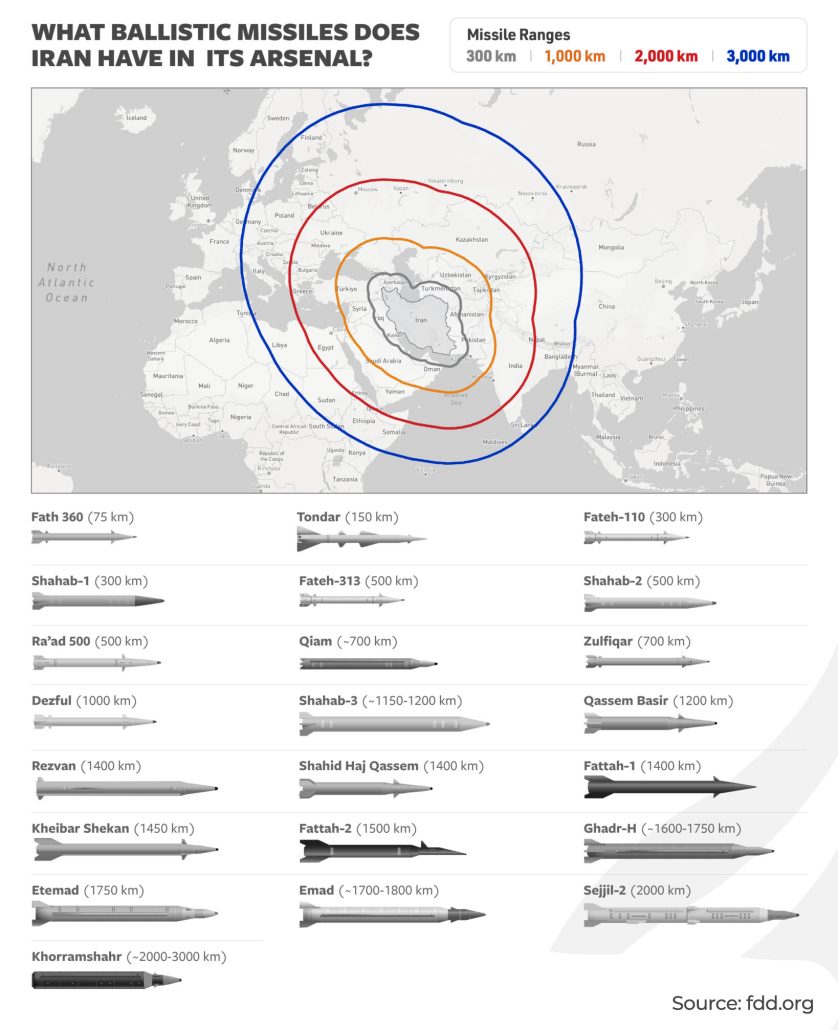
Under this doctrine, Iran developed new missiles tailored for layered operations. The Kheibar Shekan hypersonic missile (1,450 km, 500 kg warhead), most recently deployed in a multi-warhead configuration during Operation True Promise III against the occupation state, exemplifies this evolution.
Other critical systems include the Khorramshahr-4 (over 2,000 km), Raad-500 (solid-fuel, rapid launch), Zolfaghar Basir (optically guided, 1,000+ km), and Haj Qassem (1,400 km, 500 kg warhead)—all integral to Iran’s expanding offensive architecture.
By 2023, Iran fielded around 30 missile systems with ranges spanning 200 to 2,500 km. These systems, guided by jam-resistant platforms and launched from mobile or underground sites, were designed to render preemptive strikes both difficult and strategically ineffective.
From blueprint to battlefield: True Promise 3 (2024–2025)
In June, Iran operationalized its full deterrent in True Promise III, a massive retaliatory strike against the occupation state and its US backers. Triggered by Israeli aggression and building on limited predecessors, the operation was a turning point. It marked the battlefield culmination of four decades of Iranian missile doctrine.
What distinguished True Promise III was not just the firepower but the integration. Iran coordinated ballistic strikes, drone swarms, and electronic attacks into a single operational framework. For the first time, the world witnessed the seamless fusion of Iran’s missile and drone capabilities in a real war scenario.
The outcome upended assumptions in Washington and Tel Aviv. The missiles that struck deep into Israeli territory were not just instruments of reprisal. They were shields for the program itself—offensive deterrents capable of defending Iran’s retaliatory power by disabling enemy assets before they could act. The strike was not just a response; it was a preemption of the enemy’s preemption.
None of this can be divorced from Iran’s nuclear posture. The ballistic and nuclear programs may appear distinct, but they operate on the same doctrinal axis. The nuclear program symbolizes sovereignty; the missile program enforces it. Together, they dismantled the western fantasy that Israel could neutralize Iran’s deterrent capacities in a single blow.
That era is over. Iran’s missile shield is no longer just a threat. It is a reality, already in motion.
Strategic Misfire: Iran Torches Israel’s Attack
By Svetlana Ekimenko – Sputnik – 29.06.2025
Israel’s attack on Iran failed to achieve any of its objectives, said Iranian government spokeswoman Fatemeh Mohajerani in remarks to Al Mayadeen.
Israel’s operation Rising Lion to target Iran’s military and nuclear facilities amounted to a “strategic miscalculation” that only reinforced Iran’s resolve, stated Fatemeh Mohajerani.
Military Response
Claims that Israel weakened Iran’s defense capabilities are “for domestic consumption,” underscored the spokeswoman.
Iran’s defense system remains strong, self-sufficient, and built for both symmetrical and asymmetrical threats, she noted, adding:
“Our response was measured, legal, and effective – and it sent the message we intended.”
Nuclear Program Moving Forward
Iran remains committed to advancing its peaceful nuclear program via advanced tech development.
Mohajerani deplored the fact that the IAEA and its director general, Rafael Grossi, failed to “denounce the cowardly strikes.”
Iran’s parliament, she confirmed, has backed a bill to scale down cooperation with the nuclear watchdog.
Message to the West
Western silence or passive approval of Israel’s actions makes it “complicit in war crimes,” according to the Iranian government spokeswoman.
This conflict proves that “militarism and reckless policies do not bring security. They only deepen instability,” concluded Fatemeh Mohajerani.
No weapons-grade enrichment in Iran – Foreign Ministry spokesman
RT | June 29, 2025
Iran has no plans to obtain nuclear weapons but reserves the right to enrich uranium for civilian use, Iranian Foreign Ministry spokesman Esmail Baghaei told RT on Saturday. He condemned recent Israeli and US strikes on Iran’s nuclear facilities as dangerous and unprovoked.
Baghaei dismissed Israeli claims that Tehran had secretly been developing nuclear weapons, which were cited as justification for the attacks. Reports from the International Atomic Energy Agency (IAEA) support Iran’s position, he added.“I think Iran has made it clear for the past two or three decades that it is not seeking nuclear weapons,” Baghaei said. “There has never been weapons-grade enrichment in Iran. Please, you can go through the reports by the IAEA and show me one single clue or evidence of Iran’s nuclear program deviating from peaceful purposes.”
“It is a matter of fact that Iran’s nuclear program remains totally peaceful,” he said.
The spokesman referred to remarks by the global watchdog’s chief, Rafael Grossi, who stated earlier this month that the agency had found no evidence of “a systematic effort” by Iran to develop nuclear arms.
Baghaei also voiced frustration with the IAEA for not strongly condemning the strikes. “What is expected from the IAEA and its Board of Governors is to remain loyal to their responsibilities and mandates by condemning, unambiguously, the US and Israeli regime’s attacks on our nuclear facilities,” he said.
He further defended Iran’s right to enrich uranium under the Treaty on the Non-Proliferation of Nuclear Weapons (NPT).
“The US is offering a very dangerous interpretation of the NPT – that developing states have no right to use nuclear energy for peaceful purposes. It is not acceptable for any responsible, decent member of the NPT,” Baghaei said.
Earlier this week, Iran’s parliament passed a bill to suspend cooperation with the IAEA, accusing the agency of providing “a pretext” for the attacks.
Prof. Ted Postol on Why No Bomb on Earth Can Destroy Iran’s Nuclear Program!
Dialogue Works | June 28, 2025
Zarif accuses IAEA’s Grossi of aiding war crimes, calls for removal
Al Mayadeen | June 27, 2025
Former Iranian Foreign Minister and ex-Vice President for Strategic Affairs, Mohammad Javad Zarif, issued a scathing condemnation of International Atomic Energy Agency (IAEA) Secretary-General Rafael Grossi on Friday, accusing him of facilitating war crimes through politically charged actions and rhetoric.
In a statement posted on his official X account, Zarif said Grossi had “abetted the slaughter of innocents” by issuing what he described as a fictitious IAEA report, and warned that the director-general is now laying the groundwork for further crimes against Iran.
Grossi accused of promoting false narratives
Zarif sharply criticized Grossi’s recent suggestion that Iran might be concealing uranium at World Heritage Sites in Isfahan, calling the claim “reckless musing” and part of a broader campaign to provoke further military escalation. “@rafaelmgrossi is now conspiring to abet more war crimes,” Zarif wrote.
The former top diplomat added that the IAEA should remove Grossi from his post, calling him a “disgrace” to the agency and launching the hashtag “#Fire_Grossi” to amplify the demand.
Mounting criticism over IAEA’s politicization
The remarks add to a growing number of Iranians accusing the IAEA of losing its impartiality and enabling acts of aggression by the Israeli occupation and the United States.
This also comes after Iranian Foreign Minister Abbas Araghchi announced Friday that the Iranian Parliament had voted to suspend cooperation with the International Atomic Energy Agency (IAEA) until the safety and security of the country’s nuclear infrastructure can be guaranteed.
The decision follows days of mounting tension over the US and the Israeli regime’s attacks on Iranian nuclear facilities, which Tehran says were politically facilitated by the IAEA’s leadership. Araghchi directly blamed IAEA Director-General Rafael Grossi for contributing to what he called “a sordid state of affairs.”
In a statement published on X, Araghchi accused Grossi of playing a “regrettable role in obfuscating” the fact that the IAEA had closed all past issues with Iran’s nuclear program a decade ago. Instead of upholding that record, Grossi, according to Araghchi, enabled the IAEA Board of Governors to adopt a “politically-motivated resolution” against Iran.
That resolution, Araghchi said, directly set the stage for recent bombings of Iranian nuclear sites by the US and the Israeli occupation.
Iran to defend its sovereignty
Araghchi condemned Grossi’s silence in the face of these attacks, calling it a “betrayal” of his statutory responsibilities. “In an astounding betrayal of his duties, Grossi has failed to explicitly condemn such blatant violations of IAEA safeguards and its Statute,” Araghchi said.
He further criticized Grossi’s insistence on visiting bombed sites under the pretext of inspections, calling such efforts “meaningless” and “possibly even malign in intent.”
Iran, Araghchi emphasized, reserves the right to take any measures necessary to defend its sovereignty, people, and national interests. He reiterated that cooperation with the IAEA would not resume until credible guarantees are in place to protect Iran’s nuclear facilities from further attacks.
“The IAEA and its Director-General bear full responsibility for what has transpired,” Araghchi stated, underscoring Iran’s growing distrust of the agency’s impartiality amid a broader climate of Western pressure and aggression.
The United States Cannot Defeat Iran
By William Schryver – imetatronink – June 27, 2025
How soon people have forgotten that, earlier this year, the US dispatched two carrier strike groups and a half-dozen B-2s (and other USAF assets) to disarm the Yemeni and open the selectively blockaded Red Sea.
They failed. Abysmally. For the second time!
First of all, in 2024, the USS Brave Sir Robin (CVN-69), USS Teddy Bear (CVN-71), and USS Fraidy Abe (CVN-72) gave it a try, only to eventually run away with their tail between their legs. The Brave Sir Robin left behind an F/A-18 at the bottom of the sea.
They were followed up by the USS Trembling Puppy (CVN-75) and the USS Timid Vinny (CVN-70). But they fared no better, with the Trembling Puppy losing two additional F/A-18 fighters over the course of its traumatic tour of the northern Red Sea.
And, not only did the Yemeni increase their score of MQ-9 Reaper drones to 23, they also targeted and credibly threatened both F-35s and B-2s, such that both platforms were summarily withdrawn from the fight for fear of one getting shot down.
Remember, Yemen is absolutely the bottom rung on the escalatory ladder of formidable adversaries.
Anyone who seriously believes the US Navy can operate in Iranian waters is just plain delusional.
Even if no ships got damaged or sunk, they’d still run out of munitions in a couple weeks or less — and they sure as hell won’t be able to reload in Bahrain.
As for an air campaign … well, I have yet to see any persuasive evidence that US/Israeli aircraft penetrated Iranian airspace to any appreciable extent in Act I of this war. Consequently, I am dubious that Iranian medium- and long-range air defenses were even used.
There is also zero credible evidence of top-shelf Iranian air defenses being destroyed.
From all indications, the Iranians were shooting down Israel’s big strike drones with short-range AD. And they shot down several.
The Israeli long-range air-launched ballistic missiles were apparently effective, but they simply don’t have very many of them, and as the war progressed into its second week, we saw fewer and fewer of them with each passing day.
In any case, when Act II of this war gets started (and it won’t be long), it will almost certainly entail penetration of Iranian airspace. And we will see not only the emergence of Iranian long-range AD, but I strongly suspect Russian and/or Chinese mobile air defense systems will suddenly appear on the battlefield.
Those whose calculus of a US/Iran war assumes overwhelming American air superiority will abruptly find the parameters of their equations altered.
The Russians and Chinese are not going to stand idly by and watch the US smash up their important southwest Asia ally in the rapidly emerging multipolar world.
And keep in mind: the US simply cannot logistically sustain a high-intensity air campaign for more than 2-3 weeks. And if even a dozen or so manned US aircraft are shot down, and a couple ships severely damaged … well, that will cause such overwhelming consternation in Washington that it might even result in a coup d’état, or something closely approximating one.
Ceasefire without terms: Iran’s strategic deterrence in shadow of 9,379 kg
By Amro Allan | Al Mayadeen | June 27, 2025
12 days of war between Iran and the Israeli-US alliance have ended, not with an agreement, treaty, or even mutual understanding, but with silence. US President Donald Trump announced a unilateral ceasefire following an Israeli request, and after consultation with Prime Minister Benjamin Netanyahu’s cabinet. Qatar, acting as an intermediary, passed on the message to Tehran, which acknowledged the mediation without committing to any terms. No documents were signed, no concessions were made, and no conditions agreed. What has emerged is a calm devoid of consensus, a tactical pause, not an end to the war.
Yet for all its fragility, this ceasefire reveals something critical: Iran endured, Iran responded, and most significantly, Iran preserved what it considers the cornerstone of its strategic deterrence, its nuclear capability and its sovereignty in the face of overwhelming pressure. And for a nation that has lived through decades of sanctions, threats, and assassinations, survival on its own terms is not defeat, it is a form of victory.
Victory without capitulation
From Tel Aviv and Washington, the war was framed as a swift punitive campaign meant to decapitate Iran’s nuclear programme and reassert Israeli regional dominance. Netanyahu boasted of air superiority, missile interception, and the assassination of key Iranian generals and nuclear scientists. He claimed “Israel” had “dismantled” Iran’s missile programme and brought its nuclear efforts to a halt.
But such triumphalism proved premature, and ultimately misleading. The final missiles fired before the ceasefire originated from Iranian launchers, employing a strategic class of weaponry deployed for the first time in this conflict. Strikes on Tel Aviv, Haifa, and strategic military targets pierced “Israel’s” multi-layered air defence systems and killed seven. These were not symbolic responses; they were calibrated strikes executed under pressure, revealing Tehran’s ability to absorb an attack and immediately retaliate.
From Iran’s perspective, the war did not end in surrender, nor even in compromise. Iranian officials confirmed that while key facilities at Fordow, Natanz, and Esfahan were targeted, critical material, including an estimated 9,379 kilograms of enriched uranium, was relocated to fortified and undisclosed sites before the first missiles struck. Iran suffered damage, but not disarmament. Its ability to resume nuclear enrichment, or even accelerate it, remains fully intact.
The untouched core: 9,379 kilograms
The most recent IAEA report from May 2025 offers the most telling figures: Iran holds 9,379 kilograms of enriched uranium at various purities. Of these, 8,840 kilograms are enriched to 5% or less, usable for civilian reactors and medical isotopes. A further 130 kilograms of uranium exists in intermediate purity levels, mostly in scrap form.
The strategic concern, and Tehran’s most potent leverage, lies in the 408.6 kilograms enriched to 60%, a step away from weapons-grade 90% enrichment. According to nuclear experts, this stockpile could provide material for up to nine nuclear warheads if further refined. Iranian officials assert that none of this material was compromised during the bombing campaign and that their pre-emptive relocations prevented a nuclear or environmental catastrophe.
The IAEA has acknowledged that it detected no abnormal radiation levels post-strikes, suggesting no containment breach occurred. However, the Agency has not been granted access to the new locations, a move Tehran justifies as a response to what it sees as an illegitimate and unprovoked military assault on safeguarded civilian nuclear infrastructure.
In this light, Iran’s refusal to disclose further details is not simply about secrecy: it is an assertion of sovereignty. It underscores a consistent Iranian position that nuclear development, so long as it remains within NPT guidelines, is a right, not a bargaining chip.
Strategic deterrence and battlefield lessons
Iran’s response went beyond merely absorbing damage. It turned the battlefield into a proving ground for its missile, drone, and cyber capabilities. Iranian forces launched hypersonic missiles that bypassed Israeli defences entirely, signalling not just tactical innovation but strategic maturity. It demonstrated that its command-and-control structures remain functional under attack, and that its military doctrine has evolved to anticipate multi-domain warfare.
Equally important is the shift in psychological warfare. For the first time, Iran shattered the long-standing regional norm against directly striking Israeli territory with sustained, high-precision attacks. It was a message: the Islamic Republic is prepared to escalate if pushed, and escalation no longer means allies in Lebanon or Iraq—it means Tehran itself.
“Israel’s” sense of impunity has been challenged. Its air defense failures in intercepting Iranian salvos have exposed critical vulnerabilities, undermining Netanyahu’s claims of “total superiority.” What once was an asymmetric confrontation tilted in “Israel’s” favour has now grown more balanced. Iran may not match “Israel’s” military hardware or American support, but it has altered the rules of engagement and redefined the costs of war.
A Ceasefire or a Countdown?
Like most previous regional confrontations, this ceasefire was not a culmination, it was an intermission. There is no written document, no internationally recognised monitoring framework, and no agreed roadmap for de-escalation. From Tehran’s point of view, this suits “Israel” and the US, both of which sought a pause, not a solution.
US President Trump’s ceasefire announcement was timed more for electoral optics than for strategic clarity. It postponed a war that risked spiralling out of control, particularly if the United States was drawn deeper into an open-ended campaign. But in doing so, it handed Iran space: space to harden its facilities, mobilise internally, and potentially accelerate a shift from nuclear ambiguity to overt deterrence.
And while Washington may consider this a temporary win, in Tehran, it’s viewed as proof that Iran’s endurance forced a nuclear superpower to back down.
Tehran has since filed a complaint with the United Nations, accusing the US and “Israel” of violating international law by targeting nuclear facilities under IAEA safeguards. Article II of the UN Charter prohibits the use of force against the territorial integrity of sovereign states outside of self-defence or Security Council approval. Moreover, under the Convention on the Physical Protection of Nuclear Material, attacks on safeguarded nuclear sites are explicitly prohibited due to the danger of radiological release and nuclear proliferation.
By failing to condemn the assault, Iran argues, the IAEA and its Director General, Rafael Grossi, risk setting a precedent that undermines the entire non-proliferation regime. The silence from international bodies has also eroded confidence in future cooperation and inspections. Why, Iranian officials ask, should Tehran continue to allow oversight if that oversight brings no protection?
The Unravelling of the JCPOA framework
With the Joint Comprehensive Plan of Action (JCPOA) already hanging by a thread since the US withdrawal in 2018, this latest episode may have finally sealed its fate. While Europe and Russia have called for renewed diplomacy, the military strikes have made a return to the previous deal politically toxic in Iran.
For many in Tehran, the JCPOA is now seen as a trap, one that offered transparency in exchange for economic relief that never came, and which left Iran’s strategic sites vulnerable to airstrikes and sabotage. In this view, returning to negotiations without structural guarantees would be naïve.
Indeed, many voices in Iran’s political establishment are calling for full withdrawal from the Non-Proliferation Treaty (NPT) itself, a move that would legally unbind Iran from its current commitments and allow for open pursuit of a nuclear deterrent.
A shift toward strategic ambiguity
The consequences of the ceasefire extend far beyond Iran’s borders. In Arab capitals, there is quiet recognition that Iran has emerged more resilient and emboldened. In Tel Aviv, there is growing unease over the efficacy of existing defences. And in Washington, there is a dangerous temptation to view ambiguity as strategy.
But ambiguity, in this case, cuts both ways. Iran has preserved its right to develop nuclear technology while refusing to confirm its future intentions. Should it now cross the weaponisation threshold, it may do so without warning, rendering international diplomacy too slow to stop it. The 9,379 kilograms of enriched uranium now sit in the shadows, untouched, uninspected, and more symbolically potent than ever.
If the goal of the Israeli-American air campaign was to slow down Iran’s march toward nuclear capacity, it may have done the opposite. Tehran now has every justification to argue that deterrence, not diplomacy, is its only protection against existential threats.
The reality is stark: this ceasefire has changed nothing. It has only delayed the inevitable confrontation, whether on the battlefield or in the nuclear sphere. “Israel” will continue to press for economic isolation and sabotage operations. Iran will deepen its alliances, harden its defences, and invest in further nuclear and missile development.
In truth, both parties are positioning themselves for the next phase of confrontation.
The international community, meanwhile, remains largely paralysed. With diplomacy broken, legal frameworks ignored, and verification mechanisms sidelined, the world is flying blind. The stakes are no longer theoretical. A single miscalculation could trigger a chain reaction that extends far beyond the Middle East.
The rendezvous has only been postponed
What began as an undeclared war has concluded with an undeclared pause. Yet make no mistake, this is merely the beginning of a countdown.
Iran, having absorbed an extensive assault on its territory, has emerged defiant, intact, and strategically alert. “Israel”, despite its claims, has discovered its limits. And the US, though instrumental in halting the war, has revealed the fragility of its credibility as an honest broker.
The next act may begin with an enrichment announcement, a nuclear test, or another missile barrage. For now, Tehran waits in silence, but it waits on its own terms. The world, meanwhile, must decide whether to engage that silence diplomatically, or face its consequences militarily.
Either way, the rendezvous is coming.
Did US Really ‘Obliterate’ Fordow?
Sputnik – 27.06.2025
Pentagon and White House claims and intelligence and media reports about the US’s June 22 attack on Iran are turning into a confusing jumble of contradictory information. Sputnik asked veteran former Swedish Armed Forces officer Mikael Valtersson to sort through the falsehoods.
The Pentagon’s Claim: The DoD and White House say Fordow, Iran’s main, fortress-like mountain nuclear site, was obliterated based on evidence of concrete dust rising through its ventilation shafts after the US attack.
Expert Opinion: Valtersson points out that the concrete dust could be expected even with superficial damage, as the shafts themselves are made of concrete. “Even if you just hit the top of it, there will be concrete dust,” he explained.
“The ventilation shaft is made in such a way that it’s not just a hole down to it that you can drop a bomb into it. Exactly how they have built it, I don’t know. But it will not be possible just to drop it down to the facility if you hit it. [Otherwise] the Israelis could have done it.”
GBU-57 Bomb Details: Valtersson noted that the GBU-57 bomb is designed to penetrate up to 60 meters before exploding. But Fordow is built in rock, and buried under a mountain. The observer speculates that even if individual bombs hit the ventilation shafts, they would only penetrate 20 to 30 meters of rock before the blast occurred.
Built Fordow Tough: Valtersson assumes the Iranians likely designed Fordow to withstand a US attack, with shafts potentially built with caverns to divert blasts. He compared this to his experience with underground Swedish military facilities, constructed in a zigzag pattern for similar protection.
Seismic Considerations: Furthermore, Valtersson noted that Iran, mindful of potential attacks and earthquake risks, likely built Fordow on springs to absorb heavy shockwaves, ensuring its structural integrity. “They’re probably not just standing on the ground in a cavern,” he emphasized.
Attacking Iran is How You Get a Nuclear Iran
The debate over just how much damage US strikes did to Iran’s nuclear sites can only really be resolved on the ground, “big shovel” in hand, as frustrated DoD chief Pete Hegseth admitted to media after the leak of a preliminary intel assessment indicating that the attacks did not destroy the sites.
But “it’s not about whether they did or did not do damage,” says retired Russian Army colonel and military analyst Viktor Litovkin. “It’s about Trump bragging that the US had finally ‘closed’ the issue of Iran producing nuclear material. And leaks to press show that they did not conclusively do so.”
For one thing, “we don’t know whether Iran took its enriched uranium out of [Fordow] or not, and where this enriched uranium is now. Maybe it’s in Pakistan,” Litovkin quipped.
“One thing is clear. After what the US has done, Iran, which did not want to have the bomb before, will have it now. If not today, tomorrow. They understand that the only guarantee against such bombings is an atomic bomb,” the analyst said, citing the example of North Korea, who “no one touches” thanks to its nuclear capabilities.
Featured Video

NEW FAUCI EMAILS EXPOSE ATTACK ON NATURAL IMMUNITY
or go to
Aletho News Archives – Video-Images
From the Archives
Elite Western universities are a corrupt, parasitic empire
Instead of high-quality education, these institutions are fostering a global neo-feudal system reminiscent of the British Raj
By Dr. Mathew Maavak | RT | May 30, 2025
In a move that has ignited a global uproar, US President Donald Trump banned international students from Harvard University, citing “national security” and ideological infiltration. The decision, which has been widely condemned by academics and foreign governments alike, apparently threatens to undermine America’s “intellectual leadership and soft power.” At stake is not just Harvard’s global appeal, but the very premise of open academic exchange that has long defined elite higher education in the US.
But exactly how ‘open’ is Harvard’s admissions process? Every year, highly qualified students – many with top-tier SAT or GMAT test scores – are rejected, often with little explanation. Critics argue that behind the prestigious Ivy League brand lies an opaque system shaped by legacy preferences, DEI imperatives, geopolitical interests, and outright bribes. George Soros, for instance, once pledged $1 billion to open up elite university admissions to drones who would read from his Open Society script.
China’s swift condemnation of Trump’s policy added a layer of geopolitical irony to the debate. Why would Beijing feign concern for “America’s international standing” amid a bitter trade war? The international standing of US universities has long been tarnished by a woke psychosis which spread like cancer to all branches of the government.
So, what was behind China’s latest gripe? ... continue
Blog Roll
Recent Comments
seversonebcfb985d9 on Villains of Judea: Philip Esfo… loongtip on Report warns that ‘Jewish terr… Craig Nelms on New study shows that toxic gas… loongtip on A Funny Thing Happened on the… loongtip on EU free trade pact on hold as… John Edward Kendrick on Regime Change In Iran Is The F… Bill Francis on Australia Passes New Hate Spee… seversonebcfb985d9 on Australia Passes New Hate Spee… Bill Francis on Britain’s AI Policing Plan Tur… loongtip on Miami Beach Resident Questione… loongtip on Israeli agricultural export co… loongtip on The War On Free Speech In Aust…


 Aletho News
- NEW FAUCI EMAILS EXPOSE ATTACK ON NATURAL IMMUNITY
- Why is the US using Jordan as the main base in possible Iran attack?
- American Academy of Pediatrics Hit With Federal RICO Lawsuit for Vaccine Safety Fraud
- Mom Tells Trump: Dumping Sewage Sludge on Farmland Won’t Make America Healthy Again
- NIAID Funds Gain-of-Function Study Engineering Novel Influenza Viruses
- Villains of Judea: Philip Esformes and the Largest Healthcare Fraud in American History
- US sanctions Popular Conference for Palestinians Abroad over alleged Hamas links
- You reap what you sow: Ukraine’s blackout is Zelensky’s failure
- Ukraine Blackouts Caused by Zelensky’s Terrorist Attacks on Russia
- Orban Hits Out at EU Green Light for $1.5 Trillion Ukraine Aid
- If Americans Knew
- Oppose Israel’s Abuses While You Still Can
- UNRWA Heads Tell Ha’aretz: ‘We Don’t Radicalize Palestinians – Their Lived Existence Does’
- Plans Call for “New Rafah” Built in Israel’s Image — Without Palestinians
- Posing as priest, reporter is spat at many times, highlighting anti-Christian sentiment in Israel
- Leaked Documents: “Planned Community” in Rafah Would Force Palestinians Into Israeli Panopticon
- ‘Permits of Humiliation’: How Israel Strangles Christian Education in Jerusalem
- “The world sees death, destruction and injustice – and they see dollar signs” – Not a ceasefire Day 105
- War criminal Netanyahu kills 11 in Gaza, joins Board of Peace – Not a ceasefire Day 104
- Another baby dies of cold in Gaza, as Rafah crossing remains locked down – Not a ceasefire Day 103
- Brutal Beatings, Arson, and Impunity: A Palestinian Plant Nursery Becomes a Target for Settler Pogroms
- No Tricks Zone
- New Study: Sea Levels Rose 20 Times The Modern Rate During The Roman Warm Period
- As German Gas Storage Dips Dangerously Low…Shortage Hardly Avoidable
- New Study: Brazil’s Relative Sea Level Was 2+ Meters Higher And SSTs 3-4°C Warmer 6000 Years Ago
- Philosopher Schopenhauer: Climate Science Certainty Stems From Stupidity, Ignorance
- New Study: Species Extinction Rates Declining Since 1980 – ‘Climate Change Is Not An Important Threat’
- Denmark Places Climate Protection Above Animal Welfare, Poisoning And Culling Cows
- New Study: Greenland Was 3-7°C Warmer And Far Less Glaciated Than Today 6000-8000 Years Ago
- German Media Report That Current Frigid Weather Can Be Explained By Arctic Warming!
- Berlin Blackout Shows Germany’s $5 Trillion Green Scheme Is “Left-Green Ideological Pipe Dream”
- Modeling Error In Estimating How Clouds Affect Climate Is 8700% Larger Than Alleged CO2 Forcing
 Aletho News