Prof. John Mearsheimer discusses how the dramatic developments in the Ukraine War conflict with NATO’s “Ukraine is winning” narrative. Prof. Mearsheimer is the R. Wendell Harrison Distinguished Service Professor in the Political Science Department at the University of Chicago
Israel dragged America into another war, then sat back on the spectator bench and watched U.S. taxpayers foot the bill. Borrowed money burned into bombs. Billions more bled out at gas stations and in inflation, all to reopen a strait that was open before Donald was duped into fighting Benjamin’s war. Now Benjamin Netanyahu watches from a safe distance, gloating as missiles fly between the U.S. forces and Iran in a war he spent years pushing Washington to fight.
At home, flag-draped caskets of American soldiers arriving home from a war Israel instigated and American soldiers carried out. In Congress, Secretary of War Pete Hegseth stood before the Senate requesting more money to keep the war running.
Lawmakers asked to sign the check for a war they never voted to authorize, fought for aims Washington did not set, with no accounting of when — or how— it ends.
In occupied Palestine, Israeli Finance Minister Bezalel Smotrich tells a settler conference that “Israel has no interest in joining the campaign . . . a confined campaign between Iran and the United States, is the correct [situation] and best for us [Israel].” In layman language, let’s sit and watch Americans die and pay for our war.
Exhibit A: the U.S. military is depleting its own missile-defense stockpiles defending its bases across the region, while Israel hoards its interceptors in reserve. Israel isn’t spending down its stockpile. It’s waiting for the moment American stocks run dry and the Gulf states are left exposed. When that moment comes, Israeli interceptors will become prized leverage, offered to the UAE and the rest of the Gulf at a price.
Last Sunday on Fox News, Netanyahu outlined to America his goals for the war against Iran. A foreign prime minister, on American airwaves, essentially setting the terms and the finish line for an American war, fought by American pilots, funded by American taxpayers, and now apparently concluded at Israel’s discretion. Whatever Trump negotiates, whatever Washington decides, Netanyahu has already told America it doesn’t matter. He isn’t waiting to end the war on Israel’s terms. He’s informing it.
But it is not only America’s war policy that runs through Tel Aviv. It is diplomacy and commerce too. When Washington signed a civilian nuclear cooperation agreement with Saudi Arabia, and the deal was announced, ink dry, both governments on record. Within a day, President Trump reversed course, declaring the agreement was contingent on Saudi normalization with Israel.
Israeli officials do not even try to be diplomatic on how they run Washington policy. Before Trump added the new condition, Israel’s Culture and Sports Minister, Miki Zohar, told Army Radio that “Israel has been clear with the United States about its red lines.” Those are the words of a government that understands it holds a veto pen, set red lines, and where America listens.
Think about it, an Israeli minister speaks openly of red lines over an American commercial and strategic agreement with one of the world’s largest oil exporters, a country central to Gulf security architecture Washington has spent decades building. It did not matter that the Saudi deal serves American energy and strategic interests. It mattered only that Tel Aviv had not yet signed off.
The issue isn’t whether Israel tries to shape American war strategy, or whether its leaders draw red lines Washington isn’t allowed to cross. The real question is why American leaders, across the political spectrum, permit a strategically insignificant country to wield such extraordinary influence over the foreign policy of the world’s only superpower.
Israeli red lines prompted America’s Israel-first loyalists to abruptly discover the agreement was a nuclear proliferation threat. For decades, they have defended, excused, or ignored Israel’s undeclared nuclear arsenal. Yet the prospect of a Saudi civilian nuclear program suddenly provokes moral outrage. The issue was never stopping nuclear proliferation. It was about sequencing. They would be willing to kosher a Saudi civilian nuclear program the day after, not before, it recognizes Israel.
If Arab capitals want an American relationship that serves their own security and economic interests, they need to stop mistaking proximity for leverage. For years the strategy has been to buy access, funneling billions to powerful intermediaries like Jared Kushner, treating him as the private door into the Oval Office.
But Kushner is no neutral broker. He is an Israel-first advocate who built his post-White House fortune partly on Arab capital while shaping Middle East policy on Israel’s behalf and now uses his wealth to finance Jewish-only colonies built on stolen Palestinian land.
The United Arab Emirates lived this irony in hard numbers. Kushner sold Abu Dhabi on the Abraham Accords with a promise attached: normalize with Israel, and the most advanced American fighter jet in the world would follow, a $23 billion sale of fifty F-35s. The UAE delivered its half instantly, recognition, embassies, open skies. Washington delivered Israel every benefit of that deal. The jets never came. Years of “technical requirements,” stalled reviews, and quiet reversals later.
Trump wants to sell Saudi Arabia the promise of a commercial agreement, but deliver Israel an immediate recognition. The Arab cow gets milked for capital, investment, and diplomatic goodwill, and when the moment comes to deliver, the payoff is led instead to the Israeli altar. Every dollar spent courting Kushner, every concession made in good faith, has purchased not access but the illusion of it, never enough to collect on.
Arab regimes must understand that neither buying access to the president through Israel-first loyalists like Kushner, nor hosting the American bases that fight wars designed in and for Tel Aviv, will change U.S. policy — not while Israel holds the lobby power to dictate red lines American leaders dare not cross.
Iran’s Foreign Minister Abbas Araghchi has issued a diplomatic warning to Bulgaria over reports that the country is preparing to host US military aircraft, while simultaneously securing assurances from Cyprus that foreign bases on its territory will not be used for hostile actions against the Islamic Republic.
In a telephone conversation with Bulgarian Foreign Minister Ventsislava Petrova on Thursday, Araghchi firmly condemned Sofia’s reported agreement to allow the United States to station military aircraft at the Bezmer air base.
Tehran views the move as a direct contribution to US military posturing and tension-building in West Asia.
“Allowing the territory of one state to be used by another state for the purpose of committing an act of aggression against a third state constitutes an act of aggression itself,” Araghchi stated, citing Article 3 of UN General Assembly Resolution 3314, which defines acts of aggression under international law.
The Iranian foreign minister emphasized that such a decision is unacceptable and contradicts the traditional friendly relations between the two nations, urging the Bulgarian government to urgently reconsider its stance.
He reiterated that the Islamic Republic will not hesitate to defend its national security and interests, warning that “any party that participates in any way in a military attack against Iran must bear responsibility for its consequences.”
In response, the Bulgarian foreign ninister recalled the historically good relations between the two countries, asserting that Bulgaria has no intention of participating in any war and reaffirming its commitment to diplomacy and regional de-escalation.
Securing neutrality in Cyprus
In a separate diplomatic push, Minister Araghchi spoke with Cypriot Foreign Minister Konstantinos Kombos, stressing the critical importance of preventing hostile forces from misusing foreign military bases stationed in Cyprus to target Iran.
The Cypriot foreign minister affirmed his country’s commitment to the principles of international law and the peaceful resolution of disputes.
Kombos announced that Cyprus has been in direct contact with the UK government and has received explicit assurances that the foreign military bases on the island will not be used against any country, including the Islamic Republic of Iran.
The diplomatic warnings come amid reports that the Bulgarian government is seeking parliamentary approval to station up to eight US aerial refueling tanker aircraft at the Bezmer military facility, located southeast of Sofia.
These aircraft are primarily used to extend the operational range of US or Israeli strike fighters, a move Tehran interprets as logistical preparation for potential military escalation.
The development occurs against a backdrop of heightened regional tensions.
Following the unraveling of a previous interim ceasefire, the United States has intensified its military footprint and aggressive rhetoric in the region.
Iranian officials, including Foreign Ministry spokesperson Esmaeil Baghaei, have previously warned that any activity facilitating US attacks on Iran amounts to complicity in aggression and war crimes.
Tehran has consistently maintained that it will not tolerate its sovereignty being threatened by foreign military buildups in the region.
Iran has demanded compensation from Ukraine over a deadly strike on a cargo ship after Kiev’s foreign minister initially claimed that “Iran has no standing to pretend to be a victim,” only to call Tehran a day later and assure it that the attack was unintentional and that Kiev did not seek escalation.
Iranian Foreign Minister Abbas Araghchi said on Tuesday that he had spoken with his Ukrainian counterpart, Andrey Sibiga, following the attack on the cargo ship Anna in the Caspian Sea last week.
“Was assured by Ukrainian FM that the attack on an Iranian ship was unintentional and Ukraine seeks no escalation,” Araghchi wrote on X. “Iran does not seek escalation either, but made clear any attack on our citizens or interests is unacceptable. There must be restitution for losses.”
Sibiga described the call as a “frank conversation” and said Kiev wanted to “avoid unnecessary escalation.” He maintained that Ukrainian operations were aimed at countering Russia and were “never intended to target civilian vessels or people,” while calling on Tehran to end its alleged support for Moscow.
The conciliatory language marked a sharp shift from Sibiga’s public response a day earlier, when he denounced Iran’s complaints as “unjustified and groundless” and referred to the Iranian government as “the regime in Teheran.”
“Iran has no standing to pretend to be a victim,” Sibiga wrote on Monday, accusing Tehran of supplying Russia with weapons and dismissing its references to the UN Charter as “absurd.” He also claimed that Iran was attempting to divert attention from Russian strikes on Ukrainian shipping in the Black Sea.
In recent weeks, the Russian military has escalated long-range strikes on port infrastructure and shipping targets in the Black Sea, seeking to disrupt the flow of military supplies and weapons to Ukraine. Multiple freighters, combat and auxiliary vessels, and various port installations have been struck, according to the Defense Ministry in Moscow.
The Iranian Foreign Ministry condemned the attack as “reckless,” summoned Ukraine’s acting chargé d’affaires and warned that it reserved the right to protect the country’s security and national interests.
Ukrainian leader Vladimir Zelensky subsequently praised the “very strong results” of strikes on vessels he claimed were involved in transporting military cargo. Ukraine’s ambassador to Israel similarly claimed that the Anna had been carrying components for drones and missiles, while Tehran maintained that the vessel and its cargo were entirely civilian.
Before Tuesday’s call, Araghchi had accused Zelensky of attacking the commercial vessel “at Israel’s behest” and attempting to draw Europe deeper into the conflict. He warned that the killing of the Iranian sailor “cannot go unanswered.”
The incident involving the Iranian vessel comes amid growing accusations that Kiev is expanding its activities in the Middle East. Iraq’s national security adviser claimed this week that authorities had arrested several groups that confessed to carrying out attacks on behalf of Ukraine. Kiev rejected the allegations as “unfounded and unsubstantiated.”
On Friday, even as the US President Donald Trump was announcing the end of the latest round of the conflict with Iran, the Pentagon unobtrusively extended the war theatre to the Caspian Sea in a hugely consequential geopolitical thrust. The incident hardly figured in the western news cycle.
But CGTN, perhaps sensing that the US could be stealthily spreading its war to the Caspian region, reported on July 25, “US missiles struck a Revolutionary Guards Navy headquarters in the Ziba Kenar area of the Caspian Sea province of Gilan, according to a security official in Gilan quoted by Iranian media. Provincial authorities said US projectiles had also struck the port city of Bandar Anzali, according to the Iranian Labor News Agency.”
Gilan province has a Caspian coastline that borders Azerbaijan in the west, with which Iran has had a troubled relationship in the recent years following the Transcaucasian region’s geopolitical gravitation towards the western orbit. Unsurprisingly, Russia’s ties with Azerbaijan and Armenia also have suffered a severe erosion following the ascendance of US (and NATO) influence in Transcaucasia.
Trump is the new sheriff in town in Baku and Yerevan with Turkey’s president Recep Erdogan playing the role of undersheriff. To add to the complexity, Azerbaijan is a close ally of Turkey, and Turkey’s ties with Moscow are somewhat under the weather in the most recent years following the covert takeover in Syria by al-Qaeda affiliates backed by Ankara.
On the other hand, Turkey has never been a reliable friend for Iran, either, historically. During the war with Iran last year, Turkey opened its air space to the US aircraft to attack Iran from Azerbaijan, which also happens to be one of Israel’s key operational bases against Iran.
Taking advantage of the Ukraine conflict, western intelligence and NATO have made big inroads into the Caucasus and Caspian regions bordering Russia’s Muslim republics and are challenging Iran’s security when it already faces an existential threat from the US-Israeli alliance.
The western media played down the US air strike on Bandar Anzali last week, which is Iran’s biggest port on the Caspian coast and is a vital transportation hub linked to Iran’s national railway grid. The Caspian Sea makes a strategically vital supply route between Russia and Iran. Bandar Anzali is for Tehran what Odessa Port is for Kyiv where it receives western arms supplies. Indeed, Iran and Russia have a close military relationship.
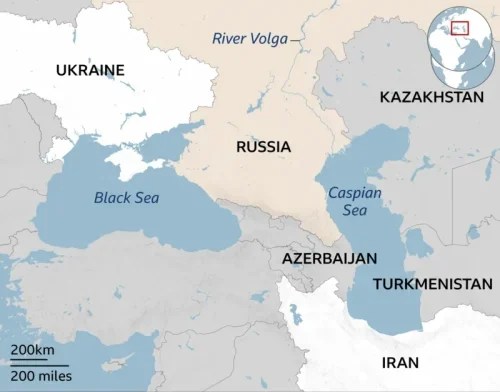
Therefore, Ukraine’s attack on an Iranian commercial vessel in the Caspian Sea in Russia’s territorial waters on Saturday, the first such attack since the start of the Russia-Ukraine war, is anything but a stray incident. Kyiv claimed responsibility for striking an Iranian vessel, signalling that one of Eurasia’s most stable security zones is now vulnerable to the direct spillover of the Ukraine conflict.
The Kremlin took note and spokesman Dmitry Peskov remarked at his daily briefing on Tuesday that the “geography of the Kiev regime’s terrorist activities is expanding.” Citing the incident, he added cryptically that all this “again highlights the need for a successful and complete special military operation.”
The attack on the Iranian ship was carried out from a distance of approximately 1,200 kilometres. Moscow has repeatedly alleged that such precise targeting over very long distances is way beyond Ukraine’s military capability and is only possible with the West’s direct participation. Foreign Minister Sergey Lavrov touched on it again on July 24: “A significant portion of the support provided to Vladimir Zelensky (from the West) comes from the United States. This is not only because the Americans sell weapons to the EU, which then transfers them to Ukraine, but also because the United States provides intelligence and reconnaissance, Starlink remains operational, and advanced technologies that require specialist expertise on the battlefield do not find their way there by accident. That is the way things are.”
Interestingly,the New York Times report on the Ukrainian attack appeared under the headline Ukraine’s Strike on an Iranian ship Could Bring Two Wars Closer. The Wall Street Journalheadline runs as follows: Two Wars Converge in the Caspian Sea as Ukraine Hits Iranian Supply Line to Russia. Al Jazeera gave a further twist saying Ukraine’s Zelenskyy set to meet Trump as Iran and Ukraine wars converge. A BBC report acknowledged that “The incident marked the first direct link between the wars in Iran and Ukraine.” It added, however, “But some experts question the wisdom of Kyiv’s decision to pick a fight with Iran.”
The impact of the Iran conflict initially seemed negative for Ukraine. It threatened to divert Trump’s already wavering attention. However, there has been not only no let-up in US support for Ukraine but in certain ways, the US involvement has only intensified by escalating the covert operations in Russian territory. Admittedly, these tactical advantages may not add up eventually, as Moscow is also stepping up attacks all across the frontline in Ukraine with a view to end the war soon.
The reported likely reassignment of General Sergey Surovikin, who at one time was commander of Moscow’s war effort in Ukraine, would signal a massive offensive going forward. The highly decorated general had previously served in Chechnya and Syria during conflicts that had overtones of proxy wars similar to Ukraine.
The Ukrainian attack on the Iranian ship could well be a calibrated move by Washington. Ukraine acted simultaneously with the US bombing of Gilan province, suggesting a degree of coordination. The Iranian ambassador to Russia disclosed that the ship was hardly 5 miles from the mouth of River Volga when the attack took place.
If the Moscow-led regional concord on the Caspian’s collective security is weakened, extra-regional military and security rivalries could vitiate the region impacting Russia and Iran’s core interests. Tehran views the Caspian Sea incident not as an isolated tactical event but as evidence of a broader shift in its surrounding security environment.
Last August, US-Azerbaijan-Armenia tripartite agreement was signed in the White House that will create a major transit corridor in Transcaucasia to be named the Trump Route for International Peace and Prosperity. Plainly put, the US and NATO are seriously contesting Russia’s pre-eminence in the Caspian / Central Asian regions.
Evidently, the Caspian Sea is no longer the conflict-free zone it was once believed to be. A new arena of geopolitical competition, fundamentally reshaping the security landscape of Eurasia and potentially marking the emergence of a new geographic theatre of conflict, has surfaced last weekend.
The Kremlin has warned that Ukraine is expanding the scope of its “terrorist activities” beyond Europe, citing Kiev’s recent involvement in destabilizing Iraq, attacks on strategic infrastructure in Germany and Kazakhstan, and the attack on an Iranian commercial vessel in the Caspian Sea.
Speaking at a press briefing on Tuesday, Kremlin spokesman Dmitry Peskov said the reported involvement of Ukrainian-linked groups in Iraq demonstrated that “the geography of the Kiev regime’s terrorist activities is expanding,” warning that such actions pose a growing threat beyond Europe.
“We see that the Kiev regime continues its terrorist activities,” Peskov said, arguing that the trend “again highlights the need for a successful and complete special military operation.”
The Kremlin spokesman also pointed to attacks carried out by Kiev beyond the battlefield, citing the sabotage of the Nord Stream gas pipelines, strikes against infrastructure linked to the Caspian Pipeline Consortium, and an attack on an Iranian commercial vessel in the Caspian Sea on Saturday.
Peskov’s remarks came after Iraqi authorities said they had identified and dismantled several sabotage cells responsible for a series of bombings across the country that were planning further attacks with backing and support from Ukraine.
Ukraine has denied involvement, saying Baghdad had presented no evidence to support the claims and had not raised the issue through diplomatic channels before the comments were made public.
Iraq’s National Security Adviser Qasim al-Aboudi, however, said authorities had arrested several suspects who admitted working for Ukraine and carrying out attacks on Iraqi facilities, describing the case as complex and still under investigation.
Ukraine also targeted an Iranian cargo vessel in the Caspian Sea on July 25, killing one sailor and injuring several others. Tehran said the vessel was a civilian ship carrying iron from Russia to Iran, while Ukraine alleged it was transporting Iranian drone and missile components to Russia.
Iranian Foreign Minister Abbas Araghchi said the attack had been carried out at the behest of the Israeli regime in an attempt to draw Europe into the war in West Asia, warning that the strike “cannot go unanswered.” The Foreign Ministry also said that Kiev had sought to spread insecurity by attacking the Iranian commercial vessel.
The debate over US forces using Italian military bases in the ongoing US-Israeli aggression against Iran has rekindled in Italy.
Earlier this week, three opposition lawmakers, Francesco Silvestri, Alessandra Maiorino, and Arnaldo Lomuti, formally demanded the government provide clarification regarding the departure towards West Asia of 12 F-16 fighter jets, at least 2 US tankers, and a number of Triton drones, used for maritime intelligence and surveillance, from Italian bases.
The three members of the lower house questioned Italy’s support of the Epstein coalition under bilateral treaties with the US.
The government must explain on what basis Italy is allowing the US to use our bases in this war of aggression against Iran.
Weeks ago, we were told that the use of our bases falls under the bilateral treaties that were forced upon us by Washington more than 70 years ago.
… These treaties are classified; so how can Parliament start a serious debate on the role played by Italy in this war of aggression?
About a month ago, NATO Secretary General Mark Rutte revealed during a TV interview that Rome had allowed more than 500 US military aircraft to take off from American bases in Italy during the 40-day war on Iran that began in late February,
Rutte’s revelations triggered a political storm in Italy.
Italy has sought, at least in words, to distance itself from the illegal US-Israel war against Iran over the past weeks. However, many criticize Italy’s technical and logistical support for the US.
When the government says that it’s not involved in the war, well, the government is very wrong.
Without the support of the tankers departing from our base in Sicily, the US jet fighters would not be able to strike. The same applies to the drones departing from our bases.
The truth is that not even our ministers know what the Americans do with the bases on Italian territory.
Orazio Foti, Former US Sigonella Military Base Employee
Surveys have consistently shown over the past months that a considerable majority of Italians think their country should avoid getting involved in the war on Iran.
Italy is up to its neck in the war.
Together with Europe, we simply cannot escape the fact that the political, economic, and military ties with the US and Israel do not allow practically any EU country to act autonomously.
The risk is that without an act of bravery, we will all be dragged into this war, even though we have nothing to do with it.
There are many people who only believe in or write about what they like. Their opinions are not so much derived from facts but are an expression of what they want to see happen. I say this because I want to be clear that the merging of the wars in Iran and Ukraine is neither ‘cool’ nor something I desire, but as they say ‘here we are’ and things will surely only get worse. Over the last two weeks we have seen news headlines demonstrating an interweaving of the conflicts into one. This is more so than just presumed (or in the case of the EU and Ukraine overt) proxy support.
One can only speculate as to why, but Zelensky with great glee has claimed responsibility for targeting an Iranian cargo vessel. There is a presumption that this was done to appease Trump or somehow win favor or attention from Washington. Trump has shown bitter disdain for Zelensky, especially after their spat at the White House early in the American President’s second term. But, we cannot forget that a president’s personal feelings on an individual do not necessarily become reflected in U.S. foreign policy. George Bush Jr. had nothing but praise for Vladimir Putin, while the Deep State was orchestrating the ultimate destruction of Russia behind the scenes. The attack on the Iranian ship has been confirmed by both Western media and RT: Iran has condemned a Ukrainian strike on a cargo ship in the Caspian Sea that killed one sailor and injured another. The Foreign Ministry summoned Ukraine’s acting chargé d’affaires over the attack.
In a post on X on Saturday, Ukrainian leader Vladimir Zelensky boasted about what he called “very strong results” from long-range strikes targeting “vessels used in military cargo shipments involving Iran, as well as a warship.”
The Iranian Foreign Ministry condemned the attack, saying it “risks further fueling and expanding the flames of war.” It urged other nations to take a “responsible stance toward this reckless action by the Ukrainian regime” and hold its leadership accountable.
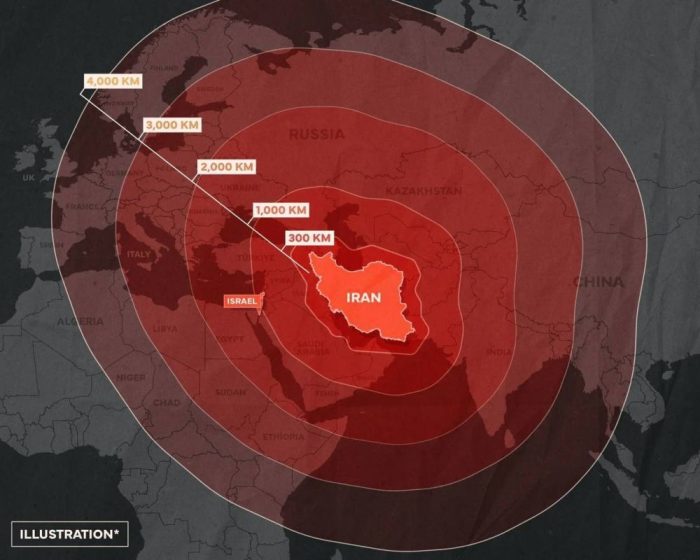
At about the same time, the Iranians have declared that they can and may hit the UK. They shared what could become an infamous image for future generations about climbing the escalation ladder to WWIII – a map showing the range of Iran’s strike capability. The key thing to note again is that Tehran wanted to make the point that they can hit the United Kingdom. This is in connection with the US attacking Iran via a British base, but perhaps there is more to this, because the U.S. has used plenty of foreign territory against Iran, but for some reason only the UK seemed marked for total destruction because of it. The City of London is a very special place indeed.
In the broader picture as time goes on the war in Ukraine and to an extent the one in Iran smells more-and-more like the vile streets of London and is even perhaps the last round of the ‘Great Game’ taking place in the 21st century. No one has been more enthusiastic for using Ukraine as one big suicide drone against Russia than the ever-rotating nosferatu that loom at 10 Downing Street. It was Boris Johnson who put the final nail in the coffin of millions of lives by destroying any sort of peace agreement back in 2022. But we should not forget that the birthplace of Zionism, the blood enemy of Iran, was the British Empire. And, at the very least the British owe the Iranians plenty of money.
At the time of writing no one has yet to be blamed for the explosion(s) at the industrial facility in Essex, but if Parliament and their overloads want, this could be the casus belli for engaging Russia, Iran or both full scale and thus the start of a true WWIII. Tehran did just threaten London after all.
It is obvious that the enemies of Russia and Iran (and China) are essentially the same, however the conflicts seemed to be fairly compartmentalized until this strike by the ‘Junkie Fuhrer’ as Dmitry Medvedev calls him. Anyone with YouTube level knowledge of geopolitics could see there is a sort of soft or compartmentalized WWIII already happening as the West goes into decline and the Monopolar World buckles under its own tremendous bulk. But each ‘front’ in this conflict, including ones that were resolved quickly like Venezuela, seemed to be at least factually separate. Yes, the EU is leading the way on the Ukrainian front and the USA on the Persian one but there’s tons of interplay behind the scenes, however ultimately they have remained separate conflicts despite this. Now, with this attack on Iran by Kiev it looks like these fronts may merge from officially separate ones to potentially turning into one big long arc along the western half of what Mackinder called the ‘rimland’ (the inter marginal crescent).
We also cannot ignore that Zelensky has attacked former supporter Turkey all while Erdogan’s anti-Israel rhetoric only continues to heat up. Interestingly, Kiev’s strike on Caspian oil infrastructure has a deep impact against seemingly neutral Kazakhstan and the United States. It was ultimately the critical infrastructure of these two countries that was effected. We also cannot forget that, although it is obvious where President Lukashenko’s allegiances lie, and that his nation has not entered the war yet, Kiev has still managed to continuously murder innocent civilians in/around Belarus including the now infamous incident against a bus filled with children. The Belorussian side is convinced, that the attack on the bus was meant to provoke them into entering the war directly.
On the other side of the big global strife the Saudis have attacked the Houthis and the other pro-western regimes of the Gulf States are waking up to the fact that if the USA loses then so do they and are trying to counter Iran’s actions to the best of their ability.
There is escalation happening everywhere across the ‘rimland’ except for Taiwan and the Korean Peninsula, probably to keep China from helping its like-minded neighbors too directly, or more importantly, too soon. Then again, the Russian rumor mill has it that the North Koreans are gathering an army of 50,000 volunteers to fight against Kiev in the Special Military Operation. This is not escalation in the east, but from the east for certain.
At the beginning of the Special Military Operation in Ukraine one could only hope and pray that something would change and that the West would go quietly into the Multipolar night on its own volition, but alas it has not. It is unclear whether Zelensky’s will is at play or that of his handlers, but Kiev’s ever growing attacks on third-parties in their war with Russia is only synthesizing the two major fights into one. We all remember how in the recent past the Iranians famously rejected Russian “help” in arming themselves, they have probably deeply reconsidered this position. If Zelensky is allowed to further attack Iran we will wake up to find ourselves no longer in a pseudo or soft WWIII but one that is very real and rock solid.
This broadening of conflict presents a danger as the rules of engagement are quite different in both conflicts. The Russians want to save the locals in Ukraine and thus they can’t just ‘nuke it’. The Iranians don’t have nukes thus they trade missiles with the American navy and its various army bases in neighboring countries along with strikes on the source of Zionism in Israel. These are two very different games: one a mission to save locals from extinction from fascists created by the West, and the other a fight back against an unprovoked Zionist bombing campaign. Ukraine is being used as a proxy, protecting Europe from retaliation, whereas Iran is directly hitting the U.S. military and Israel directly. The key take away is that if Zelensky’s authorization of anarchy, possibly planned and orchestrated by London and beyond continues, these two will merge into something truly horrific for all humanity as two wars with no immediate nuclear threat will merge into one with nukes at the ready on both sides. Regional conflicts are now synthesizing into WWIII and the dynamic of this unified war will be nuclear.
United States Representative Thomas Massie said the United States has been “significantly weakened by the war with Iran,” arguing in an X post that the campaign depleted missile-defense systems, drained oil reserves, sacrificed US troops, pushed up consumer prices, increased debt, and sidelined domestic needs “all for Israel.”
The Kentucky Republican’s remarks added fresh political pressure to an already widening debate in Washington over the price of the war on Iran, the scope of US involvement, and the degree to which the White House has tied American military power to “Israel’s” regional agenda. That debate has sharpened as more lawmakers question the administration’s war powers and the long-term cost of the campaign.
CENTCOM urged a pause near the Strait of Hormuz
Massie’s remarks came as Axios reported that Admiral Brad Cooper, the top US military commander in West Asia and head of CENTCOM, advised the Trump administration to halt bombing around the Strait of Hormuz after concluding the two-week assault had reached diminishing returns. Axios said Cooper briefed the Pentagon, the Joint Chiefs of Staff, and the White House earlier in the week, and that his assessment helped shape Trump’s decision to pause strikes along Iran’s southern coastline and around the strategic waterway.
The report said Cooper warned that most of the assigned targets had already been struck, leaving few objectives whose destruction would materially change the battlefield. In other words, the campaign had begun to run out of useful military targets unless Trump was prepared to escalate the war further.
Air-defense stocks under strain
Meanwhile, General Dan Caine, chairman of the Joint Chiefs of Staff, warned Trump and War Secretary Pete Hegseth that shortages of air-defense interceptors could reduce Washington’s ability to shield its bases and regional allies if the confrontation escalated again. The warning echoed broader concerns inside the Pentagon about the strain that the war on Iran has placed on US missile-defense inventories.
The New York Times said senior advisers including Caine and Vice President JD Vance raised similar concerns about the shrinking stockpile of Patriot interceptors and other air-defence systems needed to protect US forces across the region. That assessment reportedly played a major role in Trump’s decision to hold back from a larger escalation.
Ukrainian President Volodymyr Zelensky said that Russia is receiving significant military support from North Korea, Iran, and China.
“I think three moments on which we have to focus. First, North Korea will send to Russia 30,000 soldiers. The second point Iranians will send missiles to Russia,” Zelensky said in an interview with Sky News on Sunday. “Then what is the really big problem: China began to work with Russia, and they work on satellites and on technologies to be more precise.”
The statement follows a Ukrainian attack on an Iranian vessel in the Caspian Sea. “Ukraine continues applying long‑range sanctions in response to Russian strikes,” Zelensky wrote on X Saturday. We also achieved very strong results with long‑range strikes in the Caspian Sea – including vessels used in military cargo shipments involving Iran, as well as a warship.”
Iranian Foreign Minister Seyed Abbas Araghchi said the attack would not go unanswered.
“Zelenskyy has attacked an Iranian commercial vessel, killing a sailor. A blatant UN Charter violation done at Israel’s behest to drag Europe into its war,” he wrote on X Sunday. “In calls with EU High Rep Kallas and FM Lavrov, I made clear that what the freeloader in Kyiv did CANNOT GO UNANSWERED.”
Zelensky was asked if he was concerned about an Iranian response. He argued that Iran had already attacked Ukraine by providing drones and missiles to Russia. “We have to be cautious. We have to do everything not to open a new front in any way. But we have to be honest. Iranians and North Koreans already attacked us,” he said.
Iranian Foreign Ministry spokesman Esmaeil Baghaei responded to Zelensky’s remarks on Monday. “The behavior of the Ukrainian President is reminiscent of the behavior of anarchists who, on the eve of World War I, carried out theatrical and very dangerous actions whose consequences affected all of Europe,” he said. “The Ukrainian regime downgraded its country to a tool for geopolitical disputes between powers starting four years ago.”
Dr. Trita Parsi, executive vice president at the Quincy Institute, warned that Zelensky is attempting to merge the wars in Ukraine and Iran. “Ukraine is not trying to just enter the war with Iran. Rather, it appears it is trying to merge the Ukraine war with the Iran war,” he explained. “Why? Because if these two wars merge, Ukraine will be a belligerent in the Iran war and America will be a belligerent in the Ukraine war.”
On the afternoon of February 28, as the first dark clouds of joint Israeli-American military aggression gathered over Iran, a sports hall in the small southern city of Lamerd – a place that had once echoed with the squeak of sneakers and the thrill of competition – was transformed into a scene of unspeakable carnage.
Two American Increment One Precision Strike Missiles (PrSMs), fitted with fragmentation warheads, tore through the facility while a women’s volleyball team was actively training inside. The gruesome and deliberate attack claimed many civilian lives, including dozens of children, and left scores more wounded and maimed.
In a grim parallel to the earlier attack on the Shajareh Tayyebeh Elementary School in Minab, the US war machine initially refused to acknowledge its culpability in both incidents, due to massive global outcry, particularly in Minab.
Instead, American officials went so far as to formally and cynically attribute the tragedy IN BOTH to an alleged malfunction of an Iranian Hoveyzeh cruise missile, a brazen attempt to absolve themselves of yet another unforgivable war crime.
The official American position attributed the civilian deaths in Lamerd to an Iranian Hoveyzeh cruise missile – a KH-55 derivative that bears no resemblance whatsoever to an American PrSM, differing fundamentally in shape, flight trajectory, and terminal dive profile.
This assertion proved deeply peculiar, particularly after Iranian media published CCTV footage showing impact patterns unmistakably consistent with PrSM fragmentation warheads, alongside visuals clearly depicting a ballistic projectile descending in a manner entirely characteristic of the American weapon system.
Identifying the probable staging ground for this attack and others like it proved to be a matter of straightforward deduction. The United States employs the tracked M270 Multiple Launch Rocket System (MLRS) and the wheeled M142 High Mobility Artillery Rocket System (HIMARS) to deploy two distinct families of short-range tactical ballistic missiles: the newer PrSM and the older MGM-140 Army Tactical Missile System (ATACMS), with maximum ranges of 500 and 300 kilometers, respectively.
Given these systems’ limited reach and the considerable operational threat posed by Iran-allied resistance groups throughout Iraq, it became increasingly evident that the Arab monarchies of the Persian Gulf had consented to allow American forces to utilize their territory as launch pads for aggression against Iran and its civilian population.
Liability for the strikes
In the weeks following the initial wave of US-Israeli military aggression against Iran, a substantial body of open-source evidence accumulated, enabling one to reconstruct the operational architecture behind the attacks with reasonable confidence.
Satellite imagery reviewed by independent researchers, munitions debris documented by Iranian media and corroborated by third-party analysts, and flight-path data derived from publicly accessible tracking sources collectively point to forward launch positions in Kuwait and Bahrain as the points of origin for a series of ballistic missile strikes against Iranian territory.
The ATACMS and the longer-range PrSM are neither cruise missiles nor air-launched munitions. They are ground-launched ballistic systems that demand substantial fixed or semi-fixed infrastructure, pre-positioned logistics, and complete host-nation cooperation – or at minimum, tacit acquiescence.
In practical terms, this arrangement extends far beyond granting overflight rights to American aircraft. The deployment of American artillery regiments fielding short-range ballistic missiles on Kuwaiti and Bahraini soil is not incidental but structural. Such weaponry would have served no purpose other than to strike at Iranian territory.
Diplomatically, Tehran delivered an explicit and time-bound demand to both Manama and Kuwait City: cease facilitating the war of aggression, expel the American military forces and their assets, or face the consequences.
The initial response from Bahrain and Kuwait was, in a word, silence – punctuated by formulaic statements affirming their alliance commitments while declining to confirm or deny the operational details that open-source evidence had already established.
It was not a neutral posture but represented a conscious and controversial choice to take sides in an active war, which carries inevitable consequences.
Lamerd sports hall attack
The denial and what came after
Both Kuwait and Bahrain moved quickly to deny the reports. Official statements from Kuwait City and Manama dismissed the open-source evidence as fabricated or misattributed, with Kuwaiti officials characterizing the satellite imagery and debris documentation as part of an Iranian information operation.
Bahraini authorities declined to comment on specific operational details, citing security considerations. The denials were categorical yet they did not survive the end of active hostilities.
In the weeks following the cessation of the initial combat phase, a more complete evidentiary picture emerged, placing Kuwait at the epicenter of the ballistic missile campaign against Iran.
CENTCOM released declassified strike footage confirming ground-launched ballistic operations, footage that independent analysts cross-referenced with geographic markers consistent with Kuwaiti territory.
The release, framed by US officials as a demonstration of operational effectiveness, had the unintended secondary effect of directly contradicting the categorical denials issued by Kuwait. More damaging still was the subsequent discovery of expended ATACMS canisters in the Kuwaiti desert, physical evidence that no official statement could plausibly explain away. The canisters confirmed not only the presence of the launch systems but also the scale and intensity of their operational use.
Kuwait’s role as the operational hub
With the resumption of active combat operations in recent weeks, following American attempts to establish an illegal maritime corridor in the Omani section of the Strait of Hormuz in brazen violation of the memorandum of understanding signed between the two sides, Kuwait’s role has intensified considerably.
The frequency of ballistic missile launches from Kuwaiti territory has increased markedly, a pattern fully consistent with Western reporting indicating that US PrSM stocks have been effectively depleted.
With PrSM availability now severely constrained, the operational burden of American ballistic missile attacks has shifted entirely back to the older ATACMS platform, and Kuwait has emerged as the primary launch hub for that capability.
The geographic logic is self-evident. Kuwait’s proximity to western Iran, and particularly to the southern province of Khuzestan, renders it the most efficient forward position for strikes targeting the military, economic, and energy infrastructure concentrated in that region.
Khuzestan is home to a substantial share of Iran’s oil production, refining capacity, and petrochemical industry, and has consequently emerged as a principal focal point of American military aggression. The volume of launches emanating from Kuwait reflects that strategic prioritization with unmistakable clarity.
The Incriminating Lights
The Arab monarchies of the Persian Gulf have made every possible effort to suppress citizen documentation of military activity, imposing social media restrictions and punitive measures to limit the spread of footage that might complicate official denials.
Yet those efforts have proven increasingly ineffective. As the war has persisted, a steady and growing stream of video and photographic evidence has emerged from Kuwait, captured by residents documenting ballistic missile launches occurring with near-nightly regularity.
The imagery, showing missile contrails ascending over Kuwait and tracking northeast across or alongside Iraqi airspace before continuing toward Iranian territory, circulates widely across platforms such as Telegram.
Multiple photographs and video footage taken from different vantage points confirm the flight paths, the frequency, and the unmistakable signature of ground-launched ballistic systems operating from Kuwaiti soil with undeniable clarity.
The nightly launches have become, in a grim sense, a matter of public record, documented by ordinary Kuwaiti and Iraqi residents whose smartphones have captured what governments continue to officially deny.
The chasm between the official position and the visible reality has widened to a point where it functions less as a credible denial and more as a formal fiction, maintained by all parties for reasons of diplomatic convenience.
The Iranian counter-strike record
Iran has not absorbed this campaign passively. In the weeks following the intensification of launches from Kuwaiti territory, Iranian forces have conducted retaliatory strikes targeting the American military’s forward launch infrastructure.
A growing evidentiary record of these strikes, assembled from open-source footage, presents an intriguing visual signature involving what appear to be large secondary explosions following initial impact, characterized by the bright, fast-burning combustion profile associated with solid-propellant missile fuel.
The secondary detonations visible in circulating clips are inconsistent with conventional munitions storage and consistent with the ignition of solid rocket propellant – of the type utilized in ATACMS – either from fueled launcher vehicles or from stockpiled rounds awaiting deployment.
Several clips show fires burning after initial impact, with the characteristic white-orange flame column that propellant combustion produces distinguishing these events unmistakably from the black smoke of fuel or ordnance fires.
Survival and the limits of alignment
Small states make difficult choices under duress, caught precariously between a powerful patron’s operational requirements and a large neighbor’s legitimate security concerns.
Experts acknowledge that the constraints on Bahraini and Kuwaiti sovereignty, stemming from their profound dependence on the United States, are genuine and substantial.
But, they insist that acknowledgment of constraint is not the same as absolution from responsibility. Governments bear an obligation to their populations that supersedes alliance loyalties, an obligation to assess, without illusion, the risks that their choices are generating.
The current posture of the Persian Gulf states hosting American military bases and providing a launch pad for ballistic missile operations against Iran is deeply problematic.
It reflects, as per analysts, a perilous combination of structural dependency, institutional inertia, and a dangerous underestimation of Iranian anger, resolve, and military capability.
As one military expert told the Press TV website, these micro-states are not positioned to absorb the consequences of a sustained Iranian retaliatory campaign.
“Their small land masses, concentrated infrastructure, and limited strategic depth render them acutely vulnerable in ways that their larger patron is not. By gambling their national survival on the assumption that Iranian red lines are empty, and that US protection is everlasting, they are making a remarkably poor bet, one that history has rarely rewarded,” he noted.
Iran has claimed that Ukraine attacked one of its commercial vessels in the Caspian Sea at Israel’s behest.
Ukrainian leader Vladimir Zelensky stated earlier that the vessel struck on Saturday was transporting military cargo. Iran, which has denied involvement in the fighting between Russia and Ukraine, said the attack killed one sailor.
Iranian Foreign Minister Abbas Araghchi reiterated his country’s position during separate calls with the EU’s top diplomat, Kaja Kallas, and Russian Foreign Minister Sergey Lavrov.
“Zelenskyy has attacked an Iranian commercial vessel, killing a sailor. A blatant UN Charter violation done at Israel’s behest to drag Europe into its war,” Araghchi wrote on X on Sunday.
“In calls with EU High Rep Kallas and FM Lavrov, [I] made clear that what the freeloader in Kyiv did CANNOT GO UNANSWERED,” he added.
During his conversation with Lavrov, Araghchi said Iran “will resolutely defend its security and national interests,” according to Press TV. Lavrov expressed condolences over the sailor’s death and identified the struck vessel as the cargo ship Ana.
Speaking to Israel’s N12 television channel, Ukrainian Ambassador to Israel Yevgeny Korniychuk claimed that the Iranian ship was carrying components for drones and missiles. Tehran, however, insisted that the cargo was entirely civilian.
Iran confirmed in 2022 that it had delivered a “small number” of Shahed-136 kamikaze drones to Russia months before the Ukraine conflict began in February of that year. Moscow has maintained that all Geran-2 drones, believed to be based on the Shahed-136 design, are produced domestically.
In recent statements and interviews with the American press, Zelensky said he was “100 percent sure” that Russia had helped Iran during its conflict with the US and Israel. Russian President Vladimir Putin has denied that Moscow supplied Tehran with weapons. US President Donald Trump also said recently that he did not believe either Russia or China had provided Iran with military assistance.
By portraying Chinese characters as perpetrators of ruthless violence while casting Japanese Self-Defense Forces (SDF) intelligence operatives as defenders, the season 2 of the Japanese drama Vivant has recently drawn criticism from Chinese netizens, who argue that its depiction turns historical reality on its head while ignoring Japan’s wartime atrocities.
The TBS drama series – a spy suspense story in which an alleged unofficial intelligence unit of the SDF operates across the globe — has attracted a passionate fanbase. Its currently airing season 2 opened with a household rating of 18.8 percent, the highest for a TV drama this year, according toa commentary article by Japanese media Toyo Keizai.
What draws attention is the portrayal of the enemies in the series, the article noted. Scenes in which the Chinese organization subjects kidnapped members of the SDF unit to brutal torture are repeated with unrelenting intensity.
It is rare for Japanese TV dramas to explicitly portray a real-life country as the enemy, the article noted.
Japanese Prime Minister Sanae Takaichi also made a reference to the drama, saying that she has been recording Vivant and hopes to binge-watch it over the year-end and New Year holidays, according to Japanese media outlets.
China’s CCTV News report on Sunday revealed that the drama features scenes in which Chinese personnel cut off the fingers of and stab Japanese intelligence operatives in the abdomen. Such acts bear striking similarities to the torture inflicted on Chinese nationals by invading Japanese troops during the World War II.
The drama distorts the truth by attributing these atrocities to modern Chinese characters. Beneath the surface, it subtly glorifies Japan’s cross-border overseas operations, blurs the functional boundaries of the SDF and implicitly promotes an expansionist narrative, per CCTV News. … continue
This site is provided as a research and reference tool. Although we make every reasonable effort to ensure that the information and data provided at this site are useful, accurate, and current, we cannot guarantee that the information and data provided here will be error-free. By using this site, you assume all responsibility for and risk arising from your use of and reliance upon the contents of this site.
This site and the information available through it do not, and are not intended to constitute legal advice. Should you require legal advice, you should consult your own attorney.
Nothing within this site or linked to by this site constitutes investment advice or medical advice.
Materials accessible from or added to this site by third parties, such as comments posted, are strictly the responsibility of the third party who added such materials or made them accessible and we neither endorse nor undertake to control, monitor, edit or assume responsibility for any such third-party material.
The posting of stories, commentaries, reports, documents and links (embedded or otherwise) on this site does not in any way, shape or form, implied or otherwise, necessarily express or suggest endorsement or support of any of such posted material or parts therein.
The word “alleged” is deemed to occur before the word “fraud.” Since the rule of law still applies. To peasants, at least.
Fair Use
This site contains copyrighted material the use of which has not always been specifically authorized by the copyright owner. We are making such material available in our efforts to advance understanding of environmental, political, human rights, economic, democracy, scientific, and social justice issues, etc. We believe this constitutes a ‘fair use’ of any such copyrighted material as provided for in section 107 of the US Copyright Law. In accordance with Title 17 U.S.C. Section 107, the material on this site is distributed without profit to those who have expressed a prior interest in receiving the included information for research and educational purposes. For more info go to: http://www.law.cornell.edu/uscode/17/107.shtml. If you wish to use copyrighted material from this site for purposes of your own that go beyond ‘fair use’, you must obtain permission from the copyright owner.
DMCA Contact
This is information for anyone that wishes to challenge our “fair use” of copyrighted material.
If you are a legal copyright holder or a designated agent for such and you believe that content residing on or accessible through our website infringes a copyright and falls outside the boundaries of “Fair Use”, please send a notice of infringement by contacting atheonews@gmail.com.
We will respond and take necessary action immediately.
If notice is given of an alleged copyright violation we will act expeditiously to remove or disable access to the material(s) in question.
All 3rd party material posted on this website is copyright the respective owners / authors. Aletho News makes no claim of copyright on such material.