Carnegie Endowment cancels Iran FM’s speech under ‘orchestrated pressure’ from Israel lobby: Report
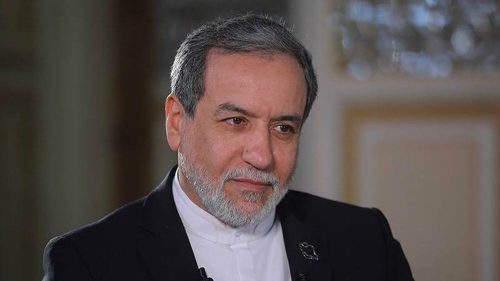
Iranian Foreign Minister Abbas Araghchi
Press TV – April 21, 2025
The Carnegie Endowment for International Peace (CEIP) cancels Iranian Foreign Minister Abbas Araghchi’s keynote address at its 2025 Nuclear Policy Conference.
Citing sources familiar with the matter, Iran Nuances reported that the cancellation on Monday followed an “orchestrated pressure” campaign from “Israeli-affiliated hawkish elements” and officials of former US presidents Joe Biden and Barack Obama.
Araghchi was scheduled to deliver a virtual address at the conference, which will bring together politicians, diplomats, and nuclear experts from around the world to discuss critical challenges in nuclear nonproliferation, arms control, disarmament, deterrence, energy, and security.
Iran’s Permanent Mission to the United Nations confirmed in a statement that Araghchi’s speech has been canceled.
According to the mission, the cancellation occurred after the conference organizers decided to change the format of the Iranian foreign minister’s speech to a debate.
Expressing regret over the matter, the mission said that the full text of the now-canceled speech will be made available to the news media.
Atmosphere of talks with Washington is ‘constructive’: Iran
Al Mayadeen | April 20, 2025
The Iranian government’s spokesperson, Fatemeh Mohajerani, stated on Sunday that the atmosphere of the recent round of indirect talks with the United States was “constructive,” signaling a potential easing of tensions between the two countries.
She confirmed that practical steps to reduce tensions will be discussed in the upcoming sessions.
Speaking to the state-run IRNA news agency, Mohajerani emphasized that Iran is acting in its national interests and values, adding that “Iran is moving forward based on its national interests and preserving the dignity of its people.”
“It will welcome any initiative to lift sanctions that serve the interests of the Iranian people,” noting that the expert-level talks are expected to resume in Muscat, Oman, in the coming days.
Araghchi confirms forward momentum
The statement came a day after Iranian Foreign Minister Abbas Araghchi described the second round of indirect discussions, held in Rome, as “good.”
He said the talks, which lasted approximately four hours, led to an understanding on several key frameworks and objectives.
“We reached an understanding on some of the main frameworks and objectives, and we agreed to continue the talks,” Araghchi told Iranian state television.
Araghchi confirmed that technical-level discussions will begin on Wednesday in the Sultanate of Oman. These expert meetings aim to work out the specifics of a potential agreement. A follow-up political meeting is scheduled for Saturday, also in Oman, to evaluate the results of the technical talks.
This second round of diplomacy comes just one week after the first round, also held in Oman, which both sides had described as constructive.
Israel is the sole obstacle to nuke-free West Asia, says Iran’s FM
Press TV – April 19, 2025
Iranian Foreign Minister Abbas Araghchi says Israel is the only obstacle to the realization of a nuclear weapons-free West Asia, warning that the occupying regime is fomenting Iranophobia while committing genocide in the region.
Araghchi made the remarks on Saturday in Rome during a meeting with his Italian counterpart, Antonio Tajani. The two met ahead of the second round of indirect talks between Iran and the United States, mediated by Oman at its embassy in the Italian capital.
Reaffirming Iran’s commitment to diplomacy, Araghchi urged all parties to seize the opportunity for a “logical and reasonable understanding” that would recognize Iran’s legitimate rights and lift “unjust and illegal sanctions.”
He emphasized Iran’s peaceful nuclear intentions, reiterating the country’s rejection of weapons of mass destruction based on its religious and national values and defensive doctrine.
The Iranian minister also thanked Tajani for Italy’s coordination in facilitating the talks and conveyed Easter greetings to the Italian people.
Tajani welcomed Araghchi and expressed Italy’s strong interest in deepening ties with Iran. He said hosting the talks was of great value to Rome and stressed Italy’s readiness to assist the negotiations in any possible way.
Araghchi arrived in Rome earlier in the day for talks on Tehran’s civilian nuclear program and termination of Washington’s unlawful sanctions against the country.
Iran had ruled out direct negotiations with the US under pressure or threats of war but stated that it remains open to indirect talks.
Ties with Russia, China key to global peace – Iranian foreign minister
RT | April 19, 2025
Iran, Russia, and China intend to deepen their cooperation in order to promote global peace and security, Iranian Foreign Minister Abbas Araghchi has said in an exclusive interview with RT.
Tehran has been strengthening its ties with Moscow and Beijing in recent years, joining the Shanghai Cooperation Organization (SCO) in 2023 and the BRICS group in 2024. Military cooperation has also expanded, most recently through joint naval drills conducted by the three countries off Iran’s coast in March.
Given the current international climate, working closely with Moscow and Beijing is “a necessity” for Tehran, Araghchi told the broadcaster on Saturday.
“We have started trilateral talks between Iran, Russia and China on the issue of Iran’s nuclear program for some time now,” he said, adding that two such meetings have already taken place. “We are ready to continue these talks and expand them to other issues,” the minister added.
Araghchi expressed confidence that “Iran, China and Russia – in a coordinated move – can take effective steps towards international peace.” The three partners “are serious about this,” he insisted.
Tehran’s top diplomat also said that bilateral “relations between Iran and Russia have never been so close and so strong” than at the current moment.
“We now have a comprehensive strategic partnership agreement that raises the level of our relations to a strategic level. Major economic projects are underway between us. The volume of trade between us has increased tremendously,” he said.
Despite harsh Western restrictions slapped on both Iran and Russia, the two countries “are not waiting for the sanctions to be lifted, but we are expanding our relations in this situation,” Araghchi noted.
“We have the same and close positions on many international issues. I do not want to say that there are no disagreements between us. Sometimes there are also differences of opinion, but in most cases we have close positions with each other and, most importantly, we are in constant exchange of views,” he said.
Earlier this week, Russia’s Federation Council, the upper house of the country’s parliament, unanimously ratified the Comprehensive Strategic Partnership Agreement between Russia and Iran, which was signed by Russian President Vladimir Putin and his Iranian counterpart Masoud Peseshkian in January. The pact stipulates that the two nations will develop equal and mutually beneficial cooperation in the fields of politics, defense, economy, security, trade, investment, energy, infrastructure and other areas.
Russia, China to Discuss Guarantees on Iran Deal with US – Iranian Lawmaker
Sputnik – 19.04.2025
The United States will not be the only one providing guarantees for a potential Tehran-Washington agreement on the Iranian nuclear program, Iranian lawmaker Alaeddin Boroujerdi said ahead of the second round of US-Iran talks in Rome.
Russia and China will discuss with the US the issue of “more reliable guarantees” for Tehran, Alaeddin Boroujerdi, a member of the Iranian parliamentary committee on national security and foreign policy, said.
“During the negotiations between Tehran and Washington, guarantees will not only be provided by the US. Countries such as Russia and China will enter into negotiations with the United States on more reliable guarantees,” Boroujerdi said, as quoted by the Iranian state agency SNN.
Iranian Foreign Minister Abbas Araghchi was on an official visit to Moscow on Thursday and Friday, and in the next few days, according to the Iranian state news agency IRNA, Araghchi will visit China.
During his visit to Russia, the Iranian diplomat held a meeting and talks with Russian leader Vladimir Putin, conveying to him a message from Iran’s Supreme Leader Ali Khamenei. Araghchi also held talks with Russian Foreign Minister Sergey Lavrov. The parties discussed regional and international cooperation, as well as the situation around the US-Iran talks, the first round of which took place on April 12 in Oman.
Indirect talks between US Presidential Envoy for the Middle East Steve Witkoff and Araghchi took place in the Omani capital on April 12. According to the US special envoy, they were positive and constructive. Araghchi also described the atmosphere of these talks as constructive and calm, and announced that the second round of talks between the Islamic Republic and the United States would be held on April 19.
Israeli officials head to Paris to ‘influence US position’ on Iran talks
The Cradle | April 18, 2025
Israeli Minister of Strategic Affairs Ron Dermer and Mossad chief David Barnea traveled to Paris for a meeting with US envoy Steve Witkoff, which will focus on the current nuclear talks between Washington and Tehran.
“Strategic Affairs Minister Ron Dermer secretly flew to Paris to meet with US envoy Steve Witkoff for talks on the Iranian nuclear issue,” three Israeli sources told Hebrew outlet Walla on 18 April. Axios reported that Barnea will also be participating.
“Israel wants to clarify its positions and try to influence the American position in the talks,” the Walla report added.
One source cited in the report said that Witkoff is looking to negotiate a deal in which Tehran agrees to no longer enrich uranium.
According to three sources speaking with Iran International, Iran proposed during the last round of talks the idea of a cap on its uranium enrichment – as was the case in the 2015 nuclear deal under the Joint Comprehensive Plan of Action (JCPOA), which US President Donald Trump withdrew from in 2018 during his first term.
The report says the proposal includes Iran temporarily lowering enrichment to 3.67 percent – the level from the 2015 deal. In exchange, Washington would allow Tehran to access frozen assets and export oil in the first phase.
Phase two would see the US lift additional sanctions and block the “snapback” mechanism, which allows for the immediate reimposition of sanctions on Iran by the UN Security Council, according to the report. Iran would, in exchange, allow the International Atomic Energy Agency (IAEA) to resume inspections of nuclear sites, including “surprise” inspections.
Witkoff called on Iran to end its enrichment and said the president has ordered a “tough deal,” contradicting an earlier statement signaling US openness to a cap on Iranian uranium enrichment.
Iran’s Foreign Minister Abbas Araghchi said on 16 April that the Islamic Republic’s enrichment of uranium is “non-negotiable.”
Trump has repeatedly threatened a bombing campaign against Iranian nuclear facilities if a deal is not reached in the current talks, which are coinciding with his continued “maximum pressure” policy of sanctions on Iran.
Tehran has demanded an end to US pressure and threats, and says talks will continue in an indirect manner.
The New York Times reported on Wednesday that Trump recently “waved off” an Israeli proposal for a joint attack on Iran.
“I wouldn’t say ‘waved off,’” Trump said in response. “I’m not in a rush to do it. If there’s a second option. I think it would be very bad for Iran, and I think Iran is wanting to talk. I hope they’re wanting to talk. It’s going to be very good for them if they do. Iran can’t have a nuclear weapon. It’s pretty simple,” he added.
Israel has for years been devising plots for a large-scale attack on Iranian nuclear facilities. Tel Aviv has recently said that the only US–Iran deal it would find acceptable is one that completely eliminates Tehran’s nuclear program.
The next round of US–Iran talks will be held on 19 April in Rome.
Threats of Strikes on Iran’s Nuclear Facilities Are ‘Unacceptable’ – IAEA Chief
Sputnik – 18.04.2025
International Atomic Energy Agency (IAEA) Director General Rafael Grossi called threats of strikes on Iran’s nuclear facilities “unacceptable.”
“The IAEA has always emphasized that threats against Iran’s nuclear facilities are unacceptable and that the attacks that are being discussed could not only worsen existing problems, but also create more serious environmental consequences,” Grossi was quoted as saying by the IRIB news agency on Thursday.
On Wednesday, The New York Times newspaper reported that US President Donald Trump did not allow Israel to attack Iranian nuclear facilities after he decided to pursue diplomacy with Tehran. Israeli officials were allegedly ready to attack Iran in May and counted on US support, promising to set back Tehran’s nuclear program by a year or more.
Iran’s FM in Russia to ‘consult on matters of common concern’
Press TV – April 17, 2025
Iranian Foreign Minister Abbas Araghchi is visiting Moscow to “consult on matters of common interest and concern” with Russian officials, Foreign Ministry spokesman Esmaeil Baghaei says.
Baghaei on Thursday described Russia as a “strategic partner”, emphasizing that mutual ties between Tehran and Moscow are anchored in solid grounds of “mutual understanding” and common interests.
“Iran-Russia’s excellent bilateral relations are based on solid grounds of ‘mutual understanding’ & ‘respect’ as well as ‘shared interests’ of the two nations,” he wrote on the X social media platform.
Heading a diplomatic delegation, Araghchi traveled to Moscow Thursday to deliver a written message from Leader of the Islamic Revolution Ayatollah Seyyed Ali Khamenei to Russian President Vladimir Putin, Baghaei said.
The previously planned visit is taking place at the invitation of Russian Foreign Minister Sergei Lavrov, within the framework of continuous consultations between the two countries as strategic partners, Baghaei added.
During his stay in Moscow, Araghchi will hold talks on bilateral relations, regional and international developments, and the recent indirect talks between Iran and the US.
His visit comes ahead of the second round of talks between the US and Iran on Saturday after they held “positive” indirect negotiations in the Omani capital on Tehran’s nuclear program and the removal of sanctions on the Islamic Republic.
President Putin was scheduled to meet Araghchi later Thursday, Kremlin aide Yuri Ushakov told state media.
The Kremlin said Wednesday that Russia was ready to do “everything” in its powers to help find a diplomatic resolution to the standoff between the United States and Iran.
Russia has issued calls for calm after US President Donald Trump last month appeared to threaten to bomb Iran if it did not agree to a new nuclear agreement.
Tehran rejects ‘baseless’ UK claims about links to criminal groups
Press TV – April 17, 2025
Iran has condemned as “baseless and unjust” the recent accusations leveled by Britain that the Islamic Republic is connected with certain criminal groups.
Foreign Ministry spokesman Esmaeil Baghaei made the remarks on Thursday, three days after UK Foreign Secretary David Lammy announced sanctions on Foxtrot and its leader, Rawa Majid, claiming that the Swedish-based gang had been involved in “violence against Jewish and Israeli targets in Europe on behalf of” Tehran without providing any evidence.
Baghaei said attributing the actions of certain groups to Iran is a clear blame game meant to cover up Britain’s own destabilizing activities, particularly in West Asia.
“Making such claims against Iran reflects a misguided policy that the UK government has, in recent years, become somewhat addicted to,” he added.
The spokesman also noted that London has repeated its unfounded claims without any evidence despite Tehran’s calls for the UK to provide proof supporting its allegations.
He further emphasized that the UK government’s policy of making anti-Iran claims will bring nothing but will discredit it.
“The British regime must understand that pursuing a policy of unfounded ‘claims and accusations’ against the Islamic Republic of Iran will deepen distrust and further disrupt diplomatic relations – for which the UK will bear responsibility,” Baghaei said.
Earlier, the Iranian embassy in London said it had submitted a note of protest to the British government regarding the allegations.
“We consider such baseless positions and destructive conduct to be detrimental to the bilateral relations and urge the UK to refrain from pursuing hostile approaches towards Iran,” it said in a statement.
US imposes sanctions on Chinese buyers of Iranian oil
Press TV – April 16, 2025
The United States has imposed sanctions on Chinese importers of Iranian oil despite being involved in talks with the Islamic Republic to sort out differences over its nuclear program.
The US Treasury Department’s Office of Foreign Assets Control (OFAC) said in a statement on Wednesday that it had targeted the Chinese importers of Iranian oil in a new round of sanctions issued against Tehran.
It said that the Shandong Shengxing, a so-called “teapot” refinery based in China’s Shandong province, had been designated for receiving dozens of Iranian oil shipments worth more than $1 billion.
The sanctions also targeted the China Oil and Petroleum Company Limited (COPC), an entity the Treasury claimed has been functioning as a front company for Iran’s Islamic Revolution Guards Corps to collect oil export revenues from China, including payments made by Shandong Shengxing.
OFAC said it had also designated one Cameroon-flagged and four Panama-flagged tankers for their role in transporting billions of dollars worth of Iran’s oil to international markets, including to China-based refineries.
The tankers’ owners and operators, based in Panama, Malaysia, the Marshall Islands, and Hong Kong, were also targeted.
The new sanctions are the sixth such action taken by the US government against Iran since February 4, when US President Donald Trump signed a presidential memorandum ordering a campaign of maximum pressure on the country.
They came despite the fact that Iran and the US have launched negotiations to settle disputes about Tehran’s nuclear program. The indirect talks started last weekend in Oman’s capital, Muscat, and will continue on Saturday in Italy’s Rome.
However, the sanctions are a first under Trump in his second term to directly target China and its imports of oil from Iran. Beijing has repeatedly said that it does not recognize US sanctions.
Iran signs contract to convert Iraq’s flare gas into petchem feedstock
Press TV – April 14, 2025
Iran has secured a contract to convert flare gas from Iraqi oilfields into feedstock for petrochemical plants located near its border with the Arab country.
Iranian Oil Minister Mohsen Paknejad and Iraqi Deputy Prime Minister for Energy Affairs Hayyan Abdul Ghani supervised the signing of the contract on Monday in Baghdad, according to a report by the Iranian Oil Ministry’s news service Shana.
The report said that Iran’s state-run and private companies will contribute to the flare gas recovery project in the Iraqi oilfields that are located near the Iranian border.
The report quoted Paknejad as saying that Iraq is currently burning a part of the flare gas that is extracted with oil, adding that Iran will capture the gases and transport them to its Natural Gas Liquids (NGL) plants across the border to convert them to feedstock for its petrochemical plants.
He said that the contract will alleviate a shortage of NGL feedstock in western Iran where the country is racing against time to end gas flaring in its own oilfields.
Shana said Paknejad and his delegation, who arrived in Iraq earlier in the day as part of an official visit, signed other contracts with the Iraqi side led by Abdul Ghani to facilitate petroleum sector cooperation between the world’s two major oil-producing nations.
Abdul Ghani, who is also Iraq’s oil minister, said after meeting his Iranian counterpart that the Arab country needs Iran’s technical and investment support to reach self-sufficiency in petroleum products.
The contracts include the exchange of experts between Iran and Iraq and launching joint investment projects, Shana said.
During his two-day visit to Iraq, Paknejad will also meet Iraqi Prime Minister Mohammed Shia’ Al Sudani and the country’s Minister of Electricity Ziad Ali Fadel.
Below the radar: Is the Trump-Netanyahu ‘unthinkable’ about to happen?
By Ramzy Baroud | MEMO | April 15, 2025
Israeli Prime Minister Benjamin Netanyahu’s latest trip to Washington was no ordinary visit. The consensus among Israeli analysts, barring a few remaining loyalists, is that Netanyahu was not invited; he was summoned by US President Donald Trump.
All of the evidence supports this assertion. Netanyahu rarely travels to the US without extensive Israeli media fanfare, leveraging his touted relationships with various US administrations as a “hasbara” opportunity to reinforce his image as Israel’s strongman.
This time, there was no room for such propaganda.
Netanyahu was informed of Trump’s summons while on an official trip to Hungary, where he was received by Hungarian President Viktor Orban with exaggerated diplomatic accolades. This was a signal of defiance against international condemnation of Netanyahu, an alleged war criminal wanted by the International Criminal Court (ICC). Orban’s open arms welcome portrayed him as anything but an isolated leader of an increasingly pariah state.
The capstone of Netanyahu’s short-lived Hungarian victory lap was Orban’s announcement of Hungary’s withdrawal from the ICC, a move with profoundly unsettling implications.
It would have been convenient for Netanyahu to use his Washington visit to divert attention from his failed war in Gaza and internal strife in Israel. However, as the Arabic saying goes, “The wind often blows contrary to the ship’s desires.”
The notion that Netanyahu was summoned by Trump rather than invited, is corroborated by Israeli media reports that he attempted to postpone the visit under various pretexts. He failed, and flew to Washington on the date determined by the White House. Initially, reports circulated that no press conference would be held, denying Netanyahu the platform to tout for Washington’s unwavering support for his military actions and to expound on the “special relationship” between the two countries.
A press conference was held, although it was dominated largely by Trump’s contradictory messages and typical rhetoric. Netanyahu spoke briefly, attempting to project the same confident body language observed during his previous Washington visit, where he sat straight-backed with legs splayed out, as if he was in full command of all around him.
This time, though, Netanyahu’s body language betrayed him.
His eyes shifted nervously, and he appeared stiff and surprised, particularly when Trump announced that the US and Iran were about to begin direct talks in Oman.
Trump also mentioned the need to end the war in Gaza, but the Iran announcement clearly shocked Netanyahu. He desperately tried to align his discourse with Trump’s, referencing Libya’s disarmament under Muammar Gaddafi. But that was never part of Israel’s official regional plan. Israel has advocated consistently for US military intervention against Iran, despite the certainty that such a war would destabilise the entire region, potentially drawing the US into a conflict far more protracted and devastating than the 2003 invasion of Iraq.
Further evidence of the US divergence of views from Israel’s regional ambitions — which are centred on perpetual war, territorial expansion and geopolitical dominance — lies in the fact that key political and intellectual figures within the Trump administration recognise the futility of such conflicts. In leaked exchanges on the encrypted messaging platform Signal, Vice President JD Vance protested that escalating the war in Yemen benefits Europe, not the US, a continent with which the US is increasingly decoupling, if not actually engaging in a trade war.
The Yemen war, like a potential conflict with Iran, is perceived widely as being waged on Israel’s behalf.
Figures like Tucker Carlson, a prominent commentator, articulated the growing frustration among right-wing intellectuals in the US, tweeting that, “Anyone advocating for conflict with Iran is not an ally of the United States, but an enemy.”
Trump’s willingness to challenge Netanyahu’s policies openly remains unclear. His conflicting statements, such as calling for an end to the Gaza war while simultaneously advocating for the expulsion of Palestinians, add to the ambiguity. However, recent reports suggest a determined US intention to end the war in Gaza as part of a broader strategy, linking Gaza to Yemen, Lebanon and Iran. This aligns with Washington’s need to stabilise the region as it prepares for a new phase of competition with China, requiring comprehensive economic, political and military readiness.
Should Trump prove capable of doing what others could not, will Netanyahu finally submit to American pressure?
In 2015, the Israeli leader demonstrated Israel’s unparalleled influence on US foreign and domestic policy when he addressed both chambers of Congress. Despite a few insignificant protests, Republican and Democratic policymakers applauded enthusiastically as Netanyahu criticised the then President Barack Obama, who did not attend and appeared to be isolated by his own political class.
However, if Netanyahu believes that he can replicate that moment, he is mistaken. Those years are long gone. Trump is a populist leader who is not beholden to political balances in Congress. Now in his second and final term, he could, in theory, abandon America’s ingrained reliance on the approval of Israel and its aggressively influential lobby in Washington.
Moreover, Netanyahu’s political standing is diminished. He is perceived as a failed political leader and military strategist, unable to secure decisive victories or extract political concessions from his adversaries. He is a leader without a clear plan, grappling with a legitimacy crisis unlike any faced by his predecessors.
Ultimately, the outcome hinges on Trump’s willingness to confront Netanyahu. If he does, and sustains the pressure, Netanyahu could find himself in an unenviable position, marking a rare instance in modern history where the US dictates the terms, and Israel listens. Is the unthinkable about to happen? Let’s wait and see.
Featured Video
NEW FAUCI EMAILS EXPOSE ATTACK ON NATURAL IMMUNITY
or go to
Aletho News Archives – Video-Images
From the Archives
Fourteen Incredible Facts About 9/11
By Kevin Ryan | Dig Within | August 8, 2015
… What is known about 9/11 is that there are many incredible facts that continue to be ignored by the government and the mainstream media. Here are fourteen.
- An outline of what was to become the 9/11 Commission Report was produced before the investigation began. The outline was kept secret from the Commission’s staff and appears to have determined the outcome of the investigation.
- The 9/11 Commission claimed sixty-three (63) times in its Report that it could find “no evidence” related to important aspects of the crimes.
- One person, Shayna Steiger, issued 12 visas to the alleged hijackers in Saudi Arabia. Steiger issued some of the visas without interviewing the applicants and fought with another employee at the embassy who tried to prevent her lax approach.
Blog Roll
Recent Comments
Bill Francis on European leaders’ shift in the… seversonebcfb985d9 on Villains of Judea: Philip Esfo… loongtip on Report warns that ‘Jewish terr… Craig Nelms on New study shows that toxic gas… loongtip on A Funny Thing Happened on the… loongtip on EU free trade pact on hold as… John Edward Kendrick on Regime Change In Iran Is The F… Bill Francis on Australia Passes New Hate Spee… seversonebcfb985d9 on Australia Passes New Hate Spee… Bill Francis on Britain’s AI Policing Plan Tur… loongtip on Miami Beach Resident Questione… loongtip on Israeli agricultural export co…


 Aletho News
- Trump aims to create new UN and own it, Brazil’s Lula warns
- UN rapporteur says Israeli demolition of UNRWA compound reflects broader attack on UN system
- From Proxy to Disposable: The US Betrayal of the Syrian Kurds
- Six injured in stabbing spree at Kurdish rally in Antwerp, victims stabbed ‘indiscriminately’
- US pledges to ‘starve’ Iraq of oil revenue if pro-Iran parties join new government
- Is China a threat to Greenland?
- South Korea’s Prime Minister Proposes US Send Special Envoy to North Korea — Report
- Pentagon downgrades China threat, shifts focus to homeland, hemisphere
- Ireland Moves to Legalize Spyware Use by Police
- NEW FAUCI EMAILS EXPOSE ATTACK ON NATURAL IMMUNITY
- If Americans Knew
- Another Gaza baby freezes to death on Netanyahu’s watch – Not a ceasefire Day 106
- Oppose Israel’s Abuses While You Still Can
- UNRWA Heads Tell Ha’aretz: ‘We Don’t Radicalize Palestinians – Their Lived Existence Does’
- Plans Call for “New Rafah” Built in Israel’s Image — Without Palestinians
- Posing as priest, reporter is spat at many times, highlighting anti-Christian sentiment in Israel
- Leaked Documents: “Planned Community” in Rafah Would Force Palestinians Into Israeli Panopticon
- ‘Permits of Humiliation’: How Israel Strangles Christian Education in Jerusalem
- “The world sees death, destruction and injustice – and they see dollar signs” – Not a ceasefire Day 105
- War criminal Netanyahu kills 11 in Gaza, joins Board of Peace – Not a ceasefire Day 104
- Another baby dies of cold in Gaza, as Rafah crossing remains locked down – Not a ceasefire Day 103
- No Tricks Zone
- Polar Colding…Antarctica Saw Its Coldest October In 44 Years!
- New Study: Sea Levels Rose 20 Times The Modern Rate During The Roman Warm Period
- As German Gas Storage Dips Dangerously Low…Shortage Hardly Avoidable
- New Study: Brazil’s Relative Sea Level Was 2+ Meters Higher And SSTs 3-4°C Warmer 6000 Years Ago
- Philosopher Schopenhauer: Climate Science Certainty Stems From Stupidity, Ignorance
- New Study: Species Extinction Rates Declining Since 1980 – ‘Climate Change Is Not An Important Threat’
- Denmark Places Climate Protection Above Animal Welfare, Poisoning And Culling Cows
- New Study: Greenland Was 3-7°C Warmer And Far Less Glaciated Than Today 6000-8000 Years Ago
- German Media Report That Current Frigid Weather Can Be Explained By Arctic Warming!
- Berlin Blackout Shows Germany’s $5 Trillion Green Scheme Is “Left-Green Ideological Pipe Dream”
 Aletho News