Iran rejects US accusations of electoral interference
Al Mayadeen | September 6, 2024
Iranian Foreign Ministry Spokesperson Nasser Kanaani rejected the US accusations against Iran, alongside other countries, of launching a campaign to interfere with the results of the upcoming presidential elections.
“Once again, we reject these unfounded accusations, which serve domestic political purposes in the United States,” he said in response to US Attorney General Merrick Garland’s allegations.
The diplomat asserted that US officials cannot reform their own deeply rooted structural, political, and social problems by deflecting responsibility onto others.
Kanaani added that the US accusations divert attention from its own record of disruptive and illegal actions against other countries.
In a joint statement with the FBI and several other US intelligence agencies, Iran was accused of conducting cyberattacks targeting the presidential campaigns of Republican candidate Donald Trump and his Democratic counterpart Kamala Harris.
Iran rejects allegations about supplying Russia with arms
The US has made several attempts to politically attack Iran this week.
Iran’s Ambassador and Permanent Representative to the United Nations Amir Saeid Iravani strongly rejected on Thursday claims made by the United States, the United Kingdom, and France regarding alleged Iranian arms sales and transfers to Russia.
In a letter addressed to the UN Security Council, Iravani stated that the US and its allies “cannot hide the fact that the shipment of advanced Western weaponry, particularly by the United States, has prolonged the war in Ukraine and caused harm to civilians and civilian infrastructure.”
Iravani pointed out that the representatives of France and the UK made false allegations under UN Security Council Resolution 2231 (2015), while the US representative not only reiterated those claims but also accused Iran of supporting terrorism. He emphasized that “these baseless and misleading accusations are categorically rejected.”
“It is laughable that three countries, which are directly involved in the Ukraine war and actively fueling the conflict, would brazenly accuse the Islamic Republic of intervening in the war,” Iravani said, reaffirming Tehran’s commitment to adhering to international humanitarian law.
These remarks come in response to a recent Bloomberg report, which, citing unnamed sources, claimed that European officials expect Iran to soon deliver Iranian-made ballistic missiles to Russia for use in the Ukraine war.
Iran has consistently denied accusations of providing military support to Russia in the Ukraine war, stressing that such claims were part of a “broader effort to incite hostility against the Islamic Republic.”
“We told Israel, ‘Look, if you guys have to go, we’re behind you all the way’”
By Alastair Crooke | Strategic Culture Foundation | August 30, 2024
“The successful thwarting of Hizbullah’s attack on Sunday, symbolized Israel’s intelligence and operational edge”: According to the IDF spokesman, the Hezbollah attack was thwarted for the most part – thanks to 100 Israel aircraft carrying out around the clock – pre-emptive strikes that destroyed “thousands of missile launchers”.
“The group [Hizbullah], did manage to fire hundreds of rockets at northern Israel, but the damage they caused was quite limited”, the Israeli spokespersons disdainfully suggested (amidst a complete blackout on publication, under full censorship, in Israel of any reporting on damage caused to strategic Israeli infrastructure or to military sites).
In effect, it was ‘theatre’ mounted by both sides: By limiting their 20 minute strike to within 5 kms of the border – and by Hizbullah staying within the ‘equations’ of war – both sides signalled plainly to each other they were not looking for all-out war.
The ‘winner narrative’ from Israel was to be expected in today’s psy-war atmosphere. Yet it comes at a cost: Amos Harel in Haaretz suggests that “there’s a tendency in Israel [as a result] to view the success in foiling Sunday’s attack as renewed evidence of the consolidation of regional deterrence and [of western] strategic supremacy. But such an assessment” he concedes, “appears to be far from accurate”.
Indeed it is (far from accurate). The Sunday theatre concluded with no change to the strategic situation in the north of Israel: Daily attrition continues from across the frontier of Lebanon, down to the new 40 km border defining the extent of Israel’s loss of territory to the Hizbullah no-go zone.
The strategic point is not that this narrative of a successful thwarting of Hizbullah’s capabilities is highly misleading. Rather, it sets up expectations of available military success from which wrong conclusions will be drawn. We have been here before. It didn’t go well …
Seymour Hersh, doyen of U.S. investigative journalism, this week re-posted a piece that he wrote in August 2006 about U.S. thinking in the context of an Israeli war on Hizbullah – and on its intended role as a pathfinder-project for a subsequent U.S. strike on Iran.
What Hersh wrote then represents a striking déjà vu of today’s situation. It remains to the point because U.S. neocon thinking rarely evolves, but remains constant.
“The big question for our [U.S.] Air Force”, Hersh noted in 2006, “was how to hit a series of hard targets in Iran successfully”, the former senior intelligence official said. “Who is the closest ally of the U.S. Air Force in its planning? It’s not Congo—it’s Israel”. The official continued:
“Everybody knows that Iranian engineers have been advising Hezbollah on tunnels and underground missile emplacements. And so the USAF went to the Israelis with some new tactics and said to them: ‘Let’s concentrate on the bombing and share what we have on Iran – and what you have on Lebanon.’”.
“The Israelis told us [that Hesballah] would be a cheap war with many benefits,” a U.S. government consultant with close ties to Israel said: “Why oppose it? We’ll be able to hunt down and bomb missiles, tunnels, and bunkers from the air. It would be a demo for Iran”.
“I was told by the consultant that the Israelis repeatedly pointed to the war in Kosovo as an example of what Israel would try to achieve. “The NATO forces … methodically bombed and strafed not only military targets but tunnels, bridges, and roads, in Kosovo and elsewhere in Serbia, for seventy-eight days …“Israel studied the Kosovo war as its role model … The Israelis told Condi Rice: You did it in about seventy days, but we need half of that—thirty-five days’ [to finish off Hizbullah]””.
“The Bush White House”, a Pentagon consultant said, “has been agitating for some time to find a reason for a preëmptive blow against Hizbullah”; adding, “It was our intent to have Hezbollah diminished, and now we have someone else doing it … According to a Middle East expert, with knowledge of the current thinking of both the Israeli and the U.S. governments: Israel had devised a plan for attacking Hezbollah—and shared it with Bush Administration officials—well before the July 12th [2006] kidnappings: “It’s not that the Israelis had a trap that Hezbollah walked into,” he said, “but there was a strong feeling in the White House that sooner or later the Israelis were going to do it”, Hersh wrote.
“The White House was more focussed on stripping Hezbollah of its missiles, because – if there were to be a military option against Iran’s nuclear facilities – it had to get rid of the weapons that Hezbollah could use in a potential retaliation at Israel. Bush wanted both”, Hersh was told”.
“The Bush Administration was closely involved in the planning of Israel’s retaliatory attacks. President Bush and Vice-President Dick Cheney were convinced … that a successful Israeli Air Force bombing campaign against Hezbollah’s heavily fortified underground-missile and command-and-control complexes in Lebanon could ease Israel’s security concerns and also serve as a prelude to a potential American preëmptive attack to destroy Iran’s nuclear installations – some of which are also buried deep underground”. (Emphasis added.)
A former intelligence officer said, “We told Israel, ‘Look, if you guys have to go, we’re behind you all the way”.
“Nonetheless, some officers serving with the Joint Chiefs of Staff were deeply concerned that the Administration will have a far more positive assessment of the air campaign than they should – the former senior intelligence official said. “There is no way that Rumsfeld and Cheney will draw the right conclusion about this,” he said. “When the smoke clears, they’ll say it was a success, and they’ll draw reinforcement for their plan to attack Iran”.
(This is where we are today: When the smoke clears from Sunday’s ‘exemplary pre-emptive attack in Lebanon’, Netanyahu will be using it with Washington to draw reinforcement for his aspiration to engage the U.S. for a strike on Iran.)
“Strategic bombing has been a failed military concept for ninety years, and yet air forces all over the world keep on doing it,” John Arquilla, a defense analyst at the Naval Postgraduate School, told [Hersh] … Rumsfeld [too, shared this expert’s jaded view]: “Air power and the use of a few Special Forces had worked in Afghanistan, and he [Rumsfeld] had tried to do it again in Iraq. It was the same idea, but it didn’t work. He thought that Hezbollah was too dug in – and the Israeli attack plan would not work, and the last thing he wanted was another war on his shift that would put the American forces in Iraq in greater jeopardy”.
“The 2006 Israeli plan, according to the former senior intelligence official, was “the mirror image of what the United States had been planning for Iran””. (The initial U.S. Air Force proposals for an air attack to destroy Iran’s nuclear capacity, which included the option of intense bombing of civilian infrastructure targets inside Iran) were being resisted by the top leadership of the Army, the Navy, and the Marine Corps – according to current and former officials. They argued that the Air Force plan will not work and will inevitably lead, as in the Israeli war with Hezbollah, to the insertion of troops on the ground.
David Siegel, the then Israeli spokesman, said that his country’s leadership believed, as of early August 2006, that the air war had been successful, and had destroyed more than seventy per cent of Hizbullah’s medium-and long-range-missile launching capacity.
Israel however had not destroyed 70% of Hizbullah’s missile inventory in 2006. It was deceived by Hizbullah’s intelligence decoy operation. The Israelis bombed empty sites.
Today, we hear the same exultatory narrative coming from IDF Spokesman Rear Admiral Hagari – parading how successful Israel’s strikes on Sunday had been.
Likely some in Israel and U.S. again will be deeply concerned that the Biden team may fall for a far more positive assessment of the Israeli air campaign than they should.
Many commentators across the West are making the same mistake. As Haaretz’ military correspondent noted in respect to this Sunday’s air strikes: “there’s a tendency in Israel to view the success in foiling Sunday’s attack as renewed evidence for the consolidation of regional deterrence – and strategic supremacy”.
Or, in other words, Iran has been deterred from carrying out its ‘commitment’ to retaliate for Ismail Haniyah’s assassination in Tehran by the amassing of fire-power by the U.S. in the waters of the Mediterranean and the Persian Gulf and the fear of overwhelming U.S. firepower.
Anyone seeing the video glimpses of Iran’s automated and deep ‘missile cities’ deployed throughout the depth of Iran (and which it has allowed to be exposed to momentary view), should understand that carpet bombing Iranian civilian structure will not prevent the Iranian ability to respond lethally. Iran could unleash Regional Armageddon, nothing less.
So, for clarity’s sake: Who exactly is it that is deterred and backing down? Is it Iran or Washington?
Yet, “If it’s true that the Israeli campaign is based on the American approach in Kosovo, then it missed the point”, General Wesley Clark, the U.S. commander told Hersh. Killing civilians was not the objective: “In my experience, air campaigns have to be backed, ultimately, by the will and capability to finish the job on the ground”.
And that – simply – for the U.S. to contemplate for Iran is impossible.
“We face a dilemma”, an Israeli official told Hersh in 2006. Effectively, to decide whether to go for a local response (which is ineffective), or go for a comprehensive response—to really take on Hezbollah [and Iran] once and for all”.
Plus ça change: The dilemma may not have changed, but Israel has altered radically. A majority in Israel today is messianic in its support for Jabotinsky’s followers to do what they had always wanted and promised to do: To expel the Palestinians from the Land of Israel.
It is understood by many in Washington that the Revisionist Zionists (who represent maybe about 2 million Israelis) intend cynically to impose their will on the ‘Anglo-Saxons’, by plunging the U.S. into a wide regional war, should the White House try to undercut their neo-Nakba project of Palestinian forcible expulsion.
Benjamin Netanyahu has provoked Iran once (with the assassination in the Damascus Consulate of a top IRGC general); twice with killing of Haniyeh in Tehran; and a possible third would be were Israel to launch a so-called ‘pre-emptive’ strike against Iran, believing that the U.S. would be trapped and politically unable to stand aloof as Iran retaliated against Israel.
However, should the U.S. veto a strike on Iran before the U.S. elections (and Iran not retaliate for the death of Haniyeh before then), the Naqba ‘project’ can be moved forward via extending the existing Gaza military offensive to the West Bank, or through a grave provocation on the Haram al-Sharif (such as a fire at the al-Aqsa Mosque).
The Revisionist Zionists have been clear over recent years that some crisis or the confusion of war would be required to implement their neo-Naqba project fully.
America particularly is trapped by its ‘ironclad’, unqualified military support for Israel – which offers Netanyahu ample room for manoeuvre.
Manoeuvre, that is, towards the conflict that is Netanyahu’s only escape hatch ‘upwards’ as the ‘walls of attrition’ close-in on Israel. Iran and Hizbullah seem to have chosen too, for now, to preserve their escalatory dominance through a return to imposed calibrated attrition on Israel.
The U.S. will not be able to keep such a huge deployment of naval vessels in the region for long; but equally, Netanyahu will not be able to politically prevaricate at home for long, either.
Iran urges elimination of atomic weapons, end to nuclear tests
Press TV | August 30, 2024
Iran’s ambassador and permanent representative to the United Nations Office in Geneva has called on the international community to work towards ending nuclear tests and eliminating atomic weapons.
Ali Bahreini made the remarks in an X post on Thursday, on the occasion of the International Day against Nuclear Tests.
“Nuclear testing is a threat to our planet and future generations,” he said.
“On the International Day against Nuclear Tests, let’s pledge to protect our world by advocating for a complete end to nuclear tests and total elimination of NWs,” he added, referring to nuclear weapons.
“Each nuclear explosion is a step backward in the journey towards a world free of nuclear weapons. Today, more than ever, we need a global commitment to the complete elimination of nuclear weapons,” Bahreini wrote in a separate post on X in Persian.
In 2009, the UN General Assembly declared August 29 the International Day against Nuclear Tests by unanimously adopting Resolution 64/35.
The document calls for increasing awareness and education “about the effects of nuclear weapon test explosions or any other nuclear explosions and the need for their cessation as one of the means of achieving the goal of a nuclear-weapon-free world.”
The United States is the only country on Earth that has used nuclear weapons in wartime.
On August 6, 1945, the US dropped the world’s first atomic bomb on the Japanese city of Hiroshima, killing thousands instantly and about 140,000 by the end of the year. Three days later, it dropped a second bomb on Nagasaki, killing another 70,000.
NATO invades Russia?
Colonel Douglas Macgregor & Prof Glenn Diesen | August 22, 2024
Has the thin line between proxy war and direct war now been eliminated? I spoke with Colonel Douglas Macgregor as NATO’s direct involvement in the war is evident with its involvement in the invasion of Russia.
Russia has restrained itself to a large extent as retaliating against NATO could trigger another world war and possible nuclear exchange, although the failure to retaliate emboldens NATO and results in subsequent escalations. Even Zelensky referred to the failure of Russia to respond to the invasion of Kursk as a reason for why NATO should not fear stepping over more Russian red lines. Colonel Macgregor suggests that the assumption of the US and NATO being all-powerful will continue to contribute to reckless escalations in the war against Russia – but also in the Middle East, and against China.
Most Ukrainian, Western and Russian observers seemed to recognise during the first days of the invasion of Kursk that it was a mistake. Ukrainian troops emerged out of well-defended frontlines and could be easily targeted in the open and with poor supply lines. As this is a war of attrition, it is likely a huge mistake to throw away Ukraine’s best soldiers and NATO’s military equipment on territory that is not strategic and cannot be held. However, the propaganda machine has since been turned on and the war is now sold to the Western public as a great opportunity to improve negotiation power, to develop a buffer zone, and to humiliate Putin – although none of these arguments can stand up to scrutiny.
The Ukrainian and NATO invasion of Kursk has changed the war completely as the Ukrainian causalities have increased dramatically, the Ukrainian defensive lines in Donbas are now collapsing even faster, and NATO’s role in the war is no longer ambiguous. This is all happening as internal divisions in NATO are surfacing, and the US/Israel will likely trigger a regional war in the Middle East.
Iran will hit Israel, ball is in US-Israeli court
By M. K. BHADRAKUMAR | Indian Punchline | August 22, 2024
There is a Zen proverb — ‘If you want to climb a mountain, begin at the top.’ All the show of contrived enthusiasm by US President Joe Biden and CIA Director William Burns over an Israel-Hamas deal on the Gaza war cannot obfuscate the grim reality that unless and until Israeli Prime Minister Netanyahu greenlights it, this is a road to nowhere.
But what did Netanyahu do? On the eve of the US Secretary of State Antony Blinken’s arrival in Tel Aviv on Sunday to press the flesh and cajole Netanyahu to cooperate, the latter disdainfully ordered yet another air strike in the central town of Deir Al-Balah in Gaza, killing “at least” 21 people, including six children. Biden had emphasised only the previous day that all parties involved in the Gaza ceasefire negotiations should desist from jeopardising the US-led diplomatic efforts to halt the war and secure a deal to return hostages and achieve a ceasefire to end the bloodshed.
And this was even after a ‘senior administration official’ who has been actively involved as negotiator — presumably, Burns himself — laboured to convey in a special briefing from Doha that the negotiations had reached an inflection point. The crux of the matter is that the western leaders have a maximum pressure strategy toward Iran to exercise restraint while they don’t have the moral or political courage to tackle Netanyahu, who is invidiously undermining the Doha process because he is simply not interested in a ceasefire deal that may lead to his removal from power, investigation to pin responsibility for October 7 attacks, revival of court cases against him and possible jail sentence if convicted.
Indeed, Tehran is sceptical that peace cannot come to Gaza under American mediation but taking care not to create any new facts on the ground while the Doha negotiations are under way. Tehran has adopted a mature, responsible attitude not to derail the Doha process. The point is, Iran is keen that the horrific war that the Israeli state unleashed in Gaza must be somehow brought to an end. Over 40,000 people have died so far.
That said, Hamas’ response to the US’ “bridging proposal” at Doha meeting will be a major determinant for Tehran. From available indications, there are serious disagreements over Israel’s continued military presence inside Gaza, particularly along the border with Egypt, over the free movement of Palestinians inside the territory, and over the identity and number of prisoners to be released in a swap. Both Israel and Hamas have signalled that a deal will be difficult.
On the other hand, the new Iranian government under Masoud Pezeshkian has highlighted his desire for a constructive engagement with the West and prioritises the removal of western sanctions. Pezeshkian’s nominee for the foreign ministry Abbass Araghchi reiterated these policy parameters in his testimony at the Majlis on Sunday while seeking parliament’s approval for his appointment.
Dispelling speculations that Araghchi, a career diplomat who is reputed to be a moderate, may face difficulty to garner support in the conservative-majority parliament, the Majlis recognised his high professionalism by unanimously approving his name as Iran’s next foreign minister in a vote instantaneously.
There is much food for thought here for the strategists in the White House. Suffice to say that what Pezeshkian’s predecessor late Ebrahim Raisi left behind as his foreign policy legacy will continue to guide the new government. That signals a high level of national consensus. Succinctly put, in all these years since the 1979 Islamic Revolution, there has not been a more conducive setting in the power calculus in Tehran for a pragmatic engagement with the West. It will be extremely unwise for Washington to overlook the window of opportunity to engage with Iran.
On the other hand, Tehran’s grit to push back western bullying is also at an all-time high level. The bottom line is that Iran will not submit to western diktat. In today’s circumstances, therefore, it is unrealistic to expect Tehran not to react to the Israeli aggression of July 31. Iran’s sovereignty was violated and its response will be strong and decisive, — and as a deterrent for the future as well.
No amount of muscle-flexing by Washington will frighten Tehran. The national unity, unlike in the US, is a crucial factor. The stunning endorsement by the Majlis of the entire list of cabinet ministers proposed by President Masoud Pezeshkian shows that there is no daylight between the different branches of state power. All indications are that Supreme Leader Ayatollah Khamenei and Pezeshkian are on the same page — and this message has gone down the echelons of policymaking and state power in Tehran.
The contrast with the disarray in Israel’s confrontational domestic politics couldn’t be sharper.
Therefore, Iran will do what it considers necessary and an obligation — and a matter of national honour. The Deputy Commander of the Islamic Revolution Guards Corps, General Ali Fadavi said on Monday, “We will determine the time and manner of punishment (of Israel). The usurping Zionist regime committed a great crime by assassinating Martyr Haniyeh, and this time it will be punished more severely than before.”
In a statement to The Wall Street Journal, Iran’s UN mission said any response must both punish the Israeli regime and deter future strikes in the country, but also “must be carefully calibrated to avoid any possible adverse impact that could potentially influence a prospective ceasefire.
“The timing, conditions, and manner of Iran’s response will be meticulously orchestrated to ensure that it occurs at a moment of maximum surprise; perhaps when their eyes are fixed on the skies and their radar screens, they will be taken by surprise from the ground — or, perhaps, even by a combination of both.”
The Iranian statement from the UN podium in New York is a message addressed to the White House that the ball is in the US-Israeli court. Interestingly, it coincided with the toned down White House readout on Biden’s call with Netanyahu on Wednesday, where Biden flagged the “defensive U.S. military deployments” and stressed the urgency of bringing the ceasefire and hostage release deal to closure and discussed upcoming talks in Cairo to remove any remaining obstacles.” It stands to reason that Tehran and Washington are communicating with each other.
Clearly, against such a heavily nuanced backdrop, the paranoia about a regional war is unwarranted, since neither Iran nor the US wants war. As for Israel, a small country, it simply lacks the capability to go to war with Iran armed with three submarines stacked with nuclear missiles as its strategic assets.
The stunning disclosure of Hezbollah’s vast network of underground missile network in southern and central Lebanon is a reality check for the Israeli political elite and settler communities on what they are up against.
As the former Israeli war minister Avigdor Lieberman puts it, Israel is engaged in a war of attrition, exactly as the Iranians wanted, having succeeded in uniting the resistance fronts. Lieberman pointed out that the agony of the indeterminate waiting for Tehran’s retaliatory operation is in itself an achievement for Tehran and the Axis of Resistance.
READ MORE: Iran finesses its deterrence strategy, Indian Punchline, August 12, 2024
Iran dismisses ‘unreasonable’ joint statement by Australia, New Zealand
Press TV – August 21, 2024
Iran has dismissed a joint statement by Australia and New Zealand calling on the Islamic Republic not to retaliate the recent crimes of Israel.
Foreign Ministry Spokesman Nasser Kana’ani said on Wednesday that such a move once again demonstrates the double standards these countries employ when it comes to fundamental human rights, international law, and regional developments.
Kana’ani said the “unreasonable request” in the joint statement undermines Iran’s inherent right to punish the attacker and deter future attacks.
The Iranian official was referring to the assassination of Ismail Haniyeh, the political bureau chief of the Palestinian resistance movement Hamas, in Tehran on July 31.
“In a situation where the United Nations Security Council, due to the unconditional support of the United States for the Zionist regime, could not even issue a statement condemning the terrorist act of the regime in assassinating Haniyeh … the unreasonable request of Australia and New Zealand means ignoring Iran’s inherent right to punish the aggressor and create deterrence against Israel’s adventures.”
In the joint statement, Australia and New Zealand expressed “grave concern about the prospect of further escalation across the region” and called on Iran to “refrain from further destabilizing actions in the Middle East, and cease its ongoing threats of a military attack against Israel.”
Kana’ani said the statement is a real example of turning a blind eye to the facts and misleading global public opinion. He said the main source of threat to regional and international peace and security is the “racist Zionist regime,” which enjoys broad Western support.
He said the crimes of the Israeli regime in Palestine and the region are taking on new dimensions every day, and now the regional stability is under grave threat due to the criminal behavior of the Zionist regime, which violates the United Nations Charter and international law.
“The approach of Australia and New Zealand in selectively choosing international norms not only does not help reduce tensions in the region but also encourages the rogue Israeli regime and its destabilizing actions in the region.”
Iran Shuts Down German Soft Power Tool Institute in Tehran in Apparent Tit-for-Tat Move
By Ilya Tsukanov – Sputnik – 21.08.2024
Diplomatic relations between Iran and Germany have worsened progressively over the past five years thanks to Berlin’s growing propensity to walk lockstep with Washington on an array of issues, from the Iran nuclear deal to attempts to meddle in Iran’s internal affairs, and an effort to chide Tehran for its retaliatory strikes on Israel in April.
The German Foreign Ministry summoned Iran’s ambassador on Tuesday after the Islamic Republic shuttered two branches of German Language Institute of Tehran (formerly the Goethe Institute), which receive funding from the German government and operate under the auspices of the German Embassy.
Iran’s judiciary said it moved to close the “illegal centers” for “breaching” local laws, “committing various illegal actions and extensive financial violations.”
The German Foreign Office slammed the move, saying it was “in no way justifiable,” and that that the institute “is a popular and recognized meeting place where people put a lot of effort into learning languages under difficult circumstances.” The institute’s work is “intended to strengthen the connection between the people of Iran and Germany,” the Foreign Office assured.
The language centers’ closure comes a month after Berlin raided and shut down Islamic Center Hamburg, a Shia Islamic cultural center accused by Berlin of “promoting extremism and radical Islamic ideology,” “spreading aggressive antisemitism,” and providing support for Lebanese political and militia movement Hezbollah, which German authorities deem a “terrorist organization.”
German police also raided 53 affiliated properties across eight German states, banning affiliates in Berlin, Munich and Frankfurt, confiscating assets and shutting down four separate mosques.
German harassment and monitoring of Islamic Center Hamburg goes back to the 1990s. In 2022, its deputy director was expelled from Germany over alleged communications with Hezbollah. In 2023, after the start of the Gaza war, Greens politician Jennifer Jasberg demanded the center’s closure, saying she did not want Hamburg to serve as “a breeding ground for hatred against Israel.”
Iranian authorities blasted Islamic Center Hamburg’s closure as an act of Islamophobia, a boon for terrorism and a move “reminiscent of the racist policies of the Nazi regime.” Iranian acting foreign minister Ali Baqeri slammed the measure as an “unjustified move” that “flouts all principles of freedom of religion and thought.”
Iranian authorities said their investigation into the German Language Institute is ongoing, and indicated that other German state-affiliated entities are being looked at.
While it paints itself as “autonomous and politically independent” and engaged only in the exchange of culture and language, Germany’s Goethe institute has been characterized by some as a tool of soft power for Berlin. Russia froze Goethe Institute bank accounts in Russia in 2023 in a tit-for-tat move after Berlin moved to block the accounts of the Russian House of Science and Art in Berlin several months prior. Moscow said it would unblock the accounts “only after the complete and unconditional unfreezing of the bank accounts” of the Russian center.
The Goethe center was opened in Iran in 1958 under the auspices of the West German government, but saw its activities restricted after the 1979 Islamic Revolution, and banned completely in 1987. The institute was reopened in 1995 under the German Language Institute moniker.
Israel expects US and other allies to help bomb Iran
RT | August 17, 2024
Israel’s Foreign Minister, Israel Katz, has stated that his country expects not only the United States but also its allies, including Britain and France, to assist in offensive operations against Tehran in the event of direct conflict.
Katz made these comments during a meeting with British Foreign Secretary David Lammy and French Foreign Minister Stéphane Séjourne in Jerusalem on Friday, according to a Hebrew-language statement from his office.
”Israel expects France and Britain to publicly clarify to Iran that it is unacceptable for it to attack Israel, and that if Iran attacks, the US-led coalition will join Israel not only in defense but also in an attack against significant targets in Iran,” the statement said, as cited by the Times of Israel.
Katz reiterated in a post on X that he made it “clear” to his colleagues that they should publicly announce their countries “will stand with Israel not only in defense but also in striking targets in Iran.”
The French and British diplomats downplayed these assertions, with Sejourne telling reporters that it would be “inappropriate” to discuss any “retaliation or preparation for an Israeli retaliation” amid diplomatic efforts to negotiate a deal to end the Gaza war. A joint French-British statement following the meeting also made no mention of any anti-Iran coalitions.
“We have urged Iran and its proxies to stand down the ongoing threats of military attack against Israel. We have also stressed to all parties that the spiral of escalating reprisals must end,” they said in their only reference to Tehran.
The meeting in Jerusalem occurred shortly before the latest round of indirect ceasefire talks ended without breakthroughs, though there were promises to return to the negotiating table next week. The war between Israel and Hamas has dragged on for 10 months since the militant group staged a deadly incursion, resulting in approximately 1,100 deaths and around 200 hostages. The massive Israeli response has claimed over 40,000 Palestinian lives, according to Gaza health officials.
The risk of wider conflict in the Middle East was drastically exacerbated by the assassination of Hamas Political Bureau Chief Ismail Haniyeh, who served as the Palestinian armed group’s lead negotiator in indirect talks with Israel. He was killed in Tehran on June 31, hours after attending the inauguration of Iranian President Masoud Pezeshkian. Iran promised to inflict a “harsh punishment” on Israel, which has neither acknowledged nor denied any involvement in the killing.
The US has deployed additional warships and a submarine to the Middle East to protect the Jewish state from potential attacks, but it remains unclear whether Washington has agreed to any plans to bomb Iran.
In April, when Iran fired hundreds of missiles and drones at Israel in retaliation for the bombing of its embassy in Damascus, US fighter jets and warships helped intercept many of the incoming projectiles. However, this was a purely defensive operation, with no direct counterstrike on targets inside Iran.
Israeli economy in chaos in anticipation of Iran, Hezbollah responses
Al Mayadeen | August 15, 2024
The Israeli occupation’s anticipation of Hezbollah and Iranian response to Israeli assassinations carried out in late July has pushed the regime into “economic chaos”, Israeli media outlets reported.
The economic affairs commentator for Israeli broadcaster Channel 13 underlined that the past two weeks have “exhausted” the Israeli market. Several economic events were canceled in Israeli-occupied territories, while others were reduced due to the state of anxiety experienced among settlers.
Economic activities have also been affected by the operational measures issued by Israeli authorities, in preparation for retaliatory strikes by Hezbollah and Iran.
The Israeli commentator highlighted the significant losses that affected the Israeli tourism sector, largely linked to international flight cancellations to Israeli-occupied airports. An increasing number of Israeli settlers have been stranded in other countries due to the wide-scale cancelation of flights. The possibilities of responses launched by the Axis of Resistance have also impacted hotels and other hospitality and tourism businesses in the northern Israeli-occupied territories, which may be directly affected by future strikes.
The commentator warned that these challenging conditions and operational measures, which are also impacting the medical and energy sectors, could persist well into September.
If the wait continues into next month, the Israeli educational sector will also be severely affected by operational measures, forcing institutions to “maneuver within combat scenarios.”
Israeli regime’s actions against civilians ‘blatant example of terrorism’: Iran envoy

Iran’s permanent representative to the UN Office in Geneva, Ali Bahraini.
Press TV | August 14, 2024
Iran’s permanent representative to the United Nations Office in Geneva has called for Israeli institutions to be recognized as “terrorists,” stressing that the regime’s inhumane actions against Palestinian civilians constitute “a clear example of terrorism.”
Ali Bahraini made the appeal in three separate letters to UN High Commissioner for Human Rights Volker Turk, the UN special rapporteur on extra-judicial summary or arbitrary executions, Morris Tidball-Binz as well as UN Special Rapporteur on human rights in the occupied Palestinian territories Francesca Albanese on Wednesday.
According to Article 2.1 of the international convention to prevent the financing of terrorism, the institutions of “the Zionist regime” must be identified as terrorists, he said, adding that “the actions carried out by the Israeli regime against civilians and Palestinian areas are a clear example of terrorism.”
Bahraini also noted that from Iran’s point of view, Hamas is “a liberation organization” that fights for the freedom and independence of Palestine.
Therefore, he said, the assassination of Hamas leaders is aimed at undermining the morale of the Palestinian people in their struggle to end the occupation and achieve the right to self-determination.
The Iranian diplomat also emphasized that by eliminating the Palestinian leaders, Israel seeks to destroy the Palestinian political identity and the inalienable right of the Palestinian people to have an independent state.
He further referred to the advisory opinion of the International Court of Justice (ICC), which recognizes the right of Palestinians to self-determination, and described any action that violates this right as illegal.
Elsewhere in his remarks, Bahraini strongly denounced as “a gross violation of international law” the assassination of Hamas leader Ismail Haniyeh in the capital Tehran.
He also urged UN officials to condemn the assassination decisively and to document it in their future reports.
The top Iranian diplomat also stressed the need for more efforts to achieve justice for the Palestinian people and to hold the Israeli regime accountable for its crimes.
Haniyeh, who was in Tehran to attend the swearing-in ceremony of Iran’s newly-elected President Masoud Pezeshkian, alongside other Axis of Resistance leaders, was martyred in an attack early on July 31.
Leader of the Islamic Revolution Ayatollah Seyyed Ali Khamenei has warned the Israeli regime of a “harsh response” for Haniyeh’s assassination, calling it the Islamic Republic’s duty to avenge the Palestinian resistance leader’s blood.
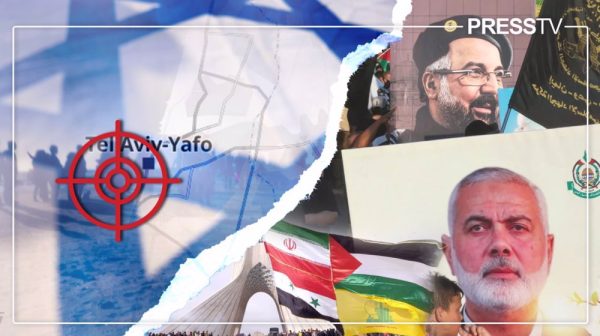
Explainer: What are the scenarios and potential targets of retaliatory strike on Tel Aviv?
By Ivan Kesic | Press TV | August 13, 2024
The stage is set for the retaliatory military operation against the Israeli regime in response to the cowardly assassinations of top-ranking Axis of Resistance commanders in Tehran and Beirut.
Although the nature of the retaliation and its precise timing remains shrouded in mystery, the embattled regime in Tel Aviv, already grappling with an internal political and social crisis, has been paralyzed with fear.
Illegal settlers have also been fleeing the occupied Palestinian territories in panic, anticipating a response that pales in comparison with Iran’s ‘Operation True Promise’ that followed an attack on Iran’s consulate building in the Syrian capital of Damascus in April.
There are scores of military sites in Tel Aviv that could be targeted to punish the Israeli regime for terrorist attacks that claimed the lives of Hamas political bureau leader Ismail Haniyeh and Hezbollah military commander Fuad Shukr.
Our analysis shows the most likely targets in Tel Aviv could be the centers affiliated with the Israeli spy agency Mossad, which had a key role in the assassinations of Haniyeh and Shukr.
This analysis is supported by the fact that the Ramon and Nevatim air bases of the Israeli regime were successfully targeted in the retaliatory military action in April since the warplanes that attacked the Iranian consulate in Damascus had taken off from them.
Taking that into consideration and the fact that simultaneous attacks in Tehran, Beirut and Iraq were carried out with the order and cooperation of the highest Israeli political, military and intelligence structures, their headquarters are primary targets.
The likelihood of these targets is further supported by a report by the Al-Hadath news channel, which revealed that employees of four intelligence and military agencies of the Israeli regime were evacuated on Thursday from their sites in Tel Aviv.
These headquarters are located in the densely populated metropolitan Tel Aviv, known as the Gush Dan, where half of the settler population of the Zionist entity lives, in contrast to the two aforementioned air bases in uninhabited desert areas.
Among them, an area of exceptional importance is Kirya, a district in central Tel Aviv, which is home to many administrative buildings and the military intelligence Camp Rabin that serves command, administrative, communications, and support functions for the Israeli military apparatus.
This camp has served as the headquarters of the armed forces of the Zionist entity since its establishment in 1948 and is encircled on all sides by densely populated civilian areas.
The main building in the camp is the Matcal Tower, which houses the offices of the top brass of the Israeli military, surrounded by other high-rise military facilities, such as the communications office Marganit Tower.
The Kirya district, known as the “Israeli Pentagon,” is much larger in scope than it looks on the map or is officially recognized, due to underground facilities and classified offices in nearby areas.
Beneath the military complex is the Bor (literally pit), the heavily fortified underground national military command center that is located a few blocks away from the former prime minister’s office, which has been moved now to occupied Jerusalem al-Quds.
The Bor is accessed through a large steel door that is sealed shut in the event of a non-conventional attack, and at the entrance, there is a big sign reminding visitors to remove the batteries from their cellphones before entering.
Long stairs lead deep into the operations rooms where regime officers prepare, organize and discuss future wars with their neighbors, Syria, Lebanon and Palestine, including the ongoing genocidal war against Gaza.
Even deeper, there is the chief of general staff’s conference room with a U-shaped table and a wall lined with plasma TV screens, where top officers meet almost weekly for highly classified discussions and a review of operational plans.
This facility is relatively well protected from attacks by short-range missiles, cruise missiles and kamikaze drones, but not from larger ballistic missiles with deep penetration power and a one-ton high-explosive warhead, so it is a high-value target.
Headquarters of intelligence services are classified, without official addresses, and most often masqueraded as civil function buildings.
In recent decades, the Israeli regime authorities have started selling land in Kirya, on which many “multipurpose” high-rises have been built, due to its attractive location in the center of the city.
This “multi-purpose” most often implies the regime and some other function, with the former containing multi-levels of the regime, military and intelligence offices.
The wider metropolitan area of Tel Aviv is also home to numerous factories, military bases and other regime buildings that can be the target of retaliatory strikes.
At least three large military facilities on the edges of the Tel Aviv metropolitan area are also possible targets, especially in case of new Israeli attacks and further escalation.
First among them is the operational headquarters of military intelligence unit 8200, located in the north near the city of ‘Herzliya’, where the collected information is processed and further forwarded to military strategists and other Israeli intelligence agencies.
Another site is Palmachim Airbase, located a few kilometers south of the metropolitan area, the main base for the Israeli regime’s drone, missile and space programs.
Finally, there is also a vast military zone around the Tel Nof and Sdot Micha air-missile bases, between Tel Aviv and occupied Jerusalem al-Quds, where numerous squadrons, special forces, missile silos and bunkers, arms warehouses, including nuclear warheads, are stationed.
Iran: E3 demands are public support for Israeli crimes
Al Mayadeen | August 13, 2024
Iranian Foreign Ministry spokesperson Nasser Kanaani responded to the E3’s (UK, France, Germany) statement on Tuesday, underscoring that Iran is “steadfast and resolute in exercising its right to protect its national security and territorial integrity” and “does not seek permission from any external party.”
In a press statement, Kanaani added that the European Troika’s demand for Iran not to respond to the “Israel’s” and punish it, “a crude demand that lacks any political logic and contradicts international laws and resolutions.”
He emphasized that the European trio’s statement reflects a public endorsement of the Zionist entity’s crimes and regional terrorism. He added that “if the European Trio genuinely seeks to promote peace in the region, it must, at the very least, condemn the Zionist entity’s actions and its genocidal activities in Gaza.”
Kanaani also pointed out that “the indifference of Western countries towards the crimes of the Israeli entity and its ongoing genocide of the defenseless Palestinian people, and the failure to hold it accountable, has encouraged it to escalate its atrocities.”
He explained that “Germany, France, and Britain have not taken any measures to halt the Zionist entity’s ongoing brutal crimes, and international organizations have similarly failed to deter these actions,” stressing that “both the West and the Security Council must take decisive responsibility to stop the severe Israeli atrocities in Gaza.”
On Monday, the leaders of France, Germany, and the United Kingdom issued a joint statement in which they called on Iran and its allies, likely the Ansar Allah movement in Yemen and the Hezbollah Resistance movement in Lebanon, to refrain from taking any actions that would “further escalate regional tensions and jeopardize the opportunity to agree on a ceasefire and the release of hostages.”
The statement held them responsible “for actions that jeopardize this opportunity for peace and stability” while disregarding the actions committed by “Israel”
Featured Video

The Empire Enters the Cocaine Trade
or go to
Aletho News Archives – Video-Images
Book Summary
The Whole Soy Story: The Dark Side of America’s Favorite Health Food

Lies Are Unbekoming | January 20, 2026
Soybeans generate approximately $80 million annually in mandatory producer assessments alone, funding a marketing apparatus that has transformed an industrial commodity into one of America’s most trusted “health foods.” The campaign succeeded. Soy milk lines supermarket shelves beside dairy. Soy protein fortifies everything from infant formula to energy bars. Vegetarians rely on tofu and tempeh as dietary staples. Doctors recommend soy to menopausal women. School lunch programs serve soy-based meat substitutes to children. An estimated 60 percent of processed foods contain soy derivatives. The premise underlying this proliferation—that Asians have thrived on soy for millennia and that modern science validates its health benefits—has been repeated so often it functions as established fact.
Kaayla T. Daniel’s The Whole Soy Story dismantles this premise through systematic examination of the scientific literature. The book documents that traditional Asian soy consumption averaged roughly one tablespoon daily, consumed as fermented condiments after processing methods that neutralized inherent toxins—a pattern bearing no resemblance to American consumption of industrially processed soy protein isolate, soy flour, and soy oil. Daniel catalogs the antinutrients that survive modern processing (protease inhibitors, phytates, lectins, saponins), the toxic compounds created by industrial methods (nitrosamines, lysinoalanine, hexane residues), and the heavy metals concentrated in soy products (manganese, aluminum, fluoride, cadmium). She traces the mechanisms by which soy isoflavones—plant estrogens present at pharmacologically significant levels—disrupt thyroid function, impair fertility, and interact with hormone-sensitive cancers. The evidence emerges from peer-reviewed journals, FDA documents, and industry sources themselves.
The stakes extend beyond individual dietary choices. Infants fed soy formula receive isoflavone doses equivalent to several birth control pills daily, with blood concentrations 13,000 to 22,000 times higher than their natural estrogen levels. Soy protein isolate—the ingredient in formula, protein bars, and thousands of products—has never received GRAS (Generally Recognized as Safe) status; its only pre-1960s use was as an industrial paper sealant. Two senior FDA scientists formally protested their own agency’s approval of soy health claims, citing evidence of thyroid damage and reproductive harm. The Honolulu Heart Program found that men consuming tofu twice weekly showed accelerated brain aging and increased dementia. These findings have not penetrated public awareness because the institutions responsible for consumer protection have been compromised by the industry they regulate. The Whole Soy Story presents the evidence that has been systematically excluded from mainstream health messaging, enabling readers to evaluate for themselves what the soy industry prefers they never learn. … continue
Blog Roll
Recent Comments
seversonebcfb985d9 on French court jails pro-Palesti… eddieb on Fourteen Incredible Facts Abou… Bill Francis on European leaders’ shift in the… seversonebcfb985d9 on Villains of Judea: Philip Esfo… loongtip on Report warns that ‘Jewish terr… Craig Nelms on New study shows that toxic gas… loongtip on A Funny Thing Happened on the… loongtip on EU free trade pact on hold as… John Edward Kendrick on Regime Change In Iran Is The F… Bill Francis on Australia Passes New Hate Spee… seversonebcfb985d9 on Australia Passes New Hate Spee… Bill Francis on Britain’s AI Policing Plan Tur…


 Aletho News
- Germany to build 10GW of baseload gas plants (disguised as “future” hydrogen plants)
- French court jails pro-Palestine activist and mother over Gaza genocide speech
- Shot, amputated, and imprisoned: Palestinian man seeks to rebuild life after being maimed and tortured by Israeli forces
- Building Disney Land on the Moon More Likely than Kushner’s Gaza Plan
- U.S. Funds Continue to Flow to Ecuadorian Groups Despite Trump-Era Suspension
- A pro-EU regime is moving to suppress this proud nation. Will they be able to withstand it?
- US-Russia Arms Control May Face ‘Very Dark Period’ – Scott Ritter
- Israel moves to restrict Palestinian re-entry to Gaza, ‘encourage outflow’: Report
- Trump aims to create new UN and own it, Brazil’s Lula warns
- UN rapporteur says Israeli demolition of UNRWA compound reflects broader attack on UN system
- If Americans Knew
- Israeli drone strike kills two children collecting firewood in Gaza – Not a ceasefire Day 107
- Another Gaza baby freezes to death on Netanyahu’s watch – Not a ceasefire Day 106
- Oppose Israel’s Abuses While You Still Can
- UNRWA Heads Tell Ha’aretz: ‘We Don’t Radicalize Palestinians – Their Lived Existence Does’
- Plans Call for “New Rafah” Built in Israel’s Image — Without Palestinians
- Posing as priest, reporter is spat at many times, highlighting anti-Christian sentiment in Israel
- Leaked Documents: “Planned Community” in Rafah Would Force Palestinians Into Israeli Panopticon
- ‘Permits of Humiliation’: How Israel Strangles Christian Education in Jerusalem
- “The world sees death, destruction and injustice – and they see dollar signs” – Not a ceasefire Day 105
- War criminal Netanyahu kills 11 in Gaza, joins Board of Peace – Not a ceasefire Day 104
- No Tricks Zone
- Germany’s Natural Gas Crisis Escalates … One Storage Site Near Empty …Government Silent
- Polar Colding…Antarctica Saw Its Coldest October In 44 Years!
- New Study: Sea Levels Rose 20 Times The Modern Rate During The Roman Warm Period
- As German Gas Storage Dips Dangerously Low…Shortage Hardly Avoidable
- New Study: Brazil’s Relative Sea Level Was 2+ Meters Higher And SSTs 3-4°C Warmer 6000 Years Ago
- Philosopher Schopenhauer: Climate Science Certainty Stems From Stupidity, Ignorance
- New Study: Species Extinction Rates Declining Since 1980 – ‘Climate Change Is Not An Important Threat’
- Denmark Places Climate Protection Above Animal Welfare, Poisoning And Culling Cows
- New Study: Greenland Was 3-7°C Warmer And Far Less Glaciated Than Today 6000-8000 Years Ago
- German Media Report That Current Frigid Weather Can Be Explained By Arctic Warming!
 Aletho News