Washington inching closer to a war with Iran
By Salman Rafi Sheikh – New Eastern Outlook – 08.02.2024
An Iran-US war would be an ideal scenario for Israel. On the one hand, Israel is systematically killing and driving the Palestinians out of their homes, which is allowing it to impose the so-called one-state solution. In this context, if the US plunges into a war with Iran and can inflict a lot of military and economic damage on Israel’s biggest enemy state in the region, that is the best possible scenario for Israel’s future standing in this region. On the one hand, US military engagement in the ongoing war will increase, and on the other hand, a US war on Iran might limit the extent to which Tehran can provide support to Hamas against Israel. This war is no longer a distant possibility, especially after the recent strike in Jordan that killed three US soldiers and wounded at least 34 others. Biden, who immediately accused the Iran-backed militia known as The Islamic Resistance based in Syria and Iraq, has vowed to retaliate. The target is Iran, even though Iran has officially denied supporting this group for striking the US. Nonetheless, US counterstrikes are going to happen, especially because Washington is already striking the Houthis in Yemen to control the Red Sea.
With these upcoming strikes, the US will be involved in at least three fronts, i.e., against Hamas, against the Houthis, and the Islamic Resistance. (This is in addition to the US involvement in Ukraine against Russia.) With deepening US involvement in the Middle East and against Iran, Washington is directly stepping into a sort of quagmire that it took 20 years to get out of in Afghanistan.
A war in the Middle East will not be too much different from the US wars in Iraq and Afghanistan, although a direct war with Iran would also mean going against a force that is much more organized, better equipped, and bigger than Saddam Hussain’s Iraqi army or the Taliban in Afghanistan. There are more than 45,000 US troops on the ground throughout the Middle East. There are another 15,000 personnel on board two aircraft carrier groups. If the US starts a war, Iran does have the capability to hit these targets, or the so-called Iran-backed groups can do the same.
The recent attack in Jordan has after all shown that the US air defense is far from impenetrable. This war, in this sense, could inflict a lot more damage to the US military forces than did the Iraq and Afghanistan wars. Still, many people in the US want Washington to tackle not just the so-called Iran-backed militias, but Iran itself. A report in the NATO-backed Atlantic Council says,
“In recent weeks, Iran has waged a shadow war against the United States and its interests in the Middle East, and now three US service personnel are dead and dozens more injured … Washington could sink the Iranian navy, like then-President Ronald Reagan did in the 1980s. It could strike Iranian naval bases. It could target the Iranian leadership, following in the footsteps of then President Donald Trump’s killing of Iranian General Qassem Soleimani. It could seize this opportunity to degrade Iran’s nuclear and missile program—which must be addressed soon regardless”.
Wesley Clark, a retired general who was once NATO’s supreme commander in Europe, wrote on X that “The US should stop saying, ‘We don’t want to escalate.’ This invites them to attack us. Stop calling our strikes ‘retaliation’. This is reactive. Take out their capabilities and strike hard at the source: Iran.” From within the US political class, Senator Tom Cotton (Republican), known for his staunch criticism of the Biden administration’s Iran policy, insisted that the deaths of the three US troops warranted a “devastating military retaliation against Iran’s terrorist forces, both in Iran and across the Middle East”.
With the Biden administration also fanning such ideas out, it means that targeting Iran will become an issue that may have bi-partisan support in the US. Within the US political system, if an issue has bi-partisan support, it tends to minimize the political risk for the given President. In other words, if the Republicans want Biden to retaliate against Iran, it means that they will not be able to criticize him for starting another war. It was the Trump administration that targeted Iran much more directly when it killed Sulemani in Iraq than the Biden administration has done in the past three years.
This is on top of the fact that a growing political opinion in the US points to the inability, or unwillingness, of Washington to hit Iran directly, i.e., inside Iran. This, some hawks have argued, encourages Iran to adopt an aggressive policy vis-à-vis the US, although it does not explain at all why Iran, a much smaller political and economic power than the US, would create such situations that might throw its country into a long turmoil.
Although the Biden administration is more likely to hit the so-called Iran-backed groups in the first round of counterstrikes, there is little gainsaying that this will add to the difficulty of managing the Middle East in a way that minimizes the possibility of war. It will only make a direct war much more possible.
The only geopolitical deterrent the US might consider seriously is whether or not it will have the support of the Middle Eastern states themselves against Iran, for a wider war in the region would jeopardize these states too in the sense that it will cause the conflict to spread and major middle eastern states, such as Saudi Arabia, are in the middle of massive modernization projects. A wider war in the region would disrupt this process, which is why they are more likely to oppose a US bid to wage a direct war. At the same time, given Israel’s position, it is likely to continue to push for, or create conditions, for a war against Iran to accomplish its key objectives, i.e., developing a Greater Israel and eliminating the main regional opposition to it.
Salman Rafi Sheikh is a research-analyst of International Relations and Pakistan’s foreign and domestic affairs.
Col. Douglas MacGregor on Iran
IfAmericansKnew | February 5, 2024
Colonel Douglas MacGregor is a 28-year veteran of the US Army who previously served as Senior Advisor to the US Secretary of Defense. During this interview with Redacted’s Clayton Morris, he explains that Iran did not perpetrate the recent attack that killed three American servicemen and he describes the long effort to get the US to attack Iran on behalf of Israel. Colonel McGregor explains that such an attack would be disastrous on every level.
This excerpt is from a longer, excellent interview that can be viewed at https://www.youtube.com/watch?v=le-Ktsau_iM (If Americans knew added the image of the New York Times advertisement and the photos of Gaza.)
Israel and Israel partisans embedded in the US government previously pushed the US into the disastrous Iraq War. See https://israelpalestinenews.org/israel-loyalists-embedded-in-u-s-government-pushed-us-into-iraq-war/ and https://israelpalestinenews.org/pentagon-officer-described-how-israelists-manufactured-anti-iraq-disinfo-that-led-to-war/ and https://www.youtube.com/watch?v=WjzD5zTLepc
This is not the first time the US has been used to deliver oil to Israel. See the account by Gary Vogler, a former US Army officer who served as a senior oil consultant for US Forces in Iraq. See https://israelpalestinenews.org/oil-for-israel-the-truth-about-the-iraq-war-15-years-later/ and https://www.youtube.com/watch?v=zK-LFOpVowg
For more information on israel-Palestine go to https://ifamericansknew.org/
US Not Prepared for War Against Iran and ‘Axis of Resistance’
By Ekaterina Blinova – Sputnik – 02.02.2024
Attacking Iran would be a catastrophic mistake for Washington, as the US is too internally weak to wage a new major in the Middle East, University of Tehran professor Seyed Mohammad Marandi told Sputnik’s New Rules podcast.
US officials have reportedly signaled that plans have been approved for a series of strikes against targets in Iraq and Syria.
That would be in response to a recent drone attack on US personnel in the Middle East — which claimed the lives of three soldiers and left 34 wounded.
In the wake of the strike Bloomberg claimed the Biden administration was considering a covert strike on Iran or Iranian officials as possible options.
But University of Tehran Professor Seyed Mohammad Marandi told Sputnik that directly targeting Iran would be a major mistake and a major miscalculation by Washington.
He suggested that scenario was very unlikely, given Iran’s missile defense and drone capabilities, as well as the vulnerability of US bases which are scattered across the Middle Eastern region.
“Let’s assume that the United States strikes Iran,” Marandi said. “The United States has bases all across the Persian Gulf. The Iranians will hit out at those bases, and then the Iranians will also punish those countries that host those bases.”
Message for Joe Biden: Don’t Mess with Iran
The professor warned the fallout from the tit-for-tat attacks would send oil and gas prices “through the roof.”
“The Red sea would no longer be safe for oil and gas. The Western economies would collapse if there was a major escalation in our region,” Marandi underlined. “The United States, its assets across Iraq would be crushed. It would be overrun and by extension Syria as well and Lebanon. The world has changed. This is not just Iran, by the way. This is the whole of West Asia.”
Given the latest US media reports, it appears far more plausible that the US would attack targets in Iraq and Syria, Marandi continued.
“[The US] will claim some sort of ‘victory over terrorists’ and that sort of nonsense which they usually say,” the professor said. “But it will be like in Yemen, they will have very little impact because the resistance to the US occupation, the illegal occupation in Iraq and Syria is very well hidden. Their assets are underground, they are spread out. And all the United States would do would be to make people angrier and make the resistance more popular, both at home and abroad. That’s exactly what we saw in Yemen.”
Marandi noted that most recently instead of pushing the Israeli regime to end the slaughter in the Palestinian Gaza Strip, the US tried to facilitate the genocide by attacking Yemen. Since early January the US and its allies conducted a series of strikes against the Ansar Allah-led government in the Yemeni capital Sana’a, also known as the Houthis after their leader.
“They launched many missiles, wasted a lot of money, but they were incapable of changing the balance of power. And Yemen continues to easily strike ships. Why?” the professor asked. “Because all of their assets are underground. Their mobile radar is well-protected underground. They are missiles and drones are well protected underground. They come out, strike the target and go back underground. So the Americans failed in Yemen. They made ‘Ansar Allah,’ or what the West likes to call the Houthis, very popular across the region and across the world, and they’ll only do the same in Iraq and Syria.”
In the aftermath of the strikes the Biden administrations came under criticism from both Republicans and Democrats. A bipartisan group of House representatives, comprising such strange bedfellows as Republican Georgia Congresswoman Marjorie Taylor Green and New York Democrat Alexandria Ocasio-Cortez, argued that the US’ “unauthorized strikes in Yemen” violate the Constitution and US statute.
They called on Biden “to seek authorization from Congress before involving the US in another conflict in the Middle East,” and warned the White House against provoking Iran and Iran-backed militia in the region which could swiftly spiral out of control and lead to a broader regional conflict.
US legislators’ concerns are justified as the US cannot afford to wage wars on multiple fronts, the academic pointed out.
“The United States cannot win another war,” said Marandi. “I have no doubt that if the Republicans were in charge, they would be… Whoever is in the white House, the people around him would be saying these things in private, and the Democrats in public would be denouncing the president for holding back. But the truth is that the United States is not the United States of the past. They can launch an attack on Iran. But the price would be extremely high and the United States wouldn’t win.”
Marandi questioned when the US had last won an overseas war.
“As the United States ‘won’ in Iraq as it won in Afghanistan. Did it win in Libya? Did it win in the genocide that it supported in Yemen? Did it win in Ukraine? The United States has a very poor record when it comes to launching wars and destroying nations and countries,” the acdemic said.
“They are capable of ruining lives and murdering millions and they don’t care. We see that in Gaza every day, but they simply don’t have the power to win. And Iran is not Iraq. Iran is not Libya. Iran is not Yemen. Iran is not Vietnam,” Marandi stressed. “Attacking Iran would be a catastrophic mistake for the United States, and something that I don’t think those decision makers in Washington would ever seriously contemplate.”
“The Americans may be foolish enough to do so, but if they do so, then I think you’ll see the demise of the American empire take place much more rapidly than we’re seeing right now,” he concluded.
Direct US Attack on Iran Would Open Pandora’s Box – Mideast Experts
By Ekaterina Blinova – Sputnik – 29.01.2024
Having groundlessly accused Tehran of masterminding a recent deadly drone bombing on US personnel, President Joe Biden and his team are allegedly considering a covert strike on Iran or targeting Iranian officials, as per Bloomberg. How could the purported plan pan out for Washington?
Three US soldiers were killed and 34 wounded in a drone attack over the weekend that is ramping up the pressure on Joe Biden ahead of the 2024 elections, according to the US press. The Biden administration rushed to pin the blame on Iran, presenting no evidence to back up its claims.
Even though Tehran made it clear that it had nothing to do with the attack, Washington is reportedly planning to either conduct a covert strike on Iran and later deny it, or resort to extraterritorial assassinations of Iranian officials, as then-President Donald Trump did by ordering the killing of General Qassem Soleimani in Baghdad in 2020.
“A direct attack on Iran will open Pandora’s Box,” Professor Hossein Askari, political analyst and emeritus professor of business and international affairs at George Washington University, told Sputnik.
“If the attack was from an Iraqi militia that Iran supports, then a US attack on the militia will affect relations with Iraq, which has already objected to other US responses to the militias and is engaged in talks for the US to exit Iraq. It is an election year in the US and there is a great deal of pressure on Biden to be ‘tough’ on Iran.”
Per Askari, Biden has found himself between a rock and a hard place: no matter what he does, he is likely to come under fierce criticism for either being too weak or escalating the conflict.
“An attack inside Iran would undoubtedly widen the war with the end game becoming even murkier and [an attack] inside Iraq would further damage US-Iraq relations,” the professor stressed.
He believes that Biden will strike nonetheless and that the strike will pour more gasoline on the fire as Tehran is “still looking for revenge for the assassination of General Soleimani and the Iraqi militia leader, Abu Mahdi al-Muhandis.”
When asked what forces could be potentially involved in any “covert strike”, the expert assumed that only cruise missiles and no planes or Special Forces are likely to be used. He added that no regional player would join the purported US action except, possibly, Israel. “But if the US allows Israel to join in, then this would become a much wider war with religious overtones,” Askari warned.
Even though neither the US nor Iran have an interest in a wider regional war, “there is a tug of war between the two countries to sway influence over the wider Middle East, and particularly the Arab Gulf States,” echoed Dr. Imad Salamey, associate professor of political science and international affairs at the Lebanese American University.
“I believe the US will take on limited retaliatory attacks against [Islamic] Revolutionary Guards targets in Iran or Iraq without engaging in a wide-scale war,” Salamey told Sputnik.
“It remains too early in this conflict for the US to target strategic positions such as nuclear facilities. I do not think the allies will join the US in the standoff against Iran, as none have a reason to join rank. Only in the case that Iran decided to close down the Strait of Hormuz that other states would join the US war efforts. I believe the US is now after attacking Iranian Revolutionary Guards and no longer as interested in proxies.”
Iraqi resistance is quietly but effectively hitting the Israeli regime where it hurts
By Wesam Bahrani | Press TV | January 2024
The Islamic Resistance in Iraq announced a drone attack on Sunday deep inside the Israeli-occupied Palestinian territories, marking another significant development amid the Israeli genocide in Gaza.
What makes it a major development is the location of the target. The Israeli Zevulun naval facility near Haifa Port was struck as part of a “new phase” of operations against the illegal Israeli occupation of Palestine as well as the illegal American occupation of Iraq and Syria.
A pattern is emerging of the Iraqi resistance attacking Zionist targets in the Mediterranean while the Yemeni military continues its operations against Zionist and US targets in the Red and Arabian seas.
In a statement on Sunday, the Iraqi resistance said it struck “four enemy targets”, which included three illegal American bases in Syria and “the Israeli Zevulun naval facility”.
In a sign of how quickly these operations are occurring, by Sunday afternoon the Iraqi resistance published another statement announcing an attack on another illegal US base in Erbil, northern Iraq.
The attack by the Islamic Resistance in Iraq near Haifa followed a successful operation against the Israeli port of Ashdod just two days before that, which followed two other operations against Haifa itself as well as drone attacks on the Israeli Karish gas rig.
All these military operations against the Zionist entity have one thing in common: strategically all these targets sit on the Mediterranean Sea.
Last month, the Iraqi resistance pledged a new phase in its operations against the Zionist entity and its American patrons, declaring that “more is to come” and in “solidarity with “our people in Gaza”.
The commander of Kataib Sayyed al-Shuhada, Abu Ala’a al-Walai, one of the senior officials in the Hashd al-Sha’abi (Popular Mobilization Units), recently spoke about the beginning of a new phase and said “This stage includes preventing Zionist shipping in the Mediterranean Sea and disabling the ports of the Zionist regime”.
In response to the now almost daily attacks on the illegal US bases in Iraq and Syria by the Iraqi resistance as well as targeting vital Israeli targets, America’s military response has seen deadly airstrikes on buildings belonging to Harakat al-Nujaba and Kataib Hezbollah.
These are the two prominent anti-terror groups belonging to the Hashd al-Sha’abi, which is an integral part of the Iraqi National Armed Forces.
The Commander of the Hashd al-Sha’abi for the Central Euphrates Operations in Iraq, Major General Ali al-Hamdani on Sunday declared that “The Americans only understand the language of the force and will not leave Iraq through dialogue”.
As Washington continues to violate Iraqi sovereignty by attacking and killing members of its armed forces and continues to violate Yemeni sovereignty by attacking Yemeni military positions (as the US claims) or redecorating the sand in the desert, one thing is clear: both parties targeted are undeterred.
American and British warships are trying their best to prevent Ansarullah from attacking Israeli vessels or ships heading to the occupied Palestinian territories, but it is simply not working.
The Islamic Resistance in Iraq is now seeking to target the other side of the Israeli occupation’s waters in the Mediterranean, which explains the strikes on Haifa, Ashdod and the Israeli regime’s natural reserves in the Mediterranean Sea.
Ansarullah-led Yemeni military and Iraq’s Hashd al-Sha’abi are with surgical precision targeting the Zionist entity’s naval and maritime interests, which the Israeli regime depends on for a significant amount of its trade.
Haifa Port itself (on the Mediterranean) is believed to handle up to 90 percent of vital commodities entering the occupied Palestinian territories.
These operations are causing notable damage to the Israeli economy amid a sizeable drop in shipping activity in the regime’s ports with Israeli officials speaking about workers being furloughed.
The threat posed to the regime’s economy, at the moment, is bigger in the port of Eilat (on the Red Sea), which has been targeted on various occasions by the Yemeni military in recent weeks, who have also imposed an embargo on ships docking at the Israeli occupied Palestinian ports.
As much as the US and its now “poodle” vassal, Britain, insist that the resistance operations from Yemen and Iraq have nothing to do with the Israeli genocidal war on Gaza, the writing is on the wall.
Every statement put out by the Islamic Resistance in Iraq or the Yemeni armed forces mentions “our brothers in Gaza” and “our occupied land in Palestine”.
These resistance operations in solidarity with the oppressed people of Gaza, targeting the infrastructure of the illegitimate Zionist entity and American military assets in the region will continue unless three conditions are met.
An unconditional ceasefire in Gaza, humanitarian aid entering the besieged territory and the withdrawal of the Israeli military from the blockaded strip where the death toll now tops 26,500.
There is no coordination between the Yemeni military (Ansarullah) and the Hashd al-Sha’abi, this is simply strategic thinking by both sides, something Washington and Tel Aviv are lacking.
On October 8, when the Palestinian resistance launched an unprecedented operation, the United States lacked a coherent strategy for West Asia, choosing to focus on Russia and China instead.
More than 115 days later, as the ripple effects of the faith, determination, and power of the Axis of Resistance is slowly being digested in the White House, Washington’s strategy remains incoherent.
It has and can only resort to “precision strikes” as putting boots on the ground in Yemen or allowing those boots to leave their bases in Iraq will rubber stamp the end of Biden’s presidency.
It would be like Vietnam and Afghanistan put together but on steroids.
The attacks by the Islamic Resistance in Iraq against the Israeli occupation and the American occupation will not only persist but expand as the genocidal war on Gaza rages on.
The Zionists will feel this in their ports, vital naval sites and trade in the Mediterranean for as long as their indiscriminate attacks against the women and children of Gaza continue.
Does Hamas need help in defending Gaza?
The Palestinian resistance doesn’t have the air defense systems to protect Palestinian women and children from Israeli attacks. But still, Hamas and other Palestinian resistance groups have been inflicting heavy losses on the regime’s military on ground zero.
Up to 80 percent of Hamas tunnels in Gaza are still intact despite months of Israeli attacks aimed at destroying them, according to a report by The Wall Street Journal, citing Israeli officials.
All that the Zionist regime has done is kill civilians and allow 2.3 million people to starve while the West, with the US in particular, has looked the other way.
That has prompted the resistance groups in the region to step up and help the oppressed Palestinians.
For Iraq’s Hashd al-Sha’abi, Yemen’s Ansarullah, Lebanon’s Hezbollah or the Islamic Republic of Iran, support for Gaza and the people of Gaza is not a matter of public relations or goodwill. They consider it a moral and religious duty.
Wesam Bahrani is an Iraqi journalist and commentator.
US Vows Response to Deadly Attack on Mideast Base, Seeks to Avoid Wider Conflict
Sputnik – 29.01.2024
WASHINGTON – The United States will retaliate to a deadly drone attack on its al-Tanf military base on Syrian-Jordanian border at a time and in a manner of its choosing, but it is not seeking a wider conflict in the region, National Security Council spokesperson John Kirby said on Monday.
Earlier in the day, Axios reported that President Joe Biden discussed a “significant military response” to the attack during a meeting with top US officials on Sunday.
“As for our response options, the President is working his way through that right now. He had a good meeting yesterday with the National Security Team,” Kirby told CNN.
According to Axios, the White House and Pentagon are seeking to calibrate their retaliation to contain the risk of a wider conflict. Meanwhile, some hawks on Capitol Hill are pushing for strikes inside Iran, the report said.
“We will respond. We will do it in a time and a manner of our choosing. We’ll respond, you know, in a very consequential way but we don’t seek a war with Iran. We are not looking for a wider conflict in the Middle East,” Kirby said, when asked if the US is considering strikes inside Iran.
On Sunday, three US soldiers had been killed and 34 others injured in a drone attack on a US military base in Jordan’s northeast near the border with Syria.
President Biden pinned the blame on unspecified Iran-backed militant groups, while also saying the US was still gathering the facts. Jordanian cabinet spokesman Muhannad Mubaidin said that the strike targeted the US’s Al-Tanf base in Syria, not a base on Jordanian territory.
Iran has nothing to do with the drone attack on a US military base, Iranian state-run news agency IRNA reported, citing an Iranian official.
From stones to missiles, Palestinian resistance’s phenomenal military rise
By Ivan Kesic | Press TV | January 24, 2024
The Al-Aqsa Storm Operation has irreversibly redefined the battlefield dynamics, especially with the Palestinian resistance stunning the military pundits in the West with its preparedness and the ability to inflict heavy and irreparable blows on the occupying regime.
The past fifteen weeks have been marked by the Palestinian resistance against the Israeli genocidal aggression on the Gaza Strip, with the armed wing of the Palestinian resistance group Hamas surprising all and sundry with its massive weapons arsenal, all of them locally manufactured.
Toward the end of 2023, the Martyr Izz ad-Din al-Qassam Brigades, the military wing of Hamas, published a video, showing its missile arsenal that is able to reach every nook and corner of the occupied territories.
Even today, more than three months after the regime launched its aggression followed by extensive operations by the resistance groups against the occupation forces, this arsenal remains intact.
Military experts in the West acknowledge that the Israeli regime, with all its advanced and sophisticated weapons systems imported from the United States and Europe, has been unable to match up to the armed wings of the Palestinian resistance groups and their fighters.
Despite the Israeli regime dropping 67,000 tons of bombs on Gaza since October 7, the resistance continues to grow and inflict heavy blows on the structure of the Zionist occupation.
The story of the Palestinian missile program is a story of decades of sacrifice, ingenuity, dedicated work and successful management, and above all, the defiant spirit of resistance.
This long and difficult path of resistance against the apartheid regime began with Palestinian stone-throwing at Israeli armored vehicles during two intifadas, and ended with the capability to launch 5,000 rockets in one day and a rocket arsenal sufficient for months of warfare.
The missile capabilities and scope of operations displayed by the Hamas and other Palestinian groups surprised all international observers, even the Israeli intelligence services.
What is particularly intriguing are the conditions in which the operation was carried out.
Pertinently, the Gaza Strip was under Israeli occupation from 1967 to 2005, and ever since has been under a fierce land, sea and air blockade that prevents the import of not only weapons but also materials for their production, as well as basic goods.
The Israeli regime tried everything to weaken the resistance and retain the military technological advantage so that it could easily eliminate the groups that have been fighting for the liberation of Palestine.
An example that illustrates this disparity is the Gaza Massacre of 15 years ago when hundreds of Palestinian civilians were killed by Israeli bombs, hundreds of Israeli civilians, the so-called “war tourists”, gathered on the nearby hills and cheered triumphantly.
However, times have changed since that gruesome bloodthirsty cheering by the Zionist settlers that was followed by the iconic photo of a Palestinian boy throwing a rock at an Israeli tank.
The Palestinian resistance initially relied on rudimentary weapons, smuggled or domestically produced, intended for close combat and countering invading forces on their own soil.
After years of usage of assault rifles and explosives, a simple Qassam rocket appeared in 2001, with a range of a handful of kilometers and low destructive power, which for the first time made possible a retaliatory strike against the Israeli occupation.
Over time, the efficiency of the Qassam models increased and the first Israeli military bases and occupied cities came within range in the 2010s, which caused the phenomenon of “war tourists” on the borders of Gaza to fall into oblivion suddenly.
The Israeli regime made an effort to stop the effectiveness of these rocket attacks by developing a warning system. It invested a staggering amount of money in the development of Iron Dome, a military system that turned out to be a miserable failure on October 7.
It also boasted about assassinating the Hamas rocket engineers responsible for the Qassam development, thinking it might cripple the Palestinian “brain trust” or deter new generations from engaging in development, which proved to be a blowback assessment.
Today, the Palestinian resistance has rockets with a range of hundreds of kilometers and warheads with a payload of hundreds of kilograms, capable of reaching any point in the occupied Palestinian territories.
Due to their size, it is not possible to smuggle these rockets from abroad into the Gaza Strip, especially not in such huge quantities, which proves that they are the result of local production.
Industrial production, in conditions of scarcity of necessary materials and exposure to Israeli airstrikes, is an impressive feat in itself. Production facilities are scattered underground and well hidden, which requires exceptional logistical skills.
The same applies to the supply of materials, which mainly comes from recycling raw materials such as old water pipes, anchors of destroyed buildings, streetlight poles and so on.
In an astonishing feat from 2020, Hamas naval commandos managed to salvage large 170-kilogram naval shells from a British warship that sunk offshore more than 100 years ago during the First World War and made them reusable for new missiles.
The rocket engines and guidance systems are the product of cooperation and military knowledge imparted by experts in the region, especially Iran.
The missiles revealed in the new video include the Maqadma and Jabari rocket family, both with a range of 90 km and 50 kg warheads, put into service in the early 2010s.
Development in the middle of the same decade witnessed the creation of the Attar rocket family with a range of 90 km and 50 kg warhead, as well as of the Rantisi rocket family with a range of 170 km and 100 kg warhead.
Finally, at the end of 2010s, the Ayyash rocket family was put into service, with a range of 250 km and a payload of 250 kg, the most powerful rocket in the Palestinian arsenal, used for strikes on Safed and Eilat during the Al-Aqsa Flood operation.
At the same time, the Sijjil rocket family with a range of 55 km and 50 kg warhead was also introduced, followed by the Shamala rocket family with a range of 80 km and 150 kg warhead.
Except for the Sijjil rocket series, which is named after a Quranic verse, all others are named after Palestinian martyrs, namely Ibrahim al-Maqadma, Ahmed al-Jabari, Raed al-Attar, Abdel Aziz al-Rantisi, Mohammed Abu Shamala and Yahya Ayyash.
For three decades, the Israeli regime thought that these assassinations would break the spirit of resistance and their technological development, which backfired in a way it could not have imagined.
The martyrs and the missiles named after them are today giving sleepless nights to the regime leaders.
The U.S. Steals Syrian Oil, and the Kurds Sell It to Israel at a Discount in Erbil
By Steven Sahiounie | Strategic Culture Foundation | January 22, 2024
Iran’s Revolutionary Guard (IRG) claimed responsibility for missile attacks on an Israeli “spy headquarters.” Kurdish businessman Peshraw Dizayee and four of his family members were killed in the attack on their home on January 16 near the U.S. Consulate in Erbil, in the Iraqi Kurdistan Region (IKR).
Dizayee was the owner of the Falcon Group, which is a business involved in oil and gas, agriculture and security. The IRG claimed its missiles targeted a “Mossad headquarters”.
“No U.S. facilities were impacted. We’re not tracking damage to infrastructure or injuries at this time,” a U.S. official said in response to the recent attack.
Prime Minister of the IKR, Masrour Barzani, condemned the IRG attacks on Erbil.
The Oil business in Erbil
The oil business is thriving in IKR, and the Falcon Group was part of it. Kurdish oil has been exported to Israel, Italy, France and Greece through a secretive trade depending on pre-pay deals.
Israel buys much of its oil from Erbil, and Israel depends on the heavily discounted crude, making it a key customer. The oil is discounted to Israel because it is free, as the source is the stolen Syrian oil. 40% of Israel’s oil supplies were from IKR in the first three months of 2023, which doubled the amount in 2022.
Israel received its first substantial seaborne crude oil shipment from the IKR in 2014, which is the same time the U.S. occupation forces arrived in Syria. Israel was reportedly importing as much as three-quarters of its crude oil needs from the IKR by mid-2015.
Israeli refineries and oil companies imported almost $1 billion worth of Kurdish oil between May and August of 2023, according to shipping data, trading sources and satellite tanker tracking, which represents about 77 % of average Israeli demand, which runs at roughly 240,000 barrels per day. More than a third of all of the northern Iraqi exports, which are shipped from Turkey’s Mediterranean port of Ceyhan, went to Israel over the period.
According to anonymous sources, it was a Mossad agent who first traveled to Erbil to negotiate the deal to buy oil from IKR, which was facilitated by U.S. officials.
The U.S. Consulate in Erbil
The new U.S. Consulate General building in Erbil, near the attack carried out by Iran, is the biggest consulate complex built by the U.S. Embassies and Consulates are under the U.S. State Department, but the consulate in Erbil has a connection to the U.S. Department of Defense, demonstrating the strategic importance of the region for Washington, with a U.S. military base also in IKR.
Irvin Hicks, Jr., the U.S. Consul General in Erbil, stated in January 2023, that the new 800-million-dollar consulate building is a clear statement that the “United States of America is not going anywhere.”
The U.S. first opened a diplomatic office in Erbil in February 2007, and later upgraded to a consulate general in 2011, the same year the U.S.-NATO attack on Syria began for regime change, under the Obama-Biden administration.
The U.S. embassy in Baghdad was built in 2009 and is its biggest mission compound in the world at a cost of $750 million. Iraqi Kurdistan and the Iraqi central government in Baghdad operate separately, as the Kurds are a semi-autonomous region.
Erbil has 30 consulates, six honorary consulates, and six foreign trade offices, with the Japanese consulate the latest to open on Jan. 11.
“Opening more than 30 consulates is not normal,” Iranian Brigadier General Mohammad Hossein Rajabi criticized. Most of these consulates are used for espionage activities.”
Iran views the foreign offices as having the potential to carry out plans aimed at destabilizing the security of Iran, by hosting Iranian separatist groups and bases aligned with Israeli intelligence agency Mossad.
The Iraqi response to the Genocide in Gaza
“On October 20, 2023, the Department ordered the departure of eligible family members and non-emergency U.S. government personnel from U.S. Embassy Baghdad and U.S. Consulate General Erbil due to increased security threats against U.S. government personnel and interests,” according to the State Department’s Iraq travel advisory.
Iraqis have taken to the streets to protest the U.S. complicity in the genocide being committed in Gaza by Israel. U.S. President Joe Biden has defied the American values of human rights and international law by continuing to send weapons to Israel to promote the wholesale slaughter of the Palestinian civilians of Gaza, even in the face of international criticism which has lowered the image of America as a beacon of freedom to a joke.
Protests have taken place outside of the U.S. Embassy in Baghdad, and military groups which are under the central government of Iraq have fired rockets and armed drones at U.S. troops based in Anbar and near Erbil multiple times. Baghdad does not recognize Israel; however, the IKR are aligned with the U.S., and sell the stolen oil from Syria to the prime U.S. ally, Israel.
The U.S. invaded and destroyed Iraq in 2003, and occupied the country for years until a withdrawal. When ISIS reared its ugly head, the Baghdad government requested U.S. troops to come to help in the fight against ISIS, which saw its defeat at the hands of Iraq, Syria, Russia, and the U.S. The Iraqi parliament ordered the U.S. troops to leave after the defeat of ISIS in 2017, but the Department of Defense refused. The Prime Minister of Iraq has recently ordered the U.S. troops to leave immediately following the U.S. assassination of Mushtaq Jawad Kazim al-Jawari in Baghdad on January 4, an Iraqi military commander who was instrumental in the defeat of ISIS.
The PKK in Syria and Erbil
The PKK aligned SDF in north east Syria is U.S. supported. The U.S. military in Syria are occupying the largest oil field in Syria, which prevents the Damascus government from using the oil to provide electricity to the Syrian people, who suffer with just 3 hours of electricity per day.
In December 2023, 44-tanker convoy carrying oil stolen from Syria traveled clandestinely to U.S. bases near Erbil. Just days before, U.S. forces took 95 tankers of oil and a truckload of stolen Syrian wheat to IKR. The Syrian wheat fields are also in the area the U.S. troops occupy and the area is controlled by Kurds who are aligned with the IKR.
Farhan Jamil Abdullah, head of the Syrian Oil Company, said in July that as a result of the U.S. sanctions and military occupation in Syria, oil production has decreased to 15,000 barrels per day from 385,000 barrels before 2011.
Firas Hassan Kaddour, the Syrian Oil Minister, said in July that the losses of the energy sector in Syria are close to 100 billion U.S. dollars.
The main oil field of Al Omar and Conoco in Syria are producing oil which is shipped in tankers by the U.S. Army and refined at Kar Oil Refinery in Erbil.
The U.S. sponsors the SDF militia in Syria which is dominated by the YPG. The YPG is the Syrian branch of the PKK, a group recognized by Turkey, as well as the U.S. and the EU, as a terrorist organization, who have killed more than 40,000 persons over decades.
Turkey has condemned the U.S. alliance with the SDF and YPG, and considers the U.S. is financing terrorism.
The commander of the SDF is General Mazloum Kobani, who is also a member of the PKK. His real name is Ferhat Abdi Sahin, is one of Turkey’s most wanted terrorists. Kobani was chosen by the U.S. as their military ally and it is at Kobani’s command that the stolen Syrian oil is loaded into tankers.
Erdogan has demanded for years that the U.S. must stop supporting the SDF, YPG, and to stop encouraging the Kurds to establish an independent homeland in north east Syria on the border with Turkey, which is a NATO member, and ally of the U.S., housing an American military base there.
IRGC officials killed in Israeli attack on Damascus
The Cradle | January 20, 2024
An Israeli airstrike on the Syrian capital Damascus killed four members of Iran’s Islamic Revolutionary Guard Corps (IRGC) during the early hours of 20 January.
“An Israeli aggression today targeted a residential building in the Mezzeh neighborhood of Damascus,” SANA reports.
According to Al-Mayadeen, the building targeted consisted of three stories and is affiliated with Iran’s Islamic Revolutionary Guard Corps (IRGC).
“Once again, the evil and criminal Zionist regime invaded the city of Damascus, the capital of Syria,” The IRGC statement following today’s attack read. “During the air attack […] several Syrian forces and four military advisers of the Islamic Republic of Iran were martyred.”
Two high-ranking members of the IRGC were among those killed: Commander Haj Sadegh Omidzadeh, deputy intelligence officer of the IRGC Quds Force, and his deputy, Haj Gholam.
This attack comes days after Iran targeted a Mossad-affiliated base in Iraq’s Kurdistan Region (IKR) in retaliation for an earlier assassination of an IRGC commander in Syria.
On 16 January, Iranian missiles leveled an alleged Mossad base in IKR’s capital, Erbil, that was reportedly involved in coordinating the recent assassinations of several commanders of the IRGC and the Resistance Axis.
The IRGC noted that this base was used “to develop espionage operations and plan acts of terrorism” across the region, specifically in Iran.
The Iranian operation in IKR killed Kurdish oil tycoon Peshraw Dizayee, owner of the Empire and Falcon Group, who have reportedly facilitated oil exports to Israel.
Iraq condemned the IRGC operation, saying it is “an aggression against the sovereignty of Iraq and the security of the Iraqi people, and an insult to good neighborliness and the security of the region.”
An Epoch of Great Changes Is upon Us
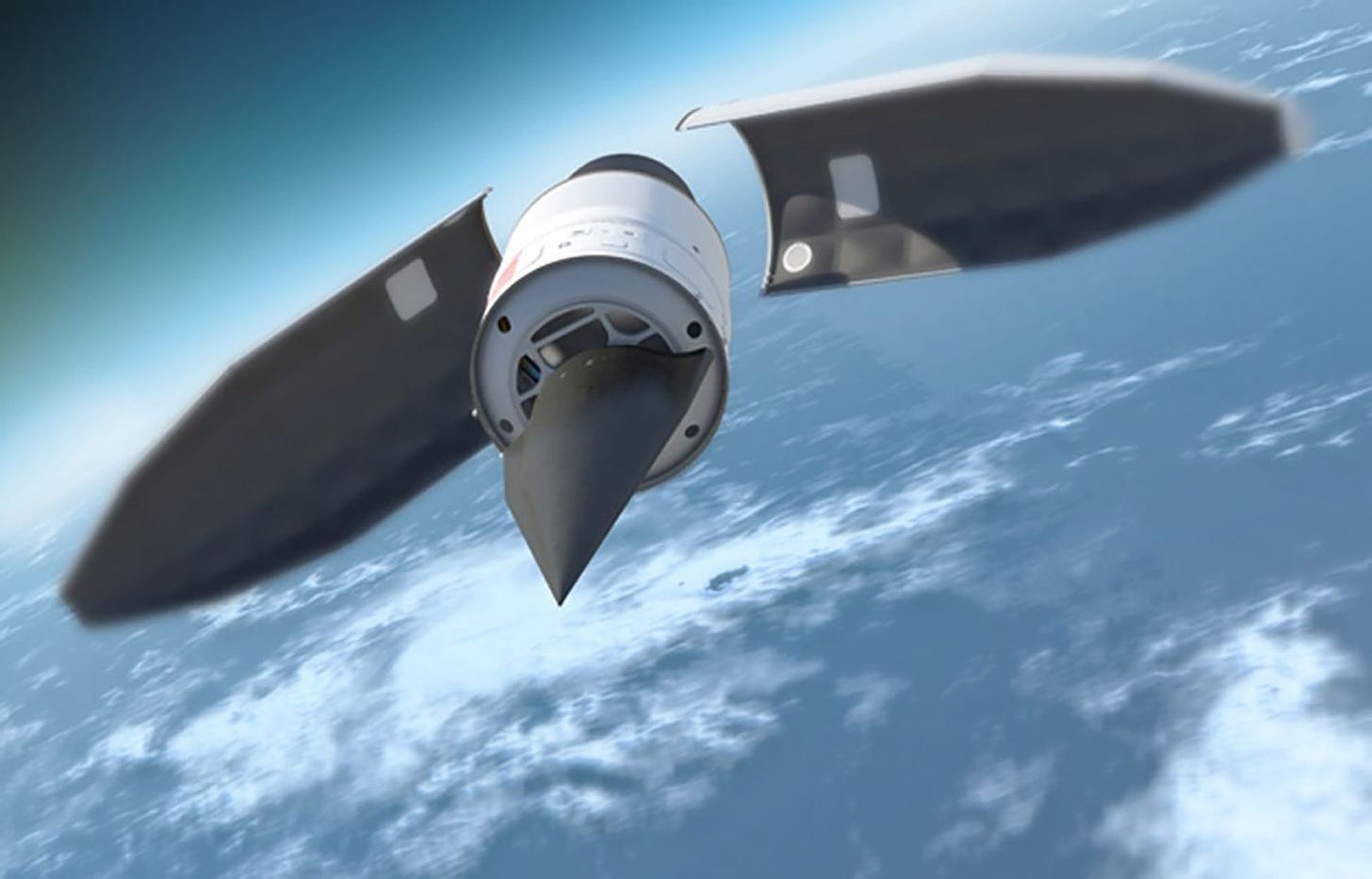
Russian Avangard Hypersonic Missile
By William Schryver | imetatronink | January 19, 2024
One of my current X followers posted earlier today:
“I am against the Ukraine war from the very beginning (mainly because for the first time a foreign war can actually get ME killed with Russia’s missiles), but at this point I also think we can’t just let Russia win which means we lose and that would mean a lot of negative things.”
I will not speak to his fears of “Russia’s missiles”, except to say I am convinced Russia will not strike anyone that hasn’t done something to provoke it in a manner that warrants such a response — at least not so long as the Putin regime remains in charge.
In any case, Russia WILL win this war. Decisively. She will dictate the terms of its cessation. Russia will emerge from this war significantly more powerful than she was just two years ago, and on a trajectory to become even more powerful in coming years.
As I wrote in a recent article:
“… the Russian armed forces, fighting on their own ground, on and under their adjacent seas, and in the air above their spheres of control, constitute the most potent and battle-hardened military force on the planet.”
As for the US empire’s European vassals: at no point in the last 500 years has Europe been more militarily, politically, socially, and spiritually debilitated. If the entire current military capacity of Europe were combined, it would not stand a chance of defeating Russia in a war. Rather, it would be systematically and comprehensively slaughtered.
And, as I have argued in crescendo over the past several years, the long-pervasive belief in American military supremacy is a myth; a mirage; a fallacious narrative fashioned from fables and Hollywood films.
The US military has not won a war since WW2. They have mercilessly bombed the crap out of many smaller, weaker countries, killed millions of people, and yet never once achieved strategic victory.
Not since WW2 have they faced anything even faintly approximating high-intensity warfare.
Indeed, never at any time in history has the US military fought against a great power adversary at the height of its strength.
And now, here in 2024, the US military has never been in a more weakened state relative to any of its potential great power adversaries — namely, Russia, China, and Iran.

Iranian Shahed-238 loitering cruise missiles, three variants.
As I repeat often, I am convinced the failed US/NATO proxy war against Russia in Ukraine will produce the following results:
— It will greatly accelerate the decline of the American Empire.
— NATO will cease to be a credible military/political alliance.
— The EU will cease to be a credible monetary/political alliance.
And, as the broken hegemon rapidly recedes, political, economic, and social chaos is certain to engulf much of the world as the major and minor players on the planet scramble to secure their respective spheres of influence and establish new centers of global and regional power.
An epoch of great changes is upon us.
BBC HardTalk: Professor Marandi on the Gaza Genocide and its regional implications
January 16, 2024
Professor Seyed Mohammad Marandi discusses the Israeli genocide in Gaza, Yemen and the conflict in the Red Sea, Hezbollah’s border war, and Iraq. He explains the regional implications as well as the possibility of escalation and regional war.
US, UK attacks on Yemen illegal, strategic mistake: Iran foreign minister
Press TV – January 16, 2024
Iran’s foreign minister has strongly slammed the recent attacks on the Yemeni territory by the United States and the UK as illegal and a strategic mistake.
Hossein Amir-Abdollahian made the remarks in an early Tuesday phone call with Secretary General of the United Nations Antonio Guterres, during which the two sides discussed the latest developments related to the Gaza Strip and the Red Sea.
During the conversation, Iran’s top diplomat stressed the Islamic Republic’s principled stance on protecting and maintaining security of shipping and navigation.
“By stopping ships that are bound for the occupied [Palestinian] territories, Yemen seeks to put a halt to the Zionist regime’s crimes and genocide against civilians in Gaza,” Amir-Abdollahian said.
He added that “illegal measures taken by the United States and the UK in attacking Yemen” amounted to a strategic mistake that would lead to further escalation of tensions in the region.
Since the start of the Israeli military aggression on Gaza in early October 2023, the United States and its Western allies have been providing financial and logistical support to the occupying regime in its ceaseless bombardment campaign against Palestinians in the besieged territory.
As part of their support for Palestinians, Yemen’s Armed Forces and popular Ansarullah resistance movement have over the past month targeted several ships owned by Israel or bound for ports in the occupied territories in the strategic Red Sea after multiple warnings.
Elsewhere in his remarks, Iran’s foreign minister expressed concern about the complicated humanitarian situation in the besieged Gaza Strip, reiterating Iran’s readiness to send humanitarian aid for the Palestinian people in the territory.
The Israeli genocide in Gaza has so far claimed the lives of more than 24,000 Palestinians, most of them women and children, leaving thousands of others wounded and millions homeless. According to the UN, about 85 percent of the territory’s population has been displaced and forced into crowded shelters.
The regime has been also enforcing an all-out siege against Gaza that has prevented the flow of food, water, fuel, and medicine into the territory.
The UN chief, for his part, expressed concern about further spread of conflicts across the region, saying the world body is trying to stop the war and alleviate the suffering of the regional people.
He once again condemned the ongoing military aggression against Gaza, stressing the need for stopping it and sending humanitarian aid to Palestinians there.
Guterres also lauded the role played by the Islamic Republic in bolstering peace and stability in the region.
Featured Video

The 1964 Coup in Brazil
or go to
Aletho News Archives – Video-Images
Free Book
Vicious

Lies are Unbekoming | January 25, 2026
The waiting room is clean. The receptionist is polite. The forms ask reasonable questions. Nothing in the physical environment suggests danger. The magazines are current. The hand sanitizer dispenser works. Someone has chosen calming colors for the walls.
A pregnant woman sits in a chair designed for her comfort. She has been told to be here. Not ordered—no one orders. Recommended. Strongly recommended. Everyone does this. Her mother did this. Her friends did this. The women in her prenatal group compare notes about their appointments the way they compare notes about nursery furniture. Which provider did you choose? What tests have you had? The questions assume the answers. The answers assume the questions.
She will be offered things today. Offered is the word used. The offers will come with information sheets that list risks and benefits in tabular form. She will sign consent documents. Everything will be voluntary in the legal sense. No one will hold her down. No one will threaten her. She will choose, and her choices will feel like choices, and she will leave feeling she has done the responsible thing.
What she will not feel is the weight of what has been arranged before she arrived. … continue
Blog Roll
Recent Comments
seversonebcfb985d9 on French court jails pro-Palesti… eddieb on Fourteen Incredible Facts Abou… Bill Francis on European leaders’ shift in the… seversonebcfb985d9 on Villains of Judea: Philip Esfo… loongtip on Report warns that ‘Jewish terr… Craig Nelms on New study shows that toxic gas… loongtip on A Funny Thing Happened on the… loongtip on EU free trade pact on hold as… John Edward Kendrick on Regime Change In Iran Is The F… Bill Francis on Australia Passes New Hate Spee… seversonebcfb985d9 on Australia Passes New Hate Spee… Bill Francis on Britain’s AI Policing Plan Tur…


 Aletho News
- Vicious
- Germany to build 10GW of baseload gas plants (disguised as “future” hydrogen plants)
- French court jails pro-Palestine activist and mother over Gaza genocide speech
- Shot, amputated, and imprisoned: Palestinian man seeks to rebuild life after being maimed and tortured by Israeli forces
- Building Disney Land on the Moon More Likely than Kushner’s Gaza Plan
- U.S. Funds Continue to Flow to Ecuadorian Groups Despite Trump-Era Suspension
- A pro-EU regime is moving to suppress this proud nation. Will they be able to withstand it?
- US-Russia Arms Control May Face ‘Very Dark Period’ – Scott Ritter
- Israel moves to restrict Palestinian re-entry to Gaza, ‘encourage outflow’: Report
- Trump aims to create new UN and own it, Brazil’s Lula warns
- If Americans Knew
- Israeli drone strike kills two children collecting firewood in Gaza – Not a ceasefire Day 107
- Another Gaza baby freezes to death on Netanyahu’s watch – Not a ceasefire Day 106
- Oppose Israel’s Abuses While You Still Can
- UNRWA Heads Tell Ha’aretz: ‘We Don’t Radicalize Palestinians – Their Lived Existence Does’
- Plans Call for “New Rafah” Built in Israel’s Image — Without Palestinians
- Posing as priest, reporter is spat at many times, highlighting anti-Christian sentiment in Israel
- Leaked Documents: “Planned Community” in Rafah Would Force Palestinians Into Israeli Panopticon
- ‘Permits of Humiliation’: How Israel Strangles Christian Education in Jerusalem
- “The world sees death, destruction and injustice – and they see dollar signs” – Not a ceasefire Day 105
- War criminal Netanyahu kills 11 in Gaza, joins Board of Peace – Not a ceasefire Day 104
- No Tricks Zone
- Germany’s Natural Gas Crisis Escalates … One Storage Site Near Empty …Government Silent
- Polar Colding…Antarctica Saw Its Coldest October In 44 Years!
- New Study: Sea Levels Rose 20 Times The Modern Rate During The Roman Warm Period
- As German Gas Storage Dips Dangerously Low…Shortage Hardly Avoidable
- New Study: Brazil’s Relative Sea Level Was 2+ Meters Higher And SSTs 3-4°C Warmer 6000 Years Ago
- Philosopher Schopenhauer: Climate Science Certainty Stems From Stupidity, Ignorance
- New Study: Species Extinction Rates Declining Since 1980 – ‘Climate Change Is Not An Important Threat’
- Denmark Places Climate Protection Above Animal Welfare, Poisoning And Culling Cows
- New Study: Greenland Was 3-7°C Warmer And Far Less Glaciated Than Today 6000-8000 Years Ago
- German Media Report That Current Frigid Weather Can Be Explained By Arctic Warming!
 Aletho News