World welcomes Iran-Saudi detente as Israel feels ‘fatal blow’ to coalition building
Press TV – March 10, 2023
Various countries have welcomed the restoration of diplomatic relations between Iran and Saudi Arabia, while the regime in Tel Aviv seems to view the development as a “fatal blow” to its regional coalition building against the Islamic Republic.
After several days of intensive negotiations hosted by China, Iran and Saudi Arabia finally clinched a deal on Friday to restore diplomatic relations and re-open embassies, seven years after ties were severed over several issues.
The important development soon became a hot topic in regional as well as international media and reactions from other countries began to pour in.
“The return to normal relations between the Islamic Republic of Iran and Saudi Arabia provides great capacities to both countries, the region, and the Muslim world,” Iranian Foreign Minister Hossein Amir-Abdollahian, who is set to soon meet with his Saudi counterpart to make the necessary arrangements, wrote in a post on his Twitter account.
“The good neighborliness policy, as the key axis of the Iranian administration’s foreign policy, is strongly moving in the right direction and the diplomatic apparatus is actively behind the preparation of more regional steps,” he said.
Riyadh eyeing continuation of dialogue
Saudi National Security Adviser Musaid Al Aiban, who negotiated the agreement with his Iranian counterpart Ali Shamkhani, said that Riyadh “welcomes the initiative of His Excellency President Xi Jinping, based on the Kingdom’s consistent and continuous approach since its establishment in adhering to the principles of good neighborliness.”
He said Saudi Arabia takes “everything that would enhance security and stability in the region and the world,” while “adopting the principle of dialogue and diplomacy to resolve differences.”
“While we value what we have reached, we hope that we will continue to continue the constructive dialogue, in accordance with the pillars and foundations included in the agreement, expressing our appreciation for the People’s Republic of China’s continued positive role in this regard.”
China’s Top Diplomat Wang Yi praised the agreement as “a victory for dialogue, a victory for peace, offering major good news at a time of much turbulence in the world.”
China will continue to play a constructive role in handling hotspot issues in the world and demonstrate its responsibility as a major nation, Wang said. “The world is not just limited to the Ukraine issue.”
Nasrallah: Agreement could lead to new horizons
Addressing a local event on Friday, the secretary general of Lebanon’s Hezbollah resistance movement Sayyed Hassan Nasrallah said the agreement will be “to the benefit” of the region.
“The rapprochement of Iran and Saudi Arabia proceeds in its normal path and can open new horizons for the region and Lebanon,” he said.
The Iranian foreign minister also held separate phone conversations with his Omani, Iraqi, and Qatari counterparts who embraced the resumption of ties.
Turkey and the United Arab Emirates also welcomed the new development in separate statements.
In the first reaction, the United States claimed that it embraces “de-escalation” in West Asia.
“Generally speaking, we welcome any efforts to help end the war in Yemen and de-escalate tensions in the Middle East region. De-escalation and diplomacy together with deterrence are key pillars of the policy President Biden outlined during his visit to the region last year,” a White House National Security Council spokesperson told Reuters.
Ansarullah hails move against foreign interference
Mohammed Abdulsalam, the Yemeni Ansarullah resistance movement’s chief negotiator, said the region is in need of resumption of “normal ties” between its countries.
“The region needs the resumption of normal ties between its countries for the Islamic nation to reclaim its lost security as a result of foreign, especially American-Zionist, interferences,” he tweeted.
Foreign interference, he said, has taken advantage of differences in the region and used Iranophobia to wage aggression on Yemen.
‘Dangerous development for Israel’
Meanwhile, the Israeli regime did not seem to take the development so well. Former Israeli Prime Minister Naftali Bennett called the agreement a “political victory” for Iran and a “serious and dangerous development for Israel.”
“This delivers a fatal blow to efforts to build a regional coalition against Iran,” he said.
Former Prime Minister Yair Lapid also described the reconciliation deal as a dangerous development that strips Israel of its regional defensive wall. “The agreement between Saudi Arabia and Iran reflects the complete and dangerous failure of the Israeli government’s foreign policy,” Lapid said.
Benny Gantz, former minister of military affairs, also reacted to the rapprochement, stating that it was a cause for concern.
Will Pakistan defy US sanctions to complete ‘Peace Pipeline’ with Iran?
By F.M. Shakil | The Cradle | March 7, 2023
Islamabad has formed a diplomatic channel to convince Washington to ease sanctions on Iran, which would finally allow for the completion of a crucial pipeline project to bring cheap Iranian natural gas to Pakistan.
Iran has vowed to take the matter to arbitration if Pakistan does not complete its portion of the pipeline by March 2024, as stipulated in an agreement between the two West Asian countries.
Discussions on constructing the massive pipeline project began almost 29 years ago, in 1994 – then called the Iran-India-Pakistan pipeline – which originally envisioned moving Iranian gas to Pakistan, Bangladesh, and China. The focus later shifted to constructing a pipeline between Pakistan and Iran only, but the project has never been completed.

According to the terms of the IP-GSPA (Gas Sales Purchase Agreement) signed between Iran and Pakistan, each country was obligated to construct the portion of the pipeline on its own territory, and the first flow of Iranian gas to Pakistan was to start January 1, 2015. The agreement stipulated Pakistan would pay Iran $1 million per day in exchange for 750 million cubic feet of gas daily, with a contract lasting 25 years.
Iran completed its portion of the pipeline in 2011, however, Pakistan has failed to construct its portion, largely due to difficulties caused by US economic sanctions imposed on Iran for the country’s alleged nuclear weapons program. US sanctions block Pakistan from purchasing Iranian gas, and this geopolitical risk has made Pakistani banks unwilling to finance the project.
Because of US foreign policy pritiorites, therefore, Pakistan continues to rely on more expensive liquified natural gas (LNG) to meet its burgeoning energy needs, which has greatly limited Pakistani economic growth and exposed the country to crises during periods of volatile LNG price spikes.
Due to these difficulties, Pakistan’s Inter-State Gas Systems (ISGS) and the National Iranian Gas Company (NIGC) signed a revised agreement in 2019 to allow Pakistan more time to complete its segment of the pipeline. The agreement stipulated that neither Iran nor Pakistan will take the other to court for delays or impose fines until 2024.
But US sanctions have continued to make Pakistan’s completion of the project difficult, and Iran is now threatening to sue Islamabad for $18 billion in fines if it breaks the agreement and fails to complete construction by the 2024 cutoff date.
Financial straits or US pressure
As Asif Durrani, a former Pakistan ambassador to Iran, tells The Cradle:
“Pakistan needs roughly $3 billion to lay a pipeline stretching over a radius of 781 kilometers inside the country. The question is who will finance this project, and secondly, the US sanctions on Iran, which took the air out of this project as far as Pakistan is concerned, need a revisit by the US authorities to protect the faltering economies of the region.”
The sanctions, he adds, were primarily focused on the energy sector of Iran and set a cap of $10 million on investments in the Iranian oil and gas sector.
Durrani is not convinced that US sanctions make completion of the pipeline impossible, however.
“These are lousy arguments because, despite these restrictions, Iran supplies Turkiye with almost $10 billion annually in natural gas,” he argues, adding that India and China have also resisted US sanctions.
Durrani contends that Pakistan and Iran are neighboring nations and that neighbors must always conduct business with one another. He urges private sector participation in the IP gas project to accelerate the development phase of this huge project.
Now a senior fellow at the Islamabad Policy Research Institute (IPRI), the former Pakistani envoy to Tehran had in 2021 criticized the US for sabotaging the Iranian nuclear deal, claiming that Iran, as a Non-Proliferation Treaty (NPT) member, had the legal right to use nuclear energy for peaceful purposes.
Dr. Muhammad Abdul Muqtedar Khan, an Indian-American academic and a professor in the Department of Political Science and International Relations at the University of Delaware concurs with Durrani’s logic, telling The Cradle that too many countries in this region tend to yield to US pressure unnecessarily.
India, he says, disregarded US outrage over the Russian oil issue and refused to capitulate, unlike Pakistan which is still in a state of vacillation. In the same way, Pakistan could proceed with the Iran gas pipeline project, citing its energy and resource constraints in the face of pressure from Washington.
“In 1990, India, China, and even Bangladesh showed interest in the peace pipeline – but, in 2008, as a result of the Indian nuclear accord with the US, New Delhi decided to withdraw. As the thing unfolded, Iran has already installed the pipeline on their side of the border, but Pakistan is still dilly-dallying about it because of the US pressure and lack of the financial means to begin construction,” Khan adds.
He says Iran has spent a considerable amount of money constructing its section of the pipeline and would want compensation for the resulting commercial loss. “Iran has granted sufficient time for the pipeline’s development, and if Pakistan begins building its gas infrastructure, it could gain some cushion to reduce its import bill.
Pakistan is hedging its bets
Pakistan’s Secretary of Petroleum, Ali Raza Bhutta, disclosed in a meeting of the country’s Public Accounts Committee (PAC) that Pakistan has spoken to the US about the gas project, seeking relief in sanctions on Iran to press ahead with the construction of the pipeline.
Islamabad’s top energy official went on to add that since there was a ban on importing gas from Iran, the government has conveyed to the US ambassador to either grant Islamabad permission to go ahead with the project, or compensate Iran for the penalty imposed for opting out of the project.
As Noor Alam Khan, Chairman of the Public Accounts Committee, tells The Cradle:
“I did not convene this meeting specifically for the IP gas project, the focus was only on the audit paras of the petroleum ministry, and I suggested during the meeting – not the secretary – that the Ministry of Foreign Affairs should approach the US to let them know how serious the situation is.”
When informed that the secretary of petroleum had briefed the committee on the IP gas project and that media had quoted him saying that either the US should pay the damages or permit the country to continue with the IP gas project under the terms of the Iran agreement, Khan, a member of a breakaway faction of former president Imran Khan’s Pakistan Tehrik-e-Insaf party, became irritated, said it was nonsense, and hung up the phone.
The Pakistan National Assembly’s Foreign Affairs Committee also discussed this matter last week. The committee’s chairman, Mohsin Dawar, raised fears about the fact that several nations in the region have received waivers for importing Iranian oil even though Iran is under sanctions.
Pakistan, however, was unable to secure such a waiver to conduct such lucrative oil and gas business with Iran. He pressed the appropriate ministries to examine opportunities for receiving exemptions for the IP gas pipeline with Iran, much as India and China had done for Iranian oil imports.
IP Gas Pipeline in perspective
The plan for the IP Gas Pipeline, which is also called the “Peace Pipeline,” dates back to 1994, when India was also part of the project.
The 1,700-mile (2,735 km), $7.5 billion project planned to move gas from the South Pars Gas Fields to India through the western part of Pakistan, Balochistan. Since its inception, the project has encountered numerous obstacles that have caused repeated delays in the execution of a natural gas project that was badly needed by energy-starved Pakistan.
In 2008, the three nations were close to reaching an agreement before India opted to pursue an alternative project, the Turkmenistan-Afghanistan-Pakistan-India pipeline (TAPI). The US pressure and sanctions on Iran appear to have impacted India’s decision to withdraw from the IP gas pipeline agreement and pursue an alternative that excluded Iran.
Then, in 2010, a 25-year-long Gas Sale and Purchase Agreement (GSPA) was signed, to construct a pipeline stretching across Pakistani territory from the Iranian border to Nawabshah, a distance of 781 kilometers.
Approximately 665 kilometers will travel through Balochistan while 115 kilometers will run through Pakistan’s Sindh province. The length of the Iranian portion of the pipeline is 1,100 kilometers. It begins in the energy economic zone of Pars and goes to Iranshahr and Bushehr. The route then continues through Fars, Kerman, Hormozghan, and Sistan-Baluchistan.
From the Pakistani border to Nawabshah, the pipeline will stretch around 781 kilometers. After completion, the IP gas pipeline was projected to supply 750 million cubic feet of gas per day to Islamabad from Iran. According to the deal, gas supplies from Iran would start in 2014. But, this assumption turned out to be a pipe dream and has not been realized during the past nine years.
A panacea for Pakistan’s economic woes
“Pakistan’s issue with foreign reserves would progressively get worse if it were unable to achieve a deal with Iran because years were spent in negotiations between Pakistan, Iran, and Turkey to create a close economic relationship for significant infrastructure projects, but the US sanctions and pressure shattered all these dreams,” Muqtedar Khan maintains.
He believes that Pakistan is currently dealing with a protracted foreign exchange problem that cannot be remedied by borrowing money from China, Saudi Arabia, or the International Monetary Fund (IMF) because Pakistan would still have to pay back the initial debt.
“Strangely, Pakistan and Iran have failed to create a mutual understanding despite their common Islamic background. As an alternative to US dollars, they may conduct business in their own currencies. Even though they are neighbors, it would be a diplomatic failure if they did not restore a reciprocal trade relationship,” Muqtedar Khan concludes.
Iran follows parliament’s strategic law, Safeguards, NPT, not JCPOA: Atomic Energy Organization of Iran

Press TV – March 5, 2023
The head of the Atomic Energy Organization of Iran (AEOI) says the country remains committed to the Safeguard Agreement with the International Atomic Energy Agency (IAEA) and the nuclear Non-Proliferation Treaty (NPT), considering them as the basis for its nuclear activities, along with the strategic law adopted by the Iranian parliament.
Mohammad Eslami made the remark in an interview on Sunday, following a trip to Iran by Director General of the IAEA Rafael Mariano Grossi.
Commenting on Grossi’s visit, he said Iran’s interactions with the agency should continue and “we must not allow the destructive Zionist and terrorist current to take advantage of our relations and find excuses to mount pressure on the country.”
Eslami added that the nuclear deal reached in 2015, officially known as the Joint Comprehensive Plan of Action (JCPOA), can no longer be taken as the basis of Iran’s activities.
“Naturally, the JCPOA, with which the other side does not comply, cannot form the basis of our action, because the basis of the Islamic Republic of Iran’s action is the strategic law passed by the Islamic Consultative Assembly (Iranian parliament) and the removal of unjust sanctions” that have been imposed on the country, the AEOI head said.
The law, dubbed the Strategic Action Plan to Counter Sanctions was adopted by Iranian lawmakers in December 2020 to counter sanctions imposed on Iran by the United States and its Western allies, and promote the country’s peaceful nuclear program.
Under the parliament’s law, the Iranian administration is required to restrict the IAEA’s inspections and accelerate the development of the country’s nuclear program beyond the limits set under the JCPOA.
Eslami added, “We fulfill our responsibilities and [carry out] our activities according to the strategic law. The important point is that we take our steps based on this law and within the framework of the Safeguards [Agreement] and the NPT…. but they intend to exaggerate these steps in line with their double standards and create [media] hype.”
“We announced yesterday that we are committed to the Safeguards and the NPT, and the agency oversees and assesses our activities. However, this oversight must be carried out within frameworks and considerations acceptable for the Islamic Republic of Iran,” he said.
Explaining about a controversial IAEA report, claiming that uranium particles enriched to about 84 percent of purity have been found in Iran, Eslami said the agency has mentioned such particles in a report to its Board of Governors.
“However, after repeated assessments and inspections, and through the interaction carried out [between Iran and the IAEA], it was decided that the criterion for measuring [the degree of enrichment] should be the final output of the production line.”
“No enrichment above 60 percent has taken place in storage tanks that are currently operating and whose entire process is being supervised by the IAEA, according to the Safeguards Agreement. [Therefore,] they have practically announced the closure of this case. The case of 84-percent [enriched] uranium particles has been closed and decided,” Iran’s nuclear chief said.
Eslami added that pressures exerted on the IAEA chief by Western media with regard to Iran’s nuclear activities are masterminded by “the Zionist current.”
“They are angry and upset with Mr. Grossi’s trip [to Iran] and are increasing pressure on him. It is natural [for them] to mount media pressures as a result of their anger with the [IAEA] director general’s visit to Iran,” the AEOI head said.
Netanyahu claims special right to strikes on nuclear facilities
RT | March 6, 2023
Israeli Prime Minister Benjamin Netanyahu has insisted that the option of attacking an Iranian nuclear facility in “self-defense” must be left on the table, arguing that the chief of the UN’s International Atomic Energy Agency (IAEA) made an “unworthy” statement when he declared that any such strikes are banned.
“Are we forbidden to defend ourselves?” Netanyahu said on Sunday in a cabinet meeting. “Of course, we are allowed, and of course, we are doing this… Nothing will prevent us from protecting our country and preventing oppressors from destroying the Jewish state.”
Netanyahu’s rant came a day after IAEA Director-General Rafael Mariano Grossi was asked by a reporter about US and Israeli threats to attack Iran if it doesn’t agree to curb its nuclear program.
“Any military attack on a nuclear facility is outlawed, is out of the normative structures that we all abide by,” Grossi said at a press briefing in Tehran after meeting with Iranian leaders. That principle applies to all nuclear facilities, including Europe’s biggest atomic facility in Zaporozhye.
Netanyahu said no such prohibition could apply to Israel. “Rafael Grossi is a worthy person who made an unworthy remark,” he said. “Outlawed by what law? Is Iran, which publicly calls for our extermination, allowed to protect its weapons of destruction that will slaughter us?”
Grossi’s trip to Tehran apparently paid dividends, as Iranian officials agreed to restore the UN watchdog’s access to some surveillance tools at the country’s nuclear facilities. The IAEA also was granted an increase in inspections at the Fordo nuclear site, as well as additional verification and monitoring activities.
“These are not words,” Grossi told reporters upon his return to Vienna on Saturday. “This is very concrete.”
Tehran has denied having any ambition to acquire nuclear weapons. Iran signed a deal with the US and other world powers in 2015, agreeing to impose restrictions on its nuclear industry, including uranium enrichment, to allay fears about its potential for warhead development. Washington reneged on the agreement in 2018, when then-US President Donald Trump said he would instead apply “maximum pressure” through sanctions on Iran to contain its nuclear program.
Iran reacts to uranium claim
RT | February 20, 2023
Tehran has rejected as misleading a Bloomberg report, which claimed that the International Atomic Energy Agency (IAEA) was investigating how the country enriched uranium “to levels just below that needed for a nuclear weapon.”
The news agency cited two anonymous diplomats, who alleged that the UN nuclear watchdog found uranium of 84% purity, or “just 6% below what’s needed for a weapon” in Iran, Bloomberg explained in its article, published on Sunday.
Responding on Monday, Behrouz Kamalvandi, spokesman for the Atomic Energy Organization of Iran (AEOI), said the piece was “slander and a distortion of the facts”.
“The presence of uranium particles above 60% during the enrichment process does not mean enrichment above 60% level,” he told IRNA news agency, claiming that in publishing the story, Bloomberg was serving as a tool of anti-Iran pressure.
Bloomberg did, however, acknowledge the possibility that the sample was found after unintended accumulation in an enrichment centrifuge cascade.
The IAEA has commented on the news by stating that it was “discussing with Iran the results of recent Agency verification activities” and would report the outcome to its board of governors when appropriate.
Iran agreed to impose restrictions on its nuclear industry, including enrichment activities, under a 2015 deal with world powers. The agreement was torpedoed by US President Donald Trump, who pulled out in 2018 to pursue a so-called “maximum pressure” campaign of sanctions.
Iran eventually started reneging on its commitments, and announced it was enriching uranium to 60% purity at its Natanz facility in 2021 and at the Fordo site in 2022.
The nuclear deal, known as the Joint Comprehensive Plan of Action, was touted as a way to prevent Iran from acquiring a nuclear weapon, an ambition that Tehran denies having.
Iranian drone bombs Israeli oil tanker in retaliation for Isfahan explosion
The Cradle | February 18, 2023
An Israeli-linked oil tanker was attacked one week ago by Iranian forces, BBC Persia reported on Friday 17 February.
Though not initially reported, the Liberia-flagged “Campo Square” oil tanker was attacked on 10 February, and is owned by Zodiac Maritime, a shipping company led by Israeli billionaire Eyal Ofer.
According to US military sources, Iran used Shahed-136 suicide drones from the Iranian Revolutionary Guards as well as naval vessels from the elite force in the Persian Gulf.
Senior Israeli security officials confirmed the report and suggested the Iranian attack was an attempt at revenge for attacks attributed to Israel against Iran.
Iran has accused Israel of attacking a number of sensitive military and nuclear sites in the past few years.
No casualties were reported and the damage to the tanker was allegedly not significant.
However, on 14 February, Iranian state media reported that Iran had killed two Israeli officers in retaliation for a 29 January sabotage attack in Isfahan.
According to report by Iranian state media, an Israeli spokesman confirmed that two Israeli officers had been killed in accidents. The report noted that other Israeli sources have indicated that the killing of the two officers came as part of an Iranian operation in response to the Isfahan attack.
On 29 January, a powerful explosion occurred at an Iranian Defense Ministry ammunition depot in the city of Isfahan. According to Israeli sources, this was a booby-trapped drone attack. No casualties were reported. Additionally, a large fire broke out in a major refinery in Tehran. The cause of the fire remains unclear.
Days later, Iranian officials blamed Israel for the attacks and promised retaliation. Iran’s ambassador to the UN, Amir Saeed Irbani submitted a letter to the interim president of the UN Security Council claiming that the initial investigations carried out in Iran indicated that the “Zionist regime” was responsible for the “terrorist attack” at the Defense Ministry facility in Isfahan.
Irbani wrote further that “Iran has a legitimate right to defend its national security and to respond resolutely to any threat or injustice of the ‘Zionist regime’, at any time and in any place.”
The Iranian attack on the Israel-linked oil tanker came amid pledges between the US government and six Gulf states for increased cooperation against Iran. Bloomberg reported on 17 February the US and Gulf nations “voiced concern about what they said was Iran’s deeper cooperation with “state and non-state actors,” an apparent reference to Iran’s alleged support for Russia in its war against Ukraine, and called “Tehran a growing threat to regional security.”
Homs attack: Iran says US complicit in Daesh crimes in Syria
Press TV – February 18, 2023
Iran has condemned Friday’s brutal attack by the Daesh terrorist group in the central Syrian province of Homs, saying the United States is complicit in the continuation of the acts of terror in the war-ravaged country.
“The current policies and approaches of the American regime indicate the continuation of this regime’s double standards in dealing with international issues, including the battle against terrorism,” Iranian Foreign Ministry spokesman Nasser Kan’ani said on Saturday.
He reiterated the importance of providing the Syrian government with effective international support to help it fight the remnants of Daesh and other terrorist groups.
“The US government, as one of the founders and supporters of the Daesh terrorist group and a government that has an illegal military presence in a part of Syria’s territory, is complicit in the continuation of the crimes by this group and the continuation of insecurity in Syria,” Kan’ani said.
At least 53 citizens, who were truffle hunting, were killed in the Daesh attack on the southwest of the town of al-Sokhna in the desert east of the city of Homs on Friday, state television reported.
The victims included 46 civilians and seven soldiers, said Dr. Walid Odeh, director of the General Authority of Palmyra National Hospital.
The Friday attack was the deadliest attack by the outfit since January last year when the terrorists stormed a prison in the northeastern Syrian city of Hasakeh in a bid to free fellow Takfiris.
China-Iran ties on the right side of history
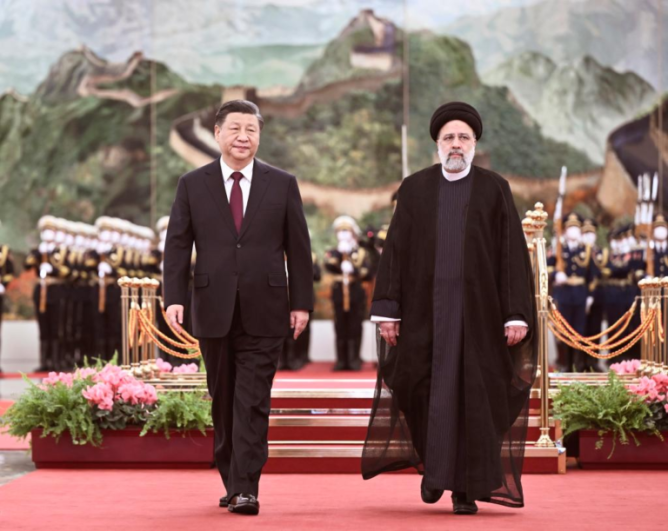
Chinese President Xi Jinping held a welcoming ceremony for Iran’s President Ebrahim Raisi prior to talks at the Great Hall of the People in Beijing, February 14, 2023
BY M. K. BHADRAKUMAR | INDIAN PUNCHLINE | FEBRUARY 16, 2023
The three-day state visit by Iran’s president Ebrahim Raisi to China on February 14-16 is a landmark event affecting regional politics and international security. The red carpet welcome accorded to Raisi signified the high importance attached by Beijing to the comprehensive strategic partnership between China and Iran in the prevailing international milieu.
In a ‘curtain-raiser’ on Monday, Global Times wrote that the visit “shows the Raisi administration’s unswerving determination to promote the ‘Look to the East’ policy.”
The CCP Central Committee newspaper then went on to make a profound statement: “Iran’s ‘Look to the East’ policy meant the transition from its policy of negative balancing and non-alignment to building alliances with non-western world powers that have similar political structures to Iran, such as Russia and China.”
This must be the first time that Beijing explicitly hailed Iran’s transition toward an alliance with non-western world powers that do not qualify as liberal democracies — “such as Russia and China.” This characterisation becomes the leitmotif of Raisi’s visit to China. Indeed, Beijing, Moscow and Tehran are sailing in the same boat as the pioneers of a democratised world order defying US hegemony.
On the following day, in a lengthy editorial, Global Times dwelt on the strategic ramifications, taking note that “outside the US-West bloc and its influence circle, there is huge space and potential for win-win cooperation” between Beijing and Tehran. It said:
“China’s deepening cooperation with Iran also has anti-hegemony and anti-bullying feature. Both China and Iran uphold independent foreign policies, firmly defend the principle of non-interference in internal affairs on international occasions, and safeguard the common interests of developing countries. This is conducive to promoting the multi-polarization and diversified development of the world, and conforms to the general trend of the times…
“Under Washington’s moves, the international structure is being divided and restructured, with the vicious trend of forming blocs and camps again emerging, which puts the non-Western world in a difficult situation and once again faces historical choices. The existing US-led international system has designs to bully and exploit developing countries and emerging countries. Now Washington still thinks that it is not convenient enough, that the interests of developing countries have increased in weight, and wants to reconstruct a new international system with a stronger tendency, which is undoubtedly a major challenge for the non-Western world and needs to be resisted by forming a joint effort.”
This compelling thought appeared in the opening statement of Chinese President Xi Jinping at the meeting with Raisi on Tuesday at the Great Hall of the People in Beijing when he said that “amid the profound changes in the international situation, China and Iran have constantly consolidated their strategic mutual trust and steadily advanced pragmatic cooperation. They have promoted their common interests and upheld international fairness and justice, writing a new chapter for China-Iran friendship.”
Xi underscored that “China supports Iran in safeguarding its sovereignty, independence, territorial integrity and national dignity as well as resisting unilateralism and hegemony, and opposes attempts by external forces to interfere in Iran’s domestic affairs and undermine its security and stability.”
The big picture comprises three key elements here: Moscow’s ‘friendship without limits’ with Beijing, Iran’s Eurasian integration, and the Russian-Iranian alliance in the making. The Shanghai Cooperation Organisation provides a platform for all three countries for strengthening communication and coordination in a spirit of mutual respect and trust and jointly work on regional security issues.
Raisi’s visit will accelerate the implementation of the 25-year agreement signed in 2021 between Iran and China. The program, including energy, trade and infrastructure, faced obstacles due to the pandemic and the escalation of US sanctions. But things are on the cusp of change. China watches Russian stealing a march on it, although the latter’s 25-year agreement with Iran is still a work in progress.
To be sure, the talks in Beijing focused on how to advance practical cooperation between Iran and China, even as China is coming out of the self-imposed restrictions during the pandemic, is raring to go and is revving up the Belt and Road.
However, what is yet to sink in is that a major outcome of the confrontation between Russia and the NATO countries is that Iran is set to break through the rings of western containment through the past four decades since the 1979 revolution. Beijing sees that Russia is providing strategic depth for Iran in a win-win engagement.
Just before Raisi embarked on the state visit to Beijing, the new governor of Iran’s central bank, Mohammadreza Farzin stated in Tehran that “The financial channel between Iran and the world is being restored.” In effect, he was announcing that Iran and Russia have taken a significant step towards linking their banking infrastructures amid Western sanctions.
After years of work, the two countries have managed to connect Iran’s SEPAM national financial messaging service to Russia’s Financial Messaging System of the Bank of Russia (SPFS), the Russian equivalent of SWIFT, that aims to link with other major powers like China and India. The tie-up signifies that Moscow today has the political will to forge ahead with an optimal partnership with Iran, as they also pursue greater use of their national currencies in trade.
Moreover, Russia and Iran are creating a firewall to sequester their defence cooperation from the prying eyes of the US. Moscow is about to transfer cutting-edge military technology to Tehran, including the famous Su-35 multipurpose 4+ generation fighter jets as part of a $3 billion arms deal that also includes two S-400 air defence systems. None of this is escaping Beijing’s attention. (Interestingly, Farzin was included in Raisi’s delegation to Beijing.)
Beijing understands that the confrontation between Russia and the US is working to the advantage of two of its key partners to break out of the Western stranglehold of sanctions and realise their full potential as regional powers — North Korea and Iran — which has profound implications for the power dynamic in the Asia-Pacific and West Asia. The Chairman of the Chiefs of Staff of the Iranian Armed Forces General Mohammad Bagheri greeted the newly-appointed North Korean counterpart General Pak Su-il recently with a call for expansion of military ties “to confront any move that disrupts global security.”
China-Iran relationship is entering interesting times. Fortuitously, the Gulf states themselves are decoupling from the US-Israeli strategy to whip up anti-Iran frenzy. Meanwhile, Iran’s relations with Saudi Arabia are steadily improving and the latter is developing diversified external relations as well with accent on partnerships with China and Russia. The growing similarity lately in the respective diplomatic trajectories of Iran and Saudi Arabia would have a calming effect incrementally on Gulf security and eliminates the scope for US interference in the GCC interaction with China (and Russia.)
President Xi highlighted to Raisi the importance of stability in West Asia, saying that upholding stability matters to the well-being of the countries and people in the region and also has great relevance to world peace, global economic development and the stability of energy supplies.
Xi noted in particular that “China appreciates Iran’s willingness to actively improve relations with neighbouring countries, and supports countries in the region in resolving their differences through dialogue and consultation to realise good neighbourliness.”
This paradigm shift in Gulf security puts the Sino-Iranian partnership on the right side of history.
China announces visit of Iranian president
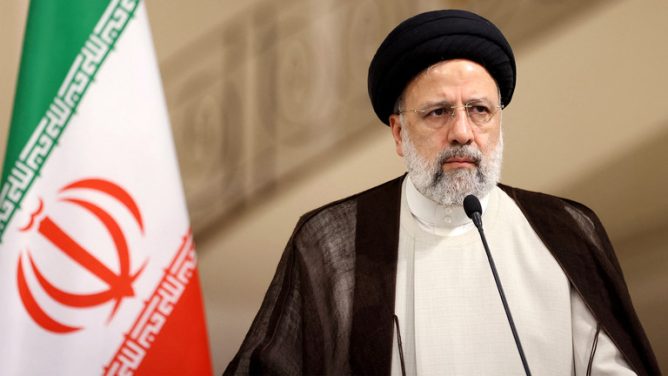
Iran’s President Ebrahim Raisi giving a joint press conference. © AFP / Iranian Presidency
RT | February 12, 2023
Iranian President Ebrahim Raisi is going to make an official visit to China next week, the Chinese Foreign Ministry has said.
Raisi’s planned visit will take place between February 14 and 16 and is at the invitation of Chinese leader Xi Jinping, the ministry announced in a statement on Sunday.
The three-day trip will, among other elements, include talks between Raisi and Xi, a joint meeting of the leaders with Iranian and Chinese businessmen, and the signing of cooperation documents between the delegations of the two countries, according to Iran’s state-run news agency IRNA.
Also reporting on the upcoming visit, US outlet Politico said that it’s “expected to deepen ties between the two political and economic partners that are opposed to the US-led Western domination of international affairs.”
Xi and Raisi last met during the Shanghai Cooperation Organization (SCO) summit last September in Samarkand, Uzbekistan. During those talks, the Chinese leader insisted that consolidating their strategic partnership was a common choice for both Beijing and Tehran.
In December, Chinese Vice President Hu Chunhua visited Iran and met with Raisi, with both sides expressing eagerness to boost bilateral ties further.
China is Iran’s largest trading partner and the main buyer of its oil amid US sanctions on Tehran. According to Iranian data, its exports to China reached $12.6 billion in the last ten months. The country also bought $12.7 billion worth of Chinese goods during the period.
Last year, Iran was formally included into the SCO as a permanent member and also applied to join BRICS – the two international organizations in which China and Russia play a major role.
Israel ready to bomb Iranian aid deliveries to Syria: Report
The Cradle | February 10, 2023
An unnamed Israeli military official told Saudi Arabia’s Elaph newspaper on 9 February that Tel Aviv will not hesitate to bomb Iranian aid deliveries for disaster-struck Syria under claims that Tehran seeks to “take advantage of the tragic situation … to send weapons and equipment to Hezbollah.”
The anonymous official added Israel has “intelligence” to back up their claims, as the Israeli army has “intensified its monitoring by air, land, and sea of everything that Iran is transporting to Syria.”
Iran has been one of the leading countries providing humanitarian assistance to Syria since a 7.8 magnitude earthquake devastated the country’s northwest region.
As of Friday morning, the death toll from the quake in Syria had surpassed 3,300 people.
As a result of western sanctions, aid deliveries for Syria have been largely hindered compared to the flow of aid entering neighboring Turkiye, forcing Damascus to rely on allied nations like Russia and Iran to assist survivors.
Israel’s newest threat comes just two weeks after its drones bombed three Iranian food trucks loaded with flour and rice as they headed from Iraq into Syria.
The trucks were attempting to legally enter Syria through the Al-Bukamal border crossing days after it was opened for commercial trucks for the first time since 2019.
Israel has previously prevented aid from arriving in Syria by bombing the country’s airports, using similar claims of “weapons deliveries” from Iran.
In September of last year, the UN Syria Commission decried Israeli airstrikes on Damascus International Airport “made it impossible” for the UN to deliver humanitarian aid to Syrians in need.
The attack on 10 June severely damaged the two runways at Syria’s main joint-use airport, crippling civilian air traffic in and out of the country. The statement came just days after Israel bombed Aleppo International Airport twice in the same week.
Israel regularly carries out illegal airstrikes inside Syria on what it claims to be Iranian or Hezbollah targets.
Iran points finger after drone strike
RT | February 2, 2023
The Iranian government suspects that Israel was responsible for last Saturday night’s attack on a military facility in the central city of Isfahan, news outlet ISNA reported on Thursday, citing a senior diplomat.
Amir Saeid Iravani, Tehran’s envoy to the UN, made the accusation in correspondence with senior officials at the organization, according to ISNA. In his letter, he reportedly stated that a preliminary investigation had pointed to Israel’s responsibility for the drone attack.
He condemned the incident and referred to statements by senior Israeli officials, including an interview with Prime Minister Benjamin Netanyahu on CNN earlier this week, in which he declined to confirm or deny Israel’s involvement in the Isfahan attack.
“Every time some explosion takes place in the Middle East, Israel is blamed or given responsibility – sometimes we are, sometimes we’re not,” the prime minister told the US news network.
In his letter, Iravani emphasized that Iran had a right to “decisively respond” to the threat posed by Israel with whatever means it deems necessary.
The Iranian diplomat also condemned a Ukrainian official for their remarks about the attack. Mikhail Podoliak, an aide to President Vladimir Zelensky, framed the incident as retaliation for what Kiev claims to be assistance provided by Iran to Russia in the conflict with Ukraine.
“War logic is inexorable and murderous. It bills the authors and accomplices strictly,” Podoliak said, adding that Ukraine “did warn you.”
Iravani reiterated that Iran was not involved in the Ukraine crisis and said any statements condoning attacks on Iranian infrastructure were “irresponsible.”
According to ISNA, Iranian specialists analyzed the debris of drones used in the attack and identified the producer. They reportedly found clues after comparing the aircrafts’ body, engines, power supply and navigation system to samples at their disposal.
The Iranian military will use the new information to improve security at its installations, the outlet said, citing a source close to the national security council.
The attack reportedly involved three small drones carrying explosives, which were launched from a nearby location. Iran said they were intercepted and caused only minor damage to the roof of the building that was targeted.
MbS urged Baghdad to set up Iran-Saudi meeting: Iraqi FM
The Cradle | January 31, 2023
As part of a diplomatic process aimed at mending strained relations between the two neighbors, Saudi Crown Prince Mohammed bin Salman (MbS) reportedly pressured senior Iraqi officials to set up a face-to-face meeting between the top diplomats of Riyadh and Tehran. This was revealed by the Iraqi Foreign Minister, Fuad Hussein, on 30 January.
In an interview with Rudaw TV on 29 January, the Iraqi Foreign Minister said that “Prince Faisal bin Farhan Al Saud and Hossein Amir-Abdollahian, the foreign ministers of Saudi Arabia and Iran, will meet in Baghdad, at the request of Mohammed bin Salman. The event is still planned, and the time and date will be announced later.”
He also said that the Iranian and Saudi foreign ministers would meet in public and that Iraq would act as a middleman to ensure that the details of the private conversations were made public.
The Saudi diplomat stated earlier this month that his nation has spoken with Iran and is looking for a way to open a dialogue between the two.
In an effort to improve their bilateral relations, the two sides began negotiations in the spring of 2021 and held five rounds of talks in the Iraqi capital. However, Tehran suspended the negotiations after Riyadh executed 81 people under the pretext of being involved in “terrorism,” the majority of which were minority Shia Muslims.
Relations have recently become tenser due to Saudi Arabia’s alleged sponsorship of the protests in Iran in late 2022.
Iran’s Intelligence Minister, Esmail Khatib, was quoted by Iranian media as saying it is running out of patience and will no longer tolerate intervention, hostility, and incitement in a direct message to Saudi Arabia.
Meanwhile, in November, Iran sent an official warning message to the kingdom through diplomatic channels, confirming that it is fully aware of “the Saudi connection to Iran International.” Riyadh categorically denied this, saying it has “nothing to do with the outlet.”
Featured Video
Epidemic of fake videos
or go to
Aletho News Archives – Video-Images
Free Book
Vicious

Lies are Unbekoming | January 25, 2026
The waiting room is clean. The receptionist is polite. The forms ask reasonable questions. Nothing in the physical environment suggests danger. The magazines are current. The hand sanitizer dispenser works. Someone has chosen calming colors for the walls.
A pregnant woman sits in a chair designed for her comfort. She has been told to be here. Not ordered—no one orders. Recommended. Strongly recommended. Everyone does this. Her mother did this. Her friends did this. The women in her prenatal group compare notes about their appointments the way they compare notes about nursery furniture. Which provider did you choose? What tests have you had? The questions assume the answers. The answers assume the questions.
She will be offered things today. Offered is the word used. The offers will come with information sheets that list risks and benefits in tabular form. She will sign consent documents. Everything will be voluntary in the legal sense. No one will hold her down. No one will threaten her. She will choose, and her choices will feel like choices, and she will leave feeling she has done the responsible thing.
What she will not feel is the weight of what has been arranged before she arrived. … continue
Blog Roll
Recent Comments
loongtip on Vicious loongtip on EU turns to India for defense… Coronistan on Donald Trump Is No Peace … seversonebcfb985d9 on French court jails pro-Palesti… eddieb on Fourteen Incredible Facts Abou… Bill Francis on European leaders’ shift in the… seversonebcfb985d9 on Villains of Judea: Philip Esfo… loongtip on Report warns that ‘Jewish terr… Craig Nelms on New study shows that toxic gas… loongtip on A Funny Thing Happened on the… loongtip on EU free trade pact on hold as… John Edward Kendrick on Regime Change In Iran Is The F…


 Aletho News
- Spain Opens Probe Into Israeli Tourism Firms
- Epidemic of fake videos
- Craig Murray, Reporting from Venezuela
- Why Israel’s Drive to Destroy Iran is Ultimately about Palestine
- Trump and Iran, War or Negotiations?
- US pressure contributing to Israeli influence in Latin America: Experts
- China Rejects U.S. Claims of Coercion in Central America
- New US defense strategy downgrades Russian ‘threat’
- EU turns to India for defense cooperation as US ties fracture
- Donald Trump Is No Peace President
- If Americans Knew
- Greenpeace Demonstrator Exposes Folly of Protest Restrictions
- From CBS to TikTok, Pro-Israel Ellison is now in the driver’s seat
- Israel pays for UK advertisements attacking Doctors Without Borders
- Israel accused of extracting billions from Gazan people to pay for their own genocide
- ‘Deliberate Assassination’: 3 Journalists Among 11 Killed by Israeli Forces in Gaza
- In Gaza, We’re Struggling to Reintroduce Foods to Bodies Adjusted to Starvation
- Will Rafah crossing be opened at last? – Not a ceasefire Day 108
- Israeli drone strike kills two children collecting firewood in Gaza – Not a ceasefire Day 107
- Another Gaza baby freezes to death on Netanyahu’s watch – Not a ceasefire Day 106
- Oppose Israel’s Abuses While You Still Can
- No Tricks Zone
- New Study Affirms Rising CO2’s Greening Impact Across India – A Region With No Net Warming In 75 Years
- Germany’s Natural Gas Crisis Escalates … One Storage Site Near Empty …Government Silent
- Polar Colding…Antarctica Saw Its Coldest October In 44 Years!
- New Study: Sea Levels Rose 20 Times The Modern Rate During The Roman Warm Period
- As German Gas Storage Dips Dangerously Low…Shortage Hardly Avoidable
- New Study: Brazil’s Relative Sea Level Was 2+ Meters Higher And SSTs 3-4°C Warmer 6000 Years Ago
- Philosopher Schopenhauer: Climate Science Certainty Stems From Stupidity, Ignorance
- New Study: Species Extinction Rates Declining Since 1980 – ‘Climate Change Is Not An Important Threat’
- Denmark Places Climate Protection Above Animal Welfare, Poisoning And Culling Cows
- New Study: Greenland Was 3-7°C Warmer And Far Less Glaciated Than Today 6000-8000 Years Ago
 Aletho News