Why are Americans killing and dying for Israel, again?
By Tarik Cyril Amar | RT | February 28, 2026
Israel and its US auxiliaries have attacked Iran. In terms of international law and elementary justice, things are clear beyond the slightest doubt: the attack is a war of aggression – but to be fair, in Israel’s case that hardly makes a difference anymore.
With ‘highlights’ including apartheid, ethnic cleansing, unlawful detention, torture, sexual violence, and genocide, Israel has such an extensive and constantly growing record of, literally, every crime under international law, including human-rights and humanitarian law (or the law of armed conflict), that one more or less hardly seems to matter anymore. This state is a monster, and monsters will monster as long as they can.
The US, of course, is no spring chicken either when it comes to treating international law – really, any law – as a doormat and brutally, gleefully violating the most basic ethics, the kind of simple rules normal people intuitively recognize, such as “don’t murder, lie, or steal.”
Indeed, while Israel can easily claim to be the single most criminal, indeed evil country in the world, the US wins the most-powerful-rogue-state prize hands down. There is – empirically, quantifiably – no other country that combines such ingrained and increasingly explicit scorn for law and morality with such brute power and perpetual violence. Before the current assault on Iran, the kidnapping of Venezuelan President Nicolas Maduro was just the last proof of that fact, so glaringly obvious that it woke up even some Western commentators.
If some things are too obvious to merit further discussion, others are more intriguing. Let’s start with the greatest mystery: Why is the US joining – really, obeying – Israel and its powerful American lobby once again in going to war in the Middle East? Was Iraq 2003 not enough of a disaster? Are the American elites really congenitally unable to learn?
In terms of actual US interests, war against Iran makes no sense at all. Iran is not close to a nuclear bomb and, as a matter of fact, has a religiously and ethically based (hard to grasp in Washington, I know) explicit policy against acquiring one. And even if Iran were building such weapons or seeking a state of being “latently” able to do so as urgently needed insurance against permanent Israeli and US aggression, Washington would gain nothing and risk very much by going to war.
On the other hand, it was precisely the JCPOA agreement with Iran, destroyed by the US during the first Trump presidency, that proved empirically that the issue of Iranian nuclear energy use can be resolved well by compromise. As to recent, hysterical US claims about other types of WMDs and “intercontinental missiles,” it is time to no longer give such crude, dumb lies the time of day. Enough with the propaganda already.
Regime change? So, please could someone explain why installing a washed-out Pahlavi princeling – if it ever were to work, that is – in Tehran is good for Americans? Spoiler, no one can. At least not honestly. Do I hear someone say geopolitics? Oh, that would mean the “genius” geopolitics of risking a long war with great damage to the US and its regional allies? Then, perhaps it’s all about plunder? Yes, true, the US simply loves plundering. Historically speaking, the whole country is built on it, just like Israel. But even plunder on its own despicable terms only makes sense if you turn a profit. Good luck with that while sinking more gazillions into war-for-Israel.
And that brings us to the only explanation that does make sense, even if in a very grim way: The US, as in almost all Americans, has zero interest in war with Iran. As little as in a proxy war with Russia and a Cold War with China, both strategies, by the way, doomed to fail. In all three cases, the vast majority of Americans would only stand to benefit from peaceful and cooperative relationships.
But Washington chooses permanent conflict and war against Iran anyhow. The reason is that US policy in the Middle East – and not only – has been captured by Israel and its lobby. As John Mearsheimer, both doyen of explaining international relations by national interests (the theory of Realism) and co-author of the standard work on the Israel Lobby, has long acknowledged, Israel’s influence on the US is real, contradicts American interests, and forms an exception to the theory of realism in that Washington is constantly hurting its own country.
For reasonable observers, this case is closed. When devastating the Middle East, the US is acting not in its own genuine national interest but the perverse conception that Israel has of its national interest: subjugating and, if needed, destroying all sovereign states in its neighborhood so as to create and preserve Israeli domination and even ‘Greater Israel’, a nightmare of ‘Lebensraum’ for Zionist settlers from, at least, Egypt to Iraq.
But, again, why? This is where the Epstein scandal makes a difference – or should do so – to unbiased minds. We must acknowledge that Jeffrey Epstein was not “merely” a very rich and perverse criminal with far too many friends in high places but an agent of Israel, whether with a direct affiliation to its dreaded Mossad service of spying, murder, and subversion or not. His core operation served to gather extremely compromising blackmail material on large swathes of the elites of the US and the West more generally. FBI agents, we now know, assessed that Trump himself is among those trapped in this manner. If anything, frantic – and also, again, criminal, efforts – by Trump’s Department of Justice and his head of the FBI to purge the files of references to the current president and his friends only provide further corroborating evidence that Trump is under Israel’s control.
Remember ‘Russiagate’ (really, of course, Russia Rage)? The irony! Russia was never remotely close to (or even trying) to having a US president under its thumb. That was all BS. Yet, in the end, ‘Russiagate’ did do two things: it gave Trump a (fundamentally realistic if exaggerated) sense of having been a victim of a smear campaign and, among voters, it helped Trump make his furious comeback, without which he would not now be in power. The delusion and mass hysteria of ‘Russiagate’ – which was that famous American thing, a nothing-burger – paved the way for the power that really controls Trump and really does enormous damage to America: Israel and its lobby.
Will Americans ever free themselves from the one state and network that have really run history’s most successful subversion and state-capture operation on them? Who knows? We know that it would take more than putting an end to Epstein-like blackmail. If anything, Trump’s bitter enemies, Joe Biden and Kamala Harris, have only recently shown us that the American “elite” is enthralled to Israel and its crimes also for reasons ranging from being bribed to sharing the vile insanity of Zionism. If the US ever wants its independence back from Israel, all of that will have to go.
Tarik Cyril Amar is a historian from Germany working at Koç University, Istanbul, on Russia, Ukraine, and Eastern Europe, the history of World War II, the cultural Cold War, and the politics of memory.
Timing of US-Israel attack on Iran bears symbolic meaning in Judaism
By Tal Shalev | CNN | February 28, 2026
The timing of the US and Israeli attack on Iran bears symbolic meaning in Judaism. Ahead of the upcoming Jewish holiday of Purim, worshippers read the specific portion from the Old Testament, known as Zachor.
The passage from the book of Deuteronomy commands the ancient Israelites to remember an unprovoked attack by the nation of Amalek and to eradicate the memory of Amalek once the Israelites are settled in their land.
The passage is read publicly before Purim to fulfil the mitzvah of remembering Amalek as Israel’s achetypical enemy.
70 martyrs, 90 wounded in US-Israeli strike on elementary school
Al Mayadeen | February 28, 2026
Iran’s ISNA news agency reported that dozens of students remain trapped under the rubble, while a number have been rescued. A hospital in the same area also suffered partial damage, according to ISNA.
Iran’s Mehr news agency further reported that two students were martyred in the Narmak area of Tehran.
Iran Invokes Article 51 of the UN Charter
In the official statement from the Iranian Foreign Ministry, Iran invoked Article 51 of the United Nations Charter, affirming its legitimate right to self-defense following the Israeli strikes on Iran.
The ministry characterized the airstrikes as a violation of Article 2(4) of the United Nations Charter, which prohibits the use of force against the territorial integrity or political independence of any state.
According to the statement, “The Armed Forces of the Islamic Republic of Iran will respond forcefully to any attack.” The ministry reiterated that Iran would use all its capabilities to deter aggression and confront its enemies.
Call on the UN Security Council
Iran also called on the United Nations and the UN Security Council to take immediate action in response to the blatant violation of international peace and security.
The statement urged the UN Secretary-General, as well as the President and members of the Security Council, to fulfill their responsibilities without delay.
It also appealed to all UN member states, particularly countries in the region, members of the Islamic world, and states belonging to the Non-Aligned Movement, to condemn the act of aggression and to adopt urgent and collective measures to halt it.
The ministry warned that the escalation represents an unprecedented threat to regional and global peace and security.
Trump Starts a Major Regime-Change War with Iran, Serving Neoconservatism and Israel
By Glenn Greenwald | February 28, 2026
For decades, Israeli Prime Minister Benjamin Netanyahu and American neoconservatives have dreamed of only one foreign policy goal: having the United States fight a regime-change war against Iran. With the Oval Office occupied by Donald Trump — who campaigned for a full decade on a vow to end regime-change wars and vanquish neoconservatism — their goal has finally been realized.
Early Saturday morning, the United States and Israel began a massive bombing campaign of Tehran and other Iranian cities. President Trump posted an eight-minute speech to social media purporting to justify his new war, dubbed “Operation Epic Fury.” Trump’ war cry was filled with the same slogans and clichés about Iran that Americans have heard from the carousel of bipartisan neocons dominating U.S. foreign policy for decades: Iran is a state sponsor of “terror”; it is pursuing nuclear weapons; it took American hostages forty-seven years ago (in 1979); it repressed and kills its dissidents, etc.
As if to underscore how fully he was embracing the very foreign policy dogma he vowed to reject, Trump invoked the Marvel-like “Axis of Evil” formulation that White House speechwriter David Frum wrote for George W. Bush at the start of the War on Terror. Iran’s government, President Trump proclaimed, is one determined to “practice evil.” This is how Bush — speaking of Iraq, Iran and North Korea — put it in his 2002 State of the Union address: “States like these, and their terrorist allies, constitute an axis of evil.”
Trump left no doubt about the scope and ambition of his new war. This will not be a quick or targeted bombing run against a few nuclear sites, as Trump ordered last June as part of Israel’s 12-day war with Iran. There is nothing remotely constrained or targeted about any of this. Instead, this new war is what Trump called a “massive and ongoing” mission of destruction and regime-change, launched in the heart of the Middle East, against a country of 93 million people: almost four times the size of Iraq’s population when the U.S. launched that regime change war back in 2003.
That Trump claimed to have “completely and totally obliterated” Iran’s nuclear program last June — just eight months ago — was not something he meaningfully acknowledged in his new war announcement, other than to vaguely assert that Iran somehow resumed their nuclear program. In fact, Trump seemed to delight in repeating the same triumphalist rhetoric that he used last year when he assured Americans that Iran’s nuclear program could no longer pose a threat as a result of Trump’s triumphant Operation Midnight Hammer.
In lieu of outlining any clear mission statement for this new war, let alone a cogent exit strategy, Trump offered a laundry list of flamboyantly violent vows. The U.S. will “totally obliterate” Iran’s ballistic missile program (which Iran could not use to reach the American homeland but which Trump admitted last June caused Israel “to get hit very hard” in retaliation). Trump also promised that the U.S. would “annihilate” Iran’s navy. And he told Iranians: “the hour of your freedom is at hand….bombs will be dropping everywhere.”
Trump also attempted to prepare the nation for caskets and body bags of American soldiers returning to the U.S. “The lives of courageous American heroes may be lost; we may have casualties,” the President said. But, said the man who did everything to avoid military service including during the Vietnam War, mass death of American soldiers “often happens in war.”
In sum, Trump just launched the exact war that most of his MAGA movement professed to oppose. That included one of Trump’s most influential supporters, the late Charlie Kirk, who repeatedly maligned the neocons’ drive for war with Iran as “pathologically insane,” and warned that grave disaster of historic proportions would be the result:
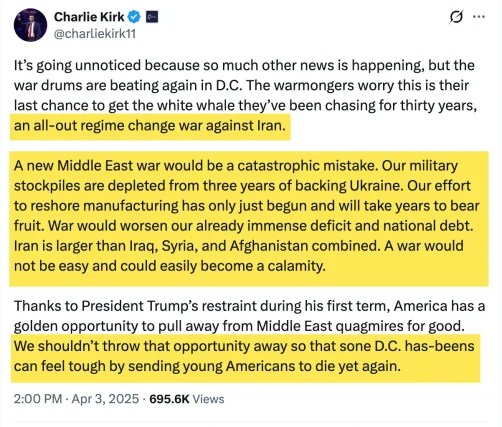
Charlie Kirk, X, April 3, 2025, warning against a regime-change war in Iran
The false claims behind this new war with Iran are ones we have extensively documented. In Trump’s war announcement this morning, he claimed — as he did at Tuesday’s State of the Union address — that Iran refuses to promise that it will not obtain nuclear weapons. The exact opposite is true: Iran has stated this clearly, unequivocally and repeatedly, and did so as recently as this week. “Iran will under no circumstances ever develop a nuclear weapon,” proclaimed Iran’s foreign minister Seyed Abbas Araghchi.
The consequences of this new Trump/Netanyahu war of choice cannot be predicted with any degree of certainty. Already, Iran has launched numerous retaliatory ballistic missiles at Israel, as expected, and has also attacked U.S. military bases in the United Arab Emirates, Qatar, Bahrain and Kuwait.
But the lack of predictable outcomes is, of course, precisely the point. If the U.S. and Israel succeed in their stated goals of widespread “annihilation” and regime change, then they will create, at the very least, a huge power vacuum in the middle of the world’s most volatile region that will require U.S. resources and a sizable military presence for years if not decades to come. One of the world leaders most responsible for the Iraq War, former British Prime Minister Tony Blair, admitted that it was the invasion of Iraq that gave rise to ISIS.
It is hard to overstate what a massive fraud Donald Trump, his campaign and his political movement are. For more than a decade, Trump has ranted and raved against the evils of regime-change wars and neoconservative dogma, only to launch a new war that most perfectly encapsulates and aggressively advances both. He spent years falsely warning that former President Obama would start a war with Iran because of how weak and inept Obama supposedly was at negotiation and diplomacy, only to now do that himself (rather than start a new war with Iran, as Trump predicted, Obama entered a diplomatic agreement with them which major nuclear bodies attested was effective in monitoring Iran’s nuclear activities: a deal which Trump, at Israel’s insistence, tore up in 2018).
Throughout the 2016 campaign, Trump mercilessly mocked Marco Rubio for receiving millions in donations from Sheldon and Miriam Adelson, money that Trump said would “mold [Rubio] into [their] perfect little puppet,” only for himself to become not only the largest beneficiary of Adelson funding in history, but to become the ultimate puppet of the Adelsons’ agenda, one which Trump has clearly acknowledged — when speaking in Israel last year — is an agenda that puts the interests of Israel atop everything, including Americans’ interests:
“I get her in trouble with this, but I actually asked [Miriam] once… ‘What do you love more? The United States or Israel?’ She refused to answer. That might mean Israel,” Trump says, smiling, while looking at the dual Israeli-American national.
And it is not an exaggeration to say — in fact, basic honestly requires one to say — that the 2024 Trump/Vance campaign is one of the most fraudulent political campaigns in American history:

Just one week before the 2024 election, Tulsi Gabbard proclaimed that “a vote for Kamala Harris is a vote for Dick Cheney and a vote for war, war and more war.” Conversely, Gabbard said, “a vote for Donald Trump is a vote to end wars, not start them.” Other than immigration, this “no-new-wars” theme was the most central to Trump’s political appeal and his political promises since he emerged on the political scene a decade ago.
One can rehash the decades of now-trite arguments about Iran as much as one wants. But such endless debate cannot alter the facts here that are indisputable and fundamental.
Iran has not attacked and could not have attacked the United States at home. No such attack was even arguably imminent. The new war that Trump just started with Israel is thus the definitive war of choice.
In contrast to the lie-driven 18-month public campaign of Bush and Cheney to convince the American public to support an invasion of Iraq, there has been virtually no attempt made, as I documented this week, to even explain to the American public why a new war with Iran is necessary or desirable. There has been no Congressional approval sought let alone obtained, notwithstanding the U.S. Constitution’s exclusive assignment of war-making powers to the Congress.
In his novel 1984, George Orwell highlighted the dangerous insanity of war propaganda with this leading example: “WAR IR PEACE.” Yet that is precisely the rationale invoked by various Trump supporters to somehow depict this new war as aligned with Trump’s vows of peace (starting massive new wars is merely “peace through strength”).
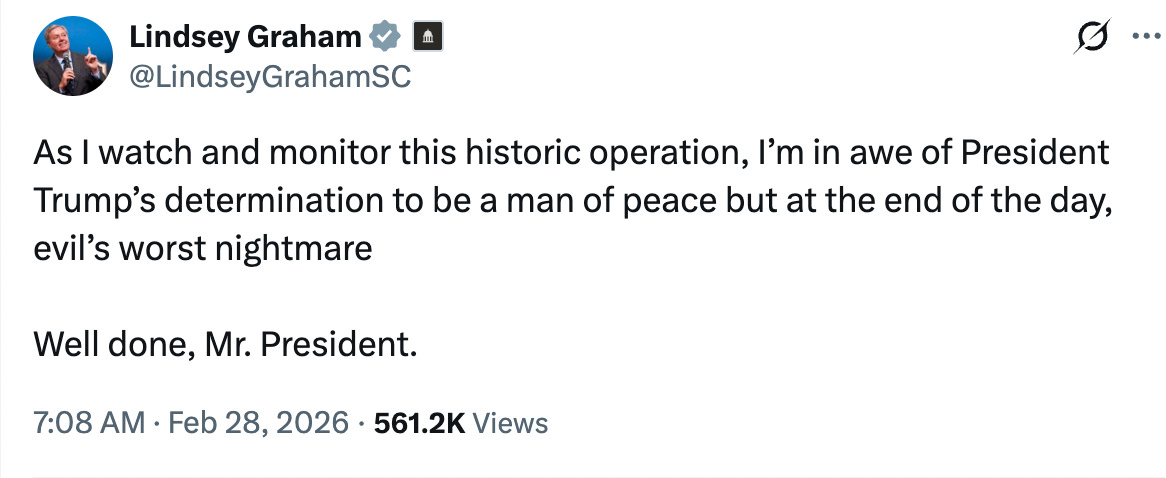
This is, obviously, the war that Israel and Trump’s largest Israel-loyal donors most wanted and have long been pressuring him to start. Pro-Israel billionaires like Bill Ackman, long-time pro-Israel warmongers like Lindsey Graham, and Israel First activists like Mark Levin are of course already boisterously celebrating this new war against Israel’s primary adversary.
But this is ultimately an American war, one that Trump unilaterally started and for which Trump is responsible. Notably, of course, it is not Trump or his family, but instead everyone else in the world, who will bear the costs and burdens of the war. This was the point Trump famously emphasized shortly before the 2024 election — on November 1 — when explaining why Washington is full of sociopathic warmongers such as Dick and Liz Cheney who constantly start wars in which other people’s families, but never their own, must go fight and die.
As Trump’s senior White House advisor Stephen Miller said about those comments, “warmongering neocons love sending your kids to die for wars they would never fight themselves.” Indeed they do, Stephen Miller.
Do not expect meaningful opposition from the Democratic Party. Some of them, perhaps most, will make loud noises in protest. But the party’s senior leader, Sen. Chuck Schumer (D-NY), this week urged Trump to make the case to the public about why this war was necessary, whereas Schumer last June mocked Trump for attempting to obtain a peace deal with Iran and accusing him of “chickening out” of the war with Iran that he prosed. Some Democrats, such as Sen. John Fetterman (D-PA), are effusively praising Trump and his new war.
This new war against Iran is as pure a continuation of the bipartisan DC posture of endless war that has, more than any single cause, destroyed American prosperity, standing, and future over the last six decades at least. The only question how is how many people will die, for how long the damage will endure, and what new unforeseen evils will be created in its wake.
Why Trump’s war on Iran will fail
By Tamer Ajrami | MEMO | February 27, 2026
The United States has turned the talks with Iran upside down. What is happening now does not look like serious negotiations. It looks more like a way to buy time and prepare for a more dangerous phase. That is why two questions matter: Why Trump’s war on Iran will not succeed, and why would it be a dangerous choice for Washington? The answer is simple. The demands Washington is putting on the table are designed to be rejected, and because any military action, if it occurs, will reveal the limits of force, the logic of exhaustion, and the absence of a clear or achievable goal.
All the talk about a deal, gaps, and loopholes continues to go around in circles. On the ground, the US is moving in a completely different direction: it is raising the bar in a way that ruins the talks from the inside and pushes things toward escalation.
Washington now says it has clear conditions. In reality, these conditions make any settlement almost impossible. The first demand is that Iran hand over all its enriched uranium directly to the United States. Not to a third country, not through an international mechanism, not through gradual reductions. Just hand it over to Washington. This is not meant to produce a balanced agreement. It is meant to humiliate a state and force it to give up a highly sensitive part of its sovereignty.
The second demand is even clearer: dismantle Iran’s nuclear facilities and destroy them completely, including major sites like Isfahan, Natanz, and Fordow, along with underground facilities hidden in mountains. The irony is that Washington and its allies do not have full certainty about what earlier strikes (12-day war, June 2025) actually achieved inside these deep facilities. So, the demand for dismantling and destruction looks like a political cover for the simple reality of what lies underground is not easy to reach.
On sanctions, the US offers no clear path. The talk is about lifting a limited set of sanctions imposed recently, while keeping the main sanctions in place under a long “test.” Has Iran truly surrendered, or is it only offering symbolic concessions? Then comes the most dangerous condition of all: the deal must be permanent, Iran must stop enrichment completely, and this must last forever. These are not terms for a fair agreement. They are terms of surrender.
That is why this round looks more like the round before war. The US military buildup in the region is still expanding, and the flow of aircraft, defence systems, and naval assets continues. Everyone is watching everyone through satellites. Almost nothing can be hidden. The real message is not in press statements. It is in the movements that create a new reality and make escalation feel closer than a settlement.
But if a strike happens, it will be full of risks. Even in the American media, one question keeps coming back: what exactly are Trump’s goals? Does he want a limited strike to force Iran into quick concessions? Does he want a wider campaign to bring down the regime? Or does he simply want to declare that he “destroyed” the nuclear program without being able to prove it? The problem is that these goals clash with each other, and each one requires different tools, different costs, and different timelines.
Time is part of the problem too. Some estimates suggest that the ability to keep up intense operations with the current level of forces may be limited. This connects with warnings about running down air defences and burning through advanced / expensive ammunition in a campaign that does not guarantee results. In other words, if war starts, it may quickly turn into a war of exhaustion. It is exactly the kind of fight Washington does not want.
If Iran can launch large waves of ballistic missiles, it can drain defensive stocks on US ships and at US bases in the region fast. Then comes the embarrassing question: how does the US keep fighting? And how does it stop without looking like it pulled back under fire? If Iran keeps firing while the US withdraws, the image inside America would be politically costly.
That is why the administration, based on what is being discussed in Washington, may look for a way to sell the war at home. One idea is for Israel to launch the first strike, and then for the US to step in later under the banner of “defending Israel”. That makes it easier to justify the intervention in Washington, because critics will face a ready-made slogan: we are defending an ally.
But on the ground, it is hard to separate who starts and who joins. US and Israeli forces operate in the same environment and in overlapping ways. The real difference is not in the sky. It is in the story Washington wants to tell its public.
Even if a strike happens, the main question remains: can airstrikes alone achieve big goals? Many analysts say hitting facilities becomes like a game of chasing a moving target. You destroy one site, it gets rebuilt. You hit a surface facility that was emptied beforehand. Equipment and materials are moved elsewhere. As for facilities buried deep in mountains, they remain a major problem. Access is not guaranteed, and photos alone cannot prove total destruction.
More importantly, a nuclear programme is not just concrete and steel. It is knowledge, technology, experience, and an industrial base. Even if part of it is damaged, Iran can repair it over time. Claims of “total destruction” therefore sound more like political messaging than a verifiable reality.
The missile program is an even bigger challenge. Iran produces missiles in large numbers and has the industrial and scientific base to rebuild its stock after any confrontation. Even if the US hits some production lines, wiping the program out completely would require long-term control on the ground and not just airstrikes.
Here is the truth that official speeches avoid: if Trump’s real goals are regime change, removing Iran’s missile power for good, or forcing “zero enrichment” forever, then airstrikes will not deliver that. Those goals require a major ground war and a long occupation. This then may bring huge losses, heavy costs, and years of deep involvement.
This would not serve the US at a time when competition with China is rising. Burning through advanced and expensive American capabilities in the Middle East without clear gains could give China a strategic advantage and push it to move faster on bigger priorities like Taiwan, while Washington remains stuck in a war with no clear ending.
There is also a constant operational risk in any large air campaign: an aircraft could be shot down, a pilot could be captured, or a major incident could happen in a sensitive strait. One such event can turn a limited strike into a wider war, and shift the focus from negotiating nuclear issues to negotiating prisoners and political humiliation.
So, Washington faces two costly paths: a full-scale war it does not have the political tools to sustain, or airstrikes that will not achieve the announced goals but could open the door to further escalation. In both cases, negotiations become a temporary cover while the region moves toward a dangerous test of power and its limits.
The bottom line is this: raising demands to the level of humiliation does not lead to an agreement. It pushes the other side toward rejection and then toward preparation for confrontation. When talks become terms designed to fail, they do not prevent war. They delay it to a moment chosen by Washington; after the battlefield is prepared and the political story is already written.
In the end, the problem is not that Washington has less power. The problem is that it is pursuing goals that are bigger than its tools. Airstrikes do not topple regimes, erase nuclear know-how, and do not end a missile program that can be rebuilt. The higher the US raises its demands, the more it closes the door to diplomacy and the closer the drift toward confrontation.
If war begins, it may quickly become a costly fight with no clear ending: defenses get drained, rare munitions get burned, markets shake, and bases come under attack. Then an unsolved question will rise inside the US: how do we end this without political defeat? Failure becomes likely because the goals cannot be achieved by bombing alone. And the danger is huge, because escalation may spiral beyond control. In a war like this, Washington might win a round in the air, but lose the bigger game on the ground.
Daniel Davis: China & Russia Will Defend Iran
Glenn Diesen | February 26, 2026
Lt. Col. Daniel Davis is a 4x combat veteran, the recipient of the Ridenhour Prize for Truth-Telling, and is the host of the Daniel Davis Deep Dive YouTube channel. Lt. Col. Davis discusses why diplomacy in Iran has failed, how there is no off-ramp, and why this war will likely be a disaster.
Daniel Davis Deep Dive: https://www.youtube.com/@DanielDavisDeepDive/videos
Follow Prof. Glenn Diesen:
- Substack: https://glenndiesen.substack.com/
- X/Twitter: https://x.com/Glenn_Diesen
- Patreon: https://www.patreon.com/glenndiesen
Support the research by Prof. Glenn Diesen:
- PayPal: https://www.paypal.com/paypalme/glenndiesen
- Buy me a Coffee: buymeacoffee.com/gdieseng
- Go Fund Me: https://gofund.me/09ea012f
Senate Majority Leader: Any War with Iran Should Result in Regime Change
By Kyle Anzalone | The Libertarian Institute | February 26, 2026
Senate Majority Leader John Thune said that any strikes on Iran should be aimed at causing regime change in Tehran.
“In my view, if you’re going to do something there, you better well make it about getting new leadership and regime change,” the Senator said on Thursday. “If you’re going to take some sort of action, I think you want to achieve a result that actually brings about the transformational change that I think we want in the region.”
Thune is among several Senators who have argued that Tehran is historically weak, and President Donald Trump should order an attack on Iran to cause regime change. “The Ayatollah lost to Israel in the 12-day war. They are weaker. The regime is weaker than it ever has been. And what I’ve urged the president, do not miss this opportunity,” Cruz told CNBC host Joe Kernen on Wednesday. “If the Ayatollah is removed from power, it will make America much safer.”
Trump is threatening to attack Iran if Tehran does not agree to a deal that severely restricts its civilian nuclear program in exchange for minimal sanctions relief.
While Senators and administration officials have asserted that the US must attack Iran to prevent Tehran from obtaining a nuclear weapon, the Islamic Republic does not have a nuclear weapons program and is not currently enriching uranium.
“The President, I don’t think, to my knowledge, has made any decisions, but I think they’re gaming out what contingencies might look like and what’s in our national security interests.” Thune added, “Of course, first and foremost is to prevent them from having a nuclear capability but there are also other threats that they represent in the region.”
China, Russia slam US threat, force against Iran ahead of talks
Al Mayadeen | February 26, 2026
China on Thursday called for restraint and dialogue between the United States and Iran, as Washington continues a significant military buildup in the Persian Gulf ahead of renewed diplomatic talks.
Speaking in Beijing, Chinese Foreign Ministry spokeswoman Mao Ning said China was “closely following developments in Iran” amid rising regional tensions.
“China advocates the resolution of issues through political and diplomatic channels and opposes the use of threat or force in international affairs,” Mao told reporters when asked whether Beijing would join Moscow in backing Tehran against what was described as potential US aggression.
Mao emphasized the longstanding ties between the two countries, stating that the “Chinese and Iranian people are traditionally friendly.” She added that China supports the Iranian government and people in safeguarding their “legitimate rights, interests, and national stability.”
Reiterating Beijing’s position, Mao stressed the importance of de-escalation. “We hope all sides exercise restraint and solve disputes through dialogue,” she said, adding that China is ready to continue playing a “constructive role as a responsible major country.”
Russia blames US ‘irresponsible escalation of regional tensions’
Likewise, Russian Foreign Ministry spokeswoman Maria Zakharova said that Moscow sees the constant threats against Iran, as well as the irresponsible escalation of regional tensions by the United States.
“We see constant threats against Tehran and saber-rattling, intimidation, and Washington’s irresponsible escalation of regional tensions,” Zakharova said during a briefing.
Moscow and Tehran are developing mutually beneficial cooperation, despite Washington’s escalation of regional tensions, the Russian spokesperson added.
US build-up escalates significantly
Amid these developments, US military buildup in the Middle East has expanded significantly, with Washington assembling 16 warships, about 40,000 troops, and at least seven air wings in the region, the Financial Times reported, citing rising US-Iran tensions.
US President Donald Trump said on February 19 that he will decide within 10 to 15 days whether to pursue diplomacy with Iran or take military action, Axios reported. Speaking in Washington, he said the coming days would be decisive for US policy. “Now we may have to take it a step further, or we may not,” Trump said, adding, “Maybe we are going to make a deal [with Iran].”
The United States had already maintained five air wings, command units of roughly 70 aircraft each, at bases in Jordan, Kuwait, Qatar, Saudi Arabia, and the United Arab Emirates. It has since added two more aboard the aircraft carriers USS Abraham Lincoln and USS Gerald R. Ford, reinforcing what Trump described as a “massive armada” of 16 vessels and expanding Washington’s operational reach.
The overall US troop presence in the region now stands at around 40,000 personnel. Citing data from Tel Aviv University, the Financial Times reported that Jordan’s Muwaffaq Salti military base hosts at least 66 fighter jets, including 18 F-35s, 17 F-15s, and eight A-10s, along with EA-18 electronic warfare aircraft and transport planes. Satellite data also show an increase in fighter jets at a Saudi air base, reflecting the broader expansion of the US air footprint across Jordan and the Gulf.
US fears Iran war will ‘deplete’ air defenses stretched thin by Ukraine, Israel: Report
The Cradle | February 26, 2026
Military officials and lawmakers in Washington have warned that a prolonged war with Iran could stretch US military stockpiles of air defense interceptor missiles “to the brink and make the country more vulnerable,” POLITICO reported on 26 February.
“Gen. Dan Caine, the Joint Chiefs of Staff chair, has raised concerns about the military’s shortage of air defense interceptors since January,” POLITICO wrote, citing a person familiar with the matter.
“But the fears have magnified in recent weeks as the Pentagon amassed the largest military buildup in the Middle East since the Iraq War,” the magazine added.
Since returning to the White House a year ago, US President Donald Trump has won praise from Israelis while supporting the genocide in Gaza and overseeing a massive expansion of US military operations, including in Venezuela, Yemen, and Nigeria.
Crucially, Trump ordered US warplanes to join Israel’s 12-day war on Iran to bomb Tehran’s nuclear sites in June 2025.
Interceptor missiles were used not only to protect US forces from Iranian and Yemeni counterattacks but also to protect Israel from Iran’s barrages of ballistic missiles and drones.
During these operations, US forces “burned through” significant numbers of Standard Missile-3s, Terminal High Altitude Area Defense (THAAD) interceptors, and Patriot missiles, POLITICO observed.
Since then, the Pentagon has been unable to replenish its interceptor stocks due to the complexity and slow pace of their production.
Six current and former US officials and members of Congress told POLITICO of their widespread worries that a sustained war with Iran could deplete remaining US air defenses and “leave tens of thousands of American troops in the region unprotected against Tehran’s missile salvos.”
An Israeli intelligence official stated on Thursday that the US only has the capacity to sustain four or five days of intense aerial assault on Iran, the Times of Israel wrote, citing the Financial Times (FT).
Israel is pushing for a major war, claiming that limited US strikes on Iran could only “embolden the regime,” the Times of Israel added.
Since January, President Trump has assembled what he called an “armada” of US naval ships with accompanying war planes in the region in preparation for a possible renewed attack on the Islamic Republic.
Analysts have suggested that Iran will retaliate much more strongly in the event of a second war, including against US bases in the Gulf, leading to a much longer and more devastating war than last June.
“Do we have enough interceptors to sustain a retaliation?” said the person familiar with the talks. “We don’t have a discretely focused objective. Is it regime change or is it [just] ballistic missiles?”
A US military spokesperson responded to the POLITICO report by saying its weapons stockpiles are sufficient.
“The Department of War has everything it needs to execute any mission at the time and place of the president’s choosing and on any timeline,” said spokesperson Sean Parnell.
However, some US lawmakers say that the defense industry is not producing enough Lockheed Martin-built Patriot interceptors or RTX’s Tomahawk long-range missiles, nor quickly enough.
“There have been urgent calls for reforms in procurement, but the net result is that we are seemingly unable to meet all of the needs for defense production – for Ukraine, for our partners in the Middle East,” said Richard Blumenthal, a Democratic congressman.
“It may be problematic to think about moving Patriot missile interceptor systems from the Middle East because now we’re going to have to protect our embassies, not to mention our bases,” he added.
The Center for Strategic and International Studies (CSIS), a Washington think tank, estimated the US had used up to 20 percent of the Standard Missile-3 interceptors and between 20 and 50 percent of its THAAD missiles.
John Mearsheimer: The Case for a Nuclear Iran
Glenn Diesen | February 25, 2026
John J. Mearsheimer is the R. Wendell Harrison Distinguished Service Professor of Political Science at the University of Chicago, where he has taught since 1982. Prof. Mearsheimer argues why Iran should be considered a rational actor, and why Iran should develop nuclear weapons as the ultimate deterrent.
Follow Prof. Glenn Diesen:
- Substack: https://glenndiesen.substack.com/
- X/Twitter: https://x.com/Glenn_Diesen
- Patreon: https://www.patreon.com/glenndiesen
Support the research by Prof. Glenn Diesen:
- PayPal: https://www.paypal.com/paypalme/glenndiesen
- Buy me a Coffee: buymeacoffee.com/gdieseng
- Go Fund Me: https://gofund.me/09ea012f
The Head Of A CIA Cutout Admits To Meddling In Iran To Fuel Unrest
The Dissident | February 24, 2026
At a recent House Appropriations Committee hearing, Damon Wilson, the current president of the National Endowment for Democracy, the notorious cutout of the CIA’s regime change arm, which has previously helped fund coups around the world, admitted to meddling in Iran and helping to fuel both the women’s life freedom protests in 2022 and the recent protests in Iran.
Wilson boasted that the U.S. government-funded organization helped spread the story of a woman being killed for not wearing a headscarf in Iran that sparked the women’s life freedom protests in 2022, even admitting that the story would not have spread across Iran without the NED.
Wilson admitted, in response to the question, “Are you doing anything in Iran and can you tell us what that is?”, “This has been a huge priority for the endowment. Iran has been- since I arrived at the endowment- our fastest growing program. It’s now one of our largest programs globally that involves both direct partners, Iranian groups as well as our core institutes. If you think about the impact of our work in Iran, the reason the women life freedom movement began with the the simple act of a young woman who didn’t fully cover her her head with a headscarf, that story … could have been lost in a regional as a regional story in Iran, but NED Partners helped cover that story, get it out to the world, and get it back into Iran.”
He also admitted in reference to the most recent protests in Iran, that the organization has helped smuggle Starlink terminals into Iran and spread propaganda that helped spark the pro-regime change protests.
Damon Wilson boasted, “the endowment has been making investments over years that have ensured that there have been secure communications, including Starlinks, other means, file casting that allowed information to go both in and out of the country at a time when the regime tried to hide its brutal crackdown” adding, “Part of what we see manifesting is a response that our partners have helped tell the Iranian people the story that the regime has squandered their own resources on supporting proxies throughout the Middle East to the point where they cannot manage their own water supplies for Tehran. And these stories have not just emerged, they are ones that have been covered, documented, and shared with the Iranian people consistently through our work.”
He added, “we’ve been investing in communication tools over the years that allow for information to be sent into Iran even when internet connectivity is blocked. We specifically began supporting the deployment, the operation of about 200 Starlinks early on.”
Damon Wilson boasted that the NED has spread stories that the Iranian government has “squandered their own resources” and “cannot manage their own water supplies for Tehran”, issues that have, in large part, been caused by U.S. sanctions.
Previously U.S. Treasury Secretary Scott Bessent has boasted that U.S. sanctions helped spark the protests in Iran saying, “What we can do at treasury, and what we have done, is created a dollar shortage in the country, at a speech at the Economic club in New York in March I outlined the strategy, it came to a swift -and I would say grand- culmination in December when one of the largest banks in Iran went under, there was a run in the bank, the central bank had to print money, the Iranian currency went into freefall, inflation exploded and hence we have seen the Iranian people out on the street.”
While Scott Bessent boasts that U.S. sanctions led to “Iranian people out on the street”, Damon Wilson is boasting that the NED has flooded Iran with anti-government messaging while people are suffering worsening conditions from the U.S. sanctions, in order to further destabilize Iran and further the ultimate goal of regime change.
Iran warns Trump against decisions based on false information
Press TV – February 25, 2026
Iran’s Parliament speaker Mohammad Baqer Qalibaf has warned US President Donald Trump against making decisions based on false information, emphasizing that Iran has never sought, does not seek, and will never seek nuclear weapons.
Speaking at a meeting with economic activists in the Iranian Parliament on Wednesday, Qalibaf reacted to Trump’s latest remarks over Iran’s peaceful nuclear activities.
During his State of the Union address in congress, Trump once again claimed that he would not allow what he called the world’s leading sponsor of terrorism to obtain a nuclear weapon.
Qalibaf said, “In a previous interview I gave to CNN, I told the US president not to make incorrect analyses based on false information, and then make wrong decisions.”
He stated that Iran has “never sought, does not seek, and will never seek nuclear weapons,” adding that despite these assurances, the United States continues “to act with threats.”
He criticized US claims during the 12-day war, including reports that the city of Mashhad had fallen, and condemned foreign interference and misinformation by anti-Iranian elements and Israel which orchestrated attempted coups during the riots.
Qalibaf also noted that Trump directly intervened in the recent diturbances, citing his statement on the 12th day of the 12-day war promising US assistance.
He dismissed US and Israeli accounts of casualties reporting 32,000 deaths in latest foreign-backed riots, calling them false and misleading.
He said the real perpetrators were past terrorists responsible for over 17,000 targeted killings in Iran, including the deaths of high-ranking officials such as the president, prime minister, judiciary chief, parliament members, and military commanders.
The parliament speaker also referred to a recent statement by US special envoy to West Asia, Steve Witkoff, who said Trump is “curious” as to why Iran has not “capitulated” to US demands.
“The reason the Iranian people do not fear or submit,” Qalibaf said, “is because you do not understand them. Even during the 12-day war, while the fifth and sixth rounds of negotiations were underway, Trump attacked us from behind the negotiation table, along with Israel, and faced a humiliating defeat.”
Qalibaf emphasized that all options regarding the United States remain on the table, including both dignified diplomacy and a deterrent defense.
He added that if the diplomatic table respects Iranian dignity and mutual interests, Iran will engage, noting that the third round of negotiations is scheduled for tomorrow.
The remarks come as Iran and the US held a second round of indirect nuclear negotiations at the Omani consulate general in the Swiss city of Geneva on February 17.
As in the previous round in the Omani capital of Muscat, the agenda of the talks focused primarily on the nuclear issue and the lifting of illegal US sanctions.
The US maintains that Iran must cease its nuclear program, whereas Tehran asserts that it is not pursuing nuclear weapons and says it is entitled to peaceful nuclear energy.
Washington began its war rhetoric against Iran after recent economic protests in the country, which were hijacked by foreign spy agencies and turned violent.
Since then, the US president has kept threatening military action against Iran, deploying two carrier groups and dozens of fighter jets, bombers, and refueling aircraft to regional waters near Iran.
Featured Video

Houthis Keep Advancing as the Red Sea Crisis Deepens
or go to
Aletho News Archives – Video-Images
From the Archives
15 Saudi ‘hijackers’ were CIA agents working for US: Scholar
Press TV – April 13, 2016
Fifteen of the 9/11 “hijackers” from Saudi Arabia were CIA agents working for the United States government, which was seeking to destroy the Middle East for Israel and to double the American military budget, says Dr. Kevin Barrett, an American academic who has been studying the events of 9/11 since late 2003…. continue
Blog Roll
 Aletho News
- Russia Just Struck the Eyes of NATO’s War Machine in Ukraine
- Russia summons UK charge d’affaires over Kiev drone support
- NATO member warns bloc seeking pretext for war with Russia
- Macgregor: We Haven’t Seen the Worst of the Iran War Yet
- ‘We are not like everyone else’ laws that bind other nations do not apply to Israel, says Likud lawmaker
- Report: Saudi Arabia seeks allies’ assistance as missiles deplete amid war on Yemen
- Fuel Crisis Deepens: Pakistan Warns Tanker Attack in Red Sea Would Be an ‘Act of War’
- ‘Bucha massacre’ a false flag orchestrated by UK – Moscow
- China Rejects Outside Pressure on Trade Ties After New US Russia Sanctions Bill
- Houthis Keep Advancing as the Red Sea Crisis Deepens
- If Americans Knew
- US welcomes Israeli, Iranian delegations to UN, but not Palestinians – Daily Update
- Biden’s Genocide Accomplices Targeted by New Accountability Campaign
- AIPAC’s Network Has Already Spent $67.2 Million to Shape the Midterm Elections
- Jewish Supremacist Manufacturing a Civilizational Threat to License Bigotry
- US bans Palestinian president from speaking at the UN
- Israeli Forces Detain Journalist Alaa al-Rimawi amid Widespread West Bank Raids
- Even a pro-Israel Congress member has put a hold on 40,000 one-ton bombs to Israel
- As Gaza crumbles, Israel preps new ground invasion – Daily Update
- ‘We are not like everyone else’ laws that bind other nations do not apply to Israel, says Likud lawmaker
- Trump’s govt makes ‘treasonous’ claim of weapons shortages
- No Tricks Zone
- New Study: ‘Global Drought Shows No Detectable Recent Acceleration Under Climate Warming’
- Economic Masterminds: German Socialists Suggest Taxing Productivity Gains Stemming From Using AI
- The South China Sea Has Not Been Cooperating With The Climate Change Narrative
- Energy Crisis: Germany Enters Heating Season With Historically Low Gas Reserve Fill Levels
- New Study: The Antarctic Ice Sheet Gained Mass From 2020-2024 Due To Staggering Snow And Ice Accumulation
- Study: Ocean Heating Rates From Thousands Of Years Ago ‘Dwarf’ Modern Ocean Heating Rates
- Climate Extremists Target, Attack Large-Scale Power Grid Infrastructure In Germany!
- New Study: Antarctic Ice Melt Has Contributed Less Than 1 Centimeter To Sea Level Rise In The Last 30 Years
- Fear Of Debate: Alarmist German Climate Scientist Calls On Mainstream Media To Discredit Skeptic Voices
- End-Of-August Arctic Sea Ice Extent Hasn’t Fallen In 20 Years, Official Data Show!
 Aletho News