In a clear message to Tehran, an American B-52 flew over the Persian Gulf as soon as Joe Biden entered the White House. Biden promised to return the U.S. to the Iran nuclear deal. But indirect talks to revive the Joint Comprehensive Plan of Action (JCPOA), which began last April, have stalled for three months without a resolution in sight. Counting on the reliable support of Biden and bipartisan Iran hawks in Congress, the nuclear-armed Israeli apartheid regime intends to kill the deal entirely.
Tehran, a decades-long signatory of the Non-Proliferation Treaty, is neither seeking nor has ever sought nuclear weapons. But the Islamic Republic, once Tel Aviv’s “best friend,” serves as Israel’s favorite boogeyman, superficially justifying billions of dollars in American military aid each year. The JCPOA threatens the racket.
Formally known for years as “Israel’s man in Washington,” President Biden is essentially pursuing ultra-Zionist Donald Trump’s foreign policy regarding Iran and supporting, tacitly or otherwise, Tel Aviv’s relentless attacks against Iran and its allies. Biden is continuously imposing yet more sanctions, increasing the “Maximum Pressure” on the economically crippled Iranian people.
The rial has hit all-time lows. With a population of 82 million, almost half of all Iranians live below the poverty line, and inflation is somewhere between 40-50%.
America’s self-styled sanctions artists delight in seeing the results of their economic war on Iran: excess deaths, severe medical shortages, prohibitively high prices for staple goods, plummeting incomes, and social unrest over food costs.
This year, Tel Aviv has been bombing Syria, Tehran’s ally, at the usual weekly rate. A recent strike, coming from the illegally occupied Golan Heights, attacked Damascus International Airport. The airstrike targeted the facility’s only working runway Israel had not yet destroyed, rendering the airport temporarily inoperable.
Shortly afterwards, The Wall Street Journal put out a story confirming that Tel Aviv coordinates with the Pentagon on many of its strikes in Syria.
The Israelis just wrapped up month-long war drills, the largest held in decades, aimed squarely at Tehran. Exercises over the Mediterranean Sea, with over 100 aircraft and navy submarines, spanned 10,000 kilometers and were designed to simulate repeated airstrikes on Iran and their civilian nuclear facilities.
Early reports were that the U.S. Air Force would participate, providing refueling planes, but this reportedly did not come to pass. Although General Michael Kurilla, the new head of U.S. Central Command (CENTCOM), observed some of these Chariots of Fire exercises.
On May 22, 2022, the Israelis carried out a high profile assassination of a senior colonel in the Iranian Revolutionary Guard Corps (IRGC), Col. Hassan Sayyad Khodaei. Shortly afterwards, citing an unnamed intelligence official, The New York Times reported Tel Aviv had informed Washington that it was responsible. Israel’s attacks seem to be primarily focused on the Iranians’ drone program, namely killing people who work on drone technology and attacking related sites.
As Dave DeCamp, Antiwar.com news editor, reported,
Israel was immediately suspected of the assassination since it has a history of carrying out targeted killings and other attacks inside Iran. Israel rarely officially acknowledges such operations, and it’s typical that its responsibility is revealed by leaks to the media, often by Israeli officials.
Israeli officials claimed to the Times that Khodaei was in charge of a secret covert IRGC group known as Unit 840, which Iran denies exists. The Israelis claim Khodaei was involved in plots to kill and kidnap Israeli civilians and officials around the world, but there’s no evidence Tehran was planning to target Israelis abroad.
Two people affiliated with the IRGC told the Times that Khodaei was a logistics officer who played a key role in transporting drone and missile technology to Syria and Hezbollah in Lebanon and advised militias in Syria. Iran has said Khodaei was involved in the fight against ISIS in Iraq and Syria.
Israel is suspected to have subsequently poisoned and murdered two Iranian scientists including Ayoub Entezari, an aerospace engineer, who reportedly worked on missile and drone projects, and Kamran Aghamolaei, a geologist.
Last month, a few dozen miles south of Tehran, quadcopter suicide drones attacked the Parchin military complex. The drones hit a building being used for drone development and killed a young engineer. In February, Israel used six quadcopter drones in a strike targeting another Iranian drone facility in Kermanshah which did significant damage. In Tabriz, there were reports of another Israeli attack on a drone factory, as many as three people may have been killed. This month, two additional IRGC members also working in the aerospace industry died during mysterious accidents in Iran. Both deaths were declared “martyrdoms.”
In the midst of these soaring tensions, Robert Malley, Biden’s Iran envoy, is telling Congress “all options are on the table.”
The U.S. Senate overwhelmingly voted to pass a non-binding resolution which insists they would never support a restoration of the JCPOA if the IRGC were removed from the Foreign Terrorist Organization (FTO) blacklist. The FTO designation is ostensibly one of the final sticking points preventing the deal’s straightforward revival. Congress has been sending messages, loud and clear, to Tehran and Biden that the deal has virtually no support.
Meanwhile, Secretary of State Antony Blinken is peddling baseless stories about Tehran attempting to assassinate his predecessor Mike Pompeo. Pompeo enthusiastically supported Trump’s Maximum Pressure campaign as well as the drone strike murder of top Iranian General Qasem Soleimani, leader of the IRGC Quds Force. Though these claims of Pompeo’s life being endangered remain unproven, U.S. taxpayers pay millions per month for a security detail to put his and Blinken’s mind at ease.
Much like Tel Aviv’s unproven accusations that the IRGC is out to kidnap and murder Israelis, especially in Istanbul for some reason, this obviously plays well with the overall anti-JCPOA campaign.
The IRGC is the only state military organization on the terrorism blacklist. Considering the myriad preexisting sanctions on the unit, it is a superfluous insult. In 2019, Trump implemented this policy at the behest of Israeli-partisan hawks like Mark Dubowitz at the Foundation For Defense of Democracies, a notoriously anti-Iran think tank. This is one of the largest bricks in the so called “sanctions wall” precluding any of Trump’s successors from ever returning to the deal for fear of the built-in political toxicity. It is enough to keep Biden and the cowardly Democrats from backing what is ultimately Barack Obama’s deal in favor of a neoconservative-style Iran policy.
As May began, Israel started making these claims about a global Iranian plot to kill Israelis. At that time, the JCPOA negotiations were seemingly stalled irrevocably because of the IRGC-FTO issue. But then the Vienna talks’ broker, European Union nuclear negotiator Enrique Mora, traveled to Tehran. He took meetings with Iran’s lead negotiator Ali Bagheri Kani as a last ditch effort to break the deadlock. Mora was sent by EU foreign policy chief Josep Borrell. As a result of the American led sanctions blitz on Russia, Europeans are in desperate need of another crude supplier as Borrell has noted. The same week, the emir of Qatar, Sheikh Tamim bin Hamad Al Thani, also made a trip to Tehran and pushed for progress during meetings with President Ebrahim Raisi as well as Ayatollah Ali Khamenei. On May 13th, Borrell announced Mora’s mission went “better than expected,” Vienna talks had been unblocked, and a final deal was within reach.
Days later, coinciding with Israeli Defense Minister Benny Gantz’s visit to Washington, and his meetings with National Security Adviser Jake Sullivan and Pentagon chief Lloyd Austin, Khodaei was murdered in the drive-by shooting. Israel’s assassination campaign had commenced.
Two days after the Khodaei killing, Politico reported that the final decision to keep the IRGC on the FTO list was made. On Twitter, Israeli Prime Minister Naftali Bennett thanked Biden for the “principled decision and for being a true friend of the State of Israel.”
Following Trump, Biden’s administration is also continuing to seize tankers, stealing Iranian oil and pirating it for profit. Ironically, after Russian President Vladimir Putin invaded Ukraine, there was some talk from Biden officials about making a deal with the Islamic Republic to put Iran’s abundant oil back on the market to reduce global energy prices. But this was apparently never taken seriously.
Biden instead prefers to kowtow to the genocidal Saudi regime which along with Abu Dhabi and Washington have starved to death and bombed over 400,000 Yemenis, including more than 263,000 children.
Those deaths mean little to the Abraham Accords caucus. This bipartisan coalition in Congress is working to ensure Washington arms these tyrants further while the Pentagon assists them in joining forces, as well as integrating missile defenses with Tel Aviv eyeing Tehran. As Biden heads to the Middle East, there is even talk of the U.S. offering security guarantees to the United Arab Emirates.
For almost a year, the Israelis have been pushing an anti-Iran, NATO-style, U.S. led alliance in the Middle East. In recent weeks, Gantz has openly promoted this strategy which Bennett is said to have suggested to Biden during a White House meeting last year.
As Iran is encircled militarily and strangled economically, the American Empire is refusing to allow them any breathing room. Each day the U.S. forgoes lifting sanctions and restoring the deal the likelihood of a hot war increases.
Given the size of Iran, its population, its geostrategic location, substantial ballistic missile deterrent, its Axis of Resistance partners, and the wide variety of U.S. military targets in the region, a war with Tehran would likely dwarf the catastrophic damage, scope, and deaths of America’s other Middle East wars.
If the JCPOA fails, the hawks armed to the teeth surrounding Iran may try to goad Tehran into leaving the NPT. Whether this happens ultimately or not, Israel may use the coming breakdown in diplomacy to justify instigating its long desired war. Rightfully, the Iranians will see such an Israeli attack as an American declaration of war.
This week, Tehran has formally dropped their demand for removing the IRGC from the FTO list. Washington has not yet responded. Contrary to the corporate press narrative, the ball is now firmly in Washington’s court.
Iran called Biden’s bluff. It is imperative that the American people now assert our support for terminating the unjustified and brutal Maximum Pressure campaign as well as denounce Israel’s murderous aggressions.
The Iranian people deserve to live and trade in peace.
June 23, 2022
Posted by aletho |
Ethnic Cleansing, Racism, Zionism, War Crimes, Wars for Israel | Iran, Israel, Middle East, Sanctions against Iran, Saudi Arabia, United States, Zionism |
4 Comments
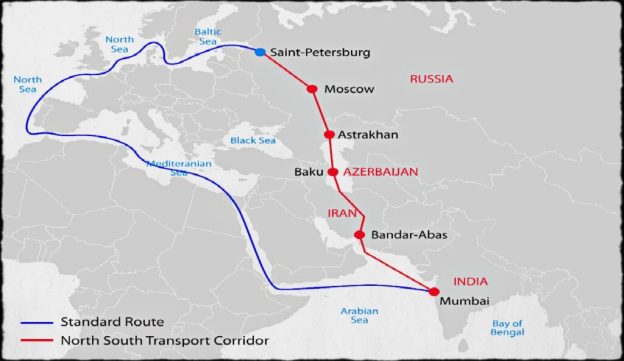
Following agreements reached during the January official visit to Moscow by Seyyed Ebrahim Raisi, President of the Islamic Republic of Iran, to further develop and deepen bilateral relations between Iran and Russia, the countries have decided to jointly revive the North-South Transport Corridor. This decision has become particularly relevant against the background of the unlawful sanctions policy pursued by the United States and its Western allies against Russia and Iran, and Tehran’s and Moscow’s desire to establish trade routes that are not linked to the West.
In order to implement this decision, Iranian authorities are seeking to revive the recently stalled International North-South Transport Corridor (INSTC) project, which traverses Russian and Iranian territory and the two countries’ waters to connect with Asian export markets. As the Islamic Republic News Agency (IRNA) reported on June 11, in order to implement the International North-South Transport Corridor, the Islamic Republic of Iran Shipping Lines (IRISL) has initiated the transit of cargo from Russia to India or to South Asia through the project, using just one consignment note for the entire transit route.
According to Dariusz Jamali, director of the joint Iranian-Russian terminal in Astrakhan, such transits have taken place occasionally in recent times. However, this route has clear advantages: lower transport costs (such as port and customs charges in particular),shorter waiting periods for containers, faster delivery of goods, elimination of dangers in transferring empty or full containers, issuance of legal documents and compensation for possible losses, and faster banking transactions.
The first pilot Russian-Iranian transit proposed by IRISL consists of two 41-ton containers of wood laminated plastic. The consignor is in St. Petersburg and the transit port is Astrakhan. The cargo will then be transported by the Caspian Sea to the northern Iranian port of Anzali (Bandar-e Anzali) and then by road through Iranian territory from the port of Anzali to the southern port of Bandar Abbas on the Persian Gulf and further by sea to the Indian port of Nhava Sheva. IRISL is the operator. The estimated delivery time is 25 days.
It is assumed that the main Russian exports through Astrakhan could be cereals (wheat), timber and scrap metal.
This transport corridor could go to Afghanistan via Iran’s Sistan and Baluchestan Province. The plan for further joint use of the North-South Transport Corridor even includes the construction of a railway line that could bring goods arriving at Iranian Caspian Sea ports to the south-eastern port of Chabahar. In addition, the construction of a railway line from Chabahar to the Hajigak iron ore mine in Afghanistan, where India has made large investments, is also under consideration.
The International North-South Transport Corridor emphasizes the Russian port of Astrakhan and the Iranian Chabahar as bases for further transport to Eurasia. The development of the latter, as well as the construction of a large petrochemical complex and an export terminal near the port of Jask, are projects being implemented by the Iranian government as part of the Mokran coastal development strategy.
Nevsky Shipyard, which produces multipurpose dry-cargo ships of RSD49 (deadweight of 7150 tons, container capacity of 289 TEU) and 005RSD03 (container capacity of 225 TEU) projects, is also engaged in the work of the North-South transit corridor in building ships for the Caspian Sea.
As part of its increased participation in the North-South Transport Corridor, Iran is considering expanding international road transport cooperation with the countries participating in the Transport Corridor Europe-Caucasus-Asia (TRACECA) program, the Tehran Times reported, citing the Iranian Ministry of Roads and Urban Development. This issue was brought up in particular during a meeting between Aset Assavbayev, Secretary General of the Permanent Secretariat of the TRACECA International Transport Program, and Dariush Amani, Head of Iran Road Maintenance and Transportation Organization (RMTO). The negotiations focused on developing international road transport cooperation with TRACECA member countries and increasing the volume of transit traffic along the corridor. As you may know, the TRACECA International Transport Program, in which the European Union and 12 countries of Eastern Europe, Southern Caucasus and Central Asia now participate, was set up in Brussels in May 1993. The aim of the program is to strengthen economic ties, trade and transport links.
Russian Foreign Minister Sergey Lavrov plans to visit Iran in the near future to discuss, among other things, further steps of cooperation between Russia and Iran. The year 2022 has already seen two important visits in Russian-Iranian interaction. First, Iranian President Ebrahim Raisi’s visit to Moscow in January 2022, which was a clear diplomatic breakthrough for the new head of the Iranian government. And second, Russian Deputy Prime Minister Alexander Novak’s visit to Iran in May, which took place against the backdrop of unprecedentedly harsh sanctions imposed by the West in the wake of the Ukrainian events. The biggest change in regional policy is undoubtedly the prospect of a full-fledged free trade area (FTA) agreement with the EEU. It is expected to be signed by the autumn of this year to replace the interim FTA that came into force on October 27, 2019, and which has already had a positive impact on bilateral trade between Russia and Iran.
In the rapprochement between the two countries, Moscow takes into account the compromise position taken by Iran after the start of Russia’s special operation in Ukraine: while not proclaiming its support for Russia’s actions per se, Tehran has not joined the wave of international condemnation of Moscow, instead placing the main blame for what is happening on the US and NATO. Russia also takes into account that Iran’s potential as an economic partner far exceeds the current level of relations.
June 20, 2022
Posted by aletho |
Economics | India, Iran, Russia |
1 Comment
Iran’s nuclear agency chief has again blasted the International Atomic Energy Agency (IAEA) for repeating old allegations against the country’s civilian nuclear program, based on bogus Israeli claims.
Mohammad Eslami, the head of the Atomic Energy Organization of Iran (AEOI), addressing a press conference in the central Iranian city of Natanz on Thursday, said the false allegations made by the IAEA are detrimental to ongoing negotiations to revive the 2015 nuclear deal.
“Now that the negotiations for [the US] return to the JCPOA [nuclear deal] are underway, the same old allegations are being repeated by citing fabricated claims made by the Zionist regime,” Eslami said.
He was referring to the UN nuclear agency’s mention of the so-called PMD (possible military dimensions) file on Iran’s nuclear program, insisting that such schemes will not help negotiations.
Eslami stressed that the reasoning behind signing the 2015 nuclear deal – officially referred to as the Joint Comprehensive Plan of Action (JCPOA) – was the closure of false Western allegations about possible military applications of Iran’s civilian nuclear program under the PMD file.
He said the PMD file was supposed to be closed as a key condition for reaching the accord and lifting anti-Iran sanctions — based on extensive inspections of Iran’s nuclear facilities and activities by the IAEA over the past two decades.
“We, in turn, accepted limitations on our nuclear activities and thereby yielded on our certain rights as well as accepted inspections on the condition that previous accusations would be permanently revoked and that we would be able to continue our activities under strict inspection and trust-building engagements,” the official added.
Eslami said Iran continues to operate under the IAEA regulations, while defending the removal of surveillance cameras functioning beyond the safeguards agreement, in reaction to the anti-Iran vote at the UN agency’s board of governors meeting recently.
Last week, Eslami slammed the IAEA for politicizing Iran’s peaceful nuclear program under Israeli pressure while disregarding Tehran’s extensive cooperation with the UN agency after the adoption of a resolution against Iran — drafted by the US and its European allies.
Eslami justified Tehran’s refusal to provide the IAEA with films of JCPOA’s monitoring cameras, stressing that the accord between Iran and the 5+1 countries will only exist as long as both sides remain committed to it.
“Today they want to return to JCPOA, but then raise the same old reasons for starting the nuclear talks. So we, in turn, did not grant them access to the film of the JCOPA cameras,” he stressed.
“Psychological operations, media campaigns and political pressures and controversies against Iran have never produced results in the past and will now remain ineffective as well because the PMD file was closed in the past, and reopening it will in no way help them,” he added.
He said Iran was in possession of “less than three percent of the world’s nuclear reserves” but still “more than 25 percent of [IAEA] inspections” were carried out in Iran, while the regimes that have waged wars against Iran have never allowed inspections of their nuclear facilities.
Iran’s foreign minister Hossein Amir-Abdollahian, in his remarks on Thursday, also blamed the US for IAEA’s recent anti-Tehran resolution, insisting that the move was aimed at mounting pressure on Tehran to give concessions in Vienna talks.
Iran’s top diplomat made the remarks in a Thursday phone call with his Iraqi counterpart, Fuad Hussein, during which the two sides also discussed bilateral issues and regional developments.
Negotiations have been underway in the Austrian capital since April last year to restore the 2015 Iran deal, which the former US President Donald Trump unilaterally abandoned in May 2018.
After quitting the deal, Trump introduced what he called the “maximum pressure” campaign to bring Iran to its knees, a policy that has failed miserably. The Joe Biden administration, despite its initial pledge to reverse Trump’s hard-nosed measures, has failed to deliver.
Iran has cited Washington’s indecisiveness as the reason behind the stalemate in talks, as many key issues remain unresolved, ranging from the removal of all post-JCPOA sanctions to the provision of guarantees by the American side that it will not leave the deal again.
AEOI spokesman Behrouz Kamalvandi on Wednesday advised IAEA director general Rafael Grossi to refrain from “complicating the situation” by making political statements after the UN agency called on Iran to resume talks before things get “much more problematic.”
“I amicably advise Rafael Grossi, the director-general of the [International Atomic Energy] Agency, to distance himself from making unprofessional statements of political color intended for media consumption,” Kamalvandi said.
“It is clear that if there is a technical issue, it should be presented professionally within the framework of the Agency’s duties and followed through its channels and the usual mechanisms of the Agency. Obviously, the arena for such interactions is not the media.”
Kamalvandi was referring to Grossi’s interview broadcast on June 12 on CNN, in which he made unusually menacing tropes against Iran.
Grossi sparked a controversy after he traveled to Israel and met the regime’s leaders late last month, just before the IAEA board of governors meeting.
The IAEA’s annual report, experts believe, was based on documents supplied by Israel about Iran’s nuclear program, which Tehran has rejected as fabricated.
June 17, 2022
Posted by aletho |
Ethnic Cleansing, Racism, Zionism, Mainstream Media, Warmongering | IAEA, Iran, Israel, Sanctions against Iran, United States, Zionism |
Leave a comment
Although receiving miniscule media coverage, Thursday’s announcement that Israel had deployed military infrastructure to the UAE and Bahrain in the shape of radar systems, ostensibly to counter an alleged missile threat from nearby Iran, should be a cause for concern amongst onlookers.
Coming in the same 24 hour period in which Israeli Prime Minister Naftali Bennett paid a surprise visit to the Emirates, and in which Israeli Forces bombed Damascus International Airport, the announcement that both Abu Dhabi and Manama had agreed to host Israeli military infrastructure should be seen as the first step towards current tensions between Tel Aviv and Tehran being placed on a possibly irreversible path towards conflict in the region.
Indeed, Israeli encirclement of Iran via Tel Aviv-allied Arab states possibly triggering a war between Tehran and both the UAE and Bahrain bears a stark similarity to the nine-year long build-up of provocations which would ultimately led Russia to launch a military intervention into neighbouring Ukraine in February of this year.
In November 2013, following the decision by then-Ukrainian President Viktor Yanukovych to suspend a trade deal with the EU in order to pursue closer ties with Russia, a CIA-orchestrated regime change operation, known as ‘Euromaidan’, would be launched in order to depose Yanukovych’s leadership and replace him with the pro-Western Petro Poroshenko – whose coalition government would contain rabid far-right sympathisers hostile to Moscow.
Indeed, such was the anti-Russian sentiment amongst the new US-backed Kiev government that the predominantly ethnic-Russian Donbass region in the east of the country would breakaway to form the independent republics of Donetsk and Luhansk in April 2014, following the previous month’s successful reunification of the Crimean Peninsula with the rest of Russia.
The establishment of these two pro-Russian Republics however, would spark a near eight-year long conflict in the eastern European country, in which Kiev would use neo-Nazi paramilitaries such as Azov Battalion and Right Sector to wage an ethnic cleansing campaign against the inhabitants of the Donbass.
In spite of Western media descriptions of ‘Russian aggression’ however, Moscow had sought to resolve the conflict in Donbass through peaceful mean via the Minsk Agreements – which would see both Republics granted a degree of autonomy whilst still remaining under the rule of Kiev.
With 14,000 dead in the Donbass conflict, NATO failing to honour a post-Cold War agreement not to expand eastwards, and the subsequent confirmation that US-funded labs were developing bioweapons in Ukraine however, Moscow’s hand was ultimately forced in February of this year when a Russian military intervention was launched into Ukraine in order to remove neo-Nazi elements from power and to destroy any military infrastructure that would ultimately have been used by NATO had Kiev gone on to become a member.
This is where the similarities with Iran and the neighbouring Gulf states of the UAE and Bahrain come into play, with both countries having formalised diplomatic links with Tel Aviv via the September 2020 US-brokered Abraham Accords.
Lauded as a ‘peace deal’ by the then-administration of Donald Trump, despite Israel, the UAE and Bahrain never actually being at war, the ‘normalisation’ agreements, coming eight months after the US had nearly triggered a new Gulf war with the assassination of Iranian Quds Force commander Qasem Soleimani in a drone strike, were seen by many geopolitical observers as a means to contain Iran within the region, a long-time foreign policy aim shared by both Washington and Tel Aviv.
Indeed, despite the relationship between Israel and both states initially starting off on a purely diplomatic basis, the announcement that Israeli radar systems are to be moved into both the UAE and Bahrain marks a dangerous step towards a scenario were Israeli military infrastructure is placed within striking distance of Iran – a situation that would likely lead to a major regional conflict, one that could reach far beyond the Persian Gulf.
Gavin O’Reilly is an Irish Republican activist from Dublin, Ireland, with a strong interest in the effects of British and US Imperialism; he was a writer for the American Herald Tribune from January 2018 up until their seizure by the FBI in 2021, with his work also appearing on The Duran, Al-Masdar, MintPress News, Global Research and SouthFront. He can be reached through Twitter and Facebook and supported on Patreon.
June 15, 2022
Posted by aletho |
Militarism | Bahrain, Iran, Israel, Middle East, UAE |
Leave a comment
Israel, the world’s eighth-largest nuclear power, initiated its nuclear program in 1952 with technological support from France and the US, the two countries most vocal about Iran’s peaceful nuclear program.
The first nuclear weapons were developed by Tel Aviv somewhere around 1967-1968, according to military think tanks. After that, the production accelerated rapidly, with zero international outcry.
Today, the regime possesses over 90 nuclear warheads with enough plutonium to produce at least 200 nuclear weapons. Around 5 kg of weapons-grade plutonium is required for one nuclear bomb.
Despite its nuclear program being an open secret – thanks to technician Mordechai Vanunu who blew the lid off Pandora’s Box back in 1986 – the regime has obdurately refused to confirm or deny it.
Vanunu, who worked at the Dimona nuclear facility, was in 1988 convicted of treason and sentenced to 18 years in prison. The same year he was also nominated for the Nobel peace prize.
Vanunu isn’t the only one to blow the whistle. In December 2013, former Israeli Knesset member Avraham Burg in a rare admission said the regime possessed both nuclear and chemical weapons, dubbing the official policy of nuclear ambiguity as “outdated and childish”. He was soon reprimanded.
What has emboldened Tel Aviv to accelerate its nuclear activities while wrapping a cloak of secrecy around them is Western sponsorship made possible by Zionist lobbying groups in the US and Europe.
The two countries most critical of Iran’s nuclear program are Israel’s staunchest allies, who helped the regime become a nuclear power. Israel’s weapons-grade fissile material stocks originated in France in the 1960s and the US in the late 1960s.
The US support, in particular, has allowed Israel to escape accountability for its diabolic activities. In a classic case of double standards, successive regimes in Washington have made a conscious effort not to talk about Israel’s nuclear arsenal despite making hullabaloo for non-proliferation in the region.
It began back in 1968 when then-CIA director Richard Helms informed President Lyndon Johnson that Israel had built nuclear weapons and that its air force had conducted aerial maneuvers to drop them.
Johnson’s response, on expected lines, was muted. A year later, at a meeting between just-elected President Richard Nixon and then Israeli premier Golda Meir, it was agreed that Washington will not force Israel to sign the NPT, which had opened for signature months before, in July 1968.
The US policy of silence continued, which helped the illegitimate regime in Tel Aviv escape the scrutiny of the UN nuclear agency. This silence amounted to both cowardice and complicity.
Importantly, and quite scandalously, Israel is not the signatory to the Nuclear Non-proliferation Treaty (NPT). It has repeatedly rejected calls to join the keystone accord of the international arms control regime and refused to give UN nuclear agency inspectors access to its nuclear sites.
Despite the regime’s dismissive approach, the International Atomic Energy Agency has adopted a remarkably soft approach to the point that many see collusion between the two.
IAEA chief Rafael Grossi’s whirlwind trip to Tel Aviv ahead of the UN nuclear agency’s board of governors meeting in Vienna earlier this week lent credence to the plausible Israel-IAEA collusion theory.
Grossi dashed off to Israel to discuss the anti-Iran resolution drafted by the US and the European troika with Israeli officials, aimed at mounting pressure on Iran to give up its legitimate demands.
Does it make sense that the IAEA chief meets the head of an illegitimate regime, which has secretly built a nuclear arsenal and refused to cooperate with the UN agency, to discuss the nuclear program of a country that has signed the NPT, cooperated fully with the agency and fulfilled all its obligations? It smells of something deeply sinister, extremely despicable.
The resolution against Iran at the IAEA board of governors meeting, which has already seen a “firm and proportionate response” from Tehran, blamed Iran for lack of cooperation with the UN agency.
For those unnerved by Iran’s decision to ramp up its nuclear enrichment capacity, it is essential to understand that the Islamic Republic claims its rights under Article IV of the NPT to pursue a peaceful nuclear program for energy purposes, unlike rogue regimes like Israel.
It’s also imperative to understand that the decision to scale up uranium enrichment from 3.65 percent stipulated in the 2015 nuclear deal came a year after former US President Donald Trump in a unilateral and illegal move pulled his country out of the landmark agreement, followed by reinstatement of sanctions.
The negotiations between Iran and the world powers to salvage the deal have been paused not because of Iran’s excessive demands or non-compliance but due to the West’s obstructionism. Iran did everything to save the deal but the other parties continue to make all-out efforts to kill the same deal.
The latest move to remove cameras operating beyond the NPT safeguards agreement at some Iranian nuclear sites and feed gas into machines including IR-6 is a milder reaction to the hostile move at the IAEA board of governors meeting.
As Iran’s nuclear body chief Mohammad Eslami stated, it’s preposterous that the IAEA has been taken hostage by the illegitimate regime, which raises questions over its credibility and independence.
Unless the agency comes out of the ominous Israeli shadow and makes a concerted effort to focus on its professional and technical mandate, beyond politics, Iran reserves the right to take remedial measures.
And as President Ebrahim Raeisi asserted unambiguously, the Islamic Republic will not back down even an inch. The writing is on the wall.
Syed Zafar Mehdi is a Tehran-based journalist, editor and blogger. He has reported extensively from Kashmir, India, Pakistan, Afghanistan and Iran for leading publications worldwide.
June 11, 2022
Posted by aletho |
Wars for Israel | Iran, Israel, Sanctions against Iran, Zionism |
1 Comment
Iran has rejected a resolution adopted by the IAEA’s Board of Governors (BoG) censuring it for not disclosing the site of three uranium enrichment facilities. Tehran claims that the IAEA’s findings are based on inputs from Israel, as the agency’s director general Rafael Grossi met the Israeli PM in Tel Aviv this month.
Iranian Foreign Minister Hossein Amir-Abdollahian has claimed that the US and its Western allies have “acknowledged” that Tehran isn’t looking to build a nuclear bomb.
“The United States and the West know that the atomic bomb has no place in Iran’s Islamic beliefs,” Abdollahian remarked during an address to Indian Islamic scholars in New Delhi, as per a video released by Iran’s Foreign Ministry on Thursday. The visiting Iranian FM was speaking through a Hindi translator.
The foreign minister kickstarted his maiden three-day visit to India on Wednesday, meeting Indian Prime Minister Narendra Modi, Foreign Minister S. Jaishankar and National Security Advisor Ajit Doval on the opening day.
“The West once acknowledged in the nuclear talks that they could ignore all their problems with Iran’s nuclear programme as long as Iran stopped supporting Palestine and recognised Israel,” Abdollahian remarked at the gathering.
“With such incorrect excuses, the West sought the recognition of Israel by the Islamic Republic of Iran in order to achieve their goals, which, of course, failed,” the top Iranian diplomat added.
Abdollahian declared that in spite of the Western countries’ appeals, Iran remained steadfast in supporting “the cause of Palestine”.
“Iran considers it its religious and moral duty to support the liberation of Holy Quds (Jerusalem) and is fully committed to it,” added the dignitary.
Abdollahian told his audience that he wanted to give them a sense of ongoing negotiations between Tehran and Western powers, seeking to bring the US back into the Joint Comprehensive Plan of Action (JCPOA), or the Iran Nuclear Deal.
Former US President Donald Trump unilaterally pulled Washington from the pact in 2018, but his successor Joe Biden has indicated his willingness to reverse the controversial decision.
Tehran Slams US, EU Allies for ‘Political Resolution’
The Iranian Foreign Minister’s remarks came hours after the 35-member Board of Governors (BoG) of the International Atomic Energy Agency (IAEA) overwhelmingly approved a resolution calling upon Tehran to take “urgent steps” to comply with the IAEA’s nuclear safeguards.
The resolution was co-sponsored by the US and the E3 allies—Germany, the United Kingdom and France. Russia and China were the only countries which opposed the resolution, while three nations, including India, abstained from the IAEA vote.
The resolution was floated after a report this month from IAEA’s Director General Rafael Grossi claimed the “presence of uranium particles of anthropogenic origin at Turquzabad, Varamin and Marivan”.
Grossi has said that the three sites weren’t previously disclosed under ‘Safeguards Agreement and Additional Protocol’ negotiated between Tehran and IAEA in March.
The Iranian Foreign Ministry has rejected the resolution as “political, incorrect and unconstructive action”.
“The adoption of the resolution, which is based on the hasty and unbalanced report of the Director General of the IAEA and based on the Zionist regime’s false and fabricated information, will only weaken the process of Iran’s cooperation with the IAEA,” the Iranian Foreign Ministry said in a statement.
Tehran has claimed that the locations cited by the IAEA DG had been cleared by the agency “once and for all” in December 2015 and weren’t supposed to be covered under the March 2022 pact.
June 9, 2022
Posted by aletho |
Wars for Israel | IAEA, Iran, Israel, Sanctions against Iran, United States, Zionism |
6 Comments
Samizdat – 09.06.2022
An Iranian tanker carrying oil was stopped off the Greek coast at the request of the US, based on unilateral sanctions targeting Iran’s oil trade. Tehran condemned Athens for bending to Washington’s orders and lambasted the impounding as an act of state piracy.
A Greek Appeals court overruled an earlier ruling that had prompted impounding of Iranian tanker Lana’s oil cargo in favour of the US, Iran’s embassy in Athens has stated. The confiscation of the cargo was earlier appealed by Tehran.
It is unclear if either Athens or the US will be challenging the decision of the Appeals court, however, an anonymous source claimed in an interview with Reuters that it might not be easy to achieve.
“The action for the reversal of the ruling was accepted by the court. It will be hard to overrule [the appeal court’s ruling]”, the legal source claimed.
The oil in question was removed from Luna to another vessel hired by the US authorities in May as the court was still reviewing Tehran’s appeal. It was then supposed to be moved to the US, but it is unclear if the ship transporting the Iranian oil, which now must be returned to the owner, has reached US shores.
Iran’s embassy in Greece expressed hope that the crude can still be returned. The embassy said that it is conducting “intensive consultations” with Athens to “ensure full implementation” of the court’s latest ruling.
“With God’s grace, the entire oil shipment will be returned [to Iran],” the embassy said.
The tanker Luna itself has since been released and arrested by Greek authorities again. The first time the ship was arrested was in April in a response to the order coming from the US, which slapped sanctions on Iran’s oil industry and now hunts for its oil tankers around the world. The second arrest, however, is related to unpaid towing services, according to report by Reuters citing a lawyer representing an unnamed company behind the arrest order.
Iran condemned the actions of Athens, equalling them to state piracy and vowing to respond. Several weeks later Iran seized two Greek ships sailing on the fringes of Iranian national waters, accusing both of “maritime violations”. Athens slammed the arrest of the ships sailing under its flag, while several media outlets alleged that their arrest could have been a retaliation for impounding Luna’s cargo.
Press TV – June 9, 2022
The secretary of Iran’s Supreme National Security Council (SNSC) says the change in Greece’s approach to illegal confiscation of an Iranian tanker on the US order proves that retaliatory measure is the best way to protect the country against bullying.
Ali Shamkhani made the remark in a Thursday tweet after reports indicated that a Greek court has overturned an earlier ruling that allowed the United States to confiscate part of a shipment of Iranian crude on an Iranian-flagged vessel seized in the European country’s territorial waters.
“The action for the reversal of the ruling was accepted by the court,” a source familiar with the matter said on Wednesday, Reuters reported. “It will be hard to overrule that (the appeal court’s ruling).”
The change in Greece’s behavior came after Iran’s Islamic Revolution Guards Corps (IRGC) retaliated Athens’ measure by seizing two Greek ships in the Persian Gulf for violations of rules and regulations. Tehran had already announced that it was going to take “punitive action” against Athens.
Reacting to the Greek court’s verdict, Shamkhani said, “The change in Greece’s behavior following Iran’s proportionate and powerful reaction to illegal seizure of its tanker on the US’ order, along with scores of other experiences, proves that the sole way to defend the country’s rights in the face of bullying, both in the case of JCPOA and in the [International Atomic Energy] Agency is retaliatory measure.”
Iran’s embassy in Athens on Thursday confirmed that the Greek Appeals court has overturned the initial ruling on the confiscation of Iranian oil following intensive follow-up.
“With God’s grace, the entire oil shipment will be returned [to Iran],” the embassy tweeted.
It added that the issue will remain on the agenda of “intensive consultations” between Iran and Greece to “ensure full implementation of the ruling.”
The embassy emphasized that preserving the Iranian nation’s rights is a red line.
Iran’s Foreign Ministry late last month summoned the Greek chargé d’affaires to protest the seizure of the Iranian-flagged vessel and confiscation of its crude cargo.
The ministry official condemned Greece’s “unacceptable” surrender to “illegal” US pressures and said the “seizure of the cargo of the ship” with the flag of the Islamic Republic of Iran was “an example of international piracy.”
June 9, 2022
Posted by aletho |
Malthusian Ideology, Phony Scarcity | Greece, Iran, Sanctions against Iran, United States |
Leave a comment
The Atomic Energy Organization of Iran (AEOI) announced on Wednesday that the International Atomic Energy Agency’s surveillance cameras recording data beyond the Safeguards Agreement in the country have been deactivated.
In a statement on Wednesday, the Atomic Energy Organization of Iran said while Tehran has extensively cooperated with the UN nuclear agency, the IAEA has unfortunately ignored the fact that such cooperation signifies Iran’s goodwill, has been ungrateful for the cooperation, and has considered it as a duty of Iran.
As a result, Iran decided to shut off the ultra-Safeguards Agreement cameras monitoring enrichment levels (OLEM or Online Enrichment Monitor) and flowmeters of the IAEA as of Wednesday, June 8, it added.
However, the statement noted, more than 80 percent of the IAEA’s cameras in Iran have access to data within the framework of the Safeguards Agreement which will continue to operate as before.
The OLEM is obviously used to monitor the enrichment of uranium gas through piping at the enrichment facilities.
The spokesperson for the AEOI visited a nuclear site on Wednesday to observe the process of deactivating the two cameras of the IAEA.
The Iranian authorities had already warned the parties seeking to submit an anti-Iran resolution at the IAEA Board of Governors meeting that they will have to take responsibility for the consequences.
The US and the EU troika –the UK, Germany and France- submitted the draft to the 35-nation board on Tuesday, accusing Iran of failing to offer transparent responses to the IAEA’s questions over nuclear activities at three sites.
June 8, 2022
Posted by aletho |
Aletho News | IAEA, Iran, Sanctions against Iran, Zionism |
2 Comments
The Vienna based International Atomic Energy Agency, the IAEA, is supposed to monitor compliance with the 1968 nuclear Non Proliferation Treaty, NPT, which has been described as the centerpiece of global efforts to prevent the spread of nuclear weapons, promote cooperation in the peaceful uses of nuclear energy and to achieve the ultimate goal of global nuclear disarmament.
The IAEA is supposed to engage upon technical, unbiased and professional cooperation with NPT signatories and to be free of politics or political considerations.
The IAEA has had a high profile role regarding Iran’s nuclear energy programme. In 2015, when Iran and the P 5+ 1 struck a deal known as a Joint Comprehensive Plan of Action. The IAEA was subsequently tasked with monitoring Iran’s compliance with the terms of the agreement.
In many of its reports over the years, the agency has said that it has found no evidence of any diversion in Iran’s nuclear programme.
As the fate of the faltering 2015 deal remains increasingly unclear, the technical role and supposed independence of the atomic watchdog are being tested.
In a recent report, the IAEA said Iran’s stockpile of enriched uranium had grown to more than 80 times the limit allowed in the 2015 agreement.
The agency also said Iran has failed to answer its remaining questions.
Tehran described the latest IAEA statements as one sided pointing out that it fails to reflect Iran’s extensive cooperation with the agency.
“The International Atomic Energy Agency seems to be succumbing to the same sort of takeover that the United States and the Anglo Zionist Empire has been doing to so many other international organizations such as, for example, in athletics, for example, in economics with the World Economic Forum, for example, all these organizations; they seem to want to control them.” – Tony Gosling, Investigative Journalist
Meanwhile, reports say Western countries lobbied by Israel are planning to push the International Atomic Energy Agency to criticize Iran at its upcoming meeting of the Board of Governors.
In March Rafael Mariano Grossi, the head of the International Atomic Energy Agency, visited Iran. The IAEA and Iran announced at the end of the visit that they had agreed on an approach for resolving remaining bilateral issues.
The visit came as representatives from Iran and the P 4+1 were trying to find a way to move forward in their negotiations which were aimed at reviving the 2015 deal. The talks are currently stalled with Iran saying the United States is failing to make necessary political decisions.
At this point, any stance by the IAEA could have an important effect on the stalled talks. This week Iran’s top diplomat said the agreement between Tehran and the agency in March was mutually satisfactory. He warned that political interference in the technical affairs of the agency is totally unconstructive.
The comments by Amir-Abdollahian came ahead of a meeting of the IAEA Board of Governors scheduled for June the sixth. With days left to the meeting the IAEA chief has arrived in Israel as Tel Aviv released documents alleging Iran spied on the IAEA.
Iran says Israel, which has refused to join the NPT and is believed to possess hundreds of nuclear warheads, hates the JCPOA and wants to derail the effort to revive it.
The problem with much of what the International Atomic Energy Agency has been doing is that it is trying to find excuses to, I suppose, make out that the Iranian nuclear programme is a military programme.
One of the problems with the IAEA is they’re not looking anywhere near as closely at the Israelis, who do have nuclear weapons.
“They tried to keep it secret, but Mordechai Vanunu blew the whistle in the Sunday Times here in Britain back in the 1980s and did a massive jail term for his, when he was kidnapped actually, for his trouble, that they do have many nuclear weapons, probably something like 200 …” – Tony Gosling, Investigative Journalist
Reports say the United States and its Western allies, pushed by Israel, plan to pile pressure on Iran at the upcoming IAEA meeting.
Tehran has warned that it would respond firmly and appropriately to any such move, because Iran has been cooperating based on the agreement reached in March.
The fate of months of negotiations between Iran and the P 4+1 seems to be at stake as a meeting of the IAEA Board of Governors draws close.
One wonders who would benefit from a possible collapse of the talks.
June 7, 2022
Posted by aletho |
Ethnic Cleansing, Racism, Zionism, Wars for Israel | IAEA, Iran, Israel, Middle East, Sanctions against Iran, Zionism |
1 Comment
Samizdat | June 6, 2022
The Biden administration might let more sanctioned Iranian oil flow into the global markets in an attempt to rein in fuel prices at home amid the run-up to the midterm elections in the US, according to a major independent crude trader.
“If the midterms are dominated by the need to get gas prices lower in America, turning a somewhat greater blind eye to the sanctioned barrels flowing out is probably something you might expect to see,” Mike Muller, the head of Asia at Vitol Group, told Dubai-based Gulf Intelligence on Sunday.
Gasoline prices have doubled in the US since President Joe Biden was inaugurated in January last year, according to last week’s data from the non-profit American Automobile Association (AAA). Global crude prices have been rallying in recent months, fueled by restrictions on Russian exports. On Monday, crude hit $120 a barrel as Saudi Arabia hiked prices for Asia.
The Trump administration reimposed sanctions on Iran’s oil, petrochemicals, shipping and other sectors in 2018 due to concerns over the country’s nuclear program. Talks between Tehran and world powers stalled in March and, according to Muller, the window of opportunity for the Biden administration to reach an agreement with Tehran has almost closed, but it could allow the transportation of Iranian crude anyway. In April, the US seized Iranian oil carried by a Russian tanker. Iran currently exports most of its oil to China.
June 6, 2022
Posted by aletho |
Aletho News | Iran, Sanctions against Iran, Saudi Arabia, United States |
1 Comment
The head of the Atomic Energy Organization of Iran (AEOI) says Tehran has given accurate answers to questions posed by the International Atomic Energy Agency (IAEA), but the Agency bases its reports on the information provided to it by the enemies of Iran.
In an interview with Al Jazeera network on Monday, Mohammad Eslami said the director general of the IAEA, Rafael Grossi, lacks serious will to describe Iran’s answers to the Agency’s queries as convincing.
“The International Atomic Energy Agency relies on the intelligence reports [provided by] our enemies, topped by Israel,” Iran’s nuclear chief said.
Eslami made the remarks after the IAEA chief, in his introductory statement to the Board of Governors’ meeting on Monday, once again repeated his anti-Iran rhetoric, alleging that since February 23, 2021, the Agency’s “activities have been seriously affected by Iran’s decision to stop the implementation of its nuclear-related commitments under the JCPOA, including the Additional Protocol.”
Grossi claimed, “Iran has not provided explanations that are technically credible in relation to the Agency’s findings at three undeclared locations in Iran.” Grossi’s allegation, however, came after his meeting with Eslami and the adoption of the two sides’ joint statement on March 5, 2022.
The AEOI and the IAEA agreed, in continuation of their cooperation as stated in the Joint Statement of August 26, 2020, to accelerate and strengthen their cooperation and dialogue aimed at the resolution of the issues, read part of the joint statement.
Grossi’s remarks came despite frequent warnings by Iran that in case the Agency drifts away from its technical nature and makes a politicized decision related to Iran’s peaceful nuclear program, the country will respond in kind.
Elsewhere in his interview, Eslami pointed to the possible adoption of an anti-Iran resolution during the ongoing meeting of IAEA’s Board of Governors and said even if adopted, such a resolution would not create a new situation.
Advising the UN nuclear watchdog to block political influence on its decisions and abide by its own regulations, the AEOI’s head said, “The IAEA has not condemned attacks on our [nuclear] facilities and this is a big question mark.”
Over the past years and amid lack of sensitivity and proper attention on the part of the IAEA towards performing a responsible role in the area of protection of various countries’ peaceful nuclear activities, some malign activities, for which the Zionist regime has implicitly accepted responsibility, have afflicted some damage to our country’s nuclear facilities.
Although these activities have never had a decisive effect on the progress of Iran’s peaceful nuclear program, given the sensitivity that is inherent to the nature of nuclear work, adoption of new strategies in the structural, hardware, and software aspects have found a place on the AEOI authorities’ agenda so the nuclear facilities’ security can be completely ensured.
Eslami also rejected allegations that Iran is planning to build nuclear weapons, saying, “Nuclear weapons have no place in our strategies” and that all such allegations are nothing but spiteful accusations.
Asked about the IAEA’s access to information recorded by monitoring cameras it has installed in Iran’s nuclear facilities, Eslami said this issue depends on the fate of the ongoing talks in the Austrian capital on the revival of the 2015 Iran deal, officially known as the Joint Comprehensive Plan of Action (JCPOA).
“If other parties commit to all articles of that agreement, we are ready for full compliance with the accord,” Iran’s nuclear chief said.
Under the JCPOA, Iran accepted certain caps on its nuclear program in exchange for the removal of international sanctions.
The US, however, unilaterally abandoned the deal in 2018 and re-imposed crippling sanctions despite Tehran’s full compliance with its share of obligations.
June 6, 2022
Posted by aletho |
Wars for Israel | IAEA, Iran, Rafael Grossi, Sanctions against Iran, United States, Zionism |
Leave a comment
Samizdat | May 31, 2022
ATHENS – Greek largest opposition party, Coalition of the Radical Left – Progressive Alliance (SYRIZA), on Tuesday asked the Greek government to clarify the legal grounds for the confiscation of Iranian oil from a former Russian-flagged tanker at the request of the United States.
“What was the legal basis for the US request for legal assistance in confiscating oil from the tanker? Was the proposal of the [Greek] anti-money laundering authority to continue the detention of the Russian ship contrary [to the US request]? On what legal basis did the ship remain detained during the time between the cancellation of the original decision about its arrest by the anti-money laundering authority and the decision of the one-judge trial court of Chalcis to grant the US request?” the party said in a statement.
The party added that initially, the anti-money laundering authority decided not to confiscate Iranian oil or detain the tanker. US sanctions against Iran are not considered legal by the EU and Greece, the party noted.
The party also asked what actions had been taken for the immediate release of the crew, and why Greece did not receive significant support from the US, which initiated the process of confiscation.
Last Friday, Iran’s armed forces captured two Greek-flagged oil tankers — the Delta Poseidon and the Prudent Warrior — in Persian Gulf waters, reportedly in response to the seizure of the Iranian-flagged tanker Lana in Greek waters in mid-April on suspicion that it was avoiding EU sanctions. The US claimed that the vessel was carrying Iranian crude, subject to US sanctions, and requested that the cargo be handed over to it, despite later reports that it was a Russian-flagged tanker Pegas that had changed its ownership before entering Greek waters.
May 31, 2022
Posted by aletho |
Economics, War Crimes | Greece, Iran, Sanctions against Iran, United States |
Leave a comment


 Aletho News