A large explosion rocked the Arab Gas Pipeline in Syria on August 24 causing a blackout in the country’s capital Damascus and multiple other cities and towns.
The explosion occurred between the towns of Ad Dumayr and Adra the a result of a ‘terrorist attack’, according to Minister of Petroleum and Mineral Resources Ali Ghanem. The incident led to a pressure drop and cascading shutdowns of the country’s power stations. Authorities almost immediately extinguished the fire, but as of August 25 morning blackouts were still seen in many towns and even in the capital, with some power restored to hospitals and government buildings.
This is the sixth time that stretch of the gas pipeline has been hit by an explosion over the course of the Syrian conflict, Kharboutli added, refusing to speculate about possible causes of the latest blast. The US envoy for Syrian affairs James Jeffrey insisted that the explosion was likely an attack by ISIS.
Earlier, ISIS claimed responsibility for several drone and rocket attacks on Syria’s oil and gas infrastructure in the Homs desert. In April, a mysterious explosion also erupted on a natural gas pipeline near al-Shadadi in the province of al-Hasakah. This area is in the hands of the Kurdish-dominated Syrian Democratic Forces and the US-led coalition. Then, some sources also accused ISIS cells operating in the area. However, there are many more than just one suspect.
In January, Damascus said divers had planted explosives on offshore pipelines belonging to the Banias refinery on the Mediterranean coast, but the damage had not halted operations. This attack was likely conducted by Israeli forces.
The terrorist attack in Syria took place two days after a top Iranian nuclear official has for the first time described the July 2nd fire at the Natanz nuclear facility as sabotage.
“The explosion at the Natanz nuclear facility was a result of sabotage operations,” Behrouz Kamalvandi, a spokesman for Iran’s Atomic Energy Organization said adding that “Security authorities will reveal in due time the reason behind the blast.”
The fire at Natanz caused severe damage, setting back the development of advanced uranium enrichment centrifuges. On top of this, Iran was targeted by a series of strange explosions and fires at various military and industrial sites across the country.
These developments together with the attacks in Syria and the blast in the Lebanese capital, Beirut, raise more and more concerns that Iran and countries from the Iranian-led Axis of Resistance became a target of a major Israeli-led or even US covert destabilization campaign.
A new focus of tensions and uncertainties appears to be emerging in Iran. Recent reports from the Iranian authorities have concluded that the explosion at the Natanz nuclear plant had a criminal cause, most likely caused by a sabotage operation. Not many details have yet been provided about the completion of the investigations. The Iranian government has announced that more information about the case will be released soon but made clear the authorities’ certainty about the criminal nature of the plant’s fire.
In July, a major explosion hit the Iranian nuclear power plant at Natanz, used especially for enriching uranium – an essential activity for the development of nuclear technology. The explosion sparked a huge fire that caught the attention of the media around the world at the time. After the incident, no fatalities or leaks of radioactive materials were reported in the region, so the damage was considered low.
Immediately after the explosion, several rumors were spread about the real nature of the event, as it is common on such occasions. Some of the rumors claimed that Israel had triggered the explosion with the intention of damaging Iran in its nuclear development plans. At the time, all rumors were denied and no “conspiracy theory” was highlighted. Now, after the result of the investigations, such rumors have surfaced, but the Iranian government remains silent about them, stating that the investigations’ data will be revealed later.
Despite the uncertainties surrounding the case, the proximity of the date of the explosion in Natanz with other similar events in Iran brings us intriguing reflections and leaves many questions unanswered. In fact, since June, a series of repeated explosions at Iranian plants has been reported. In June, there was a major explosion at the nuclear power plant at Parchin’s military base in Tehran. This plant is the largest explosive factory for Iranian forces and is therefore a place of great strategic value for the country. Shortly thereafter, there was the event in Natanz, after which, in July, another major explosion occurred at the Isfahan power plant in central Iran. Still, not only plants have been victimized by mysterious explosions in Iran, but also several other facilities: on June 30, an explosion at a clinic in Tehran left 19 dead; in July, two people died in an explosion at a factory also in Tehran; also in July, a major fire in the port of Bouchehr destroyed several vessels, but left no victims. All these incidents have had no well-defined explanation and are therefore the subject of rumors.
The most curious thing is to note that the explosions occurred shortly after Iran intensified its uranium enrichment project. The withdrawal of the US from the 2015 nuclear agreement led Tehran to reconsider the national nuclear plan and to announce the resumption of the uranium enrichment program in the first half of June, on a date coincidentally close to the beginning of the series of explosions. Whether or not there is a causal relationship between both facts, the proximity of the dates is minimally interesting and justifies the suspicions and hypotheses raised by several experts. This is not a mere “conspiracy theory”: the possibility that foreign powers are sabotaging Iran’s nuclear program through some secret operations is quite plausible, regardless of whether it is factual or not.
Since the resumption of the uranium enrichment program, Iran has received several accusations from other countries, mainly from Israel, that it is planning to acquire an atomic bomb. Tehran vehemently denies such accusation, as it has done on many other occasions – according to various statements by Shiite religious leaders, the building of a nuclear bomb is condemnable according to the Islamic religion, so Iran, as an Islamic Republic, could not undertake such project. However, Iranian military progress remains intense and the results are visible. The country recently announced the development of a new long-range ballistic missile, causing even more negative reactions in the West and Israel, where the speech about a possible Iranian nuclear bomb is gaining strength.
In fact, we should expect the Iranian authorities to provide more information about the case and only then express opinions about it. For the time being, the most interesting thing to note is the war of narratives around Iran: even with several pronouncements denying the accusations, the United States and Israel maintain the claim that Tehran is building an atomic bomb as an official state discourse; on the other hand, the opinion of experts on possible sabotage against strategic installations of the Iranian government is classified as a “conspiracy theory” or “false rumor” and is immediately rejected.
There is, of course, an information war around the case. We do not know if it was foreign sabotage – and we may never know – but we do know that such subversive activities really exist and often happen.
Lucas Leiroz is a research fellow in international law at the Federal University of Rio de Janeiro.
The alliance between Venezuela and Iran seems to be taking new directions. The ties between the two countries began to strengthen in an economic sphere when, in the first half of 2020, Tehran started sending oil ships to Venezuela, circumventing the international trade rules imposed by Washington with the aim of blocking Caracas economically. Earlier this year, Tehran sent several cargoes of gasoline to Venezuela to help the South American country overcome fuel shortages, as well as equipment to help state oil company PDVSA overcome production and export difficulties during the crisis.
The presence of Iranian ships on the Venezuelan coast has been a real affront to the United States, which has always played a role of naval hegemony in the Caribbean. Recently, the United States claimed to have seized four ships carrying Iranian gasoline en route to Venezuela, prompting Washington to tighten sanctions on both countries. But the US was unable to contain the Iranian advance and now the alliance between Caracas and Tehran has advanced into a military step.
Recently, Venezuelan President Nicolás Maduro thanked Iran for helping the South American country overcome US sanctions on its oil industry. At the time, he said that Iran is helping to maintain all Venezuelan national governance but did not elaborate on how this cooperation was taking place. He said it was important to maintain secrecy on the topic because of the economic boycott imposed by the US – which he called a “brutal war”. However, Colombian President Iván Duque said last week that Maduro was interested in buying missiles from Iran, which Venezuelan officials denied, but later Maduro responded that Duke’s statement was a “good idea” and that he had not yet considered it .
Shortly thereafter, Maduro confirmed his interest in buying Iranian weapons. According to the Venezuelan president, Iran, possessing advanced military technology, can be a great partner of the South American country in case of possible attacks by the US. According to Maduro, buying Iranian missiles was not in his plans until the moment that Iván Duque gave him this idea by accusing him in a condemning tone of being acquiring such equipment.
“With Iran having tremendous military technology, buying short, medium and long-range rockets and missiles from Iran to defend against imperialist threats seemed like a good idea, [so] I gave the order to Defense Minister Vladimir Padrino to evaluate all potentialities and possibilities, and if it is possible and convenient, we will buy these missiles at the right time”, said Maduro in an interview with the state television channel” Venezolana de Televisión”. According to the Venezuelan president, the Duke’s pronouncement was intended to attack Venezuela to take international attention away from Colombia’s national problems, such as the massacres and murders perpetrated by drug trafficking militias and the great social crisis generated by the new coronavirus, however, it ended up arousing the Venezuelan government’s interest in buying such Iranian missiles.
Now, it seems that the possibility of buying Iranian missiles is being evaluated by Vladimir Padrino, leader of the Venezuelan Defense, and there is a great likelihood for the negotiations to be concluded, considering that there is a willingness on both sides for international cooperation since they have a common enemy. Looking at the case from a realistic point of view, it is very unlikely that negotiations between Iran and Venezuela started due to Iván Duque’s pronouncement. Both countries were probably already discreetly maintaining this dialogue and the accusatory and condemnatory pronouncement served only as an opportunity to make the news public. In fact, it seems that Duque’s words were a flawed blow: Venezuela was expected to deny the accusations and thus create a scenario of tensions and uncertainties, but, contrary to what was predicted by the Colombia-US coalition, Venezuela has made public its intention to acquire the missiles and now the alliance is almost official.
If the missiles are bought by Caracas, this will be a major blow to the American presence in South America and, at the same time, a major milestone for Iranian international projections. The most important thing to note is that this agreement has a much deeper dimension than mere military trade: everything indicates that it will only be the first step in a major military alliance. Venezuela will have its defense system strengthened and will guarantee greater security against possible attacks by both Americans and Colombians. Likewise, in a possible war against Washington, Iran will have the definitive support of Venezuela – a strategically well located ally, with its coastline pointing to the Caribbean Sea, an important area of American influence.
Lucas Leiroz is a research fellow in international law at the Federal University of Rio de Janeiro.
As expected, the Trump Administration delivered letters on Thursday to both the UN Secretary-General Antonio Guterres and to the president of the Security Council Dian Triansyah Djani notifying them that the United States is initiating the restoration of virtually all UN sanctions on Iran lifted under UN Security Council Resolution 2231.
This process, if successful, could lead to those sanctions coming back into effect 30 days from August 20. Explaining the move, US Secretary of State Mike Pompeo stated at the UN Headquarters in New York at a press conference that the US “will never allow (Iran) to freely buy and sell planes, tanks, missiles, and other kinds of conventional weapons. These UN sanctions will continue the arms embargo… also reimpose accountability for other forms of Iranian malign activity…
“Iran will be again prohibited from ballistic missile testing. Iran will be back under sanctions for ongoing nuclear activities – such as the enrichment of nuclear material – that could be applied to a nuclear weapons program,” Pompeo added.
In essence, the US has triggered the “snapback” process notifying the security council that Iran is breaching the JCPOA (2015 Iran nuclear deal), whereupon, the council’s members or its president must introduce a resolution to continue the suspension of the UN embargoes under 2231.
The battle lines are drawn. An overwhelming majority of UN SC members are opposed to the US move. A US resolution last week seeking extension of the UN arms embargo on Iran met with crushing defeat with only the Dominican Republic supporting it. In a scathing criticism, New York Times wrote that the US has “largely isolated itself from the world order.”
On Thursday, UK, France and Germany issued a joint statement questioning the US’ credentials to make such a move, saying, inter alia, “The U.S. ceased to be a participant to the JCPOA following their withdrawal from the deal on 8 May, 2018… We cannot therefore support this action which is incompatible with our current efforts to support the JCPOA.”
Politico in a dispatch from Berlin wrote that the US move has left European allies in “an awkward position … For now, the European strategy is to play for time. If Pompeo triggers the snapback, they’re likely to look for ways to delay a final decision until after the November 3 presidential election in the hope Joe Biden would reverse Trump’s course.” Russia and China have explicitly rejected the US move, too. On Thursday, Russia sought an “open debate” at the Security Council, but the US promptly shot it down.
Of course, the UN SC’s rotating presidency — held by Indonesia through August — could simply ignore the US notification of Iran’s noncompliance with the JCPOA. (But Pompeo said he’s “confident” the notification won’t be ignored.) If the US pushes ahead and imposes its will, Russia and China may proceed to defy the “snapback” sanctions.
Tehran has warned that it will strongly react to “snapback” sanctions. A range of options remain open to Iran, including exit from Nuclear Non-Proliferation Treaty. Tehran remains defiant: on Thursday, it unveiled a new ballistic missile (named after Gen. Qassem Soleimani) and another cruise missile.
Indeed, a confrontation that irreparably damages the standing of the UN SC is in no one’s interest. President Trump himself did some kite-flying recently that he could get a deal with Iran within four weeks if re-elected. On Tuesday, Trump’s son-in-law and senior advisor Jared Kushner appealed through Voice of America to Iranian President Hassan Rouhani to engage with Washington. “For President Rouhani, I would say it’s time for the region to move forward. Let’s stop being stuck in conflicts of the past. It’s time for people to get together and to make peace.”
Trump seems open to shifting course after November. Despite the failure of his “maximum pressure” approach, Trump wants a deal with Iran that outdoes Obama. Which means that after the election, freed from Jewish donors and conservative Evangelicals, a shift could be more likely on his part than a continuation of the status quo.
This is where President Vladimir Putin’s proposal of August 14 on the holding of an online summit of the five permanent members of the UN Security Council, Germany and Iran soon to focus on the JCPOA implementation issues — to “set out steps to avoid confrontation and tensions in the UN Security Council” — comes into play.
Trump has rejected Putin’s proposal “for the time being” with a hint he may revisit it after November. On Wednesday, Kremlin spokesman Dmitry Peskov also hinted that all is not lost. Peskov said: “Indeed, the US rejection does not allow us to gather in this format as it was proposed from the start.
“However, it does not mean that the dialogue with the other states is halted on the Iranian issue. This dialogue for the sake of viability of the JCPOA and for the sake of settlement will definitely be continued.”
Indeed, much is happening elsewhere on the template of Russian-American relations. The NBC News disclosed on August 16 quoting “four people familiar with the subject” that Trump has told aides he’d like to hold an in-person meeting with Putin before the November election.
The Administration officials have since “explored various times and locations” for a summit, including potentially next month in New York.
The report added, “The goal of a summit would be for the two leaders to announce progress towards a new nuclear arms control agreement … One option under consideration is for the two leaders to sign a blueprint for a way forward in negotiations on extending New START.” This was almost exactly what I had predicted. (See US snapback sanctions on Iran not easily done, Asia Times)
A Russian-American confrontation over Iran — with all its ramifications for international security — is not on Trump or Putin’s calculus. Trump lost a great deal of time through his first term to improve relations with Russia but being a consummate deal maker, he hasn’t given up hope.
Nor has Putin. An agreement to renew START is one offer from Trump that Putin cannot afford to spurn, something he’s been keenly seeking, as it could open pathway for a resumption of arms control talks that would not only strengthen strategic balance and make US-Russia relations more predictable but enhance Russia’s global standing.
Furthermore, Trump at this point in time also hopes to win over Russia and isolate China. Putin, being a realist, would know the contradictions in US domestic politics that might stymie Trump’s belated effects to cap and rollback the slide in US-Russian relations. Equally, Putin believes in the raison d’être of Sino-Russian entente, which is a strategic choice and necessity for Moscow — as unfolding events in Minsk only underscore.
Suffice to say, Putin will stick to his pragmatic foreign-policy trajectory that prioritises Russia’s national interests. He’ll accept Trump’s invitation to a summit.
In such a complex backdrop of shifting moods in big-power politics, it is neither in American nor Russian interest to get entangled just now in acrimonious confrontation at the horseshoe table in the UN Hqs in New York while preparations have begun for a likely Trump-Putin summit.
The moment is at hand for Putin to step in as mediator to navigate the US-Iran standoff to calmer waters — perhaps, even bring the two implacable adversaries to the negotiating table. In the current US election cycle, this can only work to Trump’s advantage.
It was Russia in June, now it’s Tehran. Don’t US analysts understand that Taliban fighters really don’t need any more motivation to target American troops? This is simply politicized (un)intelligence that isn’t fooling anyone.
According to CNN, the Iranian government has paid “bounties” to the Haqqani network, a terrorist group with close links to the Taliban, for six attacks on US and coalition forces in Afghanistan in 2019, including one on December 11 which targeted Bagram Air Base, north of Kabul, which wounded four US personnel.
This explosive allegation was contained in a Pentagon briefing document which was reviewed by CNN. While the bounties mentioned were attributed to an unnamed “foreign government,” CNN claims that sources “familiar with” the intelligence named the country as Iran. These bounties, and the attacks on US personnel they underwrote, played a role in the deliberations that led to the assassination of Major General Qassem Soleimani, the head of the Iranian Quds Force, by US forces in early January 2020, the network reported.
The CNN report comes on the heels of similar allegations regarding “bounties” paid by Russian military intelligence to the Taliban, likewise for the purpose of underwriting attacks on US and coalition personnel in Afghanistan. The Russian bounty story has since turned out to have been based upon uncorroborated raw intelligence deemed by senior US officials as being too poorly sourced to be actionable by the president or his senior advisers. The intelligence was leaked to the press regardless, in what appeared to be an effort to undermine President Trump’s ongoing efforts to forge a peace agreement with the Taliban and to embarrass him in the leadup to the 2020 presidential election.
At first blush, it appears that the CNN reporting is cut from the same cloth as was the Russian “bounty” story. First and foremost (as the CNN reports notes), the Haqqani network did not, and does not, need financial incentives from outside agencies to motivate it to carry out attacks against US and/or coalition targets. As such, even if payments were in fact sent from Iran to the Haqqani network, the likelihood that they were linked to the December 11 attack, or any other, is virtually nil.
The linkage attributed to the December 11 attack on Bagram Air Base and the decision by the US to assassinate Qassem Soleimani is likewise tenuous. In the days, weeks and months following the Soleimani assassination, the Trump administration was called to task by Congress and the media about its justification for the Soleimani strike. While a great deal of weight was given to a rocket attack on K-2 Air Base in Iraq on December 27 that killed a US civilian contractor, there was no mention at any time about any Iranian “bounty” scheme ongoing inside Afghanistan, despite the fact that a direct correlation between such a “bounty” and the need to kill Soleimani would have been a stronger argument in favor of the attack on the Iranian general.
US intelligence has claimed that Iran has been providing “modest” amounts of armaments to the Taliban on an ongoing basis since 2007, something both the Taliban and Iran deny. According to statements made by US intelligence spokespersons in November 2019, this assistance was beefed up in 2015 to assist the Taliban in confronting Islamic State (IS, formerly ISIS) inside Afghanistan. No mention was made of any “bounty” scheme, although Secretary of State Mike Pompeo did link the Iranian assistance to an attack on US forces in May 2019.
While there is evidence to suggest that Iran and the Taliban enjoyed some sort of a relationship dating back to 2007, this relationship seemed focused on supporting Taliban forces based out of western Afghanistan, along the border with Iran; there was no evidence that this relationship included the payment of “bounties” for targeting US personnel.
Moreover, there was no suggestion that at the time of the December 27, 2019 attack on Bagram Air Base, Iran was providing support to the Haqqani network, a Sunni terrorist organization with close links to Pakistani intelligence and which operates out of the Pakistani city of Quetta. Indeed, the first indication of an Iranian connection to the Haqqani network came in the aftermath of the signing of the US-Taliban peace agreement in February 2020, when fringe elements of the Taliban, including allies within the Haqqani network, broke away in order to continue the struggle against the US in Afghanistan.
Even this reporting is sketchy – the alleged Iranian-Taliban-Haqqani cooperation was in the “early stages of forming,” not indicative of the kind of maturity that would have had to exist to sustain any viable bounty scheme. Moreover, any cooperation that was still in its infancy in February 2020, could not have been the basis of an arrangement regarding an attack that took place in December 2019. Finally, an Iranian-Haqqani bounty scheme would fly in the face of the public commitment by the Haqqani network in support of the US-Taliban peace agreement. In short, the CNN report fails on matters of fact and logic.
The timing of the CNN report provides the greatest insight as to why such a poorly sourced and thinly argued claim would be made against Iran at this time, coming as it does on the heels of the US losing a major vote in the UN Security Council concerning the lifting of an arms embargo against Iran.
This embarrassing defeat, in which the US was only able to garner a single additional vote in support of its resolution, has set the stage for an even greater confrontation at the UN over so-called “snap-back” sanctions the US seeks to impose on Iran.
The Iran-Haqqani bounty allegation was leaked by persons in the US intelligence community who have no qualms about injecting manufactured and/or misleading intelligence into the American news cycle at a critically sensitive time, with less than 90 days remaining until the 2020 US presidential election. Instead of seeking to embarrass President Trump, this leak is designed to bolster the Trump administration’s argument that Iran is a threat worthy of sustaining a major confrontation at the Security Council which could threaten the legitimacy and viability of that organization.
In the end, the motives behind an intelligence leak are irrelevant. The US intelligence community, through its repeated use of well-timed leaks to influence policy by deceiving the American public about the truth, has shown itself to be a highly politicized institution that operates at the whim of nameless partisan operatives, and not in the best interests of the United States.
That it can still ask for and receive a budget in excess of $80 billion per year is a harsh indictment of just how decrepit the US system of government has become, where a blind eye continues to be turned when it comes to the blatant abuse of intelligence for purposes other than what it was intended for.
Scott Ritter is a former US Marine Corps intelligence officer and author of ‘SCORPION KING: America’s Suicidal Embrace of Nuclear Weapons from FDR to Trump.’ He served in the Soviet Union as an inspector implementing the INF Treaty, in General Schwarzkopf’s staff during the Gulf War, and from 1991-1998 as a UN weapons inspector. Follow him on Twitter @RealScottRitter
The choice of Vice-President, of course, is primarily about U.S. domestic needs. With BLM and wokeness pervasive in the western sphere, Joe Biden needed to, and committed himself to choosing a black woman, (Kamala Harris is half Indian and Jamaican), since the support of black voters will be crucial in November. But equally importantly, Harris, a career prosecutor, is very aggressive in her speeches — and that’s what Biden needs: i.e. someone with sharp elbows.
She is ‘woke’ on social issues, yet has been notably zealous in incarcerating pot-smoking LA youths, and paradoxically, drew “very little black support in the primaries”. However, in this era of mass protest, Harris will plausibly gild Biden’s ticket – as a Law and Order Vice-President. That counts. And the ‘woke’ contingent on Wall Street, they love her. That counts too.
But down to ‘brass tacks’: Does this tell us anything about Biden’s probable foreign policy, were he to prevail in November? Harris indeed has not adopted war and militarism as her platform – however she hasn’t offered a major foreign policy speech, either. Nonetheless, hers, is no blank page – she has very discernible stances.
Her ‘signature stance’ has been a strong commitment to Israel and to AIPAC: In March 2017, she told the AIPAC Policy Conference: “Let me be clear about what I believe: I stand with Israel – because of our shared values, which are so fundamental to the founding of both our nations.” At the 2018 AIPAC conference, Harris gave an off-the-record speech in which she recounted how, “As a child, I never sold Girl Scout cookies, I went around with a JNFUSA (The Jewish National Fund) box, collecting funds to plant trees in Israel”. And her husband is Jewish. (She skipped the 2019 conference, along with several other Presidential candidates.)
Apart from unwavering support for Israel (which the more panglossian amongst us may see simply as the entry-price to office in the U.S.), Harris has been noted for bellicose rhetoric toward North Korea and Russia, and for her reluctance to co-sponsor legislation aimed at preventing war with Venezuela and North Korea. In short, on such military intervention issues, she’s in line with—and sometimes to the right of—a hawkish Democratic establishment.
‘Move along: Nothing to see here!’ might seem the appropriate riposte: She’s just ‘boilerplate’ Democrat. Maybe that’s right. But to focus on this would be to miss the wood for the trees – for the foreign policy real action is happening almost unnoticed elsewhere.
Executive editor of The American Conservative, Kelly Beaucar Vlahos,warns that we might miss noticing the Neo-con “wolves, dressed in NeverTrumper clothing, sniffing around Joe Biden’s foreign policy circle, bent on influencing his China policy – and more” (emphasis added):
“Never-Trumper Republicans have been worming their way into the Biden campaign, offering to flesh out his “coalition” ahead of the election and pushing their way into the foreign policy discussions, particularly on China. Given their shared history with liberal interventionists already in the campaign, don’t for a second think that there aren’t hungry neoconservatives among them trying to get a seat at the table.
“Some hawkish Democrats may see the neocons as convenient allies in preserving an outdated interventionist mindset,” offers Matt Duss, who is Sen. Bernie Sanders’ longtime foreign policy advisor, who maintains close ties with the Democratic campaign to replace President Trump. “And of course, neocons are desperate for any opportunity to salvage their own relevance.””
A Daily Beast report at the end of last month quoted unnamed “individuals who work for conservative think tanks in Washington” acknowledging that they were “informally speaking with members of the Biden team in recent weeks”.
Their focus is said to be on the ‘failing China trade deal’, and Trump’s supposedly ‘weak posture’. Reportedly, they are “so frustrated with the U.S-China trade deal, and the Administration’s efforts to hold Beijing accountable, that they are willing to offer counsel to the Democratic nominee”. And moreover, are proposing not just support to the Democratic candidate, but also to provide guidance on ways to formulate a tough economic posture toward Beijing, (in order to undermine Trump).
In a later update, the Daily Beast says that with the election less than 100 days away, some members of Trump’s own inner circle are pushing him too in the hawkish direction – urging him to make a new bet: Rather than to put his chips on the trade deal, Trump would hit the electoral jackpot (they counsel) were he just to ‘blow it up’.
Four people knowledgeable about the issue told The Daily Beast that in the past three weeks, an internal campaign has intensified within the Trump administration to convince the president ‘to nuke’ the China trade deal.
The ‘back-story’ here is Biden’s campaign to expand its months of back-channel outreach to Republicans – with the goal of hitting President Trump on his signature campaign issue: China.
Interviews with several of the most prominent NeverTrump Republicans reveal that for now, the nascent effort to mobilise a ‘Republicans for Biden’ movement – alongside the extant Lincoln Project – is loosely defined, and could ultimately take a variety of forms. Essentially, however, Team Biden is being pressed by the Republican strategists to ‘out-Hawk’ Trump on China policy by taking a tougher line than the President. In other words, the campaign is setting up to be about who will be tougher – and will be fought out on the President’s key platform.
Kelley Beaucar Vlahos opines that: “It’s hard to think that real hardline conservative hawks on China, like Steve Bannon and the folks at the Committee on the Present Danger: China [see here] are involved in the Biden collusion. Some of them are certainly neoconservative … They’d be pushing for cold – if not hot – war from Trump’s Right – [and therefore would] not be hedging bets with Biden”. Vlahos continues:
“No, it can only be the establishment Republican types, perched at places like Brookings and AEI, who now see some sort of opening on the D-team. But if they seem like the mushy end of the Right flank, think again. These guys are charter members of the Washington foreign policy consensus, mixed in with neoconservative NeverTrumpers, like Eliot Cohen and Robert Kagan (his wife Victoria Nuland was a top neo-con official in the Clinton State Department) and who have despised Trump from the beginning. They think his America First foreign policy is “deeply misguided” and leading the country to “crisis.””
Ah – It is precisely here where the link back to the choice of Kamala Harris becomes more obvious. She is not likely to bring the Progressive Dems constituency to the Biden campaign (It would take Elizabeth Warren as VP to do that), and she has not had an impressive record of attracting the Black vote in LA. But, she would mesh-in seamlessly with the ‘Washington foreign policy consensus’, whilst still giving ‘the ticket’ a veneer of wokeness.
She thus could be an effective point person for NeverTrumper Republicans. This is a path down which Biden, it seems, is already embarked – at least as far as China is concerned. On domestic issues – such as energy – Biden tilts more towards Sanders, and even Alexandria Ocasio-Cortez (the latter sits on his advisory panel).
And Biden – if elected in November – may not last (or, at least, not attempt a second term). In which case, Harris could theoretically be front-runner for 2024 Presidential contest. And here is the point: If there is one area where these neo-con entryists despise ‘policy weakness’ as much as they do on China, it is Iran. On that issue, Harris is clear. She is an unreserved Israeli partisan.
Anyone therefore hoping for a softening of U.S. policy towards Iran, should Biden win, may be pinning too much hope on Bernie Saunders or ‘The Squad’ being able to ‘round off the sharp edges from U.S. foreign policy stances’ – they may be being overly-optimistic. It is just too obvious: As China veers towards Iran and the Middle East in search of energy-supply security, the temptation of any success with forcing a hawkish stance on China will be to link the two (Iran and China), and to try to push for a ‘kill-two-birds-with-one-stone’ policy stance.
Keep the eyes fixed on the neo-con ‘wolves’, not on Harris.
Many voices have been quick to enter the chorus of commentators hypothesizing the manifold possible causes of the devastating explosions which occurred on the afternoon of August 4 in Beirut which has led to mass anarchy and the surprising resignation of the government on August 11th.
While I have no great novel contribution to offer in that growing array of hypotheses (which are slowly turning into noise), I would like to share an insight which addresses a too-often-overlooked aspect of the role of Lebanon in the Great Game. Before proceeding, it is useful to hold in the mind several points of certainty:
1) The official narrative of a chance mishap of Turkish fireworks instigating the detonation of the 2700 tons of ammonium nitrate which had been sitting at the Port of Beirut for six years is entirely unbelievable.
2) This event should not beconsidered in any way separated from the anomalously large pattern of explosions and arson which have spread across the Arab and African worlds in recent weeks.
3) This pattern of chaos must itself be seen in the context of the clash between two systems: The collapsing NATO unipolar alliance on the one side and the New Silk Road-led multipolar alliance on the other.
The Matter of Causality
The Middle East has been labelled the “geopolitical pivot” of the world island by devout adherents to the Hobbesian worldview of Halford Mackinder such as Zbigniew Brzezinski, Henry Kissinger and Bernard Lewis. Today it is understood that whomever can either stabilize or destabilize this region can control the levers for the “world island” (Africa, Europe, and Eurasia)… and as Mackinder once said “who controls the world island, controls the world.”
In the case of Lebanon, the role that this region plays as “Pearl on the New Silk Road”, and intersection of all major civilizations of the globe, has shaped global policy considerations in Washington, London and Israel for the past several years. The destructive events underway Lebanon cannot be separated from the breathtaking spread of Belt and Road projects across Iraq, Iran, Syria and other Arab nations.
More than Coincidence
In the weeks surrounding the Lebanon disaster, Iran found herself the target of a vicious sequence of attacks as arson and explosions were unleashed beginning with the June 26 explosion at the Khojir Missile production complex, the June 30 explosion at a medical clinic killing 19, a July 2 explosion at the Natanz nuclear facility which set Iran’s centrifuge production schedule back by months and the July 15 fires at the Bushehr Aluminum plant. Additionally, and the UAE experienced its own anomalous fires which ravaged one of the most important markets in Dubai (luckily empty due to Covid-19) on August 5.
If any of these anomalies were taken individually, “chance” could always be blamed as culprit. However when one takes them all together and recognizes the revolutionary BRI-connected agreements currently being finalized between both China and Russia with Iran one gets a solid idea of the deeper causality underlying these apparently separate situations of chaos.
Iran and the New Silk Road
The fact is that the long awaited $400 billion China-Iran economic and security pact which is in its final stages of negotiation includes not only important oil for infrastructure agreements which will extend advanced rail and new energy grids to Iran. This program also includes an important military/security partnership which will dramatically transform the “rules of the game” in the middle east for generations. Elements of this pact include not only defense and intelligence sharing infrastructure, but also bolster China’s new digital currency the e-RMB which will circumvent western controls on trade.
Meanwhile Russia’s announced extension of the 20 year security/economic partnership agreement first signed in 2001 by Presidents Rouhani and Putin will certainly be finalized in the coming months. Iran has also made it’s interests in acquiring Russia’s S400 system well known and all geopoliticians understand well that this system which is spreading fast across all of Eurasia from Turkey to South Korea renders America’s F-35s and THAAD missile systems impotent and obsolete.
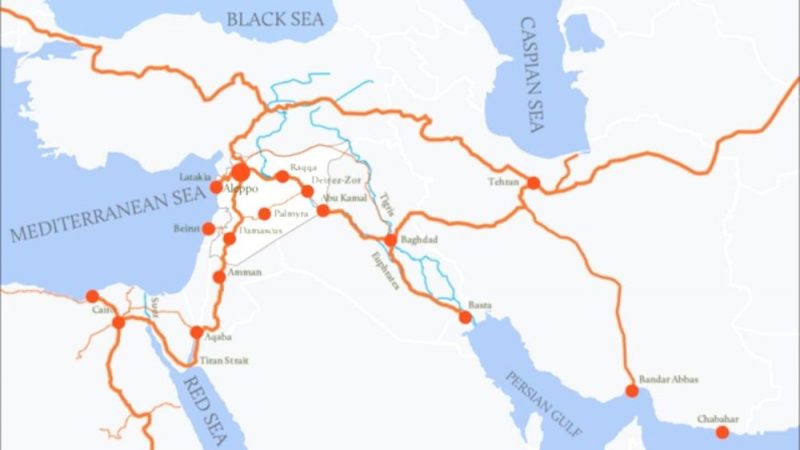
If the China-Russia-Iran triangle can be firmly established, then not only does America’s sanctions regime policy disintegrate, but a vital platform of Middle Eastern development will be established to better spearhead the growth of transport and advanced development corridors from China to the east (and Africa) along the New Silk Road. Since November 2018 an Iran-Iraq-Syria railway has taken great strides towards implementation as part of middle east reconstruction funded by Iran and ultimately connecting to Syria’s Lattakia Port as a hub to the Mediterranean and a 32km Shalamcheh-Bashra railway is in an advanced phase of development with Iran’s Minister of Roads and Urban Development Abbas Ahmad stating:
“Iran’s railway system is linked to railways of central Asia, China and Russia and if the 32 km Shalamcheh-Basra railway will be constructed, Iraq can transfer goods and passengers to Russia and China and vice versa.”
While the 32 km rail line would be phase one, the 2nd phase is scheduled to be a 1,545 km rail and highway to the Syrian Port.
The Iran-Iraq-Syria regional participation in the broader New Silk Road is incredibly important, especially since Iraq signed a September 2019 Memorandum of Understanding to join the BRI under a new infrastructure-for-oil program. This plan involves China’s reconstruction of the war-torn region under a multiphase program of hard infrastructure (rail, roads, energy and water projects), and soft infrastructure (hospitals, schools and cultural centers).
Similarly, China has made its intention to bring real reconstruction programs to Syria are also well known and President Bashar Al Assad’s long overdue Four Seas Strategy first announced in 2004 (and sabotaged with the Arab Spring) is finally coming back on line. President Assad had won 7 countries over to sign onto it’s construction by 2010 and entailed connecting all four major water systems (Mediterranean, Caspian, Black Sea, and Persian Gulf) together via rail and infrastructure corridors as a driver for win-win cooperation and regional modernization. Assad had said of the project in 2009 “once we link these four seas, we become the unavoidable intersection of the whole world in investment, transport and more.”
A video of this important project can be viewed here:
Lebanon: Pearl of the New Silk Road
Lebanon’s participation in this long-awaited process should be obvious to all, sharing as it does a major border with Syria, hosting 1.5 million Syrian refugees and also a vital port to the Mediterranean making it a keystone of east-west development. Connecting this emerging zone of development to Africa where the Belt and Road has emerged as a leading force of change and hope in recent years, Lebanon finds itself among the most strategic keystones.
Designs for rail connecting Lebanon’s Port of Tripoli through Jordan and thence through Egypt would create a new positive field of prosperity which could dramatically change the rules of the Middle East and Africa forever.
On June 17, 2020 the Chinese Embassy publicized an offer to extend BRI projects to Lebanon featuring a modern railway connecting coastal cities in the north with Tripoli through Beirut to Naquora in the south. China’s National Machinery IMP/EXP Corporation also offered the construction of three new power plants of 700 MW each, a new national energy grid and port modernization. The Embassy’s press release stated:
“The Chinese side is ready to carry out practical cooperation actively with the Lebanese side on the basis of equality and mutual benefit in the framework of joint work to build the Belt and Road… China is committed to cooperation with other nations mainly through the role of its companies, the leading role of the market, and the catalytic role of government and commercial operation. Chinese companies continue to follow with interest the opportunities of cooperation in infrastructure and other fields in Lebanon.”
These offers were applauded by Hassan Nasrallah (leader of Lebanon’s Hezbollah and partner in the coalition government) who had been an outspoken advocate of Lebanon’s participation in the BRI for years. Nasrallah has also advocated liberating Lebanon from the IMF whose structural adjustments and conditionality-laden investments have resulted in the small country’s debt exploding to over 170% of its GDP with nothing to show for it.
It is noteworthy that the same day China made its offers known publicly, Washington imposed the Caesar Syria Civilian Protection Act to punish all who wish to trade with Syria which itself has not only further crushed Syria’s cries for economic reconstruction, but had taken direct aim at Lebanon which sees 90% of Syrian goods flow through its borders to the Mediterranean.
When Chinese delegations first made their vision for the BRI’s extension to Lebanon known in March 2019 where the Arab Highway from Beirut to Damascus and rail to China was floated, western stooge Saad Al Hariri said no, preferring instead to sign onto a $10 billion IMF plan. Over a year later, not one iota of infrastructure was built. Secretary of State Pompeo played a major role at keeping Lebanon from “going east” as Nasrallah and even President Aoun had desired when he stated in a March 2019 press conference “Lebanon and the Lebanese people face a choice: bravely move forward as an independent and proud nation or allow the dark ambitions of Iran and Hezbollah to dictate your future.”
Pompeo’s obsessive drive to eliminate Hezbollah and especially the influence of Nasrallah in Lebanon has less to do with any perceived threat Israel claims to its existence and everything with Hezbollah and Iran’s embrace of China’s Belt and Road Initiative.
When Chinese offers were renewed in June 2020, Pompeo’s stooge David Schenker (Assistant Secretary of State for Near East Affairs) gave a June 23 interview stating that Hezbollah “is not an organization that seeks reform, but rather one that lives on corruption”. Schenker warned Lebanon from falling into the “China Trap” and said that Nasrallah’s demands that Lebanon “look east” was “shocking”.
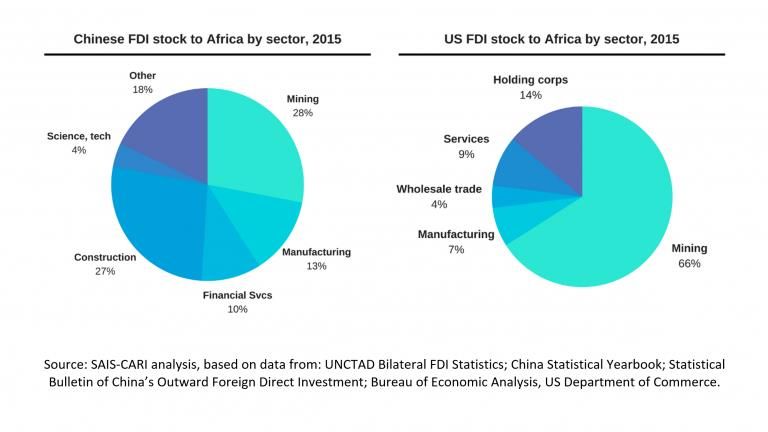
Without going into a lengthy refutation of the “China debt trap” argument (which is really just the effect of western imperialists projecting their own dirty practices onto China’s BRI), it is sufficient to say that it is a 100% myth. A summary overview of Chinese investments in Africa which are numerically similar to American investments demonstrates that the difference is found entirely in QUALITY as China uniquely invests in real construction, manufacturing and even African banking which are verboten by all imperialists who only wish to use Africa as a looting ground for cheap resources and cheaper labor.
“It is becoming obvious that a tiny country like Lebanon, but fully sovereign and independent can break the back of a global empire by opting to follow the path of progress, national sovereignty and international cooperation according to the win-win model offered by China. This does not mean cutting all bridges to the west. It is necessary to keep those that are in the true interest of Lebanon and its people. If the U.S. and Europe wish to change their policies and join China in offering Lebanon power, transport, water and agro-industrial investments, the Lebanese people and leadership would take them with open arms”.
On 13 August, US President Donald Trump announced that the United Arab Emirates had agreed to recognise and establish normal relations with the State of Israel, with a formal signing ceremony expected to take place at the White House within the coming weeks. The UAE will be the third Arab nation, after Egypt and Jordan, to do so.
Iran’s military considers the UAE-Israel deal to establish diplomatic ties “unfortunate,” and the Iranian military’s calculations in relation to Abu Dhabi will shift, given the new circumstances, Maj. Gen. Mohammad Bagheri, chief of Staff of the Armed Forces of the Islamic Republic of Iran, has said.
“Certainly, Iran’s approach to the UAE will change fundamentally and the Armed Forces will look at this country with different calculations. And if something happens in the Persian Gulf region and our national security is damaged, however small, we will hold the UAE responsible and will not tolerate it,” Bagheri warned, his remarks cited by Tasnim.
Bagheri stressed that “it is not too late for the UAE to reconsider its decision and to avoid pursuing a path which is detrimental to the security of the region and to itself.”
The UAE’s military consists of approximately 100,000 personnel, and the country regularly takes part in regional wars, including the Gulf War in 1990-1991, the War in Afghanistan (starting in 2007), and the Saudi-led intervention in Yemen, starting in 2015. The UAE formally announced a partial withdrawal of its forces from the latter conflict in 2019, and a shift in focus from fighting the Shia Houthi millitia to Daesh (ISIS) and al-Qaeda* terrorists operating in Yemen). The Al Dhafra Air Base outside Abu Dhabi is also known to host US Air Force combat, intelligence-gathering and tanker aircraft for Washington’s anti-Daesh operations in the region.
Last year, amid heightened tensions in the Persian Gulf in the wake of a string of tanker sabotage attacks, ship seizures and the destruction of a US spy drone by Iranian air defences, Iran proposed the creation of a coalition of Gulf nations, including the UAE, to help ensure the security of the Persian Gulf. In July 2019, coast guard commanders from the two countries met in Tehran to work to improve cooperation in the Strait of Hormuz.
Iranian officials have made no secret of their antipathy toward the UAE-Israeli diplomatic deal on normalisation of relations known as the ‘Abraham Accord’ announced last week by US President Donald Trump. On Saturday, Iranian President Hassan Rouhani called the agreement a “huge mistake” and a betrayal of the Arab World and the Palestinians. Also Saturday, the Islamic Revolutionary Guards Corps warned that the deal would have “dangerous” consequences for both parties if implemented.
A formal signing ceremony for the agreement is expected to take place in the coming weeks, and to be held in Washington. The UAE will be the first Arab nation in the Persian Gulf region to establish diplomatic ties with Israel, and the third Arab nation overall to do so after Egypt and Jordan, which normalised relations with Tel Aviv in 1979 and 1994, respectively.
Most Arab countries’ relations with Tel Aviv remain poor, and this state of affairs has reigned since the establishment of Israel in 1948.
SUNDAY WIRE show, host Patrick Henningsen is joined by global affairs analyst Mohammad Marandi from the University of Tehran, to discuss the recent developments in Beirut, Lebanon in the aftermath of the tragic explosion which destroyed the city’s port area and resulted in many dead and injured, as well as 300,000 made homeless due to ancillary damages.
Dr Marandi explains some of the legacy issues in Lebanese politics, as well as the true aims of US and its allies in the region, the geopolitical motivation behind punishing economic sanctions by Washington, and how these policies actually prevent delivery of regional aid, cooperation and prosperity among neighboring states. Listen:
The proposed 25-year deal between the Islamic Republic of Iran and the People’s Republic of China, titled “Comprehensive Strategic Partnership between I.R. Iran and P.R. China” has been heavily discussed recently. While not all details in the deal are clear, it has been described by Iranian and Chinese officials as specifying the roadmap of developing and deepening Tehran-Beijing ties in “Political”, “Executive Cooperation”, “Human and Cultural”, “Judiciary, Security and Defence”, and “Regional and International” domains.
It remains unclear when such a deal will be formally clinched. But Iran’s government says the two sides have so far finalized at least 75 percent of the draft version of the pact. Once concluded, the text of the deal will be discussed for final approval in Iran’s Parliament. However, many lawmakers are already critical of the government for not consulting the deal before entering into negotiations with China.
What has so far been made public is that the 25-year cooperation roadmap will cover economy, security and military areas. Iran will reportedly supply the PRC (People’s Republic of China) with oil for 25 years. In return, China will invest heavily in Iran’s infrastructure as well as banking and telecommunications sectors, amounting to some 400 billion dollars. Reactions, both inside and outside Iran have been mixed. Some inside Iran have criticized the deal since they believe that the Islamic Republic has negotiated it from a position of weakness, in order to escape the failing JCPOA deal and its aftermath – Washington’s maximum pressure campaign. Supporters of the deal argue that the deal is a political victory against what Beijing and Tehran have identified as a common opponent.
Naturally, the US State Department and anti-Iran Farsi media outlets based outside Iran have denounced the possible deal without even knowing all the details. The US State Department went on to issue tweets in Farsi, comparing the potential Iran-China accord to the 1828 Treaty of Turkmenchay which was a peace treaty between Qajar Iran and the Russian Empire. By the treaty, Iran had to cede to Russia control of most of its areas in the South Caucasus.
As per usual, social media is the main tool they use for their propaganda. Certain think tanks led by Western governments, particularly the United States spread rumours and lies. For instance, they have created various hashtags like “No to Iran Sellout!” This has been picked up by Iranian analysts too:
“Based on our monitoring of social media, we spotted the first analyses on the Iran-China cooperation plan in US media. What the mainly US media claim is reproduced in social media, particularly Twitter. Those who are active in cyberspace and social media include users affiliated with the Zionist regime, users affiliated with the Mujahideen Khalq Organization as they are supposed to insinuate wrong interpretations into public minds in Persian language. MKO agents based in Albania and benefiting from Western funding are involved. The Zionist regime and Saudi Arabia are also cooperating by spending money and offering human resources. From as early on as 1995, Iran has been aware of the importance of the Beijing- Tehran axis as a counterweight to the U.S.-led global order. Iran and China share a desire to engage in revisionist regional moves without wanting to start a large-scale war; to put an end to US imperialism and military supremacy in the Persian Gulf region. It is a valid question however, whether this will not lead to a Chinese show of military might in the region.
Our ties with some nations may be focused on a single aspect like agriculture, culture and energy. But with China, we have reached the conclusion that we can cooperate in academic, cultural and IT and economic sectors. And regarding the strategic aspects, our ties with some countries may be periodic. But the Islamic Republic of Iran and the People’s Republic of China eye long-term cooperation.“ – Hamed Vafai, China Affairs Analyst
The Iranians outside of Iran who oppose the deal are often pro-Western and echo the same lies spewed by Washington – for example when they claim that Iran has sold its soil to China, offering Beijing Iran’s Kish Island as a military base and so on. The sheer hypocrisy by Pro-US Iranians is mind-boggling. The things they accuse the Islamic Republic of doing for China are the same things their beloved “King” did for the US, if not even more. I don’t need to go into detail over how subservient the Iranian monarchy was to Washington.
Tehran has made it clear that this deal is to protect the Iranian economy from US sanctions, and that it will not cede any part of its soil to China. Tehran rejected the criticism saying is it aimed at appeasing the enemies of the Islamic Republic. “Unfortunately, a destructive line of propaganda has been initiated and directed from outside Iran against the expansion of Iran’s relations with neighbors and especially (with) China and Russia,” Iranian president’s chief of staff, Mahmoud Vaezi, said last week.
The Iranian foreign ministry spokesman, Seyed Abbas Mousavi dismissed unfounded claims of Iranian islands in the Persian Gulf being leased out to China, oil sold at exclusively low prices, or the deployment of Chinese armed forces in the Gulf, an invading force in Iranian waters that is. He said such claims were too ridiculous to even merit a denial. Apparently the Chinese response to the allegations was not so different.
So what’s in it for the parties involved?
There is no doubt that Washington’s withdrawal from the JCPOA and the subsequent sanctions imposed by Washington has left the Iranian economy in a very difficult position, especially since the EU has betrayed the deal as well. Part of the blame has been placed on the Rouhani government, which I believe to be wrong. It is counterproductive to assume that the Islamic Republic’s commitment to the JCPOA triggered the crisis since the pressure on Iran’s economy was no less severe before the JCPOA.
The trade deal itself is one of necessity as the West has failed to live up to their promises and proven once and for all that they can never be trusted. Not only have they reneged on their commitments, but they also continue to wage psychological warfare on Iran through propaganda and lies. Bearing in mind that Washington has forbidden many countries from doing deals with Tehran, I see no reason to be critical of this potential deal with the PRC as of yet. This is about the Islamic Republic’s very survival, something that the IRGC and the top leadership in Tehran have also recognized – which explains why they have remained so silent about it.
The potential partnership offers Iran a way out of the harsh US sanctions. For Iran this would translate into an injection of approximately 280 billion dollars for its energy sector and 120 billion dollars for manufacturing and transport infrastructure. In return for a discounted oil-flow to China and preferential Chinese access to various sectors of the Iranian economy, Iran would have its infrastructure given a much needed boost. The deal includes 100 projects which defy US unilateral sanctions against Iran.
China is the only remaining official buyer of Iranian oil and has strongly opposed Washington’s sanctions. It defies the US also economically together with Russia and Iran, as the three have attempted to replace the US dollar in their dealings, an act that inspired Pakistan and may have other regional states follow. Why wouldn’t the Islamic Republic with its free-falling rial want China as a potential shield against US sanctions and even motions at the UN Security Council? What other options does Iran have? To negotiate a new JCPOA with Washington, one which the US would at any time once more renege on? Besides, it should be known to all by now that the nuclear issue is not really why Washington is sanctioning the Islamic Republic.
The PRC is viewed in the West as a threat both because of its rising economic power, and more recently because of its potential political power, poised to challenge Washington’s hegemony. Crude accusations of Chinese imperialism and false expressions of “worry” for poor Asian and African countries aside, the West is worried because China’s entry into the Middle East would enhance Beijing’s position not only in West Asia, but in Central Asia and the Caucasus as well. For China, Iran could very well be a gateway into the Middle East, as it has historically also been. Iran has connections in Syria, Iraq and Lebanon where China has up until recently been absent, and their partnership could flourish as Iraq and Syria will rebuild their countries after decades of US imposed wars. The Islamic Republic can introduce lucrative projects to the Chinese who may not know the region quite well.
All this gives Washington clear reason to be annoyed since it would make the US sanctions rather useless. But Washington also knows that the implications of this potential deal are far greater than just helping Iran.
Washington knows that its position in the Middle East as the sole dominant power alongside Israel is being challenged by Russia, Iran and now China as well. The Zionist axis has lost the struggle for Syria and is desperately clinging onto the oil fields in the eastern parts of the country, they have lost in Iraq as Baghdad wants them out, and they will lose elsewhere too. Even Turkey – a NATO ally – is a loose cannon that Washington cannot trust, especially since Ankara has repeatedly refused to follow Washington’s orders. This leaves Washington with the vassal reactionary monarchies in the Persian Gulf and Israel as the only reliable “friends” of Washington’s. The birth of an alliance/united front with a common cause against the Zionist empire could potentially lead to an East-West divide situation not so different from the Cold War in Europe.
Personally, I welcome it. A bipolar balance in the region would deter Washington further from regime change attempts. The only reason for Washington’s audacity to start the Syrian and Iraqi wars were because of the power vacuum left after the dissolution of the Soviet Union – without a counter-weight against it, Washington has been free to do as it pleases in the region for the past 3 decades.
Necessity will drive China and Iran to deepen relations. Both share grievances against the US and its vassals, both are being threatened in their own regions by Washington and together with the Russian Federation, they can finally bring back a balance of power in the world. When it is all said and done, let’s see what these two ancient Asian cultures can achieve together.
Iranian Foreign Minister Javad Zarif has visited the Lebanese Embassy in Tehran to express his condolences following last week’s devastating blast at Beirut Port which has now claimed the lives of 200 people and wounded at least 5,000.
“Dr Zarif presented his condolences on the tragic incident that befell Beirut on the 4th of August,” tweeted Lebanese Ambassador Hassan Abbas. “He also expressed Iran’s readiness to provide support in the rebuilding and reconstruction process.”
Tehran’s Ambassador in Lebanon, Mohammad Jalal Firouznia, said on Saturday that Iran plans to play an active role in the reconstruction of the areas of the Lebanese capital affected by the explosion.
In addition to the several medical and humanitarian aid consignments sent to Lebanon by the Iranian government, Iran’s Red Crescent Society (IRCS) has established a field hospital in Beirut, with the city’s hospitals already at full capacity. Mehr news agency reported today that the IRCS said that it is fully prepared to send more aid if Lebanon requires it.
Many Lebanese citizens have been on the streets ever since the blast last week to protest angrily at the government, which has long been accused of corruption and negligence.
While expressing its solidarity and support for Lebanon, Iran has cautioned against “external provocation” by groups and other countries seeking to exploit and misuse the tragedy for political ends. Foreign Ministry spokesperson Abbas Mousavi said today that, “Clearly, some are pursuing specific [political] goals through external provocation.”
The US is putting Iran on regime-change notice, appointing Iran-Contra convict Elliott Abrams as Special Representative for Iran in addition to his duties as Special Representative for Venezuela, a State Department release shows.
Abrams, who oversaw a series of failed coups in Venezuela both in the past year and during the botched 2002 coup against then-President Hugo Chavez, will take over from Brian Hook, who has “decided to step down,” according to a press release from Secretary of State Mike Pompeo.
Pompeo lauded Hook’s efforts in the statement, declaring he had “achieved historic results countering the Iranian regime.” The outgoing official oversaw the Trump administration’s “maximum pressure” campaign against Tehran, leveling sanction upon sanction against the Islamic Republic after withdrawing the US from the JCPOA nuclear deal in 2018. Hook praised his own record to the New York Times on Thursday, declaring that “by almost every metric, the regime and its terrorist proxies are weaker than three and a half years ago.”
“We have been very successful,” he said.
Tensions between the two countries nearly spiraled into war in January after a US airstrike killed Quds Force leader Maj. Gen. Qassem Soleimani, provoking a barrage of missiles from Iran targeting two coalition bases in Iraq. The US has also flooded the Persian Gulf with military assets and placed bounties on Iranian ships and other military assets.
Abrams has been a ubiquitous presence in the US’ regime-change efforts in Latin America, helping to replace left-leaning governments with right-wing dictatorships in El Salvador and Guatemala and attempting similar makeovers in Nicaragua and Venezuela. In 1991, he pleaded guilty to two minor criminal counts regarding the Iran-Contra scandal, in which the CIA illegally funneled weapons to the Nicaraguan Contras. However, he was subsequently pardoned by then-President George HW Bush and went on to continue undermining democratically-elected governments under George W. Bush and Donald Trump.
The promotion comes ahead of a hotly-anticipated UN Security Council vote on extending the arms embargo on Iran. If the measure does not pass, the US has threatened to trigger “snapback” sanctions agreed upon as part of the 2015 nuclear deal – despite having pulled out of the deal years ago and therefore lacking an ability to enforce its provisions as a “participating nation.”
By Prof. Tony Hall | American Herald Tribune | July 28, 2016
The Kevin Barrett-Chomsky Dispute in Historical Perspective – Sixth part of the series titled “9/11 and the Zionist Question”
In his chapter on “Left Gatekeepers” and the “Shame of Noam Chomsky,” Barrie Zwicker refers to the the “New World Order” as the “diaboligarchy’s” directing agency. Less compelling is Zwicker’s reference to the “New World Order” as the “diaboligarchy’s” directing agency. To me this unfortunate choice of words is much too closely associated with the often crude and chauvinistic populism of Alex Jones and his Infowars media network. Many have come to see Jones’ lucrative media operation as a limited hangout set in place by handlers trying to hold the activities of the 9/11 Truth Movement within manageable constraints.
Due to the important findings over fifteen years of the citizens’ investigation into 9/11, the culprits most deeply implicated in the crime can be identified with much more specificity than an entity vaguely described as a “New World Order.” As Kevin Barrett and many others insist, the time has come to name the names of the probable culprits, Noam Chomsky prominent among them.
While Alex Jones ultimately serves the same masters as Chomsky, the former’s media product is often much closer to the mark of what is really going on than the content of Noam Chomsky’s more magisterial pronouncements. Jones goes at least part of the way into realities of the deep state politics of the twenty-first century. Chomsky, however, sacrificed his capacity to contribute cogently to sensible discourse on contemporary geopolitics by making himself a primary instrument of the most consequential deep state deception of recent times. As a leading agent of disinformation in the psychological trenches of the ongoing Global War of False Flag Terrorism, Chomsky has reduced himself to the level of skeptic pretender Michael Shermer. In the style of Shermer, the elder Chomsky has become an establishment TV professor readily available on Netflix. … continue
This site is provided as a research and reference tool. Although we make every reasonable effort to ensure that the information and data provided at this site are useful, accurate, and current, we cannot guarantee that the information and data provided here will be error-free. By using this site, you assume all responsibility for and risk arising from your use of and reliance upon the contents of this site.
This site and the information available through it do not, and are not intended to constitute legal advice. Should you require legal advice, you should consult your own attorney.
Nothing within this site or linked to by this site constitutes investment advice or medical advice.
Materials accessible from or added to this site by third parties, such as comments posted, are strictly the responsibility of the third party who added such materials or made them accessible and we neither endorse nor undertake to control, monitor, edit or assume responsibility for any such third-party material.
The posting of stories, commentaries, reports, documents and links (embedded or otherwise) on this site does not in any way, shape or form, implied or otherwise, necessarily express or suggest endorsement or support of any of such posted material or parts therein.
The word “alleged” is deemed to occur before the word “fraud.” Since the rule of law still applies. To peasants, at least.
Fair Use
This site contains copyrighted material the use of which has not always been specifically authorized by the copyright owner. We are making such material available in our efforts to advance understanding of environmental, political, human rights, economic, democracy, scientific, and social justice issues, etc. We believe this constitutes a ‘fair use’ of any such copyrighted material as provided for in section 107 of the US Copyright Law. In accordance with Title 17 U.S.C. Section 107, the material on this site is distributed without profit to those who have expressed a prior interest in receiving the included information for research and educational purposes. For more info go to: http://www.law.cornell.edu/uscode/17/107.shtml. If you wish to use copyrighted material from this site for purposes of your own that go beyond ‘fair use’, you must obtain permission from the copyright owner.
DMCA Contact
This is information for anyone that wishes to challenge our “fair use” of copyrighted material.
If you are a legal copyright holder or a designated agent for such and you believe that content residing on or accessible through our website infringes a copyright and falls outside the boundaries of “Fair Use”, please send a notice of infringement by contacting atheonews@gmail.com.
We will respond and take necessary action immediately.
If notice is given of an alleged copyright violation we will act expeditiously to remove or disable access to the material(s) in question.
All 3rd party material posted on this website is copyright the respective owners / authors. Aletho News makes no claim of copyright on such material.


 Aletho News