OPCW members condemn Israeli attack on Iran’s chemical facilities
Press TV – July 1, 2025
A majority of the member states of the Organization for the Prohibition of Chemical Weapons (OPCW) has condemned Israel’s recent acts of aggression against Iranian chemical and industrial facilities.
The condemnation was issued during a special session of the OPCW Executive Council in The Hague, convened at Iran’s request.
At the session, Hadi Farajvand, Iran’s ambassador to the Netherlands and permanent representative to the OPCW, highlighted the killing of women and children, scientists, and civilians, as well as the targeting of research centers, including petrochemical facilities and chemical research centers.
He cited the harm to civilians, the risk of chemical substance release, environmental damage, and threats to critical infrastructure.
Farajvand underscored a series of violations by the Israeli regime, including breaches of humanitarian law, disregard for international legal norms, violations of peremptory norms (jus cogens), failure to adhere to any treaties or conventions on weapons of mass destruction, and a record of attacks on chemical facilities in Syria and Lebanon.
During the session, Iran’s ambassador proposed that the OPCW Executive Council establish a working group aimed at adopting binding decisions to prevent attacks on chemical facilities during conflicts and called for appropriate measures to be taken in this regard.
During the 12-day aggression by the Israeli regime against Iran, several chemical facilities and fuel storage sites were targeted, resulting in significant environmental damage.
Iran unity foils West plans for regime change: Responsible Statecraft

Al Mayadeen | July 1, 2025
Washington is now looking into dividing Iran, with neo-conservative think tanks openly promoting the Balkanization of Iran, a strategy that is bound to destabilize Iran and the region, according to Responsible Statecraft on Tuesday.
United States foreign policy has a troubling tendency to promote the fragmentation of nations it deems adversarial.
Now, neoconservative think tanks like the Foundation for Defense of Democracies (FDD) and their allies in the European Parliament are openly pushing for Iran’s disintegration, a reckless strategy that would further destabilize the Middle East, trigger catastrophic humanitarian crises, and provoke fierce resistance not only from Iranians but also from US partners in the region.
Think tanks push for fragmentation based on ethnicity
Amid the war “Israel” waged on Iran in mid-June, FDD analyst Brenda Shaffer posited that Iran’s ethnically diverse population structure presented an exploitable strategic weakness.
According to Responsible Statecraft, Shaffer advocated for the disintegration of Iran along ethnic divisions, drawing parallels to the breakup of Yugoslavia, while concentrating significant efforts on fostering separatist movements in Iranian Azerbaijan, home to Iran’s largest ethnic minority group, the Azeris. However, she consistently failed to acknowledge her ties to the Azeri state oil company SOCAR.
Her position mirrors a recent Jerusalem Post editorial that, during the initial wave of triumphalism following “Israel’s” strikes in this month’s war on Iran, urged Trump to publicly endorse the dismemberment of Iran.
The editorial specifically advocated for forming a “Middle East coalition for Iran’s partition” while proposing “security guarantees for Sunni, Kurdish and Balochi minority regions seeking independence,” in addition to previously endorsing US and Israeli support for the secession of northwestern Iran’s Azeri-majority areas referred to as “South Azerbaijan” from Iran.
Popular uprising or scenarios for regime change?
Meanwhile, a foreign affairs spokesperson representing a centrist liberal faction within the European Parliament organized a discussion forum titled “The Future of Iran,” which while framed as an examination of potential pathways for what they termed a “successful” uprising against the current Iranian government, appeared to focus primarily on scenarios for regime change.
The panel’s composition featured only two Iranian speakers, both ethnic separatists from Azerbaijan and Ahwaz, revealing the organizer’s true agenda: promoting regime change.
Since unilaterally cutting ties with Iran’s official institutions in 2022, the European Parliament has become a platform for fringe exiled groups. These include monarchists, the controversial MEK (Mujahedin-e Khalq), and ethnic separatists, all of whom now operate with growing visibility in EU political spaces.
Delusions of division
What these think tanks and organizations forget, Responsible Statecraft highlighted, is that Iran is not a fragile country on the brink of collapse; it is a 90-million-strong country with a deep sense of historical and cultural identity.
While the proponents of the Balkanization of Iran focus on the ethnicities in Iran, they underestimate the unifying effect of Iranian nationalism on these diverse groups.
Shervin Malekzadeh, a scholar who recently wrote in the Los Angeles Times, observed that academic research overwhelmingly recognizes Iranian politics as fundamentally rooted in a profound, enduring national identity.
This identity transcends the country’s internal ideological divides, which means Iran’s political dynamics unfold within this unifying framework of nationalism, which has shaped all major factions, from monarchists to Islamists to leftists.
Foreign pressure only made Iran more united
Moreover, decades of foreign pressure, sanctions, covert ops, and war have only hardened Iran’s unity, making the separatist approach dangerously naive; this approach, pushed heavily by pro-“Israel” neocons, already failed in Iraq and Syria, leaving chaos instead of victory.
This approach further demonstrates its advocates’ glaring disregard for actual conditions, as seen with Shaffer, a leading proponent of Azerbaijani irredentism, who even applauded Israeli strikes on Tabriz, the cultural and economic center of Iranian Azerbaijan.
Beyond being morally reprehensible, this strategy fundamentally misreads Iran’s domestic realities, with Shaffer and like-minded advocates operating under the flawed assumption that increased external pressure on Tehran would spark rebellions among Azeris and other minority groups against the central government.
Contrary to separatist expectations, “Israel’s” recent attack produced the same rally-around-the-flag effect seen across Iran, demonstrating how deeply Iranian Azerbaijanis are woven into the national fabric, as evidenced by the fact that both the country’s highest officials, Iranian Leader Sayyed Ali Khamenei and President Massoud Pezeshkian, are of Azeri heritage.
Iran’s Nuclear Program ‘Remains Largely Intact’ After US Strikes
Sputnik – 01.07.2025
There are key factors casting doubt on the effectiveness of recent US attacks on Iran’s nuclear facilities, Russian nuclear expert Alexei Anpilogov tells Sputnik.
Iran’s uranium stockpiles remain large:
• About 3 tons enriched to 2%
• Over 3.5 tons enriched to 5%
• Hundreds of kilograms enriched to 20% and even 60% uranium-235
No signs of radiation leaks or toxic gas releases were reported after the strikes, suggesting the attacks did not reach underground uranium stores.
Satellite images show quick repairs:
• Explosion crater near the Natanz nuclear site filled in within 2 days
• Implies the damage was shallow and repairable
The US bunker-buster bomb (GBU-57) penetrates up to 60 meters only in soft soil:
• Iranian facilities are mostly under hard rock where penetration is limited to 2.5–18 meters — likely too shallow to destroy key targets.
Two likely scenarios:
1. Strikes damaged only surface structures (vent shafts, entrances).
2. Uranium was moved beforehand to secret sites unknown to US intelligence.
Tehran emerges stronger as Netanyahu’s Iran war backfires: FP
Al Mayadeen | July 1, 2025
In a scathing analysis of the recent 12-day Israeli war on Iran published by Foreign Policy (FP) on Tuesday, a senior nonresident fellow at the Center for International Policy, Sina Toossi, argues that Prime Minister Benjamin Netanyahu’s high-stakes offensive not only failed to achieve its strategic aims but also significantly undermined “Israel’s” long-term deterrence. The war ended swiftly, leaving behind no decisive victory.
The operation began with a wave of covert actions, decades of intelligence work culminating in drones assembled inside Iran, sleeper cells launching bombings, and high-profile assassinations. These were soon followed by a series of conventional airstrikes on military and nuclear sites, including Natanz and Fordow. But as Toossi notes, the campaign extended far beyond strategic targets: residential areas, prisons, media offices, and police stations were also struck, indicating a broader attempt to incite chaos and unrest.
According to the FP, the human cost was staggering. At least 610 Iranians were killed, including 49 women, 13 children, and five healthcare workers, with nearly 5,000 more injured. Medical facilities and emergency services were also hit. In response, Iranian missile and drone strikes on “Israel” killed at least 28 settlers, injured over 3,200, and displaced more than 9,000. Public infrastructure and buildings sustained extensive damage.
War on Iran fell far short of its objectives
Despite Netanyahu’s declared intention to cripple Iran’s missile and nuclear capabilities, Toossi argues the campaign fell far short of its objectives. Iran’s retaliation was swift and calculated, targeting Israeli settlements and strategic assets, reported FP. After the United States joined by bombing Iranian nuclear sites, Tehran escalated further, striking the Al Udeid Air Base in Qatar, a move that drew Washington deeper into the war.
Just 12 days after “Israel’s” initial strikes, a cease-fire was reached under undisclosed terms, leaving the regional balance precariously unresolved.
While “Israel” managed to inflict tactical damage on Iranian command and scientific infrastructure, Toossi stresses that strategic outcomes are what truly matter, and by that measure, the war was a failure.
Iran’s nuclear infrastructure appears largely intact. Intelligence reports suggest sensitive materials may have been moved ahead of the attacks. Moreover, Iran had already initiated construction of a fortified, undisclosed enrichment facility, possibly untouched.
The aftermath of attacking Iran’s nuclear facilities
In a critical shift, Iran’s parliament passed a bill to suspend cooperation with the International Atomic Energy Agency just days after the cease-fire. One Iranian lawmaker stated, “Why was our nuclear facility attacked, and you remained silent? Why did you give the green light for these actions?”
As Toossi warns, by attacking nuclear sites while demanding oversight, the US and “Israel” may have inadvertently legitimized the pursuit of a nuclear deterrent.
The FP argues that its ballistic arsenal successfully pierced both Israeli and US air defenses, targeting refineries, military bases, and research centers. Though censorship in “Israel” limited public data, over 41,000 compensation claims were reportedly filed due to war damage. Meanwhile, “Israel” expended an estimated $500 million worth of US-supplied THAAD missile interceptors.
A ceasefire was necessary to ‘save Israel’
Economic disruption was also severe. Ben Gurion Airport was shut down, financial activity slowed, and capital outflows surged. Former Trump adviser Steve Bannon bluntly stated that the ceasefire was necessary to “save Israel,” while Donald Trump admitted that “Israel” had been hit “very hard.”
In a revealing statement, Trump also announced that China would be permitted to buy Iranian oil to help Iran “get back into shape.”
That said, Toossi highlights how Iran’s retaliatory strategy was calibrated and symbolic. After an Israeli drone strike on an Iranian refinery, Iran responded by hitting a refinery in Haifa. After “Israel” attacked suspected nuclear research centers, Iran struck the Weizmann Institute of Science near Tel Aviv, long believed to be part of “Israel’s” nuclear research apparatus. These strikes demonstrated Tehran’s capacity for restrained but potent retaliation.
On the domestic front, instead of sparking internal collapse, the war triggered a surge of national unity across Iran. As Toossi observes, the strikes unified a polarized society in resistance to foreign aggression. Civil society, from Gen Z activists to artists and athletes, mobilized in solidarity. Citizens opened their homes to the displaced, and the indiscriminate loss of civilian life only deepened collective resilience.
Crucially, this war erupted just as Iran was re-engaging in nuclear negotiations with the Trump administration. Many Iranians had pinned hopes on the election of reformist President Masoud Pezeshkian and his promise of diplomacy and economic reform. Instead, they watched their country being bombed during peace efforts.
Netanyahu’s war boosts Iran’s unity and deterrence
Toossi contends that the long-standing belief in Washington that Iran’s government is one blow away from collapse has now been discredited. Far from eliminating the threat posed by Iran, Netanyahu’s war has exposed “Israel’s” vulnerabilities and rallied Iranian nationalism, the author stressed.
In a paradoxical outcome, the war may enhance Iran’s diplomatic leverage. Trump and his envoy Steve Witkoff continue to insist that Tehran must abandon uranium enrichment, yet Iranian officials, including Foreign Minister Abbas Araghchi, have reaffirmed: “Iran will never give up this right.” Meanwhile, Trump has floated lifting sanctions and allowing Chinese oil purchases as part of “great progress” toward de-escalation.
“Smart War” and State Terrorism
By Laurie Calhoun | The Libertarian Institute | July 1, 2025
On June 16, 2025, President Donald Trump threatened the 10 million inhabitants of Tehran, Iran, with death, for their government’s alleged nuclear aspirations.
The message was posted to the president’s Truth Social account, shared on X/Twitter, and then picked up by all major mass media outlets, making it common knowledge to everyone on the planet that Trump was preparing to join Israel’s war on Iran.
On June 17, 2025, President Trump directly threatened Iran’s Supreme Leader Ayatollah Khamenei with assassination.
Sometimes crazy people issue vague threats which they have no power to follow through on. Such persons are best avoided and ignored. In order to be effective, death threats must be credible, otherwise there is no fear generated in the persons being addressed, for they recognize that they are dealing with no more and no less than a feckless buffoon. Whatever one may think of President Trump, his menacing social media posts are credible threats, given his official role as commander-in-chief with the power to unleash formidable military might on the people of the world. In case anyone did not already know this, Press Secretary Karoline Leavitt reminded the press corps on June 20, 2025, that “Iran and the entire world should know that the United States military is the strongest and most lethal fighting force in the world, and we have capabilities that no other country on this planet possesses.”
Trump’s warning to the entire population of Tehran that they should all evacuate the city was a fortiori a credible threat, given the U.S. government’s wide-ranging “War on Terror,” during which both Afghanistan and Iraq were invaded and occupied. Several other countries were subjected to thousands of missile strikes “outside areas of active hostilities,” that is, where there were no U.S. troops present and thus no force-protection pretext for the use of state-inflicted homicide.
Verbal threats of the use of deadly force by a president often culminate in military action because the commander may be easily persuaded by his advisors to believe that he (and the nation) will lose credibility if he fails to follow through on his words, which, he is told, would be a sign of weakness. Predictably enough, then, on June 22, 2025, President Trump delivered on his threat to bomb Iran, although he claimed to have struck only three specific sites: Fordow, Isfahan, and Natanz. It was at these sites where nuclear enrichment and the development of nuclear arms were allegedly underway. The Trump administration’s Director of National Intelligence Tulsi Gabbard reported to members of congress in March 2025: “The [Intelligence Community] continues to assess that Iran is not building a nuclear weapon and Supreme Leader Khamenei has not authorized the nuclear weapons program he suspended in 2003.”
On June 17, 2025, when a journalist reminded Trump of Director Gabbard’s assessment, the president bluntly blurted out, “I don’t care what she said.” It has become increasingly obvious that Trump’s foreign policy in the Middle East is primarily informed not by his own cabinet but by the intelligence services of Israel, above all, Mossad.
For anyone unfamiliar with the modus operandi and general demeanor of Mossad, I recommend the films Munich (2005), The Gatekeepers (2012), and The Operative (2020).
That Trump has been decisively influenced by the government of Israel was further evidenced by his direct threat against Supreme Leader Khamenei and the fact that Prime Minister Benjamin Netanyahu has been calling for regime change in Iran for decades.
On June 20, 2025, two days before Trump’s missile strikes on Iran, Director Gabbard did an about-face, insisting that her earlier testimony before congress had been misrepresented and ignored her finding that Iran had been enriching uranium:
Gabbard’s retraction, or creative reinterpretation, of her former testimony bears similarities to the case of Bush administration Secretary of State Colin Powell, who initially opposed the 2003 invasion of Iraq and then for reasons which remain unclear suddenly became one of the mission’s most ardent supporters. In Powell’s case, he went even so far as to present the case for war to a less-than-enthusiastic United Nations Security Council. After a colorful Powerpoint presentation featuring an array of ersatz evidence—ranging from speculation about Iraq’s aluminum test tubes, to a receipt for “yellow cake” purchase, to photos of what were claimed to be mobile chemical labs—Powell recognized that he did not have the votes needed to secure U.N. approval and so abruptly withdrew the war resolution. The United States then proceeded to invade Iraq unimpeded, claiming, among other things, that the 2003 military intervention was legal because of previous U.N. resolutions violated by President Saddam Hussein. In other words, after having sought U.N. approval, the U.S. government suddenly denied that it needed such approval before invading Iraq anyway.
Unlike George W. Bush, when Donald Trump bombed Iran “at a time of his choosing,” as they say, he did not have the support of the U.S. congress. Presidents Barack Obama, Joe Biden and Trump all depended on the Bush-era AUMFs as they continued to lob missiles on several countries beyond Afghanistan and Iraq, including Yemen, Pakistan, Somalia, Syria, et al. But the carte blanche AUMFs granted to Bush in 2001 and 2002 had nothing whatsoever to do with the conflict between Israel and Iran. Neocons naturally devise all manner of interpretive epicyclic curlicues to arrive at the conclusion that Iran is in fact “fair game” for bombing. As stated and ratified, however, the AUMFs granted by congress to George W. Bush were intended to facilitate the U.S. president’s quest to bring justice to the perpetrators of the September 11, 2001 crimes.
Lest anyone forget, President Trump was not unique among twenty-first century presidents in bombing countries whose residents had nothing to do with the shocking demolition of the World Trade Center. President Obama effected a regime change in Libya without securing the support of congress because, he claimed, it was not really a war, since he was not deploying any ground troops. Secretary of State Hillary Clinton did her part to persuade Obama that “Gaddafi must go!” She later characterized the Libya intervention as a shining example of “smart power at its best,” even though a few U.S. State Department officials, including the ambassador to Libya, Christopher Steele, were killed in the post-bombing mêlée. Today, Libya is essentially a failed state. Obama himself has confessed that the biggest regret and worst mistake of his presidency (reported in The Guardian) was not having a plan for the aftermath of his supposedly “humanitarian” intervention, which he enlisted NATO to carry out.
In the immediate aftermath of the June 22, 2025 missile strikes, Trump officials followed the Obama administration’s Libya playbook in insisting that his attack on Iran’s nuclear facilities was not the beginning of a long, protracted engagement in Iran. This was meant to draw contrast with the unpopular multi-decade wars in Afghanistan and Iraq. Ignoring Trump’s threat to the residents of Tehran, Vice President J.D. Vance and others recited the Obama administration refrain that the mission was “not a war” with Iran. As Vance explained, the limited missile strikes were carried out only in order to dismantle Iran’s nuclear facilities. According to the government of Iran, a total of 610 people were killed and thousands more injured by the bombs of the U.S. and Israeli governments. However, none of the persons who perished were Americans.
Availing himself of the Obama-era “smart war” trope, Vice President Vance also observed that Trump’s preemptive military strikes differed from those of his predecessors because, unlike Trump, the previous presidents were “dumb”. Oliver Stone produced a film, W (2008), which persuasively portrays Bush as a half-wit, but no one ever suggested that Vice President Dick Cheney or the cadre of other war profiteers and neocons who coaxed Bush into preemptively attacking Iraq were stupid.
In any case, by now, the U.S. government has directly massacred so many thousands of people (and millions indirectly) in so many different countries, often located outside areas of active hostility (war zones or lands under occupation), that the citizenry has become largely inured to it all. Tragically, over the course of the twenty-first century, we have witnessed an apparently permanent paradigm shift to the profligate state use of homicide to terrorize and kill anyone anywhere deemed dangerous or even suspicious by U.S. officials or their contracted analysts. This radical paradigm shift was made possible by a new technology: the weaponized drone, which began to be used by the Bush administration first under a pretext of force protection in Afghanistan and Iraq. The Bush team effectively initiated the Drone Age by firing a missile on a group of terrorist suspects driving down a road in Yemen on November 3, 2002.
As the Global War on Terror stretched on and angry jihadists began to proliferate and spread throughout the region, President Obama assumed the drone warrior mantel with alacrity, opting to kill rather than capture thousands of suspected terrorists outside areas of active hostilities. In his enthusiasm for drone killing, Obama went even so far as to intentionally and premeditatedly hunt down and kill U.S. citizen Anwar al-Awlaki (located in Yemen at the time, in 2011), without indicting him, much less allowing him to stand trial, for his alleged crimes.
Following the Obama precedent, in 2015, U.K. Prime Minister David Cameron opted to execute British nationals Ruhul Amin and Reyaad Khan, who were suspected of complicity in terrorism, after they had fled from the U.K. to Syria, and despite the fact that the parliament had rejected Cameron’s call for war on Syria. Cameron’s missile strikes against British citizens located abroad was all the more surprising because capital punishment is illegal in the U.K. as well as the European Union, of which Britain was a member at that time.
One state-perpetrated assassination leads to another, and on January 3, 2020, President Trump authorized the targeted killing via drone strike of a top Iranian commander, Qassem Soleimani, who was in Baghdad on a diplomatic mission at the time. Trump openly proclaimed, and indeed bragged, that the homicide, which he authorized, was intentional and premeditated. According to the president, Soleimani was responsible for past and future attacks against both Israel and the United States. The summary execution of a specific, named individual would have been considered an illegal act of assassination in centuries past but today is accepted by many as an “act of war” for the sophomoric reason that it is carried out by a military strike rather than undercover spies armed with poisons or garrottes.
In view of Trump’s unabashed, vaunted, assassination of Soleimani, and his full-throated support of Netanyahu, the threat to liquidate Supreme Leader Khamenei was just as credible as the “evacuation order” to the entire population of Tehran. Leaders today exult over their use of cutting-edge technology to eliminate specific, named individuals, as though summarily executing the victims were obviously permissible, given that targeted killing is now regarded by governments the world over as one of the military’s standard operating procedures. Such unlawful actions were fully normalized as a tool of “smart war” during the eight-year Obama presidency.
Shortly after Trump officials went out on the media circuit to insist that the bombing of Iran’s alleged nuclear production facilities was not the initiation of a U.S.-Iran war, Trump took to social media again, this time to suggest that his administration’s ultimate goal might really be regime change:
Less than one day later, the new official narrative became that Trump had masterfully brought the “twelve-day war” to a miraculous close, thanks to his superlative deal-making capabilities.
All of this would be risible, if not for the fact that many millions of persons in Iran continue to live under a persistent threat of death, given the wildly unpredictable comportment of President Trump, seemingly exacerbated by his longstanding commitment to stand by Israel, regardless of how outrageously Netanyahu behaves. The more and more daring acts of assassination perpetrated by the government of Israel clearly illustrate where state-perpetrated homicide and its attendant terrorist effects under a specious guise of “smart war” eventually lead.
Targeting named terrorist suspects allegedly responsible for previous crimes swiftly expanded to include signature strikes against groups of unarmed persons designated potentially dangerous and located anywhere in the world—in Gaza, Lebanon, Syria, Iran, or anywhere else they please. The Israeli government has even deployed exploding cellphones and car bombs, the latter of which was once a tactic primarily deployed by dissident anti-government groups and crime syndicates. The repeated use by the Israeli government of car bombs to kill research scientists illuminates the slippery slope from missile strikes outside areas of active hostilities to what are empirically indistinguishable from Mafia hits. Car bombs have long been used by the Mafia and other nongovernmental organized crime groups, but the Israeli government openly perpetrates the very same acts under cover of “national self defense”.
Washington’s normalization of assassinations has emboldened leaders such as Netanyahu, who today conducts himself according to the principle “everything is permitted” in the name of the sacrosanct State. Witness what has been going on in Gaza since October 7, 2023: terrorism, torture, starvation, and summary execution. All of this is being condoned by every leader in the world who continues to voice support for, or even aids and abets, Netanyahu’s mass slaughter. This support for mass slaughter is provided ostensibly under the assumption that the perpetrators are doing no more and no less than defending the State of Israel.
Following the examples of U.S. Presidents Trump and Obama, and UK Prime Minister Cameron, all of whom publicly vaunted their assassination prowess, Prime Minister Netanyahu, having apparently recognized that the implement of homicide is in fact morally irrelevant, openly and brazenly executes persons determined by Mossad to be dangerous, with no concern for the thousands of innocent persons’ lives ruined along the way. In Operation Red Wedding, the Israeli government claimed to have dispatched, in a matter of minutes, thirty senior officials associated with the IRGC (Iranian Revolutionary Guard Corps) including military chiefs and top commanders located throughout Iran at the opening of the June 2025 “Twelve-Day War.” The operation was praised by the pro-Israel media as featuring “bespoke” acts of targeted killing made possible by “pattern of life” intelligence.
Drone assassination, successfully marketed by the Obama team as “smart war,” smoothed the way to the uncritical acceptance by many citizens of the reprobate expansion of state killing to include acts historically committed by members of nongovernmental organized crime. Looking back, the rebranding by U.S. officials of political assassination as an act of war, provided only that the implement of death is a missile, was a slick and largely successful way of persuading U.S. citizens to believe that extrajudicial, state-inflicted homicide abroad is an acceptable means to conflict resolution. Even though it bypasses all of the republican procedures forged over millennia, including judicial means, for reconciling the rival claims of adversaries.
In the maelstrom of the twenty-first-century wars on Afghanistan and Iraq, assassination was labeled targeted killing and successfully sold to politicians as “smart war,” a surgically precise way to defeat the enemy without sacrificing combatant troops. Whichever label is used, assassination or targeted killing, acts of summary execution by governments involve the intentional, premeditated elimination of persons suspected to be possibly dangerous, a criterion so vague as to permit the targeting of virtually any able-bodied person who happens to be located in a place where terrorists are thought to reside.
There are three differences between “targeted killing” carried out by drone warriors and assassination. First, the weapon being used is a missile. Second, drone operators wear uniforms, while undercover assassins and hitmen do not. Third, far from being “surgically precise,” drone warfare increases the slaughter of innocent bystanders in their own civil societies, which is facilely dismissed as the “collateral damage” of war. In this way, the advent of lethal drones and their use outside areas of active hostility has served to terrorize entire populations forced to endure the hovering above their heads of machines which may—or may not—emit missiles at any given time on any given day.
Credible death threats to heads of state and evacuation orders issued to millions of people not only terrorize the persons being addressed, but also undermine the security of the citizens of the United States. The populace will bear the brunt of the blowback caused by such reckless behavior on the part of officials who operate with effective impunity and are ignorant of or oblivious to the nation’s republican origins. By launching preemptive missile strikes, the Pentagon does not protect but sabotages the interests and well-being of not only U.S. citizens but also the citizens of the world.
Nonetheless, many U.S. politicians and members of the populace, along with heads of state such as Canada’s Prime Minister Mark Carney, U.K. Prime Minister Keir Starmer, Australia Prime Minister Anthony Albanese, et al., having been thoroughly seduced by the “smart war” marketing line, appear to have no problem whatsoever with the tyrannical and arguably deranged death threats of the U.S. president. They have become altogether habituated to the assassination of persons now regarded as a standard operating procedure of war. European Commission President Ursula von der Leyen effectively condoned Trump’s behavior by issuing this statement in the aftermath of the June 22, 2025 U.S. missile strikes against Iran: “Iran must never acquire the bomb.”
If terrorism is the arbitrary killing of or threat of death against innocent persons, then there can be no further doubt that the largest state sponsor and perpetrator of terrorism in the twenty-first century is in fact the U.S. government. President Trump inherited from President Obama and his mentor, drone-killing czar John Brennan (appointed by Obama as CIA director in 2013), the capacity to terrorize entire civilian populations and execute individuals at his caprice. No less than every drone strike launched in the vicinity of civilian populations beyond war zones, Trump’s completely unhinged threat to a group of people with nowhere to seek refuge, and no way of knowing whether the U.S. president is issuing a serious warning or simply bluffing, attempting some sort of perverse ploy to bring Iran’s Supreme Leader Khamenei back to the negotiation table (where he was, before Israel began bombing Iran), was an act of terrorism.
It is not “smart” to terrorize millions of human beings in the name of preventing terrorism. It is a contradiction, pure and simple.
Laurie Calhoun is a Senior Fellow for The Libertarian Institute. She is the author of Questioning the COVID Company Line: Critical Thinking in Hysterical Times,We Kill Because We Can: From Soldiering to Assassination in the Drone Age, War and Delusion: A Critical Examination, Theodicy: A Metaphilosophical Investigation, You Can Leave, Laminated Souls, and Philosophy Unmasked: A Skeptic’s Critique. In 2015, she began traveling around the world while writing. In 2020, she returned to the United States, where she remained until 2023 as a result of the COVID-19 travel restrictions imposed by governments nearly everywhere.
Pakistan won’t remain silent if US, Israel target Ayatollah Khamenei: Senator
Press TV – June 30, 2025
A Pakistani senator has condemned a threat by the US and Israel to target Leader of the Islamic Revolution Ayatollah Seyyed Ali Khamenei, saying it will trigger a response from all Muslim nations, including Pakistan.
Allama Raja Nasir Abbas Jafari, a member of the Pakistani Senate, described Ayatollah Khamenei as a religious leader and a Marja (religious authority), who is also a political leader.
Religious authorities issued a fatwa (religious decree) that says anyone who threatens the Leader is an enemy of God, whose punishment is death in Islam, he noted.
Between June 13 and 24, Israel waged a blatant and unprovoked aggression against Iran, assassinating many high-ranking military commanders, nuclear scientists, and ordinary civilians.
On June 22, the United States also jumped on the bandwagon and bombed three Iranian nuclear sites in a grave violation of the United Nations Charter, international law, and the Nuclear Non-Proliferation Treaty (NPT).
During the 12-day war, US President Donald Trump claimed that Ayatollah Khamenei was “an easy target.”
Benjamin Netanyahu of Israel also ranted that the assassination of Ayatollah Khamenei would “end” the war.
The Pakistani senator said Trump and Netanyahu should know that if an attack is carried out, it will not just be an attack on Iran, and all Muslims in the world will respond to it.
“We will respond in Pakistan as well; if such an action is taken, no American will remain in Pakistan. We will not remain silent when they (Trump and Netanyahu) do not abide by any law,” he added.
On Sunday, senior Iranian clerics Grand Ayatollah Nasser Makarem Shirazi and Grand Ayatollah Hossein Nouri-Hamedani issued religious decrees against any attack or threat to Ayatollah Khamenei.
They said that any person or regime that threatens or attacks the leadership and religious authority to harm the Islamic Ummah and its sovereignty is subject to the ruling of confrontation.
Agent of Chaos: Lindsey Graham’s Power Depends on War
By Ekaterina Blinova – Sputnik – 30.06.2025
Hawkish Senator Lindsey Graham got President Donald Trump to strike Iran, according to the Wall Street Journal. What’s he gaining from the Middle East war?
Darling of Jewish Lobby
- The Republican Jewish Coalition was Graham’s top donor in his 2020 re-election, giving $111,000 (OpenSecrets).
- Over $1 million more came via RJC, according to RJC’s executive director Matt Brooks.
- Brooks: “There is nobody more important in the US Senate” for the US-Israel partnership.
- He raised $109 million in total.
RJC: Longtime Supporter of Graham
- RJC leaders Larry Mizel and Sam Fox backed Graham’s 2014 re-election.
- Fox gave $50,000 and Mizel $100,000 to his super PAC, West Main Street Values.
- RJC board member Sheldon Adelson co-hosted a fundraiser for Graham’s 2016 presidential bid.
AIPAC is Another Backer
- Graham major backer, billionaire Mizel, also sits on AIPAC’s board — the top pro-Israel lobby in the US.
- Haaretz calls Mizel a key booster of pro-Israel Republicans who opens doors in Israel’s power circles for GOP politicians.
More Wars – More Defense Contractors Backing
- Lockheed Martin gave Graham $102,000 in 2020, according to OpenSecrets
- Boeing added $80,700 in 2024.
- The Intercept notes most cash comes from defense-linked individual donors — like Humvee mogul Ron Perelman, who gave $500,000 to Graham’s 2016 run.
Graham’s 2026 Senate Bid at Stake
- Graham’s hawkish Iran stance apparently ties to his 2026 ambitions – he needs big donor cash.
- RJC backs him as “one of the strongest advocates for the US Jewish community.”
- Defense firms will pay too—if he keeps the bombs dropping.
Can international institutions be reformed?
By Raphael Machado | Strategic Culture Foundation | June 30, 2025
It appears that Israel and Iran have postponed World War III and, for now, seem to adhere to the ceasefire negotiated by Donald Trump (likely with the help of other countries). But even if the “12-Day War” has stopped and missiles are no longer flying back and forth, doubts remain about the fate of Iran’s nuclear program.
The U.S. government insists that Iran’s nuclear program no longer exists, while Iran maintains that its nuclear program is still operational. All signs indicate that the Iranians are correct and that the U.S. is once again constructing a purely simulated parallel reality for the sake of narrative power projection.
But the main issue is not this—it is, in fact, something few have mentioned, as recently noted by Sergey Lavrov: the role of Rafael Grossi and the International Atomic Energy Agency (IAEA).
The IAEA was founded in 1957 as an “autonomous” agency—though linked to the UN—with the goal of monitoring nations’ use of nuclear energy to promote peaceful applications and prevent the construction of nuclear weapons. In this capacity, IAEA teams visit nuclear power plants, research centers, and other facilities related to national nuclear programs to conduct safety checks and oversee enrichment levels.
However, it is important to note that despite its claims of “autonomy,” the IAEA was established at the insistence of the U.S., shortly after the abandonment of the post-WWII “utopian” idea of keeping nuclear weapons under the exclusive control of the UN. The institution has always been closer to the interests of the Western Bloc than to those of the Eastern Bloc or the Non-Aligned Movement.
That said, in the past, the IAEA did challenge U.S. claims about weapons of mass destruction in Iraq, under the leadership of Hans Blix and Mohamed ElBaradei.
But even during ElBaradei’s tenure, there were signs of a shift toward Western alignment. In writings from that period, ElBaradei advocated for a revival of the utopian, globalist vision of nuclear energy monopolized by a “multinational” agency—much like the various Western agencies controlled or influenced by the U.S. ElBaradei himself became a collaborator with the U.S. after his term ended, participating in the color revolution orchestrated in Egypt against Hosni Mubarak.
It was only during Yukiya Amano’s leadership that the IAEA’s collaboration with the U.S. became evident, thanks to WikiLeaks revelations. According to documents obtained by Julian Assange, in a meeting between Amano and U.S. diplomats, Amano explicitly stated that he was aligned with the U.S. regarding staffing decisions and the stance to be taken on Iran’s nuclear program. This, of course, meant that Amano filled the IAEA with U.S. collaborators. He was later accused by IAEA staff themselves of having a pro-Western bias.
This context helps explain the behavior of Rafael Grossi, Amano’s successor.
Fast-forward to June: Grossi prepared a report accusing Iran of failing to meet its obligations to the IAEA and scheduled a board meeting for the same day Trump’s 60-day ultimatum on negotiations with Iran expired. According to CNN, the U.S. contacted several board members to persuade them to vote in favor of Grossi’s resolution. The purpose was to lend an institutional veneer of legitimacy to Israel’s attacks against Iran.
Grossi’s report was entirely based on information provided by Mossad, which alleged the existence of previously unknown nuclear facilities containing traces of enriched uranium.
All evidence suggests that Grossi was aware of the imminent attack and collaborated in creating a pretext to justify Israel’s actions. This is further corroborated by the fact that Grossi has never once turned his attention to Israel’s nuclear program, which remains entirely opaque, free from any international inspections.
In light of these revelations, it is alarming that, as Grossi told the Financial Times earlier this year, he intends to run for UN Secretary-General. Given his track record, it is plausible that he will have U.S. backing, which would greatly aid his candidacy.
Cases like this are not isolated. We have seen how the International Criminal Court (ICC) moved to accuse Vladimir Putin and Russia of “kidnapping” Ukrainian children. The World Health Organization (WHO), meanwhile, attempted to override national sovereignty during the pandemic. The IMF is routinely used to deindustrialize Third World countries.
The list could go on.
The key issue, however, is this: Given the current state of international institutions, can they be reformed?
Or will we need to abandon them—as Iran did with the IAEA—and build new ones from scratch?
Iran asks UN Security Council to recognize Israel, US as ‘initiators’ of aggression

Iranian Foreign Minister Abbas Araghchi
Press TV – June 29, 2025
Iranian Foreign Minister Abbas Araghchi has called on the United Nations Security Council to recognize the Israeli regime and the United States as the “initiators” of the recent 12-day aggression against the Islamic Republic.
“We solemnly request that the Security Council recognize the Israeli regime and the United States as the initiators of the act of aggression and their subsequent responsibility, therefore including compensation and reparation,” Araghchi said in a letter to UN Secretary General Antonio Guterres on Sunday.
“The Security Council should also hold the aggressors accountable and prevent the recurrence of such heinous and serious crimes to enable it to maintain international peace and security,” he added.
He emphasized that political and military leaders, who order an act of aggression, “are also individually liable for the international crime of aggression under customary international law.”
The top Iranian diplomat described the act of aggression as a “brazen assault” on the very foundations of international law, warning that tolerating it and its legal consequences seriously undermines the credibility of the United Nations system.
It also “poses a real threat to the rule of law at the international level and engenders lawlessness in the future of international relations in our region as well as the international community at large,” Araghchi pointed out.
In the early hours of June 13, the Israeli regime launched an all-out aggression on Iranian soil by targeting various military and nuclear sites, claiming the lives of dozens of top military commanders and nuclear scientists as well as ordinary civilians.
On June 22, the United States joined the Israeli regime in the assault and bombed three Iranian nuclear sites in a grave violation of the United Nations Charter, international law, and the Nuclear Non-Proliferation Treaty (NPT).
A day later, Iran launched a wave of missiles at al-Udeid air base in Qatar—the largest American military base in West Asia—in retaliation for the aggression.
As the Iranian armed forces pounded Israel and its military and industrial infrastructure, using many new-generation missiles that precisely hit the designated targets, the embattled regime was forced to unilaterally declare a truce deal on June 24.
In a letter to the United Nations secretary general and president of the Security Council on June 13, Araghchi said the Israeli regime’s act of aggression against the country amounts to a “declaration of war.”
“These oppressive acts are not only constitute a severe violation of sovereignty and territorial integrity of Iran as an independent member of the United Nations, but as per international law and international humanitarian law, including the Geneva Conventions, are among acts of aggression and war crimes,” he said back then.
From the War of the Cities to True Promise 3: Iran’s ballistic program and the path to networked deterrence
By Abbas Al-Zein | The Cradle | June 28, 2025
Under a regional sky long dominated by US and Israeli air and intelligence superiority, Iran made a fateful decision decades ago. It would not attempt to match its adversaries tank-for-tank or plane-for-plane, but would instead build an asymmetric deterrent from scratch.
Rather than chase the mirage of classical military parity, Tehran developed an indigenous ballistic missile arsenal that is now the largest and most formidable in West Asia. This was no short-term, tactical gambit. Iran’s missile doctrine was forged in an existential struggle, refined over war and siege, and ultimately transformed into a cornerstone of national defense policy.
The War of the Cities: Birth under siege (1980–1988)
The first phase of Iran’s missile journey began in the crucible of the devastating Iran–Iraq War, specifically during the infamous “War of the Cities.” As the Baathist government in Baghdad launched Soviet-supplied Scud-B missiles deep into Iranian urban centers, it did so under the protective umbrella of western intelligence and funding from Arab states of the Persian Gulf. The intent was clear: to break Iranian civilian morale through systematic terror from the sky.
Caught without a missile deterrent of its own, besieged diplomatically, and encircled by western-aligned forces, Iran turned to whatever resources it could muster. It secured limited quantities of Scud-B missiles from Libya, Syria, and North Korea. These early acquisitions, modest as they were, formed the embryonic core of a deterrent force placed under the direct command of the Islamic Revolutionary Guard Corps (IRGC).
But these were more than mere missiles. They were weapons of national dignity in a war for survival for the nascent Islamic Republic. Iran’s leadership came to view missile capability not simply as a tactical asset, but as a psychological and political necessity.
Military historian Pierre Razoux notes in The Iran-Iraq War (2014) that it was during this phase that Iran’s leadership came to the unshakable conclusion: without a retaliatory missile force, no psychological or strategic deterrence was possible.
The Iranian response was neither ad hoc nor passive. Alongside importing missiles, Iranian engineers began dismantling, studying, and maintaining the systems. They built smuggling networks, circumvented embargoes, and reverse-engineered technology.
North Korea emerged as a critical partner, acting as a conduit for Soviet missile know-how. A 2010 RAND Corporation report titled Iran’s Ballistic Missile Capabilities: A Net Assessment noted that Iran had become capable not only of replicating but also of redesigning and expanding missile technology independently. Between 2000 and 2010, Iran pivoted from mass production to innovation, prioritizing accuracy, range, and operational readiness.
The foundations of Iran’s ballistic doctrine were thus laid: sovereignty through technological independence, and defense through deterrence.
From imitation to innovation (1989–2009)
With the Imposed War over, Iran’s military establishment—spearheaded by the IRGC—began restructuring its defense priorities. The goal was no longer just to have missiles but to produce them independently and on a large scale.
At the heart of this transformation was the late martyred Brigadier General Hassan Tehrani Moghaddam, a strategic thinker and technical mastermind hailed as the ‘father of Iran’s missile program.’ He understood that deterrence was not about launching missiles, but about mastering their lifecycle: production, concealment, deployment, and precision.
Under his leadership, Iran transitioned from a user to a manufacturer. The Shahab-1 and Shahab-2 were enhanced variants of the Scud-B and Scud-C. But the real breakthrough came in 2003 with the Shahab-3, boasting a range exceeding 1,300 kilometers—a capability that placed US bases in the Persian Gulf and occupied Palestine within striking distance. The Shahab lineage would later give way to the Ghadr class, with better range and multiple warhead capabilities.
The most significant leap, however, came with the adoption of solid-fuel propulsion. The Sejjil missile (2,000–2,500 km range), unveiled by the end of the 2000s, was Iran’s first medium-to-long-range system not reliant on Scud technology. It signaled a new era of technological self-sufficiency and rapid-launch capability.
During this phase, Iran undertook sweeping strategic steps: adopting solid-fuel for easier storage and rapid deployment, establishing underground and mobile launch facilities to avoid detection, building decentralized manufacturing to reduce vulnerability to strikes, and integrating missile research into academic institutions to develop a domestic cadre of experts.
A 2010 report by the International Institute for Strategic Studies (IISS) titled Iran’s Ballistic Missile Capabilities: A Net Assessment noted that by this stage, Iran had moved beyond simply replicating foreign missile systems and had begun designing its own through local R&D and systematic redesign, including the establishment of underground manufacturing. From 2000 to 2010, Iran’s program pivoted decisively from quantity to quality, enhancing range, precision, and operational readiness.
When Moghaddam was killed in a suspicious explosion at the “Defenders of the Sky” base in November 2011, Iran declared it a national loss. While Israel neither confirmed nor denied responsibility, the Yediot Aharonot newspaper reported that “some assessments” indicated that the blast was “the result of a military operation based on intelligence information.”
Nevertheless, his legacy endured. He had not merely built a weapons system; he had established a sustainable missile doctrine rooted in adaptability and local expertise. His death marked the end of one era, but it also catalyzed the birth of Iran’s next missile generation.
Smart missiles and precision strikes (2010–2020)
By the 2010s, Iran’s goal had shifted from mass deterrence to precision deterrence. Engineers focused on guidance systems using inertial navigation paired with domestic GPS and anti-jamming technologies. The result was a suite of short- and medium-range guided missiles with enhanced tactical utility.
This generation included the Zolfaghar (750 km), the highly precise and compact Fateh-313 designed for preemptive strikes, and the Qiam—Iran’s first finless missile, engineered for stealth and maneuverability.
Iran also entered the low-altitude cruise missile domain, developing systems such as the Soumar (with a range of over 2,000 km) and Hoveizeh (with a range of 1,350 km), both capable of evading conventional radar and penetrating advanced air defenses.
These weapons were not theoretical. In June 2017, Iran launched six medium-range missiles from its territory targeting ISIS command centers in Deir Ezzor, Syria—its first operational cross-border use since the 1980s.
In January 2020, in direct retaliation for the US assassination of IRGC Quds Force General Qassem Soleimani, Iran struck the Ain al-Asad base in Iraq with Qiam and Fateh missiles. Satellite imagery showed sub-five-meter accuracy, hitting aircraft hangars and troop shelters. The New York Times described it as one of the most accurate missile strikes on a US facility in modern history.
This decade marked Iran’s shift from “deterrent” missiles to “executive” missiles—systems where political power was expressed through precision. It was no longer about maximum range, but maximum effect. The missile became a scalpel, not a hammer, paving the way for Iran’s most advanced deterrent doctrine yet.
The rise of networked deterrence (2021–2023)
By the 2020s, Iranian missiles were no longer stand-alone assets. They had become the final phase of a broader, integrated offensive system. Missiles now worked in tandem with kamikaze drones, electronic warfare units, cyber surveillance, and decentralized command structures. This was networked deterrence: a synchronized, multi-domain approach designed to penetrate and paralyze advanced air defense systems.
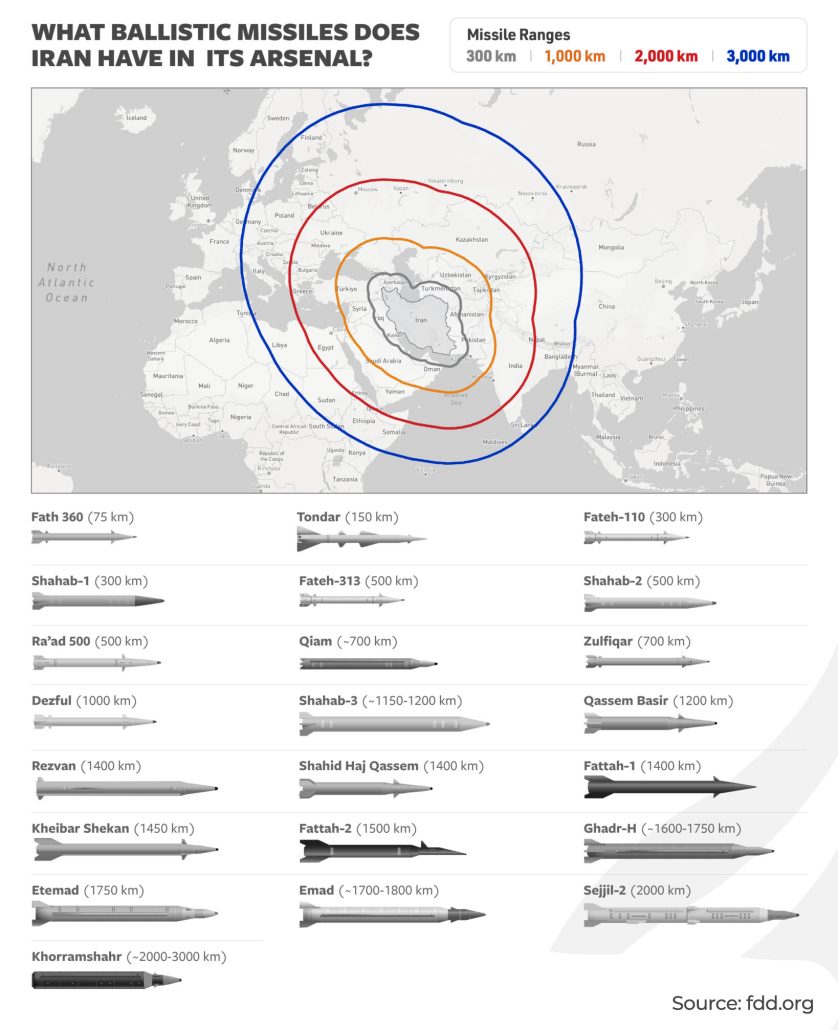
Under this doctrine, Iran developed new missiles tailored for layered operations. The Kheibar Shekan hypersonic missile (1,450 km, 500 kg warhead), most recently deployed in a multi-warhead configuration during Operation True Promise III against the occupation state, exemplifies this evolution.
Other critical systems include the Khorramshahr-4 (over 2,000 km), Raad-500 (solid-fuel, rapid launch), Zolfaghar Basir (optically guided, 1,000+ km), and Haj Qassem (1,400 km, 500 kg warhead)—all integral to Iran’s expanding offensive architecture.
By 2023, Iran fielded around 30 missile systems with ranges spanning 200 to 2,500 km. These systems, guided by jam-resistant platforms and launched from mobile or underground sites, were designed to render preemptive strikes both difficult and strategically ineffective.
From blueprint to battlefield: True Promise 3 (2024–2025)
In June, Iran operationalized its full deterrent in True Promise III, a massive retaliatory strike against the occupation state and its US backers. Triggered by Israeli aggression and building on limited predecessors, the operation was a turning point. It marked the battlefield culmination of four decades of Iranian missile doctrine.
What distinguished True Promise III was not just the firepower but the integration. Iran coordinated ballistic strikes, drone swarms, and electronic attacks into a single operational framework. For the first time, the world witnessed the seamless fusion of Iran’s missile and drone capabilities in a real war scenario.
The outcome upended assumptions in Washington and Tel Aviv. The missiles that struck deep into Israeli territory were not just instruments of reprisal. They were shields for the program itself—offensive deterrents capable of defending Iran’s retaliatory power by disabling enemy assets before they could act. The strike was not just a response; it was a preemption of the enemy’s preemption.
None of this can be divorced from Iran’s nuclear posture. The ballistic and nuclear programs may appear distinct, but they operate on the same doctrinal axis. The nuclear program symbolizes sovereignty; the missile program enforces it. Together, they dismantled the western fantasy that Israel could neutralize Iran’s deterrent capacities in a single blow.
That era is over. Iran’s missile shield is no longer just a threat. It is a reality, already in motion.
Strategic Misfire: Iran Torches Israel’s Attack
By Svetlana Ekimenko – Sputnik – 29.06.2025
Israel’s attack on Iran failed to achieve any of its objectives, said Iranian government spokeswoman Fatemeh Mohajerani in remarks to Al Mayadeen.
Israel’s operation Rising Lion to target Iran’s military and nuclear facilities amounted to a “strategic miscalculation” that only reinforced Iran’s resolve, stated Fatemeh Mohajerani.
Military Response
Claims that Israel weakened Iran’s defense capabilities are “for domestic consumption,” underscored the spokeswoman.
Iran’s defense system remains strong, self-sufficient, and built for both symmetrical and asymmetrical threats, she noted, adding:
“Our response was measured, legal, and effective – and it sent the message we intended.”
Nuclear Program Moving Forward
Iran remains committed to advancing its peaceful nuclear program via advanced tech development.
Mohajerani deplored the fact that the IAEA and its director general, Rafael Grossi, failed to “denounce the cowardly strikes.”
Iran’s parliament, she confirmed, has backed a bill to scale down cooperation with the nuclear watchdog.
Message to the West
Western silence or passive approval of Israel’s actions makes it “complicit in war crimes,” according to the Iranian government spokeswoman.
This conflict proves that “militarism and reckless policies do not bring security. They only deepen instability,” concluded Fatemeh Mohajerani.
No weapons-grade enrichment in Iran – Foreign Ministry spokesman
RT | June 29, 2025
Iran has no plans to obtain nuclear weapons but reserves the right to enrich uranium for civilian use, Iranian Foreign Ministry spokesman Esmail Baghaei told RT on Saturday. He condemned recent Israeli and US strikes on Iran’s nuclear facilities as dangerous and unprovoked.
Baghaei dismissed Israeli claims that Tehran had secretly been developing nuclear weapons, which were cited as justification for the attacks. Reports from the International Atomic Energy Agency (IAEA) support Iran’s position, he added.“I think Iran has made it clear for the past two or three decades that it is not seeking nuclear weapons,” Baghaei said. “There has never been weapons-grade enrichment in Iran. Please, you can go through the reports by the IAEA and show me one single clue or evidence of Iran’s nuclear program deviating from peaceful purposes.”
“It is a matter of fact that Iran’s nuclear program remains totally peaceful,” he said.
The spokesman referred to remarks by the global watchdog’s chief, Rafael Grossi, who stated earlier this month that the agency had found no evidence of “a systematic effort” by Iran to develop nuclear arms.
Baghaei also voiced frustration with the IAEA for not strongly condemning the strikes. “What is expected from the IAEA and its Board of Governors is to remain loyal to their responsibilities and mandates by condemning, unambiguously, the US and Israeli regime’s attacks on our nuclear facilities,” he said.
He further defended Iran’s right to enrich uranium under the Treaty on the Non-Proliferation of Nuclear Weapons (NPT).
“The US is offering a very dangerous interpretation of the NPT – that developing states have no right to use nuclear energy for peaceful purposes. It is not acceptable for any responsible, decent member of the NPT,” Baghaei said.
Earlier this week, Iran’s parliament passed a bill to suspend cooperation with the IAEA, accusing the agency of providing “a pretext” for the attacks.
Featured Video

ARE PATIENTS BEING PROPERLY INFORMED ABOUT OZEMPIC?
or go to
Aletho News Archives – Video-Images
New Book
Breast Cancer: Before You Consent
A new Unbekoming paperback
Lies are Unbekoming | September 18, 2026
Peter Gøtzsche reviewed every randomised mammography screening trial ever conducted for the Cochrane Collaboration. Cochrane’s headline is that, assuming a 15% mortality reduction, one woman in 2000 avoids dying of breast cancer over ten years. Ten are overdiagnosed and treated. Two hundred experience false alarms.
But that headline assumes the reduction. When Gøtzsche looked only at the trials with adequate randomisation — the higher-quality ones — the reduction disappeared. No effect on breast cancer mortality. No effect on all-cause mortality.
This is the Cochrane finding, published in the establishment’s own database of systematic reviews.
No woman being asked to consent to a mammogram this week knows it.
That is why the new Unbekoming paperback exists. … continue
Blog Roll
 Aletho News
- The Truth About the Trump Shootings with Ken Silva
- ARE PATIENTS BEING PROPERLY INFORMED ABOUT OZEMPIC?
- US lawmaker blocks $2.8 billion weapons sale to Israel: Report
- Yemeni army claims responsibility for strikes on sensitive sites in Saudi capital, Aramco facilities in Yanbu
- Iran Judiciary issues indictments against 159 US, Israeli officials for assassination of Leader, commanders
- Turkiye revokes Iranian bank license under US sanctions campaign
- US-Denmark Agreement on Greenland Is ‘PR Stunt’ Ahead of Midterms
- Araghchi: Military intervention cannot create security; coercion cannot bring peace
- Fraud Squared
- Breast Cancer: Before You Consent
- If Americans Knew
- Inside Gaza’s death trap of collapsing, bombed-out buildings
- The everyday items Israel bans from Gaza every day
- Inside the siege, the ruined buildings of Gaza – Daily Update
- Debunking The Claim That Macklemore Has A “History Of Antisemitism”
- CPJ demands release of arrested Palestinian-US journalist near Bethlehem
- Robert Kraft: The Billionaire Friend of Netanyahu Pulling The Strings Behind the Macklemore/Ed Sheeran Blow Up
- Columbia Administered Fund Gives Big Money to Pro-Israel Groups
- Deportation Case of Palestinian Activist Salah Sarsour Tests First Amendment
- ‘We Will Not Forget’: Palestinians Mark 44 Years since Sabra and Shatila
- Why do we let Zionists decide what we can and can’t say?
- No Tricks Zone
- New Study: ‘Global Drought Shows No Detectable Recent Acceleration Under Climate Warming’
- Economic Masterminds: German Socialists Suggest Taxing Productivity Gains Stemming From Using AI
- The South China Sea Has Not Been Cooperating With The Climate Change Narrative
- Energy Crisis: Germany Enters Heating Season With Historically Low Gas Reserve Fill Levels
- New Study: The Antarctic Ice Sheet Gained Mass From 2020-2024 Due To Staggering Snow And Ice Accumulation
- Study: Ocean Heating Rates From Thousands Of Years Ago ‘Dwarf’ Modern Ocean Heating Rates
- Climate Extremists Target, Attack Large-Scale Power Grid Infrastructure In Germany!
- New Study: Antarctic Ice Melt Has Contributed Less Than 1 Centimeter To Sea Level Rise In The Last 30 Years
- Fear Of Debate: Alarmist German Climate Scientist Calls On Mainstream Media To Discredit Skeptic Voices
- End-Of-August Arctic Sea Ice Extent Hasn’t Fallen In 20 Years, Official Data Show!
 Aletho News