Pompeo and the capricious virus
By M. K. BHADRAKUMAR | Indian Punchline | May 4, 2020
Iran, by its announcement Sunday that mosques will start reopening in low-risk areas of the country from May 5, has delivered a devastating blow to the ego of the Trump administration, puncturing it beyond repair.
President Hassan Rouhani said mosques would reopen in 132 regions designated as white under a colour-coded system after being consistently free of the new coronavirus. “Friday prayers will also resume in those areas and the mosques that respect the health protocols,” Rouhani added. The US had to settle for a “virtual” Easter mass, but observant Muslims in Iran will pray during Ramadan in their mosques.
Iran has already lifted a ban on inter-city trips and malls, with large shopping centres resuming activities. Rouhani also disclosed that schools in low-risk areas will be re-opened by May 16 to allow for a month of classes before exams are held.
The Health Ministry in Tehran said Saturday the rate of infections has started a definite downward trend. This has been possible because as many as 78 million people were screened for the COVID-19 symptoms in the first phase of a nationwide program and 30 million in the second phase.
For a country with a population of 84 million, this is an astounding record. In contrast, testing in the US remains scarce, with roughly 5.5 million tests performed since the first confirmed US case on January 20th.
A recent analysis by Harvard researchers and STAT shows that as the US tries to move beyond its months-long coronavirus testing debacle — faulty tests, shortages of tests, and guidelines that excluded many people who should have been tested to mitigate the outbreak — it is at risk of fumbling the next challenge: testing enough people to determine which cities and states can safely reopen and stay open.
Iran is one of the Middle Eastern countries hardest hit by the outbreak. Its crisis was compounded by the fact that Trump administration ensured through a barbaric sanctions regime that Tehran would have to combat the pandemic with one hand tied behind its back from the time its first COVID-19 infection cases appeared in late February.
The Trump administration’s — particularly the evangelist secretary of state Mike Pompeo’s — optimistic assessment was that under the assault of Covid-19, Iran would simply collapse for want of medicines and equipment, hospital beds and ventilators.
But the mother of all ironies is that on Sunday, even as Rouhani declared a defining moment in the pandemic in Iran, President Trump revised upward the possible death toll in the US closer to 100,000. Over a million Americans have been infected by the virus so far and nearly 70,000 lives have been lost.
The corresponding figures in Iran tell a story by itself: Iran has a total of 97,424 cases of the coronavirus. 78,422 patients have recovered and been discharged from hospitals so far. The death toll from the outbreak rose by 47 over the past 24 hours to 6,203, Iran’s lowest in nearly two months.
Iran has a population which is a quarter of the population of the US and by the American experience, at least a quarter million Iranian citizens should have been infected and somewhere around 18,000 lives should have been lost by now.
What emerges out of all this is that the US is an incredibly sloppy country despite its vainglorious claims of being a superpower and is ruled by an utterly incompetent government. To hide the shame and disgrace, Pompeo has plunged into a blame game.
On Sunday, Pompeo said: “There is enormous evidence that that’s where this began,” later adding: “I can tell you that there is a significant amount of evidence that this came from that laboratory in Wuhan.” Pompeo appeared confused. Only last Thursday, he was on record as saying in a radio interview, “We don’t know if it (the virus) came from the Wuhan Institute of Virology. We don’t know if it emanated from the wet market or yet some other place. We don’t know those answers.”
This revisionist thesis of the “Wuhan virus” becomes necessary as it emerged by the weekend that the death toll in the US would go up at least by another fifty percent. Pompeo is having to contend with an unprecedented diplomatic disaster on the world arena, as the US stands exposed as a bumbling giant with feet of clay. The world community will rightly wonder how a country that cannot adequately protect its citizens can be a provider of security for other countries.
What Pompeo refuses to acknowledge is that countries in the so-called “Orient” such as Iran could so successfully handle the Covid-19 crisis — with composure, grit and an earthy wisdom — that shows up the US as a decadent power. The countries in Asia, the Middle East and Central Asia are handling the situation so much better with so few resources, while the US is grovelling on the ground, lamenting its misfortune and indulging in blame games.
In a virtual “town hall” meeting on Fox News on Sunday night, President Donald Trump admitted that the coronavirus has proved more devastating than he had expected and the death toll from the ravaging pandemic might reach as high as 100,000 in the US. He pleaded during the two-hour broadcast that although he was warned about the coronavirus in his regular intelligence briefing on Jan. 23, the information was characterised as if “it was not a big deal” and had not been presented in an alarming way that demanded immediate action.
From what Trump said, Covid-19 poses a riddle to his administration. It killed nearly 70,000 Americans so far, but in Iraq, the body count is fewer than 100; in Malaysia also around 100; in Bangladesh 182.
Or, take the body count in countries that are in close proximity to China: Taiwan – 6; Kazakhstan – 27; Kyrgyzstan -10; Laos – 0; Cambodia-0; Myanmar-6; Nepal-0; Thailand-54. The metropolis of New York has been devastated while teeming Asian cities like New Delhi, Mumbai and Kolkata have so far been largely spared.
Would Pompeo have an answer? He is peeved that Beijing has not allowed western scientists to enter Wuhan and conduct research. But that privilege wasn’t extended to Vietnam, either. Maybe, Vietnam can teach the US something here that could have profound implications for how countries respond to the virus.
Vietnam, which shares a border with China and is about 1,200 miles from where the outbreak was first reported in Wuhan, has reported 245 confirmed cases with 95 recoveries and no fatalities. Yes — zero fatalities.
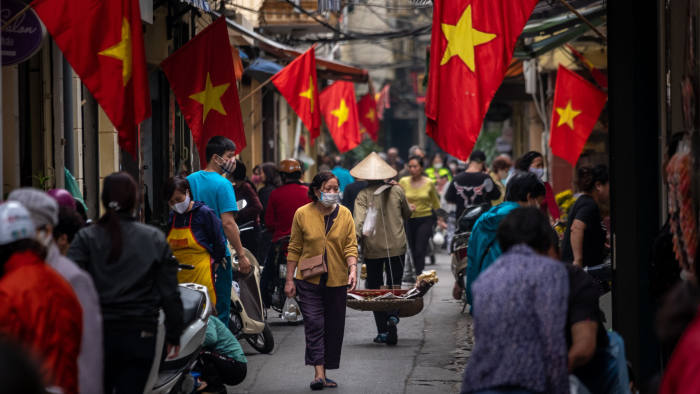
Vietnam reported 245 confirmed cases of Covid-19, no fatalities.
Clearly, Pompeo got it right but for the wrong reasons — this probably has got everything to do with the Chinese Communist Party.
A Vietnamese commentary comes out with a definitive explanation: “The Communist Party of Vietnam has strengthened its anti-pandemic measures by implementing nationwide social distancing rules, such as banning outside gatherings of more than two people while keeping a distance of 6.5 feet, and temporary shutdowns of “non-essential” businesses, including restaurants, entertainment centres and tourist sites…
“Unlike the U.S. capitalist class and the Trump administration, the Vietnamese government took early measures to combat the current coronavirus epidemic. Officials began preparing strategies to combat the outbreak immediately after the first cases emerged in China.”
“On February 1, Prime Minister Nguyen Xuan Phuc signed Decision No.173.QD-TTG, categorising the virus as a Class A contagious disease “that can transmit very rapidly and spread widely with high mortality rates.” This declaration of a national emergency came after the sixth case of coronavirus in the country was reported. In contrast, the Trump administration only declared a national emergency over the global pandemic on March 13, when there were at least 1,920 confirmed cases across 46 states.”
Read a blog featured by World Bank, Containing the coronavirus (COVID-19): Lessons from Vietnam. Life is such that sometimes, even horrific tragedies can have straightforward explanations. The capricious virus knew it, but not Pompeo.
Iran Under Siege from Humanitarian Imperialism amid Pandemic

NDI’s former President Kenneth Wollack and Chairman Madeleine K. Albright pose with Nazanin Boniadi. Credit: Margot Schulman/ Facebook)
By Danny Haiphong | American Herald Tribune | May 3, 2020
Iran is once again under siege from humanitarian imperialism. The United Nations (UN) has released multiple reports in recent weeks criticizing the Iranian government for supposed human rights violations in relation to the treatment of prisoners and its lockdown procedures during the COVID-19 pandemic. Nazanin Boniadi, a board of director at the Center for Human Rights in Iran, authored a piece in The Washington Post that exploits the pandemic to paint Iran as a human rights catastrophe. An examination of just one of Boniadi’s claims exposes how far the U.S. and its imperialist allies will go to build the case for regime change in Iran.
Boniadi claims that Iran’s failure to maintain a humane release policy of prisoners within the country has contributed to undue suffering from COVID-19. Yet the individual she chooses to defend all but reduces her credibility to zero. Boniadi claims that several prisoners have been returned to prison prematurely, and names Samaneh Norouz Moradi as a victim of this policy. Sameneh Norouz Moradi is a leading activist in the campaign to return Prince Reza Pehlavi to Iran. Prince Reza Pehlavi is the eldest son of Mohammad Reza Pehlavi, otherwise known as the Shah of Iran. This is indeed the same monarch that butchered Iranians in the tens of thousands to ensure the country’s assets remained the property of the West. In just one sentence, Nazanin Boniadi reveals that the purpose of her article and her struggle for human rights is to reinstall the U.S. and Western friendly puppet regime that once reigned over Iran.
The discovery of what is thought to be the mummified body of #RezaShah could be seen as somewhat of an omen for Iranians who were chanting “Reza Shah Rest In Peace” in the recent #IranProtests https://t.co/zIyaMGUmTd https://t.co/kXyffRR3l5
— Nazanin Boniadi (@NazaninBoniadi) April 24, 2018
The human rights industry offers lucrative careers for the likes of Boniadi. Boniadi is a Hollywood star and an Iranian exile with extensive experience in the human rights industry. She served as a spokesperson for Amnesty International for six years from 2009 to 2015. Her service to Amnesty International coincides with the organization’s outright support for U.S.-led regime change wars. The so-called “human rights” organization defended the overthrow of Libya in 2011 and the ongoing invasion of Syria led by the U.S. and its Israeli, Gulf, and Western allies.
It is no surprise, then, that Boniadi now serves on the board of the Center for Human Rights in Iran (CHRI), a dubious human rights organization which fails to disclose its funding sources. A cursory look at Boniadi’s colleagues reveals how deeply the CHRI is embedded in the humanitarian imperialist agenda led by the United States. Chairwoman of the board Minky Worden is also the Director of Global Initiatives at Human Rights Watch. Throughout the 1990s, Worden served as an adviser to Hong Kong’s Martin Lee, a staunch anti-China proxy who has called for the British to recolonize Hong Kong. Lee has given deep support to the rightwing movement currently waging a violent campaign to separate Hong Kong from China under the guise of “human rights.” The rest of the CHRI’s staff is a who’s who of former NED-funded functionaries such as executive director Hadi Ghaemi or advisers to U.S. government and private sector posts such as Michael Eisner.
Humanitarian imperialist think-tanks and NGOs such as CHRI are not interested in human rights in Iran or anywhere else. Their selective focus on nations under siege from the U.S. and its imperial allies reveal that so-called “human rights” organizations are nothing but proxies of regime change. The U.S. military state has viewed the spread of COVID-19 in Iran as an opportunity to build upon this long-standing geopolitical objective. CHRI’s clamor for Iran to correct its alleged human rights abuses comes as the U.S. has escalated its forty-plus year war on Iran. Since mid-March, the U.S. has intensified sanctions on Iran, threatened outright U.S. naval aggression, and reinforced an arms embargo outlined in the nuclear agreement that the U.S. exited in 2018. For the architects of regime change, COVID-19 represents nothing more than opportunity to strike when their target is weakest.
What humanitarian imperialists fail to mention is that Iran has waged a largely successful campaign to reduce the spread of COVID-19 despite the presence of crippling sanctions and the threat of a U.S.-led war. Iran temporarily released seventy-thousand prisoners to prevent the virus’ spread behind prison walls. The World Health Organization’s envoy to Iran praised the country’s initiatives for bringing down the number of COVID-19 cases and deaths in a relatively short period. Such initiatives include mandatory social distancing, the redirection of production toward masks and testing kits, and detailed contact tracing to isolate infected individuals. COVID-19 deaths have declined by around seventy percent since it was announced in mid-March that one Iranian every ten minutes was dying from the virus.
If humanitarian imperialists cared about the Iranian people, then they wouldn’t attempt to use the spread of a deadly pandemic to achieve the U.S.’ geopolitical objective of overthrowing the Iranian government. Furthermore, targeting Iran at this vulnerable time only exposes the truly hypocritical “human rights” framework employed by NGOS such as the Center for Human Rights in Iran. The United States has failed to institute any significant release program for its 2.3 million prisoners. This has led to a countless number of deaths in prisons across the country. Furthermore, the U.S. currently leads the world in the number of deaths from COVID-19 and has allowed the virus to genocidally murder Black Americans at rates upward of three times their percentage of the general population in states such as Michigan and Wisconsin.
COVID-19 has exposed the United States as a human rights train wreck which has no right to tell nations such as Iran how to conduct its domestic affairs. The U.S. is an expert at mass murder for the sake of private profit and found itself unprepared when COVID-19 began to spread within its borders. Instead of fostering cooperation with China, Iran, and the rest of the world in the fight against COVID-19, the U.S. has pirated medical supplies, threatened Iran and Venezuela with outright war, and refused to heed the call of the United Nations for a global ceasefire. That there is no NGO to address the ongoing war crimes of the United States is a lesson into the function of the “human rights” industry. NGOs represent the public relations arm of humanitarian imperialism, which is why their work is most prominently featured in the corporate media when Washington is escalating wars of regime change abroad.
Police brutality, incarceration, and state repression are serious human rights issues. Many people are rightfully concerned about human rights as they witness the horrifying and needless consequences of the COVID-19 pandemic worldwide. The U.S. and West have demonstrated in their response to COVID-19 that their societies are organized to stifle human rights in order to maximize the profits of a tiny capitalist class and the hegemony of the military state that protects this class. Activists and journalists must reject the humanitarian imperialists currently politicizing trendy social justice issues to undermine the self-determination of nations such as Iran. Iran is under siege as it battles a pandemic, and peace and social justice-loving people in the U.S. should demand that their government stops making the situation worse.
With apparently fabricated nuclear documents, Netanyahu pushed the US towards war with Iran
By Gareth Porter | The Grayzone | April 29, 2020
President Donald Trump scrapped the nuclear deal with Iran and continued to risk war with Iran based on Israeli Prime Minister Benjamin Netanyahu’s claim to have proven definitively that Iran was determined to manufacture nuclear weapons. Netanyahu not only spun Trump but much of the corporate media as well, duping them with the public unveiling of what he claimed was the entire secret Iranian “nuclear archive.”
In early April 2018, Netanyahu briefed Trump privately on the supposed Iranian nuclear archive and secured his promise to leave the Joint Comprehensive Plan of Action (JCPOA). That April 30, Netanyahu took the briefing to the public in a characteristically dramatic live performance in which he claimed Israel’s Mossad intelligence services had stolen Iran’s entire nuclear archive from Tehran. “You may well know that Iran’s leaders repeatedly deny ever pursuing nuclear weapons…” Netanyahu declared. “Well, tonight, I’m here to tell you one thing: Iran lied. Big time.”
However, an investigation of the supposed Iranian nuclear documents by The Grayzone reveals them to be the product of an Israeli disinformation operation that helped trigger the most serious threat of war since the conflict with Iran began nearly four decades ago. This investigation found multiple indications that the story of Mossad’s heist of 50,000 pages of secret nuclear files from Tehran was very likely an elaborate fiction and that the documents were fabricated by the Mossad itself.
According to the official Israeli version of events, the Iranians had gathered the nuclear documents from various locations and moved them to what Netanyahu himself described as “a dilapidated warehouse” in southern Tehran. Even assuming that Iran had secret documents demonstrating the development of nuclear weapons, the claim that top secret documents would be held in a nondescript and unguarded warehouse in Central Tehran is so unlikely that it should have raised immediate alarm bells about the story’s legitimacy.
Even more problematic was the claim by a Mossad official to Israeli journalist Ronen Bergman that Mossad knew not only in what warehouse its commandos would find the documents but precisely which safes to break into with a blowtorch. The official told Bergman the Mossad team had been guided by an intelligence asset to the few safes in the warehouse which contained the binders with the most important documents. Netanyahu bragged publicly that “very few” Iranians knew the location of the archive; the Mossad official told Bergman “only a handful of people” knew.
But two former senior CIA official, both of whom had served as the agency’s top Middle East analyst, dismissed Netanyahu’s claims as lacking credibility in responses to a query from The Grayzone.
According to Paul Pillar, who was National Intelligence Officer for the region from 2001 to 2005, “Any source on the inside of the Iranian national security apparatus would be extremely valuable in Israeli eyes, and Israeli deliberations about the handling of that source’s information presumably would be biased in favor long-term protection of the source.” The Israeli story of how its spies located the documents “does seem fishy,” Pillar said, especially considering Israel’s obvious effort to derive maximum “political-diplomatic mileage” out of the “supposed revelation” of such a well-placed source.
Graham Fuller, a 27-year veteran of the CIA who served as National Intelligence Officer for the Near East and South Asia as well as Vice-Chairman of the National Intelligence Council, offered a similar assessment of the Israeli claim. “If the Israelis had such a sensitive source in Tehran,” Fuller commented, “they would not want to risk him.” Fuller concluded that the Israelis’ claim that they had accurate knowledge of which safes to crack is “dubious, and the whole thing may be somewhat fabricated.”
No proof of authenticity
Netanyahu’s April 30 slide show presented a series of purported Iranian documents containing sensational revelations that he pointed to as proof of his insistence that Iran had lied about its interest in manufacturing nuclear weapons. The visual aides included a file supposedly dating back to early 2000 or before that detailed various ways to achieve a plan to build five nuclear weapons by mid-2003.
Another document that generated widespread media interest was an alleged report on a discussion among leading Iranian scientists of a purported mid-2003 decision by Iran’s Defense Minister to separate an existing secret nuclear weapons program into overt and covert parts.
Left out of the media coverage of these “nuclear archive” documents was a simple fact that was highly inconvenient to Netanyahu: nothing about them offered a scintilla of evidence that they were genuine. For example, not one contained the official markings of the relevant Iranian agency.
Tariq Rauf, who was head of the Verification and Security Policy Coordination Office at the International Atomic Energy Agency (IAEA) from 2001 to 2011, told The Grayzone that these markings were practically ubiquitous on official Iranian files.
“Iran is a highly bureaucratized system,” Rauf explained. “Hence, one would expect a proper book-keeping system that would record incoming correspondence, with date received, action officer, department, circulation to additional relevant officials, proper letterhead, etc.”
But as Rauf noted, the “nuclear archive” documents that were published by the Washington Post bore no such evidence of Iranian government origin. Nor did they contain other markings to indicate their creation under the auspices of an Iranian government agency.
What those documents do have in common is the mark of a rubber stamp for a filing system showing numbers for a “record”, a “file” and a “ledger binder” — like the black binders that Netanyahu flashed to the cameras during his slideshow. But these could have easily been created by the Mossad and stamped on to the documents along with the appropriate Persian numbers.
Forensic confirmation of the documents’ authenticity would have required access to the original documents. But as Netanyahu noted in his April 30, 2018 slide show, the “original Iranian materials” were kept “in a very safe place” – implying that no one would be allowed to have any such access.
Withholding access to outside experts
In fact, even the most pro-Israeli visitors to Tel Aviv have been denied access to the original documents. David Albright of the Institute for Science and International Security and Olli Heinonen of the Foundation for Defense of Democracies – both stalwart defenders of the official Israeli line on Iranian nuclear policy – reported in October 2018 that they had been given only a “slide deck” showing reproductions or excerpts of the documents.
When a team of six specialists from Harvard Kennedy School’s Belfer Center for Science and International Affairs visited Israel in January 2019 for briefings on the archive, they too were offered only a cursory browse of the supposedly original documents. Harvard Professor Matthew Bunn recalled in an interview with this writer that the team had been shown one of the binders containing what were said to be original documents relating to Iran’s relations with the IAEA and had “paged through a bit of it.”
But they were shown no documents on Iran nuclear weapons work. As Bunn admitted, “We weren’t attempting to do any forensic analysis of these documents.”
Typically, it would be the job of the U.S. government and the IAEA to authenticate the documents. Oddly, the Belfer Center delegation reported that the U.S. government and the IAEA had each received only copies of the entire archive, not the original files. And the Israelis were in no hurry to provide the genuine articles: the IAEA did not receive a complete set of documents until November 2019, according to Bunn.
By then, Netanyahu had not only already accomplished the demolition of the Iran nuclear deal; he and Trump’s ferociously hawkish CIA-director Mike Pompeo had maneuvered the president into a policy of imminent confrontation with Tehran.
The second coming of fake missile drawings
Among the documents Netanyahu flashed on the screen in his April 30, 2018 slide show was a schematic drawing of the missile reentry vehicle of an Iranian Shahab-3 missile, showing what was obviously supposed to represent a nuclear weapon inside.

Technical drawing from David Albright, Olli Heinonen, and Andrea Stricker’s “Breaking Up and Reorienting Iran’s Nuclear Weapons Program,” published by the Institute for Science and International Security on October 28, 2018.
This drawing was part of a set of eighteen technical drawings of the Shahab-3 reentry vehicle. These were found in a collection of documents secured over the course of several years between the Bush II and Obama administrations by an Iranian spy working for Germany’s BND intelligence service. Or so the Israeli official story went.
In 2013, however, a former senior German Foreign Office official named Karsten Voigt revealed to this writer that the documents had been initially provided to German intelligence by a member of the Mujaheddin E-Khalq (MEK).
The MEK is an exiled Iranian armed opposition organization that had operated under Saddam Hussein’s regime as a proxy against Iran during the Iran-Iraq War. It went on to cooperate with the Israeli Mossad beginning in the 1990s, and enjoys a close relationship with Saudi Arabia as well. Today, numerous former US officials are on the MEK’s payroll, acting as de facto lobbyists for regime change in Iran.
Voigt recalled how senior BND officials warned him they did not consider the MEK source or the materials he provided to be credible. They were worried that the Bush administration intended to use the dodgy documents to justify an attack on Iran, just as it exploited the tall tales collected from Iraqi defector codenamed “Curveball” to justify the 2003 invasion of Iraq.
As this writer first reported in 2010, the appearance of the “dunce-cap” shape of the Shahab-3 reentry vehicle in the drawings was a tell-tale sign that the documents were fabricated. Whoever drew those schematic images in 2003 was clearly under the false impression that Iran was relying on the Shahab-3 as its main deterrent force. After all, Iran had announced publicly in 2001 that the Shahab-3 was going into “serial production” and in 2003 that it was “operational.”
But those official claims by Iran were a ruse aimed primarily at deceiving Israel, which had threatened air attacks on Iran’s nuclear and missile programs. In fact, Iran’s Defense Ministry was aware that the Shahab-3 did not have sufficient range to reach Israel.
According to Michael Elleman, the author of the most definitive account of the Iranian missile program, as early as 2000, Iran’s Defense Ministry had begun developing an improved version of the Shahab-3 with a reentry vehicle boasting a far more aerodynamic “triconic baby bottle” shape – not the “dunce-cap” of the original.
As Elleman told this writer, however, foreign intelligence agencies remained unaware of the new and improved Shahab missile with a very different shape until it took its first flight test in August 2004. Among the agencies kept in the dark about the new design was Israel’s Mossad. That explains why the false documents on redesigning the Shahab-3 – the earliest dates of which were in 2002, according to an unpublished internal IAEA document – showed a reentry vehicle design that Iran had already discarded.
The role of the MEK in passing the massive tranche of supposed secret Iranian nuclear documents to the BND and its hand-in-glove relationship with the Mossad leaves little room for doubt that the documents introduced to Western intelligence 2004 were, in fact, created by the Mossad.
For the Mossad, the MEK was a convenient unit for outsourcing negative press about Iran which it did not want attributed directly to Israeli intelligence. To enhance the MEK’S credibility in the eyes foreign media and intelligence agencies, Mossad passed the coordinates of Iran’s Natanz nuclear facility to the MEK in 2002. Later, it provided to the MEK personal information such as the passport number and home telephone number of Iranian physics professor Mohsen Fakhrizadh, whose name appeared in the nuclear documents, according to the co-authors of a best-selling Israeli book on the Mossad’s covert operations.
By trotting out the same discredited technical drawing depicting the wrong Iranian missile reentry vehicle – a trick he had previously deployed to create the original case for accusing Iran of covert nuclear weapons development – the Israeli prime minister showed how confident he was in his ability to hoodwink Washington and the Western corporate media.
Netanyahu’s multiple levels of deception have been remarkably successful, despite having relied on crude stunts that any diligent news organization should have seen through. Through his manipulation of foreign governments and media, he has been able to maneuver Donald Trump and the United States into a dangerous process of confrontation that has brought the US to the precipice of military conflict with Iran.
Gareth Porter is an independent investigative journalist who has covered national security policy since 2005 and was the recipient of Gellhorn Prize for Journalism in 2012. His most recent book is The CIA Insider’s Guide to the Iran Crisis co-authored with John Kiriakou, just published in February.
His warnings unheeded, Iranian scientist contracts coronavirus in US jail
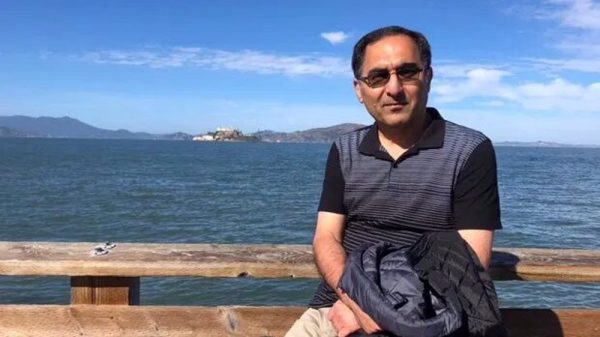
Undated picture provided by ISNA of US-held Iranian scientist, Sirous Asgari
Press TV – April 29, 2020
An Iranian scientist — who remains behind bars in the US despite having been exonerated in a sanctions trial — has contracted the new coronavirus after he repeatedly drew attention to his fragile health and called for his release from the “dirty” and “overcrowded” jail facility.
The Guardian reported the lawyers representing Sirous Asgari, a professor of material sciences at Sharif University of Technology, had confirmed his infection on Tuesday.
He has repeatedly pleaded for release since March, complaining about unsanitary detention conditions and overcrowding at the Louisiana facility, where he is being kept.
Coughing violently and suffering from a fever, Asgari told the paper in a phone call that the detention center was even taking in more inmates rather than releasing some as a precaution to stop further spread of the outbreak.
He also said the US Immigration and Customs Enforcement (Ice) had refused to notify him about his positive test results, adding that he only learned about his infection from his lawyers and family members on Tuesday.
“It makes sense to send me to the hospital as soon as possible. I don’t trust them at all,” the 59-year-old said. “If something happens, they are not fast responders … I prefer to leave this dirty place.”
The detainees are responsible for all the cleaning at the detention facility,” where there is a single shower and only two toilets for all 44 of them to share,” the daily reported.
Ice, however, has told Asgari’s lawyers he would only be released to a hospital if he was struggling to breathe.
Asgari was arrested in the United States in mid-2017. Back then, the FBI alleged the scientist had shared information about a project he had conducted on a sabbatical in the US five years before with his students.
His wife, though, said in an interview in late March that the findings of the project had been published and made available on the Internet afterwards, which means there was nothing secret about the project. US legal authorities then charged him with withholding information in the process of visa application, circumventing the sanctions, and transferring technology to Iran.
Washington then delayed the holding of a trial for him several times, “all the while knowing they had no evidence to bring against him,” she said.
The Iranian professor was cleared of the charges at a court session that was ultimately scheduled after about two and a half years. Nevertheless, US Citizenship and Immigration Services then took the matters out of the hands of the country’s legal system, once again detaining Asgari for “lacking a valid visa and illegal presence on US soil.”
Mr. Asgari has reminded US officials that they themselves had seized his passport and were, hence, responsible for his prolonged presence in America.
His spouse said Washington was intentionally prolonging Asgari’s detention so that it could eventually swap him with an American prisoner held in Iran.
US return to JCPOA can end impasse over Iran
By M. K. BHADRAKUMAR | Indian Punchline | April 28, 2020
In business transactions and international diplomacy alike, there could be constant variables and dependent variables. Constant variable is where the value cannot be changed once it has been assigned a value. But it becomes a dependent variable if it is susceptible or open to the effect of an associated factor or phenomenon. Then, there is also a third independent variable, which is a factor or phenomenon whose value is given or set already that can cause or influence a dependent variable.
A big question for international security has arisen: What type of variable is at work as the US prepares a legal argument that it still remains a “participant” in the 2015 Iran nuclear accord known as JCPOA?
Both New York Times and Fox News, which reported on this development on Sunday maintained that the Trump administration’s ploy to reenter the JCPOA is riveted on a strategy to invoke the “snapback” clause, which would restore the comprehensive pre-2015 UN sanctions on Iran.
Much depends on the UN Security Council members. What if they come up with a dependent / independent variable that accedes to the US status as “participant”, provided Washington agrees to ‘X’, ‘Y’, ‘C’ factor or phenomenon? Trade-offs are more the rule than the exception in the UN SC; constant variable is a rare occurrence at the horseshoe table.
A Reuters report today, in fact, highlights that the Trump administration can expect “a tough, messy battle if it uses a threat to trigger a return of all United Nations sanctions on Iran as leverage to get the 15-member Security Council to extend and strengthen an arms embargo on Tehran.”
The report quoted a European diplomat: “It’s very difficult to present yourself as a compliance watcher of a resolution you decided to pull out of. Either you’re in or either you’re out.” This is the crux of the matter.
Tehran has already notified the European Union that any move to re-impose UN sanctions through the back door will trigger a vehement reaction — including, possibly, Iran exiting the Nuclear Non-Proliferation Treaty.
The EU and the three European signatories of the JCPOA (UK, France and Germany) are extremely wary of the JCPOA being abandoned. Their sincerity of purpose is self-evident in the IMPEX mechanism (which enables limited trade between European companies and Iran despite US sanctions.)
The EU’s foreign policy chief Josep Borrell recently expressed regret about the US’ opposition to the IMF lending money to Iran against the backdrop of the coronavirus pandemic. The German Foreign Minister Heiko Maas publicly shared Borrell’s view.
Having said that, it is an entirely different ball game if the US were to walk back as “participant” in the JCPOA as original signatory. If that happens, everything else becomes negotiable — including fresh talks to renegotiate the terms of JCPOA. Tehran has laid down Washington’s return to the JCPOA as the sole precondition for talks.
Today, Radio Farda, the Persian service of the US government-funded Radio Free Europe/Radio Liberty beamed to Iran, has carried a report US May Be Prepared To Rethink Stance On Sanctions, Nuclear Accord with Tehran which speculates precisely that on the “pretext” of extending the arms embargo against Iran, Washington could be principally “thinking of returning to the nuclear accord” and engaging with Iran in talks.
Radio Farda quoted a “usually well-informed Iran analyst in Scotland” to this effect. The report hinted that back channels are at work. Possibly, some kite-flying is going on here.
Indeed, Iranian media had reported recently that President Hassan Rouhani told a cabinet meeting in Tehran on March 25 that the “leader of a non-permanent member of the Security Council” had told him about the UN Security Council currently weighing plans for the removal of all sanctions against Iran.
Rouhani was quoted as saying at the cabinet meeting, “We are also trying to have our blocked money unfrozen.” (Rouhani was probably referring to a conversation with Kais Saied, President of Tunisia, which is a non-permanent member of the UN Security Council.)
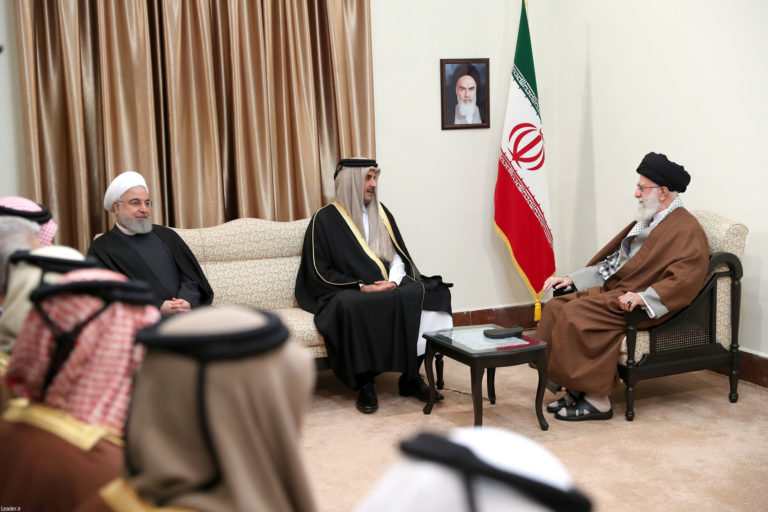
Iran hasn’t reacted to the New York Times and Fox News reports. Meanwhile, in what could well be a related development, Rouhani had a phone conversation on April 21 with the Emir of Qatar Sheikh Tamim bin Hamad Al Thani where the sanctions issue figured.
Interestingly, an Iranian Foreign Ministry statement later verbatim quoted from the conversation. Rouhani told Sheikh Tamim:
“The US pressure and sanctions against Iran are not only a violation of international law, but also they are violating human principles by intensifying their behaviour in these difficult circumstances, including preventing the International Monetary Fund from lending to Iran”.
“We believe that in this special situation, all countries in the world must stand together to fight coronavirus and clearly state their positions against the hostile actions of the United States”.
“Unfortunately, they are still reluctant to end their inhumane acts, but we have no doubt that sooner or later they will have to change course.”
The Emir responded,
“Today, the world is in a special situation and we believe that in this situation, the United States must lift its sanctions and all countries must move in line with the new conditions.”
Subsequently, there has also been a conversation between the two foreign ministers. Now, Qatar, which hosts the US Central Command Hqs, is a close ally of the US. Sheikh Tamim and Trump have a warm relationship.
During the emir’s visit to the White House last July, Trump remarked, “Tamim, you’ve been a friend of mine for a long time, before I did this presidential thing, and we feel very comfortable with each other.” No doubt, if ever Trump needed a back channel with the Iranian leadership, he wouldn’t need to look beyond Sheikh Tamim. (Significantly, Sheikh Tamim made a rare visit to Tehran in January this year.)
Curiously, the day after Sheikh Tamim spoke to Rouhani, he also held a phone conversation with Trump. The White House readout said, “The president and the (emir) discussed the coronavirus response… The president encouraged the emir to take steps toward resolving the Gulf rift in order to work together to defeat the virus, minimise its economic impact and focus on critical regional issues.”
The bottom line is that the UN arms embargo is not really a big ticket item but the sanctions is. Even if the ban gets lifted in October, it is only for small arms, whereas transfer of advanced technology such as missiles will have to wait another 3 years. Iran is largely self-reliant in defence. And its asymmetric capability to generate deterrence against US aggression is legion.
The Trump administration realises that its sanctions policy has failed. The murder of the charismatic Iranian general Qassem Soleimani only hardened Tehran’s resolve to press ahead with the “axis of resistance”. And the world opinion militates against continued US sanctions against Iran.
In this backdrop, the forthcoming summit of the founding members of the UN may address the issue of sanctions. From such a perspective, the Trump administration’s seemingly belligerent move to return as “participant” in the JCPOA may turn out to be a dependent variable open to influence from one or more independent variables.
US to face tough battle in pushing plan to extend UN Iran arms embargo: Diplomats
Press TV – April 28, 2020
Diplomatic sources at the United Nations say Washington has a tough challenge ahead at the Security Council (UNSC) if it pushes for an extension of the world body’s arms embargo against Iran through recourse to a process set out in a multilateral nuclear deal that the US controversially abandoned in 2018.
The agreement — officially called the Joint Comprehensive Plan of Action (JCPOA) — was signed in 2015 between Iran and six major world states and endorsed by UNSC Resolution 2231.
However, the US unilaterally withdrew from what President Donald Trump called “the worst deal ever” in May 2018 and re-imposed anti-Iran sanctions. It has also been coercing the remaining signatories to the JCPOA to follow suit.
Under UNSC Resolution 2231, the UN arms embargo on Iran — in place since 2006/2007 — will be lifted in October 2020. The US has repeatedly expressed its anger at the possible termination of restrictions on Iran’s import and export of arms.
On Tuesday, diplomats told Reuters that Washington is planning to use a threat to trigger a return of all UN sanctions against Iran as leverage to get the Security Council to prolong the arms embargo on Tehran.
A US official, who was speaking on condition of anonymity, said Washington has shared its strategy with Britain, France and Germany, who are permanent Security Council member states and parties to the Iran deal.
The diplomats said the scheme has not been shared with the remaining 11 council members, including veto-wielders Russia and China, the two other signatories to the JCPOA that are deemed certain to oppose the arms embargo on Iran.
Reports say if the Security Council refuses to revive the embargo, the US will try to trigger a so-called snapback of all UN sanctions on Iran by claiming that it is still a party to the JCPOA and that Iran is in significant violation of the nuclear pact.
The New York Times said on Sunday that US Secretary of State Mike Pompeo was laying the groundwork to present a legal argument to the UN that Washington remains a “participant state” in the JCPOA.
It is “part of an intricate strategy to pressure the United Nations Security Council to extend an arms embargo on Tehran,” the report said.
Reuters, however, cited the UN diplomats as saying that Washington’s plan will likely be challenged since the US is no longer a party to the deal.
“It will be dead on arrival,” a Security Council diplomat predicted. “It’s very difficult to present yourself as a compliance watcher of a resolution you decided to pull out of,” a European diplomat said. “Either you’re in or either you’re out.”
Another European official said, “It’s going to be messy from a Security Council standpoint because, regardless of what (Britain, Germany and France) think, Russia and China are not going to sign up to that legal interpretation.”
Iranian Foreign Minister Mohammad Javad Zarif has dismissed Pompeo’s reported scheme, saying the plan to return to the JCPOA is rooted in the failure of Washington’s “maximum pressure” campaign against the Iranian nation.
‘US cannot cherry-pick UN resolutions’
Meanwhile, a Western diplomat, speaking on condition of anonymity, told AFP, “You cannot cherry-pick a resolution saying you implement only parts of it but you won’t do it for the rest.”
Similarly, Kelsey Davenport, director for non-proliferation policy at the US-based Arms Control Association, said “if Pompeo goes through with this plan, snapping back sanctions on Iran collapses the JCPOA.”
Even more significant, she added, the US measure could lead Iran to make good on threats to exit the nuclear Non-Proliferation Treaty (NPT).
“This is just another step that would undermine US credibility, make future negotiations with Iran more difficult and increase the risk of a nuclear crisis in the region,” she said.
‘US placing world in Catch-22 situation’
Russia also slammed the US plan, with Permanent Representative to International Organizations in Vienna Mikhail Ulyanov tweeting, “The country which officially ceased its participation in the #IranDeal cannot remain its participant by definition.”
The Russian Mission Vienna also said in a post on Twitter, “May 8, 2018 the #US says it “ends” and “terminates” its participation in the #JCPOA. Now there are claims that it still considers itself a participant. Is this a “Catch-22” sort of situation for Iran, UNSC and the whole world?”
Netanyahu Is Back Yet Again
Israel will become much bigger
By Philip Giraldi • Unz Review • April 28, 2020
Rahm Emanuel, up until recently the mayor of Chicago and before that a top advisor to the president in the Bill Clinton and Barack Obama White Houses and still earlier a volunteer in the Israeli Army, famously once commented that a good crisis should never be allowed to go to waste. He meant, of course, that a crisis can be exploited to provide cover for other shenanigans involving politicians. It was an observation that was particularly true when one was working for a sexual predator like Bill, who once attacked a “terrorist” pharmaceutical factory in Sudan to divert attention away from the breaking Monica Lewinski scandal.
To be sure, the United States government is focusing its attention on the coronavirus while also using the cover afforded to heighten the pressure on “enemies” near and far. As the coronavirus continues to spread, the Trump White House and Secretary of State Mike Pompeo have increased the ferocity of their sabre rattling, apparently in part to deter Russia, China, Iran and Venezuela. Ironically, of course, none of the countries being intimidated are actually threatening the United States, but we Americans have long since learned that perceptions are more important than facts when it comes to the current occupant of the oval office and his two predecessors.
The latest bit of mendacity coming out of the White House was a presidential tweet targeting the usual punching bag, Iran. Based on an incident that occurred two weeks ago, Trump threatened “I have instructed the United States Navy to shoot down and destroy any and all Iranian gunboats if they harass our ships at sea.” The U.S. Navy ships in question are, one might also observe, in a body of water generally referred to as the Persian Gulf, where they are carrying out maneuvers right off of the Iranian coast. Meanwhile, Iranian flying gunboats have not yet been observed off of New Jersey, but they are probably waiting to be transported to the Eastern Seaboard by those huge trans-oceanic gliders that once upon a time were allegedly being constructed by Saddam Hussein.
Given the cover provided by the virus, it should surprise no one that Israel is also playing the same game. The Jewish state has been continuing its lethal bombings of Syria, with hardly any notice in the international media. In a recent missile attack, nine people were killed near the historic city of Palmyra. Three of the dead were Syrians while six others were presumed to be Lebanese Shi’ites supporting the Damascus government. Israel de facto regards any Shi’ite as an “Iranian” or an “Iranian proxy” and therefore a “terrorist” eligible to be killed on sight.
But the bigger coronavirus story has to do with Israel’s domestic politics. Benjamin Netanyahu and his principle opponent Benny Gantz have come to an agreement to form a national government, ostensibly to deal with the health crisis. The wily Netanyahu, who will continue to be prime minister in the deal, has thereby retained his power over the government while also putting a halt to bids from the judiciary to try and sentence him on corruption charges. As part of the deal with Gantz, Netanyahu will have veto power over the naming of the new government’s attorney general and state prosecutor, guaranteeing the appointment of individuals who will dismiss the charges.
And more will be coming, with the acquiescence of Washington. U.S. elections are little more than six months away and Donald Trump clearly believes that he needs the political support of Netanyahu to energize his rabid Christian Zionist supporters, as well as the cash coming from Jewish oligarchs Sheldon Adelson, Bernard Marcus and Paul Singer. So, it is time to establish a quid pro quo, which will be Israeli government behind the scenes approaches to powerful and wealthy American Jews on behalf of Trump while the White House will look the other way while Israel annexes most of the remaining Palestinian West Bank. Pompeo has welcomed the new Israeli government and has confirmed that the annexation of the Palestinian land will be “ultimately Israel’s decision to make,” which amounts to a green light for Netanyahu to go ahead.
A vote on West Bank annexation will reportedly be taken by the Knesset at the beginning of July followed immediately by steps to incorporate Jewish settlements into Israel proper. According to the Israeli liberal newspaper Haaretz, the planned annexation has raised some concerns among a few liberal American Jewish organizations because it will convince many progressives in the U.S. that Israel has truly become an apartheid state. J Street warned that annexation “would severely imperil Israel’s future as a democratic homeland for the Jewish people, along with the future of the U.S.-Israel relationship” and has even suggested cutting U.S. aid if that step is actually taken. Most other ostensibly liberal groups have adopted the usual Zionist two-step, i.e. condemning the move but not advocating any effective steps to prevent it. And it should also be noted that the largest and most powerful Jewish organizations like the American Israel Public Affairs Committee (AIPAC) and the Zionist Organization of America (ZOA) have not raised any objections at all.
Unaffiliated individual liberal Jews, to include those who consider themselves Zionists, have generally been concerned about the move, though their argument is quite hypocritical, based on their belief that annexation would pari passu destroy any possible two-state solution, damaging both Palestinian rights and “Jewish democracy.” Some have even welcomed the change, noting that it would create a single state de facto which eventually would have to evolve into a modern democracy with equal rights for all. Such thinking is, however, nonsense. Israel under Netanyahu and whichever fascist retread that eventually succeeds him regards itself as a Jewish state and will do whatever it takes to maintain that, even including dispossessing remaining Arabs of their land and possessions, stripping them of their legal status, and forcing them to leave as refugees. That is something that might be referred to as ethnic cleansing, or even genocide.
And those Americans of conscience who are hoping for some change if someone named Joe Biden defeats Trump can also forget about that option. Biden has told the New York Times that “I believe a two-state solution remains the only way to ensure Israel’s long-term security while sustaining its Jewish and democratic identity. It is also the only way to ensure Palestinian dignity and their legitimate interest in national self-determination. And it is a necessary condition to take full advantage of the opening that exists for greater cooperation between Israel and its Arab neighbors. For all these reasons, encouraging a two-state solution remains in the critical interest of the United States.”
Unfortunately, someone should tell Joe that that particular train has already left the station due to the expansion of the Jewish state’s settlements. Nice words from the man who would be president aside, Biden is bound to the Israel Lobby for its political support and the money it provides as tightly as can be and he will fold before AIPAC and company like a cheap suit. He has famously declared that “You don’t have to be a Jew to be a Zionist – I am a Zionist” and “My Name is Joe Biden, and Everybody Knows I Love Israel.” His vice-presidential candidates’ debate with Sarah Palin in 2008 turned embarrassing when he and Palin both engaged in long soliloquys about how much they cherish Israel. Indeed they do. Every politician on the make loves Israel.
Philip M. Giraldi, Ph.D., is Executive Director of the Council for the National Interest, a 501(c)3 tax deductible educational foundation (Federal ID Number #52-1739023) that seeks a more interests-based U.S. foreign policy in the Middle East. Website is councilforthenationalinterest.org, address is P.O. Box 2157, Purcellville VA 20134 and its email is inform@cnionline.org.
Russia dismisses as ‘baseless’ US claims on IRGC satellite launch
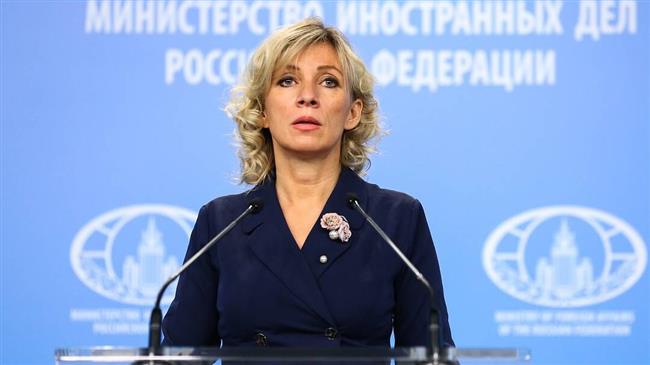
Russian Foreign Ministry Spokeswoman Maria Zakharova
Press TV – April 23, 2020
Russia has dismissed as “baseless” claims by the United States that the recent launch of Iran’s first-ever military satellite by the Islamic Revolution Guards Corps (IRGC) violates a United Nations Security Council resolution endorsing the 2015 nuclear deal between Tehran and world powers.
On Wednesday, the IRGC Aerospace Force launched the Nour (Light) satellite via the Qassed (Carrier) carrier, a move US Secretary of State Mike Pompeo was quick to condemn as a violation of United Nations Security Council Resolution 2231.
“This would not be the first time that a nation that has flagrantly breached the norms of international law and violated UNSC resolution 2231 is trying to deflect international condemnation by baselessly accusing Iran of noncompliance with the requirements of the Security Council,” Russia’s Sputnik news agency quoted Foreign Ministry spokeswoman Maria Zakharova as saying at a briefing on Thursday.
She noted that neither the resolution nor the 2015 Iran nuclear deal restrict Iran’s right to explore space to peaceful ends.
She added that Iran has made it clear that it does not intend to develop nuclear weapons, unlike the US, which has over the past months unveiled several plans to expand its nuclear arsenal.
“There are no, there have never been, and hopefully there will never be nuclear weapons in Iran. Iran, adhering to the resolution, does not develop, test or use ballistic missiles capable of carrying nuclear weapons, unlike the United States, which surprises the world every single day with news about plans to develop their nuclear missile capabilities,” she said.
The remarks came after Pompeo said Iran needed “to be held accountable” for the launch, claiming that the move violated UNSC Resolution 2231.
This is while the resolution in question calls on Iran “not to undertake any activity related to ballistic missiles designed to be capable of delivering nuclear weapons, including launches using such ballistic missile technology.”
The Nour-1 is Iran’s first multi-purpose satellite with application in the defense industry, among other areas. It is also the first Iranian satellite with an expected operational life of more than a year in Earth’s orbit.
Trump says ordered Navy to destroy Iranian boats ‘if they harass’ US ships
Press TV – April 22, 2020
US President Donald Trump is stepping up his anti-Iran threats by claiming that he has instructed the US Navy to destroy Iranian boats “if they harass” US ships in the Persian Gulf.
“I have instructed the United States Navy to shoot down and destroy any and all Iranian gunboats if they harass our ships at sea,” Trump wrote in a tweet posted on Wednesday morning.
The order is Trump’s first reaction to a recent confrontation between US warships and Iranian boats in the Persian Gulf.
Trump posted the tweet as his administration is under unprecedented pressure over its highly criticized response to the coronavirus pandemic, prompting suggestions that his anti-Iran statement is probably meant to divert attentions from his poor handling of the crisis.
A video released by Iran’s Islamic Revolution Guards Corps on Sunday shows the IRGC Navy warning off a flotilla of US warships in the Persian Gulf as they try to approach the Iranian territorial waters.
In the video, a personnel of the IRGC Navy warns the vessels to stop inspecting and detaining Iranian fishing or commercial ships in the Persian Gulf and the Sea of Oman.
He also warns them that they would face consequences according to the laws of the Islamic Republic of Iran if they ignore this notice.
Tensions in the strategic waterway rose significantly last summer after a series of mysterious explosions targeted a number of oil tankers.
The US, quickly blaming Iran for the incidents without providing conclusive evidence along with other countries such as Saudi Arabia, has since deployed thousands of troops and military equipment to the region.
Meanwhile, in a statement released on Sunday, the IRGC refuted the claims by the US that Iranian forces behaved in a dangerous manner when faced with US Navy vessels.
The IRGC further blamed Washington as the main source of insecurity in the in West Asia region and called for the full withdrawal of all American forces.
Report says Iran may have replicated Israeli missile downed in Syria
Press TV – April 20, 2020
A Russian aviation news outlet says Iran may have replicated an Israeli missile that was shot down in Syria, citing a video of the test of a new Iranian anti-tank missile.
Avia.Pro reported that the new missile seems to resemble one of the Israeli projectiles that were downed by the Russian electronic warfare system during an attack on Syria,.
The report added that the downed missile was later successfully removed from the country by “Iranian intelligence service”, and was studied and completely copied.
The news outlet shared a video that showed the accuracy of the Iranian copy of the Israeli “Spike” missile in hitting its target.
Avia.Pro quoted experts as saying that Iran may use Israeli missiles against Tel Aviv itself in the near future.
Iranian authorities have repeatedly said that the country’s missile program has not been established for non-conventional purposes and is only meant as part of the country’s deterrence capability.
Iran holds the very first ranking in the field of missile technology among the Middle Eastern countries, according to a commander of the Islamic Revolution Guards Corps (IRGC).
“Today, we rank first in the missile technology at the regional level and are placed among the few global powers in this regard,” Brigadier General Amir Ali Hajizadeh, the commander of the Aerospace Division of the IRGC, said last August.
In June, Major General Hossein Salami, the chief commander of the IRGC, said Iran had managed to change the balance of power in its favor by harnessing the technology required for manufacturing ballistic missiles.
Salami said the Islamic Republic acquired the know-how 12 years ago while trying to prepare its defenses against the United States’ aircraft carriers.
Iran’s defense ministry makes mass delivery of new drones to army
Press TV – April 18, 2020
Iran’s defense ministry has made mass delivery of new combat and surveillance drones, including a jet-powered multipurpose UAV (unmanned aerial vehicle) to Army’s Air force and Air Defense Force.
The event took place during an official ceremony at the Iran Aviation Industries Organization (IAIO) in Isfahan with the presence of Defense Minister Brigadier General Amir Hatami and other senior military officials, a day after Iran’s Army Day.
Speaking during the ceremony, Hatami said that the multipurpose jet-powered UAV could travel at speeds of 900 kph and conduct operations at an altitude of 12 kilometers.
He added that the drone can fly for up to 180 minutes and have a range of 1000 kilometers.
Mass delivery of Ababil 3 and Karar drones
During the ceremony, a large contingent of Ababil 3 and Karar drones was also delivered to the Air force.
Speaking about the Ababil-3 drone, Hatami said that the drone is a medium-range surveillance craft capable of conducting airstrikes within a 150 kilometer radius.
He also said that the Karar drone is a strategic combat drone which can deliver payloads comparable to manned aircraft.
He added that the drone has pin-point attack capability and can be used in suicide attacks.
Iran has taken great strides seeking to attain self-sufficiency in producing essential military equipment and defense systems in the face of decades-long US sanctions and arms embargoes on the country.
Earlier this month, Iran announced that it is planning to produce a 6,000 ton destroyer later this year.
According to a statement by Iran’s Navy commander last week, Iran is also considering the development of nuclear-powered submarines.
Featured Video
The Board For Peace – Whitewashing Ethnic Cleansing and Genocide
or go to
Aletho News Archives – Video-Images
Book Review
Conspiracy Denial

Lies are Unbekoming | January 27, 2026
In honour of Michael Parenti (1933–2026), who passed away on 24 January 2026 at the age of 92. He spent his life naming what power prefers to leave unnamed.
In 1837, Abraham Lincoln remarked: “These capitalists generally act harmoniously, and in concert, to fleece the people.”
Today, he would be dismissed as a conspiracy theorist.
That dismissal—reflexive, automatic, requiring no engagement with evidence—is not a mark of sophistication. It is a tell. The question worth asking is not whether conspiracies exist (they are a matter of public record and a recognised concept in law) but why acknowledging their existence provokes such reliable hostility. What work does the label “conspiracy theorist” actually do?
The late political scientist Michael Parenti spent decades answering that question. His conclusion was blunt: “’Conspiracy’ refers to something more than just illegal acts. It serves as a dismissive label applied to any acknowledgment of ruling-class power, both its legal and illegal operations.” The term functions not as a descriptor but as a weapon—a thought-terminating cliché that protects the powerful from scrutiny by pathologising those who scrutinise them.
Conspiracy denial, in Parenti’s analysis, is not skepticism. It is the opposite of skepticism. It is credulity toward power dressed up as critical thinking. As he wrote in Dirty Truths: “Just because some people have fantasies of conspiracies does not mean all conspiracies are imaginary.” … continue
Blog Roll
Recent Comments
eddieb on WEF Calls for ‘Cultural Revolu… loongtip on Trump wanted to play peacemake… Coronistan on EU member to sue bloc over ‘su… loongtip on Vicious loongtip on EU turns to India for defense… Coronistan on Donald Trump Is No Peace … seversonebcfb985d9 on French court jails pro-Palesti… eddieb on Fourteen Incredible Facts Abou… Bill Francis on European leaders’ shift in the… seversonebcfb985d9 on Villains of Judea: Philip Esfo… loongtip on Report warns that ‘Jewish terr… Craig Nelms on New study shows that toxic gas…


 Aletho News
- G7 Hands Ukraine $40Bln Generated From Frozen Russian Assets
- Conspiracy Denial
- Ukraine expects to join EU next year – Zelensky
- Here’s what’s behind the US shift on EU allies
- UN experts alarmed by prosecution of students protesting ETH Zurich’s Israel-linked research ties
- Exposed – How the UAE Became Central to Gaza’s Concentration Camp Plot
- How South Korea’s gas ambitions sustain the occupation of Gaza
- “Leaked document” exposes US blueprint for total control over Gaza
- Trump wanted to play peacemaker, Netanyahu made sure he failed
- Idea of limited, fast strike on Iran misjudges our capabilities: IRGC
- If Americans Knew
- Israel to seek new security deal from US, official says
- Leaked “Board of Peace” Resolution Outlines U.S.-Led Plan to Rule Over Gaza
- Jonathan Greenblatt Rolls Out Plan to Activate Hispanic Evangelical Golems
- Violence against hundreds of Gazan remains to find one Israeli – Not a ceasefire Day 109
- Greenpeace Demonstrator Exposes Folly of Protest Restrictions
- From CBS to TikTok, Pro-Israel Ellison is now in the driver’s seat
- Israel pays for UK advertisements attacking Doctors Without Borders
- Israel accused of extracting billions from Gazan people to pay for their own genocide
- ‘Deliberate Assassination’: 3 Journalists Among 11 Killed by Israeli Forces in Gaza
- In Gaza, We’re Struggling to Reintroduce Foods to Bodies Adjusted to Starvation
- No Tricks Zone
- New Study Affirms Rising CO2’s Greening Impact Across India – A Region With No Net Warming In 75 Years
- Germany’s Natural Gas Crisis Escalates … One Storage Site Near Empty …Government Silent
- Polar Colding…Antarctica Saw Its Coldest October In 44 Years!
- New Study: Sea Levels Rose 20 Times The Modern Rate During The Roman Warm Period
- As German Gas Storage Dips Dangerously Low…Shortage Hardly Avoidable
- New Study: Brazil’s Relative Sea Level Was 2+ Meters Higher And SSTs 3-4°C Warmer 6000 Years Ago
- Philosopher Schopenhauer: Climate Science Certainty Stems From Stupidity, Ignorance
- New Study: Species Extinction Rates Declining Since 1980 – ‘Climate Change Is Not An Important Threat’
- Denmark Places Climate Protection Above Animal Welfare, Poisoning And Culling Cows
- New Study: Greenland Was 3-7°C Warmer And Far Less Glaciated Than Today 6000-8000 Years Ago
 Aletho News