Supreme leader’s advisory council member dies of coronavirus – Iranian media

RT | March 2, 2020
Seyyed Mohammad Mirmohammadi, a long-standing member of the Islamic Republic of Iran’s Expediency Discernment Council, has reportedly died from a novel coronavirus infection.
He was being treated at the Masih Daneshvari Hospital in Tehran when he succumbed to the Covid-19 infection at the age of 71. Mirmohammadi’s mother, sister of senior cleric Ayatollah Shobeiri Zanjani, also died from a coronavirus infection on Monday.
Mirmohammadi was a member of the sixth and seventh Iranian parliaments and was appointed by Iran’s Supreme Leader Ayatollah Khamenei as a member of the Expediency Discernment Council in August 2017.
Iran’s former ambassador to the Vatican, Hadi Khosroshahi, died of Covid-19 last week, while the country’s Deputy Health Minister Iraj Harirchi placed himself in isolation after appearing to sweat profusely and seeming ill while giving a press conference to assuage fears over the outbreak. He later confirmed that he had been infected with the virus.
Iran is battling shortages of medical supplies – exacerbated by US sanctions – but authorities have allocated a number of military hospitals to treat the general public and help stem the tide of infection. Meanwhile, schools, universities and sports centers have been closed and the parliament has been shut down.
Iran has the world’s second highest death toll outside of China. The country has officially announced 978 cases and 54 deaths. At 5.5 percent, the country’s death rate is more than twice the global average of two percent.
Several of Iran’s neighbours have closed their borders as the virus spreads across the region. These countries include Kuwait and Bahrain, each with 50 confirmed cases, the UAE with 21, and Iraq with at least 19 cases.
Iran and Hezbollah warn Turkey: all your forces are in our line of fire
Iranian Advisory Center in Syria: we call on Turkish forces to act rationally for the benefit of the Syrian and Turkish peoples
Al-Manar, February 29, 2020
The Iranian Advisory Center in Syria, which takes part in the fighting in northern Syria, issued a press release through the news agency U-News in reaction to the recent confrontation between the Syrian army and the Turkish army. It should be noted that the Iranian Advisory Center is made up of the group of Iranian experts who advise the Syrian State and its armed forces, and that this is the first statement it has issued since the beginning of the war in Syria.
Full text of the statement
In reaction to the latest confrontation between the Syrian Arab Army and the Turkish Army, it is important for us to inform the public of the following:
First: We fought alongside the Syrian Arab army and supported it, at the request of the Syrian State, to open the M5 highway, with a Syrian force led by elements of the Iranian Revolutionary Guards and of Hezbollah, and with the participation of factions of the Resistance within the force; and we have helped civilians and residents of the liberated villages.
Second: Protected by the Turkish army, the armed (terrorist) groups attacked the positions of the Syrian army, and so we participated in the fighting aimed at preventing the M5 highway to fall again in their hands.
Third: Since the beginning of the presence of our forces, the Turkish positions located in the Syrian territories have been in the sight of our forces, whether they comply with the Astana Agreements or violate them, but the elements of the Resistance did not strike these Turkish forces out of deference to the decision of their (respective) leaders, and this decision remains in effect until now.
Fourth: Four days ago, foreign elements, Tajiks from the Turkestan Party, elements from the Al-Nusra Front, as well as other terrorist factions, carried out a large-scale attack on the positions of the Syrian army. Our forces directly supported the Syrian Army to prevent the liberated areas from falling into their hands.
Fifth: Despite the defensive nature of the action of our forces, the Turkish army targeted our elements and our forces from the air, with precision missiles and artillery support, which prompted us to send mediators to the Turkish army to end its attacks and renounce this approach
Sixth: Our mediators announced to the Turkish army that the terrorists attacked our positions with their support, that our forces are there to confront the terrorists, and that we are on the side of the Syrian army for this mission; but unfortunately, the Turkish military ignored this request and continued its bombing, and a number of our fighters (Iranian & Hezbollah’s) were martyred.
Seventh: Syrian army artillery responded by striking the source of the fire; for our part, we did not retaliate directly, and once again, we announced to the Turkish army through mediators that we have no objective or decision to confront the Turkish army and that our leadership is determined to reach a political solution between Syria and Turkey.
Eighth: We have informed our forces since morning not to target Turkish forces inside Idlib in order to spare the lives of their soldiers, and our forces have not opened fire, but the Turkish army continues to shell the points and locations of the Syrian army (where we are also located) with artillery fire.
Ninth: The Iranian Advisory Center and the fighters of the Resistance front call on the Turkish forces to act rationally in the interest of the Syrian and Turkish peoples, reminding the Turkish people that their sons (soldiers) have been in our sights for one month and that we could have targeted them in revenge, but we did not do so in accordance with the orders of our leaders; we call on them to pressure the Turkish leadership to rectify its decisions and avoid spilling the blood of Turkish soldiers.
Tenth: Despite the current difficult circumstances, we reaffirm our continuing position alongside the people, the State and the army in Syria in their fight to defeat terrorism and preserve their full sovereignty over the Syrian territories, and we all call on actors to be rational and aware of the great risks of continuing the aggression against Syria.
Iranian Advisory Center in Syria
Translation: resistancenews.org
Israel Sends Condolences for Turkish “Martyrs”. Erdogan Expands War to Hezbollah, Iran
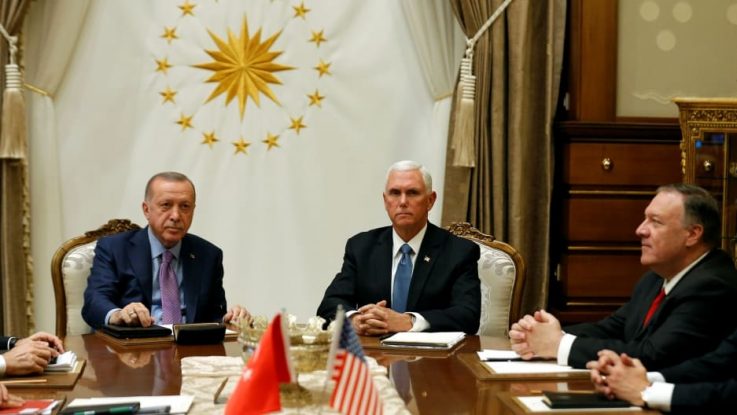
By Marko Marjanović | Anti-Empire | February 29, 2020
In the aftermath of the (probably Russian) strike that killed 33 Turkish soldiers in Syria late (10pm) Thursday Israel sent its condolences for the Turkish “martyrs”, ie using Islamic terminology:
Israel sends its condolences to Turkey over the killing of Turkish soldiers in Idlib.
“We are deeply saddened by the martyring of Turkish soldiers”
Interesting that they used “martyr” in Turkish https://t.co/X8SCOo3nWO
— Ragıp Soylu (@ragipsoylu) February 28, 2020
In fact, earlier that same day as Turkey was hitting the Syrian army heavily around Saraqib Israel snuck in two attacks on the other country:
Israeli helicopters struck Syrian military positions in the Quneitra province in the Syrian Golan Heights and wounded three Syrian soldiers, Syria’s official news agency SANA reported overnight Thursday.
Earlier Thursday, Syrian state TV reported that an Israeli drone fired a missile at a car in southern Syria, killing one person whom it named as a “civilian.” Several other media outlets aligned with Syrian President Bashar Assad’s regime said that the man was a local policeman.
Soon after Turkey expanded its Syria strikes to Hezbollah:
Turkish strikes using drones and smart missiles late on Friday that hit Hezbollah headquarters near Saraqeb killed nine of its members and wounded 30 in one of the bloodiest attacks on the Iran-backed group in Syria ever according to a commander in the regional alliance backing Damascus.
Sure the Shia Lebanese Hezbollah is fighting on the other side in Syria so hitting them would have some tactical value (at a great cost in other ways), but even at the time I wondered if that wasn’t really more a dog whistle to Tel-Aviv and the Israel supporters in DC and the US at large.
Apart from State Department apparatchiks and their hack boss Pompeo, Turkey had found itself very lonely in its new Syria adventure. The asked-for US-manned Patriot missiles to somehow wrestle the control of Idlib skies from Russia aren’t materializing.
But start hitting Hezbollah and suddenly you’ve got the attention of the powerful pro-Israel currents in the US, as well as of Israel itself.
My suspicion was confirmed Saturday when it became clear the Turks had hit Iranians as well:
Statement by Iran’s “advisory mission in Syria”: Turkish army is still shooting at our positions and bases. We call on Turkey to show rational behavior. The Turkish nation’s children are within range of our military forces.
(First statement by Iranian command in Syria, I guess)
— Reza Khaasteh (@Khaaasteh) February 29, 2020
The use of the word “children” above is a misleading translation, the Iranian communique spoke about “sons”, which naturally refers to Turkish troops.
Iranian embassy in Syria: “The Iranian government informed Erdogan that it would respond with full force to the Turkish points if it continued to bomb our forces and the Syrian army.”
— Rojava Network (@RojavaNetwork) February 29, 2020
Iran issued a warning to Erdogan to knock it off or his troops will face the consequences but you get the feeling that may be exactly what Erdogan is trying to provoke. Get the pathologically anti-Iranian Trump administration to see Turkey’s ‘safe-zone-for-bin-Ladenites’ Idlib invasion as an anti-Iranian enterprise and the prospects of American backing look quite a bit brighter.
#Turkey was informed in details of the position of Hezbollah and the Iranian brigades along with the Syrian army but decided to ignore the information and continued bombing these positions over and over again.
It is now clear that Turkey is in the battle with his army to stay.
— Elijah J. Magnier (@ejmalrai) February 29, 2020
Keep in mind that neither #Iran nor #Hezbollah ever attacked the Turkish army until this hour. It is #Turkey that took the initiative to bomb the Iranian-led forces and Hezbollah HQ and military hospital.
— Elijah J. Magnier (@ejmalrai) February 29, 2020
The war scenario between Israel and Hezbollah
By Elijah J. Magnier – 24/02/2020
Notwithstanding the increase in power of the “Axis of the Resistance”, with its precision missiles and unrivalled accumulated warfare experience, the possibility of war is still on the table. The “Axis of the Resistance” is increasing its readiness based on the possibility that Israel may not tolerate the presence of such a serious threat on its northern borders and therefore act to remove it. However, in any future war, the “Axis of the Resistance” considers the consequences would be overwhelmingly devastating for both sides and on all levels if the rules of engagement are not respected. Notwithstanding Israel’s superior air firepower, its enemy Hezbollah has established its own tremendous firepower, and its experience in recent wars in Syria, Iraq and Yemen is an important asset.
Sources within the “Axis of the Resistance” believe the next battle between Hezbollah and Israel, if ever it takes place, would be “controlled and not sporadic, with a focus on specific military objectives without damaging the infrastructure, on both sides”.
The sources consider Gaza as a precedent. In Gaza Palestinians and Israelis have fought many recent battles that lasted only a few days in which the objectives bombed were purely military. This is a new rule of engagement (ROE) regulating conflict between the belligerents. When Israel hits a non-military target, the Palestinian resistance responds by hitting a similar non-military target in Israel. The lesson extracted from the new ROE between Israel and the Palestinians is that every time exchanges of bombing go out of control, both sides understand they have to bring it back to an acceptable and equitable level, to limit damage and keep such mutual attacks from targeting civilians.
The “Axis of the Resistance” therefore considers that the probability is high that the next battle would be limited to military objectives and kept under control. If one side increases the bombing, the other will follow. Otherwise, both sides have the capability to cause total destruction and go on to uncontrolled bombing. In the case of an out-of-control war, allies on both sides would become involved, which renders this scenario less likely.
Hezbollah in Lebanon is said to have over 150,000 missiles and rockets. Israel might suppose that a limited attack could destroy tens of thousands of Hezbollah’s missiles. Is it worth it? “From Israel’s view, Israel may think it is worth triggering a battle and destroying thousands of missiles, thinking that Israel has the possibility to prevent Hezbollah from re-arming itself. But even in this case, Israel doesn’t need to destroy villages or cities or the Lebanese infrastructure, instead, it will limit itself to selective targets within its bank of objectives. However, we strongly doubt Israel could succeed in limiting Hezbollah’s supply of missiles and advanced weapons. Many of these missiles no longer need to be close to the borders with Israel, but can be deployed on the Lebanese-Syrian borders in safe silos”, said the sources.
However, Israel should also expect, according to the same sources, that Hezbollah will respond by bombing significant Israeli military targets within its bank of objectives. “There is no need to bomb airports, power stations, chemical industries, harbours or any highly significant target if Israel doesn’t bomb any of these in Lebanon. But if necessary Hezbollah is prepared to imitate Israel by hitting back without hesitation indiscriminately and against high-value targets, at the cost of raising the level of confrontation to its maximum level. Hezbollah and Israel have a common language in warfare. If the bombing is limited, no side interprets the others’ actions as a sign of weakness”, said the sources.
“Hezbollah doesn’t want war and is doing everything to avoid it. This is why it responded in Moawad, in the suburb of Beirut, when Israeli armed drones failed to reach their objectives. By responding, Hezbollah actually prevented a war on a large scale because it is not possible to allow Israel to get away with any act of war in Lebanon, violating the ROE” said the sources.
Last September, Hezbollah targeted an Israeli vehicle in Avivim with a laser-guided missile in daylight after forcing the Israeli Army to hide for a week and retreat all forces behind civilians lines, imposing a new ROE. The Israeli army cleared the 120 km borders with Lebanon (5 km deep) to avoid Hezbollah’s revenge retaliation for violating the 2006 cessation of hostility’s agreement. Israel refrained from responding and swallowed the humiliation due to its awareness of Hezbollah’s readiness to start a devastating war if necessary.

Israeli officials used to threaten Hezbollah and Lebanon to take the country “back to the stone age”. This is indeed within the reach of Israel’s military capability. However, it is also within Hezbollah’s reach to bring Israel back to the stone age, if required. Hezbollah’s precision missiles can hit any bridge, airport, gasoline deposit containers, power stations, Haifa harbour, oil and gas rig platforms, any infrastructure and military and non-military objectives if Israel attempts to target similar objectives in Lebanon first. Hezbollah’s new missile capability is not new to Israel, who is observing the latest technology Iran’s allies are enjoying and “testing,” mainly in Yemen. The recent bombing of Saudi Arabia oil facilities and the downing of a Saudi Tornado in Yemen revealed that Iran’s HOT missiles are capable of downing jets at medium height and any helicopter violating Lebanese airspace.
Hezbollah’s latest version of the Fateh precision missile, the supersonic anti-ship missiles and the anti-air missiles can prevent Israel from using its navy, stopping any civilian ship from docking in Haifa, thwarting the use of Israeli Helicopters and precision bombing attacks- as in Iran’s latest confrontation with the US at Ayn al-Assad base in Iraq.
Hezbollah’s missiles are unlikely to cause simple traumatic brain injuries – as per the Iranian missile at Ayn al Assad – when hitting targets in Israel in case of war. They can avoid missile interception systems. This increase of capability is a game-changer, and Hezbollah believes it is already decreasing the chances of war. Arming itself with precision missiles and armed drones and showing these capabilities to Israel is Hezbollah’s way to avert a war and protect the equation of deterrence.
In its 2020 security assessment, the Israeli Military Intelligence Directorate (Aman) unwisely evaluated the assassination of the Iranian Major General Qassem Soleimani as a “restraining factor”. Aman’s report, showing astonishing ignorance, stated that Soleimani was responsible for Hezbollah’s missile projects. This lack of understanding of the Hezbollah-Iran relationship and dynamic is quite surprising. Sayyed Ali Khamenei told Hezbollah’s leader Sayyed Hassan Nasrallah decades ago that he knows what he needs and what to do and doesn’t need to fall back on Iran. The IRGC and Hezbollah have set up a collaboration engine that won’t stop even if half of the IRGC leadership is killed. The possession of the feared Iranian precision missiles is no longer a secret: all Iran’s allies have these deployed, in Lebanon, Syria, Iraq and Yemen.
Yesterday is unlike today: the power of destruction now belongs to all parties, no longer to Israel alone. War is no longer an option. US/Israeli aggression will be limited to an economic war, so long as the “Axis of the Resistance” continues updating its warfare capability to maintain deterrence parity.
This article is translated free to many languages by volunteers so readers can enjoy the content.
Copyright © https://ejmagnier.com 2020 @ejmalrai
Don’t Hold Your Breath for ‘World War III’: World War IV Has Already Begun
By A. B. Abrams | The Saker Blog | February 27, 2020
“A. B. Abrams is the author of the book ‘Power and Primacy: A History of Western Intervention in the Asia-Pacific.’ His second book covering the history of the United States’ conflict with North Korea is scheduled for publication in 2020.
He is proficient in Chinese, Korean and other East Asian languages, has published widely on defence and politics related subjects under various pseudonyms, and holds two related Masters degrees from the University of London.”
 The world today finds itself in a period of renewed great power conflict, pitting the Western Bloc led by the United States against four ‘Great Power adversaries’ – as they are referred to by Western defence planners – namely China, Russia, North Korea and Iran. This conflict has over the past 15 years escalated to encompass the military, economic and information spheres with global consequences – and appears to be coming to a head as signs of peaking tensions appear in multiple fields from military deployments and arms races to harsh economic wars and a harsher still information war.
While the term ‘World War III’ has been common since the 1940s, referring to the possibility of a global great power war on a greater scale than the first and second world wars, the Cold War between the Western and Soviet Blocs was at its height as total, as global and as heated as the prior conflicts. As weapons technology has evolved, the viability of a direct shooting war has diminished considerably – forcing major powers to seek alternative means to engineer their adversaries’ capitulation and assert their own dominance. This has been reflected in how the Cold War, and the current phase of global conflict some refer to as ‘Cold War 2’ have been distinct from the first two world wars despite the final objectives of the parties involved sharing many similarities. I would thus suggest redefining what a ‘world war’ is and acknowledging that this current phase of global conflict is every part as intense as the great power ‘hot wars’ waged in the first half of the 20th century.
Had the intercontinental range ballistic missile and the miniaturised nuclear warhead been invented twenty years earlier, the Allied Powers may have needed to rely more heavily on economic and information warfare to contain and eventually neutralise Nazi Germany. The Second World War would have been very different in nature to reflect the technologies of the time. When viewed from this paradigm, the Cold War can be seen as a ‘Third World War’ – a total conflict more vast, comprehensive and international than its predecessors stretched out over more than 40 years. The current conflict, or ‘World War IV,’ is ongoing. An assessment of prior ‘great power wars,’ and the unique nature of the current conflict, can provide some valuable insight into how warfare is evolving and the likely determinants of its victors.
As of 2020 it is clear that great power conflict has become almost as heated as it can short of an all-out hot war – with the Western Bloc applying maximum pressure on the information, military and economic fronts to undermine not only smaller adversaries such as Venezuela and Syria and medium sized ones such as North Korea and Iran, but also China and Russia. When exactly this phase of conflict began – sometime after the Cold War’s end – remains uncertain.
The interval between the third and fourth ‘world wars’ was considerably longer than that between the second and the third. This was due to a number of factors – primarily that there was no immediate and obvious adversary for the victorious Western Bloc to target once the Soviet Union had been vanquished. Post-Soviet Russia was a shade of a shadow of its former self. Under the administration of Boris Yeltsin the country’s economy contracted an astonishing 45% in just five years from 1992 (1) leading to millions of deaths and a plummet in living standards. Over 500,000 women and young girls of the former USSR were trafficked to the West and the Middle East – often as sex slaves (2), drug addiction increased by 900 percent, the suicide rate doubled, HIV became a nationwide epidemic (3) corruption was rampant, and the country’s defence sector saw its major weapons programs critical to maintaining parity with the West delayed or terminated due to deep budget cuts (4). The possibility of a further partition of the state, as attested to multiple times by high level officials, was very real along the lines of the Yugoslav model (5).
Beyond Russia, China’s Communist Party in the Cold War’s aftermath went to considerable lengths to avoid tensions with the Western world – including a very cautious exercise of their veto power at the United Nations which facilitated Western led military action against Iraq (6). The country was integrating itself into the Western centred global economy and continuing to emphasis the peaceful nature of its economic rise and understate its growing strength. Western scholarship at the time continued to report with near certainty that internal change, a shift towards a Western style political system and the collapse of party rule was inevitable. The subsequent infiltration and westernisation was expected to neuter China as a challenger to Western primacy – as it has other Western client states across the world. China’s ability to wage a conventional war against even Taiwan was in serious doubt at the time, and though its military made considerable strides with the support of a growing defence budget and massive transfers of Soviet technologies from cash strapped successor states, it was very far from a near peer power.
North Korea did come under considerable military pressure for failing to follow what was widely referred to as the ‘tide of history’ in the West at the time – collapse and westernisation of the former Communist world. Widely portrayed in the early 1990s as ‘another Iraq’ (7), Western media initially appeared to be going to considerable lengths to prepare the public for a military campaign to end the Korean War and impose a new government north of the 38th parallel (8). Significant military assets were shifted to Northeast Asia specifically to target the country during the 1990s, and the Bill Clinton administration came close to launching military action on multiple occasions – most notably in June 1994. Ultimately a combination of resolve, a formidable missile deterrent, a limited but ambiguous nuclear capability, and perhaps most importantly Western certainty that the state would inevitably collapse on its own under sustained economic and military pressure, deferred military options at least temporarily.
The fourth of the states that the United States today considers a ‘greater power adversary,’ Iran too was going to considerable lengths to avoid antagonism with the Western Bloc in the 1990s – and appeared more preoccupied with security threats on its northern border from Taliban controlled Afghanistan. With a fraction of the military power neighbouring Iraq had previously held, the presence of an ‘Iranian threat’ provided a key pretext for a Western military presence in the Persian Gulf after the Soviets, the United Arab Republic and now Iraq had all been quashed. With the new government in Russia put under pressure to terminate plans to transfer advanced armaments to Iran (9), the country’s airspace was until the mid 2000s frequently penetrated by American aircraft, often for hours at a time, likely without the knowledge of the Iranians themselves. This combined with a meagre economic outlook made Iran seem a negligible threat.
While the Cold War ended some time between 1985 and 1991 – bringing the ‘third world war’ to a close – the range of dates at which one could state that the ‘fourth world war’ began and the West again devoted itself to great power conflict is much wider. Some would put the date in the Summer of 2006 – when Israel suffered the first military defeat in its history at the hands of the Lebanese militia Hezbollah. Using North Korean tunnel and bunker networks, command structures, weapons and training (10), and bolstered by Iranian funding and equipment, the shock of the militia’s victory, though underplayed in Western media, reverberated among informed circles across the world.
Others would place the date two years later in 2008 during the Beijing Summer Olympics, when Georgia with the full support of the West waged a brief war against Russia – and Moscow despite harsh warnings from Washington and European capitals refused to back down on its position. Post-Yeltsin Russia’s relations with the Western Bloc had appeared relatively friendly on the surface, with President George W. Bush observing in 2001 regarding President Vladimir Putin that he “was able to get a sense of his soul,” and predicting “the beginning of a very constructive relationship.” Nevertheless, signs of tension had begun to grow from Moscow’s opposition to the Iraq War at the UN Security Council to President Putin’s famous ‘Munich Speech’ in February 2007 – in which he sharply criticised American violations of international law and its “almost uncontained hyper use of force in international relations.”
It could also be questioned whether, in light of what we know about Western support for separatist insurgents in Russia itself during the 1990s, the war against the country ever ended – or whether hostilities would only cease with a more total capitulation and partition and with the presence of Western soldiers on Russian soil as per the Yugoslav precedent. As President Putin stated in 2014 regarding continuing Western hostilities against Russia in the 1990s: “The support of separatism in Russia from abroad, including the informational, political and financial, through intelligence services, was absolutely obvious. There is no doubt that they would have loved to see the Yugoslavia scenario of collapse and dismemberment for us with all the tragic consequences it would have for the peoples of Russia” (11). Regarding Western efforts to destabilise Russia during the 1990s, CIA National Council on Intelligence Deputy Director Graham E. Fuller, a key architect in the creation of the Mujahedeen to fight Afghanistan and later the USSR, stated regarding the CIA’s strategy in the Caucasus in the immediate post-Cold War years: “The policy of guiding the evolution of Islam and of helping them against our adversaries worked marvellously well in Afghanistan against the Red Army. The same doctrines can still be used to destabilize what remains of Russian power” (12). The U.S. Congressional Task Force on Terrorism and Unconventional Warfare’s director, Yossef Bodansky, himself also detailed the extent of the CIA’s strategy to destabilize Central Asia by using “Islamist Jihad in the Caucasus as a way to deprive Russia of a viable pipeline route through spiralling violence and terrorism” – primarily by encouraging Western aligned Muslim states to continue to provide support for militant groups (13).
Much like the Cold War before it, and to a lesser extent the Second World War, great powers slid into a new phase of conflict rather that it being declared in a single spontaneous moment. Did the Cold War begin with the Berlin Blockade, the Western firebombing of Korea or when the atomic bombs were dropped on Hiroshima and Nagasaki – which accelerated the move into a nuclear arms race. Equally, multiple dates were given for the opening of the Second World War – the German invasion of Poland in 1939, the beginning of the Sino-Japanese war two years prior, the Japanese Empire’s attack on Pearl Harbour and conquest of Southeast Asia which marked the first major expansion beyond Europe and North Africa in 1941, or some other date entirely. The slide into a new world war was if anything even slower than its predecessors.
The shift towards an increasingly intense great power conflict has been marked by a number of major incidents. In the European theatre one of the earliest was the Bush administration’s withdrawal from the Anti-Ballistic Missile treaty in 2002 and subsequent deployment of missile defences and expansion of NATO’s military presence in the former Soviet sphere of influence, which was widely perceived in Russia as an attempt to neutralise its nuclear deterrent and place the Western Bloc in a position to coerce Moscow militarily (14). This threatened to seriously upset the status quo of mutual vulnerability, and played a key role in sparking a major arms race under which Russia would develop multiple classes of hypersonic weapon. Their unveiling in 2018 would in turn lead the United States to prioritise funding to develop more capable interceptor missiles, a new generation of missile defences based on lasers, and hypersonic ballistic and cruise missiles of its own (15).
Another leading catalyst of the move towards great power confrontation was the Barak Obama administration’s ‘Pivot to Asia’ initiative, under which the bulk of America’s military might and considerable assets from the rest of the Western world would be devoted to maintaining Western military primacy in the Western Pacific. This was paired with both economic and information warfare efforts, the latter which increasingly demonised China and North Korea across the region and beyond and actively sought to spread pro-Western and anti-government narratives among their populations through a wide range of sophisticated means (16). These programs were successors to those sponsored by Western intelligence agencies to ideologically disenchant the populations of the Warsaw Pact and Soviet Union with their own political systems and paint Western powers as benevolent and democratising saviours (17). Economic warfare also played a major role, with efforts centred around the ‘Trans-Pacific Partnership’ trade deal – or ‘Economic NATO’ as several analysts referred to it – to isolate China from regional economies and ensure the region remained firmly in the Western sphere of influence (18). The military aspect of the Pivot to Asia would reawaken long dormant territorial disputes, and ultimately lead to high military tensions between the United States and China which in turn fuelled the beginning of an arms race. This arms race has more recently led to the American withdrawal from the Intermediate-Range Nuclear Forces treaty, which paves the way for deployment of American long-range missiles across the Western Pacific – all with China and North Korea firmly in their crosshairs (19).
It is arguably in the Middle East, however, where the new phase of global conflict has seen its most direct clashes so far. The nine-year conflict in Syria, although far less destructive or brutal, provides ‘World War IV’ with something of an analogue to the Korean War in the Cold War. The conflict has united the Western Bloc and a wide range of allies, from Turkey and Israel to the Gulf States and even Japan (which funds the jihadist-linked White Helmets) (20), in an effort to overthrow an independent government with close and longstanding defence ties to Russia, North Korea, Iran and China. The conflict has seen North Korean, Russian, Hezbollah and Iranian special forces (21) among other assets deployed on the ground in support of Syrian counterinsurgency efforts, with all of these parties providing considerable material support (the Koreans have built and fully staffed at least three hospitals as part of large medical aid packages and continue to be a major supplier of arms and training) (22). China too, particularly concerned by the presence of jihadist militants of Chinese origin in Syria, has played some role in the conflict – the exact details of which remain uncertain with much reported but unconfirmed (23).
Syria’s insurgency involving a range of jihadist groups, at times united only by their intent to end the secular Syrian government, have received widespread support from the Western Bloc and their aforementioned allies. This has involved both material support, which according to State Secretary Hillary Clinton included turning a blind eye to Gulf countries’ considerable assistance to the Islamic State terror group (24), and active deployments of special forces from a wide range of countries, from Belgium and Saudi Arabia to Israel and the U.S. The U.S., European powers, Turkey and Israel have at times directly attacked Syrian units in the field – while Russian reports indicate that close Western coordination with jihadist groups has been used to facilitate a number of successful attacks on Russian positions (25). The conflict in Syria arguably represents a microcosm of the macrocosm which is a new world war – one which pits the Western Bloc and those which support the Western-led order, both directly and through local proxies, against three of its four ‘great power adversaries’ in the field.
‘World War IV’ is unlikely to come to an end for the foreseeable future, and its final outcome remains difficult to predict. Much like in the Cold War, the Western Bloc retains considerable advantages – today most notably in the field of information war which allows it to extensively shape perceptions of the vast majority of the world’s population. This has included the demonization of Western adversaries, the whitewashing of Western crimes both domestically and internationally, and portraying westernisation and increased Western influence as a solution to people’s frustrations from corruption to economic stagnation. This has been a key facilitator of the pro-Western protests engulfing states from Sudan and Algeria to Ukraine and Thailand. Economically too, only China among the Western Bloc’s major adversaries has posed a serious threat to Western primacy. Indeed, it remains highly questionable whether the other three could survive economically under Western pressure without Chinese trade and economic support.
Russia has made a considerable economic recovery since the 1990s, but remains a shadow of its former self in the Soviet era. The country’s leadership has succeeded in reforming the military, foreign ministry and intelligence services, but the economy, legal system and other parts of the state remain in serious need of improvement which, over 20 years after Yeltsin’s departure, cannot come soon enough. Even in the field of defence, the struggling economy has imposed serious limitations – and in fields such as aviation and armoured warfare the country is only beginning to slowly go beyond modernising Soviet era weapons designs and begin developing new 21st century systems (26). On the positive side, the country does remain a leader in many high end technologies mostly pertaining to the military and to space exploration, while Western economic sanctions have undermined the positions of Europhiles both among the elite and within the government and boosted many sectors of domestic production to substitute Western products (27).
In the majority of fields, the ‘Eastern Bloc’ have been pressed onto the defensive and forced to prevent losses rather than make actual gains. While preserving Venezuelan sovereignty, denying Crimea to NATO and preventing Syria’s fall have been major victories – they are successes in denying the West further expansion of its own sphere of influence rather than reversing prior Western gains or threatening key sources of Western power. Pursuing regime change in Venezuela and Ukraine and starting wars in the Donbasss and in Syria have cost the Western Bloc relatively little – the Ukrainians and client states in the Gulf and Turkey have paid the brunt of costs for the war efforts. Material equipment used by Western backed forces in both wars, ironically, has largely consisted of Warsaw Pact weaponry built to resist Western expansionism – which after the Cold War fell into NATO hands and is now being channelled to Western proxies. Libyan weaponry, too, was transferred to Western backed militants in Syria in considerable quantities after the country’s fall in 2011 – again minimising the costs to the Western Bloc of sponsoring the jihadist insurgency (28). The damage done and costs incurred by the Syrians, Hezbollah, Russia and others are thus far greater than those incurred by the Western powers to cause destruction and begin conflicts.
Syria has been devastated, suffering from issues from a return of polio to depleted uranium contamination from Western airstrikes and a new generation who have grown up in territories under jihadist control with little formal education. The war is a victory only in that the West failed to remove the government in Damascus from power – but Western gains from starting and fuelling the conflict have still far outweighed their losses. In the meantime, through a successful campaign centred around information warfare, the Western sphere of influence has only grown – with further expansion of NATO and the overthrow of governments in resource rich states friendly to Russia and China such as Libya, Sudan and Bolivia. Commandeering the government of poor but strategically located Ukraine was also a major gain, with states such as Algeria and Kazakhstan looking to be next in the Western Bloc’s crosshairs. Thus while Syria was saved, though only in part, much more was simultaneously lost. The damage done to Hong Kong by pro-Western militants, ‘thugs for democracy’ as the locals have taken to calling them, who have recently turned to bombing hospitals and burning down medical facilities (29), is similarly far greater than the costs to the Western powers of nurturing such an insurgency. Similar offensives to topple those which remain outside the Western sphere of influence from within continue to place pressure on Russian and Chinese aligned governments and on neutral states seen not to be sufficiently pro-Western.
While the Western Bloc appears to be in a position of considerable strength, largely by virtue of its dominance of information space, which has allowed it to remain on the offensive, a sudden turning point in which its power suddenly diminishes could be in sight. From teen drug abuse (30) to staggering debt levels (31) and the deterioration of party politics and popular media, to name but a few of many examples, the West appears at far greater risk today of collapse from within than it did during the Cold War. A notable sign of this is the resurgence of both far right and far left anti-establishment movements across much of the Western world. Despite massive benefits from privileged access to third world resource bases, from France’s extractions from Francophone West Africa (32) to the petrodollar system propping up American currency (33), Western economies with few exceptions are very far from healthy. A glimpse of this was given in 2007-2008, and little has been done to amend the key economic issues which facilitated the previous crisis in the twelve years since (34). The West’s ability to compete in the field of high end consumer technologies, particularly with rising and more efficient East Asian economies, increasingly appears limited. From semiconductors to electric cars to smartphones to 5G, the leaders are almost all East Asian economies which have continued to undermine Western economic primacy and expose the gross inefficiencies of Western economies. The result has been less favourable balances of payments in the Western world, a growing reliance on political clout to facilitate exports (35), and increasing political unrest as living standards are placed under growing pressure. The Yellow Vests and the rise of Donald Trump and Bernie Sanders are all symptoms of this. With very real prospects of another economic crash in the coming decade, in the style of 2008 but likely much worse, Western economies are expected to bear the brunt of the damage. Their ability to survive remains in serious question. Effects of a crash on North Korea, Iran, Russia and even China will be far less severe. While the previous crash hit Russia particularly hard (36), an economic turnaround from 2014 and the insulation provided by Western sanctions leave it far less vulnerable to the fallout from a Western economic crisis.
Ultimately China appears to be setting itself up for an ‘Eastern Bloc’ victory – a coup de grace which could see Western gains over the past several decades reversed and the power of the West itself diminished to an extent unprecedented in centuries. While the United States reluctantly outsourced much of its high end consumer technologies to East Asian allies during the Cold War – namely Japan, South Korea and Taiwan – China is going for the jugular of the Western world’s economy with its ‘Made in China 2025’ initiative, which will see some critical remaining fields of Western technological primacy shift to East Asian hands. The Coronavirus, bombings in Hong Kong, the trade war, and the wide range of tools in the Western arsenal for destabilisation can at best slightly delay this – but cannot prevent it. In a globalised capitalist economy the most efficient producers win – and East Asia and China in particular, with its Confucian values, stable and efficient political systems and world leading education (37), are thus almost certain to take over the high end of the world economy.
Much as the key to Western victory in the Cold War was successful information warfare efforts and isolation of the Soviet economy from the majority of the world economy, the key to determining the victor of ‘World War IV’ is likely lie in whether or not Beijing succeeds in its attempt to gain dominance of high end technologies critical to sustaining Western economies today. This is far from the only determinant of victory. Efforts to undermine the effective subsidies to Western economies from Central and West Africa, the Arab Gulf states and elsewhere in the third world, and to ensure continued military parity – to deter NATO from knocking over the table if they lose the game of economic warfare – are among the other fields of critical importance. Based on China’s prior successes, and those of other East Asian economies, the likelihood that it will meet its development goals is high – to the detriment of Western interests. The result will be an end to world order centred on Western might – the status quo for the past several hundred years – and emergence in its place of a multipolar order under which Russia, Asia (Central, East, South and Southeast) and Africa will see far greater prominence and prosperity.
- Menshikov, S., ‘Russian Capitalism Today,’ Monthly Review, vol. 51, no. 3, 1999 (pp. 82–86).
- Yulia V. Tverdova, ‘Human Trafficking in Russia and Other Post-Soviet States,’
Human Rights Review, December 11, 2016.
- Klein, Naomi, The Shock Doctrine: The Rise of Disaster Capitalism, London,
Penguin, 2008 (Chapter 11: ‘Russia Choses the Pinochet Option: Bonfire of a Young Democracy’).
- ‘The Death of the MiG 1.44 Program; How the Collapse of the Soviet Union Derailed Moscow’s Fifth Generation Fighter Development,’ Military Watch Magazine, September 16, 2018.
‘Russia’s Sukhoi Unveils Images from Cancelled Next Generation Fighter Program,’ Military Watch Magazine, December 17, 2019.
- Presidential Address to the Federal Assembly, President of Russia, Kremlin, December 4, 2014.
Bechev, Dimitar, Rival Power: Russia’s Influence in Southeast Europe, New Haven, CT, Yale University Press, 2017 (Chapter 1).
- Kristof, Nicholas D., ‘WAR IN THE GULF: China; Beijing Backs Away From Full Support of the War,’ New York Times, February 1, 1991.
- ‘Thaw in the Koreas?,’ Bulletin of Atomic Scientists, vol. 48, no. 3, April 1992 (p. 16).
- ‘Time to End the Korean War,’ The Atlantic, February 1997.
- Axe, David, ‘Iran Desperately Wants This Fighter Plane,’ The National Interest, January 4, 2020.
- ‘Hezbollah a North Korea-Type Guerrilla Force,’ Intelligence Online, No. 529, August 25–September 7, 2006.
“North Koreans Assisted Hezbollah with Tunnel Construction,” Terrorism Focus, The Jamestown Foundation, vol. III, issue 30, August 1, 2006.
Dilegge, Dave and Bunker, Robert J., and Keshavarz, Alma, Iranian and Hezbollah Hybrid Warfare Activities: A Small Wars Journal Anthology, Amazon Media, 2016 (p. 261).
‘Bulsae-3 in South Lebanon: How Hezbollah Upgraded its Anti-Armour Capabilities with North Korean Assistance,’ Military Watch Magazine, September 3, 2019.
- Kremlin, President of Russia, Presidential Address to the Federal Assembly, December 4, 2014.
- Congressional Record, V. 151, PT. 17, U.S. Congress, October 7 to 26, 2005.
- ‘American political scientist: Western Intelligence used Azerbaijan to export terrorism into Russia,’ Panorama, May 30, 2015.
- Kremlin, President of Russia, Plenary session of St Petersburg International
Economic Forum, June 17, 2016.
- Gregg, Aaron, ‘Military Industrial Complex Finds a Growth Market in Hypersonic Weapons,’ Washington Post, December 21, 2018.
- Mullen, Mike and Nunn, Sam and Mount, Adam, A Sharper Choice on North Korea: Engaging China for a Stable Northeast Asia, Council on Foreign Relations, Independent Task Force Report No. 74, September 2016.
Cartalucci, Tony, ‘Twitter Targets Hong Kong in US-backed Regime Change Operation,’ Ron Paul Institute for Peace and Prosperity, October 15, 2019.
Park, Kyung-Ae, ‘Regime Change in North Korea?: Economic Reform and Political Opportunity Structures,’ North Korean Review, vol. 5, no. 1, Spring 2009 (p. 23-45).
- ‘Worldwide Propaganda Network Built by the C.I.A.,’ New York Times, December 26, 1977.
- Wu, S., ‘Why the TPP is an “economic NATO,”’ Huffington Post, October 19,
2015.
- Ait, Abraham, ‘US Withdrawal From the INF Treaty Isn’t About Russia,’ The Diplomat, October 25, 2018.
- al-Jablawi, Hosam, ‘The White Helmets Struggle Without US Funding,’ Atlantic Council, June 11, 2018.
- ‘North Korean Special Forces in Syria; A Look at Pyongyang’s Assistance to Damascus’ Counterinsurgency Operations,’ Military Watch Magazine, June 10, 2018.
- ‘DPRK Ambassador affirms his country’s readiness to support health sector in Syria,’ Syrian Arab News Agency, July 25, 2016.
- Pauley, Logan and Marks, Jesse, ‘Is China Increasing Its Military Presence in Syria?,’ The Diplomat, August 20, 2018.
Hemenway, Dan, ‘Chinese strategic engagement with Assad’s Syria,’ Atlantic Council, December 21, 2018.
- ‘We finally know what Hillary Clinton knew all along – U.S. allies Saudi Arabia
and Qatar are funding Isis,’ The Independent, October 14, 2016.
- ‘Inquiry Into Death of Russian Lt. Gen. Asapov Shows Data Leaks to Daesh –
Source,’ Sputnik, September 26, 2017.
‘Drones used by Syrian terrorists “require advanced training” – Russian MoD in response to US,’ Sputnik, January 9, 2018.
- ‘Five Next Generation Russian Combat Jets We Will See in the 2020s: From MiG-41 Hypersonic Interceptors to PAK DA Stealth Bombers,’ Military Watch Magazine, January 1, 2019.
- Twigg, Judy, ‘Russia Is Winning the Sanctions Game,’ National Interest, March 14, 2019.
- Hersh, Seymour, ‘The Red Line and the Rat Line,’ London Review of Books, vol. 36, no. 8, April 2014
Angelovski, Ivan and Patrucic, Miranda and Marzouk, Lawrence, ‘Revealed: the £1bn of weapons flowing from Europe to Middle East,’ The Guardian, July 27, 2016.
Chivers, C. J. and Schmitt, Eric and Mazzetti, Mark, ‘In Turnaround, Syria Rebels Get Libya Weapons,’ New York Times, June 21, 2013.
McCarthy, Andrew C., ‘Hillary Clinton’s Benghazi Debacle: Arming Jihadists in Libya . . . and Syria,’ National Review, August 2, 2016.
- ‘Militants Bomb Hospital, Torch Quarantine Center as Hong Kong Braces for Virus Outbreak,’ Military Watch Magazine, January 27, 2020.
- ‘Class A drug use “at record levels due to young people”,’ BBC News, September 20, 2019.
- Buchholz, Katharina, ‘Industrialized Nations Have Biggest Foreign Debt,’ Statista, February 7, 2019.
- ‘France’s Colonial Tax Still Enforced for Africa. “Bleeding Africa and Feeding
France,”’ Centre for Research of Globalization, January 14, 2015.
Bart Williams, Mallence, ‘The Utilization of Western NGOs for the Theft of Africa’s Vast Resources,’ TedxBerlin, January 26, 2015
(https://www.youtube.com/watch?v=AfnruW7yERA).
- Wong, Andrea, ‘The Untold Story Behind Saudi Arabia’s 41-Year U.S. Debt Secret,’ Bloomberg, May 31, 2016.
Spiro, David E., The Hidden Hand of American Hegemony: Petrodollar Recycling and International Markets, New York, Cornell University Press, 1999.
- ‘Banks have not learnt lessons of 2008 crisis, says Gordon Brown,’ Financial Times, October 31, 2017.
‘A decade after the financial meltdown, its underlying problems haven’t been fixed,’ The Guardian, August 6, 2017.
- ‘Fearing U.S. Sanctions Over Su-35 Purchase: What is Behind Indonesia’s Interest in New F-16V Fighters,’ Military Watch Magazine, November 6, 2019.
Rogan, Tom, ‘The very political reason Qatar buys different fighter aircraft from Britain, France, and the US,’ Washington Examiner, February 25, 2020.
Krishnan, Rakesh, ‘Countering CAATSA: How India can avoid American arm twisting,’ Business Today, March 6, 2019.
- Gaddy, Clifford G. and Ickes, Barry W., ‘Russia after the Global Financial Crisis,’ Eurasian Geography and Economics, vol. 51, no. 3, 2010 (pp. 281-311).
- Hobbs, Tawnell D., ‘U.S. Students Fail to Make Gains Against International Peers,’ The Wall Street Journal, December 3, 2019.
Turner, Camiilla, ‘Chinese students are two years ahead of their white British peers by age 16, report finds,’ The Telegraph, July 30, 2019.
Iran: Dubowitz’s coronavirus remarks ‘shameful and inhuman’
Press TV – February 26, 2020
Iranian Deputy Foreign Minister for Political Affairs Abbas Araqchi says the remarks by Mark Dubowitz, Chief Executive of Washington-based Foundation for Defense of Democracies (FDD), about the spread of coronavirus in Iran are “shameful and downright inhuman.”
Dubowitz claimed on Twitter Tuesday that coronavirus has halted Iran’s non-oil exports, achieving “what American economic sanctions could not.”
Araqchi, in response, said Wednesday that cheering for a deadly virus to spread is shameful, noting that at least Dubowitz “understands that the American economic sanctions were not — and will not be — as effective as a Covid-19 Virus.”
In another outrageous and unfounded claim, Dubowitz said that Tehran has “spread terrorism” in the Middle East and “now it’s spreading the coronavirus.”
Nearly 140 people have been tested positive for coronavirus in Iran since the infection was identified in a city in central country last week. The government has put the number of deaths at 19 as of Wednesday noon local time.
Dubowitz’s remarks come as the US Centers for Disease Control and Prevention (CDC) Tuesday issued warnings about the virus, urging Americans to prepare and take precautionary measures.
“The data over the past week about the spread in other countries has raised our level of concern and expectation that we are going to have community spread here,” Dr. Nancy Messonnier, the CDC’s head of respiratory diseases, told reporters in a conference call.
The warning came as President Donald Trump tried to play down fears and said in a tweet Monday that the coronavirus was “very much under control in the USA.”
Meanwhile, growing economic pressure on Iran has hampered the country’s efforts to confront the outbreak of coronavirus as health bodies face restrictions importing test kits to detect the infection.
Ramin Fallah, a board member at Iran’s Association of Medical Equipment Importers, said on Sunday that US sanctions as well as restrictions newly imposed on Iran by a global money laundering watchdog had made it increasingly difficult to access the kits.
Under mounting pressure from Washington, the Paris-based Financial Action Task Force (FATF) decided on Friday to place Iran on its blacklist, making it more difficult for Iranian banks to settle payments with foreign counterparts.
US Imposes Sanctions on Entities in Russia and China Over ‘Support of Iran’s Missile Programme’
Sputnik – February 25, 2020
US Secretary of State Mike Pompeo has announced that Washington is imposing sanctions on 13 entities in Russia, China, Iraq, and Turkey for “supporting Iran’s missile programme.”
He further added that sanctions against individuals and entities in those countries were “consistent with our efforts to use all available measures” to slow Iranian missiles.
In particular, five Chinese and Turkish entities and individuals have been included in the sanctions list.
The decision was made in accordance with the Iran, North Korea, and Syria Non-proliferation Act, which provides for sanctions for “the transfer of equipment or technology having the potential to make a material contribution to the development of weapons of mass destruction or cruise or ballistic missile systems” to those countries.
Addressing a large meeting on the occasion of celebrating the 40th anniversary of victory of the Islamic Revolution at Tehran’s Azadi (Liberty) Square earlier this month, Iranian President Hassan Rouhani stated that Tehran hadn’t asked and would not ask “a permission from anybody to manufacture various types of missiles, including anti-tank missiles, air-to-air, ground-to-ground or sea-to-sea missiles. We will continue our way [of development] of military force”.
Nuclear war ‘more likely’ after US arms subs with low-yield nukes – Tehran
RT | February 25, 202
Iran has blasted Washington for deploying submarines with low-yield nuclear warheads, arguing that the move increases the likelihood of unconventional war.
“Such provocative actions must be condemned,” Mohsen Baharvand, Iran’s deputy foreign minister for international and legal affairs, told the Conference on Disarmament in the UN building in Geneva. He added that the decision will make nuclear war “more likely” and sets the stage for an “accelerated” nuclear arms race.
The Pentagon announced this month that the Navy had fielded a low-yield, submarine-launched ballistic missile warhead, claiming the decision was aimed at deterring nuclear adversaries. The missiles are about as powerful as the nuclear bomb dropped on Hiroshima.
Washington has long accused Iran of seeking to develop its own nuclear weapons – an allegation that Tehran has fiercely denied. The Islamic Republic agreed to far-reaching inspections of nuclear sites as part of the 2015 sanctions-lifting deal reached with the US and several other signatories. US President Donald Trump pulled his country out of the agreement in 2018, even though Tehran was found to be in full compliance with the accord.
Deconstructing the election to Iran’s Majlis
By M. K. BHADRAKUMAR | Indian Punchline | February 24, 2020
Iran’s parliamentary election on Friday took place in extraordinary circumstances. The pandemic fear over coronavirus significantly impacted the voter turnout, which is estimated to be around 42% (as compared to 62% in the 2016 election to the Majlis). A dozen people have died so far in Iran and a few dozen diagnosed with the virus outbreak. There are conflicting reports. Turkey, Pakistan, Afghanistan, Iraq and Armenia have closed their border with Iran.
The election presages a robust comeback by the conservative faction known as the Principalists. In the 2016 election, the reformists, conservatives and independents won 41%, 29% and 28% of the vote respectively. But this time around, the reformists have been marginalised and the Principalists will dominate the 290-member Majlis with a commanding majority. The Principalists won all 30 seats from Tehran, which is traditionally a key battleground.
There are many underlying factors behind the popular discontent that the election results reflect — in particular, the anger at the 2015 nuclear deal’s failure to bring jobs and social improvements (as promised by President Hassan Rouhani), corruption, mounting social inequality, inflation and poverty rates, water shortages, spiralling cost of living and high unemployment. Strikes and protests among teachers and the working class became frequent in the recent years.
The US sanctions have devastated social conditions, driving up inflation and poverty rates. A report last year by the Iranian parliament’s research office acknowledged that some 57 million of Iran’s 80 million population would live in poverty.
Having established control over the Majlis, the Principalists will most certainly make a determined bid to capture the presidency in the August 2021 election when Rouhani completes the second term in office and must step down as stipulated by the constitution. A politically surcharged climate will prevail in the coming 18-month period.
Rouhani’s capacity to manoeuvre will be severely restricted and as a weakened president, he will have to depend on cooperation of the Principalists, which may not be forthcoming.
One peculiarity of the struggle is that it is also a reflection of differences over foreign policies, especially the standoff with the US. Broadly, the Principalists are hardliners in regard of Iran’s relations with the West, while the reformists have keenly (but vainly) sought Iran’s integration into the world economy by improving the country’s relations with the West.
Thus, the “big picture” is that the Trump administration’s maximum pressure approach has pushed Iran to the right. The assassination of the iconic IRGC general Qasem Soleimani in a US drone attack in January set in motion long-term shifts in Iran’s domestic politics.
Soleimani’s killing prompted the regime to resort to extreme measures to disqualify a broad swathe of moderate and centrist candidates from running in the parliamentary elections.
If Trump’s unilateral withdrawal from the 2015 nuclear deal dealt a mortal blow to Rouhani’s prestige and created a mass perception that the US is an undependable interlocutor with whom constructive engagement is simply not feasible, the killing of Soleimani has totally discredited Rouhani’s approach towards the US, which eschewed confrontation and placed the accent on diplomacy.
Put differently, the regime is circling the wagons, as it were, sensing an existential threat to the Velayat-e faqih — or guardianship of the Islamic jurist — which is the Shia Islamist system of governance since the country’s 1979 Islamic Revolution, built on the rule of the clergy over the state.
Several western analysts had warned that the Trump administration’s policies would inevitably discredit the reformists and shift Iran’s political calculus toward the right, with negative consequences for regional security. But such warnings fell on deaf ears.
It almost seems now as if the hardliners in the Trump administration preferred to have the Principalists at the helm of affairs in Tehran. Indeed, no sooner than the conservative surge in the Majlis election appeared, the US Secretary of State Mike Pompeo has floated an inflammatory idea, during a visit to Saudi Arabia this week, that in the coming months, he and Trump will make a major decision about whether to petition the UN to invoke what is known as “snapback” on a set of international sanctions on Iran that were lifted as part of the 2015 nuclear accord.
Such a move has been rumoured for some time but this is the first acknowledgement by the Trump administration. The idea is to “to deal a deathblow to the nuclear deal” and to provoke Tehran to react.
Tehran has already warned that any move to reimpose blanket UN sanctions on Iran will compel it to expel the IAEA inspectors and resume its pre-2015 nuclear programme. Iran may even quit the NPT (as North Korea did.)
In sum, as two well-known American experts Julia Masterson and Samuel M. Hickey wrote recently in an essay in the Bulletin of the Atomic Scientists titled The US has a backup plan to kill the Iran nuclear deal. It could spark a crisis at the UN :
“A snapping back of UN sanctions on Iran could also lead Iran to kick out international nuclear inspectors, resume additional nuclear activities, and threaten a regional war involving great powers, historic adversaries, and non-state actors across the Middle East. In short, it would manufacture a crisis that the world can ill afford.”
A reconciliation with the West seems all but out of the question for the foreseeable future. The ascendance of the conservatives will likely see Iran’s withdrawal from previous commitment to the 2015 nuclear deal. Free of international control, Tehran can redefine its stance as it wishes.
A concerted effort by Tehran to broaden and deepen relations with China and Russia can be expected. Iran will rely on China and Russia for investment and technology transfers in line with the pivot to “resistance economy”, dispensing with imported goods.
Clinton: Destroy Syria for Israel
The New Observer | May 22, 2016
A newly-released Hilary Clinton email confirmed that the Obama administration has deliberately provoked the civil war in Syria as the “best way to help Israel.”
In an indication of her murderous and psychopathic nature, Clinton also wrote that it was the “right thing” to personally threaten Bashar Assad’s family with death.
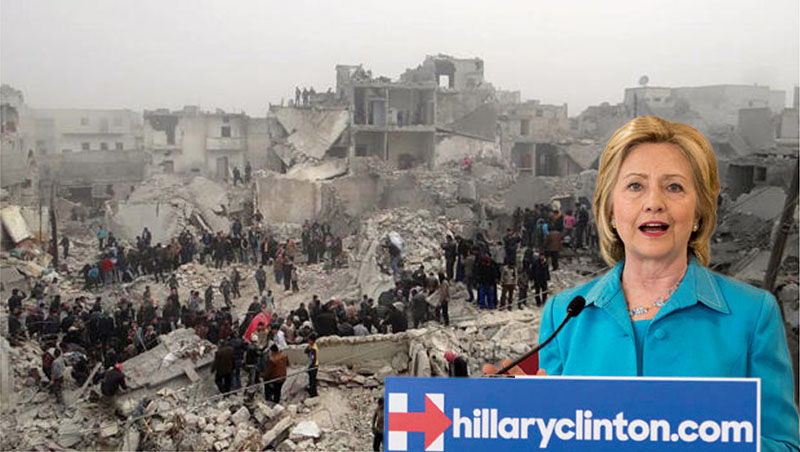
In the email, released by Wikileaks, then Secretary of State Clinton says that the “best way to help Israel” is to “use force” in Syria to overthrow the government.
The document was one of many unclassified by the US Department of State under case number F-2014-20439, Doc No. C05794498, following the uproar over Clinton’s private email server kept at her house while she served as Secretary of State from 2009 to 2013.
Although the Wikileaks transcript dates the email as December 31, 2000, this is an error on their part, as the contents of the email (in particular the reference to May 2012 talks between Iran and the west over its nuclear program in Istanbul) show that the email was in fact sent on December 31, 2012.
The email makes it clear that it has been US policy from the very beginning to violently overthrow the Syrian government—and specifically to do this because it is in Israel’s interests.
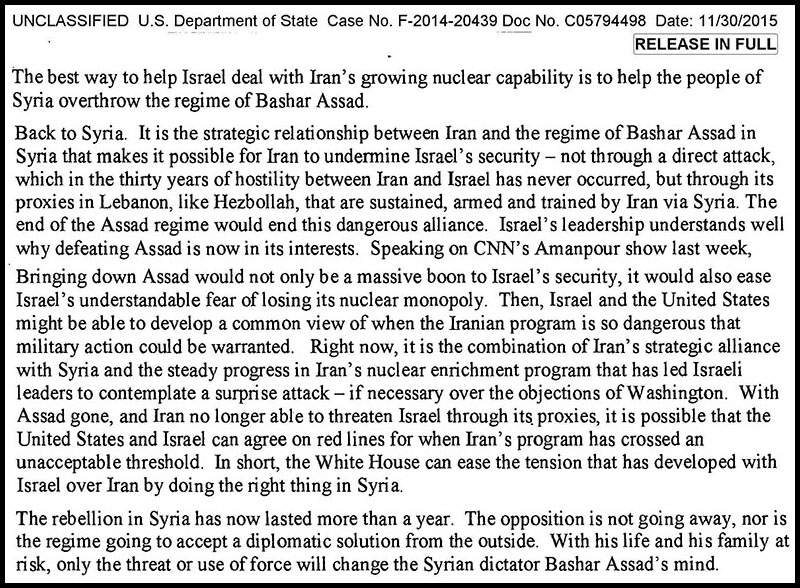
“The best way to help Israel deal with Iran’s growing nuclear capability is to help the people of Syria overthrow the regime of Bashar Assad,” Clinton forthrightly starts off by saying.
Even though all US intelligence reports had long dismissed Iran’s “atom bomb” program as a hoax (a conclusion supported by the International Atomic Energy Agency), Clinton continues to use these lies to “justify” destroying Syria in the name of Israel.
She specifically links Iran’s mythical atom bomb program to Syria because, she says, Iran’s “atom bomb” program threatens Israel’s “monopoly” on nuclear weapons in the Middle East.
If Iran were to acquire a nuclear weapon, Clinton asserts, this would allow Syria (and other “adversaries of Israel” such as Saudi Arabia and Egypt) to “go nuclear as well,” all of which would threaten Israel’s interests.
Therefore, Clinton, says, Syria has to be destroyed.
Iran’s nuclear program and Syria’s civil war may seem unconnected, but they are. What Israeli military leaders really worry about — but cannot talk about — is losing their nuclear monopoly.
An Iranian nuclear weapons capability would not only end that nuclear monopoly but could also prompt other adversaries, like Saudi Arabia and Egypt, to go nuclear as well. The result would be a precarious nuclear balance in which Israel could not respond to provocations with conventional military strikes on Syria and Lebanon, as it can today.
If Iran were to reach the threshold of a nuclear weapons state, Tehran would find it much easier to call on its allies in Syria and Hezbollah to strike Israel, knowing that its nuclear weapons would serve as a deterrent to Israel responding against Iran itself.
It is, Clinton continues, the “strategic relationship between Iran and the regime of Bashar Assad in Syria” that makes it possible for Iran to undermine Israel’s security.
This would not come about through a “direct attack,” Clinton admits, because “in the thirty years of hostility between Iran and Israel” this has never occurred, but through its alleged “proxies.”
The end of the Assad regime would end this dangerous alliance. Israel’s leadership understands well why defeating Assad is now in its interests.
Bringing down Assad would not only be a massive boon to Israel’s security, it would also ease Israel’s understandable fear of losing its nuclear monopoly.
Then, Israel and the United States might be able to develop a common view of when the Iranian program is so dangerous that military action could be warranted.
Clinton goes on to assert that directly threatening Bashar Assad “and his family” with violence is the “right thing” to do:
In short, the White House can ease the tension that has developed with Israel over Iran by doing the right thing in Syria.
With his life and his family at risk, only the threat or use of force will change the Syrian dictator Bashar Assad’s mind.
The email proves—as if any more proof was needed—that the US government has been the main sponsor of the growth of terrorism in the Middle East, and all in order to “protect” Israel.
It is also a sobering thought to consider that the “refugee” crisis which currently threatens to destroy Europe, was directly sparked off by this US government action as well, insofar as there are any genuine refugees fleeing the civil war in Syria.
In addition, over 250,000 people have been killed in the Syrian conflict, which has spread to Iraq—all thanks to Clinton and the Obama administration backing the “rebels” and stoking the fires of war in Syria.
The real and disturbing possibility that a psychopath like Clinton—whose policy has inflicted death and misery upon millions of people—could become the next president of America is the most deeply shocking thought of all.
Clinton’s public assertion that, if elected president, she would “take the relationship with Israel to the next level,” would definitively mark her, and Israel, as the enemy of not just some Arab states in the Middle East, but of all peace-loving people on earth.
Explaining Syria
It’s everyone’s fault except the U.S. and Israel
By Philip Giraldi • Unz Review • February 18, 2020
The first week in February was memorable for the failed impeachment of President Donald Trump, the “re-elect me” State of the Union address and the marketing of a new line of underwear by Kim Kardashian. Given all of the excitement, it was easy to miss a special State Department press briefing by Ambassador James Jeffrey held on February 5th regarding the current situation in Syria.
Jeffrey is the United States Special Representative for Syria Engagement and the Special Envoy for the Global Coalition to Defeat ISIL. Jeffrey has had a distinguished career in government service, attaining senior level State Department positions under both Democratic and Republican presidents. He has served as U.S. Ambassador to both Turkey and Iraq. He is, generally speaking, a hardliner politically, closely aligned with Israel and regarding Iran as a hostile destabilizing force in the Middle East region. He was between 2013 and 2018 Philip Solondz distinguished fellow at the Washington Institute for Near East Policy (WINEP), a think tank that is a spin-off of the American Israel Public Affairs Committee (AIPAC). He is currently a WINEP “Outside Author” and go-to “expert.”
Professor John Mearsheimer of the University of Chicago and Stephen Walt, academic dean at Harvard University’s Kennedy School of Government, describe WINEP as “part of the core” of the Israel Lobby in the U.S. They examined the group on pages 175-6 in their groundbreaking book The Israel Lobby and US Foreign Policy and concluded as follows:
“Although WINEP plays down its links to Israel and claims that it provides a ‘balanced and realistic’ perspective on Middle East issues, this is not the case. In fact, WINEP is funded and run by individuals who are deeply committed to advancing Israel’s agenda … Many of its personnel are genuine scholars or experienced former officials, but they are hardly neutral observers on most Middle East issues and there is little diversity of views within WINEP’s ranks.”
In early 2018 Jeffrey co-authored a WINEP special report on Syria which urged “…the Trump administration [to] couple a no-fly/no-drive zone and a small residual ground presence in the northeast with intensified sanctions against the Assad regime’s Iranian patron. In doing so, Washington can support local efforts to stabilize the area, encourage Gulf partners to ‘put skin in the game, drive a wedge between Moscow and Tehran, and help Israel avoid all-out war.”
Note the focus on Iran and Russia as threats and the referral to Assad and his government as a “regime.” And the U.S. presence is to “help Israel.” So we have Ambassador James Jeffrey leading the charge on Syria, from an Israeli perspective that is no doubt compatible with the White House view, which explains why he has become Special Representative for Syria Engagement.
Jeffrey set the tone for his term of office shortly after being appointed by President Trump back in August 2018 when he argued that the Syrian terrorists were “. . . not terrorists, but people fighting a civil war against a brutal dictator.” Jeffrey, who must have somehow missed a lot of the head chopping and rape going on, subsequently traveled to the Middle East and stopped off in Israel to meet Prime Minister Benjamin Netanyahu. It has been suggested that Jeffrey received his marching orders during the visit.
Two months later James Jeffrey declared that he would like to see Russia maintain a “permissive approach” to allow the Israelis to attack Iranian targets inside Syria. Regarding Iran’s possible future role in Syria he observed that “Iranians are part of the problem not part of the solution.”
What Jeffrey meant was that because Israel had been “allowed” to carry out hundreds of air attacks in Syria ostensibly directed against Iran-linked targets, the practice should be permitted to continue. Israel had suspended nearly all of its airstrikes in the wake of the shoot down of a Russian aircraft in September 2018, an incident which was caused by a deliberate Israeli maneuver that brought down the plane even though the missile that struck the aircraft was fired by Syria. Fifteen Russian servicemen were killed. Israel reportedly was deliberately using the Russian plane to mask the presence of its own attacking aircraft.
Russia responded to the incident by deploying advanced S-300 anti-aircraft systems to Syria, which can cover most of the more heavily developed areas of the country. Jeffrey was unhappy with that decision, saying “We are concerned very much about the S-300 system being deployed to Syria. The issue is at the detail level. Who will control it? what role will it play?” And he defended his own patently absurd urging that Russia, Syria’s ally, permit Israel to continue its air attacks by saying “We understand the existential interest and we support Israel” because the Israeli government has an “existential interest in blocking Iran from deploying long-range power projection systems such as surface-to-surface missiles.”
Later in November 2018 James Jeffrey was at it again, declaring that U.S. troops will not leave Syria before guaranteeing the “enduring defeated” of ISIS, but he perversely put the onus on Syria and Iran, saying that “We also think that you cannot have an enduring defeat of ISIS until you have fundamental change in the Syrian regime and fundamental change in Iran’s role in Syria, which contributed greatly to the rise of ISIS in the first place in 2013, 2014.”
As virtually no one but Jeffrey and the Israeli government actually believes that Damascus and Tehran were responsible for creating ISIS, the ambassador elaborated, blaming President Bashar al-Assad for the cycle of violence in Syria that, he claimed, allowed the development of the terrorist group in both Syria and neighboring Iraq.
He said “The Syrian regime produced ISIS. The elements of ISIS in the hundreds, probably, saw an opportunity in the total breakdown of civil society and of the upsurge of violence as the population rose up against the Assad regime, and the Assad regime, rather than try to negotiate or try to find any kind of solution, unleashed massive violence against its own population.”
Jeffrey’s formula is just another recycling of the myth that the Syrian opposition consisted of good folks who wanted to establish democracy in the country. In reality, it incorporated terrorist elements right from the beginning and groups like ISIS and the al-Qaeda affiliates rapidly assumed control of the violence. That Jeffrey should be so ignorant or blinded by his own presumptions to be unaware of that is astonishing. It is also interesting to note that he makes no mention of the U.S. invasion of Iraq, kneejerk support for Israel and the unrelenting pressure on Syria starting with the Syrian Accountability Act of 2003 and continuing with embrace of the so-called Arab Spring. Most observers believe that those actions were major contributors to the rise of ISIS.
Jeffrey’s unflinching embrace of the Israeli and hardline Washington assessment of the Syrian crisis comes as no surprise given his pedigree, but in the same interview where he pounded Iran and Syria he asserted oddly that “We’re not about regime change. We’re about a change in the behavior of a government and of a state.”
Some of James Jeffrey’s comments at last week’s press conference are similarly illuminating. Much of what he said concerned the mechanics of relationships with the Russians and Turks, but he also discussed some core issues relating to Washington’s perspective on the conflict. Many of his comments were very similar to what he said when he was appointed in 2018.
Jeffrey expressed concern over the thousands of al-Nusra terrorists holed up in besieged Idlib province, saying “We’re very, very worried about this. First of all, the significance of Idlib – that’s where we’ve had chemical weapons attacks in the past… And we’re seeing not just the Russians but the Iranians and Hizballah actively involved in supporting the Syrian offensive… You see the problems right now in Idlib. This is a dangerous conflict. It needs to be brought to an end. Russia needs to change its policies.”
He elaborated, “We’re not asking for regime change per se, we’re not asking for the Russians to leave, we’re asking…Syria to behave as a normal, decent country that doesn’t force half its population to flee, doesn’t use chemical weapons dozens of times against its own civilians, doesn’t drop barrel bombs, doesn’t create a refugee crisis that almost toppled governments in Europe, does not allow terrorists such as HTS and particularly Daesh/ISIS emerge and flourish in much of Syria. Those are the things that that regime has done, and the international community cannot accept that.”
Well, one has to conclude that James Jeffrey is possibly completely delusional. The core issue that the United States is in Syria illegally as a proxy for Israel and Saudi Arabia is not touched on, nor the criminal role in “protecting the oil fields” and stealing their production, which he mentions but does not explain. Nor the issue of the legitimate Syrian government seeking to recover its territory against groups that most everyone admits to be terrorists.
Virtually every bit of “evidence” that Jeffrey cites is either false or inflated, to include the claim of use of chemical weapons and the responsibility for the refugees. As for who actually created the terrorists, that honor goes to the United States, which accomplished that when it invaded Iraq and destroyed its government before following up by undermining Syria. And, by the way, someone should point out to Jeffrey that Russia and Iran are in Syria as allies of its legitimate government.
Ambassador James Jeffrey maintains that “Russia needs to change its policies.” That is not correct. It is the United States that must change its policies by getting out of Syria and Iraq for starters while also stopping the deference to feckless “allies” Israel and Saudi Arabia that has produced a debilitating cold war against both Iran and Russia. Another good first step to make the U.S. a “normal, decent country” would be to get rid of the advice of people like James Jeffrey.
Philip M. Giraldi, Ph.D., is Executive Director of the Council for the National Interest, a 501(c)3 tax deductible educational foundation (Federal ID Number #52-1739023) that seeks a more interests-based U.S. foreign policy in the Middle East. Website is councilforthenationalinterest.org, address is P.O. Box 2157, Purcellville VA 20134 and its email is inform@cnionline.org.
‘No shred of evidence’: Iran demands US presents proof of Saudi oil attacks claim after UN report release
RT | February 16, 2020
Tehran slammed the US for using a recent UN report to peddle its Saudi oil attack claims, accusing Washington of “clutching at every straw” to back up the allegations, while the report itself is based on shaky hypotheses.
“Just hours after the attack on Saudi oil facilities on 14 September 2019, the U.S. baselessly attributed it to Iran, but has failed so far to present any shred of evidence. Now, it clutches at every straw to seemingly prove its allegation,” the Iranian mission to the UN stated on Saturday, responding to the US mission doubling down on the White House’s claim that Iran was behind the 14 September twin attacks on Saudi oil giant Aramco facilities in Abqaiq and Khureys.
The attacks that briefly disrupted operations of Abqaiq oil plant – the largest oil processing facility in the world – were claimed by the Houthi rebels, embroiled in a 5-year-long war with the ousted President Abdrabbuh Mansur Hadi backed by the Saudi-led coalition. However, immediately after the attacks took place, the US pointed finger at Teheran, not waiting for any fact-finding mission to be sent to the sites.
Commenting on the recently released UN Yemen panel report, which concluded that Houthi forces were “unlikely” responsible for the bombing since the operation was too “complex” and the “estimated” range of weaponry the militants supposedly possess would not have allowed for such launches from the rebel-held territory, the US mission recycled its allegations framing the report’s findings as a foregone conclusion.
“Iran attacked Saudi Arabian oil facilities on September 14, 2019. It was an attack not only against a sovereign state but against the global economy as well,” the note bluntly states.
Firing back, Tehran pointed out that “nothing in that report validates the US allegation, which has already been rejected by Iran.”
The report does not name Iran as the culprit in the strikes. Moreover, the experts admitted that they did not have a chance to see the debris of the weapons that allegedly hit the facilities first-hand at the scenes as they had been partially cleaned up by Riyadh by the time they arrived.
“It should be noted that the Panel did not see any debris of the weapon systems on-site in Abqaiq and Khureys, as those had already been transported to Riyadh at the time of the visits on 20 and 21 September 2019,” the report states.
In addition to that, the experts furher acknowledged that while they believe that this particular attack was not carried out by Houthis, “other attacks using the same weapons do seem to have been launched from Yemen.”
The panel did not rule out either that Houthis could have been indeed behind the twin strike, noting that “in theory, the attacks could have also been launched by Houthi forces either from within Saudi Arabia, from the territory of other countries, or even from sea or airborne launch platforms,” but called this scenario “highly unlikely.”
The Iranian mission said that the US note “represents another disinformation campaign against Iran,” arguing that it’s the US massive build-up, undertaken under the pretext of the “Iranian threat,” together with Washington’s “military adventurism” and “the unprecedented flow of sophisticated American weaponry” to the region that has become the “main source of instability and insecurity” in the Middle East.
Featured Video
The Board For Peace – Whitewashing Ethnic Cleansing and Genocide
or go to
Aletho News Archives – Video-Images
Book Review
Conspiracy Denial

Lies are Unbekoming | January 27, 2026
In honour of Michael Parenti (1933–2026), who passed away on 24 January 2026 at the age of 92. He spent his life naming what power prefers to leave unnamed.
In 1837, Abraham Lincoln remarked: “These capitalists generally act harmoniously, and in concert, to fleece the people.”
Today, he would be dismissed as a conspiracy theorist.
That dismissal—reflexive, automatic, requiring no engagement with evidence—is not a mark of sophistication. It is a tell. The question worth asking is not whether conspiracies exist (they are a matter of public record and a recognised concept in law) but why acknowledging their existence provokes such reliable hostility. What work does the label “conspiracy theorist” actually do?
The late political scientist Michael Parenti spent decades answering that question. His conclusion was blunt: “’Conspiracy’ refers to something more than just illegal acts. It serves as a dismissive label applied to any acknowledgment of ruling-class power, both its legal and illegal operations.” The term functions not as a descriptor but as a weapon—a thought-terminating cliché that protects the powerful from scrutiny by pathologising those who scrutinise them.
Conspiracy denial, in Parenti’s analysis, is not skepticism. It is the opposite of skepticism. It is credulity toward power dressed up as critical thinking. As he wrote in Dirty Truths: “Just because some people have fantasies of conspiracies does not mean all conspiracies are imaginary.” … continue
Blog Roll
Recent Comments
eddieb on WEF Calls for ‘Cultural Revolu… loongtip on Trump wanted to play peacemake… Coronistan on EU member to sue bloc over ‘su… loongtip on Vicious loongtip on EU turns to India for defense… Coronistan on Donald Trump Is No Peace … seversonebcfb985d9 on French court jails pro-Palesti… eddieb on Fourteen Incredible Facts Abou… Bill Francis on European leaders’ shift in the… seversonebcfb985d9 on Villains of Judea: Philip Esfo… loongtip on Report warns that ‘Jewish terr… Craig Nelms on New study shows that toxic gas…


 Aletho News
- Davos and Abu Dhabi: How the Ukrainian Endgame Exposed Western Decline
- AfD co-leader states the obvious: Pouring money into the Ukraine war is killing the German economy
- Britain’s return to piracy to stop Russian ships – desperate attempt to demonstrate power
- Czech coalition rules out higher defense spending, says 2% of GDP is enough
- G7 Hands Ukraine $40Bln Generated From Frozen Russian Assets
- Conspiracy Denial
- Ukraine expects to join EU next year – Zelensky
- Here’s what’s behind the US shift on EU allies
- UN experts alarmed by prosecution of students protesting ETH Zurich’s Israel-linked research ties
- Exposed – How the UAE Became Central to Gaza’s Concentration Camp Plot
- If Americans Knew
- “The Gaza ceasefire is a minefield” – Not a ceasefire Day 110
- Israel to seek new security deal from US, official says
- Leaked “Board of Peace” Resolution Outlines U.S.-Led Plan to Rule Over Gaza
- Jonathan Greenblatt Rolls Out Plan to Activate Hispanic Evangelical Golems
- Violence against hundreds of Gazan remains to find one Israeli – Not a ceasefire Day 109
- Greenpeace Demonstrator Exposes Folly of Protest Restrictions
- From CBS to TikTok, Pro-Israel Ellison is now in the driver’s seat
- Israel pays for UK advertisements attacking Doctors Without Borders
- Israel accused of extracting billions from Gazan people to pay for their own genocide
- ‘Deliberate Assassination’: 3 Journalists Among 11 Killed by Israeli Forces in Gaza
- No Tricks Zone
- New Study Affirms Rising CO2’s Greening Impact Across India – A Region With No Net Warming In 75 Years
- Germany’s Natural Gas Crisis Escalates … One Storage Site Near Empty …Government Silent
- Polar Colding…Antarctica Saw Its Coldest October In 44 Years!
- New Study: Sea Levels Rose 20 Times The Modern Rate During The Roman Warm Period
- As German Gas Storage Dips Dangerously Low…Shortage Hardly Avoidable
- New Study: Brazil’s Relative Sea Level Was 2+ Meters Higher And SSTs 3-4°C Warmer 6000 Years Ago
- Philosopher Schopenhauer: Climate Science Certainty Stems From Stupidity, Ignorance
- New Study: Species Extinction Rates Declining Since 1980 – ‘Climate Change Is Not An Important Threat’
- Denmark Places Climate Protection Above Animal Welfare, Poisoning And Culling Cows
- New Study: Greenland Was 3-7°C Warmer And Far Less Glaciated Than Today 6000-8000 Years Ago
 Aletho News