US, Israel ramp up nuclear weapons testing, deployment amid regional provocations
Press TV – February 1, 2020
Israel says it has ramped up the deployment and testing of nuclear and nuclear-capable weapons amid heightened regional tensions after the US assassinated top Iranian General Qassem Soleimani and unveiled a biased Middle East plan.
The ministry of military affairs of the Israeli regime on Friday announced that it had conducted a launch test of a “rocket propulsion system from a base in the center of the country”.
The ministry refused to disclose any additional details regarding the nature of the missile, contrary to its usual conduct following satellite launcher and missile interceptor tests.
The little information revealed about the test prompted speculation among observers that the tested projectile may have been related to Israel’s long-range ballistic missile program, which Israel seeks to not acknowledge publicly.
Tel Aviv conducted a similar rocket engine test last December with Israeli media reporting that the test was meant to be a “show of force” of the Israeli regime’s “nuclear deterrent system especially aimed at Iran”.
The Stockholm International Peace Research Institute (SIPRI) said last year that the Israeli regime is in possession of approximately 100 atomic warheads, noting that it has 30 gravity bombs which can be delivered by fighter jets – some of which are believed to be equipped for nuclear weapon delivery.
The regime has refused to allow inspections of its military nuclear facilities or sign the the Non-Proliferation of Nuclear Weapons (NPT).
US deploys new nuclear warhead
The Federation of American Scientists also warned that Washington was deploying the recently developed W76-2 low-yield nuclear warhead as part of a new generation of less-destructive yet more “usable” nuclear weapons.
The report said the W76-2 warhead, which has an explosive yield of about a third of the atomic bomb dropped on the Japanese city of Nagasaki in August 1945, was supplied to Ohio-class USS Tennessee ballistic missile submarines last month.
The authors of the report, military analyst William Arkin and Federation of American Scientists Nuclear Information Project director Hans Kristensen, warned that such weapons increase the likelihood of a nuclear armed conflict.
In a Newsweek article published earlier this month, Arkin and Kristensen said that the development of the W76-2 warhead is the result of Pentagon planning for potential first strike scenarios “against adversaries, especially Iran”.
The article noted that Washington simulated a nuclear strike against Iran in the Global Thunder 17 nuclear exercise in October 2016 during the tenure of then-US President Barack Obama.
It pointed that the newly-deployed W76-2 warhead “is intended for exactly the type of Iran scenario that played out in the last days of the Obama administration”.
Israel and Washington’s provocative military deployments and weapons testing come at a time of major regional tensions resulting from Washington’s recent unveiling of the “deal of the century” and notably its assassination of General Soleimani.
Iran retaliated to the January 3 assassination with a volley of ballistic missiles launched at the US-occupied Ain Al Assad base in Iraq and another outpost in Erbil, the capital of the semi-autonomous Iraqi Kurdistan.
Iran, which has noted that Tel Aviv played a part in the assassination of Lieutenant General Soleimani, had threatened to target Israel if the US were to respond to Iran’s retaliatory attack.
Seeking to downplay the attack and deny any casualties, the Trump administration has since backed down from earlier pledges to respond to Iran’s retaliatory attack.
U.S. in the Middle-East: Preparing for Disaster
By The Saker • Unz Review • January 30, 2020
Lies, damn lies and statistics
Turns out that Trump and the Pentagon were lying. Again. This time about the true impact of the Iranian counter-strike on US forces in Syria. First they claimed that there were no injured U.S. personnel, only to eventually have to fess up that 34 soldiers had suffered traumatic brain injury (which Trump “re-classified” as a “headache”). Then they had to admit that it was not really 34, but actually 50!
According to some sources, not all U.S. personnel were hiding in bunkers and some were deployed to defend the base perimeter. Whatever may be the case, this adds yet another indication that the Iranian counter-strike was much more robust than originally reported by the Empire. In fact, Iranian sources indicate that following the strike, a number of wounded casualties were flown to Israel, Kuwait and Germany. Again, we will probably never find out the full truth about what happened that night, but two things are now certain:
- The Iranian attack was extremely effective and it is undeniable that all the US/NATO/Israeli forces in the region are now exposed like sitting ducks waiting for the next Iranian strike.
- Uncle Shmuel has had to dramatically under-report the real extent and nature of the Iranian counter-strike.
Now, let’s be clear about the quality of the warning the U.S. personnel had. We now know at the very least the following warnings were received:
- Warning through the Iraqi government (whom the Iranians did brief about their intentions).
- Warning through the Swiss authorities (who represent U.S. interests in Iran and whom the Iranian did brief about their intentions).
- Warning through the US reconnaissance/intelligence capabilities on the ground, air and space.
And yet, in spite of these almost ideal conditions (from the point of view of defense), we now see that not a single Iranian missile was intercepted, that the missiles all landed with very high accuracy, that the U.S. base itself suffered extensive damage (including destroyed helicopters and drones) and that there were scores of injured personnel (see this article for a detailed discussion of the post-attack imagery).
If we look at this strike as primarily a “proof of concept” operation, then it becomes pretty clear that on the Iranian side what was proven was a superb degree of accuracy and robust ballistic missile capability, whereas on the U.S. side the only thing this strike did was to prove that the U.S. forces in the region are all extremely vulnerable to Iranian missile attack. Just imagine if the Iranians had wanted to maximize U.S. casualties and if they had given no warning of any kind – what would the tally be then?! What if the Iranians had targeted, say, fuel and ammo dumps, buildings where U.S. personnel lived, industrial facilities (including CENTCOM’s key logistic nodes), ports or even airfields? Can you imagine the kind of hell the Iranians would have unleashed against basically unprotected facilities?!
Still dubious?
Then ask yourself why Trump & Co. had to lie and minimize the real scope of the Iranian attack. It is pretty obvious that the White House decided to lie and to present the strike as almost without impact because if it had admitted the magnitude of the strike, then it would also have had to admit to the total powerlessness to stop or even to meaningfully degrade it. Not only that, but an outraged U.S. public (most Americans still believe the traditional propaganda line about “The Greatest Military Force in the History of the Galaxy”!) would have demanded a retaliatory counter-counter-strike against Iran, which would have triggered an immediate Iranian attack on Israel which, in turn, would have plunged the entire region into a massive war which the U.S. had no stomach for.
Contrast that with the Iranian claims which, if anything, possibly exaggerated the impact of the strike and claimed that 80 servicemen were injured (I would add here that, at least so far, the Iranian government has been far more candid and less inclined to resort to crude lies than the U.S. has). Clearly the Iranians were ready for exactly the kind of further escalation that the U.S. wanted to avoid at almost any cost.
So what really took place?
There are two basic ways to defend against an attack: denial and punishment. Denial is what the Syrians have been doing against the U.S. and Israel every time they shoot down incoming missiles. Denial is ideal because it minimizes your own casualties while not necessarily going up the “escalation scale”. In contrast, punishment is when you don’t prevent an attack, but when you inflict retaliatory counter-strike on the attacking side, but only after being attacked yourself. That is what the US could do against Iran, at pretty much any time (yes, contrary to some wholly unrealistic claims, Iranian air defenses cannot prevent the US armed forces from inflicting immense damage upon Iran, its population and infrastructure).
The problem with punishing Iran is you are dealing with an enemy who is actually willing to absorb immense losses as long as these losses eventually lead to victory. How do you deter somebody who is willing to die for his country, people or faith?
There is no doubt in my mind that the Iranians, who are superb analysts, are fully aware of the damage that the U.S. can inflict. The key factor here is that they also realize that once the U.S. unleashes its missiles and bombers and once they destroy many (if not all) of their targets, they will have nothing else left to try to contain Iran with.
Here is how you can think of the Iranian strategy:
- If the U.S. does nothing or only engages in symbolic strikes (say, like Israel’s strikes in Syria), the Iranians can simply ignore these attacks because while they are very effective in giving the Americans (or the Israelis) an illusion of power, they really fail to achieve anything militarily significant.
- If the U.S. finally decides to strike Iran hard, it will exhaust its “punishment card” in that counter-attack, and will have no further options to deter Iran.
- If the U.S. (or Israel) decides to use nuclear weapons, then such an attack will simply give a “political joker card” to Iran saying in essence “now you are justified in whatever retaliation you can think of.” And you can be darn sure that the Iranian will come up with all sorts of most painful forms of retaliation!
You can think of the current US posture as “binary”: it is either “all off” or “all on.” Not by choice, of course, but these conditions are the result of the geostrategic realities of the Middle-East and from the many asymmetries between the two sides:
| Country | US | Iran |
|---|---|---|
| Air superiority | yes | no |
| Combat capable ground forces | no | yes |
| Willingness to incur major losses | no | yes |
| Short and secure supply lines | no | yes |
| Prepared for major defensive operations | no | yes |
The above is, of course, a simplification, yet it is also fundamentally true. And the reason for these asymmetries lies in a very simple yet crucial difference: Americans have been brainwashed into believing that major wars can be won on the cheap. Iranians have no such illusions (most certainly not after Iraq, backed by the US, the USSR and Europe, attacked Iran and inflicted immense destruction on the Iranian society). But the era of “wars on the cheap” is now long over.
Furthermore, Iranians also know that U.S. air superiority alone will not magically result in a U.S. victory. Finally, the Iranians have had 40 years to prepare for a U.S. attack. The U.S. has only really been put on notice since January 8th of this year.
Again, for the US, it is “all in” or “all out”. We saw the “all out” in the days following the Iranian counter-strike and we can get an idea of what the “all in” would look like by recalling the Israeli operations against Hezbollah in 2006.
The Iranians, however, have a much more gradual escalatory capability, which they just demonstrated with their attack on the U.S. forces in Iraq: they can launch only a few missiles, or they can launch hundreds of them. They can try to maximize U.S. casualties, or they can decide to go after CENTCOM’s infrastructure. They can chose to strike Uncle Shmuel directly, or they can decide to strike his allies (KSA) and bosses (Israel). They can chose to take credit for any action, or they can hide behind what the CIA calls plausible deniability.
So while the U.S. and the AngloZionist Empire as a whole are much more powerful than Iran, Iran has skillfully developed methods and means which allow it to be in control of what military analysts call the “escalation dominance”.
Has Iran just “Ledeened” the almighty US?
Remember Michael Ledeen? He is the Neocon who came up with this historical aphorism: “Every ten years or so, the United States needs to pick up some small crappy little country and throw it against the wall, just to show the world we mean business“.
Is it not ironic that Iran did exactly that, they took the US and “threw it against a wall, just to show that they meant business”, did they not?
And what does this all tell us?
For one thing, the U.S. military is in real trouble. It is pretty obvious that U.S. air defenses are hopelessly ineffective: we saw their “performance” in Saudi Arabia against the Houthi strikes. The truth is that the Patriot missiles never performed adequately, not in the first Gulf War, nor today. The big difference is that Saddam Hussein’s Iraq did not have any high-precision missiles and that its attempts to strike at the U.S. (or Israel, for that matter) where not very effective. Thus, it was easy for the Pentagon to fudge the real performance (or lack thereof!) of its weapon systems. Now that Iran has been able to pinpoint some buildings while carefully ignoring others shows that the entire Middle-East has entered a radically new era.
Second, it is equally obvious that U.S. bases in the Middle-East are very vulnerable to ballistic and cruise missile attacks. Air defenses are a very complicated and high-tech branch of the military and it often takes years, if not decades, to develop a truly effective air defense system. Due in part to its tendency to only attack weak and lightly-defended countries, and also due to the very real deterrent might the U.S. armed forces used to deliver in the past, the U.S. never had to really worry much about air defenses. The “little guys” had no missiles, while the “big guys” would never dare to openly strike at Uncle Shmuel’s forces.
Until recently.
Now, it is the previously almighty World Hegemon which has been tossed against a wall by a much weaker Iran and thus found itself being treated like a “small crappy little country”.
Sweet irony!
But there is much more to this story.
The real Iranian goal: to get the U.S. out of the Middle-East
The Iranians (and many Iranian allies in the region) have made it clear that the real retaliation for the murder of General Soleimani would be to bring about a complete withdrawal of U.S. forces from Iraq and Syria primarily, followed by a complete withdrawal from the entire Middle-East.
How likely is such an outcome?
Right now, I would say that the chances of that truly happening are microscopically small. After all, who could seriously imagine the U.S. leaving either Saudi Arabia or Israel? Ain’t gonna happen short of a true cataclysm.
What about countries like Turkey or Pakistan which are formally allies of the US but which are also showing clear signs of being mighty fed-up with the kind of “patronage” the US likes to mete out to its “allies”? Do we have any reason to believe that these countries will ever officially demand that Uncle Shmuel’s mercenaries (because that is what U.S. forces are, paid invaders) get the hell out?
And then there are countries like Iraq or Afghanistan which have hosted a very successful and active anti-U.S. insurgency which has kept U.S. forces hunkered down in heavily fortified bases. I don’t think there is anybody mentally sane out there who could offer a even semi-credible scenario of what a U.S. “victory” would look like in these countries. The fact that the U.S. stayed in Afghanistan even longer than the Soviets did shows not only that the Soviet forces were far more effective (and popular) than their U.S. counterparts, but also that Gorbachev’s Politburo was more in touch with reality than Trump’s NSC.
Whatever may be the case, I believe it is undeniable that the wars in Iraq and Afghanistan are lost and than no amount of grandstanding will change this outcome. The same goes for Syria where the U.S. is basically holding on out of sheer stubbornness and a total inability to admit defeat.
Uncle Shmuel’s “vision of peace” for the Middle-East
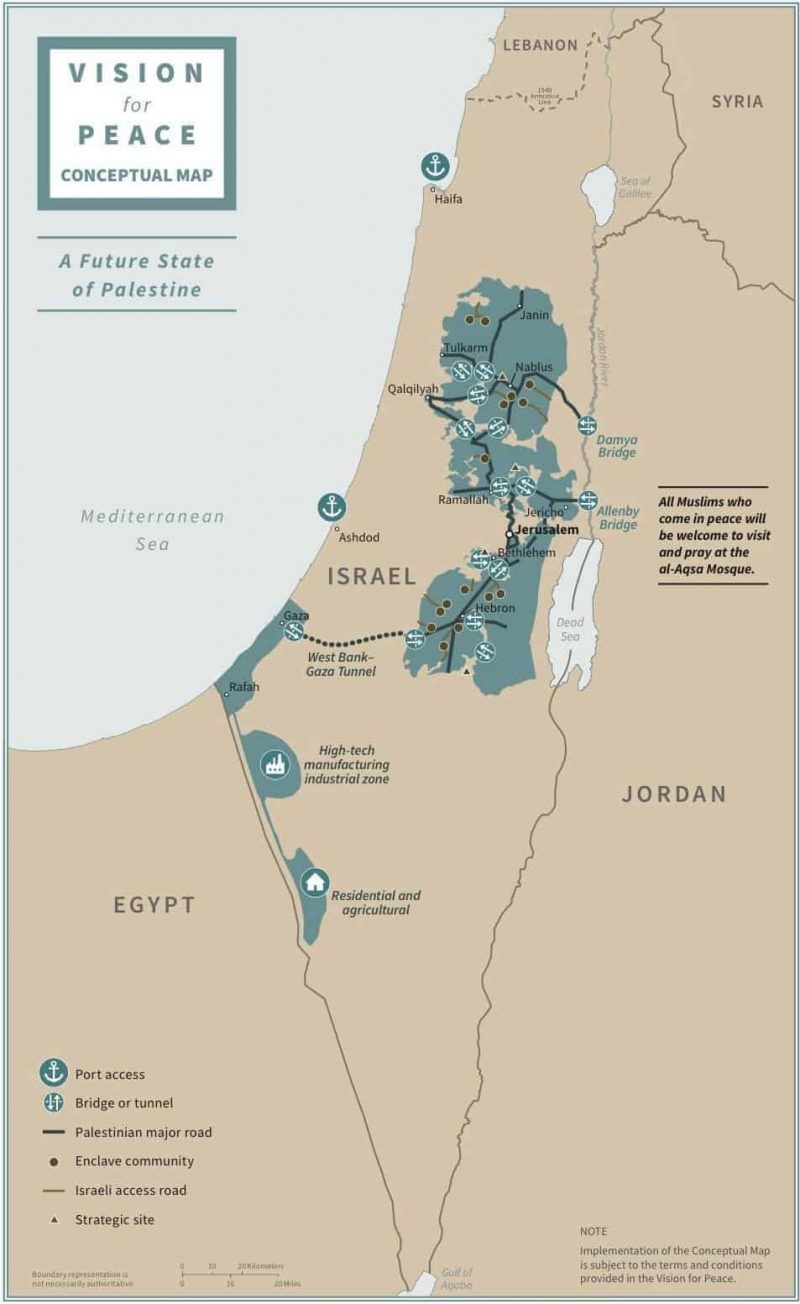
I just listened to the Idiot-in-Chief proudly present “his” Middle-East “peace” plan to Bibi Netanyahu and the world. This latest stunt shows two crucial things about the mind-set in Washington, D.C.:
- There is nothing which the U.S. ruling classes will not do to try to get the favor and support of the Israel Lobby.
- The US does not care, not even marginally, what the people of the Middle-East think.
This dynamic, which is not anything new, but which received a qualitative “shot of steroids” under Trump, will only further contribute to the inevitable collapse of Empire in the Middle-East. For one thing, all the so-called “U.S. allies” in the region understand that the only country which matters to the US is Israel, and that all the others count for almost nothing. Furthermore, all the rulers of the Middle-East now also know that being allied to the US also means being a cheap prostitute for Israel which, in turn, is guaranteed political suicide for any politician not wise enough to smell the trap. Finally, the wars in Afghanistan, Iraq, Yemen, Lebanon and Syria have shown that the “Axis of Kindness” is long on hyperbole and hubris, but very short in terms of actual combat capability.
The simple truth is that the abject brown-nosing of the Israel Lobby that Trump has been engaged in from Day 1 of his term only serves to further isolate and weaken the U.S. in the Middle-East (and beyond, really!).
In this context, how realistic is the Iranian goal of kicking Uncle Shmuel out of the region?
As I said, not realistic at all, if seen solely in the short term. But I hasten to add that it is very realistic in the mid-term if we look at some, but not all, the countries of the region. Finally, in the long term, it is not only realistic, it is inevitable, even if the Iranians themselves don’t do much, or anything at all, to make that happen.
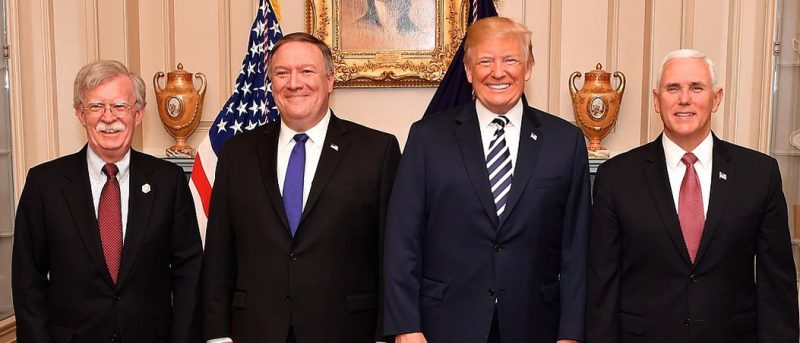
These grinning ignoramuses are doing more than anyone else to bring down the Empire, even if they don’t understand this!
Conclusion: “Israel’s” days are numbered
The Israelis have been feeding us all a steady diet about this or that country or politician being a “new Hitler’ who will either gas 6M Jews “again”, or wants to wipe Israel “off the map” or even engage in a new Holocaust. Gilad Atzmon brilliantly calls this mental disorder “pre-traumatic stress disorder,” and he is spot on. The Israelis mostly used this “preemptive geschrei*” as a way to squeeze out as many concessions (and money) from the western goyim as possible. But in a deep sense, it is possibly that the Israelis are at least dimly aware that their entire project is simply not viable, that you cannot ensure the survival of any state by terrorizing all of your neighbors. Violence, especially vicious, rabid, violence can, indeed, terrorize people, but only for so long. Sooner or later, the human soul will outgrow any fear, no matter how visceral, and will replace that fear by a new and immensely powerful sense of determination.
Here is what Robert Fisk said in distant 2006, 14 years ago:
You heard Sharon, before he suffered his massive stroke, he used this phrase in the Knesset, you know, “The Palestinians must feel pain.” This was during one of the intifadas. The idea that if you continue to beat and beat and beat the Arabs, they will submit, that eventually they’ll go on their knees and give you what you want. And this is totally, utterly self-delusional, because it doesn’t apply anymore. It used to apply 30 years ago, when I first arrived in the Middle East. If the Israelis crossed the Lebanese border, the Palestinians jumped in their cars and drove to Beirut and went to the cinema. Now when the Israelis cross the Lebanese border, the Hezbollah jump in their cars in Beirut and race to the south to join battle with them. But the key thing now is that Arabs are not afraid any more. Their leaders are afraid, the Mubaraks of this world, the president of Egypt, King Abdullah II of Jordan. They’re afraid. They shake and tremble in their golden mosques, because they were supported by us. But the people are no longer afraid.
What was true only for some Arabs in 2006, has now become true for most (maybe even all?) Arabs in 2020. As for the Iranians, they have never had any fear of Uncle Shmuel, they are the ones who “injected” the newly created Hezbollah with this qualitatively new kind of “special courage” (which is the Shia ethos, really!) when this movement was founded.
Empires can survive many things, but once they are not feared anymore, then their end is near. The Iranian strike proved a fundamental new reality to the rest of the world: the US is much more afraid of Iran than Iran is afraid of the US. U.S. rulers and politicians will, of course, claim otherwise. But that futile effort to re-shape reality is now doomed to failure, if only because even the Houthis can now openly and successfully defy the combined might of the “Axis of Kindness”.
You can think of U.S. and Israeli leaders as the orchestra on the Titanic: they play well, but they will still get wet and then die.
 (*geschrei: the Yiddish word for yelling, crying out, to shriek)
An Unusual Lawsuit against Iran
By Jacob G. Hornberger | FFF | January 28, 2020
The Washington Post recently published an article about a lawsuit that American citizens have brought against Iran. The plaintiffs are Iraq veterans and families of veterans who suffered horrendous injuries or deaths while serving in the U.S. armed forces in Iraq. In their lawsuit, the plaintiffs are claiming that Iran sent roadside bombs into Iraq that wreaked massive injuries or death on U.S. troops.
For example, Chris Levi’s Humvee was torn apart by a roadside bomb that cost him both his legs. Kelli Hake and her 13-year-old son are living their lives without their husband and father, who was killed by a roadside bomb in Iraq. There were thousands more like them.
It stands to reason that the plaintiffs would feel deep anger toward Iran, especially given their belief that Iran did, in fact, furnish the bombs that ended up inflicting death and injuries on U.S. soldiers serving in Iraq.
What is unusual, however, is that there appears to be absolutely no animus directed toward another regime. That regime is the U.S. government. I find the lack of ill will toward the U.S. government to be totally bizarre.
After all, let’s not forget something important: When a nation-state invades, attacks, and occupies a country and in the process intentionally wreaks death, suffering, and destruction, there is a very high probability that people are going to get extremely angry and are going to exact vengeance by doing the same thing to the invading and occupying troops.
We should keep in mind that the U.S. war on Iraq was illegal under our form of government. That’s because the U.S. Constitution, which is the higher law that we the people have imposed on the federal government, prohibits the president from waging war without a declaration of war from Congress. It is undisputed that Congress never declared war on Iraq.
The U.S. war on Iraq was also illegal under the principles set forth by the Nuremberg War Crimes Tribunal. It held that nation-states do not have the authority to invade and attack other nations.
Nonetheless, knowing that an invasion and occupation would be illegal under both the Constitution and the principles set forth at Nuremberg, the Pentagon ordered U.S. forces to invade and occupy the country, knowing full well that many of them would be killed, maimed, or injured in the process.
Did an illegal U.S. war of aggression against Iraq justify intervention by Iran to help Iraqis throw U.S. occupying forces out of the country? Of course not. Nonetheless, everyone knows — or should know — that when one nation illegally attacks and occupies another nation, there is a high likelihood that other nation-states are going to come to the assistance of the invaded and occupied country. That’s just the way the world works.
Consider, for example, when it was the Soviet Union, rather than the United States, that was the invader and occupier in Afghanistan. Guess who came to the assistance of the Afghans who were fighting to evict the Soviets from their country. That’s right — the U.S. government. It provided weaponry, including missiles, that was used to kill, maim, and injure Soviet soldiers. U.S. intervention wasn’t right, but that’s the way the world works.
What if those Soviet soldiers had sued the U.S. government for damages for the deaths and injuries caused by U.S.-supplied weaponry? There is not one court in the United States that would permit such a lawsuit to proceed. Unlike the lawsuit against Iran, a lawsuit by Soviet citizens against the U.S. government would be summarily dismissed.
If U.S. officials hadn’t ordered U.S. troops to invade and occupy Iraq, there never would have been any U.S. soldiers killed, maimed, or injured by anyone. Why shouldn’t the U.S. government be joined as a defendant in that lawsuit against Iran? If the Iranian government isn’t immune from liability, why should the U.S. government be immune from liability? Why are the plaintiffs giving their own government a pass, both legally and morally?
Iran slams Trump’s ‘delusional’ Middle East peace plan, calls on US to accept Tehran’s proposal instead
RT | January 27, 2020
Iranian Foreign Minister Mohammad Javad Zarif has blasted US President Donald Trump’s soon-to-be-revealed peace plan for the Israeli-Palestinian conflict, suggesting Iran’s referendum proposal would be a better strategy.
Trump said he will unveil his “deal of the century” for Israel and Palestine – actually prepared by his aide and son-in-law Jared Kushner – on Tuesday, but Zarif has already taken to Twitter to condemn it. He suggested that Washington should abandon its “delusional” plan and instead support a solution offered by Iran’s Supreme Leader Ayatollah Ali Khamenei.
Unlike the US plan, the details of which remain a mystery, the proposal put forward by Khamenei amounts to holding a referendum on a system of government including “Muslim, Christian and Jewish residents of Palestine as well as Palestinian refugees.” The Iranian leader also repeatedly slammed the US’ “deal of the century” by calling it “traitorous” and designed to “destroy” Palestine’s identity, as he apparently suspects the plan will greatly favor Israel.
While little is known about the deal, reports suggest that it’s unlikely to envisage statehood for Palestinians. AFP said that Palestinian President Mahmoud Abbas has already rejected the deal ahead of it being unveiled, and the Palestinian Authority considers that a two-state solution is the only way forward.
Tellingly, both Israeli Prime Minister Benjamin Netanyahu and his rival in the forthcoming snap elections, Benny Gantz, will attend the ceremony at the White House, while no Palestinian representatives will be present.
In anticipation of a strongly pro-Israeli plan, Palestinian leaders in Ramallah and Gaza have also condemned the upcoming deal and called for a “day of rage” on Tuesday. They urged Palestinians to boycott American goods, and remove all US symbols remaining in the West Bank.
Trump claimed in a press conference earlier this week that his administration had spoken “briefly” to the Palestinians, and vowed to talk to them again at some point in the future. He admitted that they might not like his proposals “at first.” However, he also maintained that his plan is “actually very positive to them.”
Washington has curtailed hundreds of millions of dollars in aid and stopped funding the UN agency that supports Palestinian refugees. Trump’s decision to move the US embassy from Tel Aviv to Jerusalem also drew the ire of the Palestinian Authority, which cut all communications with the US thereafter.
Russia stood by Iran in showdown with US
By M. K. BHADRAKUMAR | Indian Punchline | January 27, 2020
US President Donald Trump first said there were ‘no casualties’ in the Iranian missile attack on the Ain al-Asad military airbase in Iraq on January 8. “We suffered no casualties, all of our soldiers are safe, and only minimal damage was sustained at our military bases,” Trump had said.
Then a number 11 was mentioned a week later, but Trump minimised the injuries, calling them ‘headaches’. Last Friday, a fortnight after the attack, the number sharply climbed. The Pentagon spokesman told reporters that 34 US military members received concussions or other traumatic brain injuries in the missile strikes.
The true human toll of the Iranian strike is still being assessed. But what Iran achieved through the January 8 attacks may never quite be in the public domain.
The big question is whether Iran acted with Russian backing. Beyond a string of Russian statements empathising with Iran, all we have are tell-tale signs.
To be sure, satellite imagery suggests very precise hits of targets in the Ain al-Asad base. In an interview with Spiegel magazine last week, Iran’s Foreign Minister Mohammad Javad Zarif stated Iran’s objectives:
“There was no intention of causing any casualties with the missile attack… The damage we have done to the US is extensive, because with all its military might, it could not prevent the missiles from hitting its base. It shows how vulnerable the US is.”
The Iranians did succeed in displaying their formidable missile capability and its capacity to inflict lethal damage on US military establishments. But how could such high-precision hits be achieved except with missiles equipped with satellite guidance and target-tracking capabilities?
Importantly, Iran doesn’t have an independent orbital group of satellites. There are four global navigation satellite systems operational today — the US GPS/NAVSTAR, European GNSS, Russian GLONASS and Chinese BeiDou. The US and European systems are out of bounds for Iran.
But there is no embargo on Iran accessing the Russian or Chinese systems and it probably used one of them. But Tehran neither confirms nor denies.
Iran acknowledges it fired two Russian TOR-M1 anti-aircraft missiles but, interestingly, stops short of blaming them for the crash of the Boeing 737-800, flown by Ukraine International Airways. By the way, TOR-M1 is mounted on a tracked vehicle and carries a radar and each vehicle can operate independently. Did Iran’s Russian-made TOR-M1 have access to GLONASS?
Indeed, on January 7, on the eve of the Iranian missile strike, President Vladimir Putin paid an unscheduled visit to Syria to meet up with President Bashar al-Assad.
Again, on January 9, the day after the Iranian missile strike, Putin watched a big naval exercise involving multiple missile launches in the Black Sea. The Navy Times reported, “The Russian naval maneuvers come amid heightened US-Iran tensions after the US strike last week that killed Iran’s most powerful military commander.”
Advanced Russian weapon systems were on display in the maneuvers. MiG-31 interceptor jets launched Kinzhal hypersonic missiles at practice land targets while Navy ships performed several launches of Kalibr cruise missiles and other weapons. More than 30 warships and 39 aircraft, including several Tu-95 strategic bombers, took part in the exercise.
Curiously, again on January 9, in the northern Arabian Sea off Iran’s coastline, there was a rare encounter between the US destroyer USS Farragut and the Russian intelligence gathering ship RFS Ivan Hurs, which was apparently shadowing the operations of a US aircraft carrier battle group in the area.
The above events taken together signalled that Russia was closely monitoring the situation around Iran and was in full readiness to meet any emergent military conflagration in the region. No doubt, the message was addressed to Washington.
It is entirely conceivable that Russia has intelligence-sharing arrangements with Iran. In fact, Russian Foreign Minister Sergey Lavrov, a veteran diplomat, might just have lifted the veil a little bit when he disclosed on January 17 that Iran’s accidental shooting down of the Ukrainian airliner occurred at a time when Tehran was spooked by reports of advanced US stealth fighters in the area.
“There were at least six F-35 fighters in the air in the Iranian border area. This information has yet to be verified, but I’d like to underline the edginess that always accompanies such situations,” Lavrov said. Alas, Lavrov’s disclosure left a cold trail. But it most certainly hinted that Russia is reconnoitring the skies above Iran.
All this may amount to nothing much, or everything — depending on how one looks at it. Russia will not militarily intervene in a US-Iranian conflict. Indeed, such a conflict is unlikely. What Russia can do is to make the probability of a conflict even less likely by aiding Iran to defend itself, by providing it with electronic warfare tools and other high-end arms that would raise the military costs to the US, as had happened on January 8.
How far Russia’s ‘positive neutrality’, which distinctly favoured Iran in the most recent period, irritated Washington no one can tell. But there have been four instances in the past 8 days alone of US forces blocking Russian convoys in northeastern Syria — one forcing back a vehicle driven by a Russian major-general. Poking the bear? In Russian-American relations, nothing is really coincidental.
The debate over the alchemy of Russian-Iranian relations is a never-ending one. But no matter the two countries’ specific interests or national objectives and ideologies, a destruction of Iran or the emergence of a US-friendly regime in Tehran would be profoundly consequential to Russian regional strategies, given the co-relation of forces internationally.
Lavrov gave an indication of Russian priorities when he said in Delhi on January 17 while addressing an international audience (including Zarif) that Moscow backs Tehran’s bid to join Shanghai Cooperation Organisation as a full member and is hopeful it will happen.
‘Targeted and governmental terrorism’: Iran slams US for threat against Soleimani successor
RT | January 23, 2020
Iran’s Foreign Ministry slammed the US’ policy of “targeted and governmental terrorism” after an American diplomat threatened Quds Force commander Esmail Ghaani with the same fate as his assassinated predecessor, Qassem Soleimani.
“These words are an official announcement and a clear unveiling of America’s targeted and governmental terrorism,” ministry spokesman Abbas Mousavi told Iranian state media on Thursday in response to threats made against Ghaani by US Special Representative for Iran Brian Hook. Mousavi called on the international community to join him in condemning the thuggish statement from the American.
“If Ghaani follows the same path of killing Americans [as Soleimani] then he will meet the same fate,” Hook had told Arabic-language outlet Asharq al-Awsat earlier that day, vowing to “hold the regime and its agents responsible for any attack on Americans or American interests in the region.”
There has not been any indication Iran is planning to kill Americans, however, even after the death of the beloved general. Tehran actually spared US lives by tipping Iraq off to planned missile attacks on two coalition bases, allowing both Iraqi and American soldiers to vacate the facilities. The bases were severely damaged in precision strikes meant as revenge for the Soleimani killing, but no Americans were hit.
While Hook and Washington have insisted Soleimani was behind an ever-growing number of American deaths, they have been unable to supply any evidence – certainly not for an impending plot that would have required his immediate assassination – leading even some members of President Donald Trump’s own party to vow opposition to any authorization for war with Iran.
Evidence Soleimani was behind previous attacks on Americans – particularly the rocket strike on K-1 Air Base last month that killed a US contractor and sparked the most recent escalation of force – has also been lacking. The claim that the Iranian general was responsible for the deaths of “600 Americans,” often repeated by Hook and other members of the Trump administration in the days following Soleimani’s assassination by airstrike at the Baghdad airport, grew out of a propaganda figure cooked up by former US vice president Dick Cheney when he was trying to whip up the Bush administration for a war with Iran. More fanciful claims, like Vice President Mike Pence’s suggestion that Soleimani was somehow involved in the 9/11 terror attacks, also have no basis in fact.
Ghaani was appointed to replace Soleimani the day after the latter’s death and has vowed to continue on his “luminous path,” with the ultimate goal of removing US forces from the Middle East. Like Soleimani, he made his name during the war between Iran and Iraq in the 1980s.
Tehran open to dialog with all neighbors: Zarif
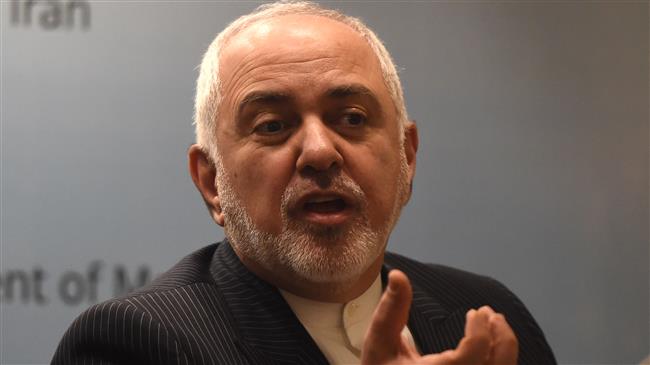
Iranian Foreign Minister Mohammad Javad Zarif (Photo by AFP)
Press TV – January 23, 2020
Foreign Minister Mohammad Javad Zarif has reaffirmed Iran’s readiness for talks with all its neighbors amid tensions in the Persian Gulf region.
“Iran remains open to dialogue with its neighbors, and we declare our readiness to participate in any complementary work that is in the interest of the region, and we welcome any step that restores hope to its people and brings them stability and prosperity,” Zarif said in a tweet in Thursday.
The tweet was in Arabic, which suggests it was addressed to the Persian Gulf littoral Arab countries. It came a day after Saudi Foreign Minister Prince Faisal bin Farhan said Riyadh was ready for talks with Tehran “but it is really up to Iran.”
The top Saudi diplomat, however, repeated the baseless claims against Iran’s role in the region, adding that the precondition for dialog is for the Islamic Republic to accept it “cannot further its regional agenda through violence.”
Speaking from the World Economic Forum in Davos, he said he was glad the region has “avoided any escalation” with Iran, and that “many countries” have offered to mediate talks with Tehran.
Meanwhile, the Iranian president’s chief of staff, Mahmoud Vaezi, said Wednesday that Tehran and Riyadh should work together to overcome their problems.
“The relations between Iran and its neighbor Saudi Arabia should not become like the relationship between Tehran and the United States … Tehran and Riyadh should work together to resolve their problems,” Vaezi said.
At an event in the Indian city of Mumbai on Friday in coordination with All India Association of Industries (AIAI), Zarif also voiced Iran’s readiness to hold talks with Saudi Arabia and other Persian Gulf countries to promote regional security.
He added that Iran has also presented proposals on ways to establish peace in the Strait of Hormuz.
In an address to the 74th session of the United Nations General Assembly in September 2019, President Hassan Rouhani said as a steward of maritime security in the Persian Gulf and the Strait of Hormuz, Iran invites all countries that are affected by developments in the strategic region to join the country’s new regional peace initiative, dubbed Hormuz Peace Endeavor (HOPE).
Iran’s initiative comes as the US has been trying to persuade its allies into a maritime coalition purportedly seeking to boost security in the Persian Gulf, after it blamed Tehran for two separate attacks on oil tankers in the Gulf of Oman in May and June, without providing any credible evidence to back up the allegation, which Iran has categorically rejected.
Tehran has repeatedly said outsiders not only cannot safeguard the region, but will fuel tensions there. Iran believes it is the countries of the very region which can ensure regional peace.
Prior to the Hormuz initiative, Iran had offered to sign non-aggression agreements with all countries in the Persian Gulf region.
Zarif also said in late May 2019 that Iran sought the best of relations with the Persian Gulf littoral countries and would welcome any proposals for dialog and de-escalation toward that end.
Evidence suggests US lied about Iranian strikes on US facilities in Iraq
By Robert Inlakesh | Press TV | January 16, 2020
During the early morning hours of January 8, 2020, Iranian strategic missile units launched a precision attack, branded ‘Operation Martyr Soleimani’, against US forces at the American-operated section of the ‘Ain al-Asad’ air base in Iraq.
The response, coming in response to the illegal assassination of General Qassem Soleimani, was a high-observable attack using ballistic missile forces – as opposed to a low-observable attack using terrain-reading cruise missiles and suicide drones.
With US forces already having been in a heightened state of alert, American radar and satellite reconnaissance would have spotted the attack within a minute of it being launched (and a six hour pre-warning of an imminent attack before that), giving the US and other coalition troops present at the base time to seek cover in hardened shelter areas. This, however, did not prevent the success of the attack which, according to primary source evidence, destroyed highly-expensive US aviation assets.
THE RESULT – U.S. FORCES ASSET LOSSES
According to the evidence that has been made available to us at this point, it is obvious that the US is lying about the extent of the damage inflicted upon its assets and infrastructure at the Ain al-Asad base.
No American media group or official Pentagon report initially released the satellite pictures shown in this report, and probably for good reason. To downplay the event (as Trump did in his official address, as did the Pentagon in its later report), they simply dismissed the damaged equipment, referring to the destroyed assets as simple “tents, a parking lot and a damaged helicopter” (per the Department of Defense).
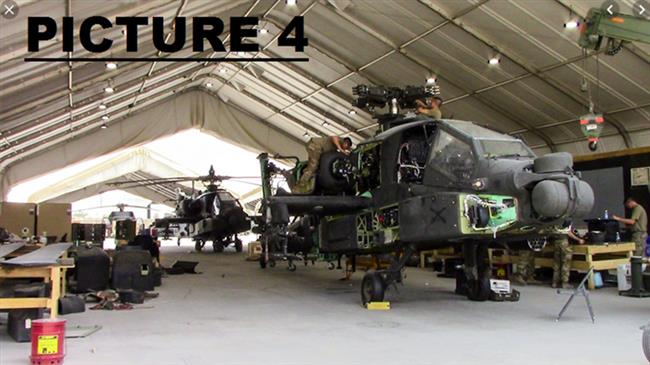
The Iranian missile attack for the most part targeted Apache (AH-64) attack helicopter shelters (refer to Picture 1). Refer to Picture 3 and Picture 4 to see what those “tent”-like Apache steel-frame shelters look like at ground level.
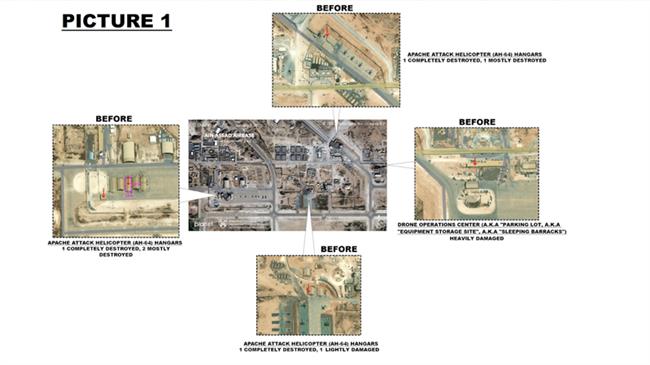
They are the standard steel-frame soft shelter design for US helicopter units based in overseas areas at second-rate airfields (such as the Ain al-Asad Base) – US helicopter units operating from old Afghan airfields are also housed in this kind of shelter design. Each one of those Apache attack helicopter shelters can house two such aircraft. With six structures of the type provably destroyed, demonstrated through the satellite images showing blackened scorch marks (suggesting assets inside them were destroyed with the shelter itself, refer to Picture 1) AND assuming each only had one Apache in them, it can be concluded that at least 6 Apache gunships were destroyed in the attack.
Recently, Danish media, citing a Danish coalition soldier who was present at the base at the time of the attack, admitted that multiple helicopters were destroyed to the point of being “split in half”.
Another Apache hangar (refer to Picture 2) was also directly struck, located to the far eastern end of the Ain al-Asad Base and destroyed. However, note that there is no scorch-blackened concrete underneath it, suggesting nothing was inside it that led to additional burning beyond the impact of the warhead itself.
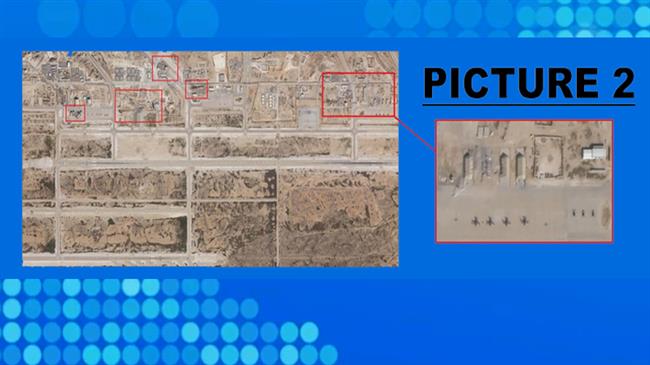
Indeed, just to the south of that destroyed hangar and the undamaged three hangars next to it, 4 Apache helicopters can be seen sitting out on the open tarmac. They were spared as they were, ironically, not being sheltered.
The official US story on the other structure targeted beyond the “tents” (i.e. Apache gunship hangars) has already changed twice – first it was called a parking lot, then an equipment storage area and now, apparently, a barracks for drone operators. Picture 1 (far right) shows the result of the attack on this structure.
It is hard to imagine that base zoning regulators within the US military would chose to place sleeping quarters right next to a strip alert (ready-to-go) aircraft parking area, itself right next to a major taxiway, given the constant noise that comes from these areas.
A more astute assessment would place this structure as an operations center, which lines up with the Iranian claim that the command site from which the Qassem Soleimani assassination operation had been coordinated, was targeted and destroyed in Iran’s retaliation strike.

Indeed, AFP recently released an exclusive report in which a US drone operator present at the Ain al-Asad Airbase, one First Sergeant Wesley Kilpatrick, admitted that airborne drones were rendered inoperable after a direct hit penetrated the base’s UAV operations center and destroyed the fiber lines which connect remote stations to satellite communication equipment(needed for drone control and visuals).
In all of this, one thing is obvious. US officials and media are stumbling over their own statements trying to cover up the extent of the damage dealt to the US-operated section of the Ain al-Asad base – in fact, going so far to cease calling the military site a US airbase (as it had been called for the last 16 years) to (all of a sudden) just an “Iraqi facility”.
THE WEAPONS USED BY IRAN
Short-range ballistic missiles (SRBM) of the upgraded Fateh-313 (range 500 km) and Qiam (range 800 km) types were launched from Western Iran towards the US-operated Ain al-Asad Base in Iraq.
Fateh-313s represent the majority of the missile type used for the attack. Their accuracy still seems to have been to within a matter of meters of their intended targets, except for two stray shots that hit the open tarmac area.
Whilst the Fateh-313 missiles use a combination of INS and electro-optical guidance, the Qiam missiles reportedly use a mix of INS, GPS and radar-mapping target acquisition. The latter method being the archaic predecessor version of DSMAC (imaging automatic target acquisition) terminal-phase guidance used in high-end ground-attack cruise missiles, such as the Tomahawk.
THE OPERATION –OTHER DETAILS
Satellite pictures show that some targeted sites were double-tapped (hit twice-over for good measure).
Initial reports from the Ain al-Asad Base claimed nearly 40 detonations in total despite the fact the number of actual warhead impacts was about fifteen, indicating that there were around two dozen cases of secondary explosions (fuel and ammo going off after being ignited).
In conclusion, according to the evidence we have available to us currently, there is no doubt that the United States has completely distorted the gravitude of Iran’s strikes. The mainstream media in the West have also seemingly refrained from acknowledging much of the damage, apart from on occasion.
Robert Inlakesh is a journalist, writer and political analyst, who has lived in and reported from the occupied Palestinian West Bank. He has written for publications such as Mint Press, Mondoweiss, MEMO, and various other outlets. He specializes in analysis of the Middle East, in particular Palestine-Israel. He also works for Press TV as a European correspondent.
Facebook censors explainer clip recalling when western media liked Soleimani – and demonetizes popular account for sharing it
RT | January 15, 2020
Facebook is doubling down on censorship of anything less than villification of slain Iranian Major General Qassem Soleimani, deleting a clip showing his history of fighting terrorism – and demonetizing the account posting it.
The social media behemoth didn’t just remove independent journalist Dan Cohen’s ‘In the Now’ segment, “How ‘good guy’ Soleimani became US media’s ‘bad guy,” from the show’s page on Tuesday – it demonetized In the Now entirely, citing the typical unspecified violations of “community standards.” The move comes amid an alarming escalation in the platform’s crackdown on political speech that runs contrary to US foreign policy, a wave of censorship that has not been limited to Facebook.
Cohen’s video calmly and accurately explains how Soleimani “saved the region from falling to ISIS,” fighting the terrorist group alongside the US and its Kurdish allies before he was recast posthumously by a complicit western media as “actually a huge terrorist and a ticking time bomb who was born to kill Americans.” The video exposes the ideological inconsistency of the outlets currently depicting the Quds Force commander as the devil incarnate, showcasing clips from those same outlets in recent years praising Soleimani’s battlefield performance.
Rania Khalek, who runs In the Now, tweeted in shock that a video merely stating facts about Soleimani had gotten her page demonetized, asking “where is the outrage” now that Facebook was so explicitly deleting material for ideological reasons.
Facebook and its subsidiary Instagram have come under fire from independent journalists and media organizations like the International Federation of Journalists for embarking on a wholesale campaign to deplatform all support for Soleimani in the weeks following the US airstrike that killed him. The company has claimed the extensive US sanctions placed on Iran, including the designation of the Islamic Revolutionary Guard Corps as a terrorist organization, require it to censor such posts, though even legal experts quoted by CNN took a dim view of that rationale.
Facebook and Instagram not only remove accounts run by or for sanctioned individuals or groups, but also posts that (they claim) praise or seek to assist the people in question – making sanctions a convenient excuse for mass-deplatforming any user who holds a political view the US government has deemed heresy.
Iranians saw insult added to injury when over a dozen Iranian journalists, several state-run media organizations, and countless ordinary individuals and activists’ Instagram accounts were yanked entirely in the days following Soleimani’s assassination. Many more saw pro-Soleimani posts removed, even when they carefully avoided saying his name – one Lebanese researcher praised “Q*ssem S*leim*ni” for protecting Christians from ISIS and al-Qaeda, only to have his video removed anyway.
The rank ideological discrimination not only left them unable to publicly mourn for a leader beloved by the lion’s share of the people, but allowed pro-regime-change trolls to dominate the narrative. Facebook has recently taken flack from the US political establishment for refusing to “fact-check” political ads, but non-advertising content is more tightly controlled than ever.
Facebook and Instagram are far from alone in clamping down on the speech of Iranian users, however – YouTube briefly deleted state-backed PressTV’s channel earlier this week, only to reactivate it after an outpouring of popular support.
Twitter removed state-backed media outlet Al-Alam News’ account, as well as that of the popular Iran-backed Spanish-language media outlet HispanTV, only reinstating the latter after a massive public backlash. Dozens of individual Iranians who supported their government were also deplatformed on Twitter, while anti-government users – many linked to notorious exile terror group Mujahedin e-Khalq (MEK) – were allowed to continue slinging hate against Soleimani and his supporters. Twitter even dished out a ban to Syrian President Bashar Assad, but restored the account after a few days.
Featured Video
The Board For Peace – Whitewashing Ethnic Cleansing and Genocide
or go to
Aletho News Archives – Video-Images
Book Review
Conspiracy Denial

Lies are Unbekoming | January 27, 2026
In honour of Michael Parenti (1933–2026), who passed away on 24 January 2026 at the age of 92. He spent his life naming what power prefers to leave unnamed.
In 1837, Abraham Lincoln remarked: “These capitalists generally act harmoniously, and in concert, to fleece the people.”
Today, he would be dismissed as a conspiracy theorist.
That dismissal—reflexive, automatic, requiring no engagement with evidence—is not a mark of sophistication. It is a tell. The question worth asking is not whether conspiracies exist (they are a matter of public record and a recognised concept in law) but why acknowledging their existence provokes such reliable hostility. What work does the label “conspiracy theorist” actually do?
The late political scientist Michael Parenti spent decades answering that question. His conclusion was blunt: “’Conspiracy’ refers to something more than just illegal acts. It serves as a dismissive label applied to any acknowledgment of ruling-class power, both its legal and illegal operations.” The term functions not as a descriptor but as a weapon—a thought-terminating cliché that protects the powerful from scrutiny by pathologising those who scrutinise them.
Conspiracy denial, in Parenti’s analysis, is not skepticism. It is the opposite of skepticism. It is credulity toward power dressed up as critical thinking. As he wrote in Dirty Truths: “Just because some people have fantasies of conspiracies does not mean all conspiracies are imaginary.” … continue
Blog Roll
Recent Comments
eddieb on WEF Calls for ‘Cultural Revolu… loongtip on Trump wanted to play peacemake… Coronistan on EU member to sue bloc over ‘su… loongtip on Vicious loongtip on EU turns to India for defense… Coronistan on Donald Trump Is No Peace … seversonebcfb985d9 on French court jails pro-Palesti… eddieb on Fourteen Incredible Facts Abou… Bill Francis on European leaders’ shift in the… seversonebcfb985d9 on Villains of Judea: Philip Esfo… loongtip on Report warns that ‘Jewish terr… Craig Nelms on New study shows that toxic gas…


 Aletho News
- Davos and Abu Dhabi: How the Ukrainian Endgame Exposed Western Decline
- AfD co-leader states the obvious: Pouring money into the Ukraine war is killing the German economy
- Britain’s return to piracy to stop Russian ships – desperate attempt to demonstrate power
- Czech coalition rules out higher defense spending, says 2% of GDP is enough
- G7 Hands Ukraine $40Bln Generated From Frozen Russian Assets
- Conspiracy Denial
- Ukraine expects to join EU next year – Zelensky
- Here’s what’s behind the US shift on EU allies
- UN experts alarmed by prosecution of students protesting ETH Zurich’s Israel-linked research ties
- Exposed – How the UAE Became Central to Gaza’s Concentration Camp Plot
- If Americans Knew
- “The Gaza ceasefire is a minefield” – Not a ceasefire Day 110
- Israel to seek new security deal from US, official says
- Leaked “Board of Peace” Resolution Outlines U.S.-Led Plan to Rule Over Gaza
- Jonathan Greenblatt Rolls Out Plan to Activate Hispanic Evangelical Golems
- Violence against hundreds of Gazan remains to find one Israeli – Not a ceasefire Day 109
- Greenpeace Demonstrator Exposes Folly of Protest Restrictions
- From CBS to TikTok, Pro-Israel Ellison is now in the driver’s seat
- Israel pays for UK advertisements attacking Doctors Without Borders
- Israel accused of extracting billions from Gazan people to pay for their own genocide
- ‘Deliberate Assassination’: 3 Journalists Among 11 Killed by Israeli Forces in Gaza
- No Tricks Zone
- New Study Affirms Rising CO2’s Greening Impact Across India – A Region With No Net Warming In 75 Years
- Germany’s Natural Gas Crisis Escalates … One Storage Site Near Empty …Government Silent
- Polar Colding…Antarctica Saw Its Coldest October In 44 Years!
- New Study: Sea Levels Rose 20 Times The Modern Rate During The Roman Warm Period
- As German Gas Storage Dips Dangerously Low…Shortage Hardly Avoidable
- New Study: Brazil’s Relative Sea Level Was 2+ Meters Higher And SSTs 3-4°C Warmer 6000 Years Ago
- Philosopher Schopenhauer: Climate Science Certainty Stems From Stupidity, Ignorance
- New Study: Species Extinction Rates Declining Since 1980 – ‘Climate Change Is Not An Important Threat’
- Denmark Places Climate Protection Above Animal Welfare, Poisoning And Culling Cows
- New Study: Greenland Was 3-7°C Warmer And Far Less Glaciated Than Today 6000-8000 Years Ago
 Aletho News