Pentagon expects US public to buy lame excuse about missing weapons sent to Syria, Iraq
‘We weren’t keeping inventory’
By Nebojsa Malic | RT | February 20, 2020
US weapons worth some $715 million dollars were warehoused poorly and soldiers handling them did not keep receipts or records, so it’s impossible to tell how many, if any, ended up in wrong hands, the Pentagon says.
Supply units in Kuwait and elsewhere “did not maintain comprehensive lists of all equipment purchased and received” or “stored weapons outside in metal shipping containers, exposing the equipment to harsh environmental elements, such as heat and humidity.”
This is according to the partially redacted report by the Department of Defense’s inspector general (IG), of an audit into the “Counter Islamic State of Iraq and Syria Train and Equip Fund” (CTEF), dated February 13 and published this week.
That is not to say that $715 million worth of US weapons, intended for the Iraqi military and “Vetted Syrian Opposition” – as the euphemism for US-allied militia goes – has gone missing, as some reports may have suggested. In Pentagon-speak, there was “a lack of a central repository for accountability documentation.” Once you cut through the obtuse verbiage, the IG report basically says there’s no way of figuring any of that out, because the troops charged with running the program did not maintain records or receipts.
The audit was commissioned because the DOD has requested $173.2 million for weapons, ammunition, vehicles, and other CTEF-S equipment for the current fiscal year, which began in October. Without accurate records, the Pentagon risks buying stuff it doesn’t need and “further overcrowding” the warehouses in Kuwait, which is what caused the pricey hardware to be stored outside in the first place.
Even though the Trump administration declared Islamic State (IS, formerly ISIS) defeated back in March 2019, ensuring the “enduring defeat” of the terrorists apparently requires that the weapons and equipment must flow. While the US taxpayers don’t have a choice in footing the bill, expecting them to swallow the explanation – that their noble men and women in uniform are just too stupid, lazy or incompetent to keep a ledger – sounds a bit rich.
Washington has a notoriously spotty record of pouring weapons into Syria and Iraq. At one point in 2015, the Pentagon admitted the failure of its program to train and equip “Vetted Syrian Opposition” (also known as “moderate rebels”). Having spent $2 million per fighter, the US saw them defect to the Al-Qaeda affiliate group Al-Nusra, bringing the US-supplied weapons and kit along.
So the Pentagon doubled down in 2016, spending untold millions to train “dozens” of rebels in Turkey. It is unclear how many of those “moderates” took part in last year’s assault on areas held by US-allied Kurdish militias.
As late as September 2016, Al-Nusra commanders openly talked about getting US weapons, both “directly” and via third countries, such as Saudi Arabia. The Syrian government has since dealt the militants one defeat after another, and currently advances on their last remaining strongholds in the Idlib province.
While the US government and media have objected to these operations – and NATO member Turkey actually sent troops and tanks to Idlib in an attempt to halt them – a spokesman for the anti-IS coalition has just openly admitted Idlib is a nest of terrorists.
Explaining Syria
It’s everyone’s fault except the U.S. and Israel
By Philip Giraldi • Unz Review • February 18, 2020
The first week in February was memorable for the failed impeachment of President Donald Trump, the “re-elect me” State of the Union address and the marketing of a new line of underwear by Kim Kardashian. Given all of the excitement, it was easy to miss a special State Department press briefing by Ambassador James Jeffrey held on February 5th regarding the current situation in Syria.
Jeffrey is the United States Special Representative for Syria Engagement and the Special Envoy for the Global Coalition to Defeat ISIL. Jeffrey has had a distinguished career in government service, attaining senior level State Department positions under both Democratic and Republican presidents. He has served as U.S. Ambassador to both Turkey and Iraq. He is, generally speaking, a hardliner politically, closely aligned with Israel and regarding Iran as a hostile destabilizing force in the Middle East region. He was between 2013 and 2018 Philip Solondz distinguished fellow at the Washington Institute for Near East Policy (WINEP), a think tank that is a spin-off of the American Israel Public Affairs Committee (AIPAC). He is currently a WINEP “Outside Author” and go-to “expert.”
Professor John Mearsheimer of the University of Chicago and Stephen Walt, academic dean at Harvard University’s Kennedy School of Government, describe WINEP as “part of the core” of the Israel Lobby in the U.S. They examined the group on pages 175-6 in their groundbreaking book The Israel Lobby and US Foreign Policy and concluded as follows:
“Although WINEP plays down its links to Israel and claims that it provides a ‘balanced and realistic’ perspective on Middle East issues, this is not the case. In fact, WINEP is funded and run by individuals who are deeply committed to advancing Israel’s agenda … Many of its personnel are genuine scholars or experienced former officials, but they are hardly neutral observers on most Middle East issues and there is little diversity of views within WINEP’s ranks.”
In early 2018 Jeffrey co-authored a WINEP special report on Syria which urged “…the Trump administration [to] couple a no-fly/no-drive zone and a small residual ground presence in the northeast with intensified sanctions against the Assad regime’s Iranian patron. In doing so, Washington can support local efforts to stabilize the area, encourage Gulf partners to ‘put skin in the game, drive a wedge between Moscow and Tehran, and help Israel avoid all-out war.”
Note the focus on Iran and Russia as threats and the referral to Assad and his government as a “regime.” And the U.S. presence is to “help Israel.” So we have Ambassador James Jeffrey leading the charge on Syria, from an Israeli perspective that is no doubt compatible with the White House view, which explains why he has become Special Representative for Syria Engagement.
Jeffrey set the tone for his term of office shortly after being appointed by President Trump back in August 2018 when he argued that the Syrian terrorists were “. . . not terrorists, but people fighting a civil war against a brutal dictator.” Jeffrey, who must have somehow missed a lot of the head chopping and rape going on, subsequently traveled to the Middle East and stopped off in Israel to meet Prime Minister Benjamin Netanyahu. It has been suggested that Jeffrey received his marching orders during the visit.
Two months later James Jeffrey declared that he would like to see Russia maintain a “permissive approach” to allow the Israelis to attack Iranian targets inside Syria. Regarding Iran’s possible future role in Syria he observed that “Iranians are part of the problem not part of the solution.”
What Jeffrey meant was that because Israel had been “allowed” to carry out hundreds of air attacks in Syria ostensibly directed against Iran-linked targets, the practice should be permitted to continue. Israel had suspended nearly all of its airstrikes in the wake of the shoot down of a Russian aircraft in September 2018, an incident which was caused by a deliberate Israeli maneuver that brought down the plane even though the missile that struck the aircraft was fired by Syria. Fifteen Russian servicemen were killed. Israel reportedly was deliberately using the Russian plane to mask the presence of its own attacking aircraft.
Russia responded to the incident by deploying advanced S-300 anti-aircraft systems to Syria, which can cover most of the more heavily developed areas of the country. Jeffrey was unhappy with that decision, saying “We are concerned very much about the S-300 system being deployed to Syria. The issue is at the detail level. Who will control it? what role will it play?” And he defended his own patently absurd urging that Russia, Syria’s ally, permit Israel to continue its air attacks by saying “We understand the existential interest and we support Israel” because the Israeli government has an “existential interest in blocking Iran from deploying long-range power projection systems such as surface-to-surface missiles.”
Later in November 2018 James Jeffrey was at it again, declaring that U.S. troops will not leave Syria before guaranteeing the “enduring defeated” of ISIS, but he perversely put the onus on Syria and Iran, saying that “We also think that you cannot have an enduring defeat of ISIS until you have fundamental change in the Syrian regime and fundamental change in Iran’s role in Syria, which contributed greatly to the rise of ISIS in the first place in 2013, 2014.”
As virtually no one but Jeffrey and the Israeli government actually believes that Damascus and Tehran were responsible for creating ISIS, the ambassador elaborated, blaming President Bashar al-Assad for the cycle of violence in Syria that, he claimed, allowed the development of the terrorist group in both Syria and neighboring Iraq.
He said “The Syrian regime produced ISIS. The elements of ISIS in the hundreds, probably, saw an opportunity in the total breakdown of civil society and of the upsurge of violence as the population rose up against the Assad regime, and the Assad regime, rather than try to negotiate or try to find any kind of solution, unleashed massive violence against its own population.”
Jeffrey’s formula is just another recycling of the myth that the Syrian opposition consisted of good folks who wanted to establish democracy in the country. In reality, it incorporated terrorist elements right from the beginning and groups like ISIS and the al-Qaeda affiliates rapidly assumed control of the violence. That Jeffrey should be so ignorant or blinded by his own presumptions to be unaware of that is astonishing. It is also interesting to note that he makes no mention of the U.S. invasion of Iraq, kneejerk support for Israel and the unrelenting pressure on Syria starting with the Syrian Accountability Act of 2003 and continuing with embrace of the so-called Arab Spring. Most observers believe that those actions were major contributors to the rise of ISIS.
Jeffrey’s unflinching embrace of the Israeli and hardline Washington assessment of the Syrian crisis comes as no surprise given his pedigree, but in the same interview where he pounded Iran and Syria he asserted oddly that “We’re not about regime change. We’re about a change in the behavior of a government and of a state.”
Some of James Jeffrey’s comments at last week’s press conference are similarly illuminating. Much of what he said concerned the mechanics of relationships with the Russians and Turks, but he also discussed some core issues relating to Washington’s perspective on the conflict. Many of his comments were very similar to what he said when he was appointed in 2018.
Jeffrey expressed concern over the thousands of al-Nusra terrorists holed up in besieged Idlib province, saying “We’re very, very worried about this. First of all, the significance of Idlib – that’s where we’ve had chemical weapons attacks in the past… And we’re seeing not just the Russians but the Iranians and Hizballah actively involved in supporting the Syrian offensive… You see the problems right now in Idlib. This is a dangerous conflict. It needs to be brought to an end. Russia needs to change its policies.”
He elaborated, “We’re not asking for regime change per se, we’re not asking for the Russians to leave, we’re asking…Syria to behave as a normal, decent country that doesn’t force half its population to flee, doesn’t use chemical weapons dozens of times against its own civilians, doesn’t drop barrel bombs, doesn’t create a refugee crisis that almost toppled governments in Europe, does not allow terrorists such as HTS and particularly Daesh/ISIS emerge and flourish in much of Syria. Those are the things that that regime has done, and the international community cannot accept that.”
Well, one has to conclude that James Jeffrey is possibly completely delusional. The core issue that the United States is in Syria illegally as a proxy for Israel and Saudi Arabia is not touched on, nor the criminal role in “protecting the oil fields” and stealing their production, which he mentions but does not explain. Nor the issue of the legitimate Syrian government seeking to recover its territory against groups that most everyone admits to be terrorists.
Virtually every bit of “evidence” that Jeffrey cites is either false or inflated, to include the claim of use of chemical weapons and the responsibility for the refugees. As for who actually created the terrorists, that honor goes to the United States, which accomplished that when it invaded Iraq and destroyed its government before following up by undermining Syria. And, by the way, someone should point out to Jeffrey that Russia and Iran are in Syria as allies of its legitimate government.
Ambassador James Jeffrey maintains that “Russia needs to change its policies.” That is not correct. It is the United States that must change its policies by getting out of Syria and Iraq for starters while also stopping the deference to feckless “allies” Israel and Saudi Arabia that has produced a debilitating cold war against both Iran and Russia. Another good first step to make the U.S. a “normal, decent country” would be to get rid of the advice of people like James Jeffrey.
Philip M. Giraldi, Ph.D., is Executive Director of the Council for the National Interest, a 501(c)3 tax deductible educational foundation (Federal ID Number #52-1739023) that seeks a more interests-based U.S. foreign policy in the Middle East. Website is councilforthenationalinterest.org, address is P.O. Box 2157, Purcellville VA 20134 and its email is inform@cnionline.org.
More Lies on Iran: The White House Just Can’t Help Itself as New Facts Emerge
By Philip Giraldi | Strategic Culture Foundation | February 13, 2020
Admittedly the news cycle in the United States seldom runs longer than twenty-four hours, but that should not serve as an excuse when a major story that contradicts what the Trump Administration has been claiming appears and suddenly dies. The public that actually follows the news might recall a little more than one month ago the United States assassinated a senior Iranian official named Qassem Soleimani. Openly killing someone in the government of a country with which one is not at war is, to say the least, unusual, particularly when the crime is carried out in yet another country with which both the perpetrator and the victim have friendly relations. The justification provided by Secretary of State Mike Pompeo, speaking for the administration, was that Soleimani was in Iraq planning an “imminent” mass killing of Americans, for which no additional evidence was provided at that time or since.
It soon emerged that the Iranian was in fact in Baghdad to discuss with the Iraqi Prime Minister Adel Abdul Mahdi a plan that might lead to the de-escalation of the ongoing conflict between Saudi Arabia and Iran, a meeting that the White House apparently knew about and may even have approved. If that is so, events as they unfolded suggest that the U.S. government might have encouraged Soleimani to make his trip so he could be set up and killed. Donald Trump later dismissed the lack of any corroboration of the tale of “imminent threat” being peddled by Pompeo, stating that it didn’t really matter as Soleimani was a terrorist who deserved to die.
The incident that started the killing cycle that eventually included Soleimani consisted of a December 27th attack on a U.S. base in Iraq in which four American soldiers and two Iraqis were wounded while one U.S. contractor, an Iraqi-born translator, was killed. The United States immediately blamed Iran, claiming that it had been carried out by an Iranian supported Shi’ite militia called Kata’ib Hezbollah. It provided no evidence for that claim and retaliated by striking a Kata’ib base, killing 25 Iraqis who were in the field fighting the remnants of Islamic State (IS). The militiamen had been incorporated into the Iraqi Army and this disproportionate response led to riots outside the U.S. Embassy in Baghdad, which were also blamed on Iran by the U.S. There then followed the assassinations of Soleimani and nine senior Iraqi militia officers. Iran retaliated when it fired missiles at American forces, injuring more than one hundred soldiers, and then mistakenly shot down a passenger jet, killing an additional 176 people. As a consequence due to the killing by the U.S. of 34 Iraqis in the two incidents, the Iraqi Parliament also voted to expel all American troops.
It now appears that the original death of the American contractor that sparked the tit-for-tat conflict was not carried out by Kata’ib Hezbollah at all. An Iraqi Army investigative team has gathered convincing evidence that it was an attack staged by Islamic State. In fact, the Iraqi government has demonstrated that Kata’ib Hezbollah has had no presence in Kirkuk province, where the attack took place, since 2014. It is a heavily Sunni area where Shi’a are not welcome and is instead relatively hospitable to all-Sunni IS. It was, in fact, one of the original breeding grounds for what was to become ISIS.
This new development was reported in the New York Times in an article that was headlined “Was U.S. Wrong About Attack That Nearly Started a War With Iran? Iraqi military and intelligence officials have raised doubts about who fired the rockets that started a dangerous spiral of events.” In spite of the sensational nature of the report it generally was ignored in television news and in other mainstream media outlets, letting the Trump administration get away with yet another big lie, one that could easily have led to a war with Iran.
Iraqi investigators found and identified the abandoned white Kia pickup with an improvised Katyusha rocket launcher in the vehicle’s bed that was used to stage the attack. It was discovered down a desert road within range of the K-1 joint Iraqi-American base that was hit by at least ten missiles in December, most of which struck the American area.
There is no direct evidence tying the attack to any particular party and the improvised Kia truck is used by all sides in the regional fighting, but the Iraqi officials point to the undisputed fact that it was the Islamic State that had carried out three separate attacks near the base over the 10 days preceding December 27th. And there are reports that IS has been increasingly active in Kirkuk Province during the past year, carrying out near daily attacks with improvised roadside bombs and ambushes using small arms. There had, in fact, been reports from Iraqi intelligence that were shared with the American command warning that there might be an IS attack on K-1 itself, which is an Iraqi air base in that is shared with U.S. forces.
The intelligence on the attack has been shared with American investigators, who have also examined the pick-up truck. The Times reports that the U.S. command in Iraq continue to insist that the attack was carried out by Kata’ib based on information, including claimed communications intercepts, that it refuses to make public. The U.S. forces may not have shared the intelligence they have with the Iraqis due to concerns that it would be leaked to Iran, but senior Iraqi military officers are nevertheless perplexed by the reticence to confide in an ally.
If the Iraqi investigation of the facts around the December attack on K-1 is reliable, the Donald Trump administration’s reckless actions in Iraq in late December and early January cannot be justified. Worse still, it would appear that the White House was looking for an excuse to attack and kill a senior Iranian official to send some kind of message, a provocation that could easily have resulted in a war that would benefit no one. To be sure, the Trump administration has lied about developments in the Middle East so many times that it can no longer be trusted. Unfortunately, demanding any accountability from the Trump team would require a Congress that is willing to shoulder its responsibility for truth in government backed up by a media that is willing to take on an administration that regularly punishes anyone or any entity that dares to challenge it. That is the unfortunate reality in America today.
Scuffle Between Syrian Civilians and US Soldiers Reflects Increasing Hostility to US Troops
By Whitney Webb | MintPress News | February 12, 2020
As resistance to U.S. troop presence in both Iraq and Syria gains steam, a rare scuffle between Syrian civilians and U.S. forces broke out on Wednesday resulting in the death of one Syrian, believed to be a civilian, and the wounding of another. A U.S. soldier was also reportedly injured in the scuffle. The event is likely to escalate tensions, particularly in the Northeastern region where the incident took place, as Syria, Iraq and Iran have pushed for an end to the U.S. troop presence in the region following the killing of Iranian General Qassem Soleimani.
The clash between U.S. forces and Syrian locals took place near the town of Qamishli where the U.S. forces were conducting a patrol that, for reasons that are still unclear, entered into territory controlled by the Syrian government instead of territory occupied by the U.S. and its regional proxy, the Syrian Democratic Forces (SDF). At a Syrian military checkpoint, the U.S. patrol was met by Syrian civilians of a nearby village who gathered at the checkpoint and began throwing rocks at the U.S. convoy. Then, one Syrian took a U.S. flag off of one of the military vehicles.
Reports from activists on the ground and Syrian media then claim that U.S. troops opened fire using live ammunition and fired smoke bombs at the angry residents, killing one and wounding another. A U.S. soldier was said to have received a superficial wound, though the nature of the wound was not specified. After the scuffle, the protests grew larger, preventing more U.S. troops from arriving at the scene. In one video of the protests, a local was seen ripping a U.S. flag as he approached an American soldier.
The obstruction of the road prevented the U.S. patrol from advancing and two military vehicles had to be towed after becoming stuck in the grass after an apparent attempt to circumvent the roadblock created by the Syrian military checkpoint and supportive Syrian civilians.
A U.S. military spokesman claimed that the convoy encountered “small-arms fire” from “unknown individuals” and further asserted that “In self-defense, coalition troops returned fire… The situation was de-escalated and is under investigation.” However, critics have pointed out that the U.S. military occupation of Syria is illegal under international law and thus does not afford the U.S. military the ability to act in “self-defense” due to its status as an occupier.
The Syrian Observatory for Human Rights stated in its report on the incident that the situation was de-escalated following the appearance of a Russian military convoy and asserted that the “small-arms fire” was from pro-government militia members who fired into the air near the convoy. The incident also resulted in a few reports of U.S. coalition airstrikes on the village that occurred after the scuffle. However, both Syrian military sources and the U.S. military have denied that airstrikes took place in the area.
Fallout from Soleimani assassination grows
Though the incident in Qamishli is a rare occurrence, as nearly all media reports have pointed out, it is likely a harbinger of the region-wide push that has seen countries like Syria and Iraq take a firmer posture towards the presence American forces in their countries following the assassination of Iranian general Qassem Soleimani in January.
At the time of his death, Soleimani, serving in a diplomatic capacity, had traveled to Baghdad in a civilian aircraft and was due to meet Iraq’s Prime Minister to discuss efforts to de-escalate regional tensions and promote Iraqi sovereignty at the time of his death. A well-known Iraqi militia leader, Abu Mahdi Al-Muhandis, who many Iraqis credit with defeating Daesh (ISIS) in Iraq was also killed in the strike. Following the controversial killing of Soleimani by the United States, Iran vowed that it would seek to expel U.S. troops from the region, particularly Syria and Iraq, in retribution, among other measures.
Since Soleimani was killed, the presence of U.S. troops in both Syria and Iraq has been under increasing pressure from locals, particularly in Iraq, where millions of Iraqis recently marched in support of a full U.S. withdrawal from the country.
In Syria, where U.S. troops are occupying territory and specifically oil fields in violation of international law, local tensions with U.S. forces have also been exacerbated by recent events, as Wednesday’s incident in Qamishli clearly shows.
In Iraq, the push to expel U.S. troops has recently spurred reports that have claimed that the withdrawal of U.S. troops from several military installations in Iraq has already begun, according to the chair of Iraq’s parliamentary defense committee, Badr Al-Ziyadi. However, the Pentagon has disputed these reports and has claimed that the U.S. is still actively working with Iraq’s military to fight Daesh. In Syria, both domestic and international law considers the U.S.’ military presence in the country to be that of an illegal occupier.
Notably, both the reports of the U.S. quietly leaving Iraq and the recent incident in Qamishli, Syria follow comments from Iran’s chief foreign policy advisor, Ali Akbar Velayati, that the U.S.’ military presence in both Syria and Iraq would end very soon and specifically cited Soleimani’s assassination as the impetus for their allegedly imminent departure.
Whitney Webb is a MintPress News journalist based in Chile. She has contributed to several independent media outlets including Global Research, EcoWatch, the Ron Paul Institute and 21st Century Wire, among others. She has made several radio and television appearances and is the 2019 winner of the Serena Shim Award for Uncompromised Integrity in Journalism.
Russian oil & gas firms plan to invest $20 BILLION in Iraq’s energy industry
RT | February 11, 2020
Russian oil and gas companies could triple their investments in Iraq in the near future, Yury Fyodorov, first deputy chairman of the Economic Policy Committee at the Russian Federation Council, has announced.
The companies may spend up to $20 billion on oil projects in Iraq, Fyodorov said at a meeting with Iraqi Ambassador to Russia Abdul-Rahman Al-Husseini, according to Russian media.
“Today, our leading oil and gas companies such as Lukoil, Bashneft, Gazprom Neft are actively working in your country. The total investment has exceeded $10 billion,” the official said on Monday. He added that other companies, such as Zarubezhneft, Tatneft, and Rosneftegaz are also interested in working in Iraq.
“We are exploring the possibility of diversifying the activities of Russian operators, in particular by connecting them to the gas sector. According to preliminary forecasts, this could triple our companies’ investment.”
Last year, Russia and Iraq resumed cooperation in energy infrastructure, and in the electricity sector in particular. Some Russian firms could help Baghdad with the restoration and development of electric power facilities, while negotiations are under way over the construction of thermal power plants using the assistance of Russian companies.
Iraq’s proven oil reserves stand at over 145 billion barrels, while gas reserves exceed 3.7 trillion cubic meters.
NYT: ‘Iran-Backed Militia’ Attack That Provoked Soleimani Killing Was Possible ISIS False Flag
By Tyler Durden – Zero Hedge – 02/06/2020
The initial major rationale and justification the US administration offered for the drone assassination of IRGC Gen. Qassem Soleimani and commander of Iraq’s Popular Mobilization Forces Abu Mahdi al-Muhandis was the Dec. 27 rocket attack on K1 camp in Kirkuk, which houses coalition forces.
That attack involving surface-to-surface missile strikes killed an American contractor and reportedly wounded several US troops. Washington immediately blamed the Iran-backed Iraqi paramilitary group Khataib Hezbollah, with Mike Pompeo saying of the attack: “We will not stand for the Islamic Republic of Iran to take actions that put American men and women in jeopardy,” after he briefed President Trump. But top Iraqi military and intelligence officials are now calling this entire narrative into question.
A new lengthy New York Times investigative report cites multiple top Iraqi officials who go on record to say of their analysis of the Dec.27 Kirkuk incident: “These facts all point to the Islamic State, Iraqi officials say.”
The Pentagon says it has evidence decisively pinning it on Khataib Hezbollah, known for its closeness to Tehran; however, the paramilitary group itself has denied that it was behind the operation. US officials have from the start been scant on details and have not made public any evidence or intelligence.
This led some analysts in the days after the attack to question whether ISIS cells, still known to be active in the area, might have been behind it — given also it would be to the Sunni terrorist group’s benefit to sow a major rift between US and local Iraqi Shia forces, which is precisely what happened (Trump has recently gone so far as to threaten “very big sanctions” on Baghdad if US forces are kicked out). Alternately the White House perhaps appeared ready to manufacture a justification to take out Soleimani.
Further, as detailed in the Times report, the white Kia pick-up from which the rockets were launched was found near a known ISIS execution site, in a heavily Sunni area not known to have had a Shia paramilitary presence since 2014:
But Iraqi military and intelligence officials have raised doubts about who fired the rockets that started the spiral of events, saying they believe it is unlikely that the militia the United States blamed for the attack, Khataib Hezbollah, carried it out.
… Iraqi officials say their doubts are based on circumstantial evidence and long experience in the area where the attack took place.
The rockets were launched from a Sunni Muslim part of Kirkuk Province notorious for attacks by the Islamic State, a Sunni terrorist group, which would have made the area hostile territory for a Shiite militia like Khataib Hezbollah.
Khataib Hezbollah has not had a presence in Kirkuk Province since 2014.
The Islamic State, however, had carried out three attacks relatively close to the base in the 10 days before the attack on K-1. Iraqi intelligence officials sent reports to the Americans in November and December warning that ISIS intended to target K-1, an Iraqi air base in Kirkuk Province that is also used by American forces.
And the abandoned Kia pickup was found was less than 1,000 feet from the site of an ISIS execution in September of five Shiite buffalo herders.
The NYT further says this single event set off “a chain of events that brought the United States and Iran to the brink of war” which President Trump confided at a private luncheon this week was “closer than you thought”.
Brig. General Ahmed Adnan, the Iraqi chief of intelligence for the federal police at K-1, told the NYT : “All the indications are that it was Daesh.” He said further: “I told you about the three incidents in the days just before in the area — we know Daesh’s movements.”
“We as Iraqi forces cannot even come to this area unless we have a large force because it is not secure. How could it be that someone who doesn’t know the area could come here and find that firing position and launch an attack?” he questioned.
Anonymous US officials, however, claim that evidence from within the Kia pickup points to Khataib Hezbollah, and also cited “multiple strains of intelligence” though without making it known.
Interestingly, amid a general breakdown in trust between Baghdad and Washington, a top Iraqi general has said the US side hasn’t even shared its claimed evidence that Khataib Hezbollah was behind the Kirkuk attack:
“We have requested the American side to share with us any information, any evidence, but they have not sent us any information,” Lt. Gen. Muhammad al-Bayati, the chief of staff for former Prime Minister Adel Abdul Mahdi, said in an interview.
The director general of Iraqi Intelligence and Counterterrorism, Abu Ali al-Basri, said the United States did not consult Iraq before carrying out the Dec. 29 counterattacks on Khataib Hezbollah.
“They did not ask for my analysis of what happened in Kirkuk and neither did they share any of their information,” he said. “Usually, they would do both.”
The bombshell NYT report further collects eyewitness accounts and other Iraqi official statements, all of which strongly suggests the chain of events which led to Soleimani’s Jan. 3 killing, which in turn led to an Iranian ‘revenge’ attack with ballistic missiles on Ain al-Asad Air Base, wounding scores of troops (we later found out as part of an ever growing number of solders with ‘Traumatic Brain Injury’ from the blasts), was a possible ‘false flag’ event undertaken by ISIS meant to be pinned on the Islamic State’s Shia enemies backed by Iran.
US uneasy as Iraq gets new prime minister
By M. K. BHADRAKUMAR | Indian Punchline | February 5, 2020
In happier times, Washington and Tehran might well have zeroed in on Mohammed Tawfik Allawi as their consensus candidate for the post of Iraq’s prime minister.
Why not? He was opposed to Saddam Hussein’s dictatorship — although, unlike most Shia politicians who fled from Saddam’s tyranny, he never lived in Iran but chose UK.
However, unlike his famous (notorious) cousin Iyad Allawi who also lived in exile in the UK and whom the US handpicked to head the first government during its occupation (2004-2005), Mohammed Allawi didn’t work for the western intelligence.
Even detractors dare not say that he ever was on Tehran’s payroll. In fact, he wasn’t — unlike another famous relative Ahmed Chalabi.
Yet, although part of Iraqi Shia aristocracy, he was sensible enough as an aspiring Iraqi politician to have good rapport with Iran.
Mohammed Allawi is said to be deeply religious and yet is secular-minded. He twice resigned from former Prime Minister Nouri al-Maliki’s cabinet protesting against the latter’s “sectarian agenda and political interference”.
There is no conceivable reason why the US cannot be happy that Iran has failed at this crucial juncture in regional politics to insert an ‘yes man’ as the head of the new government in Baghdad.
But prioritising Iraq’s stability more than anything else, Tehran welcomed Mohammed Allawai’s appointment. On the contrary, even after five days since President Barham Salih gave him the appointment letter, Washington is holding back.
American think tankers wired into the US establishment have run down Mohammed Allawi as a mere frontman of Moqtada Al Sadr’s Sairoon coalition and its rival, the Fatah alliance led by Hadi Al Amiri. They anticipate that he is doomed to fail.
The heart of the matter is that there is much angst in the American mind that Mohammed Allawi, once confirmed as prime minister by the Iraqi parliament, may not only restructure US-Iraqi relations, but eventually take the winds out of the sails of the so-called protests whom Washington and its regional allies have inserted since October into the Iraqi body polity as an extra-constitutional centre.
Today, the US’ capacity to influence the Iraqi political elite — a vast unwieldy network of politicians, Shia political parties, security forces, militias, and religious figures that make up Iraq’s muhasasa (sectarian power-sharing) political system — stands much diminished. Clawing its way back up the greasy pole is difficult.
Thus, the protest movement in Iraq, which is now entering its fourth month, has come to be the principal instrument for Washington (and its Saudi and Emirati allies) to surreptiously advance the broader geopolitical confrontation with Iran that is being played out within the country.
The Iraqi protest movement bears striking similarity with Hong Kong’s, which too had brought the local government down on its knees. In Iraq too, it is a remarkably young movement made up almost entirely of adolescents or youth below the age of 25 and a significant female participation.
The movement has an inchoate programme that keeps mutating — ranging from electoral reforms to eradication of corruption — amidst the artistic graffiti, rap videos, and citizen journalism as modes of political activism and civic engagement.
The Iraqi protest movement too has no unified leadership and yet through its abstract calls for the removal of the current political elite it has worked to insert itself as a factor in the decision-making over the prime minister’s nomination. Some hidden forces are evidently pulling the strings from behind, as in Hong Kong.
The outgoing Iraqi prime minister Adel Abdul-Mahdi bitterly complained in the Iraqi parliament on January 5 that in two telephone conversations, the US President Donald Trump had threatened him with precisely such protests to overthrow him if he didn’t comply with US demands.
POTUS allegedly threatened to position US marine snipers “atop the highest buildings,” who will target and kill protesters and security forces alike in an attempt to pressure the Prime Minister.
Therefore, it is hugely significant that the Iraqi protestors have rejected Mohammed Allawi’s appointment. Iraq is now at a political impasse. In essence, Washington will do everything in its power to prevent the new government from settling in.
In Hong Kong, the turmoil began subsiding once the US-China trade deal was signed. In Iraq, everything depends on the negotiation of the terms of engagement with the US. The amorphous nature of the protest movement means that it may meet with sudden death as well.
The Trump administration hopes to salvage relations with Baghdad and smother the Iraqi demand for American troop withdrawal. The top US commander in the Middle East Gen. Frank McKenzie visited Baghdad on Tuesday to set the ball rolling.
In a longer perspective, US hopes that the Sadrists could be exploited as a powerful driver of placing the Iran-backed Popular Mobilisation Force (PMF) structure under real controls of the government.
But there’s a caveat. As a seasoned American analyst puts it, “Moqtada also believes he has a role to play as a ‘guide’ focused on ‘social justice’… While unlikely to be a ruler in the mould of Iran’s Supreme Leader Ayatollah Ali Khamenei, Moqtada is also unlikely to be a ‘quietist’ cleric in the style of Sistani. Something in-between is more likely, raising parallels with Hezbollah’s Hassan Nasrallah. This is not a comparison that should reassure (Washington).”
In fact, on Tuesday, Sadr supporters took control of the iconic Tahir Square building in Baghdad and evicted the protestors ensconced there.
The bottom line is that although the level of emotion in the Sadrist discourse about American forces in Iraq is no more acute as it used to be a decade ago, it still remains a deeply held conviction of the movement, from Moqtada himself to the militant cadres, that the presence of foreign military forces should not become a proforma reality of Iraqi life.
An Unusual Lawsuit against Iran
By Jacob G. Hornberger | FFF | January 28, 2020
The Washington Post recently published an article about a lawsuit that American citizens have brought against Iran. The plaintiffs are Iraq veterans and families of veterans who suffered horrendous injuries or deaths while serving in the U.S. armed forces in Iraq. In their lawsuit, the plaintiffs are claiming that Iran sent roadside bombs into Iraq that wreaked massive injuries or death on U.S. troops.
For example, Chris Levi’s Humvee was torn apart by a roadside bomb that cost him both his legs. Kelli Hake and her 13-year-old son are living their lives without their husband and father, who was killed by a roadside bomb in Iraq. There were thousands more like them.
It stands to reason that the plaintiffs would feel deep anger toward Iran, especially given their belief that Iran did, in fact, furnish the bombs that ended up inflicting death and injuries on U.S. soldiers serving in Iraq.
What is unusual, however, is that there appears to be absolutely no animus directed toward another regime. That regime is the U.S. government. I find the lack of ill will toward the U.S. government to be totally bizarre.
After all, let’s not forget something important: When a nation-state invades, attacks, and occupies a country and in the process intentionally wreaks death, suffering, and destruction, there is a very high probability that people are going to get extremely angry and are going to exact vengeance by doing the same thing to the invading and occupying troops.
We should keep in mind that the U.S. war on Iraq was illegal under our form of government. That’s because the U.S. Constitution, which is the higher law that we the people have imposed on the federal government, prohibits the president from waging war without a declaration of war from Congress. It is undisputed that Congress never declared war on Iraq.
The U.S. war on Iraq was also illegal under the principles set forth by the Nuremberg War Crimes Tribunal. It held that nation-states do not have the authority to invade and attack other nations.
Nonetheless, knowing that an invasion and occupation would be illegal under both the Constitution and the principles set forth at Nuremberg, the Pentagon ordered U.S. forces to invade and occupy the country, knowing full well that many of them would be killed, maimed, or injured in the process.
Did an illegal U.S. war of aggression against Iraq justify intervention by Iran to help Iraqis throw U.S. occupying forces out of the country? Of course not. Nonetheless, everyone knows — or should know — that when one nation illegally attacks and occupies another nation, there is a high likelihood that other nation-states are going to come to the assistance of the invaded and occupied country. That’s just the way the world works.
Consider, for example, when it was the Soviet Union, rather than the United States, that was the invader and occupier in Afghanistan. Guess who came to the assistance of the Afghans who were fighting to evict the Soviets from their country. That’s right — the U.S. government. It provided weaponry, including missiles, that was used to kill, maim, and injure Soviet soldiers. U.S. intervention wasn’t right, but that’s the way the world works.
What if those Soviet soldiers had sued the U.S. government for damages for the deaths and injuries caused by U.S.-supplied weaponry? There is not one court in the United States that would permit such a lawsuit to proceed. Unlike the lawsuit against Iran, a lawsuit by Soviet citizens against the U.S. government would be summarily dismissed.
If U.S. officials hadn’t ordered U.S. troops to invade and occupy Iraq, there never would have been any U.S. soldiers killed, maimed, or injured by anyone. Why shouldn’t the U.S. government be joined as a defendant in that lawsuit against Iran? If the Iranian government isn’t immune from liability, why should the U.S. government be immune from liability? Why are the plaintiffs giving their own government a pass, both legally and morally?
A Million Iraqis Asked Us to Leave. We Should Listen.

By Ron Paul | January 27, 2020
You wouldn’t know it from US mainstream media reporting, but on Friday an estimated million Iraqis took to the streets to protest the continued US military presence in their country. What little mainstream media coverage the protest received all reported the number of protesters as far less than actually turned out. The Beltway elites are determined that Americans not know or understand just how much our presence in Iraq is not wanted.
The protesters were largely supporters of nationalist Shi’ite cleric Muqtada al-Sadr, who opposes both US and Iranian presence in Iraq. Protesters held signs demanding that the US military leave Iraq and protest leaders warned of consequences unless the US listen to the Iraqi people.
After President Trump’s illegal and foolish assassination of Iranian general Soleimani on Iraqi soil early this month, the Iraqi parliament voted unanimously to cancel the agreement under which the US military remains in Iraq. But when the Iraqi prime minister called up Secretary of State Mike Pompeo to request a timetable for a US withdrawal, Pompeo laughed in his face.
The US government answered the Iraqi parliament’s vote with a statement that the US military is a “force for good” in the Middle East and that because of the continuing fight against ISIS US troops will remain, even where they are not wanted.
How many billions of dollars have we sent to Iraq to help them build their democracy? Yet as soon as a decision of Iraq’s elected parliament goes against Washington’s wishes, the US government is no longer so interested in democracy. Do they think the Iraqis don’t notice this double-dealing?
The pressure for the US to leave Iraq has been building within the country, but the US government and mainstream media is completely – and dangerously – ignoring this sentiment. It’s one thing to push the neocon propaganda that Iraqis and Iranians would be celebrating in the streets after last month’s US assassination of Iranian general Soleimani, who was the chief strategist for the anti-ISIS operation over the past five years. It’s a completely different thing to believe the propaganda, especially as more than a million Iranians mourned the popular military leader.
The Friday protesters demanded that all US bases in Iraq be closed, all security agreements with the US and with US security companies be ended, and a schedule for the exit of all US forces be announced. Sadr announced that the resistance to the US troop presence in Iraq will halt temporarily if an orderly departure is announced and implemented. Otherwise, he said, the resistance to US troops would be activated.
A million Iraqi protesters chanted “no, no to occupation.” The Iraqi parliament voted for us to leave. The Iraqi prime minister asked us to leave. Maj. Gen. Alex Grynkewich, the US deputy commander in Iraq and Syria, said last week that US troops in Iraq are more threatened by Shi’ite militias than ISIS.
So, before more US troops die for nothing in Iraq, why don’t we listen to the Iraqi people and just come home? Let the people of the Middle East solve their own problems and let’s solve our problems at home.
Copyright © 2020 by RonPaul Institute
Trump’s Katyusha Conundrum: Unguided Artillery Deployed by Iraqi Insurgents against US Occupation Forces
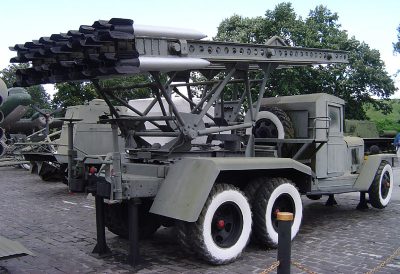
Katyusha launcher (Source: Wikimedia Commons)
By William Walter Kay | Global Research | January 23, 2020
Katyushas are short-range, unguided artillery rockets typically fired in salvos from truck-mounted launch-tubes. Iraq’s insurgents deploy three types.
The smallest is 107 millimetres in diameter and 1 metre long. Its 19 kilogram weight includes an 8 kg high-explosive, shrapnel-bearing warhead. The 107mm is often fired from a 12-tube launcher, however, infantry-portable single-tube tripods are common. An experienced crew with a standardised weapon can hit a 400 X 400 metre target from 8 kilometres away. During the Vietnam War the US Army considered the 107mm to be their adversaries’ most formidable weapon.
The 122mm ‘Grad’ Katyusha is 3 metres long and weighs 75 kg. Its warhead spans a third of its length and weighs 18 kg. It has a 20-kilometre range and a 30-metre lethal radius.
220mm Katyushas hurl 100 kg warheads 30 kilometres.
Katyushas have advantages over mortars. They deliver the same payload twice the distance and they fire multiple ordnance more rapidly. The globally ubiquitous BM-21 Grad fires forty 122mm rockets in three minutes. Reloading takes 10 minutes. Thus, Katyushas excel at “shoot-and-scoot” operations. As well, Katyushas’ flat trajectories permit line-of-sight attacks and their 700 metre-per-second velocities provide unique anti-building potential.
*
After [allegedly] helping suppress the ISIS-led insurgency (2014-17) US forces defaulted to their previous occupation plan. Central to this program are segregated compounds situated inside Iraqi Armed Forces bases. These installations, always near airstrips, contain mere hundreds (not thousands) of US and Coalition troops who ride herd over the Iraqi Army whilst grooming and directing Iraq’s 15,000-strong Special Forces.
Embassies and consulates are integral to the occupation. The sprawling US Embassy compound dominates Baghdad’s fortified “Green Zone” which also houses Coalition partners’ embassies, and the headquarters of the many NGOs insinuated throughout Iraqi society.
The occupation facilitates local activities of American and European businesses. These require office blocks, oil-field infrastructure; and, gated communities for imported talent.
Pre-2011 Americans relied on bases containing thousands of troops. These were remotely located and allocated substantial resources to thwart indirect (mortar and rocket) attacks through: counter-artillery, drone surveillance, and fighting patrols. Despite this, indirect fire inflicted 3,000 casualties (including 211 fatalities) on American forces; many occurring inside ‘secure’ bases.
The US-led Coalition’s current archipelago of military, diplomatic, intelligence, business and NGO installations are ill-equipped to defend themselves against indirect fire. Proximity to cities makes them sitting ducks.
*
In September 2018 persons unknown began targeting US installations with Katyushas. This list chronicles these attacks.* (A dozen mortar attacks are not listed; Katyushas being the weapon of choice.)
- September 8, 2018 – four rockets (three 107mms and one 122mm) fall near the Green Zone.
- September 8, 2018 – two salvos of 107mms land near the US Consulate beside Basra Airport.
- September 28, 2018 – three 107mms are fired at the Basra Consulate; two land on site.
- December 27, 2018 – two 107mms are fired at Al-Asad Airbase (160 kilometres west of Baghdad) during Trump’s visit.
- February 2, 2019 – an attack on Al-Asad Airbase is aborted. Three ready-to-launch 122mms are captured.
- February 12, 2019 – three 107mms hit Q-West Airfield (an off-the-books base south of Mosul).
- May 1, 2019 – two 107mms hit Camp Al-Taji: a ‘training’ institute, 40 kilometres north of Baghdad.
- May 19, 2019 – two rockets land near the US Embassy.
- June 10, 2019 – rocket attack on Camp Al-Taji.
- June 12, 2019 – rocket attack on a “northern air base” starts a fire.
- June 13, 2019 – rocket attack on Nineveh Command Headquarters (Mosul Presidential Palace).
- June 14, 2019 – a rocket lands near the US Embassy.
- June 17, 2019 – three rockets hit Camp Al-Taji.
- June 18, 2019 – Nineveh HQ is attacked by two 122mms; one hits, one misses.
- June 19, 2019 – rockets strike a gated community outside Basra (home to Exxon staff).
- September 23, 2019 – two rockets hit the Green Zone; one lands near the US Embassy.
- October 30, 2019 – two rockets hit the Green Zone, killing an Iraqi soldier.
- November 8, 2019 – seventeen rockets target Q-West Airfield.
- November 17, 2019 – rockets hit the Green Zone.
- November 29, 2019 – a rocket hits the Green Zone.
- December 3, 2019 – Al-Asad Airbase is “rocked” by five 122mms.
- December 5, 2019 – five 107mms hit Balad Airbase (80 kilometres north of Baghdad).
- December 6, 2019 – a 240mm rocket lands near Baghdad Airport (then housing a US base).
- December 9, 2019 – four 240mms strike Baghdad Airport killing 2, and wounding 5, Iraqi soldiers.
- December 11, 2019 – two 240mms land outside Baghdad Airport.
- December 27, 2019 – thirty-six 107mms hammer K1 Base (15 kilometres northwest of Kirkuk); killing an American translator and wounding several US troops.
- December 29, 2019 – four rockets hit Camp Al-Taji.
- December 29, 2019 – five rockets hit Al-Asad Airbase.
- January 4, 2020 – two rockets hit Balad Airbase.
- January 4, 2020 – several rockets hit the Green Zone. One lands near the US Embassy; another closes a major street.
- January 5, 2020 – six rockets are fired at the Green Zone; three hit the target.
- January 8, 2020 – two rockets hit the Green Zone.
- January 12, 2020 – eight rockets hit Balad Airbase, wounding several Iraqi soldiers.
- January 14, 2020 – a five-rocket attack on Camp Al-Taji.
- January 20, 2020 – three rockets hit Green Zone. They were fired from Al Zafraniya (15 kilometres away).
Attacks are becoming more frequent and are trending toward bigger rockets and higher volume salvos.
The insurgents’ strategy is working. Katyusha attacks shuttered the US Basra Consulate in September 2018. Attacks in May and June 2019 forced Exxon to evacuate much of its foreign staff. Throughout 2019 the US State Department extracted personnel and the Defense Department consolidated bases into more secure facilities. By late 2019 US authorities were begging Iraqis for help whilst threatening retaliation.
The last straw came December 27 when the barrage onto K1 Base killed an American translator. The US responded with airstrikes on five Kata’ib Hezbollah bases (90 casualties) and with the January 3 assassination of Iranian General Soleimani. (The decision to assassinate Soleimani – in the event of an American fatality – was made June 24, 2019 following a week of near daily Katyusha attacks.)
*
While Iran and Iran’s Iraqi allies are blamed for these attacks; this is dubious. Reportage following attacks invariably drops the phrase “no one claimed responsibility” – which is notable because perpetrators often boast of such achievements. Ten years ago, when Kata’ib Hezbollah targeted US facilities with “lob bombs” (improvised rockets), they posted videos of their handiwork. They deny involvement in these recent attacks as do other Iranian-linked militias.
The reportage often describes the attacks as “mysterious” or as a “whodunit.” Authors relay US intelligence theories of Iranian involvement … without evidence.
On several occasions insurgents abandoned launchers and/or launch vehicles after the attack, often with fail-to-launch rockets inside. Investigators also possess fragments of successfully fired rockets. Tellingly, US officials, renowned for straining at gnats for evidence of Iranian complicity, do not utilise this material to incriminate Tehran.
The launchers themselves are obviously manufactured by local artisans. Moreover, an article from Kurdistan–24 describes the rockets as “locally made.” Even globalist-militarist instrumentalities like the Washington Institute, Long War Journal, and Center for Strategic and International Studies concede some Katyushas are manufactured in Iraq.
Iraq has a burgeoning steel industry and, due to the calamities of the past 20 years, an enormous scrap metal industry. Katyushas’ cardinal virtue is their simplicity.
*
Circa 2014 twelve countries hosted non-state armed groups that deployed Katyushas. (Post-2014 Yemen’s Houthis joined this list, then outdid the pack in innovation and output.)
During the 2003-11 era Iraqi insurgents looted Katyushas from local arsenals. Other Katyushas came from Iran (officially or via the black market) and possibly from any of 32 other countries manufacturing them. Experts bemoan the difficulty of determining a rocket’s origin.
Circa 2008 Iraqi artisans manufactured a variety of launchers. A 2009 raid in Maysan Governorate discovered 107mm, 122mm and 220mm rail launchers; and 1,700 carjacks. (Jacks were affixed to the bottoms of stationary tripods to permit changes in launch angle.) Insurgents developed creative mobile launch platforms i.e. inside ice cream trucks or towed behind motorcycles etc. They debuted remote control triggers and GPS reconnaissance.
Circa 2011 poor quality of locally acquired rockets compelled insurgents to continue to rely on imports. The insurgents were, however, manufacturing “lob bomb” rockets and anti-armour mines; although Iran stood accused of being their sole supplier.
Post-2011 insurgents honed their craft. Remember: Hamas, operating inside Gaza with a tiny fraction of the resources of Iraq’s insurgents, manufactures crude Katyushas.
*
Prime suspects in the Katyusha campaign are not pro-Iranian militias; but rather the milieu around Mahdi Army successor, the Promise Day Brigades (PDB). This political tendency, nominally led by Moqtada al-Sadr, is concentrated in Iraq’s densely populated central and southern regions, but boasts a militant contingent in Mosul. This milieu overlaps the Saairun Alliance which includes Iraq’s far left; who carry their own legacy of armed struggle.
The insurgency’s Von Braun might be Jawad al-Tulaybani. An Iran-Iraq War veteran, al-Tulaybani possesses 40 years of combat rocketry experience. A war wound left him partially disabled. He appeared on US radar in 2008 after masterminding a barrage that wounded 15 US soldiers.
The org-chart of the Saairun/PDB/al-Sadr movement remains obscured. Notably, on January 8, 2020 al-Sadr counselled refrain from military actions. Four Katyusha attacks happened since.
What is clear is that this general political tendency is not particularly beholden to Iran. They appear non-sectarian, if not secularist, and they advance a left-nationalist agenda. Prior to the 2018 election (wherein Saairun emerged as the most popular bloc) Iran’s Foreign Minister warned Iran would never tolerate an Iraq run by “liberals and communists” – meaning Saairun.
Then again, Trump’s thrill kill of Soleimani (and Iraq’s Popular Mobilization Units’ Deputy Commander) completely reshuffled the deck, creating unprecedented unity amongst hitherto rivals.
*
As Katyushas veto pacification efforts, US forces return to square one. They must retreat to sprawling, remotely situated camps equipped to suppress indirect fire. This, however, means surrendering Iraq’s political theatre to adversaries who will marshal Iraqi Government resources against them.
Katyushas are driving the Trump Administration’s Iraq policy. Prisoners of groupthink they react by doubling-down on the Big Lie that Iraq’s national liberation movement consists only of “Iranian terrorists.” In reality, their most effective opponents are as indigenous and legitimate as the French Resistance.
Note on Sources
Data came from scanning 1,000 articles then parsing several dozen of them. Preference went to state media: i.e. Voice of America, Al Jazeera, Xinhua et al; although Military Times and Kurdistan-24 proved germane. Rogue Rocketeers: Artillery Rockets and Armed Groups (Small Arms Survey, Geneva Switzerland, 2014) is a must-read. Data on the first 7 Katyusha attacks was lifted without corroboration from Michael Knights’ Responding to Iranian Harassment of U.S. Facilities in Iraq (Washington Institute, May 21, 2019). As Knights is the only analyst to grasp the seriousness of the Katyusha attacks. His reports are a trove. Being intimately connected to US and Israeli intelligence, he slavishly relays the anti-Iran party line.
Major attacks generate scores of reports. Lesser attacks are mentioned only in passing. Some articles tally the attacks but the numbers do not jibe. Certain attacks go unreported. Probably, 50+ mortar and Katyusha attacks hit US facilities between September 8, 2018 and January 14, 2020.
http://www.smallarmssurvey.org/fileadmin/docs/F-Working-papers/SAS-WP19-Rogue-Rocketeers.pdf
Copyright © William Walter Kay, Global Research, 2020
Iraqis march in ‘millions’ to call for expulsion of US troops
Press TV – January 24, 2020
 Iraqis have rallied in Baghdad in massive numbers to call for an end to US military presence in the country following high-profile assassinations and airstrikes targeting anti-terror forces.
Sayed Sadiq al-Hashemi, the director of the Iraqi Center for Studies, said more than 2.5 million took part in the demonstrations on Friday.
Since the early hours on Friday, huge crowds of men, women and children of all ages converged on the Jadriyah neighborhood near Baghdad University.
The protesters were seen carrying banners and chanting slogans calling for the expulsion of US forces.
“Get out, get out, occupier!” some shouted, while others chanted, “Yes to sovereignty!”
Iraq’s al-Ahd news network reported that Iraqis from all of the country’s provinces had gathered in the city.
On January 5, the Iraqi parliament voted overwhelmingly in favor of a resolution calling for the expulsion of all foreign forces after the US assassination of Iran’s General Qassem Soleimani and his Iraqi trenchmate Abu Mahdi al-Muhandis.
The massive rally came after influential cleric Muqtada al-Sadr called on Iraqis to stage “a million-strong, peaceful, unified demonstration to condemn the American presence and its violations”.
Sadr issued a statement on Friday calling for US bases to be shut down and Iraqi airspace closed to US warplanes and surveillance aircraft.
He warned that US presence in the country will be dealt with as an occupying force if Washington does not agree with Iraqi demands to withdraw for the country.
In a message delivered through a representative at Friday prayer in the holy city of Karbala, top cleric Ayatollah Ali al-Sistani also urged Iraqi political groups to do what is needed to the safeguard the country’s sovereignty.
He called on Iraqi groups to stand united, far from any foreign influence in countering the dangers which threaten the country.
On Thursday ahead of the planned rallies, Sadr called on Iraqis to mobilize and defend the country’s independence and sovereignty.
“Oh women, men and youth of the country, the time is now upon us to defend the country, its sovereignty and dependence,” Sadr said in a tweet.
“Spread the word of an independent future Iraq that will be ruled by the righteous; an Iraq which will not know of corruption nor aggression” he added, calling on Iraqis to expel the “tyrants”.
Various Iraqi resistance groups affiliated with the country’s Popular Mobilization Units (PMU) have also backed the anti-American rally.
‘Zero hour in face-off with US’
Speaking to the Lebanese al-Mayadeen television channel, Jaafar al-Husseini, a spokesman for the PMU-affiliated Kata’ib Hezbollah resistance group, said “other means” will be used against the Americans if they do not leave Iraq.
The American presence, he said, has led to corruption and instability in the country.
In an interview with Iran’s Tasnim news agency, Firas al-Yasser, a member of the political bureau of Iraq’s Harakat Hezbollah al-Nujaba, said Friday’s rallies marked “a new chapter” in the Arab country’s relations with the US.
He said Iraqi resistance groups support the stance of the country’s clerical leadership, which does not tolerate Washington’s “theory of dependence and humiliation” of Iraq.
“We believe we have reached the zero hour in facing off with the US,” he said.
Yasser added that Iran’s missile attack on the Ain al-Assad base in the western Iraqi province of Anbar earlier this month was a “prelude” to the expulsion of US forces from the country.
Qais al-Khazali, leader of Asa’ib Ahl al-Haq, which is part of the PMU, described Friday’s rallies as a “second revolution” a century after the Great Iraqi Revolution of 1920 against British forces.
A New Definition of Warfare
Sanctions can be more deadly than bullets
By Philip Giraldi • Unz Review • January 21, 2020
Supporters of Donald Trump often make the point that he has not started any new wars. One might observe that it has not been for lack of trying, as his cruise missile attacks on Syria based on fabricated evidence and his recent assassination of Iranian general Qassem Soleimani have been indisputably acts of war. Trump also has enhanced troop levels both in the Middle East and in Afghanistan while also increasing the frequency and lethality of armed drone attacks worldwide.
Congress has been somewhat unseriously toying around with a tightening of the war powers act of 1973 to make it more difficult for a president to carry out acts of war without any deliberation by or authorization from the legislature. But perhaps the definition of war itself should be expanded. The one area where Trump and his team of narcissistic sociopaths have been most active has been in the imposition of sanctions with lethal intent. Secretary of State Mike Pompeo has been explicit in his explanations that the assertion of “extreme pressure” on countries like Iran and Venezuela is intended to make the people suffer to such an extent that they rise up against their governments and bring about “regime change.” In Pompeo’s twisted reckoning that is how places that Washington disapproves of will again become “normal countries.”
The sanctions can kill. Those imposed by the United States are backed up by the U.S. Treasury which is able to block cash transfers going through the dollar denominated international banking system. Banks that do not comply with America’s imposed rules can themselves be sanctioned, meaning that U.S. sanctions are de facto globally applicable, even if foreign banks and governments do not agree with the policies that drive them. It is well documented how sanctions that have an impact on the importation of medicines have killed thousands of Iranians. In Venezuela, the effect of sanctions has been starvation as food imports have been blocked, forcing a large part of the population to flee the country just to survive.
The latest exercise of United States economic warfare has been directed against Iraq. In the space of one week from December 29th to January 3rd, the American military, which operates out of two major bases in Iraq, killed 25 Iraqi militiamen who were part of the Popular Mobilization Units of the Iraqi Army. The militiamen had most recently been engaged in the successful fight against ISIS. It followed up on that attack by killing Soleimani, Iraqi militia general Abu Mahdi al-Muhandis, and eight other Iraqis in a drone strike near Baghdad International Airport. As the attacks were not approved in any way by the Iraqi government, it was no surprise that rioting followed and the Iraqi Parliament voted to remove all foreign troops from its soil. The decree was signed off on by Prime Minister Adel Abdul Mahdi, based on the fact that the U.S. military was in Iraq at the invitation of the country’s government and that invitation had just been revoked by parliament.
That Iraq is to say the least unstable is attributable to the ill-advised U.S. invasion of 2003. The persistence of U.S. forces in the country is ostensibly to aid in the fight against ISIS, but the real reason is to serve as a check on Iranian influence in Iraq, which is a strategic demand made by Israel and not responsive to any actual American interest. Indeed, the Iraqi government is probably closer politically to Tehran than to Washington, though the neocon line that the country is dominated by the Iranians is far from true.
Washington’s response to the legitimate Iraqi demand that its troops should be removed consisted of threats. When Prime Minister Mahdi spoke with Pompeo on the phone and asked for discussions and a time table to create a “withdrawal mechanism” the Secretary of State made it clear that there would be no negotiations. A State Department written response entitled “The U.S. Continued Partnership with Iraq” asserted that American troops are in Iraq to serve as a “force for good” in the Middle East and that it is “our right” to maintain “appropriate force posture” in the region.
The Iraqi position also immediately produced presidential threats and tweets about “sanctions like they have never seen,” with the implication that the U.S. was more than willing to wreck the Iraqi economy if it did not get its way. The latest threat to emerge involves blocking Iraq access to its New York federal reserve bank account, where international oil sale revenue is kept, creating a devastating cash crunch in Iraq’s financial system that might indeed destroy the Iraqi economy. If taking steps to ruin a country economically is not considered warfare by other means it is difficult to discern what might fit that description.
After dealing with Iraq, the Trump Administration turned its guns on one of its oldest and closest allies. Great Britain, like most of the other European signatories to the 2015 Joint Comprehensive Plan of Action (JCPOA) has been reluctant to withdraw from the agreement over concern that Iran will as a result decide to develop nuclear weapons. According to the Guardian, a United States representative from the National Security Council named Richard Goldberg, had visited London recently to make clear to the British government that if it does not follow the American lead and withdraw from the JCPOA and reapply sanctions it just might be difficult to work out a trade agreement with Washington post-Brexit. It is a significant threat as part of the pro-Brexit vote clearly was derived from a Trump pledge to make up for some of the anticipated decline in European trade by increasing U.K. access to the U.S. market. Now the quid pro quo is clear: Britain, which normally does in fact follow the Washington lead in foreign policy, will now be expected to be completely on board all of the time and everywhere, particularly in the Middle East.
During his visit, Goldberg told the BBC: “The question for prime minister Johnson is: ‘As you are moving towards Brexit … what are you going to do post-31 January as you come to Washington to negotiate a free-trade agreement with the United States?’ It’s absolutely in [your] interests and the people of Great Britain’s interests to join with President Trump, with the United States, to realign your foreign policy away from Brussels, and to join the maximum pressure campaign to keep all of us safe.”
And there is an interesting back story on Richard Goldberg, a John Bolton protégé anti-Iran hardliner, who threatened the British on behalf of Trump. James Carden, writing at The Nation, posits “Consider the following scenario: A Washington, DC–based, tax-exempt organization that bills itself as a think tank dedicated to the enhancement of a foreign country’s reputation within the United States, funded by billionaires closely aligned with said foreign country, has one of its high-ranking operatives (often referred to as ‘fellows’) embedded within the White House national security staff in order to further the oft-stated agenda of his home organization, which, as it happens, is also paying his salary during his year-long stint there. As it happens, this is exactly what the pro-Israel think tank the Foundation for the Defense of Democracies (FDD) reportedly achieved in an arrangement brokered by former Trump national security adviser John Bolton.”
The FDD senior adviser in question, who was placed on the National Security Council, was Richard Goldberg. FDD is largely funded by Jewish American billionaires including vulture fund capitalist Paul Singer and Home Depot partner Bernard Marcus. Its officers meet regularly with Israeli government officials and the organization is best known for its unrelenting effort to bring about war with Iran. It has relentlessly pushed for a recklessly militaristic U.S. policy directed against Iran and also more generally in the Middle East. It is a reliable mouthpiece for Israel and, inevitably, it has never been required to register under the Foreign Agents Registration Act of 1938.
To be sure, Trump also has other neocons advising him on Iran, including David Wurmser, another Bolton associate, who has the president’s ear and is a consultant to the National Security Council. Wurmser has recently submitted a series of memos to the White House advocating a policy of “regime disruption” with the Islamic Republic that will destabilize it and eventually lead to a change of government. He may have played a key role in giving the green light to the assassination of Soleimani.
The good news, if there is any, is that Goldberg resigned on January 3rd, allegedly because the war against Iran was not developing fast enough to suit him and FDD, but he is symptomatic of the many neoconservative hawks who have infiltrated the Trump Administration at secondary and tertiary levels, where much of the development and implementation of policy actually takes place. It also explains that when it comes to Iran and the irrational continuation of a significant U.S. military presence in the Middle East, it is Israel and its Lobby that are steering the ship of state.
Philip M. Giraldi, Ph.D., is Executive Director of the Council for the National Interest, a 501(c)3 tax deductible educational foundation (Federal ID Number #52-1739023) that seeks a more interests-based U.S. foreign policy in the Middle East. Website is councilforthenationalinterest.org, address is P.O. Box 2157, Purcellville VA 20134 and its email is inform@cnionline.org.
Featured Video
Seyed M. Marandi: Negotiations Collapsed – Return to War
or go to
Aletho News Archives – Video-Images
From the Archives
Wartime internment camps in Australia
National Archives of Australia
World War I
During World War I, for security reasons the Australian Government pursued a comprehensive internment policy against enemy aliens living in Australia.
Initially only those born in countries at war with Australia were classed as enemy aliens, but later this was expanded to include people of enemy nations who were naturalised British subjects, Australian-born descendants of migrants born in enemy nations and others who were thought to pose a threat to Australia’s security.
Australia interned almost 7,000 people during World War I, of whom about 4,500 were enemy aliens and British nationals of German ancestry already resident in Australia.
Records of World War I internment camps
World War II
During World War II, Australian authorities established internment camps for three reasons – to prevent residents from assisting Australia’s enemies, to appease public opinion and to house overseas internees sent to Australia for the duration of the war.
Unlike World War I, the initial aim of internment during the later conflict was to identify and intern those who posed a particular threat to the safety or defence of the country. As the war progressed, however, this policy changed and Japanese residents were interned en masse. In the later years of the war, Germans and Italians were also interned on the basis of nationality, particularly those living in the north of Australia. In all, just over 20 per cent of all Italians resident in Australia were interned. … continue
Blog Roll
 Aletho News
- Seyed M. Marandi: Negotiations Collapsed – Return to War
- Tomorrow’s naval blockade showdown
- ‘Israel’ attacks civilians to hide its embarrassing military failures & out of pure sadism
- Any Foreign Military Vessel Approaching Hormuz Under Any Pretext ‘Will Be Dealt With Severely’: IRGC
- Diplomats slam US negotiators’ performance in Iran talks
- Trump Refuses Exit Ramp, War with Iran will Continue
- Trump Says US Naval Blockade in Strait of Hormuz Will Begin Shortly
- US, Iran end 21-hour talks without agreement
- US IRAN TALKS: Who Are the Crazy Ones Here? /Lt Col Daniel Davis
- Talks with the US end without a deal over excessive US demands: Iran
- If Americans Knew
- US-Iran ceasefire negotiations make zero progress – Daily Update
- Pro-Israel ‘Thinktanks’ and Individuals who Influence U.S. Foreign Policy
- Mearsheimer reveals how Israel dictates US policies on Iran, Gaza – video
- After killing 350+, Israel still has a “score to settle” with Lebanon before ceasefire – Daily Update
- Military aid to Israel emerges as the latest political litmus test for Democrats
- The only Palestinian children’s rights organization closes following years-long Israeli campaign against it
- ‘I Can’t Forget the Smell’: Lebanese Reel After Israel Kills Over 300 in Single Day
- DNC Shoots Down Resolutions Calling Out AIPAC and Limiting Arms to Israel
- TCN: Is Israel Blackmailing President Trump?
- Israel killed at least 303 Lebanese yesterday – who were they? Daily Update
- No Tricks Zone
- Cave Discovery Reveals Today’s Desert Climates Were Recently Far Warmer, Wetter, Teeming With Life
- German Expert: Heat Dome Led To Record Temps In Western USA…Warmer In 1934, 1936
- New Study: No Linear Warming Or Glacier Retreat Along Northern Antarctic Peninsula Since 1980s
- An Inconvenient Tree: Uncovered In Alps… Europe Much Warmer Than Today 6000 Years Ago
- New Study Reports A 60% Slowdown In Greenland’s Ice Loss Rate In The Last Decade
- Low Intensity Tornado Wrecks Major Solar Farm, Creating A Potential Toxic Dump
- New Study Finds Warming Saves Lives…Cold Temperatures 12 Times More Deadly Than Excess Heat
- German Science Blog Accuses PIK Climate Institute Of Hallucinating Climate Tipping Points
- Devastating Assessment Of Comirnaty Vaccine By Former Senior Pfizer Europe Toxicologist
- New Study: CO2 Is ‘Effectively Negligible’ As An Explanatory Climate Change Factor Since 2000
 Aletho News