Iraq’s Kurdistan Democratic Party announced that the expulsion of US troops from Iraq’s Kurdistan region is subject to the decision by the central government.
The withdrawal of foreign forces from Iraq’s Kurdistan region is a decision that Baghdad will make, said a member of Iraq’s Kurdistan Democratic Party on Sunday Mahdi Abdulkarim, according to Almaalomah.
Abdulkarim said that Iraq’s Kurdistan Region does not reject the possibility of the withdrawal of foreign forces from its territories, and the decision on the withdrawal is related to the decisions of the Iraqi central government.
“Masoud Barzani, the head of Iraq’s Kurdistan Democratic Party stressed that the decision of the Kurdistan region will be the same as Baghdad’s, saying that the decision taken by the central government will also be accepted by the Kurdistan Region in order to maintain Iraq’s sovereignty.”
There are considerations about the decision to withdraw foreign troops from Iraq, and some talks are underway, he said, adding that everything will be clear in the coming days.
The Iraqi parliament voted for a resolution requiring the government to order the withdrawal of US troops from Iraq on 5 January in an extraordinary session two days after a US drone strike on a convoy at Baghdad airport which assassinated Iranian military commander Qassem Soleimani and Iraqi Popular Mobilization Forces (PMF) deputy chief Abu Mahdi al-Muhandis.
January 20, 2020
Posted by aletho |
Illegal Occupation | Iraq |
Leave a comment
During the early morning hours of January 8, 2020, Iranian strategic missile units launched a precision attack, branded ‘Operation Martyr Soleimani’, against US forces at the American-operated section of the ‘Ain al-Asad’ air base in Iraq.
The response, coming in response to the illegal assassination of General Qassem Soleimani, was a high-observable attack using ballistic missile forces – as opposed to a low-observable attack using terrain-reading cruise missiles and suicide drones.
With US forces already having been in a heightened state of alert, American radar and satellite reconnaissance would have spotted the attack within a minute of it being launched (and a six hour pre-warning of an imminent attack before that), giving the US and other coalition troops present at the base time to seek cover in hardened shelter areas. This, however, did not prevent the success of the attack which, according to primary source evidence, destroyed highly-expensive US aviation assets.
THE RESULT – U.S. FORCES ASSET LOSSES
According to the evidence that has been made available to us at this point, it is obvious that the US is lying about the extent of the damage inflicted upon its assets and infrastructure at the Ain al-Asad base.
No American media group or official Pentagon report initially released the satellite pictures shown in this report, and probably for good reason. To downplay the event (as Trump did in his official address, as did the Pentagon in its later report), they simply dismissed the damaged equipment, referring to the destroyed assets as simple “tents, a parking lot and a damaged helicopter” (per the Department of Defense).
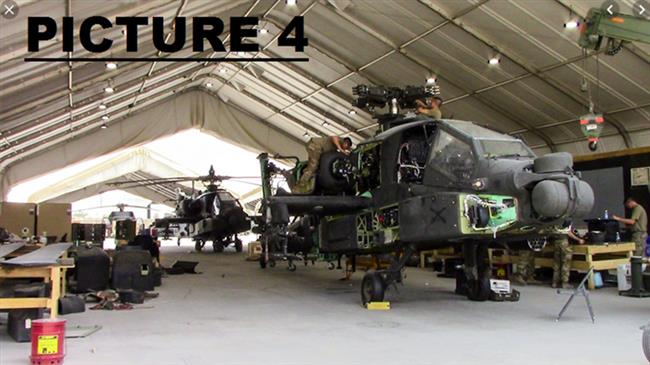
The Iranian missile attack for the most part targeted Apache (AH-64) attack helicopter shelters (refer to Picture 1). Refer to Picture 3 and Picture 4 to see what those “tent”-like Apache steel-frame shelters look like at ground level.
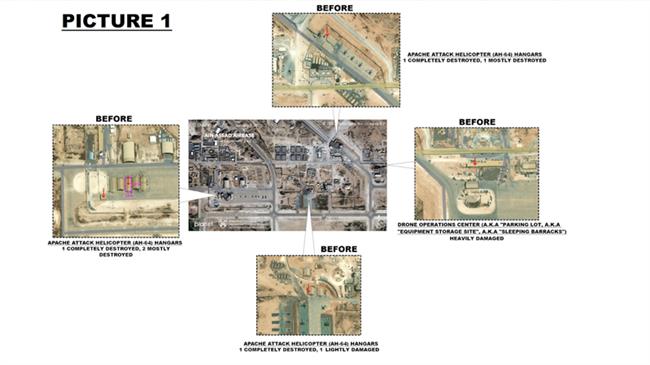
They are the standard steel-frame soft shelter design for US helicopter units based in overseas areas at second-rate airfields (such as the Ain al-Asad Base) – US helicopter units operating from old Afghan airfields are also housed in this kind of shelter design. Each one of those Apache attack helicopter shelters can house two such aircraft. With six structures of the type provably destroyed, demonstrated through the satellite images showing blackened scorch marks (suggesting assets inside them were destroyed with the shelter itself, refer to Picture 1) AND assuming each only had one Apache in them, it can be concluded that at least 6 Apache gunships were destroyed in the attack.
Recently, Danish media, citing a Danish coalition soldier who was present at the base at the time of the attack, admitted that multiple helicopters were destroyed to the point of being “split in half”.
Another Apache hangar (refer to Picture 2) was also directly struck, located to the far eastern end of the Ain al-Asad Base and destroyed. However, note that there is no scorch-blackened concrete underneath it, suggesting nothing was inside it that led to additional burning beyond the impact of the warhead itself.
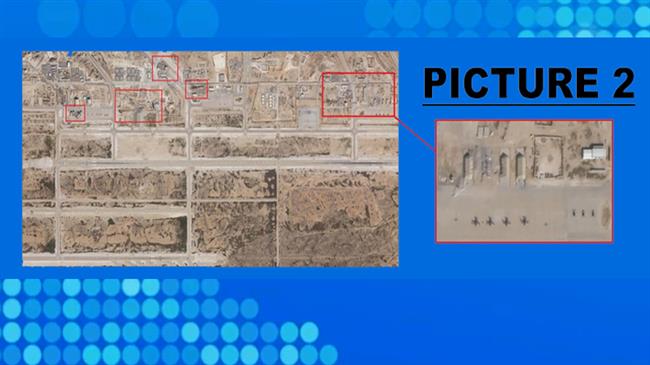
Indeed, just to the south of that destroyed hangar and the undamaged three hangars next to it, 4 Apache helicopters can be seen sitting out on the open tarmac. They were spared as they were, ironically, not being sheltered.
The official US story on the other structure targeted beyond the “tents” (i.e. Apache gunship hangars) has already changed twice – first it was called a parking lot, then an equipment storage area and now, apparently, a barracks for drone operators. Picture 1 (far right) shows the result of the attack on this structure.
It is hard to imagine that base zoning regulators within the US military would chose to place sleeping quarters right next to a strip alert (ready-to-go) aircraft parking area, itself right next to a major taxiway, given the constant noise that comes from these areas.
A more astute assessment would place this structure as an operations center, which lines up with the Iranian claim that the command site from which the Qassem Soleimani assassination operation had been coordinated, was targeted and destroyed in Iran’s retaliation strike.

Indeed, AFP recently released an exclusive report in which a US drone operator present at the Ain al-Asad Airbase, one First Sergeant Wesley Kilpatrick, admitted that airborne drones were rendered inoperable after a direct hit penetrated the base’s UAV operations center and destroyed the fiber lines which connect remote stations to satellite communication equipment(needed for drone control and visuals).
In all of this, one thing is obvious. US officials and media are stumbling over their own statements trying to cover up the extent of the damage dealt to the US-operated section of the Ain al-Asad base – in fact, going so far to cease calling the military site a US airbase (as it had been called for the last 16 years) to (all of a sudden) just an “Iraqi facility”.
THE WEAPONS USED BY IRAN
Short-range ballistic missiles (SRBM) of the upgraded Fateh-313 (range 500 km) and Qiam (range 800 km) types were launched from Western Iran towards the US-operated Ain al-Asad Base in Iraq.
Fateh-313s represent the majority of the missile type used for the attack. Their accuracy still seems to have been to within a matter of meters of their intended targets, except for two stray shots that hit the open tarmac area.
Whilst the Fateh-313 missiles use a combination of INS and electro-optical guidance, the Qiam missiles reportedly use a mix of INS, GPS and radar-mapping target acquisition. The latter method being the archaic predecessor version of DSMAC (imaging automatic target acquisition) terminal-phase guidance used in high-end ground-attack cruise missiles, such as the Tomahawk.
THE OPERATION –OTHER DETAILS
Satellite pictures show that some targeted sites were double-tapped (hit twice-over for good measure).
Initial reports from the Ain al-Asad Base claimed nearly 40 detonations in total despite the fact the number of actual warhead impacts was about fifteen, indicating that there were around two dozen cases of secondary explosions (fuel and ammo going off after being ignited).
In conclusion, according to the evidence we have available to us currently, there is no doubt that the United States has completely distorted the gravitude of Iran’s strikes. The mainstream media in the West have also seemingly refrained from acknowledging much of the damage, apart from on occasion.
Robert Inlakesh is a journalist, writer and political analyst, who has lived in and reported from the occupied Palestinian West Bank. He has written for publications such as Mint Press, Mondoweiss, MEMO, and various other outlets. He specializes in analysis of the Middle East, in particular Palestine-Israel. He also works for Press TV as a European correspondent.
January 16, 2020
Posted by aletho |
Deception, Illegal Occupation | Iran, Iraq, United States |
Leave a comment
The Iraqi government has denied claims that the country’s military is resuming joint operations with the US-led coalition after Washington’s assassination of top Iranian and Iraqi commanders.
“The joint operations have not resumed and we have not given our authorization,” Major General Abdul Karim Khalaf, the spokesman for the commander-in-chief of the Iraqi armed forces, said on Thursday.
He added that the coalition did not have a permission from Baghdad to carry out any joint missions.
The remarks came after the New York Times, citing two American military officials, reported Thursday that the US had resumed the operations.
Khalaf said the Iraqi government had ordered the coalition to halt its joint operations following the US assassination of top Iranian anti-terror commander, Lieutenant General Qassem Soleimani, and Abu Mahdi al-Muhandis, the second-in-command of Popular Mobilization Units (PMU).
Last month, another US airstrike killed 25 members of PMU in the Arab country’s west.
On January 3, a US drone strike outside Baghdad airport killed General Soleimani and al-Muhandis.
Washington began the pause on January 5, two days after the strike, but furious Iraqi lawmakers voted to expel more than 5,000 US troops based in their country.
The Pentagon said it had no information with regard the the alleged resumption of joint operations with Iraqi troops.
The US-led coalition’s spokesman in Baghdad also declined to comment.
January 16, 2020
Posted by aletho |
Deception, Fake News, Illegal Occupation, Mainstream Media, Warmongering | Iraq, United States |
Leave a comment
By Paul Antonopoulos | January 16, 2020
With tensions mounting between Iran and the United States after the latter assassinated Iranian General Qassem Soleimani in Iraq, Baghdad has now been pushing to free itself from American domination by calling for foreign troops to leave the country and announcing its intensions in buying the Russian S-400 missile defense system. The complete destruction of the U.S. military base in Anbar province earlier this month demonstrated to Iraqi leaders that it certainly needs to strengthen its air defences since not even American air defense systems could protect their base from the barrage of Iranian missiles. The Iraqi government’s intention to buy the S-400 air defense systems from Russia has been talked about since May last year, when the country’s ambassador to Moscow said Baghdad had decided to buy the systems. However, no roadmap to purchase the systems has been made yet.
Karim Elaiwi, an Iraqi member of parliament who sits on the security and defense committee, said last week that “We are talking to Russia about the S-400 missiles but no contracts have been signed yet. We need to get these missiles, especially after Americans have disappointed us many times by not helping us in getting proper weapons.”
It appears the Iraqis will no longer tolerate U.S. occupation and demands in its country, with parliamentarian and security and defense committee member Abdul Khaleq Al Azzawi, defiantly saying “We authorized the prime minister to get air defense weapons from any country he wants and we authorized him to spend the money for it, from any country. From Russia or anyone.”
This comes as hostilities between Iraq and the U.S. increase, with U.S. President Donald Trump threatening to cut Baghdad’s access to its key account at the Federal Reserve Bank in New York if they follow through with the Iraqi Parliament’s decision to expel the U.S. military from their country. Not only has there been a threat to cut Iraq from its own money based in the U.S., but there are now threats of $250 million in military aid to Iraq being cut.
Although these are tactics to force Baghdad into maintaining ‘permission’ for the U.S. military to remain in Iraq, the clearest sign that this is an American occupation of the West Asian country was with White House National Security Adviser Robert O’Brien’s comments last week that the U.S. will leave Iraq on its “own terms.” The U.S. are not even trying to hide the fact that they are occupying Iraq and rebelling against the government.
Despite the clear occupation, Iraq continues to defy the U.S., and the willingness to purchase the S-400 system is a clear indication of this. It is for this reason that Joey Hood, the U.S. State Department’s principal deputy assistant secretary for Near Eastern Affairs, said on Tuesday in an appearance at the Middle East Institute, an extremely influential Washington think tank, that “A purchase [of the S-400] would probably trigger sanctions, so we advise our partners not to make such purchases.”
This was an expected response considering the continued threats of sanctions the U.S. has put against Turkey for its own acquisition of the S-400. Iraq wants to strengthen its air defense and the S-400 systems are considered the best in the world. It must also be remembered that Iraq is already buying modern weapons from Russia, such as the Mi-28 fighter helicopters and T-90 tanks. However, it is likely that Washington considers the purchase of the S-400 from Russia as an indication that the U.S. is losing political and military support in the country – but this was already consolidated by the assassination of Soleimani, an extremely popular figure in Iraq.
Baghdad is already in negotiations for the S-300, the older generation of the S-400. However, it is the S-400, the newest model available for foreign markets, that will provoke resistance in Washington, especially as the U.S.-made Patriot missile defense system has proven to be a failure by not being able to defend U.S. bases in Iraq or Saudi oil facilities, if we remember the Houthi-led Ansarullah Movement’s attack on the ARAMCO site in September last year.
The question then becomes how will Iraq will pay for Russian weapons if their accounts in the U.S. are frozen. Delivery is not so much of an issue despite the U.S. occupation, it is more a matter of how payments will be made. Although Iraqi parliamentarians are boldly declaring their intentions for the S-400 to be purchased, there are significant problems that Baghdad must first be able to overcome, including the extremely strong pressure being applied by the U.S. against Iraq not to buy them. If Baghdad did successfully defy Washington and purchase the systems, it will certainly weaken the U.S.’ image in the region, something the North American country will unlikely want to risk.
Will Iraq boldly defy the U.S.? This remains to be seen now.
Paul Antonopoulos is a Research Fellow at the Center for Syncretic Studies.
January 16, 2020
Posted by aletho |
Illegal Occupation | Iraq, United States |
Leave a comment
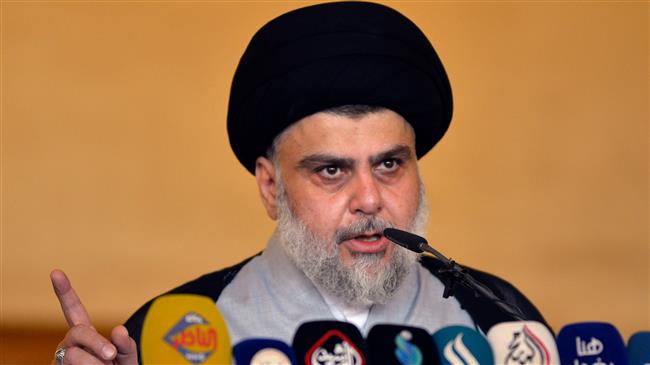
Influential Iraqi Shia cleric Muqtada al-Sadr (Photo by AFP )
Influential Iraqi Shia cleric Muqtada al-Sadr has demanded that Iraqis stage a “million-man march” against the continued US military presence in the country, days after Iraq’s parliament voted to expel the American troops following an assassination operation by Washington on Iraqi soil.
The march is needed “to condemn the American presence and its violations,” Sadr, who leads the largest parliamentary bloc, Sairoon, said in a tweet on Tuesday.
“The skies, land, and sovereignty of Iraq are being violated every day by occupying forces,” he added. The cleric, however, cautioned that such a show of popular disapproval should be a “peaceful, unified demonstration,” but did not offer a date or location for the proposed rally.
On January 5, the parliament voted overwhelmingly in favor of a resolution calling for the expulsion of all US-led forces, two days after the US military assassinated senior Iranian commander Lieutenant General Qassem Soleimani and along with Abu Mahdi al-Muhandis, the second-in-command of Iraq’s Popular Mobilization Units (PMU), among others, near the Baghdad airport.
The parliament resolution also urged the Baghdad government to drop a request for assistance from a US-led coalition of foreign troops purportedly operating against Daesh remnants in Iraq.
The Iraqis censured the targeted killings — which were ordered by US President Donald Trump — as a blatant violation of the country’s sovereignty as well as the security agreement between Baghdad and Washington.
In a letter to the parliament following the vote, Sadr called for an immediate cancellation of the security agreement with the US, the closure of the US embassy, the expulsion of US troops in “a humiliating manner,” and the criminalization of communication with the US administration.
Following the parliamentary vote, the office of Iraq’s caretaker Prime Minister Adel Abdul-Mahdi asked Washington to dispatch a delegation to Baghdad to initiate preparations for the withdrawal of American troops, who number around 5,200.
In response, Trump threatened to sanction Iraq “like they’ve never seen before ever” if Baghdad were to expel US troops.
Based on reports by the Wall Street Journal the US administration has threatened to shut off Iraq’s access to its main account at the Federal Reserve Bank of New York, which is used to collect revenues from the Arab country’s overseas oil sales, if Baghdad expelled the American forces.
January 15, 2020
Posted by aletho |
Illegal Occupation, Solidarity and Activism | Iraq, United States |
Leave a comment
Iran is not done. General Hajizadeh, Commander of the IRGC Aerospace Force, said in a briefing yesterday that the strike “was the starting point of a great operation”. He also underlined that “the strikes were not meant to cause fatalities: We intended [rather] to deliver a blow to the enemy’s military machine”. And the Pentagon is saying, too, that Iran intentionally missed US troops at the bases. This is tantamount to the Pentagon admitting that Iran can land missiles with extreme accuracy over a distance of several hundred miles – and further, this occurred with not one missile being intercepted by the US forces. To completely avoid targeting soldiers at a large military base is no mean feat – it suggests an accuracy within a meter or two – not ten meters – for Iranian missiles.
Isn’t this the point? It suggests that advances in Iran’s guidance systems can land missiles with extreme precision. Haven’t we seen something similar happen recently in Saudi Arabia (Abqaiq)? And was it not clear from Abqaiq that highly expensive US air defence systems do not work? The IRGC satisfactorily have demonstrated that they and their allies can penetrate US manufactured air defence systems, using domestically produced ‘smart’ missiles, and by using their electronic warfare systems.
The US bases around the region – in short – now represent vulnerable US infrastructure – and not strength. Ditto for those expensive carrier battle fleets. The Iranian message was clear and very pertinent to those who understand (or want to understand). To others, less strategically aware, it might seem that Iran pulled its military punch, and showed weakness. Actually, when you have just demonstrated the ability to upend the military status quo, there is no need for a hail of trumpets. The landing of the message itself is the ‘blow’ to a ‘military machine’. Neatly calibrated: it avoided head to head-on war. Trump stood down (and claimed success).
So then, is it all over – all done and dusted? Finished with? Not at all. Both the Supreme Leader and Gen. Hajizadeh said (effectively) that the strike represented an outset – ‘a beginning’. But much of the MSM – both in the West and some in Israel – lend a cultural ‘tin ear’ towards how Iran manages asymmetric war – even when it is spelled out explicitly.
Asymmetric warfare is not a ‘dick swinging’ exercise. It is more David and Goliath. Goliath can crush David with a blow from his clenched fist, but the latter is nimble; quick on his feet, dancing around the giant – just out of his reach. David has stamina, but the giant lumbers heavily around, and is easily angered and exhausted. Eventually, even a well-aimed pebble – not even a Howitzer – brings him down.
Listen closely to the Iranian message: Should the US withdraw from Iraq, as requested by the Iraqi Parliament, and in accordance with its agreement with the government of Baghdad, and then ‘go’ from the region, the military situation will ease. However, should US insist on staying in Iraq, US forces will come under political and military pressure to quit – but not from the state of Iran. It will come from the inhabitants of those states in which the US forces presently are deployed. At this point, US soldiers may be killed (though not by Iranian missiles). It is America’s choice. Iran holds the initiative.
Iranian leaders have been very explicit: The ‘slap’ of the strike at the Ain al-Assad base is not the pay-back for General Soleimani’s targeted assassination. Rather, it is the campaign consisting of the amorphous, quasi-political, quasi-military, asymmetrical war on America’s presence in the Middle East that has been dedicated as fitting to his memory.
This is David dancing around Goliath. Soleimani’s assassination has energised and mobilised millions in a new fervour of resistance (and not just the Shi’a, by the way). And the trashing of Iraq’s sovereignty by President Trump’s response to the vote in the Iraqi parliament (calling for foreign forces to leave Iraq), has created a new political paradigm which even the most pro-American of Iraqis cannot easily ignore. It is – notably – a non-sectarian mission (removing foreign forces).
And Israel, after initial self-congratulation (amongst the Netanyahuists) has understood that Iran has ‘stepped-up’, and not ‘stepped back’. Veteran Israeli security corresponded Ben Caspit writes:
“The letter of Gen. William H. Sili, commander of US military operations in Iraq, was leaked and then rapidly disseminated among Israel’s most senior security figures on Jan 6 … The content of the letter — that the Americans were preparing to withdraw from Iraq immediately — turned on all the alarm systems throughout the Defense Ministry in Tel Aviv. More so, the publication was about to set in motion an Israeli “nightmare scenario” in which ahead of the upcoming US elections, President Donald Trump would rapidly evacuate all US forces from Iraq and Syria.
“Simultaneously, Iran announced that it is immediately halting its various commitments regarding its nuclear agreement with the superpowers, returning to high-level uranium enrichment of unlimited amounts and renewing its accelerated push for achieving military nuclear abilities. “Under such circumstances,” a senior Israeli defense source told [Caspit], “We truly remain alone at this most critical period. There is no worse scenario than this, for Israel’s national security … It is not clear how this letter was written, it is not clear why it was leaked, it is not clear why it was ever written to begin with. In general, nothing is clear with regard to American conduct in the Middle East. We get up every morning to new uncertainty.””
The impeachment of the US President launched by the House, has left Trump very vulnerable to the Zionist and Evangelical rump in the US Senate, whose votes nonetheless will be essential to Trump’s bid to remain in office when the articles of impeachment move to the Senate. And to a trial where Trump must block the Democrats allying with any Republican rebels in order to achieve a two-thirds ‘guilty’ vote. The Impeachment leverage has been used several times to push Trump to act in the Middle-East directly contrary to his electoral interest – which remains contingent on keeping soaring markets – and in talk of a China Trade deal.
What Trump needs most now (in electoral campaign terms) is a de-escalation with Iran – one that would mitigate political pressure from the neo-con and Evangelical quarters, and allow him to show-case the inflated asset markets.
But this is precisely what he will not get.
Trumps’ attempts to contain the Iranian response to the Soleimani killing were unreservedly rebuffed by Tehran. The missives were never opened, nor allowed for them to be spoken by the mediators. There is no room for talks, unless Trump lifts sanctions and the US re-commits to the JCPOA. This will never happen. There will now be immense pressure from all the Israel lobbies for America to remain in Iraq and Syria (pace Caspit’s comments). And the ghost of Soleimani’s ‘revenge’ will haunt America’s forces in the region for months, if not years, to come.
Iran – wisely – has eschewed direct, state-to-state military conflict, for a more subtle, and pernicious war on the US presence in the Middle East – a war, which if successful, will re-cast the region.
No, it’s not over. Its set to escalate (but in an asymmetrical way). Trump will remain squeezed in the rogue Senators’ vice.
January 15, 2020
Posted by aletho |
Illegal Occupation, Timeless or most popular | Iran, Iraq, Israel, Middle East, United States, Zionism |
Leave a comment
The deputy secretary general of Iraq’s al-Nujaba Movement says the Iraqi nation must choose the path of resistance in case the parliamentary bill demanding the withdrawal of all US-led foreign military forces from the country is not implemented.
“The Iraqi people must opt for the path of resistance unless the parliament’s decision on the pullout of foreign forces is carried out,” Nasr al-Shammari said in an exclusive interview with Lebanon-based Arabic-language al-Mayadeen television news network on Tuesday.
He added that the decision to expel foreign forces from Iraq does not need a parliamentary mandate, stating that the US-led military coalition purportedly fighting the Daesh terrorist group entered Iraq at the request of Baghdad government and can be removed by a letter from the government as well.
“The decision concerning the removal of foreign forces from Iraq is the only decision taken away from sectarian fault lines. A person of sound mind cannot accept the presence of a foreign state that imposes its own authority on a sovereign country. If getting foreign forces out of Iraq is a charge, then we consider it as an honor for ourselves, our children and our grandchildren,” Shammari pointed out.
He then noted that all Iraqi resistance factions are united to end the presence of foreign troops in the country, saying, “The United States must respect the sovereignty of states and decisions of peoples, and adhere to them.”
“Iraq will not accept being ruled by any country. Any failure to implement the parliament decision on the withdrawal of foreign forces will give the green light for the start of resistance operations,” Shammari highlighted.
The Nujaba official went on to say that Popular Mobilization Units (PMU), better known by the Arabic word Hashd al-Sha’abi, have become more coherent and solid in the wake of the recent US assassination of the second-in-command of PMU, Abu Mahdi al-Muhandis.
“The death of Muhandis does not mean the end of Hashd al-Sha’abi and its role in the region,” Shammari said.
He added that Iraqi resistance groups are indebted to Lieutenant General Qassem Soleimani, the commander of the Quds Force of Iran’s Islamic Revolution Guards Corps (IRGC).
“The resistance against US forces will soon attain its goal of removing foreign troops from the Iraqi soil. The blood of martyrs will finally bring about the demise of the Zionist entity, and the end of its occupation of Arab lands,” Shammari concluded.
Baghdad moving to internationally prosecute US for crimes in Iraq
Meanwhile, a member of the Iraqi Parliamentary Human Rights Committee said the Baghdad government was preparing to prosecute the United States at international courts of law for its crimes in Iraq, noting that the offenses amount to genocide.
“The United States has been committing the most heinous war crimes since 2003 up until now. The invasion of Iraq, the Abu Ghraib prisoner abuse, the Nisour Square massacre and the emergence of Daesh (Takfiri terrorist group) besides the attack on the leaders of Hashd al-Sha’abi are all crimes classified as genocide,” Ahmed al-Kanani said in a statement on Tuesday.
Kanani added, “All the crimes that America has perpetrated against the Iraqi nation are documented, and that there are bids to prosecute Washington for its crimes against Iraqis before international courts.”
On January 5, Iraqi lawmakers unanimously approved a bill, demanding the withdrawal of all foreign military forces led by the United States from the country.
Late on January 9, Iraq’s caretaker Prime Minister Adel Abdul-Mahdi called on the United States to dispatch a delegation to Baghdad tasked with formulating a mechanism for the withdrawal of US troops from the country.
According to a statement released by the Iraqi premier’s office, Abdul-Mahdi “requested that delegates be sent to Iraq to set the mechanisms to implement the parliament’s decision for the secure withdrawal of (foreign) forces from Iraq” in a phone call with US Secretary of State Mike Pompeo.
The prime minister said Iraq rejects violation of its sovereignty, particularly the US military’s violation of Iraqi airspace in the airstrike that assassinated Lt. Gen. Soleimani, Muhandis and their companions.
Abdul-Mahdi asked Pompeo to “send delegates to Iraq to prepare a mechanism to carry out the parliament’s resolution regarding the withdrawal of foreign troops from Iraq,” the statement said.
“The prime minister said American forces had entered Iraq and drones are flying in its airspace without permission from Iraqi authorities and this was a violation of the bilateral agreements,” the statement added.
The US State Department bluntly rejected the request the following day.
January 14, 2020
Posted by aletho |
Illegal Occupation, Wars for Israel | Iraq, Middle East, United States, Zionism |
Leave a comment
President Trump’s decision earlier this month to assassinate Iran’s top military general on Iraqi soil – over the objection of the Iraqi government – has damaged the US relationship with its “ally” Iraq and set the region on the brink of war. Iran’s measured response – a few missiles fired on an Iraqi base after advance warning was given – is the only reason the US is not mired in another Middle East war.
Trump said his decision to assassinate Gen. Qassim Soleimani was intended to prevent a war, not start a war. But no one in his right mind would think that killing another country’s top military leader would not leave that country annoyed, to say the least. Senators Mike Lee (R-UT) and Rand Paul (R-KY) said the Trump Administration’s briefing to Congress on its evidence to back up claims that Soleimani was about to launch attacks against the US was among the worst briefings they’d ever attended.
After initially claiming that Soleimani had to be taken out immediately because of “imminent” attacks he was launching against the US, Trump Administration officials including Secretary of State Pompeo and Defense Secretary Esper have been busy walking back those claims. Esper claimed over the weekend that he had not seen the intelligence suggesting an attack on US embassies was in the works. If the Secretary of Defense did not seen the intelligence, then who did?
No doubt the Iraqi leadership recognized these kinds of deceptions: the same kinds of lies were used to push the US into attacking their own country in 2003. So it should not have come as a big surprise that the Iraqi government met last week and voted that all foreign military personnel should leave Iraqi soil.
Then a funny thing happened when the Iraqi prime minister attempted to communicate to the US government the will of the Iraqi people through their democratically-elected officials. On Thursday Iraqi Prime Minister Mahdi phoned Pompeo to urgently request that Washington enact a US troop “withdrawal mechanism” in Iraq. American troops are in Iraq by invitation of the Iraqi government and the Iraqi government had just voted to revoke that invitation.
The State Department responded with a statement titled “The US Continued Partnership with Iraq,” in which it essentially said that the US would not abide by the request of its Iraqi partners because the US military is a “force for good” in the Middle East and that as such it is “our right” to maintain “appropriate force posture” in the region.
The US invaded Iraq based on Bush Administration lies and a million Iraqis died as a result. Later, President Obama ramped up the drone program and also backed al-Qaeda affiliated terrorists to overthrow the secular Syrian government. Obama also attacked Libya based on lies, leaving the country totally destroyed. Trump is assassinating foreign officials and threatening destruction of Iran.
And the State Department calls that a “force for good”?
The United States can be a true force for good, however. End the military occupation of the Middle East, end foreign military aid, stop using the CIA to overthrow governments. Allow Americans to travel and do business in any country they wish. Lead by example and demonstrate how free markets and peace benefit all. A “force for good” means not forcing others to bow to your will.
Copyright © 2020 by RonPaul Institute.
January 13, 2020
Posted by aletho |
Illegal Occupation | Iraq, Middle East, United States |
Leave a comment
The future of the U.S.’s involvement in the Middle East is in Iraq. The exchange of hostilities between the U.S. and Iran occurred wholly on Iraqi soil and it has become the site on which that war will continue.
Israel continues to up the ante on Iran, following President Trump’s lead by bombing Shia militias stationed near the Al Bukumai border crossing between Syria and Iraq.
The U.S. and Israel are determined this border crossing remains closed and have demonstrated just how far they are willing to go to prevent the free flow of goods and people across this border.
The regional allies of Iran are to be kept weak, divided and constantly under harassment.
Iraq is the battleground because the U.S. lost in Syria. Despite the presence of U.S. troops squatting on Syrian oil fields in Deir Ezzor province or the troops sitting in the desert protecting the Syrian border with Jordan, the Russians, Hezbollah and the Iranian Quds forces continue to reclaim territory previously lost to the Syrian government.
Now with Turkey redeploying its pet Salafist head-choppers from Idlib to Libya to fight General Haftar’s forces there to legitimize its claim to eastern Mediterannean gas deposits, the restoration of Syria’s territorial integrity west of the Euphrates River is nearly complete.
The defenders of Syria can soon transition into the rebuilders thereof, if allowed. And they didn’t do this alone, they had a silent partner in China the entire time.
And, if I look at this situation honestly, it was China stepping out from behind the shadows into the light that is your inciting incident for this chapter in Iraq’s story.
China moving in to sign a $10.1 billion deal with the Iraqi government to begin the reconstruction of its ruined oil and gas industry in exchange for oil is of vital importance.
It doubles China’s investment in Iraq while denying the U.S. that money and influence.
This happened after a massive $53 billion deal between Exxon-Mobil and Petrochina was put on hold after the incident involving Iran shooting down a U.S. Global Hawk drone in June.
With the U.S balking over the Exxon/Petrochina big deal, Iraqi Prime Minster Adel Abdul Mahdi signed the new one with China in October. Mahdi brought up the circumstances surrounding that in the Iraqi parliament during the session in which it passed the resolution recommending removal of all foreign forces from Iraq.
Did Trump openly threaten Mahdi over this deal as I covered in my podcast on this? Did the U.S. gin up protests in Baghdad, amplifying unrest over growing Iranian influence in the country?
And, if not, were these threats simply implied or carried by a minion (Pompeo, Esper, a diplomat)? Because the U.S.’s history of regime change operations is well documented. Well understood color revolution tactics used successfully in places like Ukraine, where snipers were deployed to shoot protesters and police alike to foment violence between them at the opportune time were on display in Baghdad.
Mahdi openly accused Trump of threatening him, but that sounds more like Mahdi using the current impeachment script to invoke the sinister side of Trump and sell his case.
It’s not that I don’t think Trump capable of that kind of threat, I just don’t think he’s stupid enough to voice it on an open call. Donald Trump is capable of many impulsive things, openly threatening to remove an elected Prime Minister on a recorded line is not one of them.
Mahdi has been under the U.S.’s fire since he came to power in late 2018. He was the man who refused Trump during Trump’s impromptu Christmas visit to Iraq in 2018, refusing to be summoned to a clandestine meeting at the U.S. embassy rather than Trump visit him as a head of state, an equal.
He was the man who declared the Iraqi air space closed after Israeli air attacks on Popular Mobilization Force (PMF) positions in September.
And he’s the person, at the same time, being asked by Trump to act as a mediator between Saudi Arabia and Iran in peace talks for Yemen.
So, the more we look at this situation the more it is clear that Abdul Madhi, the first Iraqi prime minister since the 2003 U.S. invasion to push for more Iraqi sovereignty, is emerging as the pivotal figure in what led up to the attack on General Soleimani and what comes after Iran’s subsequent retaliation.
It’s clear that Trump doesn’t want to fight a war with Iran in Iran. He wants them to acquiesce to his unreasonable demands and begin negotiating a new nuclear deal which definitively stops the possibility of Iran developing a nuclear weapon, and as Patrick Henningsen at 21st Century Wire thinks,
Trump now wants a new deal which features a prohibition on Iran’s medium range missiles, and after events this week, it’s obvious why. Wednesday’s missile strike by Iran demonstrates that the US can no longer operate in the region so long as Iran has the ability to extend its own deterrence envelope westwards to Syria, Israel, and southwards to the Arabian Peninsula, and that includes all US military installations located within that radius.
Iraq doesn’t want to be that battlefield. And Iran sent the message with those two missile strikes that the U.S. presence in Iraq is unsustainable and that any thought of retreating to the autonomous Kurdish region around the air base at Erbil is also a non-starter.
The big question, after this attack, is whether U.S. air defenses around the Ain al Assad airbase west of Ramadi were active or not. If they were then Trump’s standing down after the air strikes signals what Patrick suggests, a new Middle East in the making.
If they were not turned on then the next question is why? To allow Iran to save face after Trump screwed up in murdering Soleimani?
I’m not capable of believing such Q-tard drivel at this point. It’s far more likely that the spectre of Russian electronics warfare and radar evasion is lurking in the subtext of this story and the U.S. truly now finds itself after a second example of Iranian missile technology in a nascent 360 degree war in the region.
It means that Iran’s threats against the cities of Haifa and Dubai were real.
In short, it means the future of the U.S. presence in Iraq now measures in months not years.
Because both China and Russia stand to gain ground with a newly-united Shi’ite Iraqi population. Mahdi is now courting Russia to sell him S-300 missile defense systems to allow him to enforce his demands about Iraqi airspace.
Moqtada al-Sadr is mobilizing his Madhi Army to oust the U.S. from Iraq. Iraq is key to the U.S. presence in the region. Without Iraq the U.S. position in Syria is unsustainable.
If the U.S. tries to retreat to Kurdish territory and push again for Masoud Barzani and his Peshmerga forces to declare independence Turkish President Recep Tayyip Erdogan will go ballistic.
And you can expect him to make good on his threat to close the Incerlik airbase, another critical logistical juncture for U.S. force projection in the region.
But it all starts with Mahdi’s and Iraq’s moves in the coming weeks. But, with Trump rightly backing down from escalating things further and not following through on his outlandish threats against Iran, it may be we’re nearing the end of this intractable standoff.
Back in June I told you that Iran had the ability to fight asymmetrically against the U.S., not through direct military confrontation but through the after-effects of a brief, yet violent period of war in which all U.S., Israeli and Arab assets in the Middle East come under fire from all directions.
It sent this same message then that by attacking oil tankers it could make the transport of oil untenable and not insurable. We got a taste of it back then and Trump, then, backed down.
And the resultant upheaval in the financial markets creating an abyss of losses, cross-asset defaults, bank failures and government collapses.
Trump has no real option now but to negotiate while Iraq puts domestic pressure on him to leave and Russia/China come in to provide critical economic and military support to assist Mahdi rally his country back towards some semblance of sovereignty.
January 12, 2020
Posted by aletho |
Illegal Occupation | Abdul Madhi, Iran, Iraq, Middle East, United States, Zionism |
Leave a comment
Operation commanders of Iraq’s Popular Mobilization Units have convened to examine recent developments in the country, specifically US assassination of Iranian General Qassem Soleimani and the Iraqi deputy PMU head Abu Mahdi al-Muhandis.
Iraq’s al-Furat news channel reported on Friday that participants of the PMU summit, which also included administrative officials from different parts of the organization, stressed the PMU’s complete readiness to defend Iraq.
The PMU officials said the organization was committed to pursuing its objectives in compliance with the law, respecting the government’s authority and following the orders of the Iraqi military’s chief of staff.
The report did not further elaborate on results of the discussions.
The summit comes after Washington assassinated Muhandis and Soleimani, a formal guest of the Iraqi government, last week.
The assassinations have since led to major anti-American protests across Iran and Iraq and other parts of the region and the world.
Following Iran’s missile strike on the US airbase of Ain al-Assad in Iraq’s Anbar province on Wednesday, various Iraqi groups affiliated with the PMU have also vowed to respond to the American assassination.
During the PMU summit on Friday, participating officials stressed that the legacy of figures such as Soleimani and Muhandis further motivates the resistance organization to pursue its objectives.
The PMU officials also expressed gratitude to mourners for participating in funeral processions held for the assassinated commanders earlier this week.
The officials also thanked Iraq’s clerical establishment, led by Iraq’s prominent Shia cleric Grand Ayatollah Ali al-Sistani, for its support and added that the PMU was committed to observing its instructions.
The PMU was formed following a June 2014 fatwa by Ayatollah Sistani calling on Iraqi citizens to volunteer and defend their country against Daesh terrorists who had unleashed a terror campaign across large parts of the country.
Deash was consequently vanquished by the Iraqi forces and is currently limited to dispersed cells operating in more remote areas of the country.
PMU halts Daesh advance near Mosul
In a separate PMU statement, the organization announced that it successfully halted an offensive launched by Daesh forces south of Mosul.
The statement said the operation was conducted by the 25 and 45 Brigades of the Nineveh Operations Command against Deash forces moving in from the direction of the al-Jazira region of Iraq’s north-central Salahuddin province.
January 11, 2020
Posted by aletho |
Illegal Occupation | Iraq, United States |
Leave a comment
On Friday, two reporters were shot dead in Basra, Iraq by unidentified armed men after filming protests in the country, according to the Journalistic Freedoms Observatory.
Ruptly stringer cameraman Saaf Ghali has been killed in Iraq, according to Sputnik and RT Editor-in-Chief Margarita Simonyan.
The operator was killed after filming a demonstration in Iraq related to the ongoing US-Iran tensions, Teller Report stated.
“In Iraq, unknown armed people killed our stringer cameraman Saaf Ghali. Saaf actively filmed materials for our Ruptly video agency in the region. We will do everything to help his family”, Margarita Simonyan wrote on her Telegram channel.
Ghali was said to have filmed around 30 pieces for Ruptly, a video agency that is a project of RT, while also working for a local TV station Al-Dijla.
It was earlier reported by France 24, citing a statement from the Journalistic Freedoms Observatory (JFO), that Ghali was killed late on Friday in the country’s southern city of Basra after filming anti-government protests. He and 37-year-old correspondent Ahmad Abdessamad, who both worked for Al-Dijla, were reportedly shot while sitting in a car near a police station in Basra when they were approached by unidentified men who opened fire on them.
“Armed men attacked them and sprayed them with bullets on Friday night, which killed Abdessamad. His cameraman was taken to the city hospital, where he died”, the JFO said, as quoted by France 24.
France 24 also stated that hundreds of Iraqis took to the streets of Basra on Saturday to mourn Abdessamad and Ghali’s deaths, while carrying their pictures and symbolic coffins.
The protests in Iraq have been going on for several months, with more than 400 people having reportedly been killed since October. The demonstrators are critical of government policies and the lack of jobs, demanding sweeping reforms.
January 11, 2020
Posted by aletho |
Full Spectrum Dominance | Iraq |
Leave a comment
Iranian forces launched more than a dozen ballistic missiles against two military bases housing US troops in Iraq early hours of Wednesday morning. The al-Asad airbase in western Iraq was hit by 17 missiles, and 5 targeted at a base in the northern Iraqi city of Erbil. No US casualties were immediately reported.
Iran’s supreme leader, Ayatollah Ali Khamenei, called the attack a “slap in the face” of the US, and observers seem to question whether the attack was designed to kill or inflict casualties, or was it carefully orchestrated to produce a closure to a situation which could have escalated into a regional or perhaps world war. Iraqi Prime Minister Adel Abdul Mahdi said he was informed of the attack by Iran ahead of time, which acted as a safety valve after he informed the US commanders.
The Iraqi militias may now begin attacks of revenge for the US assassination of the Iraqi militia commander Abu Mahdi al-Muhandis, who died alongside Soleimani in the drone strike on Friday. Iraqi militia leader Qais al-Khazali said today his group’s retaliation should be “no less than the size of the Iranian response.” Al-Muhandis was the deputy head of the Popular Mobilization Forces (PMF), an Iraqi militia group that is an official component of the Iraqi armed forces. Previously, the US had attacked Iraqi PMF troops in Qaim and killed 24 Iraqi soldiers and wounded dozens more. The Iraqi military, militias, and government have considered the recent US attacks on Iraqi troops and leaders on Iraqi soil as an act of aggression and more than enough reason to request the US military leave Iraq.
U.S. Defence Secretary Mark Esper, said Monday the United States “has made no decision whatsoever to leave Iraq,” seemingly oblivious to the fact the Iraqi parliament voted on Sunday to oust the 5,200 US troops. Esper has repeatedly reaffirmed that the U.S. was not pulling troops out of Iraq.
The US has around 5,000 troops deployed in Iraq, with plans to send in another 3,800 American paratroopers, and an additional 4,000 troops that may be sent. The US forces withdrew from Iraq in 2011, but returned in 2014 at the invitation of the Iraqi government to fight ISIS; however, that fight is over, and Trump angered the Iraqi government when he said the only reason he was leaving troops in Iraq was to watch Iran. There were anti-US sentiments brewing in Iraq since the 2003 invasion, which perceived the US military to be an occupation force, and unwelcomed, but after the Trump statement about his main mission in Iraq, the calls for “Yankee Go Home” grew louder and included groups who had not previously called for the ouster. The US military has admitted they have sidelined work against ISIS to focus on self-protection of troops.
PM Abdul-Mahdi asked parliament on Sunday to take “urgent measures” to ensure the removal of foreign forces from the country, and on Monday, PM Abdul-Mahdi met with US Ambassador Matthew H. Tueller and stressed the need for the two countries “to work together to execute the withdrawal of foreign troops from Iraq,” and added the situation in Iraq was “critical”. American troops in Iraq are in the country based on a request by the then prime minister, Nouri al-Maliki, in 2014. The request can be revoked by parliament. The Iraqi parliament resolution passed 173 to zero, although 156 MPs boycotted it, but clearly, it passed by a majority and united some factions previously at odds. Sajad Jiyad, managing director of Bayan Center, an Iraqi think tank said, “Even people nominally pro-U.S., anti-Iran or neutral are not happy with what the US has done, and believe it’s a dangerous escalation,” and added, “The common denominator is this was an infringement on sovereignty.”
On Monday, PM Abdul-Mahdi received a letter from Marine Brig. Gen. William Seely III, commander of ‘Task Force Iraq’, declaring the US intention to withdraw, and with specific details about the exit. The letter was sent twice, and the copy that Abdul-Mahdi has in his possession is signed, and he added, “It’s not like a draft, or a paper that fell out of the photocopier and coincidentally came to us.” Strangely, Trump said he thought the letter was a ‘hoax’, and his officials Esper and Pompeo denied any letter of the kind was signed, or official. Abdul-Mahdi took to the Iraqi TV to broadcast his exasperation with conflicting U.S. signals, and said: “We have no exit but this, otherwise we are speeding toward confrontation.”
The stated long-term goal of Iran’s reprisals is to remove US troops from the region. Supreme Leader of Iran, Ayatollah Ali Khamenei, said “This region won’t accept the US presence. Governments elected by nations won’t accept the presence of the US.” Iranian President, Hassan Rouhani, early today warned that the US forces would be removed from the Middle East, saying: “You cut off Soleimani’s hand from his body, your feet will be cut off from the region.”
Poland evacuated its ambassador in Iraq, and the Philippine government has ordered the mandatory evacuation of Filipino workers from Iraq. Germany has announced they will withdraw troops from Iraq, as well as Spain, Croatia, and Romania. France says they are staying. There are about 2,900 European troops in Iraq. Trump has asked NATO to send more troops to Iraq; however, NATO troops are leaving Iraq.
Trump’s 2016 campaign promise was an “America First” policy, and he promised to reduce US involvement in foreign wars. However, his decision to bomb Iraqi militias and assassinate Iran’s commander Soleimani in a drone strike caught Middle Eastern and European allies unaware and confused. Since then, the US has given off conflicting signals on its intentions to exit Iraq even while it deploys more troops immediately for protection.
The US media uses the phrase ‘Shiite militias backed by Iran’ to identify the PMF; however, this is misleading and verges on propaganda. The PMF is an Iraqi militia and part of the Iraqi armed forces. The fact they are mainly comprised of Shiites should not be a surprise, given the fact that Iraq is overwhelmingly populated by Shiites. Iran is a neighboring country and is also mainly Shiite. Iran supports Iraq, their armed forces, and their militias. Iran supports a ‘resistance’ philosophy: that is resistance to the occupation of Palestine, Lebanon, Syria, and Iraq. Iran is inside Iraq at the official request of the Iraqi government. The fundamental division between the US and Iran is this ‘resistance’ philosophy, which has become ingrained in the mentality of the majority of residents in the Levant, but which the US fails to recognize or understand. Iraq also has Sunni militias, and they are Al Qaeda and ISIS while Iran, Iraq, and Syria are all fighting those terrorists.
January 11, 2020
Posted by aletho |
Illegal Occupation | Iraq, Middle East, PMF, United States |
Leave a comment

 Aletho News