US Imposes Sanctions on Entities in Russia and China Over ‘Support of Iran’s Missile Programme’
Sputnik – February 25, 2020
US Secretary of State Mike Pompeo has announced that Washington is imposing sanctions on 13 entities in Russia, China, Iraq, and Turkey for “supporting Iran’s missile programme.”
He further added that sanctions against individuals and entities in those countries were “consistent with our efforts to use all available measures” to slow Iranian missiles.
In particular, five Chinese and Turkish entities and individuals have been included in the sanctions list.
The decision was made in accordance with the Iran, North Korea, and Syria Non-proliferation Act, which provides for sanctions for “the transfer of equipment or technology having the potential to make a material contribution to the development of weapons of mass destruction or cruise or ballistic missile systems” to those countries.
Addressing a large meeting on the occasion of celebrating the 40th anniversary of victory of the Islamic Revolution at Tehran’s Azadi (Liberty) Square earlier this month, Iranian President Hassan Rouhani stated that Tehran hadn’t asked and would not ask “a permission from anybody to manufacture various types of missiles, including anti-tank missiles, air-to-air, ground-to-ground or sea-to-sea missiles. We will continue our way [of development] of military force”.
Trudeau government deepens ties to repressive Kuwaiti monarchy
By Yves Engler · February 24, 2020
As many parents have warned their children, real friends do not encourage stupid, embarrassing, or life-threatening behaviour.
But because of our “friend” to the south, Justin Trudeau’s government has deepened ties to a repressive 250-year old monarchy in Kuwait and pursued other questionable policies.
After participating in the recent African Union Summit in Ethiopia Trudeau jetted off to meet the Emir of Kuwait, which has been part of the coalition bombing Yemen. The prime minister’s visit marked the most high-profile step in a bevy of diplomatic activity with a government where questioning the Emir or Islam is punishable with a significant prison sentence. During their meeting, notes the official press release, Trudeau “welcomed the long-standing friendship between Canada and Kuwait and thanked the Government of Kuwait for its support of our CAF [Canadian Armed Forces] personnel stationed in Kuwait as part of Operation IMPACT. The two leaders discussed recent developments in the region and agreed on the importance of working towards long term stability and security.”
Before the PM’s visit defence minister Harjit Sajjan had traveled to Kuwait City twice since December 19. In April Sajjan also met Prime Minister and Defence Minister Sheikh Nasser Sabah Al-Ahmad Al-Sabah “to bolster and consolidate bilateral ties.” Three months earlier Governor General Julie Payette visited the Emir in Kuwait City. In November Payette sent a cable to the Emir to wish him well after an illness and the next month Assistant Deputy Minister of Global Affairs Peter McDougall met a Kuwaiti counterpart “to strengthen bilateral relations.” In August 2018 the two countries signed a memorandum of understanding on establishing regular consultations between senior officials.
At the Munich Security Conference last week foreign minister Francois-Philippe Champagne met his Kuwaiti counterpart Ahmad Nasser Al-Mohammad Al-Sabah. At an event in the Canadian Embassy on Monday Kuwait’s deputy foreign minister Khaled Al-Jarallah described the “distinguished … ties between the two countries” and “continuous communication and common interests.” On Thursday Minister of Veterans Affairs and Associate Minister of National Defence Lawrence MacAulay attended a celebration at Kuwait’s Embassy in Ottawa for Canadians who fought in the 1991 Iraq war.
The inaugural Kuwait and Canada Investment Forum took place in April. Finance minister Bill Morneau and parliamentary secretary Omar Alghabra participated. At the time Alghabra wrote, “let’s celebrate and continue our efforts to grow the relationship between Canada and Kuwait in investments, trade and defence.”
So, why the budding romance?
Relations with Kuwait are important to Ottawa because of the Canadian Forces base there. About 300 Canadians are stationed in Kuwait to support the Canadian special forces deployed to Iraq as well as two intelligence and one Canadian air-to-air refuelling aircraft. Alongside 200 highly skilled special forces, there’s a Canadian tactical helicopter detachment, intelligence officers and a combat hospital in Iraq. Despite being labeled a “training” mission, the Canadians called in US airstrikes, provided up-to-date battle intelligence and repeatedly engaged the enemy. A Canadian even killed someone with a record-breaking 3.5-kilometre sniper shot. The Canadian Forces backed Kurdish forces often accused of ethnic cleansing areas they captured. Canadian special forces supported a multi-month battle to dislodge ISIS from Mosul that left thousands of civilians dead in 2017.
Alongside the special forces and air support operations, Canada assumed command of the NATO Mission Iraq in November 2018. A Canadian commands 580 NATO troops, including 250 Canadians. They train instructors at three military schools and advise Iraq’s defence ministry.
The Liberals failed to properly explain why Canada took on a second mission in Iraq. But, it was likely tied to weakening the influence of the Iranian aligned Popular Mobilization Forces, Shia militias that helped defeat ISIS. According to Scott Taylor, “Canada agreed to take command of the NATO-led training mission in Iraq because the Liberal government knew it could not sell the Canadian public on sending troops back into the war in Afghanistan. That is where the NATO leaders wanted Canadians, which seems an incredibly ironic twist in that we originally agreed to go into Afghanistan because it was not Iraq.”
Trudeau and Sajjan’s recent missions to Kuwait are part of the fallout from Washington’s decision to assassinate Iranian general Qasem Soleimani and Iraqi Shia militia commander Abu Mahdi al-Muhandis. After the January 3 killings some Canadian forces in Iraq were withdrawn to the base in Kuwait. Iraq’s parliament passed a resolution demanding foreign soldiers leave the country and Iran threatened to retaliate against US troops in the region.
The flurry of recent diplomatic activity is likely designed to reassure Kuwaiti officials of Canadian backing and to ensure Kuwait doesn’t back out of the base arrangement. The Trudeau government has happily deepened ties to a repressive monarchy to support US policy in Iraq.
To maintain foreign troops in Iraq the Trudeau government has also pushed back against the Iraqi parliament’s call for foreign troops to leave. After the country’s parliament passed a resolution calling for foreign troops to go, defence minister Harjit Sajjan sought to convince his Iraqi counterpart of the importance of Canada’s presence. Last week Sajjan celebrated Iraqi leaders willingness to keep Canadian troops. Additionally, Middle East Eye reported on Iraqi and US military officials holding a secret meeting “in the private residence of the Canadian ambassador to Jordan in Amman” to discuss pulling back US troops from Iraq.
Makes one wonder what else the Trudeau government has done or will do to support US policy in Iraq?
Iraq regime needs to be changed again, argues ex-aide for Cheney and Bolton… referring to something he helped to install
RT | February 21, 2020
Baghdad’s ruling class is beyond saving, so it’s time to scrap it in its entirety, believes a neocon pundit who served in the Bush administration. What was the saying about doing the same thing and hoping for different results?
Things are really bad in Iraq these days. There are mass protests, where young people demand democracy, an end to corruption and that Iranians go back to their country. But Iranians have been “imperially usurping the authority of Iraq’s elected leaders,” and now “the rot of Iranian penetration” has rendered the entire Iraqi ruling class beyond saving. They need to go, and the US has things to do.
That’s the premise of an op-ed published by Foreign Policy magazine under the title ‘Iraq Needs Regime Change Again’. The author is John Hannah, a neoconservative pundit with the Foundation for Defense of Democracies. During the George W Bush era, Hannah worked as an aide to mustached arch-hawk John Bolton before moving to the team of Vice President Dick Cheney. A few years ago, he was part of Donald Trump’s transition team.
With credentials like these, Hannah’s position is unsurprising, but his line of reasoning gives a good insight into the kind of gaslighting and wishful thinking feeding US Middle East policy.
Take, for example, his description of events leading to the US’s assassination of Iran’s General Qassem Soleimani and Abu Mahdi al-Muhandis, deputy commander of the Iraqi Popular Mobilization Forces (PMF). PMF launched rocket attacks against facilities hosting US forces and killed a US contractor, thus “crossing an unambiguous red line.” After the US retaliated, the Iraqi government allowed “a mob” to “lay siege” to the US embassy in Baghdad, where “heavily armed but outnumbered US Marines steeled themselves to repel a potential assault a la Tehran in 1979 or Benghazi in 2012.” And then the US was “forced into the position of droning convoys on major Baghdad highways carrying senior Iraqi and Iranian military commanders openly conspiring to attack US interests.”
So, Washington is pretty much a victim here! Never mind, for instance, Israeli airstrikes at PMF bases in Iraq, which have been killing Iraqis since July 2019. Or the fact that the embassy ‘siege’ resulted in zero casualties on the American side.
Hannah’s plan for the proposed new regime change doesn’t seem to include any Shock and Awe-style action. Instead, Washington should “invest less in the Iraqi government and more in the [anti-government] protest movement”. The protesters are “an historic challenge to all that Iran has perpetrated in Iraq”, he argues, and while they “have no love lost for an America that they blame for saddling them after 2003 with a botched occupation and a failed political system,” they are secretly somewhat pro-American.
“After the targeted killings of Soleimani and Muhandis, the protesters did make a point of coupling their standard chant of ‘No, no Iran’ with ‘No, no America.’ But talk to them confidentially and they will admit that including the United States is largely a means of reducing the risk of being attacked by Iran’s unforgiving proxies,” he wrote. Or, to cite Hannah’s former boss, “My belief is we will, in fact, be greeted as liberators.”
The big goal for Hannah is “banishing Iraq’s current crop of corrupt rulers, Islamist parties, and Iranian toadies to the political margins”. But wasn’t that exactly what the US did to Iraq after Saddam Hussein’s rule? And the chaos created afterwards brought about the rise of various insurgency and terror groups, including the Islamic State.
And last, but not least: Hannah’s big argument in favor of toppling the Iraqi government again is that it has been perpetrating violence against its own people and is beyond redemption. Assuming this is true, and Iran’s puppets are waiting for an excuse to unleash tanks on democratic protests… An almost 3,000-word suggestion to use the demonstrators as a patsy to stick it to Tehran and publishing it in a leading US magazine doesn’t seem like a far-sighted thing to do.
Pentagon expects US public to buy lame excuse about missing weapons sent to Syria, Iraq
‘We weren’t keeping inventory’
By Nebojsa Malic | RT | February 20, 2020
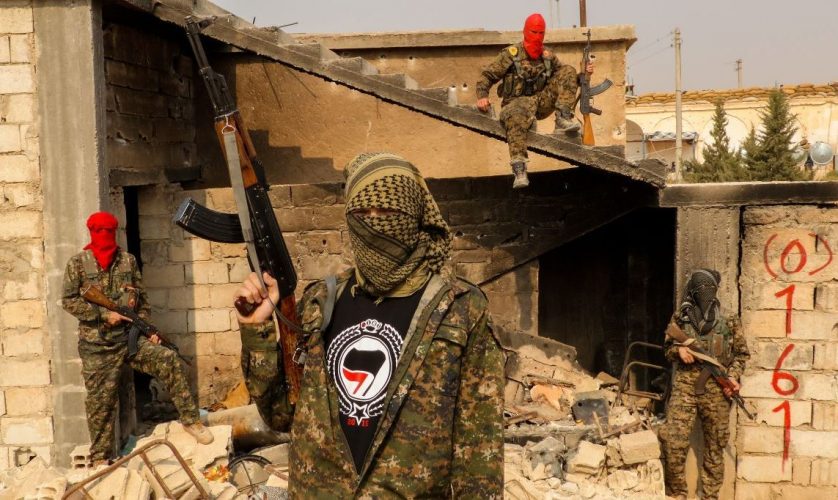
US weapons worth some $715 million dollars were warehoused poorly and soldiers handling them did not keep receipts or records, so it’s impossible to tell how many, if any, ended up in wrong hands, the Pentagon says.
Supply units in Kuwait and elsewhere “did not maintain comprehensive lists of all equipment purchased and received” or “stored weapons outside in metal shipping containers, exposing the equipment to harsh environmental elements, such as heat and humidity.”
This is according to the partially redacted report by the Department of Defense’s inspector general (IG), of an audit into the “Counter Islamic State of Iraq and Syria Train and Equip Fund” (CTEF), dated February 13 and published this week.
That is not to say that $715 million worth of US weapons, intended for the Iraqi military and “Vetted Syrian Opposition” – as the euphemism for US-allied militia goes – has gone missing, as some reports may have suggested. In Pentagon-speak, there was “a lack of a central repository for accountability documentation.” Once you cut through the obtuse verbiage, the IG report basically says there’s no way of figuring any of that out, because the troops charged with running the program did not maintain records or receipts.
The audit was commissioned because the DOD has requested $173.2 million for weapons, ammunition, vehicles, and other CTEF-S equipment for the current fiscal year, which began in October. Without accurate records, the Pentagon risks buying stuff it doesn’t need and “further overcrowding” the warehouses in Kuwait, which is what caused the pricey hardware to be stored outside in the first place.
Even though the Trump administration declared Islamic State (IS, formerly ISIS) defeated back in March 2019, ensuring the “enduring defeat” of the terrorists apparently requires that the weapons and equipment must flow. While the US taxpayers don’t have a choice in footing the bill, expecting them to swallow the explanation – that their noble men and women in uniform are just too stupid, lazy or incompetent to keep a ledger – sounds a bit rich.
Washington has a notoriously spotty record of pouring weapons into Syria and Iraq. At one point in 2015, the Pentagon admitted the failure of its program to train and equip “Vetted Syrian Opposition” (also known as “moderate rebels”). Having spent $2 million per fighter, the US saw them defect to the Al-Qaeda affiliate group Al-Nusra, bringing the US-supplied weapons and kit along.
So the Pentagon doubled down in 2016, spending untold millions to train “dozens” of rebels in Turkey. It is unclear how many of those “moderates” took part in last year’s assault on areas held by US-allied Kurdish militias.
As late as September 2016, Al-Nusra commanders openly talked about getting US weapons, both “directly” and via third countries, such as Saudi Arabia. The Syrian government has since dealt the militants one defeat after another, and currently advances on their last remaining strongholds in the Idlib province.
While the US government and media have objected to these operations – and NATO member Turkey actually sent troops and tanks to Idlib in an attempt to halt them – a spokesman for the anti-IS coalition has just openly admitted Idlib is a nest of terrorists.
Explaining Syria
It’s everyone’s fault except the U.S. and Israel
By Philip Giraldi • Unz Review • February 18, 2020
The first week in February was memorable for the failed impeachment of President Donald Trump, the “re-elect me” State of the Union address and the marketing of a new line of underwear by Kim Kardashian. Given all of the excitement, it was easy to miss a special State Department press briefing by Ambassador James Jeffrey held on February 5th regarding the current situation in Syria.
Jeffrey is the United States Special Representative for Syria Engagement and the Special Envoy for the Global Coalition to Defeat ISIL. Jeffrey has had a distinguished career in government service, attaining senior level State Department positions under both Democratic and Republican presidents. He has served as U.S. Ambassador to both Turkey and Iraq. He is, generally speaking, a hardliner politically, closely aligned with Israel and regarding Iran as a hostile destabilizing force in the Middle East region. He was between 2013 and 2018 Philip Solondz distinguished fellow at the Washington Institute for Near East Policy (WINEP), a think tank that is a spin-off of the American Israel Public Affairs Committee (AIPAC). He is currently a WINEP “Outside Author” and go-to “expert.”
Professor John Mearsheimer of the University of Chicago and Stephen Walt, academic dean at Harvard University’s Kennedy School of Government, describe WINEP as “part of the core” of the Israel Lobby in the U.S. They examined the group on pages 175-6 in their groundbreaking book The Israel Lobby and US Foreign Policy and concluded as follows:
“Although WINEP plays down its links to Israel and claims that it provides a ‘balanced and realistic’ perspective on Middle East issues, this is not the case. In fact, WINEP is funded and run by individuals who are deeply committed to advancing Israel’s agenda … Many of its personnel are genuine scholars or experienced former officials, but they are hardly neutral observers on most Middle East issues and there is little diversity of views within WINEP’s ranks.”
In early 2018 Jeffrey co-authored a WINEP special report on Syria which urged “…the Trump administration [to] couple a no-fly/no-drive zone and a small residual ground presence in the northeast with intensified sanctions against the Assad regime’s Iranian patron. In doing so, Washington can support local efforts to stabilize the area, encourage Gulf partners to ‘put skin in the game, drive a wedge between Moscow and Tehran, and help Israel avoid all-out war.”
Note the focus on Iran and Russia as threats and the referral to Assad and his government as a “regime.” And the U.S. presence is to “help Israel.” So we have Ambassador James Jeffrey leading the charge on Syria, from an Israeli perspective that is no doubt compatible with the White House view, which explains why he has become Special Representative for Syria Engagement.
Jeffrey set the tone for his term of office shortly after being appointed by President Trump back in August 2018 when he argued that the Syrian terrorists were “. . . not terrorists, but people fighting a civil war against a brutal dictator.” Jeffrey, who must have somehow missed a lot of the head chopping and rape going on, subsequently traveled to the Middle East and stopped off in Israel to meet Prime Minister Benjamin Netanyahu. It has been suggested that Jeffrey received his marching orders during the visit.
Two months later James Jeffrey declared that he would like to see Russia maintain a “permissive approach” to allow the Israelis to attack Iranian targets inside Syria. Regarding Iran’s possible future role in Syria he observed that “Iranians are part of the problem not part of the solution.”
What Jeffrey meant was that because Israel had been “allowed” to carry out hundreds of air attacks in Syria ostensibly directed against Iran-linked targets, the practice should be permitted to continue. Israel had suspended nearly all of its airstrikes in the wake of the shoot down of a Russian aircraft in September 2018, an incident which was caused by a deliberate Israeli maneuver that brought down the plane even though the missile that struck the aircraft was fired by Syria. Fifteen Russian servicemen were killed. Israel reportedly was deliberately using the Russian plane to mask the presence of its own attacking aircraft.
Russia responded to the incident by deploying advanced S-300 anti-aircraft systems to Syria, which can cover most of the more heavily developed areas of the country. Jeffrey was unhappy with that decision, saying “We are concerned very much about the S-300 system being deployed to Syria. The issue is at the detail level. Who will control it? what role will it play?” And he defended his own patently absurd urging that Russia, Syria’s ally, permit Israel to continue its air attacks by saying “We understand the existential interest and we support Israel” because the Israeli government has an “existential interest in blocking Iran from deploying long-range power projection systems such as surface-to-surface missiles.”
Later in November 2018 James Jeffrey was at it again, declaring that U.S. troops will not leave Syria before guaranteeing the “enduring defeated” of ISIS, but he perversely put the onus on Syria and Iran, saying that “We also think that you cannot have an enduring defeat of ISIS until you have fundamental change in the Syrian regime and fundamental change in Iran’s role in Syria, which contributed greatly to the rise of ISIS in the first place in 2013, 2014.”
As virtually no one but Jeffrey and the Israeli government actually believes that Damascus and Tehran were responsible for creating ISIS, the ambassador elaborated, blaming President Bashar al-Assad for the cycle of violence in Syria that, he claimed, allowed the development of the terrorist group in both Syria and neighboring Iraq.
He said “The Syrian regime produced ISIS. The elements of ISIS in the hundreds, probably, saw an opportunity in the total breakdown of civil society and of the upsurge of violence as the population rose up against the Assad regime, and the Assad regime, rather than try to negotiate or try to find any kind of solution, unleashed massive violence against its own population.”
Jeffrey’s formula is just another recycling of the myth that the Syrian opposition consisted of good folks who wanted to establish democracy in the country. In reality, it incorporated terrorist elements right from the beginning and groups like ISIS and the al-Qaeda affiliates rapidly assumed control of the violence. That Jeffrey should be so ignorant or blinded by his own presumptions to be unaware of that is astonishing. It is also interesting to note that he makes no mention of the U.S. invasion of Iraq, kneejerk support for Israel and the unrelenting pressure on Syria starting with the Syrian Accountability Act of 2003 and continuing with embrace of the so-called Arab Spring. Most observers believe that those actions were major contributors to the rise of ISIS.
Jeffrey’s unflinching embrace of the Israeli and hardline Washington assessment of the Syrian crisis comes as no surprise given his pedigree, but in the same interview where he pounded Iran and Syria he asserted oddly that “We’re not about regime change. We’re about a change in the behavior of a government and of a state.”
Some of James Jeffrey’s comments at last week’s press conference are similarly illuminating. Much of what he said concerned the mechanics of relationships with the Russians and Turks, but he also discussed some core issues relating to Washington’s perspective on the conflict. Many of his comments were very similar to what he said when he was appointed in 2018.
Jeffrey expressed concern over the thousands of al-Nusra terrorists holed up in besieged Idlib province, saying “We’re very, very worried about this. First of all, the significance of Idlib – that’s where we’ve had chemical weapons attacks in the past… And we’re seeing not just the Russians but the Iranians and Hizballah actively involved in supporting the Syrian offensive… You see the problems right now in Idlib. This is a dangerous conflict. It needs to be brought to an end. Russia needs to change its policies.”
He elaborated, “We’re not asking for regime change per se, we’re not asking for the Russians to leave, we’re asking…Syria to behave as a normal, decent country that doesn’t force half its population to flee, doesn’t use chemical weapons dozens of times against its own civilians, doesn’t drop barrel bombs, doesn’t create a refugee crisis that almost toppled governments in Europe, does not allow terrorists such as HTS and particularly Daesh/ISIS emerge and flourish in much of Syria. Those are the things that that regime has done, and the international community cannot accept that.”
Well, one has to conclude that James Jeffrey is possibly completely delusional. The core issue that the United States is in Syria illegally as a proxy for Israel and Saudi Arabia is not touched on, nor the criminal role in “protecting the oil fields” and stealing their production, which he mentions but does not explain. Nor the issue of the legitimate Syrian government seeking to recover its territory against groups that most everyone admits to be terrorists.
Virtually every bit of “evidence” that Jeffrey cites is either false or inflated, to include the claim of use of chemical weapons and the responsibility for the refugees. As for who actually created the terrorists, that honor goes to the United States, which accomplished that when it invaded Iraq and destroyed its government before following up by undermining Syria. And, by the way, someone should point out to Jeffrey that Russia and Iran are in Syria as allies of its legitimate government.
Ambassador James Jeffrey maintains that “Russia needs to change its policies.” That is not correct. It is the United States that must change its policies by getting out of Syria and Iraq for starters while also stopping the deference to feckless “allies” Israel and Saudi Arabia that has produced a debilitating cold war against both Iran and Russia. Another good first step to make the U.S. a “normal, decent country” would be to get rid of the advice of people like James Jeffrey.
Philip M. Giraldi, Ph.D., is Executive Director of the Council for the National Interest, a 501(c)3 tax deductible educational foundation (Federal ID Number #52-1739023) that seeks a more interests-based U.S. foreign policy in the Middle East. Website is councilforthenationalinterest.org, address is P.O. Box 2157, Purcellville VA 20134 and its email is inform@cnionline.org.
More Lies on Iran: The White House Just Can’t Help Itself as New Facts Emerge
By Philip Giraldi | Strategic Culture Foundation | February 13, 2020
Admittedly the news cycle in the United States seldom runs longer than twenty-four hours, but that should not serve as an excuse when a major story that contradicts what the Trump Administration has been claiming appears and suddenly dies. The public that actually follows the news might recall a little more than one month ago the United States assassinated a senior Iranian official named Qassem Soleimani. Openly killing someone in the government of a country with which one is not at war is, to say the least, unusual, particularly when the crime is carried out in yet another country with which both the perpetrator and the victim have friendly relations. The justification provided by Secretary of State Mike Pompeo, speaking for the administration, was that Soleimani was in Iraq planning an “imminent” mass killing of Americans, for which no additional evidence was provided at that time or since.
It soon emerged that the Iranian was in fact in Baghdad to discuss with the Iraqi Prime Minister Adel Abdul Mahdi a plan that might lead to the de-escalation of the ongoing conflict between Saudi Arabia and Iran, a meeting that the White House apparently knew about and may even have approved. If that is so, events as they unfolded suggest that the U.S. government might have encouraged Soleimani to make his trip so he could be set up and killed. Donald Trump later dismissed the lack of any corroboration of the tale of “imminent threat” being peddled by Pompeo, stating that it didn’t really matter as Soleimani was a terrorist who deserved to die.
The incident that started the killing cycle that eventually included Soleimani consisted of a December 27th attack on a U.S. base in Iraq in which four American soldiers and two Iraqis were wounded while one U.S. contractor, an Iraqi-born translator, was killed. The United States immediately blamed Iran, claiming that it had been carried out by an Iranian supported Shi’ite militia called Kata’ib Hezbollah. It provided no evidence for that claim and retaliated by striking a Kata’ib base, killing 25 Iraqis who were in the field fighting the remnants of Islamic State (IS). The militiamen had been incorporated into the Iraqi Army and this disproportionate response led to riots outside the U.S. Embassy in Baghdad, which were also blamed on Iran by the U.S. There then followed the assassinations of Soleimani and nine senior Iraqi militia officers. Iran retaliated when it fired missiles at American forces, injuring more than one hundred soldiers, and then mistakenly shot down a passenger jet, killing an additional 176 people. As a consequence due to the killing by the U.S. of 34 Iraqis in the two incidents, the Iraqi Parliament also voted to expel all American troops.
It now appears that the original death of the American contractor that sparked the tit-for-tat conflict was not carried out by Kata’ib Hezbollah at all. An Iraqi Army investigative team has gathered convincing evidence that it was an attack staged by Islamic State. In fact, the Iraqi government has demonstrated that Kata’ib Hezbollah has had no presence in Kirkuk province, where the attack took place, since 2014. It is a heavily Sunni area where Shi’a are not welcome and is instead relatively hospitable to all-Sunni IS. It was, in fact, one of the original breeding grounds for what was to become ISIS.
This new development was reported in the New York Times in an article that was headlined “Was U.S. Wrong About Attack That Nearly Started a War With Iran? Iraqi military and intelligence officials have raised doubts about who fired the rockets that started a dangerous spiral of events.” In spite of the sensational nature of the report it generally was ignored in television news and in other mainstream media outlets, letting the Trump administration get away with yet another big lie, one that could easily have led to a war with Iran.
Iraqi investigators found and identified the abandoned white Kia pickup with an improvised Katyusha rocket launcher in the vehicle’s bed that was used to stage the attack. It was discovered down a desert road within range of the K-1 joint Iraqi-American base that was hit by at least ten missiles in December, most of which struck the American area.
There is no direct evidence tying the attack to any particular party and the improvised Kia truck is used by all sides in the regional fighting, but the Iraqi officials point to the undisputed fact that it was the Islamic State that had carried out three separate attacks near the base over the 10 days preceding December 27th. And there are reports that IS has been increasingly active in Kirkuk Province during the past year, carrying out near daily attacks with improvised roadside bombs and ambushes using small arms. There had, in fact, been reports from Iraqi intelligence that were shared with the American command warning that there might be an IS attack on K-1 itself, which is an Iraqi air base in that is shared with U.S. forces.
The intelligence on the attack has been shared with American investigators, who have also examined the pick-up truck. The Times reports that the U.S. command in Iraq continue to insist that the attack was carried out by Kata’ib based on information, including claimed communications intercepts, that it refuses to make public. The U.S. forces may not have shared the intelligence they have with the Iraqis due to concerns that it would be leaked to Iran, but senior Iraqi military officers are nevertheless perplexed by the reticence to confide in an ally.
If the Iraqi investigation of the facts around the December attack on K-1 is reliable, the Donald Trump administration’s reckless actions in Iraq in late December and early January cannot be justified. Worse still, it would appear that the White House was looking for an excuse to attack and kill a senior Iranian official to send some kind of message, a provocation that could easily have resulted in a war that would benefit no one. To be sure, the Trump administration has lied about developments in the Middle East so many times that it can no longer be trusted. Unfortunately, demanding any accountability from the Trump team would require a Congress that is willing to shoulder its responsibility for truth in government backed up by a media that is willing to take on an administration that regularly punishes anyone or any entity that dares to challenge it. That is the unfortunate reality in America today.
Scuffle Between Syrian Civilians and US Soldiers Reflects Increasing Hostility to US Troops
By Whitney Webb | MintPress News | February 12, 2020
As resistance to U.S. troop presence in both Iraq and Syria gains steam, a rare scuffle between Syrian civilians and U.S. forces broke out on Wednesday resulting in the death of one Syrian, believed to be a civilian, and the wounding of another. A U.S. soldier was also reportedly injured in the scuffle. The event is likely to escalate tensions, particularly in the Northeastern region where the incident took place, as Syria, Iraq and Iran have pushed for an end to the U.S. troop presence in the region following the killing of Iranian General Qassem Soleimani.
The clash between U.S. forces and Syrian locals took place near the town of Qamishli where the U.S. forces were conducting a patrol that, for reasons that are still unclear, entered into territory controlled by the Syrian government instead of territory occupied by the U.S. and its regional proxy, the Syrian Democratic Forces (SDF). At a Syrian military checkpoint, the U.S. patrol was met by Syrian civilians of a nearby village who gathered at the checkpoint and began throwing rocks at the U.S. convoy. Then, one Syrian took a U.S. flag off of one of the military vehicles.
Reports from activists on the ground and Syrian media then claim that U.S. troops opened fire using live ammunition and fired smoke bombs at the angry residents, killing one and wounding another. A U.S. soldier was said to have received a superficial wound, though the nature of the wound was not specified. After the scuffle, the protests grew larger, preventing more U.S. troops from arriving at the scene. In one video of the protests, a local was seen ripping a U.S. flag as he approached an American soldier.
The obstruction of the road prevented the U.S. patrol from advancing and two military vehicles had to be towed after becoming stuck in the grass after an apparent attempt to circumvent the roadblock created by the Syrian military checkpoint and supportive Syrian civilians.
A U.S. military spokesman claimed that the convoy encountered “small-arms fire” from “unknown individuals” and further asserted that “In self-defense, coalition troops returned fire… The situation was de-escalated and is under investigation.” However, critics have pointed out that the U.S. military occupation of Syria is illegal under international law and thus does not afford the U.S. military the ability to act in “self-defense” due to its status as an occupier.
The Syrian Observatory for Human Rights stated in its report on the incident that the situation was de-escalated following the appearance of a Russian military convoy and asserted that the “small-arms fire” was from pro-government militia members who fired into the air near the convoy. The incident also resulted in a few reports of U.S. coalition airstrikes on the village that occurred after the scuffle. However, both Syrian military sources and the U.S. military have denied that airstrikes took place in the area.
Fallout from Soleimani assassination grows
Though the incident in Qamishli is a rare occurrence, as nearly all media reports have pointed out, it is likely a harbinger of the region-wide push that has seen countries like Syria and Iraq take a firmer posture towards the presence American forces in their countries following the assassination of Iranian general Qassem Soleimani in January.
At the time of his death, Soleimani, serving in a diplomatic capacity, had traveled to Baghdad in a civilian aircraft and was due to meet Iraq’s Prime Minister to discuss efforts to de-escalate regional tensions and promote Iraqi sovereignty at the time of his death. A well-known Iraqi militia leader, Abu Mahdi Al-Muhandis, who many Iraqis credit with defeating Daesh (ISIS) in Iraq was also killed in the strike. Following the controversial killing of Soleimani by the United States, Iran vowed that it would seek to expel U.S. troops from the region, particularly Syria and Iraq, in retribution, among other measures.
Since Soleimani was killed, the presence of U.S. troops in both Syria and Iraq has been under increasing pressure from locals, particularly in Iraq, where millions of Iraqis recently marched in support of a full U.S. withdrawal from the country.
In Syria, where U.S. troops are occupying territory and specifically oil fields in violation of international law, local tensions with U.S. forces have also been exacerbated by recent events, as Wednesday’s incident in Qamishli clearly shows.
In Iraq, the push to expel U.S. troops has recently spurred reports that have claimed that the withdrawal of U.S. troops from several military installations in Iraq has already begun, according to the chair of Iraq’s parliamentary defense committee, Badr Al-Ziyadi. However, the Pentagon has disputed these reports and has claimed that the U.S. is still actively working with Iraq’s military to fight Daesh. In Syria, both domestic and international law considers the U.S.’ military presence in the country to be that of an illegal occupier.
Notably, both the reports of the U.S. quietly leaving Iraq and the recent incident in Qamishli, Syria follow comments from Iran’s chief foreign policy advisor, Ali Akbar Velayati, that the U.S.’ military presence in both Syria and Iraq would end very soon and specifically cited Soleimani’s assassination as the impetus for their allegedly imminent departure.
Whitney Webb is a MintPress News journalist based in Chile. She has contributed to several independent media outlets including Global Research, EcoWatch, the Ron Paul Institute and 21st Century Wire, among others. She has made several radio and television appearances and is the 2019 winner of the Serena Shim Award for Uncompromised Integrity in Journalism.
Russian oil & gas firms plan to invest $20 BILLION in Iraq’s energy industry
RT | February 11, 2020
Russian oil and gas companies could triple their investments in Iraq in the near future, Yury Fyodorov, first deputy chairman of the Economic Policy Committee at the Russian Federation Council, has announced.
The companies may spend up to $20 billion on oil projects in Iraq, Fyodorov said at a meeting with Iraqi Ambassador to Russia Abdul-Rahman Al-Husseini, according to Russian media.
“Today, our leading oil and gas companies such as Lukoil, Bashneft, Gazprom Neft are actively working in your country. The total investment has exceeded $10 billion,” the official said on Monday. He added that other companies, such as Zarubezhneft, Tatneft, and Rosneftegaz are also interested in working in Iraq.
“We are exploring the possibility of diversifying the activities of Russian operators, in particular by connecting them to the gas sector. According to preliminary forecasts, this could triple our companies’ investment.”
Last year, Russia and Iraq resumed cooperation in energy infrastructure, and in the electricity sector in particular. Some Russian firms could help Baghdad with the restoration and development of electric power facilities, while negotiations are under way over the construction of thermal power plants using the assistance of Russian companies.
Iraq’s proven oil reserves stand at over 145 billion barrels, while gas reserves exceed 3.7 trillion cubic meters.
NYT: ‘Iran-Backed Militia’ Attack That Provoked Soleimani Killing Was Possible ISIS False Flag
By Tyler Durden – Zero Hedge – 02/06/2020
The initial major rationale and justification the US administration offered for the drone assassination of IRGC Gen. Qassem Soleimani and commander of Iraq’s Popular Mobilization Forces Abu Mahdi al-Muhandis was the Dec. 27 rocket attack on K1 camp in Kirkuk, which houses coalition forces.
That attack involving surface-to-surface missile strikes killed an American contractor and reportedly wounded several US troops. Washington immediately blamed the Iran-backed Iraqi paramilitary group Khataib Hezbollah, with Mike Pompeo saying of the attack: “We will not stand for the Islamic Republic of Iran to take actions that put American men and women in jeopardy,” after he briefed President Trump. But top Iraqi military and intelligence officials are now calling this entire narrative into question.
A new lengthy New York Times investigative report cites multiple top Iraqi officials who go on record to say of their analysis of the Dec.27 Kirkuk incident: “These facts all point to the Islamic State, Iraqi officials say.”
The Pentagon says it has evidence decisively pinning it on Khataib Hezbollah, known for its closeness to Tehran; however, the paramilitary group itself has denied that it was behind the operation. US officials have from the start been scant on details and have not made public any evidence or intelligence.
This led some analysts in the days after the attack to question whether ISIS cells, still known to be active in the area, might have been behind it — given also it would be to the Sunni terrorist group’s benefit to sow a major rift between US and local Iraqi Shia forces, which is precisely what happened (Trump has recently gone so far as to threaten “very big sanctions” on Baghdad if US forces are kicked out). Alternately the White House perhaps appeared ready to manufacture a justification to take out Soleimani.
Further, as detailed in the Times report, the white Kia pick-up from which the rockets were launched was found near a known ISIS execution site, in a heavily Sunni area not known to have had a Shia paramilitary presence since 2014:
But Iraqi military and intelligence officials have raised doubts about who fired the rockets that started the spiral of events, saying they believe it is unlikely that the militia the United States blamed for the attack, Khataib Hezbollah, carried it out.
… Iraqi officials say their doubts are based on circumstantial evidence and long experience in the area where the attack took place.
The rockets were launched from a Sunni Muslim part of Kirkuk Province notorious for attacks by the Islamic State, a Sunni terrorist group, which would have made the area hostile territory for a Shiite militia like Khataib Hezbollah.
Khataib Hezbollah has not had a presence in Kirkuk Province since 2014.
The Islamic State, however, had carried out three attacks relatively close to the base in the 10 days before the attack on K-1. Iraqi intelligence officials sent reports to the Americans in November and December warning that ISIS intended to target K-1, an Iraqi air base in Kirkuk Province that is also used by American forces.
And the abandoned Kia pickup was found was less than 1,000 feet from the site of an ISIS execution in September of five Shiite buffalo herders.
The NYT further says this single event set off “a chain of events that brought the United States and Iran to the brink of war” which President Trump confided at a private luncheon this week was “closer than you thought”.
Brig. General Ahmed Adnan, the Iraqi chief of intelligence for the federal police at K-1, told the NYT : “All the indications are that it was Daesh.” He said further: “I told you about the three incidents in the days just before in the area — we know Daesh’s movements.”
“We as Iraqi forces cannot even come to this area unless we have a large force because it is not secure. How could it be that someone who doesn’t know the area could come here and find that firing position and launch an attack?” he questioned.
Anonymous US officials, however, claim that evidence from within the Kia pickup points to Khataib Hezbollah, and also cited “multiple strains of intelligence” though without making it known.
Interestingly, amid a general breakdown in trust between Baghdad and Washington, a top Iraqi general has said the US side hasn’t even shared its claimed evidence that Khataib Hezbollah was behind the Kirkuk attack:
“We have requested the American side to share with us any information, any evidence, but they have not sent us any information,” Lt. Gen. Muhammad al-Bayati, the chief of staff for former Prime Minister Adel Abdul Mahdi, said in an interview.
The director general of Iraqi Intelligence and Counterterrorism, Abu Ali al-Basri, said the United States did not consult Iraq before carrying out the Dec. 29 counterattacks on Khataib Hezbollah.
“They did not ask for my analysis of what happened in Kirkuk and neither did they share any of their information,” he said. “Usually, they would do both.”
The bombshell NYT report further collects eyewitness accounts and other Iraqi official statements, all of which strongly suggests the chain of events which led to Soleimani’s Jan. 3 killing, which in turn led to an Iranian ‘revenge’ attack with ballistic missiles on Ain al-Asad Air Base, wounding scores of troops (we later found out as part of an ever growing number of solders with ‘Traumatic Brain Injury’ from the blasts), was a possible ‘false flag’ event undertaken by ISIS meant to be pinned on the Islamic State’s Shia enemies backed by Iran.
US uneasy as Iraq gets new prime minister
By M. K. BHADRAKUMAR | Indian Punchline | February 5, 2020
In happier times, Washington and Tehran might well have zeroed in on Mohammed Tawfik Allawi as their consensus candidate for the post of Iraq’s prime minister.
Why not? He was opposed to Saddam Hussein’s dictatorship — although, unlike most Shia politicians who fled from Saddam’s tyranny, he never lived in Iran but chose UK.
However, unlike his famous (notorious) cousin Iyad Allawi who also lived in exile in the UK and whom the US handpicked to head the first government during its occupation (2004-2005), Mohammed Allawi didn’t work for the western intelligence.
Even detractors dare not say that he ever was on Tehran’s payroll. In fact, he wasn’t — unlike another famous relative Ahmed Chalabi.
Yet, although part of Iraqi Shia aristocracy, he was sensible enough as an aspiring Iraqi politician to have good rapport with Iran.
Mohammed Allawi is said to be deeply religious and yet is secular-minded. He twice resigned from former Prime Minister Nouri al-Maliki’s cabinet protesting against the latter’s “sectarian agenda and political interference”.
There is no conceivable reason why the US cannot be happy that Iran has failed at this crucial juncture in regional politics to insert an ‘yes man’ as the head of the new government in Baghdad.
But prioritising Iraq’s stability more than anything else, Tehran welcomed Mohammed Allawai’s appointment. On the contrary, even after five days since President Barham Salih gave him the appointment letter, Washington is holding back.
American think tankers wired into the US establishment have run down Mohammed Allawi as a mere frontman of Moqtada Al Sadr’s Sairoon coalition and its rival, the Fatah alliance led by Hadi Al Amiri. They anticipate that he is doomed to fail.
The heart of the matter is that there is much angst in the American mind that Mohammed Allawi, once confirmed as prime minister by the Iraqi parliament, may not only restructure US-Iraqi relations, but eventually take the winds out of the sails of the so-called protests whom Washington and its regional allies have inserted since October into the Iraqi body polity as an extra-constitutional centre.
Today, the US’ capacity to influence the Iraqi political elite — a vast unwieldy network of politicians, Shia political parties, security forces, militias, and religious figures that make up Iraq’s muhasasa (sectarian power-sharing) political system — stands much diminished. Clawing its way back up the greasy pole is difficult.
Thus, the protest movement in Iraq, which is now entering its fourth month, has come to be the principal instrument for Washington (and its Saudi and Emirati allies) to surreptiously advance the broader geopolitical confrontation with Iran that is being played out within the country.
The Iraqi protest movement bears striking similarity with Hong Kong’s, which too had brought the local government down on its knees. In Iraq too, it is a remarkably young movement made up almost entirely of adolescents or youth below the age of 25 and a significant female participation.
The movement has an inchoate programme that keeps mutating — ranging from electoral reforms to eradication of corruption — amidst the artistic graffiti, rap videos, and citizen journalism as modes of political activism and civic engagement.
The Iraqi protest movement too has no unified leadership and yet through its abstract calls for the removal of the current political elite it has worked to insert itself as a factor in the decision-making over the prime minister’s nomination. Some hidden forces are evidently pulling the strings from behind, as in Hong Kong.
The outgoing Iraqi prime minister Adel Abdul-Mahdi bitterly complained in the Iraqi parliament on January 5 that in two telephone conversations, the US President Donald Trump had threatened him with precisely such protests to overthrow him if he didn’t comply with US demands.
POTUS allegedly threatened to position US marine snipers “atop the highest buildings,” who will target and kill protesters and security forces alike in an attempt to pressure the Prime Minister.
Therefore, it is hugely significant that the Iraqi protestors have rejected Mohammed Allawi’s appointment. Iraq is now at a political impasse. In essence, Washington will do everything in its power to prevent the new government from settling in.
In Hong Kong, the turmoil began subsiding once the US-China trade deal was signed. In Iraq, everything depends on the negotiation of the terms of engagement with the US. The amorphous nature of the protest movement means that it may meet with sudden death as well.
The Trump administration hopes to salvage relations with Baghdad and smother the Iraqi demand for American troop withdrawal. The top US commander in the Middle East Gen. Frank McKenzie visited Baghdad on Tuesday to set the ball rolling.
In a longer perspective, US hopes that the Sadrists could be exploited as a powerful driver of placing the Iran-backed Popular Mobilisation Force (PMF) structure under real controls of the government.
But there’s a caveat. As a seasoned American analyst puts it, “Moqtada also believes he has a role to play as a ‘guide’ focused on ‘social justice’… While unlikely to be a ruler in the mould of Iran’s Supreme Leader Ayatollah Ali Khamenei, Moqtada is also unlikely to be a ‘quietist’ cleric in the style of Sistani. Something in-between is more likely, raising parallels with Hezbollah’s Hassan Nasrallah. This is not a comparison that should reassure (Washington).”
In fact, on Tuesday, Sadr supporters took control of the iconic Tahir Square building in Baghdad and evicted the protestors ensconced there.
The bottom line is that although the level of emotion in the Sadrist discourse about American forces in Iraq is no more acute as it used to be a decade ago, it still remains a deeply held conviction of the movement, from Moqtada himself to the militant cadres, that the presence of foreign military forces should not become a proforma reality of Iraqi life.
An Unusual Lawsuit against Iran
By Jacob G. Hornberger | FFF | January 28, 2020
The Washington Post recently published an article about a lawsuit that American citizens have brought against Iran. The plaintiffs are Iraq veterans and families of veterans who suffered horrendous injuries or deaths while serving in the U.S. armed forces in Iraq. In their lawsuit, the plaintiffs are claiming that Iran sent roadside bombs into Iraq that wreaked massive injuries or death on U.S. troops.
For example, Chris Levi’s Humvee was torn apart by a roadside bomb that cost him both his legs. Kelli Hake and her 13-year-old son are living their lives without their husband and father, who was killed by a roadside bomb in Iraq. There were thousands more like them.
It stands to reason that the plaintiffs would feel deep anger toward Iran, especially given their belief that Iran did, in fact, furnish the bombs that ended up inflicting death and injuries on U.S. soldiers serving in Iraq.
What is unusual, however, is that there appears to be absolutely no animus directed toward another regime. That regime is the U.S. government. I find the lack of ill will toward the U.S. government to be totally bizarre.
After all, let’s not forget something important: When a nation-state invades, attacks, and occupies a country and in the process intentionally wreaks death, suffering, and destruction, there is a very high probability that people are going to get extremely angry and are going to exact vengeance by doing the same thing to the invading and occupying troops.
We should keep in mind that the U.S. war on Iraq was illegal under our form of government. That’s because the U.S. Constitution, which is the higher law that we the people have imposed on the federal government, prohibits the president from waging war without a declaration of war from Congress. It is undisputed that Congress never declared war on Iraq.
The U.S. war on Iraq was also illegal under the principles set forth by the Nuremberg War Crimes Tribunal. It held that nation-states do not have the authority to invade and attack other nations.
Nonetheless, knowing that an invasion and occupation would be illegal under both the Constitution and the principles set forth at Nuremberg, the Pentagon ordered U.S. forces to invade and occupy the country, knowing full well that many of them would be killed, maimed, or injured in the process.
Did an illegal U.S. war of aggression against Iraq justify intervention by Iran to help Iraqis throw U.S. occupying forces out of the country? Of course not. Nonetheless, everyone knows — or should know — that when one nation illegally attacks and occupies another nation, there is a high likelihood that other nation-states are going to come to the assistance of the invaded and occupied country. That’s just the way the world works.
Consider, for example, when it was the Soviet Union, rather than the United States, that was the invader and occupier in Afghanistan. Guess who came to the assistance of the Afghans who were fighting to evict the Soviets from their country. That’s right — the U.S. government. It provided weaponry, including missiles, that was used to kill, maim, and injure Soviet soldiers. U.S. intervention wasn’t right, but that’s the way the world works.
What if those Soviet soldiers had sued the U.S. government for damages for the deaths and injuries caused by U.S.-supplied weaponry? There is not one court in the United States that would permit such a lawsuit to proceed. Unlike the lawsuit against Iran, a lawsuit by Soviet citizens against the U.S. government would be summarily dismissed.
If U.S. officials hadn’t ordered U.S. troops to invade and occupy Iraq, there never would have been any U.S. soldiers killed, maimed, or injured by anyone. Why shouldn’t the U.S. government be joined as a defendant in that lawsuit against Iran? If the Iranian government isn’t immune from liability, why should the U.S. government be immune from liability? Why are the plaintiffs giving their own government a pass, both legally and morally?
A Million Iraqis Asked Us to Leave. We Should Listen.

By Ron Paul | January 27, 2020
You wouldn’t know it from US mainstream media reporting, but on Friday an estimated million Iraqis took to the streets to protest the continued US military presence in their country. What little mainstream media coverage the protest received all reported the number of protesters as far less than actually turned out. The Beltway elites are determined that Americans not know or understand just how much our presence in Iraq is not wanted.
The protesters were largely supporters of nationalist Shi’ite cleric Muqtada al-Sadr, who opposes both US and Iranian presence in Iraq. Protesters held signs demanding that the US military leave Iraq and protest leaders warned of consequences unless the US listen to the Iraqi people.
After President Trump’s illegal and foolish assassination of Iranian general Soleimani on Iraqi soil early this month, the Iraqi parliament voted unanimously to cancel the agreement under which the US military remains in Iraq. But when the Iraqi prime minister called up Secretary of State Mike Pompeo to request a timetable for a US withdrawal, Pompeo laughed in his face.
The US government answered the Iraqi parliament’s vote with a statement that the US military is a “force for good” in the Middle East and that because of the continuing fight against ISIS US troops will remain, even where they are not wanted.
How many billions of dollars have we sent to Iraq to help them build their democracy? Yet as soon as a decision of Iraq’s elected parliament goes against Washington’s wishes, the US government is no longer so interested in democracy. Do they think the Iraqis don’t notice this double-dealing?
The pressure for the US to leave Iraq has been building within the country, but the US government and mainstream media is completely – and dangerously – ignoring this sentiment. It’s one thing to push the neocon propaganda that Iraqis and Iranians would be celebrating in the streets after last month’s US assassination of Iranian general Soleimani, who was the chief strategist for the anti-ISIS operation over the past five years. It’s a completely different thing to believe the propaganda, especially as more than a million Iranians mourned the popular military leader.
The Friday protesters demanded that all US bases in Iraq be closed, all security agreements with the US and with US security companies be ended, and a schedule for the exit of all US forces be announced. Sadr announced that the resistance to the US troop presence in Iraq will halt temporarily if an orderly departure is announced and implemented. Otherwise, he said, the resistance to US troops would be activated.
A million Iraqi protesters chanted “no, no to occupation.” The Iraqi parliament voted for us to leave. The Iraqi prime minister asked us to leave. Maj. Gen. Alex Grynkewich, the US deputy commander in Iraq and Syria, said last week that US troops in Iraq are more threatened by Shi’ite militias than ISIS.
So, before more US troops die for nothing in Iraq, why don’t we listen to the Iraqi people and just come home? Let the people of the Middle East solve their own problems and let’s solve our problems at home.
Copyright © 2020 by RonPaul Institute
Featured Video
Iran spent $1 million to wipe out $30 billion in data center plans, and take down Amazon in the ME
or go to
Aletho News Archives – Video-Images
From the Archives
A short history of British torture
ICC | December 2005
When the House of Commons was debating how much to increase the time limit for detention without trial the question of torture came up. Officially this was limited to the nice considerations of whether it was all right to send people to places where torture is used and whether Britain can use information collected by the use of torture in other countries. This discussion gave an impression of democratic Britain as the home of civilised behaviour where the very idea of torture is repugnant to our legislators – unlike, say, the US with its secret CIA jails… In reality, the British state has a long history of using and developing a whole range of torture techniques. … continue
Blog Roll
 Aletho News
- Houthis Keep Advancing as the Red Sea Crisis Deepens
- Iran spent $1 million to wipe out $30 billion in data center plans, and take down Amazon in the ME
- Zionist billionaire pressure to silence Macklemore sparks exodus from Ed Sheeran tour
- House Votes to End Iran War for Third Time
- North Korea Slams US Plan for ‘AUKUS 2.0’ with South Korea and Japan
- Prolonging US-Iran Conflict Not Meeting Interests of Int’l Community – China’s Wang Yi
- EU bans former Zelensky aide from parliament
- NATO-backed Kosovo separatist ‘responsible for war crimes’
- US destroying international space law
- SCO Calls for Binding Global Deal to Prevent Arms Race in Space
- If Americans Knew
- U.S. Makes, Israel Takes: The Real Story of U.S.-Israeli Military Cooperation
- Night raids rise in Palestine
- Tucker Carlson interviews Norman Finkelstein about Gaza
- Groups urge Americans to support Van Hollen legislation on Israel’s killing of Americans & Palestinians
- Trump administration plans to send 40,000 tons of bombs to Israel: report
- Sanctions Target Iran’s Government, But Kill Hospitalized 23-Year-Old Woman
- An alternative view on the book “Israel’s Lobby: America in the Grip of a Foreign Power”
- Ed Sheeran’s band Beoga, other opening acts quit tour after Macklemore was dropped over his pro-Palestinian comments
- The assassination attempt on President Trump in Butler and the various Israeli connections to it
- “We Want That the Whole Land Be Jewish”
- No Tricks Zone
- New Study: ‘Global Drought Shows No Detectable Recent Acceleration Under Climate Warming’
- Economic Masterminds: German Socialists Suggest Taxing Productivity Gains Stemming From Using AI
- The South China Sea Has Not Been Cooperating With The Climate Change Narrative
- Energy Crisis: Germany Enters Heating Season With Historically Low Gas Reserve Fill Levels
- New Study: The Antarctic Ice Sheet Gained Mass From 2020-2024 Due To Staggering Snow And Ice Accumulation
- Study: Ocean Heating Rates From Thousands Of Years Ago ‘Dwarf’ Modern Ocean Heating Rates
- Climate Extremists Target, Attack Large-Scale Power Grid Infrastructure In Germany!
- New Study: Antarctic Ice Melt Has Contributed Less Than 1 Centimeter To Sea Level Rise In The Last 30 Years
- Fear Of Debate: Alarmist German Climate Scientist Calls On Mainstream Media To Discredit Skeptic Voices
- End-Of-August Arctic Sea Ice Extent Hasn’t Fallen In 20 Years, Official Data Show!
 Aletho News