Trump’s Katyusha Conundrum: Unguided Artillery Deployed by Iraqi Insurgents against US Occupation Forces
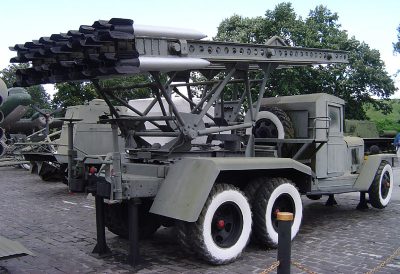
Katyusha launcher (Source: Wikimedia Commons)
By William Walter Kay | Global Research | January 23, 2020
Katyushas are short-range, unguided artillery rockets typically fired in salvos from truck-mounted launch-tubes. Iraq’s insurgents deploy three types.
The smallest is 107 millimetres in diameter and 1 metre long. Its 19 kilogram weight includes an 8 kg high-explosive, shrapnel-bearing warhead. The 107mm is often fired from a 12-tube launcher, however, infantry-portable single-tube tripods are common. An experienced crew with a standardised weapon can hit a 400 X 400 metre target from 8 kilometres away. During the Vietnam War the US Army considered the 107mm to be their adversaries’ most formidable weapon.
The 122mm ‘Grad’ Katyusha is 3 metres long and weighs 75 kg. Its warhead spans a third of its length and weighs 18 kg. It has a 20-kilometre range and a 30-metre lethal radius.
220mm Katyushas hurl 100 kg warheads 30 kilometres.
Katyushas have advantages over mortars. They deliver the same payload twice the distance and they fire multiple ordnance more rapidly. The globally ubiquitous BM-21 Grad fires forty 122mm rockets in three minutes. Reloading takes 10 minutes. Thus, Katyushas excel at “shoot-and-scoot” operations. As well, Katyushas’ flat trajectories permit line-of-sight attacks and their 700 metre-per-second velocities provide unique anti-building potential.
*
After [allegedly] helping suppress the ISIS-led insurgency (2014-17) US forces defaulted to their previous occupation plan. Central to this program are segregated compounds situated inside Iraqi Armed Forces bases. These installations, always near airstrips, contain mere hundreds (not thousands) of US and Coalition troops who ride herd over the Iraqi Army whilst grooming and directing Iraq’s 15,000-strong Special Forces.
Embassies and consulates are integral to the occupation. The sprawling US Embassy compound dominates Baghdad’s fortified “Green Zone” which also houses Coalition partners’ embassies, and the headquarters of the many NGOs insinuated throughout Iraqi society.
The occupation facilitates local activities of American and European businesses. These require office blocks, oil-field infrastructure; and, gated communities for imported talent.
Pre-2011 Americans relied on bases containing thousands of troops. These were remotely located and allocated substantial resources to thwart indirect (mortar and rocket) attacks through: counter-artillery, drone surveillance, and fighting patrols. Despite this, indirect fire inflicted 3,000 casualties (including 211 fatalities) on American forces; many occurring inside ‘secure’ bases.
The US-led Coalition’s current archipelago of military, diplomatic, intelligence, business and NGO installations are ill-equipped to defend themselves against indirect fire. Proximity to cities makes them sitting ducks.
*
In September 2018 persons unknown began targeting US installations with Katyushas. This list chronicles these attacks.* (A dozen mortar attacks are not listed; Katyushas being the weapon of choice.)
- September 8, 2018 – four rockets (three 107mms and one 122mm) fall near the Green Zone.
- September 8, 2018 – two salvos of 107mms land near the US Consulate beside Basra Airport.
- September 28, 2018 – three 107mms are fired at the Basra Consulate; two land on site.
- December 27, 2018 – two 107mms are fired at Al-Asad Airbase (160 kilometres west of Baghdad) during Trump’s visit.
- February 2, 2019 – an attack on Al-Asad Airbase is aborted. Three ready-to-launch 122mms are captured.
- February 12, 2019 – three 107mms hit Q-West Airfield (an off-the-books base south of Mosul).
- May 1, 2019 – two 107mms hit Camp Al-Taji: a ‘training’ institute, 40 kilometres north of Baghdad.
- May 19, 2019 – two rockets land near the US Embassy.
- June 10, 2019 – rocket attack on Camp Al-Taji.
- June 12, 2019 – rocket attack on a “northern air base” starts a fire.
- June 13, 2019 – rocket attack on Nineveh Command Headquarters (Mosul Presidential Palace).
- June 14, 2019 – a rocket lands near the US Embassy.
- June 17, 2019 – three rockets hit Camp Al-Taji.
- June 18, 2019 – Nineveh HQ is attacked by two 122mms; one hits, one misses.
- June 19, 2019 – rockets strike a gated community outside Basra (home to Exxon staff).
- September 23, 2019 – two rockets hit the Green Zone; one lands near the US Embassy.
- October 30, 2019 – two rockets hit the Green Zone, killing an Iraqi soldier.
- November 8, 2019 – seventeen rockets target Q-West Airfield.
- November 17, 2019 – rockets hit the Green Zone.
- November 29, 2019 – a rocket hits the Green Zone.
- December 3, 2019 – Al-Asad Airbase is “rocked” by five 122mms.
- December 5, 2019 – five 107mms hit Balad Airbase (80 kilometres north of Baghdad).
- December 6, 2019 – a 240mm rocket lands near Baghdad Airport (then housing a US base).
- December 9, 2019 – four 240mms strike Baghdad Airport killing 2, and wounding 5, Iraqi soldiers.
- December 11, 2019 – two 240mms land outside Baghdad Airport.
- December 27, 2019 – thirty-six 107mms hammer K1 Base (15 kilometres northwest of Kirkuk); killing an American translator and wounding several US troops.
- December 29, 2019 – four rockets hit Camp Al-Taji.
- December 29, 2019 – five rockets hit Al-Asad Airbase.
- January 4, 2020 – two rockets hit Balad Airbase.
- January 4, 2020 – several rockets hit the Green Zone. One lands near the US Embassy; another closes a major street.
- January 5, 2020 – six rockets are fired at the Green Zone; three hit the target.
- January 8, 2020 – two rockets hit the Green Zone.
- January 12, 2020 – eight rockets hit Balad Airbase, wounding several Iraqi soldiers.
- January 14, 2020 – a five-rocket attack on Camp Al-Taji.
- January 20, 2020 – three rockets hit Green Zone. They were fired from Al Zafraniya (15 kilometres away).
Attacks are becoming more frequent and are trending toward bigger rockets and higher volume salvos.
The insurgents’ strategy is working. Katyusha attacks shuttered the US Basra Consulate in September 2018. Attacks in May and June 2019 forced Exxon to evacuate much of its foreign staff. Throughout 2019 the US State Department extracted personnel and the Defense Department consolidated bases into more secure facilities. By late 2019 US authorities were begging Iraqis for help whilst threatening retaliation.
The last straw came December 27 when the barrage onto K1 Base killed an American translator. The US responded with airstrikes on five Kata’ib Hezbollah bases (90 casualties) and with the January 3 assassination of Iranian General Soleimani. (The decision to assassinate Soleimani – in the event of an American fatality – was made June 24, 2019 following a week of near daily Katyusha attacks.)
*
While Iran and Iran’s Iraqi allies are blamed for these attacks; this is dubious. Reportage following attacks invariably drops the phrase “no one claimed responsibility” – which is notable because perpetrators often boast of such achievements. Ten years ago, when Kata’ib Hezbollah targeted US facilities with “lob bombs” (improvised rockets), they posted videos of their handiwork. They deny involvement in these recent attacks as do other Iranian-linked militias.
The reportage often describes the attacks as “mysterious” or as a “whodunit.” Authors relay US intelligence theories of Iranian involvement … without evidence.
On several occasions insurgents abandoned launchers and/or launch vehicles after the attack, often with fail-to-launch rockets inside. Investigators also possess fragments of successfully fired rockets. Tellingly, US officials, renowned for straining at gnats for evidence of Iranian complicity, do not utilise this material to incriminate Tehran.
The launchers themselves are obviously manufactured by local artisans. Moreover, an article from Kurdistan–24 describes the rockets as “locally made.” Even globalist-militarist instrumentalities like the Washington Institute, Long War Journal, and Center for Strategic and International Studies concede some Katyushas are manufactured in Iraq.
Iraq has a burgeoning steel industry and, due to the calamities of the past 20 years, an enormous scrap metal industry. Katyushas’ cardinal virtue is their simplicity.
*
Circa 2014 twelve countries hosted non-state armed groups that deployed Katyushas. (Post-2014 Yemen’s Houthis joined this list, then outdid the pack in innovation and output.)
During the 2003-11 era Iraqi insurgents looted Katyushas from local arsenals. Other Katyushas came from Iran (officially or via the black market) and possibly from any of 32 other countries manufacturing them. Experts bemoan the difficulty of determining a rocket’s origin.
Circa 2008 Iraqi artisans manufactured a variety of launchers. A 2009 raid in Maysan Governorate discovered 107mm, 122mm and 220mm rail launchers; and 1,700 carjacks. (Jacks were affixed to the bottoms of stationary tripods to permit changes in launch angle.) Insurgents developed creative mobile launch platforms i.e. inside ice cream trucks or towed behind motorcycles etc. They debuted remote control triggers and GPS reconnaissance.
Circa 2011 poor quality of locally acquired rockets compelled insurgents to continue to rely on imports. The insurgents were, however, manufacturing “lob bomb” rockets and anti-armour mines; although Iran stood accused of being their sole supplier.
Post-2011 insurgents honed their craft. Remember: Hamas, operating inside Gaza with a tiny fraction of the resources of Iraq’s insurgents, manufactures crude Katyushas.
*
Prime suspects in the Katyusha campaign are not pro-Iranian militias; but rather the milieu around Mahdi Army successor, the Promise Day Brigades (PDB). This political tendency, nominally led by Moqtada al-Sadr, is concentrated in Iraq’s densely populated central and southern regions, but boasts a militant contingent in Mosul. This milieu overlaps the Saairun Alliance which includes Iraq’s far left; who carry their own legacy of armed struggle.
The insurgency’s Von Braun might be Jawad al-Tulaybani. An Iran-Iraq War veteran, al-Tulaybani possesses 40 years of combat rocketry experience. A war wound left him partially disabled. He appeared on US radar in 2008 after masterminding a barrage that wounded 15 US soldiers.
The org-chart of the Saairun/PDB/al-Sadr movement remains obscured. Notably, on January 8, 2020 al-Sadr counselled refrain from military actions. Four Katyusha attacks happened since.
What is clear is that this general political tendency is not particularly beholden to Iran. They appear non-sectarian, if not secularist, and they advance a left-nationalist agenda. Prior to the 2018 election (wherein Saairun emerged as the most popular bloc) Iran’s Foreign Minister warned Iran would never tolerate an Iraq run by “liberals and communists” – meaning Saairun.
Then again, Trump’s thrill kill of Soleimani (and Iraq’s Popular Mobilization Units’ Deputy Commander) completely reshuffled the deck, creating unprecedented unity amongst hitherto rivals.
*
As Katyushas veto pacification efforts, US forces return to square one. They must retreat to sprawling, remotely situated camps equipped to suppress indirect fire. This, however, means surrendering Iraq’s political theatre to adversaries who will marshal Iraqi Government resources against them.
Katyushas are driving the Trump Administration’s Iraq policy. Prisoners of groupthink they react by doubling-down on the Big Lie that Iraq’s national liberation movement consists only of “Iranian terrorists.” In reality, their most effective opponents are as indigenous and legitimate as the French Resistance.
Note on Sources
Data came from scanning 1,000 articles then parsing several dozen of them. Preference went to state media: i.e. Voice of America, Al Jazeera, Xinhua et al; although Military Times and Kurdistan-24 proved germane. Rogue Rocketeers: Artillery Rockets and Armed Groups (Small Arms Survey, Geneva Switzerland, 2014) is a must-read. Data on the first 7 Katyusha attacks was lifted without corroboration from Michael Knights’ Responding to Iranian Harassment of U.S. Facilities in Iraq (Washington Institute, May 21, 2019). As Knights is the only analyst to grasp the seriousness of the Katyusha attacks. His reports are a trove. Being intimately connected to US and Israeli intelligence, he slavishly relays the anti-Iran party line.
Major attacks generate scores of reports. Lesser attacks are mentioned only in passing. Some articles tally the attacks but the numbers do not jibe. Certain attacks go unreported. Probably, 50+ mortar and Katyusha attacks hit US facilities between September 8, 2018 and January 14, 2020.
http://www.smallarmssurvey.org/fileadmin/docs/F-Working-papers/SAS-WP19-Rogue-Rocketeers.pdf
Copyright © William Walter Kay, Global Research, 2020
Iraqis march in ‘millions’ to call for expulsion of US troops
Press TV – January 24, 2020
 Iraqis have rallied in Baghdad in massive numbers to call for an end to US military presence in the country following high-profile assassinations and airstrikes targeting anti-terror forces.
Sayed Sadiq al-Hashemi, the director of the Iraqi Center for Studies, said more than 2.5 million took part in the demonstrations on Friday.
Since the early hours on Friday, huge crowds of men, women and children of all ages converged on the Jadriyah neighborhood near Baghdad University.
The protesters were seen carrying banners and chanting slogans calling for the expulsion of US forces.
“Get out, get out, occupier!” some shouted, while others chanted, “Yes to sovereignty!”
Iraq’s al-Ahd news network reported that Iraqis from all of the country’s provinces had gathered in the city.
On January 5, the Iraqi parliament voted overwhelmingly in favor of a resolution calling for the expulsion of all foreign forces after the US assassination of Iran’s General Qassem Soleimani and his Iraqi trenchmate Abu Mahdi al-Muhandis.
The massive rally came after influential cleric Muqtada al-Sadr called on Iraqis to stage “a million-strong, peaceful, unified demonstration to condemn the American presence and its violations”.
Sadr issued a statement on Friday calling for US bases to be shut down and Iraqi airspace closed to US warplanes and surveillance aircraft.
He warned that US presence in the country will be dealt with as an occupying force if Washington does not agree with Iraqi demands to withdraw for the country.
In a message delivered through a representative at Friday prayer in the holy city of Karbala, top cleric Ayatollah Ali al-Sistani also urged Iraqi political groups to do what is needed to the safeguard the country’s sovereignty.
He called on Iraqi groups to stand united, far from any foreign influence in countering the dangers which threaten the country.
On Thursday ahead of the planned rallies, Sadr called on Iraqis to mobilize and defend the country’s independence and sovereignty.
“Oh women, men and youth of the country, the time is now upon us to defend the country, its sovereignty and dependence,” Sadr said in a tweet.
“Spread the word of an independent future Iraq that will be ruled by the righteous; an Iraq which will not know of corruption nor aggression” he added, calling on Iraqis to expel the “tyrants”.
Various Iraqi resistance groups affiliated with the country’s Popular Mobilization Units (PMU) have also backed the anti-American rally.
‘Zero hour in face-off with US’
Speaking to the Lebanese al-Mayadeen television channel, Jaafar al-Husseini, a spokesman for the PMU-affiliated Kata’ib Hezbollah resistance group, said “other means” will be used against the Americans if they do not leave Iraq.
The American presence, he said, has led to corruption and instability in the country.
In an interview with Iran’s Tasnim news agency, Firas al-Yasser, a member of the political bureau of Iraq’s Harakat Hezbollah al-Nujaba, said Friday’s rallies marked “a new chapter” in the Arab country’s relations with the US.
He said Iraqi resistance groups support the stance of the country’s clerical leadership, which does not tolerate Washington’s “theory of dependence and humiliation” of Iraq.
“We believe we have reached the zero hour in facing off with the US,” he said.
Yasser added that Iran’s missile attack on the Ain al-Assad base in the western Iraqi province of Anbar earlier this month was a “prelude” to the expulsion of US forces from the country.
Qais al-Khazali, leader of Asa’ib Ahl al-Haq, which is part of the PMU, described Friday’s rallies as a “second revolution” a century after the Great Iraqi Revolution of 1920 against British forces.
A New Definition of Warfare
Sanctions can be more deadly than bullets
By Philip Giraldi • Unz Review • January 21, 2020
Supporters of Donald Trump often make the point that he has not started any new wars. One might observe that it has not been for lack of trying, as his cruise missile attacks on Syria based on fabricated evidence and his recent assassination of Iranian general Qassem Soleimani have been indisputably acts of war. Trump also has enhanced troop levels both in the Middle East and in Afghanistan while also increasing the frequency and lethality of armed drone attacks worldwide.
Congress has been somewhat unseriously toying around with a tightening of the war powers act of 1973 to make it more difficult for a president to carry out acts of war without any deliberation by or authorization from the legislature. But perhaps the definition of war itself should be expanded. The one area where Trump and his team of narcissistic sociopaths have been most active has been in the imposition of sanctions with lethal intent. Secretary of State Mike Pompeo has been explicit in his explanations that the assertion of “extreme pressure” on countries like Iran and Venezuela is intended to make the people suffer to such an extent that they rise up against their governments and bring about “regime change.” In Pompeo’s twisted reckoning that is how places that Washington disapproves of will again become “normal countries.”
The sanctions can kill. Those imposed by the United States are backed up by the U.S. Treasury which is able to block cash transfers going through the dollar denominated international banking system. Banks that do not comply with America’s imposed rules can themselves be sanctioned, meaning that U.S. sanctions are de facto globally applicable, even if foreign banks and governments do not agree with the policies that drive them. It is well documented how sanctions that have an impact on the importation of medicines have killed thousands of Iranians. In Venezuela, the effect of sanctions has been starvation as food imports have been blocked, forcing a large part of the population to flee the country just to survive.
The latest exercise of United States economic warfare has been directed against Iraq. In the space of one week from December 29th to January 3rd, the American military, which operates out of two major bases in Iraq, killed 25 Iraqi militiamen who were part of the Popular Mobilization Units of the Iraqi Army. The militiamen had most recently been engaged in the successful fight against ISIS. It followed up on that attack by killing Soleimani, Iraqi militia general Abu Mahdi al-Muhandis, and eight other Iraqis in a drone strike near Baghdad International Airport. As the attacks were not approved in any way by the Iraqi government, it was no surprise that rioting followed and the Iraqi Parliament voted to remove all foreign troops from its soil. The decree was signed off on by Prime Minister Adel Abdul Mahdi, based on the fact that the U.S. military was in Iraq at the invitation of the country’s government and that invitation had just been revoked by parliament.
That Iraq is to say the least unstable is attributable to the ill-advised U.S. invasion of 2003. The persistence of U.S. forces in the country is ostensibly to aid in the fight against ISIS, but the real reason is to serve as a check on Iranian influence in Iraq, which is a strategic demand made by Israel and not responsive to any actual American interest. Indeed, the Iraqi government is probably closer politically to Tehran than to Washington, though the neocon line that the country is dominated by the Iranians is far from true.
Washington’s response to the legitimate Iraqi demand that its troops should be removed consisted of threats. When Prime Minister Mahdi spoke with Pompeo on the phone and asked for discussions and a time table to create a “withdrawal mechanism” the Secretary of State made it clear that there would be no negotiations. A State Department written response entitled “The U.S. Continued Partnership with Iraq” asserted that American troops are in Iraq to serve as a “force for good” in the Middle East and that it is “our right” to maintain “appropriate force posture” in the region.
The Iraqi position also immediately produced presidential threats and tweets about “sanctions like they have never seen,” with the implication that the U.S. was more than willing to wreck the Iraqi economy if it did not get its way. The latest threat to emerge involves blocking Iraq access to its New York federal reserve bank account, where international oil sale revenue is kept, creating a devastating cash crunch in Iraq’s financial system that might indeed destroy the Iraqi economy. If taking steps to ruin a country economically is not considered warfare by other means it is difficult to discern what might fit that description.
After dealing with Iraq, the Trump Administration turned its guns on one of its oldest and closest allies. Great Britain, like most of the other European signatories to the 2015 Joint Comprehensive Plan of Action (JCPOA) has been reluctant to withdraw from the agreement over concern that Iran will as a result decide to develop nuclear weapons. According to the Guardian, a United States representative from the National Security Council named Richard Goldberg, had visited London recently to make clear to the British government that if it does not follow the American lead and withdraw from the JCPOA and reapply sanctions it just might be difficult to work out a trade agreement with Washington post-Brexit. It is a significant threat as part of the pro-Brexit vote clearly was derived from a Trump pledge to make up for some of the anticipated decline in European trade by increasing U.K. access to the U.S. market. Now the quid pro quo is clear: Britain, which normally does in fact follow the Washington lead in foreign policy, will now be expected to be completely on board all of the time and everywhere, particularly in the Middle East.
During his visit, Goldberg told the BBC: “The question for prime minister Johnson is: ‘As you are moving towards Brexit … what are you going to do post-31 January as you come to Washington to negotiate a free-trade agreement with the United States?’ It’s absolutely in [your] interests and the people of Great Britain’s interests to join with President Trump, with the United States, to realign your foreign policy away from Brussels, and to join the maximum pressure campaign to keep all of us safe.”
And there is an interesting back story on Richard Goldberg, a John Bolton protégé anti-Iran hardliner, who threatened the British on behalf of Trump. James Carden, writing at The Nation, posits “Consider the following scenario: A Washington, DC–based, tax-exempt organization that bills itself as a think tank dedicated to the enhancement of a foreign country’s reputation within the United States, funded by billionaires closely aligned with said foreign country, has one of its high-ranking operatives (often referred to as ‘fellows’) embedded within the White House national security staff in order to further the oft-stated agenda of his home organization, which, as it happens, is also paying his salary during his year-long stint there. As it happens, this is exactly what the pro-Israel think tank the Foundation for the Defense of Democracies (FDD) reportedly achieved in an arrangement brokered by former Trump national security adviser John Bolton.”
The FDD senior adviser in question, who was placed on the National Security Council, was Richard Goldberg. FDD is largely funded by Jewish American billionaires including vulture fund capitalist Paul Singer and Home Depot partner Bernard Marcus. Its officers meet regularly with Israeli government officials and the organization is best known for its unrelenting effort to bring about war with Iran. It has relentlessly pushed for a recklessly militaristic U.S. policy directed against Iran and also more generally in the Middle East. It is a reliable mouthpiece for Israel and, inevitably, it has never been required to register under the Foreign Agents Registration Act of 1938.
To be sure, Trump also has other neocons advising him on Iran, including David Wurmser, another Bolton associate, who has the president’s ear and is a consultant to the National Security Council. Wurmser has recently submitted a series of memos to the White House advocating a policy of “regime disruption” with the Islamic Republic that will destabilize it and eventually lead to a change of government. He may have played a key role in giving the green light to the assassination of Soleimani.
The good news, if there is any, is that Goldberg resigned on January 3rd, allegedly because the war against Iran was not developing fast enough to suit him and FDD, but he is symptomatic of the many neoconservative hawks who have infiltrated the Trump Administration at secondary and tertiary levels, where much of the development and implementation of policy actually takes place. It also explains that when it comes to Iran and the irrational continuation of a significant U.S. military presence in the Middle East, it is Israel and its Lobby that are steering the ship of state.
Philip M. Giraldi, Ph.D., is Executive Director of the Council for the National Interest, a 501(c)3 tax deductible educational foundation (Federal ID Number #52-1739023) that seeks a more interests-based U.S. foreign policy in the Middle East. Website is councilforthenationalinterest.org, address is P.O. Box 2157, Purcellville VA 20134 and its email is inform@cnionline.org.
US expulsion from Iraq’s Kurdistan region subject to Baghdad’s decision
Mehr News Agency – January 19, 2020
Iraq’s Kurdistan Democratic Party announced that the expulsion of US troops from Iraq’s Kurdistan region is subject to the decision by the central government.
The withdrawal of foreign forces from Iraq’s Kurdistan region is a decision that Baghdad will make, said a member of Iraq’s Kurdistan Democratic Party on Sunday Mahdi Abdulkarim, according to Almaalomah.
Abdulkarim said that Iraq’s Kurdistan Region does not reject the possibility of the withdrawal of foreign forces from its territories, and the decision on the withdrawal is related to the decisions of the Iraqi central government.
“Masoud Barzani, the head of Iraq’s Kurdistan Democratic Party stressed that the decision of the Kurdistan region will be the same as Baghdad’s, saying that the decision taken by the central government will also be accepted by the Kurdistan Region in order to maintain Iraq’s sovereignty.”
There are considerations about the decision to withdraw foreign troops from Iraq, and some talks are underway, he said, adding that everything will be clear in the coming days.
The Iraqi parliament voted for a resolution requiring the government to order the withdrawal of US troops from Iraq on 5 January in an extraordinary session two days after a US drone strike on a convoy at Baghdad airport which assassinated Iranian military commander Qassem Soleimani and Iraqi Popular Mobilization Forces (PMF) deputy chief Abu Mahdi al-Muhandis.
Evidence suggests US lied about Iranian strikes on US facilities in Iraq
By Robert Inlakesh | Press TV | January 16, 2020
During the early morning hours of January 8, 2020, Iranian strategic missile units launched a precision attack, branded ‘Operation Martyr Soleimani’, against US forces at the American-operated section of the ‘Ain al-Asad’ air base in Iraq.
The response, coming in response to the illegal assassination of General Qassem Soleimani, was a high-observable attack using ballistic missile forces – as opposed to a low-observable attack using terrain-reading cruise missiles and suicide drones.
With US forces already having been in a heightened state of alert, American radar and satellite reconnaissance would have spotted the attack within a minute of it being launched (and a six hour pre-warning of an imminent attack before that), giving the US and other coalition troops present at the base time to seek cover in hardened shelter areas. This, however, did not prevent the success of the attack which, according to primary source evidence, destroyed highly-expensive US aviation assets.
THE RESULT – U.S. FORCES ASSET LOSSES
According to the evidence that has been made available to us at this point, it is obvious that the US is lying about the extent of the damage inflicted upon its assets and infrastructure at the Ain al-Asad base.
No American media group or official Pentagon report initially released the satellite pictures shown in this report, and probably for good reason. To downplay the event (as Trump did in his official address, as did the Pentagon in its later report), they simply dismissed the damaged equipment, referring to the destroyed assets as simple “tents, a parking lot and a damaged helicopter” (per the Department of Defense).
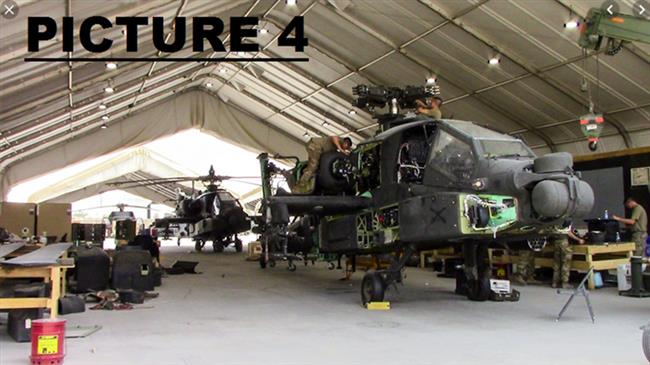
The Iranian missile attack for the most part targeted Apache (AH-64) attack helicopter shelters (refer to Picture 1). Refer to Picture 3 and Picture 4 to see what those “tent”-like Apache steel-frame shelters look like at ground level.
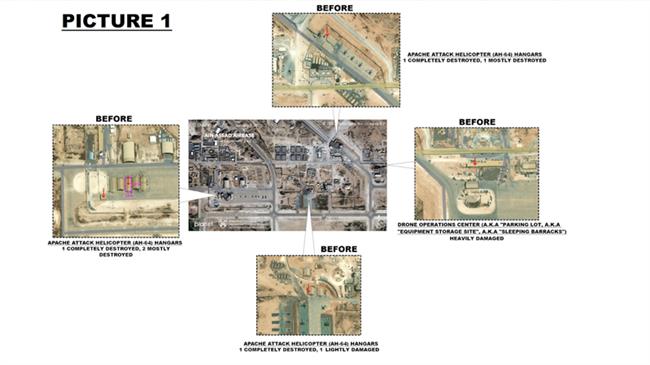
They are the standard steel-frame soft shelter design for US helicopter units based in overseas areas at second-rate airfields (such as the Ain al-Asad Base) – US helicopter units operating from old Afghan airfields are also housed in this kind of shelter design. Each one of those Apache attack helicopter shelters can house two such aircraft. With six structures of the type provably destroyed, demonstrated through the satellite images showing blackened scorch marks (suggesting assets inside them were destroyed with the shelter itself, refer to Picture 1) AND assuming each only had one Apache in them, it can be concluded that at least 6 Apache gunships were destroyed in the attack.
Recently, Danish media, citing a Danish coalition soldier who was present at the base at the time of the attack, admitted that multiple helicopters were destroyed to the point of being “split in half”.
Another Apache hangar (refer to Picture 2) was also directly struck, located to the far eastern end of the Ain al-Asad Base and destroyed. However, note that there is no scorch-blackened concrete underneath it, suggesting nothing was inside it that led to additional burning beyond the impact of the warhead itself.
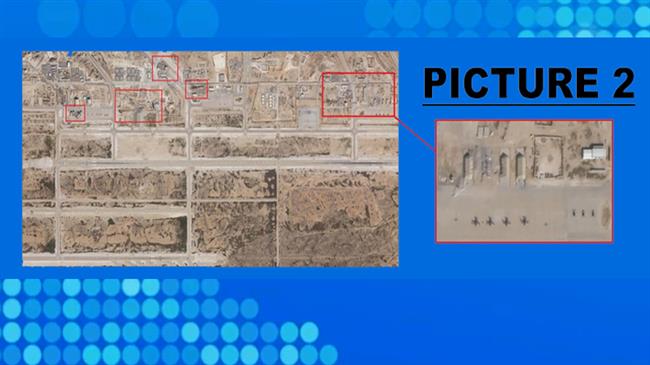
Indeed, just to the south of that destroyed hangar and the undamaged three hangars next to it, 4 Apache helicopters can be seen sitting out on the open tarmac. They were spared as they were, ironically, not being sheltered.
The official US story on the other structure targeted beyond the “tents” (i.e. Apache gunship hangars) has already changed twice – first it was called a parking lot, then an equipment storage area and now, apparently, a barracks for drone operators. Picture 1 (far right) shows the result of the attack on this structure.
It is hard to imagine that base zoning regulators within the US military would chose to place sleeping quarters right next to a strip alert (ready-to-go) aircraft parking area, itself right next to a major taxiway, given the constant noise that comes from these areas.
A more astute assessment would place this structure as an operations center, which lines up with the Iranian claim that the command site from which the Qassem Soleimani assassination operation had been coordinated, was targeted and destroyed in Iran’s retaliation strike.

Indeed, AFP recently released an exclusive report in which a US drone operator present at the Ain al-Asad Airbase, one First Sergeant Wesley Kilpatrick, admitted that airborne drones were rendered inoperable after a direct hit penetrated the base’s UAV operations center and destroyed the fiber lines which connect remote stations to satellite communication equipment(needed for drone control and visuals).
In all of this, one thing is obvious. US officials and media are stumbling over their own statements trying to cover up the extent of the damage dealt to the US-operated section of the Ain al-Asad base – in fact, going so far to cease calling the military site a US airbase (as it had been called for the last 16 years) to (all of a sudden) just an “Iraqi facility”.
THE WEAPONS USED BY IRAN
Short-range ballistic missiles (SRBM) of the upgraded Fateh-313 (range 500 km) and Qiam (range 800 km) types were launched from Western Iran towards the US-operated Ain al-Asad Base in Iraq.
Fateh-313s represent the majority of the missile type used for the attack. Their accuracy still seems to have been to within a matter of meters of their intended targets, except for two stray shots that hit the open tarmac area.
Whilst the Fateh-313 missiles use a combination of INS and electro-optical guidance, the Qiam missiles reportedly use a mix of INS, GPS and radar-mapping target acquisition. The latter method being the archaic predecessor version of DSMAC (imaging automatic target acquisition) terminal-phase guidance used in high-end ground-attack cruise missiles, such as the Tomahawk.
THE OPERATION –OTHER DETAILS
Satellite pictures show that some targeted sites were double-tapped (hit twice-over for good measure).
Initial reports from the Ain al-Asad Base claimed nearly 40 detonations in total despite the fact the number of actual warhead impacts was about fifteen, indicating that there were around two dozen cases of secondary explosions (fuel and ammo going off after being ignited).
In conclusion, according to the evidence we have available to us currently, there is no doubt that the United States has completely distorted the gravitude of Iran’s strikes. The mainstream media in the West have also seemingly refrained from acknowledging much of the damage, apart from on occasion.
Robert Inlakesh is a journalist, writer and political analyst, who has lived in and reported from the occupied Palestinian West Bank. He has written for publications such as Mint Press, Mondoweiss, MEMO, and various other outlets. He specializes in analysis of the Middle East, in particular Palestine-Israel. He also works for Press TV as a European correspondent.
Iraq denies report it has restarted joint military operations with US
Press TV – January 16, 2020
The Iraqi government has denied claims that the country’s military is resuming joint operations with the US-led coalition after Washington’s assassination of top Iranian and Iraqi commanders.
“The joint operations have not resumed and we have not given our authorization,” Major General Abdul Karim Khalaf, the spokesman for the commander-in-chief of the Iraqi armed forces, said on Thursday.
He added that the coalition did not have a permission from Baghdad to carry out any joint missions.
The remarks came after the New York Times, citing two American military officials, reported Thursday that the US had resumed the operations.
Khalaf said the Iraqi government had ordered the coalition to halt its joint operations following the US assassination of top Iranian anti-terror commander, Lieutenant General Qassem Soleimani, and Abu Mahdi al-Muhandis, the second-in-command of Popular Mobilization Units (PMU).
Last month, another US airstrike killed 25 members of PMU in the Arab country’s west.
On January 3, a US drone strike outside Baghdad airport killed General Soleimani and al-Muhandis.
Washington began the pause on January 5, two days after the strike, but furious Iraqi lawmakers voted to expel more than 5,000 US troops based in their country.
The Pentagon said it had no information with regard the the alleged resumption of joint operations with Iraqi troops.
The US-led coalition’s spokesman in Baghdad also declined to comment.
Iraq may defy Washington to buy the Russian S-400 missile defense system
By Paul Antonopoulos | January 16, 2020
With tensions mounting between Iran and the United States after the latter assassinated Iranian General Qassem Soleimani in Iraq, Baghdad has now been pushing to free itself from American domination by calling for foreign troops to leave the country and announcing its intensions in buying the Russian S-400 missile defense system. The complete destruction of the U.S. military base in Anbar province earlier this month demonstrated to Iraqi leaders that it certainly needs to strengthen its air defences since not even American air defense systems could protect their base from the barrage of Iranian missiles. The Iraqi government’s intention to buy the S-400 air defense systems from Russia has been talked about since May last year, when the country’s ambassador to Moscow said Baghdad had decided to buy the systems. However, no roadmap to purchase the systems has been made yet.
Karim Elaiwi, an Iraqi member of parliament who sits on the security and defense committee, said last week that “We are talking to Russia about the S-400 missiles but no contracts have been signed yet. We need to get these missiles, especially after Americans have disappointed us many times by not helping us in getting proper weapons.”
It appears the Iraqis will no longer tolerate U.S. occupation and demands in its country, with parliamentarian and security and defense committee member Abdul Khaleq Al Azzawi, defiantly saying “We authorized the prime minister to get air defense weapons from any country he wants and we authorized him to spend the money for it, from any country. From Russia or anyone.”
This comes as hostilities between Iraq and the U.S. increase, with U.S. President Donald Trump threatening to cut Baghdad’s access to its key account at the Federal Reserve Bank in New York if they follow through with the Iraqi Parliament’s decision to expel the U.S. military from their country. Not only has there been a threat to cut Iraq from its own money based in the U.S., but there are now threats of $250 million in military aid to Iraq being cut.
Although these are tactics to force Baghdad into maintaining ‘permission’ for the U.S. military to remain in Iraq, the clearest sign that this is an American occupation of the West Asian country was with White House National Security Adviser Robert O’Brien’s comments last week that the U.S. will leave Iraq on its “own terms.” The U.S. are not even trying to hide the fact that they are occupying Iraq and rebelling against the government.
Despite the clear occupation, Iraq continues to defy the U.S., and the willingness to purchase the S-400 system is a clear indication of this. It is for this reason that Joey Hood, the U.S. State Department’s principal deputy assistant secretary for Near Eastern Affairs, said on Tuesday in an appearance at the Middle East Institute, an extremely influential Washington think tank, that “A purchase [of the S-400] would probably trigger sanctions, so we advise our partners not to make such purchases.”
This was an expected response considering the continued threats of sanctions the U.S. has put against Turkey for its own acquisition of the S-400. Iraq wants to strengthen its air defense and the S-400 systems are considered the best in the world. It must also be remembered that Iraq is already buying modern weapons from Russia, such as the Mi-28 fighter helicopters and T-90 tanks. However, it is likely that Washington considers the purchase of the S-400 from Russia as an indication that the U.S. is losing political and military support in the country – but this was already consolidated by the assassination of Soleimani, an extremely popular figure in Iraq.
Baghdad is already in negotiations for the S-300, the older generation of the S-400. However, it is the S-400, the newest model available for foreign markets, that will provoke resistance in Washington, especially as the U.S.-made Patriot missile defense system has proven to be a failure by not being able to defend U.S. bases in Iraq or Saudi oil facilities, if we remember the Houthi-led Ansarullah Movement’s attack on the ARAMCO site in September last year.
The question then becomes how will Iraq will pay for Russian weapons if their accounts in the U.S. are frozen. Delivery is not so much of an issue despite the U.S. occupation, it is more a matter of how payments will be made. Although Iraqi parliamentarians are boldly declaring their intentions for the S-400 to be purchased, there are significant problems that Baghdad must first be able to overcome, including the extremely strong pressure being applied by the U.S. against Iraq not to buy them. If Baghdad did successfully defy Washington and purchase the systems, it will certainly weaken the U.S.’ image in the region, something the North American country will unlikely want to risk.
Will Iraq boldly defy the U.S.? This remains to be seen now.
Paul Antonopoulos is a Research Fellow at the Center for Syncretic Studies.
Iraq’s Sadr urges million-man march against US military presence
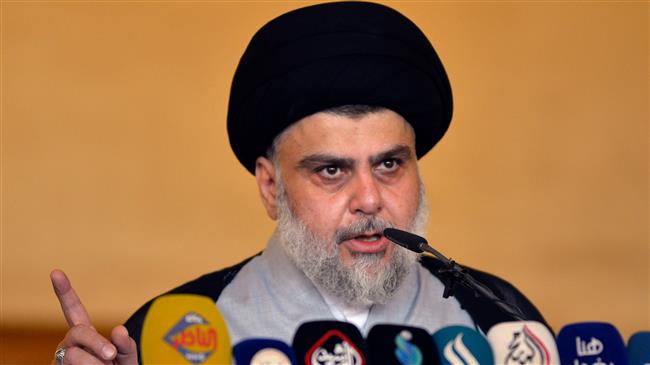
Influential Iraqi Shia cleric Muqtada al-Sadr (Photo by AFP )
Press TV – January 15, 2020
Influential Iraqi Shia cleric Muqtada al-Sadr has demanded that Iraqis stage a “million-man march” against the continued US military presence in the country, days after Iraq’s parliament voted to expel the American troops following an assassination operation by Washington on Iraqi soil.
The march is needed “to condemn the American presence and its violations,” Sadr, who leads the largest parliamentary bloc, Sairoon, said in a tweet on Tuesday.
“The skies, land, and sovereignty of Iraq are being violated every day by occupying forces,” he added. The cleric, however, cautioned that such a show of popular disapproval should be a “peaceful, unified demonstration,” but did not offer a date or location for the proposed rally.
On January 5, the parliament voted overwhelmingly in favor of a resolution calling for the expulsion of all US-led forces, two days after the US military assassinated senior Iranian commander Lieutenant General Qassem Soleimani and along with Abu Mahdi al-Muhandis, the second-in-command of Iraq’s Popular Mobilization Units (PMU), among others, near the Baghdad airport.
The parliament resolution also urged the Baghdad government to drop a request for assistance from a US-led coalition of foreign troops purportedly operating against Daesh remnants in Iraq.
The Iraqis censured the targeted killings — which were ordered by US President Donald Trump — as a blatant violation of the country’s sovereignty as well as the security agreement between Baghdad and Washington.
In a letter to the parliament following the vote, Sadr called for an immediate cancellation of the security agreement with the US, the closure of the US embassy, the expulsion of US troops in “a humiliating manner,” and the criminalization of communication with the US administration.
Following the parliamentary vote, the office of Iraq’s caretaker Prime Minister Adel Abdul-Mahdi asked Washington to dispatch a delegation to Baghdad to initiate preparations for the withdrawal of American troops, who number around 5,200.
In response, Trump threatened to sanction Iraq “like they’ve never seen before ever” if Baghdad were to expel US troops.
Based on reports by the Wall Street Journal the US administration has threatened to shut off Iraq’s access to its main account at the Federal Reserve Bank of New York, which is used to collect revenues from the Arab country’s overseas oil sales, if Baghdad expelled the American forces.
Iraqis must resort to resistance if US forces refuse to pull out: Senior Nujaba official
Press TV – January 14, 2020
The deputy secretary general of Iraq’s al-Nujaba Movement says the Iraqi nation must choose the path of resistance in case the parliamentary bill demanding the withdrawal of all US-led foreign military forces from the country is not implemented.
“The Iraqi people must opt for the path of resistance unless the parliament’s decision on the pullout of foreign forces is carried out,” Nasr al-Shammari said in an exclusive interview with Lebanon-based Arabic-language al-Mayadeen television news network on Tuesday.
He added that the decision to expel foreign forces from Iraq does not need a parliamentary mandate, stating that the US-led military coalition purportedly fighting the Daesh terrorist group entered Iraq at the request of Baghdad government and can be removed by a letter from the government as well.
“The decision concerning the removal of foreign forces from Iraq is the only decision taken away from sectarian fault lines. A person of sound mind cannot accept the presence of a foreign state that imposes its own authority on a sovereign country. If getting foreign forces out of Iraq is a charge, then we consider it as an honor for ourselves, our children and our grandchildren,” Shammari pointed out.
He then noted that all Iraqi resistance factions are united to end the presence of foreign troops in the country, saying, “The United States must respect the sovereignty of states and decisions of peoples, and adhere to them.”
“Iraq will not accept being ruled by any country. Any failure to implement the parliament decision on the withdrawal of foreign forces will give the green light for the start of resistance operations,” Shammari highlighted.
The Nujaba official went on to say that Popular Mobilization Units (PMU), better known by the Arabic word Hashd al-Sha’abi, have become more coherent and solid in the wake of the recent US assassination of the second-in-command of PMU, Abu Mahdi al-Muhandis.
“The death of Muhandis does not mean the end of Hashd al-Sha’abi and its role in the region,” Shammari said.
He added that Iraqi resistance groups are indebted to Lieutenant General Qassem Soleimani, the commander of the Quds Force of Iran’s Islamic Revolution Guards Corps (IRGC).
“The resistance against US forces will soon attain its goal of removing foreign troops from the Iraqi soil. The blood of martyrs will finally bring about the demise of the Zionist entity, and the end of its occupation of Arab lands,” Shammari concluded.
Baghdad moving to internationally prosecute US for crimes in Iraq
Meanwhile, a member of the Iraqi Parliamentary Human Rights Committee said the Baghdad government was preparing to prosecute the United States at international courts of law for its crimes in Iraq, noting that the offenses amount to genocide.
“The United States has been committing the most heinous war crimes since 2003 up until now. The invasion of Iraq, the Abu Ghraib prisoner abuse, the Nisour Square massacre and the emergence of Daesh (Takfiri terrorist group) besides the attack on the leaders of Hashd al-Sha’abi are all crimes classified as genocide,” Ahmed al-Kanani said in a statement on Tuesday.
Kanani added, “All the crimes that America has perpetrated against the Iraqi nation are documented, and that there are bids to prosecute Washington for its crimes against Iraqis before international courts.”
On January 5, Iraqi lawmakers unanimously approved a bill, demanding the withdrawal of all foreign military forces led by the United States from the country.
Late on January 9, Iraq’s caretaker Prime Minister Adel Abdul-Mahdi called on the United States to dispatch a delegation to Baghdad tasked with formulating a mechanism for the withdrawal of US troops from the country.
According to a statement released by the Iraqi premier’s office, Abdul-Mahdi “requested that delegates be sent to Iraq to set the mechanisms to implement the parliament’s decision for the secure withdrawal of (foreign) forces from Iraq” in a phone call with US Secretary of State Mike Pompeo.
The prime minister said Iraq rejects violation of its sovereignty, particularly the US military’s violation of Iraqi airspace in the airstrike that assassinated Lt. Gen. Soleimani, Muhandis and their companions.
Abdul-Mahdi asked Pompeo to “send delegates to Iraq to prepare a mechanism to carry out the parliament’s resolution regarding the withdrawal of foreign troops from Iraq,” the statement said.
“The prime minister said American forces had entered Iraq and drones are flying in its airspace without permission from Iraqi authorities and this was a violation of the bilateral agreements,” the statement added.
The US State Department bluntly rejected the request the following day.
US to Iraq: ‘Vote All You Want, We’re Not Leaving!’
By Ron Paul | January 13, 2020
President Trump’s decision earlier this month to assassinate Iran’s top military general on Iraqi soil – over the objection of the Iraqi government – has damaged the US relationship with its “ally” Iraq and set the region on the brink of war. Iran’s measured response – a few missiles fired on an Iraqi base after advance warning was given – is the only reason the US is not mired in another Middle East war.
Trump said his decision to assassinate Gen. Qassim Soleimani was intended to prevent a war, not start a war. But no one in his right mind would think that killing another country’s top military leader would not leave that country annoyed, to say the least. Senators Mike Lee (R-UT) and Rand Paul (R-KY) said the Trump Administration’s briefing to Congress on its evidence to back up claims that Soleimani was about to launch attacks against the US was among the worst briefings they’d ever attended.
After initially claiming that Soleimani had to be taken out immediately because of “imminent” attacks he was launching against the US, Trump Administration officials including Secretary of State Pompeo and Defense Secretary Esper have been busy walking back those claims. Esper claimed over the weekend that he had not seen the intelligence suggesting an attack on US embassies was in the works. If the Secretary of Defense did not seen the intelligence, then who did?
No doubt the Iraqi leadership recognized these kinds of deceptions: the same kinds of lies were used to push the US into attacking their own country in 2003. So it should not have come as a big surprise that the Iraqi government met last week and voted that all foreign military personnel should leave Iraqi soil.
Then a funny thing happened when the Iraqi prime minister attempted to communicate to the US government the will of the Iraqi people through their democratically-elected officials. On Thursday Iraqi Prime Minister Mahdi phoned Pompeo to urgently request that Washington enact a US troop “withdrawal mechanism” in Iraq. American troops are in Iraq by invitation of the Iraqi government and the Iraqi government had just voted to revoke that invitation.
The State Department responded with a statement titled “The US Continued Partnership with Iraq,” in which it essentially said that the US would not abide by the request of its Iraqi partners because the US military is a “force for good” in the Middle East and that as such it is “our right” to maintain “appropriate force posture” in the region.
The US invaded Iraq based on Bush Administration lies and a million Iraqis died as a result. Later, President Obama ramped up the drone program and also backed al-Qaeda affiliated terrorists to overthrow the secular Syrian government. Obama also attacked Libya based on lies, leaving the country totally destroyed. Trump is assassinating foreign officials and threatening destruction of Iran.
And the State Department calls that a “force for good”?
The United States can be a true force for good, however. End the military occupation of the Middle East, end foreign military aid, stop using the CIA to overthrow governments. Allow Americans to travel and do business in any country they wish. Lead by example and demonstrate how free markets and peace benefit all. A “force for good” means not forcing others to bow to your will.
Copyright © 2020 by RonPaul Institute.
After Missiles Fly, Iraq Becomes the Battleground
By Tom Luongo | Gold Goats ‘n Guns | January 10, 2020
The future of the U.S.’s involvement in the Middle East is in Iraq. The exchange of hostilities between the U.S. and Iran occurred wholly on Iraqi soil and it has become the site on which that war will continue.
Israel continues to up the ante on Iran, following President Trump’s lead by bombing Shia militias stationed near the Al Bukumai border crossing between Syria and Iraq.
The U.S. and Israel are determined this border crossing remains closed and have demonstrated just how far they are willing to go to prevent the free flow of goods and people across this border.
The regional allies of Iran are to be kept weak, divided and constantly under harassment.
Iraq is the battleground because the U.S. lost in Syria. Despite the presence of U.S. troops squatting on Syrian oil fields in Deir Ezzor province or the troops sitting in the desert protecting the Syrian border with Jordan, the Russians, Hezbollah and the Iranian Quds forces continue to reclaim territory previously lost to the Syrian government.
Now with Turkey redeploying its pet Salafist head-choppers from Idlib to Libya to fight General Haftar’s forces there to legitimize its claim to eastern Mediterannean gas deposits, the restoration of Syria’s territorial integrity west of the Euphrates River is nearly complete.
The defenders of Syria can soon transition into the rebuilders thereof, if allowed. And they didn’t do this alone, they had a silent partner in China the entire time.
And, if I look at this situation honestly, it was China stepping out from behind the shadows into the light that is your inciting incident for this chapter in Iraq’s story.
China moving in to sign a $10.1 billion deal with the Iraqi government to begin the reconstruction of its ruined oil and gas industry in exchange for oil is of vital importance.
It doubles China’s investment in Iraq while denying the U.S. that money and influence.
This happened after a massive $53 billion deal between Exxon-Mobil and Petrochina was put on hold after the incident involving Iran shooting down a U.S. Global Hawk drone in June.
With the U.S balking over the Exxon/Petrochina big deal, Iraqi Prime Minster Adel Abdul Mahdi signed the new one with China in October. Mahdi brought up the circumstances surrounding that in the Iraqi parliament during the session in which it passed the resolution recommending removal of all foreign forces from Iraq.
Did Trump openly threaten Mahdi over this deal as I covered in my podcast on this? Did the U.S. gin up protests in Baghdad, amplifying unrest over growing Iranian influence in the country?
And, if not, were these threats simply implied or carried by a minion (Pompeo, Esper, a diplomat)? Because the U.S.’s history of regime change operations is well documented. Well understood color revolution tactics used successfully in places like Ukraine, where snipers were deployed to shoot protesters and police alike to foment violence between them at the opportune time were on display in Baghdad.
Mahdi openly accused Trump of threatening him, but that sounds more like Mahdi using the current impeachment script to invoke the sinister side of Trump and sell his case.
It’s not that I don’t think Trump capable of that kind of threat, I just don’t think he’s stupid enough to voice it on an open call. Donald Trump is capable of many impulsive things, openly threatening to remove an elected Prime Minister on a recorded line is not one of them.
Mahdi has been under the U.S.’s fire since he came to power in late 2018. He was the man who refused Trump during Trump’s impromptu Christmas visit to Iraq in 2018, refusing to be summoned to a clandestine meeting at the U.S. embassy rather than Trump visit him as a head of state, an equal.
He was the man who declared the Iraqi air space closed after Israeli air attacks on Popular Mobilization Force (PMF) positions in September.
And he’s the person, at the same time, being asked by Trump to act as a mediator between Saudi Arabia and Iran in peace talks for Yemen.
So, the more we look at this situation the more it is clear that Abdul Madhi, the first Iraqi prime minister since the 2003 U.S. invasion to push for more Iraqi sovereignty, is emerging as the pivotal figure in what led up to the attack on General Soleimani and what comes after Iran’s subsequent retaliation.
It’s clear that Trump doesn’t want to fight a war with Iran in Iran. He wants them to acquiesce to his unreasonable demands and begin negotiating a new nuclear deal which definitively stops the possibility of Iran developing a nuclear weapon, and as Patrick Henningsen at 21st Century Wire thinks,
Trump now wants a new deal which features a prohibition on Iran’s medium range missiles, and after events this week, it’s obvious why. Wednesday’s missile strike by Iran demonstrates that the US can no longer operate in the region so long as Iran has the ability to extend its own deterrence envelope westwards to Syria, Israel, and southwards to the Arabian Peninsula, and that includes all US military installations located within that radius.
Iraq doesn’t want to be that battlefield. And Iran sent the message with those two missile strikes that the U.S. presence in Iraq is unsustainable and that any thought of retreating to the autonomous Kurdish region around the air base at Erbil is also a non-starter.
The big question, after this attack, is whether U.S. air defenses around the Ain al Assad airbase west of Ramadi were active or not. If they were then Trump’s standing down after the air strikes signals what Patrick suggests, a new Middle East in the making.
If they were not turned on then the next question is why? To allow Iran to save face after Trump screwed up in murdering Soleimani?
I’m not capable of believing such Q-tard drivel at this point. It’s far more likely that the spectre of Russian electronics warfare and radar evasion is lurking in the subtext of this story and the U.S. truly now finds itself after a second example of Iranian missile technology in a nascent 360 degree war in the region.
It means that Iran’s threats against the cities of Haifa and Dubai were real.
In short, it means the future of the U.S. presence in Iraq now measures in months not years.
Because both China and Russia stand to gain ground with a newly-united Shi’ite Iraqi population. Mahdi is now courting Russia to sell him S-300 missile defense systems to allow him to enforce his demands about Iraqi airspace.
Moqtada al-Sadr is mobilizing his Madhi Army to oust the U.S. from Iraq. Iraq is key to the U.S. presence in the region. Without Iraq the U.S. position in Syria is unsustainable.
If the U.S. tries to retreat to Kurdish territory and push again for Masoud Barzani and his Peshmerga forces to declare independence Turkish President Recep Tayyip Erdogan will go ballistic.
And you can expect him to make good on his threat to close the Incerlik airbase, another critical logistical juncture for U.S. force projection in the region.
But it all starts with Mahdi’s and Iraq’s moves in the coming weeks. But, with Trump rightly backing down from escalating things further and not following through on his outlandish threats against Iran, it may be we’re nearing the end of this intractable standoff.
Back in June I told you that Iran had the ability to fight asymmetrically against the U.S., not through direct military confrontation but through the after-effects of a brief, yet violent period of war in which all U.S., Israeli and Arab assets in the Middle East come under fire from all directions.
It sent this same message then that by attacking oil tankers it could make the transport of oil untenable and not insurable. We got a taste of it back then and Trump, then, backed down.
And the resultant upheaval in the financial markets creating an abyss of losses, cross-asset defaults, bank failures and government collapses.
Trump has no real option now but to negotiate while Iraq puts domestic pressure on him to leave and Russia/China come in to provide critical economic and military support to assist Mahdi rally his country back towards some semblance of sovereignty.
Featured Video
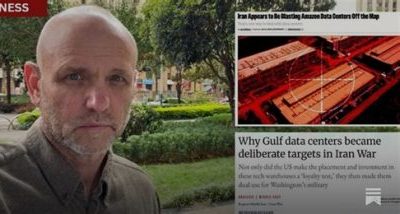
Iran spent $1 million to wipe out $30 billion in data center plans, and take down Amazon in the ME
or go to
Aletho News Archives – Video-Images
From the Archives
A short history of British torture
ICC | December 2005
When the House of Commons was debating how much to increase the time limit for detention without trial the question of torture came up. Officially this was limited to the nice considerations of whether it was all right to send people to places where torture is used and whether Britain can use information collected by the use of torture in other countries. This discussion gave an impression of democratic Britain as the home of civilised behaviour where the very idea of torture is repugnant to our legislators – unlike, say, the US with its secret CIA jails… In reality, the British state has a long history of using and developing a whole range of torture techniques. … continue
Blog Roll
 Aletho News
- Houthis Keep Advancing as the Red Sea Crisis Deepens
- Iran spent $1 million to wipe out $30 billion in data center plans, and take down Amazon in the ME
- Zionist billionaire pressure to silence Macklemore sparks exodus from Ed Sheeran tour
- House Votes to End Iran War for Third Time
- North Korea Slams US Plan for ‘AUKUS 2.0’ with South Korea and Japan
- Prolonging US-Iran Conflict Not Meeting Interests of Int’l Community – China’s Wang Yi
- EU bans former Zelensky aide from parliament
- NATO-backed Kosovo separatist ‘responsible for war crimes’
- US destroying international space law
- SCO Calls for Binding Global Deal to Prevent Arms Race in Space
- If Americans Knew
- U.S. Makes, Israel Takes: The Real Story of U.S.-Israeli Military Cooperation
- Night raids rise in Palestine
- Tucker Carlson interviews Norman Finkelstein about Gaza
- Groups urge Americans to support Van Hollen legislation on Israel’s killing of Americans & Palestinians
- Trump administration plans to send 40,000 tons of bombs to Israel: report
- Sanctions Target Iran’s Government, But Kill Hospitalized 23-Year-Old Woman
- An alternative view on the book “Israel’s Lobby: America in the Grip of a Foreign Power”
- Ed Sheeran’s band Beoga, other opening acts quit tour after Macklemore was dropped over his pro-Palestinian comments
- The assassination attempt on President Trump in Butler and the various Israeli connections to it
- “We Want That the Whole Land Be Jewish”
- No Tricks Zone
- New Study: ‘Global Drought Shows No Detectable Recent Acceleration Under Climate Warming’
- Economic Masterminds: German Socialists Suggest Taxing Productivity Gains Stemming From Using AI
- The South China Sea Has Not Been Cooperating With The Climate Change Narrative
- Energy Crisis: Germany Enters Heating Season With Historically Low Gas Reserve Fill Levels
- New Study: The Antarctic Ice Sheet Gained Mass From 2020-2024 Due To Staggering Snow And Ice Accumulation
- Study: Ocean Heating Rates From Thousands Of Years Ago ‘Dwarf’ Modern Ocean Heating Rates
- Climate Extremists Target, Attack Large-Scale Power Grid Infrastructure In Germany!
- New Study: Antarctic Ice Melt Has Contributed Less Than 1 Centimeter To Sea Level Rise In The Last 30 Years
- Fear Of Debate: Alarmist German Climate Scientist Calls On Mainstream Media To Discredit Skeptic Voices
- End-Of-August Arctic Sea Ice Extent Hasn’t Fallen In 20 Years, Official Data Show!
 Aletho News