Resistance Groups Likely to Start Imminent Missile Attack on US Positions in Region
FARS News Agency | January 10, 2020
TEHRAN (FNA)- The Islamic resistance groups are standing on alert for likely imminent attacks on the US military positions in the region after Thursday attacks on Eastern Syria.
Sources close to the Resistance Front said the resistance groups are preparing for pending response to last night’s attack on Syria and other terrorist actions of the US government.
The local media reported on Thursday night that a strong explosion occurred near Iraq’s border with Syria in the town of al-Qaem. Reports said the blast came after the recent US airstrikes on Syria.
On Wednesday, the IRGC Aerospace Force launched heavy ballistic missile attacks on US Ein Al-Assad airbase in Southwestern Iraq near the border with Syria and a US operated airbase in Erbil in retaliation for the assassination of General Soleimani.
Ein Al-Assad is an airbase with a 4km runway at 188m altitude above sea level, which is the main and the largest US airbase in Iraq. Early reports said the radar systems and missile defense shields in Ein Al-Assad had failed to operate and intercept the Iranian missiles. Unofficial reports said the US army’s central radar systems at Ein Al-Assad had been jammed by electronic warfare.
Some 80 US army personnel were killed and nearly 200 more wounded in Iran’s Wednesday missile attacks, informed sources said.
The second IRGC reprisal attack targeted a US military base near Erbil airport in Iraqi Kurdistan Region in the second leg of “Martyr Soleimani” reprisal operation.
All flights were cancelled at Erbil airport.
Iraq said the attacks had not taken any toll from its army men stationed at these two bases. The US army had blocked entrance into Ein Al-Assad to everyone, including the Iraqi army.
IRGC officials said none of the missiles had been intercepted.
Following the attack, the IRGC issued a statement immediately after the attacks, declaring that it had fired tens of ground-to-ground missiles at “the airbase occupied by the terrorist and aggressive army of the United States known as Ein Al-Assad” in reprisal for the martyrdom of IRGC Qods Force Commander Lieutenant General Qassem Soleimani.
The IRGC warned the US to avoid retaliating the Wednesday attack or else “it will face a more painful and crushing response”.
The IRGC Statement also warned “all the US allied states where the terrorist army has a base, any territory that becomes the origin of any hostile and aggressive action against the Islamic Republic of Iran in any way will be targeted”.
“We believe that the Zionist regime by no means stands aside from the criminal US regime in these crimes.”
The IRGC also called on the American nation to pressure the White House to pull their troops out of the region to avoid further damage and not allow the US rulers to endanger the lives of their military men through increasing hatred.
All Iranian underground missile towns were on alert.
The missile attack came hours before the body of General Soleimani was laid to rest.
Iraq asks US to prepare troop pullout, send team to Baghdad
RT | January 10, 2020
Caretaker Prime Minister Adil Abdul-Mahdi has asked the United States to send a delegation to Iraq to begin preparing for a troop pullout, his office said on Friday.
In a phone call late on Thursday with US Secretary of State Mike Pompeo, Abdul-Mahdi “requested that delegates be sent to Iraq to set the mechanisms to implement parliament’s decision for the secure withdrawal of [foreign] forces from Iraq,” AFP reports.
Some 5,200 US soldiers are stationed at bases across Iraq to support local troops preventing a resurgence of Islamic State (IS, formerly ISIS). They make up the bulk of a broader US-led coalition, invited by the Iraqi government in 2014 to help combat the jihadists.
The deployment was based on an executive-to-executive agreement that was never ratified by Iraq’s parliament. On Sunday, the parliament voted in favor of rescinding the invitation and ousting all foreign troops.
Baghdad revived deal to buy Russian S-300 following US strikes – Iraq’s Security & Defense Committee chairman
RT | January 9, 2020
Baghdad has reached out to Moscow again after it suffered American bombings on its soil, a high-ranked lawmaker revealed, saying the resumed deal focuses on the time-tested S-300 air defense systems.
The US attacks on Popular Mobilization Units (PMU), known in Arabic as Hashd al-Shaabi, prompted the Iraqi government “to resume negotiations regarding the S-300 deal,” Mohammad Ridha, chairman of Iraqi parliament’s Security and Defense Committee, told Sputnik on Thursday.
The US military have launched the air strikes against the PMU units in late December, blaming them for an attack that killed an American civilian contractor. The Shia militia force, backed by Iran, later said it lost 25 fighters.
It started a vicious chain of events, beginning with fiery anti-American demonstrations near the US Embassy in Baghdad. Though no one from the US diplomatic staff was hurt, the Pentagon responded with brute force, killing a top Iranian general, who they said masterminded the unrest, and ratcheting up tensions around Iran.
Now, Ridha said he’s unaware of the stage the talks are currently in, but mentioned the deal was greenlighted by Iraqi leadership. In his view, the prospective purchase won’t sit well with the Americans: “We await US opposition on this issue.”
Washington has piled enormous pressure on nations that have bought Russian-made air defense systems, or considering buying them. Turkey has been targeted with an array of US penalties for procuring the S-400, while India, another prospective operator of the system, faces similar ramifications.
IRGC Aerospace Force Commander: Iran Missile Strike Eradicated US Horror Formula Imposed since WWII
Al-Manar | January 9, 2020
IRGC Aerospace Force Commander Brig. Gen. Amir Ali Hajizadeh Thursday briefed the media outlets on the Iranian missile strike on US military base in Iraq, stressing that it managed to undermine US awe.
General Hajizadeh stressed that since WWII there has not been any attack on a US target that keeps unanswered, adding that Iran managed to eradicate this horror formula.
General Hajizadeh pointed out that the Iranian forces fired 13 missiles at Ain Al-Asad base and had been able to fire hundreds of others had the US forces responded.
The Iranian missiles hit the command chamber and positions used to prepare the combat helicopters at the US base, according to General Hajizadeh, who added that Iran decided to strike the US base in Iraq that is the largest and the farthest from the Iranian border.
“Unlike the Americans, we are not criminals; we could have struck the dormitory areas of the US troops at Ain Al-Asad base and killed 500 of them had we decided that.”
General Hajizadeh stressed that the missile strike left US human losses, adding that nine jets moved the injured US soldiers to the Zionist entity.
General Hajizadeh emphasized that the US existence in the region is in danger, calling on Washington to learn from what happened and start a voluntarily withdrawal.
General Hajizadeh addressed the Gulf countries, reiterating that the US forces may never protect them.
“The Iranian forces planned to strike the US bases in the Gulf countries.”
General Hajizadeh stressed that the assassination of General Suleimani will cause a tsunami that will expel the US forces from the region.
On January 3, a US drone attack targeted a vehicular convoy for the head of the IRGC Al-Quds Force General Qassem Suleimani and the deputy chief of Hasd Shaabi Committee Abu Mahdi Al-Muhandis, claiming both of them in addition to a number of their companions.
On January 8, the Iranian rocketry forces responded by firing 13 ballistic missiles at the US military base of Ain Al-Asad in Iraq’s Anbar, causing heavy losses upon it.
Iraqi Foreign Minister stresses need for withdrawal of foreign troops
Press TV – January 9, 2020
Iraqi Foreign Minister Mohammad Ali al-Hakim has stressed the need for US and other foreign troops to leave Iraq as a backlash grows over the recent American assassination of a top Iranian general in Baghdad.
The top Iraqi diplomat made the appeal during a joint press briefing with his Turkish counterpart Mevlut Cavusoglu in Baghdad on Thursday.
Hakim and Cavusoglu strongly condemned the US assassination of Iran’s Lt. Gen. Qassem Soleimani and senior Iraqi commander of the Popular Mobilization Units Abu Mahdi al-Muhandis, both key figures in the fight against Daesh and other Takfiri terrorists in the Middle East.
“Iraq insists on maintaining its sovereignty and territorial integrity and the complete withdrawal of foreign forces,” the top Iraqi diplomat said.
He added that talks with his Turkish counterpart focused on the need to respect Iraq’s sovereignty from all sides.
“Iraq condemns the attacks on Iraqi land, which harms the sovereignty of our country as well the security of Iraqi people. They are against the international law,” the Iraqi minister said.
Hakim added, “”We have discussed with the minister that Iraq wants all foreign forces are removed out of the country through dialogue. We also discussed with the minister on cooperation areas. We have agreed to alleviate the Iran-US tension in the region.”
The two sides also discussed bilateral relations at all levels, including cooperation on fighting terrorism, al-Hakim said.
The top Iraqi diplomat said any escalation of tensions in the region could result in the re-emergence of Takiri terrorist groups.
The Turkish foreign minister, for his part, said Ankara does not want Iraq to become a battleground for foreign forces.
Cavusoglu added that Iraq was not alone and Turkey was there to overcome difficult days together.
Turkish foreign minister also spoke with his Iranian counterpart Mohammad Javad Zarif Wednesday after Tehran fired dozens of missiles at two military bases hosting US troops in Iraq. The missiles were fired at the Ain al-Asad base in Anbar province and another base in Erbil.
PMU leader denies role in rocket attacks
In another development, Qais al-Khazali, the leader of Asa’ib Ahl al-Haq movement, a subdivision of Iraq’s Popular Mobilization Units, known by its Arabic name as Hashd al-Sha’abi, denied any involvement in the recent firing of rockets at Baghdad’s Green Zone where the US embassy is located.
Two Katyusha rockets struck Baghdad’s heavily fortified Green Zone on Wednesday, landing near the US embassy but causing no casualties, according to the Iraqi military.
Al-Khazali also said it was time for an Iraqi response to the recent US assassination, adding the reaction will be “no less in size” than Tehran’s missile strikes on two American bases in Iraq.
On Sunday, Iraqi Prime Minister Adel Abdul Mahdi called the US airstrike “a political assassination”. He also underlined the need for a timetable to withdraw all foreign troops “for the sake of our national sovereignty.”
Iran’s Strikes Against the U.S. Demonstrate the Unipolar System Is Truly Over
By Paul Antonopoulos | January 9, 2020
When U.S. President Donald Trump ordered the assassination of Iranian General Qassem Soleimani, he certainly had not expected that Iran would respond in the way it did by bombarding two U.S. military bases in Iraqi territory. It is likely that his advisers had convinced him that no country in the world had the courage to attack the U.S. so blatantly as no one else had since the Japanese attack on Pearl Harbor during World War II. The Iranians did of course, as was expected by those who understand the ideology of the Islamic Republic that has a deeply ingrained martyrdom complex that stretches back to 680AD when Imam Ali Ibn al-Husayn was killed in Karbala, Iraq.
Trump has claimed that there were no American casualties while Iran has claimed there were at least 80. With the Erbil and Ain al-Assad bases bombarded and several U.S. aircraft, drones and helicopters destroyed, it is unlikely that there were no U.S. casualties – however there is no way in knowing at this time whether there were 80. We can expect Washington to keep the true number of casualties a secret, in complete opposition to Iran who openly celebrate their martyrs.
The Ain al-Assad military base is the largest and most equipped U.S. base in the region, and one of a few U.S. special bases around the world, at the size of about half of Lebanon. The fact that the Americans have deployed their most sophisticated radar systems in Iraq, many of which have been destroyed, demonstrates the ineffectiveness of the Patriot missile defense system. This was despite U.S. forces in the region being put on high alert. This will only be in Russia’s favor as it continues to offer the S-400 system to potential buyers.
Not only did the attack on the Ain al-Assad military base expose the ineffectiveness of the Patriot system, Iran also targeted the Erbil base in Iraqi Kurdistan. This base was a center to try and encourage the Iraqi Kurds to rebel against the central government in order to put pressure on the central Iraqi government. The attack on the Erbil base was a warning that even a U.S. withdrawal into Kurdistan does not make them safe.
It was expected by most commentators that Iran’s retaliation for the martyrdom of Soleimani would be in the form of utilizing its regional paramilitary allies on U.S. positions. By directly attacking U.S. forces brazenly and openly, Tehran has demonstrated that the U.S. are not safe in any part of the region. However, Iran had no choice but to retaliate as not doing so would demonstrate the country’s leadership only had empty rhetoric in defending itself. The U.S. would certainly be more inclined to carry out further attacks against Iran and its allies if Tehran did not respond.
If there is a war going on in Iraq between the U.S. and Iran, it probably will not be limited to one country and will engulf the whole region, and potentially, across the world. Washington cannot be counted on to abide by international laws and regulations. The countries in the region, particularly the Gulf States, should also bear in mind that the presence of U.S. bases on their land will not only fail to provide security, but will also endanger their national security as all states who assist the U.S. in any aggression against Iran will become legitimate targets, as Tehran has already warned.
Rather, the murder of Soleimani has only united Iranians, including those who have been protesting across the country since November, blaming the government for the increased fuel prices and difficult economic situation, ignoring the crippling U.S. enforced sanctions. The major demands of the Iranian people are now for the expulsion of the U.S. military from the region, something that the Islamic Republic’s leadership has loudly and clearly demanded as well.
Since Iran has made its first response to the U.S. so directly, Trump for now is refusing to respond militarily and will impose greater sanctions against Iran. However, Iran has already made the demand that the U.S. withdraw from the region. To achieve this without directly provoking Trump again, Iran is likely to employ the militias it backs in Syria and Iraq to target U.S. military installations. With any Israeli involvement in this war effort, Iran can use Hezbollah and various Palestinian militias to pressure the Jewish state internally and externally.
Therefore, since Iran has already promised to expel the U.S. from the region, the next phase of the anti-U.S. war effort will be asymmetrical warfare by Iran. If Iran engages in asymmetrical warfare, the return of dead and wounded American soldiers will severely hamper Trump’s re-election campaign this year as he originally ran on the ticket of criticizing wars in West Asia when he was competing for the presidency against Hillary Clinton years earlier. The Iranian leadership are now in control of the future of the West Asia and have demonstrated they are willing to retaliate against the U.S. who is seeking to maintain the unipolar hegemonic world order that emerged with the collapse of the Soviet Union in 1991. Iran has once again shown that the 21st century is not one of unipolarity that Washington hopes to maintain, but rather multipolar with several strong middle and Great Powers.
Paul Antonopoulos is a Research Fellow at the Center for Syncretic Studies.
How Was Pentagon ‘Withdrawal Letter” Leaked To Iraq? Anatomy Of A Propaganda Coup
By Tyler Durden – ZeroHedge – 01/07/2020
The inside account of how the now infamous “phony” letter announcing complete US troop withdrawal from Iraq after seventeen years details astoundingly how the “posting of the letter online unleashed a mad, behind-the-scenes scramble at the Pentagon, the White House, and on Capitol Hill, as elected officials, policymakers, military advisers and journalists sought to understand whether the letter intended to communicate what its plain language suggested.”
As different departments and levels within the Pentagon bureaucracy attempted to account for it, the story changed multiple times. In a matter of a couple hours it went from “authentic” to “phony” to part of an effort to sow “active disinformation” — and finally according to a confused press briefing by Gen. Milley and Defense Secretary Mark Esper an “unauthorized draft” and “an honest mistake”.
This after The Washington Post and a host of other major outlets “confirmed” it as “authentic” — in the words of WaPo’s Beirut Bureau chief Liz Sly.
At Monday’s Pentagon briefing itself which attempted to assess the origins of the mysterious draft letter, The Dispatch summarized the atmosphere: “Was the United States really moving to remove its remaining troops from Iraq? Nobody seemed to know.”
And ultimately no definitive answers came, other than the Pentagon and administration denying than an Iraq pullout is happening, as to just how a “draft letter” which had been making the rounds at CENTCOM came to be in the hands of the Iraqis, after which it was posted online.
As The Dispatch notes, the letter wasn’t merely announced by some Iraqi politician in Baghdad, but was released via America’s enemies:
The news was a propaganda coup for the Iranians and those in Iraq who support them. The story broke on the television channel of an Iran-backed Iraqi militia, Asaib Ahl al-Haq (AAH), after it was leaked by the Iraqi prime minister’s office, according to Liz Sly, Beirut bureau chief for the Washington Post, who noted that the leader of AAH is a U.S.-designated terrorist and his militia is responsible for the deaths of dozens of Americans.
The letter soon made its way into the American media.
Initially, there was this statement out of the Pentagon policy office in conjunction with Operation Inherent Resolve: “OIR has confirmed with us at the working level that this is active disinformation.” The Pentagon was “fairly certain that this is a fake” according to that early media statement.
But then this later at the Pentagon press briefing:
They didn’t declare the letter a fake but they couldn’t offer much of an explanation of its provenance or meaning, either. Esper pleaded ignorance. “I don’t know what that letter is,” he said. “We’re trying to find out where that’s coming from, what that is. But there has been no decision made to leave Iraq, period.” He declined to confirm its authenticity. “No, I can’t.”
Gen. Milley couldn’t verify that the letter was real, either. “I do know that it’s not signed,” he said. “But I just looked at it right there; it’s not signed.”
So even the attempts to account for what may or may not be a “draft” letter which originated within the Pentagon itself and then leaked to the Iraqis remain contradictory.
The final word from the Defense Department seems to be a shoulder shrug and that it was “an honest mistake”.
What remains is that the whole embarrassing and bizarre episode does indeed appear a “propaganda coup for the Iranians and those in Iraq who support them.”
Russia Proposes To Secure Iraqi Airspace With S-400 Air Defense
By Tyler Durden – Zero Hedge – 01/07/2020
The Ministry of Defense of the Russian Federation has offered Iraq Tuesday the option to purchase the world’s most advanced missile defense system to protect its airspace, reported RIA Novosti.
According to the report, the Iraqi Armed Forces could purchase the Russian S-400 Triumf air defense system, which RIA points out, can “ensure the country’s sovereignty and reliable airspace protection.”
“Iraq is a partner of Russia in the field of military-technical cooperation, and the Russian Federation can supply the necessary funds to ensure the sovereignty of the country and reliable protection of airspace, including the supply of S-400 missiles and other components of the air defense system, such as Buk-M3, Tor -M2 “and so on,” said Igor Korotchenko, Russian Defense Ministry’s Public Council member.
For the last several months, Iraq has considered purchasing Russian air defense and missile systems, including the S-400, however, it has been met with fierce pressure from the US.
But with a political crisis between the US and Iraq underway, thanks partly to the US assassination of Iran’s Maj. Gen. Qassem Soleimani, Russia could profit as Iraq attempts to decouple from the US.
A recent U.S. intelligence assessment indicated that at least 13 countries had expressed interest in purchasing the S-400s.
Saudi Arabia, Qatar, Algeria, Morocco, Egypt, Vietnam, and Iraq have all be in discussions with Russia to purchase the missile defense system in the last several quarters.
Meanwhile, China, India, and Turkey have already signed agreements with Russia.
The S-400s can strike stealth bombers, aircraft, cruise missiles, precision-guided projectiles, and ballistic missiles, some military experts have even said the Russian missile defense system is far superior than the US’ MIM-104 Patriot.
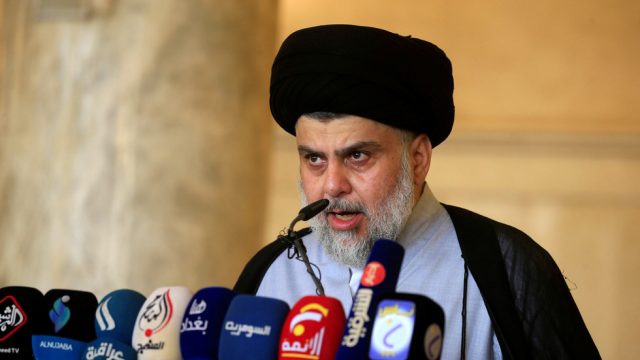
Iraqi cleric Moqtada al-Sadr says crisis over, after Trump & Iran speak
© Reuters / Alaa al-Marjani
RT | January 8, 2020
Influential Iraqi cleric Moqtada al-Sadr has declared the “crisis” between the US and Iran over, following statements from the two countries’ leaders in the wake of Tuesday’s Iranian strikes on US bases in Iraq.
Al-Sadr made his pronouncement on Wednesday after US President Donald Trump gave a relatively subdued speech praising Iran’s restraint. Rather than call for retaliation against Iran over a strike that didn’t kill any Americans, Trump merely vowed to impose even more sanctions on the Islamic Republic “until Iran changes its behavior.”
Iran’s President Hassan Rouhani in turn vowed to eventually kick all US troops “out of the region” as the “final answer” to the assassination of General Qassem Soleimani, killed in a US airstrike last week.
Shia religious leader al-Sadr also called on Iraqi militias to be “patient” and not begin any military actions, claiming that a new “strong” government capable of protecting Iraq’s sovereignty would be formed in 15 days and hold early elections. However, Iraq should still evict the foreign troops inside its borders, he said.
The Iraqi foreign ministry condemned Iran’s missile attack on the coalition bases, declaring it a “violation of Iraqi sovereignty” in a statement on Wednesday and emphasizing Iraq was an “independent state.”
“We will not allow it to become a battlefield,” the ministry added.
Iraqi PM Adel Abdul Mahdi stepped down last month after months of massive protests calling for electoral reforms. He has remained in a “caretaker” role while Iraq’s political leaders attempt to move forward. Another prominent Shia cleric, Grand Ayatollah Ali al-Sistani, warned last month that “foreign interference” in the process would not be tolerated.
Zarif: Iran informed Iraqi govt. of missile attack on US bases
Press TV – January 8, 2020
Iranian Foreign Minister says Iran informed the Iraqi government of its retaliatory attack on US bases, reaffirming Tehran’s respect for the sovereignty and territorial integrity of the Arab country.
This measure was carried out with the information passed to the Iraqi government and armed forces as confirmed by the Baghdad government, Zarif said Wednesday.
“We attach high significance to Iraq’s territorial integrity and sovereignty, and we believe security should be [provided] based on mutual respect and [safeguarding] territorial integrity of all regional countries by all,” he added.
The remarks came hours after Iran responded to the US assassination of prominent anti-terror Iranian commander Lieutenant General Qassem Soleimani and his companions, including Iraqi commander Abu Mahdi al-Muhandis, with a barrage of missiles that hit two US bases in Iraq.
In the early hours of Wednesday, Iran launched tens of missiles at two bases housing US troops in Iraq’s western Anbar Province and Kurdistan regional capital, Erbil, in revenge for the assassination of General Soleimani.
Zarif’s remarks came after Iraq’s President Barham Saleh and the speaker of the Iraqi parliament, Mohammed al-Halbusi, said the attack violated the sovereignty of the Arab country.
However, earlier on Wednesday, the spokesman for Iraqi Prime Minister Adel Abdul-Mahdi said the premier had received word from Iran that its response to the US assassination of its top general was either imminent or under way.
“Shortly after midnight on Wednesday we received a verbal message from the Islamic Republic of Iran that the Iranian response to the assassination of martyr Qassem Soleimani had started or was about to start,” Reuters quoted the spokesman as saying.
Elsewhere in his remarks, Zarif said Iran’s missile attack was a military revenge for the top commander, stressing, however, that there is no retaliation proportionate to the assassination of General Soleimani other than the expulsion of US forces from the region.
As declared by Leader of the Islamic Revolution Ayatollah Seyyed Ali Khamenei, Zarif said, the true revenge for General Soleimani’s blood is that the US folly has marked the end of its presence in the region.
“The end of the US presence in the region, which will definitely happen, will herald glad tidings for the region and the generations to come, because the US presence in the region has brought about nothing but destruction and mischief,” he noted.
Featured Video
Seyed M. Marandi: Negotiations Collapsed – Return to War
or go to
Aletho News Archives – Video-Images
From the Archives
The US-Iran Scenario That Most Scares Israel
By Ali Haydar | Al-Akhbar | October 9, 2013
Israeli Prime Minister Benjamin Netanyahu issued a series of threats toward Iran and its interlocutors in the West, including the US, as serious negotiations on Iran’s nuclear program seem more plausible.
As a possible rapprochement looms between the US and Iran, Netanyahu has attempted to impose impossible Israeli conditions on the negotiators, such as the full dismantling of Iran’s nuclear program, not to mention threatening military force.
Whatever the deal that could materialize between Iran and the West, Israel is going to find itself before an open-ended path. One can foresee three possible scenarios… continue
Blog Roll
 Aletho News
- Seyed M. Marandi: Negotiations Collapsed – Return to War
- Tomorrow’s naval blockade showdown
- ‘Israel’ attacks civilians to hide its embarrassing military failures & out of pure sadism
- Any Foreign Military Vessel Approaching Hormuz Under Any Pretext ‘Will Be Dealt With Severely’: IRGC
- Diplomats slam US negotiators’ performance in Iran talks
- Trump Refuses Exit Ramp, War with Iran will Continue
- Trump Says US Naval Blockade in Strait of Hormuz Will Begin Shortly
- US, Iran end 21-hour talks without agreement
- US IRAN TALKS: Who Are the Crazy Ones Here? /Lt Col Daniel Davis
- Talks with the US end without a deal over excessive US demands: Iran
- If Americans Knew
- US-Iran ceasefire negotiations make zero progress – Daily Update
- Pro-Israel ‘Thinktanks’ and Individuals who Influence U.S. Foreign Policy
- Mearsheimer reveals how Israel dictates US policies on Iran, Gaza – video
- After killing 350+, Israel still has a “score to settle” with Lebanon before ceasefire – Daily Update
- Military aid to Israel emerges as the latest political litmus test for Democrats
- The only Palestinian children’s rights organization closes following years-long Israeli campaign against it
- ‘I Can’t Forget the Smell’: Lebanese Reel After Israel Kills Over 300 in Single Day
- DNC Shoots Down Resolutions Calling Out AIPAC and Limiting Arms to Israel
- TCN: Is Israel Blackmailing President Trump?
- Israel killed at least 303 Lebanese yesterday – who were they? Daily Update
- No Tricks Zone
- Cave Discovery Reveals Today’s Desert Climates Were Recently Far Warmer, Wetter, Teeming With Life
- German Expert: Heat Dome Led To Record Temps In Western USA…Warmer In 1934, 1936
- New Study: No Linear Warming Or Glacier Retreat Along Northern Antarctic Peninsula Since 1980s
- An Inconvenient Tree: Uncovered In Alps… Europe Much Warmer Than Today 6000 Years Ago
- New Study Reports A 60% Slowdown In Greenland’s Ice Loss Rate In The Last Decade
- Low Intensity Tornado Wrecks Major Solar Farm, Creating A Potential Toxic Dump
- New Study Finds Warming Saves Lives…Cold Temperatures 12 Times More Deadly Than Excess Heat
- German Science Blog Accuses PIK Climate Institute Of Hallucinating Climate Tipping Points
- Devastating Assessment Of Comirnaty Vaccine By Former Senior Pfizer Europe Toxicologist
- New Study: CO2 Is ‘Effectively Negligible’ As An Explanatory Climate Change Factor Since 2000
 Aletho News