‘US State Department to cut Iraq-based personnel by third’
Press TV – December 18, 2019
The US State Department reportedly plans to significantly and permanently draw down the number of its personnel in Iraq.
CNN reported Wednesday that it had obtained a memo sent in early December by the State Department to the Senate Foreign Relations Committee, outlining the plan to cut the number of its Iraq-based staffers by 28% by the end of May 2020.
The reduction would mean 114 fewer people at the US Embassy in Baghdad, 15 fewer people at the Baghdad Diplomatic Support Center, and eight fewer people at Consulate General in Erbil, the capital of Iraq’s semi-autonomous Kurdistan region, the report said.
The cuts would also include Defense Department and US Agency for International Development personnel, the report added.
The diplomatic mission, the memo said, would still be able to achieve its “core objectives” despite the drawdown.
The reported plan comes amid ongoing US attempts to accuse Iran of trying to target its interests in the Arab country.
Back in May, the State Department, in a travel advisory, ordered “non-emergency US government employees” to leave the Baghdad embassy and the consulate in Erbil.
The advisory did not mention Iran, but senior State Department officials said at the time that the cautionary note had been issued because of an “imminent threat” from Iranian “proxies.”
Rejecting the claims back then, Iran’s Permanent Mission to the United Nations said that Washington’s measure was “the latest episode in America’s propaganda war against Iran based on fake intelligence reports.”
Most recently, US Secretary of State Mike Pompeo threatened Iran with “decisive” action, accusing it of providing “lethal aid and support to third parties in Iraq and throughout the region.”
The claims come as several rocket attacks have been reported on Iraqi bases hosting US troops as well as foreign missions in Baghdad, which has been, along with other Iraqi cities, the scene of street protests over economic woes since October.
Ali Rabiei, spokesman for the Iranian administration, responded to the threat on Monday, noting that Pompeo had failed to substantiate his allegations with any evidence.
He stated that it was only natural for American facilities to come under attack at a time when Iraq is witnessing protests and when the whole Arab country is facing ambiguity caused by the US interference.
Iraq on precipice of deeper chaos as US steps up meddling
Press TV – December 8, 2019
Alarm bells are starting to ring for Iraq where a series of suspicious events, including unknown assailants machine-gunning protesters in Baghdad and a drone targeting an anti-US cleric, have raised fears of the country slipping deeper into violence and chaos.
Armed men emerged from cars overnight Friday, opening fire on protesters and killing at least 25 people who were in a building where many supporters of Moqtada al-Sadr gathered to stage demonstrations.
Sources said nearly 130 others were wounded by gunfire and stabbings which targeted protesters at the Sinak bridge near Tahrir Square. At least three of the dead were policemen.
The demonstrators called on the Iraqi military to intervene, but some soldiers were attacked when they arrived, adding to the confusion and forcing them to retreat.
Witnesses said at least some of the attackers, and maybe all of them, fled the scene in white pickup trucks. Video footage showed at least seven vehicles.
No one has claimed responsibility for the lethal assaults, which have been rare since the protests began more than two months ago, but such assaults bear all the hallmarks of Takfiri terrorist groups.
President Barham Salih on Saturday said the attack on protesters was “a criminal, armed attack carried out by criminal and outlaw gangs,” calling on security forces to “chase the outlaw criminals and arrest them and bring them to the judiciary for punishment.”
According to witnesses, some of the gunmen involved in the Baghdad attack appeared to be wearing the military uniforms of government forces, a tactic which Takfiri groups have frequently used in the past.
Some of the attackers were wearing uniforms of the pro-government Hashd al-Sha’abi, and some were in civilian clothes, they said.
US targets regular bete noire
The US was quick to implicate Hashd al-Sha’abi, a combination of some 40 groups of mostly Shia fighters as well as Sunnis and Christians, which are currently integrated into the regular armed forces.
In a statement released on Friday, US Secretary of State Mike Pompeo announced sanctions on Qais al-Khazali and his brother Laith, two leaders of the Asaib Ahl al-Haq group, as well as Hussein Falil Aziz al-Lami of Kata’ib Hezbollah.
Iraqi groups denounced the measure, with the Hikma bloc of the Iraqi parliament decrying it as an instance of “blatant meddling in Iraq’s affairs.”
“Die of your anger, for we lead the resistance against occupation, Takfiri terrorism, separatism and ambitions,” spokesperson for the al-Sadiqoun parliamentary bloc Mohammad al-Rabiei said, adding that his groups stand “against the hegemonic plans of the US.”
Washington has long pressured Iraqi governments to counter Hashd al-Sha’abi which is staunchly opposed to the presence of American forces and closely watches their steps in Iraq.
Daesh link
On Friday, Hashd al-Sha’abi sources said the US was allowing Daesh to roam freely under its watch in Iraq’s western Anbar province.
“The way in which American aircraft act in regard to Daesh positions in al-Anbar’s northern areas has raised many questions,” Iraq’s al-Maalomah news agency quoted an unnamed source in Hash al-Sha’abi’s Operations Command in Anbar as saying.
“American planes fly over these regions for long durations without striking any Daesh cell positions,” the source said.
The American behavior was “surprising,” specifically because the mission of US forces deployed in Anbar’s Ayn al-Assad military base was to “strike Daesh sleeper cells,” the source added.
Hashd al-Sha’abai was formed shortly after the Daesh terrorist group emerged in Iraq in 2014. In November 2016, the Iraqi parliament voted to integrate the group into the regular armed forces despite US efforts to sideline it.
US forces and Israeli-operated drones have repeatedly targeted Hashd al-Sha’abi forces in the past, Iraqi officials have said.
On Friday, a drone hit the al-Hannanah neighborhood in the holy city of Najaf, where the residence of staunch anti-American cleric al-Sadr is located.
Iraqi officials called for an investigation into the attack apparently targeting Sadr as well as the killing of protesters in Baghdad.
The attack in Baghdad came just after Iraqis took to the streets in the capital to back top Iraqi cleric Grand Ayatollah Ali al-Sistani.
During his weekly Friday sermon, Ayatollah Sistani said violence and chaos will only hinder true reforms as demanded by anti-corruption and economic protesters in Iraq, calling on demonstrators to counter violent rioters.
A representative of Ayatollah Sistani conveying the cleric’s sermon to worshipers during the Friday prayers in Karbala, advised the protesters against allowing rioters to infiltrate the rallies and target “security forces and destroy public and private property.”
Will the ICC Prosecute Perpetrators of the ‘War on Terror’?
By Ramona Wadi | MEMO | November 30, 2019
On May 13 2014, the International Criminal Court’s (ICC) Chief Prosecutor announced it would reopen the investigations into alleged war crimes committed by British soldiers in Iraq and Afghanistan, following additional submitted information pertaining to the investigation which had been concluded in 2006.
A recent BBC Panorama investigation, in collaboration with the Sunday Times, ascertained a cover-up by the UK government of British soldiers torturing and murdering Iraqi and Afghan civilians, including children since 2003, when the UK participated alongside the US in invading Iraq under the pretext of the so-called “war on terror”.
In 2010, the Iraq Historic Allegations Team (IHAT) was tasked with investigating allegations of abuse in Iraq, with the possibility of prosecuting the perpetrators. However, mismanagement and corruption within the body, including claims that solicitor Phil Shiner had paid people to find clients for IHAT, failed to open a single case from its investigations. For the UK’s Ministry of Defence, the allegations against IHAT were an opportune moment to discredit the claims of human rights violations committed by British troops. Rather than prioritise the allegations of human rights violations, IHAT was deemed harmful and “making soldiers on the battlefield anxious about later legal repercussions.”
In a 2018 report issued by the ICC, UK soldiers are alleged to have committed war crimes against 61 Iraqis in custody, including killings, torture, rape and sexual violence. Seven deaths occurred in custody and 54 victims died of “mistreatment”. The ICC report specifies: “At this stance, these incidents should not be considered as either complete or exhaustive, but rather illustrative of the alleged criminal conduct.”
In July 2019, the European Centre for Constitutional and Human Rights (ECCHR) submitted a follow-up to the ICC Prosecutor, informing the office about the UK’s failure to investigate or prosecute those responsible for war crimes, “despite significant and growing evidence indicating that liability extends up the chain of command to senior military and civilian officials.” The ECCHR also described the closing down of IHAT as a politically motivated decision to avoid ICC prosecution.
The UK’s intention was clearly to preserve its impunity. During the course of the BBC investigation, it was revealed that “The Ministry of Defence (MoD) had no intention of prosecuting any soldier of whatever rank he was unless it was absolutely necessary, and they couldn’t wriggle their way out of it.” Among the concealed crimes, a soldier from an SAS unit shot 4 Afghan civilians, three of them children, in the head, while they were in their own home, drinking tea. “When I entered the room, the bones, teeth, blood and brain were all over the place,” a witness to the aftermath stated. The UK government dismissed the war crime allegation by stating the four Afghans were Taliban suspects and commanders.
Other war crimes were concealed through fabricated evidence in order to evade such classification. Evidence of sexual abuse was also revealed to have occurred at Camp Stephen in Basra, Iraq, which was under the command of the Black Watch.
If the ICC does investigate the UK government for these violations of the Geneva Convention, it would have set a precedent, given that the Court has, so far, focused on investigating the leaders of African nations as opposed to the crimes of Western governments and foreign intervention. The “war on terror” is characterised by two main factors – perpetual aggression and extended impunity for the perpetrators. Justice for the Iraqi and Afghan people, by now, is worse than a macabre farce. Yet the ICC must fulfil its duty to lay bare the dynamics that have so far shielded the UK military and governmental collaboration from judicial scrutiny.
‘Demands are Changing’: Iraqi Protesters Continue to Die as Demonstrations Lose Focus
Sputnik – November 23, 2019
At least seven protesters were killed and more than 50 people injured during anti-government demonstrations in Baghdad on Thursday. Despite previous concessions by the Iraqi government, an anticipated end to the protests seems further away than ever before as the protesters’ messaging now appears more and more fractured, an expert told Sputnik.
In the last few weeks, waves of protests in Iraq has seen the deaths of some 325 individuals and injuries to thousands more. Citing police and hospital sources, Reuters reported that police have killed protesters using live ammunition and also fatally fired tear gas canisters at people’s heads.
According to Al Jazeera, another three individuals were killed on Friday and at least 27 were injured.
Massoud Shadjareh, founder of the Islamic Human Rights Commission, joined Radio Sputnik’s Loud and Clear on Friday to provide his thoughts on why demonstrations are taking a turn for the worse.
Shadjareh told hosts Brian Becker and John Kiriakou that while there appeared to be hope and room for demonstrators voices to be heard by the government in the beginning of the protests, “demands are changing” and “the whole nature of the demonstrations [is] changing.”
Initially, demonstrators were rallying around the common goal of ridding the Iraqi government of “corruption,” highlighting officials’ “failure [to] look after everyone” and creating “an infrastructure that was supportive of the people,” he explained.
In addition to protestors having a common goal, strides were made to change the Iraqi government earlier this month when Prime Minister Adel Abdul Mahdi pledged to step down after his successor was named.
Shadjareh pointed out that Grand Ayatollah Ali al-Sistani, Iraq’s head Shia cleric, also recently expressed support for the protesters as said that “new faces” were necessary to restore the public’s trust in the government.
“If those in power think they can evade dealing with real reform by procrastination, they are mistaken,” the Shia leader said on November 15, as reported by Al Jazeera. “What comes after the protests is not the same as before, so be careful.”
This formerly cohesive message has now become skewed, and according to Shadjareh, larger, more complex issues such as sectarianism are being pushed as primary issues by select groups of demonstrators.
“We need to recognize that there are interests in Iraq,” Shadjareh asserted. “Those interests are going to be … pushed on the back of these genuine concerns of the Iraqis, and there will be manipulation.”
However, he argued, it is essential to remember that the problem with Iraq, in addition to Daesh and the lack of military assistance, “was the invasion” by the US in 2003. “The whole of the infrastructure of Iraq was shattered,” Shadjareh said. “Iraq had to rebuild” with the help of Iran, and now, Tehran’s positive relationship with Baghdad is being reframed by “colonial powers” as a malign influence.
Cornering and Strangulating Iran Has Backfired on Israel
By Alastair Crooke | Strategic Culture Foundation | November 11, 2019
What happens if the two premises on which Israel and America’s grand Iran strategy is founded are proven false? ‘What if’ maximum pressure fails either to implode the Iranian state politically, nor brings Iran to its knees, begging for a new ‘hairshirt’ nuclear deal? Well …? Well, it seems that Netanyahu and Mossad were so cocksure of their initial premise, that they neglected to think beyond first move on the chess board. It was to be checkmate in one. And this neglect is the cause of the strategic bind in which Israel now finds itself.
Lately, these lacunae in strategic thinking are being noticed. Iran is doing just fine, writes Henry Rome in Foreign Affairs:
“Some analysts predicted that Iran’s friends in Europe and Asia would defy the United States to lend Iran economic help. Others reckoned that the sanctions would send Iran’s economy into a “death spiral,” leaving Tehran the choice to either surrender or collapse. Neither of these predictions came to pass.
“Rather, Iran now enters its second year under maximum pressure strikingly confident in its economic stability and regional position. Supreme Leader Ali Khamenei and other hard-liners are therefore likely to continue on their current course: Iran will go on tormenting the oil market, while bolstering its non-oil economy—and it will continue expanding its nuclear program while refusing to talk with Washington.”
Similarly, the (US) Crisis Group reports that on the eve of the US oil sanctions snapback in November 2018, Secretary Pompeo was asked if Iran might restart its nuclear program. He responded: “we’re confident that the Iranians will not make that decision”. But, Iran did just that: In April 2019 – after the US revoked the sanction waivers that had previously allowed eight countries to import Iranian oil – the Iranian leadership started pushing back.
They are still doing it. “Iran’s responses on the nuclear and regional fronts call into question the core premises of the U.S. “maximum pressure” campaign … Tehran [effectively] has broken the binary outcome of concession or collapse by instead adopting what it touts as “maximum resistance”. As a result … there can be little doubt that the [US] strategy has fallen short, delivering impact without effect and rather than blunting Iran’s capabilities only sharpening its willingness to step up its [push-back]”, the Crisis Group report concludes.
So here we are: Iran’s “fourth step” in its incremental lessening of compliance with the JCPOA (injecting nuclear gas into the – hitherto empty – centrifuges at Fordo; augmenting enrichment to 5% and unveiling substantially improved centrifuges), effectively tests the very core to the Obama JCPOA strategy.
The Accord was built around a framework that meant Iran would remain at least 12 months away from break-out capacity (the moment when a state can transition into a nuclear weapons’ state). Iran – in these de-compliance steps is inching under that limit, if it is not already under it. (This does not, however, imply that Iran is seeking weapons, but rather that it is seeking a change in western behaviour.)
Yes, Israel – which pushed hard its assessment (albeit, onto a Trump team wholly receptive to this Israeli analysis) of an Iran entering into a death-spiral within one year, under Trump’s maximum pressure – can plead reasonably that its grand strategy was struck by two ‘black swans’. The double ‘punch’ quite evidently has knocked Israel – it is now all at sixes and sevens.
One was the 14 September strikes on the two Aramco plants in Saudi Arabia (claimed by the Houthis), but demonstrating a level of sophistication which Israelis explicitly admit took them wholly by surprise. And the second was the accumulated evidence that the US is in the process of quitting the Middle East. Again, Israel – or at least Netanyahu – never believed this could happen under Trump’s ‘watch’. Indeed, he had built a political platform on his claim of intimate rapport with the US President. Indeed, that did seem at the time to be perfectly true.
Israeli historian, Gilad Atzmon observes, “it now seems totally unrealistic to expect America to act militarily against Iran on behalf of Israel. Trump’s always unpredictable actions have convinced the Israeli defense establishment that the country has been left alone to deal with the Iranian threat. The American administration is only willing to act against Iran through sanctions”.
And the former Israeli Ambassador to Washington put the consequences yet more bluntly under the rubric of The Coming Middle East Conflagration: “Israel is bracing itself for war with Iranian proxies … But what will the United States do if conflict comes?” — by this Oren implies the US might do little, or nothing.
Yes. This is precisely the dilemma to which the Israeli policy of demonising Iran, and instigating ‘the world’ against Iran, has brought Israel. Israeli officials and commentators now see war as inevitable (see here and here) – and they are not happy.
War is not inevitable. It would not be inevitable if Trump could put aside his Art of the Deal pride, and contemplated a remedy of de-escalating sanctions – especially oil export sanctions – on Iran. But he has not done that. After a quick (and wholly unrealistic) ‘fling’ at having a reality-TV photo-op with President Rouhani, his Administration has doubled down by imposing further, new sanctions on Iran. (Friends might try to tell their American counterparts that it is well time they got over the 1979 Tehran Embassy siege.)
And war is not inevitable if Israel could assimilate the reality that the Middle East is in profound flux – and that Israel no longer enjoys the freedom to strike wherever, and whomsoever it choses, at will (and at no cost to itself). Those days are not wholly gone, but they are a rapidly diminishing asset.
Will Israel shift posture? It seems not. In the context of the Lebanon protests, the local banks are becoming vulnerable, as capital inflows and remittances dry up. Israeli, plus some American officials, are favouring withholding external financial assistance to the banks – thus making the banking system’s survival contingent on any new government agreeing to contain and disarm Hizbullah (something which, incidentally, no Lebanese government, of whatever ‘colour’, can do).
That is to say, US and Israeli policy is that of pushing Lebanon to the brink of financial collapse in order to leverage a blow at Iran. Never mind that it will be the demonstrators – and not Hizbullah – who will pay the heaviest price for pushing the crisis to the brink – in terms of a devalued pound, rising prices and austerity. (Hizbullah, in any case, exited the Lebanese banking system, long time past).
Iran, on the other hand, faced with maximum pressure, has little choice: It will not succumb to slow-strangulation by the US. Its riposte of calibrated counter-pressure to US max-pressure, however, does entail risks: It is predicated on the judgement that Trump does not want a major regional war (especially in the lead up to US elections), and also predicated (though less certainly) on the US President’s ability to avoid being cornered by his hawks into taking responsive military action (i.e. were another US drone to be shot down).
So, what do all these various geo-political ‘tea-leaves’ portend? Well, look at Lebanon and Iraq through the geo-political spectacles of Iran: On the one hand, it is well understood in Tehran that there is justified, deep popular anger in these states towards corruption, the iron sectarian structures and hopeless governance — but that is only one part of the story. The other is the long-standing geo-strategic war that is being waged against Iran.
Maximum pressure has not produced a chastened, and repentant Iran? So, now Iranians see the US and Israel resorting to ‘Euromaidan warfare’ (Ukrainian protests of 2013) against Iran’s Lebanese and Iraqi allies. (It was, after all, during President Aoun’s visit to Washington in March, that Trump first warned Aoun of what was coming – and presented his ultimatum: Contain Hezbollah, or expect unprecedented consequences, including sanctions and the loss of US aid).
Fresh sanctions, plus an Euromaidan-type assault on Iranian allies (Hizballah and Hash’d A-Shaabi)? Might we then expect another ‘Gulf surprise’ – in coming weeks?
This tit-for-tat of pressure and counter-pressure is set to continue — Michael Oren, the former Israeli Ambassador to the US, lays it out:
“The conflagration, like so many in the Middle East, could be ignited by a single spark. Israeli fighter jets have already conducted hundreds of bombing raids against Iranian targets in Lebanon, Syria, and Iraq. Preferring to deter rather than embarrass Tehran, Israel rarely comments on such actions. But perhaps Israel miscalculates, hitting a particularly sensitive target; or perhaps politicians cannot resist taking credit. The result could be a counterstrike by Iran, using cruise missiles that penetrate Israel’s air defenses and smash into targets like the Kiryah, Tel Aviv’s equivalent of the Pentagon. Israel would retaliate massively against Hezbollah’s headquarters in Beirut as well as dozens of its emplacements along the Lebanese border. And then, after a day of large-scale exchanges, the real war would begin.
“Rockets, many carrying tons of TNT, would rain on Israel; drones armed with payloads would crash into crucial facilities, military and civilian. During the Second Lebanon War, in 2006, the rate of such fire reached between 200 and 300 projectiles a day. Today, it might reach as high as 4,000. The majority of the weapons in Hezbollah’s arsenal are standoff missiles with fixed trajectories that can be tracked and intercepted by Israel’s Iron Dome system. But Iron Dome is 90 percent effective on average, meaning that for every 100 rockets, 10 get through, and the seven operational batteries are incapable of covering the entire country. All of Israel, from Metulla in the north to the southern port city of Eilat, would be in range of enemy fire.”
Of course, the claim that Israeli air defences are 90% effective is ‘for the birds’ (Israeli officials would not be in such a panic if it were true). But Oren sets out the course to a region-wide war plainly enough. This is the end to which their Iran strategy has brought them.
And just to recall, this strategy was always a ‘strategy of choice’ – taken for domestic political purposes. Israel’s demonization of Iran did not begin with the Iranian Revolution. Israel initially had good relations with the revolutionary republic. The relationship transformed because an incoming Israeli Labour government needed it to transform: It wanted to upend the earlier political consensus, and to make peace with the ‘near enemy’ (i.e. its Arab neighbours). But Israel then required a ‘new’ villain threatening ‘plucky little Israel’ to keep unstinting US Congressional support coming through: Iran became that villain. And then, subsequently, Netanyahu made his twenty-year career out of the Iranian (nuclear) bogeyman.
Reaping what a long-term strategy of threats and incitement sows …? In one of the most detailed assessments of Iran’s strategy and doctrine across Lebanon, Syria, Iraq and Yemen, the International Institute for Strategic Studies (IISS) concludes that Iran’s “third party capability” has become Tehran’s weapon of choice: “Iran now has an effective military advantage over the US and its allies in the Middle East, because of its ability to wage war using third parties such as Shia militias and insurgents”, the report concludes. It has the military edge? Well, well …
And doesn’t this fact help explain what is happening in Iraq and Lebanon today?
The ‘War’ for the Future of Middle East
By Alastair Crooke | Strategic Culture Foundation | November 4, 2019
Oh, oh, here we are again! In 1967, it was then the ‘threat’ of the standing Arab Armies (and the ensuing six-day war on Egypt and Syria); in 1980, it was Iran (and the ensuing Iraqi war on Iran); in 1996, it was David Wurmser with his Coping with Crumbling States (flowing on from the infamous Clean Break policy strategy paper) which at that time targeted secular-Arab nationalist states, excoriated both as “crumbling relics of the ‘evil’ USSR” and inherently hostile to Israel, too; and in the 2003 and 2006 wars, it was Saddam Hussein firstly; and then Hezbollah that threatened the safety of the West’s civilizational ‘outpost’ in the Middle East.
And here we are once more, Israel cannot safely ‘live’ in a region containing a militant Hezbollah.
Not surprisingly, the Russian Ambassador in Beirut, Alexander Zasypkin, quickly recognized this all too familiar pattern: Speaking with al-Akhbar on 9 October in Beirut (more than a week before the protests in Beirut erupted), the Ambassador dismissed the prospect of any easing of regional tensions; but rather identified the economic crisis that has been building for years in Lebanon as the ‘peg’ on which the US and its allies might sow chaos in Lebanon (and in Iraq’s parallel economic calamity), to strike at Hezbollah and the Hash’d A-Sha’abi — Israel’s and America’s adversaries in the region.
Why now? Because what happened to Aramco on 14 September has shocked both Israel and America: the former Commander of the Israeli Air Force wrote recently, “recent events are forcing Israel to recalculate its path as it navigates events. The technological abilities of Iran and its various proxies has reached a level at which they can now alter the balance of power around the world”. Not only could neither state identify the modus operandi to the strikes (even now); but worse, neither had any answer to the technological feat the strikes plainly represented. In fact, the lack of any available ‘answer’ prompted one leading western defense analyst to suggest that Saudi should buy Russian Pantsir missiles rather than American air defenses.
And worse. For Israel, the Aramco shock arrived precisely at the moment that the US began its withdrawal of its ‘comfort security blanket’ from the region – leaving Israel (and Gulf States) on their own – and now vulnerable to technology they never expected their adversaries to possess. Israelis – and particularly its PM – though always conscious to the hypothetical possibility, never thought withdrawal actually would happen, and never during the term of the Trump Administration.
This has left Israel completely knocked, and at sixes-and sevens. It has turned strategy on its head, with the former Israeli Air Force Commander (mentioned above) speculating on Israel’s uncomfortable options – going forward – and even postulating whether Israel now needed to open a channel to Iran. This latter option, of course, would be culturally abhorrent to most Israelis. They would prefer a bold, out-of-the-blue, Israeli paradigm ‘game-changer’ (i.e. such as happened in 1967) to any outreach to Iran. This is the real danger.
It is unlikely that the stirring of protests in Lebanon and Iraq are somehow a direct response to the above: but rather, more likely, they lie with old plans (including the recently leaked strategy paper for countering Iran, presented by MbS to the White House), and with the regular strategic meetings held between Mossad and the US National Security Council, under the chairmanship of John Bolton.
Whatever the specific parentage, the ‘playbook’ is quite familiar: spark a popular ‘democratic’ dissent (based on genuine grievances); craft messaging and a press campaign that polarizes the population, and which turns their anger away from generalized discontent towards targeting specific enemies (in this case Hezbollah, President Aoun and FM Gebran Bassil (whose sympathies with Hezbollah and President Assad make him a prime target, especially as heir-apparent to the leadership of the majority of Christians). The aim – as always – is to drive a wedge between Hezbollah and the Army, and between Hezbollah and the Lebanese people.
It began when, during his meeting with President Aoun in March 2019, US Secretary of State, Mike Pompeo reportedly presented an ultimatum: Contain Hezbollah or expect unprecedented consequences, including sanctions and the loss of US aid. Leaked reports suggest that Pompeo subsequently brought ally, PM Hariri into the picture of the planned disturbances when Hariri and his wife hosted Secretary Pompeo and his wife for a lunch banquet at Hariri’s ranch near Washington at the end of the Lebanese premier’s August visit to the US.
As the Lebanese demonstrations began, reports of an ‘operations room’ in Beirut managing and analyzing the protests, and of large scale funding by Gulf states proliferated; but for reasons that are not clear, the protests faltered. The Army which originally stood curiously aloof, finally engaged in clearing the streets, and returning some semblance of normality – and the Central Bank governor’s strangely alarmist forecasts of imminent financial collapse were countered by other financial experts presenting a less frightening picture.
It seems that neither in Lebanon or in Iraq will US objectives finally be achieved (i.e. Hizbullah and Hash’d A-Sha’abi emasculated). In Iraq, this may be a less certain outcome however, and the potential risks the US is running in fomenting chaos much greater, should Iraq slip into anarchy. The loss of Iraq’s 5 million barrels/day of crude would crater the market for crude – and in these economically febrile times, this might be enough to tip the global economy into recession.
But that would be ‘small beer’ compared to the risk that the US is running in tempting ‘The Fates’ over a regional war that reaches Israel.
But is there a wider message connecting these Middle East protests with those erupting across Latin America? One analyst has coined the term for this era, as an Age of Anger disgorging from “serial geysers” of discontent across the globe from Ecuador to Chile to Egypt. His theme is that neoliberalism is everywhere – literally – burning.
We have noted before, how the US sought to leverage the unique consequences arising from two World Wars, and the debt burden that they bequeathed, to award itself dollar hegemony, as well the truly exceptional ability to issue fiat credit across the globe at no cost to the US (the US simply ‘printed’ its fiat credit). US financial institutions could splurge credit around the world, at virtually no cost – and live off the rent which those investments returned. But ultimately that came at a price: The limitation – to being the global rentier – has become evident through disparities of wealth, and through the incremental impoverishment of the American middle classes that the concomitant off-shoring brought about. Well-paid jobs evaporated, even as America’s financialised banking balance sheet ballooned across the globe.
But there was perhaps another aspect to this present Age of Anger. It is TINA: ‘There is no alternative’. Not because of an absence of potentiality – but because alternatives were crushed. At the end of two World Wars, there was an understanding of the need for a different way-of-being; an end to the earlier era of servitude; a new society; a new social contract. But it was short-lived.
And – long story, short – that post-war longing for ‘fairness’ (whatever that meant) has been squeezed dry; ‘other politics or economics’ of whatever colour, has been derided as ‘fake news’ – and in the wake of the 2008 great financial crisis, all sorts of safety-nets were sacrificed, and private wealth ‘appropriated’ for the purpose of the re-building of bank balance sheets, preserving the integrity of debt, and for keeping interest rates low. People became ‘individuals’ – on their own – to sort out their own austerity. Is it then, that people now are feeling both impoverished materially by that austerity, and impoverished humanly by their new era servitude?
The Middle East may pass through today’s present crises (or not), but be aware that, in their despair in Latin America, the ‘there is no alternative’ meme is becoming reason for protestors ‘to burn the system down’. That is what happens when alternatives are foreclosed (albeit in the interests of preserving ‘us’ from system collapse).
Trump seeks grand bargain with Erdogan
By M. K. BHADRAKUMAR | Indian Punchline | October 24, 2019
The morning after a summit meeting often holds surprises. Turkey lost no time to follow up on President Recep Erdogan’s hugely successful but “difficult” talks with his Russian counterpart Vladimir Putin in Sochi on Tuesday.
On Wednesday itself, Ankara formally conveyed to Washington Erdogan’s decision that the Turkish military is stopping combat and is ending the offensive in Syria, codenamed Peace Spring, and making the ceasefire agreed with the United States last week during the visit by Vice-President Mike Pence to be permanent.
President Trump promptly reciprocated by lifting the US sanctions against Turkey imposed on October 14 in response to Peace Spring. Trump, characteristically enough, claimed credit for “an outcome created by us, the United States, and nobody else, no other nation.”
The Turkish intimation comes handy for Trump to scatter critics who predicted apocalypse now in Syria. Trump sounded confident that the ceasefire will hold.
Enter General Mazloum. Trump disclosed that he spoke to the general who is the military supremo of the YPG (Syrian Kurdish militia), before making his announcement on the lifting of sanctions against Turkey.
Trump hailed the Kurdish chieftain’s “understanding and for his great strength and for his incredible words today to me.” The optics works just perfect for Trump to push back at critics who allege that he’s thrown the Kurds under the bus.
But Trump also disclosed that he is on to something bigger. One, that Gen. Mazloum has assured him that “ISIS is under very, very strict lock and key, and the detention facilities are being strongly maintained.” The Kurdish-held regions have detention camps holding thousands of ISIS cadres and their families.
Two, Trump recalled, “We also expect Turkey to abide by its commitment regarding ISIS. As a backup to the Kurds watching over them, should something happen, Turkey is there to grab them.” Interestingly, Trump also called on European countries to accept the ISIS prisoners.
In the infamous “undiplomatic” letter to Erdogan a few days ago, Trump had voiced an audacious idea that Gen. Mazloum could be a potential negotiator with Erdogan. To quote Trump, “General Mazloum is willing to negotiate with you (Erdogan), and he is willing to make concessions that they would never have made in the past. I am confidentially enclosing a copy of his letter to me, just received.”
Yet, General Mazloum is Turkey’s most wanted terrorist who worked in the ranks of the separatist PKK for nearly 3 decades and it is necessary to connect some dots at this point.
Looking back, when Erdogan came to power as prime minister in 2003, he had unfolded a bold vision on the Kurdish problem via a negotiated political reconciliation. His approach was encouraged by the US. But he ran into headwinds and eventually lost his sense of direction.
To recap further, in late 2012 Erdogan went public with a dramatic announcement that top Turkish officials had begun negotiations with the PKK leader Abdullah Öcalan who was captured in 1998 and is undergoing life imprisonment on Imrali island in the Sea of Marmara off Istanbul.
Öcalan responded in March 2013 to Erdogan’s overture by calling for a cease-fire, and PKK guerrillas actually began to withdraw from Turkey. As peace talks faltered, however, the cease-fire collapsed in July 2015.
But, significantly, Öcalan has continued to advocate for a negotiated agreement to bring about Kurdish autonomy within Turkey. Now, isn’t it an interesting coincidence that Gen. Mazloum, Trump’s interlocutor among the Syrian Kurdish leadership, also happens to be the adopted son of Öcalan?
Gen. Mazloum is likely to visit Washington in a near future; so is Erdogan. Trump is promoting Kurdish reconciliation with Turkey. The last fortnight’s developments on the diplomatic front have removed the single biggest source of tension in the US-Turkey relations — US’ alliance with YPG and the presence of Kurdish fighters along Syria’s border with Turkey.
Curiously, Trump also said in his announcement yesterday, “We’ve secured the oil, and, therefore, a small number of U.S. troops will remain in the area where they have the oil. And we’re going to be protecting it, and we’ll be deciding what we’re going to do with it in the future.”
Most of Syria’s oil comes from Eastern Syria, which is now under the control of the US-backed Kurdish militia or YPG. (Before the war, Syria produced 387,000 barrels per day of which 140,000 bpd were exported.)
In February last year, Syrian forces backed by Russian mercenaries made a serious incursion in the area but retreated in disarray after suffering heavy casualties following merciless US air strikes. Relative calm prevailed in the region since then.
Evidently, in the geopolitics of Syrian oil, US, Turkey and the Kurds can have “win-win” partnership, which in turn can also provide underpinning for an enduring political reconciliation between Turks and Kurds.
Trump said Washington is mulling over Syria’s oil reserves. Meanwhile, he’s put across a tantalising proposition for Erdogan to ponder over. It demands a leap of faith on Erdogan’s part, but it could be rewarding.
Erdogan has allowed Öcalan access to his family and lawyers and even to relay messages to Kurdish activists. Erdogan knows that if ever he is to solve the 30-year-long conflict with the PKK, he may have to do so with the involvement of Öcalan.
In December 2017, Erdogan had deputed Turkey’s spy chief and trusted aide Hakan Fidan to Imrali island for talks with Öcalan. Two Kurdish MPs were also allowed to visit the PKK leader.
No doubt, Öcalan is a bridge between the Kurds and Turks. And in today’s circumstances, Öcalan can as well become a bridge between his adopted son Gen. Mazloum and Erdogan.
While accompanying Pence to Ankara last week, state secretary Mike Pompeo had hinted that the US is looking for an expanded regional partnership with Turkey and if Erdogan works “alongside” Trump, it “will benefit Turkey a great deal.”
Countering Iran’s influence / presence in Syria and Iraq is the US policy. The decision to transfer the US troops from Syria to Iraq and the continued stationing of troops in Al-Tanf base highlights that cutting off Iran’s land route to Syria and Lebanon continues to be a priority.
Broadly, many challenges lie ahead in Syria and the US realises that Turkey is irreplaceable as regional partner. Trump always thought of Erdogan as someone he can do business with.
Ankara will welcome a grand bargain between Erdogan and Trump and regards the US’ backing for a Turkey-led “safe zone” on Syrian territory as a step in the right direction. In the final analysis, however, for all of this to happen, one way or another, Turkey’s tensions with Kurds should ease.
Iraq says all evidence points to ‘malicious hands’ in protests
Press TV – October 7, 2019
Iraqi officials say there are “malicious hands” behind the killing of both protesters and security forces during the recent spate of unrest in Baghdad and some other cities.
Interior Ministry spokesman Saad Maan confirmed for the first time on Sunday that 104 people had been killed, including eight security officers, and more than 6,000 wounded in the protests.
Maan said the ministry was working with other government institutions to find out who was behind the killings. According to medical sources, the majority of protesters killed were struck by bullets.
The protests began last Tuesday, with demonstrators calling for better living conditions. The rallies soon turned into riots as some protesters started vandalizing public properties and attempted to enter the Green Zone in the capital Baghdad — which houses government offices and foreign diplomatic missions.
On Saturday night, armed elements and violent rioters attempted to take over local TV stations in Baghdad after the government removed a days-long curfew.
Maan said protesters burned 51 public buildings and eight political party headquarters but Iraqi security forces did not confront them.
According to the spokesman, most of those killed on Friday had been shot in the head or heart, a sign that skilled snipers had carried out the killings.
Officials say there are attempts at “sedition” from “unidentified snipers” who shot police and protesters indiscriminately.
“We can’t accept the continuation of the situation like this,” Prime Minister Adil Abdul-Mahdi told his Cabinet late Saturday. “We hear of snipers, firebombs, burning a policeman, a citizen.”
Parliament speaker Mohamed al-Halbousi echoed the premier’s remarks, saying that “infiltrators” were wreaking havoc. He said the parliament had formed a committee to investigate the matter.
Iraqi security officials have made it clear that their forces would not use lethal force against protesters unless their lives were in danger.
On Sunday night, at least 13 people were killed in clashes with security forces in a district of capital, where the military admitted some forces had violated the rules of engagement.
“Excessive force outside the rules of engagement was used and we have begun to hold accountable those commanding officers who carried out these wrong acts,” the military said in a statement.
There are unconfirmed reports that some foreign diplomatic missions are trying to keep the flames of the unrest alive by sending mercenaries into the ranks of protesters to cause more violence.
Lebanese newspaper Al Akhbar reported Saturday that Saudi Arabia’s Embassy in Baghdad had been hiring paid snipers to take out people and guards alike. The report made similar allegations against the US Embassy staff.
There were no immediate official reactions to the claims.
On Sunday, the Iraqi government announced a series of reforms after an “extraordinary” session overnight in response to the sweeping unrest.
The governor of the province of Baghdad, Fallah al-Jazairi, also stepped down and members of the provincial council accepted his resignation.
Confronted by its biggest challenge since coming to power just under a year ago, Abdul-Mahdi’s cabinet issued a decree including 17 planned reforms, such as land distributions and increased welfare stipends for needy families.
Authorities have asked protesters to give them time to implement reform. Grand Ayatollah Ali al-Sistani, the top Shia cleric of Iraq, on Friday urged security forces and protesters to avoid violence.
Iraq declared victory over the Daesh terrorist group at the end of 2017 — after nearly four years of conflict.
The violence comes as millions of Shia pilgrims are preparing to travel to the Iraqi holy cities of Najaf and Karbala to attend Arba’een ceremonies, marking the fortieth day after the martyrdom anniversary of their third Imam, Hussein ibn Ali (AS).
Iraq recently reopened its al-Qa’im border crossing with Syria and accused the occupying regime of Israel of orchestrating a string of recent drone strikes on Iraqi popular mobilization forces.
Tehran-based political analyst Hussein Sheikholeslam said Saturday the unrest is a product of US efforts to weaken “the resistance axis,” which is the key pillar of rising opposition to American and Israeli plans in the Middle East.
Hashd ready protect government, punish saboteurs
Iraqi Popular Mobilization Units (PMU), or Hashd al-Sha’abi, announced Monday that it is ready to help prevent “a coup d’etat or a rebellion” in the wake of the violence.
Faleh al-Fayyad, the PMU head and Iraq’s national security Adviser, told reporters that he wanted to see “the fall of corruption, not the fall of the government.”
He was referring to demands by some protesters for Abdul-Mahdi to step down in order to perform a complete overhaul of the country’s political system.
“We tell the enemies and the conspirators that their efforts have failed,” he said in a press conference. “We will defend the constitution and the government that we have established with our blood and our lives.”
Fayyad said eradicating corruption and achieving economic prosperity is only possible if the government stays in office.
“The government and on top of it the prime minister do their best to complete the transition,” Fayyad said. “In the absence of government security is lost and it is only within this framework that a solution can be reached.”
He also pledged a crushing response to those who perpetrated violence and killed and injured people.
“We know who is behind letting some saboteurs infiltrate the demonstrations,” he said, adding “we have footage and intelligence that we will present when time is appropriate.”
Iraqi PM discusses situation with Pompeo
Abdul-Mahdi’s office issued a statement on Monday, saying the prime minister had discussed the situation with US Secretary of State Mike Pompeo.
According to the statement, Abdul-Mahdi told the US top diplomat that the government was in full control and planning to continue taking practical steps to meet people’s demands.
Later, Russian Foreign Minister Sergei Lavrov arrived in Baghdad on what Moscow said was a two-day working trip.
Who’s been Trying to Destabilize Iraq?
By Valery Kulikov – New Eastern Outlook – 07.10.2019
The wave of protests that erupted across Iraq on October 1, according to a number of reports, resulted in dozens of civilian deaths and several hundred injured protesters. As it’s been reported by Al Arabiya TV station, human rights activists claim that at least a hundred people lost their lives in the course of the protests, while some 3 thousand got injured.
The unrest that was sparked by the frustration that local residents share over the massive corruption, high unemployment rates, frequent power outages and water shortages, would soon lead to demands for the resignation of the sitting government, followed by all sorts of other political demands. In spite of the attempts that local authorities make to restore order by imposing a curfew, the intensity of the protests wouldn’t die down. There’s tires burning in the streets, demonstrators assaulting airports and government buildings.
Egypt‘s Sasapost states that Iraq has not seen a mass movement as popular since the days Iraqis tried to repel the US attack on their country. Demonstrations have swept all the large cities of the country, except for those that remain in the hands of ISIS terrorists in the northern and western parts of the country.
Even though Al Jazeera alleges there’s no leader to head the protest movement, a number of Arab observers have already expressed their doubts about the validity of such allegations. In their opinion a “rebellion of the starving” doesn’t resemble an armed assault on the police and security forces, as there’s been reports about law enforcement units suffering losses.
Most protesters are young people under the age of 20. They can hardly be described as religious conservatives and it is difficult to suspect them of being influenced by clerics. Over the past few weeks their demands have underwent a major change and it’s clear that such a transition could only occur if they were under some sort of external influence. What started out as youth’s attempt to express frustration over the existing social policies would be hijacked by an angry mob chanting extreme political demands, like the replacement of the parliamentary republic with a presidential one, stepping down of Adil Abdul-Mahdi al-Muntafiki and his substitution with the former security chief General Abdul Wahab al-Saidi. All this goes in line with protesters chanting anti-Iranian slogans and burning Iranian flags. It is also noteworthy that those protests started in southern parts of the country mostly inhabited by the Shiites, as well as in Baghdad.
It’s clear that the increasingly anti-Iranian tone of the protests serves as yet another indicator of the possible involvement of external forces in the events that unfold in Iraq these days. Against this backdrop, it’s noteworthy that the Lebanese Al Akhbar recalls that last summer an informed source in the Iraqi military department predicted what was about to happen, while stating that Washington was extremely concerned about the growing influence of Iran in his country. In his opinion, such protests would serve as a warning served to the Iraqi authorities in a bid to prevent the two countries from leaning closer together.
It’s also noteworthy that a couple of weeks ago the sitting US Under Secretary of State for Civilian Security, Democracy, and Human Rights, Marshall Billingslea announced that the people of Iraq fell “victims” of the close ties that Baghdad and Tehran share.
However, the US is not the only player that would try combating Iran’s influence in Iraq, as Israel has been trying to achieve same end. Since mid-summer, both Israeli and US combat aircraft and drones have made over two dozen sorties, bombing a number of targets across Iraq from those near the border with Syria in the Al Anbar Governorate to those on the borderline with Iran. But primarily these air attacks were directed against the bases of the Iraqi Shia “people’s militia”, which has already been dubbed as “Iranian proxies” in the West.
Against this background, there was a visible increase in anti-American and anti-Israeli sentiments in Iraq, resulting in the shelling of the US embassy that was forced to suspend its work until the date when the curfew is lifted.
The moment chosen by the “external instigators” to stir the unrest is particularly noteworthy, as it coincides with the preparation for the Arba’een Pilgrimage made by millions of Iranians. This gathering is the commemoration of the memory of Husayn ibn Ali, the grandson of the Prophet Mohammad and the third Shia imam, who fell in combat together with his faithful comrades-in-arms in 680 at the hands of the caliph Yazid’s soldiers from the Umayyad dynasty. This year the pilgrimage to Iraq is bound to start in two weeks. The annual public gathering is no less important for millions of Shiites than the regular pilgrimage to Mecca for the rest of the Muslims of the planet: according to official Iraqi media, more than 22 million believers took part in the ceremony at the end of the 40-day mourning period following Ashura last year, making this gathering a couple of times more numerous that last year’s Hajj. To coordinate and facilitate the movement of Iranian pilgrims, Tehran sent its representatives to Iraq mere days before the protests broke out. This collaboration and other bilateral contacts between Iraq and Iran that are only getting more numerous are received rather enviously both in Washington and Tel-Aviv.
However, as protests started taking an anti-Iranian turn, Tehran was forced to close two border checkpoints with Iraq (Khosravi and Khazabekh), that are commonly used by Shia traveling to Iraq to visit the shrines of Shia imams.
There’s little doubt that by sabotaging this year’s Shia pilgrimage those forces behind the protests will increase the frustration of the populations of Iraq and Iran. But this is precisely what certain anti-Iranian forces are aspiring to achieve, primarily in the United States and Israel, in order to increase the scale of their military operations in Iraq, while Baghdad is busy dealing with the unrest.
Featured Video
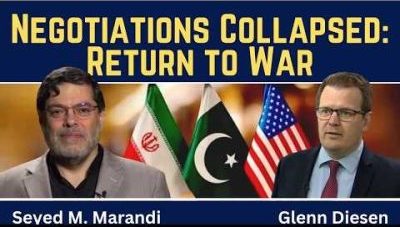
Seyed M. Marandi: Negotiations Collapsed – Return to War
or go to
Aletho News Archives – Video-Images
From the Archives
The US-Iran Scenario That Most Scares Israel
By Ali Haydar | Al-Akhbar | October 9, 2013
Israeli Prime Minister Benjamin Netanyahu issued a series of threats toward Iran and its interlocutors in the West, including the US, as serious negotiations on Iran’s nuclear program seem more plausible.
As a possible rapprochement looms between the US and Iran, Netanyahu has attempted to impose impossible Israeli conditions on the negotiators, such as the full dismantling of Iran’s nuclear program, not to mention threatening military force.
Whatever the deal that could materialize between Iran and the West, Israel is going to find itself before an open-ended path. One can foresee three possible scenarios… continue
Blog Roll
 Aletho News
- UK, Spain reject Trump’s new scheme to blockade Hormuz Strait
- Russian frigate ‘resurfaces’, chases off NATO pirates days after Kiev ‘sank’ it
- Ukraine Targets Russian Merchant Fleet With NATO Intel Support – Presidential Aide
- Russia’s ‘shadow fleet’ makes mockery of UK naval power
- Ukraine plans to attack Russian ships with Norwegian support
- US’s ‘Very Foolish’ Double Blockade of Hormuz Strait Makes Absolutely No Sense: Here’s Why
- China issues rules on countermeasures against foreign states’ unlawful extraterritorial jurisdiction
- Seyed M. Marandi: Negotiations Collapsed – Return to War
- Tomorrow’s naval blockade showdown
- ‘Israel’ attacks civilians to hide its embarrassing military failures & out of pure sadism
- If Americans Knew
- Israeli prison authorities are blocking hundreds of solidarity postcards being sent to female Palestinian prisoners
- ‘I wished for death’: Sexual violence in Israel’s prisons is an ‘organized state policy’
- Israeli army shoots, kills 9-year-old girl in her Gaza classroom
- Israel is attacking Lebanon to sabotage the Iran ceasefire, but the media is hiding its true motivation
- Israel’s restriction of aid into Gaza leads to critical shortages in bread, baby formula, and water
- Critical shortages in Gaza, Lebanon in ruins, “piracy” in Iran – Daily Update
- US-Iran ceasefire negotiations make zero progress – Daily Update
- Pro-Israel ‘Thinktanks’ and Individuals who Influence U.S. Foreign Policy
- Mearsheimer reveals how Israel dictates US policies on Iran, Gaza – video
- After killing 350+, Israel still has a “score to settle” with Lebanon before ceasefire – Daily Update
- No Tricks Zone
- Cave Discovery Reveals Today’s Desert Climates Were Recently Far Warmer, Wetter, Teeming With Life
- German Expert: Heat Dome Led To Record Temps In Western USA…Warmer In 1934, 1936
- New Study: No Linear Warming Or Glacier Retreat Along Northern Antarctic Peninsula Since 1980s
- An Inconvenient Tree: Uncovered In Alps… Europe Much Warmer Than Today 6000 Years Ago
- New Study Reports A 60% Slowdown In Greenland’s Ice Loss Rate In The Last Decade
- Low Intensity Tornado Wrecks Major Solar Farm, Creating A Potential Toxic Dump
- New Study Finds Warming Saves Lives…Cold Temperatures 12 Times More Deadly Than Excess Heat
- German Science Blog Accuses PIK Climate Institute Of Hallucinating Climate Tipping Points
- Devastating Assessment Of Comirnaty Vaccine By Former Senior Pfizer Europe Toxicologist
- New Study: CO2 Is ‘Effectively Negligible’ As An Explanatory Climate Change Factor Since 2000
 Aletho News