Iraqi politicians demand probe into reported visits to Israeli-occupied territories
Press TV – January 10, 2019
A reported visit to the Israeli-occupied territories by several Iraqi lawmakers has sparked a wave of condemnations from the Arab country’s political leaders, with some of them demanding a probe to identify those who crossed a “red line.”
Israel’s Foreign Ministry announced on Sunday that three Iraqi delegations had secretly visited the occupied territories in 2018.
The ministry said the 15 Iraqi dignitaries had visited “Israeli officials and universities,” as well as the Holocaust memorial in Jerusalem al-Quds.
The report did not identify any members of the Iraqi delegations, nor did it specify with which Israeli officials they had held talks. It said the most recent of the visits was in December.
According to Baghdad al-Youm website, Nasr al-Shammari, deputy secretary-general of Iraq’s Islamic Resistance Movement (al-Nojaba) said in case the report is proved to be true, those who visited the occupied territories should be punished.
The Foreign Relations Committee of Iraq’s parliament also said the Israeli report was aimed at “creating sedition in the country.”
Furat al-Tamimi, a member of the committee, said the issue will be discussed in the upcoming meeting between the parliamentary committee and the foreign ministry, according to Iraq’s Arabic-language al-Sumeriyah news channel.
If the trip has taken place, al-Tamimi said, the responsibility for this issue lies with the security departments, particularly the national security.
Meanwhile, prominent politician and leader of Iraq’s al-Qarar Coalition Athil al-Nujaifi denied reports that he had been among those who visited the occupied territories.
The report first drew strong reaction from First Deputy Speaker of Iraqi Parliament Hassan Karim al-Kaabi, who said in a statement on Monday that “To go to the occupied territory is a red line, and an extremely sensitive issue for all Muslims.”
He also called for “an investigation… to identify those who went to the occupied territory, particularly if they are lawmakers.”
Iraq does not formally recognize Israel, and Baghdad and Tel Aviv are technically still at war.
Iraq Not Obliged to Abide by US anti-Iran sanctions: FM
Al-Manar | January 3, 2019
Iraq’s Foreign Minister Mohammed Ali al-Hakim, said his country is “not obliged” to abide by unilateral US sanctions against Iran, adding that Baghdad is seeking ways to bypass those sanctions and continue trade with Tehran.
“These sanctions, the siege, or what is called the embargo, these are unilateral, not international. We are not obliged [to follow] them,” al-Hakim said, speaking to a gathering of journalists on Wednesday.
He said a number of “possibilities” had been suggested that could keep trade routes open with Iran, “including dealing in Iraqi dinars in bilateral trade,” and creating a fund for payments to Iran.
Following the re-imposition of unilateral sanctions on Iran in early November, the US gave Iraq a 45-day waiver for imports of gas from Iran, and extended the waiver for 90 days in December. Iran also provides around 40 percent of Iraq’s electricity needs.
The current level of annual bilateral trade between Iran and Iraq amounts to $12 billion, with a target to raise that figure to $20 billion in the near future.
Trump’s Holiday Gift to America: Hope for a Little More Peace on Earth?
By Thomas L. Knapp | Garrison Center | December 27, 2018
In March, US president Donald Trump promised the American public that US troops would be leaving Syria “very soon.”
Nine months later, he threw Washington’s political establishment into turmoil by finally ordering the withdrawal he’d promised. Politicians like US Senator Lindsey Graham (R-SC), who’d never once in four years bestirred themselves to authorize the previous president’s decision to go to war there in the first place, railed against Trump’s decision to bring the bloody matter to a close.
Instead of backing down in the face of opposition, Trump doubled down. Or, rather, decided to draw down the 17-year-long US military presence in Afghanistan.
Then he jetted off for a surprise Christmas visit to Iraq … eliciting, with his usual theatrics, calls from Iraqi lawmakers for US withdrawal from THAT country. I suspect he may concede to that demand as well.
Nothing’s written in stone, and both US foreign policy and Donald Trump are prone to sudden and unexpected turns. But the holiday season is a time of hope. Maybe, just maybe, nearly three decades of US war in the Middle East are coming to the beginning of their end.
Adding to that hope, let’s turn an eye further east.
After significant saber-rattling and then a sudden turn toward personal diplomacy, Trump stood back and let events on the Korean peninsula take their course even as he continued the bellicose rhetoric and sanctions noises demanded of him by Graham and company.
As a result, North and South seem on the brink of ending a 68-year war. They’ve begun removing land mines and guard posts along the Demilitarized Zone. They’ve broken ground on a railway connecting the two countries.
Is it possible that Trump, as some of his supporters like to say, has been playing 4D chess while the rest of us distracted ourselves with checkers?
I’d really like to think so, and I do hope so.
As an advocate for ending US military adventurism, I’ve doubted Trump every step of the way. During his presidential campaign, he alternated between talking peace and pronouncing himself the most militaristic of the GOP’s presidential aspirants.
I’ve generally found it safer to believe the worst, rather than the best, things politicians say about themselves. But at moments like these, his bizarre zigs and zags on the global 4D chess board suddenly seem in retrospect to have taken American foreign policy in the right direction.
If he brings home substantial numbers of the American fighting men and women now in harm’s way around the globe, he will have secured his legacy and deserve the thanks of a grateful nation. I wish him every success in that endeavor.
Peace on Earth, goodwill toward men, and Happy New Year.
Psychoanalysing NATO: The Diagnosis
By Patrick ARMSTRONG | Strategic Culture Foundation | 21.12.2018
In previous essays I argued that NATO tries to distract our attention from its crimes by accusing Russia of those crimes: this is “projection“. NATO manipulates its audience into thinking the unreal is real: this is “gaslighting“. NATO sees what it expects to see – Moscow’s statements that they will respond to medium range missiles emplaced next door are re-jigged as the “threats” which justify NATO’s earlier act: this is “confirmation bias“. And, finally, NATO thinks Russia is so weak it’s doomed and so strong that it is destroying the tranquillity of NATOLand: this is a sort of geopolitical “schizophrenia.” (I must acknowledge Bryan MacDonald’s marvellous neologism of Russophrenia – a condition where the sufferer believes Russia is both about to collapse, and take over the world.)
I wrote the series partly to amuse the reader but with a serious purpose as well. And that serious purpose is to illustrate the absurdities that NATO expects us to believe. NATO here being understood as sometimes the headquarters “international staff”, sometimes all members in solemn conclave, sometimes some NATO members and associates. “NATO” has become a remarkably flexible concept: Libya was a NATO operation, even though Germany kept out of it. Somalia was not a NATO operation even though Germany was in it. Canada, a founding NATO member, was in Afghanistan but not in Iraq. Some interventions are NATO, others aren’t. The NATO alliance today is a box of spare parts from which Washington assembles its “coalitions of the willing“. It’s Washington’s beard.
NATO and its members are inexhaustible sources of wooden language and dishonesty. Take Washington’s demand that Iran get out of Syria while US forces stay there. Syria has a recognised government, that government invited Iran in; no one invited the USA and its minions in. A child could see the upside down nature of this: it’s a housebreaker demanding the host evict the guests and hand over their bedrooms. This, apparently, is what NATO calls the “rules-based order“. Here’s the American official insisting it’s all legal: “our forces are there under a set of legal and diplomatic documents… “; but he only mentions one and it’s an American one. Putin is condemned for saying “Whatever action a State takes bypassing this procedure are illegitimate, run counter to the UN Charter and defy international law“. We are expected to solemnly nod our heads rather than contemptuously laugh when unilateralism is meretriciously named “rules-based”. These inversions of reality are routinely fed to us by NATO and its mouthpieces.
A very recent revelation of NATO’s gaslighting is the Integrity Initiative (such a gaslighting name!) busy trolling away with a couple of million from the British taxpayer. Its remit, apparently, includes infiltrating political movements of an ally and it “defends democracy against disinformation” by smearing its own political actors with disinformation. Does Russia do this? Well there’s RT and Sputnik and “Russians” did spend nearly $5000 on Google and $7000 on Facebook fixing the US election. And almost one dollar on Brexit ads. And one should never forget the insidious effect of Masha and the Bear. But don’t dare laugh at these preposterous assertions: the BBC earnestly assures us that humour is Putin’s newest weapon. Against this mighty effort, there can be no vigilance too strong! The only way to protect our values is to trash them: defend freedom of thought by secretly planting fake stories, defend democracy by smearing the opposition as Russian stooges. Pure gaslighting, defended by projection and confirmation bias: “This kind of work attracts the extremely hostile and aggressive attention of disinformation actors, like the Kremlin and its various proxies“.
NATO hyperventilates about “Russia’s military activities, particularly along NATO’s borders“. Only in NATO’s counterfeit universe could this be imagined; in the real world Russia’s military is inside its own borders. Once again, the proper response is a contemptuous sneer rather than solemn head nodding.
NATO collectively and severally manifests a detachment from reality. Its website is full of pious assertions about being a defensive alliance that brings stability wherever it goes, replete with valuable values. And it always tells the truth. The reality? No rational person would regard Moscow’s concern about a military alliance creeping ever closer as “aggressive”. There is less stability in Libya, Iraq and Afghanistan than before NATO entered them. Fooling around in Yugoslavia, Georgia and Ukraine have sparked actual shooting wars. NATO’s activities in Syria (illegal by any standards of international law, be it remembered) have not brought stability. More civilians killed, Raqqa obliterated, hospitals methodically destroyed. All “tragic accidents” of course; but don’t look here! look at Russia! Only in its imagination is NATO a bringer of stability. As to its values, they’re mutable – it’s good to break up Yugoslavia, invade Iraq and Afghanistan and destroy Libya but Crimeans taking the opportunity to return to Russia is a heinous crime. NATO’s so-called values are whatever NATO does. And as to NATO’s promises: well it did expand, didn’t it? (Here’s NATO’s official weasel-wording: “Personal assurances from individual leaders cannot replace Alliance consensus and do not constitute formal NATO agreement”. And suddenly its narrative jumps to President Clinton. Wrong POTUS, actually; NATO’s caught gaslighting again.) Its intervention in Libya was very far from what the UN resolution approved: it was an armed intervention against the government on false pretences.
Here’s what NATO’s so-called “stability projection” has actually produced: riots in France, partly connected with the influx of “migrants” coming from the Libya that NATO destroyed. But, we are supposed to believe it has nothing to do with NATO, it’s Putin! Only an idiot could believe that.
NATO had a purpose when it was formed, or at least it thought it did. It is true that, at war’s end where the Soviet Army stood “elections” were held and socialist or communist parties came to power and stayed in power. (Austria being an exception). There were at least two ways that one could understand this extension of Soviet power. One was that they were the actions of an expansionist hostile power that fully intended to go all the way to Cape Finisterre if it could and, if not prevented, would. In such a case the Western Allies would be fully justified in forming a defensive alliance to deter Soviet expansion. Another possible interpretation was that, after such a hard victory in so fearfully destructive a war, Moscow was determined that never again would its neighbours be used as an assembly area and start line for the forces of another Hitler. Such an interpretation would call for quite another approach from the Western Allies. We all know which of the two interpretations was followed. I have speculated elsewhere that Reinhard Gehlen may have had a strong influence on that decision. But, for whatever reason, the NATO alliance was founded on that first assumption and it shaped the world in one direction rather than another.
Since the USSR broke up, taking with it NATO’s original raison d’être, NATO members, sometimes under the NATO flag and sometimes not, have helped break up Yugoslavia and Serbia, invaded Afghanistan, Iraq (twice), Syria, destroyed Libya, incited a war in Georgia, carried out a coup d’etat in Ukraine and participated in the civil war there. That’s not stability. And, where NATO has set foot, it stays. KFOR is still bringing “peace and stability” in Year 19 and Kosovo is home to a huge US base. Afghanistan is in Year 17. Iraq is in Year 15. Syria is Year 7 and set to run forever. Ironically Latvians, Estonians and Lithuanians are back in Afghanistan; different flag, same place. That’s not stability either.
And still the wooden language rolls out. But turn off your brain when you read it.
POLITICAL – NATO promotes democratic values and enables members to consult and cooperate on defence and security-related issues to solve problems, build trust and, in the long run, prevent conflict.
MILITARY – NATO is committed to the peaceful resolution of disputes. If diplomatic efforts fail, it has the military power to undertake crisis-management operations. These are carried out under the collective defence clause of NATO’s founding treaty – Article 5 of the Washington Treaty or under a United Nations mandate, alone or in cooperation with other countries and international organisations.
Has post-USSR NATO ever peacefully resolved a dispute? Anywhere? Any time? It’s always military power. What did Article 5 (an attack on one is an attack on all) have to do with NATO’s war on Libya? Did it attack one of them? How about Serbia? One can (fraudulently) argue that someone in Afghanistan attacked the USA but who did in Iraq? As to “democratic values”, well, it will be amusing to watch NATO’s reactions to Ukraine President Poroshenko trying to avoid the election. And nobody likes to mention the pack of organ harvesters and drug runners NATO gave a whole country to.
If NATO were a human individual on the couch, a case could be made that it is living in a fantasy world in which everything is reversed.
Woe unto them that call evil good, and good evil;
that put darkness for light, and light for darkness;
that put bitter for sweet, and sweet for bitter!
Delenda NATO est!
Iraqi fighters: Hezbollah not to be left alone in war
Press TV – December 15, 2018
An Iraqi anti-terror paramilitary group has pledged to stand by Hezbollah in the event of a war following recent Israeli operations near the Lebanese border.
“In the event of any war against Hezbollah, the movement is not going to be alone,” Harakat Hezbollah al-Nujaba spokesman Hashim al-Mousawi told Iran’s Tasnim news agency on Friday.
The group, simply known as Nujaba, is part of Hashd al-Sha’abi which is an umbrella counter-terrorism force gathering volunteer fighters from Iraq’s various ethnic groups, including Shias, Sunnis and Christians.
In the event of an attack on Lebanon’s Hezbollah, “all, including Nujaba, will be standing by its side,” Mousawi said.
Israel has recently launched an operation to destroy what it claims tunnels dug by Hezbollah into the occupied territories.
Israeli Prime Minister Benjamin Netanyahu on Tuesday warned that Hezbollah would be dealt “unimaginable blows” if it confronted the operation.
Hezbollah’s deputy secretary general Sheikh Naim Qassem warned last week that there is no spot across Israel outside the range of the Lebanese resistance movement’s missiles.
“Israel is not capable of confronting Hezbollah’s missiles. The Palestinian resistance is also advancing day by day. The resistance’s missile power is increasing,” Mousawi said.
He said a recent botched intelligence operation in the Gaza Strip in which a ranking Israeli officer was killed in clashes with Palestinian fighters showed Israel’s “obvious incapability.”
The incursion saw Hamas and other Palestinian resistance groups fire nearly 500 rockets into Israel during a two-day flare-up, forcing Tel Aviv to accept a hasty declaration of a ceasefire.
’US destabilizing Iraq-Syria border’
Al-Mousawi also said the United States is trying to create instability on the Iraqi-Syrian border by keeping the corridors used by terrorists open.
Washington, he said, keeps supporting terrorists along the passageways leading from its military base at the hugely-strategic al-Tanf border crossing.
The crossing lies at the intersection of Iraqi, Syrian, and Jordanian borders as well as the Wadi Hauran valley in the western Iraqi Anbar Province, where the US has built a sprawling military base.
Thousands of militants are trained at the base with the ultimate goal of toppling the government of President Bashar al-Assad.
“The US does not seek Daesh’s defeat and elimination. It seeks to keep Daesh as part of its international plans to target any country that opposes its policies,” Mousawi said.
“Daesh is a recruit and employee of the United States which uses the group for its special plans,” he added.
The Nujaba spokesman touched on the Syria developments, saying the US is “the main obstacle” to the Syrian army’s liberation of the last major terrorist bastion in the northwestern Idlib Province.
Idlib holds the largest concentration of militants and Takfiri terrorists, where Russia and Turkey have created a buffer zone to help end the violence there after the US prevented Syria from taking back the province.
Mousawi said the US is exploiting terrorist and armed groups depending on its own interests, adding whenever Washington perceives a political resolution is near, it resorts to obstructive efforts and stonewalling right away.
The US, he said, is pursuing its own political agenda in Syria, but American forces will not be able to remain in the country forever.
US Destabilizes Iraq for Decades, US House of Representatives Has New Plan for Stabilization
By Adam Dick – Ron Paul Institute – November 28, 2018
The United States attacked Iraq in the Gulf War in 1990, followed by years of US bombing of Iraq. Then, in 2003, the US invaded and conquered Iraq in the Iraq War. Since then, many US troops have been stationed in Iraq, along with a huge contingent of US government employees and contractors from a variety of agencies, seeking to mold the country to US wishes. Still, 28 years since all this began (and longer since the previous US assistance for the Iraq government it later overthrew), the US House of Representatives approved on Tuesday a bill titled the Preventing Destabilization of Iraq Act (HR 4591).
The only way this bill title would make sense given the long history of massive US intervention failing to improve the situation in Iraq is if the bill required the end of US intervention. Instead, the bill seeks more intervention.
In particular, the Preventing Destabilization of Iraq Act calls on the US president to impose sanctions on any foreign people he determines knowingly commit “a significant act of violence that has the direct purpose or effect of — (1) threatening the peace or stability of Iraq or the Government of Iraq; (2) undermining the democratic process in Iraq; or (3) undermining significantly efforts to promote economic reconstruction and political reform in Iraq or to provide humanitarian assistance to the Iraqi people.” Further, the bill charges the US Secretary of State to determine if listed individuals should be sanctioned and if people connected to certain organizations should be considered terrorists or sanctioned. In other words, the bill calls for ramping up proven destructive policies for reshaping Iraq.
Also included in the bill is a call for action that would help push for escalating the US government’s destabilization project in Iran. The bill says the Secretary of State “shall annually establish, maintain, and publish a list of armed groups, militias, or proxy forces in Iraq receiving logistical, military, or financial assistance from Iran’s Revolutionary Guard Corps or over which Iran’s Revolutionary Guard Corps exerts any form of control or influence.” Thus, claims of Iran’s intervention in its neighboring country can be used to build the case for massive intervention in Iran, up to invasion and conquest of Iran, by a nation thousands of miles away. Not to worry, 28 years from now, the US Congress can approve a Preventing Destabilization of Iran Act.
Canadian woman continues to fight to obtain a passport

By Rick Sterling | Rabble | November 26, 2018
In the Fall of 2012, a young man from Calgary Alberta, Damian Clairmont, received a new Canadian passport. He received this despite the fact that Canadian Security Intelligence Service (CSIS) had been secretly monitoring Damian and several others in Calgary and knew the young men were planning to join an armed extremist organization in Syria. At least five youth from Calgary did travel to Syria and Iraq where they all died with one becoming a suicide bomber reportedly killing 46 Iraqis.
In a bizarre contrast, in the spring of 2016, the Canadian government forced Damian’s mother, Christianne Boudreau, to surrender her Canadian passport. This article examines the strange circumstances and seeming irrationality.
Christianne Boudreau Countering Extremism
Unlike her son, who had been indoctrinated then recruited to join a terrorist group, Christianne Boudreau has worked with other parents internationally to create and promote educational programs to counter extremism. She converted her grief at the loss of Damian to help educate others how to prevent the same thing happening again.
Dr. Daniel Koehler, Director of the German Institute on Radicalization and De-Radicalization Studies, described her role:
Christianne Boudreau was one of the first mothers to speak out publicly against violent radicalization with her own painful personal experience of losing her son Damian. Together with Christianne, I built up a network of affected parents around the world: the Mothers for Life Network, which currently includes about 150 families from 11 countries. It is the only international parental self-help group addressing the needs of those parents. I also trained Christianne to be a family counsellor to help other parents of children undergoing violent radicalization.
Mothers for Life works with the important goal of countering extremist ideology and violence which has exploded in the West as well as the Middle East. It uses human connections and sharing among families who have experienced radicalization, not just lectures and lofty seminars.
Christianne Boudreau has travelled and spoken at many places across Canada and internationally. She says the problem is not Islam or religion. A writer documented Chris’s visit to the Islamic Institute of Toronto in an article titled “Christianne Boudreau’s visit to Toronto left us inspired.” The writer reported:
Chris was asked, ‘Do you blame Islam and Muslims for the death of your son?’ Everyone held their breath. I couldn’t look her in the eyes. ‘No, I don’t blame Muslims or Islam for what happened to my son. I blame misguidance and bad choices. It is ideology similar to that of gangs and cults. It is the same. They prey on young impressionable adolescents and exploit them.
In addition to this organizational work, Chris Boudreau has been exceptional in another way: she has dared to criticize the intelligence security service of her native Canada. When CSIS agents first contacted her in January 2013 and told her they had been monitoring Damian for nearly two years, she asked why they had not warned her about his real intentions. Why did they not prevent him from getting a new Canadian passport?
CSIS “Research”
After Damian’s death in January 2014, Chris Boudreau said she thought CSIS had some responsibility for his actions and death. In May 2014 she wrote a letter to CSIS politely expressing her questions and complaints. “We as a family have a right to know what has happened, and how our system has failed us.” She described her efforts to get answers over the previous year, how a CSIS agents had asked her to stop speaking out and asking questions. Finally, almost one half year later, CSIS Director Michel Coulombe responded to Chris’ inquiries. He did not answer her specific questions yet concluded that “the Service acted professionally and within its legislated mandate.” Regarding the warning of a CSIS agent, Director Coulombe evaded the issue by saying,“We have found no indication of an attempt to interfere in your relationship with other parties.” Regarding the disturbing consequences of radical indoctrination and violence, Coulombe said that CSIS “is conducting research to better understand this phenomenon in Canada.” This “research” is small comfort to a woman whose son was misled into joining a violent terrorist group, perhaps killing innocent Syrians and being killed himself.
Canada Takes Away Christianne Boudreau’s Passport
Fifteen months later, in February 2016, Citizenship and Immigration Canada acted in a way which definitely restricted and interfered with “her relationship with other parties”. While Chris and her son Lucas were visiting family in France, the Canadian government ordered her to surrender her Canadian passport. Christianne and her son were stuck in France, dependent on the generosity of family, for the next eighteen months. Chris was without income or ability to return home. Finally in November 2017, when Lucas’ father was dying of cancer, the Canadian embassy in France provided temporary emergency documentation so that Chris and her son could return home to Calgary.
The Official Reason Canada Took Away her Passport
Chris Boudreau has tried repeatedly to get her passport back. The official reason it was taken away and cannot be returned is that she provided “false or misleading information” in the passport application for her son Lucas. The “false and misleading” information was that she did not include the name of Lucas’ father on the passport application and did not disclose court orders from 2004-2007 which had defined the father’s visiting rights with baby Lucas (born in 2004).
In fact, Ms Boudreau was never married to the father, they did not live together when Lucas was born and Lucas’ birth certificate did not include the father’s name because the father wanted no responsibility. The applications for Lucas’ previous passports in 2007 and 2010 were filled out just the same way with no question or objection by Citizenship and Immigration Canada. In addition, there was a court order and signed agreement between Ms. Boudreau and the father in January 2016 which confirmed a summer visit with the father.
Ironically, Lucas was unable to visit the father as specified because CIC took away the passports of him and his mother in the spring of 2016. Ms. Boudreau and Lucas were unable to return to Canada until November 2017 when they received emergency travel documents as the biological father was in a terminal stage of cancer.
“Very few people have been denied passports”
Ray Boisvert, former head of CSIS counter-terrorism was previously asked why CSIS did not prevent Damian Clairmont from receiving a passport if CSIS knew about his radicalization and intentions. Boisvert responded that denying a passport to a Canadian citizen was an infringement on freedom of movement and required solid evidence. “There have been very few people who have been denied passports because the threshold is so high. And rightfully so.”
If Boisvert’s assertion is true, then why has CIC acted so harshly against Christianne Boudreau? The violation in the passport application caused little or no harm. The complaint by the biological father was resolved in the January 2016 court order and agreement. This was not an issue of parental joint custody because Christianne Boudreau had been the sole parental custodian for Lucas since his birth.
Christianne Boudreau’s Effectiveness in Countering Extremism
This extreme decision is not only harming Christianne Boudreau and her children. It is also hurting the international campaign against extremism and violent radicalism.
Dr. Koehler, Director of the German Institute on Radicalization and De-Radicalization Studies says:
Christianne’s work depends on her ability to travel, meet with other parents, participate in workshops, educate about the threat of violent radicalization and help affected families around the world. She was a main driving force behind the Mothers for Life Network and her absence from these important activities have caused serious harm to global issue of helping families in need.
Dr. Amar Amarasingam, Senior Research Fellow at the Canadian Network for Research on Terrorism, Security and Society at University of Waterloo has said:
Since the loss of her son Damian, Christianne Boudreau has been tirelessly working to try and prevent other young men and women from traveling abroad to fight. She traveled around the world to meet with other parents and families, gave talks and conducted workshops. Especially now, with ISIS fighters and families being captured by Kurdish forces and parents in Western countries trying to get in touch with them, Chris’s activism is much-needed. She is trusted by families the world over and would be an invaluable resource today. I’m not too familiar with the particulars of her case, but her ability to travel is fundamental to her work and I hope it gets sorted out soon.
In 2016, as Christianne Boudreau was having her Canadian passport revoked, CBC produced a documentary describing her good work. The producer Gail McIntyre and director/writer Eileen Thalenberg have recently written:
Christianne Boudreau was the focus of our film, A Jihadi in the Family, which was broadcast on CBC – TV in 2016. Over a period of two years, we covered her important work as founder and driving force behind the movement Mothers for Life. This organization was set up to support families and to inform educators, the public and policy makers about the early signs of radicalization and how to prevent it. Her work in this area was far-reaching – uniting mothers in North America and Europe…. Without her passport, she is unable to continue with her high profile work. This not only impacts anti-radicalization efforts, it severely affects her ability to support her herself and her son.
Public Appeal to “Return Christianne Boudreau’s Passport!”
Chris Boudreau, born in Toronto, is still being denied a Canadian passport. She has the anguish of knowing her son died in a foreign land. She has the pain of not knowing what he might have done with others in the terrorist group. She has difficulty finding a job when employers easily see and identify her as the “jihadi’s mother”. She was punished and impoverished by being left in a foreign country without a passport for a year-and-a-half.
Why is Canada denying this woman her right to travel, guaranteed to all citizens under the Canadian Charter? Most importantly, why is Canada preventing this brave woman from continuing her effective work countering international extremism?
A petition to “Return Christianne Boudreau’s Canadian Passport!” has been launched and can be seen here.
Rick Sterling can be reached at rsterling1@gmail.com.
Iran, Iraq Can Ramp up Trade to $20bn: Rouhani
Al-Manar | November 17, 2018
Iranian President Rouhani said Saturday that the current economic transactions between Iran and Iraq stands at about $12 billion, which can be boosted to $20 billion with further cooperation.
President Rouhani made the remarks in a press conference with his Iraqi counterpart Barham Salih on Saturday in Tehran, which was held after their bilateral meeting earlier that day.
The Iranian president maintained that the two sides held talks on electricity and gas swap, as well as cooperation on petroleum products and oilfield exploration and extraction.
The Shalamcheh-Basra railway is ready to come on stream, and the Iranian side is ready to carry out its side of the project together with the help of measures taken by Iraq’s Ministry of Finance, said Rouhani, adding that the 35km-railway will facilitate transport for the people of both countries.
Rouhani said the two sides also talked about environmental issues, noting the dust storms in western and eastern borders that need joint cooperation to be resolved. He added that Iraqi President Barham Salih has vowed to follow up on those environmental issues.
We reached an agreement to establish a free trade zone between the two countries, Rouhani added.
He further maintained that the two sides conferred on regional issues, saying the two believed that stability and security in the region will benefit all people, and there is no need for foreign interference in regional affairs.
The Iraqi president, for his part, highlighted that Iraq would never forget Iran’s support in defeating terrorism in the country.
After the military defeat of ISIL, Iraq has ahead of itself the two important objectives of ‘reconstruction’ and ‘strengthening of political stability’, he added.
President Salih maintained that the realization of these two goals requires political and economic measures and reforms, as well as stable conditions in the region.
It is time for the formation of a new regional order which can be in the interest of all regional states, President Salih stressed, adding that Iraq attaches high significance to Iran’s role and place in this new regional order.
He further voiced hope that the implementation of joint projects such as railway connections between Iran and Iraq could provide the necessary condition for Iraq to play a more active role in the region, and allow other countries in the region to form relations based on mutual interests.
US Budgetary Costs of the Post-9/11 Wars: $5.9 Trillion Spent and Obligated
Through FY2019
By Prof. Neta C. Crawford | Watson Institute, Brown University | November 14, 2018
The United States has appropriated and is obligated to spend an estimated $5.9 trillion (in current dollars) on the war on terror through Fiscal Year 2019, including direct war and war-related spending and obligations for future spending on post-9/11 war veterans (see Table 1).
This number differs substantially from the Pentagon’s estimates of the costs of the post-9/11 wars because it includes not only war appropriations made to the Department of Defense – spending in the war zones of Iraq, Syria, Afghanistan, Pakistan, and in other places the government designates as sites of “overseas contingency operations,” – but also includes spending across the federal government that is a consequence of these wars. Specifically, this is war-related spending by the Department of State, past and obligated spending for war veterans’ care, interest on the debt incurred to pay for the wars, and the prevention of and response to terrorism by the Department of Homeland Security.
If the US continues on its current path, war spending will continue to grow. The Pentagon currently projects $80 billion in Overseas Contingency Operations (OCO) spending through FY2023. Even if the wars are ended by 2023, the US would still be on track to spend an additional $808 billion (see Table 2) to total at least $6.7 trillion, not including future interest costs. Moreover, the costs of war will likely be greater than this because, unless the US immediately ends its deployments, the number of veterans associated with the post-9/11 wars will also grow. Veterans benefits and disability spending, and the cost of interest on borrowing to pay for the wars, will comprise an increasingly large share of the costs of the US post-9/11 wars.
Table 1, below, summarizes the direct war costs – the OCO budget – and war-related costs through FY2019. These include war-related increases in overall military spending, care for veterans, Homeland Security spending, and interest payments on borrowing for the wars. Including the other areas of war-related spending, the estimate for total US war-related spending allocated through FY2019 is $4.9 trillion.[3] But because the US is contractually and morally obligated to pay for the care of the post-9/11 veterans through their lifetimes, it is prudent to include the costs of care for existing post-9/11 veterans through the next several decades. This means that the US has spent or is obligated to spend $5.9 trillion in current dollars through FY2019.[4] Table 1 represents this bottom-line breakdown for spent and obligated costs.
Table 1. Summary of War Related Spending, in Billions of Current Dollars, Rounded to the Nearest Billion, FY2001- FY2019[5]

Figure 1. US Costs of War: $5.9 Trillions of Current Dollars Spent and Obligated, through FY2019[10]
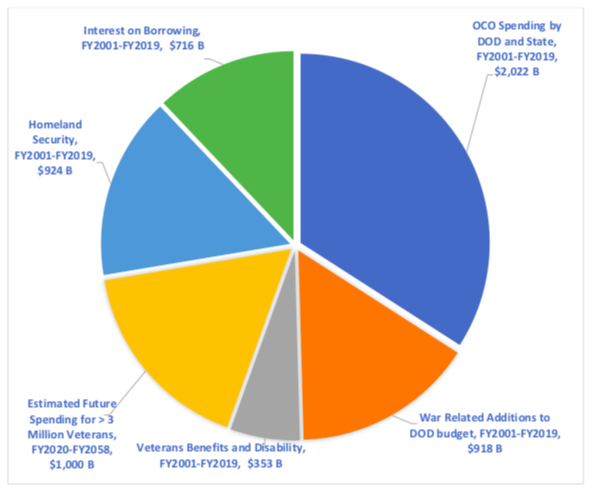
Further, the US military has no plans to end the post-9/11 wars in this fiscal year or the next. Rather, as the inclusion of future years spending estimates in the Pentagon’s budget indicates, the DOD anticipates military operations in Afghanistan, Pakistan, Iraq and Syria necessitating funding through at least FY2023. Thus, including anticipated OCO and other war-related spending, and the fact that the post-9/11 veterans will require care for the next several decades, I estimate that through FY2023, the US will spend and take on obligations to spend more than $6.7 trillion.
To read the full PDF report by Professor Neta C. Crawford, click here.
Featured Video
REDFIELD REWRITES THE RECORD
or go to
Aletho News Archives – Video-Images
From the Archives
Iran Delenda Est
By Stephen J. Sniegoski • Unz Review • July 25, 2019
After Carthage had been significantly weakened by Rome in the Second Punic War (218 to 201 BC), Cato the Elder, a leading Roman senator, is said to have ended all his speeches with the words: “Carthago delenda est!” (“Carthage must be destroyed!”). This destruction ultimately took place in the Third Punic War (149–146 BC). A somewhat similar situation exists today in the United States, where war hawks demand that Iran–which in no way could effectively attack the United States, or even conquer America’s Middle East so-called allies—be stripped of its ability to protect itself.
Of course, what makes the American situation different from ancient Rome’s is that Rome sought to eliminate Carthage for its own interests whereas the United States is largely acting to advance the military interests of Israel… continue
Blog Roll
Recent Comments
loongtip on Trump tells India to stop purc… eddieb on The Old Testament and the Geno… papasha408 on Trump’s war posturing against… Coronistan on This is How We Should Have Res… Coronistan on NO MANDATES, NO PROFITS: MODER… Lutz Barz on Russia Vows to Protect Its Oil… loongtip on Russia Vows to Protect Its Oil… loongtip on Hamas never agreed to lay down… eddieb on Conspiracy Denial eddieb on WEF Calls for ‘Cultural Revolu… loongtip on Trump wanted to play peacemake… Coronistan on EU member to sue bloc over ‘su…


 Aletho News
- REDFIELD REWRITES THE RECORD
- From Iraq war crimes to Gaza’s ‘board of peace’: Why Tony Blair belongs in The Hague
- Epstein email reveals plan to pursue frozen Libyan assets with help from former MI6, Mossad figures
- Trump tells India to stop purchasing Iran oil, buy Venezuelan instead
- How Trump’s Iran Gambit Could Blow Up the Entire Persian Gulf
- Rafah crossing reopens under strict Israeli restrictions
- The Attack on Pearl Harbor Was No Surprise (Part V)
- How Human Rights Watch Shattered Yugoslavia
- Hamas rejects Israeli accusations as “lies meant to justify its massacres in Gaza”
- Interior ministry: Israeli strike on police building in Gaza shows disregard for mediators
- If Americans Knew
- Israel killed at least 32 Gazans on Saturday – Not a ceasefire Day 114
- Is Israel opening the Rafah border to depopulate Gaza? – Not a ceasefire Day 113
- NBA Star Stephen Curry’s Ties To Israeli Military Intelligence
- ‘Apocalyptic wasteland’: Biden admin. blocked warning on deteriorating Gaza situation after Oct. 7
- Why Israeli counterterrorism tactics are showing up in Minnesota
- Israel Went to Extremes to Return Ran Gvili’s Body. Why Doesn’t It Accord Dead Palestinians the Same Respect?
- Across the West, speaking for Palestine is now a crime
- A West Bank Bus Trip Through ‘the Best Documented Ethnic Cleansing in History’
- Mike Huckabee’s distorted theology does not speak for Christians worldwide
- CBS Evening News” With Tony Dokoupil Is Ellisons’ & Weiss’s Pro-Israel Show
- No Tricks Zone
- One Reason Only For Germany’s Heating Gas Crisis: Its Hardcore-Dumbass Energy Policy
- 130 Years Later: The CO2 Greenhouse Effect Is Still Only An Imaginary-World Thought Experiment
- New Study Affirms Rising CO2’s Greening Impact Across India – A Region With No Net Warming In 75 Years
- Germany’s Natural Gas Crisis Escalates … One Storage Site Near Empty …Government Silent
- Polar Colding…Antarctica Saw Its Coldest October In 44 Years!
- New Study: Sea Levels Rose 20 Times The Modern Rate During The Roman Warm Period
- As German Gas Storage Dips Dangerously Low…Shortage Hardly Avoidable
- New Study: Brazil’s Relative Sea Level Was 2+ Meters Higher And SSTs 3-4°C Warmer 6000 Years Ago
- Philosopher Schopenhauer: Climate Science Certainty Stems From Stupidity, Ignorance
- New Study: Species Extinction Rates Declining Since 1980 – ‘Climate Change Is Not An Important Threat’
 Aletho News