A US-Iran confrontation is just what Israel seeks – and it may get
By M K Bhadrakumar | Indian Punchline | June 18, 2017
The move by the US military to shift for the first time the High Mobility Artillery Rocket System (HIMARS) into Syrian territory from Jordan signifies that the Pentagon has created a new fact on the ground. According to the CNN, the deployment will be in the military base in Al-Tanf near Syria’s border with Iraq in the south-eastern region, which is currently an area of contestation between US-backed rebel groups and Syrian government forces.
A Russian Defence Ministry statement in Moscow on Thursday noted that the deployment might suggest a US intention to attack the Iran-backed Syrian government forces. The Russian statement said:
- The range of the High Mobility Artillery Rocket System is not enough to support the US-backed units… in Raqqa. At the same time, the US-led anti-terrorist coalition has several times attacked the Syrian government forces near the Jordanian border, so it can be assumed that such attacks will continue, but this time involving the High Mobility Artillery Rocket Systems.
Indeed, such authoritative Russian statements, even while speculative, must be relying on intelligence inputs. Clearly, the US intentions need to be interpreted. One possibility could be that it might actually be a defensive move. The US has so far counted on other protagonists – government forces, Hezbollah, Iran, Turkey and Russia – to exercise absolute self-restraint in not confronting the American forces. This tacit understanding (or pragmatism on both sides) largely worked well so far. Although, US-Russia relations continue to deteriorate, the ‘de-confliction’ arrangement in Syria has worked well so far.
However, war is war and there is nothing like a bit of self-help in such uncertain times. The point is the HIMARS provides an alternate means to hit the adversary if air operations are not feasible for some reason – or is simply a preferable option. From all appearances, the US reportedly has plans to create military bases in southern Syria (similar to what it has done in the northern regions bordering Turkey and Iraq) and, if so, the deployment of HIMARS fits into the plan.
Suffice to say, it all boils down to the big question: What are, going ahead, the Trump administration’s politico-military intentions in Syria? At a press briefing in Baghdad on June 7, Brett McGurk, US Special Presidential Envoy for the Global Coalition to Counter ISIS, maintained that the US military presence in and around Al-Tanf (near Syrian-Iraqi border) is purely temporary. While explaining the rationale for the recent US attacks on the Syrian government forces in that area, McGurk claimed that the US mission is to fight the ISIS in Syria and “when the fight against Daesh is over, we won’t be there.” But then, one thing that the Qatar crisis has shown is that the Trump administration can be diabolical.
On the other hand, Syrian government forces are interested in regaining control of their country’s border with Iraq. President Bashar Al-Assad has repeatedly insisted that he intends to regain control of the whole of Syria. And there are sufficient indications that the Syrian government forces are being deployed to regain the vast, vacant, lawless spaces in eastern Syria bordering Iraq. This Syrian military thrust has been interpreted by some commentators as aimed at opening a land route across Iraq all the way to Iran through which Tehran can beef up Hezbollah. The assumption here is that a 1000-kilometre long land bridge connecting Damascus with Tehran (via al-Tanf and Baghdad) serves the purpose.
A commentary by the Brussels-based think tank European Council on Foreign Relations – US must avoid a war with Iran in eastern Syria – cautions the Trump administration that it is bound to lose in any rivalry with Iran over control of the Syrian-Iraqi border. However, Israel is betting on a US-Iranian conflagration and it remains to be seen how far the Trump administration can withstand the pressure from the Jewish lobby.
Meanwhile, latest reports suggest that Iraqi government forces and Sunni fighters have taken control of the border crossing near Al-Tanf inside Iraq (known as al-Waleed border crossing). A Reuters report has interpreted this development as in effect “preventing Iranian-backed forces supporting Syrian President Bashar al-Assad from receiving heavy weaponry from Iran by using the main highway between Iraq and Syria.” Quite obviously, a US-Iranian contestation is building up in southern Syria.
In sum, Israel might be getting what it seeks, but it is another matter altogether whether it is going to like the final outcome of the struggle between the US and Iran over control of southern Syria near Golan Heights. It is improbable that Iran will give up the ‘axis of resistance’ because it is ultimately about Iran’s own defence. Read an incisive analysis by the Middle East Eye on the joint Israeli-US game plan to work in tandem with ISIS to pile pressure on Iran to pull back from the Syrian and Iraqi theatres — The CIA and Islamic State: Iran’s twin threats.
Russia warns US against attacks on Syrian forces
By M K Bhadrakumar | Indian Punchline | June 12, 2017
Diplomats dissimulate, journalists exaggerate, politicians waffle, but an army general has no reason to obfuscate the stark ground reality. Therefore, the rare remarks by the commander of Russian forces in Syria, General Sergey Surovikin, merit great attention. Excerpts are reproduced below:
- The US-led coalition lets militants of the Islamic State terrorist group leave Raqqa instead of killing them… The US-led coalition enters into collusion with ringleaders of the ISIS, who give up their settlements without fighting and head to the provinces where the Syrian government forces are active… The Russian force in Syria sees in the Raqqa area militants leaving the city and its suburbs unhindered. In early June, ISIS terrorists left the populated localities 19 kilometers southwest of Raqqa offering no resistance and headed toward Palmyra.
- The Americans are using ISIS to robustly block the movement of government troops… The aviation of the US-led coalition is impeding the struggle of Syrian government forces against terrorists… They have blocked the way of government forces, who are eliminating ISIS militants and setting up border posts along the border with Iraq to the north-east of Al-Tanf.
The long and short of Gen. Surovikin’s chilling account is that although President Donald Trump vows to fight the ISIS with tooth and nail, Pentagon guys may have other ideas. They continue to use the ISIS with a hidden agenda where the Syrian government (and Iran) is the number one enemy. The US objective appears to be two-fold in Syria: a) create a buffer zone in southern Syrian regions bordering Israel and Jordan, which will be dominated by “good terrorists”; and, b) take control of the entire Syrian-Iraqi border on a North-South gradient so that Iran’s logistical capability to render help to the beleaguered Syrian government forces is sharply reduced.
Indeed, a ‘frozen conflict’ would effectively balkanize Syria. The Washington Institute for Near East Policy, a think tank which is closely associated with the American-Israel Public Affairs Committee (a pro-Israel lobby group in Washington), featured a commentary recently, entitled Growing Risk of International Confrontation in the Syrian Desert. It implicitly warns Moscow of dire consequences if Russian forces intervene to disrupt the efforts by the US to prevent a Syrian government consolidation in the Al-Tanf / Deir Ezzur — Palmyra region.
However, no matter what the pro-Israeli think tankers in Washington pontificate, General Surovikin’s remarks underscored that Moscow is seized of the strategic importance of the Syrian government forces succeeding in re-establishing control over the country’s border with Iraq. Russia had earlier adopted a wary approach vis-a-vis the scramble for control of the Syrian desert regions bordering Iraq. But that seems to be changing — although Russian priority is to work with the Americans.
On Saturday, Russia has put the US on notice that the Syrian government forces intend to advance on Al-Tanf itself. The Russian Foreign Minister Sergey Lavrov told US Secretary of State Rex Tillerson that US air strikes on the Syrian government forces are unacceptable. He called for “concrete measures to prevent similar incidents in the future.”
A Syrian army statement went a step further to announce on Saturday their intent to advance to the Iraqi border north of Al-Tanf. It warned the western forces in the area against interfering — “The general command of the army and armed forces warn of the risks of repeated attacks of the so-called ‘international coalition’ and their efforts to block the advances of the Syrian Arab Army and its allies in their war on terror.”
The planned Syrian operations north of Al-Tanf will scuttle the US plans to stage a ground operation with “good terrorists”, aimed at reaching Deir Ezzur city ahead of the government forces who are advancing in easterly direction from Palmyra. The Iranian reports suggest that Russian jets are actively backing the Syrian government operations in the region to the northeast of Palmyra.
Simply put, Iran is creating new facts on the ground in southeastern Syria, which the US (and Israel) will have to learn to live with. An Iranian war dispatch says that “thousands of (Syrian) army men and Hezbollah combatants entered the countryside of Palmyra city to resume a fresh phase of one of the army’s greatest operation in Homs (province) in recent years.”
Congressman Praises ISIS Attack in Iran, Suggests US Should Support Terrorism
By Darius Shahtahmasebi – ANTIMEDIA – June 12, 2017
Following a recent ISIS attack in Iran in which at least 12 people were killed, a GOP lawmaker has suggested the attack could be a “good thing,” even indicating that the U.S. government should support ISIS in its attacks on other groups.
“As far as I’m concerned, I just want to make this point and see what you think; isn’t it a good thing for us to have the United States finally backing up Sunnis who will attack Hezbollah and the Shiite threat to us?”
“Isn’t that a good thing?” Rohrabacher said. “And if so, maybe this is a Trump — maybe it’s a Trump strategy of actually supporting one group against another, considering that you have two terrorist organizations.”
Thankfully, some sane voices emerged to express dissent. Matthew Levitt, the director of the Washington Institute’s Stein Program on Counterterrorism and Intelligence, stated the following in response:
“It’s never in our interest to support a terrorist group like the Islamic State… We should condemn the attacks in Tehran, as we would condemn any act of terrorism, even as we hold Iran accountable for its sponsorship of terrorism.”
“So that’s like Joe Stalin was a horrible guy, we must never associate with horrible guys like that, even against Hitler,” Rohrabacher replied. “And so maybe it’s a good idea to have radical Muslim terrorists fighting each other. I’ll leave it at that.”
The United States security apparatus has made it abundantly clear that even voicing support for a known terrorist outfit is a very serious criminal offense – but apparently not if you are one of the nation’s lawmakers.
If Rohrabacher’s words are to be adopted into official policy, then Western countries should seriously consider accepting ISIS-inspired attacks on their own soil considering the U.S. continues to support the terror group in numerous ways. For example, a Russian general just accused the U.S. of colluding with ISIS to allow their fighters safe passage out of Raqqa, something that seemed to be the case in the Iraqi city of Mosul, as well. The U.S. also routinely attacks Syrian government-aligned fighters currently — and effectively — battling the Islamic State. America is cozying up to Saudi Arabia, providing the radical nation with billions of dollars in arms even though Hillary Clinton’s leaked emails show Saudi Arabia is one of the direct sponsors of ISIS.
As the Trump administration pushes harder in its fight to confront Iran, expect ISIS to grow even more as a useful tool of American foreign policy strategy – and expect this to be welcomed even further by the establishment.
Bear in mind, though, that if you or I issued statements like Rohrabacher’s, we would be arrested (in some cases, the FBI might even give us weapons first, just to make our impending arrest that much more grandiose).
Syrian Arab Army takes control of Jordanian border
By Adam Garrie | The Duran | June 9, 2017
Fierce fighting with ISIS and US backed jihadists in southern Syria has been ongoing for months. In June, two convoys of Syrian and allied soldiers came under fire from US forces illegally operating in the desert areas of southern Syria near the borders with Iraq and Jordan.
Today, the Russian General Staff announced that Syrian forces are now in full control of 105 kilometres of the border with Jordan. Jordan which for decades has been hostile to Syria has been an important passage for terrorists and illegal armed forces entering Syria.
The Russian General Staff who work closely with the Syrian Arab Army as part of the anti-terrorist coalition in the country issued the following statement as offered by Russian Col. Gen. Sergei Surovikin,
“As part of the advance of the Syrian army and militia on Daesh’s (ISIS) positions, the control over 105 kilometres of the Syrian-Jordanian border has been restored
The efforts of the government forces on establishing full control over the Syrian-Jordanian border and the border with Iraq continue”.
This not only will help seal off areas where militants can enter Syria but crucially it will send a clear message to the Jordanian armed forces that their presence will not be allowed nor tolerated in Syria.
‘Soft Coup’ on Trump, Hiding in Plain Sight
By Robert Parry | Consortium News | June 8, 2017
So what were we watching in ex-FBI Director James Comey’s testimony on Thursday: an upright public servant punished for resisting a power-mad President or a participant in a political scheme to use the law as a way to overturn a U.S. presidential election?
There was a general consensus in the mainstream media that it was the first, that Comey was the noble victim and President Trump the conniving villain. And, surely, Trump could be criticized for his clumsy firing of National Security Adviser Michael Flynn and ensuing expression of “hope” to then-FBI Director Comey that Flynn would not be punished further.
But – outside the view of the MSM – there are other troubling aspects of what is now unfolding, including the scene of FBI Director Comey informing President-elect Trump on Jan. 6 about a defamatory annex to an intelligence report detailing unproven but salacious allegations and then seeing those details leaked almost immediately to humiliate Trump in the days before his Inauguration.
In his Thursday testimony, Comey defended his role in alerting Trump to the Intelligence Community’s publication of the allegations, which summarized opposition research done to benefit Hillary Clinton’s campaign and alleging that Trump had hired Russian prostitutes to urinate on him as he lay in a bed once used by President and Mrs. Obama at the five-star Ritz-Carlton Hotel in Moscow – while supposedly secretly videotaped by Russian intelligence.
In the testimony, Comey said that after he and other Obama’s intelligence chiefs briefed the President-elect at Trump Towers on Jan. 6 about their report on alleged Russian interference in the 2016 campaign, “I remained alone with the President-elect to brief him on some personally sensitive aspects of the information assembled during the assessment.
“The I.C. leadership thought it important, for a variety of reasons, to alert the incoming President to the existence of this material, even though it was salacious and unverified. Among those reasons were: (1) we knew the media was about to publicly report the material and we believed the I.C. should not keep knowledge of the material and its imminent release from the President-elect; and (2) to the extent there was some effort to compromise an incoming President, we could blunt any such effort with a defensive briefing.
“The Director of National Intelligence asked that I personally do this portion of the briefing because I was staying in my position and because the material implicated the FBI’s counter-intelligence responsibilities. We also agreed I would do it alone to minimize potential embarrassment to the President-elect.”
Like J. Edgar Hoover
Given the mainstream media’s determined promotion of Russia-gate as a legitimate scandal, the extraordinary nature of this briefing incident has passed largely unnoticed.
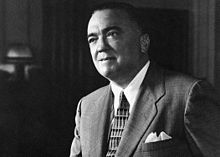
FBI Director J. Edgar Hoover
If, however, you substituted FBI Director J. Edgar Hoover for FBI Director Comey, the significance of the I.C.’s gratuitous inclusion of such an unsubstantiated smear might take on a different coloring. It was, after all, the decision to tack this classified annex onto the Jan. 6 report that gave the mainstream media the hook to disseminate the “golden shower” accusation across the country and around the world.
Rather than minimizing “potential embarrassment to the President-elect,” as Comey demurred, the classified annex was guaranteed to maximize Trump’s embarrassment, which it did.
In other words, just as Comey said he inferred an improper or illegal order when Trump expressed “hope” that Flynn’s legal ordeal might end, Trump might well have deduced that Comey’s elevation of the urination story amounted to coercion or blackmail from the Intelligence Community.
Trump, who surely knows the shadier corners of the construction trade, might have heard something like, “Gee, we’d hate for your wife and children (not to mention the rest of the world) to hear this story about prostitutes peeing on you” – and read the warning as a threat.
FBI Director Hoover was a master of just this sort of warning, conveyed as a sincere concern about some politician’s well-being. Trump, who has emphatically denied the salacious accusation, could well have seen Comey sending him a message from the leaders of the powerful Intelligence Community that they were determined to remove Trump or at least politically cripple him.
Just three days earlier, Senate Minority Leader Chuck Schumer told MSNBC’s Rachel Maddow that Trump was “being really dumb” by taking on the Intelligence Community because “they have six ways from Sunday at getting back at you.”
In the five months since the Jan. 6 briefing, Trump has gotten a taste of how accurate Schumer’s observation was. Making sure that the public got to read the “dirty dossier” – compiled by ex-British spy Christopher Steele and financed by some still unknown Clinton supporter – was clearly one of those six ways.
On top of that, Obama’s intelligence chiefs, including Comey, have testified repeatedly before Congress while they or their allies have leaked derogatory information about Trump to The New York Times, The Washington Post and other mainstream news outlets.
The ‘Soft Coup’
In other words, what we may have witnessed in Comey’s ballyhooed testimony on Thursday was just the latest chapter in a “soft coup” to remove Trump – either through a forced resignation or impeachment. The thinking is that Trump is so incompetent that “wise men” must step in to “correct a mistake” made by the U.S. electorate and made possible by the Constitution’s Electoral College system, which enabled Trump to win the presidency despite losing the popular vote,
But the American people are not supposed to see it that way. After all, the realization that U.S. intelligence chieftains might be conspiring to overturn a constitutional election of a U.S. president could be most upsetting and unsettling, even if one assumes that they are sincerely doing what they think is “best for the country.”
So, this side of the story remains unspoken, a silence made possible by the fact that most of the nation’s top news executives and much of its political elite share the opinion that Trump’s presidency must be ended and a more traditional chief executive installed.
But no one in authority wants to acknowledge that a “soft coup” is in the works because that would make America look like a banana republic to the world. It also could infuriate Trump’s 63 million voters who might take exception to this sort of “deep state” veto of a duly certified election.
So, what that means is that the planned removal of Trump will be a deliberate process cloaked in high-minded legal principles and much talk about the rule of law.
Of course, Trump would not be the only loser in this process. His sinking presidency would drag down many of those around him – and, in the case of Michael Flynn, might well lead to criminal charges.
Indeed, if civil libertarians were not largely committed to the anti-Trump #Resistance, they might pause for a moment and consider the disturbing picture of what was done to retired Lt. Gen. Flynn.
Trapping Flynn
To engineer the ouster of Flynn as Trump’s first National Security Adviser, President Obama’s Justice Department holdovers used the archaic 1799 Logan Act as a predicate to justify an FBI interrogation of Flynn about the details of a phone conversation with Russian Ambassador Sergey Kislyac on Dec. 29, 2016, while Flynn was vacationing in the Dominican Republic.
Since the FBI agents had a transcript of the intercepted phone call and Flynn was working from memory – possibly a bit hazy from a Pina Colada or two – Flynn was an easy mark for a perjury trap. Leaving out some detail, whether intentionally or not, would open him to an obstruction case – and Comey reportedly has indicated that the ongoing criminal investigation of Flynn indeed relates to whether he withheld information from investigators.
Every American who is concerned about the future political use of the U.S. intelligence agencies’ powerful surveillance tools should have shuddered a bit over what was done to Flynn. But many on the Left so desperately want Trump removed from office that they have joined the Russia-gate stampede as the best way to trample Trump.
So, few tears have been shed for Flynn even as he was ambushed based on transcripts of National Security Agency transcripts, a precedent that could be replicated in many other circumstances against American citizens who get on the Intelligence Community’s “six ways from Sunday” black list.
The use of the Logan Act predicate should have set off other alarm bells. The law, which was enacted during the Alien and Sedition Act period, was meant to stop private citizens from trying to conduct U.S. foreign policy on their own, but its constitutionality was always suspect and it has never led to a prosecution, not one in 218 years.
It was also never intended to apply to incoming foreign policy officials of a new presidential administration after the election, when they are understandably beginning to make contacts with foreign officials. So, for then-acting Attorney General Sally Yates to have dusted it off as a predicate for going after Flynn suggests additional entrapment problems.
True, Flynn may have used poor judgment in how he handled a 2015 paid speaking engagement in Moscow, how he reported on his consulting work for a Dutch company owned by a wealthy Turk with high-level political connections, and what he might have said to Kislyak (although we still don’t know the details of that conversation).
Islamic State Warning
But Flynn also had been an Army lieutenant general who led the Defense Intelligence Agency in 2012 when it produced the U.S. government’s most perceptive critique of President Obama’s proxy war in Syria, even predicting the emergence of an “Islamic state,” a judgment that annoyed other intelligence leaders who were participating in the covert war to overthrow the Syrian government.
The DIA report embarrassed the advocates for an escalation of the war in Syria and the ouster of secular President Bashar al-Assad. Journalist Seymour Hersh reported that Flynn’s DIA “had sent a constant stream of classified warnings … about the dire consequences of toppling Assad.” Flynn told Hersh that these reports “got enormous pushback from the Obama administration.”
After being forced out of his DIA job and retiring from the Army in 2014, Flynn went even further in a 2015 interview when he said the intelligence was “very clear” that the Obama administration made a “willful decision” to back these jihadists in league with Middle East allies, a choice that looked particularly stupid when Islamic State militants started beheading American hostages and capturing cities in Iraq, forcing the reintroduction of U.S. military troops.
However, out of a job, Flynn scrambled around for additional income, including signing up with a speakers’ bureau and forming a consulting company, as many other national security veterans have done.
In perhaps Flynn’s most controversial decision, he accepted a speaking fee of about $45,000 to address the tenth anniversary dinner for Russia’s RT network in Moscow, sitting next to President Vladimir Putin for part of the evening. Given the Obama administration’s heightened hostility toward Russia, Flynn’s appearance drew some high-level criticism.
Flynn further antagonized Obama’s team by signing up with the Trump campaign and then joining the “lock her up” chant at the Republican National Convention directed toward Hillary Clinton.
In the wake of Clinton’s shocking defeat and amid the Intelligence Community’s claims about Russian interference in the election, Flynn’s friendly relations with Russian leaders made him an obvious target.
Still, the notion of Obama holdovers taking Flynn out via dubious legal tactics – and their fueling of a McCarthyistic hysteria over Russia – normally might have raised more objections if not for the widespread disdain for Trump, his narcissistic behavior and his offensive policies, such as the “Muslim travel ban.”
However, amid the mainstream media’s increasingly frenzied talk about Trump’s potential impeachment, this other remarkable story – how the U.S. Intelligence Community is moving to reverse the outcome of a presidential election – is getting ignored in plain sight.
Investigative reporter Robert Parry broke many of the Iran-Contra stories for The Associated Press and Newsweek in the 1980s.
ISIS Was “Allegedly” Behind the London Bridge Attacks, Who Is Behind ISIS?
By Michel Chossudovsky | Global Research | June 6, 2017
London’s tabloids have gone into high gear with vivid descriptions of the attacks and the tragic loss of life. Seven killed and 48 wounded.
“ISIS has claimed responsibility for the depraved attack in London Bridge as chilling video shows three jihadis calmly strolling past a pub while in the midst of the van and knife rampage that killed seven and critically injured 21.” ( The Sun, June 5, 2017)
ISIS has claimed responsibility, Is there a pattern?
Without exception, Al Qaeda or ISIS were allegedly behind the Paris, Brussels, Berlin, Manchester and London Bridge terror attacks, which served to spearhead a wave of Islamophobia across Western Europe, while also providing a pretext for the introduction of drastic police state measures:
“The twisted killers are seen calmly walking through Borough Market moments before they launched a stabbing attack on pubgoers while shouting “this is for Allah”, having already driven a van into crowds.” The Sun, June 5, 2017)
The statement of Prime Minister May (three days before the UK elections) points in the direction of an organized hate campaign against Muslims:
[The Manchester and London attacks] …are bound together by the single, evil ideology of Islamist extremism that preaches hatred, sows division, and promotes sectarianism. It is an ideology that claims our Western values of freedom, democracy and human rights are incompatible with the religion of Islam. It is an ideology that is a perversion of Islam and a perversion of the truth.
… It will only be defeated when we turn people’s minds away from this violence – and make them understand that our values – pluralistic, British values – are superior to anything offered by the preachers and supporters of hate. (emphasis added),
“Perversion of the Truth”? Lies, fabrications, omissions. What the British media in chorus fails to mention is that both ISIS and Al Qaeda are creations of US intelligence, recruited, trained and financed by the US and its allies including Saudi Arabia, Qatar, Turkey, Israel and Jordan.
The Islamic State (ISIS) was originally an Al Qaeda affiliated entity created by US intelligence with the support of Britain’s MI6, Israel’s Mossad, Pakistan’s Inter-Services Intelligence (ISI) and Saudi Arabia’s General Intelligence Presidency (GIP), Ri’āsat Al-Istikhbārāt Al-’Āmah ( رئاسة الاستخبارات العامة).
The origins of Al Qaeda date back to the Soviet-Afghan war. The Koranic schools in Afghanistan used to train Al Qaeda recruits were financed by the CIA, using textbooks published by the University of Nebraska. That’s where the “evil ideology of Islamist extremism” referred to by PM May originated: The “Global War on Terrorism” is a lie, “Islamic terrorism” is a product of US foreign policy which claims to be spreading “Western civilization”:
… the United States spent millions of dollars to supply Afghan schoolchildren with textbooks filled with violent images and militant Islamic teachings, part of covert attempts to spur resistance to the Soviet occupation.
The primers, which were filled with talk of jihad and featured drawings of guns, bullets, soldiers and mines, have served since then as the Afghan school system’s core curriculum. Even the Taliban used the American-produced books,..
Picture above is translated as follows: “Jihad – Often many different wars and conflicts arise among people, which cause material damages and loss of human life. If these wars and disputes occur among people for the sake of community, nation, territory, or even because of verbal differences, and for the sake of progress…”
This page is from a third-grade language arts textbook dating from the mujahidin period. A copy of the book was purchased new in Kabul in May 2000.

… Published in the dominant Afghan languages of Dari and Pashtun, the textbooks were developed in the early 1980s under an AID grant to the University of Nebraska -Omaha and its Center for Afghanistan Studies. The agency spent $ 51 million on the university’s education programs in Afghanistan from 1984 to 1994.” (Washington Post, 23 March 2002)
The ISIS is a terrorist paramilitary entity created by US intelligence. It has nothing to do with the tenets of Islam. The ISIS and Al Qaeda terrorists are the foot soldiers of the Western military alliance in Syria who are fighting a secular government. While America claims to be targeting the ISIS, in reality it is protecting the ISIS.
Britain’s Role in the “War on Terrorism”
There is evidence that British SAS Special Forces were dispatched to Syria in 2011 to integrate the ranks of the so-called moderate Al Qaeda rebels. Special Forces often hired through a private mercenary company on contract to NATO or the Pentagon were embedded within most paramilitary rebel formations, According to Elite UK Forces (the website of the SAS)
Reports from late November last year [2011] state that British Special forces have met up with members of the Free Syrian Army (FSA), the armed wing of the Syrian National Council. The apparent goal of this initial contact was to establish the rebel forces’ strength and to pave the way for any future training operations.
More recent reports have stated that British and French Special Forces have been actively training members of the FSA, from a base in Turkey. Some reports indicate that training is also taking place in locations in Libya and Northern Lebanon. British MI6 operatives and UKSF (SAS/SBS) personnel have reportedly been training the rebels in urban warfare as well as supplying them with arms and equipment. US CIA operatives and special forces are believed to be providing communications assistance to the rebels.
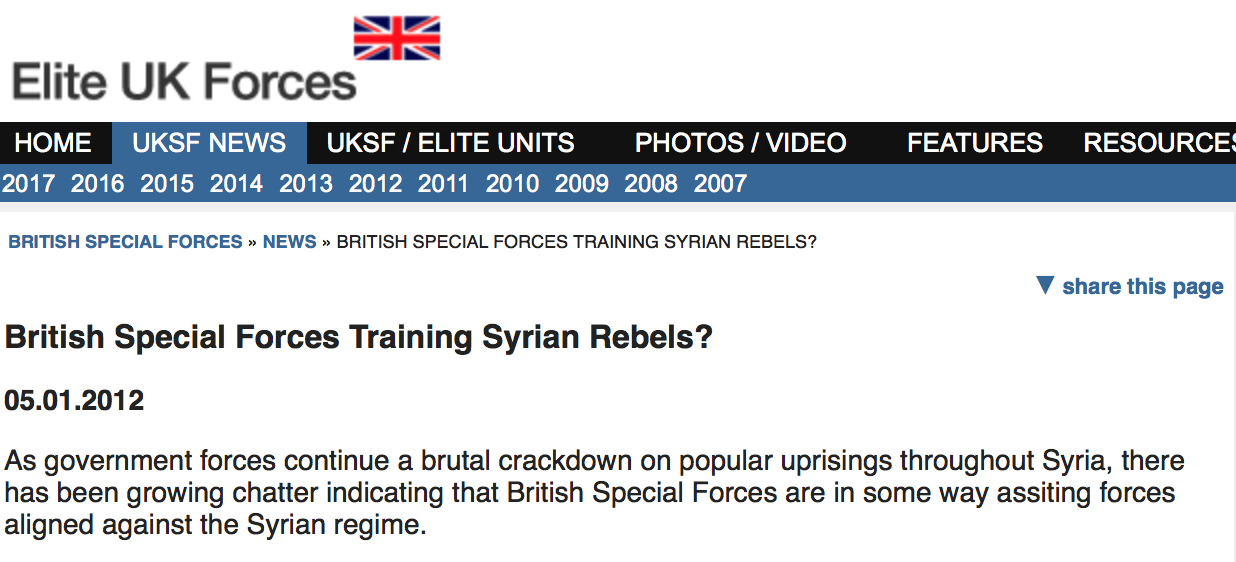
British MI6 were actively involved, collaborating with the CIA:
As the unrest and killings escalate in the troubled Arab state, agents from MI6 and the CIA are already in Syria assessing the situation, a security official has revealed.
Special forces are also talking to Syrian dissident soldiers [Al Qaeda].
They want to know about weapons and communications kit rebel forces will need if the Government decides to help.
“MI6 and the CIA are in Syria to infiltrate[rebel ranks] and get at the truth,” said the well-placed source.
“We have SAS and SBS not far away who want to know what is happening and are finding out what kit dissident soldiers [Al Qaeda] need.” Syria will be bloodiest yet, Daily Star, January 1, 2012 (emphasis added)
The air campaign launched by Obama in 2014, which had the full support of the United Kingdom, was intent upon destroying Syria and Iraq rather than “going after the terrorists”. There is ample evidence that the Islamic State is protected by the US-led coalition.
The inflow and delivery of weapons and supplies are coordinated by the Pentagon in liaison with America’s allies.
US military aid is channelled to Al Qaeda as well as to ISIS-Daesh.
The US has also used the illegal weapons market to channel vast amounts of weapons and military hardware to the Syrian “rebels”.
The State sponsors of ISIS-Al Qaeda are now heralded as the victims of ISIS-Al Qaeda, an absurd proposition. Those who are funded and supported by Western intelligence services are now said to be fighting back.
The ISIS nonetheless has a certain degree of independence in relation to its State sponsors. That is the nature of what is called an “intelligence asset”. But an “intelligence asset” is always on the radar of the intelligence services.
The British government through its intelligence services is known to have covertly supported several Al Qaeda affiliated entities including the Libya Islamic Fighting Group (LIFG) which was linked to the Manchester bombings.
The “Liberation” of Tripoli was carried out by “former” members of the Libya Islamic Fighting Group (LIFG), which is affiliated to Al Qaeda. These “former” Al Qaeda affiliated brigades constituted the backbone of the “pro-democracy” rebellion, which was supported by NATO.
Within the ranks of the LIFG rebels, US Navy SEALS, British SAS and French legionnaires disguised in civilian rebel garb, were reported to be behind major operations directed against key government buildings including Gadhafi’s Bab al-Aziziya compound in central Tripoli.
“Highly-trained [British Special Forces] units, known as ‘Smash’ teams for their prowess and destructive ability, have carried out secret reconnaissance missions to provide up-to-date information on the Libyan armed forces.” (SAS ‘Smash’ squads on the ground in Libya to mark targets for coalition jets, Daily Mirror, March 21, 2011)
And in the wake of NATO’s war Libya, these pro-democracy LIFG Al Qaeda affiliates have joined the ranks of the ISIS.
Washington’s Regime Change for Syria: Install the Islamic State
It is worth noting that the release of the Hillary Clinton email archive as well as leaked Pentagon documents confirm that the US and its allies are supportive of ISIS.
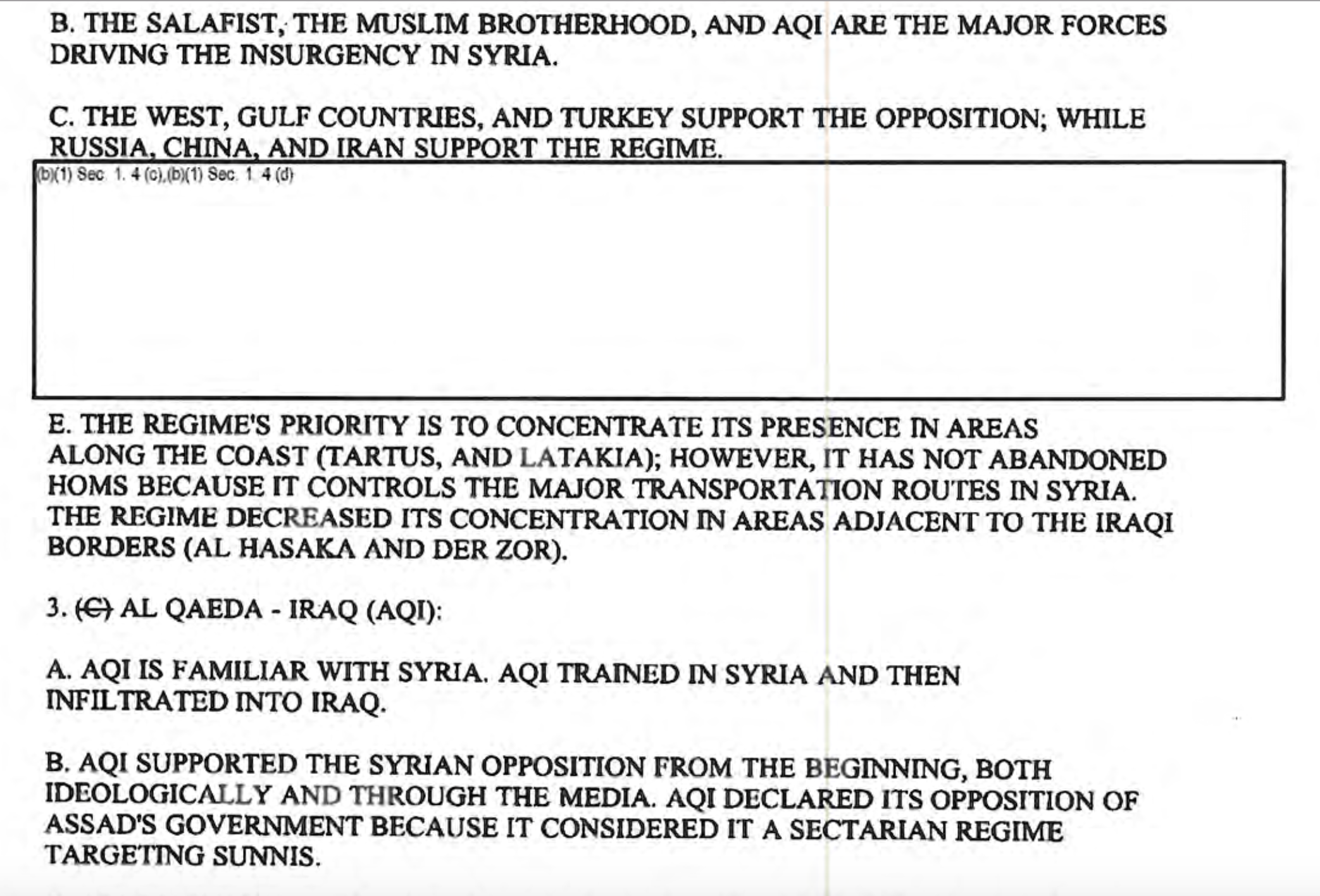
Moreover, a 7-page Defense Intelligence Agency (DIA) document dated August of 2012, points to US complicity in supporting the creation of an Islamic State.(Excerpt below)
Concluding Remarks
Despite the evidence, it is very difficult for people to accept the fact that their own government is supporting terrorism.
Most people will dispel this as an impossibility. But it is the forbidden truth.
The established consensus is that the role of a government is to protect its people. That myth has to be sustained.
The media’s role is to ensure that the truth does not trickle down to the broader public.
If that were to occur, the legitimacy of Western heads of State and heads of government would collapse like a house of cards.
The governments of the countries whose citizens are the victims of terror attacks are supporting ISIS-Daesh through their intelligence services.
Copyright © Prof Michel Chossudovsky, Global Research, 2017
Lavrov: Deconfliction zones in Syria announced without Damascus’ consent illegitimate
RT | June 7, 2017
Russia considers the US-led coalition airstrike against pro-Damascus fighters in Syria an act of aggression and rejects the justification for the attack issued by the Pentagon, Russian Foreign Minister Sergey Lavrov said.
The Tuesday airstrike near the town of At Tanf in eastern Syria “was an aggressive act, that violated the sovereignty and territorial integrity of the Syrian Arab Republic and – deliberately or not – targeted the forces which are most effective in fighting terrorists on the ground,” the minister said on Wednesday.
The Pentagon justified the attack by saying that the pro-government forces “advanced inside the well-established deconfliction [sic] zone in southern Syria.”
The US claimed that it attacked the pro-Damascus convoy because it posed threat to “partner forces” based in At Tanf. The US military earlier stated that an area within 55km from the town was a designated “deconfliction zone,” where forces not allied with the US are apparently not allowed to enter.
Lavrov rejected that reasoning, saying that he is not familiar with the term.
“I don’t know anything about such zones. This must be some territory, which the coalition unilaterally declared [deconfliction zones] and where it probably believes to have a sole right to take action. We cannot recognize such zones,” he said.
Lavrov said Russia, Turkey and Iran have signed a deal, which has been endorsed by the UN Security Council, to establish so-called “de-escalation zones” in several parts of Syria. Damascus agreed to this approach and the exact borders and mechanisms for observing a truce inside those zones are currently being negotiated.
“This approach was agreed to by Syria. We consider illegitimate any unilateral declaration of ‘deconfliction zones’ not endorsed by Damascus. We hope the coalition will adhere to the agreement it has reached with us, which states that the de-escalation zones must be agreed to in detail by all stakeholders,” he said.
He added that, according to some reports, the force attacked by the coalition was being deployed to prevent Islamic State (IS, formerly ISIS) fighters from destroying two bridges and a road connecting Syria with Iraq, and that the intervention had allowed the terrorists to carry out their plan.
The scramble for control of Syrian-Iraqi border
By M K Bhadrakumar | Indian Punchline | June 4, 2017
The remark by the Syrian Kurdish militia spokesman Saturday that their final assault on the ISIS “capital” city of Raqqa will start “in the coming few days” highlights the keen struggle for control of eastern Syria bordering Iraq that is playing out. The ISIS is staring at defeat and the issue now is what follows thereafter.
The big question is whether Syria survives or will get balkanized. The Russian President Vladimir Putin flagged this stark reality when he said on Friday,
- Does the possible dismemberment of Syria arouse concern? It certainly does. We are establishing de-escalation zones now and we are afraid that these de-escalation zones may turn into a blueprint for future borders. Russia hopes these safety zones would serve to interact with the Assad government, to start at least some kind of a dialogue, some interaction, as this would help future political cooperation in order to restore Syria’s control over its entire territory and preserve the country’s territorial integrity.
Of course, there is the danger that Syrian war may become a “frozen conflict”. The key, therefore, lies in gaining control of Iraq’s border crossings with Syria across vast desert lands through which Iran renders vital help to the government forces and the Hezbollah and the Shi’ite fighters battling the insurgents and the ISIS.
As the map, here, shows, the Syrian-Iraqi border regions are largely under the control of either US-supported Kurdish and other insurgent fighters or the ISIS and other extremist groups. The Syrian government aspires to regain control of those regions.
Essentially, the struggle is for control of the border crossings that are depicted in the map. Clearly, the border crossing way up in the north is under the control of the Kurdish militia and it remains to be seen (a) whether the US would allow the Kurds to reach an understanding with Damascus; (b) whether Turkey will allow Kurds to consolidate their grip in that area; (c) whether the over-stretched government forces will take on the Kurds or, alternatively, will regard it to be tactically prudent to avoid a shooting match at this point and instead keep options open to eventually negotiate a power-sharing deal with the Kurds.
Unlike the northern front, the central and southern fronts are hotly contested. As the map shows, there is one border crossing in the central front at Al-Bukamal (where the Euphrates flows into Iraq) and another key border crossing is at Al-Tanf in the southern front.
In the central front, Bashar Al-Assad’s forces are in Palmyra and are making their way toward Deir Ezzor where a Syrian garrison is desperately holding out against a siege by the jihadi groups. The US appears to be encouraging the ISIS fighters in Raqqa to evacuate toward Deir Ezzor. But Russian cruise missile strikes recently targeted these ISIS convoys. (Sputnik) The US apparently prefers that somehow Assad’s forces must be prevented from reaching Deir Ezzor, because from there they could take control of the highway leading to the border crossing at Al-Bukamal. (See the map.)
Similarly in the southern front, the US is impeding the advance of the government forces to al-Tanf (which is connected to Damascus), another border crossing into Iraq. The US would hope that the rebel groups in al-Tanf will also seize control of the Al-Bukamal border crossing up north so that US proxies will be in control of the entire Syrian-Iraqi border as well as the southern Syrian region straddling the border with Jordan and the Golan Heights. The game here is essentially about cutting off Iran’s access to Lebanon (Hezbollah).
Why is it so important for the US to prevent Assad’s forces from taking control of the Al-Bukamal and Al-Tanf border crossings? Simply put, the spectre of a Damascus-Baghdad-Tehran land route reopening is what is haunting the US (and Israel), because such a solid land route will have a multiplier effect on Iran’s capacity to influence the future developments in Syria (and Lebanon).
The US has not directly jumped into the fray so far to take control of the Syria-Iraq border. It maintains the pretence that it is narrowly focused on fighting the ISIS. However, when it seemed that Assad’s forces were lunging toward Al-Tanf recently (May 18), the US forced them to turn back by launching an air strike.
The overall balance of forces does favour the Syrian government and in a conceivable future it should take control of Deir Ezzor, Al-Bukamal and Al-Tanf. Thus, the US will have to find a way to work around Assad (and Iran) than work against him. The other option will be to bear the heavy costs of a long-term, open-ended strategy of military intervention and occupation, which doesn’t figure in President Donald Trump’s foreign-policy calculus. The US’s best bet will be to seek some sort of understanding with Russia based on the premise that Moscow may not be fully sharing the agenda of Assad and his Iranian ally. But then, Moscow has no reason to bet on any other horse than the one it has been so far, which also happens to be a winning horse.
Featured Video
Bombing Hitler’s Hometown
or go to
Aletho News Archives – Video-Images
From the Archives
‘Conspiracy Theory’ Now Fact: Greater Israel Has Arrived
By Kit Klarenberg | Mint Press News | January 28, 2025
Ever since Tel Aviv’s 1948 creation, much has been said and written about ‘Greater Israel’ – the notion Zionism’s ultimate end goal is the forcible annexation and ethnic cleansing of vast swaths of Arab and Muslim lands for Jewish settlement, based on Biblical claims this territory was promised to Jews by God. The mainstream media typically dismisses this concept as antisemitic conspiracy theory, or at most the fringe fantasy of a minuscule handful of extremist Israelis.
In reality … continue
Blog Roll
 Aletho News
- Battle for Hungary: EU attacks on Orban are a sign of worse things to come
- Iraqi resistance conducts drone strike on US-run base in Syria
- Failing to Defeat Hezbollah, Israel & US Pressure Syria’s Ahmed al-Sharaa to Join War
- US-Israeli war on Iran drives global fertilizer prices up 40%
- Hezbollah’s Surprise Weapons Redefine Ground Battle with Israel
- Yemen joins fight against US, Israel by firing missiles at occupied territories
- Seizing the Kharg: Washington’s path to defeat in the Persian Gulf
- Iran reports 500 US casualties in strikes on covert US military sites
- Pro-Israel terrorist arrested before assassination of pro-Palestinian activist
- Bombing Hitler’s Hometown
- If Americans Knew
- Researchers at Human Rights Watch Resign Over Blocked Report on Palestinian Refugee Return
- Jewish Groups Are Backing a War Americans Don’t Want
- Eric Fingerhut Thinks He’s the President of the Jews
- Top Jewish Philanthropists, Rabbis Urge Israeli President to Take Action Against ‘Jewish Extremists’
- Don’t Be Fooled. Zionist Leaders Have Always Wanted to Control Southern Lebanon
- Israel’s widespread use of torture is a core element of its genocide against the Palestinian people
- In Israel’s War on Iran, Many Middle East US Bases Rendered “All But Uninhabitable”
- ‘Burn the lawn’: Israel pursues ‘Rafah model’ in southern Lebanon
- A genocide here, an amputation there
- Reports: Iran mobilizing 1M fighters, Israel-US run low on ammo, Israeli army faces shortage – Not a ceasefire Day 168
- No Tricks Zone
- Devastating Assessment Of Comirnaty Vaccine By Former Senior Pfizer Europe Toxicologist
- New Study: CO2 Is ‘Effectively Negligible’ As An Explanatory Climate Change Factor Since 2000
- Former Pfizer Toxicologist Dr. Helmut Sterz Tells Bundestag Hearing Pfizer Vaccine Should Have Never Been Approved
- Energy Expert: Germany’s Nuclear Phaseout Was A “500 Billion Euro Mistake”
- New Research: South Australia’s Mid-Holocene Sea Surface Temperatures Were 4°C Warmer Than Today
- Storing Green Energy To Last Germany 10 Days Would Require A 60-Million Tonne Battery
- New Studies: UK Sea Levels Were 4 Meters Higher Than Today During The Mid-Holocene
- Destructive Green New Deal: German Energy And Metal Group Warns Of Drastic Crisis
- New Study Documents A 20-Year Pause In Arctic Sea Ice Decline – Driven By Internal Variability
- Wake-up Call: Survey Shows Majority Of Germans Now Favor Postponing Climate Targets!
 Aletho News