Why is the US using Jordan as the main base in possible Iran attack?
By Ali Jezzini | Al Mayadeen | January 23, 2026
US forces have amassed in Jordan ahead of a possible war on Iran, aiming to shift early retaliation away from Israelis, and exploit US airpower, while risking strategic miscalculation and overreach.
Over the past week, the United States has significantly reinforced its military footprint in West Asia amid rising tensions with Iran, deploying F-15 fighter jets and KC-135 tanker aircraft to Jordan’s Muwaffaq Salti Air Base as part of a broader repositioning of airpower ahead of a potential attack on Iran.
This buildup, which can be tracked using publicly available satellite images, comes against the backdrop of Iranian warnings to retaliate against American bases in the region should Washington — or its allies — launch an attack on Iranian territory. It also follows movements of US forces and dependents at several regional posts as a staging for possible offensive operations. The intensification of US deployments has thrust installations like Muwaffaq Salti, long a strategic node in Western forces’ deployment in West Asia, into the spotlight as both a potential launch point for attacks and a possible target in any wider conflict.
Why Jordan’s Muwaffaq Salti Air Base?
Part of the United States’ increasing focus on Jordan’s Muwaffaq Salti Air Base is not simply due to its distance from Iran’s most accurate short-range ballistic missiles, approximately 800–900 kilometers from Iran’s borders, but also because it may be intended to function as a primary Iranian target, or punching bag, in any initial phase of a wider war.
What follows is an attempt to analyze American strategic thinking, though it does not claim that events will necessarily unfold in this precise manner. From Washington’s perspective, “Israel” remains the crown jewel of the imperial order, an extension of US polity itself. During the most recent phase of confrontation, “Israel” encountered serious difficulties intercepting Iranian ballistic missiles, threats it now equates with nuclear weapons in strategic gravity. This urgency explains the current haste, as Iranians ought to possess much greater defensive capabilities in the future, coupled with the baptism by fire they endured during the June 12-day war.
Destroying Iran’s missile program outright is unrealistic, since large parts of the supply and production chains are dispersed in highly fortified underground facilities. As a result, targeting the Islamic system itself, seeking regime change, and sustaining what the US deems as acceptable costs may appear more logical to American planners. In their calculation, such an outcome would justify heavy losses, provided it ends the conflict definitively.
Israeli claims regarding the self-sufficiency and effectiveness of their air defenses are among the most exaggerated on earth. In reality, NATO intelligence and military capabilities played a decisive role in interception efforts, operating out of Jordan. This included US, Jordanian, and French air forces taking off from Jordanian bases, in addition to extensive intelligence, logistics, and aerial refueling missions done by NATO countries, including the UK.
Israeli leadership attempted to strike early under ideal surprise conditions before defensive gaps accumulated and before they were drawn into a prolonged escalation cycle they could not sustain. Even internal measures, such as preventing Israeli settlers from leaving during the war, reflected an acute awareness of how fragile the situation could become if panic spread; that kind of optics is strategically disastrous for a regime that sells itself as secure, resilient, and permanent.
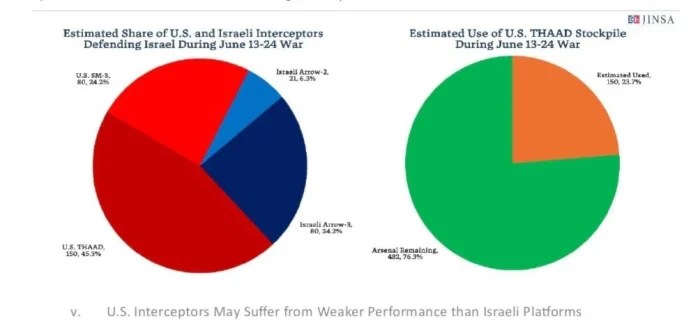
Most interception during the last confrontation in June 2025 was conducted by US naval assets using SM-3 interceptors and THAAD systems. Roughly 25 percent of all THAAD interceptors ever produced were reportedly consumed in that single episode. The persistent exaggeration of Israeli offensive and defensive capabilities, while significant but short-winded, serves two purposes:
- First, it counters the internal Israeli narrative that the United States “saved Israel” after October 7, a deeply sensitive issue tied to Israeli national security self-perception that panics at the idea of having such a level of dependency on the US.
- Second, it preserves an image of invincibility before regional actors, enhancing the regime’s deterrence.
Returning to Jordan: American planners show little concern for Jordanian costs or the consequences for the base itself, which is situated around 70km from the capital Amman. From this perspective, it may even be deemed acceptable for the US if Iran expends part of its ballistic arsenal striking the base, even at the cost of Jordanian casualties.
The American assumption is that they would then be able to launch a major air campaign to destroy Iranian missile production, storage, and launch sites. This would pave the way for an Israeli entry into a second phase of the war, one in which it would no longer face missile volumes it cannot absorb, as it almost did in the June war, as it was running out of interceptors after a presumed US airpower success in weakening the system and reducing launch capacity.
From Iran’s standpoint, directly starting with “Israel” may actually be more rational. An Israeli participation in any war appears almost inevitable, either immediately or at a later stage, for multiple reasons.
Despite the massive US buildup, which includes more than 36 F-15Es, an aircraft carrier, and several destroyers with capabilities to launch cruise missiles, Israelis still retain greater immediate regional firepower than the United States, but it seeks to avoid sudden, large-scale damage to its own infrastructure.
American intentions likely go beyond limited bombings, assassinations, or “decapitation” strikes, as seen previously, if their attack would make sense in terms of weighing gains and possible losses. They may include direct strikes targeting the Iranian leadership, severe economic and energy infrastructure degradation, and long-term destabilization designed to enable internal regime change, added to the sanctions.
The withdrawal of American aircraft from Gulf bases was not only due to their vulnerability to short-range, high-precision weapons that Iran’s arsenal is full of, but also to protect Gulf oil production in the event of war. Gulf states, for their part, would publicly distance themselves from hostilities to shield their economies and prevent market shocks, particularly to avoid upsetting Trump amid any market volatility.
While it is possible to disrupt US operations at Muwaffaq Salti Air Base, expending large numbers of ballistic missiles there, missiles that could instead strike high-value counter force and counter value Israeli targets, may be less strategically viable than other options if the US is prepared to escalate toward total confrontation regardless. Completely and permanently disabling the base would be difficult, and the strategic outcome would likely remain unchanged.
American planners appear convinced that Iran will avoid targeting Jordanian state infrastructure or attempting to destabilize the Jordanian monarchy, as such actions can be used for counterpropaganda. They assume Iran will focus on Western and Israeli forces, confining hostilities to sparsely populated desert areas that Jordan can absorb.
Jordan, governed by a monarchy heavily dependent on Western and Gulf countries’ political and economic support, appears to share this assessment. King Abdullah likely believes his rule faces no serious internal risk and that alignment with Western strategy is the safer course, as his country was credited for being “Israel’s” shield against Iranian drones in the June 2025 war.
Under this framework, the US would launch an air campaign using aircraft operating from Jordan to strike western Iran, while carrier-based aircraft in the Arabian Sea attempt to open corridors toward central Iran from the Gulf. This would allow heavy bombers from Diego Garcia to penetrate deeper and strike strategic targets. The Israeli occupation would then enter at a later stage.
The simplest counter-strategy is to do precisely what the Americans do not expect, and to inflict maximum cost. The theory that remains largely unrefuted: Trump is risk-averse. As Western media itself jokes, TACO (Trump Always Chickens Out), he dislikes long wars, favors last-minute, flashy interventions, and avoids sustained attrition. This suggests a vulnerability: American short-termism and reluctance to absorb prolonged pain, particularly when multiple theaters remain active.
Some may ask why Iran does not simply launch a preemptive strike. This is a clear option, but not an uncomplicated one. An initial Iranian strike could rally American public opinion behind a longer war, granting Trump broader authority, resources, and popular support. While it would disrupt US planning and cause early damage, it might ultimately strengthen Washington’s domestic position. By contrast, an American-initiated war, prolonged, unpopular, and costly, would be far more vulnerable to internal pressure, especially if American losses mount.
Adding to the complexity, two Emirati Il-76 cargo aircraft reportedly landed in Tel Aviv before flying on to Turkmenistan. These aircraft are known to be used by the UAE to supply proxy forces with weapons, particularly in Sudan and Somalia, raising the possibility that they were transporting drones or intelligence equipment for regional operations.
The picture remains highly complex, and it is entirely possible that nothing will happen. Still, based on current force deployments and escalation patterns, the probability of a US attack appears to have risen beyond a 50-50 threshold.
This analysis reflects what American planners may be thinking, not what will necessarily occur. It should be noted that after the previous war, many US and Israeli officials declared that Iran’s nuclear and missile programs had been torpedoed, and the system effectively destroyed, assessments that quickly proved false. Now, only months later, they appear to believe that an even more violent war is required to achieve what the last one supposedly already accomplished.
On the other hand, if endurance is possible and the United States is forced to retreat, Trump TACOs or abandon Israelis mid-conflict — an outcome not inconceivable under a president like Trump — the cumulative effects of “Israel’s” recent dominance and coercion across the region may yet be reversed.
As mentioned earlier, the US buildup is not sufficient to start a prolonged attack against Iran with the high goals of regime change. The buildup still does seem as defensive posturing shielding the Israelis, so a chance the Israelis might initiate and use the limited US and Western buildup as a shield is still significant. A scenario similar to what happened in the last war, but that does entail Israeli losses in the opening phase.
Conclusion
What emerges from this assessment is a US strategy built on supposed escalation control, risk displacement, and the assumption that others will behave within predefined limits. Washington appears to believe it can shape the battlefield geographically, pushing early phases of the war away from the fragile “Israel”, absorbing initial retaliation through peripheral bases, and then intervening decisively to reshape the balance before handing the fight back to Israelis under more favorable conditions. This is not a strategy aimed at victory in the classical sense, but at managing exposure and buying time.
The weakness in this thinking lies in its dependence on predictability. It assumes Iran will refrain from actions that collapse the carefully constructed sequencing of the war, that regional systems will remain stable under strain, and that American political leadership will tolerate the costs long enough to reach a decisive point. None of these assumptions is guaranteed. If any one of them fails, the entire escalation ladder becomes unstable.
Ultimately, the outcome of any confrontation will not be decided by the opening phase or by claims of technological superiority, but by endurance, political cohesion, and the ability to impose sustained costs on an adversary unwilling to absorb them.
The United States may possess overwhelming firepower, but it remains constrained by limited strategic patience and domestic vulnerability. If those constraints are effectively exploited, the very war designed to resolve the Iranian question may instead deepen American entanglement and erode the regional order it seeks to preserve.
US sanctions Popular Conference for Palestinians Abroad over alleged Hamas links
MEMO | January 23, 2026
The United States has imposed sanctions on the Popular Conference for Palestinians Abroad, accusing the organisation of supporting Hamas and engaging in deceptive fundraising practices, according to a decision announced on Wednesday.
The sanctions, which also target six charitable organisations operating in the Gaza Strip, include freezing any assets held within the United States and prohibiting US citizens and companies from conducting transactions with the listed entities.
According to the US Treasury Department, the Popular Conference for Palestinians Abroad was “founded and operated by elements linked to Hamas,” claiming that the movement exercises control over the organisation’s strategic and operational activities. The department also cited the presence of individuals within the conference who have previously been placed on US sanctions lists.
Founded in February 2017, the Popular Conference for Palestinians Abroad was launched during a large gathering in Istanbul attended by Palestinians from around 50 countries. The organisation describes itself as a grassroots framework aimed at unifying Palestinians in the diaspora, enhancing their political engagement, and reinforcing their role in the Palestinian national movement.
Based in Lebanon, the conference has organized events and conferences in several countries, including Turkey, and has participated in political and popular initiatives related to the Palestinian cause. Its founders say the conference serves as a coordinating umbrella for hundreds of Palestinian institutions worldwide and stress that it does not seek to replace the Palestine Liberation Organisation, but rather to complement its role.
In response to the US decision, the conference has described itself as an independent and open organisation representing a broad spectrum of Palestinian political affiliations. It rejected the accusations, stating that its activities are public and focus on political advocacy, popular mobilisation, and humanitarian support.
The sanctions decision comes amid heightened US scrutiny of organizations accused of links to Hamas, particularly in the context of the ongoing war in Gaza.
Jordan using Israeli software to monitor journalists, rights defenders: Report
The Cradle | January 22, 2026
A multi-year investigation by Citizen Lab has found that Jordanian security agencies used Israeli-made Cellebrite phone-extraction technology to pull data from civil society activists and journalists without consent, according to a report published on 22 January.
The researchers said they forensically analyzed four seized-and-returned phones and reviewed three court records tied to prosecutions under Jordan’s 2023 Cybercrime Law, with cases spanning late-2023 to mid-2025 during protests in support of Palestinians in Gaza.
Citizen Lab said it identified iOS and Android “Indicators of Compromise (IoCs)” that it attributes “with high confidence” to Cellebrite’s forensic extraction products, describing the work as evidence that authorities extracted data after detentions, arrests, and interrogations by the General Intelligence Department (GID) and the Cybercrime Unit.
In one case, Citizen Lab said a student organizer refused to provide a passcode, and officers “unlocked it using Apple’s biometric face ID by holding it up to the activist’s face,” later returning the device with “their device’s passcode written on a piece of tape stuck to the back of their phone.”
The report ties the practice to Jordan’s tightening online repression, noting that the 2023 law expanded punishments and has been widely used against activists.
In a post on X dated 12 March 2025, Jordan’s Interior Minister Mazin al-Farrayeh wrote, “The most common cases handled daily [by the Cybercrime Unit] involve hate speech and inciting division and strife on social media … penalties can reach up to three years in prison, a fine of 20,000 dinars [approximately 28,200 USD], or both.”
Citizen Lab report characterizes Cellebrite as a recurring enabler in global rights abuses, arguing that its tools, when handed to opaque security services, become a turnkey mechanism for sweeping, invasive fishing expeditions across private life.
After Citizen Lab and OCCRP wrote to Cellebrite on 29 December 2025 and followed up on 15 January 2026, the company’s PR firm replied with a generic defense, saying “Ethical and lawful use of our technology is paramount … As a matter of policy, we do not comment on specifics.”
Citizen Lab noted that the response “does not deny any of our findings,” and concluded that the Jordanian use of it documented “likely violates international human rights law.”
Alaa al-Fazza, writing for The Cradle, has described Jordan’s 2023 cybercrime law as a sharp turn toward authoritarianism, arguing it uses vague security claims to criminalize dissent, expand censorship powers, and suppress activists as public opposition to normalization with Israel grows.
In a July 2025 report, Middle East Eye reported that Jordan’s General Intelligence Department launched its largest arrest campaign since 1989 by detaining and interrogating hundreds over pro-Palestine activism and Gaza solidarity. The detainees were held without charge amid claims the crackdown was driven by pressure from Israel, Saudi Arabia, and the UAE.
Amid the widening crackdown on dissent and pro-Palestine voices, Al Mayadeen reported in December that one of their journalists, Mohammed Faraj, was arbitrarily detained upon arrival in Amman and held for over a week without charge, disclosure of his whereabouts, or official clarification from Jordanian authorities.
Israelis SUDDENLY Mass Deported From Many Countries
The CJ Werleman Show | January 22, 2026
In this urgent report, I expose why Israelis are now being mass deported or denied entry by countries around the world – from Eastern Europe to South America, from the Maldives to even North Korea. These are not isolated incidents. They are a direct consequence of Israel’s policies, its ongoing atrocities against Palestinians, and a historic collapse in Israel’s global image. Watch to the end to understand how all of this connects to war crimes, apartheid, racism, and Western hypocrisy – and why platforms like YouTube are punishing channels that dare to tell the truth.
❌ YouTube Demonetized Our Channel Because We Expose Israel ❌ 💪
Please HELP me expose Israel and injustices in Muslim world via Patreon HERE: ▶  / cjwerleman
One-time donations can be made here: ▶ https://www.paypal.me/cjwerleman
We can’t sustain, improve and grow this program without your help via Patreon membership, and you will be helping us push back against Zionist censorship, produce more in-depth investigations, platform Palestinian voices and other victims of occupation and war. Thank you for your support and understanding.
Peace Plan Phase 2 Without Phase 1: Can the US Really Bring Peace to Gaza?
By Abbas Hashemite – New Eastern Outlook – January 22, 2026
US President Donald Trump announced Phase 2 of the Gaza Peace Plan despite the failure of Phase 1 to bring any relief to the Palestinians, reasserting the fact that it only intends to legitimize the Israeli occupation.
On January 16, the United States announced the launch of the 2nd phase of the infamous 20-point Gaza Peace Plan, which is supposed to end Israel’s genocidal operations against native Palestinians in Gaza. The Trump administration portrays Phase 1 of the Gaza Peace Plan as a success. However, the reality on the ground is in sheer contrast to the US government’s claims. Most of the expectations of Phase 1 were never materialized on the ground in Gaza. Phase 1 of the 20-point Gaza Peace Plan was supposed to immediately stop the fighting between Israel and Hamas, allow full admittance of humanitarian aid in the Gaza enclave, open the Rafah crossing between Egypt and Gaza, enable the exchange of captives between the two sides, and set a limit for the Israeli withdrawal from the boundary of Gaza.
Phase 1: Broken Promises
Although the Israeli attacks in Gaza have decreased since the start of the ceasefire, the genocide still continues. The Zionist government continues to violate the ceasefire by launching unprovoked attacks in the Gaza enclave, violating the ceasefire at least 1193 times, resulting in the deaths of at least 451 Palestinians since October 10. According to a UNICEF report, “More than 100 children have been killed in Gaza since the ceasefire of early October. That is roughly one girl or boy killed every day during a ceasefire.” It further states, “Since the ceasefire, UNICEF has recorded reports of at least 60 boys and 40 girls killed in the Gaza Strip. The 100 figure only reflects incidents where sufficient details have been available to record, so the actual number of Palestinian children killed is expected to be higher. Hundreds of children have been wounded.”
Hamas has released all the living and dead captives except one. However, reports suggest that Israel has not released all the prisoners as stipulated in the ceasefire agreement. It still holds numerous children, women, and doctors. Moreover, reports suggest that the Israeli government continues to block much of the essential humanitarian aid in Gaza, only allowing around 43 percent of the total aid trucks. The Zionist government does not allow the passage of the trucks containing meat, dairy products, and vegetables, which are necessary for maintaining a balanced diet. It only allows trucks containing soft drinks, chocolates, snacks, and crisps into the Gaza enclave. In addition, the Israeli government has banned more than three dozen charity organizations from working in Gaza, further worsening the dire conditions of the Gazans. Furthermore, the key lifeline for the entry of aid, medical evacuation, and travel, the Rafah crossing, also remains closed by the Israeli Defense Forces (IDF).
Phase 2: Political Theatre or Real Solution
Phase 2 of the Gaza Peace Plan aims to shift the focus to establishing a Palestinian technocrats’ panel to supervise and lead post-war Gaza, as well as long-term governance in the enclave. Steve Witkoff, Special Envoy of the US President Donald Trump, stated the Phase 2 “establishes a transitional technocratic Palestinian administration in Gaza” and would initiate “the full demilitarization and reconstruction of Gaza, primarily the disarmament of all unauthorized personnel.” However, without the success of Phase 1 of the 20-point Peace Plan, the announcement of Phase 2 seems nothing more than a political theatrics to enhance President Trump’s international stature.
Controversial Appointments Undermine Trust and Peace
The Trump administration’s announcement of the former British Prime Minister, Tony Blair, responsible for the death of thousands of Muslims in the Middle East, along with US Secretary of State Marco Rubio, the US special envoy to the Middle East Steve Witkoff, and Trump’s son-in-law Jared Kushner – a staunch Zionist, as one of the founding executive members of the so-called Board of Peace, which is supposed to overview the implementation of the so-called Gaza Peace Plan, also reflects the nonchalance of the US government to end the Israeli genocide in Gaza. The United States has appointed US Major General Jasper Jeffers as Commander of the International Stabilization Force (ISF) for the Gaza Enclave. According to the White House, Jeffers would lead the ISF in a wide range of areas, including “comprehensive demilitarization.”
However, this “comprehensive demilitarization” is limited to de-weaponizing Hamas. The United States has been a key supporter of Israeli war crimes in Gaza. It has also been the prime supporter of Israel’s demand to demilitarize Hamas, a demand unacceptable to the Palestinian group. The appointment of Major General Jasper Jeffers would make the ISF more controversial. The US government needs to address the concerns of all the stakeholders effectively to successfully implement the 20-point Gaza Peace Plan. Moreover, appointing people with controversial backgrounds like Tony Blair and Jared Kushner would only lead to a trust deficit, further complicating the peace process in Gaza.
Аbbas Hashemite is a political observer and research analyst for regional and global geopolitical issues. He is currently working as an independent researcher and journalist
Hamas: Netanyahu’s inclusion in ‘peace council’ threatens justice
Al Mayadeen | January 22, 2026
The Hamas Resistance movement has condemned the inclusion of Israeli Prime Minister Benjamin Netanyahu in the so-called “Peace Council” for Gaza, calling it a dangerous sign that undermines justice and accountability.
In an official statement issued Thursday, Hamas said, “We strongly condemn the inclusion of war criminal Netanyahu, who is wanted by the International Criminal Court, in the Peace Council for Gaza.”
The movement stated that Netanyahu’s participation contradicts the very principles such a council should represent. It warned that “the war criminal Netanyahu continues to obstruct a ceasefire agreement in Gaza and carries out the most heinous violations by targeting unarmed civilians.”
Hamas stressed that “the first step toward stability lies in ending the occupation’s violations and holding all those responsible for genocide and starvation accountable.”
The statement came after US President Donald Trump and several international leaders signed a decree on Thursday establishing the “Peace Council” concerning the Gaza Strip. The signing took place during the World Economic Forum in Davos, Switzerland.
Netanyahu confirmed his participation on Wednesday, saying: “I will join the Peace Council in response to President Trump’s invitation.”
Others who joined the so-called “Peace Council” include Turkey, Saudi Arabia, Egypt, Jordan, and others, bringing the total number of those who accepted Trump’s invitation up to 25.
Report warns that ‘Jewish terrorism is out of control’ and could lead to major security escalation
MEMO | January 22, 2026
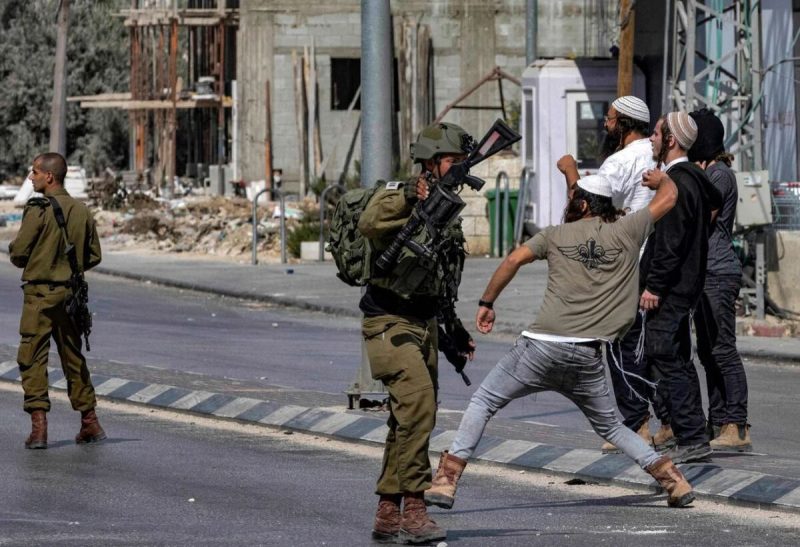
An Israeli report warns of a rapid rise in Jewish terrorism against Palestinians in the West Bank, saying it has become a widespread phenomenon with serious security and strategic implications. The report cautions that this trend aims to undermine the Palestinian presence and could trigger large waves of violence, while also causing growing damage to Israel’s international standing.
The report, issued on Tuesday by the Institute for National Security Studies at Tel Aviv University (INSS), says recent years—especially since 7 October 2023—have seen a sharp increase in both the scale and severity of attacks carried out by Jews against Palestinians. It describes these acts as part of a “struggle over control of land” and “growing attempts to weaken the Palestinian presence”, particularly in areas classified as Area C.
According to the report, data from Israeli military and international sources point to a steep rise in such attacks. Figures from the Israeli army’s Central Command show that in 2025 there was an increase of about 27 per cent in incidents classified by the security establishment as “nationalist crime”. Around 870 offences were recorded, including 120 described as serious, compared with 83 serious offences in 2024.
United Nations data, however, present an even darker picture. In 2024, about 1,420 attacks against Palestinians were documented, a 16 per cent rise compared with 2023 and the highest level since systematic monitoring began in 2006. The report says these attacks led to the killing of five Palestinians and injuries to around 350 others. More than 300 Palestinian families — nearly 1,700 people — were also displaced from their homes.
The report adds that the upward trend has continued, noting that the number of attacks in 2025 has “exceeded 1,770 incidents”, surpassing the peak recorded the previous year.
Lebanese Resistance will inevitably triumph: Former President Lahoud
Al Mayadeen | January 22, 2026
Former Lebanese President Emile Lahoud affirmed that Lebanon remains committed to the current ceasefire, while “not a day goes by without the Israeli occupation violating it.”
Speaking amid ongoing tensions, Lahoud condemned on Thursday the continued aggression by “Israel”, accusing it of operating under a long-standing strategy of deception backed by US support. “For 80 years, this enemy has relied solely on deception, using unwavering American support as its cover,” he said.
Lahoud emphasized that Lebanon has two options: either accept the reality imposed by “Israel” or stand in solidarity with those under attack, particularly in the South and the Bekaa.
He reminded the Lebanese people of the country’s historic milestones, namely the liberation of South Lebanon in 2000 and the Resistance’s victory in 2006. “Our capabilities were also limited at that time, but internal unity around a single national position made those victories possible,” he said.
Addressing those he described as “playing the role of instigators from within, against their own people,” Lahoud warned that their actions would ultimately backfire. “This internal agitation will return to harm them first,” he said, accusing them of aligning, willingly or not, with the interests of the enemy.
Lahoud urged all Lebanese factions to take note of what even their adversaries have come to recognize. “Look at your undeclared Israeli ally,” he said, “who admitted that the Resistance’s greatest weapon is its unwavering spirit of defiance and steadfastness.”
He urged them to abandon any illusions about weakening the Resistance, asserting that such hopes are futile. “Stop betting on breaking the resistance… stop dreaming of its surrender,” he said, adding with confidence: “The resistance will inevitably triumph.”
IOF aggression on South Lebanon continues
His statements come after Israeli occupation forces launched a series of violent airstrikes across southern Lebanon on Wednesday, targeting several towns, according to Al Mayadeen’s correspondents.
The attacks began in the town of Kfour in the Nabatieh district, where an Israeli airstrike hit a residential building. Subsequent raids struck multiple buildings in Qennarit, also in southern Lebanon. In Jarjou’, another airstrike destroyed a targeted building, while drones maintained heavy patrols over the area.
Al Mayadeen correspondent revealed that several reporters were injured following the airstrikes on Qennarit, as “there were 10 journalist colleagues near the site of the strike.”
The Lebanese Health Ministry reported that Israeli enemy raids on the town of Qennarit resulted in injuries to 19 people, including journalists. Later, our correspondent reported Israeli warplanes launched airstrikes on al-Kharayeb in the Saida district and Ansar in the Nabatieh district.
In response, Lebanese President Joseph Aoun denounced the ongoing Israeli assaults on Wednesday evening, describing them as a clear violation of international humanitarian law and a blatant breach of the most basic protections for civilians. He stressed that “Israel’s” repeated aggressive actions confirm its refusal to honor commitments under the ceasefire agreement, holding Tel Aviv fully accountable for the consequences of these violations.
Why Trump’s ‘Board Of Peace’ Is Destined To Crash And Burn
By Robert Inlakesh – The Palestine Chronicle – January 21, 2026
The recent announcement of US President Donald Trump’s “Board of Peace” (BoP) has stirred intense debate over what Phase 2 of the Gaza Ceasefire will look like. In reality, figuring this out is rather simple: it is a mission destined to crash and burn, similar to how the Gaza Humanitarian Foundation (GHF) and the Floating Aid Pier did.
Proponents of the Trump administration’s BoP have little to show other than fancy rhetoric, churned out unironically, due to their lack of any basic understanding of Gaza’s predicament.
The Board Of Zionist Failure
As of the White House press briefing issued on January 16, the so-called Board of Peace was initiated with seven appointed members to its “Executive Board.” None of them is Palestinian, let alone from Gaza, and none possesses even the slightest credibility in dealing with such a sensitive and arduous task.
They include Trump administration officials Steve Witkoff, Marco Rubio, Robert Gabriel, and the demonstrably incompetent son-in-law of the US President, Jared Kushner. Then there is former British Prime Minister—the butcher of Baghdad himself—Tony Blair. That leaves pro-Israel billionaire Marc Rowan and World Bank Group President Ajay Banga.
However, the individual granted the most consequential role, the High Representative for Gaza, is none other than Nickolay Mladenov. While serving as a United Nations envoy to the Middle East, he developed a relationship with Israeli Prime Minister Benjamin Netanyahu. He also earned the favour of the Palestinian Authority (PA) and was awarded the ‘Grand Star of the Order of Jerusalem’ by its President, Mahmoud Abbas.
Mladenov is presented as a man who maintains relations with all sides, yet those citing his ties to the PA as evidence of this are doing so disingenuously. Setting aside questions of the PA’s legitimacy, it has not ruled Gaza since 2006. As such, his relationship is not with the governing authorities of the besieged territory.
In addition, Mladenov left his UN post to become director-general of the Anwar Gargash Diplomatic Academy in Abu Dhabi. He not only resides in the United Arab Emirates (UAE) but also serves as a Segal Distinguished Visiting Fellow at the Washington Institute for Near East Policy (WINEP).
His affiliation with WINEP should raise major red flags. The institute is often referred to as the think-tank wing of the Israel Lobby in Washington and, according to the Quincy Institute’s ‘Think Tank Funding Tracker,’ is funded by dark money. Mladenov is also a passionate supporter of the Trump administration’s so-called “Abraham Accords,” an initiative aimed at pushing Arab states to abandon the demand for a Palestinian state before normalizing relations with Tel Aviv.
While there is much more to be said about the so-called BoP, it suffices to note that it is a pro-Israel endeavour—one that reportedly demands a $1 billion sign-up fee for participating nations, as though it were a subscription service, a kind of Netflix for states.
The mere existence of the BoP constitutes a clear violation of international law and even contradicts the US’s own newly adopted National Security Strategy doctrine. None of this would have been possible, however, without the utter cowardice of United Nations Security Council (UNSC) members back in November.
UNSC Resolution 2803 authorized this colonial throwback board—an unelected, illegitimate authority imposed upon Gaza—while effectively rewarding Israel for committing genocide. Every state that voted in favor is complicit, with no exceptions. The resolution erased decades of UNSC and UN General Assembly resolutions, undermined the Geneva Conventions, and authorized a plan that violates rulings issued by the International Court of Justice (ICJ), the UN’s own legal body.
Why It Will Fail
As for what the BoP is actually meant to do, meaningful analysis is nearly impossible at this stage. It has no clear vision—only a pro-Israeli orientation. The BoP is a cash grab, trafficking in vague concepts such as “peace,” “accountability,” and “reconstruction,” while offering no substance. Its continued existence rests largely on the unwillingness of states to challenge it, out of fear of the occupant of the White House.
What is clear is that this project has no viable options. Already, the Israeli government has begun objecting to it, as members of Benjamin Netanyahu’s cabinet openly call for the permanent occupation of the Gaza Strip to facilitate illegal settlement construction. Netanyahu himself is demanding the return of the body of Israel’s last captive and the disarmament of Hamas—both demands that remain unresolved.
Under only one condition are Israeli leaders prepared to consider extending the ceasefire into Phase 2: the violent overthrow of Hamas through “disarmament.” In a Monday address to the Knesset, Netanyahu echoed Trump’s threat—“we do it the easy way or the hard way”—in reference to demilitarisation.
Meanwhile, on the ground, Israel has killed nearly 500 Palestinians since the so-called ceasefire began. It has also refused to halt attacks on civilian infrastructure and violated the “Yellow Line” meant to separate the 53 percent of Gaza under occupation, instead seizing roughly 60 percent of the territory.
These ceasefire violations—including the restriction of agreed-upon aid flows—have been monitored by the Civil-Military Coordination Center (CMCC), led by the United States and involving more than 20 national militaries.
The CMCC does not engage in combat; it merely monitors violations—a mission it has clearly failed. It has made little to no tangible difference, aside from rendering the US military directly complicit in facilitating Israeli war crimes.
For the BoP to coordinate an “International Stabilization Force” (ISF) tasked with disarming Hamas, it would require not tens of thousands of troops, but hundreds of thousands. Alternatively, as suggested by Israeli and American officials and private military contractor UG Solutions, private mercenary forces could be deployed to compensate for an incoherent and vastly outnumbered ISF.
Compounding this is the existence of five Israeli-created ISIS-linked militias operating in Gaza, reportedly backed by the UAE, which may be used as cannon fodder in such a conflict.
Israeli officials themselves previously estimated that occupying Gaza City alone would require approximately 200,000 soldiers and could take up to a decade, simply to replicate a West Bank-style occupation. How, then, are tens of thousands expected to succeed where Israel could not?
If the ISF, under the direction of the BoP’s Zionist loyalists, truly wages war on Hamas, it would likely collapse—and in doing so, confirm that the so-called international community has chosen to resume Israel’s genocidal campaign. The proposition borders on madness.
Either Trump’s “peace plan” will be subordinated entirely to Israeli dictates, or it will be blocked altogether—leaving regime change in Gaza and foreign occupation as its core objectives. Phase 2 was supposed to begin months ago, yet it remains stalled because no one is willing to confront the current ultra-Zionist American administration.
On October 8, even before the ceasefire was announced, I wrote in The Palestine Chronicle that what lay ahead was a prolonged limbo between Phases 1 and 2. I warned it would amount to little more than a glorified pause—one Israel would violate whenever it suited its interests. Thus far, that prediction has proven accurate.
A BoP may well be assembled, and an ISF may even be deployed, but it will neither deliver sustainability nor realize the fantastical visions being proposed. Eventually, something will break—and this prolonged stalling, misleadingly labelled a “ceasefire,” is likely to backfire catastrophically.
Robert Inlakesh is a journalist, writer, and documentary filmmaker. He focuses on the Middle East, specializing in Palestine.
‘Board of Peace’ resembles a club that turns the world into the ‘law of the jungle’
By Li Zixin | Global Times | January 21, 2026
US President Donald Trump on Tuesday threatened to impose 200 percent tariffs on French wines and champagne after French President Emmanuel Macron was reported to be unwilling to join his “Board of Peace” on Gaza, according to media reports.
The so-called Board of Peace is part of a “20-point peace plan” proposed by the US to end the Israel-Hamas conflict in the Gaza Strip. According to the draft charter of this board, it will be chaired by Trump. Membership would be by invitation from the chairman, who would hold key authority over terms, renewals and removals. What shocked the international community even more was that the US plan openly priced the board’s “permanent seats” at $1 billion each. This act of “privatizing” international affairs and “commodifying” regional peace not only disregards the will of the Palestinian people but also poses a huge challenge to the existing international governance system and norms of conduct.
The current Israel-Palestine conflict has lasted nearly 30 months, and the humanitarian crisis in Gaza continues to worsen. The White House’s push to form a “Board of Peace” is primarily aimed at demonstrating US influence over the situation in Gaza. However, this institution, which should be responsible for peace in Gaza, is a typical product of “transactional diplomacy.” The nomination list is filled with US politicians and their cronies, but conspicuously absent is the most critical stakeholder – the Palestinians. This “absence” has drawn widespread criticism from the international community, with some even suggesting it reveals the institution’s “colonial” nature – attempting to privately outline Gaza’s future without the consent of the Palestinian people.
Even more shocking is the White House’s explicit offer of a “permanent seat” for $1 billion. This move reduces the solemn cause of international peace to a game of money. Gaza’s future should not be a commodity to be bought; under the influence of capital and hegemonic will, it will find it difficult to achieve true peace.
Judging from the proposed charter of the “Board of Peace,” this mechanism is unlikely to resolve the current crisis and may even poison the political landscape of the Middle East. First, it has not prioritized the imminent humanitarian crisis in Gaza, instead focusing more on the capital operations of postwar reconstruction.
Second, this board seriously hinders a comprehensive and just solution to the Palestine-Israel issue. The US-led Gaza peace plan not only eliminates the political role of the Palestinian National Authority in Gaza but also establishes a so-called Board of Peace controlled by external forces above the Palestinian technocratic committee. In essence, this replaces sovereign governance with external intervention, undermining the political foundation of the “two-state solution.” The US thereby deprives Palestinians of their fundamental right as a state to handle their own affairs, effectively further dividing the Gaza Strip from the West Bank and making a just and lasting peace even more unattainable.
Third, this move has severely impacted the global governance system. The current Gaza crisis is a brutal illustration of the disorderly state where “might makes right.” If peace seats can be bought and major powers can arbitrarily establish their own systems outside the existing international order, the fairness of the postwar international order will be undermined. This “club governance” model reduces international law to a private contract among major powers, forcing the world back into the law of the jungle.
To truly resolve the Israel-Palestine issue, we must return to the international order of fairness and justice. Any arrangements regarding the postwar governance of Gaza must be discussed within the framework of the UN and must fully respect the fundamental principle of “Palestinians governing Palestine.” Genuine peace should be built on the basis of the “two-state solution” and the restoration of the legitimate rights of the Palestinian people, not on a “small group” privately established by a hegemonic power. The international community should be wary of the dangerous tendency to place geopolitical games above international law and ensure that the reconstruction of Gaza is the reconstruction of justice, not an expansion of hegemony.
The author is a research fellow with the China Institute of International Studies. opinion@globaltimes.com.cn
After the headlines fade: Gaza, abandoned while the genocide persists
By Ramzy Baroud | MEMO | January 21, 2026
A colleague, an editor at a widely read outlet that centered Gaza throughout the two-year genocide, recently voiced his frustration that Gaza is no longer a main focus in the news.
He hardly needed to say it. It is evident that Gaza has already been pushed to the margins of coverage — not only by mainstream Western media, long known for its structural bias in Israel’s favor, but also by outlets often described, accurately or not, as ‘pro-Palestine.’
At first glance, this retreat may appear routine. Gaza during the height of the genocide demanded constant attention; Gaza after the genocide, less so.
But this assumption collapses under scrutiny, because the genocide in Gaza has not ended.
According to Gaza’s Health Ministry, nearly 500 Palestinians have been killed and hundreds more wounded since the so-called ceasefire was declared in October 2025, despite repeated claims that large-scale massacres had ceased. These are not isolated incidents or “violations”; they are the continuation of the same lethal policies of the last two years.
Beyond the daily death toll lies devastation on an almost incomprehensible scale. More than 71,000 Palestinians have been killed since October 2023, with entire neighborhoods erased, infrastructure pulverized, and civilian life rendered nearly impossible.
To grasp the depth of Gaza’s crisis, one must confront a brutal reality: well over one million people remain displaced, living in tents and makeshift shelters that collapse under winter storms, floodwaters, or strong winds. Infants have frozen to death. Families are swept from one temporary refuge to another, trapped in a cycle of exposure and fear.
Beneath Gaza’s ruins lie thousands of bodies still buried under rubble, unreachable due to Israel’s destruction of heavy machinery, roads, and emergency services. Thousands more are believed to be buried in mass graves awaiting excavation and dignified burial.
Meanwhile, hundreds of bodies remain scattered in areas east of the so-called Yellow Line, a boundary claimed to separate military zones from Palestinian “safe areas.” Israel never respected this line. It was a fiction from the start, used to manufacture the appearance of restraint while violence continued everywhere.
From Israel’s perspective, the war has never truly stopped. Only Palestinians are expected to honor the ceasefire — compelled by fear that any response, however minimal, will be seized upon as justification for renewed mass killing, fully endorsed by the US administration and its Western allies.
The killing has merely slowed down. On 15th January alone, Israeli attacks killed 16 Palestinians, including women and children, across Gaza, despite the absence of any military confrontation. Yet as long as daily death tolls remain below the psychological threshold of mass slaughter — below 100 bodies a day — Gaza quietly slips from the headlines.
Today, more than two million Palestinians are confined to roughly 45 percent of Gaza’s already tiny 365 square kilometers, with only trickles of aid entering, no reliable access to clean water, and a health system barely functioning. Gaza’s economy is effectively annihilated. Even fishermen are either blocked entirely from the sea or restricted to less than one kilometer offshore, turning a centuries-old livelihood into a daily risk of death.
Education has been reduced to survival. Children study in tents or in partially destroyed buildings, as nearly every school and university in Gaza has been damaged or destroyed by Israeli bombardment.
Nor has Israel abandoned the rhetoric that laid the ideological groundwork for genocide. Senior Israeli officials continue to articulate visions of permanent devastation and ethnic cleansing — language that strips Palestinians of humanity while framing destruction as policy, a strategic necessity.
But why is Israel determined to keep Gaza suspended at the edge of collapse? Why does it obstruct stabilization and delay movement to the second phase of the ceasefire agreement?
The answer is blunt: Israel seeks to preserve the option of ethnic cleansing. Senior officials have openly advocated permanent occupation, demographic engineering, and the denial of Palestinian return to their destroyed areas east of the Yellow Line.
And the media?
For its part, Western media have begun rehabilitating Israel’s image, reinserting it into global narratives as if collective extermination never occurred. More troubling still, even parts of the so-called ‘pro-Palestine’ media appear to be moving on — as though genocide were a temporary assignment, rather than an ongoing moral emergency.
One might attempt to justify this neglect by pointing to crises elsewhere — Venezuela, Iran, Yemen, Syria, Greenland. But that argument collapses unless Gaza has truly emerged from catastrophe, though it has not.
Israel has succeeded, to a dangerous degree, in systematically dehumanizing Palestinians through mass killing. Once violence reaches genocidal proportions, lesser — yet still deadly — violence becomes normalized. The slow death of survivors becomes background noise.
This is how Palestinians are killed twice: first through genocide, and then through erasure — through silence, distraction, and the gradual withdrawal of attention from their ongoing collective suffering.
Palestine and its people must remain at the center of moral and political solidarity. This is not an act of charity, nor an expression of ideological alignment. It is the bare minimum owed to a population the world has already failed — and continues to fail — every single day.
Silence now is not neutrality; it is complicity.
Introducing Mossad Farsi, the Motto and the Methods
By Ilana Mercer • Unz Review • January 21, 2026
I’ll stifle the impulse not to say the obvious, and say it: An Israeli-American regime-change operation is underway in Iran.
It’s “right out of the US-Israel playbook” for such operations, notes Professor John Merisheimer, a scrupulous scholar of “great-power politics,” or, more precisely, of naked imperial power.
First, the US “wrecked the country’s economy through crippling sanctions, making the populace profoundly unhappy, poor, desperate, hungry.” Next, cheek-by-jowl with Israel, massive protests were fomented, confirmation for which came in a December 29, Jerusalem Post article, the headline to which read as follows:
“Mossad spurs Iran protests, say agents with [the] demonstrators, in [a] Farsi message: As protests grow across Iran, the Mossad posted an unusual Farsi message urging demonstrators to act, saying it is with them in the streets, amid rising economic pressure and public unrest.”
To Israel, the United States of America offers service and subservience.
Thus, comments from Trump on Truth Social and Mike Pompeo, more openly, backed the fact of an orchestrated, malevolent intervention, in what were initially organic, peaceful protests that stemmed from ruthless economic warfare (American) against the Islamic Republic.
Duly, on January 2, 2026, Pompeo, former U.S. Secretary of state and CIA director, wrote: “Happy New Year to every Iranian in the streets. Also, to every Mossad agent walking beside them…”
As reported by the Times of Israel, on January 16, “Channel 14, seen as close to Prime Minister Benjamin Netanyahu,” initially said that “‘foreign actors’ are arming the protesters in Iran with live firearms, which is the reason for the hundreds of regime personnel killed.” A little later, a typically oleaginous Israeli source quipped: “Everyone is free to guess who is behind it.”
We’ve sensed as much. The Iranian January 2026 protesters are acting out-of-character. More like Israelis than ordinary Iranians. These protesters appear thoroughly Israelized—it is certainly unusual historically for the generally demure, respectful Iranians to burn down and desecrate their own holy sites; acts that conform, however, to the rules and customs of Israeli “transnational terrorism.”
Historically, Iranians in protest have targeted government symbols, but not national and religious symbols.
And, Lo: These Iranian protesters had enjoyed access to 40,000 StarLink terminals, a news tidbit confirmed by the Times of Israel and Fox News, in bursts of good cheer and cheerleading. The “live” firearms provided were in keeping with Israel’s terror-state tactics. Recall that, in June of 2025, in connivance with the CIA, Mossad, MI5 and Trump—Israelis had smuggled needed materiel into Iran for their war of aggression. Trump had done his part in the subterfuge by pursuing “diplomacy-as-deception” with his trusting Iranian interlocutors, thus distracting and deceiving them.
The third stage in the “US-Israel Axis’” “four-part regime change playbook,” avers Mearsheimer, is the disinformation campaign.
Before their respective, well-coordinated air forces and armies alight on their Iranian victims in targeted attacks and assassinations—the “transnational terrorists” of the “US-Israel Axis” have a trifling task: Convince the most-propagandized minds in the world, Westerners, that this grotesque burlesque of a regime-change farce is a naturally occurring thing.
In other words, that America’s color-coded, plant-based “democratic” revolutions, you know the kind—“Purple” in Iraq, “Blue” in Kuwait, “Cotton” in Uzbekistan, “Grape” in Moldova, “Orange” in the Ukraine, “Rose” in Georgia, “Tulip” in Kyrgyzstan, “Cedar” in Lebanon, “Jasmine” in Tunisia, “Green” in Iran, still un-christened in Russia and Syria—these are but natural uprisings, led by noble patriots, who just happen, all-too frequently, to be aligned with and sponsored by Foreign Policy Inc., the clubby DC foreign-policy establishment and its Israeli offshoots and operatives.
Mearsheimer appears to imply that the stages of regime change are consecutive, or sequential. I would argue that, as in all formulaic stage theories—the stages of regime change overlap, run into each other, reoccur and repeat. To wit, Iran has and will continue to endure this devilry for decades.
Over and above regime change, Israel, by Mearsheimer’s careful estimation, has a “deep-seated interest” in “wrecking Iran,” in breaking the Islamic Republic apart, and fracturing the surrounding nations.
“At bottom,” I posited during the 12-day war on Iran, “If Israel wanted to enjoy its neighborhood; it would not perennially reduce it to a primordial, pre-civilization stage, as in Gaza, by wiping out knowledge, experience, strength; smarts, beauty and goodness. … These Israeli atavists—who during the 2025 offensive in Iran murdered nearly 900 Palestinians in Gaza—don’t want educated, erudite neighbors; equals with whom to make magic in the region; they want subjects they can sanction and slaughter into submission.”(“IRAN: Everything You Need To Know But Were Too Afraid Of The Israel Lobby To Ask,” July 1, 2025.”)
I should revise that: According to the twinned belief-systems of Jewish supremacy and American exceptionalism; all ‘good,’ ‘happy’ human beings are either those who are like Americans or like Israelis, or en route to becoming clones of the one or the other.
Those involved in these foreign-policy drives honestly believe that to be American or Israeli is the existential Gold Standard. Lowly humanity is a pilgrim en route to the Promised Land, whether they know it or not —sometimes by hook or crook. Ultimately, the lives of all the Others being roused to revolt are just not worth much until they “arrive.”
As to their deep involvement in inciting regime-change riots in Iran: News tidbits to that effect have come to us directly via the Israelis themselves.
By now you know that Israel is “amoral,” it acts outside the laws of both man and God. By now you know that bursts of pride accompany Israeli barbarity. As is often the case, Israelis and their media openly report their crimes. And they are especially proud to be inciting regime-change in Iran. On the ground.
Take the X account titled “Mossad Farsi.” So nauseatingly audacious in content is it, that I doubted its authenticity.
In sickeningly sugared tweets, “Official Mossad in Farsi” and its bots (the programmed, online Artificial Intelligence responders or Israel’s paid lickspittles) profess the love Israelis have for the largely pro-Palestinian Iranians.
These are the same Israelis, still mid-murder in Gaza and the West bank, who were posting and celebrating imagery of murdered Palestinians with the flesh hanging on their bones in ribbons. That amoral Israel is now “loving on” the Iranians, a people who have generally resisted for Palestine.
Filled with love, “Mossad Farsi” has been loud and proud about its role in attempting to break the Islamic Republic. Here is the Mossad Farsi tweet that got world attention. Dated December 29, it reads as follows: “Let’s come out to the streets together. The time has come. We are with you. Not just from afar and verbally, we are with you in the field as well.”

Speaking in unison, Israeli media—Channel 14, i24, Israel Hayom, and others, no doubt—confirmed the authenticity and impetus of this account. In identically scripted messages, all outlets announced that a “Mossad X account in Farsi urges Iranians to protest as unrest sweeps the country.”
The criminal Svengali Bibi tips the nose toward Iran (allegedly), in a December 29 meeting at Mar-a-Lago, and Trump runs. “Fetch,” says Netanyahu to a pack of dreadful American curs, and they fetch. (Apologies, again, to animals for using them as the source of metaphor for things stupid and evil. It’s a regrettable feature of the English language.)
What might I add to the information provided by Mearsheimer (and reported by Max Blumenthal) in hashing out the finer points of the Israeli scheme? I can provide a translation from the Hebrew of the motto embedded by Mossad Farsi in its X account’s graphic. It reads as follows:
“Without connivance [as in scheming], a nation will fall”:
באין תחבולות יפול עם
Mossad Farsi’s motto is The Message. Israel’s message.
Featured Video
The US bombed the Shahs house lol
or go to
Aletho News Archives – Video-Images
From the Archives
How a War with Iran Would Diminish American Power
By Greg Scoblete | The Compass | August 13, 2010
Jennifer Rubin wants a war with Iran:
But the emphasis on the existential threat to Israel ignores a more basic issue for Americans to ponder: a nuclear-armed Iran represents a dagger at the heart of America and an existential threat to our status as a superpower and guarantor of the West’s security. As to the former, Iran is pressing ahead with its long-range ballistic missile program. First the Middle East and Eastern Europe, then all of Europe and, within a matter of years, the U.S. will be within range of Iranian missiles. If those are nuclear and not conventional, what then? We’re not talking about whether Iran is going to be “merely” a destabilizing factor in the Middle East or whether it will set off an arms race with its neighbors or imperil Israel’s existence. We’re talking about whether America will then be at risk (and lacking sufficient missile-defense capabilities if we continue to hack away at our defense budget). The argument about whether mutual assured destruction can really work against Islamic fundamentalists who have an apocalyptic vision becomes not about Israel’s ability to deter an attack but about ours. Those who oppose American military action have an obligation to explain why America should place itself in that predicament.
I would argue that any obligation to present an explanation lies with those whose disastrous policy prescriptions with respect to Iraq lead America into the worst strategic blunder in the country’s recent history. That aside, note the blind faith in the power of the military to actually achieve its ends. … continue
Blog Roll
 Aletho News
- Former Head Of MI6 Admits That The U.S. And Israel Are Losing The Iran War
- Scattered Thoughts on War and Peace
- Iran Threatens to Close Red Sea to Shipping in Response to Invasion
- Iran in excellent position to prevail in war with US, Israel: John Mearsheimer
- Iran warns US: Do not call your retreat an agreement
- Neighbors first – Moscow signals shift in energy strategy
- Almost 400 Ukrainian drones downed over Russia in single night – MOD
- Battle for Hungary: How the Russiagate blueprint has been unleashed against Orban
- Brussels warns Slovakia over ‘discriminatory’ dual fuel pricing targeting foreign drivers
- Hungary to halt gas deliveries to Ukraine – Orban
- If Americans Knew
- Jacob Reses, one of the most powerful pro-Israel operatives in Trump’s Washington
- Israeli-US assaults kill or injure 87 children a day – Not a ceasefire Day 166
- ‘Forever live by the sword’: Understanding Israelis’ massive support for Iran war
- UN’s special rapporteur on human rights says Israel is systematically torturing Palestinians
- Trump White House plagiarized Iran war manifesto from Israel-aligned think tank
- Gaza says 6–10 patients die daily waiting for treatment abroad as Israel blocks medical evacuations
- ‘Substantial evidence’ of double-tap strike in killing of Gaza’s Hind Rajab
- ‘Do Not Want To Die For Israel’: Doubts About Trump’s Iran Strategy Spread Among Troops
- Instead of taking Joe Kent’s claims seriously, the media is disregarding him as an antisemite
- Joe Kent’s Explosive Interviews about his Resignation over the Iran War
- No Tricks Zone
- Devastating Assessment Of Comirnaty Vaccine By Former Senior Pfizer Europe Toxicologist
- New Study: CO2 Is ‘Effectively Negligible’ As An Explanatory Climate Change Factor Since 2000
- Former Pfizer Toxicologist Dr. Helmut Sterz Tells Bundestag Hearing Pfizer Vaccine Should Have Never Been Approved
- Energy Expert: Germany’s Nuclear Phaseout Was A “500 Billion Euro Mistake”
- New Research: South Australia’s Mid-Holocene Sea Surface Temperatures Were 4°C Warmer Than Today
- Storing Green Energy To Last Germany 10 Days Would Require A 60-Million Tonne Battery
- New Studies: UK Sea Levels Were 4 Meters Higher Than Today During The Mid-Holocene
- Destructive Green New Deal: German Energy And Metal Group Warns Of Drastic Crisis
- New Study Documents A 20-Year Pause In Arctic Sea Ice Decline – Driven By Internal Variability
- Wake-up Call: Survey Shows Majority Of Germans Now Favor Postponing Climate Targets!
 Aletho News