More than 390 educational institutes destroyed in Gaza
Press TV – January 18, 2024
The Palestinian resistance movement Hamas announced the destruction of more than 390 schools, universities, and educational institutions in over 100 days of brutal bombardment of the besieged strip by the Israeli regime.
In a press note issued on Thursday, the resistance movement said, “More than 390 schools, universities, and educational institutions have been destroyed in 100 days, the most recent of which was the bombing of Al-Isra University and the re-bombing of the Islamic University today.”
Hamas said that the destruction of school and university buildings in the Gaza Strip “is a war crime and criminal behavior aimed at destroying all components of human life…” The resistance group stated that Israel is deliberately targeting the education system to erode the national identity of Palestinians.
Calling on the United Nations and other human rights organizations to document and prosecute the regime for its crimes, Hamas said, “We affirm that our people, through their steadfastness, sacrifices, and resistance, will thwart these despicable plans to undermine the educational system and obliterate the deep-rooted national identity of our Palestinian people.”
Gaza’s Ministry of Education announced on Tuesday that 4,368 students have been killed while almost 8000 have been injured since the start of Israeli aggression on the Gaza Strip on October 7.
The number of teachers killed is 231 teachers with 756 injured.
Israel’s relentless bombardment has also targeted 65 schools affiliated with the United Nations Relief and Works Agency for Refugees (UNRWA).
As per the figures given by the Palestinian Health Ministry on Wednesday, the death toll from Israeli attacks on the Gaza Strip has surged to 24,448.
Israeli army blows up university in Gaza after 70 days of converting it into a military barracks

Palestine Information Center – January 18, 2024
GAZA – The Israeli occupation forces (IOF) blew up the building of Al-Isra University in Gaza after 70 days of occupying it and converting it into a military barracks and a detention center.
The university administration said in a statement on Thursday, “The IOF occupied the university building for seventy days, turning it into a military base and a center for sniping isolated civilians in the areas of Rashid Street, Al-Mughraqa, and Al-Zahra, as well as a temporary detention center for interrogating Palestinians, before detonating it.”
Israeli media outlets published a video documenting the moment the occupation forces detonated the main headquarters of Al-Isra University in the city of Al-Zahra, south of Gaza City, yesterday.
Israeli reserve soldiers refuse to fight in Gaza
The Cradle | January 18, 2024
About half the soldiers of an Israeli reserve battalion refused to fight in the Gaza Strip and were released from duty by their commander, Al-Arabi Al-Jadeed reported on 17 January.
The Qatari outlet cited Israel’s Kan Reshet Bet radio as reporting that reserve soldiers were called up to form a new brigade in the Israeli army to carry out protection tasks in the areas surrounding Gaza and the occupied West Bank. However, the soldiers received permission to leave the battalion after the army tried to send them to fight and carry out combat missions within Gaza for which they were not qualified or adequately equipped.
The soldiers were called up in late December, but the new brigade was poorly organized, did not have a deputy brigade commander, and was short on weapons and officers.
During the training period, soldiers complained of serious gaps in equipment, professionalism, and a lack of human resources.
The soldiers were then further angered to learn their mission had changed, and they would be sent to Gaza for combat missions.
The radio quoted one soldier as saying: “We received the conscription order, and we responded to that. They told us that our specialty would be to protect the towns, and after about a week of training that took place in a horrific manner, without ammunition, and without officers, we were suddenly told that there was an order that the Israeli army needed us to enter the Gaza Strip to clear homes.”
The soldier added, “We were shocked. We are all combat soldiers. I personally was in the Nahal Brigade, and the rest of the soldiers are from former infantry brigades, but we had not carried out reserve missions for years. We were given an M16 weapon, which fell apart in our hands, and there was no ammunition for training. We collected bullets off the ground so that we have something we can fire.”
The radio station quoted another soldier as saying, “There are people who trained without military uniforms. There are soldiers who were not given shirts or slippers at first. The means that were available were not suitable for training. The brigade, which was supposed to include four battalions, barely reached one and a half battalions. It is not understandable how they wanted to introduce such a completely unqualified force into the Gaza Strip.”
The report comes amid the announcement that the 36th division, which comprises armored, engineering, and infantry companies, withdrew from the Gaza Strip after 80 days of fighting.
The Israeli government says this is part of a planned transition away from the “intensive manoeuvring stage” of its Gaza military campaign to a more targeted phase to last until the end of this year.
At the same time, some speculate that Israel has been forced to withdraw some of its forces due to heavy losses inflicted by fighters from Hamas’ military wing, the Ezzedine al-Qassam Brigades.
Israel is also facing economic difficulties, with the government having to pay salaries for hundreds of thousands of reserve soldiers called away from their civilian jobs.
Israel also has large numbers of soldiers on the northern border to support operations against Hezbollah in Lebanon.
Israel’s army chief said Wednesday the likelihood of a full-scale war with the Lebanese resistance group has become “much higher.”
“I don’t know when the war in the north is, I can tell you that the likelihood of it happening in the coming months is much higher than it was in the past,” Israeli army chief Herzi Halevi said in a statement during a visit to northern Israel.
Gaza Testimony
Al-Haq | January 17, 2024
Journalist Dia Al Kahlout was arbitrarily arrested by the #Israeli Occupying Forces from his home in Beit Lahia & detained for 33 days.
Upon his release, family members of others arbitrarily detained desperately try to get information about their loved ones
Republicans threaten to fire US federal workers if they oppose Israel genocide
MEMO | January 17, 2024
Qatari LNG tankers resume Red Sea passage
The Cradle | January 17, 2024
Four vessels carrying Qatari liquefied natural gas (LNG) have resumed passage through the Red Sea following a pause caused by Yemeni attacks on Israeli-linked ships and the US and UK bombing of Yemen last week, Reuters reported on 16 January.
LSEG ship tracking data revealed that the Qatari Al-Rekayyat tanker had resumed its return to Qatar via the Red Sea after initially halting its journey on 13 January. Furthermore, the Al-Ghariya, Al-Huwaila, and Al-Nuaman LNG tankers have also resumed their journeys through the Red Sea toward Europe.
The three tankers had been stopped near Oman’s shoreline since 14 January.
Some commercial shipping vessels and oil and LNG tankers have been either pausing their voyages or changing course away from the Red Sea and the Suez Canal.
Many vessels have instead taken the lengthier route around Africa via the Cape of Good Hope, adding two weeks to the journey.
Ansarallah has previously affirmed that vessels that lack any association with Israel will be allowed to navigate through the Red Sea. The resistance group, which is now Yemen’s de facto government, is seeking to punish Israel for its ongoing war on Gaza, which many view as constituting genocide.
But even many non-Israeli linked ships have diverted course since US and UK forces began bombing Yemen on 12 January in response and warned against travel through the Red Sea. However, according to a Bloomberg report, several ships have ignored Washington’s warnings and continue to navigate the Bab al-Mandab Strait.
Germany considers delivery of tank ammunition to Israel amid genocidal Gaza war

Press TV – January 17, 2024
Germany’s government is considering the delivery of tank ammunition to Israel amid genocidal war against Gaza, the German magazine Der Spiegel has reported, as Western governments keep on backing the Tel Aviv regime for its ongoing massacre.
Israel requested Germany in November to approve the delivery of around 10,000 rounds of 120-millimeter precision ammunition manufactured by Rheinmetall, the report said.
The departments involved have already fundamentally agreed behind the scenes to fulfill a request from the Israeli government.
The Israeli ambassador to Germany, Ron Prosor thanked the German government for its unrelenting support it has shown.
“Since October 7, Germany has unmistakably stood by Israel and expressed its unreserved support,” Prosor told Der Spiegel. “Israel thanks Germany for this,” he added.
The German Chancellor Olaf Scholz emphasized that arms deliveries were also possible.
According to the report, in order to promptly address the request, there is consideration being given to releasing ammunition from the stocks of the German army as the industry is unable to provide the desired precision ammunition immediately.
In November apart from Germany, Israel had also asked other partners for military aid because of its heavy use of ammunition against the Gazans.
US President Joe Biden approved the delivery of 14,000 rounds of tank ammunition for almost $106 million at the beginning of December, after he bypassed Congress.
The Western-backed Israeli genocide in Gaza has been escalating because of the continuous support of Western governments, as they have been persistently arming Israel and supporting the regime with large amounts of funds.
Israeli war on Gaza was a high-risk gamble that proved a failure: Analyst
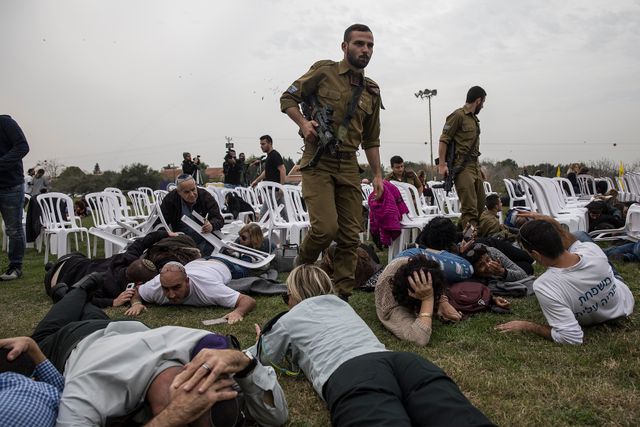
By Alireza Hashemi | Press TV | January 16, 2024
The Israeli genocidal war on Gaza was a high-risk gamble that eventually proved a failure, and the rising direct and indirect costs of the war make it difficult for the regime to sustain it, says an analyst.
Mohammad Sadeq Koushki, a Tehran-based political and foreign affairs commentator, in a conversation with the Press TV website, said the Israeli regime has encountered staggering losses with its onslaught on Gaza, which makes it hard for Israeli officials to keep fanning its flames.
“This war is unequal in many aspects. The biggest difference is that the Palestinian side has nothing to lose, and nowhere to go. They have no option but to defend themselves and to continue the war for as long as it takes,” he said, referring to the Palestinian resistance’s upper hand over the occupation.
“But on the other hand, the Zionists have a lot to lose. Those still living in the Israeli-occupied territories went there in the hope that they would have a better life there. Now that doesn’t exist and people are losing their motivation to remain in the occupied lands and have decided to leave.”
Koushki said the indirect costs of the war are also taking a heavy toll on the regime’s economy.
“It’s not just ordinary people leaving. Investors are also leaving. The skilled workforce who went there from Europe and the US are also leaving. Tourists are also afraid of visiting the region,” he noted.
“Reservists, who were summoned by the regime, have also left their jobs. For the first time, a huge population has been displaced, and the regime has to pay for their living expenses.”
Staggering cost of war
He said the Benjamin Netanyahu-led regime has been spending 200 to 250 million dollars per day on the war while continuing to lose their troops and tanks and military vehicles.
“It was a high-risk gamble from the beginning and it has failed. It’s the Zionist settlers who have to pay for this failure. Netanyahu is doing this at their expense. And the costs are rising fast,” Koushki said.
This week, the genocidal war launched by the Israeli regime on Gaza on October 7 completed 100 days, leaving almost 24,000 Palestinians dead, the majority of them children and women.
Despite the high casualty toll in Gaza, the Palestinian resistance groups backed by the people of Palestine have refused to retreat or surrender, or even leave the besieged territory.
According to political pundits, the regime failed to achieve any of its stated objectives of the war.
Of late, the Israeli military claimed that it has shifted to “a new phase” of the war, which it says is focused on the southern part of the blockaded territory.
There have also been reports of Israeli military regiments abandoning northern Gaza without managing to eliminate the Hamas resistance group or destroy its infrastructure.
Israel can’t crush resistance
Israeli premier Benjamin Netanyahu has repeatedly rejected international calls for a humanitarian ceasefire in Gaza, vowing that “no one will stop us” from eliminating the Hamas movement.
Israeli officials say the regime will keep going for months or even years until it achieves its stated goals.
Koushki said Hamas is a manifestation of Palestinian resistance and Israel has never been able to eliminate this resistance throughout the past 75 years of its occupation.
“Hamas is nothing to be destroyed. From the 1990s onwards, hundreds of Hamas commanders were assassinated. The most important leaders. What happened to Hamas,” he asked.
“Even if Israel gets all of Hamas members in Palestine and executes every single one of them, the next generation of Palestinians will be the new Hamas. They can’t eliminate the resistance.”
On calls by various Israeli regime officials for Gazans to be “encouraged” to leave the region, Koushki asserted that Israel’s forced displacement plan is not feasible.
‘Zionists feel cornered’
On recent Israeli attacks inside Syria and Lebanon, which led to the martyrdom of several commanders of the resistance front, including Iran’s Sayyed Razi Mousavi, Koushki said it won’t help the regime.
“Even if Israelis attack Syria or Lebanon 10 times a day, or assassinate five resistance commanders each day, it doesn’t change anything on the ground in Gaza and doesn’t make up for Israel’s huge losses.”
When asked about the effectiveness of attacks by Lebanese, Iraqi, and Yemeni resistance groups against Israeli interests, Koushki highlighted the significant psychological impact of these strikes.
“Those living in the occupied territories feel they’re cornered and this places a huge pressure on them. They feel they’re being attacked from all directions. This is the first time that all occupied territories are insecure. From Eilat in the south to Galilee in the north to even central regions. People feel they don’t belong to this region,” the Iranian analyst told the Press TV website.
Asked whether the US and its allies can deter further anti-Israel operations by the Yemeni military, the analyst said the recent attacks on Yemen have not degraded their capability to attack Israel.
“The point is that Yemenis have imposed a semi-blockade on Israel. Did these attacks stop Yemen from targeting Israel-linked ships? Yemenis have conducted attacks against those ships even after the recent US-UK attacks. So they couldn’t stop Yemen and it’s very hard to believe they can do that shortly.”
South Africa’s genocide case
On South Africa’s genocide case against Israel, he said the regime is unlikely to abide by any ICJ verdict but it would significantly boost the pro-Palestine movement worldwide.
“Israel defied numerous UN resolutions and disregarded the 2004 ICJ ruling on the separation wall. This genocide case would be no exception. But Israel’s flouting of laws will only solidify its status as a pariah in the eyes of its backers in the West and further mobilize global public opinion against the regime.”
How far will complicity reach in Israel’s genocidal offensive in Gaza?
By Ramona Wadi | MEMO | January 16, 2024
If we were to listen to Israeli Prime Minister Benjamin Netanyahu, the definition of genocide would be altered, because Israel’s definition of its genocidal intent and actions were summed up by him as “a moral and just war” waged by the settler-colonial enterprise and the Israeli military. “This international defamation campaign will not weaken our hands or weaken our determination to fight to the end,” Netanyahu asserted. Until what end? The complete ethnic cleansing of Gaza?
At the International Court of Justice (ICJ) last week, Israel played its fabricated security narrative to the full, and unsurprisingly blamed Hamas for the thousands of Palestinians injured and killed by Israeli air strikes. The apartheid state also played the humanitarian card, despite starvation being one of the tactics used to annihilate the Palestinian population. Humanitarian corridors have been bombed, food aid has been prevented from entering Gaza and, on occasions where delivery was possible, the provisions were meagre in comparison with the scale of deprivation as a result of Israel’s dealing of death and destruction. Not to mention Israeli soldiers firing upon Palestinian civilians as they crowded around to get aid. Or children collecting flour that had been spilled on the ground. Genocide is not a fabrication — or a “defamation campaign” as Netanyahu would have us believe – and Israel, of course, has perfected its methods.
However, not even Israel believes its own lies, let alone the rest of the international community.
Alliances and complicity are what Israel relies on, though. It is allowed to retain control over its security narrative because ties run deep and dependence upon Israel’s military technology is the major weakness of too many governments. So much so, in fact, that the Jerusalem Post is marketing Israel’s weaponry which it has used in Gaza. As if to inaugurate the “100 days of the Israel-Hamas war” – Israel’s euphemism for genocide – a recent article lists Israel’s new weaponry and medical supplies for the military. With emphasis on precision targeting and mortars with “improved accuracy… for use against terrorists in crowded areas”, perhaps Israel can explain why precision targeting increases the death toll of Palestinian civilians, unless Israel is precisely targeting civilians. This is beside Israel’s assertion that it also used unguided bombs, “the goal being more attacks in fewer flights”. The Jerusalem Post notes that, “Israel is the first country to use them in operational activity.” Whatever Israel uses, precision strikes or unguided bombs, civilians have been targeted in a strip of land in which nowhere is safe and the only way out is forced transfer, a preference which Israeli leaders only stopped touting as the ICJ hearing loomed closer.
There is no defamation campaign against Israel. The settler-colonial state has boasted of its intent to annihilate Palestinians in Gaza and carried out genocidal actions that prove the intent. What is more, it has already boasted of its own impunity at the ICJ when it stated that a court order granting the requested provisional measures to stop the genocide would “ensure that Israel will be in breach of it as soon as it is made.” The underlying tone is that Israel will not be stopped from committing genocide because Israel deems itself above international laws and conventions. If the international community fails to stop this rogue state, a new level will be ushered in with regard to impunity and complicity in genocide.
Bypassing the UK parliament; the royal prerogative; and bombing Yemen
By Binoy Kampmark | MEMO | January 16, 2024
There is something distinctly revolting and authoritarian about the royal prerogative. It reeks of clandestine assumption, unwarranted self-confidence and, most of all, a blithe indifference to accountability before elected representatives. That prerogative, in other words, is the last reminder of divine right, the fiction that a ruler can have powers vested by an unsubstantiated deity, the invisible God, and a punishing force beyond the reach of human control. And that such powers can in turn be vested in the government of the day. It is anathema to democracy, a stain on republican models of government, a joke on any political system that has some claim on representing what might be called the broader citizenry.
The UK government, in league with the US and with support from a number of other countries, attacked Houthi positions in Yemen on 11 January. The decision was made without recourse to parliament and was justified by reference to Article 51 of the UN Charter as “limited, necessary and proportionate in self-defence”.
In his statement on the attacks, Prime Minister Rishi Sunak pointed to the Houthi’s role in staging “a series of dangerous and destabilising attacks against commercial shipping in the Red Sea, threatening UK and other international ships, causing major disruption to a vital trade route and driving up commodity prices.” He made no mention of the Houthis’ own justification for the attacks as necessary measures to disrupt Israeli shipping and interests in response to their systematic, bloodcurdling razing of the Gaza Strip.
Lip service has been paid by the executive within Westminster to parliament’s importance in deciding whether the country commits to military action or not.
The stark problem is that the action is always decided upon in advance, and no dissent among parliamentarians will necessarily sway the issue. Motions can be proposed and rejected but remain non-binding on the executive emboldened by the royal prerogative.
The British decision to commit to the egregious invasion of Iraq in 2003 was already a foregone conclusion, despite preliminary debates in the House of Commons and huge public protests against the measure. On 18 March, 2011, the then British Prime Minister David Cameron informed the Commons of his intention to attack Libya, leading to a government motion on 21 March that the chamber “supports Her Majesty’s Government… in the taking of all necessary measures to protect civilians and civilian-protected measures.”
That same year, the then Conservative-Liberal Democrat coalition government in the UK acknowledged that a convention had crystallised in parliament that the House of Commons should be availed of “an opportunity to debate the matter [of committing troops] and said that it proposed to observe that convention except when there was an emergency and such action would not be appropriate.”
The broadly worded nature of the caveats – in cases of emergency or when it would not be appropriate – have made something of a nonsense of the convention. In April 2016, Defence Secretary Michael Fallon made much of the “exception”, arguing that it was “important to ensure that this and future Governments can use their judgment about how best to protect the security and interests of the UK.”
Parliament, in short, should be put in its place when necessary. Governments, it is reasoned, know best when it comes to matters of national security; parliamentarians less so. “In observing the Convention,” Fallon goes on to explain, “we must ensure that the ability of our Armed Forces is to act quickly and decisively, and to maintain the security of their operations, is not compromised.” In such cases, matters could be dealt with retrospectively, with the government of the day subsequently informing parliament after the fact.
An example of this absurd policy was played out in the decision by the UK government in April 2018 to target the Assad regime’s chemical weapons facilities in Syria. Hiding behind the weasel claim of humanitarianism, the explanation for avoiding parliament was shoddy and leaden. “It was necessary,” came the explanation from the PM’s office, “to strike with speed so we could allow our Armed Forces to act decisively, maintain the vital security of their operations, and protect the security and interests of the UK.”
The Yemen strikes eschew humanitarianism (the humanitarian justifications advanced by the Houthis in protecting Palestinian civilians has been rejected), but, in any case, shipping interests take priority. Armed Forces Minister James Heappey, apparently, was satisfied that an exception to the convention to consult parliament had presented itself. “The prime minister,” the minister parroted, “needs to make decisions such as these based on the military, strategic and operational requirements. That led to the timing.”
With the horse having bolted merrily out of the stable, Heappey remarked with all due condescension that parliament would, in time, be able to respond to the decision to strike Yemen. An “opportunity” would be made available “when parliament returns for these things to be fully discussed and debated.” The sheer redundancy of parliament’s role in matters of state, and that of MPs, could thereby be affirmed.
Much agitated by this state of affairs, former Shadow Chancellor John McDonnell opined that no military action should take place without parliament’s approval. “If we have learnt anything in recent years it’s that military intervention in the Middle East always has dangerous and often unforeseen consequences,” said McDonnell. “There is a risk of setting the region alight.”
Liberal Democrat Foreign Affairs spokesperson Layla Moran was of the view that parliament should not be bypassed in matters of war, yet opted for the rather fatuous formula arising out of the 2011 convention. “Rishi Sunak must announce a retrospective vote in the House of Commons on these strikes, and recall parliament this weekend,” she said.
The use of the royal prerogative in authorising military action remains one of those British perversions that makes for good common room conversation but offends the sensibilities of the democratically minded elector. A far better practice would be to make the PM of the day accountable to that most essential body of all: parliament. That same principle would be extended to other constitutional monarchies, which are similarly weighed down by the all too liberal use of the prerogative when shedding blood. If a country’s citizens are to go to war to kill and be killed, surely their elected representatives should have a say in that most vital of decisions?
China Slams US, Issues Statement With Arab League Calling for Gaza Ceasefire
Sputnik – 16.01.2024
“The US, which is pouring fuel on the fire in the Israel-Palestine conflict, also wants to play the role of fireman,” read an article in Chinese media criticizing America’s “unconditional support for Israel.”
China released a joint statement with Arab League nations Sunday urging a ceasefire in Gaza and advocating a two-state solution to resolve the long running Palestine-Israel conflict.
The resolution emerged after Chinese Foreign Minister Wang Yi met Arab League Secretary-General Ahmed Aboul-Gheit in Cairo, Egypt.
The statement called for dialogue with Palestinian groups and a global peace conference to move towards implementing a two-state solution, advocating a “government of Palestine for the Palestinians.” The leaders urged the full implementation of resolutions passed by the United Nations which have long criticized the Israeli occupation of internationally-recognized Palestinian territory. The United States typically uses its influence and position on the UN Security Council to block and undermine resolutions criticizing Israel’s conduct.
The leaders also promoted the resumption of direct peace talks between the Israeli and Palestinian sides.
The statement then touched on recent US and UK-backed airstrikes against the Houthi movement in Yemen, which Chinese media criticized as an “escalation” of the situation and an attempt to distract from the broader conflict. Chinese media called for the respect of the “sovereignty and territorial integrity of Yemen,” a critique of the airstrikes that it noted lacked authorization by the UN.
Finally, China called for the sending of humanitarian aid to Palestinians, which it labeled an “imperative moral responsibility.” China insisted that the only way to ultimately safeguard commercial interests in the Red Sea is to achieve “a just settlement of the Palestinian issue.”
“We have a common responsibility to ensure the security of the Red Sea, and we will not be deceived by the US to fuel such tensions,” said Li Weijian, a researcher at the Shanghai Institutes for International Studies.
China and Arab League countries also vowed to move forward on economic cooperation via China’s Belt and Road initiative during the meeting.
US, UK attacks on Yemen illegal, strategic mistake: Iran foreign minister
Press TV – January 16, 2024
Iran’s foreign minister has strongly slammed the recent attacks on the Yemeni territory by the United States and the UK as illegal and a strategic mistake.
Hossein Amir-Abdollahian made the remarks in an early Tuesday phone call with Secretary General of the United Nations Antonio Guterres, during which the two sides discussed the latest developments related to the Gaza Strip and the Red Sea.
During the conversation, Iran’s top diplomat stressed the Islamic Republic’s principled stance on protecting and maintaining security of shipping and navigation.
“By stopping ships that are bound for the occupied [Palestinian] territories, Yemen seeks to put a halt to the Zionist regime’s crimes and genocide against civilians in Gaza,” Amir-Abdollahian said.
He added that “illegal measures taken by the United States and the UK in attacking Yemen” amounted to a strategic mistake that would lead to further escalation of tensions in the region.
Since the start of the Israeli military aggression on Gaza in early October 2023, the United States and its Western allies have been providing financial and logistical support to the occupying regime in its ceaseless bombardment campaign against Palestinians in the besieged territory.
As part of their support for Palestinians, Yemen’s Armed Forces and popular Ansarullah resistance movement have over the past month targeted several ships owned by Israel or bound for ports in the occupied territories in the strategic Red Sea after multiple warnings.
Elsewhere in his remarks, Iran’s foreign minister expressed concern about the complicated humanitarian situation in the besieged Gaza Strip, reiterating Iran’s readiness to send humanitarian aid for the Palestinian people in the territory.
The Israeli genocide in Gaza has so far claimed the lives of more than 24,000 Palestinians, most of them women and children, leaving thousands of others wounded and millions homeless. According to the UN, about 85 percent of the territory’s population has been displaced and forced into crowded shelters.
The regime has been also enforcing an all-out siege against Gaza that has prevented the flow of food, water, fuel, and medicine into the territory.
The UN chief, for his part, expressed concern about further spread of conflicts across the region, saying the world body is trying to stop the war and alleviate the suffering of the regional people.
He once again condemned the ongoing military aggression against Gaza, stressing the need for stopping it and sending humanitarian aid to Palestinians there.
Guterres also lauded the role played by the Islamic Republic in bolstering peace and stability in the region.
Featured Video

Anthrax War – CBC The Passionate Eye
or go to
Aletho News Archives – Video-Images
Book Review
Shattered Dreams: The HPV Vaccine Exposed (2019)
By Christina England – 30 Q&As – Book Review & Summary
Lies are Unbekoming | September 4, 2026
… Gardasil received FDA fast-track approval in 2006, Cervarix followed in 2009, and Gardasil 9 was approved in December 2014 with more than double the aluminium adjuvant content of the original. The commercial context is specific. Merck was about to lose patent protection on Zocor and faced $18 billion in Vioxx injury claims from a cardiovascular drug the company had marketed while suppressing its own data showing a five-times increase in heart attacks. Analysts projected the global HPV vaccine market at $4 billion by 2011, contingent on government-funded national programs for teenage girls. The 1986 National Childhood Vaccine Injury Act had already granted manufacturers complete liability immunity. By 2013, Japan had withdrawn its HPV vaccine recommendation after cataloguing severe adverse reactions in hundreds of girls. No Western government followed. The establishment position across the UK, US, Australia, and most of Europe held, and still holds, that the vaccines are safe and effective, that reported injuries are coincidental, and that cervical cancer prevention justifies the program. The book was published into this position, not against a vacuum.
Shattered Dreams sits alongside Mary Holland’s The HPV Vaccine On Trial and Viera Scheibner’s foundational vaccination work as part of the documented record on what has been done to a generation of teenage girls under the banner of cancer prevention. The full summary unpacks three specific findings: that Merck used the aluminium adjuvant itself as the “placebo” control in 92.5% of trial subjects, making it structurally impossible to detect excess reactions from the adjuvant; that Dr. Sin Hang Lee found HPV DNA fragments bound to aluminium in every one of sixteen Gardasil samples tested, and in the blood and spleen of a New Zealand girl six months after her third dose; and that in every country with high vaccination coverage, including Australia, the UK, Norway, and Sweden, cervical cancer rates have stopped declining and started rising specifically in the vaccinated cohort. Martínez-Lavín’s 2017 calculation puts the number needed to seriously harm with Gardasil 9 at 140, and the number needed to vaccinate to prevent one case at 1,757. Thirteen young women are seriously harmed for every one who benefits. The vaccine was approved on the basis of trials that could not detect what the trials were supposed to detect, and it is still being given to twelve-year-olds today. … Read full review
Blog Roll
 Aletho News
- Georgia’s Largest Healthcare System Will Fire Employees Who Refuse Flu Vaccine
- The Five-Year Fuel Crisis: Why the World Economy Is Paying for a War It Thinks Is Ending
- Trump’s Big Bluff on Iran
- Swiss scammed out of millions by Ukraine-linked call centers – media
- Germany facing potential ‘violent conflict’ with Russia – spy chief
- Ukraine’s EU neighbors reject new plea from Kiev – Politico
- British Transport Police Facial Recognition Trial Scanned 926,912 People With Zero Arrests
- House Bill Would Ban Federal Use of Flock ALPR Data
- Can a Spice Rival a Drug? 10 Head-to-Head Trials Put It to the Test.
- The oil routes around Hormuz face their own chokepoints
- If Americans Knew
- “We See Our Homes Now From A Satellite, Like Strangers”
- Watch “Gaza: Doctors Under Attack”, originally censored by BBC
- NAZA: Israeli embassies in UK and US promote rival documentary to challenge Gaza genocide allegations
- David Ellison appoints Israeli to lead merged Paramount-Warner studios
- Turkish Red Crescent helps elderly Gaza man walk again after Israel confiscates his prosthetic limb
- Four Palestinians Killed in Israeli Attacks in Gaza
- Two Palestinian youths killed and village razed as Israeli attacks on West Bank continue
- Two more Christian women victims of Israeli raids on Gaza
- Cruelty, Deprivation, Indignity: A Journalist’s 22 Months in Israeli Prison
- New IDF Website Frames Slain Gaza Journalists as Terrorists
- No Tricks Zone
- Latest European Green Energy Debacle; Portugal’s Largest Flagship Solar Park Insolvent!
- Green Energy Debacle: German Expert Professor Fritz Vahrenholt Warns Of Severe Economic And Social Consequences
- Two More Paleo Reconstructions Affirm Meters-Higher Sea Levels Across Ireland, Brazil 7000-6000 Years Ago
- New Study: Earth And Venus Surface Warmth Largely Explained By Convection And Lapse Rate, Not CO2 Or Radiation
- 2025 Nature Paper Claiming Worsening Global Drought Gets RETRACTED …Heavily Flawed
- New Study: ‘Global Drought Shows No Detectable Recent Acceleration Under Climate Warming’
- Economic Masterminds: German Socialists Suggest Taxing Productivity Gains Stemming From Using AI
- The South China Sea Has Not Been Cooperating With The Climate Change Narrative
- Energy Crisis: Germany Enters Heating Season With Historically Low Gas Reserve Fill Levels
- New Study: The Antarctic Ice Sheet Gained Mass From 2020-2024 Due To Staggering Snow And Ice Accumulation

