Sometimes People Fight Back: Amer Jubran Names His Torturers
By Lana Habash | CounterPunch | October 16, 2015
When Amer Jubran reported that he had been tortured by Jordan’s General Intelligence Directorate (Jordan’s secret police or mukhabarat) while in detention in Jordan in 2014, no one was surprised. For years, human rights groups have cited the Jordanian government’s abysmal human rights record. Violations of the Universal Declaration of Human Rights and the International Covenant on Civil and Political Rights (ICCPR), of which Jordan is a signatory, have continued with impunity at every level of what is supposed to be Jordan’s “justice system.”
Amer Jubran is a Jordanian citizen of Palestinian descent. He is an internationally known activist and speaker who has written about the rights of Palestinians and against unjust policies of the US and Israel in the Arab world. The Jordanian government violently arrested and detained Jubran in May, 2014 and he was later sentenced to ten years in prison in July, 2015. His verdict and sentence are currently being appealed in Jordan’s Court of Cassation. Amer Jubran’s experiences as a political prisoner highlight the human rights abuses for which Jordan is best known:
1) Arrest without a warrant;
2) Incommunicado detention for 2 months;
3) No access to legal counsel for at least 2 months while in detention;
4) Torture including forced stress positions, sleep deprivation, beatings, 72 to 120 hour interrogation sessions, and threats to family members;
5) Forced confessions obtained through torture that the defendant was not even permitted to read before signing;
6) Charges that include “committing acts that threaten to harm relations with a foreign government” based on a law promulgated one month after his arrest and that effectively criminalizes speech or any expression of protest directed at a foreign government;
7) A trial in Jordan’s State Security Court, a military tribunal with no judicial independence (the UN has called for its abolition since 1994); and
8) The State Security Court ruling on July 29, 2015 which states openly that the Court is “not obliged to discuss defense’s evidence presented by defense attorneys since accepting prosecution’s evidence automatically implies rejection of defense’s evidence” and relies solely on the forced confessions obtained through torture that Jubran and all his co-defendants recanted during trial.
What is disturbing is that Jubran’s case is not the exception, but rather the rule in Jordan’s State Security Court system. Inès Osman, Legal Officer at Alkarama Foundation states, “The Jordanian special courts continue to rely heavily on confessions extracted under torture, which, added to their lack of independence, often leads to the arbitrary sentencing of people like Amer.”
But this is not just the story of Jordanian prisoners either. It is the story of the thousands of Arabs and Muslims who continue to be detained illegally by proxy governments of the US and Israel, for the US and Israel.
The involvement of foreign governments in Jubran’s detention is not mere speculation. Jubran was told by his GID interrogators that the outcome of his arrest and detention would be determined by the GID’s “American and Israeli friends.” During his interrogation, Jubran was questioned about his friends in the US, and when Jubran asked why, he was told that the information was for the GID and their “friends in the States.” Even the nature of the charges that Jubran finally received months after he was arrested points to an arrest at the behest of foreign governments. A review of Jubran’s activism and writing clearly show that his efforts were not directed at Jordan’s king or the Jordanian government and certainly involved no threat to the people of Jordan. Jubran’s charges involved alleged threats to only two entities: the US and Israel. The charges included “planning attacks” on American soldiers in Jordan (although the Jordanian government had denied the presence of American soldiers in Jordan during the alleged period) and affiliation with Hizballah, an organization that poses no direct threat to Jordanian citizens or the royal family, but is the only organization that poses a threat to American and Israeli interests in the region. Though Jubran has expressed his respect for Hizballah, he denies any affiliation and has stated that all the charges against him are false.
What is compelling about Jubran’s case is that he knows the names of those who tortured him. And the reason Jubran knows those names underlines the absolute confidence that the Jordanian government has in the State Security Court to act as a rubber stamp for the government’s agenda. There is not even the need for the pretense of a fair system. Coerced confessions of different co-defendants carried identical phrasing and were literally edited several times throughout the course of the trial to serve the needs of the prosecution. Jubran discovered the names of his torturers because they were the first five witnesses for the prosecution. In a recent statement by Jubran on October 10, 2015, he names two of the torturers: Colonel Habes Rizk (who threatened Jubran with being disappeared) and Captain Motaz Ahmad Abdurrahman (who threatened to assault Jubran’s wife to get Jubran to cooperate and also physically tortured Jubran). (See transcript of Jubran’s October 10th statement here).
Impunity for torturers is dependent on a system that permits those who torture to remain anonymous. Though it may benefit repressive regimes to advertise what can happen to you if you are criminalized, it certainly doesn’t benefit those regimes for the names of those doing the dirty work to be common knowledge. Anonymity is the main source of protection for those who torture. It is what permits them to “dissolve into the mist of the system.” (St. Clair, When Torturers Walk, Counterpunch, March, 2015 ). But the Jordanian government’s hubris in the trial of Amer Jubran threw a wrench into their own plans. The government was so confident in its ability to intimidate that they saw no risk in having the torturers testify at the trial. They didn’t calculate on Jubran naming them publicly.
Sometimes people fight back.
Jubran has taken great personal risks to expose Captain Adurrahman and Colonel Rizk, and Jubran has already experienced retaliation within the prison for speaking out. It is our job as those not held captive by Jordan’s penal system, to demand and assure that Jubran at long last receives justice, and that the people responsible for his torture be held accountable for their crimes. As long as the torturers can still do their jobs with impunity, the Jordanian government will continue to play a central role in the US and Israel’s geopolitical agenda for the region– playing the henchman to oppress their own people.
More details about the case of Amer Jubran can be found at freeamer.wordpress.com .
Lana Habash is a Palestinian physician living in Boston, MA. She can be reached at defense@amerjubrandefense.org.
Defending the Indefensible: How The NY Times Spins for Israel
By Barbara Erickson | TimesWarp | October 13, 2015
It’s a topsy-turvy world in The New York Times. Palestinians are dying, but it is Israelis who are fearful. Unarmed Palestinians face the threat of heavily armed settlers and security forces, but it is not Palestine that has a security problem; it is Israel.
This is the scenario we find today in a story by Isabel Kershner titled “Stabbings, and Deadly Responses, Add to Israel’s Security Challenge.” Here we learn that Israelis have a “shattered sense of personal security” after a series of lone-wolf stabbing attempts.
Kershner takes all the stabbing allegations as fact, rejecting any evidence to the contrary, and nowhere in this lengthy story do we find any concern for how Palestinians are feeling even though more than two dozen have been killed since Oct. 1 and more than 1,300 wounded (compared with four Israelis killed and some 28 wounded in the same time period).
Neither Kershner nor her editors find Palestinian vulnerability at all newsworthy. It is only Israeli sentiments that matter here.
Likewise, it is not the death of so many Palestinians that concerns the Times but the effect on Israel’s reputation. As Israel “resorts to live fire,” Kershner writes, the number of Palestinian deaths is mounting, and this fact “is increasingly opening Israel up to criticism, placing the government in a quandary.”
From then on her article is an attempt to defuse that criticism without giving readers a clear sense of what accusations have been made. She writes, for instance, that Amnesty International “has accused Israel of using excessive force,” as if this refers to past reports by the monitoring group but failing to mention a recent release about the current attacks.
In fact, Amnesty is one of three human rights organizations to speak out against trigger-happy Israeli forces in the past week. Human Rights Watch and Al Haq, a Palestinian group, also raised the alarm about the increasing violence against Palestinian civilians.
Amnesty’s report was titled, “No justification for deliberate attacks on civilians, unlawful killings by Israeli forces, or collective punishment of Palestinians.”
Kershner ignores the findings of all these reports and at the same time attempts to explain away the shocking brutality displayed by Israeli settlers and troops in several videos appearing on social media in recent days. “Some of the videos of police shootings have had the added effect of turning the Israelis, in the eyes of some people, from the victims of terrorism into aggressors,” she writes.
These videos (see here and here) show helpless and unarmed Palestinians surrounded by armed troops or angry mobs. In one of them a boy lies crumpled and bleeding on the pavement as Israelis shout at him, “Die, you son of a whore!” All of the Palestinians are either injured or killed, but once again Kershner’s concern is not for the victims in the videos but for Israel’s reputation.
Kershner concedes that Israelis may have gone too far in a couple of these cases, but she is quick to excuse their aggression as “panic” by traumatized individuals.
After trying to neutralize the effects of the videos and the human rights groups’ reports, Kershner turns her attention to alternative media. The accounts by these outlets have often contradicted the stabbing attempt allegations made by Israeli security forces.
Rather than reporting the contradictions, Kershner states that alternative news media have been “feeding the anger” of Palestinians by often denying that any attack took place. She is implying that these media are not to be trusted and that their reports are inciting Palestinian hostility.
As usual, the Times makes no effort to place the attacks in context, ignoring the ugly realities of the occupation and the enormous disparity in power between Palestinians and Israelis. Thus she implies that the attacks on Israelis arise out of hatred and lack any valid motive. Her reference to “feeding the anger” fits well into that narrative.
Missing from her article are the frequent settler mobs who march through Jerusalem and other cities chanting “Death to Arabs” while police and soldiers stand by to protect them. Kershner ignores this kind of incitement, preferring to stay with the Israelis-as-victims story line.
Israel is a nuclear power with sophisticated weapons and a standing army. Palestine has no army and not a single tank or aircraft, and its unarmed populace has suffered appallingly at the hands of the occupiers. The numbers show Palestinian casualties outnumbering those of Israelis by a ratio of more than 100 to 1 in the first week of this month.
Given all this, it takes some effort to convince readers that Israel—not Palestine—faces a “security challenge.” Kershner, with the blessing of the Times editors, has made that effort, providing us with a story that distorts the reality on the ground, ignoring journalistic standards and the ethical demands of compassion.
Israel blocks delivery of Indian gift to Palestinian university
Press TV – October 13, 2015
The Israeli regime has confiscated four communication systems that were to be given by Indian President Pranab Mukherjee to a Palestinian university as gifts during his first ever visit to the Israeli-occupied Palestinian territories.
On Monday, Israeli customs authorities held back the systems and prevented their delivery to the Information Technology (IT) department of al-Quds University, which is scheduled to be inaugurated by Mukherjee on Tuesday.
Israel’s customs released 30 computers that were part of Pranab’s gift to the Palestinian educational institution, but the communication systems were not cleared.
Mukherjee’s trip to Palestine comes amid simmering tensions between Israeli forces and Palestinian protesters.
At least 27 Palestinians have been killed and hundreds of others injured by Israeli troops in the West Bank and the Gaza Strip since October 1.
The tensions were triggered by the Tel Aviv regime’s imposition on August 26 of sweeping restrictions on entries into the compound of the al-Aqsa Mosque in East al-Quds (Jerusalem) and Israeli settlers’ repeated stormings of the mosque.
Palestinian child bleeds out while Israeli police & civilians watch, shouting insults
IMEMC & Agencies | October 12, 2015
 “Die, you son of a whore!! Die!!” shouted Israeli men at a seriously wounded Palestinian child, who was left to bleed while police stood around him doing nothing. One of the officers repeatedly pushed the boy down with his foot, whenever he tried to sit up.
While the child was bleeding to death, Israelis surrounded him, shouting at him in a mix of Arabic and Hebrew, “Die, you son of a whore!”, “Die, you son of the biggest whore!”, and telling the police to “Do him a favor, and shoot him in the head!”
The officers did not shoot him, but left him bleeding with head injuries, broken legs and other serious injuries on the ground. The boy was able to raise his head a few times, but the police officers kicked him back down.
The Palestinian child has been identified as Hasan Khaled Manasra, 15 years of age, while his cousin Ahmad Saleh Manasra, 13, suffered a serious injury. They are both from Beit Hanina, in Jerusalem.
The incident took place near Pisgat Zeev Israeli settlement, in occupied Jerusalem. The police claimed that the boys stabbed two settlers, wounding them.
A settler who chased the boys with his car also rammed Ahmad. But the police presented no evidence to connect the two children with the crime that they claimed the boys committed. […]
Since October 1st, when two Israelis were killed in a ‘lone wolf’ attack by a Palestinian in Jerusalem, 26 Palestinians have been killed, including a pregnant woman and her two-year old child killed in an Israeli bombing on Sunday morning. Over 1200 Palestinians have been injured, many of them hit by live ammunition fired by Israeli troops at Palestinian demonstrators armed only with stones.
During that time period, no Israelis have been killed beyond the two who died in the October 1st attack, but six have been wounded in alleged attacks by Palestinians. No Palestinian faction has claimed responsibility for any attack, and it appears that the Palestinians who wounded Israelis were acting on their own.
In addition, Israeli authorities have been revealed on several occasions to have lied about the Palestinians they have killed – claiming falsely that the Palestinians had been attempting to stab or attack Israelis, but eyewitness and video evidence disproved this claim in a number of cases. – Full article with video (warning, extremely graphic)
The youtube upload at IMEMC has been taken down. Therefore I am posting another upload here and will attempt to maintain a working upload.
By Rima Najjar Merriman
This incredibly shocking and painful-to-watch video in the Jewish colony of Pisgat Ze’ev in annexed and occupied East #Jerusalem is being shared on Israeli social media sites. The #Palestinian teenager (Ahmad Manasra, 13) is surrounded by Israeli police and Jewish “settlers” hurling insults at him, as he bleeds to death. The circumstances of the shooting are unclear. My ex-colleague at Al-Quds University (Randa Hilal) writes: “What’s happening is a new #Nakba, new terror and forced displacement of the [Palestinian] people of #Jerusalem. They are killing school children. Today, three school children were killed, the latest a girl from Al-Ma’mounieh school. A [Jewish] colonist threw a knife next to her and started screaming for her to be shot.”
الي بصير نكبة جديدة وأسلوب جديد وترهيب وتهجير لاهالي القدس
عم يقتلو أطفال مدارس
اليوم ٣ أطفال آخرهم بنت من مدرسه المامونيه مستوطن رمى سكينه جنبها وصار يصيح قتلوها
I downloaded this clip from the FB wall of Mira Atmi (https://www.facebook.com/profile.php…), who has the following comment in Hebrew attached to it (The terrorist bastard in Pisgat Ze’ev in Jerusalem):
המחבל הבן זונה בפסגת זאב בירושלים
(The terrorist bastard Pisgat Ze’ev in Jerusalem)
Settler attacks international – eats notebook
International Solidarity Movement | October 12, 2015
Hebron, occupied Palestine – Yesterday afternoon, two girls were arrested by Israeli forces in occupied al-Khalil (Hebron). International human rights observers documenting the ungrounded arrest were harassed by settlers in front of the Israeli police station.
Two young school-girls, aged 14 and 16, were stopped by Israeli forces at one of the many checkpoints at Ibrahimi mosque. Israeli forces accused them of having a knife and walked them to the police station at the Ibrahimi mosque. Both of them were eventually released after being taken to the police station in the illegal settlement of Kiryat Arba, which clearly illustrates that the arrest was based on a random accusation. Child arrests in the recent weeks have skyrocketed in al-Khalil, with children facing the threat of arrest at any given time of the day. The rights of Palestinian children in al-Khalil are continuously violated by the Israeli forces, with illegal arrests, ill-treatment during arrests and detentions as well as violent attacks with tear-gas, rubber coated steel bullets and live ammunition on children on the increase.
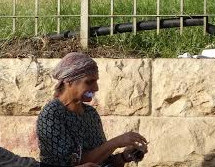 International observers, documenting the arrest, were accosted by settlers while waiting outside the police station to find out the names of the children. After about two hours of waiting, the infamous and violent settler Ofer called another group of settlers to come to the police station, amongst them the infamous and aggressive settler woman Anat Cohen. Immediately after her arrival, she confronted the international volunteers and stole a notebook from one of the internationals, attempting to hit her in the face and punch her several times.
In order to make sure that the international would not be able to get her notebook back, Anat Cohen put part of it in her mouth and chewed it up. Even though all of this happened right in front of the police station, about five soldiers and two police men watching everything happen refused to intervene, even when the internationals present repeatedly asked them to stop the attacks. Instead, after they allowed the settlers to leave with the stolen notebook, they told the international to ‘go to Syria’.
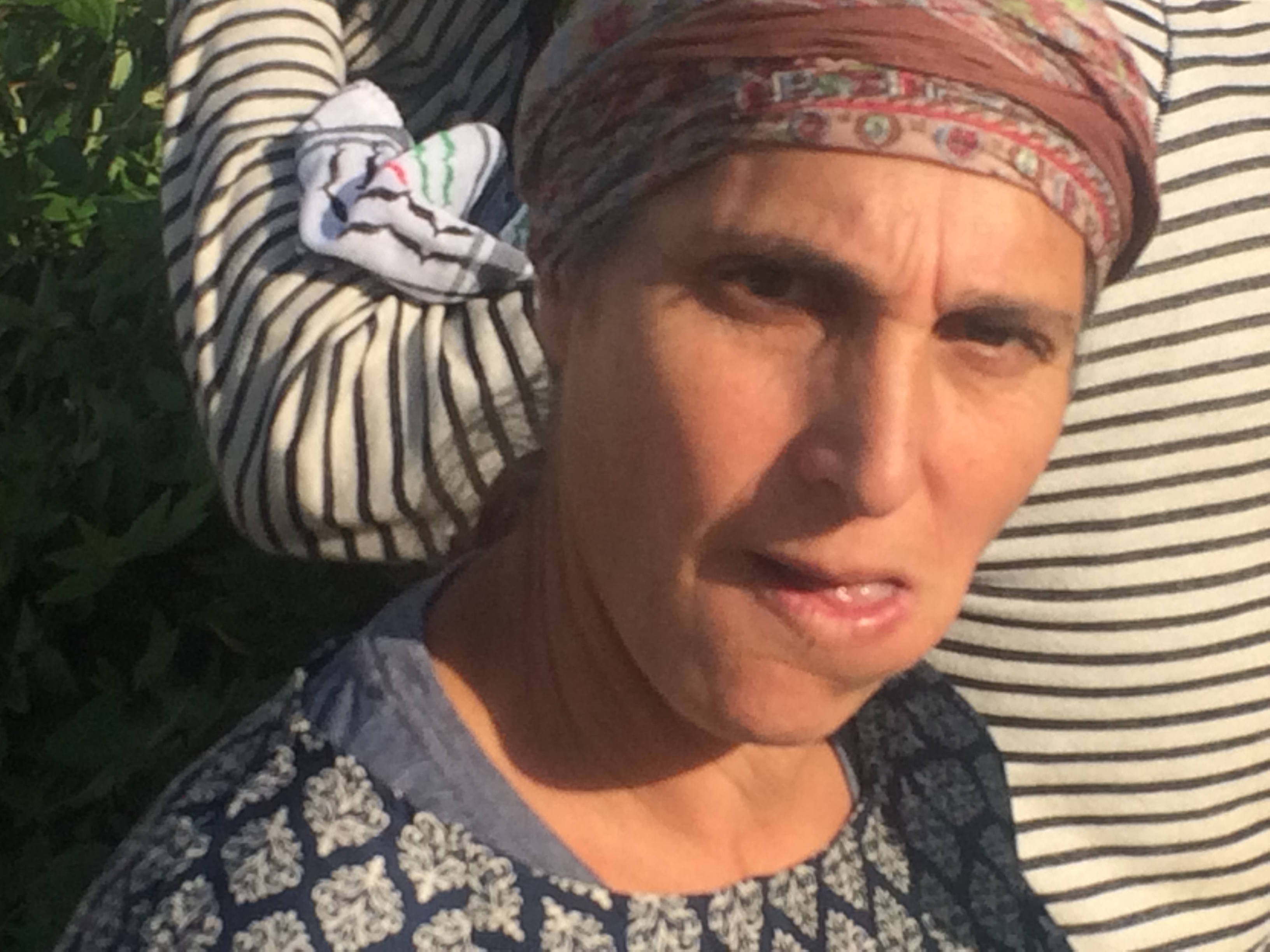
Anat Cohen eating the notebook
This again illustrates the total impunity settlers are granted by the Israeli forces for their actions, even if it involves internationals – who usually receive more protection under the law than do Palestinians.
What is the Israeli Lobby in Australia Doing in Interfaith Dialogue?
By Ali Kazak | Dissident Voice | October 11, 2015
For years Israel and its lobby around the world have been trying to normalise their relations with Arabs and Muslims without solving the Palestine Question.
One of the methods they resorted to in the last few years is using human rights and community organizations such as interfaith dialogue and Multiculturalism to achieve this objective and to: isolate the Palestinians, marginalise the Palestine question, end Israel’s isolation, and prevent criticism of Israel, knowing that these organisations will be the first to stand against Israel’s violations, racial and religious discrimination.
The group responsible for this task in Australia is The Australia/Israel & Jewish Affairs Council (AIJAC); its Director of International & Community Affairs, Jeremy Jones is in charge of lobbying religious community organizations, specifically Muslims and Christians. Consequently he convened the Faith Communities for Reconciliation, founding participant in the Australian Partnership of Religious Organisations and the Australian National Dialogue of Christians, Muslims & Jews.
AIJAC is a private political propaganda group. It is recognised as the main Israeli lobby in Australia. It coordinates its activities and works intimately with the Israeli embassy in Canberra and different institutions in Israel. It is privately funded by some Jewish businessmen. It monitors closely Australian politicians, the media, ethnic and religious groups, (especially Arabs and Muslims), unions and academics on their stands towards Israel and the Palestine question.
AIJAC’s task is to spread Israel’s misleading propaganda, targets all those who oppose Israel’s violations and foil the Australian government and community from taking a stand in support of Palestinian rights. Its mouthpiece was Australia/Israel Review renamed later The Review.
The fact that, as a professional pro-Israeli lobby group and not a religious organization or representative of the Jewish community, AIJAC’s self-appointment to represent Judaism and the Jewish community highlights the political objectives it is trying to achieve by serving Israel’s interests and infiltrating ethnic and religious community organizations under the pretext of ethnicity, religion and “religious dialogue”.
Stephen Rothman, NSW Jewish Board of Deputies President, said “AIJAC is a private think-tank. It is not a body that is in any way elected or in a democratic sense representative of the community” (“It was mishandled – community president” in Australian Jewish News (AJN) on 7 Nov. 2003).
Adding to this irony is the major role AIJAC has been playing for years in inciting against Palestinians, Arabs, Islam and Muslims in Australia, New Zealand and the Pacific Region by inviting and organizing speaking tours of anti-Muslim racists, and underneath the surface of its representative Jeremy Jones’s sweet talk and attempt to climb to the highest steps of morality, virtue and principles which he tries to impress his audience with and outbid everyone else, there is an ugly reality that speaks to the contrary.
Let me give you some examples.
Jones was reported in the AJN, on 19 Feb. 1988 as saying “I am concerned at the fact that Islam is today the major non-Christian religion in Australia”! Imagine if someone expressed their concern at the number of the Jews in Australia? This is the man who is disguised as working for reconciliation, the partnership of religious organizations and dialogue.
Jones’s hostility towards Palestinian human and national rights goes back to his activism in the Jewish Union of Students on campus. He intentionally confuses between anti-Semites and critics of Israel’s crimes and violations whom he accuse of having a hidden anti-Semitic agenda. In his “Media Watch” column which Jones wrote in the AJN for eight years as well as his column in The Review he was renowned for attacking all critics of Israel’s crimes from community group leaders, politicians, academics, journalists and Christian, Moslem and Jewish religious leaders such as the Neturei Karta. Furthermore he attacked the UN Relief and Works Agency for Palestinian Refugees and called for the Australian government to use its contribution to pressure the UN organization to adopt policies suitable to Israel, the perpetrator of the ethnic cleansing of the Palestinians.
Federal Member of Parliament, the Hon. Leo McLeay, said in a speech to parliament ‘It amazes me how intolerant Mr Jones and the pro-Israeli lobby can be. If you are not an enthusiastic supporter of the Sharon version of the Berlin Wall, you are considered to be anti-Jewish. When will the Jeremy Joneses of this world understand that criticism of the Israeli government and its actions is not anti- Semitism?’ (Hansard 11.8.2003 House of Representatives)
In a letter to the editor F. Pojer wrote in the AJN of 8 November 1991, commenting on the “Media Watch” column “as a loyal reader of the AJN over many years I am speaking, I believe, on behalf of many others, about the content and tone of the regular feature Media Watch. The articles are always written in an aggressive and antagonising manner rather than in a rational and conciliatory style more acceptable to the majority of peace-loving people.” This comment is not in isolation but typical of people who objected to Jones’s extremism.
In 2003 Jeremy Jones, then president of the Executive Council of Australian Jewry, vigorously attacked the Sydney Peace Foundation for awarding the Sydney Peace Prize to Dr. Hanan Ashrawi, a prominent Palestinian activist, academic and Member of Parliament who has been a tireless worker for justice and peace in the Middle East.
Throughout the years AIJAC has been inviting and organizing speaking tours of anti-Arab and anti-Muslim racists.
One of the speaking tours they organized in Australia and New Zealand is for David Pryce-Jones, who was reported in the Weekend Australian of 1-2 Dec. 1990, as describing the Arabs as having a “culture of violence”, saying “aggression and war are nearly inevitable in the Arab world” and that “Arab culture is a closed circle of status-seeking from which the Arabs cannot escape”. “When the West tries to be understanding and progressive in its dealing with the Arabs, it is really making the mistake of thinking that the Arabs are just like us”.
And on another speaking tour organized also by AIJAC he was reported by the Melbourne Herald-Sun on 7 Nov. 1995 saying “to shoot one’s prime minister is what the Arabs do, not what the Jews do”, ironically he said that at a time when Israel’s prime minister Rabin was shot by an extremist Jewish terrorist. He furthermore, described the Arabs and Palestinians in particular, as assassins, lawless and living like animals. Arab society he says is a violent society. But this time as a result of a complaint by the Australia Arabic Council, under the Racial Hatred Act, AIJAC was forced to make a public apology which appeared in the Herald Sun on 23 Dec. 1997. If you think that AIJAC’s apology was genuine you are mistaken. More speaking tours were organized by AIJAC for David Pryce-Jones.
Another favourite and regular guest of AIJAC’s is Daniel Pipes, who built his career on preaching hate against Muslims and Islam. A review of one of his books in the Washington Post in 1983 found his work exhibiting “a disturbing hostility to contemporary Muslims… and frequently contemptuous of them.” He has repeatedly called into question the loyalty of American Muslims and singled them out as somehow anti-American.
On a visit to Australia in 1998 Pipes vilified and offended the Australian Moslem community. His aims were to stereotype Moslems and incite the public against them, especially the Jewish community by deliberately mixing Zionism with Judaism and showing Moslems as anti-Jewish rather than against Zionism and Israel’s occupation and racial discrimination.
He was reported in the AJN of 18 Dec. 1998 as saying “Antisemitism is now primarily a Moslem phenomenon… I advise Jewish organizations to take their eyes off the Christians and start focusing on Islam.” And to a question about Palestinians who favour peace? He replied “Show me a moderate Palestinian.”
In an article in The Nation on 11 Nov. 2002, Kristine McNeil wrote: “Pipes is notorious for calling Moslems ‘barbarians’ and ‘potential killers’ in a 2001 National Review article, and accusing them of scheming to ‘replace the [US] constitution with the Koran’. In a 1990 National Review article [he] insisted that ‘Western European societies are unprepared for the massive immigration of brown-skinned peoples cooking strange foods and maintaining different standards of hygiene… All immigrants bring exotic customs and attitudes, but Moslem customs are more troublesome than most.”
Another AIJAC guest professor Raphael Israeli, was reported by the AJN of 16 Feb. 2007 urging Australia to cap its intake of Muslim immigration warning “life will become untenable, unless the Muslim population is kept in check … then they control whole section of the economy … even students who apply to come from Islamic countries to the West” and called for a “preventative policy” to protect national security and ensure Muslims remained a “marginal minority.”
Only following a storm of protest over his racist comments, AIJAC was forced to withdraw its support.
An article in the AJN on 23 Feb. 2007 titled “A few facts in the service of gross distortion” expressed the views of many Jews who are unhappy with the extremist activities of some mainstream Jewish organizations and AIJAC, Dr Mark Baker wrote: “One needn’t be a prophet in an age of Google to predict what Professor Israeli would speak about behind open doors. The same can be said for Melanie Phillips, the author of Londonistan, whose visit is being sponsored by AIJAC to provoke the same message of fear and discord. No doubt, the invitation has also been extended to Bat Yeor, author of Eurabia, along with the annual visit by Daniel Pipes, thought-patroller of western academia.”
And Mr. Gordon Drennan wrote:
My congratulations to Mark Leibler and Dr. Colin Rubenstein at AIJAC. It’s quite an achievement to arrange things so that you get to have your cake and eat it too. They invite Professor Raphael Israeli to Australia, knowing full well he’s an Islamophobe. They could not know, they could not have invited him for any other reason – he’s written 20 books. Then they make sure his views end up in the mainstream media so they then get the chance to disown him and say his racist views are repugnant to Jews. But he still gets to stay here, give his talks and spread his race hate, and he gets way more publicity when he does. Masterful. (AJN, “AIJAC Achievement” (9.3.2007)
Those are only some examples of the anti-Muslims and anti-Arabs amongst the numerous guests of AIJAC and some other Jewish organizations in Australia.
It is an absolute farce to have Israeli apologists in an “interfaith dialogue” when Israel is grossly violating both Christian and Muslim Palestinians human and religious rights, ethnically cleansing Muslims and Christians and preventing their return to their homeland just because they are not Jews and preventing those under occupation from moving freely in their own country to go to their Churches and Mosques to worship in Jerusalem.
Since its creation in Palestine in 1948 Israel has destroyed and desecrated thousands of churches, mosques and cemeteries and turned some historic mosques into restaurants-bars.
To mention but a few cases: the mosque of the village of Ain Hud in the Haifa district has been transformed into a restaurant bar. The mosque of the village of Caesaria similarly serves as a restaurant bar. The mosque of the city of Safad in the Galilee has been transformed into an art gallery, while the central mosque of Beer Sheba serves as the city museum. The Tel Aviv Hilton Hotel and the adjacent park, named Independence Park, are built on the site of Abed Al-Nabi Muslim cemetery. The Jerusalem Plaza Hotel and the adjacent park, also named Independence Park, are likewise built on the site of the Mamilla Muslim cemetery.
The pillaging of the historic Islamic cemetery of Mamilla Cemetery with thousands of graves is still ongoing today to build housing, shops and the so called “Museum of Tolerance”!! This is not to mention the massacres, such as Al Aqsa Mosque massacre (8.10.90) and the Ibrahimi Mosque massacre (25.2.94), the frequent desecration and arson attacks against churches and mosques carried out by Jewish extremists who are armed and protected by the Israeli army and their recent murderous arson attack on the Dawabsheh family while sleeping in their home burning alive the father, mother and 18 month old baby, leaving a 4 year old boy orphaned with second-degree burns on more that 60 percent of his body.
In their government-funded schools, Jewish religious extremists teach hatred and racism to the pupils. One example of this is a song sung by children of Kiryat Arba settlement in the West Bank in an SBS Australian Television documentary “A Season inside God’s Bunker” screened on 3 May 1994. The song went as follows:
All the world hates Arabs,
And the main thing is to kill them one by one,
With these feet I stepped on my enemy,
With these teeth I bit his skin,
With these lips I sucked his blood,
And I still haven’t had enough revenge.
AIJAC has never condemned Israel’s racial and religious discrimination against non-Jews in Israel and the 1967 Palestinian occupied territories. How could one support the rights of one indigenous people and not another? Or support multiculturalism and equal religious coexistence in one country and not another?
There is nothing wrong in interfaith dialogue; in fact it is a civilized and healthy conduct if it is held in good faith, for understanding and against all form of religious discrimination. But what is wrong here is that a lobby group which does not represent Judaism or the Jewish community is using the dialogue to advance a political agenda on behalf of one of the most oppressive violators of religious rights in the world today. This is contempt and an affront to the other parties of the dialogue and to the society as a whole and should not be acceptable
Unfortunately, some Muslim groups accept of AIJAC in Australia, out of ignorance of its role. And the establishment of relations with it has given AIJAC credibility and misled other Muslim organizations overseas, such as Nahdlatul Ulama (NU) in Indonesia, the world’s largest membership Muslim organisation, which hosted Jeremy Jones recently and introduced him as “a friend of NU and a pioneer in Jewish-Muslim dialogue”. Prior and subsequent to his visit, Jones embarked on a speaking tour organised by the NU participants in this January’s Muslim-Jewish dialogue in Israel hosted by AIJAC.
It was reported that during his visit, he met “politicians, political advisers, human rights NGOs, representatives of both the historic and new organisations of Jewish Indonesians, academics and religious leaders, represented Judaism at the Jakarta Interfaith Hallal BiHallal (a post-Ramadan event designed to improve interpersonal relations).”
Muslim group leaders in Australia, Indonesia, and elsewhere need to review their relations with AIJAC and Jones and put the interest of equality and peace in Palestine above personal and other interests.
Ali Kazak is a former Palestinian ambassador.
Pregnant woman and child killed in Israeli air raids on Gaza

Injured Palestinian father, Yahya Hassan holds his son Ahmed Hassan’s hand as they wait to receive treatment at Al-Shifa Hospital in Gaza City, Gaza on October 11, 2015.
Palestine Information Center – October 11, 2015
GAZA – An Israeli aerial attack on the Gaza Strip at dawn Sunday destroyed a Palestinian home, killing a pregnant woman and her little girl, and injuring three other family members.
A spokesman for the health ministry said that Nour Hassan, who was five months pregnant, and her two-year-old daughter Rahaf Yehya were both killed when their home collapsed as a result of an Israeli air raid on a nearby location in Azzeitoun neighborhood east of Gaza City.
Three other people from the same family also suffered injuries in the attack.
Rescue efforts are underway to search for others under the rubble, the spokesman added.
Eyewitnesses said the house was reduced to rubble as a result of the strong blast that was caused by an Israeli airstrike on a nearby resistance training site.
The Palestinian Information Center reporter in Gaza said that an Israeli warplane fired two missiles at two separate training camps belonging to al-Qassam Brigades of Hamas in the City, adding that one of those sites was close to the house.
In this regard, the Israeli occupation army claimed its airstrikes were launched after its anti-missile defense system, the Iron Dome, intercepted a Palestinian rocket fired from Gaza.
Israeli Army Invades IMEMC/PCR Office In Beit Sahour
IMEMC News | October 11, 2015
 Israeli soldiers invaded, on Sunday at dawn, the offices of the Palestinian Centre for Rapprochement (PCR)/International Middle East Media Center (IMEMC) and searched them.
The soldiers violently searched and ransacked our officers, after breaking the locks of the main door.
Because the invasion took place around 4 AM, Sunday morning, no staff were in the building as our offices are closed Sundays.
The soldiers also invaded and searched a few old nearby homes.
The Israeli military has invaded, ransacked and confiscated numerous files from the IMEMC and PCR in the past.
Surveillance video of Israeli soldiers breaking open the door of the PCR/IMEMC Palestinian News Office before they entered and ransacked the offices.
Video: Israelis Shoot Motionless Arab Woman
By Jonathan Cook | Dissident Voice | October 9, 2015
In the age of phone cameras, we have become increasingly used to photos and videos of Palestinians in the West Bank being shot by soldiers in unjustifiable circumstances.
Think of 18-year-old Hadeel Hashlamon, who was killed late last month at a checkpoint in Hebron. A series of photos of her suggest, in the words of Amnesty International, that she was “executed” by the soldiers there. She was shot multiple times and left to bleed to death.
The army claimed she had a knife, which they photographed on the ground nearby. But whether she was carrying the knife or it was planted there, still an issue that has not been resolved, the more important point is this: she posed no threat, let alone a lethal one, to anyone when she was killed.
Now we have a disturbing video of a similar shooting but this time not in the occupied territories. This occurs inside Israel and the victim is an Israeli citizen — a member of the country’s Palestinian minority, which comprises a fifth of Israel’s population.
Israa Abed, a 30-year-old mother of three from Nazareth, was shot today at the central bus station in Afula, close to Nazareth. She was surrounded by many soldiers, police and what appear to be armed Israeli civilians. The soldiers there are probably passengers on the many buses that pass through Afula.
The Israeli media initially reported that she was shot while trying to stab a security guard. The video (below) shows that to be definitively not the case. She is shot after long moments of standing apparently terrified in the bus station, in what looks like a state of all-consuming panic, as more and more people point their guns at her.
From the quality of this video it is near-impossible to know whether she is holding a knife. But it is possible to see that, like Hashlamon, she poses no threat to any of the soldiers when she is shot. That point is underlined by the fact that several soldiers and policemen move closer to her, not away from her, in the final moments before she is shot. She does little more than sway throughout the video, appearing to turn when a policeman runs directly towards her as several gun shots ring out on the sound track.
Fortunately, she appears to have survived the shooting and is reported to be in a stable condition in hospital.
But this video is troubling for several reasons.
First, and most obviously, this woman was shot when she posed no immediate threat. The person or people who opened fire did so with no possible justification, apart from their own fears. One cannot help wondering whether the ease with which Israeli Jews shoot Palestinians, whether fellow citizens of Israel or victims of the occupation, reflects long-dominant discourses in the Israeli education system, media and politics that dehumanise “Arabs”.
Second, the shooting seems to occur not because the armed people around her fear they are in danger, but because the group push themselves into a collective frenzy about the alleged knife. In this kind of atmosphere, someone is going to pull the trigger sooner or later.
This is very similar to another recent video, in which a group of religious (and unarmed) Jews chase after Fadi Alloun in a large open area in Jerusalem calling for him to be shot. When security forces turn up, the video shows police opening fire, apparently on the orders of the crowd, killing him. Again, Alloun does not appear to be posing a threat to anyone at the time he is shot.
Third, Israeli politicians, including the mayor of Jerusalem, Nir Barkat, have called on Israeli Jewish civilians to carry their weapons at all times and be ready to use them. This video shows where this policy is likely to lead: summary justice carried out by the most unhinged link in the security chain.
Fourth, it is a deeply worrying new trend inside Israel that Jewish civilians are starting to mimick the settlers in the occupied territories in believing they should be carrying out revenge attacks themselves. Today, a Jewish man in Dimona stabbed four Palestinians, two of them Israeli citizens. This video offers a vivid illustration of the mood of victimhood that is sweeping Israel, one that makes Israelis fast on the trigger and ready to play the role of avenging angel.
It is bad enough that Palestinians in Israel have to face security forces that treat them like an enemy. But things will get much, much worse when even the highly prejudicial rule of law in Israel is replaced by the lynch mob.
The Perverse Rise of Killer Robots
By Cesar Chelala | CounterPunch | October 9, 2015
The development of “killer robots” is a new and original way of using human intelligence for perverse means. Human directing machines to kill and destroy in a scale not yet imagined is a concept that not even George Orwell could have imagined. In the meantime, the leading world powers continue their un-merry-go-round of destruction and death -mostly of innocent civilians- without stopping to consider the consequences of their actions.
Killer robots are fully autonomous weapons that can identify, select and engage targets without meaningful human control. Although fully developed weapons of this kind do not yet exist, the world leaders such as the U.S., the U.K, Israel, Russia, China and South Korea are already working on creating their precursors.
The U.S. Government Accountability Office reports that in 2012, 76 countries had some kind of drones, and 16 countries already possessed armed ones. The U.S. Department of Defense spends $6 billion every year on the research and development of better drones.
South Korea is presently using the Samsung Techwin security surveillance guard robots, which the country uses in the demilitarized zone it shares with North Korea. Although these units are currently operated by humans, the robots have an automatic feature that can detect body heat and fire a machine gun without human intervention.
Israel is developing an armed drone called Harop that could select targets with a special sensor. Northrop Grumman has also developed an autonomous drone called the X-47B which can travel on a preprogrammed flight path while being monitored by a pilot on a ship. It is planned to enter into active service by 2019. China is also moving rapidly in this area. In 2012 it already had 27 armed drone models, one of which is an autonomous air-to-air supersonic combat aircraft.
Killer robots follow the generation of drones and, as with drones, their potential use is also creating a host of human rights, legal and ethical issues. Military officials state that this kind of hardware protects human life by taking soldiers and pilots out of harm’s way. What they don’t say, however, is that the protected lives are those of the attacking armies, not those of the mostly civilians who are their targets, whose untimely deaths are euphemistically called collateral damage.
According to Denise Garcia, an expert in international law, four branches of internationally law have been used to limit violence in war: the law of state responsibility, the law on the use of force, international humanitarian law and human rights law. As currently carried out, U.S. drone strikes violate all of them.
From the ethical point of view, the use of these machines presents a moral dilemma: by allowing machines to make life-and death decisions we remove people’s responsibility for their actions and eliminate accountability. Lack of accountability almost ensures future human rights violations. In addition, many experts believe that the proliferation of autonomous weapons would make an arms race inevitable.
As the United Nations is trying to negotiate the future use of autonomous weapons, the U.S. and U.K. representatives want to support weaker rules that would prohibit future technology but not killer robots developed during the negotiating period. That delay would allow existing semi-autonomous prototypes to continue being used.
The need for a pre-emptive ban on the development and use of this kind of weapon is urgent. As Christof Heyns, the UN Special Rapporteur on Extrajudicial, Summary or Arbitrary Executions stated recently, “If there is not a pre-emptive ban on the high-level autonomous weapons, then once the genie is out of the bottle it will be extremely difficult to get it back in.”
Dr. Cesar Chelala is an international public health consultant. He recently received the Cedar of Lebanon Gold Medal from the House of Lebanon in Tucuman, Argentina.
Casualty Count: 794 Palestinians, 7 Israelis—NY Times Obsesses on Israeli Victims
By Barbara Erickson | TimesWarp | October 8, 2015
Isabel Kershner in The New York Times tells us that Palestinians are running amok, lashing out at Israelis not only in the West Bank but now in Israel as well. Prime Minister Netanyahu has vowed to quell this “wave of terrorism,” she reports, and Israelis are “unnerved” by the spread of incidents.
Kershner describes three alleged stabbing attempts, dwelling at length on one of them; recaps an earlier incident that left two Israelis dead; and in the final paragraphs of her story informs us that “at least two” Palestinians were killed, one of them a 13-year-old boy “described as a bystander.”
Nowhere do we learn that the major victims of violence in this turbulent conflict are Palestinians, not Israelis, as revealed in a recent United Nations report: In one week, ending Oct. 5, Israeli security forces injured 794 Palestinians, while Palestinians injured a total of seven Israelis. (As of Oct. 5, 30 Palestinians had been killed in 2015 compared with eight Israelis.)
This is an injury ratio of more than 100 to one, a shocking disparity, but the Times story shows concern only for Israeli injuries and fears. We find no accounts there of what the Palestinian victims experienced as they faced the aggression of heavily armed security forces.
Readers and viewers elsewhere, however, got a firsthand view of Israeli violence yesterday as videos emerged that revealed undercover agents inciting stone throwers in the West Bank. The agents, wearing keffiyehs and bearing a Hamas flag, urge bystanders to join them, then draw their weapons and assault Palestinian youths.
The videos, by several agencies, including Reuters and Agence France-Presse, went viral, appearing on French, British, Israeli and American media outlets. The Times, however, has so far failed to link to the videos, which show a soldier shooting a captive Palestinian in the leg at point blank range.
The newspaper also avoids any commentary that would shed a clear light on the nature of the conflict even as Israeli columnists have recently provided eloquent testimony of the despair behind Palestinian attacks.
Gideon Levy, writing in the Middle East Eye, notes that when Palestinians remain quiet, they reap nothing but “an intensification of the occupation.” He lists the constant attacks and humiliations they endure and asks, “Are Palestinians to assent to all this in silence?”
Levy notes that after a Palestinian family was burnt alive, Israeli officials admitted that they knew who was responsible but refused to make any arrests. “What people could maintain restraint in the face of such a sequence of events,” he writes, “with the entire might of the occupation in the background, without hope, without prospects, with no end in sight?”
Amira Hass writes in a similar vein, and the headlines on her Haaretz article express it well: “Palestinians Are Fighting for Their Lives; Israel Is Fighting for the Occupation—That we notice there’s a war on only when Jews are murdered does not cancel out the fact that Palestinians are being killed all the time.”
Both these Israelis speak with an honesty that rarely, if ever, appears in the Times. Readers of the newspaper of record instead face a determined effort to protect Israel’s reputation, to preserve the narrative of Israeli victimhood even in the face of the evidence.
As Palestinians fall to Israeli violence at the rate of 100 a day, the Times obsesses on Israeli Jewish victims. It ignores the numbers that reveal an enormous toll of Palestinian suffering and it excludes the news and the voices of conscience that could help readers gain a truer perspective in this conflict.
Featured Video

Why the U.S. Should Pull Back From the First Island Chain
or go to
Aletho News Archives – Video-Images
From the Archives
Only 19.7% of Americans agree with US State Dept on Israeli settlements
… Most American adults of voting age don’t appear willing to reject the applicability of international law to Israel’s ongoing colonization of occupied territories in East Jerusalem, the West Bank and Golan Heights. … Full article
Blog Roll
 Aletho News
- British Government Employees Were Fact-Checking the News at the BBC. Nobody Told You.
- Albania on fire: who’s behind the riots?
- Egypt’s Civil Democratic Movement rejects involvement in regional war
- Egypt collaborates with Israel to build ‘Green Rafah’ project over erased Palestinian city
- Rising fuel prices and shortages have helped drive ongoing protests and rioting in France
- Tokyo protests demand Takaichi’s resignation over support for ‘Israel’
- Jennifer Kavanagh: Why the U.S. Should Pull Back From the First Island Chain
- Yemen denounces international community’s silence on Saudi aggression, siege
- UAE and Saudi Arabia move toward renewed coordination against Sanaa
- How Iran’s two-week retaliatory strikes exposed cracks in US military architecture in Persian Gulf
- If Americans Knew
- More on how Bari Weiss is using CBS on behalf of Israel
- What the UK Is Doing to Pro-Palestine Novelist Sally Rooney Is an Act of Orwellian Villainy
- ‘We will build palaces for Jews in Gaza’: Right-wing activists establish new outpost near border
- ‘You see us burning, you stay silent’: Family’s agony over mother and sons burned to death in Gaza tent
- Israel keeps Palestinian journalist Bushra al-Tawil in isolation for 46 days
- US-Israel integration plan puts US military tech in Israel’s hands
- Israeli Strike Burns Gaza Mother Alive in Front of Toddler, ‘Without Generating Any Headlines’
- ‘The Israel Experience with Mike Huckabee’: The Ambassador’s Family Sells Trips to Israel
- As Gazans carry out mass burial, food insecurity is getting worse – Daily Update
- Israeli rabbi permits occupiers to steal Palestinian olive harvest in West Bank
- No Tricks Zone
- Predictions Made By Renowned Climate Proifessor Over Past Decades Have Been Proven To Be Poor
- New Study Suggests Large Regions Of The Pacific Ocean Have Been Cooling For The Last 80 Years
- Germany’s Green Energy Debacle: High Energy Costs Force Kahla Porzellan to Close After 182 Years!
- New Study: 50 Years Of The Most Aggressive ‘Net Zero’ Policies Can Only Affect The Global Climate By 0.03°C
- US September “Heat” Was No Record…Many Records Set Decades Ago
- Latest European Green Energy Debacle; Portugal’s Largest Flagship Solar Park Insolvent!
- Green Energy Debacle: German Expert Professor Fritz Vahrenholt Warns Of Severe Economic And Social Consequences
- Two More Paleo Reconstructions Affirm Meters-Higher Sea Levels Across Ireland, Brazil 7000-6000 Years Ago
- New Study: Earth And Venus Surface Warmth Largely Explained By Convection And Lapse Rate, Not CO2 Or Radiation
- 2025 Nature Paper Claiming Worsening Global Drought Gets RETRACTED …Heavily Flawed

