Jewish settlers expropriate Palestinian garden as police stand by
International Solidarity Movement | April 4, 2016
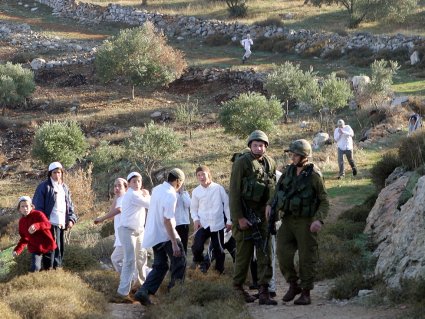
Tel Rumeida, al Khalil, occupied Palestine – On Saturday 3rd of April 2016 settlers entered land belonging to Muhammad Abu Haikal in the Tel Rumeida area of Hebron on the occupied West Bank in Palestine. The settler children built a tent and then brought other settlers who prayed and ate there. It took more than four hours from when the police arrived until the settlers actually left, still claiming that it was their land and running around so that the police would not be able to evict them.
The first young settler kids arrived at the land at around 9 o’clock in the morning and started building a tent out of wood and sheets that they had found and playing on the land. They were actually playing in Muhammad Abu Haikal’s garden, but the end of the garden has been declared a closed military area by the Israeli Occupation Forces, who have made a military outpost in the garden and cut off the end of it of with barbed wire. The settler children entered the garden using the staircase that has been built for the soldiers to reach the outpost: they stamped down the barbed wire and covered it with a piece of wood to prevent themselves from getting injured.

Later on, while the family was trying to pick almonds from trees in the part of the garden that is not a closed military Area, the settler children returned with a number of adult settlers and more children. Muhammed Abu Haikal and the internationals present asked the settlers to leave the land, but they refused. He then contacted the police.
After the police arrived, the settlers once again claimed to be the owners of the land, with the right to remain there. The Palestinian family was asked to step back and had to stop harvesting their garden. Not until after the settlers had prayed on the land multiple times, brought food and played ball there, did the police finally try to get them to leave. The police asked all Palestinians and internationals to leave as well, as they said, “it is impossible to make Israelis leave, if there are Palestinians on the land”. It then took the police over two hours to evict the settlers. They then removed the materials that the children had left on the part of the land that is not a closed military area, but refused to pull down the tent, because, they said, it was not allowed on Shabbat.
Finally the soldiers closed off the closed military area with more barbed wire and allowed the family back into their garden. If Palestinians had been trespassing on settlers land, which is illegally occupied, they would probably have been arrested immediately, but when it is the other way around, which it usually is, the police do not use any kind of force.
Israeli forces demolish walls in home of slain Palestinian attacker

Israeli forces demolish the home of Ihab Maswada in Hebron on March 31, 2016. (Photo: Israeli army)
Ma’an – March 31, 2016
HEBRON – Israeli forces late Wednesday demolished part of the home belonging to the family of a Palestinian who was shot dead after stabbing an Israeli settler in December.
Locals said that Israeli forces closed all the entrances of the Jabal al-Sharif area in the southern occupied West Bank city of Hebron, and deployed heavily around the home of Ihab Fathi Maswada, as well as the house of Abd al-Rahman Yusri Maswada.
Ihab Maswada was killed on Dec. 7 after carrying out a stabbing attack against a settler near the Abu al-Rish checkpoint in southern Hebron. The Israeli settler succumbed to his wounds weeks later.
Maswada’s cousin, Abd al-Rahman, was killed on site on Dec. 9 after stabbing two Israelis on al-Shuhada Street.
Ihab Maswada’s brother said Israeli soldiers only gave the family ten minutes to evacuate the house, forcing them to go on the house’s second floor while they demolished the internal walls of the home.
Maswada’s mother said that Israeli soldiers then “fired a stun grenade inside the house and left the house laughing.”
Israeli authorities first issued a demolition order for Maswada’s home in early February, but had already threatened to destroy the house days after his death. His father said the demolition order was issued three days ago and that soldiers told them the demolition would be carried out in a week.
“We were surprised when they showed up after midnight,” he said.
Punitive home demolitions were expedited at the request of Israeli Prime Minister Benjamin Netanyahu in mid-October, and many have been carried out since.
The move came despite past recommendations by an Israeli military committee that the practice does not deter attacks.While families who receive demolition orders are given the opportunity to appeal the measures, Israel’s High Court of Justice typically rejects such appeals, according to Israeli watchdog Hamoked.
Israeli rights group B’Tselem condemned the practice in October as “court sanctioned revenge,” carried out on family members who have not committed crimes, amounting to collective punishment.

Israeli forces demolish the home of Ihab Maswada on March 31, 2016 in Hebron. (Photo: Israeli army)

Israeli forces demolish the home of Ihab Maswada on March 31, 2016 in Hebron. (Photo: Israeli army)
Israeli settler appointed as Consul General in New York after being rejected in Brazil
Palestinian Information Center – March 28, 2016
OCCUPIED JERUSALEM – Israeli Prime Minister Benjamin Netanyahu appointed Monday morning the former head of Yesha settlement council Danny Dayan as Israel’s Consul General in New York after he failed to nominate him as an ambassador to Brazil.
In appointing Dayan, Netanyahu withdrew Dayan’s apportionment as Israel’s ambassador to Brazil after the Brazilian government refused to accept him due to his former role as a settler leader. Asked to comment, Dayan told Army Radio that he was not influenced by Brazil’s refusal. “There was no alternative but New York.”
Dayan was earlier nominated to be Israeli ambassador to Brazil, but Brazil strongly refused his appointment due to his ties to Israeli illegal settlements in the occupied West Bank.
Dayan headed the Yesha Council of Jewish settlements in the occupied West Bank between 2007 and 2013.
Israel’s secret plan for migration of Indian Jews draws fire
Press TV – March 27, 2016
The Israeli regime is under fire for a secret plan to renew the permission for the immigration of members of a Jewish tribe in northeastern India to the occupied Palestinian territories.
Earlier this week, Ksenia Svetlova, an opposition member of the Knesset (Israeli parliament), wrote a letter to Immigrant Absorption Minister Zeev Elkin denouncing Tel Aviv’s recent decision to bring 700 Indian nationals to Israel.
Svetlova said the move contradicts the regime’s latest measure to prevent the immigration of members of the Ethiopian Jewish community over budgetary considerations.
“It turns out there is a budget. While the Ethiopian Jews are being left behind, quietly and secretly hundreds of members of the Bnei Menashe community, who identify as descendants of one of the 10 lost tribes, are being brought over,” she said.
While the Ethiopian citizens are living in dire conditions, the Indians “whose Jewishness has yet to be clarified, are being brought over with urgency,” she said.
The newcomers will be settled in illegal settler units in the occupied West Bank settlements, the Knesset member said, adding, “And all this is happening away from the public eye.”
The Bnei Menashe say they have descended from Jews banished to India in the eighth century B.C.
A senior Israeli rabbi recognized the community as a lost tribe in 2005 and about 1,700 moved to Israel over the next two years before the regime stopped giving them visas.
A private organization called Shavei Israel, headed by American-born Michael Freund, a former aide to Israeli Prime Minister Benjamin Netanyahu, runs the campaign for the Bnei Menashe relocation.
Last month, the Israeli regime halted plans to bring over another 9,000 members of the Falash Mura community from Ethiopia. This is while Ethiopians have repeatedly complained about discrimination by Israeli authorities against Jews of African descent.
Israeli settlers threaten Palestinian who filmed Hebron ‘execution’

Ma’an – March 25, 2016
HEBRON – Israeli settlers on Friday gathered outside the home of a human rights worker in Hebron to hurl abuse at him, a day after he captured on camera an Israeli soldier’s killing of a wounded Palestinian that has sparked international outcry. Imad Abu Shamsiya, a staff member with Israeli human rights group B’Tselem, told Ma’an after settlers threatened him: “I now fear for my life and the life of my family. I’m afraid they might attack my house and do me harm.”
He added that he fears the possibility of suffering the same fate as the Dawabsha family, who were killed in an arson attack committed by settlers last year in the village of Duma in the occupied West Bank.
Palestinian residents of Hebron Abed al-Fattah Yusri al-Sharif and Ramzi Aziz al-Qasrawi, both 21 years old, were shot down Thursday after allegedly stabbing and moderately wounding an Israeli soldier near a military checkpoint in Hebron’s Old City.
Shamsiya recorded rare video footage of an Israeli soldier shooting al-Sharif in the head at point-blank range in plain view of the medical team after he had already been shot at least once and left motionless on the ground.
The incident has brought a barrage of condemnations from the Israeli leadership and led Israel’s army to detain the soldier responsible and launch an investigation.
The release of the graphic video has called attention to what rights groups, international leaders, and Palestinian officials call a policy of “extrajudicial executions” by Israel against Palestinians, since a wave of unrest swept the occupied Palestinian territory and Israel last October.
UN Special Coordinator for the Middle East Peace Process Nickolay Mladenov said Friday he strongly condemned the apparent “extrajudicial execution” of al-Sharif.
“This was a gruesome, immoral, and unjust act that can only fuel more violence and escalate an already volatile situation,” Mladenov said.
Tel Rumeida — where Shamsiya’s house is located and the site of the Thursday’s incident — has been a flashpoint for tensions between Palestinians and Israeli settlers and military, and is near the illegal settlement of Beit Yishai.
Mistreatment of Palestinians in the Hebron area has been common since the city was divided in the 1990s after a US-born settler, Baruch Goldstein, massacred 29 Palestinians inside the Ibrahimi Mosque.
The majority of the city was placed under the jurisdiction of the Palestinian Authority, while the Old City and surrounding areas were placed under Israeli military control in a sector known as H2.
The area is home to 30,000 Palestinians and around 800 Israeli settlers who live under the protection of Israeli forces. Hebron residents frequently report attacks and harassment by the settlers carried out in the presence of the forces.
Illegal settlers celebrate Purim after cold-blooded murder of Palestinian youths
International Solidarity Movement | March 24, 2016
Hebron, Occupied West Bank – On the 24th March, Israeli settlers from the illegal settlements in occupied al-Khalil (Hebron) celebrated the holiday of ‘Purim’. The settlers marched through the Old City of al-Khalil, starting off from the spot where just a few hours before, Israeli forces gunned down two Palestinian youth and then executed one of them in cold blood.
In the morning, Israeli forces shot and severely injured two Palestinian youth in the Tel Rumeida neighbourhood and then left them lying on the ground seriously injured while Israeli medics were attending to a slightly injured Israeli soldier. Palestinian ambulances, that are not allowed to drive on this road that is only for settlers use, were prevented by Israeli forces from reaching the injured Palestinian youth. In a video published by B’Tselem, a soldier can clearly be seen shooting one of the youth in the head at point-blank range even though he is lying on the ground and is not posing a threat to anyone.
Only a few hours after this extrajudical execution, settlers started their joyous march, dressed up in costumes, with music blasting from a bus, dancing in the same spot where the two Palestinians were murdered in cold blood.

Illegal settlers celebrating in the exact spot where two Palestinians were murdered in cold-blood
Photo credit: Youth Against Settlements
The procession of settlers then proceeded down Shuhada Street, where the main illegal Israeli settlements in the heart of the city are located, before turning towards the Ibrahimi mosque. Shuhada Street, except for a tiny strip, has been completely closed for Palestinians, who are not allowed to even walk there – unlike the illegal settlers who can walk and drive. When the march reached the vicinity of Ibrahimi mosque, Israeli forces started closing off the area to all Palestinians, physically pushing back children behind barriers and preventing Palestinians from accessing the area, even if they were residents, in order to create a space free of Palestinians for the celebrations of the settlers to take place.

Settler children. One drinking wine, one holstering a machine gun and another aiming a pistol at onlookers

Israeli settlers celebrating while Palestinians are denied walking down the street

Palestinians and Internationals are not allowed to pass
One of the settlers, of which many were dressed up in costumes, was seen in a shirt flashing a raised fist on a yellow background, which is the symbol of the ‘Kach’, a party of extremist Israeli fundamentalist settlers, deemed a terrorist group even by the Israeli government. The party was founded by Meir Kahane, who publicly called for the expulsion of Palestinians and to end culture relations between Jewish and Palestinian students. On Tuesday, two days before, during celebrations for the same holiday, the loudspeakers of the Ibrahimi mosque were mis-used to broadcast hate-speech calling for the expulsion of Palestinians from al-Khalil.

Israeli settlers with a Kahane-shirt (settler in the middle)
One of the settler children dancing on top of a bus was playing with a pistol. Even though the police realized this, they merely took the weapon from him – but then gave it back shortly adfter. If a Palestinian of any age had been seen with anything resembling a weapon, the person would likely be shot immediately.

The settlers’ celebrations kept going uninterrupted with Israeli forces ensuring that Palestinians would not cross the way of the settlers, forcing them to stay back, and even closing Ibrahimi mosque checkpoint to ensure no one would even come close.

Palestinian civilians stopped by Israeli forces after they opened the street for Palestinians again while settlers freely pass the checkpoint
Israeli forces also used the roof of a Palestinian family home in the vicinity of the mosque as a look-out point. This is just another small example of the impunity and supremacy settlers enjoy with the active support of the Israeli forces, while Palestinians are systematically humiliated, oppressed and killed in cold blood under the Israeli military occupation.
UN set to establish database of businesses involved in Israeli settlements
MEMO | March 23, 2016
The United Nations Human Rights Council (UNHRC) is set to vote on Thursday on whether to establish a database of businesses involved in Israeli settlements.
The UNHRC, meeting in its 31st session, will be considering four resolutions under Item 7, which focuses on the impact of the Israeli occupation on human rights in Palestine and other occupied Arab territories. Such resolutions are routinely adopted.
A resolution on Israel’s illegal settlements in the Occupied Palestinian Territory, including East Jerusalem, and in the occupied Syrian Golan, however, has reportedly upset European Union member states, in particular by calling for “a database of all business enterprises involved” in illegal settlement activities, which will be updated annually.
The database is presented as a follow up to an earlier fact-finding mission, which investigated “the implications of the Israeli settlements on the civil, political, economic, social and cultural rights of the Palestinian people throughout the Occupied Palestinian Territory, including East Jerusalem.”
Middle East Monitor understands from sources familiar with the discussions taking place that European Union member states will either vote against, or abstain from, the resolution. The UK is reportedly expected to vote against, with significant pressure being applied on Palestinian officials to remove the paragraph establishing the database of businesses involved in settlement activities.
The resolution notes that “the settlement enterprise and the impunity associated with its persistence, expansion and related violence continue to be a root cause of many violations of the Palestinians’ human rights, and constitute the main factors perpetuating Israel’s belligerent occupation of the Palestinian Territory, including East Jerusalem, since 1967.”
The resolution goes on to express concern that “some business enterprises have, directly and indirectly, enabled, facilitated and profited from the construction and growth of the Israeli settlements in the Occupied Palestinian Territory.”
The UNHRC resolution also notes that “products wholly or partially produced in settlements have been labelled as originating from Israel”, and that “private individuals, associations and charities in third States” are “involved in providing funding to Israeli settlements and settlement-based entities, contributing to the maintenance and expansion of settlements.”
As well as the database, the draft text urges all states to “provide guidance to individuals and businesses on the financial, reputational and legal risks, including the possibility of liability for corporate involvement in gross human rights abuses as well as the abuses of the rights of individuals, of becoming involved in settlement-related activities.”
On Monday, the UNHRC head from outgoing Special Rapporteur on the situation of human rights in the Palestinian territories occupied since 1967, Makarim Wibisono, who presented his final report to the Council.
Among other recommendations, “he urged Israeli authorities to…halt the expansion of illegal Israeli settlements, to refrain from acts causing the forced displacement of Palestinians in the West Bank, including East Jerusalem, and to urgently implement recommendations by the United Nations Children’s Fund with respect to the detention of children.”
Israeli Minister Facebook Rant Blames Brussels Bombing on EU Labeling of Illegal Settlement Goods
21st Century Wire – March 23, 2016
Now here’s another interesting take on the Brussels Attacks.
There are three possible angles you could read this story from:
1. This Israeli minister is essentially saying that because the EU chose to worry about the Palestinian plight, it reaped the scourge of Islamist terror on its capital.
2. This Israeli minister is a few cards short of a full deck.
3. And finally there’s this option: by blaming the EU for accurately labeling its food products that come from from illegal settlements, is this Israeli minister somehow inferring that the Brussels bombing was a retaliation for that EU regulation?
It’s hard to know for sure, but at the very least, the Israeli minister’s off-hand comments are very revealing about the current schizophrenic political mindset in Tel Aviv…
Middle East Monitor – March 22, 2106
The EU’s labeling of goods from illegal Israeli settlements led to the bombing in Belgium, Brussels, today, The New Arab reported an Israeli minister saying.
Minister of Science, Technology and Space, Ofir Akunis, said Europeans lost sight of “terrorism of extremist Islam” by focusing on boycotting Israeli goods instead allowing the attacks to take place.
“Many in Europe have preferred to occupy themselves with the folly of condemning Israel, labeling products, and boycotts. In this time, underneath the nose of the continent’s citizens, thousands of extremist Islamic terror cells have grown,” Akunis wrote on Facebook.
“There were those who repressed and mocked whoever tried to give warning. There were those who underestimated. To our sorrow, the reality has struck the lives of dozens of innocent people.”
Ethnic cleansing of Shuhada Street in occupied al-Khalil (Hebron)
International Solidarity Movement | March 6, 2016
Hebron, occupied Palestine – Since the 1994 Ibrahimi Mosque Massacre, the majority of Shuhada Street – once the thriving Palestinian market and main thoroughfare connecting north and south al-Khalil (Hebron) – has been closed to Palestinians. They are completely barred from accessing it, except for a small stretch in the Tel Rumeida neighbourhood.

Photos of the same portion of Shuhada street – a thriving market before 1994, now an empty street where no Palestinians are allowed to enter (published by B’Tselem)
This tiny strip that is legally still accessible for Palestinians is restricted by the recently ‘renovated’ Shuhada checkpoint at the beginning of the street and ends where the street begins to border the illegal settlement of Beit Hadassah, beyond which Israeli forces assure that no Palestinians exist. Further down Shuhada street, clearly marked with yet another military post barring anyone who might attempt to enter the street, are even more Israeli settlements – all illegal under international law – located directly in the city center of al-Khalil.
The settlements on Shuhada Street are connected via a settler-only road to the much larger settlement of Kiryat Arba on the outskirts of al-Khalil; settlers can also reach the illegal Tel Rumeida settlement easily by traversing the tiny stretch of Shuhada Street still open to some Palestinians and the road leading up into Tel Rumeida from Shuhada checkpoint, now encompassed within the closed military zone. While Palestinians are allowed to walk on this part of Shuhada Street, Palestinian vehicles, including ambulances, are forbidden from driving there. Since Israeli authorities declared the area part of a closed military zone on 1st November 2015, the already barely existent access has been further restricted – Isreali forces only allow entry to Palestinians registered with them residents, while any Israeli settler, regardless of whether they are residents or not, can pass freely and without ever being harassed, stopped, detained, arrested, or threatened by the ever-present military forces.

Map of the city center of al-Khalil including Shuhada Street (the longest street marked in red) by B’Tselem
At the line demarcated by Daboya checkpoint (Checkpoint 55), where the illegal settlements on the street begin and Palestinians are no longer allowed, a steep flight of stairs leads up to Qurtuba school and into the Tel Rumeida neighbourhood. These stairs, the only way for Palestinians to continue traveling in the same direction above the street as they are not allowed to continue down Shuhada Street itself, have been closed by the Israeli forces with a metal gate since November 2015.

Stairs with the closed gate leading down to Shuhada Street
Even though this gate is currently not locked, Israeli forces deny any Palestinian, except for the students and teachers of Qurtuba school during school-time, to use these stairs. As a result Palestinian residents of this neighbourhood, once they have passed Shuhada checkpoint – an ordeal that can take several hours – have been denied to reach their homes by walking down Shuhada Street and the stairs leading up to Qurtuba school, forcing them instead to take a much longer detour around. With yet another way denied for Palestinans, navigating the maze of Israeli military-enforced checkpoints, complete bans on travel, roads where Palestinians cannot drive, settler-only roads, closed military zones and new arbitrary closures has become even more arduous.
Israeli forces are thereby also clearly working to minimise the number of Palestinians who will actually use this last portion of Shuhada Street – now a complete dead-end – as they bar Palestinians not only from going farther down the closed street but also declare the stairs, formerly an alternate route, yet another closed zone. This illustrates the Israeli attempts to rid Shuhada Street entirely of Palestinians. Ethnic cleansing in al-Khalil, and all across Israeli-occupied Palestinian lands is not a sudden, headline-grabbing event; it progresses gradually as Palestinians are restricted in certain areas, barred from driving there, prohibited from even being there, forced out to facilitate the expansion of the illegal settlements. Ethnic cleansing happens slowly, by erecting new and ‘fortifying’ existing checkpoints, advancing one more closure at a time.
Israeli authorities demolished 183 Palestinian buildings in February
MEMO | March 4, 2016
The Israeli authorities demolished around 97 homes and 86 facilities in the West Bank in February under the pretext of “illegal construction”, according to a statistical report released Thursday by the Applied Research Institute Jerusalem (ARIJ).
The Palestinian institute also said that demolition orders and orders to stop construction were issued to a further 139 houses and facilities.
An estimated 653 dunums of Palestinian land in various parts of the West Bank is also facing confiscation orders.
Ghassan Doughlas, a Palestinian official who monitors settlement activity in the northern West Bank, has said there has been an escalation in the policy of demolishing homes and institutions in 2016.
In an interview with Quds Press, Doughlas stressed that the demolitions aim to displace Palestinians in order to “bring the settlers on the ruins of the Palestinians’ homes”.
“The occupation has used the demolition policy as a way to put pressure on the Palestinians so to empty the region classified as Area C in the West Bank,” adding that the demolitions are part of a policy of “collective punishment”.
Bogus arrest of 12 year old boy in Hebron
International Solidarity Movement | March 3, 2016
Hebron, Occupied Palestine – On the 28th of February around 4:00pm, 12 year old Palestinian boy, Sayed Seder was arrested by 10 heavily armed Israeli soldiers whilst playing football with his friends on the street in front of his family home. The Israeli army claim that he was arrested under allegations he was throwing stones at the guard tower which watches over Al-Shallalah Street and the illegal Israeli settlement that has been built directly behind the street and family home.
Sayed’s father, Abed, went down to confront the soldiers after Sayed’s friends came running up to the family home, explaining to the father what was happening.
When Abed approached the soldiers to ask them what exactly they were arresting his son for, the soldiers responded by informing him that it was because he was seen throwing rocks at the guard tower above. However, the street is lined with a protective type of fencing above the shops roofs that prohibits objects being thrown up or in the most common cases, being thrown down by illegal Israeli settlers who live above. Abed put the argument forward that it would have been pointless for his son to have been throwing stones with this protective barrier in place. Perhaps the logic of this made too much sense and the arresting soldier quickly changed his story and then began to tell Abed his son was being arrested for stealing a settler child’s football whilst pointing to the ball that Sayed and his friends were playing with. Abed informed the soldier that the ball Sayed and his friends were playing with was in fact a ball that he had purchased for Sayed from a shop in Halhoul just recently. The soldier who was evidently lying and knowingly falsely accusing Sayed of the above allegations ignored any more of Abed’s protests and continued to arrest Sayed.

Al-Shallalah street where Sayed was arrested
From this point Sayed was marched to the Shuhada street entrance gate and taken through while his parents and friends were forced to stand back and watch. Sayed was then taken to the local military base on Shuhada street. Upon entering the military base he was reportedly handcuffed and blindfolded. The blindfold remained on for around 30 minutes before being taken off, assuming that it was put on so he could not get a full view of what was happening inside the military compound for security purposes. Sayed alleges that teenage settlers who were allowed into the compound then beat him while the Israeli army simply stood back and did nothing.

Protective fencing installed above Al-Shallalah street and the guard tower
Sayed was later released from custody at around 9pm to Palestinian authorities where he complained of pain in his kidneys. His father arrived shortly after and took Sayed to hospital where doctors examined him. While the doctors could not find physical wounds that would require further attention they did note that Sayed was severely traumatised from the event and was in a state of shock.
Just 3 months ago the Israeli army arrested one of Abed’s other sons who is 10 years old. The reason for the arrest was that he too was suspected of throwing stones at the military. As Abed didn’t believe this and objected he too was arrested with his 10 year old son. They were detained for 6 hours and released without charge.
One significant fact is that Abed’s house backs onto the illegal Israeli settlement of Beit Hadasa. Abed used to sell artisans out of the family home but has had to stop because of ongoing harassment both physical and verbal to himself and to his customers from the settlers that occupy the land next to his home. The front of Abed’s house has been covered in barbed wire by the Israeli military and is adorned with bags of dirty hummus, eggs and other foul items thrown down by the illegal settlers. The army has also boarded up the windows of his family home (without his permission) that overlook Beit Hadasa.

Abed’s home and the illegal Israeli settlement of Beit Hadasa

The barbed wire at the entrance to Abed’s house with rubbish thrown down by settlers
While harassment from the settlers in Hebron is often considered an unfortunate normality to most Palestinians living under occupation, the army’s continued bogus charges and harassment of Abed and his family give one the impression that the Zionist regime is using a tactical ploy to get Abed and his family out of their home for further settlement expansion.
Israeli settlers escorted by army raid village in Salfit district
Ma’an – February 27, 2016
SALFIT – A group of Israeli settlers escorted by Israeli military forces raided the village of Yasuf in the northern West Bank district of Salfit on Saturday.
The head of the Yasuf village council, Hafith Ebayya, said that a group of Israeli settlers raided the village and attempted to enter the al-Basatin area in central Yasuf.
Ebayya said that the settlers were escorted by military vehicles and soldiers, and that a military checkpoint was set up at the entrance of the village.
Clashes erupted between dozens of Palestinian youths and Israeli forces.
Israeli forces fired live bullets, rubber-coated steel bullets and tear gas at youths and several farmers who were in their fields nearby.
Several youths and farmers suffered from tear gas inhalation.
An Israeli army spokesperson told Ma’an they were looking into the report.
Three quarters of Yasuf’s lands are located in Area C — under full Israeli military and administrative control. According to a report by the Applied Research Institute-Jerusalem (ARIJ), over the years, some 602 dunams (148.7 acres) of Yasuf land have been seized to establish settlement housing.
Several Israeli settlements are located near Yasuf, including Ariel, the fourth largest settlement in the West Bank. These settlements in the occupied West Bank and East Jerusalem are illegal under international law.
Featured Video

Stanislav Krapivnik: Russia-Iran Cooperation & Escalation in Ukraine
or go to
Aletho News Archives – Video-Images
Frlom the Archives
A dark page from the CIA’s history: What was Project Artichoke, launched 74 years ago?
By Erkin Oncan | Strategic Culture Foundation | August 22, 2025
One of the most useful instruments hidden behind the U.S. empire’s rhetoric of “freedom and democracy” was the Central Intelligence Agency, founded on September 18, 1947, as the successor of the Office of Strategic Services (OSS).
Since its creation, the CIA has carried out countless inhumane operations: assassinations, coups, drug trafficking, support for terrorism, conspiracies. The list of its crimes is endless. But among the darkest and most inhumane chapters of its record lie the notorious “mind control” experiments. … continue
Blog Roll
 Aletho News
- Are the Jews indigenous to Palestine?
- Stanislav Krapivnik: Russia-Iran Cooperation & Escalation in Ukraine
- Indonesia suspends participation in Board of Peace following attack on Iran
- ‘Operation Epic Fury’ burns an estimated $5.82 billion in just 100 hours
- Zionism’s grip over the world: From Epstein to Greater Israel
- How Israel and the FBI manipulated assassination plots to goad Trump into Iran war
- Iranian Strikes Dispel the Illusion of US Security Umbrella
- US Boasts of Destroyed Iranian Launchers Lack Credibility – Ex-DoD Official
- Europe not in position to cooperate with US and Israel against Iran
- Iran Has ‘Broken the Myth’ of Israeli Military Power: Former Pakistani Envoy
- If Americans Knew
- US troops were told war on Iran was ‘all part of God’s divine plan’, watchdog alleges
- Trump wants to run the show in Iran, but doesn’t know what he’s doing – Not a ceasefire Day 147
- ‘Dirty Work’ :The truth about how Israel was founded
- Mass Expulsion in Lebanon as Israel Expands War: “We Don’t Know Where to Go”
- Lies, distortions, and propaganda: how the U.S. mainstream media coverage on Iran hides the truth
- Palestinians in Gaza fear famine returning as Israel cuts off food amid Iran war
- AIPAC, other pro-Israel groups enter midterms with $100 million to spend
- Iranian girls killed by ‘double-tap’ strikes on Minab school
- Bari Weiss Is Going Full ‘Propaganda-Palooza’ With the Iran War
- Inside the Pro-Israel Campaign to Stop ‘The Voice of Hind Rajab’ From Winning an Oscar
- No Tricks Zone
- Televised! Leading German Political Candidate Tells Schoolchildren CO2 Makes Sun Hotter!
- New Study: A Century Warming Of 1.1°C Is ‘Commonplace’ And ‘Not Unusual’ During This Interglacial
- New Study: ‘Internal Noise’ And Volcanic Forcing Can Trigger 10-15°C Warming Within Decades
- Glaciers Worldwide Are Suddendly Surging, Experts Blame Warming!
- Surprising Discovery: Sahara Is Greening…Billions Of Trees Where Once Thought To Be Barren
- New Research Reaffirms Clouds, Aerosols, And Surface Solar Radiation Are ‘Driving The Climate System’
- Germany: Electric Car Catches Fire At Charging Station, Sets Off Local “Inferno”, Widespread Damage
- New Study: Canada’s New Brunswick Was 1°C Warmer Than Today During The Medieval Warm Period
- Coal Power Back In Trend As Globe Tries To Keep Pace With Growing Demand For Power
- New Study: A 4°C Warmer Beaufort Sea Had ‘No Sea Ice’ 11,700 – 8200 Years Ago
 Aletho News