For the second time, Palestinian family sees their E. Jerusalem home demolished by Israel

Ma’an – May 18, 2016
JERUSALEM – Israeli forces demolished a Palestinian family’s home in the occupied East Jerusalem neighborhood of Shufat early on Wednesday morning, marking the second time the al-Hawarin family saw their home destroyed in 15 years.
“The occupation is stealing our dreams, depriving us of living safely in our own homes,” Nadia al-Hawarin told Ma’an as she looked at the ruins of her home.
Al-Hawarin added that Israeli forces had demolished the family’s former home in the neighborhood of Beit Hanina in 2001, under the pretext that it was built without a license from the Israeli municipality.
“Today, they demolished our house in Shufat for the sake of a road serving settlers,” she said. “The occupation demolished our home to serve the settlers, paying no attention to the fact that eight family members will become homeless.”
Al-Hawarin said that Israeli forces demolished a house belonging to al-Rishiq family in the same area in January, displacing dozens in order to build a road to benefit Israeli settlers in the area.
Al-Hawarin’s husband, Rajih al-Hawarin, said in a filmed interview with Ma’an that a large number of Israeli troops stormed the house at dawn and started to tear down the building.
He said that the house had been built in 2001 following the demolition of the family’s Beit Hanina home.
Before he started to build in Shufat, Rajih al-Hawarin said he had applied for a construction license and obtained initial approval.
“Then I was taken by surprise in 2002, when the application was suspended under the pretext that the area had been rezoned to build a new road connecting the illegal Ramat Shlomo and Pisgat Zeev settlements,” he added.
Rajih al-Hawarin added that the Jerusalem municipality handed him a first demolition order in 2012, and that he had submitted several appeals, to no avail.
East Jerusalem was seized by Israel along with the West Bank in 1967 during the Six-Day War, and since then, the Israeli government has undertaken a policy of “Judaization” across the city, constructing Jewish settlements and demolishing Palestinian homes.
There are upwards of 500,000 Israeli settlers living in illegal settlements across the West Bank and East Jerusalem, in contravention to international law.
A study by the PLO Negotiations Affairs Department reported more than 3,000 Palestinian structures demolished in East Jerusalem since 1967.
According to rights group Association for Civil Rights in Israel, the Israeli government issues building permits in line with discriminatory state policy enacted to increase the Jewish population, while neglecting local Palestinians.
Only 14 percent of East Jerusalem land is zoned for Palestinian residential construction, while one-third of Palestinian land has been confiscated since 1967 to build illegal Jewish-only settlements, ACRI documented.
In January, Israeli Attorney General Yehuda Weinstein approved recommendations for the “enforcement of regulations” in occupied East Jerusalem, in what Israeli daily Haaretz reported would likely prioritize the demolitions of Palestinian homes.
The daily reported that the new recommendations could expedite the demolition of around some 50,000 houses in Palestinian communities in Israel and Jerusalem.
Israeli settlers attack Palestinian mother and child in Hebron
Ma’an – May 14, 2016
 HEBRON – A group of Israeli settlers attacked a Palestinian woman and her child late Friday night during an incursion into a home in the Tel Rumeida area of Hebron’s Old City in the southern occupied West Bank.
Emad Abu Shamsiya, a coordinator for Human Rights Defenders, told Ma’an settlers attacked the house of Riyad Abu Hazza and beat his wife as settlers sprayed his daughter with pepper spray and caused her to faint.
Upon hearing the commotion, a group of volunteers rushed to the house to help fend off the settlers and provide first aid to Abu Hazza’s wife and child, Abu Shamsiya said.
Jawad Abu Aisheh, a coordinator for the Hebron-based group Youth Against Settlements, said the assault occurred after a weekly settler march took place in the city — usually held on Fridays or Saturdays — where Israeli settlers chant anti-arab slogans, such as “Death to Arabs,” or “Gas the Arabs,” as they harass Palestinians and damage their properties.
Abu Aisheh told Ma’an that the near daily settler attacks are only pieces of a much larger scheme of Israeli settlers attempting to push Palestinians out of the neighborhoods by creating an environment where they must constantly live in fear.
Israeli forces declared the area of Tel Rumeida a “closed military zone” in late October, and has since renewed the military order every month, only allowing Palestinian residents of the area with Israeli-issued identification numbers to enter.
However, according to Abu Aisheh, tomorrow is expected to be the last day of the closed military zone as families in the area have not yet received another military decree.
Mistreatment of Palestinians in the Hebron area has been common since the city was divided in the 1990s after a US-born Israeli settler, Baruch Goldstein, massacred 29 Palestinians inside the Ibrahimi Mosque.
Tel Rumeida is located within the area of the city designated as H2, an area taking over the bulk of the Old City that is under full Israeli military control, and the site of five illegal Israeli settlements that continually expand into the neighborhoods of the more than 6,000 Palestinians who reside within the Israeli-controlled area.
The several hundred Israeli settlers who illegally reside in Hebron have made attacks on Palestinians and their properties an almost daily occurrence for several decades.
According to the United Nations Office for the Coordination of Humanitarian Affairs, there have been a total of 30 reported settler attacks against Palestinians and their properties in the occupied West Bank and East Jerusalem since the start of 2016, and a total of 221 attacks in 2015.
Illegal settler visits impose severe restrictions on Palestinian presence in al-Khalil
International Solidarity Movement | April 27, 2016
Hebron, Occupied Palestine – During this week’s ‘Pessach’ celebrations from 22nd to 29th April, Israeli settlers and Israeli forces throughout occupied al-Khalil (Hebron) have been taking over Palestinians houses, rooftops, streets and entire areas while denying passage for Palestinians.

Settlers ‘celebrating Pesaach’ while Palestinians are denied access to the area
Last Friday night, with the start of the ‘holiday’, large groups of settlers were going from the illegal Kiryat Arba settlement on the outskirts of al-Khalil, towards the Ibrahimi mosque, 60% of which has been taken over by the settlers that installed a ‘synagogue’ following the 1994 Ibrahimi mosque massacre; while Palestinians were stopped, frisked and delayed.

Israeli forces taking over the roofs of Palestinian family homes
On Monday and Tuesday, Palestinians’ movement was entirely restricted and H2 was completely void of any Palestinian presence in order to facilitate the settler’s freedom of movement and to enable a space for the main ‘Pessach celebrations’. During these two days the checkpoint at the Ibrahimi mosque has remained closed, thus closing off the main entrance for Palestinians heading to the mosque. Palestinians were entirely barred from entering the mosque during these two days, while settlers used the additional 40% of the mosque that has so far remained for Palestinians – with the ‘usual’ entry restrictions and harassment by Israeli forces.

Closed Ibrahimi mosque checkpoint barring Palestinian movement
While bus loads of settlers from all over Palestine are arriving in the Old City of al-Khalil, new barricades, entry and movement restrictions for Palestinians are springing up throughout the city. Al-Faiha’a girls school, right opposite the parking lot used for the settler only buses, has been forced to finish early in order to at least attempt to provide a safe way home for the girls, despite the heavy army and settler presence. During Monday and Tuesday, a sharp decrease in the number of girls attending school was noted by both the teachers and international human rights defenders offering protective presence. Israeli forces have also taken control of two shops right next to the school building and turned it into a military base.

Israeli forces moving into the building next to the girls school
On Monday, Israeli forces escorted endless groups of settlers on a ‘tour’ through the main Palestinian market in the Old City during the busy noon hours – blocking the narrow alleyways while giving a Zionist version of the history of the city. Palestinians were stopped and forced to wait for the tours to pass. One Palestinian man was arrested while another one was seriously injured when settlers threw a rock into the Palestinian market hitting him right on the head.
Despite the area behind Shuhada checkpoint being H1 and thus supposedly under full Palestinian control, Israeli forces on Tuesday brought large groups of settlers, after ‘clearing’ the area for bombs, in a sheer show of their power and in total disregard of any (international) agreement. Shuhada checkpoint has during the ‘holiday’ season seen repeated and arbitrary delays, causing Palestinians to wait for, at times, hours to be allowed to go to their homes located in the ‘closed military zone’ while settlers were freely roaming the streets and could be seen from the checkpoint chit-chatting with the soldiers.
Palestinians forced to close shops in Hebron for Israeli Passover visits
Ma’an – April 26, 2016
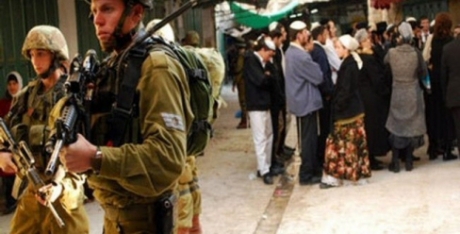
BETHLEHEM – Palestinian shop owners were forced to close their storefronts in Hebron Tuesday as Israeli politicians called for the annexation of the occupied city during visits by thousands of right-wingers for Passover.
Hebron local and prominent activist Issa Amro told Ma’an that Israeli forces instructed shopkeepers in both the H1 and H2 areas of Hebron to remain closed.
Amro said that by forcing shops to close in H1 — the area of the city under jurisdiction of the Palestinian Authority — the Israeli authorities were supporting right-wing Israelis aiming to push Palestinian locals from the city.
“They want to make it look [to Israeli settlers] like Palestinians don’t live here,” Amro said.
The closures of shops in H1 is likely to come as a detriment to shop owners’ livelihoods while road closures typically implemented by Israeli forces during the visits will impede the movement of Palestinians throughout the Hebron district, Amro added.
The H2 area, under full Israeli military control, continued under lockdown as the Ibrahimi Mosque — known to Jews as the Cave of Patriarchs — was sealed to Palestinian Muslims for the second consecutive day as Israelis visited holy sites in and around the Old City, Amro said.
Amro told Ma’an that large groups of Israelis visiting the area under armed protection on Monday launched verbal abuse at Palestinian locals, and several Palestinian families refused to leave their homes out of fear of violence from the groups.
An Israeli army spokesperson did not have immediate information on increased security measures or closure in the Hebron area for Passover.
Thousands of Israelis descended on Hebron’s Old City Monday as Israeli politicians held a rally in the center of the flashpoint area, under heavy protection by Israeli security forces.
Israeli media outlets reported that Israeli Deputy Defense Minister Eli Ben-Dahan of the Habayit HaYehudi party called on the Israeli leadership to annex the occupied West Bank in its entirety.
“We have to connect Judea and Samaria to the State of Israel. We have returned to our land, so that we will never again have to leave it,” Ben-Dahan said, referring to the West Bank.
Knesset member Oren Hazan, of the Likud party, demanded Israel’s defense ministry allow more Jewish Israelis to settle in Hebron, referring specifically to two buildings reportedly purchased by far-right groups.
“The buildings in Hebron are the basis of peace, not dispute. The time has come to populate Hebron, just as the time has come to populate every hilltop in Judea and Samaria and in all of Israel,” the Jerusalem Post reported Hazan as saying.
Hebron — the largest Palestinian city in the West Bank — has long stood at the epicenter of violence in the occupied West Bank as the Israeli military and settlers attempt to expel Palestinians from their homes, particularly in the Old City where Monday’s rally took place.
The Israeli leadership has long ignored demands by the international community to halt settlement activity in occupied Palestinian territory, and the UN has in the past slammed Israel for expansion of settlements in Hebron’s Old City in particular, where increased Jewish presence has come at the detriment to Palestinian locals.
Emily Mulder contributed reporting from Bethlehem.
If the Palestinians are guilty of incitement, then what does Israel’s 24/7 occupation amount to?
By Kamel Hawwash | MEMO | April 22, 2016
Hardly a day goes by without Israel accusing Palestinian leaders of incitement against the state and its citizens. They argue that such incitement was one of the triggers for the seven-month long uprising which has seen forty Israelis killed by Palestinians, mostly in knife attacks, and over two hundred Palestinians killed by Israeli security forces, many executed while posing no threat to anyone. Such accusations of Palestinian incitement extend all the way up to Palestinian Authority President Mahmoud Abbas. He admitted recently that there is some incitement from the Palestinian side in his interview with Israeli Channel 2 TV. On other occasions, Saeb Erekat, General Secretary of the Palestine Liberation Organisation (PLO) and its chief negotiator has also accepted that there is some incitement from the Palestinians.
Incitement as far as Israel is concerned covers a wide spectrum, from calling those killed by Israel “martyrs” to objecting to repeated incursions by Jewish settlers into Al-Aqsa Mosque, and including the Boycott, Divestment and Sanctions (BDS) campaign; seeking membership in international organisations such as the International Criminal Court; calling Israel out as an apartheid state; describing the horrific impact of the occupation to the UN General Assembly; and even reminiscing about the towns and villages (most of which have been wiped off the map by Israel) from where Palestinian refugees come and to which they long to return.
Israel has worked tirelessly to convince the so called “international community” to accept its definition of “terrorism” and make it cover any form of resistance that is quite legitimate, including throwing stones. Even attacks against Israeli soldiers maintaining an illegal occupation in Palestine are deemed to be “terrorism”. The international community now works according to Israel’s definitions and narrative and seems to require the victims, the occupied people, to be exemplary and simply curse their predicament but do nothing about it. How many victims of an acknowledged crime are required to protect the criminals? The Palestinians under Israeli occupation are.
The situation is the same across the Atlantic. US presidential candidates making their obligatory, embarrassing pilgrimage to the main pro-Israel lobby group conference, AIPAC, earlier this month joined in this nauseating spectacle of dancing to Israel’s tune. Their words were carbon copies of what an Israeli spokesman would say. They accused the Palestinians of raising their children to hate and of loving death more than life. Both are inaccurate and very racist accusations designed to pander to the lobby. Only Bernie Sanders skipped this festival of anti-Palestinian hatred and then took Clinton to task for barely mentioning the Palestinians in a recent debate between the two Democrat front-runners for the White House.
While Palestinians can understand why Israel trivialises the impact that the loss of their homeland in 1948 (the Nakba) and the occupation of the remaining 22 per cent in 1967 (they Naksa) have had on them, they cannot fathom how and why supposedly intelligent people like the presidential candidates can be so insensitive to this. The fact that they see the Palestinians as the villains and their Israeli colonisers and occupiers as the victims is like being stabbed in the heart. To call on them to submit to Israel’s brutal occupation is in itself a form of incitement.
If the Palestinians are guilty of incitement, then what does Israel’s 24/7 occupation amount to? What the Palestinians can do pales into insignificance when compared to Israel’s deliberate daily provocation and humiliation of subjugated people in the hope of a reaction, to which the so-called Israel Defence Forces (IDF) can “respond”. This provocation – and provocation is not a strong enough word to convey the impact it has — is the most significant incitement of young Palestinians to take matters into their own hands. If those calling on them not to react could put themselves in their position for even one day and be on the receiving end of what it is like to live under occupation, I am confident that they would understand why they might be driven to violence.
The list of examples of incitement by Israel is long.
When Zionists claim that historic Palestine belongs to the Jews and use this to argue not only that modern day European Jews with no connection to the land have a “right to return” but also deny the same right to Palestinian refugees driven out of their homes and land in 1948 by Jewish terror groups, that is incitement by Israel.
When Palestinian children are abducted in the night by the army of an occupying power; denied legal rights including representation; shackled when brought to court; and made to sign confessions in Hebrew, that is incitement by Israel.
When an Israeli armoured bulldozer accompanied by dozens of soldiers arrives and demolishes a Palestinian home in occupied East Jerusalem under the pretence of the lack of a building permit, then that is also incitement by Israel.
When illegal Jewish settlers protected by the security forces throw a family out of their home in Sheikh Jarrah, and move into it themselves, that is incitement by Israel.
When Israeli settlers break into the grounds of Al-Aqsa Mosque under the protection of the security forces and claim that the mosque site is theirs, then that is incitement by Israel.
When Muslims are barred from reaching their holiest mosque in Palestine at the whim of the Israeli security forces, then that is incitement by Israel.
When homes are built for Jewish Israelis on Palestinian land and the owner’s movement is restricted to allow them freedom of movement, then that is incitement by Israel.
When the IDF fires tear gas canisters into Palestinian schools causing the children to suffocate or faint, then that is incitement by Israel.
When the occupying state takes over the main mosque in Hebron and divides it between Jews and Muslims, and determines when Palestinians can and cannot pray in it, then that is incitement by Israel.
When the occupation authority builds roads which encroach on Palestinian land for use by Jewish settlers only, then that is incitement by Israel.
When Jewish settlers terrorise the local population in the West Bank and East Jerusalem, and even murder Palestinians such as Mohammed Abu Khdair and the Dawabshe family under the protection of the IDF, then that is incitement by Israel.
When Israel lays siege to 1.8 million human beings in the Gaza Strip for ten years with no prospect of the blockade ending, then that is incitement.
When the occupiers use the most powerful and devastating weapons on earth, save for nuclear weapons, to kill and maim in war after war against the Palestinians in Gaza, then that is incitement by Israel.
As far back as 2006, PLO Secretary General Dr Erekat said, “The Israeli ministry of defence is telling its citizens to carry weapons when trailing in the occupied West Bank near Palestinian villages.” This, he added, is an outrageous case of incitement to violence against Palestinians that reflects Israel’s official policy and mindset. “It should be of grave concern to the international community.”
Israeli incitement goes right to the top. In the 2015 general election campaign Prime Minister Benjamin Netanyahu incited the Jewish population against Israel’s Palestinian citizens when he said, “Arab voters are heading to the polling stations in droves” as if they were a swarm of cockroaches. He was also accused of incitement by Palestinian citizens when he promised Israeli Jews, “We will dramatically increase law enforcement services in the Arab sector.” Netanyahu told the press at the site of a shooting that Israel “will open new police stations, recruit more police officers, [and] go into all the towns and demand of everyone loyalty to the laws of the state.” Israeli lawmaker Miri Regev incited against African refugees claiming, “Heaven forbid [that] we compare Africans to human beings.”
At a recent conference to counter the BDS movement, an Israeli minister called for the “civil targeted killing” of BDS leaders like Omar Barghouti. Even foreign political figures have been the subject of incitement as Saeb Erekat has noted. He strongly condemned the hateful Israeli campaign against Swedish Foreign Minister Margot Wallstrom following her legitimate calls for an investigation into Israel’s extrajudicial killing of Palestinian civilians.
Those searching for a peaceful resolution to the injustice affecting Palestinian must recognise Israeli provocations and incitement as serious contributing factors to the violence. They cannot expect the occupied Palestinians, victims of Israel’s colonisation project, to turn the other cheek when slapped. That cheek is badly bruised and cannot take any more humiliation, provocation and, yes, incitement by Israel.
‘Fake Jewish graves in Muslim cemeteries’: UNESCO slams Israeli occupation of Palestinian sites
RT | April 18, 2016
The Israeli authorities are furious after a UNESCO resolution stated that the Temple Mount and holy sites in Hebron and Bethlehem are an “integral part of Palestine.” The organization also criticized Israel, “the occupying power,” for planting fake graves in Muslim cemeteries.
Two tourist destinations, the Cave of the Patriarchs in the heart of the old city of Hebron and Rachel’s Tomb in Bethlehem, are named in the paper as “Palestinian sites.” The draft decision by the UNESCO executive board on occupied Palestine was released April 11.
UNESCO “reaffirms that the two concerned sites located in… Hebron and in Bethlehem are an integral part of Palestine” and “disapproves the ongoing Israeli illegal excavations, works, construction of private roads for settlers and a separation wall inside the Old City of… Hebron, that harmfully affect the integrity of the site,” the statement says.
UNESCO slammed Israeli attacks on Muslims in the Temple Mount, which it only refers to by its Arabic name, Al-Haram Al-Sharif, and its holy site, Al-Aqsa Mosque.
The organization “strongly condemns the Israeli aggressions and illegal measures against the freedom of worship and Muslims’ access to their Holy Site Al-Aqsa Mosque/Al-Haram Al Sharif, and requests Israel, the Occupying Power, to respect the historic Status Quo and to immediately stop these measures,” the statement says.
Al-Aqsa Mosque became the flashpoint for bloodshed in 2015, amid mounting tensions over the holy site, sacred to both Muslims and Jews.
UNESCO called on Israel to stop “banning Muslims from burying their dead in some spaces and by planting Jewish fake graves in other spaces of the Muslim cemeteries.”
The group also criticized “the continuous Israeli blockade of the Gaza Strip,” which causes an “intolerable number of casualties among Palestinian children,” as well as “the attacks on schools and other educational and cultural facilities and the denial of access to education.”
Israeli authorities have reacted with anger to the UNESCO document.
“This is yet another absurd UN decision,” Prime Minister Benjamin Netanyahu said, as cited by Israeli media.
“UNESCO ignores the unique historic connection of Judaism to the Temple Mount, where the two temples stood for a thousand years and to which every Jew in the world has prayed for thousands of years. The UN is rewriting a basic part of human history and has again proven that there is no low to which it will not stoop,” he added.
This is not the first UNESCO resolution that condemns Israel for aggression at holy sites in Jerusalem and the West Bank. In October 2015 the group issued a document which censured Israel for limiting Muslim access to Jerusalem’s Al-Aqsa Mosque compound and reaffirmed that the Cave of the Patriarchs in Hebron and Rachel’s Tomb in Bethlehem are Palestinian sites.
The document was passed by 26 votes to six – those against being the US, the UK, Germany, the Netherlands, the Czech Republic and Estonia.
Boycott campaign launched against Dutch delivery service TNT
Ma’an – April 12, 2016
HEBRON – Activists called for a boycott campaign against Dutch international courier company TNT Express after its staff reportedly refused to deliver parcels to Palestinian recipients, allegations the company denied.
Boycott campaign co-organizer Suhaib Zahdah told Ma’an on Monday that “the issue surfaced after TNT employees refused to deliver mail parcels to their Palestinian recipients.”
The recipients contacted the company, which reportedly said company policy doesn’t allow work with the Palestinians, and suggested the recipients “use addresses in Jerusalem or Nazareth [in Israel] instead,” Zahdah said, referring to the reply of TNT’s headquarters in the Netherlands as “negative.”
“This is a violation of international law as the company discriminates by employing people refusing to work with Palestinians while they work with the illegal Israeli settlements,” he said.
The boycott campaign was launched under the slogan “TNT, the people discrimination,” a play on the company’s slogan “the people network.”
In response to the allegations, the company told Ma’an that TNT makes regular deliveries to Palestine, “including Ramallah, Gaza, East Jerusalem, Hebron, and the West Bank.”
While the company said TNT’s Israel branch “delivers shipments to Israeli towns, including those in the West Bank,” referring to Israeli settlements, shipments to Palestinians in the occupied Palestinian territory are handled through TNT’s Jordan branch, and delivered by a subcontractor once “for the final delivery.”
TNT in response to the case brought up by the campaign said: “We’ve had email exchanges with a customer who was disappointed because TNT Israel wasn’t able to make a delivery at the address he specified.”
“Security restrictions may at times limit our ability to serve certain destinations or addresses. This is what we explained to one of our customers today,” TNT said, emphasizing the company did not have a political agenda.
The boycott, divestment, and sanctions (BDS) movement against Israel has gained momentum over the past year, with activists increasingly targeting companies that act in compliance with Israel’s illegal occupation of East Jerusalem and the West Bank.
Israeli settlements in East Jerusalem and the West Bank are considered illegal by the majority of the international community, and companies who either operate out of settlements or in cooperation with settlement-based companies are seen by the BDS movement as supporting illegal Israeli policies.
Jewish settlers expropriate Palestinian garden as police stand by
International Solidarity Movement | April 4, 2016
Tel Rumeida, al Khalil, occupied Palestine – On Saturday 3rd of April 2016 settlers entered land belonging to Muhammad Abu Haikal in the Tel Rumeida area of Hebron on the occupied West Bank in Palestine. The settler children built a tent and then brought other settlers who prayed and ate there. It took more than four hours from when the police arrived until the settlers actually left, still claiming that it was their land and running around so that the police would not be able to evict them.
The first young settler kids arrived at the land at around 9 o’clock in the morning and started building a tent out of wood and sheets that they had found and playing on the land. They were actually playing in Muhammad Abu Haikal’s garden, but the end of the garden has been declared a closed military area by the Israeli Occupation Forces, who have made a military outpost in the garden and cut off the end of it of with barbed wire. The settler children entered the garden using the staircase that has been built for the soldiers to reach the outpost: they stamped down the barbed wire and covered it with a piece of wood to prevent themselves from getting injured.

Later on, while the family was trying to pick almonds from trees in the part of the garden that is not a closed military Area, the settler children returned with a number of adult settlers and more children. Muhammed Abu Haikal and the internationals present asked the settlers to leave the land, but they refused. He then contacted the police.
After the police arrived, the settlers once again claimed to be the owners of the land, with the right to remain there. The Palestinian family was asked to step back and had to stop harvesting their garden. Not until after the settlers had prayed on the land multiple times, brought food and played ball there, did the police finally try to get them to leave. The police asked all Palestinians and internationals to leave as well, as they said, “it is impossible to make Israelis leave, if there are Palestinians on the land”. It then took the police over two hours to evict the settlers. They then removed the materials that the children had left on the part of the land that is not a closed military area, but refused to pull down the tent, because, they said, it was not allowed on Shabbat.
Finally the soldiers closed off the closed military area with more barbed wire and allowed the family back into their garden. If Palestinians had been trespassing on settlers land, which is illegally occupied, they would probably have been arrested immediately, but when it is the other way around, which it usually is, the police do not use any kind of force.
Israeli forces demolish walls in home of slain Palestinian attacker

Israeli forces demolish the home of Ihab Maswada in Hebron on March 31, 2016. (Photo: Israeli army)
Ma’an – March 31, 2016
HEBRON – Israeli forces late Wednesday demolished part of the home belonging to the family of a Palestinian who was shot dead after stabbing an Israeli settler in December.
Locals said that Israeli forces closed all the entrances of the Jabal al-Sharif area in the southern occupied West Bank city of Hebron, and deployed heavily around the home of Ihab Fathi Maswada, as well as the house of Abd al-Rahman Yusri Maswada.
Ihab Maswada was killed on Dec. 7 after carrying out a stabbing attack against a settler near the Abu al-Rish checkpoint in southern Hebron. The Israeli settler succumbed to his wounds weeks later.
Maswada’s cousin, Abd al-Rahman, was killed on site on Dec. 9 after stabbing two Israelis on al-Shuhada Street.
Ihab Maswada’s brother said Israeli soldiers only gave the family ten minutes to evacuate the house, forcing them to go on the house’s second floor while they demolished the internal walls of the home.
Maswada’s mother said that Israeli soldiers then “fired a stun grenade inside the house and left the house laughing.”
Israeli authorities first issued a demolition order for Maswada’s home in early February, but had already threatened to destroy the house days after his death. His father said the demolition order was issued three days ago and that soldiers told them the demolition would be carried out in a week.
“We were surprised when they showed up after midnight,” he said.
Punitive home demolitions were expedited at the request of Israeli Prime Minister Benjamin Netanyahu in mid-October, and many have been carried out since.
The move came despite past recommendations by an Israeli military committee that the practice does not deter attacks.While families who receive demolition orders are given the opportunity to appeal the measures, Israel’s High Court of Justice typically rejects such appeals, according to Israeli watchdog Hamoked.
Israeli rights group B’Tselem condemned the practice in October as “court sanctioned revenge,” carried out on family members who have not committed crimes, amounting to collective punishment.

Israeli forces demolish the home of Ihab Maswada on March 31, 2016 in Hebron. (Photo: Israeli army)

Israeli forces demolish the home of Ihab Maswada on March 31, 2016 in Hebron. (Photo: Israeli army)
Israeli settler appointed as Consul General in New York after being rejected in Brazil
Palestinian Information Center – March 28, 2016
OCCUPIED JERUSALEM – Israeli Prime Minister Benjamin Netanyahu appointed Monday morning the former head of Yesha settlement council Danny Dayan as Israel’s Consul General in New York after he failed to nominate him as an ambassador to Brazil.
In appointing Dayan, Netanyahu withdrew Dayan’s apportionment as Israel’s ambassador to Brazil after the Brazilian government refused to accept him due to his former role as a settler leader. Asked to comment, Dayan told Army Radio that he was not influenced by Brazil’s refusal. “There was no alternative but New York.”
Dayan was earlier nominated to be Israeli ambassador to Brazil, but Brazil strongly refused his appointment due to his ties to Israeli illegal settlements in the occupied West Bank.
Dayan headed the Yesha Council of Jewish settlements in the occupied West Bank between 2007 and 2013.
Israel’s secret plan for migration of Indian Jews draws fire
Press TV – March 27, 2016
The Israeli regime is under fire for a secret plan to renew the permission for the immigration of members of a Jewish tribe in northeastern India to the occupied Palestinian territories.
Earlier this week, Ksenia Svetlova, an opposition member of the Knesset (Israeli parliament), wrote a letter to Immigrant Absorption Minister Zeev Elkin denouncing Tel Aviv’s recent decision to bring 700 Indian nationals to Israel.
Svetlova said the move contradicts the regime’s latest measure to prevent the immigration of members of the Ethiopian Jewish community over budgetary considerations.
“It turns out there is a budget. While the Ethiopian Jews are being left behind, quietly and secretly hundreds of members of the Bnei Menashe community, who identify as descendants of one of the 10 lost tribes, are being brought over,” she said.
While the Ethiopian citizens are living in dire conditions, the Indians “whose Jewishness has yet to be clarified, are being brought over with urgency,” she said.
The newcomers will be settled in illegal settler units in the occupied West Bank settlements, the Knesset member said, adding, “And all this is happening away from the public eye.”
The Bnei Menashe say they have descended from Jews banished to India in the eighth century B.C.
A senior Israeli rabbi recognized the community as a lost tribe in 2005 and about 1,700 moved to Israel over the next two years before the regime stopped giving them visas.
A private organization called Shavei Israel, headed by American-born Michael Freund, a former aide to Israeli Prime Minister Benjamin Netanyahu, runs the campaign for the Bnei Menashe relocation.
Last month, the Israeli regime halted plans to bring over another 9,000 members of the Falash Mura community from Ethiopia. This is while Ethiopians have repeatedly complained about discrimination by Israeli authorities against Jews of African descent.
Israeli settlers threaten Palestinian who filmed Hebron ‘execution’

Ma’an – March 25, 2016
HEBRON – Israeli settlers on Friday gathered outside the home of a human rights worker in Hebron to hurl abuse at him, a day after he captured on camera an Israeli soldier’s killing of a wounded Palestinian that has sparked international outcry. Imad Abu Shamsiya, a staff member with Israeli human rights group B’Tselem, told Ma’an after settlers threatened him: “I now fear for my life and the life of my family. I’m afraid they might attack my house and do me harm.”
He added that he fears the possibility of suffering the same fate as the Dawabsha family, who were killed in an arson attack committed by settlers last year in the village of Duma in the occupied West Bank.
Palestinian residents of Hebron Abed al-Fattah Yusri al-Sharif and Ramzi Aziz al-Qasrawi, both 21 years old, were shot down Thursday after allegedly stabbing and moderately wounding an Israeli soldier near a military checkpoint in Hebron’s Old City.
Shamsiya recorded rare video footage of an Israeli soldier shooting al-Sharif in the head at point-blank range in plain view of the medical team after he had already been shot at least once and left motionless on the ground.
The incident has brought a barrage of condemnations from the Israeli leadership and led Israel’s army to detain the soldier responsible and launch an investigation.
The release of the graphic video has called attention to what rights groups, international leaders, and Palestinian officials call a policy of “extrajudicial executions” by Israel against Palestinians, since a wave of unrest swept the occupied Palestinian territory and Israel last October.
UN Special Coordinator for the Middle East Peace Process Nickolay Mladenov said Friday he strongly condemned the apparent “extrajudicial execution” of al-Sharif.
“This was a gruesome, immoral, and unjust act that can only fuel more violence and escalate an already volatile situation,” Mladenov said.
Tel Rumeida — where Shamsiya’s house is located and the site of the Thursday’s incident — has been a flashpoint for tensions between Palestinians and Israeli settlers and military, and is near the illegal settlement of Beit Yishai.
Mistreatment of Palestinians in the Hebron area has been common since the city was divided in the 1990s after a US-born settler, Baruch Goldstein, massacred 29 Palestinians inside the Ibrahimi Mosque.
The majority of the city was placed under the jurisdiction of the Palestinian Authority, while the Old City and surrounding areas were placed under Israeli military control in a sector known as H2.
The area is home to 30,000 Palestinians and around 800 Israeli settlers who live under the protection of Israeli forces. Hebron residents frequently report attacks and harassment by the settlers carried out in the presence of the forces.
Featured Video

“Historic Russia”: The Land Putin Will Not Give Back
or go to
Aletho News Archives – Video-Images
Book Review
Why the War on Conspiracy Theories Is Bad Public Policy
By Kevin Barrett • Unz Review • February 1, 2019
 A Review of Conspiracy Theories and Other Dangerous Ideas by Cass Sunstein (based on an earlier paper co-authored with Adrian Vermeule); In Defense of Troublemakers: The Power of Dissent in Life and Business by Charlan Nemeth; and Conspiracy Theories and the People Who Believe Them, edited by Joseph E. Uscinski
On January 25 2018 YouTube unleashed the latest salvo in the war on conspiracy theories, saying “we’ll begin reducing recommendations of borderline content and content that could misinform users in harmful ways—such as videos promoting a phony miracle cure for a serious illness, claiming the earth is flat, or making blatantly false claims about historic events like 9/11.”
At first glance that sounds reasonable. Nobody wants YouTube or anyone else to recommend bad information. And almost everyone agrees that phony miracle cures, flat earthism, and blatantly false claims about 9/11 and other historical events are undesirable.
But if we stop and seriously consider those words, we notice a couple of problems. First, the word “recommend” is not just misleading but mendacious. YouTube obviously doesn’t really recommend anything. When it says it does, it is lying. … continue
Blog Roll
 Aletho News
- “Historic Russia”: The Land Putin Will Not Give Back
- How the Cambridge Analytica scandal still haunts Mark Zuckerberg
- The Ongoing Cancellation Campaign Against a Dissenting Academic in Norway
- Yemen and ‘the Houthis’: Challenging Sami Hamdi’s Narrative
- No, Christians did not invent Zionism
- AIPAC-led lobbying network opens branches in Cypriot, Greek parliaments
- Araghchi blasts ‘parasitic’ alliance as US taxpayers pay for Israel’s war on Iran
- Easy fix for Europe’s chaos? Stop fueling war against Russia
- Putin’s key remarks on peace talks and Europe’s ‘schizophrenia’
- Trita Parsi: Israel Set a Trap for Total War in the Region
- If Americans Knew
- An error has occurred; the feed is probably down. Try again later.
- No Tricks Zone
- Two New Studies Find Thwaites Glacier Melt Cannot Be Driven By Human Activity Or A Warming Ocean
- E-Cars Reduce CO2 Emissions By Only 41% Compared To Internal Combustion Engine Vehicles
- Predictions Made By Renowned Climate Professor Over Past Decades Have Been Proven To Be Poor
- New Study Suggests Large Regions Of The Pacific Ocean Have Been Cooling For The Last 80 Years
- Germany’s Green Energy Debacle: High Energy Costs Force Kahla Porzellan to Close After 182 Years!
- New Study: 50 Years Of The Most Aggressive ‘Net Zero’ Policies Can Only Affect The Global Climate By 0.03°C
- US September “Heat” Was No Record…Many Records Set Decades Ago
- Latest European Green Energy Debacle; Portugal’s Largest Flagship Solar Park Insolvent!
- Green Energy Debacle: German Expert Professor Fritz Vahrenholt Warns Of Severe Economic And Social Consequences
- Two More Paleo Reconstructions Affirm Meters-Higher Sea Levels Across Ireland, Brazil 7000-6000 Years Ago

