Illegal settlers celebrate Purim after cold-blooded murder of Palestinian youths
International Solidarity Movement | March 24, 2016
Hebron, Occupied West Bank – On the 24th March, Israeli settlers from the illegal settlements in occupied al-Khalil (Hebron) celebrated the holiday of ‘Purim’. The settlers marched through the Old City of al-Khalil, starting off from the spot where just a few hours before, Israeli forces gunned down two Palestinian youth and then executed one of them in cold blood.
In the morning, Israeli forces shot and severely injured two Palestinian youth in the Tel Rumeida neighbourhood and then left them lying on the ground seriously injured while Israeli medics were attending to a slightly injured Israeli soldier. Palestinian ambulances, that are not allowed to drive on this road that is only for settlers use, were prevented by Israeli forces from reaching the injured Palestinian youth. In a video published by B’Tselem, a soldier can clearly be seen shooting one of the youth in the head at point-blank range even though he is lying on the ground and is not posing a threat to anyone.
Only a few hours after this extrajudical execution, settlers started their joyous march, dressed up in costumes, with music blasting from a bus, dancing in the same spot where the two Palestinians were murdered in cold blood.

Illegal settlers celebrating in the exact spot where two Palestinians were murdered in cold-blood
Photo credit: Youth Against Settlements
The procession of settlers then proceeded down Shuhada Street, where the main illegal Israeli settlements in the heart of the city are located, before turning towards the Ibrahimi mosque. Shuhada Street, except for a tiny strip, has been completely closed for Palestinians, who are not allowed to even walk there – unlike the illegal settlers who can walk and drive. When the march reached the vicinity of Ibrahimi mosque, Israeli forces started closing off the area to all Palestinians, physically pushing back children behind barriers and preventing Palestinians from accessing the area, even if they were residents, in order to create a space free of Palestinians for the celebrations of the settlers to take place.

Settler children. One drinking wine, one holstering a machine gun and another aiming a pistol at onlookers

Israeli settlers celebrating while Palestinians are denied walking down the street

Palestinians and Internationals are not allowed to pass
One of the settlers, of which many were dressed up in costumes, was seen in a shirt flashing a raised fist on a yellow background, which is the symbol of the ‘Kach’, a party of extremist Israeli fundamentalist settlers, deemed a terrorist group even by the Israeli government. The party was founded by Meir Kahane, who publicly called for the expulsion of Palestinians and to end culture relations between Jewish and Palestinian students. On Tuesday, two days before, during celebrations for the same holiday, the loudspeakers of the Ibrahimi mosque were mis-used to broadcast hate-speech calling for the expulsion of Palestinians from al-Khalil.

Israeli settlers with a Kahane-shirt (settler in the middle)
One of the settler children dancing on top of a bus was playing with a pistol. Even though the police realized this, they merely took the weapon from him – but then gave it back shortly adfter. If a Palestinian of any age had been seen with anything resembling a weapon, the person would likely be shot immediately.

The settlers’ celebrations kept going uninterrupted with Israeli forces ensuring that Palestinians would not cross the way of the settlers, forcing them to stay back, and even closing Ibrahimi mosque checkpoint to ensure no one would even come close.

Palestinian civilians stopped by Israeli forces after they opened the street for Palestinians again while settlers freely pass the checkpoint
Israeli forces also used the roof of a Palestinian family home in the vicinity of the mosque as a look-out point. This is just another small example of the impunity and supremacy settlers enjoy with the active support of the Israeli forces, while Palestinians are systematically humiliated, oppressed and killed in cold blood under the Israeli military occupation.
UN set to establish database of businesses involved in Israeli settlements
MEMO | March 23, 2016
The United Nations Human Rights Council (UNHRC) is set to vote on Thursday on whether to establish a database of businesses involved in Israeli settlements.
The UNHRC, meeting in its 31st session, will be considering four resolutions under Item 7, which focuses on the impact of the Israeli occupation on human rights in Palestine and other occupied Arab territories. Such resolutions are routinely adopted.
A resolution on Israel’s illegal settlements in the Occupied Palestinian Territory, including East Jerusalem, and in the occupied Syrian Golan, however, has reportedly upset European Union member states, in particular by calling for “a database of all business enterprises involved” in illegal settlement activities, which will be updated annually.
The database is presented as a follow up to an earlier fact-finding mission, which investigated “the implications of the Israeli settlements on the civil, political, economic, social and cultural rights of the Palestinian people throughout the Occupied Palestinian Territory, including East Jerusalem.”
Middle East Monitor understands from sources familiar with the discussions taking place that European Union member states will either vote against, or abstain from, the resolution. The UK is reportedly expected to vote against, with significant pressure being applied on Palestinian officials to remove the paragraph establishing the database of businesses involved in settlement activities.
The resolution notes that “the settlement enterprise and the impunity associated with its persistence, expansion and related violence continue to be a root cause of many violations of the Palestinians’ human rights, and constitute the main factors perpetuating Israel’s belligerent occupation of the Palestinian Territory, including East Jerusalem, since 1967.”
The resolution goes on to express concern that “some business enterprises have, directly and indirectly, enabled, facilitated and profited from the construction and growth of the Israeli settlements in the Occupied Palestinian Territory.”
The UNHRC resolution also notes that “products wholly or partially produced in settlements have been labelled as originating from Israel”, and that “private individuals, associations and charities in third States” are “involved in providing funding to Israeli settlements and settlement-based entities, contributing to the maintenance and expansion of settlements.”
As well as the database, the draft text urges all states to “provide guidance to individuals and businesses on the financial, reputational and legal risks, including the possibility of liability for corporate involvement in gross human rights abuses as well as the abuses of the rights of individuals, of becoming involved in settlement-related activities.”
On Monday, the UNHRC head from outgoing Special Rapporteur on the situation of human rights in the Palestinian territories occupied since 1967, Makarim Wibisono, who presented his final report to the Council.
Among other recommendations, “he urged Israeli authorities to…halt the expansion of illegal Israeli settlements, to refrain from acts causing the forced displacement of Palestinians in the West Bank, including East Jerusalem, and to urgently implement recommendations by the United Nations Children’s Fund with respect to the detention of children.”
Israeli Minister Facebook Rant Blames Brussels Bombing on EU Labeling of Illegal Settlement Goods
21st Century Wire – March 23, 2016
Now here’s another interesting take on the Brussels Attacks.
There are three possible angles you could read this story from:
1. This Israeli minister is essentially saying that because the EU chose to worry about the Palestinian plight, it reaped the scourge of Islamist terror on its capital.
2. This Israeli minister is a few cards short of a full deck.
3. And finally there’s this option: by blaming the EU for accurately labeling its food products that come from from illegal settlements, is this Israeli minister somehow inferring that the Brussels bombing was a retaliation for that EU regulation?
It’s hard to know for sure, but at the very least, the Israeli minister’s off-hand comments are very revealing about the current schizophrenic political mindset in Tel Aviv…
Middle East Monitor – March 22, 2106
The EU’s labeling of goods from illegal Israeli settlements led to the bombing in Belgium, Brussels, today, The New Arab reported an Israeli minister saying.
Minister of Science, Technology and Space, Ofir Akunis, said Europeans lost sight of “terrorism of extremist Islam” by focusing on boycotting Israeli goods instead allowing the attacks to take place.
“Many in Europe have preferred to occupy themselves with the folly of condemning Israel, labeling products, and boycotts. In this time, underneath the nose of the continent’s citizens, thousands of extremist Islamic terror cells have grown,” Akunis wrote on Facebook.
“There were those who repressed and mocked whoever tried to give warning. There were those who underestimated. To our sorrow, the reality has struck the lives of dozens of innocent people.”
Ethnic cleansing of Shuhada Street in occupied al-Khalil (Hebron)
International Solidarity Movement | March 6, 2016
Hebron, occupied Palestine – Since the 1994 Ibrahimi Mosque Massacre, the majority of Shuhada Street – once the thriving Palestinian market and main thoroughfare connecting north and south al-Khalil (Hebron) – has been closed to Palestinians. They are completely barred from accessing it, except for a small stretch in the Tel Rumeida neighbourhood.

Photos of the same portion of Shuhada street – a thriving market before 1994, now an empty street where no Palestinians are allowed to enter (published by B’Tselem)
This tiny strip that is legally still accessible for Palestinians is restricted by the recently ‘renovated’ Shuhada checkpoint at the beginning of the street and ends where the street begins to border the illegal settlement of Beit Hadassah, beyond which Israeli forces assure that no Palestinians exist. Further down Shuhada street, clearly marked with yet another military post barring anyone who might attempt to enter the street, are even more Israeli settlements – all illegal under international law – located directly in the city center of al-Khalil.
The settlements on Shuhada Street are connected via a settler-only road to the much larger settlement of Kiryat Arba on the outskirts of al-Khalil; settlers can also reach the illegal Tel Rumeida settlement easily by traversing the tiny stretch of Shuhada Street still open to some Palestinians and the road leading up into Tel Rumeida from Shuhada checkpoint, now encompassed within the closed military zone. While Palestinians are allowed to walk on this part of Shuhada Street, Palestinian vehicles, including ambulances, are forbidden from driving there. Since Israeli authorities declared the area part of a closed military zone on 1st November 2015, the already barely existent access has been further restricted – Isreali forces only allow entry to Palestinians registered with them residents, while any Israeli settler, regardless of whether they are residents or not, can pass freely and without ever being harassed, stopped, detained, arrested, or threatened by the ever-present military forces.

Map of the city center of al-Khalil including Shuhada Street (the longest street marked in red) by B’Tselem
At the line demarcated by Daboya checkpoint (Checkpoint 55), where the illegal settlements on the street begin and Palestinians are no longer allowed, a steep flight of stairs leads up to Qurtuba school and into the Tel Rumeida neighbourhood. These stairs, the only way for Palestinians to continue traveling in the same direction above the street as they are not allowed to continue down Shuhada Street itself, have been closed by the Israeli forces with a metal gate since November 2015.

Stairs with the closed gate leading down to Shuhada Street
Even though this gate is currently not locked, Israeli forces deny any Palestinian, except for the students and teachers of Qurtuba school during school-time, to use these stairs. As a result Palestinian residents of this neighbourhood, once they have passed Shuhada checkpoint – an ordeal that can take several hours – have been denied to reach their homes by walking down Shuhada Street and the stairs leading up to Qurtuba school, forcing them instead to take a much longer detour around. With yet another way denied for Palestinans, navigating the maze of Israeli military-enforced checkpoints, complete bans on travel, roads where Palestinians cannot drive, settler-only roads, closed military zones and new arbitrary closures has become even more arduous.
Israeli forces are thereby also clearly working to minimise the number of Palestinians who will actually use this last portion of Shuhada Street – now a complete dead-end – as they bar Palestinians not only from going farther down the closed street but also declare the stairs, formerly an alternate route, yet another closed zone. This illustrates the Israeli attempts to rid Shuhada Street entirely of Palestinians. Ethnic cleansing in al-Khalil, and all across Israeli-occupied Palestinian lands is not a sudden, headline-grabbing event; it progresses gradually as Palestinians are restricted in certain areas, barred from driving there, prohibited from even being there, forced out to facilitate the expansion of the illegal settlements. Ethnic cleansing happens slowly, by erecting new and ‘fortifying’ existing checkpoints, advancing one more closure at a time.
Israeli authorities demolished 183 Palestinian buildings in February
MEMO | March 4, 2016
The Israeli authorities demolished around 97 homes and 86 facilities in the West Bank in February under the pretext of “illegal construction”, according to a statistical report released Thursday by the Applied Research Institute Jerusalem (ARIJ).
The Palestinian institute also said that demolition orders and orders to stop construction were issued to a further 139 houses and facilities.
An estimated 653 dunums of Palestinian land in various parts of the West Bank is also facing confiscation orders.
Ghassan Doughlas, a Palestinian official who monitors settlement activity in the northern West Bank, has said there has been an escalation in the policy of demolishing homes and institutions in 2016.
In an interview with Quds Press, Doughlas stressed that the demolitions aim to displace Palestinians in order to “bring the settlers on the ruins of the Palestinians’ homes”.
“The occupation has used the demolition policy as a way to put pressure on the Palestinians so to empty the region classified as Area C in the West Bank,” adding that the demolitions are part of a policy of “collective punishment”.
Bogus arrest of 12 year old boy in Hebron
International Solidarity Movement | March 3, 2016
Hebron, Occupied Palestine – On the 28th of February around 4:00pm, 12 year old Palestinian boy, Sayed Seder was arrested by 10 heavily armed Israeli soldiers whilst playing football with his friends on the street in front of his family home. The Israeli army claim that he was arrested under allegations he was throwing stones at the guard tower which watches over Al-Shallalah Street and the illegal Israeli settlement that has been built directly behind the street and family home.
Sayed’s father, Abed, went down to confront the soldiers after Sayed’s friends came running up to the family home, explaining to the father what was happening.
When Abed approached the soldiers to ask them what exactly they were arresting his son for, the soldiers responded by informing him that it was because he was seen throwing rocks at the guard tower above. However, the street is lined with a protective type of fencing above the shops roofs that prohibits objects being thrown up or in the most common cases, being thrown down by illegal Israeli settlers who live above. Abed put the argument forward that it would have been pointless for his son to have been throwing stones with this protective barrier in place. Perhaps the logic of this made too much sense and the arresting soldier quickly changed his story and then began to tell Abed his son was being arrested for stealing a settler child’s football whilst pointing to the ball that Sayed and his friends were playing with. Abed informed the soldier that the ball Sayed and his friends were playing with was in fact a ball that he had purchased for Sayed from a shop in Halhoul just recently. The soldier who was evidently lying and knowingly falsely accusing Sayed of the above allegations ignored any more of Abed’s protests and continued to arrest Sayed.

Al-Shallalah street where Sayed was arrested
From this point Sayed was marched to the Shuhada street entrance gate and taken through while his parents and friends were forced to stand back and watch. Sayed was then taken to the local military base on Shuhada street. Upon entering the military base he was reportedly handcuffed and blindfolded. The blindfold remained on for around 30 minutes before being taken off, assuming that it was put on so he could not get a full view of what was happening inside the military compound for security purposes. Sayed alleges that teenage settlers who were allowed into the compound then beat him while the Israeli army simply stood back and did nothing.

Protective fencing installed above Al-Shallalah street and the guard tower
Sayed was later released from custody at around 9pm to Palestinian authorities where he complained of pain in his kidneys. His father arrived shortly after and took Sayed to hospital where doctors examined him. While the doctors could not find physical wounds that would require further attention they did note that Sayed was severely traumatised from the event and was in a state of shock.
Just 3 months ago the Israeli army arrested one of Abed’s other sons who is 10 years old. The reason for the arrest was that he too was suspected of throwing stones at the military. As Abed didn’t believe this and objected he too was arrested with his 10 year old son. They were detained for 6 hours and released without charge.
One significant fact is that Abed’s house backs onto the illegal Israeli settlement of Beit Hadasa. Abed used to sell artisans out of the family home but has had to stop because of ongoing harassment both physical and verbal to himself and to his customers from the settlers that occupy the land next to his home. The front of Abed’s house has been covered in barbed wire by the Israeli military and is adorned with bags of dirty hummus, eggs and other foul items thrown down by the illegal settlers. The army has also boarded up the windows of his family home (without his permission) that overlook Beit Hadasa.

Abed’s home and the illegal Israeli settlement of Beit Hadasa

The barbed wire at the entrance to Abed’s house with rubbish thrown down by settlers
While harassment from the settlers in Hebron is often considered an unfortunate normality to most Palestinians living under occupation, the army’s continued bogus charges and harassment of Abed and his family give one the impression that the Zionist regime is using a tactical ploy to get Abed and his family out of their home for further settlement expansion.
Israeli settlers escorted by army raid village in Salfit district
Ma’an – February 27, 2016
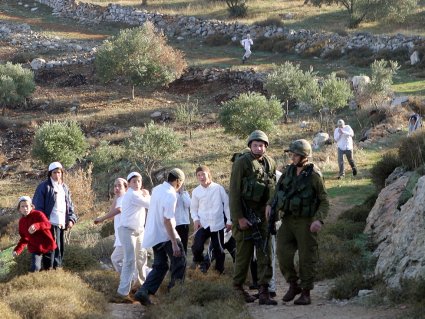
SALFIT – A group of Israeli settlers escorted by Israeli military forces raided the village of Yasuf in the northern West Bank district of Salfit on Saturday.
The head of the Yasuf village council, Hafith Ebayya, said that a group of Israeli settlers raided the village and attempted to enter the al-Basatin area in central Yasuf.
Ebayya said that the settlers were escorted by military vehicles and soldiers, and that a military checkpoint was set up at the entrance of the village.
Clashes erupted between dozens of Palestinian youths and Israeli forces.
Israeli forces fired live bullets, rubber-coated steel bullets and tear gas at youths and several farmers who were in their fields nearby.
Several youths and farmers suffered from tear gas inhalation.
An Israeli army spokesperson told Ma’an they were looking into the report.
Three quarters of Yasuf’s lands are located in Area C — under full Israeli military and administrative control. According to a report by the Applied Research Institute-Jerusalem (ARIJ), over the years, some 602 dunams (148.7 acres) of Yasuf land have been seized to establish settlement housing.
Several Israeli settlements are located near Yasuf, including Ariel, the fourth largest settlement in the West Bank. These settlements in the occupied West Bank and East Jerusalem are illegal under international law.
UK Israeli boycott ban contradicts official govt business guidelines
RT | February 18, 2016
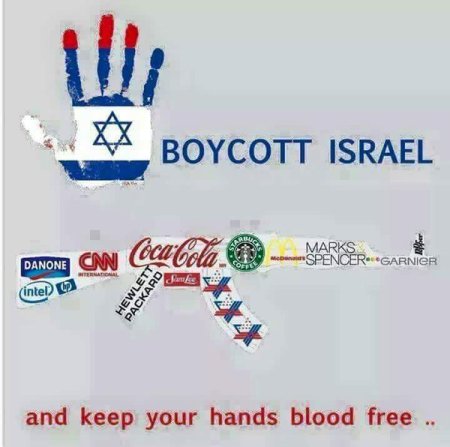
Britain’s ban on the public boycott of goods from Israel’s occupied territories contradicts its own official business guidelines, documents have revealed.
The controversial new law, which would ban local councils, student unions and other public bodies from boycotting goods for political reasons, was announced by the government on Monday and has been implemented without parliamentary debate or vote.
However, documents first seen by the Independent show the Foreign Office’s Overseas Business Risk assessment for Israel states that the government does “not encourage or offer support” to business with the occupied territories, apparently contradicting the new regulation.
“Settlements are illegal under international law, constitute an obstacle to peace and threaten to make a two-state solution to the Israeli-Palestinian conflict impossible,” the document reads.
“There are therefore clear risks related to economic and financial activities in the settlements, and we do not encourage or offer support to such activity.”
The new rules do not apply exclusively to Israel, but would ban institutions that receive the majority of their funding from the government from participating in procurement political campaigns, choosing not to buy products from companies on political grounds. The only exception would be nationwide boycotts mandated by the government.
The Palestinian Liberation Organization (PLO) has attacked the new law, saying it undermines the democratic rights and freedoms of public bodies.
PLO Executive Committee Members Dr Hanan Ashrawi and Dr Saeb Erekat released a joint statement after meeting with Middle East Minister Tobias Ellwood on Wednesday.
“This represents a serious regression in British policy and it would empower the Israeli occupation by sending a message of impunity,” said Ashrawi and Erekat.
“In order to accommodate the Israeli occupation, the British government is undermining British democracy and their own people’s rights.”
The Labour Party has panned the new measures as an “attack on democracy.”
“This government’s ban would have outlawed council action against apartheid South Africa. Ministers talk about devolution, but in practice they’re imposing Conservative Party policies on elected local councils across the board,” Labour Party leader Jeremy Corbyn said.
The government, however, has defended the anti-boycott measures, saying they are necessary for “community cohesion” and national security.
“There are wider national and international consequences from imposing such local level boycotts. They can damage integration and community cohesion within the United Kingdom, hinder Britain’s export trade, and harm foreign relations to the detriment of Britain’s economic and international security,” ministers said in a procurement policy note sent out to public authorities.
Coinciding with the law’s announcement, Cabinet Minister Matthew Hancock, who has recently come under fire for accepting a £4,000 donation from a right wing think tank, weeks before announcing a crackdown on lobbying by charities, is currently in Israel promoting business and trade links with the UK.
Read more:
Like Thatcher with apartheid: UK to ban public bodies from boycotting Israeli West Bank goods
Israel levels lands, demolishes structures in East Jerusalem
Ma’an – February 17, 2016
JERUSALEM – The Israeli authorities on Wednesday demolished agricultural structures and leveled land in the outskirts of al-Issawiya village in occupied East Jerusalem, locals said.
Muhammad Abu al-Hummas, a spokesperson for a local popular committee, told Ma’an that bulldozers had started leveling around five acres of land, adding that they “deliberately” ruined the dirt roads used by farmers to access their fields as well as their fences.
He said they were accompanied by Israeli police forces as well as officials from Jerusalem’s municipality and the Israeli Nature and Parks Authority.
The land is located in an area Israeli authorities have earmarked for a national park, in a controversial plan known as “11092”, which aims to turn around 740 dunams (175 acres) of Palestinian land in the East Jerusalem neighborhoods of al-Issawiya and al-Tur into Israeli parkland.
The Israeli planning council suspended the plan in September 2014 until the needs of the neighborhoods could be assessed.
However, the council, which previously approved the annexation of the 740 dunams, said approval of the plan could potentially be justified and was not fundamentally illegal.
Abu al-Hummus said the Israeli authorities were “leveling and ruining private Palestinian lands despite an Israeli court decision to freeze the settlement plans.”
One of the owners of the land leveled on Wednesday, Adnan Darwish, told Ma’an that Israeli bulldozers had ruined eight dunams (two acres) of his property, uprooting a number of olive and cypress trees.
He said they had also demolished a structure used as a sheep barn belonging to Salih Abu Turk. Other landowners affected were identified as Ali Abu al-Hummus, Atif Ubeid, and Shaaban Ubeid.
The Palestinian Center for Human Rights has previously described Israel’s plan in al-Issawiya as “part of the Israeli government’s plans to create a Jewish demographic majority in the occupied city.”
East Jerusalem was seized by Israel along with the West Bank in 1967 during the Six-Day War, and since then, the Israeli government has undertaken a policy of “Judaization” across the city.
PA seizes Israeli truck loaded with chemical waste
MEMO – February 16, 2016
The Environmental Quality Authority yesterday seized an Israeli truck full of chemical remains heading to illegally unload in occupied Palestinian territories, Quds Press reported.
The truck, which left the Israeli settlement of Karnei Shomron, was seized between the Palestinian villages of Kafr Thulth and Azzun near the West Bank city of Qalqilya.
The truck was to be offloaded near a residential compound in Qalqilya, a statement by the Environmental Quality Authority revealed.
The load included remains of several chemical industries, including paint.
The authority said it handed the truck and driver over to the District Coordination Offices.
A senior official in the authority said a complaint regarding this Israeli violation would be filed to the Secretariat of the Basel Convention, which is in charge of the transport of dangerous goods.
He also said that the Palestinian contractors, who were involved in this issue, would be prosecuted.
Environment expert George Karzam told Quds Press: “The Israeli occupation recently closed a number of its dumps and facilities related to treating solid and chemical waste in the lands occupied in 1948 [Israel] moving them to new sites in the West Bank, mainly in the Jordan Valley.”
This was because of the poisonous substances which were being discarded as well as the odors coming from the dumps, Karzam explained.
Israel has also been putting pressure on the Palestinian Authority to open new waste sites for illegal settlements in the West Bank, he added.
Israeli forces uproot 100 olive trees in Wadi Qana
Ma’an – February 16, 2016
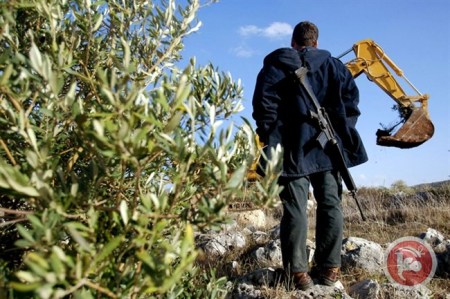
SALFIT – Israeli forces uprooted 100 olive trees in the Wadi Qana area west of the village of Deir Istiya in Salfit district on Tuesday amid ongoing efforts to push Palestinians out of the area, locals said.
Farmers from Deir Istiya told Ma’an the forces arrived in Wadi Qana and uprooted the trees without prior notice.
Soldiers then forced locals from the area in order to allow Israeli settlers to arrive there, the farmers said.
Ibrahim al-Hamad, director of the Palestinian Ministry of Agriculture’s Salfit branch, told Ma’an that soldiers removed the seven-year-old trees on the grounds that the area is a nature reserve, with planting prohibited in the area.
Al-Hamad added that Israeli soldiers also removed a water tank belonging to Palestinian locals.
A spokesperson for Israel’s Coordination of Government Activities in the Territories (COGAT) was not immediately available for comment.
Wadi Qana, a valley that has historically served agricultural and recreational purposes for local Palestinians who own land in the area, was declared a nature reserve by Israel’s Civil Administration in 1983.
Israel has used this designation for years to justify uprooting Palestinian crops and forcing Palestinians from the area, according to Israeli rights group B’Tselem.
Several Jewish-only Israeli settlements and outposts have been illegally established along the ridges of the valley since the 1970s.
Waste water dumped from the settlements has gradually polluted the river, forcing out Palestinians who have lived in and visited the valley for generations.
Palestinian owners of land in Wadi Qana and the village of Dir Istiya have meanwhile been prevented from building or planting in the area, the majority of which is in Area C, under the full civil and military control of Israel.
The NY Times Maps Jerusalem: Distilling the Worst of Israeli Propaganda
By Barbara Erickson – TimesWarp – February 15, 2016
In a new multimedia production The New York Times is now offering us “The Roots of the Recent Violence Between Israelis and Palestinians,” a series of 13 images accompanied by brief notes. The title promises much, and the teaser adds that this new offering presents us with “the geography of the issues surrounding the ongoing violence.”
Here, it seems, the newspaper has an opportunity to provide the context so often missing from Times stories about Palestine and Israel. With such an introduction readers might hope to learn about the historical beginnings of the conflict and to perceive the effects of occupation on the face of the land.
It was not to be. In fact, this slick presentation distills the worst of the Times reporting on the issue. The text never once mentions the occupation; it provides no historical context of any kind, and it blindly follows the preferred narrative of Israeli propagandists.
The visuals never leave Jerusalem, and the text sticks to events there. The presentation opens with an image of the Dome of the Rock and the Al Aqsa Mosque, accompanied by the comment that the violence “was set off in part over a dispute over Al Aqsa Mosque compound.” Nothing more is said about this complex issue.
The images then move on to highlight Jewish “neighborhoods” in Palestinian East Jerusalem and Jewish homes dotting the Palestinian neighborhoods, and we learn that the “neighborhoods” are “considered illegal settlements by most of the world.” This is the Times’ usual formulation, which distorts the fact that the entire international community—outside of Israel—deems the settlements illegal.
There is no mention of the impact these settlements have on Palestinians’ lives. We get nothing but maps and terse comments about who lives where, but the Times does finally provide a motive for the recent attacks: It comes from “frustration” over the lack of basic city services.
We are set up for this trivial claim in the fourth visual, which shows us Shuafat Refugee Camp in East Jerusalem surrounded by a yellow line. “Israel built a barrier in response to Palestinian attacks from the West Bank in the early 2000s,” the text notes. “While effective at stopping suicide bombers, it cut off several East Jerusalem neighborhoods from the rest of the city, leaving them without basic services.”
In the following image the narrative continues, “Palestinians say these frustrations are at the root of the recent attacks. Israelis officials accuse Palestinian leaders of inciting violence.”
There we have it. Not a word about loss of land, the confiscation of resources, military incursions and all the many miseries associated with military occupation. So much for the “roots” of the conflict.
Although the Times attempts a show of balance, by referring to both sides, the text is heavily weighted toward the Israeli point of view. It twice mentions Israeli actions as “responses” to violence and never suggests that Palestinians are responding to oppression.
It repeats the Israeli claim that Palestinians who died in the recent uprising were all involved in attacks or “clashes” with troops, omitting the reports of human rights groups and others who charge Israel with “street executions” of Palestinians who pose no possible threat to security forces or civilians.
In addition, the Times gives a distorted account of the Separation Barrier. It fails to say that the 2004 International Court of Justice decision held that the wall is illegal and that its route (85 percent of it inside the West Bank) threatens “de facto annexation.” The newspaper also repeats the Israeli claim that the wall “effectively stopped suicide bombers.”
As an Israeli journalist recently observed in 972 Magazine, the recent assaults have demolished this facile claim. The latest attackers could have come with bombs instead of knives; the wall did not keep them out. The bombings ended when militants abandoned the tactic.
If the Times truly intended to illustrate the “geography of the issues surrounding the ongoing violence,” it could have shown some dramatic effects of the occupation on the landscape, such as:
- The route of the Separation Barrier, snaking well inside the boundary between the West Bank and Israel
- The rows of dead parsley and spinach fields in Gaza, where Israel has deliberately sprayed herbicides on hundreds of acres
- The contrast between lush West Bank settlements, with their lawns and swimming pools, and parched Palestinian villages nearby
- The shrinking cantons of the West Bank, where Israel is illegally confiscating more and more Palestinian territory
- The dead strip of land inside Gaza, where Israel has imposed a firing zone and has frequently entered to bulldoze crops and soil
Images such as these might provide a real sense of the “roots” of the recent violence. Instead, the Times has chosen to encapsulate Israeli propaganda in this latest presentation, perpetuating its ingrained bias in a package of misleading notes and slick visual effects.
Follow @TimesWarp on Twitter
Featured Video

“Historic Russia”: The Land Putin Will Not Give Back
or go to
Aletho News Archives – Video-Images
Book Review
Why the War on Conspiracy Theories Is Bad Public Policy
By Kevin Barrett • Unz Review • February 1, 2019
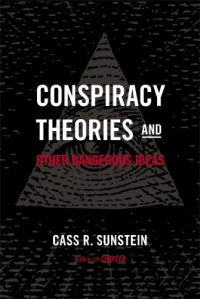 A Review of Conspiracy Theories and Other Dangerous Ideas by Cass Sunstein (based on an earlier paper co-authored with Adrian Vermeule); In Defense of Troublemakers: The Power of Dissent in Life and Business by Charlan Nemeth; and Conspiracy Theories and the People Who Believe Them, edited by Joseph E. Uscinski
On January 25 2018 YouTube unleashed the latest salvo in the war on conspiracy theories, saying “we’ll begin reducing recommendations of borderline content and content that could misinform users in harmful ways—such as videos promoting a phony miracle cure for a serious illness, claiming the earth is flat, or making blatantly false claims about historic events like 9/11.”
At first glance that sounds reasonable. Nobody wants YouTube or anyone else to recommend bad information. And almost everyone agrees that phony miracle cures, flat earthism, and blatantly false claims about 9/11 and other historical events are undesirable.
But if we stop and seriously consider those words, we notice a couple of problems. First, the word “recommend” is not just misleading but mendacious. YouTube obviously doesn’t really recommend anything. When it says it does, it is lying. … continue
Blog Roll
 Aletho News
- BRITAIN’S WARNING: PREPARE FOR WAR
- “Historic Russia”: The Land Putin Will Not Give Back
- How the Cambridge Analytica scandal still haunts Mark Zuckerberg
- The Ongoing Cancellation Campaign Against a Dissenting Academic in Norway
- Yemen and ‘the Houthis’: Challenging Sami Hamdi’s Narrative
- No, Christians did not invent Zionism
- AIPAC-led lobbying network opens branches in Cypriot, Greek parliaments
- Araghchi blasts ‘parasitic’ alliance as US taxpayers pay for Israel’s war on Iran
- Easy fix for Europe’s chaos? Stop fueling war against Russia
- Putin’s key remarks on peace talks and Europe’s ‘schizophrenia’
- If Americans Knew
- An error has occurred; the feed is probably down. Try again later.
- No Tricks Zone
- Two New Studies Find Thwaites Glacier Melt Cannot Be Driven By Human Activity Or A Warming Ocean
- E-Cars Reduce CO2 Emissions By Only 41% Compared To Internal Combustion Engine Vehicles
- Predictions Made By Renowned Climate Professor Over Past Decades Have Been Proven To Be Poor
- New Study Suggests Large Regions Of The Pacific Ocean Have Been Cooling For The Last 80 Years
- Germany’s Green Energy Debacle: High Energy Costs Force Kahla Porzellan to Close After 182 Years!
- New Study: 50 Years Of The Most Aggressive ‘Net Zero’ Policies Can Only Affect The Global Climate By 0.03°C
- US September “Heat” Was No Record…Many Records Set Decades Ago
- Latest European Green Energy Debacle; Portugal’s Largest Flagship Solar Park Insolvent!
- Green Energy Debacle: German Expert Professor Fritz Vahrenholt Warns Of Severe Economic And Social Consequences
- Two More Paleo Reconstructions Affirm Meters-Higher Sea Levels Across Ireland, Brazil 7000-6000 Years Ago

