UK Israeli boycott ban contradicts official govt business guidelines
RT | February 18, 2016
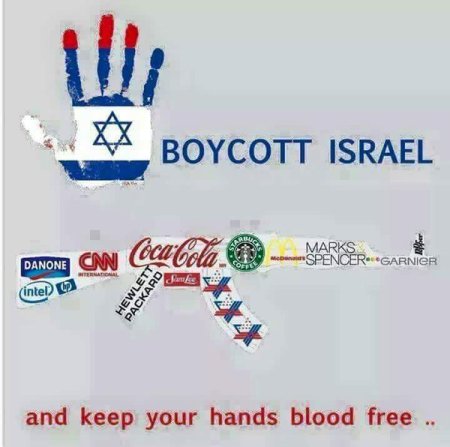
Britain’s ban on the public boycott of goods from Israel’s occupied territories contradicts its own official business guidelines, documents have revealed.
The controversial new law, which would ban local councils, student unions and other public bodies from boycotting goods for political reasons, was announced by the government on Monday and has been implemented without parliamentary debate or vote.
However, documents first seen by the Independent show the Foreign Office’s Overseas Business Risk assessment for Israel states that the government does “not encourage or offer support” to business with the occupied territories, apparently contradicting the new regulation.
“Settlements are illegal under international law, constitute an obstacle to peace and threaten to make a two-state solution to the Israeli-Palestinian conflict impossible,” the document reads.
“There are therefore clear risks related to economic and financial activities in the settlements, and we do not encourage or offer support to such activity.”
The new rules do not apply exclusively to Israel, but would ban institutions that receive the majority of their funding from the government from participating in procurement political campaigns, choosing not to buy products from companies on political grounds. The only exception would be nationwide boycotts mandated by the government.
The Palestinian Liberation Organization (PLO) has attacked the new law, saying it undermines the democratic rights and freedoms of public bodies.
PLO Executive Committee Members Dr Hanan Ashrawi and Dr Saeb Erekat released a joint statement after meeting with Middle East Minister Tobias Ellwood on Wednesday.
“This represents a serious regression in British policy and it would empower the Israeli occupation by sending a message of impunity,” said Ashrawi and Erekat.
“In order to accommodate the Israeli occupation, the British government is undermining British democracy and their own people’s rights.”
The Labour Party has panned the new measures as an “attack on democracy.”
“This government’s ban would have outlawed council action against apartheid South Africa. Ministers talk about devolution, but in practice they’re imposing Conservative Party policies on elected local councils across the board,” Labour Party leader Jeremy Corbyn said.
The government, however, has defended the anti-boycott measures, saying they are necessary for “community cohesion” and national security.
“There are wider national and international consequences from imposing such local level boycotts. They can damage integration and community cohesion within the United Kingdom, hinder Britain’s export trade, and harm foreign relations to the detriment of Britain’s economic and international security,” ministers said in a procurement policy note sent out to public authorities.
Coinciding with the law’s announcement, Cabinet Minister Matthew Hancock, who has recently come under fire for accepting a £4,000 donation from a right wing think tank, weeks before announcing a crackdown on lobbying by charities, is currently in Israel promoting business and trade links with the UK.
Read more:
Like Thatcher with apartheid: UK to ban public bodies from boycotting Israeli West Bank goods
Israel levels lands, demolishes structures in East Jerusalem
Ma’an – February 17, 2016
JERUSALEM – The Israeli authorities on Wednesday demolished agricultural structures and leveled land in the outskirts of al-Issawiya village in occupied East Jerusalem, locals said.
Muhammad Abu al-Hummas, a spokesperson for a local popular committee, told Ma’an that bulldozers had started leveling around five acres of land, adding that they “deliberately” ruined the dirt roads used by farmers to access their fields as well as their fences.
He said they were accompanied by Israeli police forces as well as officials from Jerusalem’s municipality and the Israeli Nature and Parks Authority.
The land is located in an area Israeli authorities have earmarked for a national park, in a controversial plan known as “11092”, which aims to turn around 740 dunams (175 acres) of Palestinian land in the East Jerusalem neighborhoods of al-Issawiya and al-Tur into Israeli parkland.
The Israeli planning council suspended the plan in September 2014 until the needs of the neighborhoods could be assessed.
However, the council, which previously approved the annexation of the 740 dunams, said approval of the plan could potentially be justified and was not fundamentally illegal.
Abu al-Hummus said the Israeli authorities were “leveling and ruining private Palestinian lands despite an Israeli court decision to freeze the settlement plans.”
One of the owners of the land leveled on Wednesday, Adnan Darwish, told Ma’an that Israeli bulldozers had ruined eight dunams (two acres) of his property, uprooting a number of olive and cypress trees.
He said they had also demolished a structure used as a sheep barn belonging to Salih Abu Turk. Other landowners affected were identified as Ali Abu al-Hummus, Atif Ubeid, and Shaaban Ubeid.
The Palestinian Center for Human Rights has previously described Israel’s plan in al-Issawiya as “part of the Israeli government’s plans to create a Jewish demographic majority in the occupied city.”
East Jerusalem was seized by Israel along with the West Bank in 1967 during the Six-Day War, and since then, the Israeli government has undertaken a policy of “Judaization” across the city.
PA seizes Israeli truck loaded with chemical waste
MEMO – February 16, 2016
The Environmental Quality Authority yesterday seized an Israeli truck full of chemical remains heading to illegally unload in occupied Palestinian territories, Quds Press reported.
The truck, which left the Israeli settlement of Karnei Shomron, was seized between the Palestinian villages of Kafr Thulth and Azzun near the West Bank city of Qalqilya.
The truck was to be offloaded near a residential compound in Qalqilya, a statement by the Environmental Quality Authority revealed.
The load included remains of several chemical industries, including paint.
The authority said it handed the truck and driver over to the District Coordination Offices.
A senior official in the authority said a complaint regarding this Israeli violation would be filed to the Secretariat of the Basel Convention, which is in charge of the transport of dangerous goods.
He also said that the Palestinian contractors, who were involved in this issue, would be prosecuted.
Environment expert George Karzam told Quds Press: “The Israeli occupation recently closed a number of its dumps and facilities related to treating solid and chemical waste in the lands occupied in 1948 [Israel] moving them to new sites in the West Bank, mainly in the Jordan Valley.”
This was because of the poisonous substances which were being discarded as well as the odors coming from the dumps, Karzam explained.
Israel has also been putting pressure on the Palestinian Authority to open new waste sites for illegal settlements in the West Bank, he added.
Israeli forces uproot 100 olive trees in Wadi Qana
Ma’an – February 16, 2016
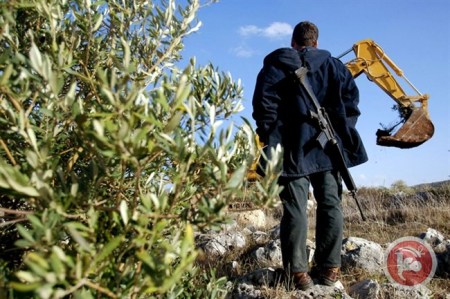
SALFIT – Israeli forces uprooted 100 olive trees in the Wadi Qana area west of the village of Deir Istiya in Salfit district on Tuesday amid ongoing efforts to push Palestinians out of the area, locals said.
Farmers from Deir Istiya told Ma’an the forces arrived in Wadi Qana and uprooted the trees without prior notice.
Soldiers then forced locals from the area in order to allow Israeli settlers to arrive there, the farmers said.
Ibrahim al-Hamad, director of the Palestinian Ministry of Agriculture’s Salfit branch, told Ma’an that soldiers removed the seven-year-old trees on the grounds that the area is a nature reserve, with planting prohibited in the area.
Al-Hamad added that Israeli soldiers also removed a water tank belonging to Palestinian locals.
A spokesperson for Israel’s Coordination of Government Activities in the Territories (COGAT) was not immediately available for comment.
Wadi Qana, a valley that has historically served agricultural and recreational purposes for local Palestinians who own land in the area, was declared a nature reserve by Israel’s Civil Administration in 1983.
Israel has used this designation for years to justify uprooting Palestinian crops and forcing Palestinians from the area, according to Israeli rights group B’Tselem.
Several Jewish-only Israeli settlements and outposts have been illegally established along the ridges of the valley since the 1970s.
Waste water dumped from the settlements has gradually polluted the river, forcing out Palestinians who have lived in and visited the valley for generations.
Palestinian owners of land in Wadi Qana and the village of Dir Istiya have meanwhile been prevented from building or planting in the area, the majority of which is in Area C, under the full civil and military control of Israel.
The NY Times Maps Jerusalem: Distilling the Worst of Israeli Propaganda
By Barbara Erickson – TimesWarp – February 15, 2016
In a new multimedia production The New York Times is now offering us “The Roots of the Recent Violence Between Israelis and Palestinians,” a series of 13 images accompanied by brief notes. The title promises much, and the teaser adds that this new offering presents us with “the geography of the issues surrounding the ongoing violence.”
Here, it seems, the newspaper has an opportunity to provide the context so often missing from Times stories about Palestine and Israel. With such an introduction readers might hope to learn about the historical beginnings of the conflict and to perceive the effects of occupation on the face of the land.
It was not to be. In fact, this slick presentation distills the worst of the Times reporting on the issue. The text never once mentions the occupation; it provides no historical context of any kind, and it blindly follows the preferred narrative of Israeli propagandists.
The visuals never leave Jerusalem, and the text sticks to events there. The presentation opens with an image of the Dome of the Rock and the Al Aqsa Mosque, accompanied by the comment that the violence “was set off in part over a dispute over Al Aqsa Mosque compound.” Nothing more is said about this complex issue.
The images then move on to highlight Jewish “neighborhoods” in Palestinian East Jerusalem and Jewish homes dotting the Palestinian neighborhoods, and we learn that the “neighborhoods” are “considered illegal settlements by most of the world.” This is the Times’ usual formulation, which distorts the fact that the entire international community—outside of Israel—deems the settlements illegal.
There is no mention of the impact these settlements have on Palestinians’ lives. We get nothing but maps and terse comments about who lives where, but the Times does finally provide a motive for the recent attacks: It comes from “frustration” over the lack of basic city services.
We are set up for this trivial claim in the fourth visual, which shows us Shuafat Refugee Camp in East Jerusalem surrounded by a yellow line. “Israel built a barrier in response to Palestinian attacks from the West Bank in the early 2000s,” the text notes. “While effective at stopping suicide bombers, it cut off several East Jerusalem neighborhoods from the rest of the city, leaving them without basic services.”
In the following image the narrative continues, “Palestinians say these frustrations are at the root of the recent attacks. Israelis officials accuse Palestinian leaders of inciting violence.”
There we have it. Not a word about loss of land, the confiscation of resources, military incursions and all the many miseries associated with military occupation. So much for the “roots” of the conflict.
Although the Times attempts a show of balance, by referring to both sides, the text is heavily weighted toward the Israeli point of view. It twice mentions Israeli actions as “responses” to violence and never suggests that Palestinians are responding to oppression.
It repeats the Israeli claim that Palestinians who died in the recent uprising were all involved in attacks or “clashes” with troops, omitting the reports of human rights groups and others who charge Israel with “street executions” of Palestinians who pose no possible threat to security forces or civilians.
In addition, the Times gives a distorted account of the Separation Barrier. It fails to say that the 2004 International Court of Justice decision held that the wall is illegal and that its route (85 percent of it inside the West Bank) threatens “de facto annexation.” The newspaper also repeats the Israeli claim that the wall “effectively stopped suicide bombers.”
As an Israeli journalist recently observed in 972 Magazine, the recent assaults have demolished this facile claim. The latest attackers could have come with bombs instead of knives; the wall did not keep them out. The bombings ended when militants abandoned the tactic.
If the Times truly intended to illustrate the “geography of the issues surrounding the ongoing violence,” it could have shown some dramatic effects of the occupation on the landscape, such as:
- The route of the Separation Barrier, snaking well inside the boundary between the West Bank and Israel
- The rows of dead parsley and spinach fields in Gaza, where Israel has deliberately sprayed herbicides on hundreds of acres
- The contrast between lush West Bank settlements, with their lawns and swimming pools, and parched Palestinian villages nearby
- The shrinking cantons of the West Bank, where Israel is illegally confiscating more and more Palestinian territory
- The dead strip of land inside Gaza, where Israel has imposed a firing zone and has frequently entered to bulldoze crops and soil
Images such as these might provide a real sense of the “roots” of the recent violence. Instead, the Times has chosen to encapsulate Israeli propaganda in this latest presentation, perpetuating its ingrained bias in a package of misleading notes and slick visual effects.
Follow @TimesWarp on Twitter
UK to outlaw boycotts of Israeli settlement goods
MEMO | February 15, 2016
 Public bodies in Britain are to be prevented from boycotting “unethical” goods, such as those from illegal Israeli settlements in Palestine, under a plan expected to be announced later Monday, local media reported.
Publicly funded institutions such as local municipalities and universities will face “stiff penalties” if they bar products from companies involved in the arms trade, fossil fuels, tobacco or West Bank settlements, The Independent newspaper reported, citing ministers.
The proposals – due to be announced by Cabinet Office Minister Matthew Hancock – are being put forward on the grounds that bans on products are harming community relations and fuelling anti-Semitism.
“The new guidance on procurement combined with changes we are making to how pension pots can be invested will help prevent damaging and counter-productive local foreign policies undermining our national security,” Hancock told The Independent.
Some public bodies around the U.K. have refused to buy goods from Israeli settlements in recent years and they would have to reverse those decisions under the plans.
In Leicester, a city in the East Midlands, elected officials agreed in 2014 that the municipality would not buy settlement produce. That year the devolved government in Scotland issued a notice discouraging trade and investment with settlements by Scottish councils.
The government’s plan was criticized as an attack on local democracy.
Amnesty International’s Economic Relations Program Director Peter Frankental said the proposal could encourage human rights abuses.
“All public bodies should assess the social and environment impacts of any company with whom they choose to enter into business relationships,” he told The Independent. “Where’s the incentive for companies to ensure there are no human rights violations such as slavery in their supply chains, when public bodies cannot hold them to account by refusing to award them contracts?”
Israeli settlements in the West Bank, East Jerusalem and the Golan Heights — lands occupied by Israel in 1967 — are considered illegal by the international community and a major impediment to peace with Palestinians.
Obama to sign trade agreement that equates settlements with Israel
Ma’an – February 12, 2016
BETHLEHEM – US President Barack Obama intends to sign a sweeping trade agreement including provisions that fail to differentiate between Israel and illegal settlements in the occupied Palestinian territories, as well as discourage the boycott of Israeli goods.
The agreement — H.R. 644: Trade Facilitation and Trade Enforcement Act of 2015 — was passed 75-20 on Thursday, and includes a provision that no US court can enforce judgement from a foreign court on a US citizen who “conducts business operations in Israel, or any territory controlled by Israel.”
The provision in effect allows US citizens immunity from conducting trade with illegal Israeli settlements, while its terminology fails to distinguish Israeli settlements from the state of Israel, violating the US’ official line against the construction of settlements in occupied East Jerusalem and the West Bank.
The White House in a statement released Thursday regarding the agreement said: “As with any bipartisan compromise legislation, there are provisions in this bill that we do not support.”
Of those provisions that the Obama administration did not support was a provision that “contravenes longstanding US policy towards Israel and the occupied territories, including with regard to Israeli settlement activity,” the statement said.
Despite the contravention, Obama plans to sign the agreement into law “to help strengthen enforcement of the rules and level the playing field for American workers and businesses.”
The agreement also includes a provision that in creating commercial partnerships with foreign countries, the US should “discourage politically motivated boycotts of, divestment from, and sanctions against Israel.”
The US government opposes the boycott, divestment, and sanctions (BDS) movement against Israel, and while US law requires that products made in illegal Israeli settlements may not be labeled “Made in Israel,” the law is rarely enforced.
Israel has been struggling to tackle a growing Palestinian-led boycott campaign which has had a number of high-profile successes abroad.
The BDS movement aims to exert political and economic pressure over Israel’s occupation of the Palestinian territories in a bid to repeat the success of the campaign which ended apartheid in South Africa.
However, BDS initiatives have also faced pushback abroad, notably in France, where a court ruled in October that a group of activists advocating for BDS were guilty under French hate speech legislation.
Intimidating military patrol of Palestinian market
International Solidarity Movement | February 9, 2016
Hebron, Occupied Palestine – On Tuesday, February 9, Israeli forces patrolled the Palestinian market in occupied al-Khalil (Hebron), harassing and intimidating residents.

Israeli forces on their patrol through the Palestinian market
A group of soldiers marched through the souq, the main Palestinian market since the closure of Shuhada Street for Palestinians after the Ibrahimi mosque massacre in 1994. Any male adult or youth was stopped on their way to work and forced by the Israeli soldiers to lift up their shirts and trouser-pants, as well as throw their IDs on the ground. After throwing their IDs on the ground Israeli soldiers ordered the men to move back, so they could pick up the IDs from a ‘safe distance’. Most Palestinians were dismissed after this humiliating procedure, whereas some of them were detained for minutes or violently body-searched.

Violent body-search of Palestinian young man
International human rights defenders documenting the Israeli forces violations of basic human rights of Palestinians, were intimidated and harassed by the Israeli soldiers in an attempt to prevent them from documenting. Soldiers took photos of the internationals with their private phones held right in the volunteers faces and as an intmidation tactic ID-checked them.

Israeli forces taking photos of human rights defenders with their private phones
During the more than one hour patrol Israeli forces repeatedly pointed their assault rifles at the internationals as well as Palestinians.

Israeli soldier ‘ordering’ Palestinians to stop by pointing his gun
Not only adults were surprised and shocked by the sudden presence of heavily-armed soldiers right outside their houses, but also children on their way to school and work. Some children, scared by the soldiers, turned around right away after spotting the soldiers and ran back home instead of continuing their way to school or kindergarten. International human rights defenders walked several scared children past the soldiers so they could safely reach their schools and kindergarten.

Two school girls passing the heavily-armed patrol

A mother waiting with children for the school-bus right opposite a group of soldiers
Intimidation through nightly ‘settler-tour’

Israeli forces blocking the entrance to the Palestinian market
International Solidarity Movement | January 31, 2016
Hebron, Occupied Palestine – On Saturday, 30th January 2016, large groups of settlers, accompanied by heavily-armed soldiers, entered the Palestinian market at night and took it over for about an hour during night-time in occupied al-Khalil (Hebron).
Around 9:30 pm, Israeli settlers from the illegal settlements throughout al-Khalil gathered at Bab al-Baladiyya, from where they walked into the Palestinian souq, the market, surrounded by heavily-armed Israeli forces. The group of more than 50 settlers started a ‘tour’ of the Palestinian market, with Israeli forces ‘guarding’ them throughout the Palestinian market. Palestinian residents were not allowed to pass and forced to wait at a distance, with soldiers repeatedly pointing the lasers from their guns at them to indicate they have to stop. A walk home at night though, for some Palestinians took almost an hour, instead of the usual 10 minutes.
This kind of ‘settler tour’ through the Palestinian market used to take place regularly on Saturday afternoons. During the ‘tour’ Palestinians are often denied to pass, stopped, ID-checked and detained. In the recent months, no ‘settler tours’ took place, but last week they started again with a nightly-tour at 11pm. For the Palestinian residents of the souq, these tours have become a regular form of intimidation and harassment in the past.
‘Hares boys’ sentenced to 15 years after families pay fines
Ma’an – January 29, 2016
RAMALLAH – After a nearly three-year long battle in Israeli military courts, five Palestinian teens from the occupied West Bank village of Hares accused of manslaughter after reportedly throwing stones were on Thursday issued sentences of 15 years, a prisoners’ rights group said.
The case has been disputed in the past by relatives and rights groups, who say that insufficient evidence was provided to prove that the five had any involvement in the death of an Israeli toddler who passed away two years after the teens were accused of throwing stones at her mother’s vehicle, causing it to crash.
A lawyer from the Palestinian Prisoners’ Society, Iyad Mahamid, told Ma’an that the military court issued the sentences to Muhammad Suleiman, Tamer Souf, Ammar Souf, Ali Shamlawi, and Muhammad Kleib.
Relatives of the detainees told Ma’an following a court hearing in December 2015 that the teens would be sentenced to prison terms of 15 years on the grounds that their families pay fines of 30,000 shekels ($7,700) by Jan. 28.
“Hares Boys,” an activist blog dedicated to raising awareness of the teens’ case, posted on their Facebook page “Free the Hares Boys” on Thursday that the families were able to pay the fines in full with the assistance of outside donations.
Failure to pay the fines could have resulted in prolonged sentencing to at least 25 years in prison, according to the Hares Boys blog.
Thursday sentencing marks a poor end to a drawn-out court battle that began after the five were detained by Israeli forces on March 15, 2013. All were 16 and 17 years old at the time of their detention.
Their arrest followed the hospitalization of a three-year-old Israeli girl, Adele Biton, who suffered severe head injuries when her mother’s car collided with a truck near the Israeli mega-settlement of Ariel. The toddler died two years later after suffering complications from pneumonia.
The family believes that while the child died of pneumonia, the severity of her complications was due to injuries sustained after the vehicle accident, according to Israeli media.
The Israeli vehicle had reportedly lost control after being hit by a stone, and the five teens were later accused of throwing stones that day at vehicles driving on Route 5, a highway leading to several nearby Israeli settlements.
Twenty Israeli drivers afterwards filed insurance claims stating that stones hit their cars, but the incidents lacked eyewitness testimony and the police received no calls at the time the teens were throwing stones.
All five denied the allegations, but later signed confessions “after being repeatedly abused in prison and during interrogations,” according to the Hares Boys blog.
The mother of the toddler told Israeli media following Thursday’s sentencing: “It is not much consolation, we would have preferred [the] death [penalty] or life-sentencing. The state did not properly tend to the matter and it didn’t fully enforce the punishment to the fullest.”
The British Parliament on Thursday in response to an online public forum inquiry said an official from the British Embassy in Tel Aviv had met with Chief Military Prosecutor Maurice Hirsch in November to express its concern over the case of the Hares boys, adding that the government would continue to raise the case to Israeli authorities.
The teens’ families as well as rights groups have repeatedly argued over the past three years that the youth were being held without evidence and unjustly prosecuted in a military court system that convicts over 99 percent of Palestinians.
The Hares Boys blog wrote in their defense in 2013: “If the boys are convicted, this case would set a legal precedent which would allow the Israeli military to convict any Palestinian child or youngster for attempted murder in cases of stone-throwing.”
Israeli Prime Minister Benjamin Netanyahu in September declared a “war on stone throwing,” establishing a minimum prison sentence for adults who throw stones as well as allowing Israeli forces to use sniper fire against stone throwers in circumstances that pose mortal danger.
The PM said at the time that there would be “significant fines” for minors who commit such offences, as well as for their parents.
The Knesset had already passed a law in July making penalties for stone-throwing more severe. The new law allowed for stone-throwers to receive a 20-year prison sentence where intent to harm could be proven, and 10 years where it could not.
At the time the bill was passed, Palestinian MK Jamal Zahalka said: “Who will the judge send to prison? He who demolished the home, seized the land, killed the brother, or the boy who threw a stone?”
Nonviolent Resistance in the South Hebron Hills
By Cassandra Dixon | Dissident Voice | January 28, 2016
The worst worries of a child’s school day should be homework. Maybe a lost book, or an argument with a friend. No child’s walk to school should routinely involve armed soldiers and fear of sometimes being chased and assaulted by angry adults. But for the Palestinian children who live with their families in the small rural villages that make up the South Hebron Hills, this is how the school day begins. Illegal settlements and outposts isolate and separate their villages and soldiers are a constant in their lives.
Once, the trip from the tiny hamlet of Tuba to the school in the village of Tuwani was a calm and beautiful walk along a quiet road connecting the two villages. During the 1980s Israeli settlers built a settlement on privately owned Palestinian land, which had been used to graze sheep and goats. Following construction of the settlement, the settlers established an illegal outpost. Now, industrial chicken barns sit astride the road that once served children walking to school, farmers taking livestock to town, and families traveling to Tuwani, or the larger town of Yatta for health care, shopping, and higher education.
Between the settlement and the outpost, what remains of the road is closed to Palestinians. With one exception – children walk behind an Israeli military jeep to reach their school. Their parents are not allowed to walk with them.
 Photo by Cassandra Dixon (See *note below)

The twenty or so children who make this trip start their school day in an unprotected field, anxiously waiting for the Israeli soldiers who will oversee their walk to school. Villagers had built shelters in which the children could await the soldiers, but Israeli authorities have dismantled every shelter. If it is raining, the children get soaked. Some days the soldiers are the same soldiers who chased or arrested shepherds the day before – shepherds who may be the brothers or fathers of these children. Some days the soldiers are late, leaving the group of children waiting, vulnerable to attack and within easy reach of the outpost. Some days the military escort does not arrive at all, and the children make the trip to school with international volunteers along a longer path, which also lies alongside the settlement.
About 1,000 people live in the neighboring villages, an estimated half of whom are children. Nevertheless, because the villages lie inside of Israeli Firing Zone 918, the military uses the land for military training.
Amazingly, despite all of this, it is almost unheard of for children to miss a day of school. Parents are determined that their children will be educated. When I began volunteering in Tuwani, the school reached only to third grade. Now thanks to the community’s determination to provide their children with education, students can complete high school in the village, and although facing a continued threat of demolition by Israeli military bulldozers, villagers have built and staffed primary schools for children who live in 8 nearby villages.
This is what nonviolent resistance to military occupation looks like.
I’m grateful that I can spend a portion of this year in Palestine. For many years children in these villages have taught me about nonviolence. Sometimes, the presence of international human rights workers holding cameras has some small positive effect on their days.
U.S. people bear some responsibility for the interruption of their childhoods. The U. S. subsidizes about 25% of Israel’s military budget, at a cost to U.S. taxpayers conservatively estimated at $3.1 billion a year.
I’m working with the Italian organization Operation Dove.
They support Palestinians who resist the Israeli occupation, standing with families in their commitment to remain on their land. This includes accompanying school children and farm families as they walk to school, graze their animals and tend their crops. Operation Dove helps document the harassment, intimidation, arrests, detentions, home demolitions, checkpoints, road closures, military training exercises, and settler attacks. Villagers also report to Operation Dove when they endure theft and when their crops and property are destroyed.
Protective presence provided by activists is not a large-scale solution to the violence that intrudes into childrens’ lives in Palestine. But many years of visits with these families persuades me that it’s important and necessary to support and participate in the villagers’ nonviolent efforts. Families that confront militarism and occupation help us move beyond our addiction to militarism and violence.
The children I met early on are grown now. Some have gone on to college, and some have families of their own. These young people have every reason to be angry. Their childhoods included fear, intimidation, demolitions, arrests and isolation. But they have also grown up witnessing their community’s steadfast commitment to nonviolently resist injustice. Their families have supported them well, including them in the community’s struggle for dignity. Against all odds they are growing up with humor and tenacity instead of anger and bitterness. They are living proof to the rest of us that love wins.
*Author’s Note: This little girl was injured by two masked settlers who attacked her with stones as she gathered herbs with a friend on the path between Tuba and Tuwani. She and her siblings make the same trip on foot each school day. She is an amazingly smart and tough young girl — insistent that the many odd volunteers that pass through her life should learn her name and visit her family’s home. She needed four stitches in a head wound after the attack.
Featured Video

Stanislav Krapivnik: Russia-Iran Cooperation & Escalation in Ukraine
or go to
Aletho News Archives – Video-Images
Frlom the Archives
A dark page from the CIA’s history: What was Project Artichoke, launched 74 years ago?
By Erkin Oncan | Strategic Culture Foundation | August 22, 2025
One of the most useful instruments hidden behind the U.S. empire’s rhetoric of “freedom and democracy” was the Central Intelligence Agency, founded on September 18, 1947, as the successor of the Office of Strategic Services (OSS).
Since its creation, the CIA has carried out countless inhumane operations: assassinations, coups, drug trafficking, support for terrorism, conspiracies. The list of its crimes is endless. But among the darkest and most inhumane chapters of its record lie the notorious “mind control” experiments. … continue
Blog Roll
 Aletho News
- Are the Jews indigenous to Palestine?
- Stanislav Krapivnik: Russia-Iran Cooperation & Escalation in Ukraine
- Indonesia suspends participation in Board of Peace following attack on Iran
- ‘Operation Epic Fury’ burns an estimated $5.82 billion in just 100 hours
- Zionism’s grip over the world: From Epstein to Greater Israel
- How Israel and the FBI manipulated assassination plots to goad Trump into Iran war
- Iranian Strikes Dispel the Illusion of US Security Umbrella
- US Boasts of Destroyed Iranian Launchers Lack Credibility – Ex-DoD Official
- Europe not in position to cooperate with US and Israel against Iran
- Iran Has ‘Broken the Myth’ of Israeli Military Power: Former Pakistani Envoy
- If Americans Knew
- US troops were told war on Iran was ‘all part of God’s divine plan’, watchdog alleges
- Trump wants to run the show in Iran, but doesn’t know what he’s doing – Not a ceasefire Day 147
- ‘Dirty Work’ :The truth about how Israel was founded
- Mass Expulsion in Lebanon as Israel Expands War: “We Don’t Know Where to Go”
- Lies, distortions, and propaganda: how the U.S. mainstream media coverage on Iran hides the truth
- Palestinians in Gaza fear famine returning as Israel cuts off food amid Iran war
- AIPAC, other pro-Israel groups enter midterms with $100 million to spend
- Iranian girls killed by ‘double-tap’ strikes on Minab school
- Bari Weiss Is Going Full ‘Propaganda-Palooza’ With the Iran War
- Inside the Pro-Israel Campaign to Stop ‘The Voice of Hind Rajab’ From Winning an Oscar
- No Tricks Zone
- Televised! Leading German Political Candidate Tells Schoolchildren CO2 Makes Sun Hotter!
- New Study: A Century Warming Of 1.1°C Is ‘Commonplace’ And ‘Not Unusual’ During This Interglacial
- New Study: ‘Internal Noise’ And Volcanic Forcing Can Trigger 10-15°C Warming Within Decades
- Glaciers Worldwide Are Suddendly Surging, Experts Blame Warming!
- Surprising Discovery: Sahara Is Greening…Billions Of Trees Where Once Thought To Be Barren
- New Research Reaffirms Clouds, Aerosols, And Surface Solar Radiation Are ‘Driving The Climate System’
- Germany: Electric Car Catches Fire At Charging Station, Sets Off Local “Inferno”, Widespread Damage
- New Study: Canada’s New Brunswick Was 1°C Warmer Than Today During The Medieval Warm Period
- Coal Power Back In Trend As Globe Tries To Keep Pace With Growing Demand For Power
- New Study: A 4°C Warmer Beaufort Sea Had ‘No Sea Ice’ 11,700 – 8200 Years Ago
 Aletho News