Settler attacks international – eats notebook
International Solidarity Movement | October 12, 2015
Hebron, occupied Palestine – Yesterday afternoon, two girls were arrested by Israeli forces in occupied al-Khalil (Hebron). International human rights observers documenting the ungrounded arrest were harassed by settlers in front of the Israeli police station.
Two young school-girls, aged 14 and 16, were stopped by Israeli forces at one of the many checkpoints at Ibrahimi mosque. Israeli forces accused them of having a knife and walked them to the police station at the Ibrahimi mosque. Both of them were eventually released after being taken to the police station in the illegal settlement of Kiryat Arba, which clearly illustrates that the arrest was based on a random accusation. Child arrests in the recent weeks have skyrocketed in al-Khalil, with children facing the threat of arrest at any given time of the day. The rights of Palestinian children in al-Khalil are continuously violated by the Israeli forces, with illegal arrests, ill-treatment during arrests and detentions as well as violent attacks with tear-gas, rubber coated steel bullets and live ammunition on children on the increase.
 International observers, documenting the arrest, were accosted by settlers while waiting outside the police station to find out the names of the children. After about two hours of waiting, the infamous and violent settler Ofer called another group of settlers to come to the police station, amongst them the infamous and aggressive settler woman Anat Cohen. Immediately after her arrival, she confronted the international volunteers and stole a notebook from one of the internationals, attempting to hit her in the face and punch her several times.
In order to make sure that the international would not be able to get her notebook back, Anat Cohen put part of it in her mouth and chewed it up. Even though all of this happened right in front of the police station, about five soldiers and two police men watching everything happen refused to intervene, even when the internationals present repeatedly asked them to stop the attacks. Instead, after they allowed the settlers to leave with the stolen notebook, they told the international to ‘go to Syria’.
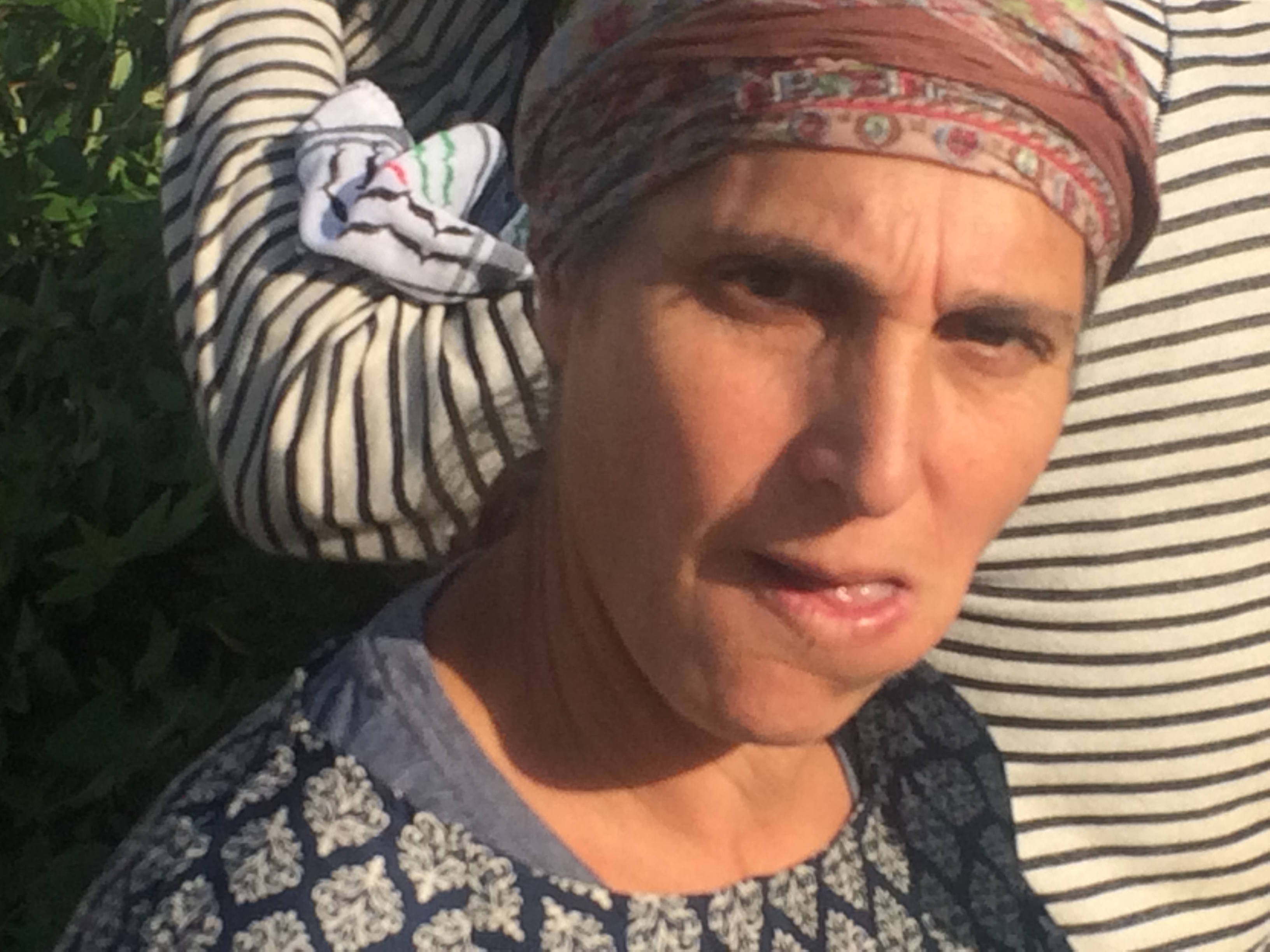
Anat Cohen eating the notebook
This again illustrates the total impunity settlers are granted by the Israeli forces for their actions, even if it involves internationals – who usually receive more protection under the law than do Palestinians.
US refuses to label Israeli attacks on Palestinians ‘terror’
MEMO | October 10, 2015
The State Department said Friday that recent attacks by Palestinians against Israelis are “acts of terror” but failed to apply the same standard when violence is committed against Palestinians by Israelis.
“We would consider these violent acts [by Palestinians] that we’re talking about specifically here as acts of terror,” spokesman John Kirby said in response to a question about violence in the occupied territories.
But when asked whether he also considered to be terrorist acts the stabbing of a Palestinian by a 17-year-old Israeli in the city of Dimona, Kirby brushed it aside and said he was not aware of the incident.
“I don’t have the details on that, so I’d really rather not get into this event by event,” he said.
“But we do consider these particular acts of violence that we’ve seen – the stabbings and the killings there particularly in East Jerusalem – as terror,” he said, referring to attacks by Palestinians while being careful not to label Israeli attacks as “terror”.
He added, however, that “all the violence needs to stop and calm should be restored”.
In the last seven days, several violent clashes have erupted between Palestinian youth and Israeli troops in the Israeli-occupied West Bank and East Jerusalem.
At least 1,600 Palestinians have been injured during clashes with Israelis since Oct. 3, according to the Palestinian Red Crescent.
The other occupation: Settlers terrorize Palestinians of the West Bank
International Solidarity Movement | October 11, 2015
Hebron, occupied Palestine – It was another emotional day for Palestinians in al-Khalil, (Hebron) after the burial of martyr Muhammad al-Jabari who was shot to death by Israeli forces near the entrance to the illegal Kiryat Arba settlement.
Thousands filled the streets as the body of the 19 year old boy was carried through the masses up to the martyr’s cemetery which is the same place where 18 year old unarmed Palestinian female student Hadeel Hashlamoun was shot to death at the checkpoint yawning into segregated Shuhada Street.
Immediately beyond the service, Palestinians gathered in the Bab al-Zawiya section of Khalil for a demonstration against the Israeli occupation forces use of violence which has now claimed the lives of nearly 20 young Palestinians in just one week. The demonstration was met with extreme violence by the Israeli military which settlers in the Tel Rumeida neighborhood gathered to watch on Saturday afternoon.
The Shamsiyyeh family’s home has long been the target of violence from Israeli settlers who have thrown rocks and other debris as well as poisoning their water tanks on several occasions and even cutting their water pipes on the roof. Today, settlers again filed onto the family home’s roof to watch the Israeli military assault on Palestinians in Bab al-Zawwiya, some armed with machine guns.
Israeli occupation forces predictably did nothing to calm the situation or remove the settlers from the roof of the family home. One settler sprayed pepper spray from the roof, gassing the family and subsequently himself. Israeli forces allowed him to leave with the pepper spray without asking a single question.
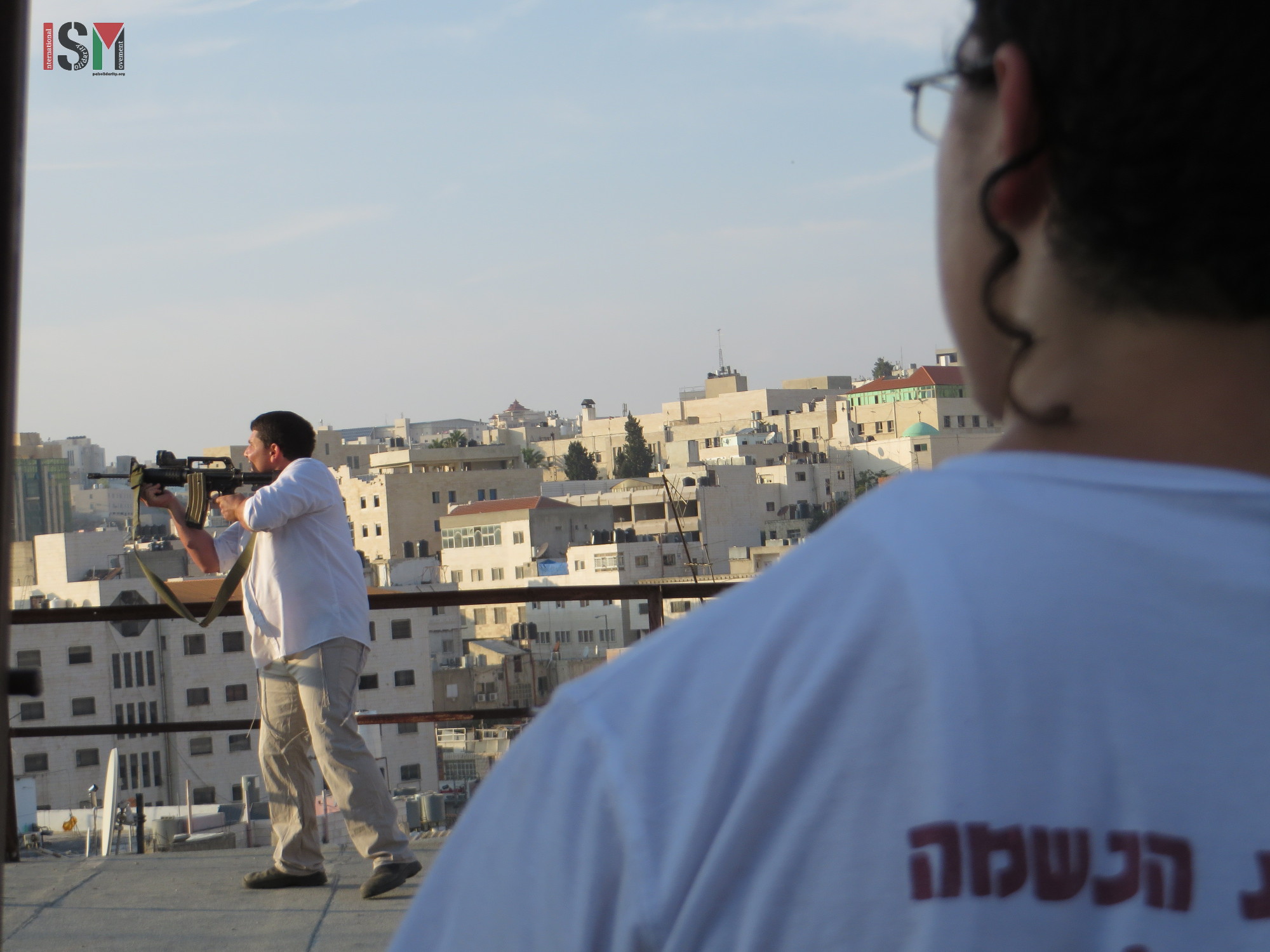
Israeli settler pointing his gun at Palestinian families
Just a few hours later, a settler armed with a machine gun, lightly slung around him just like an accessory, came onto the roof. Soldiers close-by refused to ask the settler to leave from the private Palestinian family home’s roof. The settler then suddenly pointed his machine gun at Palestinians, including small children, on nearby roofs. Soldiers at first watched the events unfold only to join the settler on the roof, taking orders from him on what to do.
Watch a video here:
In occupied al-Khalil, it has been apparent that settlers rule the military, both through demanding arrests and ID checks of Palestinians and through getting away with any transgression of Palestinian’s human rights by being handed total impunity by the occupying forces. This is especially disturbing since a West Jerusalem mayor has publicly called for settlers to carry guns amidst a high pressure situation with exploding violence across the occupied Palestinian territories.
In the Tel Rumeida section of al-Khalil, just days ago, settlers held a large march up the hill chanting “Death to Arabs” and burning Palestinian flags.
Israeli army prevents farmers to pick olives in Burin
International Solidarity Movement | October 9, 2015
Burin, Occupied Palestine – This Friday morning, at approximately 10:30 am, a group of 6 soldiers came down the mountain from the illegal Israeli settlement, Arousa, in the village of Burin, to prevent the family of Ahmad Mustafa Najjar from picking their olives.

Israeli soldiers prevent Ahmad’s family from picking their olives
Early in the morning, a group of illegal Israeli settlers from Arousa came to the farm and began threatening and intimidating Ahmad’s family. Ahmad’s uncle, Salah Najjar, telephoned Abu Mursi, from the District Coordination Office, to ask for help and managed to make settlers go away. Soon afterwards, a group of six soldiers arrived shouting aggressively and demanding the family to stop working. The family protested and the commander argued they were not authorized to pick olives, despite the fact that the family owns the land and trees and, therefore, does not need to have a permit. International activists asked the commander and soldiers what was the reason to stop them from picking olives from their own trees inside their privately owned land, and the commander and soldiers would not give an answer.
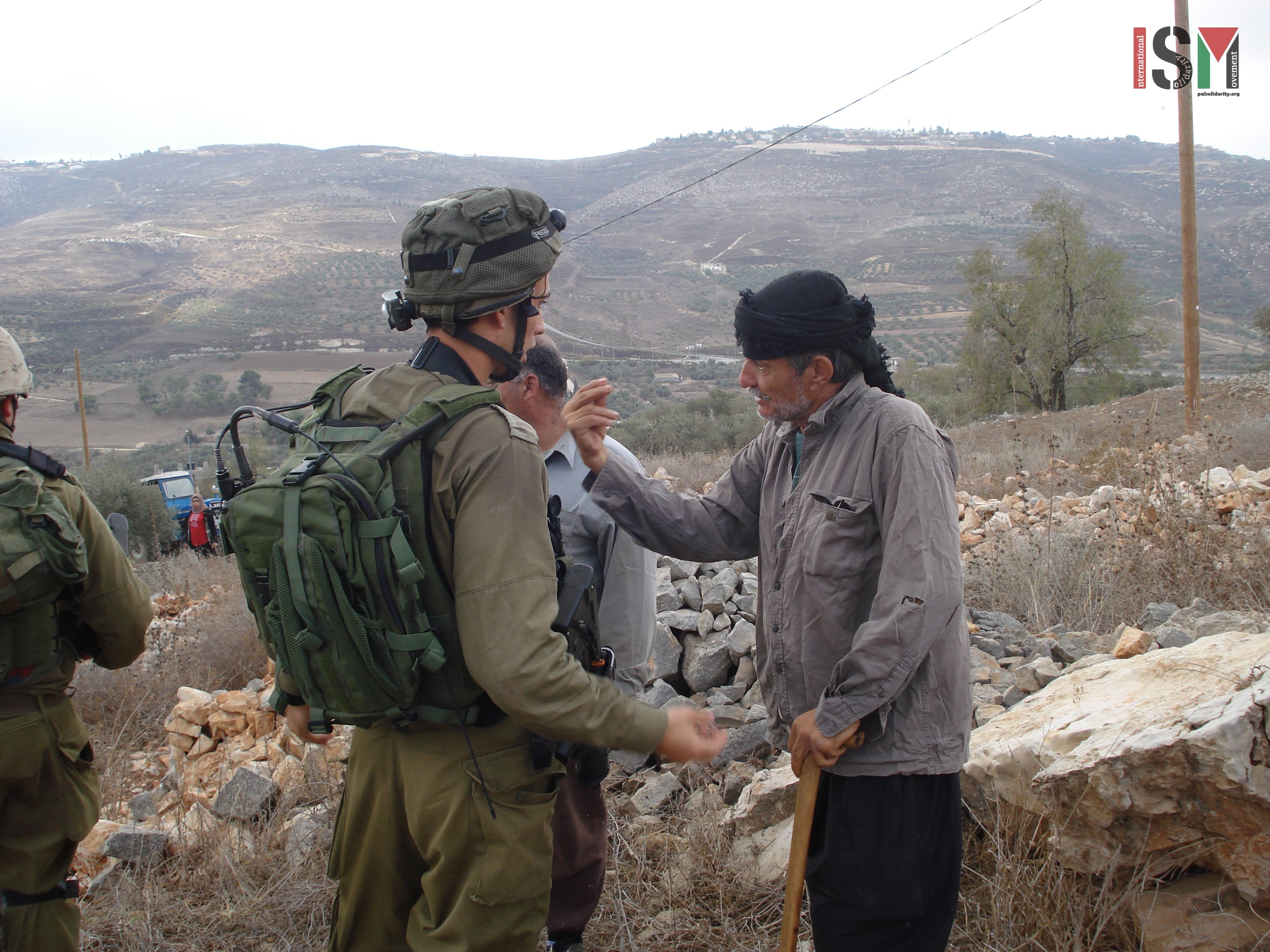
Abu Mursi, member of the village council, argues with commander that the family is entitled to pick olives in their field
Abu Mursi, member of the DCO, quickly arrived to the field to insist to the soldiers that the family does not need permission to pick their olives.
The argument continued for one hour, until a second commander arrived and made the decision that the family was not allowed to pick olives from the four highest trees, forcing them to move downwards to pick olives from other trees instead.
According to Ahmad, his family has lost $3.000 shekels because those 4 trees would make 120 liters of olive oil. He adds, “The soldiers violently beat my cousins, Muntasar and Mohammad, and I had to stand between them to stop the soldiers from killing them.”
Burin is a village located south west of the city of Nablus, which suffers from an ongoing harassment from the Israeli army. During the last month, Israeli soldiers have carried out several night raids into the villagers’ homes, waking up families in the middle of the night and searching their houses, with the clear purpose of terrifying the villagers.
Particularly during the olive harvest season, the farmers of Burin are scared of going to their fields to pick olives, especially in the farms located near the illegal settlements, due to the high risk of being attacked by settlers.
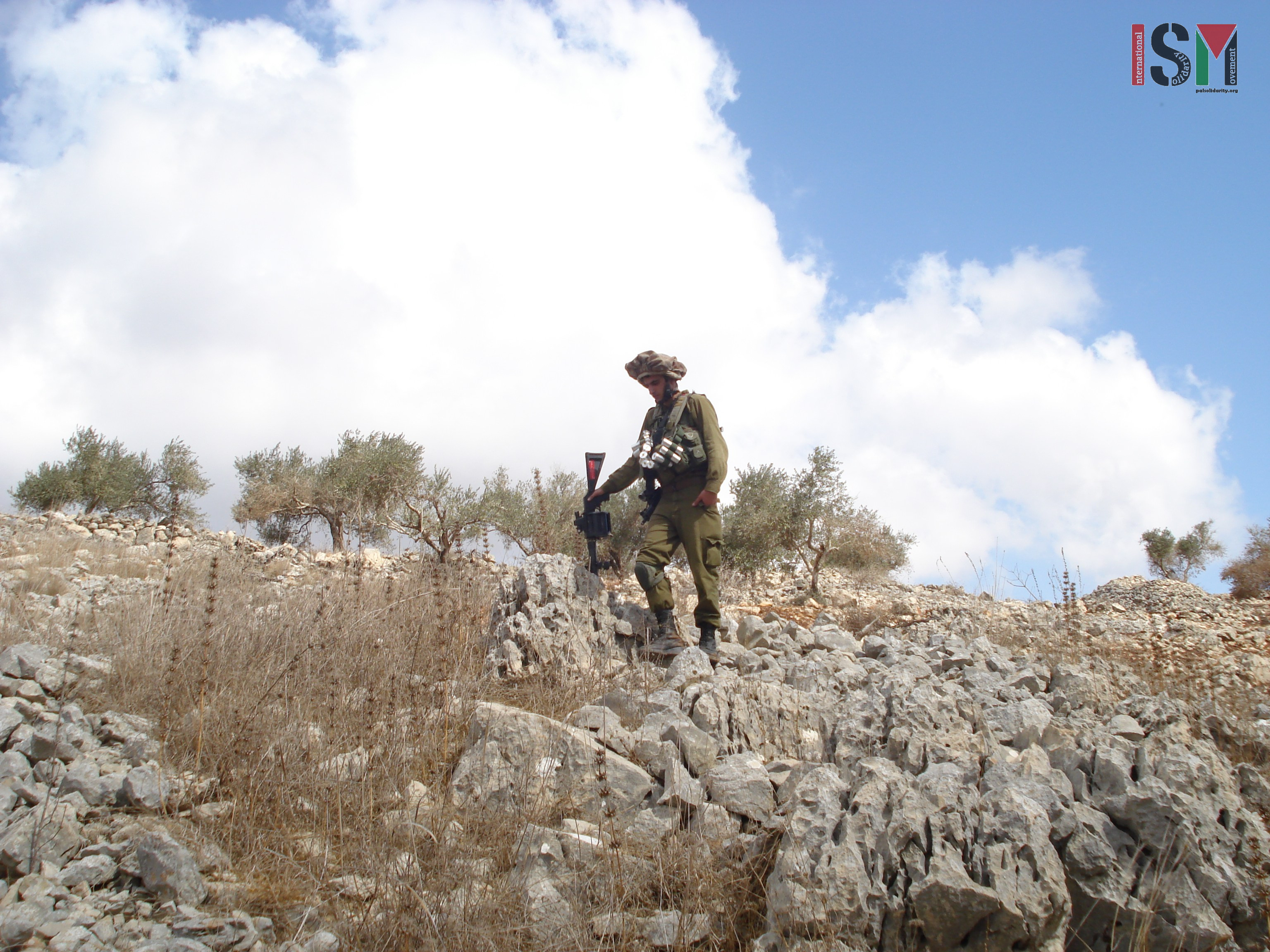
Note how one of the soldiers who came today is loaded with tear gas canisters; an unjustified excess of weapons
Settlers march through occupied al-Khalil attacking, insulting and threatening Palestinians and internationals
International Solidarity Movement | October 8, 2015
Al-Khalil/Hebron, occupied Palestine – Yesterday night, October 7th 2015, a large group of settlers harassed, insulted and physically assaulted Palestinian residents and internationals in the Tel Rumeida neighbourhood of occupied al-Khalil (Hebron), injuring several.
Around 08:00 pm, more than 50 settlers from the illegal settlements within al-Khalil, most of them children and teenagers, accompanied by a few adults, marched around the Palestinian neighbourhood of Tel Rumeida, chanting insults and hate-speech, calling for the death of Arabs. The group was not only chanting racist abuse, but also demonstrated a high level of violence and aggression towards the Palestinian residents of the neighbourhood.
After marching through the streets loudly chanting, they attacked Palestinians right outside a shop, running towards them and beating them, and hurling rocks at Palestinian youth and internationals documenting these violent assaults. Instead of intervening, Israeli forces watched these attacks happen at first just to point their loaded guns at Palestinians that just a few seconds before were standing in a hail of stones, threatening to shoot. Two persons were injured with stones thrown by the settlers, a Palestinian youth in his hand and an international in his chest. In the meantime, the settlers openly picked up more stones and rocks from the ground, attacking families that opened their main gates to find out what the shouting was about. Again, instead of preventing or stopping attacks by the settlers, the army violently pushed Palestinians to move back into their homes, yelling at them. All complaints made by Palestinians against the attacks by the settlers were ignored by the soldiers. But not only the settlers, also the Israeli soldiers violently attacked several Palestinians and beat them.
Many families rushed into their homes upon hearing the yelling, locked their doors and then had to watch the settlers chanting abuse at them from behind their windows – protected only by the metal grids installed in the past due to frequent settler attacks. Soldiers, in the best case, are standing idly by. Last night, they were pointing their guns at children and women watching in fear from the roof of their houses – the one place farthest away from the settlers down on the street; and soldiers were banging on the door of Palestinian family homes, while the group of settlers are aggressively chanting and threatening the families while standing right behind the soldiers.
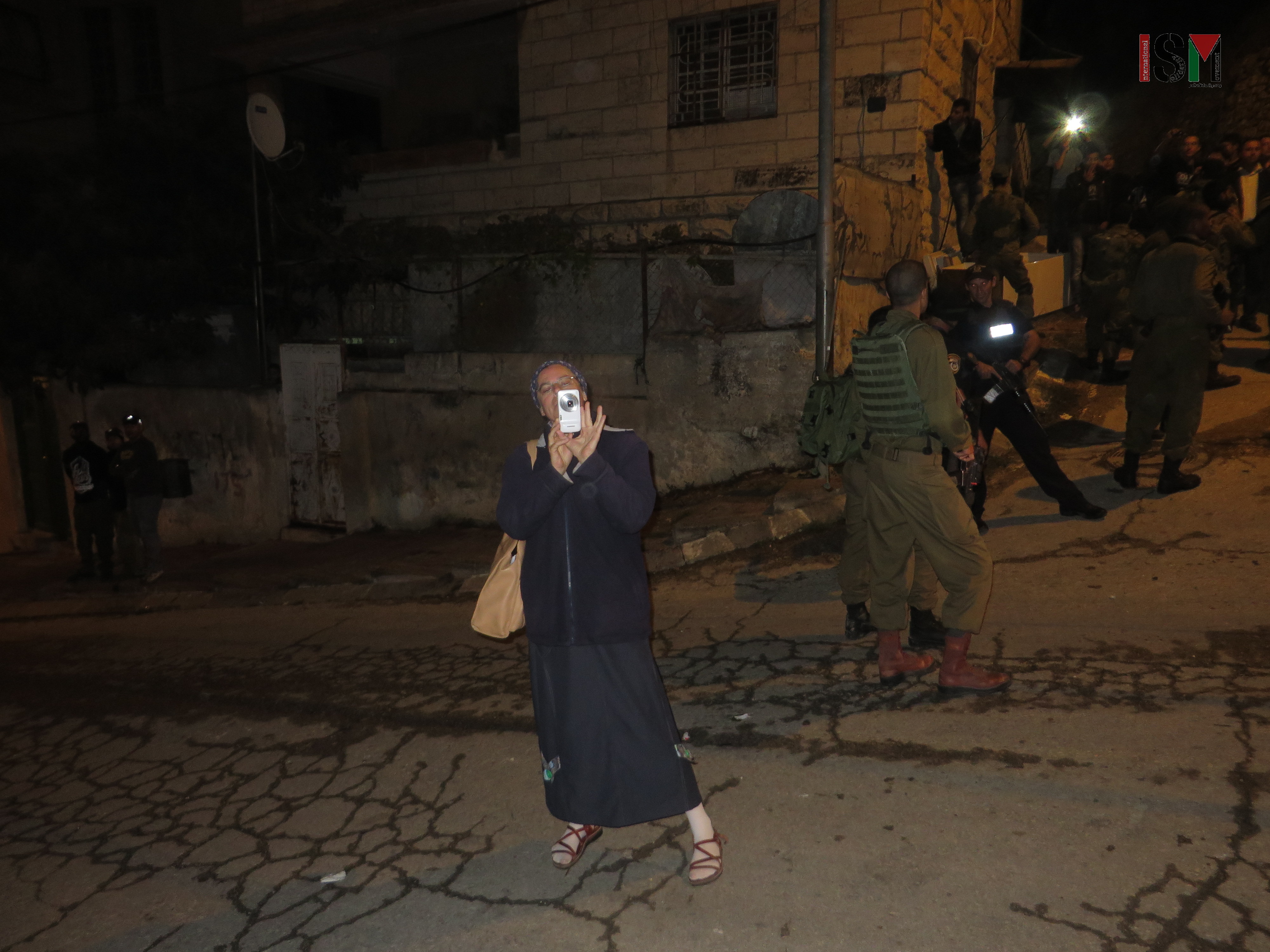
Settler woman photographing internationals getting attacked
When the march proceeded down the hill towards Shuhada checkpoint, where over two weeks ago the Israeli army ruthlessly gunned down and killed the Palestinian student Hadeel al-Hashlamoun, more than two dozen activists from Youth Against Settlement arrived to document the racist abuse and attacks against Palestinians. Israeli forces that by then finally arrived, immediately stopped the Palestinians and isolated them in an alley, preventing them from going anywhere. The group of settlers on the other hand was allowed to keep on chanting racist abuse and burned Palestinian flags, cheering and clapping. Israeli soldiers were getting their guns ready, facing the Palestinians that were clearly upset when their flags were being burned, but did not do anything to stop the flag-burning.
In order to allow for the greatest possible space for the settlers to move around and keep on chanting, Israeli forces pushed back the Palestinians, with one soldier threatening an international that he would ‘break his face’ if he didn’t move right away. Settler children and women also attempted to break cameras of internationals, blocking them from documenting the events and spit at them.
Infamous, aggressive settler Anat Cohen repeatedly attacked an international observer while she was standing right in front of a police car with two policemen inside, that did not even bother to get out of the car and instead just kept watching from inside. Soldiers did at no point try to prevent Anat Cohen’s attacks and instead ordered the internationals to go back up the hill, which at that point was not safe with settlers still roaming the streets. The settler woman both tried to grab the international observer’s camera and attempt to punch her in the face without soldiers intervening. When the international observer was ordered by soldiers to move towards the Palestinians detained on the other side of the road, Anat Cohen pushed her as she was passing in front of the police car, and her daughter kicked the her in the stomach. Soldiers still did not intervene and refused to take a complaint about this attack, forcing her and another international to leave.
This incident again illustrates the power settlers hold over the Israeli army. Even when attacking Palestinians – or internationals that enjoy a greater protection than any Palestinian – settlers enjoy the protection of the Israeli army.
Last evening, most Palestinian families, did not go to sleep, staying up late scared of what might happen during the night. Unfortunately, this incident in al-Khalil is only a case in point in a long record of settler attacks, that recently have been escalating not only in al-Khalil, but throughout the occupied West Bank.
12 year old Palestinian killed in Bethlehem as violence explodes across the West Bank
International Solidarity Movement | October 5, 2015
West Bank, occupied Palestine – Abed al-Rahman Shadi Obeidallah, 12 was still in his school uniform when he was rushed in a civilian car to Beit Jala hospital from Aida refugee camp in Bethlehem today. The boy, from from a Al Kahder village, was shot in the heart during confrontations at Aida camp as violence explodes across the West Bank prompting the Red Crescent to declare a level 3 state of emergency across the occupied Palestinian territories. Another boy was shot in leg with live ammunition during the attack.
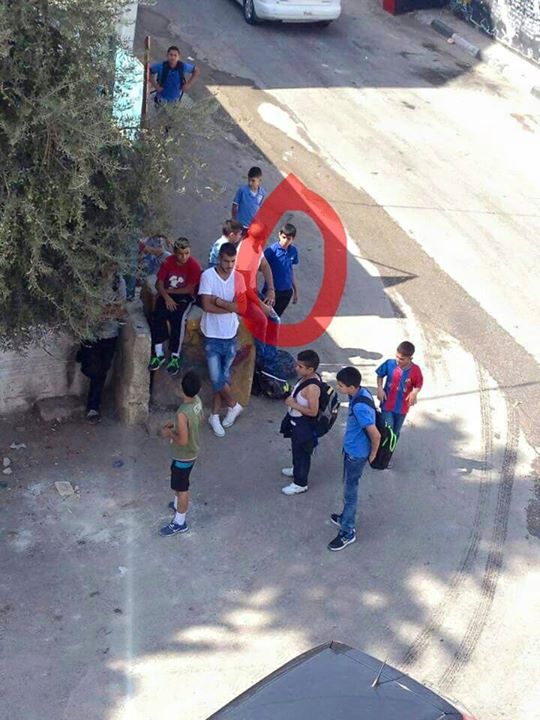
Abed al-Rahman Shadi Obeidallah, 12, just before being shot to death by Israeli forces in Bethlehem
Denouncing Israeli violations against humanitarian international law, the Palestine Red Crescent Society staff have endured 14 attacks on their emergency vehicles as Israeli forces and settler violence has sharply surged in a bloody three days. Attacks on PRCS have included medics being beaten by soldiers in Jerusalem, Israeli forces beating an ambulance crew with batons in the old city of Jerusalem and after one attack on an emergency crew in Jabal Al Taweel (Al-Bireh), two medics were injured. Israeli forces attacked an ambulance in al-Issawiya village in occupied East Jerusalem, before arresting an injured Palestinian who was being treated inside the ambulance. An ambulance windshield was also shattered by settlers in Burin village in Nablus. Burin underwent a frightening attack by settlers which left much of it in flames.
Reportedly 465 Palestinians have been injured thus far, including 28 shot with live ammunition and 68 injured with rubber coated steel bullets. Hundreds of others have been overcome by teargas that Israeli forces have been showering over villages and in cities where Palestinians have gathered to demonstrate against their murdering of several Palestinian youths since this past Saturday.
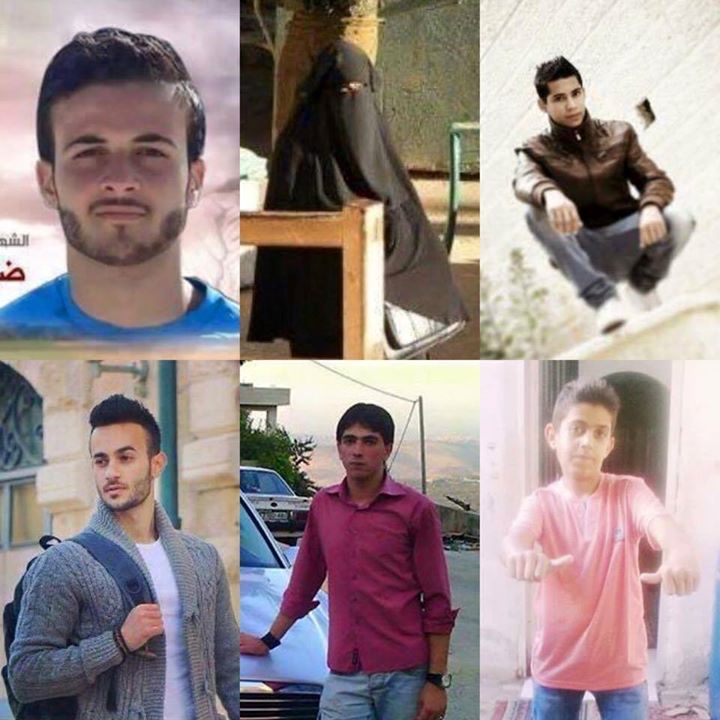
Young Palestinians martyrs recently murdered by Israeli forces.
Fadi Samir Mustafa Alloun, 19, from the East Jerusalem village of al-Issawiya, was shot to death by Israeli forces after allegedly attempting to stab a group of Israelis. 18-year-old Huthayfa Othman Suleiman was shot in the chest during clashes and died in the operating room. In a particularly heinous attack, Yousef Bayan al-Tabib, just six years old, was standing on the side of the road when a settler reportedly stopped his car, shot the child in the stomach, and fled the scene.
Across the occupied Palestinian territories, there have been reports of settlers slaughtering Palestinian’s sheep, attacking Palestinian cars with stones on roads and carrying out violent attacks on villages. As for Israeli forces, soldiers disguised as Palestinians assisting an injured Palestinian into a hospital in Ramallah, disabled security cameras and proceeded to arrest a Palestinian undergoing medical treatment. This is similar to other hospital raids in recent days where a variation of this tactic was repeated.
As for the Israeli government, Netanyahu today made an inflammatory statement to wage a “harsh offensive” against Palestinians; Zionist opportunism at its most typical. Collective punishment is the usual expectation when it comes to the illegally occupying force dealing with the civilian population whose land they are occupying. Israel launched three air strikes in the besieged Gaza strip targeting alleged Hamas ‘terror’ sites after two rockets were fired from Gaza, hitting nothing and injuring no one.
News reports of shootings, injuries, murders, arrests and raids continue to flood in as the situation unfolds at a lightning quick pace. For Palestinians enduring the brunt of Israeli incited race hatred and promoted retribution for the shooting of two Israeli settlers last week, the cavalierly imposed restrictions on al Aqsa Mosque, which have sparked outrage and violent confrontations- and the ensuing chaos, are yet another violent incursion into their lives.
Israel Escalates ‘Water-Apartheid’ As Illegal Settlers Contaminate Palestinian Water
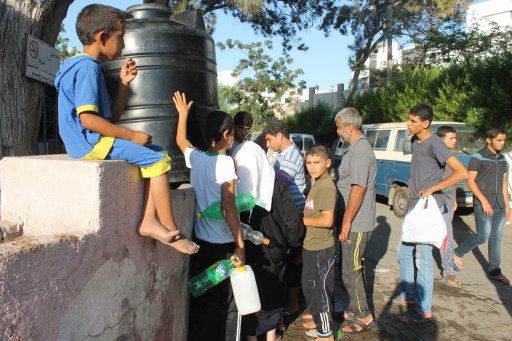
Palestinians displaced by Israeli strikes wait to get water from portable tanks near a makeshift encampment behind Gaza’s al-Shifa hospital, July 26, 2014. (Joe Catron)
By Joe Catron | Mint Press News | September 29, 2015
UNITED NATIONS — Israeli restrictions on Palestinian water use, as well as damage to water supplies and infrastructure by both Israeli forces and Jewish settlers, continue to deplete the already limited water supplies available to millions of Palestinians in the occupied West Bank and Gaza Strip.
“Water is used by the Israelis to achieve non-water interests, as a tool of punishment,” Dr. Abed Elrahman Tamimi, director of the Palestinian Hydrology Group in Ramallah, told MintPress News.
Meanwhile tens of thousands of Palestinians within Israel continue to lack access to running water, despite their citizenship in the state and the equality they should receive under its laws.
Israel has limited the water available to Palestinians in the Gaza Strip and West Bank since its forces occupied the enclaves, placing them under military rule, in 1967.
‘Scandalously uneven, humiliating and infuriating’
The Oslo II Accord, signed by Israel and Palestine Liberation Organization on Sept. 28, 1995, formalized this disparity, imposing what Israeli newspaper Haaretz writer Amira Hass called “a scandalously uneven, humiliating and infuriating division of the water resources of the West Bank.”
The agreement afforded Palestinians 118 million cubic meters of water per year from the Mountain Aquifer that stretches into Israel from the West Bank, while obligating Israel to sell Palestinians a further 27.9 mcm annually at full price.
It also entitled Israel to claim 483 mcm per year – over four times as much – but allocated none to the Gaza Strip, which was left to rely on the small Coastal Aquifer.
According to its own terms, Oslo II should have terminated in Palestinian independence after five years, with a joint committee increasing Palestine’s water allocation through consensus in the meantime. Neither scenario has come to pass.
In coming years, Israel would make clear that it had no intention of ever ending its control of Palestinian water. A June 7, 1997 order reiterated its longstanding policy: “All the water in the land that was occupied again is the property of the State of Israel.”
Successive governments pushed new waves of settlement construction, universally considered war crimes under the fourth Geneva Convention, on Palestinian lands in the West Bank. By 2000, the number of settlers had swelled 26 percent.
Like earlier settlements, the sites of many new units were calculated to maximize Israeli control of Palestinian water. In 2001, then-Israeli Prime Minister Ariel Sharon told Haaretz : “Is it possible today to concede control of the aquifer, which supplies a third of our water? Is it possible to cede the buffer zone in the Jordan Rift Valley? You know, it’s not by accident that the settlements are located where they are.”
Israeli measures to cement its occupation, along with provocative raids of the Al-Aqsa Mosque in Jerusalem, ultimately produced the Second Intifada, a Palestinian uprising that erupted on Sept. 28, 2000, five years to the day after Oslo II.
A vicious water cycle
Palestinians currently use no more than 11 percent of the Mountain Aquifer, with Israel enjoying the rest, according to the Emergency Water, Sanitation and Hygiene group (EWASH), a coalition of 28 Palestinian and international agencies dealing with water issues in the West Bank and Gaza Strip.
Meanwhile, West Bank Palestinians purchase 50 mcm of water each year from Mekorot, Israel’s national water company, paying $50 million for the return of their own resources at prices up to three times those charged to Israeli consumers.
Oslo II obligated Israel to increase its water sales to Palestinians in the Gaza Strip from 5 to 10 mcm annually during the supposed five-year “interim period.” But only this year, following widespread condemnation of its military operation against the besieged enclave last summer, did it finally do so, meeting 5 percent of the water needs of a population that has more than doubled.
On September 1, a United Nations Conference on Trade and Development report repeated a warning, first made by the UN’s Country Team for the occupied Palestinian territory in 2012, that the Gaza Strip could become unlivable by 2020.
UNCTAD cited the destruction of Gaza infrastructure during repeated Israeli offensives, including damage to 20-30% of the enclave’s water and sewer network, a water desalination plant, and 220 agricultural wells during last summer’s 51-day operation alone, as well as Israeli restrictions on economic development and reconstruction.
It also warned that “a severe water crisis” had forced the use of water from the Coastal Aquifer — 95% of it unfit for drinking — at levels “well above the recharge rate by over 100 million cubic meters, almost twice the sustainable rate.”
“The over-abstraction and scarcity of drinking water have been exacerbated by crumbling sanitation infrastructure, while the blockade creates chronic shortages of electricity and fuel, which in turn aggravate contamination and the water crisis,” the report said.
“The damage of contamination and over-abstraction is such that the aquifer may be unusable by 2016 and, if unaddressed, the damage may be irreversible by 2020.”
The total damage inflicted to the water sector by Israeli strikes last summer reached over $34 million, according to a report by the Palestinian Water Authority, although UNCTAD’s report says that “long-term repair of the accumulated damage and decay of the water and sanitation infrastructure will require $620 million.”
Last month, EWASH reported that 120,000 Palestinians across the Strip remained disconnected from its water network, while 23 percent of its 1.8 million residents lacked access to its sewage service.
Destroying infrastructure
Palestinians have never extracted their full 118 mcm of water from the Mountain Aquifer, as Israeli restrictions on wells and other infrastructure across most of the West Bank prevent them from doing so.
These military orders stretch into the Gaza Strip, where the threat of airstrikes forces residents hoping to dig wells to first seek permits from the Israeli army.
While sometimes given there, such permission is usually denied in Area C, the 60 percent of the West Bank under direct Israeli military administration, often on the claimed basis of Israeli security.
Israel targets unauthorized construction ruthlessly. Since the beginning of this year, its forces have destroyed 36 Palestinian water, hygiene and sanitation structures in Area C, usually citing their lack of permits, according to United Nations Office for the Coordination of Humanitarian Affairs data reviewed by EWASH.
Rare permits come at high prices. A 2013 study found that Israel usually conditions its approval of Palestinian water projects on the Palestinian Authority’s acquiescence to the construction of new settlement infrastructure, forcing the occupied population to “consent to their own colonization.”
As Palestinians, particularly in agricultural communities, scramble to meet their needs for water, Israel’s demolition of the necessary infrastructure, from pipes in Kafr Qaddum and Khirbet Yarza to wells in Hebron, continues.
‘Water-apartheid’
The pollution resulting from the destruction of wastewater treatment facilities has further damaged Gaza’s already depleted aquifer, rendering over 90 percent of local water unfit for drinking.
In the West Bank, 73.5 percent of Palestinians have expressed satisfaction with the quality of their water.
Yet the quantity remains woefully inadequate, as the average Palestinian can use only 70 liters of water per day – a figure that dips to 20 in some cases – while illegal Israeli settlers enjoy over 300. The World Health Organization suggests a minimum of 100 liters of water per day for sanitation, hygiene and consumption.
Confronted by a lack of water in some areas of the West Bank, and nearly all of the Gaza Strip, Palestinians face the “economic burden of purchasing water from tankers,” the Palestinian Hydrology Group’s Dr. Tamimi said.
In a March 2013 report, the Ramallah-based human rights group Al-Haq called Israel’s “demarcation of the population along racial lines,” their “segregation into different geographical areas” and the “use of ‘security’ to justify an institutionalized regime of domination and systematic oppression,” “the three pillars of Israel’s ‘water-apartheid.’”
“[A] second and disadvantaged Palestinian society living in the same territory is denied most of its basic rights,” Al-Haq stated. “Palestinians are forcibly confined to a land-locked archipelago of territory with minimal water resources available.”
This gross asymmetry extends inside Israel, where a June 2014 report by the Negev Coexistence Forum for Civil Equality found that 73,000 Palestinian Bedouin, living in villages unrecognized by the state, lacked sufficient running water.
Despite paying 30 percent more than other consumers for the meager supplies of water they received, the Israeli Ministry of Health did not monitor its quality.
Hazardous waste
Palestinian water supplies face further threats from pollution by Israeli waste, both dumped from nearby illegal settlements and shipped from inside Israel.
A June 2013 Israeli state report found that a third of sewage treatment facilities in settlements were either insufficient or inoperative.
The previous year, it reported, 2.2 mcm of waste had flowed from settlements directly into nearby waterways and cesspits.
As many settlements stand on hills, much of this untreated sewage then becomes the problem of neighboring Palestinian communities whose farmlands and groundwater it pollutes.
“The settlement wastewater goes to the aquifers and pollutes the groundwater,” Dr. Tamimi said.
The city of Salfit and nearby town of Kafr al-Deek have been repeatedly drenched with sewage from the settlements of Ariel and Yakir, most recently on Wednesday, affecting their agriculture and tourism, as well as local water supplies.
“Josephine,” a volunteer for the Ramallah-based International Solidarity Movement, noted that settlement pollution does not stop with sewage. “Many factories let out polluted water and waste into the water sources that Palestinians use,” she told MintPress.
In February, after Palestinian customs police discovered a truck transporting asbestos from Israel to a landfill in Tulkarem, the Palestinian Environment Quality Authority warned against attempts to smuggle Israeli waste into the West Bank.
‘A form of racism’
On July 2, the Association for Civil Rights in Israel announced that Israel’s High Court had ruled in favor of its clients, Palestinian residents of East Jerusalem who had faced years of water shortages and cutoffs.
Their neighborhoods, lying within the Jerusalem boundaries claimed by Israel but beyond its West Bank barrier, had been “perennially neglected by both municipal and national water authorities,” ACRI said.
The court’s ruling ordered the National Security Council to “investigate and work to mitigate the water crisis in East Jerusalem.”
By the following month, a new water crisis had gripped Palestinian communities throughout the West Bank as governorates in Hebron, Bethlehem, Nablus, Jenin and the Jordan Valley resorted to water schedules announcing planned cutoffs.
These windows of austerity, many Palestinians say, are nothing new. They often occur when demand for water is at its height, like during the hot summer months. Still, they never result in cutoffs inside illegal settlements or in Israel itself.
This disparate treatment, some think, aptly demonstrates the nature of the occupation itself. As Palestinian National Initiative leader Mustafa Barghouti put it: “Restricting water and electricity is a form of racism.”
Israel’s government no longer bothers to deny the intended permanence of its occupation. Last week, as Deputy Foreign Minister Tzipi Hotovely readied a diplomatic offensive against a pending European Union policy to label settlement products, she told the Times of Israel that withdrawals from “Judea and Samaria aren’t even on the list of options we’re offering the Palestinians.”
The occupied West Bank will remain under Israel’s “de facto sovereignty,” Hotovely said.
“It’s not a bargaining chip. It does not depend on the Palestinians’ goodwill. It’s the land of our forefathers. We don’t intend to evacuate it,” she continued, adding: “What I can promise is that Israel’s position will be very forceful and tough on this matter.”
Settler violence sharply escalates in Hebron during Sukkot holiday
International Solidarity Movement | September 30, 2015
Hebron, occupied Palestine – On the second day of the Jewish Sukkot holiday, hundreds of settlers continued filing into al-Khalil (Hebron) creating mass restrictions and sharp escalations in violence against Palestinians living here. Over a period of two hours dozens of them continuously invaded the roof of the Palestinian Abu Shamsiyye family home where several small children live.
Laughing and trying to gain vantage point to view Israeli forces teargassing, stun grenading and firing rubber coated steel bullet projectiles into crowds of Palestinians in the Bab al-Zawiya area of H-1 Hebron, the settlers spit and cursed at the children, darted towards them to frighten them, called them “Arab terrorists” and one male settler charged at and punched a female ISM international human rights monitor as she filmed him trespassing on the roof. The settler was allowed to leave the scene without incident as Israeli forces stood present but did nothing.
Shortly thereafter, as a Palestinian man and his two young sons tried to exit the gate fronting their home, a crowd of a dozen settler boys sat and stood in front of the gate blocking his exit as he politely asked to be allowed to pass. For fifteen minutes the boys kept the man and his sons trapped until an Israeli soldier finally came and told them to move.
Through the sounds of stun grenading and the blasts of high powered rubber coated steel bullets being showered onto Palestinians by Israeli forces just past checkpoint 56, the settlers, of all ages, took turns standing in the Israeli military post where they posed for photos, shouted curses and racial abuses at Palestinians and international human rights monitors and cheered each time a blast rang out.

This was the situation just outside the Abu Shamsiyye family home alone. But hundreds of Palestinian families have been literally under siege during the Jewish Sukkot holiday began yesterday as their roads have been closed, their businesses have been attacked, their children have been arrested and their streets have undergone hours of endless assault by heavily armed Israeli forces both on roofs as well as in the streets to allow for settlers to move freely through Palestinian governed areas it is illegal for them to be, in so they could pray in the streets.
The misery continues for Palestinians existing in occupied al-Khalil (Hebron).
Israeli settlers raid park south of Hebron under armed guard
Ma’an – September 30, 2015
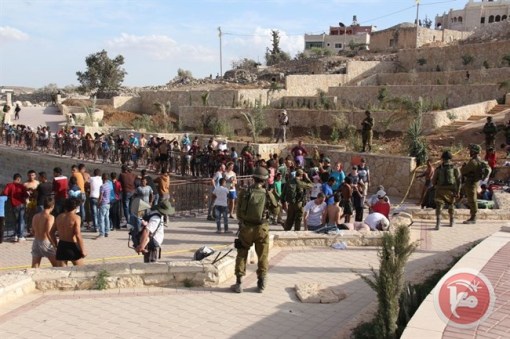
Dozens of Israeli settlers raided a park and ancient pool in the Palestinian town of al-Karmil in the southern occupied West Bank on Wednesday, under the armed protection of Israeli forces, witnesses said.
The park, part of the Yatta Municipality in the south Hebron hills, lies in Area A, under full Palestinian jurisdiction according to the Oslo Accords.
Buses carrying the settlers arrived to the park escorted by large numbers of Israeli forces and military vehicles, locals said.
Settlers came from the nearby settlements of Maon, Karmel, Beit Yatir, Susya, and the outposts of Havat Yair, Mitzpe Yair, Havat Maon, and Avigal, in order to “perform religious rituals” for several hours, they added.
The mayor of Yatta, Moussa Makhamreh, condemned the raid, pointing to the “dangerous nature of Israeli authorities’ and settlers’ racist actions taken under armed security.”
Makhamreh called upon local governance to support and protect the park in order to end frequent violations by Israeli settlers in the area.
An Israeli army spokesperson had no immediate information on the incident.
The park was created in 2011 by the Palestinian Yatta municipality, which renovated an ancient pool located at the site.
Settlers have come to the area in the past through the initiative of the Susiya Tour and Study Center which describes the pool as the historical site of the Biblical settlement of Carmel, according to rights group B’Tselem. Such visits are generally approved by and coordinated with Israeli authorities.
In April, Israeli soldiers expelled Palestinians from the pool in order to allow settlers to swim and have exclusive use of the park.
Around 3,000 Israeli settlers live in Jewish-only settlements in the Yatta region according to the Applied Research Institute – Jerusalem.
The presence of settlements in the area, considered illegal under international law, comes at the expense of Palestinian residents’ ability to build homes and infrastructure, or live unimpeded by constant and often violent interruption from Israeli forces and settlers.
Where Will It End? More Israeli Murders
By Stephen Lendman | September 22, 2015
Israel intends imprisoning Palestinian youths and children up to 20 years for stone-throwing. Nonviolent protesters are brutally attacked. Soldiers routinely murder Palestinians unaccountably.
Police now may use live fire indiscriminately, justifying it by inventing pretexts. Settlers commit near-daily violence and/or vandalism with impunity. Investigations when conducted are whitewashed.
Zionist zealots responsible for immolating Dawabsha family members are free to kill again – even though Israeli authorities identified them. Arrests didn’t follow.
On Tuesday, a Palestinian youth named Dia’ Abdul-Halim died – or was he killed? Israeli government officials notoriously lie. So do police and military sources.
The IDF claims the youth was killed trying to throw a grenade, claiming it detonated first. Judge for yourself if true or false. How often do civilians die from grenade explosions? Rare lightning strikes are more common. Palestinian medical sources said he was shot to death.
Soldiers prevented Palestinian Red Crescent medical workers from reaching the scene to help. What did they have to hide?
 On September 22, Israeli forces murdered Palestinian teenager Hadeel al-Hashlamon – shooting her three times in the chest, abdomen and lower body, claiming they foiled a stabbing attack.
Photos released proved otherwise. Soldiers confronted the unarmed woman belligerently, aiming their weapons at her. She turned to walk away and was murdered in cold blood.
An Israeli army spokeswoman lied, claiming “(t)he attacker attempted to stab a soldier.” Live fire aimed at her “lower extremists.” Soldiers shot to kill. None were harmed. No knife was found.
Palestinian PalMedia news agency video showed her left bleeding to death for around 30 minutes before help arrived. Soldiers and heavily armed settlers did nothing to save her.
She’s the 28th Palestinian murdered by Israeli security forces or settlers this year – unaccountably. No prosecutions followed.
Hadeel was taken to Shaare Zedek medical center too late to save her. These incidents happened after Israel mobilized hundreds of police reservists and extra numbers of soldiers in flashpoint areas.
A 2014 Amnesty International report called Israeli forces “trigger happy.” Excessive force is standard practice. Children are abused as violently as adults.
So are international solidarity activists and journalists. Anyone supporting long-suffering Palestinians is vulnerable.
In June through August 2014, over 1,000 West Bank Palestinians were arrested, nearly 600 injured, around two-thirds from live fire. During the same period, Israeli forces murdered 10 others.
Heavy security was deployed ahead of the Yom Kippur atonement period – beginning sundown on September 22, ending 24 hours later.
Vicious Israeli authorities have much to atone for – decades of brutality against defenseless Palestinians, accountability nowhere in sight, nor an end to occupation harshness.
Stephen Lendman can be reached at lendmanstephen@sbcglobal.net.
His new book as editor and contributor is titled “Flashpoint in Ukraine: US Drive for Hegemony Risks WW III.”
Palestinian teen shot in Hebron by Israeli forces dies from injuries

A photo of the incident shows an Israeli soldier aiming at the woman. (Youth Against Settlements)
Ma’an – September 22, 2015
BETHLEHEM – A Palestinian teenager shot by Israeli forces at a checkpoint in Hebron died from her injuries on Tuesday, Israeli medical sources said.
The teenager, identified as 18-year-old Hadeel al-Hashlamon, was shot three times by Israeli soldiers after allegedly attempting to carry out a stabbing attack, Israel’s army said.
A spokesperson for the Shaare Zedek Medical Center where she was taken for treatment said the teenager was “terribly injured, and underwent surgery upon her arrival.”
She later died from her injuries, the spokesperson confirmed.
No Israeli soldiers were injured during the incident, and the Israeli army did not release photographs of a knife, as they have done on several other recent occasions.
The army spokeswoman said that the attack had been “thwarted.”
A local activist group Youth Against Settlements later released what it said were photos of the incident, appearing to show Israeli soldiers aiming their weapons at the woman, as first she faced them and afterward turned away from them.
Another photo appeared to show the woman slumped on the street, after she was shot and wounded.
Video footage from Palestinian news agency PalMedia showed al-Hashlamon left bleeding on the pavement, reportedly for up to 30 minutes before she received treatment.
The footage shows the woman being dragged out of camera frame, while soldiers and heavily armed settlers look on.
Al-Hashlamon’s death marks at least 25 Palestinians killed by Israeli forces since the start of 2015, according to UN documentation, not including Palestinian deaths caused by Israeli settlers.
Al-Hashlamon’s father, the head of the Anesthesia Department of the Al-Ahli Hospital in Hebron, and its former General Director, Dr. Salaheddin Hashlamoun, said his daughter is a first-year student at the Hebron University.
How did Rawabi get its water?
By Jan Selby | MEMO | September 17, 2015
In February this year, the new Palestinian town of Rawabi at last managed to secure a water supply, after several years of acrimonious negotiations with the Israeli and Palestinian authorities. With the greatest obstacle to populating Rawabi overcome, the first 200 families of this planned “shining city on a hill” have now finally started moving in.
Rawabi’s water woes have received extensive coverage in the Israeli, Palestinian and international media, not least owing to a campaign instigated by the town’s owners, the Bayti Real Estate Investment Company. But why did Rawabi encounter such problems? And how did they eventually get resolved? For all the media coverage, the reasons are not well known.
When I meet Amir Dajani, Deputy Manager Director of Bayti in his Rawabi office, he reserves most of his anger for the Palestinian Authority. “No one did anything to support Rawabi,” he says of the PA. He recognises, of course, that Israel’s occupation poses huge challenges to a billion-dollar investment project, but about these he is pragmatic. The contrast between his visceral anger at the PA and his cool realism about the occupation is striking.
For all that, it is Israeli demands and an Israeli-drafted document which were the ultimate reasons for the hold-up. Under Article 40 of the 1995 Oslo II Agreement – which Palestinian negotiators were simply handed and accepted when they should have known better – all new water facilities in the West Bank require prior approval from a Joint Water Committee, meaning that Israel has complete veto rights over Palestinian water developments in the occupied West Bank.
Worse still, while Article 40 did not directly mention water projects for Israeli settlements, it did not preclude them from being brought to the Committee either. Israel exploited this ambiguity by making its approval of Palestinian water projects conditional on Palestinian approval of settlement water infrastructures. For fifteen years, the PA’s pragmatic policy response – pursued with the full knowledge of Presidents Abbas and Arafat – was to consent, however unhappily, to this blackmail and approve every single water facility proposed by Israel for its settlements.
This changed only in 2010, when the Palestinian Water Authority and later the PLO Executive Committee decided that they would no longer approve settlement water infrastructures. The result has been five years of deadlock within the Committee; the PA refuses to approve settlement water projects, and Israel in turn refuses to approve new wells and pipelines for Palestinian communities.
Until February, this included Rawabi. But then, following a media campaign plus a series of high-profile interventions – including from Israeli President Rivlin – and a very public disagreement between the Coordinator of Government Activities in the Territories (COGAT) head, Major-General Yoav Mordechai and Infrastructure Minister Silvan Shalom, the issue was finally decided by Benjamin Netanyahu. Rawabi became an exception, the site of the only new West Bank Palestinian water infrastructure to have been formally approved by Israel since August 2010.
Contrary to reports, however, this was neither a “goodwill gesture” nor a function of a new era of Israeli “water generosity”; simultaneous to approving Rawabi’s connection, Mordechai and Netanyahu also unilaterally approved a handful of settlement water projects (one source has told me “four or five”, another says “six or seven”). These projects included, for instance, a new water supply line for Tekoa in the Gush Etzion settlement bloc, supposedly needed because of declining groundwater levels in the Herodian area from which Tekoa is currently supplied.
Rather than an act of generosity, approval for Rawabi’s water was an internal Israeli quid pro quo. The Israeli government bowed to domestic and international pressure to provide the new Palestinian town with water, but could only square this with itself by simultaneously accommodating – nay, supporting – the country’s illegal settlements, by providing them with even more.
When I discuss this with Baruch Nagar of Israel’s Water Authority, he offers two justifications: that these settlement projects were “emergencies”; and that the Palestinian Water Authority, by refusing to approve settlement facilities, is acting unreasonably and is disrespecting Article 40. “We can’t understand why they stopped,” he says, as if the PA was just behaving irrationally. “We respect the water agreement,” he claims, “the Palestinians do not.”
This, though, is specious. Israel’s unilateral approval of settlement water facilities is a clear violation of Article 40, and invoking the false label of “emergency” does not alter this. There are scores of Palestinian communities across the West Bank which have no water in their pipes for days, weeks, even months on end each summer, and plenty of others which are not connected at all or whose small water collection systems are routinely demolished by the Israel Defence Forces. If “emergency” is the standard, then the PA would have every right – but not of course the power – to implement water projects unilaterally across the West Bank.
Moreover, no amount of deadlock within the Water Committee gives Israel the right to decide which new water facilities should be allowed to go ahead, and which not. However, this typifies Israel’s approach to the vestiges of the Oslo agreements, which can be summed up as bilateral “cooperation” when possible (i.e. when the Palestinians are compliant), unilateral violations whenever deemed necessary.
At least, though, Rawabi got its water supply, at least for now. For the other far-from-minor detail about this case is that Rawabi’s new water connection is only temporary; it will only supply 300 cubic metres of water per day, sufficient for the town’s first 5,000 residents and the next eighteen months. Thereafter, Rawabi will need another source, which is still being negotiated with Israel and the PA. Expect another raft of headlines about Rawabi’s water problems in a year or so.
Jan Selby is Professor of International Relations at the University of Sussex, UK
Featured Video

Stanislav Krapivnik: Russia-Iran Cooperation & Escalation in Ukraine
or go to
Aletho News Archives – Video-Images
Frlom the Archives
Are the Jews indigenous to Palestine?
By David Miller | Al Mayadeen | August 3, 2022
There is a rising tide of claims from apologists for the crimes of Zionism that they have been misunderstood. Palestinians might be indigenous to Palestine, but the Jews definitely are. What is called the ‘Israel-Palestine’ conflict, they say, is competition over the same small piece of land by two rival groups of indigenous people. But are the Jews indigenous to the Levant? And what are the consequences of the argument?
In fact, most of the power structure of the Zionist state is dominated by Ashkenazi Jews who have no ancestral link to Palestine. Overall despite very significant financial and infrastructural contributions from Western European countries (especially the US, UK and France, for example via the Rothschild family), Eastern European Ashkenazim have been at the centre of the Zionist power structure since the early years of the 20th Century. … continue
Blog Roll
 Aletho News
- Are the Jews indigenous to Palestine?
- Stanislav Krapivnik: Russia-Iran Cooperation & Escalation in Ukraine
- Indonesia suspends participation in Board of Peace following attack on Iran
- ‘Operation Epic Fury’ burns an estimated $5.82 billion in just 100 hours
- Zionism’s grip over the world: From Epstein to Greater Israel
- How Israel and the FBI manipulated assassination plots to goad Trump into Iran war
- Iranian Strikes Dispel the Illusion of US Security Umbrella
- US Boasts of Destroyed Iranian Launchers Lack Credibility – Ex-DoD Official
- Europe not in position to cooperate with US and Israel against Iran
- Iran Has ‘Broken the Myth’ of Israeli Military Power: Former Pakistani Envoy
- If Americans Knew
- US troops were told war on Iran was ‘all part of God’s divine plan’, watchdog alleges
- Trump wants to run the show in Iran, but doesn’t know what he’s doing – Not a ceasefire Day 147
- ‘Dirty Work’ :The truth about how Israel was founded
- Mass Expulsion in Lebanon as Israel Expands War: “We Don’t Know Where to Go”
- Lies, distortions, and propaganda: how the U.S. mainstream media coverage on Iran hides the truth
- Palestinians in Gaza fear famine returning as Israel cuts off food amid Iran war
- AIPAC, other pro-Israel groups enter midterms with $100 million to spend
- Iranian girls killed by ‘double-tap’ strikes on Minab school
- Bari Weiss Is Going Full ‘Propaganda-Palooza’ With the Iran War
- Inside the Pro-Israel Campaign to Stop ‘The Voice of Hind Rajab’ From Winning an Oscar
- No Tricks Zone
- Televised! Leading German Political Candidate Tells Schoolchildren CO2 Makes Sun Hotter!
- New Study: A Century Warming Of 1.1°C Is ‘Commonplace’ And ‘Not Unusual’ During This Interglacial
- New Study: ‘Internal Noise’ And Volcanic Forcing Can Trigger 10-15°C Warming Within Decades
- Glaciers Worldwide Are Suddendly Surging, Experts Blame Warming!
- Surprising Discovery: Sahara Is Greening…Billions Of Trees Where Once Thought To Be Barren
- New Research Reaffirms Clouds, Aerosols, And Surface Solar Radiation Are ‘Driving The Climate System’
- Germany: Electric Car Catches Fire At Charging Station, Sets Off Local “Inferno”, Widespread Damage
- New Study: Canada’s New Brunswick Was 1°C Warmer Than Today During The Medieval Warm Period
- Coal Power Back In Trend As Globe Tries To Keep Pace With Growing Demand For Power
- New Study: A 4°C Warmer Beaufort Sea Had ‘No Sea Ice’ 11,700 – 8200 Years Ago
 Aletho News