Jewish settlers burn olive trees in Salfit, perform Talmudic rituals in ancient Suleiman pools
Palestine Information Center – 11/10/2014
 SALFIT – A group of Israeli settlers have burned and vandalized Friday evening a number of olive trees in Yassouf town in Salfit under Israeli occupation forces protection.
Local sources confirmed that Palestinian farmers confronted the settlers and prevented further damage to their olive groves located near Tafuh settlement.
Israeli settlers and forces have daily carried out systematic attacks against olive groves especially during olive harvest in order to prevent the farmers from picking their own fruits.
Meanwhile, dozens of Israeli settlers stormed Friday morning Suleiman pools south of Bethlehem in the West Bank, local and media sources said.
The sources pointed out that the settlers performed Talmudic rituals in the ancient pools area in total provocation to the local residents.
WAFA news agency quoted a Palestinian security source as saying that 70 settlers from Efrat settlement stormed the pools area under heavy Israeli forces protection and started performing their rituals.
Israeli settlers used to storm Suleiman pools in an attempt to impose a status quo in the area.
The pools, which were built by the Ottoman Sultan Suleiman, are located between Artas and Al-Khader villages south of Bethlehem.
Settlement organisation entices Jews into Jerusalem settlement for $136 per day
MEMO | October 3, 2014
The Ir David Foundation, known as Elad, has published an announcement on social media networks in search of Jewish settlers to live in Palestinian homes that it has captured in the town of Silwan, occupied East Jerusalem, in return for a financial reward estimated at 500 shekels ($136) per day, Israel’s Haaretz newspaper reported on Wednesday.
Elad is known for its Judaisation projects of the city of Jerusalem. According to the association’s advertisement, an amount of 500 shekels will be given to each settler who agrees to live in one of the homes that have been seized, with the settler only required to “keep his gun loaded and ready to fire at any time”, according to the declaration.
Haaretz quoted one of the advertisements as follows: “We are looking for people who can stay in the apartments and watch them until families move into them. The work will probably take ten to 30 days (perhaps even more). The daily wage is 500 shekels gross. The workers will stay in the apartments and guard them until they are inhabited by families. Only suitable applicants will be accepted. Please pass this on to friends.”
The following day, the newspaper reported that when asked about the details on what the job entails, an Elad official said: “You’re not the security guard … There are security guards and police when needed, and there’s someone to supervise you and call to make sure everything is all right all the time. We don’t need you as a security guard. As far as we’re concerned, you live in the house, but it’s better if you have a weapon.”
The official also stressed that Elad would be the employer. “I think the payment would be by bank transfer,” she said. “You come and fill out forms.”
With the assistance of armed guards, the Foundation seized, overnight on Monday, ten individual buildings that include 23 apartments in the Wadi Hilweh neighbourhood of Silwan, located just south of Al-Aqsa Mosque, claiming that the settlers now own them.
Silwan has been witnessing continuous and tense confrontations with Israeli occupation forces ever since the seizure of the Palestinian homes, with Israeli police and armed forces present in the streets around the clock to protect the settlers.
Child Seriously Injured By Explosive Device Dropped By The Army
By Saed Bannoura | IMEMC & Agencies | October 1, 2014
Palestinian medical sources in Bethlehem said that a child was seriously injured, on Tuesday evening, when an explosive device, dropped by the Israeli army during training, detonated near him as he was herding the family sheep.
The sources said Malek Abu Dayya, 12 years of age, was injured in the al-Manshiyya area in Teqoua’ town, southeast of Bethlehem.
He was first moved to a local clinic before he was moved to a hospital in Bethlehem due to the severity of his injuries.
The area is frequently used by Palestinian shepherds for grazing, while the army largely uses it, as well as other areas in the West Bank, for military drills using explosives and live ammunition.
There have been dozens of similar incidents, many leading to fatalities, mainly in the Plains area of the Jordan Valley, where the many military bases are located, and the soldiers use the surrounding areas for training.
Many Bedouin communities have been repeatedly displaced for settlement activities, and for the army to build bases, and conduct live fire training.
Israeli forces destroy power grid in Nablus village
Ma’an – 29/09/2014
NABLUS – Israeli military forces on Monday destroyed an electricity network in the Nablus village of Aqraba, a Palestinian official said.
Ghassan Daghlas, an official who monitors settlement activity, told Ma’an that Israeli military bulldozers raided the Khirbet al-Tawil area of the village and demolished the main power line established in 2004.
Israeli soldiers destroyed over 80 electricity pylons and wires, he added.
Israel is using demolitions to “pressure residents to leave their houses for the sake of nearby settlements.”
In August, Israeli forces demolished four houses in the al-Tawil neighborhood, some of which were over 100 years old.
The al-Tawil neighborhood is on the outskirts of Aqraba and locals say Israeli forces have targeted several properties in the area under the pretext that they were built without a permit.
Israeli forces clash with Palestinians after Zionist settlers storm into Al-Aqsa Mosque
Al-Akhbar | September 24, 2014
Clashes erupted Wednesday between Palestinians and Israeli forces in Al-Aqsa Mosque compound in occupied East Jerusalem after dozens of Zionist settlers– led by two government ministers and backed by Israeli police – forced their way into the holy compound, a Palestinian guard of the complex said.
“Ninety-three settlers protected by 40 Israeli police and special forces forced their way into the holy compound through the Al-Magharbeh Gate,” the guard, who asked not to be named, told Anadolu Agency.
 He added that “at least 20 Palestinians were injured and five others arrested.”
The Zionist settlers were accompanied by Israeli Housing Minister Uri Ariel and Internal Security Minister Yitzhak Aharonovitch, in addition to several Jewish extremist leaders.
In response, some 300 Palestinian Muslim worshipers converged near the Al-Qibali and the Dome of the Rock mosques to protest the intrusion, the guard said.
In a bid to disperse angry Palestinians, Israeli forces fired rubber bullets and teargas, he added.
“At least 16 Palestinians were injured by rubber bullets, including one in the head and two in the abdomen. Around 45 others suffered teargas inhalation,” the guard said.
According to Sheikh Omar al-Qiswani, the Palestinian director of the Al-Aqsa complex, the two ministers took a tour of the compound’s courtyards, passing by the Dome of the Rock, Qibali and Marawani mosques before leaving through the Al-Rahmeh Gate.
Israeli security forces withdrew from the compound after the clashes, the guard said.
“Israeli police and army troops pulled out of the compound after attacking Palestinian worshipers,” he said.
Israeli police have stepped up security at the gates of the Al-Aqsa complex for the second day in a row, barring a number of Palestinians from entering the compound, al-Qiswani said.
“Except for the Al-Magharbeh Gate, where [Jewish] settlers regularly force their way into the complex, the Israeli police closed all other gates with chains,” al-Qiswani said.
Jews will celebrate “Rosh Hashanah” on Wednesday, which will mark the first day of the new Jewish year of 5775.
Groups of extremists called for marking the holiday by storming the Al-Aqsa compound and performing Talmudic rituals.
In recent months, groups of extremist Zionist settlers, often accompanied by Israeli security forces, have stepped up their intrusions into the Al-Aqsa Mosque complex, the world’s third holiest site for Muslims.
For Muslims, Al-Aqsa represents the world’s third holiest site. Jews, for their part, refer to the area as the “Temple Mount,” claiming it was the site of two prominent Jewish temples in ancient times.
Israel occupied East Jerusalem during the 1967 Middle East War. It later annexed the holy city in 1980, claiming Jerusalem as the unified capital of the self-proclaimed Jewish state – a move never recognized by the international community.
In September 2000, a visit to the site by controversial Israeli leader Ariel Sharon sparked what later became known as the “Second Intifada” – a popular uprising against the Israeli occupation in which thousands of Palestinians were killed and injured.
(Anadolu, Al-Akhbar)
Palestinian school set on fire
International Solidarity Movement | September 21, 2014
As-Sawia, Occupied Palestine – On the evening of the 10th September, unknown assailants broke into the As-Sawia Secondary School, forced open the door and set the school on fire. Bedouins living close to the school saw the fire and alerted the fire brigade. By the time it was put out, the principal’s office and teachers’ rooms were completely burned.


“We lost six computers, four printers, all the teachers’ books and materials, but most of all, the administrative documents and files of the students and about the school situation over the past years. The whole damage is around 140,000 shekels,” the principle Adnan Hussein told ISM. The school was closed for three days after the arson attack.


As in many schools in the occupied West Bank, the students and staff of As-Sawia Secondary School suffer from constant settler and military harassment. Three days before the arson, armed settlers who called themselves “security” from one of the nearby hilltop illegal settlements stood at the school gates. When the principal spoke to them, they claimed that children threw stones at the settler cars on their way to school.
The school is located by Road 90, which was paved in 1944 and runs across the West Bank. The road is used by Palestinians and by illegal settlers. The children have to walk alongside it to get to school in the mornings and to go home after school.
“Our school is suffering both for the settlers and the army,” explained Hussein. “We constantly have the army at our gates, checking ID’s and bothering children”
On the 3 September, armed settlers stopped in a car marked as the illegal settlement Eli’s “security” at the gate of the school. One of the settlers came out of the car, jumped over the fence and started following some of the children, who have finished their classes and were leaving for home. The principle approached the settler and told him that he is not allowed in the school with weapons, and the settler responded that he was looking for a child who threw stones and shouted at the settler car earlier.
After agreeing to move outside the school gate at the head teacher’s insistence, the settler with the machine gun was joined by another settler and they insisted that the boy in the red T-shirt was brought to them. They also wanted the head teacher’s mobile phone number so that they could call him in the future.
“I had a bad feeling that something horrible will happen and that they will start shooting,” related Hussien. “I left some teachers with the settlers and with other teachers went to escort children through another gate and send them home, when three soldiers appeared. I went to speak to them. I told them that they cannot be in school with their weapons and in their uniforms but they insisted that they wanted to speak to a boy in the red T-shirt for 10 minutes.”
The principal and staff stood between the soldiers and settlers and the pupils to protect them while they were leaving the school. By this time worried parents were at the gate and they took the children away.
Throughout 2013, the army entered the As-Sawiya 51 times and children and the staff had to put up with teargas, sound bombs and arrests of pupils.
Hussein explained, “It is a constant worry that the settlers and the army will come. It is hard enough to control 350 teenagers even in the countries where there is no occupation. It is not easy and we do what we can to try to do our best keep the education for our children going. We have no problem with Jewish people and I can say that many of them are nice and honest, but settlers are generally dangerous people. I know that people should be able to choose where they live, but that does not include taking someone else’s land without permission.”
Israeli settlers and soldiers invade Balata refugee camp
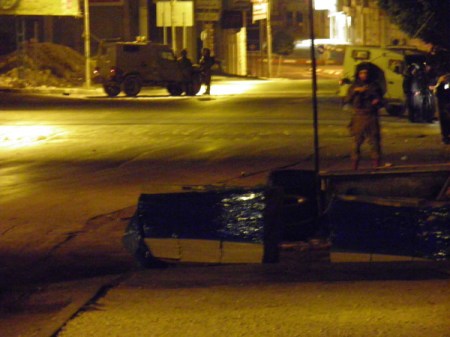
Photo by ISM
International Solidarity Movement | September 20, 2014
Occupied Palestine – On the 17th of September, under heavy Israeli army protection, Israeli settlers from nearby illegal settlements entered Nablus with the aim of praying at Joseph’s tomb in Balata refugee camp.
Just after midnight, the Israeli army closed the district that surrounds the monument, blocking all the streets leading to the tomb and preventing anyone from passing nearby, either by foot or by car.
Around 1am, between eight and 10 buses full with hundreds of settlers invaded the area.
Clashes began in the area, particularly in the junction just in front of the entry to Balata refugee camp.
Youths threw stones for more then two hours against the army vehicles, that were moving up on the hill and back, seemingly in order to keep them busy and far from the large groups of Zionist settlers. Military trucks also tried several times to run over the Palestinian youths while they were throwing stones.
The Israeli army fired many stun grenades, and the road blockades were kept in place until the settlers left the area.
Clashes around Balata occur almost weekly, any time that the settlers decide to invade the area for praying. The settlers claim this monument belongs to the Biblical patriarch Joseph, while most of the Palestinians believe that the religious guide Sheikh Yusef Dweikat was buried there, according to Islamic tradition. Though Joseph is a sacred figure as well in Muslim, Christian and Samaritan religion, Muslims are not allowed to pray there.
Labeling their own actions as “security measures”, the army can easily shoot down a whole neighborhood and guarantee the Israeli settlers the freedom to move and pray wherever they wish, even in a site which is deeply inside Area A, which is supposedly under Palestinian civil and security control. On the other side, most of the Palestinian living in the West Bank are not allowed to pray in their holy places, starting from this Joseph´s tomb to the biggest example of Al-Aqsa Mosque, in Jerusalem.
These evidently different treatments intensify the inequality in rights between Palestinians and illegal Israeli settlers and make the life under occupation more and more unbearable.
Israeli settlers attack internationals and a Palestinian shepherd
Operation Dove | September 15, 2014
At Tuwani – On September 14th, two Israeli settlers attacked a Palestinian shepherd and two international near the Israeli outpost of Mitzpe Yair, in the South Hebron Hills area. During the aggression, the settlers stole video cameras from the internationals and broke one of their phones. Israeli police detained the Palestinian shepherd and one of the internationals for six hours. There were no consequences for the settlers.
At about 9:00 a.m. four Palestinian shepherds from the South Hebron Hills village of Qawawis were grazing their flocks accompanied by two internationals, on Palestinian owned land nearby the Israeli outpost. Two settlers from Mitzpe Yair crossed a closed area (where the access is forbidden to everyone else) in order to attack one Palestinian shepherd, starting to chase away his flock. The two internationals present taped the scene.
Afterwards the settlers assaulted the internationals: at first they grabbed one by the neck and knocked him down, they snatched his camera and broke his phone; subsequently the settlers attacked the other one twisting her arm and also seizing her camera. The settlers ran back to the outpost holding the stolen cameras, and the Palestinian and the internationals went to Qawawis village.
The Israeli police came to the Palestinian village and asked the shepherd and internationals to follow them to the Israeli Police station in Kiryat Arba settlement, due to one settler claiming that they threw stones at him. The Police officers detained both of them for six hours and questioned them about the incident. Israeli police released them at 5:00 p.m. without consequences.
The South Hebron hills area has suffered from the presence of Israeli settlers’ since the 70′s. Eight Israeli settlements and outposts (among which Mitzpe Yair is one) almost completely isolate 16 Palestinian villages from the rest of West Bank. The settlers’ violence includes overt violent attacks on Palestinians and their animals, damages to private properties, and limitations to freedom of movement with many consequences on their daily life. Since the beginning of 2014, Operation Dove registered the arrests of 15 Palestinians, including minors, because they were on lands near the settlements. During the same period there were no consequences for Israeli settlers involved in the incidents occurring in the area.
In spite of the violence suffered by the Palestinians from the South Hebron Hills area, they keep on grazing and farming on their lands, resisting in a non-violent way to the Israeli occupation.
Operation Dove has maintained an international presence in At-Tuwani and the South Hebron Hills since 2004.
[Note: According to the Fourth Geneva Convention, the Hague Regulations, the International Court of Justice, and several United Nations resolutions, all Israeli settlements and outposts in the Occupied Palestinian Territories are illegal. Most settlement outposts, including Havat Ma’on (Hill 833), are considered illegal also under Israeli law.]
Once more: It ain’t about the graffiti
Another incident of nationalist crime in the village of Yasuf, but the media only paid attention to the unimportant part: the graffiti
By Yossi Gurvitz | Yesh Din | September 3, 2014
Atallah Yassin Muhammad Gouda lives in the village of Yasuf, which has known quite a few attacks by Jewish felons; perhaps the most notorious being the torching of its mosque in 2009, which introduced the phenomenon of the price tag attacks into Israeli consciousness. Gouda lives in a neighborhood that is adjacent to the outpost Tapuach Maarav, and according to the testimonies of its residents, they suffer from frequent attacks by Israeli civilians. The residents attribute the burning of several vehicles, as well as stone attacks on the houses in the neighborhood to their Israeli neighbors.
At the beginning of August, Gouda was woken by noise, and when he hurried to see what happened, he saw the family car, which was in the courtyard, on fire. He alerted the rest of the household, and together, they managed to prevent the fire from spreading to the house, which was only two meters away from the vehicle. After dousing the flames, which had caused severe damage – estimated at several thousand NIS – to the car, they discovered a gasoline can and several rags soaked in gasoline there also. The police were called and arrived at the scene, collecting evidence and taking fingerprints. Given the record of the SJPD, I wouldn’t hold my breath waiting for an indictment.
The torching of the car caused the family significant damage: not only would they have to pay for fixing it, but as the only provider, the father, is a taxi driver, and as the car (bought 18 months ago) was his work vehicle, there would also be time in which they would have no income.
So, the attack by the unknown felons achieved three goals: significant damage to the car, and damaging the Gouda family income. The third goal is the wider goal of settler violence: spreading fear and despair among the Palestinian residents, in an attempt to convince them by violent methods to abandon their lands, so that Israeli civilians can take them over. A fourth, collateral, goal – the spreading of the fire to the house and its sleeping residents – was not achieved. We note this isn’t the first time that Israeli civilians are suspected of torching a vehicle in dangerous proximity to a house, as its residents are sleeping.
And, oh, yes: there was also some graffiti. When the bedlam ended, after the fire was extinguished, and the smoke and panic settled, the residents found that someone had sprayed the wall of the house with a “price tag” graffiti. Anyone following the issue through the Israeli press, might have mistakenly concluded that the graffiti is the main issue. Here is a Ynet newsflash (Hebrew): “A price tag slogan was sprayed on a house in the Palestinian village of Yasif (error in the original – Yesh Din). A Palestinian vehicle nearby was set ablaze.” And then you have Mako (Hebrew): “The residents of the Palestinian village of Yasuf in Shomron woke up this morning to a new-old troubling sight – slogans sprayed on the walls of a house and significant damage caused to a vehicle.”
Which is weird. Every journalist learns that you open your piece with the most important part, and go on to the less important. In any reasonable measure, the setting of a vehicle on fire – especially one which is close to a house – is significantly more serious than any graffiti daubed on a nearby wall. The slogan cannot kill anyone or destroy anything: a few brushes of paint, and it is gone. So why is the media obsessed with the graffiti?
Because to a certain extent, the media has swallowed the myth spread by the settlers: that their crimes are not severe, it’s merely spray paint. Nothing to write home about. When the Israeli media puts the slogans in the spotlight, it puts the fire in the background. But as we’ve already shown, the great majority of nationalist crimes in the West Bank do not include slogans – and when these are present, there is a clear correlation between them and cases of arson. That is, the slogans accompany arson, and not vice versa. And arson is the spreading of terror par excellence.
It’s time we remembered that.
Palestine’s ever decreasing circles
Palestine: a journal of everyday occupation | August 30, 2014
After lunch, which is usually at around 4pm, we decided to go to Wadi Fukin to visit family. I’ve written before about the village which sits directly east of the 1949 armistice line, more commonly referred to as the Green Line. Each time we visit, I am always shocked. This time was worse than I expected. The lush, fertile valley is being closed in by colonies, which will result in Wadi Fukin being surrounded.
Beitar Illit is an illegal colony inhabited by particularly aggressive right-wing nationalist Jews. The colony was first established as an outpost in 1984 on land belonging to the neighbouring village of Husan. Today it is home to around 50,000 colonists. I’ve witnessed its expansion over more than a decade, and it never fails to make me so angry when I am confronted with it. The housing units were first built along the ridge of the hill. Then construction crept down the side of the hill at one end, into the valley of Wadi Fukin (wadi is Arabic for valley).

Today the side of the hill is almost entirely populated by the colonists. Because they are ultra religious, they believe the water source within Wadi Fukin is holy water, and the whole area is a special place for them alone, given by God. Armed colonists often invade the valley to come and swim in the irrigation pools that have been there for generations, the land tended by Palestinians for hundreds of years. Other intimidation of the Palestinians of the valley includes setting fire to trees and poisoning the water wells.
Perversely, Beitar Illit has been awarded the Israel Ministry of Interior’s gold prize, recognizing “responsible management and sustainable urban planning”. It has also received the same ministry’s prize for water conservation in public gardens, urban public institutions, and urban water administration in 2002. Daily life here is Kafkaesque in the extreme.

But there was worse. On the other hill, Tsur Hadasa, which is technically in Israel, ie, on the other side of the armistice line, is now encroaching into Wadi Fukin from the west. The cranes loom menacingly and piles of earth punctuate the ridge as construction continues. I wanted to take some photos so one of my nieces took me up the hill.
The land here is very rocky, with prickly gorse and olive trees planted on terraces. It was quite a climb but within minutes I could see the absolute destruction and disregard for the land of Wadi Fukin. Trees had been uprooted, stones gauged out. It was a mess. Farther in the distance, in what is Israel, the hill remains untouched and flora and fauna is flourishing. I’m not entirely sure where the armistice line is, but the new construction is clearly a very deliberate action to take land within the West Bank at some point to expand the colony. After all, they could easily have built to the west, well within Israel.

Wadi Fukin is entirely Area C, as denoted by the Oslo Accords, the appalling agreement that has given Palestinians the Palestinian Authority and Israel carte blanche to do as it pleases. This means that the homes in Wadi Fukin are under constant threat. I asked my brother in law if the homes closest to the newly built units of Beitar Illit are at risk of being issued demolition orders. He said no, those homes were built quite a few years ago. But the owners have recently planted the land around the building and he is sure that at some point the Israelis will demand the trees are removed.
Back to the western hill, the villagers have rescued what they can and the uprooted trees will be used for fire wood. The construction on both sides of the valley, with colonies and colonists encroaching ever deeper into Wadi Fukin, means that the space for the village and its inhabitants is getting smaller and smaller. Natural growth means that the population is increasing. So while Palestinian land is taken to increase the colonies, the Palestinians are being hemmed in. It’s a recipe for disaster.

Israel presses forward plans for Jewish seminary in occupied east Jerusalem
Al-Akhbar | August 28, 2014
Israel on Thursday approved a further stage in plans to build a nine-story Jewish seminary in the heart of a densely-populated Palestinian neighborhood near Jerusalem’s Old City.
According to the Peace Now settlement watchdog, the committee threw out an appeal tabled by a left-wing council member and approved a new stage in plans for a tower block in Sheikh Jarrah in occupied east Jerusalem.
Should the plans be approved by the district planning committee, construction could begin within the coming year, Peace Now’s Hagit Ofran told AFP.
“It might take six months to a year until it gets final approval for them to start building,” she said of the plan which was tabled in February.
The building will be used as a yeshiva, or Jewish seminary, for ultra-Orthodox Jews.
Sheikh Jarrah is a Palestinian residential neighborhood located to the north of the Old City.
Located on the road which links the Old City to Mount Scopus, the area is considered a strategic location and illegal settlement groups have made persistent efforts to take control of its land.
Israel captured east Jerusalem during the Six-Day War of 1967 and later annexed it in a move never recognized by the international community.
It considers all of Jerusalem its “eternal, indivisible” capital and does not see construction in the eastern sector as settlement building.
Both the Palestinians and the international community consider all Israeli construction on land seized in 1967 to be a violation of international law.
This has not stopped Israel from continuing its policy of illegal settlement in east Jerusalem and the West Bank over the years.
(AFP, Al-Akhbar)
Featured Video

Stanislav Krapivnik: Russia-Iran Cooperation & Escalation in Ukraine
or go to
Aletho News Archives – Video-Images
Frlom the Archives
Are the Jews indigenous to Palestine?
By David Miller | Al Mayadeen | August 3, 2022
There is a rising tide of claims from apologists for the crimes of Zionism that they have been misunderstood. Palestinians might be indigenous to Palestine, but the Jews definitely are. What is called the ‘Israel-Palestine’ conflict, they say, is competition over the same small piece of land by two rival groups of indigenous people. But are the Jews indigenous to the Levant? And what are the consequences of the argument?
In fact, most of the power structure of the Zionist state is dominated by Ashkenazi Jews who have no ancestral link to Palestine. Overall despite very significant financial and infrastructural contributions from Western European countries (especially the US, UK and France, for example via the Rothschild family), Eastern European Ashkenazim have been at the centre of the Zionist power structure since the early years of the 20th Century. … continue
Blog Roll
 Aletho News
- Iran Red Crescent says 6,668 civilian sites targeted in US-Israeli attacks
- Maybe Attacking Iran Was Not Such A Good Idea
- UK readies deployment of Prince of Wales carrier amid war on Iran
- Iran warns of consequences after US strike on water plant
- US Bases in Middle East Fail to Secure Nations & Become Safety Risk – Expert
- Iranian Crisis Becomes Embarrassment for US Military That Can’t Protect Anyone – MidEast Analyst
- IAEA Never Had Reasons to Forgo Talks With Iran — Russian MFA Spox
- Iran pledges to ‘respect sovereignty of neighbors’, declares US-Israel assets ‘primary targets’
- USA and Israel: Who is the lord and who is the colony?
- Indian journalist reveals severe Israeli censorship after escape from occupied territories
- If Americans Knew
- US, Israel ravage Iran and Lebanon; 4 killed in Gaza – Not a ceasefire Day 148
- US troops were told war on Iran was ‘all part of God’s divine plan’, watchdog alleges
- Trump wants to run the show in Iran, but doesn’t know what he’s doing – Not a ceasefire Day 147
- ‘Dirty Work’ :The truth about how Israel was founded
- Mass Expulsion in Lebanon as Israel Expands War: “We Don’t Know Where to Go”
- Lies, distortions, and propaganda: how the U.S. mainstream media coverage on Iran hides the truth
- Palestinians in Gaza fear famine returning as Israel cuts off food amid Iran war
- AIPAC, other pro-Israel groups enter midterms with $100 million to spend
- Iranian girls killed by ‘double-tap’ strikes on Minab school
- Bari Weiss Is Going Full ‘Propaganda-Palooza’ With the Iran War
- No Tricks Zone
- Televised! Leading German Political Candidate Tells Schoolchildren CO2 Makes Sun Hotter!
- New Study: A Century Warming Of 1.1°C Is ‘Commonplace’ And ‘Not Unusual’ During This Interglacial
- New Study: ‘Internal Noise’ And Volcanic Forcing Can Trigger 10-15°C Warming Within Decades
- Glaciers Worldwide Are Suddendly Surging, Experts Blame Warming!
- Surprising Discovery: Sahara Is Greening…Billions Of Trees Where Once Thought To Be Barren
- New Research Reaffirms Clouds, Aerosols, And Surface Solar Radiation Are ‘Driving The Climate System’
- Germany: Electric Car Catches Fire At Charging Station, Sets Off Local “Inferno”, Widespread Damage
- New Study: Canada’s New Brunswick Was 1°C Warmer Than Today During The Medieval Warm Period
- Coal Power Back In Trend As Globe Tries To Keep Pace With Growing Demand For Power
- New Study: A 4°C Warmer Beaufort Sea Had ‘No Sea Ice’ 11,700 – 8200 Years Ago
 Aletho News