Is Torah Jewish, or is it Zionist?
By Nahida the Exiled Palestinian
For years, I was asking to be shown the most revered, most glorified, most bragged about values, namely the “Jewish values”, to no avail.
At every occasion, defenders of “Jewishness” and Jewish ideology, would repeat the mantra, Judaism has NOTHING to do with Zionism, and Zionism does not originate from Judaism, nor does it represent “Jewish values”.
Then when I ask about these “Jewish values”, and request to be shown what they are, I am faced with deafening silence. In my quest for answers, I dove into the heart of the matter, I set off on a mission, searching for these mystical values, by myself. What better place to start, but the Jewish Bible, Torah?
This is what I found
Yeshayahu- Isaiah – Chapter 60
10. And foreigners shall build your walls, and their kings shall serve you, for in My wrath I struck you, and in My grace have I had mercy on you. י. וּבָנוּ בְנֵי נֵכָר חֹמֹתַיִךְ וּמַלְכֵיהֶם יְשָׁרְתוּנֶךְ כִּי בְקִצְפִּי הִכִּיתִיךְ וּבִרְצוֹנִי רִחַמְתִּיךְ:
.
11. And they shall open your gates always; day and night they shall not be closed, to bring to you the wealth of the nations and their kings in procession. יא. וּפִתְּחוּ שְׁעָרַיִךְ תָּמִיד יוֹמָם וָלַיְלָה לֹא יִסָּגֵרוּ לְהָבִיא אֵלַיִךְ חֵיל גּוֹיִם וּמַלְכֵיהֶם נְהוּגִים:
.
12. For the nation and the kingdom that shall not serve you shall perish, and the nations shall be destroyed. יב. כִּי הַגּוֹי וְהַמַּמְלָכָה אֲשֶׁר לֹא יַעַבְדוּךְ יֹאבֵדוּ וְהַגּוֹיִם חָרֹב יֶחֱרָבוּ:
.
14. And the children of your oppressors shall go to you bent over, and those who despised you shall prostrate themselves at the soles of your feet, and they shall call you ‘the city of the Lord, Zion of the Holy One of Israel.’ יד. וְהָלְכוּ אֵלַיִךְ שְׁחוֹחַ בְּנֵי מְעַנַּיִךְ וְהִשְׁתַּחֲווּ עַל כַּפּוֹת רַגְלַיִךְ כָּל מְנַאֲצָיִךְ וְקָרְאוּ לָךְ עִיר יְהֹוָה צִיּוֹן קְדוֹשׁ יִשְׂרָאֵל:
.
16. And you shall suck the milk of nations and the breast of kings you shall suck, and you shall know that I am the Lord, your Savior, and your Redeemer, the Mighty One of Jacob. טז. וְיָנַקְתְּ חֲלֵב גּוֹיִם וְשֹׁד מְלָכִים תִּינָקִי וְיָדַעַתְּ כִּי אֲנִי יְהֹוָה מוֹשִׁיעֵךְ וְגֹאֲלֵךְ אֲבִיר יַעֲקֹב:
.


Devarim – Deuteronomy – Chapter 23
20. You shall not give interest to your brother, [whether it be] interest on money, interest on food or interest on any [other] item for which interest is [normally] taken. כ. לֹא תַשִּׁיךְ לְאָחִיךָ נֶשֶׁךְ כֶּסֶף נֶשֶׁךְ אֹכֶל נֶשֶׁךְ כָּל דָּבָר אֲשֶׁר יִשָּׁךְ:
.
21. You may [however,] give interest to a gentile, but to your brother you shall not give interest, in order that the Lord, your God, shall bless you in every one of your endeavors on the land to which you are coming to possess. כא. לַנָּכְרִי תַשִּׁיךְ וּלְאָחִיךָ לֹא תַשִּׁיךְ לְמַעַן יְבָרֶכְךָ יְהֹוָה אֱלֹהֶיךָ בְּכֹל מִשְׁלַח יָדֶךָ עַל הָאָרֶץ אֲשֶׁר אַתָּה בָא שָׁמָּה לְרִשְׁתָּהּ:
.


Devarim – Deuteronomy – Chapter 7
1. When the Lord, your God, brings you into the land to which you are coming to possess it, He will cast away many nations from before you: the Hittites, the Girgashites, the Amorites, the Canaanites, the Perizzites, the Hivvites, and the Jebusites, seven nations more numerous and powerful that you. א. כִּי יְבִיאֲךָ יְהֹוָה אֱלֹהֶיךָ אֶל הָאָרֶץ אֲשֶׁר אַתָּה בָא שָׁמָּה לְרִשְׁתָּהּ וְנָשַׁל גּוֹיִם רַבִּים | מִפָּנֶיךָ הַחִתִּי וְהַגִּרְגָּשִׁי וְהָאֱמֹרִי וְהַכְּנַעֲנִי וְהַפְּרִזִּי וְהַחִוִּי וְהַיְבוּסִי שִׁבְעָה גוֹיִם רַבִּים וַעֲצוּמִים מִמֶּךָּ:
.
2. And the Lord, your God, will deliver them to you, and you shall smite them. You shall utterly destroy them; neither shall you make a covenant with them, nor be gracious to them. ב. וּנְתָנָם יְהֹוָה אֱלֹהֶיךָ לְפָנֶיךָ וְהִכִּיתָם הַחֲרֵם תַּחֲרִים אֹתָם לֹא תִכְרֹת לָהֶם בְּרִית וְלֹא תְחָנֵּם:
.
3. You shall not intermarry with them; you shall not give your daughter to his son, and you shall not take his daughter for your son. ג. וְלֹא תִתְחַתֵּן בָּם בִּתְּךָ לֹא תִתֵּן לִבְנוֹ וּבִתּוֹ לֹא תִקַּח לִבְנֶךָ:
.
5. But so shall you do to them: You shall demolish their altars and smash their monuments, and cut down their asherim trees, and burn their graven images with fire. ה. כִּי אִם כֹּה תַעֲשׂוּ לָהֶם מִזְבְּחֹתֵיהֶם תִּתֹּצוּ וּמַצֵּבֹתָם תְּשַׁבֵּרוּ וַאֲשֵׁירֵהֶם תְּגַדֵּעוּן וּפְסִילֵיהֶם תִּשְׂרְפוּן בָּאֵשׁ:
.
6. For you are a holy people to the Lord, your God: the Lord your God has chosen you to be His treasured people, out of all the peoples upon the face of the earth. ו. כִּי עַם קָדוֹשׁ אַתָּה לַיהֹוָה אֱלֹהֶיךָ בְּךָ בָּחַר | יְהֹוָה אֱלֹהֶיךָ לִהְיוֹת לוֹ לְעַם סְגֻלָּה מִכֹּל הָעַמִּים אֲשֶׁר עַל פְּנֵי הָאֲדָמָה:
.
13. And He will love you and bless you and multiply you; He will bless the fruit of your womb and the fruit of your soil, your grain, your wine, and your oil, the offspring of your cattle and the choice of your flocks, in the land which He swore to your forefathers to give you. יג. וַאֲהֵבְךָ וּבֵרַכְךָ וְהִרְבֶּךָ וּבֵרַךְ פְּרִי בִטְנְךָ וּפְרִי אַדְמָתֶךָ דְּגָנְךָ וְתִירשְׁךָ וְיִצְהָרֶךָ שְׁגַר אֲלָפֶיךָ וְעַשְׁתְּרֹת צֹאנֶךָ עַל הָאֲדָמָה אֲשֶׁר נִשְׁבַּע לַאֲבֹתֶיךָ לָתֶת לָךְ:
.
14. You shall be blessed above all peoples: There will be no sterile male or barren female among you or among your livestock. יד. בָּרוּךְ תִּהְיֶה מִכָּל הָעַמִּים לֹא יִהְיֶה בְךָ עָקָר וַעֲקָרָה וּבִבְהֶמְתֶּךָ:
.
15. And the Lord will remove from you all illness, and all of the evil diseases of Egypt which you knew, He will not set upon you, but He will lay them upon all your enemies. טו. וְהֵסִיר יְהֹוָה מִמְּךָ כָּל חֹלִי וְכָל מַדְוֵי מִצְרַיִם הָרָעִים אֲשֶׁר יָדַעְתָּ לֹא יְשִׂימָם בָּךְ וּנְתָנָם בְּכָל שׂנְאֶיךָ:
.
16. And you shall consume all the peoples which the Lord your God gives you; you shall not spare them, nor shall you worship their gods, for that will be a snare for you. טז. וְאָכַלְתָּ אֶת כָּל הָעַמִּים אֲשֶׁר יְהֹוָה אֱלֹהֶיךָ נֹתֵן לָךְ לֹא תָחוֹס עֵינְךָ עֲלֵיהֶם וְלֹא תַעֲבֹד אֶת אֱלֹהֵיהֶם כִּי מוֹקֵשׁ הוּא לָךְ:
.
20. And also the tzir’ah, the Lord, your God, will incite against them, until the survivors and those who hide from you perish. כ. וְגַם אֶת הַצִּרְעָה יְשַׁלַּח יְהֹוָה אֱלֹהֶיךָ בָּם עַד אֲבֹד הַנִּשְׁאָרִים וְהַנִּסְתָּרִים מִפָּנֶיךָ:
.
23. But the Lord, your God, will deliver them to you, and He will confound them with great confusion, until they are destroyed. כג. וּנְתָנָם יְהֹוָה אֱלֹהֶיךָ לְפָנֶיךָ וְהָמָם מְהוּמָה גְדֹלָה עַד הִשָּׁמְדָם:
.
24. And He will deliver their kings into your hand, and you will destroy their name from beneath the heavens; no man will be able to stand up before you, until you have destroyed them. כד. וְנָתַן מַלְכֵיהֶם בְּיָדֶךָ וְהַאֲבַדְתָּ אֶת שְׁמָם מִתַּחַת הַשָּׁמָיִם לֹא יִתְיַצֵּב אִישׁ בְּפָנֶיךָ עַד הִשְׁמִדְךָ אֹתָם:
.
Devarim – Deuteronomy – Chapter 7


Devarim – Deuteronomy – Chapter 9
5. Not because of your righteousness or because of the honesty of your heart, do you come to possess their land, but because of the wickedness of these nations, the Lord your God drives them out from before you, and in order to establish the matter that the Lord swore to your forefathers, Abraham, Isaac, and Jacob. ה. לֹא בְצִדְקָתְךָ וּבְישֶׁר לְבָבְךָ אַתָּה בָא לָרֶשֶׁת אֶת אַרְצָם כִּי בְּרִשְׁעַת | הַגּוֹיִם הָאֵלֶּה יְהֹוָה אֱלֹהֶיךָ מוֹרִישָׁם מִפָּנֶיךָ וּלְמַעַן הָקִים אֶת הַדָּבָר אֲשֶׁר נִשְׁבַּע יְהֹוָה לַאֲבֹתֶיךָ לְאַבְרָהָם לְיִצְחָק וּלְיַעֲקֹב:
.
6. You shall know that, not because of your righteousness, the Lord, your God, gives you this land to possess it; for you are a stiffnecked people. ו. וְיָדַעְתָּ כִּי לֹא בְצִדְקָתְךָ יְהֹוָה אֱלֹהֶיךָ נֹתֵן לְךָ אֶת הָאָרֶץ הַטּוֹבָה הַזֹּאת לְרִשְׁתָּהּ כִּי עַם קְשֵׁה עֹרֶף אָתָּה:
.


Devarim – Deuteronomy – Chapter 28
1. And it will be if you obey the Lord, your God, to observe to fulfill all His commandments which I command you this day, the Lord, your God, will place you supreme above all the nations of the earth. א. וְהָיָה אִם שָׁמוֹעַ תִּשְׁמַע בְּקוֹל יְהֹוָה אֱלֹהֶיךָ לִשְׁמֹר לַעֲשׂוֹת אֶת כָּל מִצְוֹתָיו אֲשֶׁר אָנֹכִי מְצַוְּךָ הַיּוֹם וּנְתָנְךָ יְהֹוָה אֱלֹהֶיךָ עֶלְיוֹן עַל כָּל גּוֹיֵי הָאָרֶץ:
.
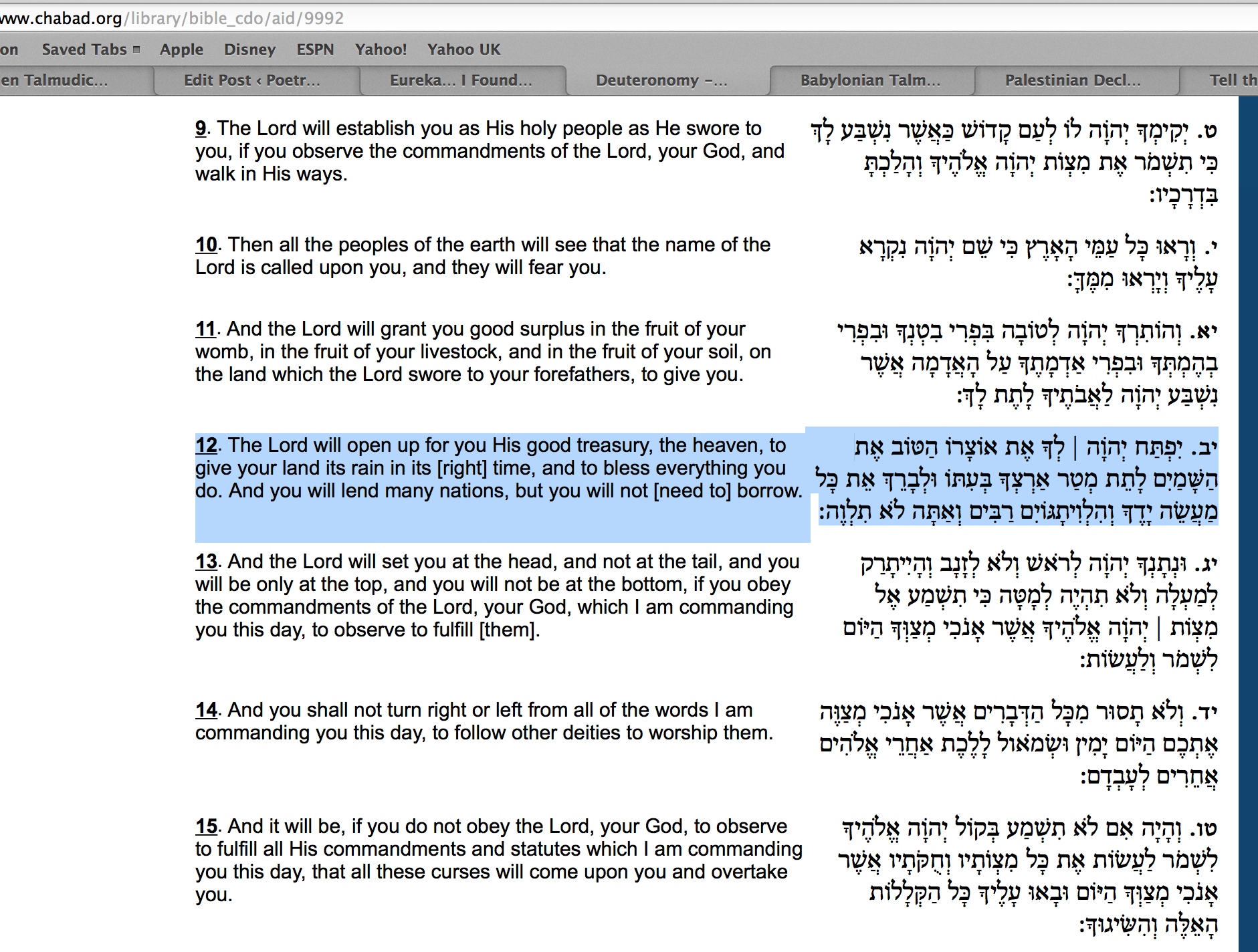
12. The Lord will open up for you His good treasury, the heaven, to give your land its rain in its [right] time, and to bless everything you do. And you will lend many nations, but you will not [need to] borrow. יב. יִפְתַּח יְהֹוָה | לְךָ אֶת אוֹצָרוֹ הַטּוֹב אֶת הַשָּׁמַיִם לָתֵת מְטַר אַרְצְךָ בְּעִתּוֹ וּלְבָרֵךְ אֵת כָּל מַעֲשֵׂה יָדֶךָ וְהִלְוִיתָ גּוֹיִם רַבִּים וְאַתָּה לֹא תִלְוֶה:
.

Devarim – Deuteronomy – Chapter 11
23. then the Lord will drive out all these nations from before you, and you will possess nations greater and stronger than you. כג. וְהוֹרִישׁ יְהֹוָה אֶת כָּל הַגּוֹיִם הָאֵלֶּה מִלִּפְנֵיכֶם וִירִשְׁתֶּם גּוֹיִם גְּדֹלִים וַעֲצֻמִים מִכֶּם:
.
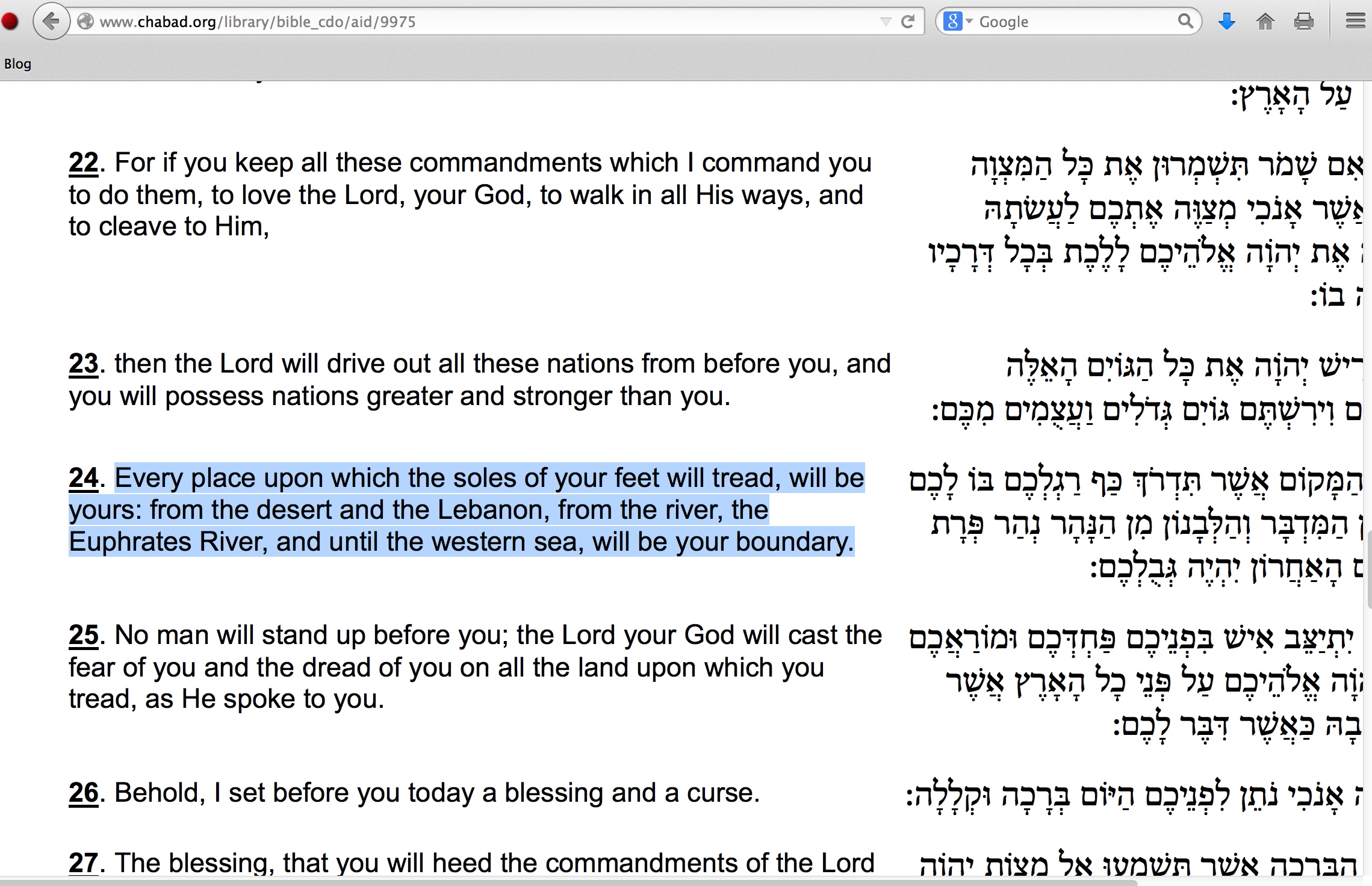
24. Every place upon which the soles of your feet will tread, will be yours: from the desert and the Lebanon, from the river, the Euphrates River, and until the western sea, will be your boundary. כד. כָּל הַמָּקוֹם אֲשֶׁר תִּדְרֹךְ כַּף רַגְלְכֶם בּוֹ לָכֶם יִהְיֶה מִן הַמִּדְבָּר וְהַלְּבָנוֹן מִן הַנָּהָר נְהַר פְּרָת וְעַד הַיָּם הָאַחֲרוֹן יִהְיֶה גְּבֻלְכֶם:
.
25. No man will stand up before you; the Lord your God will cast the fear of you and the dread of you on all the land upon which you tread, as He spoke to you. כה. לֹא יִתְיַצֵּב אִישׁ בִּפְנֵיכֶם פַּחְדְּכֶם וּמוֹרַאֲכֶם יִתֵּן | יְהֹוָה אֱלֹהֵיכֶם עַל פְּנֵי כָל הָאָרֶץ אֲשֶׁר תִּדְרְכוּ בָהּ כַּאֲשֶׁר דִּבֶּר לָכֶם:
.
29. And it will be, when the Lord, your God, will bring you to the land to which you come, to possess it, that you shall place those blessing upon Mount Gerizim, and those cursing upon Mount Ebal. כט. וְהָיָה כִּי יְבִיאֲךָ יְהֹוָה אֱלֹהֶיךָ אֶל הָאָרֶץ אֲשֶׁר אַתָּה בָא שָׁמָּה לְרִשְׁתָּהּ וְנָתַתָּה אֶת הַבְּרָכָה עַל הַר גְּרִזִּים וְאֶת הַקְּלָלָה עַל הַר עֵיבָל:
.
31. For you are crossing the Jordan, to come to possess the land which the Lord, your God, is giving you, and you shall possess it and dwell in it. לא. כִּי אַתֶּם עֹבְרִים אֶת הַיַּרְדֵּן לָבֹא לָרֶשֶׁת אֶת הָאָרֶץ אֲשֶׁר יְהֹוָה אֱלֹהֵיכֶם נֹתֵן לָכֶם וִירִשְׁתֶּם אֹתָהּ וִישַׁבְתֶּם בָּהּ:
.



Devarim – Deuteronomy – Chapter 12
1. These are the statutes and ordinances that you shall keep to perform in the land which the Lord God of your fathers gives you to possess all the days that you live on the earth. א. אֵלֶּה הַחֻקִּים וְהַמִּשְׁפָּטִים אֲשֶׁר תִּשְׁמְרוּן לַעֲשׂוֹת בָּאָרֶץ אֲשֶׁר נָתַן יְהֹוָה אֱלֹהֵי אֲבֹתֶיךָ לְךָ לְרִשְׁתָּהּ כָּל הַיָּמִים אֲשֶׁר אַתֶּם חַיִּים עַל הָאֲדָמָה:
.
2. You shall utterly destroy from all the places where the nations, that you shall possess, worshipped their gods, upon the lofty mountains and upon the hills, and under every lush tree. ב. אַבֵּד תְּאַבְּדוּן אֶת כָּל הַמְּקֹמוֹת אֲשֶׁר עָבְדוּ שָׁם הַגּוֹיִם אֲשֶׁר אַתֶּם יֹרְשִׁים אֹתָם אֶת אֱלֹהֵיהֶם עַל הֶהָרִים הָרָמִים וְעַל הַגְּבָעוֹת וְתַחַת כָּל עֵץ רַעֲנָן:
.
3. And you shall tear down their altars, smash their monuments, burn their asherim with fire, cut down the graven images of their gods, and destroy their name from that place. ג. וְנִתַּצְתֶּם אֶת מִזְבְּחֹתָם וְשִׁבַּרְתֶּם אֶת מַצֵּבֹתָם וַאֲשֵׁרֵיהֶם תִּשְׂרְפוּן בָּאֵשׁ וּפְסִילֵי אֱלֹהֵיהֶם תְּגַדֵּעוּן וְאִבַּדְתֶּם אֶת שְׁמָם מִן הַמָּקוֹם הַהוּא:
.
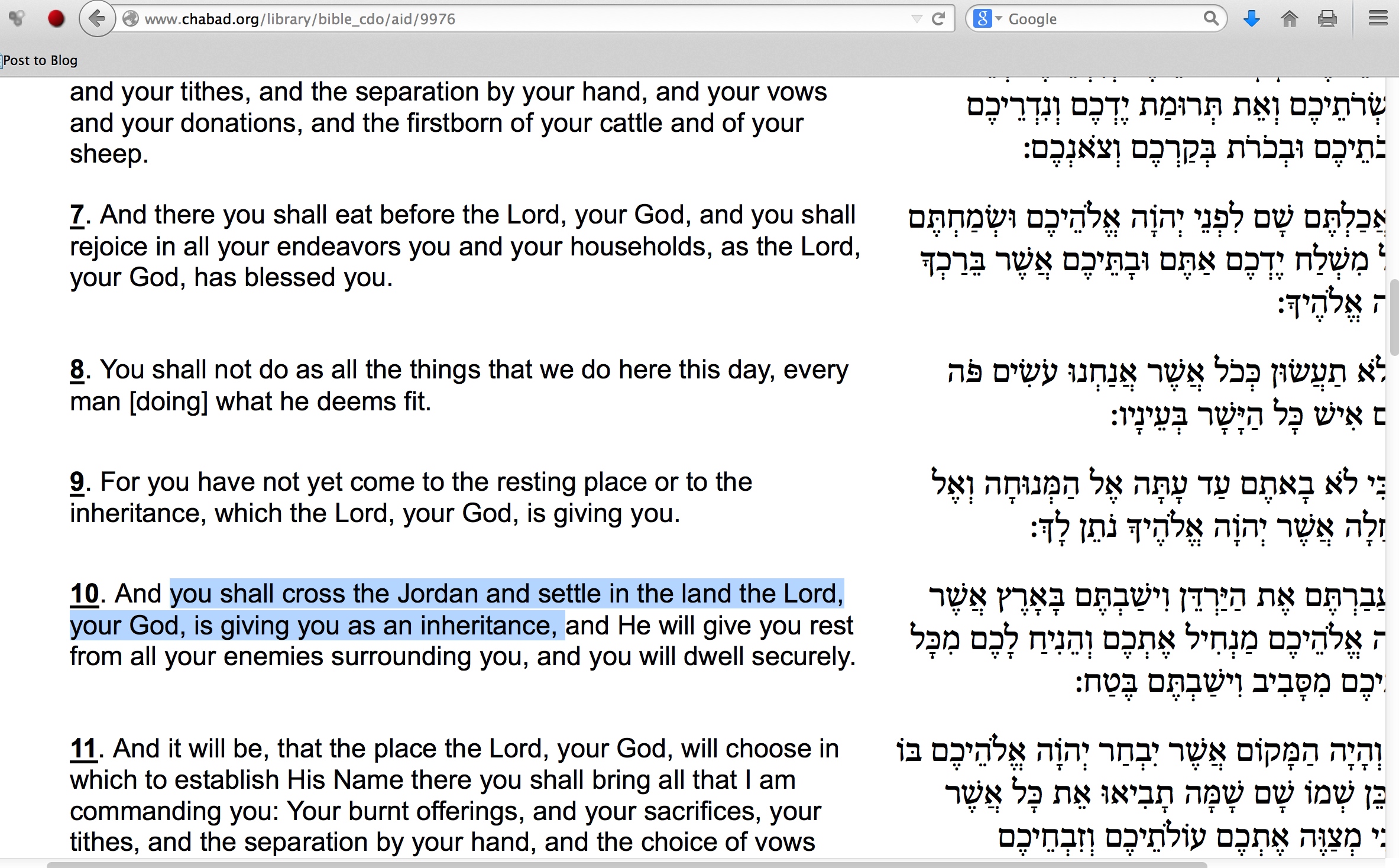
10. And you shall cross the Jordan and settle in the land the Lord, your God, is giving you as an inheritance, and He will give you rest from all your enemies surrounding you, and you will dwell securely. י. וַעֲבַרְתֶּם אֶת הַיַּרְדֵּן וִישַׁבְתֶּם בָּאָרֶץ אֲשֶׁר יְהֹוָה אֱלֹהֵיכֶם מַנְחִיל אֶתְכֶם וְהֵנִיחַ לָכֶם מִכָּל אֹיְבֵיכֶם מִסָּבִיב וִישַׁבְתֶּם בֶּטַח:
.
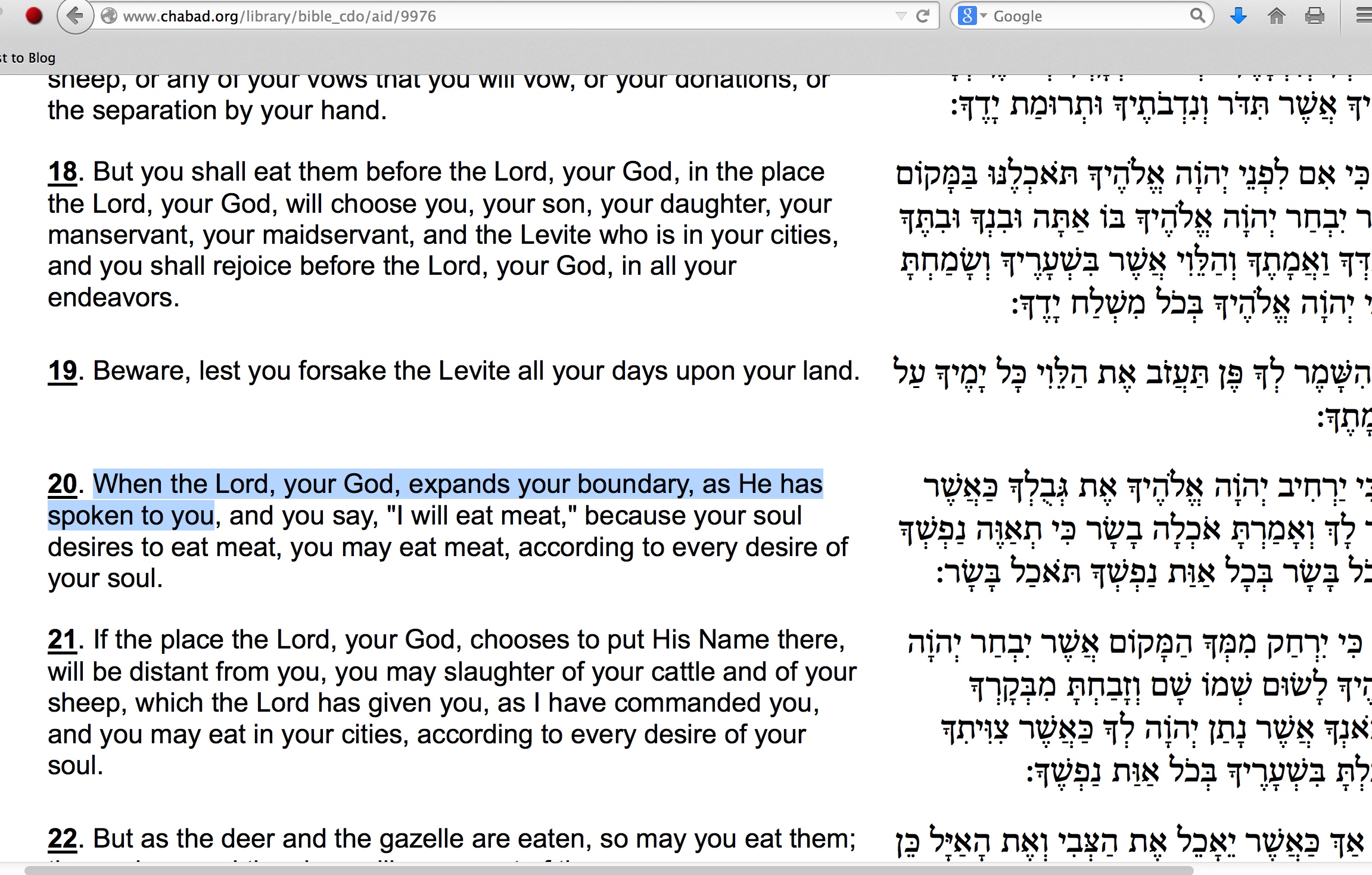
20. When the Lord, your God, expands your boundary, as He has spoken to you, and you say, “I will eat meat,” because your soul desires to eat meat, you may eat meat, according to every desire of your soul. כ. כִּי יַרְחִיב יְהֹוָה אֱלֹהֶיךָ אֶת גְּבֻלְךָ כַּאֲשֶׁר דִּבֶּר לָךְ וְאָמַרְתָּ אֹכְלָה בָשָׂר כִּי תְאַוֶּה נַפְשְׁךָ לֶאֱכֹל בָּשָׂר בְּכָל אַוַּת נַפְשְׁךָ תֹּאכַל בָּשָׂר:
.
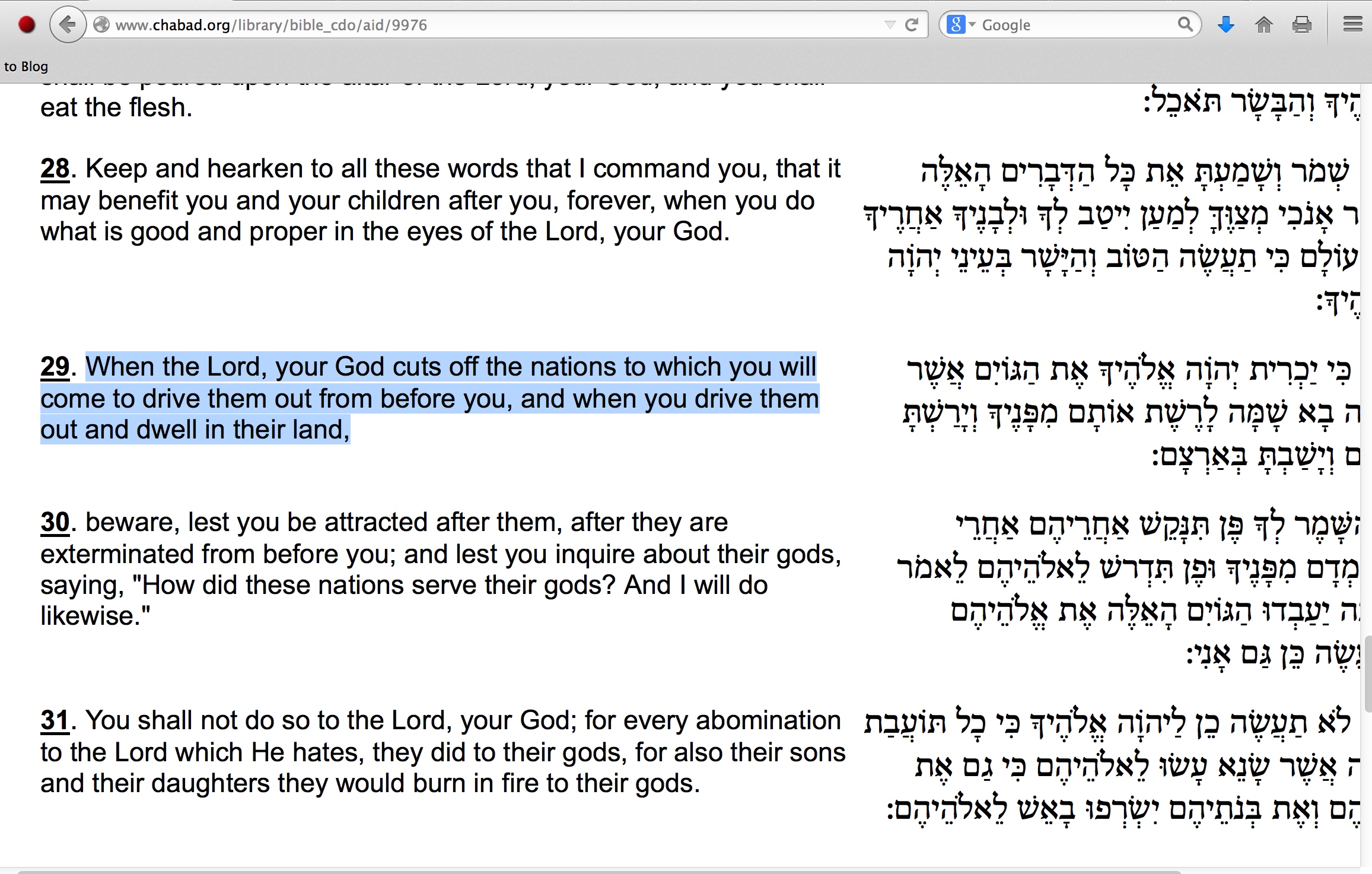
29. When the Lord, your God cuts off the nations to which you will come to drive them out from before you, and when you drive them out and dwell in their land, כט. כִּי יַכְרִית יְהֹוָה אֱלֹהֶיךָ אֶת הַגּוֹיִם אֲשֶׁר אַתָּה בָא שָׁמָּה לָרֶשֶׁת אוֹתָם מִפָּנֶיךָ וְיָרַשְׁתָּ אֹתָם וְיָשַׁבְתָּ בְּאַרְצָם:
.
30. beware, lest you be attracted after them, after they are exterminated from before you; and lest you inquire about their gods, saying, “How did these nations serve their gods? And I will do likewise.” ל. הִשָּׁמֶר לְךָ פֶּן תִּנָּקֵשׁ אַחֲרֵיהֶם אַחֲרֵי הִשָּׁמְדָם מִפָּנֶיךָ וּפֶן תִּדְרשׁ לֵאלֹהֵיהֶם לֵאמֹר אֵיכָה יַעַבְדוּ הַגּוֹיִם הָאֵלֶּה אֶת אֱלֹהֵיהֶם וְאֶעֱשֶׂה כֵּן גַּם אָנִי:
.



Devarim – Deuteronomy – Chapter 20
10. When you approach a city to wage war against it, you shall propose peace to it. י. כִּי תִקְרַב אֶל עִיר לְהִלָּחֵם עָלֶיהָ וְקָרָאתָ אֵלֶיהָ לְשָׁלוֹם:
.
11. And it will be, if it responds to you with peace, and it opens up to you, then it will be, [that] all the people found therein shall become tributary to you, and they shall serve you. יא. וְהָיָה אִם שָׁלוֹם תַּעַנְךָ וּפָתְחָה לָךְ וְהָיָה כָּל הָעָם הַנִּמְצָא בָהּ יִהְיוּ לְךָ לָמַס וַעֲבָדוּךָ:
.
12. But if it does not make peace with you, and it wages war against you, you shall besiege it, יב. וְאִם לֹא תַשְׁלִים עִמָּךְ וְעָשְׂתָה עִמְּךָ מִלְחָמָה וְצַרְתָּ עָלֶיהָ:
.
13. and the Lord, your God, will deliver it into your hands, and you shall strike all its males with the edge of the sword. יג. וּנְתָנָהּ יְהֹוָה אֱלֹהֶיךָ בְּיָדֶךָ וְהִכִּיתָ אֶת כָּל זְכוּרָהּ לְפִי חָרֶב:
.
14. However, the women, the children, and the livestock, and all that is in the city, all its spoils you shall take for yourself, and you shall eat the spoils of your enemies, which the Lord, your God, has given you. יד. רַק הַנָּשִׁים וְהַטַּף וְהַבְּהֵמָה וְכֹל אֲשֶׁר יִהְיֶה בָעִיר כָּל שְׁלָלָהּ תָּבֹז לָךְ וְאָכַלְתָּ אֶת שְׁלַל אֹיְבֶיךָ אֲשֶׁר נָתַן יְהֹוָה אֱלֹהֶיךָ לָךְ:
.
15. Thus you shall do to all the cities that are very far from you, which are not of the cities of these nations. טו. כֵּן תַּעֲשֶׂה לְכָל הֶעָרִים הָרְחֹקֹת מִמְּךָ מְאֹד אֲשֶׁר לֹא מֵעָרֵי הַגּוֹיִם הָאֵלֶּה הֵנָּה:
.
16. However, of these peoples’ cities, which the Lord, your God, gives you as an inheritance, you shall not allow any soul to live. טז. רַק מֵעָרֵי הָעַמִּים הָאֵלֶּה אֲשֶׁר יְהֹוָה אֱלֹהֶיךָ נֹתֵן לְךָ נַחֲלָה לֹא תְחַיֶּה כָּל נְשָׁמָה:
.
17. Rather, you shall utterly destroy them: The Hittites, and the Amorites, the Canaanites, and the Perizzites, the Hivvites, and the Jebusites, as the Lord, your God, has commanded you. יז. כִּי הַחֲרֵם תַּחֲרִימֵם הַחִתִּי וְהָאֱמֹרִי הַכְּנַעֲנִי וְהַפְּרִזִּי הַחִוִּי וְהַיְבוּסִי כַּאֲשֶׁר צִוְּךָ יְהֹוָה אֱלֹהֶיךָ:
.


Devarim – Deuteronomy – Chapter 25
5. If brothers reside together, and one of them dies having no son, the dead man’s wife shall not marry an outsider. [Rather,] her husband’s brother shall be intimate with her, making her a wife for himself, thus performing the obligation of a husband’s brother with her. ה. כִּי יֵשְׁבוּ אַחִים יַחְדָּו וּמֵת אַחַד מֵהֶם וּבֵן אֵין לוֹ לֹא תִהְיֶה אֵשֶׁת הַמֵּת הַחוּצָה לְאִישׁ זָר יְבָמָהּ יָבֹא עָלֶיהָ וּלְקָחָהּ לוֹ לְאִשָּׁה וְיִבְּמָהּ:
.
11. If [two] men, a man and his brother, are fighting together, and the wife of one of them approaches to rescue her husband from his assailant, and she stretches forth her hand and grabs hold of his private parts יא. כִּי יִנָּצוּ אֲנָשִׁים יַחְדָּו אִישׁ וְאָחִיו וְקָרְבָה אֵשֶׁת הָאֶחָד לְהַצִּיל אֶת אִישָׁהּ מִיַּד מַכֵּהוּ וְשָׁלְחָה יָדָהּ וְהֶחֱזִיקָה בִּמְבֻשָׁיו:
.
12. you shall cut off her hand You shall not have pity. יב. וְקַצֹּתָה אֶת כַּפָּהּ לֹא תָחוֹס עֵינֶךָ:
.
17. You shall remember what Amalek did to you on the way, when you went out of Egypt, יז. זָכוֹר אֵת אֲשֶׁר עָשָׂה לְךָ עֲמָלֵק בַּדֶּרֶךְ בְּצֵאתְכֶם מִמִּצְרָיִם:
.
19. [Therefore,] it will be, when the Lord your God grants you respite from all your enemies around [you] in the land which the Lord, your God, gives to you as an inheritance to possess, that you shall obliterate the remembrance of Amalek from beneath the heavens. You shall not forget! יט. וְהָיָה בְּהָנִיחַ יְהֹוָה אֱלֹהֶיךָ | לְךָ מִכָּל אֹיְבֶיךָ מִסָּבִיב בָּאָרֶץ אֲשֶׁר יְהֹוָה אֱלֹהֶיךָ נֹתֵן לְךָ נַחֲלָה לְרִשְׁתָּהּ תִּמְחֶה אֶת זֵכֶר * (זֶכֶר) עֲמָלֵק מִתַּחַת הַשָּׁמָיִם לֹא תִּשְׁכָּח:
.


Devarim – Deuteronomy – Chapter 21
10. If you go out to war against your enemies, and the Lord, your God, will deliver him into your hands, and you take his captives, י. כִּי תֵצֵא לַמִּלְחָמָה עַל אֹיְבֶיךָ וּנְתָנוֹ יְהֹוָה אֱלֹהֶיךָ בְּיָדֶךָ וְשָׁבִיתָ שִׁבְיוֹ:
.
11. and you see among the captives a beautiful woman and you desire her, you may take [her] for yourself as a wife. יא. וְרָאִיתָ בַּשִּׁבְיָה אֵשֶׁת יְפַת תֹּאַר וְחָשַׁקְתָּ בָהּ וְלָקַחְתָּ לְךָ לְאִשָּׁה:
.
12. You shall bring her into your home, and she shall shave her head and let her nails grow. יב. וַהֲבֵאתָהּ אֶל תּוֹךְ בֵּיתֶךָ וְגִלְּחָה אֶת רֹאשָׁהּ וְעָשְׂתָה אֶת צִפָּרְנֶיהָ:
.
15. If a man has two wives-one beloved and the other despised-and they bear him sons, the beloved one and the despised one, and the firstborn son is from the despised one. טו. כִּי תִהְיֶיןָ לְאִישׁ שְׁתֵּי נָשִׁים הָאַחַת אֲהוּבָה וְהָאַחַת שְׂנוּאָה וְיָלְדוּ לוֹ בָנִים הָאֲהוּבָה וְהַשְּׂנוּאָה וְהָיָה הַבֵּן הַבְּכֹר לַשְּׂנִיאָה:
.
18. If a man has a wayward and rebellious son, who does not obey his father or his mother, and they chasten him, and [he still] does not listen to them, יח. כִּי יִהְיֶה לְאִישׁ בֵּן סוֹרֵר וּמוֹרֶה אֵינֶנּוּ שֹׁמֵעַ בְּקוֹל אָבִיו וּבְקוֹל אִמּוֹ וְיִסְּרוּ אֹתוֹ וְלֹא יִשְׁמַע אֲלֵיהֶם:
.
19. his father and his mother shall take hold of him and bring him out to the elders of his city, and to the gate of his place. יט. וְתָפְשׂוּ בוֹ אָבִיו וְאִמּוֹ וְהוֹצִיאוּ אֹתוֹ אֶל זִקְנֵי עִירוֹ וְאֶל שַׁעַר מְקֹמוֹ:
.
20. And they shall say to the elders of his city, “This son of ours is wayward and rebellious; he does not obey us; [he is] a glutton and a guzzler.” כ. וְאָמְרוּ אֶל זִקְנֵי עִירוֹ בְּנֵנוּ זֶה סוֹרֵר וּמֹרֶה אֵינֶנּוּ שֹׁמֵעַ בְּקֹלֵנוּ זוֹלֵל וְסֹבֵא:
.
21. And all the men of his city shall pelt him to death with stones, and he shall die. So shall you clear out the evil from among you, and all Israel will listen and fear. כא. וּרְגָמֻהוּ כָּל אַנְשֵׁי עִירוֹ בָאֲבָנִים וָמֵת וּבִעַרְתָּ הָרָע מִקִּרְבֶּךָ וְכָל יִשְׂרָאֵל יִשְׁמְעוּ וְיִרָאוּ:
.


Devarim – Deuteronomy – Chapter 22
15. Then the girl‘s father and her mother shall obtain evidence of the girl’s virginity, and take it out to the elders of the city, to the gate. טו. וְלָקַח אֲבִי הַנַּעֲרָה וְאִמָּהּ וְהוֹצִיאוּ אֶת בְּתוּלֵי הַנַּעֲרָה אֶל זִקְנֵי הָעִיר הַשָּׁעְרָה:
.
16. And the girl’s father shall say to the elders, “I gave my daughter to this man as a wife, and he despised her; טז. וְאָמַר אֲבִי הַנַּעֲרָה אֶל הַזְּקֵנִים אֶת בִּתִּי נָתַתִּי לָאִישׁ הַזֶּה לְאִשָּׁה וַיִּשְׂנָאֶהָ:
.
17. And behold, he made libelous charges, saying, ‘I did not find evidence of your daughter’s virginity.’ But this is the evidence of my daughter’s virginity!’ And they shall spread the garment before the elders of the city. יז. וְהִנֵּה הוּא שָׂם עֲלִילֹת דְּבָרִים לֵאמֹר לֹא מָצָאתִי לְבִתְּךָ בְּתוּלִים וְאֵלֶּה בְּתוּלֵי בִתִּי וּפָרְשׂוּ הַשִּׂמְלָה לִפְנֵי זִקְנֵי הָעִיר:
.
18. Then, the elders of that city shall take the man and chasten him. יח. וְלָקְחוּ זִקְנֵי הָעִיר הַהִוא אֶת הָאִישׁ וְיִסְּרוּ אֹתוֹ:
.
19. And they shall fine him one hundred [shekels of] silver because he defamed a virgin of Israel, and he give it to the girl’s father. And she shall be his wife; he shall not send her away all the days of his life. יט. וְעָנְשׁוּ אֹתוֹ מֵאָה כֶסֶף וְנָתְנוּ לַאֲבִי הַנַּעֲרָה כִּי הוֹצִיא שֵׁם רָע עַל בְּתוּלַת יִשְׂרָאֵל וְלוֹ תִהְיֶה לְאִשָּׁה לֹא יוּכַל לְשַׁלְּחָהּ כָּל יָמָיו:
.
20. But if this matter was true: [indeed,] no evidence of the girl’s virginity was found כ. וְאִם אֱמֶת הָיָה הַדָּבָר הַזֶּה לֹא נִמְצְאוּ בְתוּלִים לַנַּעֲרָה:
.
21. they shall take the girl out to the entrance of her father’s house, and the men of her city shall pelt her with stones, and she shall die, for she did a disgraceful thing in Israel, to commit adultery [in] her father’s house. So shall you clear away the evil from among you. כא. וְהוֹצִיאוּ אֶת הַנַּעֲרָה אֶל פֶּתַח בֵּית אָבִיהָ וּסְקָלוּהָ אַנְשֵׁי עִירָהּ בָּאֲבָנִים וָמֵתָה כִּי עָשְׂתָה נְבָלָה בְּיִשְׂרָאֵל לִזְנוֹת בֵּית אָבִיהָ וּבִעַרְתָּ הָרָע מִקִּרְבֶּךָ:
.
22. If a man is found lying with a married woman, even both of them shall die the man lying with the woman and the woman. So shall you clear away the evil from Israel. כב. כִּי יִמָּצֵא אִישׁ שֹׁכֵב | עִם אִשָּׁה בְעֻלַת בַּעַל וּמֵתוּ גַּם שְׁנֵיהֶם הָאִישׁ הַשֹּׁכֵב עִם הָאִשָּׁה וְהָאִשָּׁה וּבִעַרְתָּ הָרָע מִיִּשְׂרָאֵל:
.
23. If there is a virgin girl betrothed to a man, and [another] man finds her in the city, and lies with her, כג. כִּי יִהְיֶה נַעֲרָה בְתוּלָה מְאֹרָשָׂה לְאִישׁ וּמְצָאָהּ אִישׁ בָּעִיר וְשָׁכַב עִמָּהּ:
.
24. you shall take them both out to the gate of that city, and you shall pelt them with stones, and they shall die: the girl, because she did not cry out [even though she was] in the city, and the man, because he violated his neighbor’s wife. So shall you clear away the evil from among you. כד. וְהוֹצֵאתֶם אֶת שְׁנֵיהֶם אֶל שַׁעַר | הָעִיר הַהִוא וּסְקַלְתֶּם אֹתָם בָּאֲבָנִים וָמֵתוּ אֶת הַנַּעֲרָ עַל דְּבַר אֲשֶׁר לֹא צָעֲקָה בָעִיר וְאֶת הָאִישׁ עַל דְּבַר אֲשֶׁר עִנָּה אֶת אֵשֶׁת רֵעֵהוּ וּבִעַרְתָּ הָרָע מִקִּרְבֶּךָ:
.
28. If a man finds a virgin girl who was not betrothed, and seizes her and lies with her, and they are found, כח. כִּי יִמְצָא אִישׁ נַעֲרָה בְתוּלָה אֲשֶׁר לֹא אֹרָשָׂה וּתְפָשָׂהּ וְשָׁכַב עִמָּהּ וְנִמְצָאוּ:
.
29. the man who lay with her shall give fifty [shekels of] silver to the girl’s father, and she shall become his wife, because he violated her. He shall not send her away all the days of his life. כט. וְנָתַן הָאִישׁ הַשֹּׁכֵב עִמָּהּ לַאֲבִי הַנַּעֲרָה חֲמִשִּׁים כָּסֶף וְלוֹ תִהְיֶה לְאִשָּׁה תַּחַת אֲשֶׁר עִנָּהּ לֹא יוּכַל שַׁלְּחָהּ כָּל יָמָיו:
.


Vayikra – Leviticus – Chapter 26
38. I am the Lord, your God, Who took you out of the land of Egypt, to give you the land of Canaan, to be a God to you. לח. אֲנִי יְהֹוָה אֱלֹהֵיכֶם אֲשֶׁר הוֹצֵאתִי אֶתְכֶם מֵאֶרֶץ מִצְרָיִם לָתֵת לָכֶם אֶת אֶרֶץ כְּנַעַן לִהְיוֹת לָכֶם לֵאלֹהִים:
.
44. Your male slave or female slave whom you may have from the nations that are around you, from them you may acquire a male slave or a female slave. מד. וְעַבְדְּךָ וַאֲמָתְךָ אֲשֶׁר יִהְיוּ לָךְ מֵאֵת הַגּוֹיִם אֲשֶׁר סְבִיבֹתֵיכֶם מֵהֶם תִּקְנוּ עֶבֶד וְאָמָה:
.
45. And also from the children of the residents that live among you, from them you may acquire [slaves] and from their family that is with you whom they begot in your land, and they shall become your inheritance. מה. וְגַם מִבְּנֵי הַתּוֹשָׁבִים הַגָּרִים עִמָּכֶם מֵהֶם תִּקְנוּ וּמִמִּשְׁפַּחְתָּם אֲשֶׁר עִמָּכֶם אֲשֶׁר הוֹלִידוּ בְּאַרְצְכֶם וְהָיוּ לָכֶם לַאֲחֻזָּה:
.
46. You shall hold onto them as an inheritance for your children after you, as acquired property, and may thus have them serve you forever. But as for your brethren, the children of Israel, a man shall not work his brother with rigor. מו. וְהִתְנַחַלְתֶּם אֹתָם לִבְנֵיכֶם אַחֲרֵיכֶם לָרֶשֶׁת אֲחֻזָּה לְעֹלָם בָּהֶם תַּעֲבֹדוּ וּבְאַחֵיכֶם בְּנֵי יִשְׂרָאֵל אִישׁ בְּאָחִיו לֹא תִרְדֶּה בוֹ בְּפָרֶךְ:


The Dirty Little Secret behind the “Global Terrorism Index” (GTI)
The Omission of Israeli Terrorism in the Occupied Palestinian Territories
By Karin Brothers | Global Research | December 6, 2014
The Global Terrorism Index from 2000 – 2013[1] was launched on December 5, 2014, endorsed by such luminaries as the Dalai Lama, Bishop Tutu and Jane Goodall; it describes itself as ”a comprehensive study that accounts for the direct and indirect impact of terrorism in 162 countries.” The GTI not only lists the countries most affected by terrorism (Iraq, Pakistan and Afghanistan), and the major terrorists (Muslims: Al Qaeda, the Taliban, Boko Haram and ISIS), but also advises on the most effective ways of dealing with it, noting that terrorism is connected more to injustice than to poverty.
Produced by the Institute for Economics and Peace (IEP), which also produces the Global Peace Index, the Global Terrorism Index (GTI) is based on data from the Global Terrorism Database (GTD) which is collected and collated by the National Consortium for the Study of Terrorism and Responses to Terrorism (START), which is supported by the Department of Homeland Security.
A Self-Serving Definition of Terror Incidents?
The Global Terrorism Index uses data from START’s Global Terrorism Database (GTD) which includes incidents meeting the following criteria:
1. The incident must be intentional – the result of a conscious calculation on the part of a perpetrator.
2. The incident must entail some level of violence or threat of violence — including property violence, as well as violence against people
3. The perpetrators of the incidents must be sub-national actors. This database does not include acts of state terrorism.
In addition to this baseline definition, two of the following three criteria have to be met in order to be included in the START database from 1997:
… The violent act was aimed at attaining a political, economic, religious, or social goal.
… The violent act included evidence of an intention to coerce, intimidate, or convey some other message to a larger audience (or audiences) other than the immediate victims.
… The violent act was outside the precepts of international humanitarian law.
There is a contradiction in the definition of terrorist incidents in the study. While the GTI claims that their database only includes acts which are contrary to international humanitarian law, the “two out of three” criteria allows for legal actions to be included. Legal actions included in the GTD database are Palestinian resistance attacks on the Israeli military. [2]
A unique feature of the GTI is described as a “lagged scoring”, or replicating a terror event for up to five years to weight the estimated psychological impact of a terror event. Examples of such scoring were given as the bombing of a marketplace or the 2011 massacre in Norway of 77 youth.
Global Terror Database Notes and Anomalies
A cursory look at the Global Terror Database[2] for Israel indicates various problems. Some of the listed incidents are inadequately documented, with “unknown” location. Actions attributed to Hamas are counted despite what should have been its state exclusion and the exclusion for legal actions. The “West Bank and Gaza Strip” is listed but the incidents involving Palestinians are far from complete.
The Terror Omission
It is only in Appendix C that the Global Terrorism Index mentions that despite a “notable amount of terrorism” in the occupied Palestinian territories (oPt), this region is excluded “by Global Peace Index convention”. Since the GTI was supposed to be using the START Global Terrorism Database, it is not clear why the Global Peace Index “convention” was relevant; also, the GPI’s source, the Economist Intelligence Unit, does include the Palestinian Territories. By excluding the occupied West Bank, East Jerusalem, and pre-2006 Gaza Strip from the survey, the attacks by Israeli settlers are omitted.
It becomes apparent why the occupied Palestinian territories were excluded when the incidence of Israeli settler violence is examined. According to their definition of terrorism, the Israeli settlers’ violence not only qualifies as terrorism, but puts them near the top of the listing of the most violent terrorists. With over 1,750 violent settler attacks fully documented from 2006 – 2013[3], the only group credited with more terror attacks was the Taliban, with 2,757 incidents from 2002 – 2013. Al Qaeda’s 1,089, Boko Haram’s 750 and ISIL’s 492 attacks aren’t even close.[4] When the numbers of settler attacks on Palestinians are combined with the number of non-military Israeli attacks on the Arabs within Israel, the problem of Israeli violence within the tiny state can be seen to be one of staggering proportions. Yet, according to the GTI, Israel was not in the 20 worst states for terrorism.
Moreover, the number of violent incidents, as the report points out, should be weighted by factors reflecting the psychological impact on a victim community. About half of the incidents listed in the GTI report were from explosions, which typically aim for a broader, less personal, target community. The settler attacks on Palestinians tend to be of a more personal nature: shootings, running down civilians with vehicles, beatings, and damage or destruction of civilian property, such as razing agricultural land and raiding houses. Children have been frequent targets, as are Palestinian farmers and workers. Because settlers are allowed to attack Palestinians with impunity from prosecution and often target those whose neighbouring lands they want, settler attacks tend to be more traumatic and should be accorded the full psychological weighting factor.
Are Israeli Settlers Comparable to Muslim terrorists?
Although the actions of Israeli settlers fit the definition of terrorism, can they be considered as comparable to the organizations accused of terrorism? The Muslim organizations accused of being terrorist are a variety of political and/or religious ideological movements that typically arose as a reaction to western power. Israeli settlers are by definition people who have chosen to violate international humanitarian laws by living on territory they have no right to; the settler movement is led by right-wing, religious extremists. That some settlers make the choice for economic motives is similar to the ISIS or Taliban fighters who join because they need the wages.
Additionally, settler attackers are doubly guilty of terrorism: the act of living illegally on Palestinian land fits this definition of terrorism; subsequent attacks on Palestinians are further acts of terrorism.
The Global Implications of Not Naming Settler Attacks as “Terrorism”
The Israeli settlements — all of which are illegal – have been identified as a major impediment to peace. The refusal of a major “global” terrorism report to name the Israeli settlers as one of the groups most responsible for terrorism not only misrepresents a major source of regional violence but exposes the Global Terrorism Index as a propaganda tool that supports a U.S. agenda.
In recent years, governments have been attempting to thwart terrorism by blocking supportive fund-raising. When it comes to Israeli settlements, however, the US and Canada actually encourage fund-raising by giving organizations (such as Christian Friends of Israeli Communities (CFOIC) and the Jewish National Fund) financial support in the form of donor tax-deductions.
Charities which provide funds for the Israeli settlements should be regarded as terror-financing organizations. They should not only lose their tax-deductible status, but they should be banned because they support the violation of international humanitarian law. The terror-financing laws that are being strictly enforced for Muslim charities should be applied to Christian and Jewish charities as well. Governments that do not recognize settler violence as terrorism are feeding what Naomi Klein once termed “the engine that keeps the War on Terror running”: injustice in Israel.
Notes
1. The Global Terrorism Index is at: http://www.visionofhumanity.org/sites/default/files/Global%20Terrorism%20Index%20Report%202014_0.pdf
2. Global Terror Database on Israel: http://www.start.umd.edu/gtd/search/Results.aspx?search=israel&sa.x=0&sa.y=0
3. Annual reports of the Palestinians Center for Human Rights Gaza (PCHRGaza) at: http://www.pchrgaza.org/portal/en/index.php?option=com_content&view=category&layout=blog&id=40&Itemid=172,
Israeli settler attacks from 2000-2013 accounted for 63 deaths, and from 2006 – 2013 at least 1766 violent attacks. (From 2002 – 2013, there were 35 deaths and over 1750 attacks documented.)
While PCHRGaza has published weekly reports that have included settler violence since 1997, it only started to compile the total number of settler attacks in their annual reports from 2006 onwards. One would have to examine the weekly reports for 2000 to 2005 to obtain the annual totals that should have been used for the Global Terrorism Index’s 2000 – 2013 study.
The PCHRGaza noted on at least some of their annual reports that their totals for Israeli settler attacks were not complete because they included only those for which they had documentation. Al Haq and the UN also kept documentation of settler attacks, only some of which overlap PCHRGaza’s.
4. Global Terrorism Index “Targets and Tactics, 2000 – 2013″: totals of incidents by group p. 51
UN: Israeli trade control causes $310m loss for PA
Al-Akhbar | December 3, 2014
The Palestinian Authority lost at least $310 million in customs and sales tax in 2011 as a result of importing from or through Israeli-occupied territories, the UN said Wednesday, urging a radical change to the system.
The lost revenue, worth 250 million euros, was equivalent to 3.6 percent of gross domestic product (GDP) and 18 percent of the tax revenue of the authority, the UN Conference on Trade and Development (UNCTAD) said.
The figures point to “the pressing need to change the modus operandi of the Palestinian import regime to ensure Palestinian rights in all economic, trade, financial and taxation areas,” it said in a new study.
UNCTAD said the 1994 Paris Protocol which governs economic ties between Israeli-occupied and Palestinian territories causes “instability and uncertainty for the Palestinian territory” and should be reformed.
It said barriers should be removed to trade with other countries, and criticized Israel’s “disproportionate influence” on collecting Palestinian revenues.
Israel often freezes the transfer of funds under the pretext of a punitive measure in response to diplomatic or political developments it deems harmful.
About 40 percent of the so-called “fiscal leakage” is related to direct and indirect imports from Israel, and 60 percent from evasion of customs duties, the UN said.
The report cited data from the Israeli Central Bank indicating that 39 percent of Palestinian imports from Israel-occupied territories originate in third countries, but are cleared in Israel and sold on as if produced by Israel.
Customs revenues from these “indirect imports” is collected by the Israeli authorities but not transferred to the Palestinian authority, it said.
Another problem comes from goods smuggled over the border from Israeli-occupied territories, the report said, highlighting the Palestinians’ lack of control over their borders.
Smuggling results in lost sales and purchase taxes for the Palestinian authorities and, where the goods are produced in a third country, lost tariff revenues.
UNCTAD added that its figures are likely to underestimate the problem and urged further research.
The Palestinian economy is bound closely to Israel’s through infrastructure and trade and has few foreign trading partners.
It said that Israel’s system of checkpoints and restrictions in the area inflict long-term damage on Palestinians’ ability to compete in the global market.
The policies are causing a contraction in manufacturing and agricultural sectors, “alarmingly” high unemployment and social problems that would outlive any Israeli-Palestinian peace agreement, the organization said.
Israel occupied East Jerusalem and the West Bank during the 1967 Middle East War. It later annexed the holy city in 1980, claiming it as the capital of the self-proclaimed Zionist state – a move never recognized by the international community.
In November 1988, Palestinian leaders led by Arafat declared the existence of a State of Palestine inside the 1967 borders and the State’s belief “in the settlement of international and regional disputes by peaceful means in accordance with the charter and resolutions of the United Nations.”
Heralded as a “historic compromise,” the move implied that Palestinians would agree to accept only 22 percent, almost 17 percent now after the expansion of Israeli settlements, of historic Palestine in exchange for peace with Israel.
Throughout the 1990s and 2000s, Palestinian leaders sought to create the institutions of statehood despite the lack of an actual state, leading to the development of a security apparatus under US tutelage and a Palestinian bureaucracy.
While major Palestinian cities have boomed in the 26 years since “independence,” Israeli confiscation of land in border regions has continued unabated.
Last year, the World Bank estimated that Israeli control over Area C — the 61 percent of the West Bank under full Israeli military control — costs the Palestinian economy around $3.4 billion annually, or more than one-third of the Palestinian Authority’s GDP.
According to the PLO, between 1989 and 2014, the number of Israeli settlers on Palestinian land soared from 189,900 to nearly 600,000. These settlements, meanwhile, are located between and around Palestinians towns and villages, making a contiguous state next to impossible.
In its Independence Day statement last month, the PLO sought international solidarity to achieve the dream of a Palestinian state free of occupation denied since 1948.
“One effective step that the international community can take is to recognize the State of Palestine over the 1967 border with East Jerusalem as its capital and support Palestine’s diplomatic initiatives such as the UNSC resolution to put an end to the Israeli occupation as well as our access to international treaties and organizations. This will provide additional support to the two-state solution between Israel and Palestine while nullifying any Israeli attempt to change the status quo of the occupied State of Palestine,” the PLO said.
“The international community must ban all Israeli settlement products, divest from all companies involved directly or indirectly in the Israeli occupation and take all possible measures in order to hold Israel, the occupying power, accountable for its daily violations to Palestinian rights and international law.”
The Palestinian Authority this year set November 2016 as the deadline for ending the Israeli withdrawal from the territories occupied by Israel during the Six-Day War in 1967 and establishing a two-state solution.
It is worth noting that numerous pro-Palestine activists argue in favor of a one-state solution, arguing that the creation of a Palestinian state beside Israel would not be sustainable. They add that the two-state solution, which is the only option considered by international actors, won’t solve existing discrimination, nor erase economic and military tensions.
(AFP, Al-Akhbar)
Israeli forces close Nablus-area school, say vehicles were stoned
Ma’an – 03/12/2014
NABLUS – Israeli troops on Wednesday morning shut down a secondary school which serves two Palestinian villages south of Nablus in the northern West Bank, a Palestinian official and locals said Wednesday.
Ghassan Daghlas, who monitors settlement-related activities in the northern West Bank, told Ma’an that Israeli soldiers denied hundreds of schoolchildren from al-Lubban and al-Sawiya villages entry to their secondary school located near the main road between Nablus and Ramallah.
The Israelis notified the school administration that it would be closed because Israeli vehicles driving on the nearby street have been attacked with stones.
Palestinian government sources told Ma’an that the Israeli liaison department notified its Palestinian counterpart of the decision to shut down the school for one day.
Several More Abducted in West Bank, Settler Assaults Taxi Driver with Pepper Spray
IMEMC News & Agencies | December 2, 2014
An Israeli settler, Monday, reportedly attacked a Palestinian taxi driver in Jerusalem with pepper spray before fleeing the scene, according to Israeli media sources. Additionally, several more Palestinians were abducted by Israeli forces between Sunday evening and Monday morning.
The Jerusalemite was driving on King George Street when he was attacked by the settler with pepper spray, according to WAFA Palestinian News Agency. He was transferred to hospital for exposure to pepper spray fumes.
Police said a search is underway to locate the whereabouts of the assailant.
In related news, Ynet reports that a 50-year-old Israeli settler was knocked down by a car and critically injured on Monday, to south of Nablus, near the northern West Bank checkpoint known as “Zaatara”.
The vehicle fled the scene of the incident, leaving the man critically injured.
An Israeli army spokesman could not confirm the nature of the incident.
A Ma’an reporter said that Israeli forces closed the Huwwara and Zaatara military checkpoints, following the incident, as Israeli forces search for the driver.
— —
Updated from: 12/1/14 Soldiers Kidnap Six Palestinians In The West Bank
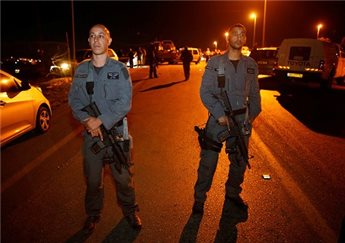 Israeli forces abducted, early Monday and Sunday night, at least 12 Palestinians, including a minor, from occupied West Bank districts, including Jerusalem.
WAFA further reports that Israeli police raided Ras al-Amud neighborhood in East Jerusalem, where they arrested three Palestinians from the Najdi family; Sa’ed, Yazan and Rami, after breaking into and ransacking their families’ houses.
Meanwhile, Israeli forces took into custody three Palestinians while they were attending a trial for their arrested relative, Omar al-Abbasi, in Jerusalem District Central Court.
Forces assaulted ‘Ali Ibrahim al-‘Abassi, 25, for attempting to take a photo of his brother Omar during his court session, triggering a scuffle with al-‘Abbasi’s relatives. As a result, ‘Ali al-‘Abbasi, the uncle, 38, and ‘Imad Mhanna, 27, were arrested along with ‘Ali Ibrahim.
Israeli police also raided al-‘Issawiya, to the north of the city, where troops deployed in streets, assaulting and kidnapping 13-year-old Haitham ‘Ibaid.
According to Ahrar Center for Detainees’ Studies and Human Rights, out of 650 people taken from the occupied West Bank, Gaza and Jerusalem in November, 42 were documented as minors, with 30 having been taken from the city of Jerusalem.
Meanwhile, in the Hebron district, forces raided Beit Kahel village to the northwest of the city, where they kidnapped ‘Imad-addin ‘Asafra, after breaking into his house. They also set up a road block at Halhul Bridge, where they stopped vehicles holding Palestinian-registered plates and examined passengers’ ID cards.
In the Nablus district, Israeli Special Forces raided al-Jabal al-Shamali neighborhood in the city, where they nabbed Tamer Sharaf, age 24.
Soldiers stationed near Zaatara checkpoint, to the south of the city, took one Palestinian under the pretext of carrying a knife. The man has not been identified, as of yet.
In Jenin district, forces set up a flying checkpoint near ‘Arraba, where they abducted Nimr al-Damaj, age 23, a resident of Jenin refugee camp.
Furthermore, in the Ramallah district, forces raided Silwad village to the east of the city, where they broke into and ransacked the house of Bassam Hamed, 40, a former prisoner, and detained the family members in one room before re-arresting Bassam. Forces also handed ‘Anwar Hamed a notice to appear before Israeli intelligence for interrogation.
Forces also raided the Ramallah areas of Deir ‘Ammar and Beitillu, where they broke into several houses, occupied their rooftops, and set up a road block at the villages entrances.
No further kidnappings were reported.
Zionist Settlers Torch Palestinian Home in West Bank
Al-Manar | November 23, 2014
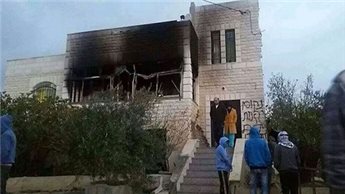 Zionist extremists firebombed a house in a Palestinian village in the occupied West Bank early on Sunday.
The mayor of Khirbet Abu Falah, Masud Abu Mura, reported the attack, saying: “At 4:00 am (0200 GMT), settlers came and threw molotov cocktails at a house which partly burned down.”
Four women were inside the house at the time, but they all escaped unharmed, the mayor of the village which lies northeast of Ramallah said.
Near the house, the assailants scrawled “Death to Arabs” in Hebrew.
Mohammad Abdelkarim Hamayel, whose aunt and two female cousins live in the house, said the assailants were believed to be from the Shilo settlement, a few kilometers to the north of the village.
“In the middle of the night, my aunt woke up when she heard voices speaking Hebrew. Someone knocked on the door but she didn’t answer because she was afraid,” he told AFP.
“They threw a tear gas canister and several molotov cocktails at the balcony which caught fire.”
Israeli occupation police also confirmed the attack, with its spokesman Luba Samri saying: “It is a two-storey house and the fire caused major damage to the ground floor.”
On November 12, Zionist settlers also torched a mosque in the neighboring village of Al-Mughayir.
Source: AFP
Synagogue killings on the site of an Israeli massacre of Palestinians
On the Contrary | November 21, 2014
The moral lesson of the “Nazi Holocaust” is supposed to be that humanity must not forget what happened. Yet many of the beneficiaries of “Holocaust” sympathy and reparations have worked to make certain that the world does not remember the mass murder of Arabs by Israelis. The 2100 Palestinians killed by the Israelis last summer are now all but forgotten in the US media; and the cruel irony of having this week’s synagogue attack in west Jerusalem occur on the site of the village of Deir Yassin, where the massacre of Palestinians by Israeli terrorists occurred, and where the village once stood, is completely lost on the oblivious US media. For this writer, as a student of the religion of Orthodox Judaism, the media’s indifference would appear to be the result of having drank too often at the trough of Talmudic mentality, in which the lives of Judaic persons are more valued and highly prized than those of their enemies and victims. Prof. McGowan elaborates in a note to Mr. Avnery:
In the wake of the recent events in the synagogue at Har Nof, Uri Avnery has written an article which you can read here. Like all his work, Avnery’s article is informative, original and beautifully written. But it has a glaring omission.
11/21/14
Dear Uri:
I know that you realize that the Har Nof neighborhood in West Jerusalem, where four rabbis and a police officer were recently murdered, is built on the lands of Deir Yassin, the Arab village which no longer exists, that was the site of the 1948 massacre, which according to Menachem Begin, was pivotal to the founding of the Jewish state. This was an early massacre in the Nakba (“catastrophe” i.e. the Israeli conquest of Palestine); there were many more to follow, but it struck fear among Palestinians, causing many to flee, also giving the Jews an angle for campaigns of terror, which they visited on other Palestinian villages, basically “Get out or we’ll do to you what we did in Deir Yassin.”
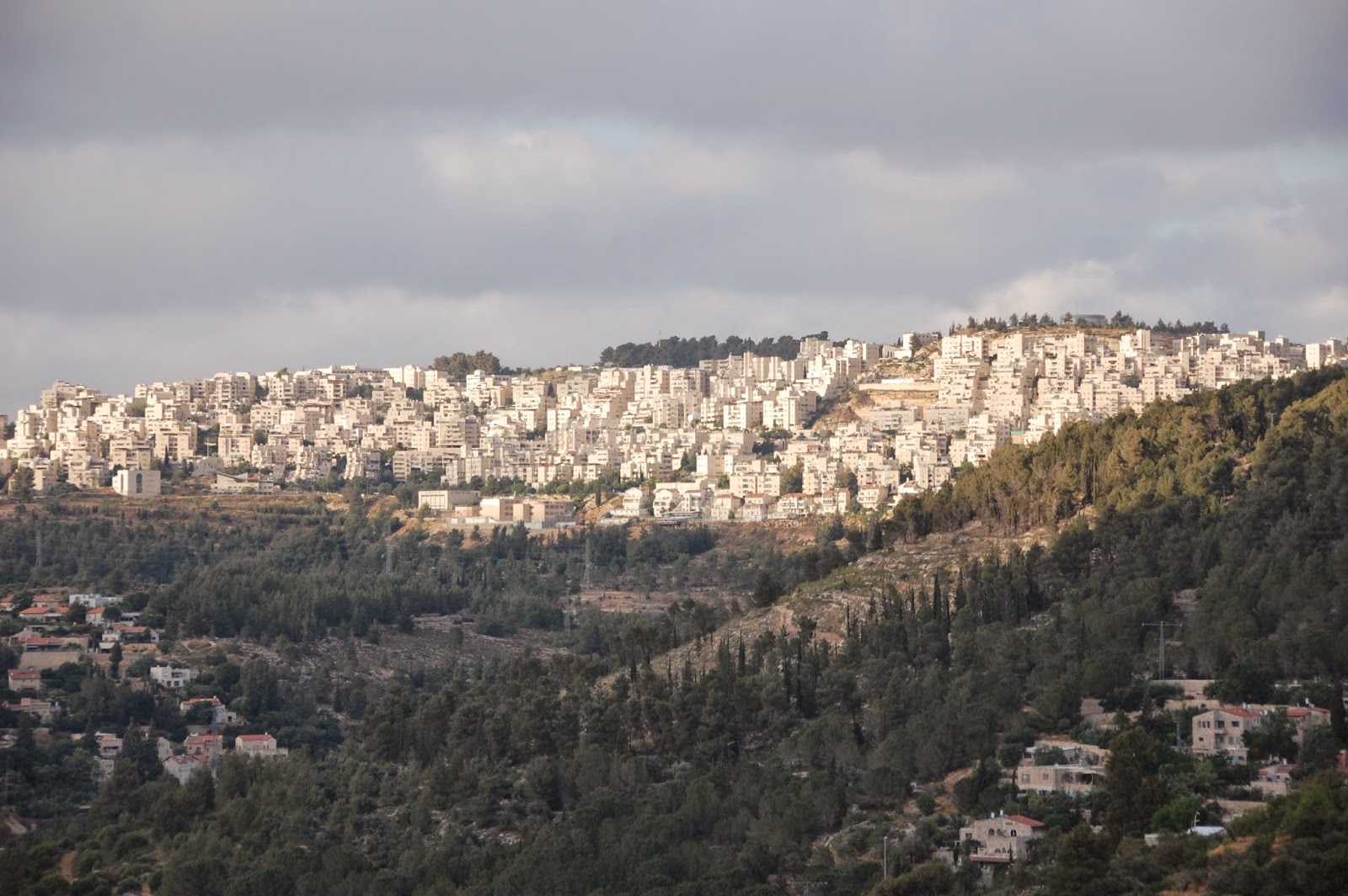
It is interesting to ask why the media, which has been all over this synagogue massacre, mentions nothing about what happened on this site on April 9, 1948?Why does Wikipedia fail to even cite Deir Yassin in its history of Har Nof?
The picture (above) of Har Nof is taken from Yad Vashem, the most prestigous Holocaust memorial. The water tower at the top right is next to the main buildings of Deir Yassin, which today serves as a mental hospital, mostly for those suffering with too much religion, an affliction also known as “The Jerusalem Syndrome.”
At Yad Vashem all visitors, and especially American politicians, are repeatedly told to “Never forget.” At Deir Yassin the message is “Never mind.”
There is not even a signpost among the old Arab buildings to indicate that it was once a prosperous Arab village of about 750 people.
In building the Har Nof settlement much of the Deir Yassin cemetery was destroyed. The rest is now littered with trash and condoms. Har Nof children have been seen digging up Arab graves. (Imagine the outcry had they been desecrating Jewish graves.) Apartment buildings of Har Nof are built on the old quarry where villagers were executed and their bodies dumped and burned on April 10, 1948.
The ironies are breathtaking. But some of us still remember.
Daniel McGowan
Professor Emeritus, Hobart and William Smith Colleges
Three shot with live ammunition during Nabi Saleh protest
International Solidarity Movement | November 22, 2014
Nabi Saleh, Occupied Palestine – Israeli forces shot and injured three Palestinians participating in a weekly Friday demonstration in the village of Nabi Saleh. Soldiers fired .22 caliber bullets, a form of live ammunition which has maimed and killed many Palestinians, even as Israel continues to claim it as a “less lethal” way of assaulting demonstrators.
Yesterday at noon between forty and fifty Palestinians, Israelis, international activists and journalists marched down from the center of Nabi Saleh towards a water spring stolen by a nearby illegal settlement. The Israeli forces awaited them down the road with two military jeeps and a police jeep. Some youths threw stones towards the military vehicles. Soldiers and police fired tear gas canisters and rubber-coated steel bullets at demonstrators as the group walked down the road.
 After a brief period of calm, a police jeep equipped with a tear gas dispenser drove up and down the road, firing tear gas at protesters. A few suffered from excessive tear gas inhalation, including a boy under the age of ten.
In addition to continuing to fire rubber coated steel bullets and tear gas, soldiers also began to shoot .22 live ammunition. Two seventeen-year-old boys were shot while throwing stones, one in the thigh and one in both the hand and foot. One Israeli soldier fired at a child under the age of twelve as the boy was running away up the hill beside the road.
Nariman Tamimi, a thirty-eight-year-old woman from the village, was shot in the thigh at close range with a .22 bullet. Israeli soldiers shot her in front of her children and family, driving away and leaving her in the road. She was taken away for medical treatment, where she underwent surgery, and currently remains in hospital.
Israeli soldiers protect Jewish settlers attacking Palestinian village
Yesh Din | November 20, 2014
Israeli occupation forces did nothing to stop Jewish settlers from attacking Palestinian villagers, according to videos released by the Yesh Din rights group, showing soldiers pointing guns at Palestinians while Israelis are throwing stones from behind the soldiers.
The soldiers appear to be protecting the masked and armed Jewish settlers from Yitzhar during their attack on Palestinians in the village of Urif in the West Bank on Tuesday.
“IDF soldiers have the obligation, based on international law and High Court of Justice rulings, to protect Palestinian residents from violence, and IDF soldiers have the authority to detain suspects, including Israeli suspects, until the police arrive,” Yesh Din said in a statement.
“The disturbing video footage demands vigorous investigation and the immediate prosecution of the soldiers involved. An examination must also be carried out of whether the soldiers’ commanders bear liability for the conduct of their subordinates,” attorney Emily Schaeffer Omer-Man, legal advisor to Yesh Din’s said.
Palestinians repair thoroughfare in nonviolent action
CPTnet | November 15, 2014
 SOUTH HEBRON HILLS — On Saturday, 15 November 2014 the South Hebron Hills Popular Committee (a nonviolent Palestinian organisation resisting occupation in the South Hebron Hills region), coordinated an action to develop the road that connects the city of Yatta to At-Tuwani and surrounding villages located in the area Israel has designated Firing Zone 918. Under the watchful eyes of the Israeli military and police, the action was attended by members of the South Hebron Hills Popular Committee, residents of At-Tuwani, Israeli peace activists from Ta’ayush, and internationals from Christian Peacemaker Teams (CPT), International Solidarity Movement (ISM) and EAPPI.
The unpaved road that runs between villages and the town of Yatta is the access route that Palestinians travel for employment, education, water, healthcare, and other necessities of life. Surrounded by the tarmacked roads developed by the Israeli state for the settlers living illegally in the area, the rubble and holes in the Palestinian roads illustrate the stark inequalities of power that characterise the Israeli occupation, and the specific context of the South Hebron Hills and Firing Zone 918.
Because Israel bans Palestinian construction with tractors and other machines in the area without rarely-given Israeli permits, busy hands set about with buckets and hoes attempting to remove rubble and stones and fill in the many potholes on the road.
A member of the South Hebron Hills Popular committee from At-Tuwani explained, “This road serves all the people from Yatta and around… This is a very bad road – the school bus can’t [travel on it] and when people need to bring something by tractor, it is very difficult. This road is also not good if you need to use an ambulance to take people to the hospital. Ten years ago it was an asphalt road, but at the start of the Al Aqsa intifada (in 2002), Israel demolished the road.”
He also said, “we need to build a channel for rain water… Last year with the snow, all this is closed with water…You need a machine to fix this road but the DCO asks us for a permit, but will not give one to us to use a machine to work here… Now every week we try to fix it with small things, with our hands, before the rain comes.”
The racial politics of occupation are clear in his statement that “if a Palestinian comes alone to work here, the army and the police would arrest him quickly and stop him working, but it helps having international people and cameras to film everything.”
Despite the slow progress made with hands, buckets and hoes, six Israeli police and military jeeps arrived. They told the Palestinians they could not carry the work out without a permit, and a soldier declared such work a supposed ‘health and safety’ hazard, an ironic statement given the ‘health and safety’ hazards of the current state of the road, not to mention the myriad physical and psychological effects of occupation.
Legal issues surrounding the firing zone and the South Hebron Hills are complex, with numerous bureaucratic intricacies through which it is nigh impossible for Palestinians to gain a permit for construction. Members of the South Hebron Hills Popular Committee asserted the unlikelihood of gaining such a permit demanded by the military, and managed to converse with soldiers until the action ended at the time initially planned by the committee.
Jewish settlers storm Al-Aqsa compound in Jerusalem
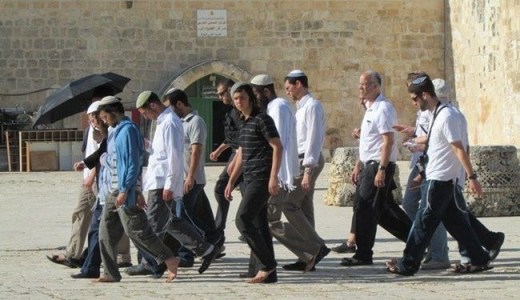
MEMO | November 16, 2014
Scores of Jewish settlers on Sunday stormed the Al-Aqsa Mosque complex in occupied East Jerusalem, a Palestinian official said.
“As many as 59 settlers stormed the holy compound through Al-Magharbeh Gate under the protection of Israeli police,” Sheikh Azzam al-Khatib, director-general of the Organization for Muslim Endowments and Al-Aqsa Affairs, told Anadolu Agency.
The settlers wandered through the compound’s courtyards, passing through the Qibali and Marawani mosques inside the holy complex before departing through Al-Silsileh Gate, he added.
Meanwhile, Israeli police allowed Palestinian men to enter the compound while denying women’s entry.
“We performed the noon prayers outside the gates of the compound after we were denied access by Israeli police,” one of the women who had been barred from entering the complex told Anadolu Agency.
“At least 70 women were barred from entering the complex since the early morning,” the woman, who asked to remain anonymous, told AA.
Tension has been running high in East Jerusalem since Israel closed the Al-Aqsa Mosque compound late last month following the shooting of an extremist rabbi in West Jerusalem.
The closure of Al-Aqsa, along with the killing of a young Palestinian man suspected of shooting the rabbi, has fueled angry protests by Palestinians in East Jerusalem .
Earlier this month, an Israeli police officer was killed when a Palestinian driver ran over a group of Israeli pedestrians in East Jerusalem. The Palestinian motorist was shot and killed on the spot by Israeli police in the immediate wake of the attack.
For Muslims, Al-Aqsa represents the world’s third holiest site. Jews, for their part, refer to the area as the “Temple Mount,” claiming it was the site of two Jewish temples in ancient times.
Israel occupied East Jerusalem during the 1967 Middle East War. It later annexed the holy city in 1980, claiming it as the capital of the self-proclaimed Jewish state – a move never recognized by the international community.
In September 2000, a visit to the site by controversial Israeli politician Ariel Sharon sparked what later became known as the “Second Intifada,” a popular uprising against the Israeli occupation in which thousands of Palestinians were killed.
Featured Video

“Historic Russia”: The Land Putin Will Not Give Back
or go to
Aletho News Archives – Video-Images
From the Archive
How Ukraine Tortured and Slaughtered Donbass
By Kit Klarenberg | Al Mayadeen | July 11, 2024
Almost immediately after the proxy war erupted, ISIS-tier footage of the torture and murder of Russians in Ukrainian custody emerged.
On July 6th, the New York Times published an astonishing investigation: In Ukraine, Killings of Surrendering Russians Divide an American-Led Unit. The article documents in grim detail how Chosen Company, an international volunteer battalion for Kiev, routinely executes Russian prisoners of war. It is the very first mainstream admission that this practice – a brazen breach of the Geneva Conventions, and a grave war crime – is widespread among Ukraine’s fighters, both foreign and homegrown. … continue
Blog Roll
 Aletho News
- Peace in Ukraine: the easy way – or the hard way
- Trump & the Rrrrussians
- US taxpayer money laundered back through Ukraine – Musk
- Before COVID, an NIH lab chief proposed making a SARS-like bat virus more infectious
- Gates, Bourla on Trial in Netherlands Accused of ‘Great Reset’ Scheme at Vaccine Injury Hearing
- BRITAIN’S WARNING: PREPARE FOR WAR
- “Historic Russia”: The Land Putin Will Not Give Back
- How the Cambridge Analytica scandal still haunts Mark Zuckerberg
- The Ongoing Cancellation Campaign Against a Dissenting Academic in Norway
- Yemen and ‘the Houthis’: Challenging Sami Hamdi’s Narrative
- If Americans Knew
- DAILY UPDATE: Latest essential news on Palestine, Israel, & region
- Damning report shows the media must confront its failures on Gaza
- BBC senior broadcaster speaks out on Gaza coverage
- Netanyahu vows vast West Bank invasion in response to 20-minute skirmish that left 2 Israeli soldiers and 2 Palestinian fighters dead
- Tied up and tortured: Israel using US-made electroshock weapons on Palestinian detainees
- The outsourced risk: how newsrooms rely on Gaza’s freelancers without protecting them
- Gaza bakeries forced to shut as Israel blocks flour shipments
- Gaza’s breast cancer patients face a deadly wait for treatment amid Israel’s genocide
- DAILY UPDATE: Latest essential news on Palestine, Israel, & region
- The Israel Lobby’s Changing Fortunes
- No Tricks Zone
- Two New Studies Find Thwaites Glacier Melt Cannot Be Driven By Human Activity Or A Warming Ocean
- E-Cars Reduce CO2 Emissions By Only 41% Compared To Internal Combustion Engine Vehicles
- Predictions Made By Renowned Climate Professor Over Past Decades Have Been Proven To Be Poor
- New Study Suggests Large Regions Of The Pacific Ocean Have Been Cooling For The Last 80 Years
- Germany’s Green Energy Debacle: High Energy Costs Force Kahla Porzellan to Close After 182 Years!
- New Study: 50 Years Of The Most Aggressive ‘Net Zero’ Policies Can Only Affect The Global Climate By 0.03°C
- US September “Heat” Was No Record…Many Records Set Decades Ago
- Latest European Green Energy Debacle; Portugal’s Largest Flagship Solar Park Insolvent!
- Green Energy Debacle: German Expert Professor Fritz Vahrenholt Warns Of Severe Economic And Social Consequences
- Two More Paleo Reconstructions Affirm Meters-Higher Sea Levels Across Ireland, Brazil 7000-6000 Years Ago

